EP2563074B1 - Procédé de gestion de changement cellulaire - Google Patents
Procédé de gestion de changement cellulaire Download PDFInfo
- Publication number
- EP2563074B1 EP2563074B1 EP12161383.0A EP12161383A EP2563074B1 EP 2563074 B1 EP2563074 B1 EP 2563074B1 EP 12161383 A EP12161383 A EP 12161383A EP 2563074 B1 EP2563074 B1 EP 2563074B1
- Authority
- EP
- European Patent Office
- Prior art keywords
- cell
- signal quality
- communication device
- idle mode
- threshold
- Prior art date
- Legal status (The legal status is an assumption and is not a legal conclusion. Google has not performed a legal analysis and makes no representation as to the accuracy of the status listed.)
- Active
Links
Images




Classifications
-
- H—ELECTRICITY
- H04—ELECTRIC COMMUNICATION TECHNIQUE
- H04W—WIRELESS COMMUNICATION NETWORKS
- H04W48/00—Access restriction; Network selection; Access point selection
- H04W48/20—Selecting an access point
-
- H—ELECTRICITY
- H04—ELECTRIC COMMUNICATION TECHNIQUE
- H04W—WIRELESS COMMUNICATION NETWORKS
- H04W76/00—Connection management
- H04W76/20—Manipulation of established connections
- H04W76/27—Transitions between radio resource control [RRC] states
Definitions
- the present invention relates to a method of handling cell selection in a wireless communication system.
- WCDMA Wideband Code Division Multiple Access
- 3G mobile communication systems as a wireless access technology, for providing high spectrum efficiency, universal coverage, and multimedia transmission with high quality and high data rate.
- various quality of service (QoS) requirements can be met at the same time, two-way transmissions with flexibility and diversity are provided, signal quality is improved, and a probability that communication is interrupted is reduced.
- UMTS universal mobile telecommunications system
- one of the 3G mobile communication systems provides a dual/multi mode function with which a user equipment (UE) can perform an inter-system handover, such as a handover between 2G and the 3G mobile communication systems, to enhance transparency between different mobile communication systems for the UE.
- UE user equipment
- a large geographic area is divided into a large number of cells in a wireless communication system, such as the 3G mobile communication system, for reusing wireless resources (e.g. times, frequencies and/or codes) in different cells, to utilize the wireless resources efficiently.
- wireless resources e.g. times, frequencies and/or codes
- neighboring cells are usually grouped into a location area, to reduce an amount of location update procedures performed by the UE.
- an amount of control information transmitted/received by the UE can be reduced, and a probability that a mobile terminated (MT) call for the UE is missed can also be reduced.
- MT mobile terminated
- Fig. 1 is schematic diagram of a wireless communication system 10 according to the prior art.
- the wireless communication system 10 includes location areas LA1, LA2 and LA3. Further, the location area LA1 includes cells CL_1, CL_2 and CL_3, the location area LA2 includes cells CL_4 and CL_5, and the location area LA3 includes a cell CL_6.
- a network of the wireless communication system 10 not only transmits information of the UE UE_P to the cell CL_1, but also transmits the information of the UE UE_P to other cells of the location area LA1, e.g., the cells CL_2 and CL_3.
- the cell CL_2 can identify the UE UE_P, and the UE UE_P does not need to perform a location update procedure.
- an amount of control information transmitted/received by the UE UE_P can be reduced, and a probability that a MT call for the UE UE_P is missed can also be reduced.
- the cell CL_4 does not have the information of the UE UE_P, and can not identify the UE UE_P.
- the UE UE_P needs to perform the location update procedure, for providing the information of the UE UE_P to the cell CL_4.
- the UE UE_P can not perform a data transmission or a voice call during the location update procedure (e.g., several seconds).
- the UE UE_P may move across multiple location areas. For example, the UE UE_P first moves from the cell CL_1 to the cell CL_5, and then moves from the cell CL_5 to the cell CL_6. In this situation, the UE UE_P may not perform the data transmission or the voice call over 10 seconds, and inconvenience is caused to the UE UE_P.
- a UE receives signals transmitted by neighboring cells except receiving a signal transmitted by a cell with which the UE currently communicates. Then, the UE measures qualities of the signals received, and feeds back the signal qualities to a network. According to the signal qualities fed back by the UE, the network indicates to the UE which cells should be added in active sets of the UE, and which cells should be removed from the active sets. In other words, the UE maintain the active sets according to the signal qualities of the cells, wherein signal qualities of cells in the active sets are better than signal qualities of other cells.
- the UE can access a service via the cells in the active sets, and can perform a handover with some or all of the cells in the active sets when moving. Further, the UE can select a cell from the cells in the active sets for camping on the cell, when the UE transfers to an idle mode.
- the UE transfers from a connected mode to the idle mode.
- the UE should determine a cell for camping in the idle mode, and the UE determines a cell with a best signal quality for camping according to the prior art.
- the cell with the best signal quality and a cell with which the UE finishes the data transmission or the voice call are not necessarily in the same location area. If the cell with the best signal quality and the cell with which the UE finishes the data transmission or the voice call are not in the same location area, the UE needs to perform the location update procedure before transferring to the idle mode. Thus, the UE can not perform the data transmission or the voice call again for seconds.
- Fig. 2 is schematic diagram of signal qualities of cells in active sets of the UE UE_P in Fig. 1 according to the prior art.
- the active sets of the UE UE_P include the cells CL_1 and the CL_4 which are in the location areas LA_1 and LA_2, respectively.
- the UE UE_P camps in the idle mode, and camps on the cell CL_1.
- the cell CL_4 starts to serve the UE UE_P.
- the UE UE_P can perform the data transmission or the voice call via the cells CL_1 and CL_4 simultaneously, and quality of the data transmission or the voice call can be improved. After the data transmission or the voice call is finished, the UE UE_P transfers back to the idle mode again. Since signal quality of the cell CL_4 becomes better than signal quality of the cell CL_1 due to movement of the UE UE_P or variation of environment, the UE UE_P selects the cell CL_4 for camping on the cell CL_4 in the idle mode. However, the cells CL_1 and CL_4 are not in the same location area, and the UE needs to perform the location update procedure before transferring to the idle mode. Thus, the UE can not perform the data transmission or the voice call again for seconds. Therefore, determining a suitable cell for camping in the idle mode is an important topic to be discussed and addressed.
- the application aims at providing a method and a communication device of a wireless communication system for handling cell selection to solve the abovementioned problem.
- the network and a UE can be seen as a transmitter or a receiver according to transmission direction, e.g., for an uplink (UL), the UE is the transmitter and the network is the receiver, and for a downlink (DL), the network is the transmitter and the UE is the receiver.
- UL uplink
- DL downlink
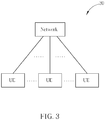
- the communication device 40 can be a UE or the network shown in Fig. 3 , but is not limited herein.
- the communication device 40 may include a processor 400 such as a microprocessor or Application Specific Integrated Circuit (ASIC), a storage unit 410 and a communication interfacing unit 420.
- the storage unit 410 may be any data storage device that can store a program code 414, accessed and executed by the processor 400. Examples of the storage unit 410 include but are not limited to a subscriber identity module (SIM), read-only memory (ROM), flash memory, random-access memory (RAM), CD-ROM/DVD-ROM, magnetic tape, hard disk and optical data storage device.
- SIM subscriber identity module
- ROM read-only memory
- flash memory random-access memory
- CD-ROM/DVD-ROM magnetic tape
- hard disk and optical data storage device optical data storage device.
- the communication interfacing unit 420 is preferably a transceiver and is used to transmit and receive signals according to processing results of the processor 400.
- Fig. 5 illustrates a schematic diagram of communication protocol layers for the wireless communication system 30.
- the behaviors of some of the protocol layers may be defined in the program code 414 and executed by the processing means 400.
- the protocol layers from top to bottom are a radio resource control (RRC) layer 500, a packet data convergence protocol (PDCP) layer 502, a radio link control (RLC) layer 504, a medium access control (MAC) layer 506 and a physical (PHY) layer 508.
- the RRC layer 500 is used for performing broadcast, paging, RRC connection management, measurement reporting and control and radio bearer control responsible for generating or releasing radio bearers.
- the PDCP layer 502 is used for ciphering and integrity protection of transmissions, and maintaining delivery order during a handover.
- the RLC layer 504 is used for segmentation/concatenation of packets and maintaining delivery sequence when a packet or packets are lost.
- the MAC layer 506 is responsible for a hybrid automatic repeat request (HARQ) process, multiplexing logical channels, a random access channel (RACH) procedure and maintaining a UL timing alignment.
- HARQ hybrid automatic repeat request
- RACH random access channel
- ACK acknowledgement
- NACK negative acknowledgement
- the PHY layer 308 is used to provide physical channels, e.g., physical UL shared channel (PUSCH), physical DL shared channel (PDSCH), physical UL control channel (PUCCH) and physical DL control channel (PDCCH), etc., such that control information and data of different UEs can be transmitted and received with low and even no interference.
- physical channels e.g., physical UL shared channel (PUSCH), physical DL shared channel (PDSCH), physical UL control channel (PUCCH) and physical DL control channel (PDCCH), etc.
- Fig. 6 is a flowchart of a process 60 according to an example of the present invention.
- the process 60 is utilized in a UE shown in Fig. 3 , for handling cell selection.
- the UE is transferring (i.e., starts to transfer) from a connected mode to an idle mode.
- the process 60 may be compiled into the program code 414 and includes the following steps: Step 600: Start.
- Step 602 Determine whether a plurality of active sets of the UE comprises at least one first cell of a location area of the wireless communication system, for producing a result, and the location area comprising a first cell serving the UE when the UE transfers from the idle mode to the connected mode.
- Step 604 Select a second cell from the at least one first cell for camping in the idle mode, when the result indicates that the plurality of active sets comprise the at least one first cell.
- Step 606 End.
- the UE After the UE finishes a data transmission or a voice call, the UE transfers from the connected mode to the idle mode.
- the UE first determines whether a plurality of active sets of the UE comprises at least one first cell of a location area of the wireless communication system, for producing a result, and the location area comprising a first cell serving the UE when the UE transfers from the idle mode to the connected mode. Then, the UE selects a second cell from the at least one first cell for camping in the idle mode, when the result indicates that the plurality of active sets comprise the at least one first cell.
- the UE when the UE transfers from the connected mode to the idle mode, the UE selects the second cell from the plurality of active sets according to the location area, such that the second cell and the first cell are both in the same location area, wherein the first cell serves the UE when the UE transfers from the idle mode to the connected mode, i.e., when the UE is triggered by the data transmission or the voice call.
- the UE does not need to perform a location update procedure, when transferring from the connected mode to the idle mode.
- the UE can perform a data transmission or a voice call without being affected by the location update procedure, when transferring from the connected mode to the idle mode, i.e., starting to camp on the second cell.
- a goal of the process 60 is that since the UE is served by a first cell of a location area when transferring from an idle mode to a connected mode, the UE selects a second cell in the location area when the UE transfers from the connected mode to the idle mode, such that the second cell and the first cell are both in the same location area and a location update procedure is avoided.
- Realization of the process 60 is not limited. For example, when the UE is transferring (i.e., starts to transfer) from the connected mode to the idle mode, the UE can camp on the first cell directly if the first cell is included in active sets of the UE. Thus, the UE does not need to perform the location update procedure. Further, the UE does not need to change the first cell serving the UE.
- Fig. 7 is a flowchart of a process 70 according to an example of the present invention.
- the process 70 is utilized in a UE shown in Fig. 3 , for handling cell selection.
- the UE determines that active sets of the UE include a cell which serves the UE when the UE transfers from an idle mode to the connected mode (i.e., the step 702).
- the UE checks whether signal quality of the cell is available at the UE (i.e., the step 704), i.e., whether the UE has the signal quality of the cell.
- the UE continues to check whether the signal quality of the cell includes a measurement result of Event 1F of the cell (i.e., the step 706), wherein the Event 1F is an event indicating that signal quality of a primary common pilot channel (P-CPICH) is lower than a threshold.
- the Event 1F is defined in 3rd Generation Partnership Project (3GPP) technical specification (TS) 25.331, for indicating the UE to measure and report the signal quality.
- 3GPP 3rd Generation Partnership Project
- TS technical specification
- the UE compares received signal code power (RSCP) and ratio of received pilot energy to total received energy (Eclo) of the Event 1F with the threshold of the Event 1F (i.e., the step 708).
- RSCP received signal code power
- Eclo ratio of received pilot energy to total received energy
- the UE determines the cell for camping in the idle mode (i.e., the step 710). Besides, if the signal quality of the cell does not include the measurement result of the Event 1F, the UE continues to check whether the signal quality of the cell includes a measurement result of Event 2D of the cell (i.e., the step 712), wherein the Event 2D is an event indicating that signal quality of a frequency band currently being used is lower than a threshold.
- the Event 2D is also defined in the 3GPP TS 25.331, for indicating the UE to measure and report the signal quality.
- the UE compares RSCP and Eclo of the Event 2D with the threshold of the Event 2D (i.e., the step 714). If the RSCP and the Eclo of the Event 2D is higher than the threshold of the Event 2D, the UE determines the cell for camping in the idle mode (i.e., the step 710).
- the UE determines a cell with a best quality from the active sets for camping in the idle mode (i.e., the step 716), and performs a location update procedure.
- the UE checks the signal quality of the cell, to avoid that the UE is not able to camp on the cell in the idle mode, i.e., the signal quality is too bad such that the UE can not keep connection with the cell.
- the UE determines the cell with the best quality from the active sets for camping in the idle mode, and performs the location update procedure.
- Fig. 8 is a schematic diagram of signal qualities of cells in active sets of a UE according to an example of the present invention.
- Fig. 8 is used for illustrating the process 70.
- the active sets include cells CL_1a and CL_2a which are in location areas LA_1a and LA_2a, respectively.
- the signal qualities of the cells serving the UE are represented by bold lines.
- the UE camps in an idle mode on the cell CL_1a at first. After the UE is triggered by a data transmission or a voice call and transfers from the idle mode to the connected mode, the cell CL_2a starts to serve the UE.
- the UE can perform the data transmission or the voice call via the cells CL_1a and CL_2a simultaneously, and quality of the data transmission or the voice call can be improved. After the data transmission or the voice call is finished, the UE transfers back to the idle mode again. Even though signal quality of the cell CL_2a is better than signal quality of the cell CL_1a due to movement of the UE or variation of environment at this time, the UE selects the cell CL_1a for camping in on the cell CL_1a in the idle mode according to the process 70, as long as the signal quality of the cell CL_1a is higher than a threshold. Thus, a location update procedure can be avoided.
- location update procedures are performed, when the UE transfers between the connected mode and the idle mode. Accordingly, the UE cannot perform the data transmission or the voice call during the location update procedures.
- the cell serving the UE when the UE transfers from the idle mode to the connected mode is determined for camping in the idle mode, as long as the signal quality of the cell is higher than the threshold.
- the UE can determine a second cell with a best signal quality of the location area for camping in the idle mode when the UE transfers back to the idle mode.
- the UE can camp on the second cell with the best signal quality, and a location update procedure is avoided since the second cell and the first cell are in the same location area.
- Fig. 9 is a flowchart of a process 90 according to an example of the present invention.
- the process 90 is utilized in a UE shown in Fig. 3 , for handling cell selection.
- the UE when the UE leaves a connected mode (i.e., the step 900), the UE first determines at least one cell of a location area from active sets of the UE, wherein a cell which serves the UE when the UE transfers from the idle mode to the connected mode is included in the location area (i.e., the step 902). Then, the UE selects a cell with a best signal quality from the at least one cell (i.e., the step 904).
- Steps 906, 908, 910, 912, 914 and 916 are the same as the steps 706, 708,710, 712, 714 and 716, respectively, and are not narrated herein.
- the UE checks signal quality of the cell, to avoid that the UE is not able to camp on the cell in the idle mode, i.e., the signal quality is too bad such that the UE can not keep connection with the cell.
- the UE determines a cell with a best quality from the active sets for camping in the idle mode, and performs a location update procedure.
- the UE determines the cell with the best quality from the active sets for camping in the idle mode, and performs the location update procedure.
- the process 90 further solves that the cell serving the UE when the UE transfers from the idle mode to the connected mode is removed from the active sets or the signal quality of the cell is lower than the threshold, such that the UE determines a cell with a different location area.
- Fig. 10 is a schematic diagram of signal qualities of cells in active sets of a UE according to an example of the present invention.
- Fig. 10 is used for illustrating the process 90.
- the active sets include cells of location areas LA_1b and LA_2b.
- the location area LA_1b includes cells CL_1b, CL_2b and CL_3b, wherein the cell CL_3b is added in the active sets later, and the location area LA_2b includes a cell CL_4b.
- the signal qualities of the cells serving the UE are represented by bold lines.
- the UE camps in an idle mode on the cell CL_1b at first.
- the cell CL_2b, CL_4b and later CL_3b start to serve the UE.
- the UE can perform the data transmission or the voice call via the cells CL_2b, CL_3b and CL_4b simultaneously, and quality of the data transmission or the voice call can be improved.
- the UE transfers back to the idle mode again.
- the UE determines the cell CL_3b with a best signal quality from the location area LA_1b, and checks whether signal quality of the cell CL_3b is higher than a threshold.
- the UE camps on the cell CL_3b in the idle mode if the signal quality of the cell CL_3b is higher than the threshold.
- a location update procedure can be avoided.
- location update procedures are performed according to the prior art, when the UE transfers between the connected mode and the idle mode. Accordingly, the UE cannot perform the data transmission or the voice call during the location update procedures.
- the UE determines the second cell with the best signal quality of the location area from the actives sets of the UE, wherein the location area includes the first cell which serves the UE when the UE transfers from the idle mode to the connected mode.
- the UE camps on a cell with better signal quality.
- the UE can measure signal qualities and measurement results mentioned above according to a request transmitted by the network, and is not limited herein.
- measurement results used for determining whether the signal qualities are higher than corresponding thresholds are not limited to the measurement results of the Event 1F and the Event 2D, as long as the measurement results can be used for evaluating the signal qualities.
- two measurement results are used in the processes 70 and 90, and an amount of the measurement results can be increased or decreased according to capability of the UE, and is not limited herein.
- the abovementioned steps of the processes including suggested steps can be realized by means that could be a hardware, a firmware known as a combination of a hardware device and computer instructions and data that reside as read-only software on the hardware device, or an electronic system.
- hardware can include analog, digital and mixed circuits known as microcircuit, microchip, or silicon chip.
- the electronic system can include a system on chip (SOC), system in package (SiP), a computer on module (COM), and the communication device 40.
- SOC system on chip
- SiP system in package
- COM computer on module
- the present invention provides a method of handling cell selection for a UE in a wireless communication system.
- the UE According to a location area of which a first cell serves the UE when the UE transfers from an idle mode to a connected mode, the UE selects a second cell from active sets of the UE for camping in the idle mode, such that the second cell and the first cell are in the same location area, and the UE does not need to perform a location update procedure.
- an amount of control information transmitted/received by the UE can be reduced, and a probability that a MT call for the UE is missed can also be reduced.
Landscapes
- Engineering & Computer Science (AREA)
- Computer Security & Cryptography (AREA)
- Computer Networks & Wireless Communication (AREA)
- Signal Processing (AREA)
- Mobile Radio Communication Systems (AREA)
Claims (10)
- Procédé de gestion de sélection de cellule pour un dispositif de communication dans un système de communication sans fil,
le système de communication sans fil comprenant une pluralité de cellules de service qui appartiennent à différentes zones de localisation, le procédé comprenant :le fait d'être desservi par une première cellule dans une zone de localisation du système de communication sans fil dans un mode inactif, lorsque le dispositif de communication passe du mode inactif à un mode connecté ;la détermination du fait qu'un ensemble actif du dispositif de communication comprend au moins une cellule de la même zone de localisation que la première cellule, pour produire un résultat déterminé, lorsque le dispositif de communication commence à passer du mode connecté en retour au mode inactif (602) ; etla sélection d'une deuxième cellule à partir de ladite au moins une cellule de la même zone de localisation que la première cellule pour attendre dans le mode inactif lorsque le résultat déterminé indique que l'ensemble actif comprend ladite au moins une cellule, lorsque le dispositif de communication commence à passer du mode connecté en retour au mode inactif (604). - Procédé selon la revendication 1, le dispositif de communication sélectionnant la deuxième cellule par :
la sélection de la première cellule, lorsque le résultat déterminé indique que l'ensemble actif comprend la première cellule. - Procédé selon la revendication 2, le dispositif de communication sélectionnant la deuxième cellule par :la vérification du fait qu'une qualité de signal de la première cellule est disponible au niveau du dispositif de communication ; etla détermination de la première cellule en tant que deuxième cellule, lorsque la qualité de signal de la première cellule est disponible au niveau du dispositif de communication et est supérieure à un seuil.
- Procédé selon la revendication 3, comprenant en outre :
la détermination d'une cellule dans l'ensemble actif présentant une meilleure qualité de signal en tant que deuxième cellule, lorsque la qualité de signal de la première cellule n'est pas disponible au niveau du dispositif de communication. - Procédé selon la revendication 3, comprenant en outre :
la détermination d'une cellule dans l'ensemble actif présentant une meilleure qualité de signal en tant que deuxième cellule, lorsque la qualité de signal de la première cellule est disponible au niveau du dispositif de communication et est inférieure au seuil. - Procédé selon la revendication 3, le dispositif de communication mesurant la qualité de signal d'une cellule selon une requête transmise par un réseau du système de communication sans fil.
- Procédé selon la revendication 3, la qualité de signal comprenant une puissance de code de signal reçu, RSCP, et un rapport d'énergie pilote reçue à l'énergie reçue totale, Eclo, d'un premier événement ou une RSCP et un Eclo d'un deuxième événement, le premier événement indiquant que la qualité de signal d'un canal pilote commun primaire, P-CPICH, est inférieure à un premier seuil et
le deuxième événement indiquant que la qualité de signal d'une bande de fréquence actuellement utilisée est inférieure à un deuxième seuil. - Procédé selon la revendication 7, le seuil étant le premier seuil ou le deuxième seuil.
- Procédé selon la revendication 1, comprenant en outre :
la détermination d'une cellule dans l'ensemble actif présentant une meilleure qualité de signal, lorsque le résultat déterminé indique que l'ensemble actif ne comprend aucune cellule de la même zone de localisation que la première cellule. - Procédé selon la revendication 1, comprenant en outre :
la détermination d'une cellule dans l'ensemble actif présentant une meilleure qualité de signal, lorsque le résultat déterminé indique qu'une qualité de signal de n'importe quelle cellule de ladite au moins une cellule n'est pas disponible au niveau du dispositif de communication.
Applications Claiming Priority (1)
| Application Number | Priority Date | Filing Date | Title |
|---|---|---|---|
| TW100130339A TWI531262B (zh) | 2011-08-24 | 2011-08-24 | 處理細胞選擇的方法及其通訊裝置 |
Publications (3)
| Publication Number | Publication Date |
|---|---|
| EP2563074A2 EP2563074A2 (fr) | 2013-02-27 |
| EP2563074A3 EP2563074A3 (fr) | 2014-10-01 |
| EP2563074B1 true EP2563074B1 (fr) | 2020-09-09 |
Family
ID=45977204
Family Applications (1)
| Application Number | Title | Priority Date | Filing Date |
|---|---|---|---|
| EP12161383.0A Active EP2563074B1 (fr) | 2011-08-24 | 2012-03-27 | Procédé de gestion de changement cellulaire |
Country Status (3)
| Country | Link |
|---|---|
| US (1) | US8938235B2 (fr) |
| EP (1) | EP2563074B1 (fr) |
| TW (1) | TWI531262B (fr) |
Families Citing this family (13)
| Publication number | Priority date | Publication date | Assignee | Title |
|---|---|---|---|---|
| TWI423710B (zh) * | 2010-10-15 | 2014-01-11 | Acer Inc | 行動通訊裝置、系統、以及連線建立方法 |
| JPWO2014155638A1 (ja) * | 2013-03-28 | 2017-02-16 | 富士通株式会社 | 通信端末及び基地局 |
| KR102108260B1 (ko) | 2013-07-04 | 2020-05-08 | 삼성전자주식회사 | 무선 통신 시스템에서 단말의 셀 선택 방법 및 장치 |
| US10834645B2 (en) | 2018-11-30 | 2020-11-10 | Google Llc | Active coordination set for mobility management |
| US11224081B2 (en) * | 2018-12-05 | 2022-01-11 | Google Llc | Disengaged-mode active coordination set management |
| CN113169765B (zh) | 2018-12-28 | 2024-05-17 | 谷歌有限责任公司 | 用于无线网络的用户设备协调集合 |
| US12114394B2 (en) | 2019-01-02 | 2024-10-08 | Google Llc | Multiple active-coordination-set aggregation for mobility management |
| AU2020216095A1 (en) | 2019-01-28 | 2021-06-03 | Google Llc | Dynamic carrier subband operation for active coordination sets |
| WO2020172022A1 (fr) | 2019-02-21 | 2020-08-27 | Google Llc | Ensemble de coordination d'équipements utilisateurs pour un réseau sans fil utilisant une bande de fréquences sans licence |
| CN113519130B (zh) | 2019-03-12 | 2024-03-08 | 谷歌有限责任公司 | 用户设备协调集合波束扫描 |
| US10893572B2 (en) | 2019-05-22 | 2021-01-12 | Google Llc | User-equipment-coordination set for disengaged mode |
| CN114365422B (zh) | 2019-09-19 | 2025-01-24 | 谷歌有限责任公司 | 用于活动协调集的增强波束搜索 |
| CN113676969B (zh) * | 2021-08-18 | 2024-10-29 | 维沃移动通信有限公司 | 小区重选方法、装置、终端及可读存储介质 |
Family Cites Families (11)
| Publication number | Priority date | Publication date | Assignee | Title |
|---|---|---|---|---|
| US6334052B1 (en) * | 1997-03-07 | 2001-12-25 | Telefonaktiebolaget Lm Ericsson (Publ) | Subscription-based mobile station idle mode cell selection |
| FI105639B (fi) * | 1997-06-25 | 2000-09-15 | Nokia Mobile Phones Ltd | Parannettu menetelmä solun vaihtamiseksi |
| US7596378B1 (en) * | 1999-09-30 | 2009-09-29 | Qualcomm Incorporated | Idle mode handling in a hybrid GSM/CDMA network |
| FI108104B (fi) * | 1999-01-15 | 2001-11-15 | Nokia Networks Oy | Solunvalinta pakettiradioverkossa |
| WO2001076273A2 (fr) * | 2000-04-03 | 2001-10-11 | Nokia Corporation | Procede et systeme de communication |
| US20050148349A1 (en) * | 2003-12-19 | 2005-07-07 | Padmaja Putcha | Cell selection on transitioning from dedicated mode in wireless communications devices |
| US7747275B2 (en) * | 2004-05-06 | 2010-06-29 | M-Stack Limited | Cell selection in mobile communications |
| EP1631108B1 (fr) | 2004-08-27 | 2007-03-14 | Research In Motion Limited | Procédé et dispositif pour utiliser des informations de réseau historiques afin de limiter des mises à jour de réseau pendant la sélection d'un canal de communication |
| US7328010B2 (en) * | 2004-12-14 | 2008-02-05 | Telefonaktiebolaget Lm Ericsson (Pub) | Method and apparatus for steering idle mobile stations |
| US9554317B2 (en) | 2010-01-12 | 2017-01-24 | Blackberry Limited | System and method for supporting emergency services in home cells |
| US20120276945A1 (en) * | 2011-04-26 | 2012-11-01 | Nokia Siemens Networks Oy | Cell selection techniques for idle mode for wireless networks |
-
2011
- 2011-08-24 TW TW100130339A patent/TWI531262B/zh active
-
2012
- 2012-03-08 US US13/415,783 patent/US8938235B2/en active Active
- 2012-03-27 EP EP12161383.0A patent/EP2563074B1/fr active Active
Non-Patent Citations (1)
| Title |
|---|
| None * |
Also Published As
| Publication number | Publication date |
|---|---|
| US8938235B2 (en) | 2015-01-20 |
| TW201311022A (zh) | 2013-03-01 |
| US20130053045A1 (en) | 2013-02-28 |
| TWI531262B (zh) | 2016-04-21 |
| EP2563074A2 (fr) | 2013-02-27 |
| EP2563074A3 (fr) | 2014-10-01 |
Similar Documents
| Publication | Publication Date | Title |
|---|---|---|
| EP2563074B1 (fr) | Procédé de gestion de changement cellulaire | |
| US10980034B2 (en) | Method for terminal transmitting channel state information in wireless communication system, and terminal that uses the method | |
| CN108029144B (zh) | 用于非许可射频谱带上直接通信的方法和设备 | |
| US8649363B2 (en) | Method of hybrid automatic repeat request entity handling and communication device thereof | |
| US8693437B2 (en) | Method of configuring secondary cells and related communication device | |
| EP3621392B1 (fr) | Procédé de transmission de signal de liaison montante et dispositif terminal | |
| EP3886528B1 (fr) | Procédés et appareils de gestion d'état de cellule | |
| US20120157143A1 (en) | Wireless communication system, wireless communication apparatus, and wireless communication method | |
| JP2018520548A (ja) | カバレージ拡張をサポートするマシンタイプ通信デバイスのためのセル選択手順 | |
| US9774427B2 (en) | Method of handling uplink/downlink configurations for time-division duplexing system and related communication device | |
| JP2018516495A (ja) | 低レイテンシワイヤレス通信のためのランダムアクセス | |
| WO2018176219A1 (fr) | Système et procédé pour éviter le collision de signal de radiomessagerie à l'aide de combinaison de répétition de radiomessagerie et de demande de répétition automatique hybride (harq) | |
| US8494453B2 (en) | Method of handling measurement and related communication device | |
| US12490260B2 (en) | Retransmission of MsgB in two-step random access procedure | |
| EP2373111A1 (fr) | Procédé de changement de support de composant principal et dispositif de communication associé | |
| EP2946615A1 (fr) | Gestion de communications sans fil au moyen d'informations relatives aux performances des demandes de planification | |
| US9781764B2 (en) | Radio resource control (RRC) connection re-establishment | |
| EP2490347A1 (fr) | Procédé de contrôle de diversité de réception pour l'amélioration de la durée de vie de batterie et dispositif de communication associé | |
| US20250089036A1 (en) | Method and apparatus of beam determination | |
| US8526937B2 (en) | Method of handling logged MDT reporting in a wireless communication system and related communication device | |
| EP3386246B1 (fr) | Manipulation d'entrée de réseau dans un groupe de cellules | |
| US11528707B2 (en) | Primary and secondary beams based channel access | |
| US12542627B2 (en) | Method for fast scheduling of retransmission | |
| US20240063860A1 (en) | Communication Method and Communication Device | |
| US20260052497A1 (en) | Method and apparatus for maintaining uplink time alignment |
Legal Events
| Date | Code | Title | Description |
|---|---|---|---|
| PUAI | Public reference made under article 153(3) epc to a published international application that has entered the european phase |
Free format text: ORIGINAL CODE: 0009012 |
|
| AK | Designated contracting states |
Kind code of ref document: A2 Designated state(s): AL AT BE BG CH CY CZ DE DK EE ES FI FR GB GR HR HU IE IS IT LI LT LU LV MC MK MT NL NO PL PT RO RS SE SI SK SM TR |
|
| AX | Request for extension of the european patent |
Extension state: BA ME |
|
| PUAL | Search report despatched |
Free format text: ORIGINAL CODE: 0009013 |
|
| AK | Designated contracting states |
Kind code of ref document: A3 Designated state(s): AL AT BE BG CH CY CZ DE DK EE ES FI FR GB GR HR HU IE IS IT LI LT LU LV MC MK MT NL NO PL PT RO RS SE SI SK SM TR |
|
| AX | Request for extension of the european patent |
Extension state: BA ME |
|
| RIC1 | Information provided on ipc code assigned before grant |
Ipc: H04W 48/20 20090101AFI20140828BHEP |
|
| 17P | Request for examination filed |
Effective date: 20150326 |
|
| RBV | Designated contracting states (corrected) |
Designated state(s): AL AT BE BG CH CY CZ DE DK EE ES FI FR GB GR HR HU IE IS IT LI LT LU LV MC MK MT NL NO PL PT RO RS SE SI SK SM TR |
|
| STAA | Information on the status of an ep patent application or granted ep patent |
Free format text: STATUS: EXAMINATION IS IN PROGRESS |
|
| 17Q | First examination report despatched |
Effective date: 20161122 |
|
| GRAP | Despatch of communication of intention to grant a patent |
Free format text: ORIGINAL CODE: EPIDOSNIGR1 |
|
| STAA | Information on the status of an ep patent application or granted ep patent |
Free format text: STATUS: GRANT OF PATENT IS INTENDED |
|
| INTG | Intention to grant announced |
Effective date: 20200423 |
|
| GRAS | Grant fee paid |
Free format text: ORIGINAL CODE: EPIDOSNIGR3 |
|
| GRAA | (expected) grant |
Free format text: ORIGINAL CODE: 0009210 |
|
| STAA | Information on the status of an ep patent application or granted ep patent |
Free format text: STATUS: THE PATENT HAS BEEN GRANTED |
|
| AK | Designated contracting states |
Kind code of ref document: B1 Designated state(s): AL AT BE BG CH CY CZ DE DK EE ES FI FR GB GR HR HU IE IS IT LI LT LU LV MC MK MT NL NO PL PT RO RS SE SI SK SM TR |
|
| REG | Reference to a national code |
Ref country code: GB Ref legal event code: FG4D |
|
| REG | Reference to a national code |
Ref country code: AT Ref legal event code: REF Ref document number: 1313149 Country of ref document: AT Kind code of ref document: T Effective date: 20200915 Ref country code: CH Ref legal event code: EP |
|
| REG | Reference to a national code |
Ref country code: DE Ref legal event code: R096 Ref document number: 602012072192 Country of ref document: DE |
|
| REG | Reference to a national code |
Ref country code: IE Ref legal event code: FG4D |
|
| REG | Reference to a national code |
Ref country code: LT Ref legal event code: MG4D |
|
| PG25 | Lapsed in a contracting state [announced via postgrant information from national office to epo] |
Ref country code: HR Free format text: LAPSE BECAUSE OF FAILURE TO SUBMIT A TRANSLATION OF THE DESCRIPTION OR TO PAY THE FEE WITHIN THE PRESCRIBED TIME-LIMIT Effective date: 20200909 Ref country code: LT Free format text: LAPSE BECAUSE OF FAILURE TO SUBMIT A TRANSLATION OF THE DESCRIPTION OR TO PAY THE FEE WITHIN THE PRESCRIBED TIME-LIMIT Effective date: 20200909 Ref country code: SE Free format text: LAPSE BECAUSE OF FAILURE TO SUBMIT A TRANSLATION OF THE DESCRIPTION OR TO PAY THE FEE WITHIN THE PRESCRIBED TIME-LIMIT Effective date: 20200909 Ref country code: BG Free format text: LAPSE BECAUSE OF FAILURE TO SUBMIT A TRANSLATION OF THE DESCRIPTION OR TO PAY THE FEE WITHIN THE PRESCRIBED TIME-LIMIT Effective date: 20201209 Ref country code: GR Free format text: LAPSE BECAUSE OF FAILURE TO SUBMIT A TRANSLATION OF THE DESCRIPTION OR TO PAY THE FEE WITHIN THE PRESCRIBED TIME-LIMIT Effective date: 20201210 Ref country code: FI Free format text: LAPSE BECAUSE OF FAILURE TO SUBMIT A TRANSLATION OF THE DESCRIPTION OR TO PAY THE FEE WITHIN THE PRESCRIBED TIME-LIMIT Effective date: 20200909 Ref country code: NO Free format text: LAPSE BECAUSE OF FAILURE TO SUBMIT A TRANSLATION OF THE DESCRIPTION OR TO PAY THE FEE WITHIN THE PRESCRIBED TIME-LIMIT Effective date: 20201209 |
|
| REG | Reference to a national code |
Ref country code: AT Ref legal event code: MK05 Ref document number: 1313149 Country of ref document: AT Kind code of ref document: T Effective date: 20200909 |
|
| REG | Reference to a national code |
Ref country code: NL Ref legal event code: MP Effective date: 20200909 |
|
| PG25 | Lapsed in a contracting state [announced via postgrant information from national office to epo] |
Ref country code: LV Free format text: LAPSE BECAUSE OF FAILURE TO SUBMIT A TRANSLATION OF THE DESCRIPTION OR TO PAY THE FEE WITHIN THE PRESCRIBED TIME-LIMIT Effective date: 20200909 Ref country code: RS Free format text: LAPSE BECAUSE OF FAILURE TO SUBMIT A TRANSLATION OF THE DESCRIPTION OR TO PAY THE FEE WITHIN THE PRESCRIBED TIME-LIMIT Effective date: 20200909 Ref country code: PL Free format text: LAPSE BECAUSE OF FAILURE TO SUBMIT A TRANSLATION OF THE DESCRIPTION OR TO PAY THE FEE WITHIN THE PRESCRIBED TIME-LIMIT Effective date: 20200909 |
|
| PG25 | Lapsed in a contracting state [announced via postgrant information from national office to epo] |
Ref country code: EE Free format text: LAPSE BECAUSE OF FAILURE TO SUBMIT A TRANSLATION OF THE DESCRIPTION OR TO PAY THE FEE WITHIN THE PRESCRIBED TIME-LIMIT Effective date: 20200909 Ref country code: CZ Free format text: LAPSE BECAUSE OF FAILURE TO SUBMIT A TRANSLATION OF THE DESCRIPTION OR TO PAY THE FEE WITHIN THE PRESCRIBED TIME-LIMIT Effective date: 20200909 Ref country code: NL Free format text: LAPSE BECAUSE OF FAILURE TO SUBMIT A TRANSLATION OF THE DESCRIPTION OR TO PAY THE FEE WITHIN THE PRESCRIBED TIME-LIMIT Effective date: 20200909 Ref country code: PT Free format text: LAPSE BECAUSE OF FAILURE TO SUBMIT A TRANSLATION OF THE DESCRIPTION OR TO PAY THE FEE WITHIN THE PRESCRIBED TIME-LIMIT Effective date: 20210111 Ref country code: RO Free format text: LAPSE BECAUSE OF FAILURE TO SUBMIT A TRANSLATION OF THE DESCRIPTION OR TO PAY THE FEE WITHIN THE PRESCRIBED TIME-LIMIT Effective date: 20200909 Ref country code: SM Free format text: LAPSE BECAUSE OF FAILURE TO SUBMIT A TRANSLATION OF THE DESCRIPTION OR TO PAY THE FEE WITHIN THE PRESCRIBED TIME-LIMIT Effective date: 20200909 |
|
| PG25 | Lapsed in a contracting state [announced via postgrant information from national office to epo] |
Ref country code: AT Free format text: LAPSE BECAUSE OF FAILURE TO SUBMIT A TRANSLATION OF THE DESCRIPTION OR TO PAY THE FEE WITHIN THE PRESCRIBED TIME-LIMIT Effective date: 20200909 Ref country code: AL Free format text: LAPSE BECAUSE OF FAILURE TO SUBMIT A TRANSLATION OF THE DESCRIPTION OR TO PAY THE FEE WITHIN THE PRESCRIBED TIME-LIMIT Effective date: 20200909 Ref country code: ES Free format text: LAPSE BECAUSE OF FAILURE TO SUBMIT A TRANSLATION OF THE DESCRIPTION OR TO PAY THE FEE WITHIN THE PRESCRIBED TIME-LIMIT Effective date: 20200909 Ref country code: IS Free format text: LAPSE BECAUSE OF FAILURE TO SUBMIT A TRANSLATION OF THE DESCRIPTION OR TO PAY THE FEE WITHIN THE PRESCRIBED TIME-LIMIT Effective date: 20210109 |
|
| REG | Reference to a national code |
Ref country code: DE Ref legal event code: R097 Ref document number: 602012072192 Country of ref document: DE |
|
| PG25 | Lapsed in a contracting state [announced via postgrant information from national office to epo] |
Ref country code: SK Free format text: LAPSE BECAUSE OF FAILURE TO SUBMIT A TRANSLATION OF THE DESCRIPTION OR TO PAY THE FEE WITHIN THE PRESCRIBED TIME-LIMIT Effective date: 20200909 |
|
| PLBE | No opposition filed within time limit |
Free format text: ORIGINAL CODE: 0009261 |
|
| STAA | Information on the status of an ep patent application or granted ep patent |
Free format text: STATUS: NO OPPOSITION FILED WITHIN TIME LIMIT |
|
| 26N | No opposition filed |
Effective date: 20210610 |
|
| PG25 | Lapsed in a contracting state [announced via postgrant information from national office to epo] |
Ref country code: SI Free format text: LAPSE BECAUSE OF FAILURE TO SUBMIT A TRANSLATION OF THE DESCRIPTION OR TO PAY THE FEE WITHIN THE PRESCRIBED TIME-LIMIT Effective date: 20200909 Ref country code: DK Free format text: LAPSE BECAUSE OF FAILURE TO SUBMIT A TRANSLATION OF THE DESCRIPTION OR TO PAY THE FEE WITHIN THE PRESCRIBED TIME-LIMIT Effective date: 20200909 |
|
| PG25 | Lapsed in a contracting state [announced via postgrant information from national office to epo] |
Ref country code: IT Free format text: LAPSE BECAUSE OF FAILURE TO SUBMIT A TRANSLATION OF THE DESCRIPTION OR TO PAY THE FEE WITHIN THE PRESCRIBED TIME-LIMIT Effective date: 20200909 Ref country code: MC Free format text: LAPSE BECAUSE OF FAILURE TO SUBMIT A TRANSLATION OF THE DESCRIPTION OR TO PAY THE FEE WITHIN THE PRESCRIBED TIME-LIMIT Effective date: 20200909 |
|
| REG | Reference to a national code |
Ref country code: CH Ref legal event code: PL |
|
| REG | Reference to a national code |
Ref country code: BE Ref legal event code: MM Effective date: 20210331 |
|
| PG25 | Lapsed in a contracting state [announced via postgrant information from national office to epo] |
Ref country code: CH Free format text: LAPSE BECAUSE OF NON-PAYMENT OF DUE FEES Effective date: 20210331 Ref country code: LU Free format text: LAPSE BECAUSE OF NON-PAYMENT OF DUE FEES Effective date: 20210327 Ref country code: LI Free format text: LAPSE BECAUSE OF NON-PAYMENT OF DUE FEES Effective date: 20210331 Ref country code: IE Free format text: LAPSE BECAUSE OF NON-PAYMENT OF DUE FEES Effective date: 20210327 |
|
| PG25 | Lapsed in a contracting state [announced via postgrant information from national office to epo] |
Ref country code: BE Free format text: LAPSE BECAUSE OF NON-PAYMENT OF DUE FEES Effective date: 20210331 |
|
| PG25 | Lapsed in a contracting state [announced via postgrant information from national office to epo] |
Ref country code: HU Free format text: LAPSE BECAUSE OF FAILURE TO SUBMIT A TRANSLATION OF THE DESCRIPTION OR TO PAY THE FEE WITHIN THE PRESCRIBED TIME-LIMIT; INVALID AB INITIO Effective date: 20120327 Ref country code: CY Free format text: LAPSE BECAUSE OF FAILURE TO SUBMIT A TRANSLATION OF THE DESCRIPTION OR TO PAY THE FEE WITHIN THE PRESCRIBED TIME-LIMIT Effective date: 20200909 |
|
| PG25 | Lapsed in a contracting state [announced via postgrant information from national office to epo] |
Ref country code: MK Free format text: LAPSE BECAUSE OF FAILURE TO SUBMIT A TRANSLATION OF THE DESCRIPTION OR TO PAY THE FEE WITHIN THE PRESCRIBED TIME-LIMIT Effective date: 20200909 |
|
| PG25 | Lapsed in a contracting state [announced via postgrant information from national office to epo] |
Ref country code: TR Free format text: LAPSE BECAUSE OF FAILURE TO SUBMIT A TRANSLATION OF THE DESCRIPTION OR TO PAY THE FEE WITHIN THE PRESCRIBED TIME-LIMIT Effective date: 20200909 |
|
| REG | Reference to a national code |
Ref country code: DE Ref legal event code: R082 Ref document number: 602012072192 Country of ref document: DE Representative=s name: STRAUS, ALEXANDER, DIPL.-CHEM.UNIV. DR.PHIL., DE |
|
| PG25 | Lapsed in a contracting state [announced via postgrant information from national office to epo] |
Ref country code: MT Free format text: LAPSE BECAUSE OF FAILURE TO SUBMIT A TRANSLATION OF THE DESCRIPTION OR TO PAY THE FEE WITHIN THE PRESCRIBED TIME-LIMIT Effective date: 20200909 |
|
| PGFP | Annual fee paid to national office [announced via postgrant information from national office to epo] |
Ref country code: GB Payment date: 20260209 Year of fee payment: 15 |
|
| PGFP | Annual fee paid to national office [announced via postgrant information from national office to epo] |
Ref country code: DE Payment date: 20260204 Year of fee payment: 15 |
|
| PGFP | Annual fee paid to national office [announced via postgrant information from national office to epo] |
Ref country code: FR Payment date: 20260209 Year of fee payment: 15 |