EP2563149B1 - Procédé pour réduire des infections virales provoquées par des insectes vecteurs - Google Patents
Procédé pour réduire des infections virales provoquées par des insectes vecteurs Download PDFInfo
- Publication number
- EP2563149B1 EP2563149B1 EP11718686.6A EP11718686A EP2563149B1 EP 2563149 B1 EP2563149 B1 EP 2563149B1 EP 11718686 A EP11718686 A EP 11718686A EP 2563149 B1 EP2563149 B1 EP 2563149B1
- Authority
- EP
- European Patent Office
- Prior art keywords
- plant
- methyl
- acibenzolar
- cyantraniliprole
- cynt
- Prior art date
- Legal status (The legal status is an assumption and is not a legal conclusion. Google has not performed a legal analysis and makes no representation as to the accuracy of the status listed.)
- Active
Links
Classifications
-
- A—HUMAN NECESSITIES
- A01—AGRICULTURE; FORESTRY; ANIMAL HUSBANDRY; HUNTING; TRAPPING; FISHING
- A01N—PRESERVATION OF BODIES OF HUMANS OR ANIMALS OR PLANTS OR PARTS THEREOF; BIOCIDES, e.g. AS DISINFECTANTS, AS PESTICIDES OR AS HERBICIDES; PEST REPELLANTS OR ATTRACTANTS; PLANT GROWTH REGULATORS
- A01N43/00—Biocides, pest repellants or attractants, or plant growth regulators containing heterocyclic compounds
- A01N43/72—Biocides, pest repellants or attractants, or plant growth regulators containing heterocyclic compounds having rings with nitrogen atoms and oxygen or sulfur atoms as ring hetero atoms
- A01N43/82—Biocides, pest repellants or attractants, or plant growth regulators containing heterocyclic compounds having rings with nitrogen atoms and oxygen or sulfur atoms as ring hetero atoms five-membered rings with three ring hetero atoms
-
- A—HUMAN NECESSITIES
- A01—AGRICULTURE; FORESTRY; ANIMAL HUSBANDRY; HUNTING; TRAPPING; FISHING
- A01N—PRESERVATION OF BODIES OF HUMANS OR ANIMALS OR PLANTS OR PARTS THEREOF; BIOCIDES, e.g. AS DISINFECTANTS, AS PESTICIDES OR AS HERBICIDES; PEST REPELLANTS OR ATTRACTANTS; PLANT GROWTH REGULATORS
- A01N43/00—Biocides, pest repellants or attractants, or plant growth regulators containing heterocyclic compounds
- A01N43/48—Biocides, pest repellants or attractants, or plant growth regulators containing heterocyclic compounds having rings with two nitrogen atoms as the only ring hetero atoms
- A01N43/56—1,2-Diazoles; Hydrogenated 1,2-diazoles
-
- A—HUMAN NECESSITIES
- A01—AGRICULTURE; FORESTRY; ANIMAL HUSBANDRY; HUNTING; TRAPPING; FISHING
- A01N—PRESERVATION OF BODIES OF HUMANS OR ANIMALS OR PLANTS OR PARTS THEREOF; BIOCIDES, e.g. AS DISINFECTANTS, AS PESTICIDES OR AS HERBICIDES; PEST REPELLANTS OR ATTRACTANTS; PLANT GROWTH REGULATORS
- A01N41/00—Biocides, pest repellants or attractants, or plant growth regulators containing organic compounds containing a sulfur atom bound to a hetero atom
- A01N41/02—Biocides, pest repellants or attractants, or plant growth regulators containing organic compounds containing a sulfur atom bound to a hetero atom containing a sulfur-to-oxygen double bond
- A01N41/10—Sulfones; Sulfoxides
Definitions
- the present invention is directed to methods of reducing insect-vectored viral infection and transmission in plants, methods of reducing damage to plants caused by viral infection, by application of a defined combination of an anthranilic bis-amide (ryanodine receptor modulator) insecticide and a plant activator, to compositions comprising the combinations and to plants and plant propagation material treated therewith.
- the agrochemical industry is continually seeking methods of controlling plant pests and improving the growth of plants.
- Chemicals are typically used (i) to control undesirable species (for example, pests, such as insects, or vegetation, e.g., weeds, or fungi), and (ii) to promote plant growth (e.g., by providing nutrients), and thereby improve the growth of plants.
- Insect-vectored viral infections are a widespread cause of plant damage, for which there are few effective measures of control.
- International patent application WO 2003/016284 and European patent application EP 1,717,237 refer to substituted anthranilamides for controlling invertebrate pests.
- International patent application WO 04/067528 refers to a series of cyanthranilamide insecticides.
- International patent application WO 2005/107468 refers to pesticidal compositions comprising anthranilamides in admixture with other agrochemicals.
- International patent application WO 2006/108552 refers to pesticidal compositions comprising bis-amide insecticides and fungicides for controlling pests, such as insects and acarids and also undesirable phytopathogenic fungi.
- United States patent application US 2009/0275471 refers to insecticidal compositions comprising anthranilamides in combination in combination with insecticides, fungicides and acaricides.
- International patent application WO 2008/020998 refers to the in-furrow fungicide application for reducing plant damage by control of insect-vectored viral infection.
- International patent applications WO 2008/021152 and WO 2008/122396 refer to the use of anthranilamides for increasing crop vigour and yield.
- WO 2008/151781 discloses pesticidal combinations, including a combination comprising chlorantraniliprole and acebenzolar-S-methyl.
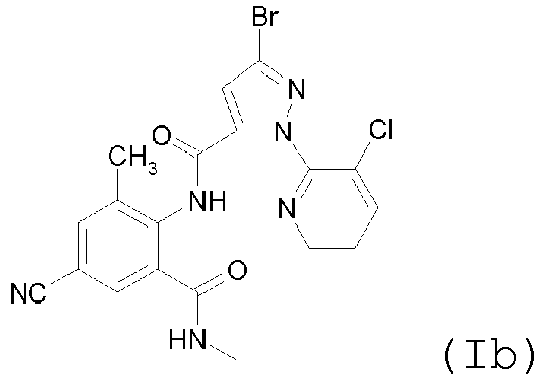
- Cyantraniliprole (3-bromo-1-(3-chloro-2-pyridyl)-4'-cyano-2'-methyl-6'-(methylcarbamoyl)pyrazole-5-carboxanilide), is an anthranilic bis-amide insecticide registered in, inter alia, the United States, for use on tree, vine and vegetable crops.
- Acibenzolar-S-methyl ( S -methyl benzo[1,2,3]thiadiazole-7-carbothioate), is a plant activator that is used for controlling fungi and bacteria.
- the present invention provides a method of reducing insect-vectored viral infection in a plant by application of a combination of cyantraniliprole (Ib), or an agrochemically acceptable salt thereof, and acibenzolar-S-methyl, in a ratio of 10 to 40 parts cyantraniliprole (Ib) to 1 to 10 parts acibenzolar-S-methyl, by weight, together with an agrochemically acceptable diluent or carrier.
- a combination of cyantraniliprole (Ib), or an agrochemically acceptable salt thereof, and acibenzolar-S-methyl in a ratio of 10 to 40 parts cyantraniliprole (Ib) to 1 to 10 parts acibenzolar-S-methyl, by weight, together with an agrochemically acceptable diluent or carrier.
- Agrochemically acceptable salts possess a cation, which is known and accepted in the art for the formation of salts for agricultural or horticultural use.
- the salts are water-soluble.
- References to a compound of formula (Ib) herein shall be deemed to also include agrochemically acceptable salts thereof.
- each agent may be in the form of an agrochemical composition comprising an agrochemically acceptable diluent or carrier.
- references herein to the active agents of the invention or components comprising said agents shall be deemed to include the agents as sole ingredients or agrochemical compositions thereof.
- the active agents of the invention may be applied simultaneously, separately or sequentially. Each active agent may be applied directly as separate components or as a mixture of the two. References herein to a combination of a compound of formula (Ib) and a plant activator, acibenzolar-S-methyl, shall be deemed to include the active agents as separate individual ingredients or as a mixture of the two, or agrochemical compositions of said individual ingredients, or mixture thereof, comprising an agrochemically acceptable diluent or carrier.
- the present invention is directed to a composition
- a composition comprising an a compound of formula (Ib), and acibenzolar-S-methyl, in a ratio of 10 to 40 parts cyantraniliprole (Ib) to 1 to 10 parts acibenzolar-S-methyl, by weight, together with an agrochemically acceptable diluent or carrier.
- the combinations of the invention may be applied to the plant, plant propagation material or locus thereof, or any combination thereof. Accordingly, the present invention provides methods as described herein comprising the application of a combination of the invention to a plant, plant propagation material or locus thereof, or any combination thereof.
- Locus means the fields on which the plants to be treated are growing, or where the seeds of cultivated plants are sown, or the place where the seed will be placed into the soil.
- the plant, plant propagation material or locus thereof may be treated with a combination of the invention before the material is sown or planted.
- the plant, plant propagation material or locus thereof may be treated with a combination of the invention after the material is sown or planted.
- the combination of the invention may be applied to the previously treated propagation material, either before its planting, and/or at its planting and/or during its growth.
- the treatment of the soil with a combination of the invention can occur on several occasions during the growth of a plant up to the harvest (i.e. before its planting, and/or at its planting and/or during its growth).
- the treatment of a single composition and then the individual components in succession is also envisaged during the growth of a plant.
- the combination of the invention may be applied to the locus of the plant on one or more occasions during the growth of the plant. It can be applied to the planting site before the seed is sown, during the sowing of the seed, pre-emergence and/or post-emergence. The combination can also be used while the plant is being grown in a green house and the use can be continued after transplantation.
- the soil may, for example, be treated directly, prior to transplanting, at transplanting or after transplanting.
- the use of the combination of the invention can be via any suitable method, which ensures that the agents penetrate the soil, for example, nursery tray application, in furrow application, soil drenching, soil injection, drip irrigation, application through sprinklers or central pivot, incorporation into soil (broad cast or in band) are such methods.
- the rate and frequency of use of the combination of the invention on the plant may vary within wide limits and depends on the type of use, the specific active agents, the nature of the soil, the method of application (pre- or post-emergence, etc .), the plant to be controlled, the prevailing climatic conditions, and other factors governed by the method of application, the time of application and the target plant.
- the time elapse between applications of the components to the locus of the plant should be such that on application of the second component the improved plant growth characteristics are demonstrated.
- the order of the application of the components is not critical.
- the second component is applied within preferably 14, such as 10, for example, 5, more preferably 4, especially 3, advantageously 1, days of the first component. Most preferably, the components are applied simultaneously or sequentially.
- Typical rates of application are normally from 1g to 2kg of active ingredient (a.i.) per hectare (ha), preferably from 5g to 1kg a.i./ha, more preferably from 20g to 600g a.i./ha, yet more preferably from 50g to 200g a.i./ha. Most preferably, the rate of application of the compound of formula (lb) is 50g to 200g / ha, and the rate of application of plant activator is from 5g to 50g / ha.
- the present invention provides an agrochemical composition
- an agrochemical composition comprising a combination of cyantraniliprole and acibenzolar-S-methyl, in a ratio of 10 to 40 parts compound of cyantraniliprole to 1 to 10 parts acibenzolar-S-methyl, by weight, together with an agrochemically acceptable diluent or carrier.
- the compound of formula (Ib) may be applied once or on several occasions in combination with acibenzolar-S-methyl during the growth of a plant depending on the plant and circumstances, for example, 1 to 6 or 1 to 4 occasions, and the amounts indicated above for a compound of formula (Ib), and acibenzolar-S-methyl are application rates are for each application.
- plant propagation material is understood to denote all the generative parts of the plant, such as seeds, which can be used for the multiplication of the latter and vegetative plant material such as cuttings and tubers (for example, potatoes).
- vegetative plant material such as cuttings and tubers (for example, potatoes).
- the seeds in the strict sense
- roots, fruits, tubers, bulbs, rhizomes parts of plants.
- Germinated plants and young plants which are to be transplanted after germination or after emergence from the soil, may also be mentioned. These young plants may be protected before transplantation by a total or partial treatment by immersion.
- the present invention is also applicable for use with a plant propagation material, e.g. plant seed that has already undergone a treatment with a pesticide.
- the treatment could vary from a thin film of the formulation containing the combination of the invention on a plant propagation material, such as a seed, where the original size and/or shape are recognizable to a thick film (such as a coating or pelleting with many layers of different materials (such as carriers, for example, clays; different formulations, such as of active ingredients; polymers; and colourants) where the original shape and/or size of the seed is no longer recognisable.
- a thin film of the formulation containing the combination of the invention on a plant propagation material, such as a seed where the original size and/or shape are recognizable to a thick film (such as a coating or pelleting with many layers of different materials (such as carriers, for example, clays; different formulations, such as of active ingredients; polymers; and colourants) where the original shape and/or size of the seed is no longer recognisable.
- the combination of the invention is adhered to the propagation material, such as a seed.
- the combination of the invention is present on the seed in a pellet form.
- the present method can be applied to a seed in any physiological state, it is preferred that the seed be in a sufficiently durable state that it incurs no damage during the treatment process.
- the seed would be a seed that had been harvested from the field; removed from the plant; and separated from any cob, stalk, outer husk, and surrounding pulp or other non-seed plant material.
- the seed would preferably also be biologically stable to the extent that the treatment would cause no biological damage to the seed. It is believed that the treatment can be applied to the seed at any time between harvest of the seed and sowing of the seed or during the sowing process (seed directed applications).
- the seed treatment occurs to an unsown seed, and the term "unsown seed” is meant to include seed at any period between the harvest of the seed and the sowing of the seed in the ground for the purpose of germination and growth of the plant. Treatment to an unsown seed is not meant to include those practices in which the pesticide is applied to the soil but would include any application practice that would target the seed during the sowing/planting process.
- the treated plant propagation material of the present invention can be treated in the same manner as conventional plant propagation material.
- the treated propagation material can be stored, handled, sowed and tilled in the same manner as any other pesticide treated material, such as seeds.
- the treatment occurs before sowing of the seed so that the seed being sown or planted has been pre-treated.
- compositions and methods of the present invention may be used for the treatment of any plant including, for example, cereals (wheat, barley, rye, oats, maize (including field corn, pop corn and sweet corn), rice, sorghum and related crops); beet (sugar beet and fodder beet); leguminous plants (beans, lentils, peas, soybeans); oil plants (rape, mustard, sunflowers); cucumber plants (marrows, cucumbers, melons); fibre plants (cotton, flax, hemp, jute); vegetables (spinach, lettuce, asparagus, cabbages, carrots, eggplants, onions, pepper, tomatoes, potatoes, paprika, okra); plantation crops (bananas, fruit trees, rubber trees, tree nurseries), ornamentals (flowers, shrubs, broad-leaved trees and evergreens, such as conifers); as well as other plants such as vines, bushberries (such as blueberries), caneberries, cranberries, peppermint,
- ryegrasses such as perennial ryegrass (Lolium perenne L.) and annual (Italian) ryegrass (Lolium multiflorum Lam.)) and warm-season turf grasses (for example, Bermudagrasses (Cynodon L. C. Rich), including hybrid and common Bermudagrass; Zoysiagrasses (Zoysia Willd.), St. Augustinegrass (Stenotaphrum secundatum (Walt.) Kuntze); and centipedegrass (Eremochloa ophiuroides (Munro.) hack.)).
- compositions and methods of the present invention are particularly suitable for the treatment of crops, such as field crops, fruits, vegetables, nuts (particularly peanuts), berries, tropical plantations, ornamentals and others, such as wheat, barley, rye, oats, rice, maize, sorghum, beans, lentils, peas, soybeans, rape, mustard, poppy, sugar-and fodder- beet, cotton, flax, hemp, jute, sunflowers, castor oil, groundnuts, potatoes, tobacco, sugar cane, apples, pears, plums, peaches, nectarines, apricots, cherries, oranges, lemons, grapefruit, mandarins, olives vines, hops, almonds, walnuts, hazelnuts, avocado, bananas, tea, coffee, coconut, cocoa, natural rubber plants, oil plants, strawberries, raspberries, blackberries, spinach, lettuce, asparagus, cabbages, Chinese kale, carrots, onions, tomatoes, cucumbers, pepper, eggplants, melons, pap
- Suitable plants also include plants that have been rendered tolerant to herbicides like bromoxynil or classes of herbicides (such as HPPD inhibitors, ALS inhibitors; for example primisulfuron, prosulfuron and trifloxysulfuron, EPSPS (5-enol-pyrovyl-shikimate-3-phosphate-synthase) inhibitors, GS (glutamine synthetase) inhibitors or PPO (protoporphyrinogen-oxidase) inhibitors) as a result of conventional methods of breeding or genetic engineering.
- herbicides like bromoxynil or classes of herbicides
- EPSPS 5-enol-pyrovyl-shikimate-3-phosphate-synthase
- GS glutamine synthetase
- PPO protoporphyrinogen-oxidase
- imazamox by conventional methods of breeding (mutagenesis) is Clearfield® summer rape (Canola).
- crops that have been rendered tolerant to herbicides or classes of herbicides by genetic engineering methods include glyphosate- and glufosinate-resistant maize varieties commercially available under the trade names RoundupReady®, Herculex I® and LibertyLink®.
- Suitable plants also include plants which have been so transformed by the use of recombinant DNA techniques that they are capable of synthesising one or more selectively acting toxins, such as are known from toxin-producing bacteria, especially those of the genus Bacillus.
- Suitable plants also include plants which have been so transformed by the use of recombinant DNA techniques that they are capable of synthesising antipathogenic substances having a selective action, such as the so-called "pathogenesis-related proteins" (PRPs, see e.g. European patent application EP 0,392,225 ).
- PRPs pathogenesis-related proteins
- Examples of such antipathogenic substances and transgenic plants capable of synthesising such antipathogenic substances are known, for example, from European patent applications EP 0,392,225 and EP 0,353,191 and International patent application WO 95/33818 .
- the methods of producing such transgenic plants are generally known to the person skilled in the art and are described, for example, in the publications mentioned above.
- compositions and methods of the present invention as defined herein are particularly suitable for the treatment of tomato, tobacco, peanut and barley.
- the present invention provides a method of reducing insect-vectored viral infection in a tomato, tobacco, peanut or barley plant by application of a combination of cyantraniliprole and acibenzolar-S-methyl.
- the present invention provides a combination of cyantraniliprole and acibenzolar-S-methyl, for use in the methods of the present invention, wherein the plant is a tomato, tobacco, peanut or barley plant.
- the present invention provides for the use of a combination of cyantraniliprole and acibenzolar-S-methyl, in the methods of the present invention, wherein the plant is a tomato, tobacco, peanut or barley plant.
- the present invention additionally provides a plant or plant propagation material treated with a combination of the invention as defined herein.
- the plant or plant propagation material is tomato, tobacco, peanut or barley.
- the plant or plant propagation material is tomato, tobacco, peanut or barley, which has been treated with a defined combination of cyantraniliprole and acibenzolar-S-methyl.
- compositions and methods of the present invention are particularly suitable for the treatment of plants which are susceptible to damage by insect-vectored viral infections transmitted by whitefly, aphid, leafhopper or thrips, such as leaf curl virus, which may be transmitted by whitefly.
- the present invention provides a method of reducing insect-vectored viral infection in a plant by application of a combination of cyantraniliprole and acibenzolar-S-methyl, wherein the plant is susceptible to damage by viral infections transmitted by whitefly, aphid, leafhopper or thrips.
- the present invention provides a method of reducing damage to a plant caused by one or more viral infections transmitted by whitefly, aphid, leafhopper or thrips, by application of a combination of cyantraniliprole and acibenzolar-S-methyl.
- the present invention a combination of cyantraniliprole and acibenzolar-S-methyl, for use in the methods of the present invention, wherein the plant is susceptible to damage by viral infections transmitted by whitefly, aphid, leafhopper or thrips.
- the present invention provides for the use of a combination of cyantraniliprole and acibenzolar-S-methyl, in the methods of the present invention, wherein the plant is susceptible to damage by viral infections transmitted by whitefly, aphid, leafhopper or thrips.
- the combinations, compositions and methods of the present invention are particularly suitable for the treatment of tomato, tobacco, peanut and barley, in order to protect them from damage by insect-vectored viral infections transmitted by whitefly, aphid, leafhopper or thrips.
- a grower in the management of his crop would use one or more other agronomic chemicals in addition to the combination of the present invention.
- agronomic chemicals include herbicides, pesticides, such as fungicides, herbicides, insecticides, bactericides, acaricides, nematicides, plant nutrients and plant fertilizers.
- the present invention provides for the use of a combination or composition according to the present invention together with one or more herbicides, pesticides, plant nutrients or plant fertilizers.
- Suitable examples of plant nutrients or plant fertilizers are calcium sulfate CaSO 4 , calcium nitrate Ca(NO 3 ) 2 .4H 2 O, calcium carbonate CaCO 3 , potassium nitrate KNO 3 , magnesium sulfate MgSO 4 , potassium hydrogen phosphate KH 2 PO 4 , manganese sulfate MnSO 4 , copper sulfate CuSO 4 , zinc sulfate ZnSO 4 , nickel chloride NiCl 2 , cobalt sulfate CoSO 4 , potassium hydroxide KOH, sodium chloride NaCl, boric acid H 3 BO 3 and metal salts thereof, Na 2 MoO 4 .
- the nutrients may be present in an amount of 5% to 50% by weight, preferably of 10% to 25% by weight or of 15% to 20% by weight each.
- Preferred additional nutrients are urea, melamine, potassium oxide, and inorganic nitrates.
- the most preferred additional plant nutrient is potassium oxide. Where the preferred additional nutrient is urea, it is present in an amount of generally 1% to 20% by weight, preferably 2% to 10% by weight or of 3% to 7% by weight.
- herbicides examples include glyphosate, glufosinate, glyfosinate, imidazilinone, and STS system (sulfonylurea).
- pesticides include spinosad, avermectin, such as the natural avermectins, A1a, A1b, A2a, A2b, B1a, B1b, B2a and B2b, which can be obtained from Streptomyces avermitilis, and avermectin monosaccharide derivatives, such as abamectin, doramectin, emamectin, eprinomectin, ivermectin and selamectin, and milbemycin derivatives, such as milbemectin, milbemycin oxime, moxidectin and SI0009.
- avermectin such as the natural avermectins, A1a, A1b, A2a, A2b, B1a, B1b, B2a and B2b, which can be obtained from Streptomyces avermitilis
- nematicides are abamectin, carbamate nematicides (e.g. aldicarb, carbofuran, carbosulfan, oxamyl, aldoxycarb, ethoprop benomyl, alanycarb), organophosphorus nematicides (e.g.
- pesticides that can be used include acephate, acetamiprid, acetoprole, aldicarb, alpha-cypermethrin, azinphos-methyl, azoxystrobin, benalaxyl, benalaxyl-M, benclothiaz, bendicoarb, benfuracarb, benomyl, bensultap, bifenthrin, bitertanol, boscalid, captan, carbendazim, carbaryl, carbofuran, carbosulfan, carboxin, carbpropamid, chlorothalonil, chlorpyrifos, chlorpyrifos-methyl, clothianidin, copper salts (such as copper sulfate, cuprous oxide, Bordeaux mixture, copper hydroxide, copper sulfate (tribasic), copper oxychloride and copper octanoate), cymoxanil, cyperme
- the components of the invention are generally in the form of a formulation containing other customary formulation adjuvants because it allows, for example, less burdensome handling and application.
- DF dry flowables
- LF liquid flowables
- TL true liquids
- EC emulsifiable concentrates
- SC suspension concentrates
- D dusts
- WP wettable powders
- SE suspoemulsions
- WG water-dispersible granules
- DF dry flowables
- LF liquid flowables
- TL true liquids
- SC suspension concentrates
- D dusts
- WP wettable powders
- SE suspoemulsions
- WG water-dispersible granules
- others such as encapsulations in polymeric substances.
- the compound of formula (Ib), andacibenzolar-S-methyl can be part of a single composition and used simultaneously (i.e. they are mixed together - often referred to as "a pre-mix"), or can be separate products and used separately or sequentially. In the event they are separate products, they can be mixed together shortly before use by the user.
- the compound of formula (Ib), and acibenzolar-S-methyl are used in single composition that has been specifically formulated, the composition comprising at least one of the adjuvants customary in formulation technology, such as extenders, e.g., solvents or solid carriers, or surface-active compounds (surfactants).
- the adjuvants customary in formulation technology such as extenders, e.g., solvents or solid carriers, or surface-active compounds (surfactants).
- Suitable formulation adjuvants are, for example, solid carriers, solvents, stabilisers, slow-release adjuvants, dyes and optionally surface-active substances (surfactants).
- Suitable carriers and adjuvants in this case include all substances customarily used in crop protection products, especially in products for controlling snails and slugs.
- Suitable adjuvants, such as solvents, solid carriers, surface-active compounds, non-ionic surfactants, cationic surfactants, anionic surfactants and further adjuvants in the compositions used in accordance with the invention are, for example, the same as those described in EP 0,736,252 .
- compositions may comprise from 0.1 to 99%, in particular 0.1 to 95%, of the combination and from 1 to 99.9 %, in particular 5 to 99.9 %, of at least one solid or liquid auxiliary.
- the composition may additionally comprise from 0 to 25 %, in particular 0.1 to 20 %, of surfactants (% is in each case per cent by weight). While concentrated compositions are more preferred as commercial goods, the end user generally uses dilute compositions that comprise considerably lower concentrations of the combination.
- Emulsifiable concentrates are:
- compositions may also comprise further solid or liquid adjuvants, such as stabilisers, e.g., vegetable oils or epoxidised vegetable oils (e.g., epoxidised coconut oil, rapeseed oil or soybean oil), antifoams, e.g., silicone oil, preservatives, viscosity regulators, binders and/or tackifiers.
- stabilisers e.g., vegetable oils or epoxidised vegetable oils (e.g., epoxidised coconut oil, rapeseed oil or soybean oil)
- antifoams e.g., silicone oil
- preservatives e.g., silicone oil
- viscosity regulators binders and/or tackifiers.
Landscapes
- Life Sciences & Earth Sciences (AREA)
- Agronomy & Crop Science (AREA)
- Pest Control & Pesticides (AREA)
- Plant Pathology (AREA)
- Health & Medical Sciences (AREA)
- Engineering & Computer Science (AREA)
- Dentistry (AREA)
- General Health & Medical Sciences (AREA)
- Wood Science & Technology (AREA)
- Zoology (AREA)
- Environmental Sciences (AREA)
- Agricultural Chemicals And Associated Chemicals (AREA)
- Medicines Containing Material From Animals Or Micro-Organisms (AREA)
- Medicines That Contain Protein Lipid Enzymes And Other Medicines (AREA)
Claims (8)
- Procédé de réduction d'une infection virale à vecteur insecte chez une plante par application d'une combinaison de cyantraniliprole (Ib), ou un sel acceptable en agrochimie de celui-ci,

- Procédé selon la revendication 1 dans lequel le taux d'application du cyantraniliprole (Ib) est de 50 g à 200 g/ha, et le taux d'application de l'acibenzolar-S-méthyle est de 5 g à 50 g/ha.
- Procédé selon la revendication 1 ou la revendication 2 dans lequel la plante est une plante cultivée choisie parmi des cultures en champs de fruits, légumes, noix, arachides, baies, plantations tropicales, plantes d'ornement et autres, telles que le blé, l'orge, le seigle, l'avoine, le riz, le maïs, le sorgho, les fèves, les lentilles, les pois, le soja, le colza, la moutarde, le pavot, la betterave sucrière et fourragère, le coton, le lin, le chanvre, la jute, les tournesols, le ricin, les arachides, les pommes de terre, le tabac, la canne à sucre, les pommes, les poires, les prunes, les pèches, les nectarines, les abricots, les cerises, les oranges, les citrons, le pamplemousse, les mandarines, les olives, les vignes, le houblon, les amandes, les noix, les noisettes, l'avocat, les bananes, le thé, le café, la noix de coco, le cacao, les plantes de caoutchouc naturel, les plantes oléagineuses, les fraises, les framboises, les mûres, l'épinard, la laitue, l'asperge, les choux, le chou frisé chinois, les carottes, les oignons, les tomates, les concombres, le poivron, les aubergines, les melons, le paprika, le piment, les roses, les chrysanthèmes et les oeillets.
- Procédé selon la revendication 3 dans lequel la plante est la tomate, le tabac, l'arachide ou l'orge.
- Procédé selon la revendications 1 ou la revendication 2 dans lequel la plante est sensible aux dommages causés par des infections virales transmises par les aleurodes, les aphidés, les cicadelles ou les thrips.
- Procédé selon l'une quelconque des revendications 1 à 5 dans lequel le cyantraniliprole (Ib) et l'acibenzolar-5-méthyle sont appliqués simultanément, séparément ou séquentiellement.
- Plante ou matériau de propagation de plante traité(e) avec et comprenant une combinaison de cyantraniliprole (Ib), ou un sel acceptable en agrochimie de celui-ci,

- Composition comprenant du cyantraniliprole (Ib), ou un sel acceptable en agrochimie de celui-ci,
Priority Applications (4)
| Application Number | Priority Date | Filing Date | Title |
|---|---|---|---|
| EP11718686.6A EP2563149B1 (fr) | 2010-04-30 | 2011-04-21 | Procédé pour réduire des infections virales provoquées par des insectes vecteurs |
| HRP20161372TT HRP20161372T1 (hr) | 2010-04-30 | 2011-04-21 | Postupak za smanjenje virusnih infekcija vektoriranih kukcima |
| CY20161101147T CY1118556T1 (el) | 2010-04-30 | 2016-11-09 | Μια μεθοδος μειωσης των μολυνσεων απο ιους μεσω εντομων-φορεων |
| CY2021001C CY2021001I2 (el) | 2010-04-30 | 2021-07-26 | Παραγωγα ετεροκυκλικου αμιδιου χρησιμα ως μικροβιοκτονα |
Applications Claiming Priority (3)
| Application Number | Priority Date | Filing Date | Title |
|---|---|---|---|
| EP10161627 | 2010-04-30 | ||
| PCT/EP2011/056390 WO2011134876A1 (fr) | 2010-04-30 | 2011-04-21 | Procédé pour réduire des infections virales provoquées par des insectes vecteurs |
| EP11718686.6A EP2563149B1 (fr) | 2010-04-30 | 2011-04-21 | Procédé pour réduire des infections virales provoquées par des insectes vecteurs |
Publications (2)
| Publication Number | Publication Date |
|---|---|
| EP2563149A1 EP2563149A1 (fr) | 2013-03-06 |
| EP2563149B1 true EP2563149B1 (fr) | 2016-08-31 |
Family
ID=44562678
Family Applications (1)
| Application Number | Title | Priority Date | Filing Date |
|---|---|---|---|
| EP11718686.6A Active EP2563149B1 (fr) | 2010-04-30 | 2011-04-21 | Procédé pour réduire des infections virales provoquées par des insectes vecteurs |
Country Status (14)
| Country | Link |
|---|---|
| US (1) | US20130212744A1 (fr) |
| EP (1) | EP2563149B1 (fr) |
| JP (1) | JP2013525395A (fr) |
| KR (1) | KR20130067263A (fr) |
| CN (1) | CN102869263A (fr) |
| BR (1) | BR112012027814A2 (fr) |
| CY (2) | CY1118556T1 (fr) |
| ES (1) | ES2602741T3 (fr) |
| HR (1) | HRP20161372T1 (fr) |
| HU (1) | HUE031700T2 (fr) |
| MA (1) | MA34182B1 (fr) |
| MX (1) | MX2012012448A (fr) |
| PT (1) | PT2563149T (fr) |
| WO (1) | WO2011134876A1 (fr) |
Families Citing this family (19)
| Publication number | Priority date | Publication date | Assignee | Title |
|---|---|---|---|---|
| JP2013536651A (ja) | 2010-08-24 | 2013-09-19 | コーニンクレッカ フィリップス エヌ ヴェ | 属性ベースのデジタル署名 |
| CN103238603B (zh) * | 2012-02-01 | 2015-05-27 | 沈阳科创化学品有限公司 | 一种杀虫制剂及其应用 |
| HUP1300435A2 (hu) * | 2012-07-20 | 2014-02-28 | Sumitomo Chemical Co | Eljárás a kártékony organizmusok által okozott károk csökkentésére a gabonatermesztésben |
| WO2014079820A1 (fr) | 2012-11-22 | 2014-05-30 | Basf Se | Utilisation de composés d'anthranilamides pour réduire les infections virales véhiculées par les insectes |
| CN105746526B (zh) * | 2013-01-16 | 2018-06-26 | 陕西汤普森生物科技有限公司 | 一种含四氯虫酰胺与生物源类的杀虫组合物 |
| CN105746540A (zh) * | 2013-01-18 | 2016-07-13 | 陕西汤普森生物科技有限公司 | 一种含四氯虫酰胺的杀虫组合物 |
| ES2716379T3 (es) * | 2013-02-20 | 2019-06-12 | Basf Se | Compuestos de antranilamida, sus mezclas y el uso de los mismos como pesticidas |
| CN103651434A (zh) * | 2013-12-19 | 2014-03-26 | 北京燕化永乐生物科技股份有限公司 | 一种复配杀虫剂 |
| CN103651385A (zh) * | 2013-12-19 | 2014-03-26 | 北京燕化永乐生物科技股份有限公司 | 一种杀虫组合物 |
| CN103651386A (zh) * | 2013-12-19 | 2014-03-26 | 北京燕化永乐生物科技股份有限公司 | 含溴虫腈的杀虫组合物 |
| ES2882654T3 (es) * | 2014-03-28 | 2021-12-02 | Ishihara Sangyo Kaisha | Método para prevenir la infección por virus vegetal |
| WO2016115470A1 (fr) * | 2015-01-16 | 2016-07-21 | Valent Biosciences Corporation | Mélanges synergiques de bacillus thuringiensis subsp. aizawai, bacillus thuringiensis subsp. kurstaki et de chlorantraniliprole |
| AU2016206537B2 (en) * | 2015-01-16 | 2019-04-04 | Valent Biosciences Llc | Synergistic Bacillus thuringiensis subsp. aizawai and chlorantraniliprole mixtures for plant pest control |
| JP6789612B2 (ja) | 2015-02-06 | 2020-11-25 | 扶桑化学工業株式会社 | 植物用発育向上剤、およびそれを用いた植物の製造方法 |
| IN201731033800A (fr) * | 2017-09-23 | 2019-03-29 | ||
| WO2020058010A1 (fr) * | 2018-09-19 | 2020-03-26 | Basf Se | Mélanges pesticides comprenant un composé mésoionique |
| EP3628157A1 (fr) | 2018-09-28 | 2020-04-01 | Basf Se | Procede de lutte contre les insectes resistants aux insecticides et transmission du virus aux plantes |
| WO2021148330A1 (fr) | 2020-01-20 | 2021-07-29 | Syngenta Crop Protection Ag | Procédé de réduction d'infections virales véhiculées par les insectes dans des graminées |
| KR102442464B1 (ko) | 2020-10-14 | 2022-09-14 | 호서대학교 산학협력단 | 억새 꽃 정유를 포함하는 피부재생 또는 상처치유용 조성물 |
Family Cites Families (20)
| Publication number | Priority date | Publication date | Assignee | Title |
|---|---|---|---|---|
| DD100135A1 (fr) * | 1972-04-19 | 1973-09-12 | ||
| CA1340685C (fr) | 1988-07-29 | 1999-07-27 | Frederick Meins | Sequences d'adn codant des polypeptides possedant une activite de beta-1,3-glucanase |
| EP0392225B1 (fr) | 1989-03-24 | 2003-05-28 | Syngenta Participations AG | Plantes transgéniques résistantes aux maladies |
| US5639949A (en) | 1990-08-20 | 1997-06-17 | Ciba-Geigy Corporation | Genes for the synthesis of antipathogenic substances |
| TW344649B (en) | 1995-04-05 | 1998-11-11 | Novartis Ag | Pesticidal composition |
| BR0212183B1 (pt) | 2001-08-16 | 2014-10-21 | Du Pont | composto de antranilamida substituída, seus n-óxidos e sais, método para o controle de uma praga invertebrada e composição para o controle de uma praga invertebrada |
| ES2424840T3 (es) | 2003-01-28 | 2013-10-09 | E.I. Du Pont De Nemours And Company | Insecticidas tipo ciano antranilamida |
| HRP20110021T1 (hr) | 2004-02-18 | 2011-03-31 | Ishihara Sangyo Kaisha | Antranilamidi, postupak njihove priprave i suzbijači štetočina koji ih sadrže |
| WO2005107468A1 (fr) | 2004-05-10 | 2005-11-17 | Syngenta Participations Ag | Melanges pesticides |
| MY140912A (en) * | 2004-07-26 | 2010-01-29 | Du Pont | Mixtures of anthranilamide invertebrate pest control agents |
| RU2007140900A (ru) | 2005-04-08 | 2009-05-20 | Зингента Партисипейшнс Аг (Ch) | Смеси пестицидов |
| DE102006042437A1 (de) | 2006-03-30 | 2007-10-04 | Bayer Cropscience Ag | Wirkstoffkombinationen mit insektiziden Eigenschaften |
| BRPI0716419A2 (pt) | 2006-08-08 | 2013-10-29 | Bayer Cropscience Lp | Método de aperfeiçoamento de crescimento de planta por redução de infecções virais |
| CL2007002306A1 (es) | 2006-08-09 | 2009-08-28 | Du Pont | Metodo para incrementar el rendimiento de un cultivo o el vigor de un cultivo y detener la transmision de enfermedades infecciosas por artropodos plaga que comprende tratar plantas de un cultivo con una carboxamida artropodicida,su n-oxido, o una sal de esta. |
| AU2007298999B2 (en) * | 2006-09-18 | 2013-11-07 | Basf Se | Pesticidal mixtures comprising an anthranilamide insecticide and a fungicide |
| TW200904332A (en) | 2007-04-04 | 2009-02-01 | Syngenta Participations Ag | Method of improving the growth of a plant |
| CN101730472A (zh) * | 2007-06-14 | 2010-06-09 | 先正达参股股份有限公司 | 包含杀虫剂和植物活化剂的农药组合 |
| EP2070413A1 (fr) * | 2007-12-11 | 2009-06-17 | Bayer CropScience AG | Combinaisons de composés actifs |
| WO2010025870A1 (fr) * | 2008-09-03 | 2010-03-11 | Bayer Cropscience Ag | Combinaisons synergiques de dérivés de l’acide carbonique du thiadiazole |
| WO2011083709A1 (fr) * | 2010-01-08 | 2011-07-14 | 住友化学株式会社 | Composition agrochimique granulaire |
-
2011
- 2011-04-21 KR KR1020127028434A patent/KR20130067263A/ko not_active Withdrawn
- 2011-04-21 JP JP2013506596A patent/JP2013525395A/ja not_active Withdrawn
- 2011-04-21 EP EP11718686.6A patent/EP2563149B1/fr active Active
- 2011-04-21 MX MX2012012448A patent/MX2012012448A/es not_active Application Discontinuation
- 2011-04-21 PT PT117186866T patent/PT2563149T/pt unknown
- 2011-04-21 BR BR112012027814A patent/BR112012027814A2/pt not_active IP Right Cessation
- 2011-04-21 WO PCT/EP2011/056390 patent/WO2011134876A1/fr not_active Ceased
- 2011-04-21 MA MA35336A patent/MA34182B1/fr unknown
- 2011-04-21 HR HRP20161372TT patent/HRP20161372T1/hr unknown
- 2011-04-21 US US13/695,410 patent/US20130212744A1/en not_active Abandoned
- 2011-04-21 CN CN2011800216513A patent/CN102869263A/zh active Pending
- 2011-04-21 HU HUE11718686A patent/HUE031700T2/en unknown
- 2011-04-21 ES ES11718686.6T patent/ES2602741T3/es active Active
-
2016
- 2016-11-09 CY CY20161101147T patent/CY1118556T1/el unknown
-
2021
- 2021-07-26 CY CY2021001C patent/CY2021001I2/el unknown
Non-Patent Citations (1)
| Title |
|---|
| THOMAS M. PERRING ET AL: "MANAGEMENT OF PLANT VIRAL DISEASES THROUGH CHEMICAL CONTROL OF INSECT VECTORS", ANNUAL REVIEW OF ENTOMOLOGY, vol. 44, no. 1, 1 January 1999 (1999-01-01), pages 457 - 481, XP055089744, ISSN: 0066-4170, DOI: 10.1146/annurev.ento.44.1.457 * |
Also Published As
| Publication number | Publication date |
|---|---|
| HRP20161372T1 (hr) | 2016-12-02 |
| EP2563149A1 (fr) | 2013-03-06 |
| CY2021001I2 (el) | 2023-01-05 |
| MA34182B1 (fr) | 2013-04-03 |
| ES2602741T3 (es) | 2017-02-22 |
| US20130212744A1 (en) | 2013-08-15 |
| WO2011134876A1 (fr) | 2011-11-03 |
| HUE031700T2 (en) | 2017-07-28 |
| MX2012012448A (es) | 2012-11-21 |
| CN102869263A (zh) | 2013-01-09 |
| JP2013525395A (ja) | 2013-06-20 |
| CY1118556T1 (el) | 2017-07-12 |
| BR112012027814A2 (pt) | 2017-01-10 |
| CY2021001I1 (el) | 2021-05-05 |
| KR20130067263A (ko) | 2013-06-21 |
| PT2563149T (pt) | 2016-11-15 |
Similar Documents
| Publication | Publication Date | Title |
|---|---|---|
| EP2563149B1 (fr) | Procédé pour réduire des infections virales provoquées par des insectes vecteurs | |
| EP2592923B1 (fr) | Procédés d'irrigation de plantes avec 1-mcp | |
| US9980479B2 (en) | Method of reducing nematode damage | |
| US20100173776A1 (en) | Method for enhancing plant tolerance | |
| CN108024538A (zh) | 协同杀昆虫组合物 |
Legal Events
| Date | Code | Title | Description |
|---|---|---|---|
| PUAI | Public reference made under article 153(3) epc to a published international application that has entered the european phase |
Free format text: ORIGINAL CODE: 0009012 |
|
| 17P | Request for examination filed |
Effective date: 20121026 |
|
| AK | Designated contracting states |
Kind code of ref document: A1 Designated state(s): AL AT BE BG CH CY CZ DE DK EE ES FI FR GB GR HR HU IE IS IT LI LT LU LV MC MK MT NL NO PL PT RO RS SE SI SK SM TR |
|
| DAX | Request for extension of the european patent (deleted) | ||
| 17Q | First examination report despatched |
Effective date: 20131205 |
|
| GRAP | Despatch of communication of intention to grant a patent |
Free format text: ORIGINAL CODE: EPIDOSNIGR1 |
|
| RIC1 | Information provided on ipc code assigned before grant |
Ipc: A01N 43/56 20060101ALI20160120BHEP Ipc: A01P 21/00 20060101ALI20160120BHEP Ipc: A01N 43/82 20060101ALI20160120BHEP Ipc: A01P 7/00 20060101AFI20160120BHEP |
|
| INTG | Intention to grant announced |
Effective date: 20160204 |
|
| GRAS | Grant fee paid |
Free format text: ORIGINAL CODE: EPIDOSNIGR3 |
|
| GRAA | (expected) grant |
Free format text: ORIGINAL CODE: 0009210 |
|
| AK | Designated contracting states |
Kind code of ref document: B1 Designated state(s): AL AT BE BG CH CY CZ DE DK EE ES FI FR GB GR HR HU IE IS IT LI LT LU LV MC MK MT NL NO PL PT RO RS SE SI SK SM TR |
|
| REG | Reference to a national code |
Ref country code: CH Ref legal event code: EP Ref country code: GB Ref legal event code: FG4D |
|
| REG | Reference to a national code |
Ref country code: IE Ref legal event code: FG4D |
|
| REG | Reference to a national code |
Ref country code: DE Ref legal event code: R096 Ref document number: 602011029811 Country of ref document: DE |
|
| REG | Reference to a national code |
Ref country code: AT Ref legal event code: REF Ref document number: 824115 Country of ref document: AT Kind code of ref document: T Effective date: 20161015 |
|
| REG | Reference to a national code |
Ref country code: HR Ref legal event code: TUEP Ref document number: P20161372 Country of ref document: HR |
|
| REG | Reference to a national code |
Ref country code: RO Ref legal event code: EPE |
|
| REG | Reference to a national code |
Ref country code: PT Ref legal event code: SC4A Ref document number: 2563149 Country of ref document: PT Date of ref document: 20161115 Kind code of ref document: T Free format text: AVAILABILITY OF NATIONAL TRANSLATION Effective date: 20161109 |
|
| REG | Reference to a national code |
Ref country code: HR Ref legal event code: T1PR Ref document number: P20161372 Country of ref document: HR |
|
| REG | Reference to a national code |
Ref country code: LT Ref legal event code: MG4D |
|
| REG | Reference to a national code |
Ref country code: NL Ref legal event code: MP Effective date: 20160831 |
|
| REG | Reference to a national code |
Ref country code: AT Ref legal event code: MK05 Ref document number: 824115 Country of ref document: AT Kind code of ref document: T Effective date: 20160831 |
|
| PG25 | Lapsed in a contracting state [announced via postgrant information from national office to epo] |
Ref country code: RS Free format text: LAPSE BECAUSE OF FAILURE TO SUBMIT A TRANSLATION OF THE DESCRIPTION OR TO PAY THE FEE WITHIN THE PRESCRIBED TIME-LIMIT Effective date: 20160831 Ref country code: NO Free format text: LAPSE BECAUSE OF FAILURE TO SUBMIT A TRANSLATION OF THE DESCRIPTION OR TO PAY THE FEE WITHIN THE PRESCRIBED TIME-LIMIT Effective date: 20161130 Ref country code: LT Free format text: LAPSE BECAUSE OF FAILURE TO SUBMIT A TRANSLATION OF THE DESCRIPTION OR TO PAY THE FEE WITHIN THE PRESCRIBED TIME-LIMIT Effective date: 20160831 Ref country code: FI Free format text: LAPSE BECAUSE OF FAILURE TO SUBMIT A TRANSLATION OF THE DESCRIPTION OR TO PAY THE FEE WITHIN THE PRESCRIBED TIME-LIMIT Effective date: 20160831 |
|
| REG | Reference to a national code |
Ref country code: ES Ref legal event code: FG2A Ref document number: 2602741 Country of ref document: ES Kind code of ref document: T3 Effective date: 20170222 |
|
| PG25 | Lapsed in a contracting state [announced via postgrant information from national office to epo] |
Ref country code: SE Free format text: LAPSE BECAUSE OF FAILURE TO SUBMIT A TRANSLATION OF THE DESCRIPTION OR TO PAY THE FEE WITHIN THE PRESCRIBED TIME-LIMIT Effective date: 20160831 Ref country code: AT Free format text: LAPSE BECAUSE OF FAILURE TO SUBMIT A TRANSLATION OF THE DESCRIPTION OR TO PAY THE FEE WITHIN THE PRESCRIBED TIME-LIMIT Effective date: 20160831 Ref country code: LV Free format text: LAPSE BECAUSE OF FAILURE TO SUBMIT A TRANSLATION OF THE DESCRIPTION OR TO PAY THE FEE WITHIN THE PRESCRIBED TIME-LIMIT Effective date: 20160831 Ref country code: NL Free format text: LAPSE BECAUSE OF FAILURE TO SUBMIT A TRANSLATION OF THE DESCRIPTION OR TO PAY THE FEE WITHIN THE PRESCRIBED TIME-LIMIT Effective date: 20160831 |
|
| REG | Reference to a national code |
Ref country code: FR Ref legal event code: PLFP Year of fee payment: 7 |
|
| REG | Reference to a national code |
Ref country code: GR Ref legal event code: EP Ref document number: 20160402806 Country of ref document: GR Effective date: 20170222 |
|
| REG | Reference to a national code |
Ref country code: GB Ref legal event code: 732E Free format text: REGISTERED BETWEEN 20170331 AND 20170405 |
|
| PG25 | Lapsed in a contracting state [announced via postgrant information from national office to epo] |
Ref country code: EE Free format text: LAPSE BECAUSE OF FAILURE TO SUBMIT A TRANSLATION OF THE DESCRIPTION OR TO PAY THE FEE WITHIN THE PRESCRIBED TIME-LIMIT Effective date: 20160831 |
|
| PG25 | Lapsed in a contracting state [announced via postgrant information from national office to epo] |
Ref country code: SM Free format text: LAPSE BECAUSE OF FAILURE TO SUBMIT A TRANSLATION OF THE DESCRIPTION OR TO PAY THE FEE WITHIN THE PRESCRIBED TIME-LIMIT Effective date: 20160831 Ref country code: DK Free format text: LAPSE BECAUSE OF FAILURE TO SUBMIT A TRANSLATION OF THE DESCRIPTION OR TO PAY THE FEE WITHIN THE PRESCRIBED TIME-LIMIT Effective date: 20160831 Ref country code: PL Free format text: LAPSE BECAUSE OF FAILURE TO SUBMIT A TRANSLATION OF THE DESCRIPTION OR TO PAY THE FEE WITHIN THE PRESCRIBED TIME-LIMIT Effective date: 20160831 Ref country code: BE Free format text: LAPSE BECAUSE OF FAILURE TO SUBMIT A TRANSLATION OF THE DESCRIPTION OR TO PAY THE FEE WITHIN THE PRESCRIBED TIME-LIMIT Effective date: 20160831 Ref country code: CZ Free format text: LAPSE BECAUSE OF FAILURE TO SUBMIT A TRANSLATION OF THE DESCRIPTION OR TO PAY THE FEE WITHIN THE PRESCRIBED TIME-LIMIT Effective date: 20160831 Ref country code: SK Free format text: LAPSE BECAUSE OF FAILURE TO SUBMIT A TRANSLATION OF THE DESCRIPTION OR TO PAY THE FEE WITHIN THE PRESCRIBED TIME-LIMIT Effective date: 20160831 |
|
| REG | Reference to a national code |
Ref country code: DE Ref legal event code: R097 Ref document number: 602011029811 Country of ref document: DE |
|
| PLBE | No opposition filed within time limit |
Free format text: ORIGINAL CODE: 0009261 |
|
| STAA | Information on the status of an ep patent application or granted ep patent |
Free format text: STATUS: NO OPPOSITION FILED WITHIN TIME LIMIT |
|
| REG | Reference to a national code |
Ref country code: HU Ref legal event code: AG4A Ref document number: E031700 Country of ref document: HU |
|
| 26N | No opposition filed |
Effective date: 20170601 |
|
| PG25 | Lapsed in a contracting state [announced via postgrant information from national office to epo] |
Ref country code: SI Free format text: LAPSE BECAUSE OF FAILURE TO SUBMIT A TRANSLATION OF THE DESCRIPTION OR TO PAY THE FEE WITHIN THE PRESCRIBED TIME-LIMIT Effective date: 20160831 |
|
| REG | Reference to a national code |
Ref country code: DE Ref legal event code: R119 Ref document number: 602011029811 Country of ref document: DE |
|
| REG | Reference to a national code |
Ref country code: IE Ref legal event code: MM4A |
|
| PG25 | Lapsed in a contracting state [announced via postgrant information from national office to epo] |
Ref country code: DE Free format text: LAPSE BECAUSE OF NON-PAYMENT OF DUE FEES Effective date: 20171103 Ref country code: MC Free format text: LAPSE BECAUSE OF FAILURE TO SUBMIT A TRANSLATION OF THE DESCRIPTION OR TO PAY THE FEE WITHIN THE PRESCRIBED TIME-LIMIT Effective date: 20160831 |
|
| PG25 | Lapsed in a contracting state [announced via postgrant information from national office to epo] |
Ref country code: LU Free format text: LAPSE BECAUSE OF NON-PAYMENT OF DUE FEES Effective date: 20170421 |
|
| REG | Reference to a national code |
Ref country code: FR Ref legal event code: PLFP Year of fee payment: 8 |
|
| PG25 | Lapsed in a contracting state [announced via postgrant information from national office to epo] |
Ref country code: IE Free format text: LAPSE BECAUSE OF NON-PAYMENT OF DUE FEES Effective date: 20170421 |
|
| PG25 | Lapsed in a contracting state [announced via postgrant information from national office to epo] |
Ref country code: MT Free format text: LAPSE BECAUSE OF NON-PAYMENT OF DUE FEES Effective date: 20170421 |
|
| REG | Reference to a national code |
Ref country code: ES Ref legal event code: SPCF Free format text: PRODUCT NAME: COMBINACION DE CIANTRANILIPROL, O UNA SAL AGROQUIMICAMENTE ACEPTABLE DEL MISMO Y ACIBENZOLAR-S-METILO EN TODAS SUS FORMAS TAL COMO ESTAN PROTEGIDAS EN LA PATENTE BASE; NATIONAL AUTHORISATION NUMBER: ES-00096; DATE OF AUTHORISATION: 20180227; NUMBER OF FIRST AUTHORISATION IN EUROPEAN ECONOMIC AREA (EEA): ; DATE OF FIRST AUTHORISATION IN EEA: Spc suppl protection certif: C201830038 Effective date: 20180726 |
|
| PG25 | Lapsed in a contracting state [announced via postgrant information from national office to epo] |
Ref country code: AL Free format text: LAPSE BECAUSE OF FAILURE TO SUBMIT A TRANSLATION OF THE DESCRIPTION OR TO PAY THE FEE WITHIN THE PRESCRIBED TIME-LIMIT Effective date: 20160831 |
|
| REG | Reference to a national code |
Ref country code: ES Ref legal event code: SPCG Free format text: PRODUCT NAME: COMBINACION DE CIANTRANILIPROL, O UNA SAL AGROQUIMICAMENTE ACEPTABLE DEL MISMO Y ACIBENZOLAR-S-METILO; NATIONAL AUTHORISATION NUMBER: ES-00096; DATE OF AUTHORISATION: 20180227; NUMBER OF FIRST AUTHORISATION IN EUROPEAN ECONOMIC AREA (EEA): ; DATE OF FIRST AUTHORISATION IN EEA: Spc suppl protection certif: C201830038 Extension date: 20330227 Effective date: 20190321 |
|
| REG | Reference to a national code |
Ref country code: HR Ref legal event code: ODRP Ref document number: P20161372 Country of ref document: HR Payment date: 20190402 Year of fee payment: 9 |
|
| PG25 | Lapsed in a contracting state [announced via postgrant information from national office to epo] |
Ref country code: MK Free format text: LAPSE BECAUSE OF FAILURE TO SUBMIT A TRANSLATION OF THE DESCRIPTION OR TO PAY THE FEE WITHIN THE PRESCRIBED TIME-LIMIT Effective date: 20160831 |
|
| REG | Reference to a national code |
Ref country code: HR Ref legal event code: ODRP Ref document number: P20161372 Country of ref document: HR Payment date: 20200326 Year of fee payment: 10 |
|
| PG25 | Lapsed in a contracting state [announced via postgrant information from national office to epo] |
Ref country code: IS Free format text: LAPSE BECAUSE OF FAILURE TO SUBMIT A TRANSLATION OF THE DESCRIPTION OR TO PAY THE FEE WITHIN THE PRESCRIBED TIME-LIMIT Effective date: 20161231 |
|
| REG | Reference to a national code |
Ref country code: HR Ref legal event code: ODRP Ref document number: P20161372 Country of ref document: HR Payment date: 20210412 Year of fee payment: 11 |
|
| REG | Reference to a national code |
Ref country code: HR Ref legal event code: ODRP Ref document number: P20161372 Country of ref document: HR Payment date: 20220412 Year of fee payment: 12 |
|
| REG | Reference to a national code |
Ref country code: HR Ref legal event code: ODRP Ref document number: P20161372 Country of ref document: HR Payment date: 20230329 Year of fee payment: 13 |
|
| P01 | Opt-out of the competence of the unified patent court (upc) registered |
Effective date: 20230526 |
|
| REG | Reference to a national code |
Ref country code: HR Ref legal event code: ODRP Ref document number: P20161372 Country of ref document: HR Payment date: 20240330 Year of fee payment: 14 |
|
| REG | Reference to a national code |
Ref country code: HR Ref legal event code: ODRP Ref document number: P20161372 Country of ref document: HR Payment date: 20250401 Year of fee payment: 15 |
|
| PGFP | Annual fee paid to national office [announced via postgrant information from national office to epo] |
Ref country code: GB Payment date: 20250422 Year of fee payment: 15 Ref country code: ES Payment date: 20250513 Year of fee payment: 15 |
|
| PGFP | Annual fee paid to national office [announced via postgrant information from national office to epo] |
Ref country code: HU Payment date: 20250411 Year of fee payment: 15 |
|
| PGFP | Annual fee paid to national office [announced via postgrant information from national office to epo] |
Ref country code: IT Payment date: 20250422 Year of fee payment: 15 |
|
| PGFP | Annual fee paid to national office [announced via postgrant information from national office to epo] |
Ref country code: HR Payment date: 20250401 Year of fee payment: 15 |
|
| PGFP | Annual fee paid to national office [announced via postgrant information from national office to epo] |
Ref country code: PT Payment date: 20250331 Year of fee payment: 15 |
|
| PGFP | Annual fee paid to national office [announced via postgrant information from national office to epo] |
Ref country code: FR Payment date: 20250424 Year of fee payment: 15 |
|
| PGFP | Annual fee paid to national office [announced via postgrant information from national office to epo] |
Ref country code: GR Payment date: 20250422 Year of fee payment: 15 Ref country code: BG Payment date: 20250424 Year of fee payment: 15 |
|
| PGFP | Annual fee paid to national office [announced via postgrant information from national office to epo] |
Ref country code: CH Payment date: 20250501 Year of fee payment: 15 |
|
| PGFP | Annual fee paid to national office [announced via postgrant information from national office to epo] |
Ref country code: RO Payment date: 20250409 Year of fee payment: 15 |
|
| PGFP | Annual fee paid to national office [announced via postgrant information from national office to epo] |
Ref country code: TR Payment date: 20250404 Year of fee payment: 15 |
|
| PGFP | Annual fee paid to national office [announced via postgrant information from national office to epo] |
Ref country code: CY Payment date: 20250409 Year of fee payment: 15 |
|
| REG | Reference to a national code |
Ref country code: HR Ref legal event code: PNAN Ref document number: P20161372 Country of ref document: HR Owner name: SYNGENTA PARTICIPATIONS AG, CH Ref country code: HR Ref legal event code: PPPP Ref document number: P20161372 Country of ref document: HR Owner name: SYNGENTA CROP PROTECTION AG, CH |
|
| REG | Reference to a national code |
Ref country code: CH Ref legal event code: R14 Free format text: ST27 STATUS EVENT CODE: U-0-0-R10-R14 (AS PROVIDED BY THE NATIONAL OFFICE) Effective date: 20260323 |