EP2566069B1 - Erkennungsverfahren für Nachrichten des Typs "Automatisches Identifizierungssystem" zur Überwachung von Schiffen und Bojen durch Satellit. - Google Patents
Erkennungsverfahren für Nachrichten des Typs "Automatisches Identifizierungssystem" zur Überwachung von Schiffen und Bojen durch Satellit. Download PDFInfo
- Publication number
- EP2566069B1 EP2566069B1 EP12181282.0A EP12181282A EP2566069B1 EP 2566069 B1 EP2566069 B1 EP 2566069B1 EP 12181282 A EP12181282 A EP 12181282A EP 2566069 B1 EP2566069 B1 EP 2566069B1
- Authority
- EP
- European Patent Office
- Prior art keywords
- message
- field
- sia
- hypothetical
- bits
- Prior art date
- Legal status (The legal status is an assumption and is not a legal conclusion. Google has not performed a legal analysis and makes no representation as to the accuracy of the status listed.)
- Active
Links
Images



Classifications
-
- H—ELECTRICITY
- H04—ELECTRIC COMMUNICATION TECHNIQUE
- H04B—TRANSMISSION
- H04B7/00—Radio transmission systems, i.e. using radiation field
- H04B7/14—Relay systems
- H04B7/15—Active relay systems
- H04B7/185—Space-based or airborne stations; Stations for satellite systems
- H04B7/18502—Airborne stations
- H04B7/18506—Communications with or from aircraft, i.e. aeronautical mobile service
- H04B7/18508—Communications with or from aircraft, i.e. aeronautical mobile service with satellite system used as relay, i.e. aeronautical mobile satellite service
Definitions
- the present invention relates to a system for monitoring ships and buoys by satellites.
- the automatic identification system is a system for the exchange of short messages between ships, coast stations and navigation aid systems within a radius of 20 to 30 minutes. nautical miles (37 to 56 km).
- AIS uses Self-Organized Time Division Multiple Access (SOTDMA) in the band allocated to VHF maritime mobile services.
- SOTDMA Self-Organized Time Division Multiple Access
- the communication takes place on the SIA 1 (centered on 162.975 MHz) or SIA 2 (centered on 162.025 MHz) channels, each 25 kHz wide.
- the messages exchanged are of predefined length and include data such as ship identification, position, route and speed.
- Each of the communication channels is divided in time into frames of 60 s duration. Each frame is divided into 2250 time slots, each of which can be occupied, in nominal operation, by a message (or report) SIA.
- each ship sends its SIA messages alternately on both communication channels.
- the frequency of the SIA messages of a given ship depends on its speed: if the ship is en route, a message is sent every 2-10 s, the spacing between two consecutive messages being all the shorter as the ship is fast ; if the ship is stopped, messages are sent every 3 minutes.
- the intervals between the messages of the different platforms participating in the system are indicated, for example in report ITU-R M.2084: "Satellite detection of automatic identification system messages".
- SIA receivers on ships and coast stations receive messages from all nearby ships, enabling them to create a detailed mapping of the local environment.
- AIS operates without a central TDMA controller that manages vessel access at time intervals.
- Each SIA transponder monitors the communication channels and reserves in each message the transmission interval that it will use to send the next message.
- Conflict resolution procedures are used to avoid collisions of messages in a local geographic area within a single time interval.
- the document US 7,876,865 discloses a system and method for detecting SIA messages in space and decoding them.
- SIA signals are scanned and candidate SIA messages are identified by correlating the digitized data with predefined signals that correspond to an SIA message code sequence for different Doppler shifts.
- the message code sequence used for the correlation corresponds to the message start common to all SIA messages, i.e. the 24-bit training sequence and the 8-bit start flag.
- the message code sequence used for the correlation may be lengthened by known message parts, for example the ship identifier (in this case the MMSI number).
- the document US 7,876,865 therefore resumes the idea of ITU-R report M.2084 of trying to detect again detected transmitter messages shortly before. This approach exploits the fact that a significant number of bits of two consecutive messages of the same ship are the same.
- An object of the present invention is to improve the detection of satellite AIS messages, for example, to achieve regional or global mapping of AIS transmitters.
- an SIA message detection method comprises providing digital data representing signals received by a satellite on at least one SIA channel, and identifying a candidate message in the digital data by correlation of digital data with a hypothetical fragmentary message.
- the hypothetical fragmentary message comprises at least one SIA message fragment which depends on the transmission time and / or the position of the transmitter and which is determined using an SIA transmitter database.
- the method according to the invention is therefore based on a database in which information is stored on SIA transmitters. This information is primarily used to determine which SIA issuers are the ground footprint of the satellite at the time of its passage (ie at the time of reception of the signals converted into the digital data considered). Instead of looking in the digital data for any SIA message - by correlating the digital data with a message fragment common to all SIA messages (including the conditioning sequence possibly followed by the start flag) - the invention proposes to search in the digital data an SIA message from a specific sender, which is known from the database to be (or was - in case the data would not be evaluated in real time -) in the area served by the satellite at the time of signal reception.
- the hypothetical fragmentary message therefore consists of message fragments that can be predicted using the database and the satellite trajectory (ie, satellite position versus time).
- each SIA message contains the "User ID" field which uniquely identifies the issuer (this is normally the MMSI number of the ship).
- the start flag and the "user ID" field By using for correlation with the digital data a fragmentary message comprising the conditioning sequence, the start flag and the "user ID" field, it is possible to search in a targeted manner for SIA messages originating from a specific SIA transmitter. . It will be appreciated that the height of the correlation peak with respect to noise increases with the size (the number of bits) of the fragmentary message.
- the dynamic parts of the candidate message are predicted.
- dynamic part or field here is meant a part of SIA message likely to change from one message to another, for example indications of position, navigation, etc.
- the dynamic part of the hypothetical fragmentary message may comprise at least one SIA message fragment which depends on the transmission time (eg bits of the fields “timestamp”, “UTC year”, “Month UTC” , “UTC Day”, “UTC Time”, “UTC Minute” and / or “Second UTC") and / or transmitter position (eg bits in the "longitude” and / or “latitude” fields ").
- transmission time eg bits of the fields “timestamp", "UTC year”, “Month UTC” , “UTC Day”, “UTC Time”, “UTC Minute” and / or “Second UTC”
- transmitter position eg bits in the "longitude” and / or “latitude” fields "
- the at least one SIA message fragment depending on the position of the transmitter comprises the most significant bits of the "longitude” field and / or the most significant bits of the "latitude” field. It is assumed here that between two consecutive markings of the same ship, the position of the same ship is at least roughly the same. It is possible to predict the new position of a ship in a radius around its last known position, which is the product of the maximum speed of the ship and the time that has elapsed since the last message. The prediction can be even more precise if other parameters, such as eg the destination of the ship, its last course, last speed, last navigation status, etc. are known (ie stored in the database).
- the position estimate will be very accurate for SIA messages received during the same satellite pass. Between two satellite passes, a transmitter may remain unobserved for a few hours (eg 1 to 2 hours). The more precise the position estimate, the more significant bits of the "longitude” and "latitude” fields will be known.
- the digital data is preferably time stamped (eg by the satellite).
- the at least one message fragment SIA dependent on the transmission time can then be determined on the basis of the time stamp of the digital data.
- the at least one message fragment SIA depending on the transmission time may comprise in particular bits of the "timestamp” field or bits of the "UTC year”, “UTC month”, “UTC day”, “UTC time”, “UTC Minute” and / or "Second UTC".
- the hypothetical fragmentary message comprises bits of one or more static fields specific to the transmitter identified in the base of data.
- static field is meant here a field whose content does not change from one message to another for a given SIA transmitter.
- static fields are the "User ID” field (containing the MMSI number), the “SIA version indicator” field, the “IMO number” (international maritime organization number) field, the " Call sign ", the field” name “(name of the ship), the field” type of ship and type of cargo ", the field” general dimensions / reference for position ", the field” type of electronic device for the determination of the position ".
- the hypothetical fragmentary message may include bits of one or more other dynamic fields specific to the sender identified in the database, for example example, the field “RAIL flag” (the “receiver autonomous integrity monitoring"), the "particular maneuver indicator” field, the "estimated time of arrival” field, the field “Current draft”, the "destination” field, the “navigation status” field, the "background route” field, the “background speed” field, and / or the "communication status” field.
- the candidate message is decoded and information contained in the decoded message is used to update the SIA issuer database.
- the identification of the candidate message is preferably performed by correlating the digital data with several hypothetical fragmentary messages. Indeed, it may be necessary to test several hypotheses to identify the candidate message, especially if the signal specific to the message is very low or noisy.
- One reason is that the predictable fragments of the candidate message can be separated from each other by gaps.
- the length of these gaps is known because the SIA standard provides fixed nominal field lengths. However, the length of a field may vary if stuffing bits are to be inserted to avoid the appearance of a sequence of bits identical to the start or end flags. Since we can not know, a priori, whether the gaps (the unknown parts of the candidate message) contain stuffing bits, the several hypothetical fragmentary messages can be designed so as to test the presence or absence of stuffing bits in the candidate message.
- the correlations corresponding to the different hypothetical fragmentary messages can be calculated in series and / or in parallel.
- the position of the satellite at the time of receiving signals can be obtained in several ways.
- the satellite can be equipped with a geopositioning system (GPS, Doris, Galileo, Glonass, Compass or other) and thus connect the digital data to satellite trajectory data.
- GPS Globalstar, Doris, Galileo, Glonass, Compass or other
- Another possibility is to obtain satellite trajectory data from a satellite control center (center TT & C: telemetry, tracking and control) or a monitoring network using eg a laser distance determination system.
- Yet another possibility is to estimate the position of the satellite at the time of receiving signals by triangulation (by distance reading) with respect to transmitters whose SIA messages are identified in the digital data. The trajectory of the satellite can thus be reconstructed on the basis of the SIA messages it receives.
- the beginning of the hypothetical fragmentary message is preferably synchronized with a beginning of the SIA frame time slot. Since the digital data is time stamped, and the SIA frames are synchronized to the UTC time, the time uncertainty range is reduced to the synchronization jitter of the SIA ( ⁇ 312 ⁇ s corresponding to ⁇ 3 bits) plus a certain buffer to hold account of the uncertainty of the vessel's position. In all, it can be assumed that the time uncertainty range is ⁇ 6 bits with respect to the UTC time.
- a calculated Doppler shift for the hypothetical fragmentary message as a function of a position of the transmitter is compensated.
- the Doppler shift of an SIA message depends on the relative speed between the satellite and the sender of the message. Since we can neglect the speed of the SIA transmitter in the terrestrial reference system, it is possible to express the Doppler shift as a function of the position of the transmitter in the satellite reference frame. For a low orbit satellite, the Doppler shift will be within ⁇ 4.5 kHz.
- the uncertainty of the Doppler shift will be less than 500 Hz. However, for a small height (the angle between the target direction and the horizontal) of the satellite the uncertainty of the Doppler shift will normally be order of ⁇ 100 Hz.
- the SIA standard tolerates a carrier frequency error of ⁇ 500 Hz, the total uncertainty in the frequency domain is ⁇ 1000 Hz (Doppler shift uncertainty plus frequency error). of the carrier).
- the carrier frequency error is normally essentially constant over time.
- this error is stored in the database, so that it can be taken into account for the search in the frequency domain.
- the uncertainty in the frequency domain will be that of the Doppler shift only ( ⁇ 100 Hz).
- the carrier frequency error of a certain AIS transmitter is not yet recorded in the database, it should be calculated from the frequency at which the correlation peak is detected and theoretical Doppler shift (obtained by using the position of the satellite and the transmitter) and store it in the database for later use.
- the modulation index of the SIA transmitter stored in the database.
- the modulation index nominal value for SIA: 0.5. If the modulation index is a priori unknown, we can therefore perform the correlation for several modulation index hypotheses (eg in the range of 0.5 ⁇ 0.1) and store in the database the value of the modulation index that maximized the correlation.
- Another aspect of the invention relates to a computer program, including computer-executable instructions, which, when executed by a computer, cause the computer to perform the method as described above.
- a computer program product comprising a computer medium (e.g. or a ROM, a CD-ROM, a USB key, a hard disk, etc.) containing the instructions of the program.
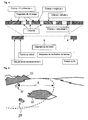
- the figure 1 shows the general scheme of a satellite SIA message detection system.
- the messages are received by AIS receivers from nearby ships and coast stations.
- Each ship 10 can thus create a detailed cartography of the SIA transmitters in its local environment (in a radius of about 20 to 30 nautical miles), which complements the information provided by radar and other navigational aids.
- SIA messages can also be received by satellites 14 in low Earth orbit (OTB), i.e. which evolve at an altitude of between 160 and 2000 km.
- OTB low Earth orbit
- the footprint of an antenna in a low-orbit satellite typically covers a geographical area whose dimensions far exceed those of the cells in which the SIA avoids message collisions. Since the cells are generally not coordinated with each other, the SIA signals received by the satellite may contain messages that overlap in time and frequency. The problem arises especially in areas where the density of ships is high.
- the SIA 1 (centered on 162.975 MHz) or SIA 2 (centered on 162.025 MHz) channels, hereinafter simply referred to as SIA signals, are received by the satellite 14 and digitized.
- the digital data thus obtained are time stamped and transmitted to one or more ground stations 16 via a downlink.
- the vessel monitoring system may include several OTB satellites and several ground stations.
- the control of the OTB satellite or satellites is done by one or more satellite control centers 18. For reasons of readability, reference will be made, in the following, to an OTB satellite. If several OTB satellites are used, the data processing of the different satellites is preferably carried out in parallel.
- the OTB satellite 14 is equipped with a geopositioning system, for example a GPS receiver.
- the satellite can then determine its position using radionavigation signals 24 from GNSS satellites 20.
- the digital data representing the SIA signals can then be connected to the trajectory 22 of the OTB satellite in a bijective manner: each data sequence can be uniquely assigned to a time and position of the OTB satellite.
- the figure 2 is an illustration of the structure of an SIA message.
- Each SIA message has 256 bits and is subdivided into a power up field (8 bits), a conditioning sequence (24 bits), a message start flag (8 bits), a data sequence (168 bits), a verification sequence of frames (16 bits), an end of message flag (8 bits) and a buffer (24 bits).
- a power up field 8 bits
- a conditioning sequence 24 bits
- a message start flag 8 bits
- a data sequence 168 bits
- a verification sequence of frames (16 bits
- an end of message flag 8 bits
- a buffer 24 bits
- the data sequence of an SIA message is also subdivided into several fields of determined length.
- the structure of the data sequence and the transmitted fields depend on the type of message. It is therefore noted that each SIA message comprises bit sequences that are common to all SIA messages, eg the power up field, the conditioning sequence, the start flag, and the end flag. If we limit our to a certain type of SIA message, the field "message ID" is also known.
- the other bit sequences are specific to the transmitter. Among these, it is still possible to distinguish between "static" transmitter-specific bit sequences, which are programmed in the indefinite-duration transmitter, and “dynamic" transmitter-specific bit sequences, which are likely to change from one message to another.
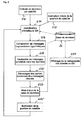
- the figure 3 shows the block diagram of the inventive method according to a first preferred embodiment.
- the invention exploits the fact that a certain number of bits of the data sequence of an SIA message can be predicted if the SIA transmitter which has sent the message is known and if, in addition, certain additional information about this issuer, including its position.
- the bits that can be predicted include, in particular, the bits of the "static" transmitter-specific fields, since it is sufficient to save the contents of these fields in a database of SIA transmitters.
- bits that can be predicted are some bits of the "dynamic" transmitter-specific fields, such as, for example, the most significant bits of the "longitude” and “latitude” fields - provided, however, to identify the position of the issuer concerned at a rate sufficiently high not to "lose the issuer's view".
- step E10 Data collection (step E10) is performed at the OTB satellite, as described above.
- the time stamped digital data are transmitted to a computer center, which can be in a ground station 16 in direct connection with the satellite 14 or at another place in communication with the ground station 16.
- the digital data (directly or indirectly) from the OTB satellite (s) is normally correlated with the conditioning sequence. This sequence being rather short, it will not allow to detect a correlation peak, and therefore a candidate message, in the presence of a noisy signal.
- SIA transmitters which may have sent an SIA message in the area covered by the OTB satellite at the time of its passage are identified.
- the trajectory of the satellite is first determined (step E12).
- the trajectory i.e. the position as a function of time
- the data relating to the trajectory of the satellite can be transmitted to the computer center by the same communication link as the data of the SIA signals.
- the computing center can receive the data relating to the trajectory of the OTB satellite from a satellite control center 18 (center TT & C), by any communication link.
- SIA transmitter database 26 is consulted, which returns the SIA transmitters whose last position recorded in the database 26 is in a predetermined zone around the satellite position.
- This predetermined zone may comprise the ground footprint of the satellite antenna or antennas and possibly a peripheral zone. This peripheral zone makes it possible to take into account vessels whose last position recorded in the database is outside the footprint on the ground but sufficiently close to it for the ship to have been able to enter from the time that has occurred. elapsed since the position was detected.
- one or more hypothetical fragmentary messages are composed, which comprise bits that can be predicted based on the information contained in the database 26 (step E16).
- candidate messages are searched for in the digital data by correlating them with hypothetical fragmentary messages (step E18).
- step E20 Once a candidate message identified in the digital data is decoded (in step E20) its unknown parts (i.e., unpredictable bit sequences with sufficient certainty). Decoding of unknown parts can be done conventionally, eg using the Viterbi algorithm. The information contained in the decoded messages is then used to update the database 26 (step E22).
- the subscribers of the database can access it, and in particular be displayed a map of SIA transmitters (step E24).
- an SIA transmitter When an SIA transmitter has left the ground footprint of the satellite, it remains unobserved until the next pass of the same or another satellite of the satellite AIS message detection system. With a constellation of four satellites OTB, one can arrive at times of local nonobservance of the order of 2 hours. This means that the data stored for a transmitter entering a satellite footprint is, on average, 2 hours old. For the composition of the hypothetical fragmentary messages, it is preferable to take this period into account. It may be necessary to test several hypotheses to identify a candidate message in the digital data. These hypotheses can be tested in parallel and / or in series. If the serial variant is chosen, it is advisable to start with the most probable hypothesis and, in case of failure of the detection, to continue with the following hypotheses according to the decreasing probability.
- SIA message of type 1 the hypothetical fragment message to be correlated with the sender.
- digital data is configured accordingly.
- failure ie failure to detect a correlation peak
- the following table shows the predictable bits for SIA messages of type 1, 2 or 3.
- the number of predictable bits depends on the complexity of the model used for the prediction as well as the freshness of the database at the moment. prediction.
- the bits of the "static" transmitter-specific fields can generally all be predicted.
- the freshness of the database is decisive for knowing how many bits of these fields can be predicted.
- the figure 4 is an illustration of a hypothetical fragmentary message for detecting an SIA type 1 message from an immobilized ship (moored or at anchor) whose SIA transmitter is in the AMRTAO communication state.
- Predictable bit sequences (message fragments) are shown as hatched. Note that predictable bit sequences can span multiple fields. For some fields, for example the "longitude” and “latitude” fields, only a portion of the bits are predictable with sufficient certainty.
- each SIA message begins with a sequence of predictable bits if the SIA transmitter is known.
- This sequence of bits representing a first fragment of the hypothetical fragmentary message, includes in particular the fields “conditioning sequence”, “start flag”, “message ID”, “repetition indicator” and “user ID”, that is at least 70 bits.
- this first message fragment can be significantly longer (110 bits for a message type 4, 306 bits for a message type 5).
- the hypothetical fragmentary messages comprise at least one message fragment dependent on the transmission time (for example the "timestamp” field of type messages, 1, 2, 3 or 21) and / or the position of the SIA transmitter (for example, the "longitude” and “latitude” fields of messages of type 1, 2, 3, 4 and 21).
- the last known position ie stored in the database
- the navigation state has not changed. This hypothesis is certainly not true in all cases, but is very likely for the considered non-compliance times (a few hours at most).
- a certain threshold value eg 50 km / h.
- the vessel in question is a ferry, whose routes are known in the past, it is very likely to find the vessel on one of these routes, which greatly reduces the area uncertainty of position. If the estimated time of arrival and the destination port is known, this also allows for predictions on the route followed by the ship.
- step E18 A preferred embodiment of the step of searching for candidate messages in the digital data (step E18) is now described in more detail.
- the digital data is only correlated with the predicted bit segments (message fragments).
- the unknown bits are not correlated with the digital data of the SIA signals. Thanks to the synchronization of the digital data on the UTC time and the at least approximate knowledge of the position of the SIA transmitters, the propagation delay of the SIA messages of each transmitter can be calculated. Since each SIA transmitter synchronizes (directly or indirectly) its messages on the UTC time, it is known, taking into account the propagation time, the times at which the SIA messages of a given transmitter can start with an accuracy of ⁇ 6 bits (range temporal uncertainty).
- the time uncertainty range consists of the synchronization jitter SIA ( ⁇ 312 ⁇ s corresponding to ⁇ 3 bits) plus a buffer to account for the uncertainty of the position of the ship.
- the time search range corresponds to the time uncertainty range (ie 12 bits). The correlations are performed at the beginning of the time interval of the SIA frame.
- the correlation method is performed over a frequency search range around the carrier frequency. If we look for an SIA message from a transmitter whose carrier frequency error is contained in the database, we can compensate for this error and the uncertainty in the residual frequency domain is that of the Doppler shift only. (normally ⁇ 100 Hz).
- the frequency search interval will therefore typically be 200 Hz wide.
- each correlation operation will comprise 24 integrations. If we divide the frequency search interval into 8 cells (25 Hz wide), we will have a total of 192 integrations per cell in the time / frequency search space (not counting the different assumptions for the modulation index see below). It should be noted that the width of the cells in frequency is preferably chosen so as to be able to detect the main peak of the correlation on the frequency axis unequivocally.
- the residual error can be used to correct the carrier frequency error stored in the database.
- the OTB satellite comprises a group of elementary antennas (forming a phased array antenna) which each receive the signals SIA.
- the digital data obtained by converting the signals received at the different antennas can then be combined with each other to obtain a desired directivity of the antenna group.
- the antenna footprint of the antenna group can then be scanned by changing the phase relationships between the different digital data streams. This frequency-selective technique (narrow frequency cells) significantly reduces the power of interfering signals.
- the figure 7 shows, schematically, the footprint 34 of the antenna group of the satellite.
- the satellite moves at a speed V sat (indicated by the arrow 36), which causes a Doppler shift of the SIA signals received by the satellite.
- the iso-Doppler lines are indicated by reference numeral 38.
- the hatched band 40 corresponds to a frequency cell. Thanks to the phased array antenna, the detection area can be reduced to a local area 42 substantially smaller than the footprint 34. One can then try to detect the SIA messages of ships likely to be in this local area 42 according to their last position recorded in the database. Within the local area 42, the span of the Doppler shifts is much smaller compared to the footprint 34, which considerably reduces the number of test cells for each local area 42.
- the figure 8 shows the block diagram of the inventive method according to a second preferred embodiment.
- the steps identical or similar to those of the method of the figure have been designated by the same reference number.
- the data is collected at the OTB satellite (step E10).
- the time-stamped digital data are transmitted to the computer center.
- the main difference from the process of the figure 3 resides in the fact that the position of the satellite is obtained by triangulation by distance reading with respect to the positions of the transmitters whose SIA messages are identified in the digital data.
- This variant of the invention is interesting if the OTB satellite is not equipped with a system of geopositioning, if this system is faulty, or if the orbital data concerning the satellite are not communicated by the control center.
- the SIA transmitters which may have sent an SIA message contained in the digital data (step E14) are identified.
- an initial estimate of the position of the satellite (found at step E12 ') is available at this stage in order to be able to reduce the initial possibilities. If an initial estimate of the satellite position is not available, it may be possible to detect a first SIA message in the digital data in a conventional manner (using only the static part common to all SIA messages for the correlation) . After decoding the first SIA message, the position of a first received SIA transmitter is known, which can then serve as a rough estimate of the position of the satellite.
- the times T emission_i_UTC are known because of the synchronization of the frame SIA on the time UTC.
- the update of the database is done as in the example of the figure 3 .
Landscapes
- Engineering & Computer Science (AREA)
- Physics & Mathematics (AREA)
- Astronomy & Astrophysics (AREA)
- Aviation & Aerospace Engineering (AREA)
- General Physics & Mathematics (AREA)
- Computer Networks & Wireless Communication (AREA)
- Signal Processing (AREA)
- Position Fixing By Use Of Radio Waves (AREA)
- Mobile Radio Communication Systems (AREA)
- Navigation (AREA)
- Traffic Control Systems (AREA)
- Radio Relay Systems (AREA)
Claims (15)
- Erkennungsverfahren für Nachrichten des Typs AIS, das Folgendes aufweist:Bereitstellen von digitalen Daten, die Signale darstellen, welche über einen Satelliten auf mindestens einem AIS-Kanal empfangen wurden;Identifizieren einer Kandidatnachricht in den digitalen Daten (E18) durch Korrelation der digitalen Daten mit einer hypothetischen fragmentarischen Nachricht;dadurch gekennzeichnet, dass die hypothetische fragmentarische Nachricht mindestens ein AIS-Nachrichtenfragment aufweist, das von der Sendezeit und/oder der Position des Senders abhängt und das mittels einer Datenbank von AIS-Sendern (26) bestimmt wird.
- Verfahren nach Anspruch 1, dadurch gekennzeichnet, dass die hypothetische fragmentarische Nachricht mindestens ein AIS-Nachrichtenfragment aufweist, das von der Position des Senders abhängt, und dass die Zusammensetzung der hypothetischen fragmentarischen Nachricht Folgendes aufweist:Identifizierung eines AIS-Senders der sich zum Zeitpunkt des Empfangs der Signale (E14) in einem von dem Satelliten abgedeckten Bereich befindet, anhand der AIS-Senderdatenbank;Bestimmung des mindestens einen AIS-Nachrichtenfragments in Abhängigkeit von der Position des Senders anhand einer Position des identifizierten Senders, die in der Datenbank gespeichert ist.
- Verfahren nach Anspruch 2, dadurch gekennzeichnet, dass das mindestens eine, von der Position des Senders abhängige AIS-Nachrichtenfragment werthohe Bits des Datenfelds "Länge" und/oder werthohe Bits des Datenfelds "Breite" aufweist.
- Verfahren nach einem der Ansprüche 1 bis 3, dadurch gekennzeichnet, dass die digitalen Daten mit einem Zeitstempel versehen sind, dass die hypothetische fragmentarische Nachricht ein oder mehrere AIS-Nachrichtenfragmente in Abhängigkeit von der Sendezeit aufweist, und dass die Zusammensetzung der hypothetischen fragmentarischen Nachricht die Bestimmung des mindestens einen AIS-Nachrichtenfragments in Abhängigkeit von der Sendezeit anhand des Zeitstempels der digitalen Daten aufweist.
- Verfahren nach Anspruch 4, dadurch gekennzeichnet, dass das mindestens eine, von der Sendezeit abhängige AIS-Nachrichtenfragment Bits des Datenfelds "Zeitstempel" oder Bits des Datenfelds "Jahr UTC", "Monat UTC", "Tag UTC", "Stunde UTC", "Minute UTC" und/oder "Sekunde UTC" aufweist.
- Verfahren nach einem der Ansprüche 1 bis 5, dadurch gekennzeichnet, dass die hypothetische fragmentarische Nachricht Bits von einem oder mehreren statischen Datenfeldern aufweist, die für den in der Datenbank identifizierten Sender spezifisch sind, zum Beispiel das Datenfeld "Nutzer-ID", das Datenfeld "Anzeige der AIS-Version", das Datenfeld "IMO-Nummer", das Datenfeld "Rufzeichen", das Datenfeld "Name", das Datenfeld "Schiffstyp und Frachttyp", das Datenfeld "Allgemeine Abmessungen/Referenz für die Position", das Datenfeld "Art der elektronischen Vorrichtung zur Positionsbestimmung".
- Verfahren nach einem der Ansprüche 1 bis 6, dadurch gekennzeichnet, dass die hypothetische fragmentarische Nachricht Bits von einem oder mehreren dynamischen Datenfeldern aufweist, die für den in der Datenbank identifizierten Sender spezifisch sind, zum Beispiel das Datenfeld "RAIM-Anzeige", das Datenfeld "Anzeige des besonderen Manövers", das Datenfeld "geschätzte Ankunftszeit", das Datenfeld "aktueller Tiefgang", das Datenfeld "Bestimmungsort", das Datenfeld "Navigationsstatus", das Datenfeld "Kurs über Grund", das Datenfeld "Geschwindigkeit über Grund" und/oder das Datenfeld "Kommunikationsstatus".
- Verfahren nach einem der Ansprüche 1 bis 7, dadurch gekennzeichnet, dass nach der Identifizierung einer Kandidatnachricht in den digitalen Daten die anstehende Nachricht entschlüsselt wird (E20) und dass die in der entschlüsselten Nachricht enthaltenen Informationen verwendet werden, um die Datenbank der AIS-Sender zu aktualisieren (E22).
- Verfahren nach einem der Ansprüche 1 bis 8, dadurch gekennzeichnet, dass die Identifizierung der Kandidatnachricht (E18) durch Korrelation der digitalen Daten mit mehreren hypothetischen fragmentarischen Nachrichten realisiert wird, wobei die verschiedenen Korrelationen in Reihe und/oder parallel berechnet werden.
- Verfahren nach Anspruch 9, dadurch gekennzeichnet, dass die hypothetischen fragmentarischen Nachrichten so verfasst sind, dass sie die Anwesenheit oder Abwesenheit von Stopfbits in der Kandidatnachricht testen.
- Verfahren nach einem der Ansprüche 1 bis 10, dadurch gekennzeichnet, dass die Position des Satelliten zum Zeitpunkt des Empfangs von Signalen durch Triangulierung in Bezug auf die Sender geschätzt (E12") wird, von denen eine oder mehrere AIS-Nachrichten in den digitalen Daten identifiziert wurden.
- Verfahren nach einem der Ansprüche 1 bis 11, dadurch gekennzeichnet, dass für die Korrelation der digitalen Daten mit der hypothetischen fragmentarischen Nachricht der Anfang der hypothetischen fragmentarischen Nachricht mit einem Zeitintervallbeginn des AIS-Übertragungsblocks synchronisiert wird.
- Verfahren nach einem der Ansprüche 1 bis 12, dadurch gekennzeichnet, dass für die Korrelation der digitalen Daten mit der hypothetischen fragmentarischen Nachricht eine Dopplerverschiebung, die für die hypothetische fragmentarische Nachricht in Abhängigkeit einer Position des Senders berechnet wird, kompensiert wird und dass gegebenenfalls für die Kompensation der Dopplerverschiebung ein Fehler in Bezug auf die Frequenz der Trägerwelle des Senders, die in der Datenbank (26) gespeichert ist, berücksichtigt wird.
- Verfahren nach einem der Ansprüche 1 bis 13, dadurch gekennzeichnet, dass für die Korrelation der digitalen Daten mit der hypothetischen fragmentarischen Nachricht der Modulationsindex des Senders, der in der Datenbank (26) gespeichert ist, berücksichtigt wird.
- Computerprogrammprodukt, aufweisend einen Datenträger, der Anweisungen enthält, die von dem Computer ausgeführt werden können, die, wenn sie von einem Computer ausgeführt werden, den Computer veranlassen, das Verfahren nach einem der Ansprüche 1 bis 14 auszuführen.
Applications Claiming Priority (1)
| Application Number | Priority Date | Filing Date | Title |
|---|---|---|---|
| FR1157849A FR2979736B1 (fr) | 2011-09-05 | 2011-09-05 | Procede de detection de messages sia |
Publications (2)
| Publication Number | Publication Date |
|---|---|
| EP2566069A1 EP2566069A1 (de) | 2013-03-06 |
| EP2566069B1 true EP2566069B1 (de) | 2014-09-24 |
Family
ID=46651431
Family Applications (1)
| Application Number | Title | Priority Date | Filing Date |
|---|---|---|---|
| EP12181282.0A Active EP2566069B1 (de) | 2011-09-05 | 2012-08-22 | Erkennungsverfahren für Nachrichten des Typs "Automatisches Identifizierungssystem" zur Überwachung von Schiffen und Bojen durch Satellit. |
Country Status (6)
| Country | Link |
|---|---|
| US (1) | US9246575B2 (de) |
| EP (1) | EP2566069B1 (de) |
| JP (1) | JP5903356B2 (de) |
| CN (1) | CN102984673B (de) |
| CA (1) | CA2787939C (de) |
| FR (1) | FR2979736B1 (de) |
Families Citing this family (30)
| Publication number | Priority date | Publication date | Assignee | Title |
|---|---|---|---|---|
| US8833702B2 (en) * | 2012-05-07 | 2014-09-16 | Robert Briskman | Autonomous satellite orbital debris avoidance system and method |
| FR2997252B1 (fr) * | 2012-10-23 | 2014-12-12 | Astrium Sas | Procede et systeme de detection de signaux de diffusion emis par des sources terrestres et recus par un satellite |
| DE102012110541B4 (de) * | 2012-11-05 | 2016-01-21 | Deutsches Zentrum für Luft- und Raumfahrt e.V. | AIS-Schiffstransceiver |
| JP5996467B2 (ja) * | 2013-03-27 | 2016-09-21 | 株式会社日立ソリューションズ | 移動体位置情報の不正検出装置、移動体位置情報の補正処理装置及び不正検出プログラム |
| JP6178663B2 (ja) * | 2013-08-12 | 2017-08-09 | 株式会社日立ソリューションズ | データ補完装置、データ補完方法、およびデータ補完プログラム |
| SE537593C2 (sv) * | 2013-10-04 | 2015-07-07 | True Heading Ab | Förfarande samt anordning för tidsbestämningen av mottagandet av ett radiomeddelande |
| KR20150071911A (ko) * | 2013-12-19 | 2015-06-29 | 한국전자통신연구원 | 투묘지 이탈 선박 제어 장치 및 그 방법 |
| CN103837867B (zh) * | 2014-03-20 | 2016-03-30 | 武汉大学 | 一种利用ais信息进行高频雷达天线通道校正的方法 |
| CN104181526A (zh) * | 2014-07-31 | 2014-12-03 | 青岛创铭新能源有限公司 | 一种卫星遥感的太阳能雷达探测系统装置 |
| DE102014114593B4 (de) | 2014-10-08 | 2018-03-22 | Deutsches Zentrum für Luft- und Raumfahrt e.V. | Verfahren zur Bereitstellung von Daten von empfangenen AIS-Datenpaketen, Einrichtung und Computerprogramm dafür |
| WO2016206749A1 (en) * | 2015-06-25 | 2016-12-29 | Sat4M2M Ug | Method of communication between a subscriber device and a leo satellite in which a signature signal is repetitively transmitted by the device and transmitted back by the satellite. |
| CN105551309B (zh) * | 2015-12-10 | 2018-03-27 | 上海海事大学 | 自监督预警海上甚高频通信装置及其监督预警方法 |
| US10330794B2 (en) * | 2016-04-04 | 2019-06-25 | Spire Global, Inc. | AIS spoofing and dark-target detection methodology |
| CN106209828A (zh) * | 2016-07-08 | 2016-12-07 | 武汉理工大学 | 一种ais船台数据在线分析装置和方法 |
| CN107491752B (zh) * | 2017-08-14 | 2020-11-06 | 中国石油大学(华东) | 一种基于深度学习的自然场景中船牌文字识别方法、装置 |
| CN110299938B (zh) * | 2019-03-29 | 2021-08-13 | 中国人民解放军63921部队 | 一种适用于低轨卫星的地面测控资源调度方法 |
| CN110138416B (zh) * | 2019-04-11 | 2021-08-03 | 上海卫星工程研究所 | 星载ais船舶有线多通道检测概率测试方法 |
| WO2021049221A1 (ja) * | 2019-09-09 | 2021-03-18 | 古野電気株式会社 | 船舶情報表示システム、船舶情報表示方法、画像生成装置、及びプログラム |
| EP4103957A1 (de) | 2020-02-11 | 2022-12-21 | AST & Science, LLC | Geolokation von hochfrequenzgeräten unter verwendung von räumlichen gruppenstrahlern |
| CN111600774B (zh) * | 2020-05-13 | 2021-11-12 | 北京奇艺世纪科技有限公司 | 消费延迟确定方法、系统、装置、设备及可读存储介质 |
| KR102272428B1 (ko) * | 2020-07-14 | 2021-07-01 | 한국항공우주연구원 | 선박자동식별정보를 이용한 위성 궤도전파기 및 그 제어 방법 |
| CN112019303B (zh) * | 2020-09-03 | 2022-05-27 | 上海航天测控通信研究所 | 一种vdes卫星接收机帧头检测方法及系统 |
| CN112330981B (zh) * | 2020-10-16 | 2023-04-18 | 青岛博瑞斯自动化技术有限公司 | 一种基于物联网的船岸通管理系统及方法 |
| CN112504235A (zh) * | 2020-11-16 | 2021-03-16 | 长光卫星技术有限公司 | 一种小卫星在轨自主成像方法 |
| CN113078937B (zh) * | 2021-03-19 | 2023-04-07 | 四川航天神坤科技有限公司 | 一种tdd体制下的数据链下行链路的捕获方法及其系统 |
| KR102765479B1 (ko) * | 2021-11-09 | 2025-02-11 | 주식회사 에코마린 | 인공지능기반의 목적지 포트 코드 예측 시스템 |
| CN115416877B (zh) * | 2022-09-06 | 2023-05-02 | 宁波天巡科技有限公司 | 一种基于小推力的卫星碰撞高度规避方法及智能化系统 |
| CN116193364A (zh) * | 2023-02-24 | 2023-05-30 | 北京大学重庆大数据研究院 | 船载自动识别系统完整静态信息快速更新方法 |
| CN116828391B (zh) * | 2023-08-29 | 2023-12-05 | 中船(浙江)海洋科技有限公司 | 一种检测ais异常开关的方法 |
| CN117857671B (zh) * | 2024-03-08 | 2024-06-18 | 交通运输部北海航海保障中心天津航标处 | 一种基于船舶报文的多源ais数据完善性处理方法 |
Family Cites Families (10)
| Publication number | Priority date | Publication date | Assignee | Title |
|---|---|---|---|---|
| JPH09212796A (ja) * | 1996-01-30 | 1997-08-15 | Hitachi Ltd | 交通情報通信装置及び処理システム |
| JP4925525B2 (ja) * | 2001-08-03 | 2012-04-25 | 古野電気株式会社 | 他船表示装置 |
| JP2003123199A (ja) * | 2001-10-11 | 2003-04-25 | Mitsubishi Electric Corp | 船舶情報システム |
| JP4399397B2 (ja) * | 2005-06-23 | 2010-01-13 | 古野電気株式会社 | 他船ターゲット表示装置 |
| US7990263B2 (en) * | 2006-09-28 | 2011-08-02 | Beatty Street Properties, Inc. | Vector-based harbor scheduling |
| US20090161797A1 (en) * | 2007-06-08 | 2009-06-25 | Cowles Philip R | Satellite detection of automatic identification system signals |
| US7876865B2 (en) | 2007-06-08 | 2011-01-25 | COM DEV International Ltd | System and method for decoding automatic identification system signals |
| US20110140882A1 (en) * | 2009-12-10 | 2011-06-16 | Electronics And Telecommunications Research Institute | Emergency alert system and method thereof, and relay device |
| FR2962867B1 (fr) * | 2010-07-13 | 2012-08-17 | Thales Sa | Systeme permettant d'augmenter la couverture, l'information et la robustesse des dispositifs d'identification automatique de navires. |
| US20120130571A1 (en) * | 2010-11-24 | 2012-05-24 | Dunkle Gregory D | Method for Navigation in No-Passing Zones |
-
2011
- 2011-09-05 FR FR1157849A patent/FR2979736B1/fr active Active
-
2012
- 2012-08-21 CA CA2787939A patent/CA2787939C/fr active Active
- 2012-08-22 EP EP12181282.0A patent/EP2566069B1/de active Active
- 2012-08-23 JP JP2012183729A patent/JP5903356B2/ja active Active
- 2012-08-29 US US13/598,011 patent/US9246575B2/en active Active
- 2012-09-04 CN CN201210324358.0A patent/CN102984673B/zh active Active
Also Published As
| Publication number | Publication date |
|---|---|
| JP2013109753A (ja) | 2013-06-06 |
| EP2566069A1 (de) | 2013-03-06 |
| FR2979736A1 (fr) | 2013-03-08 |
| CA2787939A1 (fr) | 2013-03-05 |
| JP5903356B2 (ja) | 2016-04-13 |
| FR2979736B1 (fr) | 2013-08-30 |
| CN102984673B (zh) | 2016-08-24 |
| CA2787939C (fr) | 2018-09-11 |
| CN102984673A (zh) | 2013-03-20 |
| US9246575B2 (en) | 2016-01-26 |
| US20130058271A1 (en) | 2013-03-07 |
Similar Documents
| Publication | Publication Date | Title |
|---|---|---|
| CA2787939C (fr) | Procede de detection de messages sia | |
| EP1804071B1 (de) | Verfahren zur Optimierung der Verarbeitungen von Lokalisierungsdaten bei Vorliegen mehrerer Satellitenpositionskonstellationen | |
| EP2444823B1 (de) | Verfahren und System zur Geolokalisierung einer Funkbake in einem Warnsystem | |
| KR101159569B1 (ko) | 수신된 sps 신호에서의 모호성을 감소시키기 위한 시스템 및/또는 방법 | |
| EP1503220A2 (de) | Positionsbestimmung einer Mobilendgerät mittels auf Anfrage gesendeten Hilfsdaten | |
| TWI421524B (zh) | 用於獲得所接收的sps信號之時間基準的系統及/或方法 | |
| EP1544636A1 (de) | Vorrichtung zur Bestimmung durch Filtern von Datenintegrität eines differentiellen Positionierungssystems, für ein Mobilgerät | |
| EP1804399B1 (de) | Verfahren zur Synchronisierung von Basisstationen eines terrestrischen zellularen Kommunikationsnetzes | |
| FR2858510A1 (fr) | Determination de positions de terminaux mobiles a l'aide de donnees d'assistance transmises sur requete | |
| EP1907875B1 (de) | Positionsbestimmungsverfahren, -einrichtung und -system mit synchron gepulstem mehrquellen-relais | |
| EP3769105B1 (de) | Verfahren und system zur geolokation von gruppenentwicklungsendgeräten | |
| EP0613021B1 (de) | Verfahren, Gerät und Sender zur Funkortung mittels eines Mehrträger-Funkübertragungssystems | |
| EP1876465B1 (de) | Verfahren zur Ermittlung von gemeinschaftlichen Navigationsinformationen für Regionen, die über verschiedene Gruppen von Überwachungsstationen von Satelliten eines Satellitennavigationssystems verfügen | |
| US12436296B2 (en) | Cloud-offloaded GNSS positioning method | |
| EP1907876B1 (de) | Mobilgeräte, verfahren und system zur positionsbestimmung eines mobilgeräts | |
| EP4176532A1 (de) | Verfahren zur übertragung von daten zwischen einer ressourcenbeschränkten vorrichtung und einem nicht-geostationären satelliten und zugehöriges system | |
| EP2259643B1 (de) | Verfahren zur Übertragung von Positionsinformationen über eine mobile Vorrichtung | |
| EP4343379A1 (de) | Verfahren und vorrichtung zur erkennung von hindernissen im nahen zustand mittels eines passiven multistatischen gnss-radars für mobile plattformen | |
| EP1139690B1 (de) | Verfahren zur Ortsbestimmung eines Mobiltelefons | |
| FR2802037A1 (fr) | Procede et appareil permettant d'assurer la conservation de l'integrite d'un gps assiste |
Legal Events
| Date | Code | Title | Description |
|---|---|---|---|
| PUAI | Public reference made under article 153(3) epc to a published international application that has entered the european phase |
Free format text: ORIGINAL CODE: 0009012 |
|
| AK | Designated contracting states |
Kind code of ref document: A1 Designated state(s): AL AT BE BG CH CY CZ DE DK EE ES FI FR GB GR HR HU IE IS IT LI LT LU LV MC MK MT NL NO PL PT RO RS SE SI SK SM TR |
|
| AX | Request for extension of the european patent |
Extension state: BA ME |
|
| 17P | Request for examination filed |
Effective date: 20130327 |
|
| GRAJ | Information related to disapproval of communication of intention to grant by the applicant or resumption of examination proceedings by the epo deleted |
Free format text: ORIGINAL CODE: EPIDOSDIGR1 |
|
| GRAP | Despatch of communication of intention to grant a patent |
Free format text: ORIGINAL CODE: EPIDOSNIGR1 |
|
| GRAC | Information related to communication of intention to grant a patent modified |
Free format text: ORIGINAL CODE: EPIDOSCIGR1 |
|
| GRAP | Despatch of communication of intention to grant a patent |
Free format text: ORIGINAL CODE: EPIDOSNIGR1 |
|
| INTG | Intention to grant announced |
Effective date: 20140401 |
|
| INTG | Intention to grant announced |
Effective date: 20140409 |
|
| GRAS | Grant fee paid |
Free format text: ORIGINAL CODE: EPIDOSNIGR3 |
|
| GRAA | (expected) grant |
Free format text: ORIGINAL CODE: 0009210 |
|
| AK | Designated contracting states |
Kind code of ref document: B1 Designated state(s): AL AT BE BG CH CY CZ DE DK EE ES FI FR GB GR HR HU IE IS IT LI LT LU LV MC MK MT NL NO PL PT RO RS SE SI SK SM TR |
|
| REG | Reference to a national code |
Ref country code: GB Ref legal event code: FG4D Free format text: NOT ENGLISH |
|
| REG | Reference to a national code |
Ref country code: CH Ref legal event code: EP |
|
| REG | Reference to a national code |
Ref country code: AT Ref legal event code: REF Ref document number: 688990 Country of ref document: AT Kind code of ref document: T Effective date: 20141015 |
|
| REG | Reference to a national code |
Ref country code: IE Ref legal event code: FG4D Free format text: LANGUAGE OF EP DOCUMENT: FRENCH |
|
| REG | Reference to a national code |
Ref country code: DE Ref legal event code: R096 Ref document number: 602012003185 Country of ref document: DE Effective date: 20141106 |
|
| PG25 | Lapsed in a contracting state [announced via postgrant information from national office to epo] |
Ref country code: SE Free format text: LAPSE BECAUSE OF FAILURE TO SUBMIT A TRANSLATION OF THE DESCRIPTION OR TO PAY THE FEE WITHIN THE PRESCRIBED TIME-LIMIT Effective date: 20140924 Ref country code: LT Free format text: LAPSE BECAUSE OF FAILURE TO SUBMIT A TRANSLATION OF THE DESCRIPTION OR TO PAY THE FEE WITHIN THE PRESCRIBED TIME-LIMIT Effective date: 20140924 Ref country code: GR Free format text: LAPSE BECAUSE OF FAILURE TO SUBMIT A TRANSLATION OF THE DESCRIPTION OR TO PAY THE FEE WITHIN THE PRESCRIBED TIME-LIMIT Effective date: 20141225 Ref country code: NO Free format text: LAPSE BECAUSE OF FAILURE TO SUBMIT A TRANSLATION OF THE DESCRIPTION OR TO PAY THE FEE WITHIN THE PRESCRIBED TIME-LIMIT Effective date: 20141224 Ref country code: FI Free format text: LAPSE BECAUSE OF FAILURE TO SUBMIT A TRANSLATION OF THE DESCRIPTION OR TO PAY THE FEE WITHIN THE PRESCRIBED TIME-LIMIT Effective date: 20140924 |
|
| REG | Reference to a national code |
Ref country code: LT Ref legal event code: MG4D Ref country code: NL Ref legal event code: VDEP Effective date: 20140924 |
|
| PG25 | Lapsed in a contracting state [announced via postgrant information from national office to epo] |
Ref country code: HR Free format text: LAPSE BECAUSE OF FAILURE TO SUBMIT A TRANSLATION OF THE DESCRIPTION OR TO PAY THE FEE WITHIN THE PRESCRIBED TIME-LIMIT Effective date: 20140924 Ref country code: LV Free format text: LAPSE BECAUSE OF FAILURE TO SUBMIT A TRANSLATION OF THE DESCRIPTION OR TO PAY THE FEE WITHIN THE PRESCRIBED TIME-LIMIT Effective date: 20140924 Ref country code: RS Free format text: LAPSE BECAUSE OF FAILURE TO SUBMIT A TRANSLATION OF THE DESCRIPTION OR TO PAY THE FEE WITHIN THE PRESCRIBED TIME-LIMIT Effective date: 20140924 Ref country code: CY Free format text: LAPSE BECAUSE OF FAILURE TO SUBMIT A TRANSLATION OF THE DESCRIPTION OR TO PAY THE FEE WITHIN THE PRESCRIBED TIME-LIMIT Effective date: 20140924 |
|
| REG | Reference to a national code |
Ref country code: AT Ref legal event code: MK05 Ref document number: 688990 Country of ref document: AT Kind code of ref document: T Effective date: 20140924 |
|
| PG25 | Lapsed in a contracting state [announced via postgrant information from national office to epo] |
Ref country code: NL Free format text: LAPSE BECAUSE OF FAILURE TO SUBMIT A TRANSLATION OF THE DESCRIPTION OR TO PAY THE FEE WITHIN THE PRESCRIBED TIME-LIMIT Effective date: 20140924 |
|
| PG25 | Lapsed in a contracting state [announced via postgrant information from national office to epo] |
Ref country code: SK Free format text: LAPSE BECAUSE OF FAILURE TO SUBMIT A TRANSLATION OF THE DESCRIPTION OR TO PAY THE FEE WITHIN THE PRESCRIBED TIME-LIMIT Effective date: 20140924 Ref country code: IS Free format text: LAPSE BECAUSE OF FAILURE TO SUBMIT A TRANSLATION OF THE DESCRIPTION OR TO PAY THE FEE WITHIN THE PRESCRIBED TIME-LIMIT Effective date: 20150124 Ref country code: PT Free format text: LAPSE BECAUSE OF FAILURE TO SUBMIT A TRANSLATION OF THE DESCRIPTION OR TO PAY THE FEE WITHIN THE PRESCRIBED TIME-LIMIT Effective date: 20150126 Ref country code: CZ Free format text: LAPSE BECAUSE OF FAILURE TO SUBMIT A TRANSLATION OF THE DESCRIPTION OR TO PAY THE FEE WITHIN THE PRESCRIBED TIME-LIMIT Effective date: 20140924 Ref country code: RO Free format text: LAPSE BECAUSE OF FAILURE TO SUBMIT A TRANSLATION OF THE DESCRIPTION OR TO PAY THE FEE WITHIN THE PRESCRIBED TIME-LIMIT Effective date: 20140924 Ref country code: ES Free format text: LAPSE BECAUSE OF FAILURE TO SUBMIT A TRANSLATION OF THE DESCRIPTION OR TO PAY THE FEE WITHIN THE PRESCRIBED TIME-LIMIT Effective date: 20140924 Ref country code: EE Free format text: LAPSE BECAUSE OF FAILURE TO SUBMIT A TRANSLATION OF THE DESCRIPTION OR TO PAY THE FEE WITHIN THE PRESCRIBED TIME-LIMIT Effective date: 20140924 |
|
| PG25 | Lapsed in a contracting state [announced via postgrant information from national office to epo] |
Ref country code: AT Free format text: LAPSE BECAUSE OF FAILURE TO SUBMIT A TRANSLATION OF THE DESCRIPTION OR TO PAY THE FEE WITHIN THE PRESCRIBED TIME-LIMIT Effective date: 20140924 Ref country code: PL Free format text: LAPSE BECAUSE OF FAILURE TO SUBMIT A TRANSLATION OF THE DESCRIPTION OR TO PAY THE FEE WITHIN THE PRESCRIBED TIME-LIMIT Effective date: 20140924 |
|
| REG | Reference to a national code |
Ref country code: DE Ref legal event code: R097 Ref document number: 602012003185 Country of ref document: DE |
|
| PG25 | Lapsed in a contracting state [announced via postgrant information from national office to epo] |
Ref country code: DK Free format text: LAPSE BECAUSE OF FAILURE TO SUBMIT A TRANSLATION OF THE DESCRIPTION OR TO PAY THE FEE WITHIN THE PRESCRIBED TIME-LIMIT Effective date: 20140924 |
|
| PLBE | No opposition filed within time limit |
Free format text: ORIGINAL CODE: 0009261 |
|
| STAA | Information on the status of an ep patent application or granted ep patent |
Free format text: STATUS: NO OPPOSITION FILED WITHIN TIME LIMIT |
|
| PG25 | Lapsed in a contracting state [announced via postgrant information from national office to epo] |
Ref country code: IT Free format text: LAPSE BECAUSE OF FAILURE TO SUBMIT A TRANSLATION OF THE DESCRIPTION OR TO PAY THE FEE WITHIN THE PRESCRIBED TIME-LIMIT Effective date: 20140924 |
|
| 26N | No opposition filed |
Effective date: 20150625 |
|
| PG25 | Lapsed in a contracting state [announced via postgrant information from national office to epo] |
Ref country code: SI Free format text: LAPSE BECAUSE OF FAILURE TO SUBMIT A TRANSLATION OF THE DESCRIPTION OR TO PAY THE FEE WITHIN THE PRESCRIBED TIME-LIMIT Effective date: 20140924 |
|
| REG | Reference to a national code |
Ref country code: DE Ref legal event code: R119 Ref document number: 602012003185 Country of ref document: DE |
|
| PG25 | Lapsed in a contracting state [announced via postgrant information from national office to epo] |
Ref country code: MC Free format text: LAPSE BECAUSE OF FAILURE TO SUBMIT A TRANSLATION OF THE DESCRIPTION OR TO PAY THE FEE WITHIN THE PRESCRIBED TIME-LIMIT Effective date: 20140924 |
|
| REG | Reference to a national code |
Ref country code: CH Ref legal event code: PL |
|
| PG25 | Lapsed in a contracting state [announced via postgrant information from national office to epo] |
Ref country code: LI Free format text: LAPSE BECAUSE OF NON-PAYMENT OF DUE FEES Effective date: 20150831 Ref country code: CH Free format text: LAPSE BECAUSE OF NON-PAYMENT OF DUE FEES Effective date: 20150831 |
|
| REG | Reference to a national code |
Ref country code: IE Ref legal event code: MM4A |
|
| PG25 | Lapsed in a contracting state [announced via postgrant information from national office to epo] |
Ref country code: IE Free format text: LAPSE BECAUSE OF NON-PAYMENT OF DUE FEES Effective date: 20150822 Ref country code: DE Free format text: LAPSE BECAUSE OF NON-PAYMENT OF DUE FEES Effective date: 20160301 |
|
| REG | Reference to a national code |
Ref country code: FR Ref legal event code: PLFP Year of fee payment: 5 |
|
| PG25 | Lapsed in a contracting state [announced via postgrant information from national office to epo] |
Ref country code: MT Free format text: LAPSE BECAUSE OF FAILURE TO SUBMIT A TRANSLATION OF THE DESCRIPTION OR TO PAY THE FEE WITHIN THE PRESCRIBED TIME-LIMIT Effective date: 20140924 |
|
| PG25 | Lapsed in a contracting state [announced via postgrant information from national office to epo] |
Ref country code: SM Free format text: LAPSE BECAUSE OF FAILURE TO SUBMIT A TRANSLATION OF THE DESCRIPTION OR TO PAY THE FEE WITHIN THE PRESCRIBED TIME-LIMIT Effective date: 20140924 Ref country code: HU Free format text: LAPSE BECAUSE OF FAILURE TO SUBMIT A TRANSLATION OF THE DESCRIPTION OR TO PAY THE FEE WITHIN THE PRESCRIBED TIME-LIMIT; INVALID AB INITIO Effective date: 20120822 Ref country code: BG Free format text: LAPSE BECAUSE OF FAILURE TO SUBMIT A TRANSLATION OF THE DESCRIPTION OR TO PAY THE FEE WITHIN THE PRESCRIBED TIME-LIMIT Effective date: 20140924 |
|
| PG25 | Lapsed in a contracting state [announced via postgrant information from national office to epo] |
Ref country code: BE Free format text: LAPSE BECAUSE OF NON-PAYMENT OF DUE FEES Effective date: 20150831 |
|
| PG25 | Lapsed in a contracting state [announced via postgrant information from national office to epo] |
Ref country code: TR Free format text: LAPSE BECAUSE OF FAILURE TO SUBMIT A TRANSLATION OF THE DESCRIPTION OR TO PAY THE FEE WITHIN THE PRESCRIBED TIME-LIMIT Effective date: 20140924 |
|
| REG | Reference to a national code |
Ref country code: FR Ref legal event code: PLFP Year of fee payment: 6 |
|
| PG25 | Lapsed in a contracting state [announced via postgrant information from national office to epo] |
Ref country code: MK Free format text: LAPSE BECAUSE OF FAILURE TO SUBMIT A TRANSLATION OF THE DESCRIPTION OR TO PAY THE FEE WITHIN THE PRESCRIBED TIME-LIMIT Effective date: 20140924 |
|
| REG | Reference to a national code |
Ref country code: FR Ref legal event code: PLFP Year of fee payment: 7 |
|
| PG25 | Lapsed in a contracting state [announced via postgrant information from national office to epo] |
Ref country code: AL Free format text: LAPSE BECAUSE OF FAILURE TO SUBMIT A TRANSLATION OF THE DESCRIPTION OR TO PAY THE FEE WITHIN THE PRESCRIBED TIME-LIMIT Effective date: 20140924 |
|
| PGFP | Annual fee paid to national office [announced via postgrant information from national office to epo] |
Ref country code: LU Payment date: 20240820 Year of fee payment: 13 |
|
| PGFP | Annual fee paid to national office [announced via postgrant information from national office to epo] |
Ref country code: GB Payment date: 20250630 Year of fee payment: 14 |
|
| PGFP | Annual fee paid to national office [announced via postgrant information from national office to epo] |
Ref country code: FR Payment date: 20250630 Year of fee payment: 14 |