EP2567193B1 - Verfahren und führungseinheit zum leiten von batteriebetriebenen transportmitteln zu aufladestationen - Google Patents
Verfahren und führungseinheit zum leiten von batteriebetriebenen transportmitteln zu aufladestationen Download PDFInfo
- Publication number
- EP2567193B1 EP2567193B1 EP11717582.8A EP11717582A EP2567193B1 EP 2567193 B1 EP2567193 B1 EP 2567193B1 EP 11717582 A EP11717582 A EP 11717582A EP 2567193 B1 EP2567193 B1 EP 2567193B1
- Authority
- EP
- European Patent Office
- Prior art keywords
- transportation means
- reconditioning
- battery
- path
- station
- Prior art date
- Legal status (The legal status is an assumption and is not a legal conclusion. Google has not performed a legal analysis and makes no representation as to the accuracy of the status listed.)
- Active
Links
Images



Classifications
-
- B—PERFORMING OPERATIONS; TRANSPORTING
- B60—VEHICLES IN GENERAL
- B60L—PROPULSION OF ELECTRICALLY-PROPELLED VEHICLES; SUPPLYING ELECTRIC POWER FOR AUXILIARY EQUIPMENT OF ELECTRICALLY-PROPELLED VEHICLES; ELECTRODYNAMIC BRAKE SYSTEMS FOR VEHICLES IN GENERAL; MAGNETIC SUSPENSION OR LEVITATION FOR VEHICLES; MONITORING OPERATING VARIABLES OF ELECTRICALLY-PROPELLED VEHICLES; ELECTRIC SAFETY DEVICES FOR ELECTRICALLY-PROPELLED VEHICLES
- B60L1/00—Supplying electric power to auxiliary equipment of vehicles
- B60L1/003—Supplying electric power to auxiliary equipment of vehicles to auxiliary motors, e.g. for pumps, compressors
-
- G—PHYSICS
- G01—MEASURING; TESTING
- G01C—MEASURING DISTANCES, LEVELS OR BEARINGS; SURVEYING; NAVIGATION; GYROSCOPIC INSTRUMENTS; PHOTOGRAMMETRY OR VIDEOGRAMMETRY
- G01C21/00—Navigation; Navigational instruments not provided for in groups G01C1/00 - G01C19/00
- G01C21/26—Navigation; Navigational instruments not provided for in groups G01C1/00 - G01C19/00 specially adapted for navigation in a road network
- G01C21/34—Route searching; Route guidance
-
- B—PERFORMING OPERATIONS; TRANSPORTING
- B60—VEHICLES IN GENERAL
- B60L—PROPULSION OF ELECTRICALLY-PROPELLED VEHICLES; SUPPLYING ELECTRIC POWER FOR AUXILIARY EQUIPMENT OF ELECTRICALLY-PROPELLED VEHICLES; ELECTRODYNAMIC BRAKE SYSTEMS FOR VEHICLES IN GENERAL; MAGNETIC SUSPENSION OR LEVITATION FOR VEHICLES; MONITORING OPERATING VARIABLES OF ELECTRICALLY-PROPELLED VEHICLES; ELECTRIC SAFETY DEVICES FOR ELECTRICALLY-PROPELLED VEHICLES
- B60L1/00—Supplying electric power to auxiliary equipment of vehicles
- B60L1/02—Supplying electric power to auxiliary equipment of vehicles to electric heating circuits
-
- B—PERFORMING OPERATIONS; TRANSPORTING
- B60—VEHICLES IN GENERAL
- B60L—PROPULSION OF ELECTRICALLY-PROPELLED VEHICLES; SUPPLYING ELECTRIC POWER FOR AUXILIARY EQUIPMENT OF ELECTRICALLY-PROPELLED VEHICLES; ELECTRODYNAMIC BRAKE SYSTEMS FOR VEHICLES IN GENERAL; MAGNETIC SUSPENSION OR LEVITATION FOR VEHICLES; MONITORING OPERATING VARIABLES OF ELECTRICALLY-PROPELLED VEHICLES; ELECTRIC SAFETY DEVICES FOR ELECTRICALLY-PROPELLED VEHICLES
- B60L1/00—Supplying electric power to auxiliary equipment of vehicles
- B60L1/14—Supplying electric power to auxiliary equipment of vehicles to electric lighting circuits
-
- B—PERFORMING OPERATIONS; TRANSPORTING
- B60—VEHICLES IN GENERAL
- B60L—PROPULSION OF ELECTRICALLY-PROPELLED VEHICLES; SUPPLYING ELECTRIC POWER FOR AUXILIARY EQUIPMENT OF ELECTRICALLY-PROPELLED VEHICLES; ELECTRODYNAMIC BRAKE SYSTEMS FOR VEHICLES IN GENERAL; MAGNETIC SUSPENSION OR LEVITATION FOR VEHICLES; MONITORING OPERATING VARIABLES OF ELECTRICALLY-PROPELLED VEHICLES; ELECTRIC SAFETY DEVICES FOR ELECTRICALLY-PROPELLED VEHICLES
- B60L50/00—Electric propulsion with power supplied within the vehicle
- B60L50/50—Electric propulsion with power supplied within the vehicle using propulsion power supplied by batteries or fuel cells
-
- B—PERFORMING OPERATIONS; TRANSPORTING
- B60—VEHICLES IN GENERAL
- B60L—PROPULSION OF ELECTRICALLY-PROPELLED VEHICLES; SUPPLYING ELECTRIC POWER FOR AUXILIARY EQUIPMENT OF ELECTRICALLY-PROPELLED VEHICLES; ELECTRODYNAMIC BRAKE SYSTEMS FOR VEHICLES IN GENERAL; MAGNETIC SUSPENSION OR LEVITATION FOR VEHICLES; MONITORING OPERATING VARIABLES OF ELECTRICALLY-PROPELLED VEHICLES; ELECTRIC SAFETY DEVICES FOR ELECTRICALLY-PROPELLED VEHICLES
- B60L53/00—Methods of charging batteries, specially adapted for electric vehicles; Charging stations or on-board charging equipment therefor; Exchange of energy storage elements in electric vehicles
- B60L53/80—Exchanging energy storage elements, e.g. removable batteries
-
- B—PERFORMING OPERATIONS; TRANSPORTING
- B60—VEHICLES IN GENERAL
- B60L—PROPULSION OF ELECTRICALLY-PROPELLED VEHICLES; SUPPLYING ELECTRIC POWER FOR AUXILIARY EQUIPMENT OF ELECTRICALLY-PROPELLED VEHICLES; ELECTRODYNAMIC BRAKE SYSTEMS FOR VEHICLES IN GENERAL; MAGNETIC SUSPENSION OR LEVITATION FOR VEHICLES; MONITORING OPERATING VARIABLES OF ELECTRICALLY-PROPELLED VEHICLES; ELECTRIC SAFETY DEVICES FOR ELECTRICALLY-PROPELLED VEHICLES
- B60L58/00—Methods or circuit arrangements for monitoring or controlling batteries or fuel cells, specially adapted for electric vehicles
- B60L58/10—Methods or circuit arrangements for monitoring or controlling batteries or fuel cells, specially adapted for electric vehicles for monitoring or controlling batteries
- B60L58/12—Methods or circuit arrangements for monitoring or controlling batteries or fuel cells, specially adapted for electric vehicles for monitoring or controlling batteries responding to state of charge [SoC]
-
- B—PERFORMING OPERATIONS; TRANSPORTING
- B60—VEHICLES IN GENERAL
- B60L—PROPULSION OF ELECTRICALLY-PROPELLED VEHICLES; SUPPLYING ELECTRIC POWER FOR AUXILIARY EQUIPMENT OF ELECTRICALLY-PROPELLED VEHICLES; ELECTRODYNAMIC BRAKE SYSTEMS FOR VEHICLES IN GENERAL; MAGNETIC SUSPENSION OR LEVITATION FOR VEHICLES; MONITORING OPERATING VARIABLES OF ELECTRICALLY-PROPELLED VEHICLES; ELECTRIC SAFETY DEVICES FOR ELECTRICALLY-PROPELLED VEHICLES
- B60L58/00—Methods or circuit arrangements for monitoring or controlling batteries or fuel cells, specially adapted for electric vehicles
- B60L58/10—Methods or circuit arrangements for monitoring or controlling batteries or fuel cells, specially adapted for electric vehicles for monitoring or controlling batteries
- B60L58/16—Methods or circuit arrangements for monitoring or controlling batteries or fuel cells, specially adapted for electric vehicles for monitoring or controlling batteries responding to battery ageing, e.g. to the number of charging cycles or the state of health [SoH]
-
- B—PERFORMING OPERATIONS; TRANSPORTING
- B60—VEHICLES IN GENERAL
- B60L—PROPULSION OF ELECTRICALLY-PROPELLED VEHICLES; SUPPLYING ELECTRIC POWER FOR AUXILIARY EQUIPMENT OF ELECTRICALLY-PROPELLED VEHICLES; ELECTRODYNAMIC BRAKE SYSTEMS FOR VEHICLES IN GENERAL; MAGNETIC SUSPENSION OR LEVITATION FOR VEHICLES; MONITORING OPERATING VARIABLES OF ELECTRICALLY-PROPELLED VEHICLES; ELECTRIC SAFETY DEVICES FOR ELECTRICALLY-PROPELLED VEHICLES
- B60L8/00—Electric propulsion with power supply from forces of nature, e.g. sun or wind
- B60L8/003—Converting light into electric energy, e.g. by using photo-voltaic systems
-
- G—PHYSICS
- G01—MEASURING; TESTING
- G01C—MEASURING DISTANCES, LEVELS OR BEARINGS; SURVEYING; NAVIGATION; GYROSCOPIC INSTRUMENTS; PHOTOGRAMMETRY OR VIDEOGRAMMETRY
- G01C21/00—Navigation; Navigational instruments not provided for in groups G01C1/00 - G01C19/00
- G01C21/26—Navigation; Navigational instruments not provided for in groups G01C1/00 - G01C19/00 specially adapted for navigation in a road network
- G01C21/34—Route searching; Route guidance
- G01C21/3453—Special cost functions, i.e. other than distance or default speed limit of road segments
- G01C21/3469—Fuel consumption; Energy use; Emission aspects
-
- B—PERFORMING OPERATIONS; TRANSPORTING
- B60—VEHICLES IN GENERAL
- B60L—PROPULSION OF ELECTRICALLY-PROPELLED VEHICLES; SUPPLYING ELECTRIC POWER FOR AUXILIARY EQUIPMENT OF ELECTRICALLY-PROPELLED VEHICLES; ELECTRODYNAMIC BRAKE SYSTEMS FOR VEHICLES IN GENERAL; MAGNETIC SUSPENSION OR LEVITATION FOR VEHICLES; MONITORING OPERATING VARIABLES OF ELECTRICALLY-PROPELLED VEHICLES; ELECTRIC SAFETY DEVICES FOR ELECTRICALLY-PROPELLED VEHICLES
- B60L2200/00—Type of vehicles
- B60L2200/12—Bikes
-
- B—PERFORMING OPERATIONS; TRANSPORTING
- B60—VEHICLES IN GENERAL
- B60L—PROPULSION OF ELECTRICALLY-PROPELLED VEHICLES; SUPPLYING ELECTRIC POWER FOR AUXILIARY EQUIPMENT OF ELECTRICALLY-PROPELLED VEHICLES; ELECTRODYNAMIC BRAKE SYSTEMS FOR VEHICLES IN GENERAL; MAGNETIC SUSPENSION OR LEVITATION FOR VEHICLES; MONITORING OPERATING VARIABLES OF ELECTRICALLY-PROPELLED VEHICLES; ELECTRIC SAFETY DEVICES FOR ELECTRICALLY-PROPELLED VEHICLES
- B60L2200/00—Type of vehicles
- B60L2200/18—Buses
-
- B—PERFORMING OPERATIONS; TRANSPORTING
- B60—VEHICLES IN GENERAL
- B60L—PROPULSION OF ELECTRICALLY-PROPELLED VEHICLES; SUPPLYING ELECTRIC POWER FOR AUXILIARY EQUIPMENT OF ELECTRICALLY-PROPELLED VEHICLES; ELECTRODYNAMIC BRAKE SYSTEMS FOR VEHICLES IN GENERAL; MAGNETIC SUSPENSION OR LEVITATION FOR VEHICLES; MONITORING OPERATING VARIABLES OF ELECTRICALLY-PROPELLED VEHICLES; ELECTRIC SAFETY DEVICES FOR ELECTRICALLY-PROPELLED VEHICLES
- B60L2200/00—Type of vehicles
- B60L2200/40—Working vehicles
-
- B—PERFORMING OPERATIONS; TRANSPORTING
- B60—VEHICLES IN GENERAL
- B60L—PROPULSION OF ELECTRICALLY-PROPELLED VEHICLES; SUPPLYING ELECTRIC POWER FOR AUXILIARY EQUIPMENT OF ELECTRICALLY-PROPELLED VEHICLES; ELECTRODYNAMIC BRAKE SYSTEMS FOR VEHICLES IN GENERAL; MAGNETIC SUSPENSION OR LEVITATION FOR VEHICLES; MONITORING OPERATING VARIABLES OF ELECTRICALLY-PROPELLED VEHICLES; ELECTRIC SAFETY DEVICES FOR ELECTRICALLY-PROPELLED VEHICLES
- B60L2200/00—Type of vehicles
- B60L2200/46—Vehicles with auxiliary ad-on propulsions, e.g. add-on electric motor kits for bicycles
-
- B—PERFORMING OPERATIONS; TRANSPORTING
- B60—VEHICLES IN GENERAL
- B60L—PROPULSION OF ELECTRICALLY-PROPELLED VEHICLES; SUPPLYING ELECTRIC POWER FOR AUXILIARY EQUIPMENT OF ELECTRICALLY-PROPELLED VEHICLES; ELECTRODYNAMIC BRAKE SYSTEMS FOR VEHICLES IN GENERAL; MAGNETIC SUSPENSION OR LEVITATION FOR VEHICLES; MONITORING OPERATING VARIABLES OF ELECTRICALLY-PROPELLED VEHICLES; ELECTRIC SAFETY DEVICES FOR ELECTRICALLY-PROPELLED VEHICLES
- B60L2240/00—Control parameters of input or output; Target parameters
- B60L2240/40—Drive Train control parameters
- B60L2240/54—Drive Train control parameters related to batteries
- B60L2240/545—Temperature
-
- B—PERFORMING OPERATIONS; TRANSPORTING
- B60—VEHICLES IN GENERAL
- B60L—PROPULSION OF ELECTRICALLY-PROPELLED VEHICLES; SUPPLYING ELECTRIC POWER FOR AUXILIARY EQUIPMENT OF ELECTRICALLY-PROPELLED VEHICLES; ELECTRODYNAMIC BRAKE SYSTEMS FOR VEHICLES IN GENERAL; MAGNETIC SUSPENSION OR LEVITATION FOR VEHICLES; MONITORING OPERATING VARIABLES OF ELECTRICALLY-PROPELLED VEHICLES; ELECTRIC SAFETY DEVICES FOR ELECTRICALLY-PROPELLED VEHICLES
- B60L2240/00—Control parameters of input or output; Target parameters
- B60L2240/60—Navigation input
- B60L2240/62—Vehicle position
- B60L2240/622—Vehicle position by satellite navigation
-
- B—PERFORMING OPERATIONS; TRANSPORTING
- B60—VEHICLES IN GENERAL
- B60L—PROPULSION OF ELECTRICALLY-PROPELLED VEHICLES; SUPPLYING ELECTRIC POWER FOR AUXILIARY EQUIPMENT OF ELECTRICALLY-PROPELLED VEHICLES; ELECTRODYNAMIC BRAKE SYSTEMS FOR VEHICLES IN GENERAL; MAGNETIC SUSPENSION OR LEVITATION FOR VEHICLES; MONITORING OPERATING VARIABLES OF ELECTRICALLY-PROPELLED VEHICLES; ELECTRIC SAFETY DEVICES FOR ELECTRICALLY-PROPELLED VEHICLES
- B60L2240/00—Control parameters of input or output; Target parameters
- B60L2240/60—Navigation input
- B60L2240/66—Ambient conditions
-
- B—PERFORMING OPERATIONS; TRANSPORTING
- B60—VEHICLES IN GENERAL
- B60L—PROPULSION OF ELECTRICALLY-PROPELLED VEHICLES; SUPPLYING ELECTRIC POWER FOR AUXILIARY EQUIPMENT OF ELECTRICALLY-PROPELLED VEHICLES; ELECTRODYNAMIC BRAKE SYSTEMS FOR VEHICLES IN GENERAL; MAGNETIC SUSPENSION OR LEVITATION FOR VEHICLES; MONITORING OPERATING VARIABLES OF ELECTRICALLY-PROPELLED VEHICLES; ELECTRIC SAFETY DEVICES FOR ELECTRICALLY-PROPELLED VEHICLES
- B60L2250/00—Driver interactions
- B60L2250/16—Driver interactions by display
-
- Y—GENERAL TAGGING OF NEW TECHNOLOGICAL DEVELOPMENTS; GENERAL TAGGING OF CROSS-SECTIONAL TECHNOLOGIES SPANNING OVER SEVERAL SECTIONS OF THE IPC; TECHNICAL SUBJECTS COVERED BY FORMER USPC CROSS-REFERENCE ART COLLECTIONS [XRACs] AND DIGESTS
- Y02—TECHNOLOGIES OR APPLICATIONS FOR MITIGATION OR ADAPTATION AGAINST CLIMATE CHANGE
- Y02T—CLIMATE CHANGE MITIGATION TECHNOLOGIES RELATED TO TRANSPORTATION
- Y02T10/00—Road transport of goods or passengers
- Y02T10/60—Other road transportation technologies with climate change mitigation effect
- Y02T10/70—Energy storage systems for electromobility, e.g. batteries
-
- Y—GENERAL TAGGING OF NEW TECHNOLOGICAL DEVELOPMENTS; GENERAL TAGGING OF CROSS-SECTIONAL TECHNOLOGIES SPANNING OVER SEVERAL SECTIONS OF THE IPC; TECHNICAL SUBJECTS COVERED BY FORMER USPC CROSS-REFERENCE ART COLLECTIONS [XRACs] AND DIGESTS
- Y02—TECHNOLOGIES OR APPLICATIONS FOR MITIGATION OR ADAPTATION AGAINST CLIMATE CHANGE
- Y02T—CLIMATE CHANGE MITIGATION TECHNOLOGIES RELATED TO TRANSPORTATION
- Y02T10/00—Road transport of goods or passengers
- Y02T10/60—Other road transportation technologies with climate change mitigation effect
- Y02T10/7072—Electromobility specific charging systems or methods for batteries, ultracapacitors, supercapacitors or double-layer capacitors
-
- Y—GENERAL TAGGING OF NEW TECHNOLOGICAL DEVELOPMENTS; GENERAL TAGGING OF CROSS-SECTIONAL TECHNOLOGIES SPANNING OVER SEVERAL SECTIONS OF THE IPC; TECHNICAL SUBJECTS COVERED BY FORMER USPC CROSS-REFERENCE ART COLLECTIONS [XRACs] AND DIGESTS
- Y02—TECHNOLOGIES OR APPLICATIONS FOR MITIGATION OR ADAPTATION AGAINST CLIMATE CHANGE
- Y02T—CLIMATE CHANGE MITIGATION TECHNOLOGIES RELATED TO TRANSPORTATION
- Y02T10/00—Road transport of goods or passengers
- Y02T10/60—Other road transportation technologies with climate change mitigation effect
- Y02T10/72—Electric energy management in electromobility
-
- Y—GENERAL TAGGING OF NEW TECHNOLOGICAL DEVELOPMENTS; GENERAL TAGGING OF CROSS-SECTIONAL TECHNOLOGIES SPANNING OVER SEVERAL SECTIONS OF THE IPC; TECHNICAL SUBJECTS COVERED BY FORMER USPC CROSS-REFERENCE ART COLLECTIONS [XRACs] AND DIGESTS
- Y02—TECHNOLOGIES OR APPLICATIONS FOR MITIGATION OR ADAPTATION AGAINST CLIMATE CHANGE
- Y02T—CLIMATE CHANGE MITIGATION TECHNOLOGIES RELATED TO TRANSPORTATION
- Y02T90/00—Enabling technologies or technologies with a potential or indirect contribution to GHG emissions mitigation
- Y02T90/10—Technologies relating to charging of electric vehicles
- Y02T90/12—Electric charging stations
-
- Y—GENERAL TAGGING OF NEW TECHNOLOGICAL DEVELOPMENTS; GENERAL TAGGING OF CROSS-SECTIONAL TECHNOLOGIES SPANNING OVER SEVERAL SECTIONS OF THE IPC; TECHNICAL SUBJECTS COVERED BY FORMER USPC CROSS-REFERENCE ART COLLECTIONS [XRACs] AND DIGESTS
- Y02—TECHNOLOGIES OR APPLICATIONS FOR MITIGATION OR ADAPTATION AGAINST CLIMATE CHANGE
- Y02T—CLIMATE CHANGE MITIGATION TECHNOLOGIES RELATED TO TRANSPORTATION
- Y02T90/00—Enabling technologies or technologies with a potential or indirect contribution to GHG emissions mitigation
- Y02T90/10—Technologies relating to charging of electric vehicles
- Y02T90/14—Plug-in electric vehicles
-
- Y—GENERAL TAGGING OF NEW TECHNOLOGICAL DEVELOPMENTS; GENERAL TAGGING OF CROSS-SECTIONAL TECHNOLOGIES SPANNING OVER SEVERAL SECTIONS OF THE IPC; TECHNICAL SUBJECTS COVERED BY FORMER USPC CROSS-REFERENCE ART COLLECTIONS [XRACs] AND DIGESTS
- Y02—TECHNOLOGIES OR APPLICATIONS FOR MITIGATION OR ADAPTATION AGAINST CLIMATE CHANGE
- Y02T—CLIMATE CHANGE MITIGATION TECHNOLOGIES RELATED TO TRANSPORTATION
- Y02T90/00—Enabling technologies or technologies with a potential or indirect contribution to GHG emissions mitigation
- Y02T90/10—Technologies relating to charging of electric vehicles
- Y02T90/16—Information or communication technologies improving the operation of electric vehicles
Definitions
- the present invention relates generally to a method for guiding transportation means with batteries to reconditioning stations according to claim 1, a guidance-unit for the execution of the claimed methods according to claim 14 and a computer program product.
- the vehicles can be expected to be dominated by wheelers comparable to the presently used passenger cars, but also other transportation means such as lorries, trucks, tractors, public buses, scooters, motorcycles, electrically powered bikes, crates, coaches or even construction machineries can in the future be equipped with electrical propulsions and therefore the herein described method and unit is also applicable on those.
- storage, battery or energy cell represent means, which are movable and capable of supplying electrical energy.
- This comprises advanced technologies such as liquid batteries as e.g. presented in US 2007/0154814 , energy cells which are rechargeable by exchange of electrolytes or liquid electrodes e.g. similar to the "liquid battery” presented in MIT's technology review magazine, No. 10, March/April 2009 .
- the storages can in general be primary cells as well as secondary cells, which signify that they do not necessarily need to be rechargeable or regeneratable. They can as well just be exchangeable, replaceable or even consumable just once, with their remains disposable after usage. Therefore, the words storage, battery, energy cell, and accumulator are used in a synonymous way to describe those means.
- the document JP 10170293 concerns the search of an optimum leading route to the destination, by considering the charge of an on-vehicle battery on the basis of road map data which contains information on charging stations.
- a GPS receiver receives a GPS signal from a satellite and detects the present position, moving direction and moving velocity of the vehicle.
- a memory stores road map data which includes information on the charging station such as its position and a residual capacity of an on-vehicle battery is measured.
- a controller searches an optimum leading route to the destination and displays the present position and the leading route on a road map to guide a driver.
- a navigation system for an electric vehicle which can perform total time forecasting to a destination, including the charging time for a vehicle-mounted battery, is known.
- the system is also capable of providing information on restaurant locations, tourist spots, leisure facilities, or the like in the vicinity of charging facilities.
- the navigation system for the electric vehicle which comprises a display, an input section, a battery management section for measuring a remaining amount of the vehicle-mounted battery and a database section which stores position, information on charging performance and map information of the charging facilities.
- An analysis section calculates charging time at the charging facility on the basis of the remaining amount of the vehicle-mounted battery, the energy consumption of the electric vehicle, the distance from the present position to the charging facility and the distance from the charging facility to the destination.
- the time of arrival at the destination including the charging time calculated by the analysis section, is displayed on the display section.
- the document JP 1012802 discloses a system to prevent a battery-driven vehicle from stopping due to the consumption of the remaining capacity of a battery during travelling by an alternation of the destination to a charging position, when the battery voltage arrives at a predetermined value. Therein a separate distance between the present travelling position of the battery-driven vehicle and a charging position for charging the battery is detected and a battery voltage allowable value according to the separate distance signals is set. On the other hand, when the fact is detected that the remaining capacity of the battery arrives at a predetermined battery voltage allowable value, the designation is altered to a position instructed by a destination setter and a travel controller outputs a command for the vehicle to travel to the charging position.
- the therein presented method of changing the target of travel to a charging location when the battery level drops below a certain threshold might be acceptable if the recharging of the energy storage can be done within short time or the vehicle is of a kind such as an autonomous electrical lawn mower, but it is not desirable for personal transportation and time consuming regeneration or charging processes, since the unpredictability of the system and the thereof resulting unknown time of travel and stopovers would for sure not be accepted by a driver in many cases.
- the publication DE 10 2008 017556 presents a navigation unit of a hydrid vehicle which records a charge-possible point and the history of travelling conditions near the charge-possible point. If a destination point on an optimum route is the charge-possible point, the navigation unit determines a continuous section where the electrically powered travelling is possible up to the charge-possible point, based on the history through state of a charge management plan preparation processing. The changing over between the hydrid powered and the electrically powered travelling is done according to this determination while travelling.
- the vehicles will in this case drop off the whole battery package at the reconditioning station and replace it with another, most likely, but not necessarily, one with a higher energy content than the previous one.
- the dropped off battery will be recharged at the location and then be put to another vehicle's disposal.
- the stopover time can thereby be reduced to the time needed for the replacement of the battery, which can, in fact, be even shorter than the time needed to fuel a state of the art car.
- the stock of fully or partially charged batteries at such a station can only be limited and a single location can easily run out of charged batteries, while other batteries are lying around, unused for quite a while, at some other locations.
- the resources of storages are a limited set, which entities can be associated to transportation means or reconditioning stations. Although in a global view their number is sufficient to power the complete set of vehicles presently on the road, there can likely be a shortage of storages or a queue for regeneration slots (storages and regeneration slots are further also referred to as resources) in one area, while in another area there is a huge stock of storages or lots of unused regeneration slots.
- the document US 5 790 976 A discloses a method for guiding an electrical battery-operated vehicle to a recharging station among a network of geographically distributed recharging stations along a route to a selected destination by assigning a selected recharging station to the vehicle taking into account different costs such as travelling time, overall energy consumption of the vehicle, a priority of the vehicle for a reserved station.
- WO 2010/115573 A discloses a method for assigning a plurality of electric vehicles having exchangeable powering batteries to a plurality of reconditioning stations within a given geographic area, each reconditioning station having a certain stock of reconditioning batteries, the method using a multi-objective optimisation based on a cost function combining several criteria.
- a particular object of the invention is to provide an optimisation, comprising actual, at least partially online, information about a plurality of eligible resources.
- a further object of the invention is to improve the battery management for electrically powered vehicles comprising the guidance of the vehicles and to achieve a more accurate forecast of consumption and remaining range of the transportation means with the residual charge of the battery.
- An aspect of the underlying problem can be described as a problem of assignment of a limited set of resources (batteries, reconditioning slots) to a limited set of consumers (transportation means) based on environmentally dependent driving behaviour (e.g. availability of resources and conditions thereof) which can also vary over time.
- certain conditions and aspects of the influencing parameters can be comprised by a usage of abstracted mathematical models of the underlying physical or logical background, which can be comprised in lookup tables, statistical, historical or forecasted data.
- Those models can be overall, global models of the behaviour of the whole set of resources as well as models for subsystems such as e.g. a single battery or engine of a transportation means.
- a plurality of methods are known to a skilled person, as e.g. physical models, differential equations, Fuzzy-Logic models, logical models, statistics models, forecasting models, etc.
- the dropping in or out can also occur when a resource is taken in or out of service, e.g. by parking, repairs, duty, demanded stopovers, overnight stays, holidays, etc. so the number of resources to consider in the optimisation can be reduced to the actual active ones. Nevertheless, data about means currently out of service can also be valuable for predicting forecasts, which can be included in the planning of the assignment.
- an assignment problem has to be solved, in which a limited quantity has to be dynamically mapped to another quantity by taking into account variable environmentally dependent behaviour.
- an optimisation process is needed, which is trying to find an optimized assignment by, probably recursively, optimizing the found solution by following a strategy that directs the results towards an, at least locally, optimal solution.
- the parameters to be optimized which are used to characterize the optimized solution, are in general a plurality of such parameters which will be combined in a desired way e.g. by an appropriate cost function.
- the optimisation can be done by an application of a search algorithm, particularly based on the principle of incomplete search, which comprises heuristics that try to exploit partial knowledge about structure of the mathematical space, such as linear relaxation, constraint generation, and constraint propagation and the described models.
- This category includes a great variety of general metaheuristic methods, such as simulated annealing, tabu search, A-teams, and genetic programming, which can be used for combining arbitrary heuristics in specific ways.
- a complete and exhaustive enumeration is theoretically possible but in practice a rise of complexity of the problem will increase the calculation effort in such a way that the solution will not allow to find a solution within reasonable time, in particular not to provide solutions in real time or online.
- the optimisation includes geographically distributed locations which are connected by discrete pathways for the transportation means
- the art of graph theory can be incorporated in the optimisation, wherein the positions can be represented as vertices and the pathways as edges.
- the basic approach used will be similar to the problem of state of the art navigation systems but the weighting of the edges and vertices of the graph and even the availability of the vertices is dependent on other auxiliary conditions than those simple ones from prior art wherein only the shortest time of travel from A to B has to be found.
- This makes a comparison of the simple, two-dimensional route planning as known from prior art to the herein presented method for assigning is not feasible, although the present method can also comprise some basics of such an approach, but in a much more sophisticated form.
- combinatorial search is often used for algorithms that look for a specific sub-structure of a given discrete structure, such as a graph, a string, a finite group, and so on.
- combinatorial optimization is typically used when the goal is to find a sub-structure with a maximum (or minimum) value of some parameter. Since the sub-structure is usually represented in the computer by a set of integer variables with constraints, these problems can be viewed as special cases of constraint satisfaction or discrete optimization; but they are usually formulated and solved in a more abstract setting where the internal representation is not explicitly mentioned.
- the accuracy of the forecast can be improved.
- the remaining available capacity or the allowable peak current can strongly depend on the temperature or usage history of the battery.
- the heating of the battery can be predicted dependent on an estimated forecast of current consumption, whereof not only a variation of available capacity but also a possibly resulting restriction of further current limits dependent on the expected rise in the temperature of the battery can be taken into account in the management of the battery.
- a consumption prediction of the vehicle is required to estimate the available range of the vehicle, achievable by the available amount of energy.
- this can be expressed as an average energy consumption per distance, but more accurate results can be achieved by taking into account at least one of the following sets of information.
- solar cells are also allowing a regeneration during driving or stopovers, this can also be taken into account when determining the expected range by incorporation of actual data of energy supplied from such a source and/or by a forecast of such, which can e.g. consider weather forecasts and the resulting expectable sunshine.
- a three dimensional terrain model enables to not only take into account the distance to be travelled, but also an altitude profile of the track and the thereof influenced consumption or charge of battery during travel, which allows a more accurate prediction of consumption on the selected path of travel.
- the type of road, potential stop and go or overland zones, speed profiles, weather conditions, traffic information as well as traffic guidance information can be comprised in such an evaluation.
- Systems and protocols therefore are e.g. the ones developed by TPEG, known e.g. as TMC or TIS which are broadcasted over the RDS channels of radio stations, but also lots of internet based services are known which are usable for the same purpose.
- Such a forecast of consumption based on similar, event based occurrences is, for example, daily routine in electrical supply network administration, wherein the management of network consumption versus production of electricity has to be forecasted quite accurately each day to buy or sell the correct amount of energy resources on the international electricity market as required the next day.
- the characteristics of the vehicle itself have influence on the energy consumption.
- Such characteristics can range from a simple numerical factor representing the characteristic kWh/km, over a speed and/or load dependent characteristic, to a plurality of information such as type of vehicle, weight and load conditions, aerodynamic resistance, top speed, most efficient speed, characteristic energy consumption on different types of roads, which can for example also be determined according to analyses of recorded history data.
- the energy consumption can also be classified per road or path segment. Thereby a desirable optimum-speed on a road segment can be determined according to the actual position and road segment the vehicle is travelling, for example to optimize the energy consumption of the vehicle, to enhance the road usage, for traffic guidance, according to road conditions, to enhance service life of the top-surface and/or according to the gradients of the road segments.
- batteries are exchangeable, also the types of batteries usable by the vehicle have to be known, as possibly batteries, differing in size, voltage, capacity, power-characteristics or the like can be available.
- the ones of the actual driver can have enormous impact on the consumption per mileage.
- Those can range from a simple classification like "race driver”, “normal driver”, “cruiser” or “sunday driver” to a more sophisticated approach by modelling the driver's characteristics based on known historical data, in particular on the same vehicle or route or at least the same type of vehicle or route.
- the driver has to be identified by some means such as e.g. a special code of his keys, his fingerprint, voice recognition, RFID, entering information on an input device, or others, which information can for example also be used for adjusting the seat position and mirrors to suit the driver's needs.
- stopover durations and further targets allows to determine whether a recharge during a stopover is sufficient for storing enough energy to reach the further planned target, or if for example an exchange of the battery, even before reach of the intermediate stopover location would be the overall better option, whereby since a charging at the intermediate stopover is possible, also a replacement by a not fully charged battery would do, since the rest of the charge to full capacity can be done during the stopover.
- the driver does not necessarily have to be human, but can also be an electronic vehicle guidance system which, at least partially, steers the transportation means from one location to another.
- electronic vehicle guidance system which, at least partially, steers the transportation means from one location to another.
- Such systems are at the moment in a quite early development stage, they will probably be available to the public in near future, at least for simple tasks such as overland highway travel.
- even more enhancements could be gained by the herein disclosed methods, as e.g. an automatic adaptation of driving characteristics for the achievement of a desired range of movement which allows reaching a certain station can be implemented.
- the time of day for charging can be incorporated in the planning process, since the price of electricity is highly dependent on the availability which can highly fluctuate in the course of time.
- the incorporation of so called “Smart-Grid-Charging-Infrastructures” can bring further benefits in the forecast of desirable recharging schedules by taking into account the availability and/or price of electricity.
- an overall optimisation also including the choice of route can be done, e.g. in cooperation with a state of the art car navigation system.
- the criteria therefore can for example be the shortest time to travel, shortest distance to travel, lowest energy consumption, nicest view, sightseeing spots, avoiding of toll charges or parking fees, optimized connections to public transportation means, optimized round-trip time by inclusion of a plurality of destinations, possible activities during stopovers like coffee breaks, meals, golf courses, swimming pools, hotels, or others. It is also possible to work out the most relevant alternatives and provide those as options for the driver to choose from.
- the mentioned identification of the driver or analysing the choices from a history of the same or similar trips enables the system to tune the presented alternatives according to the preferences of the driver or even automatically choose the drivers preferred route if the driver and his preferences are known as for example the daily route to and from work.
- Means for establishing the communication line are, due to the mobility of the vehicles, preferably wireless communication means, such as the known WPAN, WLAN, WMAN, WWAN, GSM, GPRS, UMTS, HSDPA, NGMN, Iridium OpenPort, WIMAX, Bluetooth, Zigbee or other similar means. Also, a communication over the power-line which is used for charging is possible.
- some information about the actual positions of the resources are also desirable.
- Those can e.g. be defined by global position data from a GPS, GLONAS, GALILEO or other system, capable of providing position information, which can be received by means associated either directly to the battery or to the transportation means.
- the conditions of the batteries and the forecasts of consumption in particular in combination with positions and characteristics of the reconditioning locations, allow an optimisation of the distribution of the resources that can be managed by an application of an optimisation algorithm on the overall problem.
- the reconditioning locations By characteristics of the reconditioning locations, information on things like charging capacity, capability, number of charging slots, stock and condition of batteries in stock, availability of the battery-stock and the charging-slots, scheduled reservations or fixed bookings of the batteries on stock or changing-slots and others, can be obtained. Also the price for regeneration can be of importance and included in the decision e.g. whether to choose a close but pricey or a remoter but also cheaper location.
- a problem thereby is to find a decent assignment of the available resources, while still gratifying auxiliary conditions, at least to a certain range.
- the optimisation can be done by some search algorithms such as known from the arts of combinatory, graph-theory, genetic algorithms, Tabu-Search, Simulated Annealing, or others. Criteria for optimisation can be e.g. the time of travel for each vehicle, the overall energy consumption, the distribution of batteries as desired according to a forecast of further needs, a load balancing over the plurality of reconditioning locations, a load balancing on the roads, an optimisation of vehicle delays due to charging times, avoidance of traffic jams at rush-hours, or any combination of such.
- the relevant optimisation criteria can be weighted and combined by application of a cost function which helps to optimize against multiple demands. For example the optimisation could be directed to consider minimizing the individual travelling times of the entities of transportation means to 50% but also to reducing the overall energy consumption of the whole set of transportation means to 25% by still fulfilling the stopover demands of the drivers to a certain range which seems acceptable at 25%.
- a narrowing of the solution space of the optimisation when closing in to a desired reconditioning location, a narrowing of the solution space of the optimisation will occur, whereby for example in a first step a preliminary reservation of an available stock or regeneration slot can be executed, and/or in a second step a fixed booking of the desired resources can be executed to ensure the availability at the time the desired location is reached, and also inform management means(s) of the reduced resources at the desired location, which has to be concerned in the further optimisations.
- management means(s) of the reduced resources at the desired location which has to be concerned in the further optimisations.
- the means for managing the battery in the vehicle can also fulfil other additional purposes such as e.g. auto speed limit, distance control, management of the motors and/or comfort functions, etc.
- the method according to the invention for guiding a mobile transportation means of a set of transportation means, to a selected reconditioning station of a set of reconditioning stations which transportation means have each associated a powering battery of a set of batteries, in a geographically distributed arrangement of the transportation means and the reconditioning stations comprises at least the following steps: The step of determining a position of the battery and/or the associated transportation means as a position datum by the usage of a position determination means, in particular wherein the position of the battery is determined either by the battery itself or by the position of the associated transportation means or by the position of the reconditioning station where the battery is currently on stock.
- the assignment of the selected reconditioning station is based on an environmentally dependent driving behaviour.
- the environmentally dependent driving behaviour can be represented by a model and/or historical data, in particular with forecasting of the consumption characteristic according to an altitude profile of the path from a three-dimensional terrain information and/or characteristics of a driver of the transportation means.
- the environmentally dependent driving behaviour can comprise further information from a plurality of entities of the sets of reconditioning stations, transportation means and/or batteries as part of the environment, in particular also information of their respective conditions.
- the characteristics of a driver of the transportation means comprise the driving style of the driver of the vehicle, in particular determined from actual data or a history of the driving characteristics of the same driver.
- the model of the environmentally dependent driving behaviour can optionally further comprise the actual and/or forecasted information of the stations, transportation means and/or batteries as well as the other environmental influences as mentioned in this document.
- the invention also relates to a guidance unit and a computer program product for the execution of the method according to the invention.
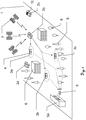
- Figure 1 illustrates a 3D view of an exemplary geographical setup of an area 1 wherein a set of transportation means 2a, 2b, 2c and a set of reconditioning stations 3a, 3b and 3c is shown.
- the transportation means 2 are illustrated by cars only although the method is not limited to this type of vehicle.
- the reconditioning stations 3a to 3c are illustrated by circles comprising a stock of two batteries 4, but in practice, the stocks will most certainly be different at different stations.
- Some of those reconditioning stations 3 can also allow the charging of the battery 4 without substitution, by supplying charging energy to the transportation means 2 (or, more exact, to its assigned battery 4) for recharging, which can be done for example by a connecting cable or wireless by induction.
- the term "reconditioning" can also mean any other process, such as for example an exchange of electrolytes or electrodes, either solid or liquid ones.
- the target 5 towards which the entity of transportation means 2b is heading is, in this special case, also a refreshing station, in particular a "charge-only" station where no stock of batteries for exchange is present.
- the destination 5 could for example be a parking slot at a shopping centre 5a which is equipped with an electrical socket where vehicle 2b can be plugged in for recharge, while the vehicle is parked and the driver is doing business.
- a restaurant 6 located, which can be visited by the driver for a lunch or coffee stopover during which the battery of his vehicle can be reconditioned, which means it can be exchanged or charged.
- a stopover can be one planned by the driver, allowing him to relax, consume food or drinks, as well as one demanded e.g. by governmental restrictions such as limited driving hours or times.
- other leisure activities such as sightseeing, museums, swimming pools, amusement parks, golf courses, etc. as well as business opportunities like temporary offices, can be provided at the stopover location 6.
- Such additional opportunities can be included in the planning of the trip and the assignment of a certain entity of reconditioning station 3b out of the available set, dependent on needs and likes of the driver.
- a position determination means as illustrated by the satellite navigation system 7, which can for example be a GPS, GLONAS, or GALILEO system, is comprised in either the vehicle 2 or its powering battery. Also, other possibilities such as GSM-Stations or movement tracking systems can be used to gather an actual position datum of the vehicle or battery.
- the positions of reconditioning stations 3 are known (although there might be mobile reconditioning stations too) this allows an assigning of a certain entity of reconditioning station 3b or 3c to an entity of transportation means 2b, preferably close to a path to a desired target position 5, as exemplarily shown by the two paths which are indicated by the dashed lines.
- Such a guidance means for guiding a transportation means 2b to a reconditioning station 3b can for example be similar to the state of the art navigation systems, where a driver can enter a desired target location to which he then will be guided along the shortest, quickest or cheapest path.
- some stopovers for reconditioning the battery might have to be included in the planning, if the energy of the battery is not sufficient to directly reach the desired destination 5.
- the inclusion of information about a continuation of travel - if known - can be planned in as well to avoid running out of energy later on, in an area where no reconditioning stations are within range or an indirection would have to be taken to reach a station.
- planned going on an exchange of the battery can be planned in along the path, even in advance of reaching the first target 5, although such would not be necessary for reaching the target 5.
- the second target can be, as a simple example, the way home from the target 5, taking the same path as used to go there.
- the transportation means 2c is also equipped with a solar panel 10, which allows a recharge of the energy cell by sunlight during travel or stopovers, dependent on the weather conditions. This can also be taken into account in the forecast of the consumption prediction, in particular in combination with a forecast of potential sunshine at its location.
- Figure 2 shows an abstracted close-up view of one entity of transportation means 2 on the way to the target 5.
- the powering battery 4 is thereby not limited to a single unit but can also comprise multiple units which can be used parallel or sequentially. It is also an option to vary the number of units according to an actually desired range which means for example that for short travels less batteries will be on board of the vehicle than for long overland travels which for example can brings advantages due to weight reduction.
- such a forecast can comprise information about the environmental driving behaviour such as terrain, in particular the altitude profile 13a, 13b and 13c, of the path 12a, 12b or 12c which will be travelled and/or other additional environmentally dependent driving behaviours.
- the terrain information allows a more accurate forecast of the consumption, as for example type or condition of the road on the selected path and in particular, the altitude profile of the path, has a direct influence on the power consumption. For example, a path over a steep pass on a mountain will require more energy than taking a path along a valley with less height differences or a flat highway through a tunnel. Therefore, the achievable range will vary dependent on the selected path as shown by the ranges 11a, 11b and 11c in context of the respective paths 12a, 12b and 12c.
- the path 12b can not be taken, since the range 11b is not sufficient to reach the destination 5 with the amount of energy from the energy cell 4 associated to the transportation means 2. Therefore, a reconditioning of the power energy cell 4 by charge or exchange would be needed but apparently, no station 3 for doing so is available along the path 12b, so that this path can not be chosen.
- the inclusion of the terrain information 13a and 13c results in the case of path 12a in a range 11a which is makes it impossible to reach the reconditioning station 3a.
- the environmental dependent driving behaviour can comprise the characteristics of the driver of the vehicle which can be human, but also non-human in a computer controlled vehicle or in case of an autonomous vehicle comprising an auto-pilot.
- a driver characteristic can be class of driver, his preferences and all the other things influencing the assignment as mentioned herein.
- the driving characteristics can be implemented as a mathematical model of a driver which is parameterized according to historical data recorded for the same driver, or also automatic detection according to the present behaviour of the driver or by input from the driver which helps to indicate the fact how "urgent" a travel is and if a higher energy consumption has to predicted due to the university driving style which will be used.
- Such information to be comprised in the forecast can be modelled in different ways, for example based on the underlying physics of driving, but also on recorded historical data, a model whereof is generated and/or parameterized.
- Figure 3 shows a single entity of transportation means 2 and a set of reconditioning stations 3a, 3b, 3c and stopover locations 6a, 6b, and 6c and connecting path 12a and 12b to a desired final station or location 5, which can be seen as one of the simplest embodiments according to the present invention.
- practical implementations can be much more complex with much bigger sets.
- the assignment can be done completely offline, with the necessary data coming from some digital storage media, such as a DVD comprising geographical data like terrain information, connecting street networks and positions of reconditioning stations.
- the data can be comprised according to the invention to find possible solutions for the assignment of entities of reconditioning stations to the transportation means and guiding the transportation means on a path to the reconditioning stations 3, the stopover locations 6 toward the final destination 5, wherein the actual assignment will also influence the path.
- the currently assigned battery will allow, according to its condition at the actual time and position, and according to the usage forecast, which comprises a terrain-dependent consumption prediction of the paths 12a and 12b, to achieve a range as marked by the line 11b. Since this range 11b allows only on one of the two possible paths to reach a reconditioning station 3, this path 12b is in this case the only one which can be taken.
- the station 3b located within the range 11b on the path 12b there will be - according to online information about the condition of the station 3b - only one battery available at the expected time of arrival, which will be reconditioned up to 70%.
- the achievable range 11a will not be sufficient to reach the desired destination 5 from the station 3b, for which at least 80% of full capacity of the available type of battery would be needed.
- a solution would be to wait at the station 3b until the battery will be sufficiently charged, which can be expected, according to a forecast of the charging process, in about 42 minutes after the expected arrival at the station 3b.
- the driver has to wait at the station 3b until the battery has reached its 80% capacity or alternatively, the method according to the invention can suggest for example a coffee-stopover at the location 6b along the path 12b, to reduce or avoid waiting times at the station 3b.
- the battery can be reserved online or booked according to the selected assignment at the station 3b where the transportation means will be guided.
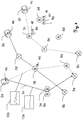
- Figure 4 illustrates an exemplary assignment according to the invention in view of multiple transportation means 2, stations 3 and batteries 4 out of the respective sets, which are geographically distributed over an area.
- it is one possible way for solving the assignment to consider the whole sets, but this is in general not mandatory, since it can be sufficient to consider only those subsets of entities, which can actually interact with each other due to their availabilities, positions, ranges and directions.
- the considered set of transportation means consists of two cars 2a, 2c, whose drivers have each entered desired target location 5a, 5c into their guidance systems.
- a third vehicle 2b in the set of transportation means that has to be considered which is a mail van 2b on its planned daily route to the remote post offices 5d and 5b.
- One of the plurality of possible solutions for assignment of the transportation means 2 to the set of available reconditioning stations 3a to 3d and under consideration of the available road-connections between them is shown by the lines from the transportation means 2 to their targets 5.
- this can be avoided by an optimisation of the assignment and guidance.
- an accurate prediction of energy consumption, dependent on the path of travel is achieved by taking into account environmentally dependent driving behaviour, in particular the terrain information 13a and 13b, which are forecasted by a model, a new, alternative solution can be found, which is marked by the dotted line 14. Due to the lower energy consumption on the new path 14 with the terrain 13a than on the path with terrain 13b, the station 3a will be in range of vehicle 2a. As the driver of 2a on his way to 5a has planned a meal stopover at the restaurant 6b anyway, his path can be optimized by taking the meal about half an hour earlier at the restaurant 6a, which is combined with the reconditioning station 3a.
- This optimisation does also affect the vehicle 2b, as this can now be assigned to the battery 4d at the station 3b without conflict, allowing it a quick reconditioning stopover by exchange of the battery at the station 3b, which is desirable since the post van 2b has a fixed schedule for its trip, which comprises the stations 5d and 5b, wherein delays can have severe impact on the whole postal service in this area. Therefore, a certain priority can be assigned to this vehicle's demand over e.g. leisure travels, or shopping trips.
- the assignment can also comprise information about the mentioned schedule of the trip of 2b whereby a forecast of demand of batteries at station 3b can be done each working day, when the post van 2b will be on its way, to ensure the quality of the postal service in this area.
- this can e.g. be done by a preliminary reservation of the reconditioning station 3b or in particular of an entity of the stock of batteries 4 at the station 3b.
- the method according to the invention does assign the set of transportation means 2 ⁇ 2a, 2b, 2c ⁇ to the set of reconditioning stations 3 ⁇ 3a, 3b, 3c, 3d ⁇ for charging or exchanging the powering battery ⁇ 4a, 4b, 4c ⁇ of the corresponding transportation means out of the set of batteries 4 ⁇ 4a ,4b, 4c, 4d, 4e, 4f, 4g, 4h, 4i ⁇ .
- supplementary conditions are comprised such as for example the possible paths between the mentioned sets, a model of terrain information 13a and 13b of the paths, a model of driver's characteristics, the conditions of the entities like charge level of the entities of battery 4, consumption index or model of the transportation means 2, reconditioning capabilities of the stations and/or the other influencing factors, especially, but not restricted to those factors and aspects explicitly mentioned in this application.
- an optimisation of the assignment can be done with the goal of finding the best global solution.
- Such an optimisation can for example be targeted to an avoidance of resource conflicts, in particular a lack of charge or exchange facilities at the reconditioning stations 3, but also multiple aspects can be targeted in optimisation for example by weighting different aspects according to a cost function as already explained.
- the terrain or environmental information can be used to weight the edges of the graph between the vertices.
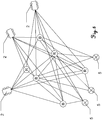
- Figure 5 exemplarily shows an almost complete solution space of assignment and guidance options for a small set of stations B and transportation means 2 which shows rapid increase of complexity in view of larger sets.
- an embodiment which comprises information of a plurality of entities or a subset of the sets can further improve the performance of the method according to the invention.
- an information exchange between the entities is established, only at certain times like during stopovers or online during most of the time of travel by some wireless communication means as discussed above the overall performance can be increased.
- edges of the graph in figure 5 which are shown by solid lines, can be weighted dependent on a number of the side conditions, which can also be interdependent on each other, as already explained above.
- the method according to the invention will determine the assignment of the resources by applying of a search algorithm as known in the art, to the graph for determining an optimized assignment whereby the transportation means can be guided to the reconditioning stations.
- Figure 6 shows an exemplary setup were a path 15 of the transportation means 2 to a destination 5 is shown, along which a reconditioning station 3 is assigned to the transportation means 2, where its assigned battery can be exchanged. Further there is a coffee-stopover 6 assigned where the already exchanged battery of the transportation means 2 can further be connected to a recharging facility if necessary for reaching the destination 5 or follow up destinations.
- the information on which the assignment is based is in this embodiment transmitted over wireless communication means 16, illustrated by antennas at the transportation means and stations.
- the actual optimisation is done at the centralized assignment means 17 for the considered area 1 which can establish a communication link to the transportation means, stations and also to the internet for the reception of weather forecasts, traffic information, expectable demands due to special events, planned schedules and the other information already mentioned.
- This actual and forecasted information is used as auxiliary conditions or constraints in the assignment process, which is done by a cluster of servers at the assignment means 17.
- the grid shown in the area 1 can be used for determining the distances according to the Metricor Manhattan-Method.
- the results of the assignment will be transmitted to the transportation means and station which will comprise the assignment in the local planning at the station 3 or guidance of the transportation means 2, for example in planning the path and stopovers and guiding or assisting the driver of the transportation means to follow the path along the assignments.
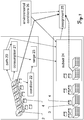
- Figure 7 exemplarily shows a simple illustration of an embodiment of the assignment, not from a geographical, but from a logical view, to explain some of the basic steps comprised therein.
- An entity of the set of transportation means 2 which has an associated or currently assigned battery 4 is assigned to an entity of reconditioning station 3 out of a set of such stations.
- the stations can also have a stock of currently assigned batteries 4 which are either waiting for charging, are currently being charged or have already been charged and are stocked to be supplied to demanding transportation means. All the batteries 4 at the reconditioning stations 3 and the transportation means 2 make up the set of batteries.
- the assignment 25 will at least comprise information about the condition 22 of the battery 4 and the consumption prediction 21 of the transportation means 2 along a desired path 20, whereof a range of motion 23 can be evaluated, which is currently achievable. Out of the information, regarding the range 23 and the path 20, as one special example, a pre selection of a subset of eligible stations 24 which are convenient for the transportation means can be involved, out of which subset selected assignment 25 can be made.
- This selected assignment comprises an optimisation of the assignment 25 on the basis of the environmentally dependent driving behaviour.
- a change of assignment 25 can also result in a change of the path 20, whereby a recursive re-calculation might occur during optimisation.
- a plurality of other environmental restrictions and/or conditions 26 can also be comprised in the selection of the assignment 25 according to the invention, the scope of which being defined by the claims.
Landscapes
- Engineering & Computer Science (AREA)
- Power Engineering (AREA)
- Radar, Positioning & Navigation (AREA)
- Remote Sensing (AREA)
- Transportation (AREA)
- Mechanical Engineering (AREA)
- General Physics & Mathematics (AREA)
- Physics & Mathematics (AREA)
- Automation & Control Theory (AREA)
- Life Sciences & Earth Sciences (AREA)
- Sustainable Development (AREA)
- Sustainable Energy (AREA)
- Electric Propulsion And Braking For Vehicles (AREA)
- Navigation (AREA)
- Hybrid Electric Vehicles (AREA)
- Charge And Discharge Circuits For Batteries Or The Like (AREA)
Claims (15)
- Verfahren zum Leiten eines mobilen Transportmittels (2a) eines Satzes von Transportmitteln (2) zu einer ausgewählten Rekonditionierungsstation (3a) eines Satzes von Rekonditionierungsstationen (3), wobei den Transportmitteln (2) jeweils eine Versorgungsbatterie (4a) eines geografisch verteilten Satzes von Batterien (4) in einer geografisch verteilten Anordnung der Transportmittel (2) und der Rekonditionierungsstationen (3) zugeordnet wird, mit den folgenden Schritten:• Bestimmen einer Position der Versorgungsbatterie (4a),• Bestimmen eines Zustands der Versorgungsbatterie (4a),• Vorhersagen einer Verbrauchscharakteristik des Transportmittels (2a),• Abschätzen einer erreichbaren Bewegungsreichweite für das Transportmittel (2a) gemäß seiner Verbrauchscharakteristik und dem Zustand seiner Versorgungsbatterie (4a),• Zuweisen der ausgewählten Rekonditionierungsstation (3a) aus dem Satz von Rekonditionierungsstationen (3) zu dem Transportmittel (2a) zum Austausch der Versorgungsbatterie (4a), die sich innerhalb der Bewegungsreichweite des Transportmittels (2a) entlang eines Weges (12a) zu einem gewünschten Ziel (5a) befindet,• Leiten des Transportmittels (2a) zu der ausgewählten Rekonditionierungsstation (3a),dadurch gekennzeichnet, dass
eine Optimierung der Zuweisung und/oder des Weges durch einen Suchalgorithmus zum Zuweisen des Satzes von Transportmitteln (2) zu dem Satz von Rekonditionierungsstationen (3) und Batterien (4) basierend auf tatsächlichen und/oder vorhergesagten Informationen über mehrere Einheiten der Sätze von Transportmitteln (2), Stationen (3) und Batterien (4) sowie ihrer Zustände durchgeführt wird, wobei die Optimierung mit einer Kostenfunktion erfolgt, die wenigstens Folgendes kombiniert:• eine räumliche Verteilung des Satzes von Batterien (4) auf die Rekonditionierungsstationen (3) und eine Vorhersage der Batterien (4), die von dem Satz von Transportmitteln (2) gewünscht werden,• eine Fahrtzeit der Transportmittel (2),• einen Gesamtenergieverbrauch von einer oder mehreren Einheiten des Satzes von Transportmitteln (2),• eine Priorität von einer oder mehreren Einheiten des Satzes von Transportmitteln (2),wobei die Optimierung eine Verengung des Lösungsraums während der Annäherung an die ausgewählte Rekonditionierungsstation (3) oder einen Zwischenstopp-Ort (6) für jedes Transportmittel (2, 2a, 2b, 2c) umfasst, was in einem optimierten Fahrtweg (12a, 12b, 15) resultiert. - Verfahren nach Anspruch 1,
dadurch gekennzeichnet, dass
der Suchalgorithmus auf folgenden Prinzipien basiert:• Heuristik,• unvollständige Suche,• genetische Algorithmen,• Tabu-Suche,• simulierte Abkühlung,• Greedy-Algorithmus,• Prim-Algorithmus und/oder• Kruskal-Algorithmus. - Verfahren nach einem der vorhergehenden Ansprüche,
dadurch gekennzeichnet, dass
die Optimierung auf zentralisierte Weise durchgeführt wird, und zwar durch:• ein stationäres dezidiertes Mittel (17) oder• eine Gruppe solcher dedizierter Mittel,
oder dezentralisiert• in jeder Batterie oder jedem Transportmittel oder• durch Cloud-Computing. - Verfahren nach einem der vorhergehenden Ansprüche,
dadurch gekennzeichnet, dass• der Weg (12a) oder ein Abschnitt des Weges und/oder die Zuweisung für das Transportmittel (2a) während der Fahrt neuerlich bestimmt wird, insbesondere durch Einbeziehung einer vorläufigen Reservierung der zugewiesenen Rekonditionierungsstation (3a) oder einer darin gelagerten Batterieeinheit (4a), und/oder• der Weg, der Abschnitt des Weges und/oder die Zuweisung für das Transportmittel (2a) vor der Ankunft bei der Rekonditionierungsstation (3a) durch eine fixe Buchung der zugewiesenen Rekonditionierungsstation (3a) oder einer darin gelagerten Einheit des Satzes von Batterien (4) fixiert wird. - Verfahren nach einem der vorhergehenden Ansprüche,
dadurch gekennzeichnet, dass
die ausgewählte Rekonditionierungsstation (3a) bestimmt wird, indem ferner tatsächliche und/oder vorhergesagte Informationen über Folgendes einbezogen werden:• einen Zustand der Rekonditionierungsstationen (3) des jeweiligen Satzes,• einen Zustand und eine Position der wenigstens einen anderen Batterie aus dem entsprechenden Satz (4),• den Weg (12a) des Transportmittels (2a), und/oder• einen Weg (12b) und eine Zuteilung wenigstens eines anderen Transportmittels (2b) aus dem entsprechenden Satz. - Verfahren nach Anspruch 5,
dadurch gekennzeichnet, dass
der Zustand der Rekonditionierungsstation (3) wenigstens tatsächliche und/oder vorhergesagte Informationen über Folgendes umfasst:• eine Rekonditionierungskapazität der Station,• eine Nutzung der Rekonditionierungskapazität,• eine Anzahl verfügbarer Slots für die Rekonditionierung,• eine maximale Rekonditionierungsgeschwindigkeit,• eine Nutzungseinschränkung für öffentliche, private oder bestimmte andere Gruppen,• einen Batterievorrat in der Station,• eine Information zur Buchung oder Reservierung des Batterievorrats oder der Rekonditionierungskapazität,• einen Preis für die Rekonditionierung der Batterie, und/oder• eine Information über Freizeit- oder Geschäftsaktivitäten rund um die Station. - Verfahren nach einem der vorhergehenden Ansprüche,
dadurch gekennzeichnet, dass
die tatsächlichen Informationen über ein Kommunikationsnetz (16) ausgetauscht werden, wobei sie entweder generell online während der Fahrt aktualisiert werden oder wenigstens gelegentlich aktualisiert werden, insbesondere durch ein Drahtloskommunikationsmittel. - Verfahren nach einem der vorhergehenden Ansprüche,
dadurch gekennzeichnet, dass
die Zuweisung der ausgewählten Rekonditionierungsstation (3a) auf einem umweltabhängigen Fahrverhalten basiert. - Verfahren nach Anspruch 8,
dadurch gekennzeichnet, dass
das umweltabhängige Fahrverhalten durch ein Modell und/oder historische Daten repräsentiert wird, insbesondere mit einer Vorhersage der Verbrauchscharakteristik gemäß einem Höhenprofil (13) des Weges (12) oder eines Abschnitts des Weges aus einer dreidimensionalen Geländeinformation und/oder einer Charakteristik eines Fahrers des Transportmittels (2a). - Verfahren nach einem der vorhergehenden Ansprüche,
dadurch gekennzeichnet, dass
der Weg (12a) gemäß Folgendem bestimmt wird:• der Position des Transportmittels (2a),• der Position des gewünschten Ziels (5a) des Transportmittels (2a), insbesondere gemäß einer Eingabe des Fahrers,• den Positionen der Rekonditionierungsstationen (3),• Informationen über eine geplante Fortsetzung, nachdem das gewünschte Ziel (5a) erreicht wurde,• Informationen über geplante oder verlangte Zwischenstopps (6) des Transportmittels (2a) und erwartete Zeiten für Zwischenstopps, und/oder• Informationen aus Verkehrsinformationen oder Verkehrsleitsystemen. - Verfahren nach einem der vorhergehenden Ansprüche,
dadurch gekennzeichnet, dass
der Zustand der Batterie (4a, 4b, 4c, 4d, 4e, 4f, 4g, 4h, 4i) wenigstens einen Subsatz aus Folgendem umfasst:• tatsächliche Kapazität,• volle Kapazität,• Temperatur,• tatsächlicher Nutzungsstatus,• geschätzte verbleibende Leistung,• geschätzte Zeit der Aufladung bis zur vollen Kapazität,• Alter,• Herstellungsdatum,• verstrichene Betriebsstunden,• verstrichene Regenerationszyklen,• Gesundheit oder gewichtetes Alter gemäß einer Nutzungshistorie,• erforderliche Wartungszeiten,• Lebenserwartung,• Belastungshistorie,• gewünschte Aufladeeigenschaften,• maximale Aufladeleistung,• gewünschte Versorgungseigenschaften,• maximale Spitzenleistung,• maximale Dauerleistung und/oder• Hersteller, Typ, Modell, Seriennummer. - Verfahren nach Anspruch 11,
dadurch gekennzeichnet, dass
der Zustand der Batterie (4a, 4b, 4c, 4d, 4e, 4f, 4g, 4h, 4i) wenigstens einen Subsatz aus Folgendem umfasst:• Temperatur und• tatsächlicher Nutzungsstatus,wobei Umgebungstemperaturbedingungen bei einer Prognose des Verbrauchs von Vorrichtungen in dem Fahrzeug berücksichtigt werden, die von der Batterie versorgt werden, wobei die Vorrichtungen wenigstens eine aus einer Heizung und einer Kühlung umfassen. - Verfahren nach Anspruch 9,
dadurch gekennzeichnet, dass
das Modell, das für die Vorhersage der Verbrauchscharakteristik verwendet wird, wenigstens einen Subsatz aus Folgendem umfasst:• dem Weg (12a) oder einem Abschnitt des Weges des Transportmittels (2a), insbesondere umfassend einen Stop-and-Go-Bereich, einen Straßentyp und einen Straßenzustand;• einer Verbrauchscharakteristik des Transportmittels (2a), insbesondere umfassend einen charakteristischen Energieverbrauch des Transportmittels (2a), eine Transportmittelklasse, ein Gewicht und/oder eine Last;• einer Fahrercharakteristik eines tatsächlichen, entweder menschlichen oder nicht menschlichen Fahrers des Transportmittels (2a);• einer Informationshistorie anderer Transportmittel (2) und/oder Fahrer, die den Weg vorher befahren haben;• einer Vorhersage von Ferien-, Saison- oder Stoßzeitbedingungen, die auf dem Weg zu erwarten sind; und/oder• einer Information aus Verkehrsinformationen oder Verkehrsleitsystemen. - Leiteinheit, die zur Durchführung des Verfahrens nach einem der Ansprüche 1 bis 13 bestimmt ist, umfassend wenigstens:• eine Lokalisierungseinheit (7) zur Bestimmung von Positionsdaten,• eine Batteriebeobachtungseinheit zur Bestimmung eines Zustands einer Versorgungsbatterie (4), die einem Transportmittel (2) zugeordnet ist,• eine Reichweitenabschätzungseinheit zur Bestimmung einer erreichbaren Reichweite gemäß dem Zustand der Versorgungsbatterie (4a) und einer Vorhersage einer Verbrauchsprognose besagten Transportmittels (2a), das der Versorgungsbatterie (4a) zugeordnet ist;• eine Leitungseinheit, insbesondere umfassend eine Schnittstelle für einen menschlichen Benutzer, zur Zuweisung einer Einheit aus einem Satz von Rekonditionierungsstationen (3) zu dem Transportmittel (2a) und zur Bereitstellung von Informationen zum Leiten des Transportmittels (2a) zu der Rekonditionierungsstations-Einheit entlang eines Weges zu einem Ziel (5) für das Transportmittel.
- Computerprogrammprodukt, umfassend einen auf einem maschinenlesbaren Medium gespeicherten Programmcode, zum Durchführen des Verfahrens nach einem der Ansprüche 1 bis 13, wenn das Programm in einem Computer oder in einem Cluster von Recheneinheiten ausgeführt wird.
Priority Applications (1)
| Application Number | Priority Date | Filing Date | Title |
|---|---|---|---|
| EP11717582.8A EP2567193B1 (de) | 2010-05-06 | 2011-04-27 | Verfahren und führungseinheit zum leiten von batteriebetriebenen transportmitteln zu aufladestationen |
Applications Claiming Priority (3)
| Application Number | Priority Date | Filing Date | Title |
|---|---|---|---|
| EP10162188A EP2385349A1 (de) | 2010-05-06 | 2010-05-06 | Verfahren und Führungseinheit zum Leiten von batteriebetriebenen Transportmitteln zu Aufladestationen |
| EP11717582.8A EP2567193B1 (de) | 2010-05-06 | 2011-04-27 | Verfahren und führungseinheit zum leiten von batteriebetriebenen transportmitteln zu aufladestationen |
| PCT/EP2011/056688 WO2011138205A1 (en) | 2010-05-06 | 2011-04-27 | Method and guidance-unit for guiding battery-operated transportation means to reconditioning stations |
Publications (2)
| Publication Number | Publication Date |
|---|---|
| EP2567193A1 EP2567193A1 (de) | 2013-03-13 |
| EP2567193B1 true EP2567193B1 (de) | 2021-04-14 |
Family
ID=42813513
Family Applications (2)
| Application Number | Title | Priority Date | Filing Date |
|---|---|---|---|
| EP10162188A Withdrawn EP2385349A1 (de) | 2010-05-06 | 2010-05-06 | Verfahren und Führungseinheit zum Leiten von batteriebetriebenen Transportmitteln zu Aufladestationen |
| EP11717582.8A Active EP2567193B1 (de) | 2010-05-06 | 2011-04-27 | Verfahren und führungseinheit zum leiten von batteriebetriebenen transportmitteln zu aufladestationen |
Family Applications Before (1)
| Application Number | Title | Priority Date | Filing Date |
|---|---|---|---|
| EP10162188A Withdrawn EP2385349A1 (de) | 2010-05-06 | 2010-05-06 | Verfahren und Führungseinheit zum Leiten von batteriebetriebenen Transportmitteln zu Aufladestationen |
Country Status (6)
| Country | Link |
|---|---|
| US (1) | US9103686B2 (de) |
| EP (2) | EP2385349A1 (de) |
| KR (1) | KR20130004529A (de) |
| CN (1) | CN102884401B (de) |
| CA (1) | CA2798221C (de) |
| WO (1) | WO2011138205A1 (de) |
Families Citing this family (112)
| Publication number | Priority date | Publication date | Assignee | Title |
|---|---|---|---|---|
| US10217160B2 (en) | 2012-04-22 | 2019-02-26 | Emerging Automotive, Llc | Methods and systems for processing charge availability and route paths for obtaining charge for electric vehicles |
| US9123035B2 (en) | 2011-04-22 | 2015-09-01 | Angel A. Penilla | Electric vehicle (EV) range extending charge systems, distributed networks of charge kiosks, and charge locating mobile apps |
| US9285944B1 (en) | 2011-04-22 | 2016-03-15 | Angel A. Penilla | Methods and systems for defining custom vehicle user interface configurations and cloud services for managing applications for the user interface and learned setting functions |
| DE102011108381B4 (de) * | 2011-07-22 | 2013-02-21 | Audi Ag | Verfahren zum Unterstützen einer Person beim Planen einer Fahrt mit einem Elektrofahrzeug und Kraftfahrzeug mit einer Navigationseinrichtung |
| EP2737599B1 (de) | 2011-07-26 | 2018-10-10 | Gogoro Inc. | Vorrichtung, verfahren und artikel zur authentifizierung, sicherheit und steuerung von energiespeichereinrichtungen, wie etwa batterien, auf der basis von benutzerprofilen |
| US10186094B2 (en) | 2011-07-26 | 2019-01-22 | Gogoro Inc. | Apparatus, method and article for providing locations of power storage device collection, charging and distribution machines |
| JP5960260B2 (ja) * | 2011-07-26 | 2016-08-02 | ゴゴロ インク | 電力蓄積デバイスの収集、充電、および分配マシンの場所を提供するための装置、方法、および物品 |
| EP2737594B1 (de) | 2011-07-26 | 2019-02-13 | Gogoro Inc. | Vorrichtung, verfahren und artikel für einen raum für eine energiespeichervorrichtung |
| TWI581541B (zh) | 2011-07-26 | 2017-05-01 | 睿能創意公司 | 用於認證、保全及控制如電池組之電力儲存器件之裝置、方法及物品 |
| EP2737597B1 (de) | 2011-07-26 | 2019-10-16 | Gogoro Inc. | Vorrichtung, verfahren und artikel zur physischen sicherheit von energiespeichereinrichtungen bei fahrzeugen |
| JP6422119B2 (ja) | 2011-07-26 | 2018-11-14 | ゴゴロ インク | 収集充電分配装置間でバッテリなどの電力貯蔵装置を再分配するための装置、方法及び物品 |
| JP6026535B2 (ja) | 2011-07-26 | 2016-11-16 | ゴゴロ インク | 予約電力蓄積デバイス収集、充電、および分配マシンにおける電力蓄積デバイスの予約を行なうための装置、方法、および物品 |
| US9129461B2 (en) | 2011-07-26 | 2015-09-08 | Gogoro Inc. | Apparatus, method and article for collection, charging and distributing power storage devices, such as batteries |
| US9437058B2 (en) | 2011-07-26 | 2016-09-06 | Gogoro Inc. | Dynamically limiting vehicle operation for best effort economy |
| TWI560637B (en) | 2011-07-26 | 2016-12-01 | Gogoro Inc | Apparatus, method and article for providing information regarding availability of power storage devices at a power storage device collection, charging and distribution machine |
| JP5793245B2 (ja) | 2011-07-26 | 2015-10-14 | ゴゴロ インク | 乗り物診断データを提供するための装置、方法、および物品 |
| WO2013080211A1 (en) * | 2011-12-02 | 2013-06-06 | Better Place GmbH | Battery selection system and method |
| KR101287292B1 (ko) * | 2012-01-05 | 2013-08-13 | 르노삼성자동차 주식회사 | 전기 자동차 충전 구역 관리 시스템 및 방법 |
| ES2869856T3 (es) | 2012-01-09 | 2021-10-26 | Airbiquity Inc | Servicios de red de carga de vehículos eléctricos |
| US8676400B2 (en) * | 2012-02-03 | 2014-03-18 | Volkswagen Ag | Navigation system and method for an electric vehicle travelling from a starting point to a destination |
| DE102012012567A1 (de) * | 2012-06-23 | 2013-12-24 | Audi Ag | Navigationsvorrichtung mit einer Reichweitenanzeige für einen elektrischen Fahrbetrieb und Kraftwagen mit einer Navigationsvorrichtung |
| US9302594B2 (en) * | 2012-07-31 | 2016-04-05 | Qualcomm Incorporated | Selective communication based on distance from a plurality of electric vehicle wireless charging stations in a facility |
| DE102012220604B4 (de) * | 2012-11-13 | 2014-11-20 | Siemens Aktiengesellschaft | Parkraumreservierungssystem und Verfahren |
| BR112015011290A2 (pt) | 2012-11-16 | 2017-07-11 | Gogoro Inc | aparelho, método e artigo para sinais de realização de curva de veículo |
| US9608952B2 (en) * | 2012-12-14 | 2017-03-28 | Intel Corporation | Systems and methods for user device interaction |
| US9854438B2 (en) | 2013-03-06 | 2017-12-26 | Gogoro Inc. | Apparatus, method and article for authentication, security and control of portable charging devices and power storage devices, such as batteries |
| US11222485B2 (en) | 2013-03-12 | 2022-01-11 | Gogoro Inc. | Apparatus, method and article for providing information regarding a vehicle via a mobile device |
| BR112015023244A2 (pt) | 2013-03-12 | 2017-07-18 | Gogoro Inc | aparelho, processo e artigo para alterar planos de troca de dispositivos de armazenamento de energia elétrica portáteis |
| US8798852B1 (en) | 2013-03-14 | 2014-08-05 | Gogoro, Inc. | Apparatus, system, and method for authentication of vehicular components |
| JP6462655B2 (ja) | 2013-03-15 | 2019-01-30 | ゴゴロ インク | 蓄電デバイスの収集および分配のためのモジュラーシステム |
| EP2784446B1 (de) * | 2013-03-26 | 2019-10-30 | Alcatel Lucent | Zeiteffizientes Verkehrsleitsystem |
| DE102013208744A1 (de) * | 2013-05-13 | 2014-11-13 | Siemens Aktiengesellschaft | Verfahren zum automatischen Ermitteln des Energiebedarfs und/oder des Belegungsbedarfs einer Elektrotankstelle und zugehörige DV-Anlagen |
| JP2015011576A (ja) * | 2013-06-28 | 2015-01-19 | 株式会社東芝 | 蓄電池駆動車両の運行システム |
| JP5362930B1 (ja) * | 2013-07-04 | 2013-12-11 | レスク株式会社 | 電動車両用バッテリ交換システム及びプログラム |
| DE102013213339A1 (de) * | 2013-07-08 | 2015-01-08 | Ford Global Technologies, Llc | Steuereinrichtung für ein autonomes Landfahrzeug |
| EP3026751B1 (de) * | 2013-07-25 | 2019-04-17 | Nissan Motor Co., Ltd | Benutzungsverwaltungssystem für sekundärbatterie, benutzungsverwaltungsvorrichtung für sekundärbatterie und benutzungsverwaltungsverfahren für sekundärbatterie |
| TWI644194B (zh) | 2013-08-06 | 2018-12-11 | 睿能創意公司 | 電能儲存裝置熱分布調節控制器、方法及其電動車系統 |
| US9770996B2 (en) | 2013-08-06 | 2017-09-26 | Gogoro Inc. | Systems and methods for powering electric vehicles using a single or multiple power cells |
| DE102013014527A1 (de) * | 2013-09-03 | 2015-03-05 | Rwe Ag | Verfahren und System zum dynamischen Bereitstellen von Informationen über Ladestationen |
| US9124085B2 (en) | 2013-11-04 | 2015-09-01 | Gogoro Inc. | Apparatus, method and article for power storage device failure safety |
| TWI626183B (zh) | 2013-11-08 | 2018-06-11 | 睿能創意公司 | 用於提供車輛事件資料的裝置、方法與物品 |
| CN111114377B (zh) * | 2013-11-28 | 2024-08-27 | 松下电器(美国)知识产权公司 | 信息输出方法、信息提示装置以及信息输出系统 |
| KR101542665B1 (ko) * | 2013-12-03 | 2015-08-12 | 강병혁 | 전기자동차용 배터리팩의 이용방법 |
| TWI645646B (zh) | 2014-01-23 | 2018-12-21 | Gogoro Inc. | 使用以矩陣佈置的電能儲存器之系統和方法 |
| GB2522648A (en) | 2014-01-31 | 2015-08-05 | Nokia Technologies Oy | An apparatus, method and computer program for enabling charging of a vehicle |
| US9714837B2 (en) | 2014-02-07 | 2017-07-25 | Recargo, Inc. | Presenting routing information for electric vehicles |
| US9663111B2 (en) * | 2014-05-30 | 2017-05-30 | Ford Global Technologies, Llc | Vehicle speed profile prediction using neural networks |
| US9365218B2 (en) * | 2014-07-14 | 2016-06-14 | Ford Global Technologies, Llc | Selectable autonomous driving modes |
| WO2016025392A1 (en) | 2014-08-11 | 2016-02-18 | Gogoro Inc. | Multidirectional electrical connector, plug and system |
| USD789883S1 (en) | 2014-09-04 | 2017-06-20 | Gogoro Inc. | Collection, charging and distribution device for portable electrical energy storage devices |
| CN110481360B (zh) | 2014-09-04 | 2023-06-16 | 睿能创意公司 | 可携式电能储存器的充电模块 |
| US9858811B2 (en) * | 2014-10-20 | 2018-01-02 | Empire Technology Development Llc | Vehicle traffic management |
| DE102014226031A1 (de) | 2014-12-16 | 2016-06-16 | Volkswagen Aktiengesellschaft | Verfahren und Vorrichtung zum Prognostizieren einer Reichweite eines Fahrzeugs mit zumindest teilweise elektrischem Antrieb |
| US9690298B2 (en) * | 2015-05-14 | 2017-06-27 | Egenpower Inc. | Border-signal generating and wire winding device for border recognition of self-propelled mower |
| EP3303048B1 (de) | 2015-06-05 | 2022-11-16 | Gogoro Inc. | Systeme und verfahren zur fahrzeugladungserkennung und reaktion |
| EP3104122A1 (de) * | 2015-06-12 | 2016-12-14 | Ecole Nationale de l'Aviation Civile | Energieverwaltungssystem für fahrzeuge |
| US11212654B2 (en) | 2015-11-04 | 2021-12-28 | Honda Motor Co., Ltd. | Coordinated driving through driver-to-driver V2X communication |
| US10309791B2 (en) * | 2015-11-04 | 2019-06-04 | Honda Motor Co., Ltd. | Virtual towing |
| JP6657828B2 (ja) * | 2015-11-17 | 2020-03-04 | オムロン株式会社 | 誘導装置、誘導システムおよび誘導方法 |
| JP6582909B2 (ja) | 2015-11-17 | 2019-10-02 | オムロン株式会社 | バッテリ予約装置およびバッテリ予約方法 |
| JP6766343B2 (ja) * | 2015-11-17 | 2020-10-14 | オムロン株式会社 | バッテリ予約装置 |
| JP6597218B2 (ja) | 2015-11-17 | 2019-10-30 | オムロン株式会社 | バッテリ予約装置およびバッテリ予約方法 |
| JP6724343B2 (ja) | 2015-11-17 | 2020-07-15 | オムロン株式会社 | 予約管理装置、予約管理システムおよび予約管理方法 |
| US10260898B2 (en) * | 2016-07-12 | 2019-04-16 | Toyota Motor Engineering & Manufacturing North America, Inc. | Apparatus and method of determining an optimized route for a highly automated vehicle |
| WO2018061415A1 (ja) * | 2016-09-30 | 2018-04-05 | 本田技研工業株式会社 | 経路探索装置、バッテリ情報管理装置及びプログラム |
| US10661805B2 (en) * | 2016-11-22 | 2020-05-26 | Samsung Electronics Co., Ltd. | Vehicle control unit (VCU) and operating method thereof |
| WO2018104966A1 (en) * | 2016-12-07 | 2018-06-14 | Kumar Maini Chetan | A rechargeable battery management system |
| FR3061471B1 (fr) * | 2017-01-05 | 2020-10-16 | Renault Sas | Procede d’optimisation de la consommation energetique d’un vehicule hybride |
| US10288439B2 (en) | 2017-02-22 | 2019-05-14 | Robert D. Pedersen | Systems and methods using artificial intelligence for routing electric vehicles |
| CN108688479B (zh) * | 2017-04-06 | 2023-09-01 | 中兴通讯股份有限公司 | 一种电池管理方法、装置及系统 |
| CN108725264A (zh) * | 2017-04-24 | 2018-11-02 | 中兴通讯股份有限公司 | 一种座椅调节方法、装置和系统 |
| FR3066981B1 (fr) * | 2017-05-31 | 2019-06-14 | Electricite De France | Dispositif de gestion d'un ensemble de propulsion electrique d'un vehicule |
| DE102017213984A1 (de) | 2017-08-10 | 2019-02-14 | Bayerische Motoren Werke Aktiengesellschaft | Verfahren zum Betreiben einer Navigationsvorrichtung für ein Kraftfahrzeug |
| DE102017215792B4 (de) * | 2017-09-07 | 2020-06-18 | Bayerische Motoren Werke Aktiengesellschaft | Verfahren, Vorrichtung, Computerprogramm und Computerprogrammprodukt zur Routenplanung für ein Fahrzeug |
| US10414280B2 (en) | 2017-11-10 | 2019-09-17 | Toyota Motor Engineering & Manufacturing North America, Inc. | Systems and methods for selective battery control |
| US11203266B2 (en) * | 2018-02-23 | 2021-12-21 | Honda Motor Co., Ltd. | Battery station management system including server for generating monitoring screen showing state information of battery exchange devices and battery devices in each battery station and battery station management method |
| EP3536552A1 (de) * | 2018-03-06 | 2019-09-11 | Carrier Corporation | Interaktive auslösungsplanungsanwendung für eine transportkühleinheit mit einer energiespeichervorrichtung |
| US10852737B2 (en) | 2018-03-22 | 2020-12-01 | Micron Technology, Inc. | Power management, dynamic routing and memory management for autonomous driving vehicles |
| GB2572962A (en) * | 2018-04-16 | 2019-10-23 | Morgan Brown Consultancy Ltd | Vehicle Routing |
| US11067403B2 (en) * | 2018-07-05 | 2021-07-20 | GM Global Technology Operations LLC | Vehicle energy usage tracking |
| DK201870686A1 (en) * | 2018-08-02 | 2020-02-20 | Aptiv Technologies Limited | MANAGEMENT OF MULTIPLE AUTONOMOUS VEHICLES |
| EP3605414B1 (de) | 2018-08-02 | 2023-06-14 | Hexagon Technology Center GmbH | Stromnetzverwaltung |
| DE102018118945A1 (de) * | 2018-08-03 | 2020-02-06 | Deutsche Telekom Ag | Batterien und ein geeignetes Schnell-Wechselsystem der Batterien für Fahrzeuge |
| US10645864B2 (en) | 2018-08-21 | 2020-05-12 | Cnh Industrial Canada, Ltd. | Product runout tracking system and method |
| US20200130510A1 (en) * | 2018-10-30 | 2020-04-30 | Brandon Eck | System and method for autonomous shipping |
| US20220024340A1 (en) | 2018-11-29 | 2022-01-27 | Honda Motor Co., Ltd. | Battery use system, charging device, information processing device, battery use method, program, and storage medium |
| IT201900000605A1 (it) * | 2019-01-15 | 2020-07-15 | Univ Degli Studi Genova | Metodo e sistema per la gestione ottimizzata in tempo reale del trasporto tramite veicoli elettrici |
| EP3702201B1 (de) * | 2019-02-27 | 2021-03-31 | Sap Se | Steuerung der elektrofahrzeugladeinfrastruktur |
| JP6964112B2 (ja) * | 2019-05-28 | 2021-11-10 | 本田技研工業株式会社 | 情報提供装置、情報提供方法、及びプログラム |
| KR102391003B1 (ko) * | 2019-06-03 | 2022-04-27 | 현대자동차주식회사 | 차량용 배터리 교체 시스템 및 그 제어방법 |
| US11207995B2 (en) * | 2019-07-08 | 2021-12-28 | Caterpillar Paving Products Inc. | System and method for charging machines |
| CN111191813A (zh) * | 2019-10-14 | 2020-05-22 | 重庆邮电大学 | 基于货物载重与软时间窗限制的车辆配送路径优化方法 |
| EP3835115A1 (de) * | 2019-12-12 | 2021-06-16 | Permobil AB | Verfahren zum schätzen der verbleibenden fahrdistanz, die von einer ladung für eine angetriebene mobilitätsvorrichtung verfügbar ist |
| DE102020107916A1 (de) * | 2020-03-23 | 2021-09-23 | Ford Global Technologies Llc | Verfahren zum Ermitteln einer Fahrtroute für einen Kraftwagen und System zum Durchführen des Verfahrens |
| IT202000011893A1 (it) * | 2020-05-21 | 2021-11-21 | E P T – Eco Power Tech Phoenix S R L | Sistema di trasporto pubblico con autobus con batterie di alimentazione e metodo di gestione |
| CN114005295A (zh) | 2020-07-28 | 2022-02-01 | 比亚迪股份有限公司 | 一种预估车辆能耗信息的方法、装置、设备及介质 |
| US11898856B2 (en) * | 2020-10-20 | 2024-02-13 | Gm Cruise Holdings Llc | Autonomous vehicle long distance rides |
| JP2024502428A (ja) * | 2020-12-31 | 2024-01-19 | 奥動新能源汽車科技有限公司 | バッテリー交換ステーションの推奨方法、システム、電子装置及び記憶媒体 |
| DE102021202468A1 (de) * | 2021-03-15 | 2022-09-15 | Zf Friedrichshafen Ag | Vorrichtung und Verfahren zur modellbasierten prädizierten Regelung einer Komponente eines Fahrzeugs |
| CN113607179A (zh) * | 2021-07-30 | 2021-11-05 | 车主邦(北京)科技有限公司 | 导航终点的确定方法、装置、电子设备及存储介质 |
| CN113532469A (zh) * | 2021-07-30 | 2021-10-22 | 车主邦(北京)科技有限公司 | 导航方法、装置、电子设备及存储介质 |
| CN114330226B (zh) * | 2021-12-31 | 2025-06-24 | 国网北京市电力公司 | 一种基于图论的电池管控方法、装置、设备及介质 |
| CN116923181B (zh) * | 2022-04-02 | 2026-03-13 | 奥动新能源股份有限公司 | 换电设备的换电检测方法及系统、换电设备及存储介质 |
| EP4507919A1 (de) * | 2022-04-14 | 2025-02-19 | Volvo Truck Corporation | Intelligente prädiktive batterierampe und wechselmodul zum laden eines nutzfahrzeugs im bewegten zustand des nutzfahrzeugs |
| FI131562B1 (en) * | 2022-04-22 | 2025-06-30 | Liikennevirta Oy / Virta Ltd | SCALABLE PROCEDURE FOR HANDLING ERRORS IN AN ELECTRIC VEHICLE CHARGING STATION NETWORK |
| DE102022111264A1 (de) | 2022-05-06 | 2022-06-15 | Daimler Truck AG | Verfahren zur fahrstreckenabhängigen Prognose von Energiekosten für ein Fahrzeug |
| US20240034184A1 (en) * | 2022-08-01 | 2024-02-01 | King Fahd University Of Petroleum And Minerals | Method for minimizing electric vehicle outage |
| EP4438393B1 (de) * | 2023-03-29 | 2025-09-17 | Honda Motor Co., Ltd. | Computerimplementiertes verfahren zur steuerung einer verteilung von geladenen batterien in einem system mit lokal verteilten stationen zur bereitstellung von austauschbatterien |
| US12523482B2 (en) | 2024-02-15 | 2026-01-13 | Toyota Motor Engineering & Manufacturing North America, Inc. | Knowledge-based artificial intelligence system for estimating vehicle range |
| EP4635787A1 (de) * | 2024-02-28 | 2025-10-22 | Honeywell International Inc. | Vorrichtungen, computerimplementierte verfahren und computerprogrammprodukte zur energiebasierten reisepfadplanung |
| US20250271274A1 (en) * | 2024-02-28 | 2025-08-28 | Honeywell International Inc. | Apparatuses, computer-implemented methods, and computer program products for energy-based travel pathway planning |
| KR102804244B1 (ko) * | 2025-03-11 | 2025-05-09 | 한화시스템 주식회사 | Gva 표준 공용화를 위한 데이터 처리 시스템 및 방법 |
Citations (1)
| Publication number | Priority date | Publication date | Assignee | Title |
|---|---|---|---|---|
| WO2010115573A1 (de) * | 2009-04-08 | 2010-10-14 | Li-Tec Battery Gmbh | Elektrofahrzeug mit gps gestützter tankstellenreservierung |
Family Cites Families (16)
| Publication number | Priority date | Publication date | Assignee | Title |
|---|---|---|---|---|
| JPS6412802A (en) | 1987-07-02 | 1989-01-17 | Fujitsu Ltd | Battery-driven vehicle |
| US5487002A (en) * | 1992-12-31 | 1996-01-23 | Amerigon, Inc. | Energy management system for vehicles having limited energy storage |
| DE19519107C1 (de) * | 1995-05-24 | 1996-04-04 | Daimler Benz Ag | Fahrtroutenratgebereinrichtung |
| JPH1012802A (ja) | 1996-06-27 | 1998-01-16 | Nec Kyushu Ltd | リードフレーム及びそれを用いた半導体装置 |
| US6005494A (en) * | 1996-10-16 | 1999-12-21 | Chrysler Corporation | Energy minimization routing of vehicle using satellite positioning an topographic mapping |
| JPH10170293A (ja) | 1996-12-05 | 1998-06-26 | Nissan Motor Co Ltd | 電気自動車の経路探索装置 |
| US7126341B2 (en) * | 1997-11-03 | 2006-10-24 | Midtronics, Inc. | Automotive vehicle electrical system diagnostic device |
| KR100651246B1 (ko) | 2004-02-17 | 2006-11-29 | 경상대학교산학협력단 | 액체전해질을 사용한 나트륨/유황 전지 |
| JP2006115623A (ja) | 2004-10-15 | 2006-04-27 | Fuji Heavy Ind Ltd | 走行可能距離推定システム |
| JP2006112932A (ja) | 2004-10-15 | 2006-04-27 | Fuji Heavy Ind Ltd | 電気自動車のナビゲーションシステム |
| JP2006331405A (ja) | 2005-04-21 | 2006-12-07 | Ntt Facilities Inc | 二次電池供給システムおよび二次電池供給方法 |
| JP4788643B2 (ja) | 2007-04-23 | 2011-10-05 | 株式会社デンソー | ハイブリッド車両用の充放電制御装置および当該充放電制御装置用のプログラム |
| CA2737243A1 (en) | 2007-09-20 | 2009-03-26 | Better Place GmbH | Electric vehicle network |
| JP5583124B2 (ja) | 2008-07-08 | 2014-09-03 | シーメンス アクチエンゲゼルシヤフト | 車両にエネルギーチャージするためのアダプタ装置および方法 |
| JP5493510B2 (ja) * | 2009-07-01 | 2014-05-14 | 日産自動車株式会社 | 情報提供システム、情報センタ、車載装置及び情報提供方法 |
| AU2010324651B2 (en) * | 2009-11-24 | 2015-10-22 | Telogis, Inc. | Vehicle route selection based on energy usage |
-
2010
- 2010-05-06 EP EP10162188A patent/EP2385349A1/de not_active Withdrawn
-
2011
- 2011-04-27 US US13/639,449 patent/US9103686B2/en active Active
- 2011-04-27 KR KR1020127031774A patent/KR20130004529A/ko not_active Ceased
- 2011-04-27 WO PCT/EP2011/056688 patent/WO2011138205A1/en not_active Ceased
- 2011-04-27 CN CN201180022484.4A patent/CN102884401B/zh active Active
- 2011-04-27 CA CA2798221A patent/CA2798221C/en not_active Expired - Fee Related
- 2011-04-27 EP EP11717582.8A patent/EP2567193B1/de active Active
Patent Citations (1)
| Publication number | Priority date | Publication date | Assignee | Title |
|---|---|---|---|---|
| WO2010115573A1 (de) * | 2009-04-08 | 2010-10-14 | Li-Tec Battery Gmbh | Elektrofahrzeug mit gps gestützter tankstellenreservierung |
Also Published As
| Publication number | Publication date |
|---|---|
| US20130046457A1 (en) | 2013-02-21 |
| AU2011250100A1 (en) | 2012-10-18 |
| CA2798221C (en) | 2016-05-24 |
| EP2567193A1 (de) | 2013-03-13 |
| US9103686B2 (en) | 2015-08-11 |
| EP2385349A1 (de) | 2011-11-09 |
| CN102884401B (zh) | 2015-11-25 |
| CN102884401A (zh) | 2013-01-16 |
| CA2798221A1 (en) | 2011-11-10 |
| KR20130004529A (ko) | 2013-01-10 |
| WO2011138205A1 (en) | 2011-11-10 |
Similar Documents
| Publication | Publication Date | Title |
|---|---|---|
| EP2567193B1 (de) | Verfahren und führungseinheit zum leiten von batteriebetriebenen transportmitteln zu aufladestationen | |
| US12447850B2 (en) | Dispatch-based charging for electric vehicle fleet | |
| Vosooghi et al. | Shared autonomous electric vehicle service performance: Assessing the impact of charging infrastructure | |
| JP5439242B2 (ja) | エネルギーナビゲーション制御装置、エネルギーナビゲーションシステム、およびエネルギーナビゲータ | |
| US10380898B1 (en) | Smart platooning of vehicles | |
| JP6399928B2 (ja) | 電気自動車ネットワークにおける負荷の推定および管理 | |
| KR102862272B1 (ko) | 운송기 특성들에 기초한 라우팅 | |
| US20180202825A1 (en) | Apparatus and method for providing charging equipment information to vehicle | |
| Lu et al. | Operating electric taxi fleets: A new dispatching strategy with charging plans | |
| CN107878218A (zh) | 优化插电式车辆车队的自适应系统和方法 | |
| CN102387936A (zh) | 具有基于gps的加油站预留服务的电动车辆 | |
| CN102867430A (zh) | 电动汽车用的信息终端以及巡航控制装置 | |
| CN116572788A (zh) | 电动化车辆与充电挂车之间电力流优先级排序系统和方法 | |
| US12567118B2 (en) | Strategic opportunity charging for on-route electric vehicles | |
| US12485789B2 (en) | Strategic opportunity charging for on-route electric vehicles | |
| El-Fedany et al. | A smart coordination system integrates MCS to minimize EV trip duration and manage the EV charging, mainly at peak times | |
| WO2024145657A1 (en) | Stategic opportunity charging for on-route electric vehicles | |
| Jung et al. | Shared-taxi operations with electric vehicles | |
| CN120725366A (zh) | 用于电动汽车的移动充电桩路径规划方法及系统 | |
| AU2011250100B2 (en) | Method and guidance-unit for guiding battery-operated transportation means to reconditioning stations | |
| Schönberg | Trip Planning for Electric Vehicles | |
| Khosravian | De-carbonizing Passenger Electric Vehicles and Medium-to-Heavy-Duty Electric Trucks: A Strategic Framework for the City of Toronto and the Province of Ontario | |
| WO2024144824A1 (en) | Strategic opportunity charging for on-route electric vehicles | |
| Liao | Driving Toward Sustainability: Large-Scale Electric Road Systems for Road Freight-an optimization model for ERS Network Planning | |
| Posthoorn | Vehicle Scheduling of Electric City Buses |
Legal Events
| Date | Code | Title | Description |
|---|---|---|---|
| PUAI | Public reference made under article 153(3) epc to a published international application that has entered the european phase |
Free format text: ORIGINAL CODE: 0009012 |
|
| 17P | Request for examination filed |
Effective date: 20120920 |
|
| AK | Designated contracting states |
Kind code of ref document: A1 Designated state(s): AL AT BE BG CH CY CZ DE DK EE ES FI FR GB GR HR HU IE IS IT LI LT LU LV MC MK MT NL NO PL PT RO RS SE SI SK SM TR |
|
| DAX | Request for extension of the european patent (deleted) | ||
| RIN1 | Information on inventor provided before grant (corrected) |
Inventor name: PETTERSSON, BO |
|
| RIN1 | Information on inventor provided before grant (corrected) |
Inventor name: PETTERSSON, BO |
|
| STAA | Information on the status of an ep patent application or granted ep patent |
Free format text: STATUS: EXAMINATION IS IN PROGRESS |
|
| 17Q | First examination report despatched |
Effective date: 20180508 |
|
| RIN1 | Information on inventor provided before grant (corrected) |
Inventor name: PETTERSSON, BO |
|
| GRAP | Despatch of communication of intention to grant a patent |
Free format text: ORIGINAL CODE: EPIDOSNIGR1 |
|
| STAA | Information on the status of an ep patent application or granted ep patent |
Free format text: STATUS: GRANT OF PATENT IS INTENDED |
|
| RIC1 | Information provided on ipc code assigned before grant |
Ipc: B60L 53/80 20190101ALI20201022BHEP Ipc: G01C 21/34 20060101AFI20201022BHEP Ipc: B60L 58/16 20190101ALI20201022BHEP Ipc: B60L 1/02 20060101ALI20201022BHEP Ipc: B60L 8/00 20060101ALI20201022BHEP Ipc: B60L 1/14 20060101ALI20201022BHEP Ipc: B60L 58/12 20190101ALI20201022BHEP Ipc: B60L 1/00 20060101ALI20201022BHEP |
|
| INTG | Intention to grant announced |
Effective date: 20201117 |
|
| GRAS | Grant fee paid |
Free format text: ORIGINAL CODE: EPIDOSNIGR3 |
|
| GRAA | (expected) grant |
Free format text: ORIGINAL CODE: 0009210 |
|
| STAA | Information on the status of an ep patent application or granted ep patent |
Free format text: STATUS: THE PATENT HAS BEEN GRANTED |
|
| AK | Designated contracting states |
Kind code of ref document: B1 Designated state(s): AL AT BE BG CH CY CZ DE DK EE ES FI FR GB GR HR HU IE IS IT LI LT LU LV MC MK MT NL NO PL PT RO RS SE SI SK SM TR |
|
| REG | Reference to a national code |
Ref country code: GB Ref legal event code: FG4D |
|
| REG | Reference to a national code |
Ref country code: CH Ref legal event code: EP |
|
| REG | Reference to a national code |
Ref country code: DE Ref legal event code: R096 Ref document number: 602011070679 Country of ref document: DE |
|
| REG | Reference to a national code |
Ref country code: IE Ref legal event code: FG4D |
|
| REG | Reference to a national code |
Ref country code: AT Ref legal event code: REF Ref document number: 1382812 Country of ref document: AT Kind code of ref document: T Effective date: 20210515 |
|
| REG | Reference to a national code |
Ref country code: LT Ref legal event code: MG9D |
|
| REG | Reference to a national code |
Ref country code: AT Ref legal event code: MK05 Ref document number: 1382812 Country of ref document: AT Kind code of ref document: T Effective date: 20210414 |
|
| REG | Reference to a national code |
Ref country code: NL Ref legal event code: MP Effective date: 20210414 |
|
| PG25 | Lapsed in a contracting state [announced via postgrant information from national office to epo] |
Ref country code: AT Free format text: LAPSE BECAUSE OF FAILURE TO SUBMIT A TRANSLATION OF THE DESCRIPTION OR TO PAY THE FEE WITHIN THE PRESCRIBED TIME-LIMIT Effective date: 20210414 Ref country code: BG Free format text: LAPSE BECAUSE OF FAILURE TO SUBMIT A TRANSLATION OF THE DESCRIPTION OR TO PAY THE FEE WITHIN THE PRESCRIBED TIME-LIMIT Effective date: 20210714 Ref country code: HR Free format text: LAPSE BECAUSE OF FAILURE TO SUBMIT A TRANSLATION OF THE DESCRIPTION OR TO PAY THE FEE WITHIN THE PRESCRIBED TIME-LIMIT Effective date: 20210414 Ref country code: LT Free format text: LAPSE BECAUSE OF FAILURE TO SUBMIT A TRANSLATION OF THE DESCRIPTION OR TO PAY THE FEE WITHIN THE PRESCRIBED TIME-LIMIT Effective date: 20210414 Ref country code: NL Free format text: LAPSE BECAUSE OF FAILURE TO SUBMIT A TRANSLATION OF THE DESCRIPTION OR TO PAY THE FEE WITHIN THE PRESCRIBED TIME-LIMIT Effective date: 20210414 Ref country code: FI Free format text: LAPSE BECAUSE OF FAILURE TO SUBMIT A TRANSLATION OF THE DESCRIPTION OR TO PAY THE FEE WITHIN THE PRESCRIBED TIME-LIMIT Effective date: 20210414 |
|
| PG25 | Lapsed in a contracting state [announced via postgrant information from national office to epo] |
Ref country code: NO Free format text: LAPSE BECAUSE OF FAILURE TO SUBMIT A TRANSLATION OF THE DESCRIPTION OR TO PAY THE FEE WITHIN THE PRESCRIBED TIME-LIMIT Effective date: 20210714 Ref country code: PL Free format text: LAPSE BECAUSE OF FAILURE TO SUBMIT A TRANSLATION OF THE DESCRIPTION OR TO PAY THE FEE WITHIN THE PRESCRIBED TIME-LIMIT Effective date: 20210414 Ref country code: PT Free format text: LAPSE BECAUSE OF FAILURE TO SUBMIT A TRANSLATION OF THE DESCRIPTION OR TO PAY THE FEE WITHIN THE PRESCRIBED TIME-LIMIT Effective date: 20210816 Ref country code: ES Free format text: LAPSE BECAUSE OF FAILURE TO SUBMIT A TRANSLATION OF THE DESCRIPTION OR TO PAY THE FEE WITHIN THE PRESCRIBED TIME-LIMIT Effective date: 20210414 Ref country code: SE Free format text: LAPSE BECAUSE OF FAILURE TO SUBMIT A TRANSLATION OF THE DESCRIPTION OR TO PAY THE FEE WITHIN THE PRESCRIBED TIME-LIMIT Effective date: 20210414 Ref country code: RS Free format text: LAPSE BECAUSE OF FAILURE TO SUBMIT A TRANSLATION OF THE DESCRIPTION OR TO PAY THE FEE WITHIN THE PRESCRIBED TIME-LIMIT Effective date: 20210414 Ref country code: IS Free format text: LAPSE BECAUSE OF FAILURE TO SUBMIT A TRANSLATION OF THE DESCRIPTION OR TO PAY THE FEE WITHIN THE PRESCRIBED TIME-LIMIT Effective date: 20210814 Ref country code: LV Free format text: LAPSE BECAUSE OF FAILURE TO SUBMIT A TRANSLATION OF THE DESCRIPTION OR TO PAY THE FEE WITHIN THE PRESCRIBED TIME-LIMIT Effective date: 20210414 Ref country code: GR Free format text: LAPSE BECAUSE OF FAILURE TO SUBMIT A TRANSLATION OF THE DESCRIPTION OR TO PAY THE FEE WITHIN THE PRESCRIBED TIME-LIMIT Effective date: 20210715 |
|
| PG25 | Lapsed in a contracting state [announced via postgrant information from national office to epo] |
Ref country code: LU Free format text: LAPSE BECAUSE OF NON-PAYMENT OF DUE FEES Effective date: 20210427 |
|
| REG | Reference to a national code |
Ref country code: DE Ref legal event code: R097 Ref document number: 602011070679 Country of ref document: DE |
|
| REG | Reference to a national code |
Ref country code: BE Ref legal event code: MM Effective date: 20210430 |
|
| PG25 | Lapsed in a contracting state [announced via postgrant information from national office to epo] |
Ref country code: RO Free format text: LAPSE BECAUSE OF FAILURE TO SUBMIT A TRANSLATION OF THE DESCRIPTION OR TO PAY THE FEE WITHIN THE PRESCRIBED TIME-LIMIT Effective date: 20210414 Ref country code: LI Free format text: LAPSE BECAUSE OF NON-PAYMENT OF DUE FEES Effective date: 20210430 Ref country code: MC Free format text: LAPSE BECAUSE OF FAILURE TO SUBMIT A TRANSLATION OF THE DESCRIPTION OR TO PAY THE FEE WITHIN THE PRESCRIBED TIME-LIMIT Effective date: 20210414 Ref country code: CH Free format text: LAPSE BECAUSE OF NON-PAYMENT OF DUE FEES Effective date: 20210430 Ref country code: SM Free format text: LAPSE BECAUSE OF FAILURE TO SUBMIT A TRANSLATION OF THE DESCRIPTION OR TO PAY THE FEE WITHIN THE PRESCRIBED TIME-LIMIT Effective date: 20210414 Ref country code: SK Free format text: LAPSE BECAUSE OF FAILURE TO SUBMIT A TRANSLATION OF THE DESCRIPTION OR TO PAY THE FEE WITHIN THE PRESCRIBED TIME-LIMIT Effective date: 20210414 Ref country code: EE Free format text: LAPSE BECAUSE OF FAILURE TO SUBMIT A TRANSLATION OF THE DESCRIPTION OR TO PAY THE FEE WITHIN THE PRESCRIBED TIME-LIMIT Effective date: 20210414 Ref country code: CZ Free format text: LAPSE BECAUSE OF FAILURE TO SUBMIT A TRANSLATION OF THE DESCRIPTION OR TO PAY THE FEE WITHIN THE PRESCRIBED TIME-LIMIT Effective date: 20210414 Ref country code: DK Free format text: LAPSE BECAUSE OF FAILURE TO SUBMIT A TRANSLATION OF THE DESCRIPTION OR TO PAY THE FEE WITHIN THE PRESCRIBED TIME-LIMIT Effective date: 20210414 |
|
| PLBE | No opposition filed within time limit |
Free format text: ORIGINAL CODE: 0009261 |
|
| STAA | Information on the status of an ep patent application or granted ep patent |
Free format text: STATUS: NO OPPOSITION FILED WITHIN TIME LIMIT |
|
| 26N | No opposition filed |
Effective date: 20220117 |
|
| PG25 | Lapsed in a contracting state [announced via postgrant information from national office to epo] |
Ref country code: IE Free format text: LAPSE BECAUSE OF NON-PAYMENT OF DUE FEES Effective date: 20210427 |
|
| PG25 | Lapsed in a contracting state [announced via postgrant information from national office to epo] |
Ref country code: IS Free format text: LAPSE BECAUSE OF FAILURE TO SUBMIT A TRANSLATION OF THE DESCRIPTION OR TO PAY THE FEE WITHIN THE PRESCRIBED TIME-LIMIT Effective date: 20210814 Ref country code: AL Free format text: LAPSE BECAUSE OF FAILURE TO SUBMIT A TRANSLATION OF THE DESCRIPTION OR TO PAY THE FEE WITHIN THE PRESCRIBED TIME-LIMIT Effective date: 20210414 |
|
| PG25 | Lapsed in a contracting state [announced via postgrant information from national office to epo] |
Ref country code: IT Free format text: LAPSE BECAUSE OF FAILURE TO SUBMIT A TRANSLATION OF THE DESCRIPTION OR TO PAY THE FEE WITHIN THE PRESCRIBED TIME-LIMIT Effective date: 20210414 Ref country code: BE Free format text: LAPSE BECAUSE OF NON-PAYMENT OF DUE FEES Effective date: 20210430 |
|
| PG25 | Lapsed in a contracting state [announced via postgrant information from national office to epo] |
Ref country code: HU Free format text: LAPSE BECAUSE OF FAILURE TO SUBMIT A TRANSLATION OF THE DESCRIPTION OR TO PAY THE FEE WITHIN THE PRESCRIBED TIME-LIMIT; INVALID AB INITIO Effective date: 20110427 Ref country code: CY Free format text: LAPSE BECAUSE OF FAILURE TO SUBMIT A TRANSLATION OF THE DESCRIPTION OR TO PAY THE FEE WITHIN THE PRESCRIBED TIME-LIMIT Effective date: 20210414 |
|
| PG25 | Lapsed in a contracting state [announced via postgrant information from national office to epo] |
Ref country code: MK Free format text: LAPSE BECAUSE OF FAILURE TO SUBMIT A TRANSLATION OF THE DESCRIPTION OR TO PAY THE FEE WITHIN THE PRESCRIBED TIME-LIMIT Effective date: 20210414 |
|
| PG25 | Lapsed in a contracting state [announced via postgrant information from national office to epo] |
Ref country code: TR Free format text: LAPSE BECAUSE OF FAILURE TO SUBMIT A TRANSLATION OF THE DESCRIPTION OR TO PAY THE FEE WITHIN THE PRESCRIBED TIME-LIMIT Effective date: 20210414 |
|
| PG25 | Lapsed in a contracting state [announced via postgrant information from national office to epo] |
Ref country code: MT Free format text: LAPSE BECAUSE OF FAILURE TO SUBMIT A TRANSLATION OF THE DESCRIPTION OR TO PAY THE FEE WITHIN THE PRESCRIBED TIME-LIMIT Effective date: 20210414 |
|
| PGFP | Annual fee paid to national office [announced via postgrant information from national office to epo] |
Ref country code: DE Payment date: 20250422 Year of fee payment: 15 |
|
| PGFP | Annual fee paid to national office [announced via postgrant information from national office to epo] |
Ref country code: FR Payment date: 20250425 Year of fee payment: 15 |
|
| PGFP | Annual fee paid to national office [announced via postgrant information from national office to epo] |
Ref country code: GB Payment date: 20260306 Year of fee payment: 16 |