EP2567518B1 - Handhabung eines fehlers einer anforderungsnachricht während des aufbaus eines label switched paths - Google Patents
Handhabung eines fehlers einer anforderungsnachricht während des aufbaus eines label switched paths Download PDFInfo
- Publication number
- EP2567518B1 EP2567518B1 EP10725173.8A EP10725173A EP2567518B1 EP 2567518 B1 EP2567518 B1 EP 2567518B1 EP 10725173 A EP10725173 A EP 10725173A EP 2567518 B1 EP2567518 B1 EP 2567518B1
- Authority
- EP
- European Patent Office
- Prior art keywords
- node
- request message
- label switched
- switched path
- message
- Prior art date
- Legal status (The legal status is an assumption and is not a legal conclusion. Google has not performed a legal analysis and makes no representation as to the accuracy of the status listed.)
- Not-in-force
Links
- 238000000034 method Methods 0.000 claims description 48
- 238000011144 upstream manufacturing Methods 0.000 claims description 20
- 238000006243 chemical reaction Methods 0.000 claims description 10
- 230000001419 dependent effect Effects 0.000 claims description 6
- 230000004044 response Effects 0.000 claims description 3
- 230000011664 signaling Effects 0.000 description 23
- 230000003287 optical effect Effects 0.000 description 20
- 230000007246 mechanism Effects 0.000 description 11
- 230000009471 action Effects 0.000 description 9
- 230000005540 biological transmission Effects 0.000 description 7
- 238000005516 engineering process Methods 0.000 description 6
- JLKIGFTWXXRPMT-UHFFFAOYSA-N sulphamethoxazole Chemical compound O1C(C)=CC(NS(=O)(=O)C=2C=CC(N)=CC=2)=N1 JLKIGFTWXXRPMT-UHFFFAOYSA-N 0.000 description 4
- 230000008859 change Effects 0.000 description 3
- 238000012545 processing Methods 0.000 description 3
- 238000013459 approach Methods 0.000 description 2
- 238000007726 management method Methods 0.000 description 2
- 230000008569 process Effects 0.000 description 2
- 230000000246 remedial effect Effects 0.000 description 2
- 230000001052 transient effect Effects 0.000 description 2
- 206010000210 abortion Diseases 0.000 description 1
- 238000004891 communication Methods 0.000 description 1
- 238000012217 deletion Methods 0.000 description 1
- 230000037430 deletion Effects 0.000 description 1
- 230000000694 effects Effects 0.000 description 1
- RGNPBRKPHBKNKX-UHFFFAOYSA-N hexaflumuron Chemical compound C1=C(Cl)C(OC(F)(F)C(F)F)=C(Cl)C=C1NC(=O)NC(=O)C1=C(F)C=CC=C1F RGNPBRKPHBKNKX-UHFFFAOYSA-N 0.000 description 1
- 230000010365 information processing Effects 0.000 description 1
- 230000010354 integration Effects 0.000 description 1
- 238000013507 mapping Methods 0.000 description 1
- 238000012986 modification Methods 0.000 description 1
- 230000004048 modification Effects 0.000 description 1
- 230000006855 networking Effects 0.000 description 1
- 230000001360 synchronised effect Effects 0.000 description 1
- 230000001960 triggered effect Effects 0.000 description 1
Images



Classifications
-
- H—ELECTRICITY
- H04—ELECTRIC COMMUNICATION TECHNIQUE
- H04L—TRANSMISSION OF DIGITAL INFORMATION, e.g. TELEGRAPHIC COMMUNICATION
- H04L47/00—Traffic control in data switching networks
- H04L47/70—Admission control; Resource allocation
- H04L47/72—Admission control; Resource allocation using reservation actions during connection setup
- H04L47/724—Admission control; Resource allocation using reservation actions during connection setup at intermediate nodes, e.g. resource reservation protocol [RSVP]
-
- H—ELECTRICITY
- H04—ELECTRIC COMMUNICATION TECHNIQUE
- H04L—TRANSMISSION OF DIGITAL INFORMATION, e.g. TELEGRAPHIC COMMUNICATION
- H04L12/00—Data switching networks
- H04L12/54—Store-and-forward switching systems
- H04L12/56—Packet switching systems
- H04L12/5691—Access to open networks; Ingress point selection, e.g. ISP selection
-
- H—ELECTRICITY
- H04—ELECTRIC COMMUNICATION TECHNIQUE
- H04L—TRANSMISSION OF DIGITAL INFORMATION, e.g. TELEGRAPHIC COMMUNICATION
- H04L45/00—Routing or path finding of packets in data switching networks
-
- H—ELECTRICITY
- H04—ELECTRIC COMMUNICATION TECHNIQUE
- H04L—TRANSMISSION OF DIGITAL INFORMATION, e.g. TELEGRAPHIC COMMUNICATION
- H04L45/00—Routing or path finding of packets in data switching networks
- H04L45/50—Routing or path finding of packets in data switching networks using label swapping, e.g. multi-protocol label switch [MPLS]
-
- H—ELECTRICITY
- H04—ELECTRIC COMMUNICATION TECHNIQUE
- H04L—TRANSMISSION OF DIGITAL INFORMATION, e.g. TELEGRAPHIC COMMUNICATION
- H04L69/00—Network arrangements, protocols or services independent of the application payload and not provided for in the other groups of this subclass
- H04L69/14—Multichannel or multilink protocols
-
- H—ELECTRICITY
- H04—ELECTRIC COMMUNICATION TECHNIQUE
- H04L—TRANSMISSION OF DIGITAL INFORMATION, e.g. TELEGRAPHIC COMMUNICATION
- H04L47/00—Traffic control in data switching networks
- H04L47/70—Admission control; Resource allocation
- H04L47/82—Miscellaneous aspects
- H04L47/825—Involving tunnels, e.g. MPLS
Definitions
- This invention relates to methods of setting up a label switched path (LSP) for traffic between nodes of a network, and to nodes of such a network able to act as an intermediate node along the path and set up a label switched path (LSP) for traffic to others of the nodes, and to nodes able to act as an ingress node for the path.
- LSP label switched path
- Optical Transport Networks such as those specified in the ITU-T G.709 recommendation are known, having a control plane to control nodes of such networks to reserve (set up) new paths by sending messages between the nodes to reserve resources at each node.
- RSVP-TE RSVP-Traffic Engineering
- MPLS Multi-Protocol Label Switching
- the egress node returns an RSVP-TE RESV message to the ingress node, back along the path to cause the nodes along the path to confirm the reservation of resources such as bandwidth on switch paths and ports, for the requested path, for traffic of a signal type specified in the message.
- RSVP-TE does not change the intrinsic RSVP unreliability described above.
- GMPLS Generalized MPLS [RFC3945] generalized the concept of LSP. An LSP became regarded as meaning "any possible form of connection which someone is willing to control”. Again, GMPLS does not change the intrinsic RSVP unreliability aspect.
- the message identification and acknowledgment mechanism defined in [RFC2961] addresses this problem. It provides a retransmission mechanism which can be applied to any RSVP signaling message (i.e. can be used in any context: RSVP, RSVP-TE).
- RSVP RSVP-TE
- [RFC2961] describes a number of RSVP-TE extensions for the support of reliable message delivery on a per hop basis.
- Standard RSVP as defined in [RFC2205] keeps its state alive via the generation of refresh messages. Refresh messages are used to both synchronize node states between RSVP-TE neighbors and to recover from the loss of RSVP-TE messages. The use of refresh messages is relied on to recover from many different possible failure scenarios. This can be unsatisfactory.
- US 2008/0025334 discloses systems and methods for assured communications with quality of service.
- An object of the invention is to provide improved apparatus or methods.
- the invention provides: a method of setting up a label switched path for traffic between nodes of a network, has steps of, at a given one of the nodes: receiving a request message requesting reservation of resources for the requested label switched path, the request message being sent from an ingress node of the requested label switched path, via intermediate nodes along the requested label switched path to an egress node, and returning an acknowledgement message to an upstream node along the requested label switched path, to acknowledge receipt of the request message.
- the request message is also sent on to a downstream node along the requested label switched path, and there is a step of detecting receipt or absence of an acknowledgement from the downstream node, the acknowledgement representing that the request message was received, or that a resend of the request message was received. Then there is a step of determining whether the given node should react to the detected absence, and later, a step of receiving a return message sent from the egress node if the request message reaches the egress node, to cause the nodes along the requested label switched path to use the reserved resources to set up the requested label switched path.
- Another aspect of the invention can involve a similar method, for an ingress node rather than an intermediate node.
- This has steps of sending a request message for reservation of resources for the requested label switched path, the request message being sent from the ingress node of the requested label switched path, via intermediate nodes along the requested label switched path to an egress node, and receiving an acknowledgement message from a downstream node along the requested label switched path, to acknowledge receipt of the request message, or that a resend of the request message was received.
- a further step is sending an indication in respect of this requested label switched path, to a downstream node, indicating whether the downstream node should react to an absence of a corresponding acknowledgement message from a further downstream node, and, if the request message reaches the egress node.
- the ingress node can receive a return message sent from the egress node if the request message reaches the egress node, to cause the nodes along the requested label switched path to use the reserved resources to set up the requested label switched path.
- Another aspect provides a corresponding program for a computer, to carry out the method.
- the node has a processor having a first input part arranged to receive from a node downstream, a request message for reservation of resources for the requested label switched path, sent from an ingress node of the requested label switched path, via intermediate nodes along the requested label switched path to an egress node, a first output part arranged to return an acknowledgement message to an upstream node, to acknowledge receipt of the request message, and a second output part arranged to send the request message on to a downstream node along the requested label switched path.
- the second input part is arranged to receive an acknowledgement from the downstream node that the request message was received, or that a resend of the request message was received, and the processor is arranged to detect receipt of, or an absence of, the acknowledgement, and to determine whether the given node should react to the detected absence.
- a second input part is provided to receive a return message sent from the egress node if the request message reaches the egress node, the processor being arranged to use the reserved resources to set up the requested label switched path in response to the return message.
- Another aspect provides a corresponding node to act as an ingress node. It has an output part arranged to send an indication in respect of this requested label switched path, to a downstream node, indicating whether the downstream node should react to an absence of a corresponding acknowledgement message from a further downstream node.
- Elements or parts of the described nodes or networks may comprise a program encoded in media for performing any kind of information processing. It may comprise software encoded in a disk or other computer-readable medium and/or instructions encoded in an application specific integrated circuit (ASIC), field programmable gate array (FPGA), or other processor or hardware.
- ASIC application specific integrated circuit
- FPGA field programmable gate array
- References to switching nodes can encompass any kind of switching node, not limited to the types described, not limited to any level of integration, or size or bandwidth or bit rate and so on.
- references to software or program can encompass any type of programs in any language executable directly or indirectly on processing hardware.
- references to hardware, processing hardware, processor or circuitry can encompass any kind of logic or analog circuitry, integrated to any degree, and not limited to general purpose processors, digital signal processors, ASICs, FPGAs, discrete components or logic and so on.
- RFC 2961 does not define any actions to be taken in case of message delivery failure
- embodiments of the present invention can address this gap, enabling consequent actions for each possible failure to be defined and controlled.
- extensions to [RFC2961] are set out to address these issues.
- They support reliable delivery with the definition of an Ack message, which can be used to detect message loss and support reliable RSVP message delivery on a per hop basis.
- the extensions can be in the form of new objects, namely MESSAGE_ID and MESSAGE_ID_ACK, to support acknowledgment messages and reliable RSVP message delivery on a per hop basis, as will be described in more detail below.
- control planes can use Generalized Multi-Protocol Label Switching (GMPLS), which extends MPLS from supporting Packet Switching Capable (PSC) interfaces and switching to include support of four new classes of interfaces and switching: Layer-2 Switching (L2SC), Time-Division Multiplex (TDM), Lambda Switch (LSC), and Fiber-Switch (FSC) Capable.
- GPLS Generalized Multi-Protocol Label Switching
- RFC3471 A functional description of the extensions to MPLS signaling that are needed to support these classes of interfaces and switching is provided in RFC3471, while RFC3473 describes the ReSource reserVation Protocol (RSVP-TE) specific formats and mechanisms needed to support all four classes of interfaces.
- RFC 4328 presents the technology details that are specific to G.709 Optical Transport Networks (OTN). Such parameters are carried through the signaling protocol in dedicated traffic parameter objects. Moreover RFC 4328 defines how to encode such labels when these G.709 traffic parameters are used.
- OTN G.709 Optical Transport Networks
- G.709 defines several networking layers constituting the optical transport hierarchy:
- Optical Channel Transport Unit (OTUk)
- OFDUk Optical Channel Data Unit
- RFC 4328 adapts GMPLS to control G.709 type OTNs, creating:
- GMPLS signaling extensions for G.709 need to cover the messages such as Generalized Label Requests, used to request capacity at nodes along the path as well as the specific technology dependent objects included in the so-called traffic parameters for SONET/SDH networks.
- RFC 4328 also proposes a label space definition suitable for that purpose.
- the Generalized Label Request is a message used by RSVP-TE for the signaling of a Label Switched Path (LSPs) on any kind of network technology. It is defined in RFC3471 and extended in RFC 4328 in order to support G.709 OTN architecture. It includes a common part (i.e., used for any switching technology) and a technology dependent part (i.e., the traffic parameters). RFC 4328 extends both parts to accommodate GMPLS Signaling to the G.709 transport plane recommendation.
- LSPs Label Switched Path
- MESSAGE_ID has been defined as follows:
- the Epoch field of 24 bits takes a value that indicates when the Message_Identifier sequence has reset. It SHOULD be randomly generated each time a node reboots or the RSVP agent is restarted. The value SHOULD NOT be the same as was used when the node was last operational. This value MUST NOT be changed during normal operation.
- the Message_Identifier field of 32 bits can be combined with the message generator's IP address, to provide a unique message identifier. The values placed in this field change incrementally and only decrease when the Epoch changes or when the value wraps.
- the MESSAGE_ID_ACK has been defined as follows:
- Bits 0-7 are flags. No flags are currently defined. This field MUST be zero on transmission and ignored on receipt.
- the next 24 bits are an Epoch field copied from the message being acknowledged.
- the next 32 bits are a Message_Identifier field copied from the message being acknowledged.
- the RFC also specifies the usage of MESSAGE_ID and MESSAGE_ID_ACK to support RSVP-TE reliable message delivery. This is the quote of the relevant part of the RFC:
- Figs. 1 and 2 show a schematic view of a sequence of messages passed between nodes based on a conventional protocol.
- the left hand block represents an ingress node 10
- the middle block represents one of many intermediate nodes 40
- the right hand block represents an egress node 55.
- a sequence of messages between the nodes is shown by arrows, with time flowing down the figure.
- a request message is sent from the ingress node to the intermediate node along the path being set up.
- the intermediate node returns an acknowledgement message and passes the request message on to the next intermediate node and eventually to the egress node.
- the egress node sends a return message (such as an RSVP RESV message) back along the path to cause the nodes to use the reserved resources to set up the path.
- Each node responds to the return message to set up the path and pass the message along the path until it reaches the ingress node.
- a return message such as an RSVP RESV message
- the ingress node now knows the path is set up and can start sending data traffic along the path.
- RFC 2961 does not specify any consequent action in case of delivery failures. This is due to the fact that the Label Switched Paths (LSP) set up using RSVP-TE are soft-state, that is each node composing the LSP sends refresh messages periodically and in case of they are not received, the LSP is torn down [RFC 2205]. Therefore [RFC 2961] does not state that a delivery failure should trigger any consequent action because it relies on refresh timer elapsing to roll back the action that signaling was performing.
- LSP Label Switched Paths
- This soft-state mechanism fits well only for packet based LSP, but it is not a good approach for transport network technologies such SDH, OTN or even DWDM.
- GMPLS controlling non packet networks decouples the fate of the signaling messages and thus of the refresh messages from the fate of the data plane. This decoupling leads to one of the most important requirement of GMPLS applied to transport networks that a failure in the control plane must not affect the data plane.
- This means the LSP refresh timer is typically set to a very high time (sometimes in the order of days). In this scenario the deletion due to the "cleanup timer" interval may result in resources being allocated for an unnecessary period of time. This may lead to the impossibility of establishing a new connection even if required resources are available (e.g. re-routing may fail and the network is underutilized).
- GMPLS implementations are based on a hard-state approach that does not imply any refresh mechanism. In this case tearing down a semi-established LSP in case of, say, a PATH message delivery failure is even more useful.
- GMPLS controlled non-packet networks impose that in case of signaling procedure failure, either set-up or tear-down, some consequent actions have to be triggered. For example, in a case of set-up failure due to lack of control plane connectivity between two nodes it is necessary to start a tear-down procedure for the LSP segment already created. In this case, all the nodes that take part in the signaling process must know that signaling failure triggers consequent actions.
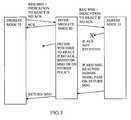
- Fig. 3 shows a schematic view of a sequence of messages passed between nodes based on an embodiment. This view has similar parts to those of figures 1 or 2 , but differs in that the ingress node can be arranged to send an indication to the intermediate node as to whether to react if there is no acknowledgement. Also, the intermediate node is shown as being able to decide whether to react if there is no acknowledgement, based either on the message from the ingress node (if control by the ingress node is desired), or based on a local policy (if local or distributed control is desired).
- Fig 4 shows some steps carried out by a node acting as an intermediate node, according to an embodiment.
- a request message is received, and an acknowledgement is returned upstream at step 210.
- the request message causes each node that receives it to check that it has sufficient bandwidth or other resource to set up the requested path, and to prevent such available resource from being committed to other paths.
- the request message is sent on downstream at step 220, and if there is an absence of an acknowledgement that the request message was received, this is detected at step 230.
- the node determines whether it should react to the detected absence, for example by reference to an indication in the request message, or by reference to a predetermined policy stored locally for that node.
- the intermediate node can expect to receive a return message from an upstream node, to cause the intermediate node to set up the path using the reserved resources. This can involve for example filling in routing tables or allocating time slots or frequencies or allocating wavelengths or optical paths in optical switches, depending on the switch type for example.
- embodiments can have other features such as: the step of determining whether to react can involve receiving an indication of whether to react from an upstream node. This enables the ingress node or other node to control the reaction to the absence of the acknowledgement. This can help the ingress node to set up paths more reliably and make more efficient use of network resources.
- the step of determining whether to react to the detected absence can involve, also, or instead, the step of looking up a predetermined policy for the given node. This can help enable some control of the reaction to be distributed, and thus enable more diverse nodes to be used. This can enable upgrades to be introduced more gradually for example.
- the indication can be a part of the request message. This can be more convenient and more reliable than sending a separate message.
- the request message can be an RSVP PATH message. This is a well known protocol, though the indication need not be limited to use with this protocol.
- the method can have the step of determining how the node should react to the absence of the acknowledgement. This can help enable different types of reaction to be specified, to suit different policies for example, such as how many retries to try before considering the acknowledgement to be absent, or whether to free up the reserved resources immediately or only after the ingress node has decided whether to try a different route for the path either from the present node or from the start for example.
- the method can have the steps of determining that the given node does not support reacting to the absence of the acknowledgement, and returning an error message from the given node to the upstream node. This can help enable the ingress node to learn more information about the nodes and to control the setting up of the path even if not all nodes are of the same version or up to date.
- the method can involve determining the absence of the acknowledgement only after one or more attempts at retransmission of the request message. This can help ensure the reaction does not take place unnecessarily due to transient congestion or transient unavailability for any reason.
- the method can involve reacting to the absence of acknowledgement by starting an abort procedure to release the reserved resources at the node and upstream nodes. This can help enable the reserved resources to be reused more quickly.
- the method can be suitable for an ingress mode, involving sending an indication in respect of this requested path, to a downstream node, indicating whether the downstream node should react to an absence of a corresponding acknowledgement message from a further downstream node.
- the method can have the step of receiving an error message at the ingress node, indicating that a downstream node does not support reacting to the absence of the acknowledgement, and selecting either to set up the path without requiring the reaction to the absence at some nodes, or to retry setting up the path along a different route through the nodes.
- This can help enable the ingress node to choose between a safer, more reliable option of a new route, even though that may not be the optimal route, or choosing the first (presumably best) route with the drawback of inability to react to absence of acknowledgement (and thus risking a long set up if the request message procedure is interrupted).
- the method can be implemented using a program on a computer readable medium having instructions which when executed by a processor at a node of a network, cause the processor to carry out the method of any preceding claim.
- a corresponding node of a network can be arranged to send the indication as part of the request message.
- the node can be arranged to act as an ingress node and have an output part being arranged to send an indication in respect of the requested path, to a downstream node, indicating whether the downstream node should react to an absence of a corresponding acknowledgement message from a further downstream node.
- Figure 5 shows parts of an optical transport network. Three nodes are shown, there can be many more.
- An ingress node 10 has an LSR path reservation control part 20, which controls an add drop multiplexer part 30.
- the reservation control part can have a processor 65 and a store having a program 75 for execution by the processor 65.
- the program can enable the node to act as an ingress node, or in some cases, to act as an intermediate node for other paths started elsewhere.
- An intermediate node 40 has its own LSR path reservation control part 50, which controls a router 60.
- the reservation control part can have a processor 65 and a store having a program 75 for execution by the processor 65.
- the program can enable the node to act as an intermediate node.
- An egress node 70 has its own LSP path reservation control part 80, which controls it's add/drop multiplexer 90. Again, the reservation control part can have a processor 65 and a store having a program 75 for execution by the processor 65. The program can enable the node to act as an egress node for the path shown, or as an ingress or intermediate node for other paths.
- a source entity 100 is shown, as a source of the traffic for which the new path is needed, through the network to a destination entity 110.
- Optical links are shown for carrying the traffic between the nodes, and a connection is shown between the control parts of the nodes for passing messages to reserve the path.
- This connection can in principle use either the same or different physical links to those used by the traffic between nodes.
- the optical links for the traffic can have a multiplex structure of trib slots. A path can use one or more of these trib slots, and a reservation procedure needs to indicate which of these trib slots is reserved.
- a first step is the source entity requesting a new label switched path (LSP) from a first node to another node.
- This first node can be any node which has add or transmit capability, and this now becomes referred to the ingress node for this path.
- the second node can be any node which has a drop or receive capability, and this now becomes referred to as the egress node for this path.
- the request can be authorized by a network management system, or by a human operator, and a route to the destination or egress node can be determined. Then a command goes to the ingress node to reserve the path.
- the ingress node issues an RSVP-TE PATH message in the form of a generalised label request, for the reservation of the requested LSP, to a next node along the designated path.
- Each node passes the message on if it recognises it and has capacity to meet the request, in terms of bandwidth along links and capacity through optical switches or routers and so on. Otherwise any intermediate node may return an error message and the ingress node or the network management system can react accordingly, to try a different path for example, or provide an indication to the source.
- the egress node returns an RSVP-TE RESV message from the egress node, in the form of a generalised label, back along the path to cause the nodes along the path to reserve resources for the requested path, for traffic of a signal type specified by the PATH message, for example in a trib slot or slots specified by the RESV message.
- Each intermediate node along the path passes the message along if it can make the reservation, or issues an error message. If the RESV message reaches the ingress node, that indicates that the path has been successfully reserved and can be used for traffic, so this is indicated to the source entity.
- Figs 6 shows a sequence chart for sequences of operations of the nodes of the embodiment of figure 1 or of other embodiments. There are three columns shown, to separate actions at ingress node, intermediate node and egress node respectively, and time flows down the page.
- a request message is sent from the ingress node, with an indication of how a downstream node should react to an absence of an acknowledgement.
- the intermediate node returns an acknowledgement to the ingress node. If no acknowledgement is received by the ingress node, it will retry the transmission of the request message.
- At the intermediate node if it supports the indication, it will pass on the request message to the next node downstream along the path, with the indication of whether to react still included.
- the intermediate node Again if no acknowledgement is received, the intermediate node will retry sending.
- the downstream node (shown here as the egress node, but can be another intermediate node) may send an acknowledge, but if the intermediate node as shown does not detect an acknowledgement, this could be either as a result of the request message not getting through, or the acknowledgement not getting back.
- the intermediate node reacts as per the indication from the ingress node or as per the locally stored policy.
- Examples of possible reactions can be to wait for a return message from the egress node, or abort the set up, or alert the ingress node and await its decision. Which of these possible reactions should be chosen can be specified in the indication in the message, or can be made dependent on current conditions or criteria, such as level of demand in the network, or whether other routes for the path have already been tried and failed for example.
- the egress node gets the request message, then the return message is returned along the path, assuming no abort procedure has been started.
- the return message is passed along the nodes to the ingress node.
- the ingress node can assume the path is now ready and can start transmitting data.
- Fig 7 shows a sequence chart for sequences of operations of the nodes of the embodiment of figure 1 or of other embodiments. In this case two columns are shown, a left hand column for an upstream node and a right hand column for an intermediate node unable to support reacting to absence.
- a request message is sent from the upstream node, with an indication of how a downstream node should react to an absence of an acknowledgement.
- the intermediate node returns an acknowledgement to the upstream node. If no acknowledgement is received by the upstream node, it will retry the transmission of the request message.
- the indication in the request message about reacting to absence is not recognized or recognized but not supported. An error message is returned to the upstream node.
- the upstream node receives this error message and sends it back upstream to the ingress node to decide either to continue setting up the path without changing the route, or to retry on a different route via different intermediate nodes.
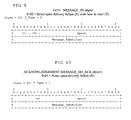
- Figure 8 shows an example of a request message with an indication of whether to react in the form of a new flag shown as (R) in the flags field of a MESSAGE_ID object.
- R react upon delivery failure
- a node If a node does not support the explicit trigger procedure for the LSP then it will not return the React flag in the MESSAGE_ID_ACK. If the downstream node does not support the MESSAGE_ID extension or the explicit trigger procedure it will inform the previous node that, depending on a configuration policy, may go on with the signaling or abort it issuing a Path Error message with the error code/sub-code "Notify Error/React upon delivery failure unsupported" for the affected LSP. Notify Error code is 25; "React upon delivery failure unsupported" sub-code is IANA TBD (suggested 13). This will inform the sender that this procedure is not supported by the downstream node.
- the head node (ingress node) of the LSP will see the error and then may re-send the original message without the MESSAGE_ID object or abort the signaling.
- the nodes of the LSP send a signaling message a configured number of times before starting the appropriate abort procedure.
- the procedures are dependent on the signaling procedure that fails and reuse already defined RSVP mechanism.
- the node must issue a Path Error message with the error code/sub-code "Notify Error/Reliable signaling transmission failure" for the affected LSP. Notify Error code is 25; "Reliable signaling transmission failure" sub-code would need to be agreed by IANA, a proposed code is 12).
- a first node sends a message with MESSAGE_ID object and the React flag set indicating that MESSAGE_ID_ACK is required
- a second node downstream replies with a message containing an MESSAGE_ID_ACK with React flag set, and the same happens between that second node and a further downstream third node.
- the second node sends a message towards the third node without receiving any message back.
- the second node resends the message a configurable amount of times then it must start an abort procedure.
- Figure 9 shows a message structure for a request message in the form of an RSVP PATH message object as in figure 8 but with a further variation in that there is an indication of how to react to the detected absence.
- This is a flag (T) at bit 3 of the flags which can indicate the type of reaction, for example if set it can mean abort the setting up, and if not set, it can mean for example alert the ingress node.
- An equivalent acknowledge object can be envisaged.
- LSP label switched path
- Whether the given node should react to the detected absence can be determined from an indication (R) in the request message.
- R an indication
- other nodes can react more quickly to take remedial action, to reroute or to remove the resource reservations without a long wait for a time out or a refresh message from the waiting ingress node, to enable more efficient use of the resources.
- Other variations and embodiments can be envisaged within the claims.
Landscapes
- Engineering & Computer Science (AREA)
- Computer Networks & Wireless Communication (AREA)
- Signal Processing (AREA)
- Computer Security & Cryptography (AREA)
- Data Exchanges In Wide-Area Networks (AREA)
Claims (15)
- Verfahren zum Aufbau eines Etikettaustauschpfades für Verkehr zwischen Knoten eines Netzes, wobei das Verfahren die folgenden Schritte an einem gegebenen der Knoten aufweist:Empfangen einer Anforderungsnachricht, die eine Reservierung von Betriebsmitteln für den angeforderten Etikettaustauschpfad anfordert, wobei die Anforderungsnachricht von einem Eingangsknoten (10) des angeforderten Etikettaustauschpfades über Zwischenknoten (40) entlang des angeforderten Etikettaustauschpfades an einen Ausgangsknoten (70) gesendet wird,Zurücksenden einer Bestätigungsnachricht an einen Upstream-Knoten entlang des angeforderten Etikettaustauschpfades, um den Empfang der Anforderungsnachricht zu bestätigen,Weitersenden der Anforderungsnachricht an einen Downstream-Knoten entlang des angeforderten Etikettaustauschpfades,Erkennen eines Nichtvorhandenseins einer Bestätigung vom Downstream-Knoten, wobei die Bestätigung darstellt, dass die Anforderungsnachricht empfangen wurde oder dass eine Neusendung der Anforderungsnachricht empfangen wurde,Bestimmen, ob der gegebene Knoten auf das erkannte Nichtvorhandensein reagieren sollte,Empfangen einer Rücknachricht, die vom Ausgangsknoten gesendet wird, wenn die Anforderungsnachricht den Ausgangsknoten erreicht, um zu veranlassen, dass die Knoten entlang des angeforderten Etikettaustauschpfades die reservierten Betriebsmittel zum Aufbauen des angeforderten Etikettaustauschpfades verwenden.
- Verfahren nach Anspruch 1, wobei der Schritt des Bestimmens, ob reagiert werden soll, ein Empfangen einer Anzeige dessen umfasst, ob von einem Upstream-Knoten reagiert werden soll.
- Verfahren nach Anspruch 1 oder 2, wobei der Schritt des Bestimmens, ob auf das erkannte Nichtvorhandensein reagiert werden soll, den Schritt des Nachschlagens einer vorbestimmten Richtlinie für den gegebenen Knoten umfasst.
- Verfahren nach Anspruch 2 oder Anspruch 3, falls abhängig von Anspruch 2, wobei die Anzeige ein Teil der Anforderungsnachricht ist.
- Verfahren nach Anspruch 4, wobei die Anforderungsnachricht eine Resource Reservation Protocol, RSVP, PATH-Nachricht ist.
- Verfahren nach einem der vorhergehenden Ansprüche, aufweisend den Schritt des Bestimmens, wie der Knoten auf das Nichtvorhandensein der Bestätigung reagieren sollte.
- Verfahren nach Anspruch 2 oder einem der Ansprüche, wenn von Anspruch 2 abhängig, aufweisend die Schritte des Bestimmens, dass der gegebene Knoten das Reagieren auf das Nichtvorhandensein der Bestätigung nicht unterstützt, und Zurücksenden einer Fehlernachricht vom gegebenen Knoten an den Upstream-Knoten.
- Verfahren nach einem der vorhergehenden Ansprüche, aufweisend den Schritt des Bestimmens des Nichtvorhandenseins der Bestätigung nur nach einem oder mehreren Versuchen bei Wiederholungssendung der Anforderungsnachricht.
- Verfahren nach Ansprüchen, aufweisend den Schritt des Reagierens auf das Nichtvorhandensein einer Bestätigung durch Starten eines Abbruchvorgangs, um die reservierten Betriebsmittel am Knoten und den Upstream-Knoten freizugeben.
- Verfahren zum Aufbau eines Etikettaustauschpfades für Verkehr zwischen Knoten eines Netzes, wobei das Verfahren die folgenden Schritte an einem Eingangsknoten der Knoten aufweist:Senden einer Anforderungsnachricht zur Reservierung von Betriebsmitteln für den angeforderten Etikettaustauschpfad, wobei die Anforderungsnachricht vom Eingangsknoten (10) des angeforderten Etikettaustauschpfades über Zwischenknoten (40) entlang des angeforderten Etikettaustauschpfades an einen Ausgangsknoten (70) gesendet wird,Empfangen einer Bestätigungsnachricht von einem Downstream-Knoten entlang des Etikettaustauschpfades zum Bestätigen des Empfangs der Anforderungsnachricht oder, dass eine Neusendung der Anforderungsnachricht empfangen wurde,Senden einer Anzeige in Bezug auf diesen angeforderten Etikettaustauschpfad an einen Downstream-Knoten, die anzeigt, ob der Downstream-Knoten auf ein Nichtvorhandensein einer entsprechenden Bestätigungsnachricht von einem weiteren Downstream-Knoten reagieren sollte, und, wenn die Anforderungsnachricht den Ausgangsknoten erreicht,Empfangen einer Rücknachricht, die vom Ausgangsknoten gesendet wird, wenn die Anforderungsnachricht den Ausgangsknoten erreicht, um zu veranlassen, dass die Knoten entlang des angeforderten Etikettaustauschpfades die reservierten Betriebsmittel zum Aufbauen des angeforderten Etikettaustauschpfades verwenden.
- Verfahren nach Anspruch 10, und aufweisend den Schritt des Empfangens einer Fehlernachricht am Eingangsknoten, die anzeigt, dass ein Downstream-Knoten das Reagieren auf das Nichtvorhandensein der Bestätigung nicht unterstützt, und Auswählen, entweder den Pfad ohne Verlangen der Reaktion auf das Nichtvorhandenseins an einigen Knoten aufzubauen oder den Aufbau des Pfades entlang einer anderen Route durch die Knoten erneut zu versuchen.
- Programm auf einem computerlesbaren Medium mit Anweisungen, die, wenn durch einen Prozessor an einem Knoten eines Netzes ausgeführt, den Prozessor veranlassen, alle Schritte des Verfahrens nach einem der vorhergehenden Ansprüche auszuführen.
- Knoten eines Netzes mit einer Anzahl von anderen Knoten, wobei der Knoten imstande ist, als ein Zwischenknoten zu fungieren und einen Etikettaustauschpfad für Verkehr zu anderen der Knoten aufzubauen, wobei der Knoten einen Prozessor aufweist, der aufweist:einen ersten Eingangsteil, der so ausgelegt ist, dass er eine Anforderungsnachricht zur Reservierung von Betriebsmitteln für den angeforderten Etikettaustauschpfad empfängt, die von einem Eingangsknoten (10) des angeforderten Etikettaustauschpfades über Zwischenknoten (40) entlang des angeforderten Etikettaustauschpfades an einen Ausgangsknoten (70) gesendet wird,einen ersten Ausgangsteil, der so ausgelegt ist, dass er eine Bestätigungsnachricht an einen Upstream-Knoten zurücksendet, um den Empfang der Anforderungsnachricht zu bestätigen,einen zweiten Ausgangsteil, der so ausgelegt ist, dass er die Anforderungsnachricht entlang des angeforderten Etikettaustauschpfades an einen Downstream-Knoten sendet,einen zweiten Eingang, der so ausgelegt ist, dass er eine Bestätigung vom Downstream-Knoten empfängt, dass die Anforderungsnachricht empfangen wurde oder dass eine Neusendung der Anforderungsnachricht empfangen wurde, wobei der Prozessor so ausgelegt ist, dass er ein Nichtvorhandensein der Bestätigung erkennt und bestimmt, ob der gegebene Knoten auf das erkannte Nichtvorhandensein reagieren sollte,einen zweiten Eingangsteil, der so ausgelegt ist, dass er eine Rücknachricht empfängt, die vom Ausgangsknoten gesendet wird, wenn die Anforderungsnachricht den Ausgangsknoten erreicht, wobei der Prozessor so ausgelegt ist, dass er als Antwort auf die Rücknachricht die reservierten Betriebsmittel zum Aufbauen des angeforderten Etikettaustauschpfades verwendet.
- Knoten nach Anspruch 13, wobei der zweite Ausgangsteil so ausgelegt ist, das er die Anzeige als Teil der Anforderungsnachricht sendet.
- Knoten eines Netzes mit einer Anzahl von anderen Knoten, wobei der Knoten imstande ist, als ein Eingangsknoten zu fungieren und einen Etikettaustauschpfad für Verkehr zu anderen der Knoten aufzubauen, wobei der Knoten einen Prozessor aufweist, der aufweist:einen Ausgangsteil zum Senden einer Anforderungsnachricht zur Reservierung von Betriebsmitteln für den angeforderten Etikettaustauschpfad, wobei die Anforderungsnachricht vom Eingangsknoten (10) des angeforderten Etikettaustauschpfades über Zwischenknoten (40) entlang des angeforderten Etikettaustauschpfades an einen Ausgangsknoten (70) gesendet wird,einen Eingangsteil zum Empfangen einer Bestätigungsnachricht an einen Downstream-Knoten entlang des angeforderten Etikettaustauschpfades, um den Empfang der Anforderungsnachricht zu bestätigen, wobei der Ausgangsteil so ausgelegt ist, dass er eine Anzeige in Bezug auf diesen angeforderten Etikettaustauschpfad an einen Downstream-Knoten sendet, die anzeigt, ob der Downstream-Knoten auf ein Nichtvorhandensein einer entsprechenden Bestätigungsnachricht von einem weiteren Downstream-Knoten reagieren sollte, undder Eingangsteil so ausgelegt ist, dass er eine Rücknachricht vom Ausgangsknoten empfängt, wenn die Anforderungsnachricht den Ausgangsknoten erreicht, um zu veranlassen, dass die Knoten entlang des angeforderten Etikettaustauschpfades die reservierten Betriebsmittel zum Aufbauen des angeforderten Etikettaustauschpfades verwenden.
Priority Applications (1)
| Application Number | Priority Date | Filing Date | Title |
|---|---|---|---|
| EP10725173.8A EP2567518B1 (de) | 2010-05-06 | 2010-06-14 | Handhabung eines fehlers einer anforderungsnachricht während des aufbaus eines label switched paths |
Applications Claiming Priority (3)
| Application Number | Priority Date | Filing Date | Title |
|---|---|---|---|
| EP10162172 | 2010-05-06 | ||
| EP10725173.8A EP2567518B1 (de) | 2010-05-06 | 2010-06-14 | Handhabung eines fehlers einer anforderungsnachricht während des aufbaus eines label switched paths |
| PCT/EP2010/058306 WO2011137936A1 (en) | 2010-05-06 | 2010-06-14 | Handling failure of request message during set up of label switched path |
Publications (2)
| Publication Number | Publication Date |
|---|---|
| EP2567518A1 EP2567518A1 (de) | 2013-03-13 |
| EP2567518B1 true EP2567518B1 (de) | 2014-03-26 |
Family
ID=43301745
Family Applications (1)
| Application Number | Title | Priority Date | Filing Date |
|---|---|---|---|
| EP10725173.8A Not-in-force EP2567518B1 (de) | 2010-05-06 | 2010-06-14 | Handhabung eines fehlers einer anforderungsnachricht während des aufbaus eines label switched paths |
Country Status (3)
| Country | Link |
|---|---|
| US (1) | US8850014B2 (de) |
| EP (1) | EP2567518B1 (de) |
| WO (1) | WO2011137936A1 (de) |
Families Citing this family (10)
| Publication number | Priority date | Publication date | Assignee | Title |
|---|---|---|---|---|
| US9116759B2 (en) * | 2011-02-18 | 2015-08-25 | Ab Initio Technology Llc | Restarting data processing systems |
| US9021299B2 (en) | 2011-02-18 | 2015-04-28 | Ab Initio Technology Llc | Restarting processes |
| US9565128B2 (en) * | 2012-08-30 | 2017-02-07 | Adva Optical Networking Se | Method for managing services in a generalized-multi-protocol label switching, GMPLS, controlled network |
| US9253097B1 (en) * | 2012-12-28 | 2016-02-02 | Juniper Networks, Inc. | Selective label switched path re-routing |
| US9641455B2 (en) * | 2013-07-18 | 2017-05-02 | International Business Machines Corporation | Mechanism for terminating relay operations in a distributed switch with cascaded configuration |
| CN106162764A (zh) * | 2015-04-03 | 2016-11-23 | 电信科学技术研究院 | 一种路径选择方法及装置 |
| US9838307B2 (en) | 2015-12-28 | 2017-12-05 | Juniper Networks, Inc. | Simple hierarchical label-switched paths |
| CN112350934A (zh) * | 2019-08-07 | 2021-02-09 | 中国电信股份有限公司 | 数据传输方法、网络节点和数据传输系统 |
| CN111796950B (zh) * | 2020-07-16 | 2023-06-30 | 网易(杭州)网络有限公司 | 数据处理方法和系统 |
| US12244570B2 (en) * | 2021-12-09 | 2025-03-04 | Matrixcare, Inc. | Invisible middleware for asynchronous communication |
Family Cites Families (10)
| Publication number | Priority date | Publication date | Assignee | Title |
|---|---|---|---|---|
| JP3615057B2 (ja) * | 1998-07-17 | 2005-01-26 | 株式会社東芝 | ラベルスイッチングパス設定方法及びノード装置 |
| US8451846B1 (en) * | 2006-04-19 | 2013-05-28 | Juniper Networks, Inc. | LSP hierarchy for MPLS networks |
| CN101087221B (zh) * | 2006-06-07 | 2010-12-08 | 华为技术有限公司 | 资源预留协议节点及其交互方法 |
| CN101087207B (zh) * | 2006-06-09 | 2010-05-12 | 华为技术有限公司 | 一种多节点通信故障的处理方法 |
| US8300653B2 (en) | 2006-07-31 | 2012-10-30 | Harris Corporation | Systems and methods for assured communications with quality of service |
| GB0702508D0 (en) * | 2007-02-09 | 2007-03-21 | Ericsson Telefon Ab L M | Label switched path networking |
| FR2931604A1 (fr) * | 2008-05-23 | 2009-11-27 | France Telecom | Technique de protection dans un reseau de communication en mode connecte d'un arbre primaire point a multipoint. |
| US8848712B2 (en) * | 2009-08-10 | 2014-09-30 | Infinera Corporation | Distributed RSVP-TE in a multi-chassis node architecture |
| US8339942B2 (en) * | 2009-10-15 | 2012-12-25 | Telefonaktiebolaget L M Ericsson (Publ) | RSVP-TE graceful restart under fast re-route conditions |
| EP2466789A1 (de) * | 2010-12-15 | 2012-06-20 | Telefonaktiebolaget LM Ericsson (publ) | Nachrichtenübertragung zur Sicherstellung der Löschung eines etikettgeschalteten Pfads |
-
2010
- 2010-06-14 EP EP10725173.8A patent/EP2567518B1/de not_active Not-in-force
- 2010-06-14 US US12/994,318 patent/US8850014B2/en active Active
- 2010-06-14 WO PCT/EP2010/058306 patent/WO2011137936A1/en not_active Ceased
Also Published As
| Publication number | Publication date |
|---|---|
| US20120042077A1 (en) | 2012-02-16 |
| EP2567518A1 (de) | 2013-03-13 |
| US8850014B2 (en) | 2014-09-30 |
| WO2011137936A1 (en) | 2011-11-10 |
Similar Documents
| Publication | Publication Date | Title |
|---|---|---|
| EP2567518B1 (de) | Handhabung eines fehlers einer anforderungsnachricht während des aufbaus eines label switched paths | |
| US10250459B2 (en) | Bandwidth on-demand services in multiple layer networks | |
| DK2595350T3 (en) | GMPLS-based OAM provision | |
| US10484299B2 (en) | Method and apparatus for configuring quality of service | |
| JP5163479B2 (ja) | パス切替え方法 | |
| US20090103533A1 (en) | Method, system and node apparatus for establishing identifier mapping relationship | |
| EP1898584B1 (de) | Verfahren und vorrichtung zur wiederherstellung eines gemeinsam genutzten vermaschten netzes | |
| US20080056159A1 (en) | Method for setting path and node apparatus | |
| WO2008006268A1 (fr) | Procédé,système et dispositif de noeud permettant de réaliser une protection de service dans un réseau optique commuté automatiquement | |
| JP6269088B2 (ja) | 冗長パス提供方法および伝送装置 | |
| US9774492B2 (en) | Message passing to assure deletion of label switched path | |
| US20070195709A1 (en) | Methods and Systems for Notifying and Negotiating Capabilities of Monitoring the Performance of Label Switching Path | |
| US9294416B2 (en) | Method of and apparatus for configuring quality of service | |
| EP2154841B1 (de) | Verfahren und system zur festlegung eines dienstpfades und knoteneinrichtung | |
| JP4443442B2 (ja) | 中継装置 | |
| JP4920308B2 (ja) | パス設定方法、ノード装置および監視制御装置 | |
| BRPI1013897B1 (pt) | método e dispositivo de nó para negociação associada a uma capacidade de canal entre nós | |
| US20110222847A1 (en) | Method, system, and device for implementing service forwarding | |
| EP4033703A1 (de) | Verfahren und vorrichtung zur herstellung eines dienstpfades, elektronisches gerät und lesbares speichermedium | |
| JP5083168B2 (ja) | 擬似ワイヤの設定方法及び装置 | |
| EP2704382B1 (de) | Verfahren zur Verwaltung von Diensten in einem mit Generalized-Multi-Protocol-Label-Switching (GMPLS) gesteuerten Netzwerk | |
| WO2012171368A1 (zh) | 一种隧道重建的方法及网元 | |
| US20150071057A1 (en) | Segment recovery | |
| CN102546361A (zh) | 一种通告传送平面失效的方法和装置 |
Legal Events
| Date | Code | Title | Description |
|---|---|---|---|
| PUAI | Public reference made under article 153(3) epc to a published international application that has entered the european phase |
Free format text: ORIGINAL CODE: 0009012 |
|
| 17P | Request for examination filed |
Effective date: 20121017 |
|
| AK | Designated contracting states |
Kind code of ref document: A1 Designated state(s): AL AT BE BG CH CY CZ DE DK EE ES FI FR GB GR HR HU IE IS IT LI LT LU LV MC MK MT NL NO PL PT RO SE SI SK SM TR |
|
| DAX | Request for extension of the european patent (deleted) | ||
| 17Q | First examination report despatched |
Effective date: 20130801 |
|
| REG | Reference to a national code |
Ref country code: DE Ref legal event code: R079 Ref document number: 602010014605 Country of ref document: DE Free format text: PREVIOUS MAIN CLASS: H04L0012560000 Ipc: H04L0012700000 |
|
| GRAP | Despatch of communication of intention to grant a patent |
Free format text: ORIGINAL CODE: EPIDOSNIGR1 |
|
| RIC1 | Information provided on ipc code assigned before grant |
Ipc: H04L 12/70 20130101AFI20131113BHEP |
|
| INTG | Intention to grant announced |
Effective date: 20131129 |
|
| GRAS | Grant fee paid |
Free format text: ORIGINAL CODE: EPIDOSNIGR3 |
|
| GRAA | (expected) grant |
Free format text: ORIGINAL CODE: 0009210 |
|
| AK | Designated contracting states |
Kind code of ref document: B1 Designated state(s): AL AT BE BG CH CY CZ DE DK EE ES FI FR GB GR HR HU IE IS IT LI LT LU LV MC MK MT NL NO PL PT RO SE SI SK SM TR |
|
| REG | Reference to a national code |
Ref country code: GB Ref legal event code: FG4D |
|
| REG | Reference to a national code |
Ref country code: CH Ref legal event code: EP |
|
| REG | Reference to a national code |
Ref country code: AT Ref legal event code: REF Ref document number: 659454 Country of ref document: AT Kind code of ref document: T Effective date: 20140415 |
|
| REG | Reference to a national code |
Ref country code: IE Ref legal event code: FG4D |
|
| REG | Reference to a national code |
Ref country code: DE Ref legal event code: R096 Ref document number: 602010014605 Country of ref document: DE Effective date: 20140508 |
|
| REG | Reference to a national code |
Ref country code: NL Ref legal event code: T3 |
|
| PG25 | Lapsed in a contracting state [announced via postgrant information from national office to epo] |
Ref country code: LT Free format text: LAPSE BECAUSE OF FAILURE TO SUBMIT A TRANSLATION OF THE DESCRIPTION OR TO PAY THE FEE WITHIN THE PRESCRIBED TIME-LIMIT Effective date: 20140326 Ref country code: NO Free format text: LAPSE BECAUSE OF FAILURE TO SUBMIT A TRANSLATION OF THE DESCRIPTION OR TO PAY THE FEE WITHIN THE PRESCRIBED TIME-LIMIT Effective date: 20140626 |
|
| REG | Reference to a national code |
Ref country code: AT Ref legal event code: MK05 Ref document number: 659454 Country of ref document: AT Kind code of ref document: T Effective date: 20140326 |
|
| REG | Reference to a national code |
Ref country code: LT Ref legal event code: MG4D |
|
| PG25 | Lapsed in a contracting state [announced via postgrant information from national office to epo] |
Ref country code: SE Free format text: LAPSE BECAUSE OF FAILURE TO SUBMIT A TRANSLATION OF THE DESCRIPTION OR TO PAY THE FEE WITHIN THE PRESCRIBED TIME-LIMIT Effective date: 20140326 Ref country code: FI Free format text: LAPSE BECAUSE OF FAILURE TO SUBMIT A TRANSLATION OF THE DESCRIPTION OR TO PAY THE FEE WITHIN THE PRESCRIBED TIME-LIMIT Effective date: 20140326 |
|
| PG25 | Lapsed in a contracting state [announced via postgrant information from national office to epo] |
Ref country code: LV Free format text: LAPSE BECAUSE OF FAILURE TO SUBMIT A TRANSLATION OF THE DESCRIPTION OR TO PAY THE FEE WITHIN THE PRESCRIBED TIME-LIMIT Effective date: 20140326 Ref country code: HR Free format text: LAPSE BECAUSE OF FAILURE TO SUBMIT A TRANSLATION OF THE DESCRIPTION OR TO PAY THE FEE WITHIN THE PRESCRIBED TIME-LIMIT Effective date: 20140326 |
|
| PG25 | Lapsed in a contracting state [announced via postgrant information from national office to epo] |
Ref country code: CY Free format text: LAPSE BECAUSE OF FAILURE TO SUBMIT A TRANSLATION OF THE DESCRIPTION OR TO PAY THE FEE WITHIN THE PRESCRIBED TIME-LIMIT Effective date: 20140326 Ref country code: BG Free format text: LAPSE BECAUSE OF FAILURE TO SUBMIT A TRANSLATION OF THE DESCRIPTION OR TO PAY THE FEE WITHIN THE PRESCRIBED TIME-LIMIT Effective date: 20140626 Ref country code: BE Free format text: LAPSE BECAUSE OF FAILURE TO SUBMIT A TRANSLATION OF THE DESCRIPTION OR TO PAY THE FEE WITHIN THE PRESCRIBED TIME-LIMIT Effective date: 20140326 Ref country code: EE Free format text: LAPSE BECAUSE OF FAILURE TO SUBMIT A TRANSLATION OF THE DESCRIPTION OR TO PAY THE FEE WITHIN THE PRESCRIBED TIME-LIMIT Effective date: 20140326 Ref country code: CZ Free format text: LAPSE BECAUSE OF FAILURE TO SUBMIT A TRANSLATION OF THE DESCRIPTION OR TO PAY THE FEE WITHIN THE PRESCRIBED TIME-LIMIT Effective date: 20140326 Ref country code: RO Free format text: LAPSE BECAUSE OF FAILURE TO SUBMIT A TRANSLATION OF THE DESCRIPTION OR TO PAY THE FEE WITHIN THE PRESCRIBED TIME-LIMIT Effective date: 20140326 Ref country code: IS Free format text: LAPSE BECAUSE OF FAILURE TO SUBMIT A TRANSLATION OF THE DESCRIPTION OR TO PAY THE FEE WITHIN THE PRESCRIBED TIME-LIMIT Effective date: 20140726 |
|
| PG25 | Lapsed in a contracting state [announced via postgrant information from national office to epo] |
Ref country code: ES Free format text: LAPSE BECAUSE OF FAILURE TO SUBMIT A TRANSLATION OF THE DESCRIPTION OR TO PAY THE FEE WITHIN THE PRESCRIBED TIME-LIMIT Effective date: 20140326 Ref country code: PL Free format text: LAPSE BECAUSE OF FAILURE TO SUBMIT A TRANSLATION OF THE DESCRIPTION OR TO PAY THE FEE WITHIN THE PRESCRIBED TIME-LIMIT Effective date: 20140326 Ref country code: SK Free format text: LAPSE BECAUSE OF FAILURE TO SUBMIT A TRANSLATION OF THE DESCRIPTION OR TO PAY THE FEE WITHIN THE PRESCRIBED TIME-LIMIT Effective date: 20140326 Ref country code: AT Free format text: LAPSE BECAUSE OF FAILURE TO SUBMIT A TRANSLATION OF THE DESCRIPTION OR TO PAY THE FEE WITHIN THE PRESCRIBED TIME-LIMIT Effective date: 20140326 |
|
| PG25 | Lapsed in a contracting state [announced via postgrant information from national office to epo] |
Ref country code: PT Free format text: LAPSE BECAUSE OF FAILURE TO SUBMIT A TRANSLATION OF THE DESCRIPTION OR TO PAY THE FEE WITHIN THE PRESCRIBED TIME-LIMIT Effective date: 20140728 |
|
| REG | Reference to a national code |
Ref country code: DE Ref legal event code: R097 Ref document number: 602010014605 Country of ref document: DE |
|
| PG25 | Lapsed in a contracting state [announced via postgrant information from national office to epo] |
Ref country code: MC Free format text: LAPSE BECAUSE OF FAILURE TO SUBMIT A TRANSLATION OF THE DESCRIPTION OR TO PAY THE FEE WITHIN THE PRESCRIBED TIME-LIMIT Effective date: 20140326 Ref country code: LU Free format text: LAPSE BECAUSE OF FAILURE TO SUBMIT A TRANSLATION OF THE DESCRIPTION OR TO PAY THE FEE WITHIN THE PRESCRIBED TIME-LIMIT Effective date: 20140614 Ref country code: DK Free format text: LAPSE BECAUSE OF FAILURE TO SUBMIT A TRANSLATION OF THE DESCRIPTION OR TO PAY THE FEE WITHIN THE PRESCRIBED TIME-LIMIT Effective date: 20140326 |
|
| PLBE | No opposition filed within time limit |
Free format text: ORIGINAL CODE: 0009261 |
|
| REG | Reference to a national code |
Ref country code: CH Ref legal event code: PL |
|
| STAA | Information on the status of an ep patent application or granted ep patent |
Free format text: STATUS: NO OPPOSITION FILED WITHIN TIME LIMIT |
|
| 26N | No opposition filed |
Effective date: 20150106 |
|
| REG | Reference to a national code |
Ref country code: IE Ref legal event code: MM4A |
|
| REG | Reference to a national code |
Ref country code: FR Ref legal event code: ST Effective date: 20150227 |
|
| PG25 | Lapsed in a contracting state [announced via postgrant information from national office to epo] |
Ref country code: IT Free format text: LAPSE BECAUSE OF FAILURE TO SUBMIT A TRANSLATION OF THE DESCRIPTION OR TO PAY THE FEE WITHIN THE PRESCRIBED TIME-LIMIT Effective date: 20140326 |
|
| REG | Reference to a national code |
Ref country code: DE Ref legal event code: R097 Ref document number: 602010014605 Country of ref document: DE Effective date: 20150106 |
|
| PG25 | Lapsed in a contracting state [announced via postgrant information from national office to epo] |
Ref country code: LI Free format text: LAPSE BECAUSE OF NON-PAYMENT OF DUE FEES Effective date: 20140630 Ref country code: IE Free format text: LAPSE BECAUSE OF NON-PAYMENT OF DUE FEES Effective date: 20140614 Ref country code: CH Free format text: LAPSE BECAUSE OF NON-PAYMENT OF DUE FEES Effective date: 20140630 |
|
| PG25 | Lapsed in a contracting state [announced via postgrant information from national office to epo] |
Ref country code: FR Free format text: LAPSE BECAUSE OF NON-PAYMENT OF DUE FEES Effective date: 20140630 |
|
| PG25 | Lapsed in a contracting state [announced via postgrant information from national office to epo] |
Ref country code: SI Free format text: LAPSE BECAUSE OF FAILURE TO SUBMIT A TRANSLATION OF THE DESCRIPTION OR TO PAY THE FEE WITHIN THE PRESCRIBED TIME-LIMIT Effective date: 20140326 |
|
| PGFP | Annual fee paid to national office [announced via postgrant information from national office to epo] |
Ref country code: NL Payment date: 20150626 Year of fee payment: 6 |
|
| PG25 | Lapsed in a contracting state [announced via postgrant information from national office to epo] |
Ref country code: MT Free format text: LAPSE BECAUSE OF FAILURE TO SUBMIT A TRANSLATION OF THE DESCRIPTION OR TO PAY THE FEE WITHIN THE PRESCRIBED TIME-LIMIT Effective date: 20140326 |
|
| PG25 | Lapsed in a contracting state [announced via postgrant information from national office to epo] |
Ref country code: SM Free format text: LAPSE BECAUSE OF FAILURE TO SUBMIT A TRANSLATION OF THE DESCRIPTION OR TO PAY THE FEE WITHIN THE PRESCRIBED TIME-LIMIT Effective date: 20140326 |
|
| PG25 | Lapsed in a contracting state [announced via postgrant information from national office to epo] |
Ref country code: GR Free format text: LAPSE BECAUSE OF FAILURE TO SUBMIT A TRANSLATION OF THE DESCRIPTION OR TO PAY THE FEE WITHIN THE PRESCRIBED TIME-LIMIT Effective date: 20140627 |
|
| PG25 | Lapsed in a contracting state [announced via postgrant information from national office to epo] |
Ref country code: TR Free format text: LAPSE BECAUSE OF FAILURE TO SUBMIT A TRANSLATION OF THE DESCRIPTION OR TO PAY THE FEE WITHIN THE PRESCRIBED TIME-LIMIT Effective date: 20140326 Ref country code: HU Free format text: LAPSE BECAUSE OF FAILURE TO SUBMIT A TRANSLATION OF THE DESCRIPTION OR TO PAY THE FEE WITHIN THE PRESCRIBED TIME-LIMIT; INVALID AB INITIO Effective date: 20100614 |
|
| PGFP | Annual fee paid to national office [announced via postgrant information from national office to epo] |
Ref country code: GB Payment date: 20160627 Year of fee payment: 7 |
|
| PGFP | Annual fee paid to national office [announced via postgrant information from national office to epo] |
Ref country code: DE Payment date: 20160628 Year of fee payment: 7 |
|
| REG | Reference to a national code |
Ref country code: NL Ref legal event code: MM Effective date: 20160701 |
|
| PG25 | Lapsed in a contracting state [announced via postgrant information from national office to epo] |
Ref country code: NL Free format text: LAPSE BECAUSE OF NON-PAYMENT OF DUE FEES Effective date: 20160701 |
|
| REG | Reference to a national code |
Ref country code: DE Ref legal event code: R119 Ref document number: 602010014605 Country of ref document: DE |
|
| GBPC | Gb: european patent ceased through non-payment of renewal fee |
Effective date: 20170614 |
|
| PG25 | Lapsed in a contracting state [announced via postgrant information from national office to epo] |
Ref country code: DE Free format text: LAPSE BECAUSE OF NON-PAYMENT OF DUE FEES Effective date: 20180103 Ref country code: GB Free format text: LAPSE BECAUSE OF NON-PAYMENT OF DUE FEES Effective date: 20170614 |
|
| PG25 | Lapsed in a contracting state [announced via postgrant information from national office to epo] |
Ref country code: MK Free format text: LAPSE BECAUSE OF FAILURE TO SUBMIT A TRANSLATION OF THE DESCRIPTION OR TO PAY THE FEE WITHIN THE PRESCRIBED TIME-LIMIT Effective date: 20140326 |
|
| PG25 | Lapsed in a contracting state [announced via postgrant information from national office to epo] |
Ref country code: AL Free format text: LAPSE BECAUSE OF FAILURE TO SUBMIT A TRANSLATION OF THE DESCRIPTION OR TO PAY THE FEE WITHIN THE PRESCRIBED TIME-LIMIT Effective date: 20140326 |