EP2568101A2 - Knaufzylinder - Google Patents
Knaufzylinder Download PDFInfo
- Publication number
- EP2568101A2 EP2568101A2 EP20120075104 EP12075104A EP2568101A2 EP 2568101 A2 EP2568101 A2 EP 2568101A2 EP 20120075104 EP20120075104 EP 20120075104 EP 12075104 A EP12075104 A EP 12075104A EP 2568101 A2 EP2568101 A2 EP 2568101A2
- Authority
- EP
- European Patent Office
- Prior art keywords
- knob
- magnetic
- knob shaft
- shaft
- cylinder
- Prior art date
- Legal status (The legal status is an assumption and is not a legal conclusion. Google has not performed a legal analysis and makes no representation as to the accuracy of the status listed.)
- Granted
Links
Images

Classifications
-
- E—FIXED CONSTRUCTIONS
- E05—LOCKS; KEYS; WINDOW OR DOOR FITTINGS; SAFES
- E05B—LOCKS; ACCESSORIES THEREFOR; HANDCUFFS
- E05B15/00—Other details of locks; Parts for engagement by bolts of fastening devices
- E05B15/0053—Other details of locks; Parts for engagement by bolts of fastening devices means providing a stable, i.e. indexed, position of lock parts
- E05B15/0073—Other details of locks; Parts for engagement by bolts of fastening devices means providing a stable, i.e. indexed, position of lock parts magnetically operated
-
- E—FIXED CONSTRUCTIONS
- E05—LOCKS; KEYS; WINDOW OR DOOR FITTINGS; SAFES
- E05B—LOCKS; ACCESSORIES THEREFOR; HANDCUFFS
- E05B47/00—Operating or controlling locks or other fastening devices by electric or magnetic means
- E05B47/06—Controlling mechanically-operated bolts by electro-magnetically-operated detents
- E05B47/0611—Cylinder locks with electromagnetic control
- E05B47/0615—Cylinder locks with electromagnetic control operated by handles, e.g. by knobs
-
- E—FIXED CONSTRUCTIONS
- E05—LOCKS; KEYS; WINDOW OR DOOR FITTINGS; SAFES
- E05B—LOCKS; ACCESSORIES THEREFOR; HANDCUFFS
- E05B9/00—Lock casings or latch-mechanism casings ; Fastening locks or fasteners or parts thereof to the wing
- E05B9/04—Casings of cylinder locks
- E05B2009/047—Means for returning cylinder locks to their neutral position
Definitions
- the invention relates to a knob cylinder, the knob shaft or spindle is rotatably connected to the cam of a lock cylinder.
- the key can only be removed in a defined position of the key.
- knob cylinder usually have no fixed position in the rotation of the knob, which corresponds to this basic or neutral position.
- Knob cylinders can be operated from the outside either with the key or an electronic knob.
- lock cylinders which are not to be opened from the outside with a key but via an electronic knob and from the inside with a mechanical knob, there is usually no fixed cam position.
- the z. B. panic doors, escape route doors or fire doors is required.
- These lock cylinders require that the actuator of the lock cylinder after a completed closing operation, always in its normal position or neutral position in the range of 3:00 to 9:00 o'clock, for example, to exercise the panic function.
- the invention is therefore based on the object to provide a knob cylinder, in which the cam is brought forcibly after a closing operation in a position between 3:00 clock and 9:00 clock, and if possible without a dead center in the return movement, so that thus the conditions for installation in z.
- a knob cylinder in which the cam is brought forcibly after a closing operation in a position between 3:00 clock and 9:00 clock, and if possible without a dead center in the return movement, so that thus the conditions for installation in z.
- the cam is brought forcibly after a closing operation in a position between 3:00 clock and 9:00 clock
- the restoring device occupies the smallest possible space, in particular, that it can be installed in existing lock cylinder without much effort, for example subsequently.
- knob shaft or spindle is rotatably connected to the cam of a lock cylinder, wherein for the provision of the cam in a basic position, a rotating on the knob shaft acting magnet arrangement is provided.
- magnetic discs are arranged, which are alternately oriented in opposite directions and each consist of two or more segments, each one of the magnetic discs against the knob shaft receiving lock cylinder housing is held against rotation and the associated axially closest magnetic disc is held against rotation with respect to the knob shaft and the magnetic poles are selected such that the magnetic disc connected to the knob shaft is constantly rotated back into the basic position.
- a "fixed" magnetic disk (consisting of two or more segments) is located between two (or more) equal / unevenly polarized magnetic disks.
- the housing-fixed magnetic disk keeps its position, for example, via a small "nose", which engages in a housing groove.
- the two other magnetic disks, between which the magnetic disk fixed to the housing, are firmly connected to the knob shaft.
- the magnetic poles are now chosen so that the middle magnetic disk is attracted in the "resting state" of the two outer magnetic disks. If the knob shaft is now twisted, then the cylinder-fixed magnet segments come in the repulsively polarized area of the outer magnet segments and are rotated back by it. At a middle magnetic disk. which comes into effect with two adjacent magnetic disks, no external magnetic forces occur because the outer magnetic disks center to the middle magnetic disk.
- the knob shaft coaxially surrounding at least two mutually oppositely oriented magnetic rings are provided, wherein the inner magnetic ring against rotation of the knob shaft and the outer magnetic ring against rotation of the lock cylinder housing is held and the magnetic poles are chosen so that with the knob shaft connected magnetic ring is constantly rotated back to the normal position.
- Magnetic disks are therefore not used here, ie magnets in which the axial extent due to the disk-like design is small, but magnetic rings which have a comparatively larger axial length (or width).
- these magnetic rings are arranged coaxially, ie lie inside each other.
- the magnetized areas may be either diametrical in this solution, ie seen in the circumferential direction, the polarity alternates, or they may be radially aligned.
- the inner circumference of the magnetic ring has a different polarity than the outer circumference, wherein, of course, in the associated, coaxially arranged magnetic ring, the polarity, for example, on the outer circumference opposite to the inner circumference of the other magnetic ring.
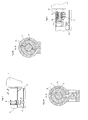
- FIG. 1 schematically shows a knob cylinder, in which on one side of the only partially shown, with an electronic knob cylinder or with a key to be operated lock cylinder 3 is located. On the opposite side a knob 1 is indicated.
- the lock cylinder housing is designated 2. That the knob shaft 7 ( FIGS. 2a and b ) connected to the cylinder core of the lock cylinder, the cam 5 receiving the closing member is denoted by 4.
- the cut AA in FIG. 2a shows one of the magnetic disks 6 with the different polarities. This magnetic disk 6 encloses the knob shaft 7, wherein this is rotatably arranged in the magnetic disk. However, this magnetic disk 7 itself is held by a nose 8, which engages in a recess 9 in the lock cylinder housing 2 against this rotationally.
- the cut BB in FIG. 2b indicates the axially adjacent magnetic disk 10 again, wherein it can be seen that this is rotationally connected to the knob shaft 7.
- the magnetic disk 10 rotates with this and relative to the locked by the lock cylinder housing magnetic disk 6. Due to the opposite polarities acts so that the magnetic force resettable to the knob shaft, so that these in a basic position or neutral position, as shown in the FIG. 2a is shown, is turned back.
- the magnetic disks can also be divided into several segments.
- FIG. 3 shows the axial juxtaposition of the magnetic disks 6 and 10, wherein in this embodiment, a magnetic disk 6 on both sides of the magnetic disks 10 are assigned.
- Denoted at 11 are the axial position of the magnetic disk defining means.
- the magnetic disks which have only a small axial extent or width, replaced by magnetic rings.
- the magnetic rings are now, for example - as in the FIG. 4 represented - coaxially arranged one inside the other.
- the coaxial inner magnet ring 14 is located on the knob shaft or is connected to this rotationally fixed.
- the magnetization is diametrical in these magnetic rings, similar to the previously described magnetic disks.
- the variant is constructive FIG. 5 constructed the same way, with the difference that here the magnetization is radial, that is different on the respective inner circumference than on the outer circumference of the magnetic ring.
Landscapes
- Physics & Mathematics (AREA)
- Electromagnetism (AREA)
- Lock And Its Accessories (AREA)
- Mechanical Control Devices (AREA)
- Preventing Unauthorised Actuation Of Valves (AREA)
- Adjustable Resistors (AREA)
Abstract
Description
- Die Erfindung betrifft einen Knaufzylinder, dessen Knaufwelle oder -spindel drehfest mit dem Schließbart eines Schließzylinders verbunden ist.
- Bei Schließzylinder, die ausschließlich mit einem Schlüssel betätigt werden, kann der Schlüssel nur in einer definierten Stellung des Schlüssels abgezogen werden.
- Demgegenüber haben Knaufzylinder meist keine feste Position bei der Verdrehung des Knaufes, die dieser Grund- oder Neutralstellung entspricht.
Knaufzylinder können von der Außenseite entweder mit dem Schlüssel oder einem elektronischen Knauf betätigt werden. - Insbesondere bei Schließzylindern, die von außen nicht mit einem Schlüssel sondern über einen Elektronikknauf und von Innen mit einem mechanischen Knauf zu öffnen sind, gibt es meist keine feste Schließbartposition. die z. B. bei Paniktüren, Fluchtwegtüren oder auch Feuerschutztüren erforderlich ist.
Bei diesen Schließzylindern besteht die Forderung, dass das Stellglied des Schließzylinders nach einem ausgeführten Schließvorgang, immer in seiner Grundstellung oder Neutralstellung im Bereich von 3:00 bis 9:00Uhr stehen muss, um beispielsweise die Panikfunktion ausüben zu können. - Aus der
EP 2 088 263 B1 ist es bekannt eine Rückstellfeder vorzusehen, die in diesem Fall dazu dient, den aus einer Neutralstellung verdrehten Zylinderkern selbsttätig in diese Neutralstellung zurückzudrehen. - Eine andere, ebenfalls auf die Wirkung einer Feder aufbauende Rückstelleinrichtung ist aus der
EP 2 115 246 B1 bekannt. - Nachteilig bei den bisher bekannten Lösungen ist, dass ein nicht unerheblicher Bauraum konstruktiv bedingt eingenommen wird bzw. notwendig ist, um die Rückstellfedern unterzubringen. Dies bedeutet,dass die konstruktiven Elemente sowohl in der Knaufwelle wie auch im Zylindergehäuse angeordnet sind.
- Ein weiterer Nachteil besteht darin, dass sich Totpunkte bei Rückstellfedern nicht vermeiden lassen, d. h. es gibt bestimmte Stellungen des Stellgliedes und damit des Schließbartes, bei denen die Rückstellfeder an einer Rückdrehung in die Grund- oder Neutralstellung gehindert ist.
Damit kann unter Umständen die Panikfunktion nicht ausgeübt werden, zumindest nicht sicher genug. - Der Erfindung liegt daher die Aufgabe zugrunde, einen Knaufzylinder bereitzustellen, bei dem der Schließbart zwangsmäßig nach einem Schließvorgang in eine Position zwischen 3:00 Uhr und 9:00 Uhr gebracht wird, und zwar möglichst ohne das bei der Rückstellbewegung ein Totpunkt vorhanden ist, so dass damit die Voraussetzungen für den Einbau in z. B. Brandschutztüren, Paniktüren oder Fluchtwegtüren gegeben sind.
- Ein weiterer, wesentlicher Punkt ist, dass die Rückstelleinrichtung einen möglichst geringen Bauraum einnimmt, insbesondere, dass sie auch in bestehende Schließzylinder ohne großen Aufwand, beispielsweise nachträglich, einbaubar ist.
- Gelöst wird diese Aufgabe erfindungsgemäß mit einem Knaufzylinder, dessen Knaufwelle oder -spindel drehfest mit dem Schließbart eines Schließzylinder verbunden ist,
wobei zur Rückstellung des Schließbartes in eine Grundstellung, eine auf die Knaufwelle drehend wirkende Magnetanordnung vorgesehen ist. - Gemäß einer vorzugsweisen Ausführung ist vorgesehen, dass auf der Knaufwelle axial hintereinander mehrere die Knaufwelle umgebende Magnetscheiben angeordnet sind, die abwechselnd gegenpolig ausgerichtet sind und jeweils aus zwei oder mehr Segmenten bestehen, wobei jeweils eine der Magnetscheiben gegenüber dem die Knaufwelle aufnehmenden Schließzylindergehäuse verdrehfest gehalten ist und die zugeordnete axial nächstliegende Magnetscheibe gegenüber der Knaufwelle drehfest gehalten ist und die Magnetpolungen so gewählt sind, dass die mit der Knaufwelle verbundene Magnetscheibe ständig in die Grundstellung zurückgedreht wird.
- Diese Lösung zeichnet sich insbesondere dadurch aus, dass das Rückstellsystem keinen Totpunkt aufweist.
- Die Lösung besteht darin, dass eine "gehäusefeste" Magnetscheibe (bestehend aus zwei oder mehreren Segmenten) sich zwischen zwei (oder mehreren) gleich / ungleich gepolten Magnetscheiben befindet. Die gehäusefeste Magnetscheibe hält ihre Lage beispielsweise über eine kleine "Nase", die in eine Gehäusenut eingreift. Die beiden anderen Magnetscheiben, zwischen denen sich die gehäusefeste Magnetscheibe befindet, sind fest mit der Knaufwelle verbunden. Die Magnetpolungen sind nun so gewählt, dass die mittlere Magnetscheibe im "Ruhezustand" von den beiden äußeren Magnetscheiben angezogen wird. Wird die Knaufwelle nun verdreht, dann kommen die zylinderfesten Magnetsegmente in den abstoßend gepolten Bereich der äußeren Magnetsegmente und werden davon zurückgedreht.
Bei einer mittleren Magnetscheibe. die mit zwei benachbarten Magnetscheiben in Wirkung tritt, treten keine äußeren Magnetkräfte auf, da sich die äußeren Magnetscheiben zur mittleren Magnetscheibe zentrieren. - Bei einer Anordnung mit jeweils nur einer gehäusefesten und einer drehbaren Magnetscheibe treten dagegen axiale Kräfte auf. Die zurückdrehend wirkende Funktion der beiden Magnetscheiben ist aber gegeben.
- Bei dieser Lösung kommen - wie beschrieben - Magnetscheiben zum Einsatz.
- Nach einer anderen Ausführungsform der Erfindung ist vorgesehen, dass die Knaufwelle koaxial umgebend mindestens zwei gegenpolig ausgerichtete Magnetringe vorgesehen sind, wobei der innere Magnetring verdrehfest gegenüber der Knaufwelle und der äußere Magnetring verdrehfest gegenüber dem Schließzylindergehäuse gehalten ist und die Magnetpolungen so gewählt sind, dass der mit der Knaufwelle verbundene Magnetring ständig in die Grundstellung zurückgedreht wird.
- Hierbei kommen somit nicht Magnetscheiben zu Einsatz, also Magnete, bei denen die axiale Erstreckung aufgrund der scheibenartigen Ausbildung , gering ist, sondern Magnetringe, die eine vergleichsweise größere axiale Länge (oder Breite) aufweisen.
- Darüber hinaus sind diese Magnetringe koaxial angeordnet, d. h. liegen ineinander.
- Die magnetisierten Bereiche können bei dieser Lösung entweder diametral sein, d.h. in Umfangsrichtung gesehen wechselt sich die Polarität ab, oder sie können radial ausgerichtet sein.
Bei dieser radialen Ausrichtung weist der Innenumfang des Magnetringes eine andere Polarität auf als der Außenumfang, wobei natürlich bei dem zugehörigen , koaxial angeordneten Magnetring, die Polarität beispielsweise am Außenumfang entgegengesetzt der des Innenumfangs des anderen Magnetringes ist.
Die Erfindung soll nachfolgend mit Bezug auf die Zeichnungen erläutert werden. - Dabei zeigt:
- Fig. 1
- eine schematische Darstellung der Knaufseite eines Knaufzylinders,
- Fig. 2a und b
- Schnitte gemäß A-A und B-B in
Figur 1 für die erste Ausführungsform, - Fig. 3
- ein Detail aus
Figur 1 und - Fig.4 und 5
- die zweite Ausführungsform in zwei Varianten.
- Die
Figur 1 zeigt schematisch einen Knaufzylinder, bei dem sich auf auf der einen Seite der nur teilweise dargestellte, mit einem elektronischen Knaufzylinder oder mit einem Schlüssel zu betätigende Schließzylinder 3 befindet. Auf der gegenüber liegenden Seite ist ein Knauf 1 angedeutet. Das Schließzylindergehäuse ist mit 2 bezeichnet.
Das die Knaufwelle 7 (Figur 2a und b ) mit dem Zylinderkern des Schließzylinders verbindende, den Schließbart 5 aufnehmende Schließglied ist mit 4 bezeichnet.
Der Schnitt A-A inFigur 2a zeigt eine der Magnetscheiben 6 mit den unterschiedlichen Polaritäten. Diese Magnetscheibe 6 umschließt die Knaufwelle 7, wobei diese in der Magnetscheibe drehbar angeordnet ist. Diese Magnetscheibe 7 selbst ist aber durch eine Nase 8, die in eine Ausnehmung 9 im Schließzylindergehäuse 2 eingreift gegenüber diesem verdrehfest gehalten.
Der Schnitt B-B inFigur 2b gibt die axial benachbarte Magnetscheibe 10 wieder, wobei erkennbar ist, dass diese mit der Knaufwelle 7 verdrehfest verbunden ist. - Wird die Knaufwelle 7 verdreht, so dreht sich die Magnetscheibe 10 mit dieser und relativ zu der vom Schließzylindergehäuse arretierten Magnetscheibe 6. Aufgrund der entgegengesetzten Polaritäten wirkt damit die Magnetkraft rückstellend auf die Knaufwelle ein, so dass diese in eine Grundstellung oder Neutralstellung, wie sie in der
Figur 2a dargestellt ist, zurück gedreht wird. - Selbstverständlich können die Magnetscheiben auch in mehrere Segmente unterteilt sein.
- Die Detaildarstellung in
Figur 3 zeigt die axiale nebeneinander Anordnung der Magnetscheiben 6 und 10, wobei bei diesem Ausführungsbeispiel einer Magnetscheibe 6 beidseitig die Magnetscheiben 10 zugeordnet sind.
Mit 11 sind die axiale Position der Magnetscheiben festlegende Mittel bezeichnet. - Bei der zweiten Ausführungsart, wie sie in den
Figuren 4 und 5 dargestellt worden ist, wurden die Magnetscheiben, die eine nur geringe axiale Erstreckung oder Breite aufweisen, durch Magnetringe ersetzt. - Darüber hinaus sind die Magnetringe nun beispielsweise - wie in der
Figur 4 dargestellt - koaxial ineinander angeordnet. - Beim äußeren Magnetring 12 ist die Nase 13 erkennbar, d. h. dieser Magnetring ist gegenüber dem hier nicht dargestellten Schließzylindergehäuse verdrehfest gehalten.
- Der koaxial innere Magnetring 14 befindet sich auf der Knaufwelle bzw. wird mit dieser verdrehfest verbunden.
- Die Magnetisierung ist bei diesen Magnetringen, ähnlich wie bei den vorher beschriebenen Magnetscheiben, diametral.
- Konstruktiv ist die Variante nach
Figur 5 genauso aufgebaut, mit dem Unterschied, dass hier die Magnetisierung radial ist, also auf dem jeweiligen Innenumfang anders als auf dem Außenumfang des Magnetringes.
Claims (6)
- Knaufzylinder, dessen Knaufwelle (7) oder -spindel drehfest mit dem Schließbart (5) eines Schließzylinder verbunden ist,
dadurch gekennzeichnet,
dass zur Rückstellung des Schließbartes (5) in eine Grundstellung, eine auf die Knaufwelle (7) drehend wirkende Magnetanordnung (6,10;12,14) vorgesehen ist. - Knaufzylinder nach Anspruch 1,
dadurch gekennzeichnet,
dass auf der Knaufwelle (7) axial hintereinander mehrere die Knaufwelle umgebende Magnetscheiben (6,10) angeordnet sind, die abwechselnd gegenpolig ausgerichtet sind und jeweils aus zwei oder mehr Segmenten bestehen, wobei jeweils eine der Magnetscheiben (6) gegenüber dem die Knaufwelle aufnehmenden Schließzylindergehäuse (2) verdrehfest gehalten ist und mindestens eine zugeordnete axial nächstliegende Magnetscheiben (10) gegenüber der Knaufwelle (7) drehfest gehalten ist und die Magnetpolungen so gewählt sind, dass die mit der Knaufwelle (7) verbundene Magnetscheibe (10) ständig in die Grundstellung zurückgedreht wird. - Knaufzylinder nach Anspruch 1,
dadurch gekennzeichnet,
dass die Knaufwelle (7) koaxial umgebend mindestens zwei gegenpolig ausgerichtete Magnetringe (12,14) vorgesehen sind, wobei der innere Magnetring verdrehfest (14) gegenüber der Knaufwelle (7) und der äußere Magnetring (12) verdrehfest gegenüber dem Schließzylindergehäuse (2) gehalten ist und die Magnetpolungen so gewählt sind, dass der mit der Knaufwelle verbundene Magnetring (14) ständig in die Grundstellung zurückgedreht wird. - Knaufzylinder nach Anspruch 3,
dadurch gekennzeichnet,
dass die Magnetringe eine diametrale Magnetisierung aufweisen. - Knaufzylinder nach Anspruch 3,
dadurch gekennzeichnet,
dass die Magnetringe eine radiale Magnetisierung aufweisen. - Knaufzylinder nach einem der vorstehenden Ansprüche,
dadurch gekennzeichnet,
dass die Magnetanordnung nur den Bauraum der Knaufwelle einnimmt.
Applications Claiming Priority (1)
| Application Number | Priority Date | Filing Date | Title |
|---|---|---|---|
| DE102011113796A DE102011113796A1 (de) | 2011-09-12 | 2011-09-12 | Knaufzylinder |
Publications (3)
| Publication Number | Publication Date |
|---|---|
| EP2568101A2 true EP2568101A2 (de) | 2013-03-13 |
| EP2568101A3 EP2568101A3 (de) | 2014-04-30 |
| EP2568101B1 EP2568101B1 (de) | 2015-11-18 |
Family
ID=46939462
Family Applications (1)
| Application Number | Title | Priority Date | Filing Date |
|---|---|---|---|
| EP12075104.5A Active EP2568101B1 (de) | 2011-09-12 | 2012-09-10 | Knaufzylinder |
Country Status (2)
| Country | Link |
|---|---|
| EP (1) | EP2568101B1 (de) |
| DE (1) | DE102011113796A1 (de) |
Cited By (2)
| Publication number | Priority date | Publication date | Assignee | Title |
|---|---|---|---|---|
| WO2018226835A2 (en) | 2017-06-06 | 2018-12-13 | Schlage Lock Company Llc | Lever return mechanism using magnets |
| US12509916B2 (en) | 2022-04-29 | 2025-12-30 | Iloq Oy | Electromechanical lock cylinder |
Families Citing this family (2)
| Publication number | Priority date | Publication date | Assignee | Title |
|---|---|---|---|---|
| DE102012108998B3 (de) * | 2012-09-24 | 2014-05-22 | Uhlmann & Zacher Gmbh | Antipanikzylinder |
| DE102014111413B3 (de) | 2014-08-11 | 2015-09-17 | ASTRA Gesellschaft für Asset Management mbH & Co. KG | Schließzylinderanordnung |
Citations (2)
| Publication number | Priority date | Publication date | Assignee | Title |
|---|---|---|---|---|
| EP2088263B1 (de) | 2008-01-19 | 2010-06-23 | DOM-Sicherheitstechnik GmbH & Co. KG | Schließzylinder mit selbsttätiger Rückstellung des Schließgliedes |
| EP2115246B1 (de) | 2007-02-08 | 2010-10-06 | EVVA Sicherheitstechnologie GmbH | Schloss mit selbsttätiger schliessbartrückstellung |
Family Cites Families (7)
| Publication number | Priority date | Publication date | Assignee | Title |
|---|---|---|---|---|
| CH492107A (de) * | 1966-11-19 | 1970-06-15 | Huwil Werke Gmbh | Schloss mit magnetischen Zuhaltungen |
| DE19923786A1 (de) * | 1998-06-03 | 1999-12-09 | Dom Sicherheitstechnik | Schließzylinder |
| DE20023646U1 (de) * | 2000-09-08 | 2005-07-07 | Meis, Guido | Schließvorrichtung für eine Tür |
| DE10238153A1 (de) * | 2002-08-15 | 2004-03-25 | Wittenstein Ag | Verriegelungseinrichtung für Fahrzeuge, insbesondere für Flugzeuge |
| DE10303220B3 (de) * | 2003-01-23 | 2004-09-16 | Dom Sicherheitstechnik Gmbh & Co Kg | Schließzylinder |
| DE102009043358A1 (de) * | 2008-04-11 | 2011-04-07 | Cestronics Gmbh | Schließzylinder mit magnetisch gekuppeltem Schließglied |
| AT509465B1 (de) * | 2010-03-30 | 2011-09-15 | Evva Sicherheitstechnologie | Vorrichtung zur zutrittskontrolle mit elektromechanischem wandler |
-
2011
- 2011-09-12 DE DE102011113796A patent/DE102011113796A1/de not_active Withdrawn
-
2012
- 2012-09-10 EP EP12075104.5A patent/EP2568101B1/de active Active
Patent Citations (2)
| Publication number | Priority date | Publication date | Assignee | Title |
|---|---|---|---|---|
| EP2115246B1 (de) | 2007-02-08 | 2010-10-06 | EVVA Sicherheitstechnologie GmbH | Schloss mit selbsttätiger schliessbartrückstellung |
| EP2088263B1 (de) | 2008-01-19 | 2010-06-23 | DOM-Sicherheitstechnik GmbH & Co. KG | Schließzylinder mit selbsttätiger Rückstellung des Schließgliedes |
Cited By (4)
| Publication number | Priority date | Publication date | Assignee | Title |
|---|---|---|---|---|
| WO2018226835A2 (en) | 2017-06-06 | 2018-12-13 | Schlage Lock Company Llc | Lever return mechanism using magnets |
| EP3635203A4 (de) * | 2017-06-06 | 2021-04-28 | Schlage Lock Company LLC | Heberückzugsmechanismus mit magneten |
| US11732500B2 (en) | 2017-06-06 | 2023-08-22 | Schlage Lock Company Llc | Lever return mechanism using magnets |
| US12509916B2 (en) | 2022-04-29 | 2025-12-30 | Iloq Oy | Electromechanical lock cylinder |
Also Published As
| Publication number | Publication date |
|---|---|
| EP2568101A3 (de) | 2014-04-30 |
| DE102011113796A1 (de) | 2013-03-14 |
| EP2568101B1 (de) | 2015-11-18 |
Similar Documents
| Publication | Publication Date | Title |
|---|---|---|
| EP1987218B1 (de) | Schloss mit Sicherheitseinrichtung | |
| DE102011080228B3 (de) | Arretierungsvorrichtung für Windturbinen | |
| EP2568101B1 (de) | Knaufzylinder | |
| DE102011015314A1 (de) | Schließzylinder | |
| EP2162816B1 (de) | Drehsteller mit veränderbarem rastverlauf | |
| CH627813A5 (de) | Steuereinrichtung, insbesondere fuer zylinderschloss. | |
| AT353128B (de) | Magnetisch betaetigbares zylinderschloss | |
| EP3665346B1 (de) | Kupplungssystem für ein elektromechanisches schloss | |
| EP3484024B1 (de) | Aktuator | |
| EP2931995B1 (de) | Schliesszylinder und wende-schlüssel mit schlüsselabzugssperre | |
| EP2360343B1 (de) | Schiebefenster oder Schiebetür mit einer Schließeinrichtung | |
| DE102006059599A1 (de) | Schließzylinder mit durch Magnetkraft verlagerbarem Zuhaltungsstift und zugehöriger Schlüssel | |
| DE102007036360A1 (de) | Personenschleuse | |
| DE2853185A1 (de) | Zylinderschloss mit magnetkoerpern | |
| DE102011106896A1 (de) | Kupplungssystem für ein- und/oder zweiseitig mit einem Schlüssel zu betätigende Schließzylinder | |
| DE102006006949A1 (de) | Schlüsseltransferschalter System und Methode | |
| EP2985398B1 (de) | Schliesszylinderanordnung | |
| EP0835975B1 (de) | Schliesszylinder | |
| DE102016111965A1 (de) | Umschalteinrichtung | |
| EP0368052B1 (de) | Profilschliesszylinder | |
| AT367148B (de) | Zylinderschloss mit einem gehaeuse und zumindest einem darin verdrehbaren zylinderkern | |
| DE3924971A1 (de) | Schliesszylinder, insbesondere fuer kraftfahrzeugtuerschloesser | |
| EP1731696A2 (de) | Schliesszylinder für ein elektronisches Schliesssystem | |
| DE2365990C3 (de) | Mittels eines Permanentmagnet-Schlüssels betätigbares Drehzylinderschloß | |
| DE20213365U1 (de) | Drosselvorrichtung |
Legal Events
| Date | Code | Title | Description |
|---|---|---|---|
| PUAI | Public reference made under article 153(3) epc to a published international application that has entered the european phase |
Free format text: ORIGINAL CODE: 0009012 |
|
| AK | Designated contracting states |
Kind code of ref document: A2 Designated state(s): AL AT BE BG CH CY CZ DE DK EE ES FI FR GB GR HR HU IE IS IT LI LT LU LV MC MK MT NL NO PL PT RO RS SE SI SK SM TR |
|
| AX | Request for extension of the european patent |
Extension state: BA ME |
|
| PUAL | Search report despatched |
Free format text: ORIGINAL CODE: 0009013 |
|
| AK | Designated contracting states |
Kind code of ref document: A3 Designated state(s): AL AT BE BG CH CY CZ DE DK EE ES FI FR GB GR HR HU IE IS IT LI LT LU LV MC MK MT NL NO PL PT RO RS SE SI SK SM TR |
|
| AX | Request for extension of the european patent |
Extension state: BA ME |
|
| RIC1 | Information provided on ipc code assigned before grant |
Ipc: E05B 47/00 20060101AFI20140321BHEP Ipc: E05B 9/04 20060101ALI20140321BHEP |
|
| 17P | Request for examination filed |
Effective date: 20141014 |
|
| RBV | Designated contracting states (corrected) |
Designated state(s): AL AT BE BG CH CY CZ DE DK EE ES FI FR GB GR HR HU IE IS IT LI LT LU LV MC MK MT NL NO PL PT RO RS SE SI SK SM TR |
|
| 17Q | First examination report despatched |
Effective date: 20150113 |
|
| GRAP | Despatch of communication of intention to grant a patent |
Free format text: ORIGINAL CODE: EPIDOSNIGR1 |
|
| INTG | Intention to grant announced |
Effective date: 20150616 |
|
| GRAS | Grant fee paid |
Free format text: ORIGINAL CODE: EPIDOSNIGR3 |
|
| GRAA | (expected) grant |
Free format text: ORIGINAL CODE: 0009210 |
|
| AK | Designated contracting states |
Kind code of ref document: B1 Designated state(s): AL AT BE BG CH CY CZ DE DK EE ES FI FR GB GR HR HU IE IS IT LI LT LU LV MC MK MT NL NO PL PT RO RS SE SI SK SM TR |
|
| REG | Reference to a national code |
Ref country code: GB Ref legal event code: FG4D Free format text: NOT ENGLISH |
|
| REG | Reference to a national code |
Ref country code: CH Ref legal event code: EP Ref country code: CH Ref legal event code: NV Representative=s name: E. BLUM AND CO. AG PATENT- UND MARKENANWAELTE , CH |
|
| REG | Reference to a national code |
Ref country code: AT Ref legal event code: REF Ref document number: 761667 Country of ref document: AT Kind code of ref document: T Effective date: 20151215 |
|
| REG | Reference to a national code |
Ref country code: IE Ref legal event code: FG4D Free format text: LANGUAGE OF EP DOCUMENT: GERMAN |
|
| REG | Reference to a national code |
Ref country code: DE Ref legal event code: R096 Ref document number: 502012005217 Country of ref document: DE |
|
| REG | Reference to a national code |
Ref country code: NL Ref legal event code: FP |
|
| REG | Reference to a national code |
Ref country code: LT Ref legal event code: MG4D |
|
| PG25 | Lapsed in a contracting state [announced via postgrant information from national office to epo] |
Ref country code: NO Free format text: LAPSE BECAUSE OF FAILURE TO SUBMIT A TRANSLATION OF THE DESCRIPTION OR TO PAY THE FEE WITHIN THE PRESCRIBED TIME-LIMIT Effective date: 20160218 Ref country code: HR Free format text: LAPSE BECAUSE OF FAILURE TO SUBMIT A TRANSLATION OF THE DESCRIPTION OR TO PAY THE FEE WITHIN THE PRESCRIBED TIME-LIMIT Effective date: 20151118 Ref country code: ES Free format text: LAPSE BECAUSE OF FAILURE TO SUBMIT A TRANSLATION OF THE DESCRIPTION OR TO PAY THE FEE WITHIN THE PRESCRIBED TIME-LIMIT Effective date: 20151118 Ref country code: IT Free format text: LAPSE BECAUSE OF FAILURE TO SUBMIT A TRANSLATION OF THE DESCRIPTION OR TO PAY THE FEE WITHIN THE PRESCRIBED TIME-LIMIT Effective date: 20151118 Ref country code: LT Free format text: LAPSE BECAUSE OF FAILURE TO SUBMIT A TRANSLATION OF THE DESCRIPTION OR TO PAY THE FEE WITHIN THE PRESCRIBED TIME-LIMIT Effective date: 20151118 Ref country code: IS Free format text: LAPSE BECAUSE OF FAILURE TO SUBMIT A TRANSLATION OF THE DESCRIPTION OR TO PAY THE FEE WITHIN THE PRESCRIBED TIME-LIMIT Effective date: 20160318 |
|
| PG25 | Lapsed in a contracting state [announced via postgrant information from national office to epo] |
Ref country code: PL Free format text: LAPSE BECAUSE OF FAILURE TO SUBMIT A TRANSLATION OF THE DESCRIPTION OR TO PAY THE FEE WITHIN THE PRESCRIBED TIME-LIMIT Effective date: 20151118 Ref country code: PT Free format text: LAPSE BECAUSE OF FAILURE TO SUBMIT A TRANSLATION OF THE DESCRIPTION OR TO PAY THE FEE WITHIN THE PRESCRIBED TIME-LIMIT Effective date: 20160318 Ref country code: SE Free format text: LAPSE BECAUSE OF FAILURE TO SUBMIT A TRANSLATION OF THE DESCRIPTION OR TO PAY THE FEE WITHIN THE PRESCRIBED TIME-LIMIT Effective date: 20151118 Ref country code: GR Free format text: LAPSE BECAUSE OF FAILURE TO SUBMIT A TRANSLATION OF THE DESCRIPTION OR TO PAY THE FEE WITHIN THE PRESCRIBED TIME-LIMIT Effective date: 20160219 Ref country code: RS Free format text: LAPSE BECAUSE OF FAILURE TO SUBMIT A TRANSLATION OF THE DESCRIPTION OR TO PAY THE FEE WITHIN THE PRESCRIBED TIME-LIMIT Effective date: 20151118 Ref country code: LV Free format text: LAPSE BECAUSE OF FAILURE TO SUBMIT A TRANSLATION OF THE DESCRIPTION OR TO PAY THE FEE WITHIN THE PRESCRIBED TIME-LIMIT Effective date: 20151118 Ref country code: FI Free format text: LAPSE BECAUSE OF FAILURE TO SUBMIT A TRANSLATION OF THE DESCRIPTION OR TO PAY THE FEE WITHIN THE PRESCRIBED TIME-LIMIT Effective date: 20151118 |
|
| PG25 | Lapsed in a contracting state [announced via postgrant information from national office to epo] |
Ref country code: CZ Free format text: LAPSE BECAUSE OF FAILURE TO SUBMIT A TRANSLATION OF THE DESCRIPTION OR TO PAY THE FEE WITHIN THE PRESCRIBED TIME-LIMIT Effective date: 20151118 |
|
| REG | Reference to a national code |
Ref country code: FR Ref legal event code: PLFP Year of fee payment: 5 |
|
| REG | Reference to a national code |
Ref country code: DE Ref legal event code: R097 Ref document number: 502012005217 Country of ref document: DE |
|
| PG25 | Lapsed in a contracting state [announced via postgrant information from national office to epo] |
Ref country code: DK Free format text: LAPSE BECAUSE OF FAILURE TO SUBMIT A TRANSLATION OF THE DESCRIPTION OR TO PAY THE FEE WITHIN THE PRESCRIBED TIME-LIMIT Effective date: 20151118 Ref country code: SK Free format text: LAPSE BECAUSE OF FAILURE TO SUBMIT A TRANSLATION OF THE DESCRIPTION OR TO PAY THE FEE WITHIN THE PRESCRIBED TIME-LIMIT Effective date: 20151118 Ref country code: EE Free format text: LAPSE BECAUSE OF FAILURE TO SUBMIT A TRANSLATION OF THE DESCRIPTION OR TO PAY THE FEE WITHIN THE PRESCRIBED TIME-LIMIT Effective date: 20151118 Ref country code: SM Free format text: LAPSE BECAUSE OF FAILURE TO SUBMIT A TRANSLATION OF THE DESCRIPTION OR TO PAY THE FEE WITHIN THE PRESCRIBED TIME-LIMIT Effective date: 20151118 Ref country code: RO Free format text: LAPSE BECAUSE OF FAILURE TO SUBMIT A TRANSLATION OF THE DESCRIPTION OR TO PAY THE FEE WITHIN THE PRESCRIBED TIME-LIMIT Effective date: 20151118 |
|
| PLBE | No opposition filed within time limit |
Free format text: ORIGINAL CODE: 0009261 |
|
| STAA | Information on the status of an ep patent application or granted ep patent |
Free format text: STATUS: NO OPPOSITION FILED WITHIN TIME LIMIT |
|
| 26N | No opposition filed |
Effective date: 20160819 |
|
| PG25 | Lapsed in a contracting state [announced via postgrant information from national office to epo] |
Ref country code: SI Free format text: LAPSE BECAUSE OF FAILURE TO SUBMIT A TRANSLATION OF THE DESCRIPTION OR TO PAY THE FEE WITHIN THE PRESCRIBED TIME-LIMIT Effective date: 20151118 |
|
| PG25 | Lapsed in a contracting state [announced via postgrant information from national office to epo] |
Ref country code: MC Free format text: LAPSE BECAUSE OF FAILURE TO SUBMIT A TRANSLATION OF THE DESCRIPTION OR TO PAY THE FEE WITHIN THE PRESCRIBED TIME-LIMIT Effective date: 20151118 |
|
| REG | Reference to a national code |
Ref country code: IE Ref legal event code: MM4A |
|
| PG25 | Lapsed in a contracting state [announced via postgrant information from national office to epo] |
Ref country code: IE Free format text: LAPSE BECAUSE OF NON-PAYMENT OF DUE FEES Effective date: 20160910 |
|
| REG | Reference to a national code |
Ref country code: FR Ref legal event code: PLFP Year of fee payment: 6 |
|
| PG25 | Lapsed in a contracting state [announced via postgrant information from national office to epo] |
Ref country code: LU Free format text: LAPSE BECAUSE OF NON-PAYMENT OF DUE FEES Effective date: 20160910 |
|
| PG25 | Lapsed in a contracting state [announced via postgrant information from national office to epo] |
Ref country code: HU Free format text: LAPSE BECAUSE OF FAILURE TO SUBMIT A TRANSLATION OF THE DESCRIPTION OR TO PAY THE FEE WITHIN THE PRESCRIBED TIME-LIMIT; INVALID AB INITIO Effective date: 20120910 Ref country code: CY Free format text: LAPSE BECAUSE OF FAILURE TO SUBMIT A TRANSLATION OF THE DESCRIPTION OR TO PAY THE FEE WITHIN THE PRESCRIBED TIME-LIMIT Effective date: 20151118 |
|
| PG25 | Lapsed in a contracting state [announced via postgrant information from national office to epo] |
Ref country code: MK Free format text: LAPSE BECAUSE OF FAILURE TO SUBMIT A TRANSLATION OF THE DESCRIPTION OR TO PAY THE FEE WITHIN THE PRESCRIBED TIME-LIMIT Effective date: 20151118 Ref country code: TR Free format text: LAPSE BECAUSE OF FAILURE TO SUBMIT A TRANSLATION OF THE DESCRIPTION OR TO PAY THE FEE WITHIN THE PRESCRIBED TIME-LIMIT Effective date: 20151118 Ref country code: MT Free format text: LAPSE BECAUSE OF FAILURE TO SUBMIT A TRANSLATION OF THE DESCRIPTION OR TO PAY THE FEE WITHIN THE PRESCRIBED TIME-LIMIT Effective date: 20151118 |
|
| PG25 | Lapsed in a contracting state [announced via postgrant information from national office to epo] |
Ref country code: BG Free format text: LAPSE BECAUSE OF FAILURE TO SUBMIT A TRANSLATION OF THE DESCRIPTION OR TO PAY THE FEE WITHIN THE PRESCRIBED TIME-LIMIT Effective date: 20151118 |
|
| REG | Reference to a national code |
Ref country code: FR Ref legal event code: PLFP Year of fee payment: 7 |
|
| PG25 | Lapsed in a contracting state [announced via postgrant information from national office to epo] |
Ref country code: AL Free format text: LAPSE BECAUSE OF FAILURE TO SUBMIT A TRANSLATION OF THE DESCRIPTION OR TO PAY THE FEE WITHIN THE PRESCRIBED TIME-LIMIT Effective date: 20151118 |
|
| PGFP | Annual fee paid to national office [announced via postgrant information from national office to epo] |
Ref country code: NL Payment date: 20250814 Year of fee payment: 14 |
|
| REG | Reference to a national code |
Ref country code: CH Ref legal event code: U11 Free format text: ST27 STATUS EVENT CODE: U-0-0-U10-U11 (AS PROVIDED BY THE NATIONAL OFFICE) Effective date: 20251001 |
|
| PGFP | Annual fee paid to national office [announced via postgrant information from national office to epo] |
Ref country code: DE Payment date: 20250813 Year of fee payment: 14 |
|
| PGFP | Annual fee paid to national office [announced via postgrant information from national office to epo] |
Ref country code: BE Payment date: 20250818 Year of fee payment: 14 Ref country code: GB Payment date: 20250807 Year of fee payment: 14 |
|
| PGFP | Annual fee paid to national office [announced via postgrant information from national office to epo] |
Ref country code: FR Payment date: 20250821 Year of fee payment: 14 Ref country code: AT Payment date: 20250827 Year of fee payment: 14 |
|
| PGFP | Annual fee paid to national office [announced via postgrant information from national office to epo] |
Ref country code: CH Payment date: 20251001 Year of fee payment: 14 |