EP2568216A2 - Luminaire - Google Patents
Luminaire Download PDFInfo
- Publication number
- EP2568216A2 EP2568216A2 EP12182503A EP12182503A EP2568216A2 EP 2568216 A2 EP2568216 A2 EP 2568216A2 EP 12182503 A EP12182503 A EP 12182503A EP 12182503 A EP12182503 A EP 12182503A EP 2568216 A2 EP2568216 A2 EP 2568216A2
- Authority
- EP
- European Patent Office
- Prior art keywords
- thermal transfer
- transfer portion
- globe
- luminaire
- light
- Prior art date
- Legal status (The legal status is an assumption and is not a legal conclusion. Google has not performed a legal analysis and makes no representation as to the accuracy of the status listed.)
- Granted
Links
Images




Classifications
-
- F—MECHANICAL ENGINEERING; LIGHTING; HEATING; WEAPONS; BLASTING
- F21—LIGHTING
- F21V—FUNCTIONAL FEATURES OR DETAILS OF LIGHTING DEVICES OR SYSTEMS THEREOF; STRUCTURAL COMBINATIONS OF LIGHTING DEVICES WITH OTHER ARTICLES, NOT OTHERWISE PROVIDED FOR
- F21V29/00—Protecting lighting devices from thermal damage; Cooling or heating arrangements specially adapted for lighting devices or systems
- F21V29/50—Cooling arrangements
- F21V29/502—Cooling arrangements characterised by the adaptation for cooling of specific components
- F21V29/506—Cooling arrangements characterised by the adaptation for cooling of specific components of globes, bowls or cover glasses
-
- F—MECHANICAL ENGINEERING; LIGHTING; HEATING; WEAPONS; BLASTING
- F21—LIGHTING
- F21K—NON-ELECTRIC LIGHT SOURCES USING LUMINESCENCE; LIGHT SOURCES USING ELECTROCHEMILUMINESCENCE; LIGHT SOURCES USING CHARGES OF COMBUSTIBLE MATERIAL; LIGHT SOURCES USING SEMICONDUCTOR DEVICES AS LIGHT-GENERATING ELEMENTS; LIGHT SOURCES NOT OTHERWISE PROVIDED FOR
- F21K9/00—Light sources using semiconductor devices as light-generating elements, e.g. using light-emitting diodes [LED] or lasers
- F21K9/20—Light sources comprising attachment means
- F21K9/23—Retrofit light sources for lighting devices with a single fitting for each light source, e.g. for substitution of incandescent lamps with bayonet or threaded fittings
- F21K9/232—Retrofit light sources for lighting devices with a single fitting for each light source, e.g. for substitution of incandescent lamps with bayonet or threaded fittings specially adapted for generating an essentially omnidirectional light distribution, e.g. with a glass bulb
-
- F—MECHANICAL ENGINEERING; LIGHTING; HEATING; WEAPONS; BLASTING
- F21—LIGHTING
- F21V—FUNCTIONAL FEATURES OR DETAILS OF LIGHTING DEVICES OR SYSTEMS THEREOF; STRUCTURAL COMBINATIONS OF LIGHTING DEVICES WITH OTHER ARTICLES, NOT OTHERWISE PROVIDED FOR
- F21V29/00—Protecting lighting devices from thermal damage; Cooling or heating arrangements specially adapted for lighting devices or systems
- F21V29/50—Cooling arrangements
- F21V29/502—Cooling arrangements characterised by the adaptation for cooling of specific components
- F21V29/503—Cooling arrangements characterised by the adaptation for cooling of specific components of light sources
-
- F—MECHANICAL ENGINEERING; LIGHTING; HEATING; WEAPONS; BLASTING
- F21—LIGHTING
- F21K—NON-ELECTRIC LIGHT SOURCES USING LUMINESCENCE; LIGHT SOURCES USING ELECTROCHEMILUMINESCENCE; LIGHT SOURCES USING CHARGES OF COMBUSTIBLE MATERIAL; LIGHT SOURCES USING SEMICONDUCTOR DEVICES AS LIGHT-GENERATING ELEMENTS; LIGHT SOURCES NOT OTHERWISE PROVIDED FOR
- F21K9/00—Light sources using semiconductor devices as light-generating elements, e.g. using light-emitting diodes [LED] or lasers
- F21K9/60—Optical arrangements integrated in the light source, e.g. for improving the colour rendering index or the light extraction
-
- F—MECHANICAL ENGINEERING; LIGHTING; HEATING; WEAPONS; BLASTING
- F21—LIGHTING
- F21Y—INDEXING SCHEME ASSOCIATED WITH SUBCLASSES F21K, F21L, F21S and F21V, RELATING TO THE FORM OR THE KIND OF THE LIGHT SOURCES OR OF THE COLOUR OF THE LIGHT EMITTED
- F21Y2115/00—Light-generating elements of semiconductor light sources
- F21Y2115/10—Light-emitting diodes [LED]
Definitions
- Embodiments described herein relate generally to a luminaire.
- the luminaire employing the light-emitting diodes has a long life-span and may be configured to use less power, replacement of the existing incandescent lamp by the luminaire with the light-emitting diodes is expected.
- a luminaire includes a body portion, a light source provided on one of end portions of the body portion and having light-emitting elements, a globe provided so as to cover the light source, and a thermal transfer portion thermally joined to at least one of the globe and a thermal radiating surface of the body portion on the side of the end portion. Then, an end surface of the thermal transfer portion on the side of the globe is exposed from the globe.
- FIGs. 1A and 1B are schematic drawings illustrating a luminaire according to a first embodiment.
- FIG. 1A is a schematic partial cross-sectional view of the luminaire
- FIG. 1B is a cross-sectional view taken along the line A-A in FIG. 1A .
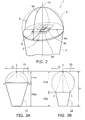
- FIG. 2 is a schematic perspective view illustrating a thermal transfer portion.
- a luminaire 1 includes a body portion 2, a light source 3, a globe 5, a cap portion 6, a control unit 7, and a thermal transfer portion 9.
- the body portion 2 may be formed into a shape, for example, gradually increasing in cross-sectional area in a direction perpendicular to an axial direction as it goes from the cap portion 6 side to the globe 5 side.
- the shape of the body portion 2 is not limited thereto and may be modified as needed in accordance with, for example, the size of the light source 3 or the globe 5, or the size of the cap portion 6. In this case, by employing a shape approximate to a neck portion of an incandescent lamp, replacement of the existing incandescent lamp by the luminaire 1 is facilitated.
- the body portion 2 may be formed of a material having a high rate of thermal transfer, for example.
- the body portion 2 may be formed of, for example, a metal such as aluminum (Al), copper (Cu), and an alloy thereof.
- the material of the body portion 2 is not limited thereto, and may be formed of an inorganic material such as aluminum nitride (AlN), and alumina (Al 2 O 3 ) or an organic material such as a high thermal conductive resin.
- the light source 3 is provided at the center of one end portion 2a of the body portion 2.
- An irradiating surface 3a of the light source 3 is provided so as to be perpendicular to a center axis 1a of the luminaire 1 and radiates light mainly in the axial direction of the luminaire 1.
- the light source 3 may have, for example, a plurality of light-emitting elements 3b. However, the number of the light-emitting elements 3b may be changed as needed, so that one or more light-emitting elements 3b may be provided according an application of the luminaire 1 or the size of the light-emitting elements 3b.
- the light-emitting element 3b may be so called a self-light-emitting element such as a light-emitting diode, an organic light-emitting diode, and a laser diode.
- a regularly disposed form such as a matrix pattern, a zigzag pattern, or a radial pattern may be employed, or an arbitrarily disposed form is also applicable.
- the globe 5 is provided on the end portion 2a side of the body portion 2 so as to cover the light source 3.
- the globe 5 may have a curved surface projecting in the direction of radiation of light.
- the globe 5 is divided corresponding to areas partitioned by the thermal transfer portion 9, so that an end surface of the thermal transfer portion 9 is exposed from the globe 5.
- the globe 5 has translucency, and is configured to allow light radiated from the light source 3 to go outside from the luminaire 1.
- the globe 5 may be formed of a material having translucency and, for example, may be formed of glass, a transparent resin such as polycarbonate, or a translucent ceramics. If needed, applying a diffusing agent or a fluorescent material on an inner surface of the globe 5, or impregnating the diffusing agent or the fluorescent material in the interior of the globe 5 (kneading the diffusing agent or the fluorescent material into the translucent material) is also conceivable.
- the cap portion 6 is provided at an end portion 2b of the body portion 2 opposite the side on which the globe 5 is provided.
- the cap portion 6 may have a shape which is fixturable to a socket to which the incandescent lamp is mounted.
- the cap portion 6 may have the same shape as, for example, E26-type or E17-type prescribed in JIS Standard.
- the shape of the cap portion 6 is not limited to those described above, but may be modified as needed.
- the cap portion 6 may be configured to have pin-type terminals used for fluorescent lamps, or may have L-shaped terminals used for a ceiling plug.
- the cap portion 6 illustrated in FIG. 1A includes a cylindrical shell portion 6a having a thread formed thereon and an eyelet portion 6b provided on an end portion of the shell portion 6a opposite an end portion provided on the side of the body portion 2.
- the control unit 7, described later, is electrically connected to the shell portion 6a and the eyelet portion 6b.
- the control unit 7 is provided in a space formed in the interior of the body portion 2.
- the control unit 7 may have an illumination circuit configured to supply power to the light source 3.
- the control unit 7 may also have a light modulating circuit configured to modulate light of the light source 3.
- a substrate 8 is provided between the light source 3 and the body portion 2.
- the substrate 8 may be formed of a material having a high rate of thermal transfer, for example.
- the body portion 8 may be formed of, for example, a metal such as aluminum (Al), copper (Cu), and an alloy thereof, and formed with a wiring pattern, not illustrated, on a surface thereof via an insulating layer.
- the material of the substrate 8 is not limited to those described above, but may be modified as needed.
- the substrate 8 may be formed with the wiring pattern on a surface of a base material using a resin.
- the substrate 8 may employ the base material of an inorganic material such as aluminum nitride (AlN) or an organic material such as a high-thermal conductive resin.
- heat generated by the light source 3 may be released to the outside easily via the substrate 8 and the body portion 2. As described later, the heat generated by the light source 3 may be released easily to the outside via the substrate 8, the thermal transfer portion 9, and the globe 5. Detailed description relating to the thermal release via the substrate 8, the thermal transfer portion 9, and the globe 5 will be given later.
- the heat generated by the light source 3 is released to the outside via the substrate 8 and the body portion 2.
- the light-emitting elements 3b are used for the light source 3, there arises a problem of decrease in a light distribution angle in comparison with the incandescent lamp.
- the light distribution angle may be increased by forming the globe 5 to have a substantially spherical shape.
- the size of the body portion 2 is decreased as described later, so that the sufficient cooling effect may not be obtained only by radiating the heat from the body portion 2 side.
- FIGs. 3A and 3B are schematic drawings illustrating a relationship between the shape of the globe and the light distribution angle.
- FIG. 3A illustrates a globe 15 having a semi-spherical shape
- FIG. 3B shows a globe 25 having a substantially spherical shape.
- an outline dimension of the luminaire 1 is preferably the same as that of the incandescent lamp as much as possible. Therefore, in FIGS. 3A and 3B , the globes 15 and 25 are set to D in diameter and the luminaire is set to H in height, and these dimensions are set to be substantially the same as those of corresponding parts of the incandescent lamp.
- the luminaire 1 may radiate further backward than the case of the globe 15 having the semi-spherical shape illustrated in FIG.3A . Consequently, the light distribution angle may be increased.
- a height H1b of the globe 25 becomes larger than a height H1a of the globe 15.
- a height H2b of a body portion 22 becomes smaller than a height H2a of a body portion 12.
- the closer to the spherical shape the globe 5 becomes to increase the light distribution angle the smaller the size of the body portion 2 becomes, which may impair easy thermal radiation from the body portion 2 side.
- the amount of thermal radiation to the globe 5 side is increased by providing the thermal transfer portion 9.
- the thermal transfer portion 9 is thermally joined to either one of the globe 5 or a thermal radiating surface of the body portion 2 on the side of the end portion 2a.
- the thermal transfer portion 9 may include an end portion 9a thermally joined to the globe 5 at least partly, an end portion 9b thermally joined to the end portion 2a of the body portion 2 at least partly, an end portion 9c thermally joined to the substrate 8 at least partly, and an end portion 9d thermally joined to the irradiating surface 3a of the light source 3 at least partly.
- thermally joined means that heat is transferred between the thermal transfer portion 9 and the counterpart member by at least any one of thermal conduction, convection, and radiation.
- the heat may be transferred by the thermal conduction by bringing the thermal transfer portion 9 into contact with the counterpart member, or the heat may be transferred by the convection or the radiation by providing a small gap with respect to the thermal transfer portion 9.
- the end portion 9a, the end portion 9b, the end portion 9c, and the end portion 9d of the heat transfer portion 9 may be brought into contact with the counterpart member or may be separated therefrom by an extent which achieves the thermal transfer.
- the end portion 9a, the end portion 9b, the end portion 9c, and the end portion 9d of the thermal transfer portion 9 are preferably brought into contact with the counterpart member.
- the thermal joint does not necessarily have to be performed in the entire areas of the end portion 9a, the end portion 9b, the end portion 9c, and the end portion 9d, and only have to be performed at least partly.
- the thermal joint is preferably performed in areas as wide as possible.
- At least any one of the end portion 2a of the body portion 2, the substrate 8, and the irradiating surface 3a of the light source 3 serves as the thermal radiating surface on the side of the end portion 2a of the body portion 2. Therefore, an end portion of the thermal transfer portion 9 which is thermally joined at least partly to at least any one of these thermal radiating surfaces may be provided.
- a joint portion 80 containing a material having a high rate of thermal transfer may be provided between at least part of the end portions 9b, 9c, and 9d and the thermal radiating surface on the side of the end portion 2a.
- the joint portion 80 may be provided by joining the end portion 2a of the body portion 2 and the end portion 9b by soldering or the like.
- the joint portion 80 may be provided by joining, for example, the substrate 8 and the end portion 9c by soldering or the like.
- the joint portion 80 may be provided by joining the irradiating surface 3a of the light source 3 and the end portion 9d by, for example, a high-conductive adhesive agent added with ceramics filler or metal filler or the like having a high rate of thermal transfer.
- joint portion 80 containing a material having a high rate of thermal transfer may be provided between the globe 5 and the end portion 9a.
- the joint portion 80 may be provided by joining the globe 5 and the end portion 9a by, for example, the high-conductive adhesive agent added with ceramics filler or metal filler having a high rate of thermal transfer.
- thermal transfer portion 9 and the counterpart it is also possible just to bring the end portion of the thermal transfer portion 9 and the counterpart into contact with each other to achieve the thermal joint therebetween.
- the thermal resistance may be reduced, and hence the cooling effect described later may be improved.
- a gap may be formed between the end portion of the thermal transfer portion 9 and the counterpart at the time of joining. Since the thermal resistance is increased when the gap is formed, the thermal resistance may be reduced by joining via the joint portion 80 even when the gap is formed.
- the thermal transfer portion 9 may be formed of a material having a high rate of thermal transfer.
- the thermal transfer portion 9 may be formed of, for example, a metal such as aluminum (Al), copper (Cu), and an alloy thereof.
- the material of the thermal transfer portion 9 is not limited thereto, and may be formed of an inorganic material such as aluminum nitride (AlN) or an organic material such as a high thermal conductive resin.
- the end portion of the thermal transfer portion 9 on the globe 5 side may be provided with a level difference.
- a gap due to a production error or the like may be formed between the thermal transfer portion 9 and the globe 5.
- light irradiated from the light source 3 may be leaked from the gap, or dust existing on the outside may enter into the inside of the globe 5 from the gap.
- the level difference is provided at the end portion of the thermal transfer portion 9 on the globe 5 side.
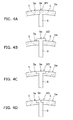
- FIG. 4A to FIG. 4D are partially enlarged schematic drawings illustrating shoulder portions 9f provided at a portion of the thermal transfer portion 9 having the level difference.
- a shoulder portion 9f1 may have a form of a depression depressed in the direction of the thickness of the thermal transfer portion 9.
- the thermal transfer portion 9 and the globe 5 may be overlapped with each other at the depressed portion. Therefore, leaking of light irradiated from the light source 3 from the gap, or entering of dust existing on the outside into the inside of the globe 5 from the gap may be inhibited. Also, assembling of the globe 5 may be facilitated.
- an end surface 9e of the thermal transfer portion 9 and an outer peripheral surface 5a of the globe 5 are preferably flush with each other.
- a shoulder portion 9f2 may have a projecting form projecting in the direction of the thickness of the thermal transfer portion 9.
- the thermal transfer portion 9 and the globe 5 may be overlapped with each other at the projecting portion. Therefore, leaking of light irradiated from the light source 3 from the gap, or entering of dust existing on the outside into the inside of the globe 5 from the gap may be inhibited. Also, assembling of the globe 5 may be facilitated.
- the end surface 9e of the thermal transfer portion 9 and the outer peripheral surface 5a of the globe 5 are preferably flush with each other.
- a shoulder portion 9f3 may have the depressed form as well as the projecting form.
- the thermal transfer portion 9 may have a shoulder portion having at least either one of the projecting form projecting in the direction of the thickness of the thermal transfer portion 9 or the depressed form depressed in the direction of the thickness of the thermal transfer portion 9 at the end portion on the globe 5 side.
- the thermal transfer portion 9 is simply provided on the inside of the globe 5, the difference between a bright section and a dark section generated on the globe 5 is increased, so that an uneven brightness of the luminaire 1 may be increased. Therefore, the thermal transfer portion 9 is configured to be capable of reflecting light radiated from the light source 3.
- the thermal transfer portion 9 may have a higher reflectance than that of the globe 5.
- the thermal transfer portion 9 may have, for example, a reflecting layer 60 on a surface thereof.
- the reflecting layer 60 may be a layer formed by applying, for example, a white coating material.
- the coating material used for the white coating preferably has resistance to heat generated by the luminaire 1 and resistance to light radiated from the light source 3.
- the coating materials as described above include, for example, a polyester-resin-based white coating material, an acrylic-resin-based white coating material, an epoxy-resin-based white coating material, a silicone-resin-based white coating material, a urethane-resin-based white coating material containing at least one of white pigments such as titanium oxide (TiO 2 ), zinc oxide (ZnO), barium sulfate (BaSO 4 ), and magnesium oxide (MgO), or a combination of two or more of the white coating materials selected therefrom.
- white pigments such as titanium oxide (TiO 2 ), zinc oxide (ZnO), barium sulfate (BaSO 4 ), and magnesium oxide (MgO
- the reflecting layer 60 is not limited thereto and, for example, a layer formed by coating a metal such as silver or aluminum having a high reflectance by a plating method, an evaporation method, or a sputtering method or a layer formed by cladding the same with a base material may also be applicable.
- the thermal transfer portion 9 itself may be formed of a material having a high reflectance.
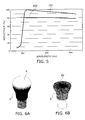
- FIG. 5 is a graph illustrating a reflectance of the reflecting layer.
- a line 100 in FIG. 5 shows a case of a reflecting layer formed of a rolled plate of aluminum (A1050 prescribed in JIS standard), and a line 101 shows a case of a reflecting layer formed by applying the polyester-resin-based white coating material.
- the reflectance with respect to light radiated from the light source 3 is preferably 90% or higher, and more preferably 95% or higher.
- the reflectance in this specification is based on light having a wavelength of at least approximately 460nm or approximately 570nm.
- the reflecting layer 60 is preferably formed by applying the polyester-resin-based white coating material.
- the thermal transfer portion 9 is capable of reflecting light radiated from the light source 3
- the difference between the bright section and the dark section generated on the globe 5 may be reduced, so that the uneven brightness of the luminaire 1 may be reduced.
- the light distribution angle of the luminaire 1 may be widened.
- the thermal transfer portion 9 may have a form of a plate shape, or a form of a plurality of plate-shaped members intersecting each other.
- the thermal transfer portion 9 illustrated in FIG. 1 and FIG. 2 has a form of two plate-shaped members intersecting into a cross shape.
- the thermal transfer portion 9 may have a form of rotation symmetry with respect to an optical axis of the luminaire 1.
- the center axis 1a of the luminaire 1 corresponds to the optical axis of the luminaire 1.
- the thermal transfer portion 9 may have a form of rotation symmetry with respect to the center axis 1a of the luminaire 1.
- the thermal transfer portion 9 has a form of rotation symmetry with respect to the optical axis of the luminaire 1, the brightness in the areas partitioned by the thermal transfer portion 9 may be equalized with respect to each other.
- the difference between the bright section and the dark section generated on the globe 5 may be reduced, so that the uneven brightness of the luminaire 1 may be reduced.
- FIGs. 6A and 6B are schematic drawings illustrating a state of thermal radiation in the luminaire which is not provided with the thermal transfer portion.
- FIG. 6A is a schematic drawing illustrating a temperature distribution of the luminaire
- FIG. 6B is a schematic drawing illustrating the temperature distribution in the vicinity of the end portion 2a of the body portion 2.
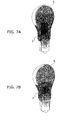
- FIGs. 7A and 7B are schematic drawings illustrating a state of thermal radiation in the luminaire which is provided with the thermal transfer portion.
- FIG. 7A shows a case where the inner surface of the globe 5 and the end surface of the thermal transfer portion are in contact with each other (when the end surface of the thermal transfer portion is not exposed from the globe 5), and FIG. 7B shows a case where the end surface of the thermal transfer portion 9 is exposed from the globe 5.
- FIGs. 6A and 6B and Figs. 7A and 7B are drawings of the temperature distribution of the luminaire obtained by simulation, and a case where an output from the light source 3 is set to approximately 5W (watt) and the environment temperature is set to approximately 25°C.
- the temperature distribution is indicated by shading of monotone color, and is shown so as to be deeper with increase in temperature and lighter with decrease in temperature.
- the thermal transfer portion 9 When the thermal transfer portion 9 is not provided, as illustrated in FIG. 6A , the surface temperature of the globe 5 is lowered, and the temperature of the body portion 2 increases.
- the thermal transfer portion 9 when the thermal transfer portion 9 is not provided, the heat generated by the light source 3 is released from the body portion 2 side and the release of heat from the globe 5 side is small. As illustrated in FIG. 6B , it is understood that the sufficient cooling effect is not obtained only by the thermal radiation from the body portion 2 side.
- the thermal transfer portion 9 when the thermal transfer portion 9 is provided, the heat generated by the light source 3 may be transferred to the globe 5 side by the thermal transfer portion 9. Therefore, as illustrated in Figs. 7A and 7B , the temperature of the body portion 2 may be lowered by thermal radiation from the globe 5 side.
- the temperature of the body portion 2 may further be decreased as illustrated in FIG. 7B .
- Lowering of the temperature of the body portion 2 means that increase in temperature of the light-emitting elements 3b is inhibited. Therefore, the power to be supplied to the light source 3 may be increased, and hence the increase in luminous energy is achieved.
- the thermal radiating property of the luminaire 1 may be improved. Therefore, elongation of the life-span of the luminaire 1 is achieved. In addition, the basic performance of the luminaire 1 such as the increase in luminous energy and the widening of the light distribution angle are improved.
- the thermal transfer portion 9 is capable of reflecting light radiated from the light source 3
- the difference between the bright section and the dark section generated on the globe 5 may be reduced, so that the uneven brightness of the luminaire 1 may be reduced.
- the thermal transfer portion 9 has a form of rotation symmetry with respect to the optical axis of the luminaire 1, the difference between the bright section and the dark section generated on the globe 5 may be reduced, so that the uneven brightness of the luminaire 1 may be reduced.
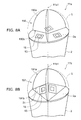
- FIGs. 8A and 8B are schematic perspective views illustrating a luminaire according to a second embodiment.
- FIG. 8A is a schematic perspective view illustrating a thermal transfer portion in which light sources are arranged flatly; and FIG. 8B is a schematic perspective view illustrating a thermal transfer portion in which the light sources are arranged sterically.
- luminaires 11a and 11b are each provided with the body portion 2, light sources 13, the globe 5, and thermal transfer portions 190 and 191 respectively. Although illustration is omitted, the cap portion 6 and the control unit 7 are also provided in the same manner as the luminaire 1 described above.
- the forms of disposing the light sources 13 are different from those illustrated in FIG. 1 and FIG. 2 .
- the light sources 13 are provided on the end portion 2a of the body portion 2 via a substrate 18.
- the light sources 13 are provided respectively at positions of rotation symmetry with respect to a center axis 11a1 of the luminaire 11a.
- a projection 2c is provided on the end portion 2a of the body portion 2.
- the projection 2c has a regular triangular pyramid shape, and the light sources 13 are provided on inclined surfaces thereof respectively via the substrate 18.
- the light sources 13 are provided respectively at positions of rotation symmetry with respect to a center axis 11b1 of the luminaire 11b.
- An apex of the projection 2c is provided at a position where the center axis 11b1 of the luminaire 11b passes.
- the light sources 13 are provided on the inclined surfaces of the projection 2c, optical axes of the respective light sources 13 intersect the center axis 11b1 of the luminaire 11b.
- the light sources 13 are provided respectively at the positions of rotation symmetry with respect to the center axis 11b1 of the luminaire 11b, the center axis 11b1 of the luminaire 11b corresponds to an optical axis of the luminaire 11b.
- the projection 2c may be formed of a material having a high rate of thermal transfer, for example.
- the projection 2c may be formed of, for example, a metal such as aluminum (Al), copper (Cu), and an alloy thereof.
- the material of the projection 2c is not limited thereto, and may be formed of an inorganic material such as aluminum nitride (AlN) or an organic material such as a high thermal conductive resin.
- the projection 2c and the body portion 2 may be formed of the same material, or may be formed of different materials.
- the projection 2c and the body portion 2 may be formed integrally, or the projection 2c and the body portion 2 may be joined via a material having a high rate of thermal transfer.
- the light source 13 may be provided with one or more light-emitting elements 3b in the same manner as the light source 3.
- the number of the light-emitting elements 3b may be changed as needed in accordance with the application of the luminaires 11a and 11b and the size of the light-emitting elements 3b.
- one each of the light source 13 is provided on each of the three inclined surfaces of the projection 2c having the regular triangular pyramid shape.
- the substrate 18 may be formed of a material having a high rate of thermal transfer in the same manner as the substrate 8.
- the substrate 18 may be formed of, for example, a metal such as aluminum (Al), copper (Cu), and an alloy thereof, and formed with a wiring pattern, not illustrated, on a surface thereof via an insulating layer.
- the thermal transfer portion 190 provided on the luminaire 11a illustrated in FIG. 8A is thermally joined to at least either one of the globe 5 or the thermal radiating surface of the body portion 2 on the end portion 2a side.
- the thermal transfer portion 190 may includes an end portion 190a thermally joined to the globe 5 at least partly, and an end portion 190b thermally joined to the end portion 2a of the body portion 2 at least partly.
- the end portion 190a corresponds to the end portion 9a of the thermal transfer portion 9 described above.
- the end portion 190b corresponds to the end portion 9b of the thermal transfer portion 9 described above.
- An end portion corresponding to the end portion 9c of the thermal transfer portion 9 described above may be provided in accordance with the size or the shape of the substrate 18.
- the thermal transfer portion 191 provided on the luminaire 11b illustrated in FIG. 8B is thermally joined to at least either one of the globe 5 or the thermal radiating surface of the body portion 2 on the end portion 2a side.
- the thermal transfer portion 191 may include an end portion 191a thermally joined to the globe 5 at least partly, and an end portion 191b thermally joined to the projection 2c at least partly.
- the end portion 191b may be thermally joined also to the end portion 2a of the body portion 2.
- the end portion 191a corresponds to the end portion 9a of the thermal transfer portion 9 described above. Since the projection 2c may be considered to be thermally a part of the end portion 2a of the body portion 2, the end portion 191b corresponds to the end portion 9b of the thermal transfer portion 9 described above.
- An end portion corresponding to the end portion 9c of the thermal transfer portion 9 described above may be provided in accordance with the size or the shape of the substrate 18.
- Thermal joint between the end portions of the thermal transfer portions 190 and 191 and the counterpart is achieved by simply bringing into contact with each other. However, by joining the end portions of the thermal transfer portions 190 and 191 and the counterpart via the joint portion 80 containing a material having a high rate of thermal transfer, the thermal resistance may be reduced, and hence the cooling effect may be improved.
- the joint portion 80 may be provided by joining the end portions of the thermal transfer portions 190 and 191 and the counterpart by soldering or by the high-conductive adhesive agent added with the ceramics filler having a high rate of thermal transfer.
- the material of the thermal transfer portions 190 and 191 or the reflectance may be the same as the case of the thermal transfer portion 9 described above.
- the thermal transfer portions 190 and 191 may have a form of a plate shape, or a form of a plurality of plate-shaped members intersecting each other.
- the thermal transfer portions 190 and 191 illustrated in FIGs. 8A and 8B have a form of three of the plate-shaped members intersecting each other. Then, the light sources 13 are provided respectively in three areas partitioned by the plate-shaped members.
- the thermal transfer portions 190 and 191 may have a form of rotation symmetry with respect to optical axes of the luminaires 11a and 11b.
- the thermal transfer portions 190 and 191 may have a form of rotation symmetry with respect to the center axes 11a1 and 11b1 of the luminaires 11a and 11b.
- the thermal transfer portions 190 and 191 have the form of rotation symmetry with respect to the optical axes of the luminaires 11a and 11b, the brightness in the areas partitioned by the thermal transfer portions 190 and 191 may be equalized with respect to each other.
- the difference between the bright section and the dark section generated on the globe 5 may be reduced, so that the uneven brightness of the luminaires 11a and 11b may be reduced.
- the number of the light-emitting elements which can be provided may be increased in comparison with a case where the light sources 13 are arranged planarly as the luminaire 11a.
- FIGs. 9A and 9B are schematic drawings illustrating a thermal transfer portion having an opening portion.
- FIG. 9A is a partially cross-sectional schematic view illustrating the thermal transfer portion having the opening portion
- FIG. 9B is a schematic graph illustrating an effect of provision of the opening portion.
- a thermal transfer portion 29 is provided with an opening portion 29a having a height H3.
- the thermal transfer portion 29 has the opening portion 29a penetrating therethrough in the direction of the thickness thereof.
- the thermal transfer portion 29 is provided at a position where light radiated from the light source 3 is blocked.
- the opening portion 29a by providing the opening portion 29a, the light radiated from the light source 3 may be inhibited from being blocked.
- light extracting efficiency may be improved by increasing the height H3 of the opening portion 29a.
- FIG. 9B the case where the height H3 of the opening portion 29a is changed is illustrated.
- a case where a width W of the opening portion 29a is changed is also the same.
- the light extracting efficiency may be improved also by increasing the width W of the opening portion 29a.
- the opening portion 29a is too large, there arises a risk that the amount of thermal transfer by the thermal transfer portion 29 and hence the amount of thermal radiation is reduced, so that the amount of light radiated from the light source 3 is reduced.
- the amount of thermal radiation from the thermal transfer portion 29 is reduced, so that limit power (power which can be supplied to the light-emitting elements 3b) is reduced. If the limit power is reduced, the amount of light radiated from the light source 3 is reduced correspondingly.
- the size of the opening portion 29a may be determined as needed considering the characteristics of the light-emitting elements 3b, improvement of the light extracting efficiency owing to the provision of the opening portion 29a and lowering of the thermal radiating property due to the provision of the opening portion 29a.
- FIG. 9A the opening portion 29a opening at a peripheral edge of the thermal transfer portion 29 on the body portion 2 side is illustrated.
- the shape of the opening portion 29a and the position of provision of the opening portion 29a may be changed as needed.
- the opening portion 29a at a position closer to the light source 3, the light extracting efficiency may be improved. Therefore, the opening portion 29a opening at the peripheral edge of the thermal transfer portion on the body portion 2 side as illustrated in FIG. 9A is preferable.
- FIG. 10 is a schematic partial cross-sectional view illustrating an opening portion according to another embodiment.
- an opening portion 39a provided on a thermal transfer portion 39 is opened at an end portion of the thermal transfer portion 39 on the body portion 2 side and an end portion of the globe 5 side.
- the thermal transfer portion 39 comes into contact with the substrate 8 on the center side, extends to the globe 5 side, and extends outward from an axis of the luminaire along the shape of the globe in the vicinity of the globe 5.
- the thermal transfer portion 39 has an "umbrella shape" in cross section including the axis of the luminaire.
- a state in which part of outgoing light from the light source 3 is propagated and reflected in the globe 5 is indicated by dashed lines (light L1 and L2) by projecting on the cross section in FIG. 10 .
- the opening portion 39a opening on a peripheral edge of the thermal transfer portion 39 on the globe 5 side the light L1 emitted from the light source 3 and reflected from an inner surface of the globe and the light L2 reflected from an end surface of a lens 40 are radiated backward of the luminaire as illustrated in FIG. 10 . Therefore, improvement of the light extracting efficiency is achieved, and simultaneously, the light distribution angle may be widened.
- the thermal transfer portion 39 may be formed entirely of a single plate as illustrated in FIG. 10 .
- a plate-shaped member on a left half and a plate-shaped member on a right half are formed integrally, and the two plate-shaped members may be connected at a position indicated by a dot line portion in FIG. 10 , for example.
- the plate-shaped member on the left half and the plate-shaped member on the right half of the thermal transfer portion 39 in FIG. 10 may be formed separately and connected along the dot line portion in FIG. 10 .
- the thermal transfer portion 39 may be added with another separate plate-shaped member (not illustrated).
- the plate-shaped member to be added intersects or is connected to other plate-shaped members at the dot line portion illustrated in FIG. 10 , and constitutes part of the thermal transfer portion 39.
- the light sources 3 may be arranged in a circular shape.
- the light sources 3 may be provided in the vicinity of the globe 5.
- an optical element such as the annular lens 40 may easily be provided.
- the position of the opening portion 39a opening at the peripheral edge of the thermal transfer portion 39 on the globe 5 side is not specifically limited.
- the light extracting efficiency may further be improved by forming the opening portion 39a at a position closer to the body portion 2, and the light distribution angle may be widened.
- the opening portion may be formed so as to open at least either the peripheral edge of the thermal transfer portion on the body portion side or the peripheral edge of the thermal transfer portion on the globe 5 side.
- FIG. 11 is a schematic graph illustrating the thickness of the thermal transfer portion.
- the light extracting efficiency lowers by increase in thickness of the thermal transfer portion.
- the amount of thermal radiation by the thermal transfer portion is increased with increase in thickness of the thermal transfer portion, and the limit power is increased correspondingly. Then, when the limit power is increased, the amount of light radiated from the light source 3 may be increased correspondingly.
- an outline dimension of the luminaire is preferably the same as that of the incandescent lamp as much as possible. Therefore, since the wideness of the area where the light source 3 and the thermal transfer portion are arranged is limited, if the thickness of the thermal transfer portion is increased too much, there is a risk that the number of the light-emitting elements 3b is reduced. Also, if the thickness of the thermal transfer portion is too thick, there arises a risk that the light extracting efficiency is lowered.
- the thermal transfer portion may be manufactured by, for example, die-casting.
- the thickness of the thermal transfer portion is preferably determined by considering the amount of thermal radiation by the thermal transfer portion, the wideness of the area where the light source 3 and the thermal transfer portion are arranged, and the manufacturability of the thermal transfer portion.
- the thickness of the thermal transfer portion within a range from 0.5 mm to 5 mm inclusive, all of the amount of thermal radiation by the thermal transfer portion, the wideness of the area where the light source 3 and the thermal transfer portion are arranged, and the manufacturability of the thermal transfer portion are considered.
- the thickness of the thermal transfer portion within the range from 0.5 mm to 5 mm inclusive, 90% or more of light extracting efficiency is obtained.
- a thermal resistance at a connecting portion between the thermal transfer portion and the element provided on the body portion 2 side may be lowered.
- FIGs. 12A to 12D are schematic drawings for illustrating the connecting portion between the thermal transfer portion and the substrate.
- FIGs. 12A and 12C illustrate a case where the lowering of the thermal resistance is not considered
- FIGs . 12B and 12D illustrate a case where the lowering of the thermal resistance is achieved.
- a substrate 28 is provided with a substrate 28a formed of aluminum or copper, an insulating portion 28b provided on the substrate 28a, a solder resist portion 28c provided on the insulating portion 28b, and a wiring portion 28d provided on the insulating portion 28b.
- the substrate 28 is so-called a metal-base substrate.
- the solder resist portion 28c may be formed by applying solder resist formed of a resin or the like by using a printing method and a photographic method.
- the solder resist portion 28c is formed by using the solder resist formed of the resin or the like, the thermal resistance at a connecting portion between the thermal transfer portion 29 and the substrate 28 is increased.
- a substrate 281 is provided with the substrate 28a, the insulating portion 28b provided on the substrate 28a, a solder resist portion 28c1 provided on the insulating portion 28b, and the wiring portion 28d provided on the insulating portion 28b.
- a connecting portion between the thermal transfer portion 29 and the substrate 281 is not provided with the solder resist portion 28c1, and the thermal transfer portion 29 and the insulating portion 28b are connected. Therefore, the thermal resistance may be reduced by an amount corresponding to the solder resist portion 28c1.
- the solder resist portion 28c1 may not be formed in an area where the thermal transfer portion 29 is connected, or the solder resist portion 28c1 may be formed by separating the solder resist in the area where the thermal transfer portion 29 is connected.
- a substrate 38 is provided with a solder resist portion 38a, a wiring portion 38b provided on the solder resist portion 38a, an insulating portion 38c provided on the wiring portion 38b, and a solder resist portion 38d provided on the insulating portion 38c, and a wiring portion 38e provided on the insulating portion 38c.
- the substrate 38 is so-called a resin substrate.
- the solder resist portion 38d may be formed by applying the solder resist formed of the resin or the like by using the printing method and the photographic method.
- the solder resist portion 38d is formed by using the solder resist formed of the resin or the like, the thermal resistance at a connecting portion between the thermal transfer portion 29 and the substrate 38 is increased.
- a substrate 381 is provided with the solder resist portion 38a, the wiring portion 38b provided on the solder resist portion 38a, the insulating portion 38c provided on the wiring portion 38b, and a solder resist portion 38d1 provided on the insulating portion 38c, and the wiring portion 38e provided on the insulating portion 38c.
- a connecting portion between the thermal transfer portion 29 and the substrate 381 is not provided with the solder resist portion 38d1, and the thermal transfer portion 29 and the insulating portion 38c are connected. Therefore, the thermal resistance may be reduced by an amount corresponding to the solder resist portion 38d1.
- the solder resist portion 38d1 may not be formed in an area where the thermal transfer portion 29 is connected, or the solder resist portion 38d1 may be formed by separating the solder resist in the area where the thermal transfer portion 29 is connected.
- solder resist portion formed of the solder resist may be avoided from being formed in a portion between an end portion of the thermal transfer portion 29 and the thermal radiating surface of the body portion 2 on the end portion 2a side.
- solder resist portion using the solder resist may be provided so as to surround the area of the end portion 2a of the body portion 2 where the thermal transfer portion 29 is connected.
- the lowering of the thermal resistance is not limited thereto.
- the lowering of the thermal resistance is achieved by increasing a contact surface area by providing a seat portion, not illustrated, in the thermal transfer portion on the body portion 2 side, by bringing the thermal transfer portion and the body portion 2 side into tight contact by screwing or the like, or by providing a metal having a low thermal resistance or the like between the thermal transfer portion and the body portion 2 side.
- the diffusion portion is provided so as to diffuse light incoming into the thermal transfer portion.
- the diffusing portion may be at least either one of a projecting portion provided on the surface of the thermal transfer portion or a diffusing layer 70 (see FIG. 1B ) containing a diffusing agent provided on the surface of the thermal transfer portion.
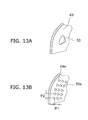
- FIGs. 13A and 13B are schematic drawings illustrating the projecting portion or portions provided on the surface of the thermal transfer portion.
- FIG. 13A shows a case in which one projecting portion is provided on the surface of a thermal transfer portion 49 and FIG. 13B illustrates a case where a plurality of the projecting portions are provided on the surface of a thermal transfer portion 49a.
- the projecting portion or portions are provided on the surface of the thermal transfer portion, light incoming into the thermal transfer portion may be diffused. If the light incoming into the thermal transfer portion can be diffused, the light distribution angle may be widened.
- one projecting portion 50 may be provided on the surface of the thermal transfer portion 49 as illustrated in FIG. 13A and a plurality of projecting portions 50a may be provided on the surface of the thermal transfer portion 49a as illustrated in FIG. 13B .
- a regularly disposing form may be employed, and an arbitrary disposing form may also be employed.
- pitches P1 and P2 of the projecting portions 50a are preferably set to 10 times or more a wavelength of light radiated from the light source 3 to avoid an interference fringe from being generated.
- the shape of the projecting portion is not limited to those described above, but may be modified as needed.
- the description given above relates to a case where the light incoming into the thermal transfer portion is diffused by providing the projecting portion or projecting portions on the surface of the thermal transfer portion.
- the diffusing layer 70 may be provided on the surface of the thermal transfer portion to cause the light incoming into the thermal transfer portion is caused to diffuse.
- the diffusing layer 70 may be a resin layer or the like containing a diffusing agent which diffuses the light, for example.
- the diffusing agents include fine particles formed of metal oxide such as silicon oxide or titanium oxide, or fine particle polymer.
- the diffusing layer 70 is provided on the surface of the thermal transfer portion, light incoming into the thermal transfer portion may be diffused. If the light incoming into the thermal transfer portion can be diffused, the light distribution angle may be widened.
- FIGs. 13A and 13B only one of the surfaces of the thermal transfer portion is illustrated. However, the projecting portion or portions or the diffusing layer may be provided on the other surface of the thermal transfer portion.
- FIGs. 14A and 14B are schematic drawings illustrating the arrangement of the thermal transfer portion 59 and the light-emitting elements 3b in plan view.
- FIG. 14A is a schematic drawing illustrating the arrangement of the thermal transfer portion 59 and the light-emitting element 3b in plan view
- FIG. 14B is a schematic drawing for illustrating the positional relationship between the thermal transfer portion 59 and the light-emitting element 3b in plan view.
- the numbers of the light-emitting elements 3b provided in the respective areas 59a are preferably the same.
- the thermal transfer portion 59 and the light-emitting elements 3b preferably do not overlap with each other in plan view.
- the light-emitting element 3b is a light-emitting element provided in an area 59a1.
- the thermal transfer portion preferably has a form of rotation symmetry with respect to the optical axis of the luminaire and the center axis of the luminaire.
- the thermal transfer portion does not have to have a form of rotation symmetry.
- the positions where the light-emitting elements 3b are provided are not limited to the center side of the end portion 2a of the body portion 2 (for example the cases illustrated in FIG. 1 and FIG. 8 ).
- the light-emitting elements 3b may be provided on the peripheral side of the end portion 2a of the body portion 2 or, alternatively, the light-emitting elements 3b may be provided in the entire area of the end portion 2a of the body portion 2.
- the shapes, the dimensions, the materials, the arrangements, and the numbers of the elements provided in the luminaire 1 and the luminaires 11a and 11b are not limited to those described above, and may be modified as needed.
Landscapes
- Engineering & Computer Science (AREA)
- General Engineering & Computer Science (AREA)
- Physics & Mathematics (AREA)
- Microelectronics & Electronic Packaging (AREA)
- Optics & Photonics (AREA)
- Non-Portable Lighting Devices Or Systems Thereof (AREA)
- Arrangement Of Elements, Cooling, Sealing, Or The Like Of Lighting Devices (AREA)
Applications Claiming Priority (1)
| Application Number | Priority Date | Filing Date | Title |
|---|---|---|---|
| JP2011197723A JP5809493B2 (ja) | 2011-09-09 | 2011-09-09 | 照明装置 |
Publications (3)
| Publication Number | Publication Date |
|---|---|
| EP2568216A2 true EP2568216A2 (fr) | 2013-03-13 |
| EP2568216A3 EP2568216A3 (fr) | 2013-03-20 |
| EP2568216B1 EP2568216B1 (fr) | 2014-11-05 |
Family
ID=47115247
Family Applications (1)
| Application Number | Title | Priority Date | Filing Date |
|---|---|---|---|
| EP12182503.8A Not-in-force EP2568216B1 (fr) | 2011-09-09 | 2012-08-31 | Luminaire |
Country Status (4)
| Country | Link |
|---|---|
| US (1) | US8618723B2 (fr) |
| EP (1) | EP2568216B1 (fr) |
| JP (1) | JP5809493B2 (fr) |
| CN (1) | CN102997088B (fr) |
Cited By (3)
| Publication number | Priority date | Publication date | Assignee | Title |
|---|---|---|---|---|
| WO2015157035A1 (fr) * | 2014-04-09 | 2015-10-15 | Cree, Inc | Lampe à del |
| EP3101332A4 (fr) * | 2014-01-27 | 2016-12-07 | Shanghai Sansi Electr Eng Co Ltd | Nouvel appareil d'éclairage à del |
| EP3101337A4 (fr) * | 2014-01-27 | 2016-12-28 | Shanghai Sansi Electr Eng Co Ltd | Appareil d'éclairage à del |
Families Citing this family (4)
| Publication number | Priority date | Publication date | Assignee | Title |
|---|---|---|---|---|
| JP6293869B2 (ja) * | 2014-03-28 | 2018-03-14 | 株式会社東芝 | 照明装置 |
| CN108397718A (zh) * | 2018-02-28 | 2018-08-14 | 东莞市闻誉实业有限公司 | 路灯 |
| US11168879B2 (en) * | 2020-02-28 | 2021-11-09 | Omachron Intellectual Property Inc. | Light source |
| US11524023B2 (en) | 2021-02-19 | 2022-12-13 | Modernatx, Inc. | Lipid nanoparticle compositions and methods of formulating the same |
Family Cites Families (11)
| Publication number | Priority date | Publication date | Assignee | Title |
|---|---|---|---|---|
| CN100405170C (zh) * | 2003-04-01 | 2008-07-23 | 鸿富锦精密工业(深圳)有限公司 | 直下式背光模块及其扩散板 |
| JP2005166578A (ja) | 2003-12-05 | 2005-06-23 | Hamai Denkyu Kogyo Kk | 電球形ledランプ |
| JP2008186758A (ja) | 2007-01-31 | 2008-08-14 | Royal Lighting Co Ltd | 電球形照明用ledランプ |
| CN201054827Y (zh) * | 2007-05-29 | 2008-04-30 | 光硕光电股份有限公司 | 高发光率的光源封装结构 |
| US20100073944A1 (en) * | 2008-09-23 | 2010-03-25 | Edison Opto Corporation | Light emitting diode bulb |
| JP5519701B2 (ja) * | 2008-11-18 | 2014-06-11 | コーニンクレッカ フィリップス エヌ ヴェ | 電気ランプ |
| CN201377709Y (zh) * | 2009-07-23 | 2010-01-06 | 深圳市长方照明工业有限公司 | 一种led灯泡 |
| US8541933B2 (en) * | 2010-01-12 | 2013-09-24 | GE Lighting Solutions, LLC | Transparent thermally conductive polymer composites for light source thermal management |
| DE102010001046A1 (de) | 2010-01-20 | 2011-07-21 | Osram Gesellschaft mit beschränkter Haftung, 81543 | Leuchtvorrichtung |
| CN201599745U (zh) * | 2010-01-20 | 2010-10-06 | 深圳市同洲电子股份有限公司 | 一种led灯具及led灯具的基板 |
| CN201753850U (zh) * | 2010-07-16 | 2011-03-02 | 中微光电子(潍坊)有限公司 | 一种led照明模组及专用模具 |
-
2011
- 2011-09-09 JP JP2011197723A patent/JP5809493B2/ja not_active Expired - Fee Related
-
2012
- 2012-08-31 US US13/602,055 patent/US8618723B2/en not_active Expired - Fee Related
- 2012-08-31 EP EP12182503.8A patent/EP2568216B1/fr not_active Not-in-force
- 2012-09-06 CN CN201210328755.5A patent/CN102997088B/zh not_active Expired - Fee Related
Non-Patent Citations (1)
| Title |
|---|
| None |
Cited By (4)
| Publication number | Priority date | Publication date | Assignee | Title |
|---|---|---|---|---|
| EP3101332A4 (fr) * | 2014-01-27 | 2016-12-07 | Shanghai Sansi Electr Eng Co Ltd | Nouvel appareil d'éclairage à del |
| EP3101337A4 (fr) * | 2014-01-27 | 2016-12-28 | Shanghai Sansi Electr Eng Co Ltd | Appareil d'éclairage à del |
| WO2015157035A1 (fr) * | 2014-04-09 | 2015-10-15 | Cree, Inc | Lampe à del |
| US9562677B2 (en) | 2014-04-09 | 2017-02-07 | Cree, Inc. | LED lamp having at least two sectors |
Also Published As
| Publication number | Publication date |
|---|---|
| US8618723B2 (en) | 2013-12-31 |
| JP2013058459A (ja) | 2013-03-28 |
| CN102997088B (zh) | 2014-12-03 |
| EP2568216A3 (fr) | 2013-03-20 |
| EP2568216B1 (fr) | 2014-11-05 |
| US20130063942A1 (en) | 2013-03-14 |
| JP5809493B2 (ja) | 2015-11-11 |
| CN102997088A (zh) | 2013-03-27 |
Similar Documents
| Publication | Publication Date | Title |
|---|---|---|
| EP2568216B1 (fr) | Luminaire | |
| JP5066304B1 (ja) | ランプ | |
| JP5175986B2 (ja) | ランプ及び照明装置 | |
| JP5475732B2 (ja) | 照明装置 | |
| WO2013024557A1 (fr) | Lampe à del et dispositif d'éclairage | |
| CN102893073B (zh) | 带有双重漫射器的led模块 | |
| JP2012252899A (ja) | 照明器具 | |
| JP2013016493A (ja) | 照明装置およびその組み立て方法 | |
| JP5809494B2 (ja) | 照明装置およびその製造方法 | |
| CN204099932U (zh) | 照明用光源以及照明装置 | |
| WO2013145049A1 (fr) | Lampe | |
| JP2012119152A (ja) | 照明装置 | |
| US20140003057A1 (en) | Lighting Device | |
| EP2781830A2 (fr) | Luminaire | |
| JP5537612B2 (ja) | 照明装置 | |
| JP5059988B1 (ja) | 照明用光源 | |
| JP5824680B2 (ja) | ランプ及び照明装置 | |
| CN204494239U (zh) | 照明器具 | |
| JP6061215B2 (ja) | 照明器具 |
Legal Events
| Date | Code | Title | Description |
|---|---|---|---|
| PUAL | Search report despatched |
Free format text: ORIGINAL CODE: 0009013 |
|
| PUAI | Public reference made under article 153(3) epc to a published international application that has entered the european phase |
Free format text: ORIGINAL CODE: 0009012 |
|
| 17P | Request for examination filed |
Effective date: 20120831 |
|
| AK | Designated contracting states |
Kind code of ref document: A2 Designated state(s): AL AT BE BG CH CY CZ DE DK EE ES FI FR GB GR HR HU IE IS IT LI LT LU LV MC MK MT NL NO PL PT RO RS SE SI SK SM TR |
|
| AX | Request for extension of the european patent |
Extension state: BA ME |
|
| AK | Designated contracting states |
Kind code of ref document: A3 Designated state(s): AL AT BE BG CH CY CZ DE DK EE ES FI FR GB GR HR HU IE IS IT LI LT LU LV MC MK MT NL NO PL PT RO RS SE SI SK SM TR |
|
| AX | Request for extension of the european patent |
Extension state: BA ME |
|
| RIC1 | Information provided on ipc code assigned before grant |
Ipc: F21V 29/00 20060101AFI20130213BHEP Ipc: F21K 99/00 20100101ALI20130213BHEP Ipc: F21V 3/00 20060101ALI20130213BHEP Ipc: F21Y 101/02 20060101ALN20130213BHEP |
|
| RIC1 | Information provided on ipc code assigned before grant |
Ipc: F21K 99/00 20100101ALI20140403BHEP Ipc: F21Y 101/02 20060101ALN20140403BHEP Ipc: F21V 29/00 20060101AFI20140403BHEP Ipc: F21V 3/00 20060101ALI20140403BHEP |
|
| GRAP | Despatch of communication of intention to grant a patent |
Free format text: ORIGINAL CODE: EPIDOSNIGR1 |
|
| GRAJ | Information related to disapproval of communication of intention to grant by the applicant or resumption of examination proceedings by the epo deleted |
Free format text: ORIGINAL CODE: EPIDOSDIGR1 |
|
| GRAP | Despatch of communication of intention to grant a patent |
Free format text: ORIGINAL CODE: EPIDOSNIGR1 |
|
| INTG | Intention to grant announced |
Effective date: 20140530 |
|
| RIC1 | Information provided on ipc code assigned before grant |
Ipc: F21V 29/00 20060101AFI20140521BHEP Ipc: F21K 99/00 20100101ALI20140521BHEP Ipc: F21V 3/00 20060101ALI20140521BHEP Ipc: F21Y 101/02 20060101ALN20140521BHEP |
|
| INTG | Intention to grant announced |
Effective date: 20140611 |
|
| GRAS | Grant fee paid |
Free format text: ORIGINAL CODE: EPIDOSNIGR3 |
|
| GRAA | (expected) grant |
Free format text: ORIGINAL CODE: 0009210 |
|
| AK | Designated contracting states |
Kind code of ref document: B1 Designated state(s): AL AT BE BG CH CY CZ DE DK EE ES FI FR GB GR HR HU IE IS IT LI LT LU LV MC MK MT NL NO PL PT RO RS SE SI SK SM TR |
|
| REG | Reference to a national code |
Ref country code: GB Ref legal event code: FG4D |
|
| REG | Reference to a national code |
Ref country code: CH Ref legal event code: EP |
|
| REG | Reference to a national code |
Ref country code: AT Ref legal event code: REF Ref document number: 694837 Country of ref document: AT Kind code of ref document: T Effective date: 20141115 |
|
| REG | Reference to a national code |
Ref country code: IE Ref legal event code: FG4D |
|
| REG | Reference to a national code |
Ref country code: DE Ref legal event code: R096 Ref document number: 602012003644 Country of ref document: DE Effective date: 20141218 |
|
| REG | Reference to a national code |
Ref country code: AT Ref legal event code: MK05 Ref document number: 694837 Country of ref document: AT Kind code of ref document: T Effective date: 20141105 |
|
| REG | Reference to a national code |
Ref country code: NL Ref legal event code: VDEP Effective date: 20141105 |
|
| REG | Reference to a national code |
Ref country code: LT Ref legal event code: MG4D |
|
| PG25 | Lapsed in a contracting state [announced via postgrant information from national office to epo] |
Ref country code: FI Free format text: LAPSE BECAUSE OF FAILURE TO SUBMIT A TRANSLATION OF THE DESCRIPTION OR TO PAY THE FEE WITHIN THE PRESCRIBED TIME-LIMIT Effective date: 20141105 Ref country code: NO Free format text: LAPSE BECAUSE OF FAILURE TO SUBMIT A TRANSLATION OF THE DESCRIPTION OR TO PAY THE FEE WITHIN THE PRESCRIBED TIME-LIMIT Effective date: 20150205 Ref country code: IS Free format text: LAPSE BECAUSE OF FAILURE TO SUBMIT A TRANSLATION OF THE DESCRIPTION OR TO PAY THE FEE WITHIN THE PRESCRIBED TIME-LIMIT Effective date: 20150305 Ref country code: NL Free format text: LAPSE BECAUSE OF FAILURE TO SUBMIT A TRANSLATION OF THE DESCRIPTION OR TO PAY THE FEE WITHIN THE PRESCRIBED TIME-LIMIT Effective date: 20141105 Ref country code: PT Free format text: LAPSE BECAUSE OF FAILURE TO SUBMIT A TRANSLATION OF THE DESCRIPTION OR TO PAY THE FEE WITHIN THE PRESCRIBED TIME-LIMIT Effective date: 20150305 Ref country code: ES Free format text: LAPSE BECAUSE OF FAILURE TO SUBMIT A TRANSLATION OF THE DESCRIPTION OR TO PAY THE FEE WITHIN THE PRESCRIBED TIME-LIMIT Effective date: 20141105 Ref country code: LT Free format text: LAPSE BECAUSE OF FAILURE TO SUBMIT A TRANSLATION OF THE DESCRIPTION OR TO PAY THE FEE WITHIN THE PRESCRIBED TIME-LIMIT Effective date: 20141105 |
|
| PG25 | Lapsed in a contracting state [announced via postgrant information from national office to epo] |
Ref country code: AT Free format text: LAPSE BECAUSE OF FAILURE TO SUBMIT A TRANSLATION OF THE DESCRIPTION OR TO PAY THE FEE WITHIN THE PRESCRIBED TIME-LIMIT Effective date: 20141105 Ref country code: RS Free format text: LAPSE BECAUSE OF FAILURE TO SUBMIT A TRANSLATION OF THE DESCRIPTION OR TO PAY THE FEE WITHIN THE PRESCRIBED TIME-LIMIT Effective date: 20141105 Ref country code: PL Free format text: LAPSE BECAUSE OF FAILURE TO SUBMIT A TRANSLATION OF THE DESCRIPTION OR TO PAY THE FEE WITHIN THE PRESCRIBED TIME-LIMIT Effective date: 20141105 Ref country code: HR Free format text: LAPSE BECAUSE OF FAILURE TO SUBMIT A TRANSLATION OF THE DESCRIPTION OR TO PAY THE FEE WITHIN THE PRESCRIBED TIME-LIMIT Effective date: 20141105 Ref country code: CY Free format text: LAPSE BECAUSE OF FAILURE TO SUBMIT A TRANSLATION OF THE DESCRIPTION OR TO PAY THE FEE WITHIN THE PRESCRIBED TIME-LIMIT Effective date: 20141105 Ref country code: SE Free format text: LAPSE BECAUSE OF FAILURE TO SUBMIT A TRANSLATION OF THE DESCRIPTION OR TO PAY THE FEE WITHIN THE PRESCRIBED TIME-LIMIT Effective date: 20141105 Ref country code: LV Free format text: LAPSE BECAUSE OF FAILURE TO SUBMIT A TRANSLATION OF THE DESCRIPTION OR TO PAY THE FEE WITHIN THE PRESCRIBED TIME-LIMIT Effective date: 20141105 Ref country code: GR Free format text: LAPSE BECAUSE OF FAILURE TO SUBMIT A TRANSLATION OF THE DESCRIPTION OR TO PAY THE FEE WITHIN THE PRESCRIBED TIME-LIMIT Effective date: 20150206 |
|
| PG25 | Lapsed in a contracting state [announced via postgrant information from national office to epo] |
Ref country code: DK Free format text: LAPSE BECAUSE OF FAILURE TO SUBMIT A TRANSLATION OF THE DESCRIPTION OR TO PAY THE FEE WITHIN THE PRESCRIBED TIME-LIMIT Effective date: 20141105 Ref country code: CZ Free format text: LAPSE BECAUSE OF FAILURE TO SUBMIT A TRANSLATION OF THE DESCRIPTION OR TO PAY THE FEE WITHIN THE PRESCRIBED TIME-LIMIT Effective date: 20141105 Ref country code: EE Free format text: LAPSE BECAUSE OF FAILURE TO SUBMIT A TRANSLATION OF THE DESCRIPTION OR TO PAY THE FEE WITHIN THE PRESCRIBED TIME-LIMIT Effective date: 20141105 Ref country code: SK Free format text: LAPSE BECAUSE OF FAILURE TO SUBMIT A TRANSLATION OF THE DESCRIPTION OR TO PAY THE FEE WITHIN THE PRESCRIBED TIME-LIMIT Effective date: 20141105 |
|
| REG | Reference to a national code |
Ref country code: DE Ref legal event code: R097 Ref document number: 602012003644 Country of ref document: DE |
|
| PLBE | No opposition filed within time limit |
Free format text: ORIGINAL CODE: 0009261 |
|
| STAA | Information on the status of an ep patent application or granted ep patent |
Free format text: STATUS: NO OPPOSITION FILED WITHIN TIME LIMIT |
|
| 26N | No opposition filed |
Effective date: 20150806 |
|
| PG25 | Lapsed in a contracting state [announced via postgrant information from national office to epo] |
Ref country code: IT Free format text: LAPSE BECAUSE OF FAILURE TO SUBMIT A TRANSLATION OF THE DESCRIPTION OR TO PAY THE FEE WITHIN THE PRESCRIBED TIME-LIMIT Effective date: 20141105 |
|
| PG25 | Lapsed in a contracting state [announced via postgrant information from national office to epo] |
Ref country code: SI Free format text: LAPSE BECAUSE OF FAILURE TO SUBMIT A TRANSLATION OF THE DESCRIPTION OR TO PAY THE FEE WITHIN THE PRESCRIBED TIME-LIMIT Effective date: 20141105 |
|
| REG | Reference to a national code |
Ref country code: DE Ref legal event code: R119 Ref document number: 602012003644 Country of ref document: DE |
|
| PG25 | Lapsed in a contracting state [announced via postgrant information from national office to epo] |
Ref country code: LU Free format text: LAPSE BECAUSE OF FAILURE TO SUBMIT A TRANSLATION OF THE DESCRIPTION OR TO PAY THE FEE WITHIN THE PRESCRIBED TIME-LIMIT Effective date: 20150831 Ref country code: MC Free format text: LAPSE BECAUSE OF FAILURE TO SUBMIT A TRANSLATION OF THE DESCRIPTION OR TO PAY THE FEE WITHIN THE PRESCRIBED TIME-LIMIT Effective date: 20141105 |
|
| REG | Reference to a national code |
Ref country code: CH Ref legal event code: PL |
|
| PG25 | Lapsed in a contracting state [announced via postgrant information from national office to epo] |
Ref country code: LI Free format text: LAPSE BECAUSE OF NON-PAYMENT OF DUE FEES Effective date: 20150831 Ref country code: CH Free format text: LAPSE BECAUSE OF NON-PAYMENT OF DUE FEES Effective date: 20150831 |
|
| PG25 | Lapsed in a contracting state [announced via postgrant information from national office to epo] |
Ref country code: RO Free format text: LAPSE BECAUSE OF FAILURE TO SUBMIT A TRANSLATION OF THE DESCRIPTION OR TO PAY THE FEE WITHIN THE PRESCRIBED TIME-LIMIT Effective date: 20141105 |
|
| REG | Reference to a national code |
Ref country code: IE Ref legal event code: MM4A |
|
| REG | Reference to a national code |
Ref country code: FR Ref legal event code: ST Effective date: 20160429 |
|
| PG25 | Lapsed in a contracting state [announced via postgrant information from national office to epo] |
Ref country code: DE Free format text: LAPSE BECAUSE OF NON-PAYMENT OF DUE FEES Effective date: 20160301 Ref country code: IE Free format text: LAPSE BECAUSE OF NON-PAYMENT OF DUE FEES Effective date: 20150831 |
|
| PG25 | Lapsed in a contracting state [announced via postgrant information from national office to epo] |
Ref country code: FR Free format text: LAPSE BECAUSE OF NON-PAYMENT OF DUE FEES Effective date: 20150831 |
|
| PG25 | Lapsed in a contracting state [announced via postgrant information from national office to epo] |
Ref country code: MT Free format text: LAPSE BECAUSE OF FAILURE TO SUBMIT A TRANSLATION OF THE DESCRIPTION OR TO PAY THE FEE WITHIN THE PRESCRIBED TIME-LIMIT Effective date: 20141105 |
|
| GBPC | Gb: european patent ceased through non-payment of renewal fee |
Effective date: 20160831 |
|
| PG25 | Lapsed in a contracting state [announced via postgrant information from national office to epo] |
Ref country code: BG Free format text: LAPSE BECAUSE OF FAILURE TO SUBMIT A TRANSLATION OF THE DESCRIPTION OR TO PAY THE FEE WITHIN THE PRESCRIBED TIME-LIMIT Effective date: 20141105 Ref country code: SM Free format text: LAPSE BECAUSE OF FAILURE TO SUBMIT A TRANSLATION OF THE DESCRIPTION OR TO PAY THE FEE WITHIN THE PRESCRIBED TIME-LIMIT Effective date: 20141105 Ref country code: HU Free format text: LAPSE BECAUSE OF FAILURE TO SUBMIT A TRANSLATION OF THE DESCRIPTION OR TO PAY THE FEE WITHIN THE PRESCRIBED TIME-LIMIT; INVALID AB INITIO Effective date: 20120831 |
|
| PG25 | Lapsed in a contracting state [announced via postgrant information from national office to epo] |
Ref country code: GB Free format text: LAPSE BECAUSE OF NON-PAYMENT OF DUE FEES Effective date: 20160831 |
|
| PG25 | Lapsed in a contracting state [announced via postgrant information from national office to epo] |
Ref country code: TR Free format text: LAPSE BECAUSE OF FAILURE TO SUBMIT A TRANSLATION OF THE DESCRIPTION OR TO PAY THE FEE WITHIN THE PRESCRIBED TIME-LIMIT Effective date: 20141105 |
|
| PG25 | Lapsed in a contracting state [announced via postgrant information from national office to epo] |
Ref country code: BE Free format text: LAPSE BECAUSE OF FAILURE TO SUBMIT A TRANSLATION OF THE DESCRIPTION OR TO PAY THE FEE WITHIN THE PRESCRIBED TIME-LIMIT Effective date: 20141105 |
|
| PG25 | Lapsed in a contracting state [announced via postgrant information from national office to epo] |
Ref country code: MK Free format text: LAPSE BECAUSE OF FAILURE TO SUBMIT A TRANSLATION OF THE DESCRIPTION OR TO PAY THE FEE WITHIN THE PRESCRIBED TIME-LIMIT Effective date: 20141105 |
|
| PG25 | Lapsed in a contracting state [announced via postgrant information from national office to epo] |
Ref country code: AL Free format text: LAPSE BECAUSE OF FAILURE TO SUBMIT A TRANSLATION OF THE DESCRIPTION OR TO PAY THE FEE WITHIN THE PRESCRIBED TIME-LIMIT Effective date: 20141105 |
|
| RIC2 | Information provided on ipc code assigned after grant |
Ipc: F21V 3/00 20150101ALI20140521BHEP Ipc: F21V 29/00 20150101AFI20140521BHEP Ipc: F21K 99/00 20160101ALI20140521BHEP Ipc: F21Y 101/02 20000101ALN20140521BHEP |