EP2568293A1 - Matrixzusatz für Massenspektrometrie - Google Patents
Matrixzusatz für Massenspektrometrie Download PDFInfo
- Publication number
- EP2568293A1 EP2568293A1 EP12181017A EP12181017A EP2568293A1 EP 2568293 A1 EP2568293 A1 EP 2568293A1 EP 12181017 A EP12181017 A EP 12181017A EP 12181017 A EP12181017 A EP 12181017A EP 2568293 A1 EP2568293 A1 EP 2568293A1
- Authority
- EP
- European Patent Office
- Prior art keywords
- mass spectrometry
- matrix
- additive
- hydrophobic
- hydrophobic substance
- Prior art date
- Legal status (The legal status is an assumption and is not a legal conclusion. Google has not performed a legal analysis and makes no representation as to the accuracy of the status listed.)
- Withdrawn
Links
- 0 CC=NC*CCCCCOC(CCC1O)C=C1O Chemical compound CC=NC*CCCCCOC(CCC1O)C=C1O 0.000 description 1
Images


Classifications
-
- H—ELECTRICITY
- H01—ELECTRIC ELEMENTS
- H01J—ELECTRIC DISCHARGE TUBES OR DISCHARGE LAMPS
- H01J49/00—Particle spectrometers or separator tubes
- H01J49/02—Details
- H01J49/04—Arrangements for introducing or extracting samples to be analysed, e.g. vacuum locks; Arrangements for external adjustment of electron- or ion-optical components
- H01J49/0459—Arrangements for introducing or extracting samples to be analysed, e.g. vacuum locks; Arrangements for external adjustment of electron- or ion-optical components for solid samples
-
- H—ELECTRICITY
- H01—ELECTRIC ELEMENTS
- H01J—ELECTRIC DISCHARGE TUBES OR DISCHARGE LAMPS
- H01J49/00—Particle spectrometers or separator tubes
- H01J49/02—Details
- H01J49/10—Ion sources; Ion guns
- H01J49/16—Ion sources; Ion guns using surface ionisation, e.g. field-, thermionic- or photo-emission
- H01J49/161—Ion sources; Ion guns using surface ionisation, e.g. field-, thermionic- or photo-emission using photoionisation, e.g. by laser
- H01J49/164—Laser desorption/ionisation, e.g. matrix-assisted laser desorption/ionisation [MALDI]
-
- G—PHYSICS
- G01—MEASURING; TESTING
- G01N—INVESTIGATING OR ANALYSING MATERIALS BY DETERMINING THEIR CHEMICAL OR PHYSICAL PROPERTIES
- G01N33/00—Investigating or analysing materials by specific methods not covered by groups G01N1/00 - G01N31/00
- G01N33/48—Biological material, e.g. blood, urine; Haemocytometers
- G01N33/50—Chemical analysis of biological material, e.g. blood, urine; Testing involving biospecific ligand binding methods; Immunological testing
- G01N33/68—Chemical analysis of biological material, e.g. blood, urine; Testing involving biospecific ligand binding methods; Immunological testing involving proteins, peptides or amino acids
- G01N33/6803—General methods of protein analysis not limited to specific proteins or families of proteins
- G01N33/6848—Methods of protein analysis involving mass spectrometry
-
- H—ELECTRICITY
- H01—ELECTRIC ELEMENTS
- H01J—ELECTRIC DISCHARGE TUBES OR DISCHARGE LAMPS
- H01J49/00—Particle spectrometers or separator tubes
- H01J49/0027—Methods for using particle spectrometers
- H01J49/0031—Step by step routines describing the use of the apparatus
Definitions
- the present invention relates to MALDI-MS (Matrix-Assisted Laser Desorption/Ionization Mass Spectrometry) application. More specifically, the present invention relates to a matrix additive for mass spectrometry.
- MALDI-MS Microx-Assisted Laser Desorption/Ionization Mass Spectrometry
- JP-A-2005-326391 discloses a method for more efficiently ionizing a hydrophobic peptide, especially a peptide modified with a 2-nitrobenzenesulfenyl group (NBS-modified peptide), by using, as a matrix, ⁇ -cyano-3-hydroxycinnamic acid (3-CHCA), 3-hydroxy-4-nitrobenzoic acid (3H4NBA), or a mixture of them than by using a common matrix such as ⁇ -cyano-4-hydroxycinnamic acid (4-CHCA) or 2,5-dihydroxybenzoic acid (DHB).
- the present inventors have intensively studied, and as a result, have found that a compound resembling 2,5-dihydroxybenzoic acid and 3,5-dihydroxybenzoic acid and having an alkyl group with a certain degree of length does not function as a matrix, but the object of the present invention can be achieved by using such a compound as a matrix additive. This finding has led to the completion of the present invention.
- the present invention includes the following.
- the present invention makes it possible to achieve improvement in sensitivity for detection of a hydrophobic substance in mass spectrometry.
- the present invention provides 5-alkoxy-2- or -3-hydroxybenzoic acid represented by the following formula (I): where R is an alkyl group having 6 to 10 carbon atoms.
- the alkyl group may be linear or branched.
- the substituted carboxyl group and hydroxyl group are ortho or meta to each other.
- the compound represented by the above formula (I) may be synthesized by, for example, introducing an alkyl group into 2,5-dihydroxybenzoic acid or 3,5-dihydroxybenzoic acid using an alkylating agent represented by R-X (where R is an alkyl group having 6 to 10 carbon atoms and X is a halogen (F, Cl, Br or I) or another leaving group).
- R-X alkylating agent represented by R-X (where R is an alkyl group having 6 to 10 carbon atoms and X is a halogen (F, Cl, Br or I) or another leaving group).
- the alkylating agent R-X may be used in an amount of 1.0 to 2.0 equivalents per equivalent of 2,5-dihydroxybenzoic acid or 3,5-dihydroxybenzoic acid.
- acetone, tetrahydrofuran, dimethylformamide, or the like may be used as a solvent. Reaction conditions may be 2 hours or longer at 50 to 170°C (e.g., acetone: 56°C, tetrahydrofuran: 66°C, dimethylformamide: 153°C).
- the compound represented by the above formula (I) is useful as a matrix additive for matrix-assisted laser desorption/ionization (MALDI) mass spectrometry.
- the compound according to the present invention does not have the ability to ionize an analyte alone and therefore does not function as a matrix.
- the use of the compound according to the present invention in combination with a matrix makes it possible to enhance the ability of the matrix to ionize an analyte, thereby improving the limit of detection.
- a matrix to be used in combination with the additive according to the present invention is not particularly limited.
- the matrix may be appropriately selected from common matrixes by those skilled in the art.
- the matrix may be selected from the group consisting of ⁇ -cyano-4-hydroxycinnamic acid, 2,5-dihydroxybenzoic acid, sinapic acid, and 1,5-diaminonaphthalene.
- 5-alkoxy-2-hydroxybenzoic acid represented by the following formula (II), where the substituted carboxyl group and hydroxyl group are ortho to each other, may be preferably used in combination with a matrix for mass spectrometry selected from the group consisting of ⁇ -cyano-4-hydroxycinnamic acid, sinapic acid, and 1,5-diaminonaphthalene.
- 5-alkoxy-3-hydroxybenzoic acid represented by the following formula (III), where the substituted carboxyl group and hydroxyl group are meta to each other, may be preferably used in combination with a matrix for mass spectrometry selected from the group consisting of 2,5-dihydroxybenzoic acid and 1,5-diaminonaphthalene.
- An object to be analyzed by mass spectrometry using the additive according to the present invention is not particularly limited, and may be, for example, a molecule having a molecular weight of 500 to 30,000, preferably 1,000 to 10,000.
- the additive according to the present invention is preferably used for mass spectrometry of a hydrophobic substance.
- a sample may contain a substance (e.g., a hydrophilic substance) other than the hydrophobic substance that is an analyte.
- the degree of hydrophobicity of the hydrophobic substance is not particularly limited as long as it is at a level that can be regarded as hydrophobic based on any well-known hydrophobicity index or hydrophobicity calculation method.
- the degree of hydrophobicity of the hydrophobic substance may be at a level that can be regarded as hydrophobic by those skilled in the art based on the BB Index (Bull and Breese Index). More specifically, the BB Index of the hydrophobic substance may be, for example, 1000 or less, preferably -1000 or less.
- the degree of hydrophobicity of the hydrophobic substance may be at a level that can be regarded as hydrophobic by those skilled in the art based on the HPLC Index.
- the HPLC Index is a hydrophobicity index reported by C.A. Browne, H.P.J. Bennett, and S. Solomon in Analytical Biochemistry, 124, 201-208, 1982 , and is also referred to as "HPLC/HFBA retention" because it is based on retention time in reversed-phase HPLC using, as an eluent, an aqueous acetonitrile solution containing 0.13% heptafluoro-n-butyric acid (HFBA).
- the HPLC Index of the hydrophobic substance may be, for example, 100 or more, for example, 100 to 10,000, preferably 100 to 1,000.
- the additive according to the present invention is highly effective in enhancing the ability of a matrix to ionize a hydrophobic peptide (in the present invention, the term "peptide" includes proteins).
- the determination as to whether a peptide to be analyzed is hydrophobic or not may be made based on the BB Index or the HPLC Index. More specifically, the hydrophobic peptide may be a peptide containing, as constituent amino acids, more amino acids having a higher degree of hydrophobicity. Examples of such hydrophobic amino acids include isoleucine, leucine, valine, alanine, phenylalanine, proline, methionine, tryptophan, and glycine. Further, cysteine, tyrosine, and the like may also be included.
- the hydrophobic peptide may be a peptide having not only such a primary structure but also a higher-order structure with a higher degree of hydrophobicity.
- Examples of such a hydrophobic peptide include peptides having a structure likely to interact with the surface of a hydrophobic stationary phase in a reversed-phase HPLC column.
- a crystal for mass spectrometry can be obtained through the step of forming, on a target plate for mass spectrometry, a liquid droplet of a mixture containing, in a solvent, at least an analyte, a matrix, and the additive according to the present invention and the step of removing the solvent from the formed liquid droplet of the mixture to obtain non-volatile matter contained in the mixture (i.e., at least the analyte, the matrix, and the additive) as a residue.
- the thus obtained residue is a crystal for mass spectrometry.
- the term "crystal for mass spectrometry" is synonymous with the term "residue”.
- a conductive metal plate usually used in MALDI mass spectrometry may be used. More specifically, a plate made of stainless steel or gold may be used.
- a specific method for preparing a liquid droplet of the mixture on a target plate is not particularly limited. For example, first, a sample solution containing an analyte, a matrix solution, and an additive solution are prepared separately from one another, or a sample solution containing an analyte and an additive-containing matrix solution are prepared separately from each other. Then, these solutions are mixed to obtain a mixture, and the obtained mixture is dropped onto a target plate. Alternatively, these solutions may be mixed on a target plate by dropping these solutions onto the same position on the target plate (on-target mix) . In the case of on-target mix, the order of dropping the solutions is not particularly limited.
- the ratio of the additive to the matrix may be, for example, a molar ratio of 0.01 to 50 moles, preferably 0.05 to 0.5 moles per mole of the matrix.
- the additive may be prepared as, for example, a solution of 0.5 to 50 mg/mL, preferably 5 to 10 mg/mL, for example, 5 mg/mL.
- the matrix may be prepared as, for example, a solution of 1 mg/mL to a saturated concentration, preferably 1 to 10 mg/mL, for example, 10 mg/mL.
- these additive solution and matrix solution may be mixed in a volume ratio of 10 : 1 to 1 : 10, preferably 1 : 1 to 1 : 10, for example 1 : 10.
- the solvent of the mixture may be selected from the group consisting of acetonitrile (ACN), trifluoroacetic acid (TFA), methanol (MeOH), ethanol (EtOH), tetrahydrofuran (THF), dimethylsulfoxide (DMSO), and water.
- ACN acetonitrile
- THF methanol
- EtOH ethanol
- THF tetrahydrofuran
- DMSO dimethylsulfoxide
- water dimethylsulfoxide
- Specific examples of the solvent of the mixture include an aqueous ACN-TFA solution, an aqueous ACN solution, an aqueous MeOH-TFA solution, an aqueous MeOH solution, an aqueous EtOH-TFA solution, an aqueous EtOH solution, an aqueous THF-TFA solution, an aqueous THF solution, an aqueous DMSO-TFA solution, and an aqueous DMSO solution.
- an aqueous ACN-TFA solution or an aqueous ACN solution may be preferably used.
- the concentration of ACN in the aqueous ACN-TFA solution may be, for example, 10 to 90 vol%, preferably 25 to 75 vol%, and the concentration of TFA in the aqueous ACN-TFA solution may be, for example, 0.05 to 1 vol%, preferably 0.05 to 0.1 vol%.
- the volume of the liquid droplet of the mixture is not particularly limited, and may be appropriately determined by those skilled in the art .
- the liquid droplet of the mixture may be formed in the well.
- the liquid droplet is formed so as to have a volume that can be held in the well. More specifically, the liquid droplet may be formed so as to have a volume of about 0.1 ⁇ L to 2 ⁇ L, for example, about 0.5 ⁇ L. [5-2. Removal of Solvent and Embodiment of Crystal for Mass Spectrometry]
- the solvent is removed from the liquid droplet of the mixture on the target plate.
- the removal of the solvent includes natural evaporation of the solvent.
- the amount of the matrix contained per residue (that is, per crystal for mass spectrometry) generated by evaporation may be, for example, 1 to 1,000 nmol, preferably 10 to 100 nmol.
- the amount of the additive may be 0.01 to 50 times, preferably 0.05 to 0.5 times the amount of the matrix.
- the amount of the analyte may be in the range of 50 amol to 100 pmol or in the range of 100 amol to 50 pmol with respect to 25 nmol of the matrix.
- the residue has a substantially circular shape on a surface in contact with the target plate. That is, the outer edge of the residue is substantially circular.
- the average diameter of the substantially circular shape may vary depending on the amount of the sample, the volume of the liquid droplet, the amount of the matrix, the composition of the solvent etc., but is for example 1 to 3 mm, preferably 1 to 2 mm. It is to be noted that the average diameter is the average of the lengths of line segments cut from lines passing through the center of gravity of the substantially circular shape by the outer edge of the residue.
- a hydrophobic substance is uniformly present before the solvent is removed.
- the hydrophobic substance is not uniformly present in the residue obtained by removing the solvent but is localized in the outer peripheral region of the residue. More specifically, the hydrophobic substance is enriched in the outer peripheral region of the residue, and is therefore less likely to be present in a region inside the outer peripheral region of the residue. More specifically, 50 mol% or more, preferably 70 mol% or more of the entire hydrophobic substance present in the residue may be localized in the outer peripheral region of the residue.
- the outer peripheral region of the residue where the hydrophobic substance is localized has a substantially annular (ring) shape.
- the average diameter of the outer edge of the outer peripheral region is the average of the lengths of line segments cut from lines passing through the center of gravity by the outer edge of the outer peripheral region, which is in agreement with the average diameter of the residue that has already been described.
- the average diameter of the inner edge of the outer peripheral region is the average of the lengths of line segments cut from lines passing through the center of gravity by the inner edge of the outer peripheral region, which is, for example, 80% or more, preferably 90% or more of the average outer diameter.
- the upper limit of the above range is not particularly limited, but is, for example, 99%.
- the hydrophobic substance is locally present in the residue, whereas the substance other than the hydrophobic substance is uniformly present in the entire region of the residue including the central part of the residue in which the hydrophobic substance is less likely to be present.
- the substance other than the hydrophobic substance is relatively more hydrophilic than the hydrophobic substance.
- the substance other than the hydrophobic substance may be a substance whose BB Index is larger than -1,000, preferably larger than 1, 000 or whose HPLC Index is smaller than 100, preferably smaller than 60.
- Such localization of the hydrophobic substance is advantageous in that the hydrophobic substance as the analyte can be localized in a very small region.
- the localization of the analyte in a very small region makes it possible for the analyte to be densely present at a point irradiated with laser, which is preferred from the viewpoint of achieving sensitive analysis.
- sensitive mass spectrometry can be achieved not by irradiating the entire region of the residue (i.e., both the outer peripheral region and the region inside the outer peripheral region) with laser in a conventional manner but by irradiating only the ring-shaped outer peripheral region of the residue where the hydrophobic substance is localized with laser.
- the present invention does not particularly exclude the operation of irradiating the entire region of the residue with laser in a conventional manner in mass spectrometry. Even when the operation of irradiating the entire region of the residue with laser is performed, sensitivity-improving effect can be obtained by the effect of concentration of the hydrophobic substance in the outer peripheral region.
- a mass spectrometer using the additive according to the present invention is not particularly limited as long as it is used in combination with a MALDI (Matrix-Assisted Laser Desorption/Ionization) ion source.
- a mass spectrometer examples include MALDI-TOF (Matrix-Assisted Laser Desorption/Ionization-Time-of-Flight) mass spectrometers, MALDI-IT (Matrix-Assisted Laser Desorption/Ionization-Ion Trap) mass spectrometers, MALDI-IT-TOF (Matrix-Assisted Laser Desorption/Ionization-Ion Trap-Time-of-Flight) mass spectrometers, and MALDI-FTICR (Matrix-Assisted Laser Desorption/Ionization-Fourier Transform Ion Cyclotron Resonance) mass spectrometers.
- MALDI-TOF Matrix-Assisted Laser Desorption/Ionization-Time-of-Flight
- MALDI-IT-TOF
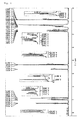
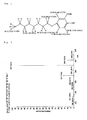
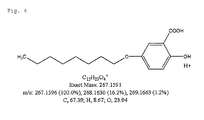
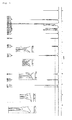
- Fig. 5 is a H NMR spectrum and Fig. 6 shows the result of proton assignment.
- a hydrophobic peptide (Humanin) was analyzed using the compound 3 (C8-ADHB) as an additive added to a matrix ⁇ -cyano-4-hydroxycinnamic acid (CHCA, hereinafter, also referred to as "4-CHCA").
- CHCA matrix ⁇ -cyano-4-hydroxycinnamic acid
- 4-CHCA matrix ⁇ -cyano-4-hydroxycinnamic acid
- hydrophobic peptides were analyzed using the compound 3 (C8-ADHB) as an additive added to a matrix ⁇ -cyano-4-hydroxycinnamic acid (CHCA).
- CHCA matrix ⁇ -cyano-4-hydroxycinnamic acid
- the hydrophobic peptides were analyzed using a conventional matrix ⁇ -cyano-4-hydroxycinnamic acid (CHCA) alone without using the additive.
- a 10 mg/mL 4-CHCA (Laser Bio) solution (50% ACN/0.05% TFA water) was prepared.
- sample solutions 20 amol/ ⁇ L to 2 pmol/ ⁇ L solutions (50% ACN/0.05 TFA water) of each of the hydrophobic peptides, ⁇ -amyloid 1-42, NF- ⁇ B Inhibitor, and [Gly14]-Humanin were prepared.
- sample solutions 20 amol/ ⁇ L to 2 pmol/ ⁇ L solutions (50% ACN/0.05 TFA water) of each of the hydrophobic peptides, ⁇ -amyloid 1-42, NF- ⁇ B Inhibitor, and [Gly14]-Humanin were prepared.
- 0.5 ⁇ L of each of the sample solutions prepared in (2) and 0.5 ⁇ L of the matrix solution prepared in (1) were dropped into an individual well on a MALDI plate and mixed (on-target mix).
- hydrophobic peptides were analyzed using the compound 3 (C8-ADHB) as an additive added to a matrix 2,5-dihydroxybenzoic acid (DHB). More specifically, analysis was performed in the same manner as in the above 3-1 except that the matrix was changed to DHB.
- hydrophobic peptides were analyzed using a conventional matrix 2, 5-dihydroxybenzoic acid (DHB) alone without using the additive. More specifically, analysis was performed in the same manner as in comparative example in the above 3-1 except that the matrix was changed to DHB.
- DHB 5-dihydroxybenzoic acid
- MALDI-TOF mass spectrometry was performed using a compound represented by the formula (I), where R has 4, 6, or 10 carbon atoms and the substituted carboxyl group and hydroxyl group are ortho to each other, in the same manner as in Example 2 to examine the influence of the chain length of the hydrophobic group R on sensitivity-improving effect.
- MALDI-TOF mass spectrometry was performed using, as the additive according to the present invention, a compound represented by the formula (I) where R has 8 carbon atoms and the substituted carboxyl group and hydroxyl group are ortho to each other, that is, the compound 3 (o-C8-ADHB) or a compound represented by the formula (I) where R has 8 carbon atoms and the substituted carboxyl group and hydroxyl group are meta to each other (m-C8-ADHB) in the same manner as in Example 2 to examine the influence of positional isomerism (ortho and meta) on sensitivity-improving effect.
- TABLE 5 limit of detection [fmol/well] Humanin pos neg m -C8-ADHB+4-CHCA 10 100 o -C8-ADHB+4-CHCA 0.1 1 4-CHCA 10 100
- Table 5 shows a comparison between the result of mass spectrometry using a matrix for mass spectrometry CHCA ( ⁇ -cyano-4-hydroxycinnamic acid) and the additive in combination and the result of mass spectrometry without using the additive.
- sensitivity-improving effect that is, detection limit-lowering effect was obtained when the ortho-substituted additive (o-C8-ADHB) was used.
- the additive according to the present invention had sensitivity-improving effect (i.e., detection limit-lowering effect) and/or S/N ratio-improving effect.
- CHCA ⁇ -cyano-4-hydroxycinnamic acid
- the mixture was analyzed using a conventional matrix ⁇ -cyano-4-hydroxycinnamic acid (CHCA) alone without using the additive.
- CHCA matrix ⁇ -cyano-4-hydroxycinnamic acid
- Fig. 7 shows the results of analysis of the 1 : 1 mixture of a 20 fmol/ ⁇ L solution of a hydrophilic peptide ⁇ -amyloid 1-11 and a 20 fmol/ ⁇ L solution of a hydrophobic peptide Humanin (i.e., the results of analysis of a mixture of 10 fmol of the hydrophilic peptide and 10 fmol of the hydrophobic peptide placed on the MALDI plate). More specifically, Fig. 7 (a) is a positive mode mass spectrum obtained using the additive-containing matrix (4-CHCA + ADHB) and Fig. 7 (b) is a positive mode mass spectrum obtained using the matrix (4-CHCA) alone.
- the hydrophilic peptide ⁇ -amyloid 1-11 was detected as a main peak, and the relative intensity of the peak of the hydrophobic peptide Humanin to that of the hydrophilic peptide was significantly low.
- the hydrophobic peptide Humanin was detected as a main peak, and the relative intensity of the peak of the hydrophilic peptide ⁇ -amyloid 1-11 to that of the hydrophobic peptide was significantly low.
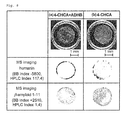
- Fig. 8 shows a photograph of a crystal in a well on the MALDI plate, an MS image of the hydrophobic peptide Humanin analyzed in positive mode, and an MS image of the hydrophilic peptide ⁇ -amyloid 1-11 analyzed in positive mode, which were obtained when the additive-containing matrix 4-CHCA + ADHB was used (a) and those obtained when the matrix 4-CHCA was used alone (b).
- the hydrophilic peptide ⁇ -amyloid 1-11 was detected mainly in the inner region of the crystal and the hydrophobic peptide Humanin was detected mainly in the outer peripheral region of the crystal.
- the matrix 4-CHCA was used alone, both the hydrophilic peptide and the hydrophobic peptide were detected in the entire region of the crystal.
- the presence of the additive has caused the localization of the hydrophobic peptide in the outer peripheral region in the process of sample-matrix crystallization.
- the enrichment effect of the hydrophobic peptide due to localization can be regarded as one of the possible causes of improved sensitivity for detection of the hydrophobic peptide in this example.
- the tryptic digest was analyzed using a conventional matrix ⁇ -cyano-4-hydroxycinnamic acid (4-CHCA) alone without using the additive.
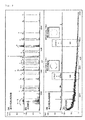
- Fig. 9(a) is a mass spectrum of the tryptic digest of Phosphorylase b, which was obtained when the additive-containing matrix 4-CHCA + ADHB was used and Fig. 9 (b) is a mass spectrum of the tryptic digest of Phosphorylase b, which was obtained when the matrix 4-CHCA was used alone.
- An asterisk besides an ion peak indicates that the ion peak is derived from a peptide fragment of the tryptic digest of Phosphorylase b.
- ND indicates that no ions could be detected.
- Fig. 9 the same ions were detected in the range of m/z 2500 or less in both cases where 4-CHCA + ADHB was used and where 4-CHCA was used, but in the range of m/z 2600 or more, peak intensities derived from peptide fragments were particularly high when ADHB was used. More specifically, ion peaks at m/z 3715.2 and m/z 4899.3 were detected only when C8-ADHB was used. In Fig. 9 , MS images of peak substances at m/z 3715.2 and m/z 4899.3 are inserted.
- sequence coverage of the tryptic digest of Phosphorylase b was increased by about 10% when 4-CHCA + ADHB was used as compared to when 4-CHCA was used alone.
- HPLC Index -60.2 to 200.0
- C8-ADHB compound 3
- CHCA matrix ⁇ -cyano-4-hydroxycinnamic acid
- Fig. 10 shows the HPLC Index and name of each of the analytes, the sensitivity improvement degree (rate) when 4-CHCA + ADHB was used (a) as compared to when the conventional matrix ⁇ -cyano-4-hydroxycinnamic acid (4-CHCA) was used alone (b), and positive mode MS images of each of the analytes obtained when 4-CHCA + ADHB was used (a) and when 4-CHCA was used alone (b).
- the MS images were created based on the relative intensities of [M+H] + ion peaks of the analytes.
- the additive C8-ADHB had sensitivity-improving effect mainly on the hydrophobic peptides having an HPLC Index of 100 or more among the 14 kinds of peptides. Further, it was confirmed from the MS images obtained when 4-CHCA + ADHB was used that all the peptides having an HPLC Index of 100 or more were detected in the outer peripheral region of a sample-matrix crystal. As in the cases of Example 6 shown in Fig. 8 and Example 7 shown in Fig. 9 , the enrichment effect of the peptide fragments due to localization in the outer peripheral region of a sample-matrix crystal can be regarded as one of the possible causes of improved sensitivity for detection of the peptide fragments.
Landscapes
- Life Sciences & Earth Sciences (AREA)
- Physics & Mathematics (AREA)
- Engineering & Computer Science (AREA)
- Health & Medical Sciences (AREA)
- Chemical & Material Sciences (AREA)
- Molecular Biology (AREA)
- Analytical Chemistry (AREA)
- Biomedical Technology (AREA)
- Optics & Photonics (AREA)
- Bioinformatics & Computational Biology (AREA)
- Urology & Nephrology (AREA)
- Immunology (AREA)
- Hematology (AREA)
- Bioinformatics & Cheminformatics (AREA)
- Proteomics, Peptides & Aminoacids (AREA)
- Food Science & Technology (AREA)
- Cell Biology (AREA)
- Biophysics (AREA)
- Spectroscopy & Molecular Physics (AREA)
- Microbiology (AREA)
- Plasma & Fusion (AREA)
- Biotechnology (AREA)
- Medicinal Chemistry (AREA)
- Biochemistry (AREA)
- General Health & Medical Sciences (AREA)
- General Physics & Mathematics (AREA)
- Pathology (AREA)
- Other Investigation Or Analysis Of Materials By Electrical Means (AREA)
Applications Claiming Priority (2)
| Application Number | Priority Date | Filing Date | Title |
|---|---|---|---|
| JP2011196776 | 2011-09-09 | ||
| JP2012076289A JP2013068598A (ja) | 2011-09-09 | 2012-03-29 | 質量分析用マトリックスの添加剤 |
Publications (2)
| Publication Number | Publication Date |
|---|---|
| EP2568293A1 true EP2568293A1 (de) | 2013-03-13 |
| EP2568293A8 EP2568293A8 (de) | 2013-05-08 |
Family
ID=47022458
Family Applications (1)
| Application Number | Title | Priority Date | Filing Date |
|---|---|---|---|
| EP12181017A Withdrawn EP2568293A1 (de) | 2011-09-09 | 2012-08-20 | Matrixzusatz für Massenspektrometrie |
Country Status (3)
| Country | Link |
|---|---|
| US (2) | US20130062570A1 (de) |
| EP (1) | EP2568293A1 (de) |
| JP (1) | JP2013068598A (de) |
Families Citing this family (4)
| Publication number | Priority date | Publication date | Assignee | Title |
|---|---|---|---|---|
| WO2014136779A1 (ja) * | 2013-03-08 | 2014-09-12 | 株式会社 島津製作所 | マトリックスを用いる質量分析法 |
| US9885725B2 (en) | 2014-03-27 | 2018-02-06 | Shimadzu Corporation | MALDI analysis of hydrophobic compounds using 2(3),5-dihydoxybenzoate with a long alkyl chain as an additive to MALDI matrix |
| WO2019202872A1 (ja) * | 2018-04-16 | 2019-10-24 | 株式会社島津製作所 | 質量分析用キット、微生物識別用キット、試料の調製方法、分析方法および微生物の識別方法 |
| US10481163B1 (en) * | 2018-05-31 | 2019-11-19 | Shimadzu Corporation | Mass spectrometry method using mixed matrix |
Citations (5)
| Publication number | Priority date | Publication date | Assignee | Title |
|---|---|---|---|---|
| US5667789A (en) * | 1994-11-03 | 1997-09-16 | L'oreal | Salicylic acid derivative as a stabilizer for an oil-in-water emulsion |
| WO2002097393A2 (en) * | 2001-05-29 | 2002-12-05 | Vanderbilt University | Cleavable surfactants and methods of use thereof |
| US20040142487A1 (en) * | 2003-01-13 | 2004-07-22 | Tianxin Wang | Methods and compositions for mass spectrometry analysis |
| US20050224710A1 (en) * | 2004-04-13 | 2005-10-13 | Eiichi Matsuo | Method for measuring hydrophobic peptides using maldi mass spectrometer |
| JP2005326391A (ja) | 2004-04-13 | 2005-11-24 | Shimadzu Corp | Maldi質量分析装置による疎水性ペプチドの測定方法 |
-
2012
- 2012-03-29 JP JP2012076289A patent/JP2013068598A/ja active Pending
- 2012-08-20 EP EP12181017A patent/EP2568293A1/de not_active Withdrawn
- 2012-08-25 US US13/594,789 patent/US20130062570A1/en not_active Abandoned
-
2013
- 2013-11-15 US US14/082,023 patent/US20140084152A1/en not_active Abandoned
Patent Citations (5)
| Publication number | Priority date | Publication date | Assignee | Title |
|---|---|---|---|---|
| US5667789A (en) * | 1994-11-03 | 1997-09-16 | L'oreal | Salicylic acid derivative as a stabilizer for an oil-in-water emulsion |
| WO2002097393A2 (en) * | 2001-05-29 | 2002-12-05 | Vanderbilt University | Cleavable surfactants and methods of use thereof |
| US20040142487A1 (en) * | 2003-01-13 | 2004-07-22 | Tianxin Wang | Methods and compositions for mass spectrometry analysis |
| US20050224710A1 (en) * | 2004-04-13 | 2005-10-13 | Eiichi Matsuo | Method for measuring hydrophobic peptides using maldi mass spectrometer |
| JP2005326391A (ja) | 2004-04-13 | 2005-11-24 | Shimadzu Corp | Maldi質量分析装置による疎水性ペプチドの測定方法 |
Non-Patent Citations (2)
| Title |
|---|
| C.A. BROWNE; H.P.J. BENNETT; S. SOLOMON, ANALYTICAL BIOCHEMISTRY, vol. 124, 1982, pages 201 - 208 |
| FUKUYAMA Y ET AL: "Alkylated dihydroxybenzoic acid as a MALDI matrix additive for hydrophobic peptide analysis", ANALYTICAL CHEMISTRY, vol. 84, no. 9, 1 May 2012 (2012-05-01), pages 4237 - 4243, XP055048250, DOI: 10.1021/AC300540R * |
Also Published As
| Publication number | Publication date |
|---|---|
| EP2568293A8 (de) | 2013-05-08 |
| JP2013068598A (ja) | 2013-04-18 |
| US20130062570A1 (en) | 2013-03-14 |
| US20140084152A1 (en) | 2014-03-27 |
Similar Documents
| Publication | Publication Date | Title |
|---|---|---|
| Griffiths et al. | Electrospray and tandem mass spectrometry in biochemistry | |
| Samyn et al. | A case study of de novo sequence analysis of N-sulfonated peptides by MALDI TOF/TOF mass spectrometry | |
| EP2568293A1 (de) | Matrixzusatz für Massenspektrometrie | |
| WO2012058248A2 (en) | Systems and methods extending the laserspray ionization mass spectrometry concept from atmospheric pressure to vacuum | |
| Yoo et al. | Toward top-down determination of PEGylation site using MALDI in-source decay MS analysis | |
| US11408897B2 (en) | Mass defect-based multiplex dimethyl pyrimidinyl ornithine (DiPyrO) tags for high-throughput quantitative proteomics and peptidomics | |
| US20050224710A1 (en) | Method for measuring hydrophobic peptides using maldi mass spectrometer | |
| US10386372B1 (en) | Materials and methods for screening topoisomers | |
| US10481163B1 (en) | Mass spectrometry method using mixed matrix | |
| Kinumi et al. | Phosphopeptide sequencing by in-source decay spectrum in delayed extraction matrix-assisted laser desorption ionization time-of-flight mass spectrometry | |
| Petre et al. | Structural characterisation of tyrosine-nitrated peptides by ultraviolet and infrared matrix-assisted laser desorption/ionisation Fourier transform ion cyclotron resonance mass spectrometry | |
| Neubert et al. | MALDI post-source decay and LIFT-TOF/TOF investigation of α-cyano-4-hydroxycinnamic acid cluster interferences | |
| Matthiesen et al. | Introduction to proteomics | |
| JP6083595B2 (ja) | タンパク質とリン酸化ペプチドのペプチド主鎖のN−Cα結合又はCα−C結合の特異的切断方法 | |
| Baker et al. | Tandem mass spectrometry of model peptides modified with trans-2-hexenal, a product of lipid peroxidation | |
| US9885725B2 (en) | MALDI analysis of hydrophobic compounds using 2(3),5-dihydoxybenzoate with a long alkyl chain as an additive to MALDI matrix | |
| EP2950092B1 (de) | Massenspektrometrisches verfahren mittels matrix | |
| Horn et al. | Improved protein identification using automated high mass measurement accuracy MALDI FT-ICR MS peptide mass fingerprinting | |
| JP5727407B2 (ja) | 質量分析用マトリックスの添加剤 | |
| JP6135814B2 (ja) | 親水性チオールプローブ | |
| Zhou et al. | A binary matrix for improved detection of phosphopeptides in matrix‐assisted laser desorption/ionization mass spectrometry | |
| Kitanaka et al. | N-Terminal derivatization with structures having high proton affinity for discrimination between Leu and Ile residues in peptides by high-energy collision-induced dissociation | |
| JP6478048B2 (ja) | 混合マトリックスを用いる質量分析法 | |
| Sachon et al. | In-source fragmentation of very labile peptides in matrix-assisted laser desorption/ionization time-of-flight mass spectrometry | |
| 藤嶽美穂代 et al. | Accurate Molecular Weight Measurements of Cystine Derivatives on FAB-MS |
Legal Events
| Date | Code | Title | Description |
|---|---|---|---|
| PUAI | Public reference made under article 153(3) epc to a published international application that has entered the european phase |
Free format text: ORIGINAL CODE: 0009012 |
|
| AK | Designated contracting states |
Kind code of ref document: A1 Designated state(s): AL AT BE BG CH CY CZ DE DK EE ES FI FR GB GR HR HU IE IS IT LI LT LU LV MC MK MT NL NO PL PT RO RS SE SI SK SM TR |
|
| AX | Request for extension of the european patent |
Extension state: BA ME |
|
| RAP1 | Party data changed (applicant data changed or rights of an application transferred) |
Owner name: HIROSHIMA UNIVERSITY Owner name: SHIMADZU CORPORATION |
|
| 17P | Request for examination filed |
Effective date: 20130829 |
|
| RBV | Designated contracting states (corrected) |
Designated state(s): AL AT BE BG CH CY CZ DE DK EE ES FI FR GB GR HR HU IE IS IT LI LT LU LV MC MK MT NL NO PL PT RO RS SE SI SK SM TR |
|
| 17Q | First examination report despatched |
Effective date: 20140710 |
|
| STAA | Information on the status of an ep patent application or granted ep patent |
Free format text: STATUS: THE APPLICATION IS DEEMED TO BE WITHDRAWN |
|
| 18D | Application deemed to be withdrawn |
Effective date: 20141121 |