EP2568341A2 - Appareil de formation d'images - Google Patents
Appareil de formation d'images Download PDFInfo
- Publication number
- EP2568341A2 EP2568341A2 EP12183077A EP12183077A EP2568341A2 EP 2568341 A2 EP2568341 A2 EP 2568341A2 EP 12183077 A EP12183077 A EP 12183077A EP 12183077 A EP12183077 A EP 12183077A EP 2568341 A2 EP2568341 A2 EP 2568341A2
- Authority
- EP
- European Patent Office
- Prior art keywords
- charging
- voltage
- image forming
- members
- photosensitive
- Prior art date
- Legal status (The legal status is an assumption and is not a legal conclusion. Google has not performed a legal analysis and makes no representation as to the accuracy of the status listed.)
- Withdrawn
Links
- 238000001514 detection method Methods 0.000 claims abstract description 7
- 238000005755 formation reaction Methods 0.000 claims description 65
- 230000015572 biosynthetic process Effects 0.000 claims description 60
- 230000001186 cumulative effect Effects 0.000 claims description 10
- 238000005259 measurement Methods 0.000 claims description 5
- 238000012546 transfer Methods 0.000 description 69
- 238000000034 method Methods 0.000 description 34
- 239000000463 material Substances 0.000 description 30
- 239000010410 layer Substances 0.000 description 23
- 230000008569 process Effects 0.000 description 21
- 238000007790 scraping Methods 0.000 description 20
- 238000002360 preparation method Methods 0.000 description 14
- 238000007599 discharging Methods 0.000 description 13
- 238000004140 cleaning Methods 0.000 description 12
- 230000006870 function Effects 0.000 description 11
- 230000001955 cumulated effect Effects 0.000 description 7
- 230000007547 defect Effects 0.000 description 7
- 230000003321 amplification Effects 0.000 description 5
- 238000003199 nucleic acid amplification method Methods 0.000 description 5
- 230000008859 change Effects 0.000 description 4
- 230000004044 response Effects 0.000 description 4
- 239000002344 surface layer Substances 0.000 description 4
- OKTJSMMVPCPJKN-UHFFFAOYSA-N Carbon Chemical compound [C] OKTJSMMVPCPJKN-UHFFFAOYSA-N 0.000 description 3
- 229910052799 carbon Inorganic materials 0.000 description 3
- 230000000694 effects Effects 0.000 description 3
- 238000002347 injection Methods 0.000 description 3
- 239000007924 injection Substances 0.000 description 3
- 230000001737 promoting effect Effects 0.000 description 3
- CBENFWSGALASAD-UHFFFAOYSA-N Ozone Chemical compound [O-][O+]=O CBENFWSGALASAD-UHFFFAOYSA-N 0.000 description 2
- 238000013459 approach Methods 0.000 description 2
- 230000007423 decrease Effects 0.000 description 2
- 238000011161 development Methods 0.000 description 2
- 230000005684 electric field Effects 0.000 description 2
- 229910052751 metal Inorganic materials 0.000 description 2
- 239000002184 metal Substances 0.000 description 2
- 230000003746 surface roughness Effects 0.000 description 2
- 229920002943 EPDM rubber Polymers 0.000 description 1
- 229910052782 aluminium Inorganic materials 0.000 description 1
- XAGFODPZIPBFFR-UHFFFAOYSA-N aluminium Chemical compound [Al] XAGFODPZIPBFFR-UHFFFAOYSA-N 0.000 description 1
- 229910021417 amorphous silicon Inorganic materials 0.000 description 1
- 230000003247 decreasing effect Effects 0.000 description 1
- 230000008021 deposition Effects 0.000 description 1
- 230000006866 deterioration Effects 0.000 description 1
- 238000010586 diagram Methods 0.000 description 1
- 229920001971 elastomer Polymers 0.000 description 1
- 238000002474 experimental method Methods 0.000 description 1
- 150000002222 fluorine compounds Chemical class 0.000 description 1
- 239000006260 foam Substances 0.000 description 1
- 238000011835 investigation Methods 0.000 description 1
- 230000007774 longterm Effects 0.000 description 1
- 230000014759 maintenance of location Effects 0.000 description 1
- 238000004519 manufacturing process Methods 0.000 description 1
- 238000012986 modification Methods 0.000 description 1
- 230000004048 modification Effects 0.000 description 1
- 238000003825 pressing Methods 0.000 description 1
- 230000009467 reduction Effects 0.000 description 1
- 238000009877 rendering Methods 0.000 description 1
- 239000011347 resin Substances 0.000 description 1
- 229920005989 resin Polymers 0.000 description 1
- 229910001220 stainless steel Inorganic materials 0.000 description 1
- 239000010935 stainless steel Substances 0.000 description 1
- 239000004753 textile Substances 0.000 description 1
- XOLBLPGZBRYERU-UHFFFAOYSA-N tin dioxide Chemical compound O=[Sn]=O XOLBLPGZBRYERU-UHFFFAOYSA-N 0.000 description 1
- 229910001887 tin oxide Inorganic materials 0.000 description 1
- 238000010792 warming Methods 0.000 description 1
Images







Classifications
-
- G—PHYSICS
- G03—PHOTOGRAPHY; CINEMATOGRAPHY; ANALOGOUS TECHNIQUES USING WAVES OTHER THAN OPTICAL WAVES; ELECTROGRAPHY; HOLOGRAPHY
- G03G—ELECTROGRAPHY; ELECTROPHOTOGRAPHY; MAGNETOGRAPHY
- G03G15/00—Apparatus for electrographic processes using a charge pattern
- G03G15/02—Apparatus for electrographic processes using a charge pattern for laying down a uniform charge, e.g. for sensitising; Corona discharge devices
- G03G15/0266—Arrangements for controlling the amount of charge
Definitions
- the present invention relates to an image forming apparatus such as an electrophotographic type copying machine, printer or facsimile machine.
- a tandem type electrophotographic type image forming apparatus in which image forming stations having respective photosensitive members are arranged in line along a moving direction of a recording material carrying member or an intermediary transfer member.
- the image forming stations of the tandem type image forming apparatus include yellow, magenta, cyan and black image forming stations, for example, toner images formed on the photosensitive members of the image forming stations are sequentially transferred onto the recording material or an intermediary transfer member carried on the recording material carrying member, supperimposedly.
- the surface of the photosensitive member is charged uniformly, and thereafter, it is exposed to light in accordance with image information so that an electrostatic latent image is formed on the photosensitive member.
- the electrostatic latent image is developed with toner into a toner image on the photosensitive member.
- non-contact charging devices such as a corotron or scorotron.
- a non-contact type or proximity type such as or a charging roller a charging brush to which a voltage is applied, the charging roller and the charging brush being disposed in proximity with and in contact with the surface of the photosensitive member.
- the contact charging device is advantageous over the non-contact type charging device in that the voltage of the voltage source can be reduced and in that the generation amount of the ozone is small.
- the charging voltage readily changes by variation of the properties of the charging member or by change in the temperature and/or humidity.
- an AC charging type is used in which an oscillating voltage having a DC voltage (charging DC voltage) component and an AC voltage component (charging AC voltage) is applied to the charging member.
- the charging AC voltage charging AC voltage
- the photosensitive member is not charged up to a desired potential or the charging of the photosensitive member is not uniform with the result that sandpaper like background or foggy background (deposition of the toner on the non-image portion on which the toner is not to be deposited) is produced.
- the charging AC voltage is too high, the wearing (scraping) of the photosensitive member is promoted with the result of less durability.
- the AC charging type charging device does not work with the charging AC voltage not higher than the minimum level.
- the minimum charging AC voltage is substantially twice the voltage (discharge starting voltage) at which the discharge starts between the charging member and the photosensitive member when only a DC voltage is applied to the charging member and is gradually increased (Japanese Laid-open Patent Application Sho 63-149668 ).
- the minimum charging AC voltage changes with the property difference, among individuals, of the charging member, the photosensitive member, the voltage source circuit or the like, and with ambient condition change and elapse time. It is known that a discharge current flowing into the photosensitive member from the charging member to contribute the charging of the photosensitive member is determined, and the control is carried out to maintain the discharge current constant (discharge current control) (Japanese Laid-open Patent Application 2001-201921 ). A function of the flowing AC current relative to the applied charging AC voltage in the uncharging region is determined. In addition, a function of the flowing AC current relative to an applied charging AC voltage in the discharge range is determined. The discharge current is calculated as a difference between the functions to determine the required charging AC voltage or AC current thereby to control the charging bias voltage.
- the tandem type image forming apparatus if the image forming stations are provided with respective AC voltage sources to apply the charging AC voltages within the proper ranges to the charging members of the image forming stations, respectively, the number of the voltage sources is large. If the number of the voltage sources increases, the device is upsized, and the weight thereof increases with the result of cost increase.
- commonality of the voltage source for the image forming stations is desired.
- Single commonality of the voltage source however, the same charging AC voltages are applied to the image forming stations, and therefore, when is charging AC voltages within the proper ranges are different depending on the image forming stations, one or some of the image forming stations are not supplied with the proper charging AC voltages.
- an optimum charging AC voltage for the yellow image forming station is 1800 Vpp - 1850 Vpp
- an optimum charging AC voltage for the magenta image forming station is 2100 Vpp - 2150 Vpp
- a charging AC voltage having 2000 Vpp is commonly applied to the yellow image forming station and the magenta image forming station
- the wearing (scraping) of the photosensitive member is promoted in the yellow image forming station with the result of shortened lifetime of the photosensitive member.
- charging non-uniformity of the photosensitive member occurs in the magenta image forming station with the result of image defect such as the fog.
- an image forming apparatus comprising a plurality of photosensitive members; a plurality of charging members, provided for said photosensitive members, respectively, for electrically charging said photosensitive members by being supplied with charging voltages each comprising a component of an DC voltage and a component of an AC voltage; an AC voltage source for outputting an AC voltage commonly applied to at least two of said charging members; control means for controlling the AC voltages applied to said at least two charging members; variable resisters connected between said AC voltage source and said at least two charging members, respectively; use situation detecting means for detecting use situations of said photosensitive members, respectively; and adjusting means for adjusting electric resistances of said variable resisters, respectively, wherein said adjusting means adjusts the electric resistances of said variable resisters in accordance with the detection results of said use situation detecting means such that the discharge currents applied to said at least two charging members are within predetermined ranges, respectively.
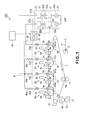
- Figure 1 is a schematic illustration of an image forming apparatus according to an embodiment of the present invention.
- Figure 2 is a schematic sectional view illustrating detailed structure around a charging roller of the image forming apparatus according to the embodiment of the present invention.
- Figure 3 is an operation sequence diagram of the image forming apparatus according to the embodiment of the present invention.
- Figure 4 is an illustration of a control method for a charging AC voltage of the image forming apparatus according to the embodiment of the present invention.
- Figure 5 is a graph of an example of Vpp-Iac in a color image formation portion when a fresh photosensitive drum is used in the image forming apparatus according to the embodiment of the present invention.
- Figure 6 is a graph of an example of the Vpp-Iac of the color image formation portion with increase of the number of image formations in the image forming apparatus according to the embodiment of the present invention.
- Figure 7 is a graph of an example of Vpp-Iac illustrating a principle of a control for the charging AC voltage in the image forming apparatus according to the embodiment of the present invention.
- Figure 8 is a graph of a relationship between a discharge current and a scraping amount of the photosensitive drum in an image forming apparatus according to an embodiment of the present invention.
- Figure 9 is a flow chart showing a process of the control method for the charging AC voltage in the image forming apparatus according to the embodiment of the present invention.
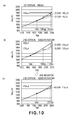
- Figure 10 is a graph showing an example of Vpp-Iac illustrating a principle of the control for the charging AC voltage in the image forming apparatus according to another embodiment of the present invention.
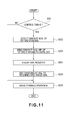
- Figure 11 is a flow chart showing a process of the control method for the charging AC voltage in the image forming apparatus according to another embodiment of the present invention.
- Figure 12 is a graph showing an example of Vpp-Iac illustrating a principle of the control for the charging AC voltage in the image forming apparatus according to a further embodiment of the present invention.
- Figure 13 is a flow chart showing a process of the control method for the charging AC voltage in the image forming apparatus according to a further embodiment of the present invention.
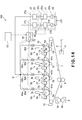
- Figure 14 is a schematic illustration of an image forming apparatus according to a further embodiment of the present invention.
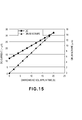
- Figure 15 is a graph of a relation between a charging AC voltage application time and the scraping amount of the photosensitive drum, and a relation between the charging AC voltage application time and a charging DC current, in an image forming apparatus according to a further embodiment of the present invention.
- Figure 16 is a flow chart showing a process of the control method for the charging AC voltage in the image forming apparatus according to a further embodiment of the present invention.
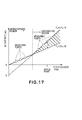
- Figure 17 is an illustration of a control method for the charging AC voltage in an image forming apparatus according to a further embodiment of the present invention.
- Figure 18 is an illustration of a control method for the charging AC voltage in an image forming apparatus according to a further embodiment of the present invention.
- Figure 19 is a graph of an example of Vpp-Iac in the color image formation portion of the image forming apparatus according to a further embodiment of the present invention.
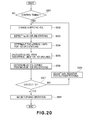
- Figure 20 is a flow chart showing a process of the control method for the charging AC voltage in the image forming apparatus according to a further embodiment of the present invention.
- Figure 1 show a general arrangement of an image forming apparatus 100 according to Embodiment 1 of the present invention.
- the image forming apparatus 100 according to this embodiment is a tandem type full-color image forming apparatus using an electrophotographic system.
- the image forming apparatus 100 comprises a plurality of image forming stations, namely, first, second, third and fourth image forming stations Sa, Sb, Sc, Sd for forming yellow (Y), magenta (M), cyan (C) and black (Bk) images.
- image forming stations Sa, Sb, Sc, Sd are arranged in line at constant intervals along a moving direction of an image carrying surface of an intermediary transfer member as a transfer member which will be described hereinafter in detail.
- a voltage source is common for the first, second and third image forming stations Sa, Sb, Sc to apply the voltages to the charging members therein.
- the structures and operations of the first, second, third and fourth image forming stations Sa, Sb, Sc, Sd are substantially the same except for the developers therein. Therefore, unless reference is to be made to particular ones, the suffixes a, b, c and d are omitted to indicate that reference is made to each of the elements of any of the image forming stations.
- the image forming station S includes a drum type electrophotographic photosensitive member (photosensitive member), that is, photosensitive drum 1 as an image bearing member.
- photosensitive member photosensitive member
- the first one is a roller type charging member, that is, a charging roller 2 as a contact type charging means.
- the second is an exposure device (laser scanner) 3 as exposure means.
- the third is a developing device 4 as developing means.
- the fourth is a primary transfer roller 5 which is a roller type primary transfer member as primary transferring means.
- the fifth is a drum cleaning device 6 as photosensitive member cleaning means.
- the charging roller 2 rotates in contact with the surface of the photosensitive drum1.
- the developing devices 4a, 4b, 4c, 4d accommodate yellow toner, magenta toner, cyan toner and black toner, respectively.
- the drum cleaning device 6 includes a cleaning blade as a cleaning member, and the cleaning blade contacts the photosensitive drum 1 to scrape the toner off the surface of the rotating photosensitive drum1.
- the apparatus further comprises an intermediary transfer belt 7 in the form of an endless belt as an intermediary transfer member which is opposed to the photosensitive drum 1 in the image forming station S.
- the intermediary transfer belt 7 is stretched around a plurality of rollers with a predetermined tension.
- the primary transfer roller 5 is opposed to the photosensitive drum 1 of the image forming station S in the inside of the intermediary transfer belt7.
- the primary transfer roller 5 is urged toward the photosensitive drum 1 with the intermediary transfer belt 7 therebetween to constitute a primary transfer portion (primary transfer nip) N1 where the photosensitive drum 1 and the intermediary transfer belt 7 are contacted with each other.
- a secondary transfer roller 8 which is a roller type secondary transfer member as secondary transferring means is provided at a position opposed to one of the rollers supporting the intermediary transfer belt7.
- the secondary transfer roller 8 is urged toward said one of the rollers with the intermediary transfer belt 7 interposed therebetween to constitute a secondary transfer portion the secondary transfer nip) N2 where said secondary transfer roller 8 and said intermediary transfer belt 7 are contacted with each other.
- Image forming operations will be described with an example in which a full-color image is formed on a recording material P.
- the photosensitive drum 1 is charged uniformly by the charging roller2.
- the charging voltage applying means will be described hereinafter.
- the surface of the charged photosensitive drum 1 is exposed to scanning light in accordance with image information by an exposure device3.
- an electrostatic latent image (electrostatic image) is formed on the photosensitive drum1.
- the electrostatic latent image formed on the photosensitive drum 1 is developed with the toner by the developing device4.
- a toner image is formed on the photosensitive drum1.
- the toner image is formed by the image exposure and a reverse development.
- the photosensitive drum 1 is charged uniformly and is exposed by the exposure device 3 to decrease in the absolute value of the potential at an image portion, to which the toner charged to the polarity the same as the charge polarity of the photosensitive drum 1 (negative polarity, in this embodiment) is deposited.
- the color toner images thus formed on the photosensitive drum 1 of the image forming stations S are transferred (primary transfer) sequentially and imposedly onto the intermediary transfer belt 7 by the primary transfer rollers 5 in the primary transfer portions N1.
- the primary transfer roller 5 is supplied with a primary transfer voltage (primary transfer bias) of the polarity opposite to the regular charge polarity (negative in this embodiment) of the toner from a primary transfer voltage source (unshown) as a primary transfer voltage applying means.
- the toner images transferred onto the intermediary transfer belt is transferred (secondary transfer) onto the recording material P by the function of the secondary transfer roller 8 in the secondary transfer portion N2.
- the secondary transfer roller 8 is supplied with the secondary transfer voltage (secondary transfer bias voltage) of the polarity opposite to the regular charge polarity (negative in this embodiment) of the toner from a secondary transfer voltage source (unshown) as secondary transfer voltage applying means.
- the recording material P is fed from a recording material accommodating cassette (unshown) or the like to the secondary transfer portion N2 by a supplying roller 11 or the like.
- the recording material P having the transferred toner image is separated from the intermediary transfer belt 7 and is fed to a fixing device 9 as fixing means.
- the recording material P passes through a nip (fixing nip) between a fixing roller 9a and a pressing roller 9b of the fixing device 9, during which the toner image is heated and pressed thereby to be fixed. Thereafter, the recording material P is discharged to the outside of the image forming apparatus 100.
- the toner (primary-untransferred toner) remaining on the photosensitive drum 1 after the primary transfer step is removed from the photosensitive drum 1 and is collected by the drum cleaning device6.
- the residual toner (after-secondary-transfer) remaining on the intermediary transfer belt 7 after the secondary transfer step is removed and collected from the intermediary transfer belt 7 by a belt cleaning device 10 as intermediary transfer member cleaning means.
- the charging rollers 2 of the image forming stations S are supplied with charging voltages (charging bias voltages) from a charging voltage source circuit 20 as charging voltage applying means. By doing so, the surfaces of the photosensitive drums 1 are charged uniformly to predetermined potentials.
- the charging voltage source circuit 20 includes an AC voltage source portion 21, a DC voltage source portion 22 and a DC amplification portion 23. Using them, the charging voltage source circuit 20 generates an oscillating voltage which is in the form of superimposed DC voltage (charging DC voltage) and AC voltage (charging AC voltage), as the charging voltage to be applied to the charging rollers2.
- the charging voltage source circuit 20 includes respective voltage source circuit elements for the fourth image forming station Sd (black image forming station) and the color image formation portions Sa, Sb, Sc (first, second and third image forming stations).
- each of the DC voltage and the AC voltage are common to all of the color image formation portions Sa, Sb, Sc.
- a different DC voltage source and a different AC voltage source are provided for the black image forming station Sd.
- the charging rollers 2a, 2b, 2c of the color image formation portions Sa, Sb, Sc are supplied with the DC voltages from a first DC voltage source (DC voltage generating circuit) 26a in the DC voltage source portion 22.
- the value of the DC voltage value is adjusted by a first DC amplification circuit 27a in the DC amplification portion 23.
- the charging rollers 2a, 2b, 2c of the color image formation portions Sa, Sb, Sc are supplied with the AC voltage from a first AC voltage source (AC voltage generating circuit) 24a in the AC voltage source portion 21.
- the value of the AC voltage is adjusted by a first AC amplifying circuit 25 a in the AC voltage source portion 21.
- the charging roller 2d of the black image forming station Sd is supplied with the DC voltage from a second DC voltage source (DC voltage generating circuit) 26d in the DC voltage source portion 22.
- the value of the DC voltage value is adjusted by a second DC amplification circuit 27d in the DC amplification portion 23.
- the charging roller 2d of the black image forming station Sd is supplied with the AC voltage from the second AC voltage source (AC voltage generating circuit) 24d in the AC voltage source portion 21.
- the value of the AC voltage is adjusted by a second AC amplifying circuit 25d in the AC voltage source portion 21.
- Charging AC currents which are the values of the AC currents flowing into the charging rollers 2a, 2b, 2c, 2d are measured by AC current measuring devices 30a, 30b, 30c, 30d as AC current measuring means, respectively.
- a relationship between the applied charging AC voltage Vpp obtained by raising and dropping the charging AC voltage by the first and second AC amplifying circuits 25a, 25b and the measured charging AC current Iac is calculated by a control circuit 34. The relation is used in order to determine the charging AC voltage for providing the required discharge current.
- a frequency of an output of the AC voltage source portion 21 is 1.5 kHz.
- the charging DC voltage is approx. - 500V.
- a charged potential of the photosensitive drum 1 converges uniformly to the charging DC voltage substantially.
- the image forming apparatus 100 of this embodiment includes variable resisters 40a, 40b and 40c provided between the charging rollers 2a, 2b, 2c and a branch point of the current from the AC voltage source portion 21 to the charging rollers 2a, 2b, 2c of the third image forming stations Sa, Sb, Sc.
- the control circuit 34 controls the electric resistances of the variable resisters 40a, 40b, 40c.
- the electric resistance of the variable resister can be switched among 0 ⁇ , 1.0 ⁇ 10 ⁇ 5 ⁇ , 5.0 ⁇ 10 ⁇ 5 ⁇ , 1.0 ⁇ 10 ⁇ 6 ⁇ and 5.0 ⁇ 10 ⁇ 6 ⁇ .
- the photosensitive drum 1 includes an organic photosensitive member (OPC) having a negative charging property and having an outer diameter of 30 mm.
- OPC organic photosensitive member
- the photosensitive drum 1 is rotated in a direction indicated by the arrow (counterclockwise direction) in Figure 1 at a process speed of 210 mm/s (normal speed) by a driving device (unshown).
- the photosensitive drum 1 comprises an aluminum cylinder (electroconductive drum base member) 1p, and three layers therein including an undercoat layer 1q thereon for suppressing interference of the light and improving an adhesiveness with the upper layer, a photocharge generation layer 1r and a charge transfer layer 1s, in this order from the bottom.
- a thickness of the charge transfer layer is 28 ⁇ m, and when it is worn down to 13 ⁇ m, a problem or the like improper charging arises.
- a length of the charging roller 2 (rotational axis direction) is 320 mm.
- the charging roller 2 comprises a core metal (supporting member) 2p and there layers thereon including a lower layer 2q, the middle layer 2r and a surface layer 2s, in this order from the bottom.
- the lower layer 2q is a foam sponge layer effective to reduce charging noise
- the surface layer 2s is a protection layer for preventing current leakage which occurs if the photosensitive drum 1 has a pin hole or the like.
- the specifications of the charging roller 2 in this embodiment are as follows:
- Middle layer 2r carbon dispersed NBR rubber having a volume resistivity of 10 ⁇ 2 - 10 ⁇ 5 ⁇ cm and a layer thickness of 700 ⁇ m.
- Surface layer 2s tin oxide and carbon dispersed fluorine compound resin material having a volume resistivity of 10 ⁇ 7 - 10 ⁇ 10 ⁇ cm and a surface roughness (JIS 10 point average surface roughness Ra) of 1.5 ⁇ m and having a layer thickness of 10 ⁇ m.
- JIS 10 point average surface roughness Ra JIS 10 point average surface roughness
- the charging roller 2 is urged toward the center of the photosensitive drum 1 by an urging spring 2t as urging means to be press-contacted to the surface of the photosensitive drum 1 at a predetermined pressure.
- the charging roller 2 is rotated by the photosensitive drum1.
- a press-contact portion between the photosensitive drum 1 and the charging roller 2 is a charging nip.
- an overall volume resistivity of the charging roller 2 is 1.0 ⁇ 10 ⁇ 5 ⁇ cm.
- the charging member is not necessarily contacted to the surface of the photosensitive member. If only the dischargeable region determined by a voltage across the gap and a corrected Paschen curve is assured between the charging member and the photosensitive member, they may be spaced by several 10 ⁇ m, for example (non-contact proximity arrangement). Therefore, in this invention, the contact charging includes such proximity charging.
- Figure 3 shows an operational sequence of the image forming apparatus 100 in this embodiment.
- An initial rotating operation is carried out during a starting operation period (starting operation period or warming period) at the time of starting the image forming apparatus 100.
- starting operation period or warming period a starting operation period at the time of starting the image forming apparatus 100.
- the photosensitive drum 1 upon actuation of a main switch of the image forming apparatus 100, the photosensitive drum 1 is rotated, the fixing device 9 is heated to a predetermined temperature, and other predetermined preparing operations for the process means are executed.
- the rotating operation for the printing preparation is carried out after the input of a printing signal (image formation start signal) before the printing step (image forming process) is actually executed (preparation rotating operation period).
- the rotating operation for the printing preparation is carried out continuing from the initial rotating operation, when the printing signal is inputted during the initial rotating operation.
- the main motor is once stopped after completion of the initial rotating operation so that the rotation of the photosensitive drum 1 is stopped, and the image forming apparatus 100 is placed in a stand-by (waiting) state until the printing signal is inputted.
- the rotating operation for the printing preparation is carried out.
- the image formation process is carried out on the continuously rotating photosensitive drum 1, and the toner image formed on the surface of the rotating photosensitive drum is transferred to the recording material P, and the toner image is fixed by the fixing device9. Then, a print is discharged (printout) to the outside of the image forming apparatus 100.
- the printing step is carried out repetitively for the set number of image formations.
- This operation is carried out, in the case of the continuous printing operation, during the period after a trailing end of a recording material P passes through the transfer position (secondary transfer portion N2) and before a leading end of the next recording material P reaches the transfer position, that is, the recording material P is not present in the transfer position.
- the post-rotating operation is carried out after completion of the printing step on a single recording material P or after completion of the printing step on the final recording material P in the continuous printing.
- the main motor continues to drive to rotate while carrying out predetermined finishing operations (preparing operation for the next image forming operation) in such periods.
- the main motor is stopped to stop the rotation of the photosensitive drum 1, and the image forming apparatus 100 is placed in the stand-by state until the next printing signal is inputted.
- the post-rotating operation is carried out, and the image forming apparatus 100 is placed in the stand-by state.
- the stand-by state when the printing signal is inputted, the image forming apparatus 100 carries out the pre-rotation step.
- the printing step period in above section c is the image forming operation period, and the initial rotating operation period in above section a, the pre-rotating operation period in above section b, the sheet interval step period in the above section d and the post-rotating operation period are non-image-formation periods.
- control circuit 34 The operation of the image forming apparatus 100 in this embodiment is controlled as a whole by the control circuit 34 provided in the image forming apparatus 100.
- the control circuit 34 comprises a memory 60 as storing means for storing information, a CPU70 as control means for instructing various operations of the image forming apparatus 100.
- the image forming apparatus 100 includes a counter 50 as use situation detecting means for detecting use situation information of the photosensitive drum 1 of each of the image forming stations.
- the use situation information detected by the counter 50 is transmitted to the control circuit 34.
- the number of image formations which is interrelated with a use amount of the photosensitive drum 1 is detected as the use situation information.
- the counter 50 counts the print number while converting to the number of A4 size recording materials P oriented in the predetermined direction, and cumulates the counts.
- the use situation information is transmitted from the counter 50, and the information of the AC current flowing between the photosensitive drum 1 and the charging roller 2 from the current measuring device 30 is transmitted.
- the information is stored in the memory 60if necessary.
- the CPU70 controls various operations of the image forming apparatus 100 in accordance with the information stored in the memory 60.
- the charging AC current Iac which is a value of the AC current flowing by the application of the charging AC voltage has the following relationship relative to the charging AC voltage Vpp which is a value of the peak-to-peak voltage of the charging AC voltage. That is, the relationship is linear by the un-discharging range in which the voltage is less than twice the discharge starting voltage (Vthx2: discharge start point).
- Vthx2 discharge starting voltage
- the discharge starting voltage Vth is the voltage at which the discharge to the photosensitive member starts when a DC voltage is applied to the charging member.
- the charging AC current Iac gradually offsets toward an increasing side with increase of the charging AC voltage Vpp.
- the offset is the increment ⁇ Iac of the current contributing to the discharge.
- the minimum charging AC voltage is substantially twice the discharge starting voltage Vth. If the charging AC voltage is not more than the minimum level, the charging of the photosensitive drum 1 is non-uniform with the result of the image defect such as the foggy background, sandpaper like background or the like.
- the minimum charging AC voltage changes depending on the variation of the electric resistance of the charging member or depending on the changes thereof with elapse of time, for example. Therefore, with the known AC charging type, the charging AC voltage is not less than the minimum charging AC voltage normally. For the similar reasons, the charging AC voltage is such that a charging AC current not less than the charging AC current which flows when the minimum charging AC voltage is applied.
- a ratio of the charging AC current relative to the charging AC voltage Vpp in the un-discharging range less than Vthx2 is ⁇ .
- the image flow is a phenomenon-in which the electric discharge product or the like ozone and/or NOx are deposited on the surface of the photosensitive member, and the deposited matter absorbs moisture under a high humidity ambience with the result of reduction of the charge retention performance of the surface of the photosensitive member, which leads to the disturbance to the image
- the discharge current ⁇ Iac decreases, the image defect such as the foggy background and the sandpaper like background is produced. Therefore, in the AC charging type system, the settings are controlled such that the minimum discharge current capable of charging the photosensitive member uniformly is provided. By doing so, satisfactory images can be formed, and the scraping of the photosensitive member is minimized, thus elongating the lifetime of the image forming apparatus.
- Parts (a), (b) and (c) of Figure 5 show an example of a relation (Vpp-Iac) of the charging AC current Iac relative to the charging AC voltage Vpp in the first, second and third image forming stations Sa, Sb, Sc, respectively, when the photosensitive drum 1 is a fresh one.
- Vpp-Iac a relation of the charging AC current Iac relative to the charging AC voltage Vpp in the first, second and third image forming stations Sa, Sb, Sc, respectively, when the photosensitive drum 1 is a fresh one.
- Vpp-Iac the charging AC voltage Vpp required to provide the necessary discharge current
- the optimum discharge current (required minimum charging AC voltage (Vmin)) with which the uniform charging of the photosensitive drum 1 is assured, and the wearing of the photosensitive drum 1 is suppressed is 100 ⁇ 20 ⁇ A.
- the charging AC voltage at the time of the discharge current being 100 ⁇ A is 2150 Vpp equally in the first, second and third image forming stations Sa, Sb, Sc.
- the charging AC voltage at the time of the discharge current being 100 ⁇ A is 2150 Vpp equally in the first, second and third image forming stations Sa, Sb, Sc.
- the discharge currents are 100 ⁇ A in all these image forming stations.
- Parts (a), (b) and (c) of Figure 6 show the change of the Vpp-Iac in the process wearing of the photosensitive drum 1, taking the second image forming station Sb for instance.
- This Figure shows the results of measurements under the ambient condition of the temperature of 23°C and 5 % of humidity.
- Part (a) of Figure 6 corresponds to part (b) of Figure5 .
- the charging AC voltage is dept set at 2150 Vpp which is the same as with the fresh photosensitive drum 1
- the discharge current is 200 ⁇ A the number of image formations is 30000, and it is 250 ⁇ A when the number of image formations is 60000, that is, the discharge is slightly more than the proper level.
- the wearing amount of the photosensitive drum 1 further increases, and the toner and/or the externally added material may be deposited on the surface of the photosensitive drum 1 (filming).
- the charging AC voltage is decreased.
- the charging AC voltage is reduced to 1980 Vpp for 30000 sheets and to 1900 Vpp for 60000, for example as shown in Figure6 .
- Table 1 shows a relation between the number of image formations and the optimum charging AC voltage to provide the discharge current of 100 ⁇ A.
- the optimum charging AC voltage changes for each 15000 of the number of image formations. Therefore, in this embodiment, the charging AC voltage is lowered accompanying the increase of the number of image formations, in accordance with Table 1.
- Table 1 Cumulative number of image formations (sheet) Optimum applied voltage Vpp when discharging current is 100 ⁇ mA 0 2150 15000 2040 30000 1980 45000 1930 60000 1900
- the problem of the excessive discharge does not arise by changing the charging AC voltages for all of the image forming stations in accordance with Table1. Or, if the photosensitive drums 1a, 1b, 1c of the first, second and third image forming stations Sa, Sb, Sc are replaced simultaneously, the problem of the excessive discharge does not arise.
- the use situations of the first, second and third image forming stations Sa, Sb, Sc are different actually.
- the numbers of image formations may be different among the first, second and third image forming stations Sa, Sb, Sc, when the images are formed using one of the first, second and third image forming stations Sa, Sb, Sc, for example. If the photosensitive drums 1 of the first, second and third image forming stations Sa, Sb, Sc have to be simultaneously replaced, all the photosensitive drums 1 have to be replaced even if a problem arises in only one image forming station. From the standpoint of low running cost, the photosensitive drums 1 are replaceable independently from each other in the recent image forming apparatus in most cases.
- Parts (a), (b) and (c) of Figure 7 show an example of the Vpp-Iac when the difference among the discharge currents of the first, second and third image forming stations Sa, Sb, Sc is large.
- Part (a) of Figure 7 is a graph when the photosensitive drum 1a of the first image forming station Sa is fresh
- part (b) of Figure 7 is a graph of the Vpp-Iac when the number of image formations of the second image forming station Sb is 60000 which means close to the end of the lifetime thereof.
- the charging AC voltage when the charging AC voltage is controlled so that the discharge current by the first image forming station Sa is 100 ⁇ A, the charging AC voltage of 2150 Vpp is applied to the first image forming station Sa. Then, the same 2150 Vpp is applied to the second image forming station Sb, too, if the charging AC voltage is applied in parallel by a single AC voltage source. In this case, the discharge current is 250 ⁇ A in the second image forming station Sb, which means slightly excessive discharge.
- the charging AC voltage is controlled so that the discharge current by the second image forming station Sb is 100 ⁇ A, the charging AC voltage of 1900 Vpp is applied to the second image forming station Sb. And, the same 1900 Vpp is applied to the first image forming station Sa, too.
- the discharge current in the first image forming station Sa is 40 ⁇ A, which means shortage of the discharge current with the result of the image defect attributable to the improper charging of the photosensitive drum 1, such as the sandpaper like background and/or foggy background.
- Figure 8 is a graph showing an interrelation between the number of image formations and the scraping amount of the photosensitive drum 1 when is discharge current is 100 ⁇ A (proper discharge current in this embodiment) and when the discharge current is 250 ⁇ A.
- the scraping amount of the photosensitive drum 1 is the scraping amount of the charge transfer layer of the photosensitive drum1.
- the charging property is poor with the result of improper charging, when the scraping amount of the photosensitive drum 1 is not less than 15 ⁇ m.
- the excessive discharge and improper charging may occur in one or some of the image forming stations.
- variable resisters 40a, 40b, 40c are adjusted in accordance with the use situation of the photosensitive drum 1, more particularly in accordance with the number of image formations which interrelates with the use amount of the photosensitive drum1.
- variable resisters 40a, 40b and 40c are set to predetermined electric resistances.
- the variable resister 40a is set to 0 ⁇ .
- the variable resister 40b is set to 5.0 ⁇ 10 ⁇ 6 ⁇ .
- the charging AC voltage is 2150 Vpp which is suitable for a fresh photosensitive drum 1a of the first image forming station Sa.
- Part (c) of Figure 7 shows Vpp-Iac in the second image forming station Sb in such a case. From part (c) of Figure 7 , the inclination in the graph of the Vpp-Iac in the second image forming station Sb at this time is substantially the same as the inclination in the graph (part (a) of Figure 7 ) of the Vpp-Iac in the first image forming station Sa when the photosensitive drum 1 is fresh.
- the discharge current when the charging AC voltage of the 2150 Vpp is applied is 110 ⁇ A which is within the optimum range of the discharge current in this embodiment.
- the electric resistance of the variable resister 40 is adjusted as follows.
- the resistance is 0 ⁇ ; when it is 5000 - 15000, the resistance is 1.0 ⁇ 10 ⁇ 5 ⁇ ; when it is 15000 - 30000, the resistance is 5.0 ⁇ 10 ⁇ 5 ⁇ ; when it is 30000 - 45000, the resistance is 1.0 ⁇ 10 ⁇ 6 ⁇ ; and when it is 45000 - 60000, the resistance is 5.0 ⁇ 10 ⁇ 6 ⁇ .
- the charging AC voltage is set to 2150 Vpp required when photosensitive drum 1 is fresh, by which the discharge current can be controlled within the range of 100 ⁇ A ⁇ 20 ⁇ A for all of the first - third image forming stations Sa - Sc, irrespective of the use situation of the photosensitive drum1.
- Figure 9 is a flowchart illustrating the control of adjusting is charging AC voltage applied to the charging rollers 2a, 2b, 2c of the color image formation portions Sa, Sb, Sc in which the AC voltage source is common in this embodiment.
- the CPU70 starts the process at the timing of the charging bias voltage control (at the printing preparation rotating operation in this embodiment) (S101).
- the counter 50 detects the number of image formations of the photosensitive drums 1a, 1b, 1c of the first, second and third image forming stations Sa, Sb, Sc (S 102).
- the information indicative of the number of image formations of the photosensitive drums 1a, 1b, 1c is transmitted to the memory 60.
- the CPU70 adjusts the variable resisters 40a, 40b, 40c in response to the information of the use amounts of the photosensitive drums 1a, 1b, 1c stored in the memory 60 as described above.
- the charging AC voltage of the charging voltage is constant-voltage-controlled during the image forming operation (S106).
- the image forming apparatus 100 includes an AC voltage source 21 for outputting the AC voltage to be applied commonly to at least two charging members.
- the image forming apparatus 100 includes control means for controlling the AC voltage to be applied to at least two charging members from the AC voltage source.
- the image forming apparatus 100 includes variable resisters 40 connected between the AC voltage source 21 and the at least two charging members, respectively.
- the image forming apparatus 100 includes use situation detecting means (counter) 50 for detecting the use situation of each of the photosensitive members.
- the image forming apparatus 100 includes adjusting means for adjusting the electric resistances of the variable resisters 40, respectively.
- the CPU70 has functions of the control means and the adjusting means.
- the control means applies, from the AC voltage source 21 to the at least two charging members, the AC voltage set such that the predetermined discharge current is provided when the use situation of the photosensitive member is the predetermined one upon the image formation.
- the adjusting means adjusts the electric resistance of the variable resisters 40 connected to the at least two charging members, respectively, in image formation, in the following manner. That is, the adjustment is effected in accordance with the detection result, by the use situation detecting means 50, of the use situations of the photosensitive members charged by the at least two charging members, so that the discharge currents within the predetermined range are provided between the at least two charging members and the associated photosensitive members, respectively.
- the specified use situation is the fresh state of the photosensitive member.
- the use situation of the photosensitive member is discriminated on the basis of the cumulated image formation number using the photosensitive member, and the image forming apparatus 100 is provided with counting means (counter) for counting the number of image formations as the use situation detecting means.
- the AC current measuring device 30 is provided in the image forming apparatus 100, the AC current measuring device 30 may be omitted as long as the implementation of the control for the charging AC voltage of this embodiment.
- the charging AC voltages are outputted to the plurality of image forming stations from the single AC voltage source, so that an inexpensive and small size structure can be accomplished.
- the variable resisters 40 provided between the AC voltage source and the charging rollers 2 of the image forming stations are adjusted in accordance with the number of image formations of the image forming stations.
- the discharge current in the optimum range can be provided with the same charging AC voltage. Therefore, the low cost, the downsizing of the device can be accomplished, while maintaining high image quality for long term.
- a voltage source is used commonly for a plurality of image forming stations, and the proper discharge current can be provided in each image forming station.
- the use situation of the photosensitive drum 1 is represented by the cumulated number of image formations, on the basis of which the electric resistance of the variable resister 40 is adjusted.
- the image forming operation includes the multiple pre-rotation period, the sheet interval period and the post-rotation step. Therefore, the scraping amount of the photosensitive drum 1 may be different between when the image formations are carried out continuously on 100 sheets and when they are carried out on 100 sheets non-continuously.
- the counter 50 as the use situation detecting means detects the number of rotations of the photosensitive drum 1 which is interrelated with the use amount of the photosensitive drum1.
- the counter 50 counts the number of rotations of the photosensitive drum 1 of each image forming station by the drive time (durations) of the driving motor. More particularly, the counter 50 obtains the number of rotations of the photosensitive drum 1 from the drive time and the rotational speed of the photosensitive drum 1, and the number of rotations is integrated and stored.
- Table 2 shows a relationship between the number of rotations of the photosensitive drum and the optimum charging AC voltage to provide the discharge current of 100 ⁇ A in this embodiment.
- the optimum charging AC voltage changes for each 40000 rotations of the photosensitive drum1. Therefore, in this embodiment, it is desired to lower the charging AC voltage with increase of the cumulated number of rotations of the photosensitive drum 1 in accordance with Table2.
- Table 2 Cumulative number of rotations of photosensitive drum Optimum applied voltage Vpp when discharging current is 100 ⁇ mA 0 2150 40000 2040 80000 1980 120000 1930 160000 1900
- the problem of the excessive discharge does not arise by changing the charging AC voltages for all of the image forming stations in accordance with Table1. Or, if the photosensitive drums 1a, 1b, 1c of the first, second and third image forming stations Sa, Sb, Sc are replaced simultaneously, the problem of the excessive discharge does not arise.
- the use situations of the first, second and third image forming stations Sa, Sb, Sc are different actually.
- the numbers of rotations of the photosensitive drums 1 may be different among the first, second and third image forming stations Sa, Sb, Sc, when the images are formed using one of the first, second and third image forming stations Sa, Sb, Sc, for example. If the photosensitive drums 1 of the first, second and third image forming stations Sa, Sb, Sc have to be simultaneously replaced, all the photosensitive drums 1 have to be replaced even if a problem arises in only one image forming station. From the standpoint of low running cost, the photosensitive drums 1 are replaceable independently from each other in the recent image forming apparatus in most cases.
- Parts (a), (b) and (c) of Figure 10 show an example of the Vpp-Iac when the difference among the discharge currents of the first, second and third image forming stations Sa, Sb, Sc is large.
- Part (a) of Figure 10 is a graph when the photosensitive drum 1a of the first image forming station Sa is fresh
- part (b) of Figure 10 is a graph of the Vpp-Iac when the number of rotations of the photosensitive drum 1b of the second image forming station Sb is 160000 which means close to the end of the lifetime thereof.
- the charging AC voltage when the charging AC voltage is controlled so that the discharge current by the first image forming station Sa is 100 ⁇ A, the charging AC voltage of 2150 Vpp is applied to the first image forming station Sa. Then, the same 2150 Vpp is applied to the second image forming station Sb, too, if the charging AC voltage is applied in parallel by a single AC voltage source. In this case, the discharge current is 250 ⁇ A in the second image forming station Sb, which means slightly excessive discharge.
- the charging AC voltage is controlled so that the discharge current by the second image forming station Sb is 100 ⁇ A, the charging AC voltage of 1900 Vpp is applied to the second image forming station Sb. And, the same 1900 Vpp is applied to the first image forming station Sa, too.
- the discharge current in the first image forming station Sa is 40 ⁇ A, which means shortage of the discharge current with the result of the image defect attributable to the improper charging of the photosensitive drum 1, such as the sandpaper like background and/or foggy background.
- variable resisters 40a, 40b, 40c are adjusted in accordance with the use situation of the photosensitive drums 1, more particularly, the numbers of rotations of the photosensitive drum1, respectively.
- the variable resister 40a is set to 0 ⁇ .
- the variable resister 40b is set to 5.0 ⁇ 10 ⁇ 6 ⁇ .
- the charging AC voltage is 2150 Vpp which is suitable for a fresh photosensitive drum 1a of the first image forming station Sa.
- Part (c) of Figure 10 shows Vpp-Iac in the second image forming station Sb in such a case. From part (c) of Figure 10 , the inclination in the graph of the Vpp-Iac in the second image forming station Sb at this time is substantially the same as the inclination in the graph (part (a) of Figure 10 ) of the Vpp-Iac in the first image forming station Sa when the photosensitive drum 1 is fresh.
- the discharge current when the charging AC voltage of the 2150 Vpp is applied is 110 ⁇ A which is within the optimum range of the discharge current in this embodiment.
- the electric resistance of the variable resister 40 is adjusted as follows.
- the resistance is 0 ⁇ ; when it is 10000 - 40000, the resistance is 1.0 ⁇ 10 ⁇ 5 ⁇ ; when it is 40000 - 80000, the resistance is 5.0 ⁇ 10 ⁇ 5 ⁇ ; when it is 80000 - 120000, the resistance is 1.0 ⁇ 10 ⁇ 6 ⁇ ; and when it is 120000 - 160000, the resistance is 5.0 ⁇ 10 ⁇ 6 ⁇ .
- the charging AC voltage is set to 2150 Vpp required when photosensitive drum 1 is fresh, by which the discharge current can be controlled within the range of 100 ⁇ A ⁇ 20 ⁇ A for all of the first - third image forming stations Sa - Sc, irrespective of the use situation of the photosensitive drum1.
- FIG 11 is a flowchart illustrating the control of adjusting is charging AC voltage applied to the charging rollers 2a, 2b, 2c of the color image formation portions Sa, Sb, Sc in which the AC voltage source is common in this embodiment.
- the CPU70 starts the process at the timing of the charging bias voltage control (at the printing preparation rotating operation in this embodiment) (S201).
- the counter 50 detects the numbers of rotations of the photosensitive drums 1a, 1b, 1c of the first, second and third image forming stations Sa, Sb, Sc (S202).
- the information of the numbers of rotations of the photosensitive drums 1a, 1b, 1c is transmitted to the memory 60.
- the CPU70 adjusts the variable resisters 40a, 40b, 40c in response to the information of the numbers of rotations of the photosensitive drums 1a, 1b, 1c stored in the memory 60 as described above.
- the charging AC voltage of the charging voltage is constant-voltage-controlled during the image forming operation (S206).
- the use situation of the photosensitive member is discriminated by the number of rotations of the photosensitive member, and the image forming apparatus 100 includes means (counter) for the number of rotations of the photosensitive member as the use situation detecting means.
- the charging AC voltages are outputted to the plurality of image forming stations from the single AC voltage source, so that an inexpensive and small size structure can be accomplished.
- the variable resisters provided between the AC voltage source and the charging rollers 2 of the image forming stations are adjusted in accordance with the number of rotations of the photosensitive drums 1 of the image forming stations, respectively.
- the use situation of the photosensitive drum 1 is represented by the cumulated number of image formations, on the basis of which the electric resistance of the variable resister 40 is adjusted.
- the image forming operation in Embodiment 2 includes the multiple pre-rotation period, the sheet interval period and the post-rotation step. Therefore, the scraping amount of the photosensitive drum 1 may be difference between when the image formations are carried out continuously on 100 sheets and when they are carried out on 100 sheets non-continuously.
- the counter 50 as the use situation detecting means detects the time (duration) of the charging AC voltage application to the charging roller 2 of the image forming station.
- the counter 50 integrates the output time of the charging AC voltage application from the charging voltage source portion 21 and stores the integrated time.
- Table 3 shows a relationship the time of the charging AC voltage application and the optimum charging AC voltage to provide the 100 ⁇ A of the discharge current in this embodiment.
- the value of the optimum charging AC voltage changes for each 5 hours of the charging AC voltage application. Therefore, in this embodiment, it is desired to lower the charging AC voltage with increase of the time of the charging AC voltage application.
- Table 3 Cumulative charging AC voltage application duration (h) Optimum applied voltage Vpp when discharging current is 100 ⁇ mA 0 2150 5 2040 10 1980 15 1930 20 1900
- the problem of the excessive discharge does not arise by changing the charging AC voltages for all of the image forming stations in accordance with Table 3. Or, if the photosensitive drums 1a, 1b, 1c of the first, second and third image forming stations Sa, Sb, Sc are replaced simultaneously, the problem of the excessive discharge does not arise.
- the charging AC voltage application time may be different among the first, second and third image forming stations Sa, Sb, Sc, when the images are formed using one of the first, second and third image forming stations Sa, Sb, Sc, for example. If the photosensitive drums 1 of the first, second and third image forming stations Sa, Sb, Sc have to be simultaneously replaced, all the photosensitive drums 1 have to be replaced even if a problem arises in only one image forming station. From the standpoint of low running cost, the photosensitive drums 1 are replaceable independently from each other in the recent image forming apparatus in most cases.
- Parts (a), (b) and (c) of Figure 12 show an example of the Vpp-Iac when the difference among the discharge currents of the first, second and third image forming stations Sa, Sb, Sc is large.
- Part (a) of Figure 12 is a graph when the photosensitive drum 1a of the first image forming station Sa is fresh
- part (b) of Figure 12 is a graph of the Vpp-Iac when the charging AC voltage application time of the second image forming station Sb is 20 hours which means close to the end of the lifetime thereof.
- the charging AC voltage is controlled so that the discharge current by the second image forming station Sb is 100 ⁇ A, the charging AC voltage of 1900 Vpp is applied to the second image forming station Sb. And, the same 1900 Vpp is applied to the first image forming station Sa, too.
- the discharge current in the first image forming station Sa is 40 ⁇ A, which means shortage of the discharge current with the result of the image defect attributable to the improper charging of the photosensitive drum 1, such as the sandpaper like background and/or foggy background.
- variable resisters 40a, 40b, 40c are adjusted in accordance with the use situation of the photosensitive drums 1, more particularly, the charging AC voltage application time, respectively.
- the variable resister 40a is set to 0 ⁇ .
- the variable resister 40b is set to 5.0 ⁇ 10 ⁇ 6 ⁇ .
- the charging AC voltage is 2150 Vpp which is suitable for a fresh photosensitive drum 1a of the first image forming station Sa.
- Part (c) of Figure 12 shows Vpp-Iac in the second image forming station Sb in such a case.
- the inclination in the graph of the Vpp-Iac in the second image forming station Sb at this time is substantially the same as the inclination in the graph (part (a) of Figure 12 ) of the Vpp-Iac in the first image forming station Sa when the photosensitive drum 1 is fresh.
- the discharge current when the charging AC voltage of the 2150 Vpp is applied is 110 ⁇ A which is within the optimum range of the discharge current in this embodiment.
- the resistance is 0 ⁇ ; when it is 2 - 5 hrs, the resistance is 1.0 ⁇ 10 ⁇ 5 ⁇ ; when it is 5 - 10 hrs, the resistance is 5.0 ⁇ 10 ⁇ 5 ⁇ ; when it is 10 - 15 hrs, the resistance is 1.0 ⁇ 10 ⁇ 6 ⁇ ; and when it is 15 - 20 hrs, the resistance is 5.0 ⁇ 10 ⁇ 6 ⁇ .
- the charging AC voltage is set to 2150 Vpp required when photosensitive drum 1 is fresh, by which the discharge current can be controlled within the range of 100 ⁇ A ⁇ 20 ⁇ A for all of the first - third image forming stations Sa - Sc, irrespective of the use situation of the photosensitive drum1.
- Figure 13 is a flowchart illustrating the control of adjusting is charging AC voltage applied to the charging rollers 2a, 2b, 2c of the color image formation portions Sa, Sb, Sc in which the AC voltage source is common in this embodiment.
- the CPU70 starts the process at the timing of the charging bias voltage control (at the printing preparation rotating operation in this embodiment) (S301).
- the counter 50 detects the charging AC voltage application time of the photosensitive drums 1a, 1b, 1c of the first, second and third image forming stations Sa, Sb, Sc (S302).
- the information of the charging AC voltage application time is transmitted to the memory 60 (S303).
- the CPU70 adjusts the variable resisters 40a, 40b, 40c in response to the information of the charging AC voltage application time of the first, second and third image forming stations Sa, Sb, Sc stored in the memory 60 as described above, respectively (S304).
- the charging AC voltage of the charging voltage is constant-voltage-controlled during the image forming operation (S306).
- the use situation of the photosensitive member is discriminated on the basis of the cumulated charging time of the photosensitive member by the charging member, and the image forming apparatus 100 is provided with counting means (counter) for counting the charging time as the use situation detecting means.
- the charging AC voltages are outputted to the plurality of image forming stations from the single AC voltage source, so that an inexpensive and small size structure can be accomplished.
- the variable resisters 40 provided between the AC voltage source and the charging rollers 2 of the image forming stations are adjusted in accordance with the charging AC voltage application time of the image forming station, respectively.
- FIG 14 is a schematic view showing a general arrangement of the image forming apparatus 100 according to this embodiment of the present invention.
- DC current measuring devices 80a, 80b, 80c, 80d replaces the AC current measuring devices 30a, 30b, 30c, 30d of the image forming apparatus shown in Figure 1 .
- the information of the DC current measured by DC current measuring device 80 is inputted to the control circuit 34.
- Figure 15 shows the results of investigations as to the relationship between the charging AC voltage application time (h) and the wearing amount of the charge transfer layer of the photosensitive drum 1 (scraping amount of the photosensitive drum 1) ( ⁇ m) in the image forming apparatus 100 of this embodiment.
- Figure 15 also shows a relationship between the charging AC voltage application time (h) and the DC current (- ⁇ A) measured in the DC current measuring devices 80a, 80b, 80c, 80d.
- the measuring conditions for the DC current are as follows.
- a charged potential of the photosensitive drum 1 is -500V;
- a primary transfer bias applied to a primary transfer roller 5 is +500V;
- the temperature are 23°C; and
- the humidity is 5 %.
- the scraping amount of the photosensitive drum 1 is predicted from the charging AC voltage application time, and is fed forward to the adjusting value for the variable resister 40a, 40b, 40c.
- the scraping amount of the photosensitive drum 1 can be predicted with high accuracy, and can be fed back to the adjusting value of the variable resister 40a, 40b, 40c.
- the electric resistance of the variable resister 40 is adjusted as follows.
- the resistance is 0 ⁇ ; and when it is 14 - 17 (- ⁇ A), it is 1.0 ⁇ 10 ⁇ 5 ⁇ .
- the resistance is 5.0 ⁇ 10 ⁇ 5 ⁇ ; when it is 22 - 27 (- ⁇ A), the resistance is 1.0 ⁇ 10 ⁇ 6 ⁇ ; and when it is 27 - 32 (- ⁇ A), the resistance is 5.0 ⁇ 10 ⁇ 6 ⁇ .
- the charging AC voltage is set to 2150 Vpp required when photosensitive drum 1 is fresh, by which the discharge current can be controlled within the range of 100 ⁇ A ⁇ 20 ⁇ A for all of the first - third image forming stations Sa - Sc, irrespective of the use situation of the photosensitive drum1.
- Figure 16 is a flowchart illustrating the control of adjusting is charging AC voltage applied to the charging rollers 2a, 2b, 2c of the color image formation portions Sa, Sb, Sc in which the AC voltage source is common in this embodiment.
- the CPU70 starts the process at the timing of the charging bias voltage control (at the printing preparation rotating operation in this embodiment) (S401).
- the CPU70 applies a charging bias voltage having the charging DC voltage of and the charging AC voltage 2150 Vpp, and applies a primary transfer bias voltage of +500V in order to provide the charging voltage of -500V in each of the first, second and third image forming stations Sa, Sb, Sc.
- the DC current measuring devices 80a, 80b, 80c DC currents flowing between the charging roller 2 and the photosensitive drum 1 in the first, second and third image forming stations Sa, Sb, Sc are measured (S403).
- the measured DC currents are transmitted in the memory 60 (S405).
- the charging AC voltage of the charging voltage is constant-voltage-controlled during the image forming operation (S407).
- the image forming apparatus 100 includes an AC voltage source 21 for outputting the AC voltage to be applied commonly to at least two charging members.
- the image forming apparatus 100 includes control means for controlling the AC voltage to be applied to at least two charging members from the AC voltage source.
- the image forming apparatus 100 includes variable resisters 40 connected between the AC voltage source 21 and the at least two charging members, respectively.
- the image forming apparatus 100 includes the DC current measuring device 80 for measuring the DC current flowing through at least two charging members when the photosensitive member is charged.
- the image forming apparatus 100 includes adjusting means for adjusting the electric resistances of the variable resisters 40, respectively.
- the CPU70 has functions of the control means and the adjusting means.
- control means applies, from the AC voltage source 21 to the at least two charging members, the AC voltage set such that the predetermined discharge current is provided when the DC current measuring device 80 detects a predetermined DC current upon the image formation.
- the adjusting means adjusts the electric resistance of the variable resisters 40 connected to the at least two charging members, respectively, in image formation, in the following manner. That is, the adjustment is effected in accordance with the DC current detected from the at least two charging members by the DC current measuring device 80 during the non-image-formation, so that the discharge currents within the predetermined range are provided between the at least two charging members and the associated photosensitive members, respectively.
- the charging AC voltages are outputted to the plurality of image forming stations from the single AC voltage source, so that an inexpensive and small size structure can be accomplished.
- the variable resisters 40 provided between the AC voltage source and the charging rollers 2 of the image forming stations are adjusted in accordance with the results of the detections of the scraping amounts of the photosensitive drums 1 of the image forming stations by detecting the charging DC currents.
- Embodiments 1 - 4 the Vpp-Iac relations of the first, second and third image forming stations Sa, Sb, Sc are controlled by adjusting the variable resisters 40a, 40b, 40c so that the target discharge current is provided.
- the discharge current control in this embodiment will be described with respect to one image forming station, that is, one charging roller.
- a determination method of a charging AC voltage when a common AC voltage source is used for a plurality of image forming stations will be described in detail hereinafter.
- a control circuit 34 controls an AC voltage circuit 21 to apply sequentially three charging AC voltages in the discharge range and three charging AC voltages in the un-discharging range. When These charging AC voltages are applied, the AC currents Iac flowing into the charging rollers 2 are measured by the associated AC current measuring devices 30, and are inputted to the control circuit 34.
- Vpp D - A + B / ⁇ - ⁇ .
- the charging AC voltage applied to the charging roller 2 is switched to the value determined by equation (4), with which the constant-voltage-control is carried out.
- the charging AC voltage required to provide the discharge current necessary in the printing step is calculated.
- the determined charging AC voltage is applied with a constant voltage control.
- Parts (a), (b) and (c) of Figure 19 shows an example of the relationship (Vpp-Iac) between the charging AC voltage Vpp and the charging AC current Iac obtained for the first, second and third image forming stations Sa, Sb, Sc, respectively.
- the plots of Vpp-Iac of the first, second and third image forming stations Sa, Sb, Sc may be deviated due to the difference in the use frequency, the replacement timing of the photosensitive drum 1, the electric resistance of the charging roller 2 or the like.
- the required charging AC voltages calculated through the above-described method of this embodiment when the required discharge current is 100 ⁇ A are as follows: In the first image forming station Sa, it is 1920 Vpp; in the second image forming station Sb, it is 1800 Vpp, and in the third image forming station Sc it is 2120 Vpp.
- the required charging AC voltage is determined for each image forming station, and the obtained charging AC voltage is applied to the charging member of the associated image forming station, by which the proper discharge current can be provided.
- a common voltage source is used to apply the charging AC voltages to the charging members of the image forming stations; it is not possible to apply different charging AC voltages to the image forming stations.
- Figure 20 shows a process of controlling the charging AC voltage applied to the charging rollers 2a, 2b, 2c of the color image formation portions Sa, Sb, Sc from the common AC voltage source.
- the CPU70 starts the process at the timing of the charging bias voltage control (at the printing preparation rotating operation in this embodiment) (S501).
- the charging AC voltages applied to the charging rollers 2a, 2b, 2c are sequentially switched to three points in the discharge range and three points in the un-discharging range by the first AC amplifying circuit 25a (S502).
- the charging AC voltages are measured by the AC current measuring devices 30a, 30b, 30c for the first, second and third image forming stations Sa, Sb, Sc, respectively, and the measurements are stored in the memory 60 (S503).
- the CPU70 calculates two approximated lines through the calculating method described in conjunction with Figures 17 , 18 , from the information of the charging AC currents stored in the memory 60 (S504).
- the information includes the information for the three points (V ⁇ 1, I ⁇ 1), (V ⁇ 2, I ⁇ 2), (V ⁇ 3, I ⁇ 3) in the discharge range, and the information for the three points (V ⁇ 1, I ⁇ 1), (V ⁇ 2, I ⁇ 2), (V ⁇ 3, I ⁇ 3) in the un-discharging range.
- the CPU70 calculates the required charging AC voltage for the required discharge current for each of the first, second and third image forming stations Sa, Sb, Sc using formula 4 (S505).
- the required discharge current is 100 ⁇ A.
- the required charging AC voltages for the discharge current of 100 ⁇ A obtained by the calculation are, as shown in Figure 19 , for example, 1920 Vpp in the first image forming station Sa, 1800 Vpp in the second image forming station Sb and 2120 Vpp in the third image forming station Sc.
- the CPU70 selects 2120 Vpp which is for the third image forming station Sc and which is the maximum charging AC voltage, as the charging AC voltages applied to the color image formation portions Sa, Sb, Sc during the printing step (S506).
- the CPU70 discriminates whether or not the selected charging AC voltage is within 10 % tolerances relative to the discharge currents D required by the first image forming station Sa and the second image forming station Sb, respectively, which are other than the image forming station (maximum value) (S507), that is, 0.9D ⁇ D ⁇ 1.1D.
- the CPU70 can determine the discharge currents for the first and second image forming stations Sa, Sb from the two approximated lines calculated for the first and second image forming stations Sa, Sb.
- the required discharge current D is 100 ⁇ A, and therefore, the discrimination is whether or not it is within 90 - 110 ⁇ A.
- the discharge current is 200 ⁇ A in the first image forming station Sa, and the discharge current is 300 ⁇ A in the second image forming station Sb, which do not fall within the 10 % tolerance range.
- the CPU70 adjusts the variable resister 40 provided for the image forming station (s) other than the maximum value image forming station (S509). More particularly, the CPU70 adjusts the variable resisters 40 of the other image forming stations so that the Vpp-Iac relations approach to that of the image forming station with which the required charging AC voltage is the maximum.
- the increments of the variable resistance may be determined properly in consideration of the desired accuracy and resulting complication, but five step change as in the foregoing embodiments is one of practical selections.
- variable resister 40c in the third image forming station Sb is 0 ⁇ ; the variable resister 40a to first image forming station Sa is 1.0 ⁇ 10 ⁇ 6 ⁇ ; and the variable resister 40b in the second image forming station Sb is 5.0 ⁇ 10 ⁇ 6 ⁇ .
- the Vpp-Iac relations in the first and second image forming stations Sa, Sb are substantially equivalent with the Vpp-Iac relation in the third image forming station Sc.
- the calculation of the Vpp-Iac is executed, again (S502).
- the operation goes to the image forming operation (S508).
- the charging AC voltage of the charging voltage is constant-voltage-controlled to the charging AC voltage determined in the step S506.
- step S501 If the discrimination in the step S501 indicates that it is not the timing of the charging bias voltage adjusting operation, the operations in the steps S502 - S507 are not carried out, and the operation goes to the image forming operation with the previous settings of the charging AC voltage and the variable resister 40 (S508).
- the image forming apparatus 100 includes an AC voltage source 21 for outputting the AC voltage to be applied commonly to at least two charging members.
- the image forming apparatus 100 includes the AC current measuring device 30 for measuring the AC current flowing into the at least two charging member when the AC voltage is applied from the AC voltage source 21.
- the image forming apparatus 100 includes the control means for controlling the peak-to-peak voltages of the AC voltage applied to at least two charging member from the AC voltage source 21.
- the image forming apparatus 100 includes variable resisters 40 connected between the AC voltage source 21 and the at least two charging members, respectively.
- the image forming apparatus 100 includes adjusting means for adjusting the electric resistances of the variable resisters 40, respectively.
- the CPU70 has functions of the control means and the adjusting means.
- the control means carries out the following control operation.
- the AC voltages are applied to at least two charging members from the AC voltage source, and the AC current flowing into the respective charging members are measured by the AC current measuring devices, and then the peak-to-peak voltages of the AC voltages required to be applied from the AC voltage sources to provide the predetermined discharge currents are calculated from the result of measurements.
- the maximum value of the peak-to-peak voltages of the required AC voltages obtained by the calculation is determined as the target value of the constant-voltage-control during the image formation.
- the adjusting means adjusts the electric resistances of the variable resisters connected with the respective charging members other than the charging member for which the maximum value is calculated.
- the discharge currents are that provided by the maximum calculated charging AC voltage among the image forming stations which are supplied from the common AC voltage source Then, the electric resistance of the variable resisters 40 of each of the other image forming stations is adjusted toward the large side. By doing so, the Vpp-Iac of each of the other image forming stations approaches to the Vpp-Iac of the image forming station with which the charging AC voltage is the maximum. Therefore, despite the employment of the common AC voltage source, the discharge currents of the image forming stations can be adjusted to be within the predetermined tolerance, that is, 10 % tolerance in this embodiment. In this embodiment, the discharge currents can be adjusted to be within 100 ⁇ 10 ⁇ A, the predetermined discharge current being 100 ⁇ A. By doing so, the image defect attributable to the improper charging of the photosensitive drum 1 such as the sandpaper like background and/or foggy background in the other (non-maximum) ones of the image forming stations having the common AC voltage source.
- the approximated lines are determined from the data of the charging AC voltages and the charging AC currents in the discharge range and the un-discharging range, respectively.
- the approximated line can be determined from at least two points in the discharge range.
- the discharge current control is effected, and the variable resisters are adjusted.
- the AC voltage source for applying the charging AC voltage in the charging member is common for the yellow, magenta and cyan image forming stations.
- this is not inevitable, and the present invention is applicable when a single AC voltage source is employed to apply the AC voltages to the charging members of the image forming stations, with the same advantageous effects.
- the AC voltage source may be common to the yellow, magenta, cyan and black image forming stations.
- the electric resistance of the variable resister can be adjustable in 5 positions.
- the number can be increased to reduce the tolerance to the required discharge current.
- the required discharge current can be provided even when the photosensitive drum is worn further.
- the factor representing the use situation of the photosensitive drum of each image forming station is the cumulative number of image formations, the cumulative number of rotations of the photosensitive drum or the cumulative charging time of the photosensitive drum.
- this is not inevitable, and they may be used in combination. By doing so, the detection accuracy of the use situation of the photosensitive drum can be improved.
- the calculation and determination program is executed for determining the peak-to-peak voltage or the AC current of the charging AC voltage in the charging step of the printing step, during the printing preparation rotating operation period which is a non-image-formation period.
- the program may be executed another non-image-formation period, that is, during the initial rotating operation, the sheet interval step, or during the post-rotation step, or during a plurality of non-image-formation periods.
- the image forming apparatus uses the drum cleaning device.
- the present invention is applicable to a so-called cleanerless image forming apparatus in which a developing device carries out simultaneous development and cleaning without use of a drum cleaning device.
- the photosensitive drum may be a direct injection chargeable type having a charge injection layer having a surface resistance of 10 ⁇ 9 - 10 ⁇ 14 ⁇ cm. Even if the charge injection layer is not used, the present invention is applicable when the charge transfer layer has the resistance within the above-described resistance range.
- the photosensitive drum may be an amorphous silicon photosensitive member having a volume resistivity of the surface layer of approx. 10 ⁇ 13 ⁇ .
- charging member is a roller type flexible contact charging member (charging roller).
- other material such as fur brush, felt or textile, or other configuration is usable. By combining various materials, proper elasticity, electroconductivity, surface property and durability can be provided.
- the waveform of the AC voltage component (voltage component having periodically changing level) of the oscillating electric field applied to the charging member may be a sinusoidal wave, a rectangular wave, a triangular wave or the like. It may be a rectangular wave provided by rendering a DC voltage source ON and OFF periodically.
- the image forming apparatus is an intermediary transfer type, but this is not inevitable in the present invention.
- a recording material carrying member is provided in place of the intermediary transfer member used in the image forming apparatus of the above-described embodiments, in which a toner image is transferred directly onto the recording material carried on recording material carrying member (direct transfer type).
- the recording material carrying member may be an endless belt.
- multi-color toner images is superimposedly transferred onto the recording material carried on recording material carrying member. Thereafter, the toner image on recording material is fixed on the recording material to provide a color image.
- the present invention is applicable to such a direct transfer type image forming apparatus, with the same advantageous effects.
- An image forming apparatus includes photosensitive drums; drum charging members, an AC voltage source for outputting an AC voltage commonly to at least two of the charging members; an AC voltage control devices for the charging members; variable resisters connected between the AC voltage source and the at least two charging members, respectively; use situation detecting means for detecting use situations of the drums, respectively; and adjusting means for adjusting electric resistances of the variable resisters, respectively.
- the adjusting means adjusts the electric resistances of the resisters in accordance with the detection results of the use situation detecting means such that the discharge currents applied to the at least two charging members are within predetermined ranges, respectively.
Landscapes
- Physics & Mathematics (AREA)
- Engineering & Computer Science (AREA)
- Plasma & Fusion (AREA)
- General Physics & Mathematics (AREA)
- Electrostatic Charge, Transfer And Separation In Electrography (AREA)
- Control Or Security For Electrophotography (AREA)
Applications Claiming Priority (1)
| Application Number | Priority Date | Filing Date | Title |
|---|---|---|---|
| JP2011197708A JP5791436B2 (ja) | 2011-09-09 | 2011-09-09 | 画像形成装置 |
Publications (2)
| Publication Number | Publication Date |
|---|---|
| EP2568341A2 true EP2568341A2 (fr) | 2013-03-13 |
| EP2568341A3 EP2568341A3 (fr) | 2014-04-30 |
Family
ID=46982451
Family Applications (1)
| Application Number | Title | Priority Date | Filing Date |
|---|---|---|---|
| EP12183077.2A Withdrawn EP2568341A3 (fr) | 2011-09-09 | 2012-09-05 | Appareil de formation d'images |
Country Status (4)
| Country | Link |
|---|---|
| US (1) | US8805219B2 (fr) |
| EP (1) | EP2568341A3 (fr) |
| JP (1) | JP5791436B2 (fr) |
| CN (1) | CN102998936B (fr) |
Families Citing this family (6)
| Publication number | Priority date | Publication date | Assignee | Title |
|---|---|---|---|---|
| JP6188449B2 (ja) * | 2013-06-26 | 2017-08-30 | キヤノン株式会社 | 画像形成装置 |
| JP6464557B2 (ja) * | 2014-02-28 | 2019-02-06 | ブラザー工業株式会社 | 画像形成装置 |
| JP6432061B2 (ja) * | 2014-11-10 | 2018-12-05 | コニカミノルタ株式会社 | 画像形成装置 |
| JP6097972B2 (ja) * | 2015-02-26 | 2017-03-22 | コニカミノルタ株式会社 | 画像形成装置 |
| JP6732514B2 (ja) * | 2016-04-22 | 2020-07-29 | キヤノン株式会社 | 画像形成装置 |
| JP2018155787A (ja) * | 2017-03-15 | 2018-10-04 | コニカミノルタ株式会社 | 画像形成装置、画像形成装置の制御方法、および画像形成装置の制御プログラム |
Citations (2)
| Publication number | Priority date | Publication date | Assignee | Title |
|---|---|---|---|---|
| JPS63149668A (ja) | 1986-12-15 | 1988-06-22 | Canon Inc | 帯電方法及び同装置並びにこの装置を備えた電子写真装置 |
| JP2001201921A (ja) | 2000-01-20 | 2001-07-27 | Canon Inc | 帯電制御方法及び画像形成装置 |
Family Cites Families (6)
| Publication number | Priority date | Publication date | Assignee | Title |
|---|---|---|---|---|
| JPH0693150B2 (ja) * | 1988-04-20 | 1994-11-16 | キヤノン株式会社 | 画像形成装置 |
| DE60032069T2 (de) * | 1999-08-02 | 2007-07-05 | Ricoh Co., Ltd. | Gerät zur Bilderzeugung mit der Möglichkeit zur effektiven Darstellung von einem gleichmässigen Ladungspotential |
| US20080226317A1 (en) * | 2007-03-12 | 2008-09-18 | Seiko Epson Corporation | Image Forming Apparatus and Method |
| JP2008224995A (ja) * | 2007-03-12 | 2008-09-25 | Seiko Epson Corp | 画像形成装置および画像形成方法 |
| US7949268B2 (en) * | 2008-10-02 | 2011-05-24 | Xerox Corporation | Dynamic photo receptor wear rate adjustment based on environmental sensor feedback |
| JP2011075713A (ja) | 2009-09-29 | 2011-04-14 | Kyocera Mita Corp | 帯電装置用電源ユニット及び該ユニットを備える画像形成装置 |
-
2011
- 2011-09-09 JP JP2011197708A patent/JP5791436B2/ja not_active Expired - Fee Related
-
2012
- 2012-08-29 US US13/597,577 patent/US8805219B2/en not_active Expired - Fee Related
- 2012-09-05 EP EP12183077.2A patent/EP2568341A3/fr not_active Withdrawn
- 2012-09-07 CN CN201210329807.0A patent/CN102998936B/zh not_active Expired - Fee Related
Patent Citations (2)
| Publication number | Priority date | Publication date | Assignee | Title |
|---|---|---|---|---|
| JPS63149668A (ja) | 1986-12-15 | 1988-06-22 | Canon Inc | 帯電方法及び同装置並びにこの装置を備えた電子写真装置 |
| JP2001201921A (ja) | 2000-01-20 | 2001-07-27 | Canon Inc | 帯電制御方法及び画像形成装置 |
Also Published As
| Publication number | Publication date |
|---|---|
| CN102998936A (zh) | 2013-03-27 |
| US8805219B2 (en) | 2014-08-12 |
| JP2013057917A (ja) | 2013-03-28 |
| JP5791436B2 (ja) | 2015-10-07 |
| EP2568341A3 (fr) | 2014-04-30 |
| US20130064562A1 (en) | 2013-03-14 |
| CN102998936B (zh) | 2015-10-07 |
Similar Documents
| Publication | Publication Date | Title |
|---|---|---|
| JP5247549B2 (ja) | 画像形成装置 | |
| US8023840B2 (en) | Image forming apparatus for detecting the distribution of electrical resistance of a transferring member | |
| EP2568341A2 (fr) | Appareil de formation d'images | |
| JP2001201920A (ja) | 帯電制御方法及び画像形成装置 | |
| US7684719B2 (en) | Charging apparatus and image forming apparatus | |
| US9134645B2 (en) | Image forming apparatus | |
| US9915889B2 (en) | Image forming apparatus | |
| JP2019015895A (ja) | 画像形成装置 | |
| US10921728B2 (en) | Image forming apparatus | |
| US20180253051A1 (en) | Image forming apparatus | |
| JP7242376B2 (ja) | 画像形成装置 | |
| US9372446B2 (en) | Image forming apparatus | |
| JP2020060653A (ja) | 対向部材の静電容量検出方法および画像形成装置 | |
| US10578991B2 (en) | Image forming apparatus having nip portion holding recording material between transfer member and image bearing member | |
| US10545425B2 (en) | Image forming apparatus | |
| JP2018004917A (ja) | 画像形成装置 | |
| US20130064563A1 (en) | Image forming apparatus | |
| JP2009251127A (ja) | 画像形成装置 | |
| US12124181B2 (en) | Image forming apparatus including discharge member that supply discharge current to intermediate transfer belt onto which toner image is trnasferred | |
| JP7256989B2 (ja) | 被帯電体表面層厚検知装置、画像形成装置、及び、被帯電体表面層厚検知方法 | |
| JP3372410B2 (ja) | 画像形成装置 | |
| JP2025050478A (ja) | 画像形成装置 |
Legal Events
| Date | Code | Title | Description |
|---|---|---|---|
| PUAI | Public reference made under article 153(3) epc to a published international application that has entered the european phase |
Free format text: ORIGINAL CODE: 0009012 |
|
| AK | Designated contracting states |
Kind code of ref document: A2 Designated state(s): AL AT BE BG CH CY CZ DE DK EE ES FI FR GB GR HR HU IE IS IT LI LT LU LV MC MK MT NL NO PL PT RO RS SE SI SK SM TR |
|
| AX | Request for extension of the european patent |
Extension state: BA ME |
|
| PUAL | Search report despatched |
Free format text: ORIGINAL CODE: 0009013 |
|
| AK | Designated contracting states |
Kind code of ref document: A3 Designated state(s): AL AT BE BG CH CY CZ DE DK EE ES FI FR GB GR HR HU IE IS IT LI LT LU LV MC MK MT NL NO PL PT RO RS SE SI SK SM TR |
|
| AX | Request for extension of the european patent |
Extension state: BA ME |
|
| RIC1 | Information provided on ipc code assigned before grant |
Ipc: G03G 15/02 20060101AFI20140324BHEP |
|
| STAA | Information on the status of an ep patent application or granted ep patent |
Free format text: STATUS: THE APPLICATION HAS BEEN WITHDRAWN |
|
| 18W | Application withdrawn |
Effective date: 20140926 |