EP2568450A2 - Systèmes de surveillance d'accès destinés à être utilisés avec des kiosques manipulés par le consommateur et d'autres enceintes - Google Patents
Systèmes de surveillance d'accès destinés à être utilisés avec des kiosques manipulés par le consommateur et d'autres enceintes Download PDFInfo
- Publication number
- EP2568450A2 EP2568450A2 EP20120183163 EP12183163A EP2568450A2 EP 2568450 A2 EP2568450 A2 EP 2568450A2 EP 20120183163 EP20120183163 EP 20120183163 EP 12183163 A EP12183163 A EP 12183163A EP 2568450 A2 EP2568450 A2 EP 2568450A2
- Authority
- EP
- European Patent Office
- Prior art keywords
- door
- enclosure
- kiosk
- reader
- consumer
- Prior art date
- Legal status (The legal status is an assumption and is not a legal conclusion. Google has not performed a legal analysis and makes no representation as to the accuracy of the status listed.)
- Withdrawn
Links
Images




Classifications
-
- G—PHYSICS
- G07—CHECKING-DEVICES
- G07F—COIN-FREED OR LIKE APPARATUS
- G07F9/00—Details other than those peculiar to special kinds or types of apparatus
- G07F9/001—Interfacing with vending machines using mobile or wearable devices
-
- G—PHYSICS
- G07—CHECKING-DEVICES
- G07D—HANDLING OF COINS OR VALUABLE PAPERS, e.g. TESTING, SORTING BY DENOMINATIONS, COUNTING, DISPENSING, CHANGING OR DEPOSITING
- G07D3/00—Sorting a mixed bulk of coins into denominations
- G07D3/14—Apparatus driven under control of coin-sensing elements
-
- A—HUMAN NECESSITIES
- A47—FURNITURE; DOMESTIC ARTICLES OR APPLIANCES; COFFEE MILLS; SPICE MILLS; SUCTION CLEANERS IN GENERAL
- A47B—TABLES; DESKS; OFFICE FURNITURE; CABINETS; DRAWERS; GENERAL DETAILS OF FURNITURE
- A47B96/00—Details of cabinets, racks or shelf units not covered by a single one of groups A47B43/00 - A47B95/00; General details of furniture
-
- G—PHYSICS
- G06—COMPUTING OR CALCULATING; COUNTING
- G06K—GRAPHICAL DATA READING; PRESENTATION OF DATA; RECORD CARRIERS; HANDLING RECORD CARRIERS
- G06K19/00—Record carriers for use with machines and with at least a part designed to carry digital markings
- G06K19/06—Record carriers for use with machines and with at least a part designed to carry digital markings characterised by the kind of the digital marking, e.g. shape, nature, code
- G06K19/067—Record carriers with conductive marks, printed circuits or semiconductor circuit elements, e.g. credit or identity cards also with resonating or responding marks without active components
- G06K19/07—Record carriers with conductive marks, printed circuits or semiconductor circuit elements, e.g. credit or identity cards also with resonating or responding marks without active components with integrated circuit chips
- G06K19/0723—Record carriers with conductive marks, printed circuits or semiconductor circuit elements, e.g. credit or identity cards also with resonating or responding marks without active components with integrated circuit chips the record carrier comprising an arrangement for non-contact communication, e.g. wireless communication circuits on transponder cards, non-contact smart cards or RFIDs
-
- G—PHYSICS
- G06—COMPUTING OR CALCULATING; COUNTING
- G06K—GRAPHICAL DATA READING; PRESENTATION OF DATA; RECORD CARRIERS; HANDLING RECORD CARRIERS
- G06K19/00—Record carriers for use with machines and with at least a part designed to carry digital markings
- G06K19/06—Record carriers for use with machines and with at least a part designed to carry digital markings characterised by the kind of the digital marking, e.g. shape, nature, code
- G06K19/067—Record carriers with conductive marks, printed circuits or semiconductor circuit elements, e.g. credit or identity cards also with resonating or responding marks without active components
- G06K19/07—Record carriers with conductive marks, printed circuits or semiconductor circuit elements, e.g. credit or identity cards also with resonating or responding marks without active components with integrated circuit chips
- G06K19/077—Constructional details, e.g. mounting of circuits in the carrier
- G06K19/07749—Constructional details, e.g. mounting of circuits in the carrier the record carrier being capable of non-contact communication, e.g. constructional details of the antenna of a non-contact smart card
-
- G—PHYSICS
- G06—COMPUTING OR CALCULATING; COUNTING
- G06K—GRAPHICAL DATA READING; PRESENTATION OF DATA; RECORD CARRIERS; HANDLING RECORD CARRIERS
- G06K7/00—Methods or arrangements for sensing record carriers, e.g. for reading patterns
- G06K7/0008—General problems related to the reading of electronic memory record carriers, independent of its reading method, e.g. power transfer
-
- G—PHYSICS
- G06—COMPUTING OR CALCULATING; COUNTING
- G06Q—INFORMATION AND COMMUNICATION TECHNOLOGY [ICT] SPECIALLY ADAPTED FOR ADMINISTRATIVE, COMMERCIAL, FINANCIAL, MANAGERIAL OR SUPERVISORY PURPOSES; SYSTEMS OR METHODS SPECIALLY ADAPTED FOR ADMINISTRATIVE, COMMERCIAL, FINANCIAL, MANAGERIAL OR SUPERVISORY PURPOSES, NOT OTHERWISE PROVIDED FOR
- G06Q10/00—Administration; Management
- G06Q10/08—Logistics, e.g. warehousing, loading or distribution; Inventory or stock management
-
- G—PHYSICS
- G06—COMPUTING OR CALCULATING; COUNTING
- G06Q—INFORMATION AND COMMUNICATION TECHNOLOGY [ICT] SPECIALLY ADAPTED FOR ADMINISTRATIVE, COMMERCIAL, FINANCIAL, MANAGERIAL OR SUPERVISORY PURPOSES; SYSTEMS OR METHODS SPECIALLY ADAPTED FOR ADMINISTRATIVE, COMMERCIAL, FINANCIAL, MANAGERIAL OR SUPERVISORY PURPOSES, NOT OTHERWISE PROVIDED FOR
- G06Q10/00—Administration; Management
- G06Q10/08—Logistics, e.g. warehousing, loading or distribution; Inventory or stock management
- G06Q10/087—Inventory or stock management, e.g. order filling, procurement or balancing against orders
-
- G—PHYSICS
- G07—CHECKING-DEVICES
- G07F—COIN-FREED OR LIKE APPARATUS
- G07F1/00—Coin inlet arrangements; Coins specially adapted to operate coin-freed mechanisms
- G07F1/04—Coin chutes
- G07F1/046—Coin chutes with means for dealing with jamming, e.g. by bent wires
-
- G—PHYSICS
- G07—CHECKING-DEVICES
- G07F—COIN-FREED OR LIKE APPARATUS
- G07F11/00—Coin-freed apparatus for dispensing, or the like, discrete articles
- G07F11/004—Restocking arrangements therefor
-
- G—PHYSICS
- G07—CHECKING-DEVICES
- G07F—COIN-FREED OR LIKE APPARATUS
- G07F9/00—Details other than those peculiar to special kinds or types of apparatus
- G07F9/002—Vending machines being part of a centrally controlled network of vending machines
-
- G—PHYSICS
- G07—CHECKING-DEVICES
- G07F—COIN-FREED OR LIKE APPARATUS
- G07F9/00—Details other than those peculiar to special kinds or types of apparatus
- G07F9/02—Devices for alarm or indication, e.g. when empty; Advertising arrangements in coin-freed apparatus
- G07F9/026—Devices for alarm or indication, e.g. when empty; Advertising arrangements in coin-freed apparatus for alarm, monitoring and auditing in vending machines or means for indication, e.g. when empty
-
- G—PHYSICS
- G07—CHECKING-DEVICES
- G07F—COIN-FREED OR LIKE APPARATUS
- G07F9/00—Details other than those peculiar to special kinds or types of apparatus
- G07F9/06—Coin boxes
-
- Y—GENERAL TAGGING OF NEW TECHNOLOGICAL DEVELOPMENTS; GENERAL TAGGING OF CROSS-SECTIONAL TECHNOLOGIES SPANNING OVER SEVERAL SECTIONS OF THE IPC; TECHNICAL SUBJECTS COVERED BY FORMER USPC CROSS-REFERENCE ART COLLECTIONS [XRACs] AND DIGESTS
- Y10—TECHNICAL SUBJECTS COVERED BY FORMER USPC
- Y10T—TECHNICAL SUBJECTS COVERED BY FORMER US CLASSIFICATION
- Y10T29/00—Metal working
- Y10T29/49—Method of mechanical manufacture
- Y10T29/49826—Assembling or joining
Definitions
- the present technology is generally related to the field of consumer-operated kiosks and, more particularly, to access security for such kiosks and other commercial enclosures.
- consumer-operated vending and service machines there are numerous types of consumer-operated vending and service machines in use today, including food and drink vending machines, coin counting kiosks, DVD rental kiosks, etc.
- Various embodiments of consumer-operated kiosks are disclosed in, for example: U.S. Patent Nos. 5,620,079 , 6,494,776 , 7,584,869 , 7,653,599 , 7,748,619 , 7,815,071 , and 7,865,432 ; and U.S. Patent Application Nos. 12/758,677 , 12/806,531 , 61/364,360 and 61/409,050 ; each of which is incorporated herein in its entirety by reference.
- Figure 1 is a front isometric view of a consumer-operated kiosk having an access monitoring system configured in accordance with an embodiment of the present technology.
- Figure 2 is an enlarged front isometric view of a portion of the kiosk of Figure 1 with a front door opened to illustrate aspects of the access monitoring system.
- Figure 3A is an enlarged isometric view taken from Figure 2 illustrating additional aspects of the access monitoring system
- Figure 3B is a similar isometric view of the consumer-operated kiosk with the front door closed.
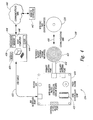
- Figure 4 is a partially schematic diagram illustrating various aspects of an access monitoring system configured in accordance with an embodiment of the present technology.
- Figure 5 is a flow diagram of a routine for monitoring access to a consumer-operated kiosk or other enclosure in accordance with an embodiment of the present technology.
- Figure 6 is a block diagram of a suitable computer for implementing various aspects of the present technology.
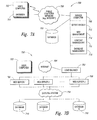
- Figure 7A is a block diagram illustrating a suitable system in which various aspects of the present technology may operate in a networked computer environment.
- Figure 7B is a block diagram illustrating an alternative system to that of Figure 7A .
- a consumer-operated kiosk e.g., a consumer coin counting machine, prepaid card dispensing/reloading machine, DVD rental machine, etc.
- a consumer-operated kiosk includes an access door having a digital "smart switch” that utilizes wireless technology to determine door status (e.g., whether the door is opened or closed).
- the digital door switch includes a digital identifier, such as a radio frequency identification (RFID) transponder or "tag" mounted to one of the machine enclosure or the door, and a wireless reader, such as an RFID reader, mounted to the other of the enclosure or the door.
- RFID radio frequency identification
- the identifier moves into proximity of the reader and the reader detects the presence of the identifier.
- the presence of the identifier indicates that the door is in the closed position.
- the identifier moves away from the reader so that the reader can no longer detect the presence of the identifier.
- the absence of the identifier indicates that the door is open.
- the reader can communicate door status information to a kiosk computer or other processing device, which can in turn record, for example, when the door is opened, when the door is closed, and how long the door remained open.
- this access information can be uploaded to a computer located remotely from the kiosk (such as a computer located at a kiosk operating center) that may be connected to a network of similar kiosks.
- the access information for a particular kiosk can then be compared to service personnel access logs for that machine to ensure that only authorized persons had access to the kiosk at all times.
- the recorded access times can be used to ascertain who had access to the machine during the time period in question.
- a general-purpose data processing device e.g., a personal computer, RFID reader controller, server computer, and/or wireless device.
- a general-purpose data processing device e.g., a personal computer, RFID reader controller, server computer, and/or wireless device.
- PDAs personal digital assistants
- wearable computers all manner of cellular or mobile phones (including Voice over IP (VoIP) phones), dumb terminals, media players, multi-processor systems, microprocessor-based or programmable consumer electronics, set-top boxes, network PCs, mini-computers, mainframe computers, and the like.
- the terms "computer,” “controller,” “server,” “host,” “host system,” and the like are generally used interchangeably herein, and generally refer to any of the above devices and systems, as well as any data processor.
- aspects of the invention can also be embodied in a special purpose computer or data processor that is specifically programmed, configured, or constructed to perform one or more of the computer-executable instructions explained in detail herein. While some aspects of the invention, such as certain functions, may be described as being performed exclusively on a single device, the invention can also be practiced in distributed environments where functions or modules are shared among disparate processing devices which are linked through a communications network, such as a Local Area Network (LAN), Wide Area Network (WAN), or the Internet. In a distributed computing environment, program modules may be located in both local and remote memory storage devices.
- LAN Local Area Network
- WAN Wide Area Network
- program modules may be located in both local and remote memory storage devices.
- Some aspects of the invention may also be stored or distributed on tangible computer-readable media, including magnetically or optically readable computer discs, hard-wired or preprogrammed chips (e.g., EEPROM semiconductor chips), nanotechnology memory, biological memory, or other data storage media.
- computer implemented instructions, data structures, screen displays, and other data under aspects of the invention may be distributed over the Internet or over other networks (including wireless networks), on a propagated signal on a propagation medium (e.g., an electromagnetic wave(s), a sound wave, etc.) over a period of time, or they may be provided on any analog or digital network (packet switched, circuit switched, or other scheme).
- FIG. 1 is an isometric front view of a consumer-operated kiosk 100 having an access monitoring system configured in accordance with an embodiment of the present technology.
- the kiosk 100 is a consumer-operated coin counting machine that can include, for example, the ability to dispense redeemable vouchers, dispense and/or reload prepaid cards, dispense E-certificates for on-line purchases, transfer funds to accounts, and/or provide other products and services.
- the kiosk 100 and various aspects thereof can be at least generally similar in structure and function to one or more of the kiosks operated by Coinstar Inc. of Bellevue, WA, and/or one or more of the machines disclosed in U.S. Patent Nos. 7,865,432 , 7,815,071 , and 6,494,776 , each of which is incorporated herein in its entirety by reference.
- the consumer-operated kiosk 100 includes an external housing, such as an enclosure 102 having a hinged access panel, such as a front door 104.
- the door 104 is rotatably mounted to a corner portion of the enclosure 102 by a vertical hinge 106.
- the hinge 106 allows the door 104 to rotate between a closed position that prevents access to an interior portion of the enclosure 102 (as shown in Figure 1 ) and an open position that permits access to the interior portion of the enclosure 102 (see Figure 2 ).
- the kiosk 100 further includes a coin input region, such as a hinged coin input tray 108 in which the consumer can deposit his or her coins.
- a display screen 112 and associated user-selection buttons e.g., a touch screen
- the kiosk 100 can also include a voucher outlet 114 from which the consumer can receive a redeemable voucher for all or a portion of the value of the deposited coins.
- the kiosk 100 can include a card outlet 116 from which the user can receive a new prepaid card (e.g., a prepaid phone card or prepaid credit card) for all or a portion of the coin value, and/or a card reader 118 with which the user can reload or "top-up" an existing prepaid card or an account with a portion of the coin value.
- a new prepaid card e.g., a prepaid phone card or prepaid credit card
- the kiosk 100 described above is merely representative of one type of consumer-operated kiosk, commercial enclosure, or other enclosure that can include the access monitoring systems described herein.
- other types of consumer-operated kiosks, enclosures, and machines can include access monitoring systems configured in accordance with the present disclosure.
- Such machines can include, for example, DVD rental kiosks (such as those operated by Redbox Automated Retail, LLC of Oakbrook, IL), food vending machines such as coffee vending machines, card dispensing machines, consumer electronics vending machines, gift card exchange machines, cash registers, etc.
- other kiosks and machines can include more, fewer, or different functionalities than those described herein.
- FIG 2 is an enlarged front view of a portion of the kiosk 100 of Figure 1 with the door 104 in an open position. Opening the door 104 provides access to a coin counting unit 220 and a corresponding coin collection bin 222.
- the coin counting unit 220 receives coins from the coin input tray 108 and counts the coins before directing them into the coin bin 222.
- Service personnel can access the kiosk 100 via the door 104 to service the coin counting unit 220, to remove the coin bin 222, and/or to perform other needed tasks.
- the kiosk 100 includes an access monitoring system 200 that comprises an identification device or identifier 226 mounted to an upper inboard corner of the door 104 proximate the hinge 106, and a reading device or reader 224 mounted to an adjacent portion of the enclosure 102.
- the reader 224 can be mounted to the door 104 while the identifier 226 is mounted to the enclosure 102.
- the identifier 226 and/or the reader 224 can be mounted in other locations on the door 104 and/or the enclosure 102.
- the identifier 226 and the reader 224 are positioned such that they will be aligned and proximate to each other, or at least generally aligned and proximate to each other, when the door 104 is securely closed and/or locked against the enclosure 102.
- the identifier 226 is a wireless identifier, such as an RFID transponder or "tag.”
- the reader 224 is a wireless reader, such as an RFID reader.
- the reader 224 can be operably connected (via, e.g., a USB port) to a kiosk computer for recording kiosk entry times, duration, and entering-person identification, and/or for communicating such information to a remote computer.
- Figure 3A is an enlarged isometric view taken from Figure 2 illustrating aspects of the access monitoring system 200 in more detail
- Figure 3B is a similar isometric view of the consumer-operated kiosk 100 with the front door 104 closed.
- Some of the door structure e.g., a door skin
- the reader 224 can be fastened to an upper front corner portion of the kiosk enclosure 102 (e.g., to a frame or chassis panel 338) with one or more fasteners 332 (e.g., rivets).
- the identifier 226 can be similarly attached to an adjacent portion of the door (e.g., a door frame member 334) by one or more fasteners 336.
- the reader 224 can wirelessly sense or detect the presence of the identifier 226 when the door 104 is closed as shown in Figure 3B and the identifier 226 is within the operational read range of the reader 224, but the reader 224 cannot detect the identifier 226 when the door 104 is opened as shown in Figure 3A and the identifier 226 is outside the read range. As described in greater detail below, this enables the reader 224 to send a first signal to a kiosk computer (not shown) when the door 104 is opened, and a corresponding second signal to the kiosk computer when the door 104 is subsequently closed.
- the illustrated embodiment includes a hinged door (i.e.,. the door 104), in other embodiments the access monitoring system 200 and/or one or more individual components, features and aspects thereof can be similarly implemented with other types of movable or removable access structures, including other types of doors (e.g., sliding doors), access panels (e.g., panels that can be entirely removed from the enclosure), etc. Accordingly, the systems and methods described herein are not limited to use with a particular type of door or other access structure.
- FIG. 4 is a schematic diagram of the access monitoring system 200 configured in accordance with an embodiment of the present technology.
- the identifier 226 is a wireless identifier, such as a low cost, passive RFID transponder or RFID "tag" (for example, an EM4100 or EM4102 compatible RFID transponder).
- tags can include an integrated circuit (IC) and a corresponding antenna (e.g., a small coil of wires).
- IC integrated circuit
- the tag does not contain a battery or other power source, and may be considered "low frequency” (e.g., 125/134 KHz) for use with "read only” RFID readers.
- RFID tags suitable for use with the present technology can include one or more of the following features: a relatively small chip size, a relatively low power consumption, a read range of from about 2 inches to about 6 inches, such as about 3 inches, an operating frequency of from about 100 KHz to about 150 KHz, such as about 125 KHz, a laser programmable 64-bit memory array with data rate and coding options, an on-chip resonance capacitor, an on-chip supply buffer capacitor, an on-chip voltage limiter, an on-chip full wave rectifier, a relatively large modulation depth due to a low impedance modulation device, and/or other suitable features.
- the reader 224 is a wireless reader, such as a 125kHz EM4100 or EM4102 RFID reader module in a printed circuit board (PCB) form factor with a USB port for reading EM4100 or EM4102 compatible tags.
- the reader 224 can include a radio frequency (RF) transmitter and receiver (“transceiver") 431 for wireless communication 430 with the identifier 226.
- RF radio frequency
- the transceiver 431 can be controlled by a micro processor and/or digital signal processor 433 mounted to a PCB 434.
- the transceiver 431 is operably tethered or otherwise electronically connected to the circuit board 434 by a cable 432 (e.g., a USB cable that plugs into a USB port on the PCB 434).
- the transceiver 431 is the portion of the reader 224 actually mounted to the outside of the kiosk panel 338 so that it faces the identifier 226 when the door 104 is closed (see Figures 3A and 3B ).
- the PCB 434 can be suitably mounted inside the kiosk 100.
- the reader PCB 434 is operably connected to a host computer 438 (e.g., a central or main kiosk computer that controls all or a portion of the functions of the kiosk 100) via a communication link 436 (e.g., a USB cable).
- the communication link 436 enables the reader 224 to exchange information with and/or communicate information to the host computer 438.
- Such information can include, for example, what time the door 104 ( Figure 1 ) is opened, how long the door 104 remains open, and what time the door 104 is subsequently closed.
- the host computer 438 can be at least generally similar in structure and function to a personal computer, and can include a processor 446, memory 448, and a digital clock 444.
- the host computer 438 can also include a communications facility (e.g., a modem 450) for exchanging information (such as door status information) with a remote computer 442 via a communication link 440, such as a plain old telephone system (POTS), a wireless communication link, the Internet, and/or a specialized network.
- a communications facility e.g., a modem 450
- POTS plain old telephone system
- the remote computer 442 can be associated with, for example, a central operations facility for managing operation of a network of kiosks. Such operations can include, for example, providing maintenance, restocking consumables, removing money, etc.
- Figure 5 is a representative flow diagram illustrating a routine 500 for monitoring, recording, and/or controlling access to the consumer-operated kiosk 100 and/or other kiosks and enclosures in accordance with an embodiment of the present technology.
- the routine 500 or portions thereof can be performed by the host computer 438 and/or the reader 224 based at least in part on input from the identifier 226 ( Figure 4 ).
- the flow diagram 500 does not show all functions or exchanges of data, but instead provides an understanding of commands and data exchanged in some embodiments of the system. Those of ordinary skill in the art will recognize that some functions or exchange of commands and data may be repeated, varied, omitted, or supplemented, and other (e.g., less important) aspects not shown may be readily implemented.
- the routine 500 starts in block 502 when a reader, e.g., the reader 224 checks for the presence of an RFID tag, e.g., the identifier 226. If the reader detects the presence of the tag in decision block 504 (indicating the door is closed), then the routine proceeds to decision block 506 to determine whether a clock (e.g., the clock 444 of Figure 4 ) is running (indicating that the door 104 had previously been opened and the clock started). If the clock is not running, the routine proceeds to decision block 508 to determine if a preset interval of time has elapsed.
- the preset time interval can be a relatively short period of time (e.g., one second or less) that elapses between successive checks by the reader for the presence of the tag.
- the preset time interval can be shorter than the time typically required for a person to open the door. If the preset time interval has not elapsed, then the routine cycles through decision block 508 until the preset time interval has elapsed. Once the preset time interval has elapsed, the routine returns to block 502 and again checks for the presence of the tag.
- the routine proceeds to decision block 510 and determines if the clock is running. If the clock is not running, then the routine proceeds to block 512 and starts the clock. The routine also proceeds to block 514 and records the current time to reflect when the door was opened.
- the routine can include the ability to disable all or a portion of the kiosk functionality when the door is opened. For example, if the access monitoring system described herein is used with a coin counting kiosk, the routine can disable the coin counting apparatus once the door is opened.
- This feature can prevent unscrupulous people from breaking into the machine and recycling the same portion of coins through the coin counting device to thereby obtain a redeemable voucher having a grossly inflated cash value.
- the disabling feature of block 516 can be omitted.
- the routine proceeds to decision block 518 to determine if the preset period of time between checks for the presence of the tag has elapsed. Once the preset time interval has elapsed, the routine returns again to block 502 to again check for the presence of the tag. If the routine determines that the tag is still not present in decision block 504 (indicating that the door is still open), then the routine proceeds to decision block 510 where it accordingly determines that the clock is already running. From there the routine simply repeats the foregoing cycle and checks for the presence of the tag until such time as the routine determines that the tag is present in decision block 504 (indicating that the door has now been closed).
- routine 500 can optionally send a "timestamp" and/or other door access information to a remote computer, such as a computer located at a central operations headquarters remote from the coin counting kiosk.
- a timestamp is a sequence of characters denoting the date and/or time at which a certain event occurred (e.g., a door was opened and/or the door was closed), and/or when the event is recorded by a computer.
- the timestamp can include, for example, information such as what time the door was opened, how long the door remained open, and when the door was closed.
- Timestamps from a particular kiosk can be used by, for example, a kiosk operator, in a number of different ways. For example, in one embodiment the timestamps can be compared to task logs of field technicians to ensure that only authorized persons had access to the kiosk during a particular period of time. Moreover, persons accessing the kiosk to remove, for example, collected coins, can also provide their entry logs for comparison to the timestamps to ensure that only approved personnel removed coins from a kiosk.
- routine 500 can be stored in the memory 448 (e.g., nonvolatile memory) that forms part of the computer 438 ( Figure 4 ), or it can be stored in removable media, such as disks, or hardwired or preprogrammed in chips, such as EEPROM semiconductor chips.
- memory 448 e.g., nonvolatile memory
- Disposable media such as disks, or hardwired or preprogrammed in chips, such as EEPROM semiconductor chips.
- routine 500 and other functions and methods described herein can be performed by the computer 438, the reader 224, or both.
- the functions can be implemented by an application specific integrated circuit (ASIC), a digital signal processing (DSP) integrated circuit, through conventional programmed logic arrays or circuit elements. While many of the embodiments are shown and described as being implemented in hardware (e.g., one or more integrated circuits designed specifically for a task), such embodiments could equally be implemented in software and be performed by one or more processors (e.g., the processor 433 and/or the processor 446 of Figure 4 ).
- ASIC application specific integrated circuit
- DSP digital signal processing
- Such software can be stored on any suitable computer-readable medium, such as microcode stored in a semiconductor chip, on a computer-readable disk, or downloaded from a server and stored locally at a client.
- suitable computer-readable medium such as microcode stored in a semiconductor chip, on a computer-readable disk, or downloaded from a server and stored locally at a client.
- the reader e.g., the reader 22
- the tag e.g., the identifier 22
- the system logs a "door open” time (via, e.g., the kiosk computer 438).
- the reader senses the tag and the system logs a "door closed” time.
- the door open and closed times can form a "timestamp” or timestamps for a particular kiosk.
- the timestamps can be uploaded daily to a remote headquarters computer along with other reporting information, or they can be electronically retrieved remotely from headquarters as needed.
- a hidden camera e.g., a video camera
- a video camera can be running the entire time the machine is operating, and the timestamps can be correlated to the video to determine who had access to the machine during a particular time.
- an RFID tag may be mounted to the kiosk enclosure in such a way as to allow a person using a hand held device, such as a handheld RFID reader to sense the tag even if the kiosk is packaged for transit.
- the tag could therefore be used for inventory identification early in the kiosk build and assembly process and for tracking purposes thereafter.
- an RFID reader or other reading device e.g., a barcode scanner
- a tethered antenna could be plugged into the reader via a remote port and used to scan the RFID tags or other identifiers from the various internal components of the kiosk, such as a system computer, a coin counter, a coin cleaner, an LCD monitor, etc.
- field technicians could be provided with an on-screen utility for removing and adding components to the kiosk.
- a new component could be held up to the reader antenna and the unique RFID tag on the component read, and then the new component can be used to replace a malfunctioning or defunct component that is subtracted from the list of installed components. Similar to kiosk access information, this information could be uploaded to a remote system for inventory management, investigation and/or configuration control. Alternatively, the kiosk can be polled remotely from operation headquarters to obtain information about kiosk components on an as-needed basis.
- a door of a kiosk can be manually opened with a key or similar device, and a reader (e.g., an RFID reader) and an identifier (e.g., an RFID tag) can be used to log when and for how long the door was open.
- a reader e.g., an RFID reader
- an identifier e.g., an RFID tag
- the door can be latched shut with, for example, a solenoid driven lock that is electronically operated by detecting the presence of a particular identifier device.
- personnel authorized to access the kiosk can be issued a unique "RFID key fob" (or other RFID tag or transponder device) that can be placed in a specified location on or near the kiosk to be read by a suitable reader mounted to the kiosk (e.g., an RFID reader).
- the reader transmits a signal to, e.g., the kiosk computer which activates the door opening solenoid to allow full, or at least limited access to the kiosk depending on the scope of access provided by the particular key fob code.
- the kiosk computer which activates the door opening solenoid to allow full, or at least limited access to the kiosk depending on the scope of access provided by the particular key fob code.
- the physical key could still be used to open the door, but the physical key would only be provided to an authorized field technician, whereas others would require the special key fob to open a particular kiosk.
- a key fob that contains a wireless identifier such as, for example, a RFID chip
- an identifier such as an RFID chip can be included on a wallet sized card such as a credit card sized device, or on a bracelet worn on the user's wrist.
- a wireless kiosk access monitoring system as described herein can be relatively easily retrofitted to existing kiosks in the field.
- the components of the system e.g., an RFID tag or chip and an RFID reader
- these types of wireless identification systems can provide more security than a physical key, which can be easily copied.
- a wireless access monitoring system can be remotely enabled and/or disabled via a communications link (e.g., the Internet) with a remote computer.
- a communications link e.g., the Internet
- a machine-readable code such as a barcode
- a scanner such as a suitable infrared barcode scanner
- the barcode and scanner can be positioned such that the scanner can "read” or suitably scan the bar code when the door is fully closed.
- a computer 600 such as a kiosk computer, has one or more processors 601 coupled to one or more user input devices 602 and data storage devices 604.
- the computer is also coupled to at least one output device such as a display device 606 and one or more optional additional output devices 608 (e.g., printer, plotter, speakers, tactile or olfactory output devices, etc.).
- the computer may be coupled to external computers, such as via an optional network connection 610, a wireless transceiver 612, or both.
- the input devices 602 may include a keyboard and/or a pointing device such as a mouse. Other input devices are possible such as a microphone, joystick, pen, game pad, scanner, digital camera, video camera, and the like.
- the data storage devices 604 may include any type of computer-readable media that can store data accessible by the computer 600, such as magnetic hard and floppy disk drives, optical disk drives, magnetic cassettes, tape drives, flash memory cards, digital video disks (DVDs), Bernoulli cartridges, RAMs, ROMs, smart cards, etc. Indeed, any medium for storing or transmitting computer-readable instructions and data may be employed, including a connection port to a network such as a local area network (LAN), wide area network (WAN) or the Internet (not shown in Figure 6 ).
- LAN local area network
- WAN wide area network
- the Internet not shown in Figure 6 .
- a distributed computing environment with a web interface includes one or more user computers 702 in a system 700 are shown, each of which includes a browser program module 704 that permits the computer to access and exchange data with the Internet 706, including web sites within the World Wide Web portion of the Internet.
- the user computers may include one or more central processing units or other logic-processing circuitry, memory, input devices (e.g., keyboards and pointing devices), output devices (e.g., display devices and printers), and storage devices (e.g., magnetic, fixed and floppy disk drives, and optical disk drives), such as described above with respect to Figure 6 .
- User computers may include other program modules such as an operating system, one or more application programs (e.g., word processing or spread sheet applications), and the like.
- the user computers 102 include wireless computers, such as mobile phones, personal digital assistants (PDA's), palm-top computers, etc., which communicate with the Internet via a wireless link.
- the computers may be general-purpose devices that can be programmed to run various types of applications, or they may be single-purpose devices optimized or limited to a particular function or class of functions.
- the network may have a client-server architecture, in which a computer is dedicated to serving other client computers, or it may have other architectures such as a peer-to-peer, in which one or more computers serve simultaneously as servers and clients.
- the server computer(s), including the database(s) may employ security measures to inhibit malicious attacks on the system, and to preserve integrity of the messages and data stored therein (e.g., firewall systems, secure socket layers (SSL) password protection schemes, encryption, and the like).
- SSL secure socket layers
- the server computer 708 may include a server engine 712, a web page management component 714, a content management component 716 and a database management component 718.
- the server engine performs basic processing and operating system level tasks.
- the web page management component handles creation and display or routing of web pages. Users may access the server computer by means of a URL associated therewith.
- the content management component handles most of the functions in the embodiments described herein.
- the database management component includes storage and retrieval tasks with respect to the database, queries to the database, and storage of data.
- FIG. 7B an alternative embodiment to the system 700 is shown as a system 750.
- the system 750 is substantially similar to the system 700, but includes more than one web server computer (shown as server computers 1, 2, ... J).
- a web load balancing system 752 balances load on the several web server computers. Load balancing is a technique well-known in the art for distributing the processing load between two or more computers, to thereby more efficiently process instructions and route data. Such a load balancer can distribute message traffic, particularly during peak traffic times.
- a distributed file system 754 couples the web servers to several databases (shown as databases 1, 2 ... K).
- a distributed file system is a type of file system in which the file system itself manages and transparently locates pieces of information (e.g., content pages) from remote files or databases and distributed files across the network, such as a LAN.
- the distributed file system also manages read and write functions to the databases.
- a display description may be in HTML, XML or WAP format, email format or any other format suitable for displaying information (including character/code-based formats, algorithm-based formats (e.g., vector generated), and bitmapped formats).
- various communication channels such as local area networks, wide area networks, or point-to-point dial-up connections, may be used instead of the Internet.
- the system may be conducted within a single computer environment, rather than a client/server environment.
- the user computers may comprise any combination of hardware or software that interacts with the server computer, such as television-based systems and various other consumer products through which commercial or noncommercial transactions can be conducted.
- the various aspects of the invention described herein can be implemented in or for any e-mail environment.
- the words “comprise,” “comprising,” and the like are to be construed in an inclusive sense, as opposed to an exclusive or exhaustive sense; that is to say, in the sense of "including, but not limited to.”
- the terms “connected,” “coupled,” or any variant thereof means any connection or coupling, either direct or indirect, between two or more elements; the coupling or connection between the elements can be physical, logical, or a combination thereof.
- the words “herein,” “above,” “below,” and words of similar import, when used in this application refer to this application as a whole and not to any particular portions of this application.
Landscapes
- Physics & Mathematics (AREA)
- General Physics & Mathematics (AREA)
- Engineering & Computer Science (AREA)
- Business, Economics & Management (AREA)
- Theoretical Computer Science (AREA)
- Economics (AREA)
- General Business, Economics & Management (AREA)
- Operations Research (AREA)
- Quality & Reliability (AREA)
- Strategic Management (AREA)
- Tourism & Hospitality (AREA)
- Marketing (AREA)
- Human Resources & Organizations (AREA)
- Entrepreneurship & Innovation (AREA)
- Development Economics (AREA)
- Accounting & Taxation (AREA)
- Computer Hardware Design (AREA)
- Microelectronics & Electronic Packaging (AREA)
- Finance (AREA)
- Computer Networks & Wireless Communication (AREA)
- Artificial Intelligence (AREA)
- Computer Vision & Pattern Recognition (AREA)
- Control Of Vending Devices And Auxiliary Devices For Vending Devices (AREA)
- Burglar Alarm Systems (AREA)
Applications Claiming Priority (1)
| Application Number | Priority Date | Filing Date | Title |
|---|---|---|---|
| US13/229,526 US8482413B2 (en) | 2011-09-09 | 2011-09-09 | Access monitoring systems for use with consumer-operated kiosks and other enclosures |
Publications (2)
| Publication Number | Publication Date |
|---|---|
| EP2568450A2 true EP2568450A2 (fr) | 2013-03-13 |
| EP2568450A3 EP2568450A3 (fr) | 2014-02-12 |
Family
ID=46982455
Family Applications (1)
| Application Number | Title | Priority Date | Filing Date |
|---|---|---|---|
| EP20120183163 Withdrawn EP2568450A3 (fr) | 2011-09-09 | 2012-09-05 | Systèmes de surveillance d'accès destinés à être utilisés avec des kiosques manipulés par le consommateur et d'autres enceintes |
Country Status (3)
| Country | Link |
|---|---|
| US (2) | US8482413B2 (fr) |
| EP (1) | EP2568450A3 (fr) |
| CA (1) | CA2788037A1 (fr) |
Cited By (4)
| Publication number | Priority date | Publication date | Assignee | Title |
|---|---|---|---|---|
| WO2015050848A1 (fr) * | 2013-10-01 | 2015-04-09 | Havoc LLC | Systèmes, articles et procédés associés à un passage et à une exécution de commande de détail, utilisant des communications sans fil |
| CN110276880A (zh) * | 2019-05-22 | 2019-09-24 | 陈泽彬 | 一种货架结构的自动零售机 |
| GB2615572A (en) * | 2022-02-11 | 2023-08-16 | Nicoventures Trading Ltd | Case |
| US20240119435A1 (en) * | 2021-03-12 | 2024-04-11 | Amazon Technologies, Inc. | Automated and self-service item kiosk |
Families Citing this family (39)
| Publication number | Priority date | Publication date | Assignee | Title |
|---|---|---|---|---|
| CA2603639C (fr) * | 2005-04-07 | 2015-05-19 | Michael Daily | Kiosque libre-service et systeme de securite pour vente au detail |
| CA2926097C (fr) | 2008-10-02 | 2020-11-10 | ecoATM, Inc. | Marche des occasions et distributeur automatique pour dispositifs |
| US10846684B2 (en) | 2009-07-17 | 2020-11-24 | James Curtis | Kiosk gift card system and method |
| US11379810B2 (en) | 2009-07-17 | 2022-07-05 | James Curtis | Kiosk gift card system and method |
| US12125807B2 (en) | 2009-07-17 | 2024-10-22 | James Curtis | Kiosk gift card system and method |
| CN102741906B (zh) | 2010-01-29 | 2016-06-08 | 艾利丹尼森公司 | 智能标识系统应用中使用的rfid/nfc板和/或阵列及其使用方法 |
| US10977965B2 (en) | 2010-01-29 | 2021-04-13 | Avery Dennison Retail Information Services, Llc | Smart sign box using electronic interactions |
| WO2013033522A1 (fr) | 2011-09-01 | 2013-03-07 | Avery Dennison Corporation | Appareil, système et procédé de suivi de consommateurs |
| US8482413B2 (en) | 2011-09-09 | 2013-07-09 | Coinstar, Inc. | Access monitoring systems for use with consumer-operated kiosks and other enclosures |
| EP2771845B1 (fr) * | 2012-09-10 | 2019-01-02 | Avery Dennison Corporation | Procédé de prévention de détournement non autorisé d'étiquettes nfc |
| US10540527B2 (en) | 2012-10-18 | 2020-01-21 | Avery Dennison Retail Information Services Llc | Method, system and apparatus for NFC security |
| CN104471969B (zh) | 2012-11-19 | 2019-07-30 | 艾利丹尼森公司 | 禁用未经授权的nfc安全系统和方法 |
| US8988225B2 (en) | 2012-12-04 | 2015-03-24 | Honeywell International, Inc. | Door/window contact system |
| US20140370989A1 (en) | 2013-06-13 | 2014-12-18 | Patent Investment & Licensing Company | System to facilitate communication with casino employees and players and to log data related to employee work |
| US20170186270A1 (en) | 2013-08-06 | 2017-06-29 | Patent Investment & Licensing Company | Method and system for dispatching casino personnel and tracking interactions with players |
| US9087431B2 (en) | 2013-08-06 | 2015-07-21 | Patent Investment & Licensing Company | Method for creating an electronic log for documenting entries into gaming machines |
| US20150102903A1 (en) * | 2013-10-11 | 2015-04-16 | Wal-Mart Stores, Inc. | Secure Delivery Receptacle |
| US9235945B2 (en) | 2014-02-10 | 2016-01-12 | Outerwall Inc. | Coin input apparatuses and associated methods and systems |
| CN104123790A (zh) * | 2014-07-29 | 2014-10-29 | 北京君汇港沣科技发展有限公司 | 一种自助式售货机消费方法及装置 |
| US11055682B2 (en) * | 2014-10-13 | 2021-07-06 | NCR Corportation | Authenticated self-service terminal (SST) access |
| US10922642B2 (en) * | 2014-11-04 | 2021-02-16 | Hall Labs Llc | System and method for linking an event to video documenting the event |
| US9600026B2 (en) * | 2015-07-14 | 2017-03-21 | Zivelo Inc. | Interactive kiosk systems and methods for their manufacture |
| US9858738B2 (en) | 2015-07-17 | 2018-01-02 | Wal-Mart Stores, Inc. | Apparatus and method to determine whether to unlock a delivered-package vault |
| US10118421B2 (en) | 2016-09-22 | 2018-11-06 | Teeco Associates, Inc. | Printer with secure tray |
| US10192233B2 (en) | 2017-02-22 | 2019-01-29 | Arch Holdings, Lp | System and method for media trade-in |
| US10430767B2 (en) | 2017-05-24 | 2019-10-01 | Arch Holdings, Lp | Media life cycle management system |
| CN109426836A (zh) * | 2017-08-22 | 2019-03-05 | 洛阳华清天木生物科技有限公司 | 一种实验室危化品闭环管理系统和方法 |
| CN107945423A (zh) * | 2017-12-05 | 2018-04-20 | 广州扫地僧信息科技有限公司 | 选物贩卖机识别物品的方法和装置及选物贩卖机 |
| US10825308B2 (en) * | 2018-04-20 | 2020-11-03 | Crane Payment Innovations, Inc. | Cashier assist automated payment system |
| US11880879B2 (en) | 2018-06-29 | 2024-01-23 | Ghost House Technology, Llc | Apparatuses of item location, list creation, routing, imaging and detection |
| US20200160890A1 (en) * | 2018-11-20 | 2020-05-21 | Jiangsu Fine Storage Information Technology Co., L td. | Storage cabinet |
| CN113631067A (zh) * | 2018-12-07 | 2021-11-09 | 鬼屋技术有限责任公司 | 物品定位、清单创建、路线规划、成像和检测的系统、设备和方法 |
| US11880877B2 (en) | 2018-12-07 | 2024-01-23 | Ghost House Technology, Llc | System for imaging and detection |
| EP4204334A1 (fr) * | 2020-08-25 | 2023-07-05 | ecoATM, LLC | Kiosque d'évaluation et d'achat de dispositifs électroniques usagés |
| CN112515378A (zh) * | 2020-11-13 | 2021-03-19 | 郑春生 | 一种公用物品智能保管盒 |
| DE102021107606A1 (de) * | 2021-03-25 | 2022-09-29 | Aesculap Ag | Doppelcodierungseinrichtung für in- und außenseitige Containercodierung |
| US12353944B2 (en) * | 2022-05-24 | 2025-07-08 | Triumph Controls, Llc | Screening action for indicating status of equipment |
| US12469352B2 (en) | 2023-02-10 | 2025-11-11 | Trinity Axis Inc. | Functionality of a dispensing machine that is in communication with a wireless network |
| US12406244B1 (en) | 2024-07-12 | 2025-09-02 | Wells Fargo Bank, N.A. | Automated teller machine fuel pump |
Citations (7)
| Publication number | Priority date | Publication date | Assignee | Title |
|---|---|---|---|---|
| US5620079A (en) | 1992-09-04 | 1997-04-15 | Coinstar, Inc. | Coin counter/sorter and coupon/voucher dispensing machine and method |
| US6494776B1 (en) | 1992-09-04 | 2002-12-17 | Coinstar, Inc. | Coin counter/sorter and coupon/voucher dispensing machine and method |
| US7584869B2 (en) | 2004-04-15 | 2009-09-08 | Redbox Automated Retail, Llc | Article dispensing system and method for same |
| US7653599B2 (en) | 2002-02-15 | 2010-01-26 | Coinstar, Inc. | Methods and systems for exchanging and/or transferring various forms of value |
| US7748619B2 (en) | 2005-12-05 | 2010-07-06 | Coinstar, Inc. | Card dispensing apparatuses and associated methods of operation |
| US7815071B2 (en) | 2002-02-15 | 2010-10-19 | Coinstar, Inc. | Apparatuses and methods for dispensing magnetic cards, integrated circuit cards, and other similar items |
| US7865432B2 (en) | 2002-02-15 | 2011-01-04 | Coinstar, Inc. | Methods and systems for exchanging and/or transferring various forms of value |
Family Cites Families (28)
| Publication number | Priority date | Publication date | Assignee | Title |
|---|---|---|---|---|
| US4278968A (en) * | 1979-11-13 | 1981-07-14 | Arnett Coleman C | Door status detector apparatus |
| US6736251B2 (en) | 1992-09-04 | 2004-05-18 | Coinstar, Inc. | Coin counter and voucher dispensing machine and method |
| PT874335E (pt) * | 1997-03-29 | 2005-11-30 | Scheidt & Bachmann Gmbh | Instalacao de uma multiplicidade de maquinas automaticas de venda de artigos ou de servicos |
| JP3547977B2 (ja) * | 1998-02-27 | 2004-07-28 | 株式会社ナブコ | 自動ドアシステムのリモート監視装置 |
| WO2000011296A1 (fr) * | 1998-08-19 | 2000-03-02 | Fisher & Paykel Limited | Systeme d'ouverture et de fermeture de porte |
| AU2002211769B2 (en) * | 2000-10-20 | 2006-10-26 | Promega Corporation | Radio frequency identification method and system of distributing products |
| US7181369B2 (en) * | 2001-06-15 | 2007-02-20 | Nabco, Ltd. | Method and system for administering automatic door apparatus, and automatic door apparatus |
| US8225458B1 (en) * | 2001-07-13 | 2012-07-24 | Hoffberg Steven M | Intelligent door restraint |
| JP2003159465A (ja) * | 2001-11-28 | 2003-06-03 | Aruze Corp | 遊技関連機器鍵ユニット、遊技関連機器及び遊技場監視システム |
| JP4178285B2 (ja) * | 2002-08-09 | 2008-11-12 | 豊丸産業株式会社 | 遊技機 |
| JP4039198B2 (ja) * | 2002-10-09 | 2008-01-30 | 日産自動車株式会社 | 施解錠装置 |
| CA2429623A1 (fr) * | 2003-05-26 | 2004-11-26 | Cstar Technologies Inc. | Systeme et methode de suivi d'inventaire |
| US7319397B2 (en) * | 2004-08-26 | 2008-01-15 | Avante International Technology, Inc. | RFID device for object monitoring, locating, and tracking |
| US7178729B2 (en) * | 2005-02-25 | 2007-02-20 | Cisco Technology, Inc. | Methods and devices for providing alerts for spoilage and hazardous combinations |
| MX2007012240A (es) * | 2005-03-30 | 2007-12-07 | Lg Electronics Inc | Refrigerador de avatar. |
| SE0502492L (sv) * | 2005-11-11 | 2007-05-12 | Scan Coin Ind Ab | Kontantdepineringsanordning och associerade förfaranden och anordningar |
| US7642916B2 (en) * | 2006-03-23 | 2010-01-05 | Xerox Corporation | RFID bridge antenna |
| US20070247277A1 (en) * | 2006-04-24 | 2007-10-25 | Kenneth Murchison | Electronic or automatic identification method to remotely manage the locks or access points to a multi-compartment secure distribution receptacle, via the internet or wireless communication network |
| US20070247276A1 (en) * | 2006-04-24 | 2007-10-25 | Kenneth Murchison | Electronic or automatic identification method to remotely manage a lock or access point to a secure distribution receptacle, via the Internet or wireless communication network |
| JP4846444B2 (ja) * | 2006-05-17 | 2011-12-28 | ローレル精機株式会社 | 監視装置 |
| EP2104900B1 (fr) * | 2006-11-08 | 2018-12-26 | Sargent & Greenleaf,Inc. | Système de suivi d'argent liquide |
| WO2009075226A1 (fr) * | 2007-12-10 | 2009-06-18 | Omron Corporation | Etiquette rfid, et système et procédé permettant la détection de changement d'environnement d'étiquette rfid |
| US7889082B2 (en) * | 2008-11-05 | 2011-02-15 | International Business Machines Corporation | Expiration management method and system |
| WO2010056152A1 (fr) * | 2008-11-14 | 2010-05-20 | Khozyainov Boris Alekseevich | Système de contrôle de la mise en place d’équipements |
| US20100194579A1 (en) * | 2009-02-02 | 2010-08-05 | Dong-A University Industry-University Cooperation Foundation | Container security device, container security system, and security management method |
| EP2465028B1 (fr) | 2009-08-12 | 2016-01-27 | Outerwall Inc. | Appareils de distribution de cartes et procédés de fonctionnement associés |
| US9045919B2 (en) * | 2011-08-15 | 2015-06-02 | Cold Chain, Llc | Pneumatic door opening and security system |
| US8482413B2 (en) | 2011-09-09 | 2013-07-09 | Coinstar, Inc. | Access monitoring systems for use with consumer-operated kiosks and other enclosures |
-
2011
- 2011-09-09 US US13/229,526 patent/US8482413B2/en not_active Expired - Fee Related
-
2012
- 2012-08-28 CA CA2788037A patent/CA2788037A1/fr not_active Abandoned
- 2012-09-05 EP EP20120183163 patent/EP2568450A3/fr not_active Withdrawn
-
2013
- 2013-06-11 US US13/915,123 patent/US8760296B2/en not_active Expired - Fee Related
Patent Citations (7)
| Publication number | Priority date | Publication date | Assignee | Title |
|---|---|---|---|---|
| US5620079A (en) | 1992-09-04 | 1997-04-15 | Coinstar, Inc. | Coin counter/sorter and coupon/voucher dispensing machine and method |
| US6494776B1 (en) | 1992-09-04 | 2002-12-17 | Coinstar, Inc. | Coin counter/sorter and coupon/voucher dispensing machine and method |
| US7653599B2 (en) | 2002-02-15 | 2010-01-26 | Coinstar, Inc. | Methods and systems for exchanging and/or transferring various forms of value |
| US7815071B2 (en) | 2002-02-15 | 2010-10-19 | Coinstar, Inc. | Apparatuses and methods for dispensing magnetic cards, integrated circuit cards, and other similar items |
| US7865432B2 (en) | 2002-02-15 | 2011-01-04 | Coinstar, Inc. | Methods and systems for exchanging and/or transferring various forms of value |
| US7584869B2 (en) | 2004-04-15 | 2009-09-08 | Redbox Automated Retail, Llc | Article dispensing system and method for same |
| US7748619B2 (en) | 2005-12-05 | 2010-07-06 | Coinstar, Inc. | Card dispensing apparatuses and associated methods of operation |
Cited By (4)
| Publication number | Priority date | Publication date | Assignee | Title |
|---|---|---|---|---|
| WO2015050848A1 (fr) * | 2013-10-01 | 2015-04-09 | Havoc LLC | Systèmes, articles et procédés associés à un passage et à une exécution de commande de détail, utilisant des communications sans fil |
| CN110276880A (zh) * | 2019-05-22 | 2019-09-24 | 陈泽彬 | 一种货架结构的自动零售机 |
| US20240119435A1 (en) * | 2021-03-12 | 2024-04-11 | Amazon Technologies, Inc. | Automated and self-service item kiosk |
| GB2615572A (en) * | 2022-02-11 | 2023-08-16 | Nicoventures Trading Ltd | Case |
Also Published As
| Publication number | Publication date |
|---|---|
| US8482413B2 (en) | 2013-07-09 |
| EP2568450A3 (fr) | 2014-02-12 |
| CA2788037A1 (fr) | 2013-03-09 |
| US8760296B2 (en) | 2014-06-24 |
| US20130307386A1 (en) | 2013-11-21 |
| US20130063008A1 (en) | 2013-03-14 |
Similar Documents
| Publication | Publication Date | Title |
|---|---|---|
| US8482413B2 (en) | Access monitoring systems for use with consumer-operated kiosks and other enclosures | |
| EP2104900B1 (fr) | Système de suivi d'argent liquide | |
| US20210074101A1 (en) | Self-service modular drop safes | |
| EP2819106A1 (fr) | Gestion de transfert d'argent | |
| US9286770B2 (en) | Automated banking system with coin holder and electrically conductive trace | |
| CN106297069B (zh) | 现金钞箱管理系统、现金钞箱管理方法 | |
| WO2002067213A2 (fr) | Terminal de table pour des achats dans des points de vente | |
| CN201876935U (zh) | 可视频导购的自动售药咨询机 | |
| CN110219546A (zh) | 智能专用存储机及其控制方法 | |
| Mamdapur et al. | Implementing radio frequency identification technology in libraries: Advantages and disadvantages | |
| US7036724B2 (en) | System for enhancing the data storage security of cash-free transactions in vending machines | |
| CN104331785A (zh) | 多功能店铺管理平台 | |
| EP1544807A2 (fr) | caissette de transport améliorée pour média | |
| JP6938811B2 (ja) | 入金機管理システム | |
| WO2019227127A1 (fr) | Système et procédé de traitement de paiement | |
| CN2884341Y (zh) | 一种彩票自助投注机 | |
| JP4909579B2 (ja) | 遊技店舗内現金管理システム | |
| KR101324596B1 (ko) | 선불카드 자동발매장치 | |
| US20250265563A1 (en) | Mobile payment and monitoring device for gaming machines | |
| TWI497453B (zh) | 具有入金功能的銷售點系統 | |
| KR200372400Y1 (ko) | 알에프아이디 기술을 이용한 금융자동화기기의현금카세트 보안 시스템 | |
| CN208433044U (zh) | 一种基于虹膜识别技术的自动售卖机用防盗报警装置 | |
| KR100607561B1 (ko) | 알에프아이디 기술을 이용한 금융자동화기기의 현금카세트보안 시스템 및 그 방법 | |
| JP2002297978A (ja) | 在庫管理機能付販売端末システム | |
| WO2025030036A1 (fr) | Distributeur indexable à capacité d'achat à distance uniquement |
Legal Events
| Date | Code | Title | Description |
|---|---|---|---|
| PUAI | Public reference made under article 153(3) epc to a published international application that has entered the european phase |
Free format text: ORIGINAL CODE: 0009012 |
|
| 17P | Request for examination filed |
Effective date: 20120905 |
|
| AK | Designated contracting states |
Kind code of ref document: A2 Designated state(s): AL AT BE BG CH CY CZ DE DK EE ES FI FR GB GR HR HU IE IS IT LI LT LU LV MC MK MT NL NO PL PT RO RS SE SI SK SM TR |
|
| AX | Request for extension of the european patent |
Extension state: BA ME |
|
| RAP1 | Party data changed (applicant data changed or rights of an application transferred) |
Owner name: OUTERWALL INC. |
|
| PUAL | Search report despatched |
Free format text: ORIGINAL CODE: 0009013 |
|
| AK | Designated contracting states |
Kind code of ref document: A3 Designated state(s): AL AT BE BG CH CY CZ DE DK EE ES FI FR GB GR HR HU IE IS IT LI LT LU LV MC MK MT NL NO PL PT RO RS SE SI SK SM TR |
|
| AX | Request for extension of the european patent |
Extension state: BA ME |
|
| RIC1 | Information provided on ipc code assigned before grant |
Ipc: G07F 9/02 20060101ALI20140109BHEP Ipc: G07F 11/00 20060101AFI20140109BHEP Ipc: G07F 17/00 20060101ALI20140109BHEP |
|
| 17Q | First examination report despatched |
Effective date: 20140910 |
|
| STAA | Information on the status of an ep patent application or granted ep patent |
Free format text: STATUS: THE APPLICATION IS DEEMED TO BE WITHDRAWN |
|
| 18D | Application deemed to be withdrawn |
Effective date: 20150121 |