EP2568620A1 - Procédé et dispositif de génération et de renvoi de livre de codes adaptatif à rang élevé dans un système entrée multiple sortie multiple - Google Patents
Procédé et dispositif de génération et de renvoi de livre de codes adaptatif à rang élevé dans un système entrée multiple sortie multiple Download PDFInfo
- Publication number
- EP2568620A1 EP2568620A1 EP10850960A EP10850960A EP2568620A1 EP 2568620 A1 EP2568620 A1 EP 2568620A1 EP 10850960 A EP10850960 A EP 10850960A EP 10850960 A EP10850960 A EP 10850960A EP 2568620 A1 EP2568620 A1 EP 2568620A1
- Authority
- EP
- European Patent Office
- Prior art keywords
- high rank
- long
- correlation matrix
- codebook
- term
- Prior art date
- Legal status (The legal status is an assumption and is not a legal conclusion. Google has not performed a legal analysis and makes no representation as to the accuracy of the status listed.)
- Withdrawn
Links
Images
Classifications
-
- H—ELECTRICITY
- H04—ELECTRIC COMMUNICATION TECHNIQUE
- H04B—TRANSMISSION
- H04B7/00—Radio transmission systems, i.e. using radiation field
- H04B7/02—Diversity systems; Multi-antenna system, i.e. transmission or reception using multiple antennas
- H04B7/04—Diversity systems; Multi-antenna system, i.e. transmission or reception using multiple antennas using two or more spaced independent antennas
- H04B7/06—Diversity systems; Multi-antenna system, i.e. transmission or reception using multiple antennas using two or more spaced independent antennas at the transmitting station
- H04B7/0613—Diversity systems; Multi-antenna system, i.e. transmission or reception using multiple antennas using two or more spaced independent antennas at the transmitting station using simultaneous transmission
- H04B7/0615—Diversity systems; Multi-antenna system, i.e. transmission or reception using multiple antennas using two or more spaced independent antennas at the transmitting station using simultaneous transmission of weighted versions of same signal
- H04B7/0619—Diversity systems; Multi-antenna system, i.e. transmission or reception using multiple antennas using two or more spaced independent antennas at the transmitting station using simultaneous transmission of weighted versions of same signal using feedback from receiving side
- H04B7/0636—Feedback format
- H04B7/0639—Using selective indices, e.g. of a codebook, e.g. pre-distortion matrix index [PMI] or for beam selection
-
- H—ELECTRICITY
- H04—ELECTRIC COMMUNICATION TECHNIQUE
- H04B—TRANSMISSION
- H04B7/00—Radio transmission systems, i.e. using radiation field
- H04B7/02—Diversity systems; Multi-antenna system, i.e. transmission or reception using multiple antennas
- H04B7/04—Diversity systems; Multi-antenna system, i.e. transmission or reception using multiple antennas using two or more spaced independent antennas
- H04B7/0413—MIMO systems
- H04B7/0456—Selection of precoding matrices or codebooks, e.g. using matrices antenna weighting
- H04B7/0482—Adaptive codebooks
-
- H—ELECTRICITY
- H04—ELECTRIC COMMUNICATION TECHNIQUE
- H04B—TRANSMISSION
- H04B17/00—Monitoring; Testing
- H04B17/30—Monitoring; Testing of propagation channels
- H04B17/309—Measuring or estimating channel quality parameters
- H04B17/336—Signal-to-interference ratio [SIR] or carrier-to-interference ratio [CIR]
-
- H—ELECTRICITY
- H04—ELECTRIC COMMUNICATION TECHNIQUE
- H04B—TRANSMISSION
- H04B7/00—Radio transmission systems, i.e. using radiation field
- H04B7/02—Diversity systems; Multi-antenna system, i.e. transmission or reception using multiple antennas
- H04B7/04—Diversity systems; Multi-antenna system, i.e. transmission or reception using multiple antennas using two or more spaced independent antennas
- H04B7/0413—MIMO systems
- H04B7/0452—Multi-user MIMO systems
-
- H—ELECTRICITY
- H04—ELECTRIC COMMUNICATION TECHNIQUE
- H04B—TRANSMISSION
- H04B7/00—Radio transmission systems, i.e. using radiation field
- H04B7/02—Diversity systems; Multi-antenna system, i.e. transmission or reception using multiple antennas
- H04B7/04—Diversity systems; Multi-antenna system, i.e. transmission or reception using multiple antennas using two or more spaced independent antennas
- H04B7/0413—MIMO systems
- H04B7/0456—Selection of precoding matrices or codebooks, e.g. using matrices antenna weighting
- H04B7/0486—Selection of precoding matrices or codebooks, e.g. using matrices antenna weighting taking channel rank into account
-
- H—ELECTRICITY
- H04—ELECTRIC COMMUNICATION TECHNIQUE
- H04B—TRANSMISSION
- H04B7/00—Radio transmission systems, i.e. using radiation field
- H04B7/02—Diversity systems; Multi-antenna system, i.e. transmission or reception using multiple antennas
- H04B7/04—Diversity systems; Multi-antenna system, i.e. transmission or reception using multiple antennas using two or more spaced independent antennas
- H04B7/06—Diversity systems; Multi-antenna system, i.e. transmission or reception using multiple antennas using two or more spaced independent antennas at the transmitting station
- H04B7/0613—Diversity systems; Multi-antenna system, i.e. transmission or reception using multiple antennas using two or more spaced independent antennas at the transmitting station using simultaneous transmission
- H04B7/0615—Diversity systems; Multi-antenna system, i.e. transmission or reception using multiple antennas using two or more spaced independent antennas at the transmitting station using simultaneous transmission of weighted versions of same signal
- H04B7/0619—Diversity systems; Multi-antenna system, i.e. transmission or reception using multiple antennas using two or more spaced independent antennas at the transmitting station using simultaneous transmission of weighted versions of same signal using feedback from receiving side
- H04B7/0621—Feedback content
- H04B7/0626—Channel coefficients, e.g. channel state information [CSI]
-
- H—ELECTRICITY
- H04—ELECTRIC COMMUNICATION TECHNIQUE
- H04B—TRANSMISSION
- H04B7/00—Radio transmission systems, i.e. using radiation field
- H04B7/02—Diversity systems; Multi-antenna system, i.e. transmission or reception using multiple antennas
- H04B7/04—Diversity systems; Multi-antenna system, i.e. transmission or reception using multiple antennas using two or more spaced independent antennas
- H04B7/06—Diversity systems; Multi-antenna system, i.e. transmission or reception using multiple antennas using two or more spaced independent antennas at the transmitting station
- H04B7/0613—Diversity systems; Multi-antenna system, i.e. transmission or reception using multiple antennas using two or more spaced independent antennas at the transmitting station using simultaneous transmission
- H04B7/0615—Diversity systems; Multi-antenna system, i.e. transmission or reception using multiple antennas using two or more spaced independent antennas at the transmitting station using simultaneous transmission of weighted versions of same signal
- H04B7/0619—Diversity systems; Multi-antenna system, i.e. transmission or reception using multiple antennas using two or more spaced independent antennas at the transmitting station using simultaneous transmission of weighted versions of same signal using feedback from receiving side
- H04B7/0636—Feedback format
- H04B7/0645—Variable feedback
- H04B7/065—Variable contents, e.g. long-term or short-short
-
- H—ELECTRICITY
- H04—ELECTRIC COMMUNICATION TECHNIQUE
- H04B—TRANSMISSION
- H04B7/00—Radio transmission systems, i.e. using radiation field
- H04B7/02—Diversity systems; Multi-antenna system, i.e. transmission or reception using multiple antennas
- H04B7/04—Diversity systems; Multi-antenna system, i.e. transmission or reception using multiple antennas using two or more spaced independent antennas
- H04B7/06—Diversity systems; Multi-antenna system, i.e. transmission or reception using multiple antennas using two or more spaced independent antennas at the transmitting station
- H04B7/0613—Diversity systems; Multi-antenna system, i.e. transmission or reception using multiple antennas using two or more spaced independent antennas at the transmitting station using simultaneous transmission
- H04B7/0615—Diversity systems; Multi-antenna system, i.e. transmission or reception using multiple antennas using two or more spaced independent antennas at the transmitting station using simultaneous transmission of weighted versions of same signal
- H04B7/0619—Diversity systems; Multi-antenna system, i.e. transmission or reception using multiple antennas using two or more spaced independent antennas at the transmitting station using simultaneous transmission of weighted versions of same signal using feedback from receiving side
- H04B7/0658—Feedback reduction
- H04B7/0663—Feedback reduction using vector or matrix manipulations
-
- H—ELECTRICITY
- H04—ELECTRIC COMMUNICATION TECHNIQUE
- H04B—TRANSMISSION
- H04B7/00—Radio transmission systems, i.e. using radiation field
- H04B7/02—Diversity systems; Multi-antenna system, i.e. transmission or reception using multiple antennas
- H04B7/04—Diversity systems; Multi-antenna system, i.e. transmission or reception using multiple antennas using two or more spaced independent antennas
- H04B7/0413—MIMO systems
- H04B7/0456—Selection of precoding matrices or codebooks, e.g. using matrices antenna weighting
- H04B7/046—Selection of precoding matrices or codebooks, e.g. using matrices antenna weighting taking physical layer constraints into account
- H04B7/0469—Selection of precoding matrices or codebooks, e.g. using matrices antenna weighting taking physical layer constraints into account taking special antenna structures, e.g. cross polarized antennas into account
Definitions
- Embodiments of the present invention relate to a Multiple Input Multiple Output (MIMO) system in a wireless communication network, and more specifically to the generation and feedback of a high rank adaptive codebook in a MIMO system.
- MIMO Multiple Input Multiple Output
- Multi-antenna techniques such as single-user MIMO (SU-MIMO) and multi-user MIMO (MU-MIMO), are identified as key techniques for Long-Term Evolution-Advanced LTE-A to satisfy the IMT-Advanced requirements.
- SU-MIMO single-user MIMO
- MU-MIMO multi-user MIMO
- LTE-A Long-Term Evolution-Advanced LTE-A
- precoding To implement precoding, it is required that a transmitting apparatus can obtain channel state information, which, in turn, requires user equipment to feed back the channel state information to a base station.
- Channel information feedback accuracy has bee proven to have great impact on system performance of multi-antenna schemes, especially MU-MIMO.
- a codebook In this approach, a set of codebooks (also referred to as a codebook set) is prestored at a base station and user equipment, and a receiving apparatus selects a matching precoding matrix under some criterion according to a current channel state and then feeds back a Precoding Matrix Index (PMI) to a transmitting apparatus.
- PMI Precoding Matrix Index
- One normal codebook feedback scheme uses a fixed codebook.
- This scheme is characterized by simple implementation and low feedback overheads.
- a codebook's ability to adapt to scenarios and its system performance gains are rather limited. It is impossible to have a constant codebook optimized for all antenna configurations and application scenarios.
- Another codebook feedback scheme uses an adaptive codebook, wherein long-term wideband spatial correlation matrix is used to aid channel information quantization and feedback.
- the adaptive codebook can adaptively change according to a long-term spatial correlation matrix of each user so as to better accommodate the channel information for different users.
- This scheme is also termed spatial correlation based adaptive codebook feedback, which has been widely supported by many companies in 3GPP LTE-A to improve channel feedback accuracy and enhance system performance for SU/MU-MIMO.
- the baseline codebook is transformed with a long-term spatial correlation matrix, the codebook is rotated, and the transformed codebook is aligned to the preferred beamforming direction, which is the dominant eigenvector of the long-term spatial correlation matrix.
- the obtained adaptive codebook can be selected from only a spherical cap rather than the whole hypersphere during channel quantization. Therefore, the adaptive codebook can naturally be used to quantize rank-one channel information or dominant eigenvector information.
- the spatial correlation based adaptive feedback has really shown explicit system performance gains in rank-one transmission over normal codebook feedback without spatial correlation information. But in current adaptive codebook schemes, for high rank (higher than 1) channel feedback some lower level (level 1) of eigenvectors also needs to be quantized and fed back in addition to a dominant eigenvector. Since the adaptive codebook is not aligned to the direction of the lower level of eigenvectors, the current high rank adaptive codebook is not suitable for high rank transmission. In high rank transmission, current spatial correlation based adaptive codebook feedback cannot achieve significant system performance gains and even probably lower performance than normal codebook feedback without spatial correlation information. How to further improve high rank channel feedback quality makes critical challenge for feedback mechanism design.
- the embodiments of the present invention propose an enhanced adaptive codebook generating and feedback mechanism to further improve high rank channel feedback quality and the corresponding system performance.
- An embodiment of the present invention provides a method for generating a high rank adaptive codebook in a MIMO communication system, comprising:
- Another embodiment of the present invention provides a method for feeding back channel information in a MIMO communication system, comprising:
- An embodiment of the present invention provides a method for processing channel information in a MIMO communication system, comprising:
- An embodiment of the present invention provides an apparatus for generating a high rank adaptive codebook in a MIMO communication system, comprising:
- an aligning component configured for transforming different column vectors in a high rank baseline codebook by different levels of a long-term channel correlation matrix to align to directions of different eigenvectors of the long-term channel correlation matrix
- a constructing component configured for using the transformed column vectors to construct a high rank adaptive codebook.
- An embodiment of the present invention provides an apparatus for feeding back channel information in a MIMO communication system, comprising:
- a constructing component configured for transforming different column vectors in a high rank baseline codebook by different levels of a long-term channel correlation matrix to align to directions of different eigenvectors of the long-term channel correlation matrix, thereby constructing a high rank adaptive codebook
- a generating component configured for constituting a high rank adaptive codebook set on the basis of all high rank adaptive codebooks
- a determining component configured for determining from the high rank adaptive codebook set an index of a high rank adaptive codebook matching a current channel
- a feedback component configured for feeding back information on the long-term channel correlation matrix and the index.
- An embodiment of the present invention provides an apparatus for processing channel information in a MIMO communication system, comprising:
- a receiving component configured for receiving information on a long-term channel correlation matrix and an index of a high rank adaptive codebook
- a aligning component configured for transforming different column vectors of a high rank baseline codebook corresponding to the index by different levels of the long-term channel correlation matrix to align to directions of different eigenvectors of the long-term channel correlation matrix
- a constructing component configured for using the transformed column vectors to construct a high rank adaptive codebook.
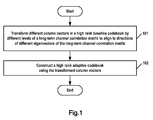
- Fig. 1 shows a flowchart of a method for generating a high rank adaptive codebook in a MIMO communication system according to an embodiment of the present invention
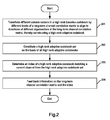
- Fig. 2 shows a flowchart of a method for feeding back channel information in a MIMO communication system according to an embodiment of the present invention
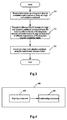
- Fig. 3 shows a flowchart of a method for processing channel information in a MIMO communication system according to another embodiment of the present invention
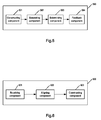
- Fig. 4 shows a block diagram of an apparatus for generating a high rank adaptive codebook in a MIMO communication system according to an embodiment of the present invention
- Fig. 5 shows a block diagram of an apparatus for feeding back channel information in a MIMO communication system according to an embodiment of the present invention
- Fig. 6 shows a block diagram of an apparatus for processing channel information in a MIMO communication system according to another embodiment of the present invention.
- Fig. 7 shows a block diagram of a MIMO communication system according to an embodiment of the present invention.
- a high rank baseline codebook set is composed of multiple high rank baseline codebooks.
- Each high rank baseline codebook is composed of multiple column vectors.
- Each column vector can be used to quantize different eigenvectors of channels.
- different column vectors in the high rank baseline codebook are transformed by different levels of a spatial correlation matrix to align to different beamforming of different levels of eigenvectors. All transformed column vectors constitute a new high rank adaptive codebook, which can more precisely depict high rank channel information.
- This kind of high rank adaptive codebook can be used for various antenna configurations and application scenarios. As an example, antenna deployment may be, e.g.
- the transmitting antenna number may be e.g. 4Tx or 8Tx antennas.
- the embodiments of the present invention may apply to scenarios for transmitting any allowed number of streams (i.e., any transmission rank).
- the embodiments of the present invention may apply to any multi-antenna scheme, e.g. SU-MIMO or MU-MIMO.
- the rank in a MIMO system is defined as the number of independent equations corresponding to the MIMO system (algebraic rank).
- the magnitude of the rank limits the number of data streams that can be space-division multiplexed in the system.
- the rank is always less than or equal to both the number of Tx antennas and the number of Rx antennas.
- the term “rank” generally refers to the number of transmitted data streams, and the term “high rank” generally means that the number of transmitted data streams is more than 1.
- a codebook used by the system has usually high rank.
- a codebook set comprises multiple codebooks, and a codebook comprises column vectors.
- a codebook set i.e., the more codebooks included), the higher quantization accuracy being achieved.
- Fig. 1 shows a flowchart of a method for generating a high rank adaptive codebook in a MIMO communication system according to an embodiment of the present invention.
- a high rank baseline codebook is transformed by different levels of a long-term channel correlation matrix to align to directions of different eigenvectors of the long-term channel correlation matrix.
- a high rank adaptive codebook is constructed using the transformed column vectors.
- a baseline codebook set is prestored by a transmitting apparatus and a receiving apparatus.
- the baseline codebook set may be predetermined according to concrete antenna configurations and application scenarios.
- the baseline codebook set may be predetermined by a base station offline and then transferred to user equipment.
- the long-term channel correlation matrix may be generated according to a measured channel response or obtained by receiving from other apparatus.
- the receiving apparatus may determine the long-term channel correlation matrix by measuring a reference signal (e.g., pilot signal) of transmission link.
- the transmitting apparatus may obtain information on the long-term channel correlation matrix by feedback from the receiving apparatus.
- the channel correlation matrix is divided into levels according to its eigenvectors. If the number of Tx antennas is M, then the channel correlation matrix is an M x M matrix. If the channel correlation matrix has r eigenvalues and r corresponding eigenvectors, then a covariance matrix related to an eigenvector of the largest eigenvalue is allocated to the first level, a covariance matrix related to an eigenvector of the second largest eigenvalue is allocated to the second level, and so on and so forth, the channel correlation matrix is divided into M levels. Accordingly, these eigenvectors corresponding to different eigenvalues are termed different levels of eigenvectors.
- the l th column vector of the high rank baseline codebook is transformed by the l to M levels of the long-term spatial correlation matrix, wherein l ⁇ 1, M is the number of Tx antennas, and M also corresponds to the largest number of levels of the long-term spatial correlation matrix.
- the transmitting apparatus is, for example, a base station of a cell with M Tx antennas
- the receiving apparatus is, for example, user equipment UE with N RX
- the number of transmitted data streams is r, wherein r is less than M.
- Each UE may detect downlink (DL) channel according to DL reference signals, calculate a long-term wideband spatial correlation matrix averaged over multiple sub-bands and multiple subframes, and then quantize and feed back to its serving cell.
- DL downlink
- each baseline codebook in the baseline codebook set is transformed according to a long-term spatial correlation matrix of each user, thereby obtaining a corresponding adaptive codebook.
- the corresponding adaptive codebooks constitute an adaptive codebook set.
- the different column vectors in the baseline codebook should be rotated by different levels of the spatial correlation matrix.
- each codebook in the baseline codebook set is transformed to be a corresponding high rank adaptive codebook, then a new high rank adaptive codebook set is obtained.
- the above method may further comprise other steps.
- the above method may further comprise a step of determining a baseline codebook set.
- some kind of orthogonalization operation such as, Gram-Schmit scheme (or QR decomposition), singular value decomposition (SVD), zero forcing (ZF) scheme, etc., may be further applied for the new high rank adaptive codebook.
- the new adaptive codebook can also be acquired by users and the cell according to the same generating rule.
- Fig. 2 shows a flowchart of a method for feeding back channel information in a MIMO communication system according to an embodiment of the present invention.
- step 201 different column vectors in a high rank baseline codebook are transformed by different levels of a long-term channel correlation matrix to align to directions of different eigenvectors of the long-term channel correlation matrix, thereby constructing a high rank adaptive codebook.
- step 202 a high rank adaptive codebook set is constituted on the basis of all high rank adaptive codebooks.
- an index of a high rank adaptive codebook matching a current channel is determined from the high rank adaptive codebook set.
- step 204 information on the long-term channel correlation matrix and the index is fed back.
- the above method is implemented in the receiving apparatus.
- the transmitting apparatus is, for example, a base station of a cell with M transmitting antennas
- the receiving apparatus is, for example, user equipment UE with N Rx antennas
- the number of transmitted data streams is r , wherein r is less than or equal to M.
- the receiving apparatus may obtain an adaptive codebook whose rank is r through step 201. Concrete details have been described with reference to Fig. 1 and thus are not detailed here. If at step 201 each codebook in the baseline codebook set is transformed to obtain a corresponding high rank adaptive codebook, then at step 202 all high rank adaptive codebooks constitute a high rank adaptive codebook set.
- high rank channel quantization may be performed by the obtained high rank adaptive codebook and short-term channel response, so as to determine the index.
- the channel quantization may be performed according to various methods.
- the high rank channel quantization may be performed according to a minimum chordal distance, or a proper high rank precoder is directly selected to match the channel information according to a maximum post-processing Signal-to-Noise Ratio (SINR) or channel capacity.
- SINR Signal-to-Noise Ratio
- the minimum chordal distance rule may be applied for rank r channel quantization.
- a current channel may be represented according to a current short-term channel eigenvector.
- user equipment k can acquire r different eigenvectors [ V k 1 ⁇ V kr ] of short-term sub-band.
- user equipment k can feed back to the base station the determined index of the high rank adaptive codebook matching the current channel. At the same time, user equipment k can feed back information on the long-term channel correlation matrix.
- the base station can determine a corresponding codebook in the baseline codebook set upon receipt of the index fed back.
- the codebook is transformed using the received information on the long-term channel correlation matrix, and an adaptive codebook is generated according to the same rule as applied at user equipment k.
- the base station can use the adaptive codebook as a preferred transmitting precoder or channel quantization for its serving cell.
- the transmitting precoder of user equipment k can be represented as or be further scheduled with other users by zero forcing (ZF) for MU-MIMO.
- Fig. 3 shows a flowchart of a method for processing channel information in a MIMO communication system according to an embodiment of the present invention.
- step 301 information on a long-term channel correlation matrix and on an index of a high rank adaptive codebook is received.
- different column vectors of a high rank baseline codebook corresponding to the index are transformed by different levels of the long-term channel correlation matrix to align to directions of different eigenvectors of the long-term channel correlation matrix.
- a high rank adaptive codebook is constructed using the transformed column vectors.
- the above method is implemented at the transmitting apparatus.
- the l column vector of the high rank baseline codebook is transformed by the l to M levels of the long-term spatial correlation matrix, wherein l ⁇ 1, M is the number of Tx antennas, and M also corresponds to the total number of levels of the long-term spatial correlation matrix.
- the long-term channel correlation matrix is a quantized MxM long-term spatial correlation matrix R k of user equipment k, which is represented as below:
- Fig. 4 shows a block diagram of an apparatus 400 for generating a high rank adaptive codebook in a MIMO communication system according to an embodiment of the present invention.
- the apparatus 400 comprises an aligning component 401 and a constructing component 402.
- the aligning component 401 is configured for transforming different column vectors in a high rank baseline codebook by different levels of a long-term channel correlation matrix to align directions of different eigenvectors of the long-term channel correlation matrix.
- the constructing component 402 is configured for constructing the high rank adaptive codebook by the transformed column vectors.
- all column vectors, except for the first column, of the high rank baseline codebook are not transformed by the whole long-term spatial correlation matrix but transformed by only partial levels thereof.
- the l column vector is transformed by ( M- l + 1 ) levels corresponding to lower eigenvalues, wherein M is the number of Tx antennas.
- the l th column vector of the high rank baseline codebook is transformed by l th to M th levels of the long-term spatial correlation matrix to align to the direction of the l th eigenvector.
- the long-term channel correlation matrix is a MxM quantized long-term spatial correlation matrix R k of user equipment k, which may be represented through identical transformation as below:
- the apparatus 400 generates the long-term channel correlation matrix according to a measured channel response.
- the apparatus 400 obtains the long-term channel correlation matrix by receiving information on the long-term channel correlation matrix.
- Fig. 5 shows a block diagram of an apparatus 500 for feeding back channel information in a MIMO communication system according to an embodiment of the present invention.
- the apparatus 500 comprises: a constructing component 501, a generating component 502, a determining component 503 and a feedback component 504.
- the constructing component 501 transforms different column vectors in a high rank baseline codebook by different levels of a long-term channel correlation matrix to align to directions of different eigenvectors of the long-term channel correlation matrix, thereby constructing a high rank adaptive codebook.
- the generating component 502 constructs a high rank adaptive codebook set on the basis of all high rank adaptive codebooks.
- the determining component 503 determines an index of a high rank adaptive codebook matching a current channel from the high rank adaptive codebook set.
- the feedback component 504 feeds back information on the long-term channel correlation matrix and the index.
- high rank channel quantization is performed by the high rank adaptive codebook and a short-term channel response, so as to determine the index.
- the high rank channel quantization is performed according to a minimum chordal distance.
- the high rank channel quantization is determined according to a maximum post-processing Signal-to-Noise Ratio (SINR) or channel capacity.
- SINR Signal-to-Noise Ratio
- the determined matching high rank adaptive codebook is selected as a high rank precoder.
- Fig. 6 shows a block diagram of an apparatus 600 for processing channel information in a MIMO communication system according to an embodiment of the present invention.
- the apparatus 600 comprises a receiving component 601, an aligning component 602 and a constructing component 603.
- the receiving component 601 receives information on a long-term channel correlation matrix and on an index of a high rank adaptive codebook.
- the aligning component 602 transforms different column vectors of a high rank baseline codebook corresponding to the index by different levels of the long-term channel correlation matrix to align to directions of different eigenvectors of the long-term channel correlation matrix.
- the constructing component 603 constructs a high rank adaptive codebook using the transformed column vectors.
- all column vectors, except for the first column, of the high rank baseline codebook are not transformed by the whole long-term spatial correlation but transformed by only partial levels of the long-term spatial correlation matrix, for example, by ( M- l +1) levels corresponding to lower eigenvalues, wherein M is the number of transmitting antennas.
- the l th column vector of the high rank baseline codebook is transformed by l th to M th levels of the long-term spatial correlation matrix to align to the direction of the l th eigenvector.
- the long-term channel correlation matrix is a quantized MxM long-term spatial correlation matrix R k of user equipment k, which is represented as below:
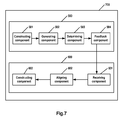
- Fig. 7 shows a block diagram of a MIMO communication system 700 according to an embodiment of the present invention.
- the system 700 comprises an apparatus 500 and an apparatus 600.
- the apparatus 500 comprises: a constructing component 501, a generating component 502, a determining component 503 and a feedback component 504.
- the apparatus 600 comprises a receiving component 601, an aligning component 602 and a constructing component 603.
- the constructing component 501 transforms different column vectors in a high rank baseline codebook by different levels of a long-term channel correlation matrix to align to directions of different eigenvectors of the long-term channel correlation matrix, thereby constructing a high rank adaptive codebook.
- the generating component 502 constructs a high rank adaptive codebook set on the basis of all high rank adaptive codebooks.
- the determining component 503 determines an index of a high rank adaptive codebook matching a current channel from the high rank adaptive codebook set.
- the feedback component 504 feeds back to the apparatus 600 information on the long-term channel correlation matrix and the index.
- the receiving apparatus 600 processes information fed back from a feedback channel.
- the receiving component 601 receives information on a long-term channel correlation matrix and on an index of a high rank adaptive codebook.
- the aligning component 602 transforms different column vectors of a high rank baseline codebook corresponding to the index by different levels of the long-term channel correlation matrix to align to directions of different eigenvectors of the long-term channel correlation matrix.
- the constructing component 603 constructs a high rank adaptive codebook using the transformed column vectors.
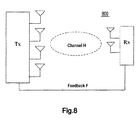
- Fig. 8 shows a schematic view of a MIMO system 800 in which the embodiments of the present invention may be applied.
- the system 800 comprises a transmitting apparatus Tx and a receiving apparatus Rx.
- the transmitting apparatus has M (M is an integer more than or equal to 1) transmitting antennas, e.g., 4 transmitting antennas shown in the figure.
- the receiving apparatus Rx has N (N is an integer more than or equal to 1) receiving antennas, e.g., 2 receiving antennas shown in the figure.
- a MIMO channel H is constructed between the transmitting apparatus Tx and the receiving apparatus Rx.
- the receiving apparatus Rx may feed back information on the MIMO channel H to the transmitting apparatus Tx.
- the system 800 transmits 2 data streams in the same sub-frequency band and the same frame; that is, the rank r is 2.
- the embodiments of the present invention may be applied to downlink transmission.
- the transmitting apparatus Tx may be a base station
- the receiving apparatus Rx may be user equipment.
- Fig. 8 illustrates only one receiving apparatus, it should be noted that the present invention may not only correspond to single-user MIMO (SU-MIMO) schemes, but also may be applied to multi-user MIMO (MU-MIMO) schemes.
- SU-MIMO single-user MIMO
- MU-MIMO multi-user MIMO
- each user equipment may independently employ the spatial correlation based codebook generating and feedback schemes according to embodiments of the present invention.
- the embodiments of the present invention may also be applied to uplink transmission.
- the transmitting apparatus Tx may be user equipment, while the receiving apparatus Rx may be a base station.
- the spatial correlation based adaptive codebook design and feedback mechanism is described as below.
- Each UE detects downlink (DL) channel according to DL reference signals, calculates a long-term wideband spatial correlation matrix averaged over multiple sub-bands and multiple subframes, quantizes and feeds back the matrix to its serving cell.
- DL downlink
- DL reference signals calculates a long-term wideband spatial correlation matrix averaged over multiple sub-bands and multiple subframes, quantizes and feeds back the matrix to its serving cell.
- user equipment k has its MxM dimensional quantized long-term spatial correlation matrix R k :
- the adaptive codebook is transformed according to a long-term spatial correlation matrix of each user.
- the different column vectors in the baseline codebook should be rotated by different levels of the spatial correlation matrix.
- the users and the cell may also acquire a new adaptive codebook according to the same design rule.
- high rank channel quantization may be performed according to minimum chordal distance, or a proper high rank precoder may be selected to match the channel information according to maximum post-processing SINR or channel capacity.
- the minimum chordal distance rule is applied for rank r channel quantization.
- the user can acquire different levels of short-term sub-band eigenvectors [ V k l ⁇ V kr ].
- Rank k adaptive codebook feedback may be used as a preferred transmitting precoder or channel quantization for its serving cell.
- the transmitting precoder can be represented as V ⁇ k ⁇ 1 . . . V ⁇ k ⁇ r H for user equipment k, or be further scheduled with other users by zero forcing (ZF) for MU-MIMO.
- ZF zero forcing
- Adaptive codebook scheme I is the traditional high rank adaptive feedback scheme. After system level simulations, it is found that adaptive codebook scheme I has 12% loss of cell average throughput over normal codebook feedback without transformation. If only transformation in the first column of baseline codebook, adaptive codebook scheme II has only 3% gains of cell average throughput and 27% gains of cell edge throughput. But using adaptive codebook scheme III according to the embodiments of the present invention, it is found that high rank adaptive codebook feedback has explicit system performance improvement, coupled with 22% gains of cell average throughput and 24% gains of cell edge throughput.
- the embodiments of the present invention propose an enhanced adaptive codebook generating and feedback mechanism based on long-term spatial correlation feedback to further improve high rank channel feedback accuracy and the corresponding system performance.
- Each column vector in the high rank baseline codebook is transformed by a specific level of the spatial correlation matrix to align to a beamforming direction of the specific level of the eigenvector, and then each column vector in the newly generated adaptive codebook can be used to quantize a specific eigenvector more accurately.
- System level simulations have proven that the adaptive codebook scheme proposed by the embodiments of the present invention has superior system performance gains without any additional feedback overhead.
- This kind of adaptive codebook can be used for any antenna deployment (e.g., co-polarized or cross-polarized), any transmitting antenna number (e.g., 4Tx or 8Tx antennas), any transmission rank and any multi-antenna scheme (e.g., SU-MIMO or MU-MIMO).
- any antenna deployment e.g., co-polarized or cross-polarized
- any transmitting antenna number e.g., 4Tx or 8Tx antennas
- any transmission rank e.g., SU-MIMO or MU-MIMO
Landscapes
- Engineering & Computer Science (AREA)
- Computer Networks & Wireless Communication (AREA)
- Signal Processing (AREA)
- Physics & Mathematics (AREA)
- Mathematical Physics (AREA)
- Quality & Reliability (AREA)
- Electromagnetism (AREA)
- Radio Transmission System (AREA)
- Compression, Expansion, Code Conversion, And Decoders (AREA)
Applications Claiming Priority (1)
| Application Number | Priority Date | Filing Date | Title |
|---|---|---|---|
| PCT/CN2010/072501 WO2011137591A1 (fr) | 2010-05-06 | 2010-05-06 | Procédé et dispositif de génération et de renvoi de livre de codes adaptatif à rang élevé dans un système entrée multiple sortie multiple |
Publications (2)
| Publication Number | Publication Date |
|---|---|
| EP2568620A1 true EP2568620A1 (fr) | 2013-03-13 |
| EP2568620A4 EP2568620A4 (fr) | 2015-10-28 |
Family
ID=44903578
Family Applications (1)
| Application Number | Title | Priority Date | Filing Date |
|---|---|---|---|
| EP10850960.5A Withdrawn EP2568620A4 (fr) | 2010-05-06 | 2010-05-06 | Procédé et dispositif de génération et de renvoi de livre de codes adaptatif à rang élevé dans un système entrée multiple sortie multiple |
Country Status (7)
| Country | Link |
|---|---|
| US (1) | US9094075B2 (fr) |
| EP (1) | EP2568620A4 (fr) |
| JP (1) | JP5576558B2 (fr) |
| KR (1) | KR101409732B1 (fr) |
| CN (1) | CN102792604B (fr) |
| BR (1) | BR112012028251A2 (fr) |
| WO (1) | WO2011137591A1 (fr) |
Cited By (1)
| Publication number | Priority date | Publication date | Assignee | Title |
|---|---|---|---|---|
| US9787378B2 (en) | 2013-01-31 | 2017-10-10 | Nec Corporation | Terminal apparatus, base station apparatus, and method for sharing codebook in communication system |
Families Citing this family (6)
| Publication number | Priority date | Publication date | Assignee | Title |
|---|---|---|---|---|
| BR112012025271A2 (pt) * | 2010-04-07 | 2016-06-21 | Alcatel Lucent | método e aparelho para retroinformar e construir uma matriz de correlação em sistemas de múltiplas entradas e múltiplas saídas |
| CN103905100B (zh) * | 2012-12-26 | 2019-02-19 | 中兴通讯股份有限公司 | 基于4天线码本的数据预编码处理方法及装置 |
| US9450787B2 (en) * | 2014-01-24 | 2016-09-20 | Huawei Technologies Co., Ltd. | System and method for early termination in iterative null-space directed singular value decomposition for MIMO |
| EP3131211B1 (fr) | 2015-08-14 | 2019-10-09 | Industrial Technology Research Institute | Procédé de formation de faisceau dynamique et appareils associés l'utilisant |
| WO2019144377A1 (fr) | 2018-01-26 | 2019-08-01 | Qualcomm Incorporated | Techniques et appareils de configuration de précodage |
| KR102517669B1 (ko) | 2018-06-27 | 2023-04-05 | 삼성전자주식회사 | 무선 통신 방법 및 장치 |
Family Cites Families (17)
| Publication number | Priority date | Publication date | Assignee | Title |
|---|---|---|---|---|
| US8385433B2 (en) | 2005-10-27 | 2013-02-26 | Qualcomm Incorporated | Linear precoding for spatially correlated channels |
| CN101330479B (zh) | 2007-06-20 | 2011-04-20 | 中兴通讯股份有限公司 | 一种预编码多输入多输出传输及码本编码的方法 |
| KR101481166B1 (ko) * | 2007-06-25 | 2015-01-28 | 엘지전자 주식회사 | 다중안테나 시스템에서의 귀환데이터 전송 방법 |
| US20110080964A1 (en) * | 2007-12-12 | 2011-04-07 | Nokia Corporation | Adaptive codebook for beamforming in limited feedback mimo systems |
| KR100913940B1 (ko) * | 2008-04-25 | 2009-08-26 | 삼성전자주식회사 | 적응적으로 코드북을 변경하거나 업데이트하는 다중 안테나 통신 시스템 |
| US8204151B2 (en) * | 2008-08-06 | 2012-06-19 | Samsung Electronics Co., Ltd. | Methods and apparatus to generate multiple antennas transmit precoding codebook |
| US8649456B2 (en) | 2009-03-12 | 2014-02-11 | Futurewei Technologies, Inc. | System and method for channel information feedback in a wireless communications system |
| US8675627B2 (en) * | 2009-03-23 | 2014-03-18 | Futurewei Technologies, Inc. | Adaptive precoding codebooks for wireless communications |
| CN101540663B (zh) * | 2009-04-30 | 2011-08-24 | 北京邮电大学 | 一种用于高阶mimo系统的预编码码本的构造方法 |
| CN102868498B (zh) * | 2009-06-18 | 2015-12-09 | 华为技术有限公司 | 码本生成方法、数据传输方法及装置 |
| CN101631004B (zh) * | 2009-08-10 | 2014-05-28 | 中兴通讯股份有限公司 | 一种预编码方法、系统及预编码码本的构造方法 |
| CN101635612B (zh) * | 2009-08-18 | 2014-12-10 | 中兴通讯股份有限公司 | 多输入多输出系统的预编码码本构造方法和装置 |
| US20110103493A1 (en) * | 2009-11-02 | 2011-05-05 | Futurewei Technologies, Inc. | System and Method for Wireless Communications with Adaptive Codebooks |
| CN101771510B (zh) * | 2010-02-12 | 2015-06-03 | 中兴通讯股份有限公司 | 一种mimo信道信息反馈的方法及系统 |
| JP5281604B2 (ja) | 2010-03-09 | 2013-09-04 | 株式会社エヌ・ティ・ティ・ドコモ | コードブック制御方法、基地局装置及び移動局装置 |
| WO2011124021A1 (fr) * | 2010-04-07 | 2011-10-13 | 上海贝尔股份有限公司 | Procédé et appareil de retour d'informations et de pré-codage |
| US8724728B2 (en) * | 2010-12-01 | 2014-05-13 | Samsung Electronics Co., Ltd. | Method of generating adaptive codebook and multiple input multiple output communication system using the adaptive codebook |
-
2010
- 2010-05-06 BR BR112012028251A patent/BR112012028251A2/pt not_active IP Right Cessation
- 2010-05-06 CN CN201080064372.0A patent/CN102792604B/zh active Active
- 2010-05-06 US US13/696,427 patent/US9094075B2/en not_active Expired - Fee Related
- 2010-05-06 WO PCT/CN2010/072501 patent/WO2011137591A1/fr not_active Ceased
- 2010-05-06 KR KR1020127031729A patent/KR101409732B1/ko not_active Expired - Fee Related
- 2010-05-06 JP JP2013508349A patent/JP5576558B2/ja not_active Expired - Fee Related
- 2010-05-06 EP EP10850960.5A patent/EP2568620A4/fr not_active Withdrawn
Cited By (1)
| Publication number | Priority date | Publication date | Assignee | Title |
|---|---|---|---|---|
| US9787378B2 (en) | 2013-01-31 | 2017-10-10 | Nec Corporation | Terminal apparatus, base station apparatus, and method for sharing codebook in communication system |
Also Published As
| Publication number | Publication date |
|---|---|
| KR20130016352A (ko) | 2013-02-14 |
| EP2568620A4 (fr) | 2015-10-28 |
| US20130051487A1 (en) | 2013-02-28 |
| KR101409732B1 (ko) | 2014-06-19 |
| WO2011137591A1 (fr) | 2011-11-10 |
| US9094075B2 (en) | 2015-07-28 |
| CN102792604B (zh) | 2016-06-15 |
| CN102792604A (zh) | 2012-11-21 |
| BR112012028251A2 (pt) | 2016-08-02 |
| JP5576558B2 (ja) | 2014-08-20 |
| JP2013530591A (ja) | 2013-07-25 |
Similar Documents
| Publication | Publication Date | Title |
|---|---|---|
| US8934564B2 (en) | Generalized reference signaling scheme for multi-user multiple input, multiple output (MU-MIMO) using arbitrarily precoded reference signals | |
| CN102725967B (zh) | 用于信息反馈以及预编码的方法和装置 | |
| US8761289B2 (en) | MIMO feedback schemes for cross-polarized antennas | |
| EP3171525B1 (fr) | Système et procédé de rétroaction d'informations de canal dans un système de communication sans fil | |
| EP2525505B1 (fr) | Procédé et dispositif pour obtenir un indicateur de matrice de précodage (pmi) et une matrice de précodage | |
| US8488725B2 (en) | Method and system for spatial channel state information feedback based on a kronecker product | |
| RU2540405C2 (ru) | Способ и устройство для использования факторизованного предварительного кодирования | |
| EP2771993B1 (fr) | Conception de livre de codes de faible complexité, à rang pouvant être étendu et procédé de support de renvoi de matrice de précodage pour systèmes mimo multi-utilisateurs et mono-utilisateurs | |
| CN102035615B (zh) | 一种基于mimo的下行数据传输方法、装置及系统 | |
| EP2209220A1 (fr) | Procédé de formation de faisceau de données devant être transmises par une station de base dans un système MU-MIMO et appareil de réalisation de celui-ci | |
| US9094075B2 (en) | Methods and apparatuses for generating and feeding back high rank adaptive codebook in multiple input multiple output system | |
| CN103493393B (zh) | 用于多输入多输出(mimo)的空间信道状态信息反馈的方法和系统 | |
| CN104662942A (zh) | 改善dl mu-mimo通信系统的传输能力的方法 | |
| CN106817720B (zh) | 一种获取信道信息的方法及装置 | |
| CN101834698B (zh) | 信道信息的发送方法和装置 | |
| CN104883236A (zh) | 一种多输入多输出系统及其传输方法、基站和用户设备 | |
| KR20100108684A (ko) | 다중 안테나 무선 통신 시스템에서 채널 정보 피드백 방법 및 이를 위한 장치 |
Legal Events
| Date | Code | Title | Description |
|---|---|---|---|
| PUAI | Public reference made under article 153(3) epc to a published international application that has entered the european phase |
Free format text: ORIGINAL CODE: 0009012 |
|
| 17P | Request for examination filed |
Effective date: 20121206 |
|
| AK | Designated contracting states |
Kind code of ref document: A1 Designated state(s): AL AT BE BG CH CY CZ DE DK EE ES FI FR GB GR HR HU IE IS IT LI LT LU LV MC MK MT NL NO PL PT RO SE SI SK SM TR |
|
| DAX | Request for extension of the european patent (deleted) | ||
| 111Z | Information provided on other rights and legal means of execution |
Free format text: AL AT BE BG CH CY CZ DE DK EE ES FI FR GB GR HR HU IE IS IT LI LT LU LV MC MK MT NL NO PL PT RO SE SI SK SM TR Effective date: 20130410 |
|
| RAP1 | Party data changed (applicant data changed or rights of an application transferred) |
Owner name: ALCATEL LUCENT |
|
| D11X | Information provided on other rights and legal means of execution (deleted) | ||
| RA4 | Supplementary search report drawn up and despatched (corrected) |
Effective date: 20150924 |
|
| RIC1 | Information provided on ipc code assigned before grant |
Ipc: H04B 7/06 20060101ALI20150918BHEP Ipc: H04B 7/04 20060101AFI20150918BHEP |
|
| 17Q | First examination report despatched |
Effective date: 20170728 |
|
| STAA | Information on the status of an ep patent application or granted ep patent |
Free format text: STATUS: THE APPLICATION IS DEEMED TO BE WITHDRAWN |
|
| RAP1 | Party data changed (applicant data changed or rights of an application transferred) |
Owner name: ALCATEL LUCENT |
|
| 18D | Application deemed to be withdrawn |
Effective date: 20171208 |