EP2568732B1 - Procédé et appareil d'économie d'énergie dans une station de base d'un système de communications mobiles - Google Patents
Procédé et appareil d'économie d'énergie dans une station de base d'un système de communications mobiles Download PDFInfo
- Publication number
- EP2568732B1 EP2568732B1 EP11809262.6A EP11809262A EP2568732B1 EP 2568732 B1 EP2568732 B1 EP 2568732B1 EP 11809262 A EP11809262 A EP 11809262A EP 2568732 B1 EP2568732 B1 EP 2568732B1
- Authority
- EP
- European Patent Office
- Prior art keywords
- frame
- sub
- radio frequency
- frequency channel
- downlink
- Prior art date
- Legal status (The legal status is an assumption and is not a legal conclusion. Google has not performed a legal analysis and makes no representation as to the accuracy of the status listed.)
- Active
Links
Images

Classifications
-
- H—ELECTRICITY
- H04—ELECTRIC COMMUNICATION TECHNIQUE
- H04W—WIRELESS COMMUNICATION NETWORKS
- H04W52/00—Power management, e.g. Transmission Power Control [TPC] or power classes
- H04W52/02—Power saving arrangements
- H04W52/0203—Power saving arrangements in the radio access network or backbone network of wireless communication networks
- H04W52/0206—Power saving arrangements in the radio access network or backbone network of wireless communication networks in access points, e.g. base stations
-
- H—ELECTRICITY
- H04—ELECTRIC COMMUNICATION TECHNIQUE
- H04W—WIRELESS COMMUNICATION NETWORKS
- H04W72/00—Local resource management
- H04W72/30—Resource management for broadcast services
-
- H—ELECTRICITY
- H04—ELECTRIC COMMUNICATION TECHNIQUE
- H04W—WIRELESS COMMUNICATION NETWORKS
- H04W88/00—Devices specially adapted for wireless communication networks, e.g. terminals, base stations or access point devices
- H04W88/08—Access point devices
- H04W88/085—Access point devices with remote components
-
- Y—GENERAL TAGGING OF NEW TECHNOLOGICAL DEVELOPMENTS; GENERAL TAGGING OF CROSS-SECTIONAL TECHNOLOGIES SPANNING OVER SEVERAL SECTIONS OF THE IPC; TECHNICAL SUBJECTS COVERED BY FORMER USPC CROSS-REFERENCE ART COLLECTIONS [XRACs] AND DIGESTS
- Y02—TECHNOLOGIES OR APPLICATIONS FOR MITIGATION OR ADAPTATION AGAINST CLIMATE CHANGE
- Y02D—CLIMATE CHANGE MITIGATION TECHNOLOGIES IN INFORMATION AND COMMUNICATION TECHNOLOGIES [ICT], I.E. INFORMATION AND COMMUNICATION TECHNOLOGIES AIMING AT THE REDUCTION OF THEIR OWN ENERGY USE
- Y02D30/00—Reducing energy consumption in communication networks
- Y02D30/70—Reducing energy consumption in communication networks in wireless communication networks
Definitions
- the present invention relates to the field of mobile communications and particularly to a method and apparatus for energy saving of a base station in a mobile communication system.
- a base station facility takes up the largest proportion up to 90% of energy consumption and a core network facility, a network administration device and other devices take up only no more than 10% of energy consumption throughout the mobile network.
- a primary base station device takes up approximately 50% and an air conditioner and other heat sinks in a facility house take up approximately 45% of energy consumption in the base station facility.
- the base station is altered with intelligent ventilation, e.g., a direct ventilation application, self-heat radiation, etc., an integrated facility house is adopted, and a requirement of the facility house on the heat sinker is lowered; and
- intelligent ventilation e.g., a direct ventilation application, self-heat radiation, etc.
- the energy-saving design and application of the primary base station device is crucial.
- the dependency of the device upon an environment of the facility house can also be lowered effectively, and a load of a supporting power source and the air conditioner of the facility house can be lowered greatly, thereby further lowering effectively the total energy consumption.
- the majority of energy is consumed by a power amplifier of a base station transmitter, and how to lower the energy consumption and heat generation of the power amplifier while guaranteeing a linearity index of the power amplifier is crucial for lowering the energy consumption of the entire device and saving energy.
- fined management of resources has to be performed throughout network management of mobile communication, for example, disabling of some carrier frequencies may be considered in some areas with a relatively small number of users in a specific period of time (e.g. 10 p.m. to 5 a.m.) while satisfying an essential communication demand to thereby lower energy consumption effectively.
- LTE Long Term Evolution
- Embodiments of the invention primarily directed to an LTE system propose a method and apparatus for energy saving of a base station by disabling a downlink sub-frame using a Multicast Broadcast Single Frequency Network (MBSFN) sub-frame.
- MBSFN Multicast Broadcast Single Frequency Network
- An embodiment of the invention provides a method for energy saving of a base station in a mobile communication system, the method including the operations of:
- An embodiment of the invention provides a base station apparatus including a base station scheduler and a baseband data processing unit, where the base station apparatus further includes a statistic unit, a determination unit, a decision unit, a radio frequency channel disablement information obtainment unit and a radio frequency channel disabling unit, and where:
- a traffic load value of a cell is measured, and the number of downlink sub-frames required to satisfy a current communication service of the cell is determined according to a change in traffic load; and a sub-frame that can be disabled is set to an MBSFN sub-frame in which no multicast service is borne and a radio frequency channel corresponding to the multicast symbols is disabled for the purpose of lowered energy consumption.
- HUAWEI "Energy saving techniques for LTE" 3GPP DRAFT; R2-101824 discloses energy saving techniques for LTE, and particularly discloses an approach using MBSFN to reduce time domain transmission, because MBSFN subframes have less common reference signals (CRS) than normal subframes.
- CRS common reference signals
- HUAWEI "Energy saving techniques for LTE" 3GPP DRAFT; R2-101213 discloses energy saving techniques for LTE, and particularly discloses an approach using MBSFN to reduce time domain transmission, because MBSFN subframes have less common reference signals (CRS) than normal subframes. If the system has zero downlink load, this approach allows reducing the transmission time by 40% with the current specification. Further gains (55%) are possible by allowing more MBSFN subframes per radio frame but backward compatibility must be considered.
- 3GPP STANDARD 3GPP STANDARD; 3GPP TS 36.211 discloses two supported frame structures: Type 1 applicable to FDD and Type 2 applicable to TDD.
- 3rd Generation Partnership Project Technical Specification Group Radio Access Network; Evolved Universal Terrestrial Radio Access (E-UTRA); Radio Resource Control (RRC); Protocol specification (Release 9)
- 3GPP STANDARD 3GPP TS 36.331 discloses MCCH information validity and notification of changes.
- the MCCH information change notifications on PDCCH are transmitted periodically and are carried on MBSFN subframes only.
- ERICSSON ET AL "Extended cell DTX for enhanced energy-efficient network operation", 3GPP DRAFT; R1-09501 discloses that a power amplifier PA still consumes power even if no data is transmitted and that the PA may be turned off completely to maximise the power saving during a period during which no data is to be transmitted. The duration for turning on the PA would correspond to just half of an OFDM symbol period.
- An embodiment of the invention primarily directed to a Long Term Evolution (LTE) system proposes a method for lowering energy consumption by setting a downlink sub-frame that can be disabled to an MBSFN sub-frame in which no multicast service is borne and disabling a radio frequency channel corresponding to MBSFN multicast symbols.
- LTE Long Term Evolution
- a traffic load average of downlink sub-frames is determined
- a radio frequency channel includes a small signal portion and a large signal portion, where the small signal portion includes a digital to analog converter, an analog transceiver and other analog devices, and the large signal portion includes a power amplifier. No or little data is transmitted in a part of downlink sub-frames in a lightly loaded cell. A radio frequency channel is still in an operating status even in the case that no radio frequency signal is transmitted in the radio frequency channel, and energy consumed in this case is consumed as a thermal loss instead of being converted into a useful radio frequency signal.
- a base station in operation detects in real time the amount of traffic borne in a cell and obtains the traffic load average of downlink sub-frames, and when the traffic load average of downlink sub-frames is below a specific threshold, the base station can further determine the number of downlink sub-frames required to satisfy a current communication service of the cell, set the remaining sub-frames to MBSFN sub-frames and disable radio frequency channel(s) corresponding to multicast symbols in the corresponding MBSFN sub-frames in which no data is borne for the purpose of lowered energy consumption.
- QoSs Quality of Services
- both the number of the MBSFN sub-frames and the downlink sub-frame traffic load threshold are related to an average amount of data that can be borne in one sub-fame:
- the technology of disabling a downlink sub-frame using an MBSFN sub-frame can be initiated if the traffic load average of downlink sub-frames is below the downlink sub-frame traffic load threshold ⁇ (K_DL - 1) and a number m of MBSFN sub-frames can be set at most if the traffic load average of downlink sub-frames is below the downlink sub-frame traffic load threshold ⁇ (K_DL - m), where m ⁇ K_DL.
- the traffic load average of downlink sub-frames can be determined by monitoring in real time a capacity index. For example, the amount of data in a downlink data buffer is obtained through being monitored in real time, or the statistical average of the amounts of data in the downlink data buffer is obtained (with a statistic period being an integer multiple of 10ms), and the traffic load average of downlink sub-frames is determined according to a proportional relationship between the obtained amount of data and the number of downlink sub-frames in use.
- MBSFN sub-frame(s) in which no multicast service is borne shall be determined also taking into account an influence of a common channel, e.g., broadcast, paging, synchronization signalling, etc.
- 3GPP 3 rd generation mobile communication system standardization organization
- the radio frame has a frame length of 10ms, and each frame is divided into two 5ms half-frames.
- Each 5ms half-frame is divided into eight normal slots each with a length of 0.5ms and one special slot area with a length of 1ms, and the 1ms special slot area is composed of a Downlink Pilot Time Slot (DwPTS), a Guard Period (GP) and an Uplink Pilot Time Slot (UpPTS); and also each two normal slots are paired into a sub-frame, where a sub-frame #0 and the downlink pilot time slot are always used for downlink transmission, and the uplink pilot time slot is always used for uplink transmission.
- DwPTS Downlink Pilot Time Slot
- GP Guard Period
- UpPTS Uplink Pilot Time Slot
- Table 1 Uplink and Downlink Configuration Switching Periodicity Sub-Frame Numbers 0 1 2 3 4 5 6 7 8 9 0 5 ms D S U U U D S U U U 1 5 ms D S U U D D S U U D 2 5 ms D S U D D D S U D D 3 10 ms D S U U U D D D D D D 4 10 ms D S U U D D D D D D 5 10 ms D S U D D D D D D D D D 6 10 ms D S U U U U D S U U U D S U U D
- D represents a normal downlink sub-frame
- U represents a normal uplink sub-frame
- S represents a special sub-frame.
- Proportion configuration of downlink/uplink sub-frames of a cell has been defined in planning cell networking and thereafter will substantially not be altered.
- downlink control channels include a Physical Control Format Indicator Channel (PCFICH), a Physical Hybrid ARQ Indicator Channel (PHICH) and a Physical Downlink Control Channel (PDCCH).
- PCFICH Physical Control Format Indicator Channel
- PHICH Physical Hybrid ARQ Indicator Channel
- PDCCH Physical Downlink Control Channel
- the PCFICH carries information about the number (1, 2, 3 or 4) of Orthogonal Frequency Division Multiplexing (OFDM) symbols in a sub-frame, which are used for transmission of the PDCCH.
- the PCFICH is transmitted in a first symbol of a downlink sub-frame, and a User Equipment (UE) shall determine a time-length span (in number of OFDM symbols) of DCI before demodulating the control information.
- CFI Control Format Indicator
- N RB DL > 10 N RB DL represents a downlink bandwidth of the LTE system
- the time-length span of the DCI may be 1, 2 or 3 and characterized by the value of the CFI.
- the time-length span of the DCI may range from 2 OFDM symbols to 4 OFDM symbols and at this time is characterized by the CFI plus 1.
- the PCFICH is present when the number of symbols occupied by the PDCCH is above zero.
- 2-bit information of the PCFICH is encoded into 32 bits and modulated using Quadrature Phase Shift Keying (QPSK), and the PCFICH is mapped at four Resource Element Groups (REGs) (i.e., four consecutive physical resource units) other than reference symbols in the first OFDM symbol of the downlink sub-frame, and the four REGs mapping the PCFICH are distributed throughout the system bandwidth at a uniform interval.
- RAGs Resource Element Groups
- the PHICH contains ACK/NACK feedback information corresponding to a Physical Uplink Shared Channel (PUSCH).
- PUSCH Physical Uplink Shared Channel
- a plurality of PHICHs are mapped onto the same resource element as a group of PHICH mapped onto physical resource elements in which neither reference signal nor PCFICH is transmitted.
- the PDCCH bears scheduling and other control information generally including allocation information of Uplink Shared Channel (UL-SCH) and Downlink Shared Channel (DL-SCH) and Transmit Power Control (TPC) information of a PUCCH and the PUSCH respectively.
- the PDCCH occupies the first N OFDM symbols of a sub-frame, where the value of N can be 1, 2, 3 or 4.
- the smallest resource unit used by the LTE system for transmission is a Resource Element (RE), and several resource elements constitute a Resource Block (RB).
- RE Resource Element
- RB Resource Block
- a downlink physical channel corresponds to a set of a series of resource elements to bear higher-layer information.
- a Primary Synchronization Channel (PSCH), a Secondary Synchronization Channel (SSCH) and a Physical Broadcast Channel (PBCH) among downlink physical channels belong to channels at a cell level and are provided with defined resource locations specified in the standard as follows:
- the PSCH is located on 72 sub-carriers at the middle of the last OFDM symbols in the slot 0 and the slot 10; and for the TDD system, the PSCH is located on 72 sub-carriers at the middle of the 3 rd OFDM symbols in the sub-frame 1 and the sub-frame 6.
- the SSCH is located on 72 sub-carriers at the middle of the second last OFDM symbols in the slot 0 and the slot 10; and for the TDD system, the SSCH is located on 72 sub-carriers at the middle of the last OFDM symbols in the sub-frame 1 and the sub-frame 11.
- the PBCH is located on 72 sub-carriers at the middle of the first four symbols in the slot 1 of the sub-frame 0.
- the sub-frame 0, the sub-frame 4, the sub-frame 5 and the sub-frame 9 may be used for paging and can not be set to an MBSFN sub-frame; and for the TDD system, the sub-frame 0, the sub-frame 1, the sub-frame 5 and the sub-frame 6 may be used for paging and can not be set to an MBSFN sub-frame, and the sub-frame 2 is set to an uplink sub-frame all the time and can not be set to an MBSFN sub-frame.
- MBSFN sub-frames available in each radio frame are #1, #2, #3, #6, #7 and #8 corresponding to 6 bits of a bitmap.
- MBSFN sub-frames available in each radio frame are #3, #4, #7, #8 and #9 corresponding to the first 5 bits of a bitmap, and the last bit of the bitmap is unused. It shall be noted that an uplink sub-frame can not be allocated to an MBSFN sub-frame.
- uplink and downlink sub-frames shall be scheduled collectively so that no information will be borne in a control area of the downlink sub-frames. If a downlink sub-frame to be set to an MBSFN sub-frame has borne downlink data of another service, then the downlink sub-frame shall be scheduled by transferring the data borne therein to another available downlink sub-frame for transmission or allocating no data to the downlink sub-frame.
- an operation of disabling a downlink sub-frame can be performed if there is no control channel in the downlink sub-frame; and an operation of disabling a slot in a downlink sub-frame can be performed if there is a control channel in the downlink sub-frame but no downlink shared channel information is borne in the sub-frame.
- signalling information is required for the base station to signal the user equipment that the base station transmits no cell-specific reference signal, or the user equipment is required to be provided with a function to detect blindly that the base station transmits no cell-specific reference signal or with a corresponding mechanism to process an error of demodulating a cell-specific reference signal.
- a cell-specific reference signal is transmitted in all the downlink sub-frames and distributed throughout the system bandwidth range.
- the user equipment obtains samples of a channel frequency response on different OFDM symbols and on different sub-carriers from the received cell-specific reference signal and further obtains a channel frequency response of respective REs throughout the time and frequency plane or REs in a part of the time and frequency range as needed in an interpolation algorithm to thereby evaluate status information of the entire channel. If a sub-frame or a slot is disabled directly, then extra signalling information is required to signal the user equipment; otherwise, the user equipment will not know that the base station transmits no cell-specific reference signal and may demodulate a cell-specific reference signal in error.
- the user equipment is required to be provided with a function to detect blindly a PCFICH and identify that no CFI information is transmitted in the downlink, and the user equipment will not receive and demodulate any cell-specific reference signal upon blind detection of that no CIF information is borne in the downlink sub-frame.
- An MBSFN sub-frame is a sub-frame distinguished from a uni-cast sub-frame, where the first one or two symbols are uni-cast symbols for boring control information, and only the remaining part that follows is really used as multicast symbols for MBSFN transmission.
- RRC Radio Resource Control
- eMBMS Evolved Multimedia Broadcast Multicast Service
- SIB13 System Information Block Type 13
- BCCH Broadcast Control Channel
- MCCH Multicast Control Channel
- An MBMS notification is broadcast in the PDCCH format 1C, and the location of an MBMS sub-frame will be broadcast as broadcast information.
- Control information related to the eMBMS is separate from uni-cast control information, and the majority of MBMS control information is transmitted on an MBMS-specific logic channel MCCH.
- An MBSFN area corresponds to an MCCH.
- the minority of the MBMS control information is transmitted on a BCCH to receive an MCCH.
- the user equipment To receive an MBMS service, the user equipment firstly fetches an SIB 13 and fetches an MCCH message at a corresponding location according to MCCH configuration information in the SIB13 and then further receives the relevant MBMS service at a corresponding location according to MTCH configuration and MBMS service information in the MCCH message.
- the UE is notified in broadcast information at the network side of which sub-frame is configured as an MBSFN sub-frame, and the UE for which there is no MBMS service will not demodulate the MBSFN sub-frame; and the UE will listen to only an MCCH service of a relevant MBSNF area in the case that there are a plurality of MCCHs.
- the SIB13 can indicate that no MBMS service is borne in a specific sub-frame even if the sub-frame is set to an MBMS sub-frame because the SIB13 indicates a mapping relationship between an MCCH and the MBMS sub-frame, and if a specific MBMS sub-frame has no MCCH mapped thereto, then it is still not necessary for the user equipment for which there is an MBMS service to demodulate the MBMS sub-frame, thus saving power of both the base station and the user equipment.
- scheduling received by the UE indicates that the sub-frame is an MBSFN the sub-frame which is actually virtual, so the UE will not receive any following data part of the sub-frame more upon reception of a control channel part thereof, and this period is a blank period of time in the downlink for the UE.
- the base station determines MBSFN downlink sub-frames in which no multicast service is borne and then sets these sub-frames to MBSFN sub-frames and signals those sub-frames, which are set to MBSFN sub-frames, to the physical layer by broadcasting the SIB13.
- the first one or two symbols of an MBSFN sub-frame are uni-cast symbols for boring control information, and the remaining part that follows is used as multicast symbols for MBSFN transmission, and in order to facilitate disabling of a corresponding physical channel, data at the locations in which the MBSFN multicast symbols are borne can be set to a specific value (e.g., consecutive zeros) for the purpose of identification to facilitate a check of a moment of time for initiating disabling of a radio frequency channel (e.g., a check using consecutive zeros as a flag).
- a specific value e.g., consecutive zeros
- an operation of disabling a radio frequency channel is performed from the symbol to the last symbol of the sub-frame; or data in the time domain can be obtained after performing Inverse Fast Fourier Transform (IFFT) on a baseband signal in the frequency domain, it is determined starting from the first symbol whether the data in the time domain on each symbol is the specific value for the purpose of identification, and if the data in the time domain on the symbol is the specific value for the purpose of identification, then an operation of disabling a radio frequency channel is performed from the symbol to the last symbol of the sub-frame.
- IFFT Inverse Fast Fourier Transform
- all the radio frequency channel can be disabled at a time, or the radio frequency channel can be disabled separately, that is, a small signal portion (a digital to analog converter, an analog transceiver and other analog devices) and a large signal portion (a power amplifier) of a radio frequency channel are disabled separately.
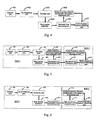
- the invention proposes a specific implementation apparatus as illustrated in Fig. 4 , where the base station apparatus includes a statistic unit 401, a determination unit 402, a decision unit 403, a base station scheduler 404, a baseband data processing unit 405, a radio frequency channel disablement information obtainment unit 406 and a radio frequency channel disabling unit 407.
- the base station apparatus includes a statistic unit 401, a determination unit 402, a decision unit 403, a base station scheduler 404, a baseband data processing unit 405, a radio frequency channel disablement information obtainment unit 406 and a radio frequency channel disabling unit 407.
- the statistic unit 401 is configured to collect and make a statistic of downlink traffic load information of the base station and to report the information at a preset periodicity.
- the report periodicity can be set as needed to an integer multiple of 10ms.
- the determination unit 402 is configured to determine the traffic load average of downlink sub-frames according to the downlink traffic load information reported from the statistic unit 401, to determine whether to initiate to an operation of disabling a downlink sub-frame using an MBSFN sub-frame, and to notify the decision unit 403 of a determination result.
- the technology of disabling a downlink sub-frame using an MBSFN sub-frame can be initiated if the traffic load average of downlink sub-frames is below a downlink sub-frame traffic load threshold ⁇ (K_DL - 1) and a number m of MBSFN sub-frames can be set at most, if the traffic load average of downlink sub-frames is below the downlink sub-frame traffic load threshold ⁇ (K_DL - m), where m ⁇ K_DL.
- Downlink sub-frame traffic load threshold Average amount of data borne in downlink sub-fame * ⁇ , where ⁇ represents a preset load factor.
- the decision unit 403 is configured to determine which downlink sub-frames are to be set to MBSFN sub-frames and to notify the base station scheduler 404 of them.
- the MBSFN sub-frames shall be determined taking into account an influence of a common channel, e.g., broadcast, paging, etc.
- the radio frequency channel disablement decision unit is configured to decide which sub-fames without downlink data transmitted therein can be set to MBSFN sub-frames and to notify the base station scheduler 404 of them.
- the base station scheduler 404 is configured to determine the number of uni-cast symbols (control area symbols) included in a determined MBSFN sub-frame in which no downlink data is transmitted. There is no uni-cast symbol in the MBSFN sub-frame in which no downlink data is transmitted if neither data of a corresponding uplink sub-frame is to be scheduled nor uplink feed information ACK/NACK is to be borne in the MBSFN sub-frame in which no downlink data is transmitted. If a sub-frame bears downlink data, then the sub-frame is required to be scheduled by transferring the borne data to another available downlink sub-frame for transmission.
- the baseband data processing unit 405 is configured to set data of multicast symbols of the downlink sub-frames, which can be disabled, to a specific value, which can be all-zero or all-one or can be a specific sequence to identify symbol disablement, according to a notification of the base station scheduler 404.
- the radio frequency channel disablement information obtainment unit 406 is configured to detect a starting point of time at which a radio frequency channel is disabled. If baseband data of a symbol is a specific consecutive value or a sequence to identify symbol disablement, the starting time of the symbol is determined as the starting point of time for performing disablement. The determination will be made for the first three symbols at most because the first one or two symbols of an MBSFN sub-frame may be uni-cast symbols, and the sub-frame has not been set to an MBSFN sub-frame and thus no operation of disabling a symbol or a radio frequency channel will be performed if the third symbol is still not zero.
- the radio frequency channel disablement information obtainment unit 406 is further configured to generate and transmit an instruction to disable a radio frequency channel possibly in the form of a switch level or another instruction form.
- the radio frequency channel disabling unit 407 is configured to perform an operation of disabling a radio frequency channel, according to the starting point of time output from the radio frequency channel disablement information obtainment unit 406, from the starting point of time to the last symbol.
- the radio frequency channel disabling unit 407 can disable all the radio frequency channel at a time or disable a radio frequency channel separately, that is, disable a small signal portion (a digital to analog converter, an analog transceiver and other analog devices) and a large signal portion (a power amplifier) of the radio frequency channel separately, dependent upon a varying design demand of the radio frequency channel.
- a radio frequency device will experience a signal settling procedure from a disabling status to an operating status, so the ending time for a disabling periodicity of a sub-frame shall be advanced appropriately, typically by 1 to 5 ⁇ s dependent upon a different settlement period of time for the device.
- a Radio Remote Unit shall determine by itself when to initiate disabling of a radio frequency channel according to data transmitted from a Base Band Unit (BBU) to the RRU; or a radio frequency channel disablement information detection and notification unit may be arranged at the BBU to notify the RRU of when to disable a radio frequency channel.
- BBU Base Band Unit
- the BBU includes a statistic unit 501, a determination unit 502, a decision unit 503, a base station scheduler 504, a baseband data processing unit 505 and a radio frequency channel disablement information detection and notification unit 506.
- the RRU includes a baseband data reception unit 511, a radio frequency channel disablement information obtainment unit 512 and a radio frequency channel disabling unit 513.
- the statistic unit 501 is configured to collect and make a statistic of downlink traffic load information of the base station and to report the information at a preset periodicity.
- the report periodicity can be set as needed to an integer multiple of 10ms.
- the determination unit 502 is configured to determine the traffic load average of downlink sub-frames according to the downlink traffic load information reported from the statistic unit 501, to determine hereby whether to initiate an operation of disabling a downlink sub-frame using an MBSFN sub-frame, and to notify the decision unit 503 of a determination result.
- the technology of disabling a downlink sub-frame using an MBSFN sub-frame can be initiated if the traffic load average of downlink sub-frames is below a downlink sub-frame traffic load threshold ⁇ (K_DL - 1) and a number m of MBSFN sub-frames can be set at most, if the traffic load average of downlink sub-frames is below the downlink sub-frame traffic load threshold ⁇ (K_DL - m), where m ⁇ K_DL.
- Downlink sub-frame traffic load threshold Average amount of data borne in downlink sub-fame * ⁇ , where ⁇ represents a preset load factor.
- the decision unit 503 is configured to determine which downlink sub-frames are to be set to MBSFN sub-frames and to notify the base station scheduler 504 of them.
- the MBSFN sub-frames shall be determined taking into account an influence of a common channel, e.g., broadcast, paging, etc.
- the radio frequency channel disablement decision unit is configured to decide which sub-fames without downlink data transmitted therein can be set to MBSFN sub-frames and to notify the base station scheduler of them.
- the base station scheduler 504 is configured to determine the number of uni-cast symbols (control area symbols) included in a determined MBSFN sub-frame in which no downlink data is transmitted. There is no uni-cast symbol in the MBSFN sub-frame in which no downlink data is transmitted if neither data of a corresponding uplink sub-frame is to be scheduled nor uplink feed information ACK/NACK is to be borne in the MBSFN sub-frame in which no downlink data is transmitted. If a sub-frame bears downlink data, then the sub-frame is required to be scheduled by transferring the borne data to another available downlink sub-frame for transmission.
- the baseband data processing unit 505 is configured to set baseband data of multicast symbols of the downlink sub-frames, which can be disabled, to a specific value (which can be all-zero or all-one or can be a specific sequence to identify symbol disablement) according to a notification of the base station scheduler 504 and to transmit the baseband data to the RRU.
- the radio frequency channel disablement information detection and notification unit 506 is configured to detect a starting location of multicast symbols.
- the first one or two symbols of an MBSFN sub-frame are uni-cast symbols for boring control information, and the remaining part that follows is used as multicast symbols for MBSFN transmission, and in order to facilitate disabling of a corresponding physical channel, data at the locations in which the MBSFN multicast symbols are borne can be set to a specific value (e.g., consecutive zeros) for the purpose of identification to facilitate a check of a point of time for disabling a radio frequency channel.
- an MBSFN sub-frame may include one or two symbols in which uni-cast control information is borne. If the baseband data is the specific consecutive value or the sequence to identify symbol disablement, then the starting point of time for performing disablement is the starting point of time for the symbol and notified to the RRU, possibly by signalling the point of time to the RRU.
- the baseband data reception unit 511 is configured to receive the baseband data from the BBU.
- the radio frequency channel disablement information obtainment unit 512 is configured to receive information on the point of time for disabling a radio frequency from the BBU and to transmit a corresponding control instruction to the radio frequency channel disabling unit 513.
- the radio frequency channel disabling unit 513 is configured to perform operations of enabling and disabling a radio frequency channel according to the control instruction output from the radio frequency channel disablement information obtainment unit 512.
- the radio frequency channel disabling unit is controlled to disable all the radio frequency channel at a time or disable a radio frequency channel separately, that is, disable a small signal portion (a digital to analog converter, an analog transceiver and other analog devices) and a large signal portion (a power amplifier) of the radio frequency channel separately, dependent upon a varying design demand of the radio frequency channel.
- the invention further proposes another specific implementation apparatus as illustrated in Fig. 6 :
- the statistic unit 601 is configured to collect and make a statistic of downlink traffic load information of the base station and to report the information at a preset periodicity.
- the report periodicity can be set as needed to an integer multiple of 10ms.
- the determination unit 602 is configured to determine the traffic load average of downlink sub-frames according to the downlink traffic load information reported from the statistic unit 601, to determine hereby whether to initiate an operation of disabling a downlink sub-frame using an MBSFN sub-frame, and to notify the decision unit 603 of a determination result.
- the technology of disabling a downlink sub-frame using an MBSFN sub-frame can be initiated if the traffic load average of downlink sub-frames is below a downlink sub-frame traffic load threshold ⁇ (K_DL - 1); and a number m of MBSFN sub-frames can be set at most, if the traffic load average of downlink sub-frames is below the downlink sub-frame traffic load threshold ⁇ (K_DL - m), where m ⁇ K_DL.
- Downlink sub-frame traffic load threshold Average amount of data borne in downlink sub-fame * ⁇ , where ⁇ represents a preset load factor.
- the decision unit 603 is configured to determine which downlink sub-frames are to be set to MBSFN sub-frames and to notify the base station scheduler 604 of them.
- the MBSFN sub-frames shall be determined taking into account an influence of a common channel, e.g., broadcast, paging, etc.
- the radio frequency channel disablement decision unit is configured to decide which sub-fames without downlink data transmitted therein can be set to MBSFN sub-frames and to notify the base station scheduler of them.
- the base station scheduler 604 is configured to determine the number of uni-cast symbols (control area symbols) included in a determined MBSFN sub-frame in which no downlink data is transmitted. There is no uni-cast symbol in the MBSFN sub-frame in which no downlink data is transmitted if neither data of a corresponding uplink sub-frame is to be scheduled nor uplink feed information ACK/NACK is to be borne in the MBSFN sub-frame in which no downlink data is transmitted. If a sub-frame bears downlink data, then the sub-frame is required to be scheduled by transferring the borne data to another available downlink sub-frame for transmission.
- the baseband data processing unit 605 is configured to set baseband data of the downlink sub-frames, which can be disabled, to a specific sequence to identify disabled symbols, where the specific sequence can be consecutive zeros or ones or can be a specific sequence to identify symbol disablement, according to a notification of the base station scheduler 604 and to transmit the baseband data to the RRU.
- the baseband data reception unit 611 is configured to receive the baseband data from the BBU.
- the radio frequency channel disablement information obtainment unit 612 is configured to detect a starting location of multicast symbols.
- the first one or two symbols of an MBSFN sub-frame are uni-cast symbols for boring control information, and the remaining part that follows is used as multicast symbols for MBSFN transmission, and in order to facilitate disabling of a corresponding physical channel, data at the locations in which the MBSFN multicast symbols are borne can be set to a specific value (e.g., consecutive zeros) for the purpose of identification to facilitate a check of a point of time for disabling a radio frequency channel.
- an MBSFN sub-frame may include one or two symbols in which uni-cast control information is borne. If the baseband data is the specific consecutive value or the sequence to identify symbol disablement, then the starting point of time for performing disablement is the starting point of time for the symbol and a corresponding instruction to disable/enable a radio frequency channel is transmitted to the radio frequency channel disabling unit 613.
- the radio frequency channel disabling unit 613 is configured to perform an operation of disabling/enabling a radio frequency channel according to the corresponding instruction to disable/enable a radio frequency channel output from the radio frequency channel disablement information obtainment unit 612.
- the radio frequency channel disabling unit 613 can disable all the radio frequency channels at a time or disable a radio frequency channel separately, that is, disable a small signal portion (a digital to analog converter, an analog transceiver and other analog devices) and a large signal portion (a power amplifier) of the radio frequency channel separately, dependent upon a varying design demand of the radio frequency channels.
- the radio frequency channel disablement determination/detection unit may be located differently so that the radio frequency channel disablement determination/detection unit can be implemented at a BBU or an RRU for a distributed base station.
- the embodiments of the invention can be embodied as a method, a system or a computer program product. Therefore the invention can be embodied in the form of an all-hardware embodiment, an all-software embodiment or an embodiment of software and hardware in combination. Furthermore the invention can be embodied in the form of a computer program product embodied in one or more computer useable storage mediums (including but not limited to a disk memory, a CD-ROM, an optical memory, etc.) in which computer useable program codes are contained.
- a computer useable storage mediums including but not limited to a disk memory, a CD-ROM, an optical memory, etc.
- These computer program instructions can also be stored into a computer readable memory capable of directing the computer or the other programmable data processing device to operate in a specific manner so that the instructions stored in the computer readable memory create an article of manufacture including instruction means which perform the functions specified in the flow(s) of the flow chart and/or the block(s) of the block diagram.
- These computer program instructions can also be loaded onto the computer or the other programmable data processing device so that a series of operational steps are performed on the computer or the other programmable data processing device to create a computer implemented process so that the instructions executed on the computer or the other programmable device provide steps for performing the functions specified in the flow(s) of the flow chart and/or the block(s) of the block diagram.
Landscapes
- Engineering & Computer Science (AREA)
- Computer Networks & Wireless Communication (AREA)
- Signal Processing (AREA)
- Mobile Radio Communication Systems (AREA)
Claims (11)
- Procédé d'économie d'énergie d'une station de base dans un système de communication mobile, le procédé comportant les étapes ci-dessous consistant à :collecter et réaliser des statistiques d'informations de charge de trafic en liaison descendante d'une station de base et signaler des informations de résultats statistiques avec une périodicité prédéfinie, dans lequel la périodicité prédéfinie est un multiple entier de 10 ms ;déterminer s'il convient de définir une sous-trame de liaison descendante de réseau de multidiffusion/diffusion monofréquence, MBSFN, dans laquelle aucun service de multidiffusion n'est pris en charge selon les statistiques d'informations de charge de trafic en liaison descendante ;déterminer une sous-trame de liaison descendante qui est définie sur la sous-trame de réseau MBSFN ;détecter des informations de désactivation de canal radiofréquence ;mettre en oeuvre une opération de désactivation d'un canal radiofréquence selon les informations de désactivation de canal radiofréquence détectées ;définir des données de bande de base de symboles de multidiffusion de la sous-trame de liaison descendante de réseau MBSFN sur une valeur spécifique, dans laquelle la valeur spécifique est 0 ou 1, ou une séquence pour identifier une désactivation de symboles ;détecter des données de bande de base sur chaque symbole en partant du premier symbole, et déterminer un instant de début, où les données de bande de base correspondent à la valeur spécifique, en tant qu'instant de début pour une instruction visant à désactiver un canal radiofréquence ; etmettre en oeuvre l'opération de désactivation du canal radiofréquence pour une période de sous-trame correspondante selon l'instant de début pour désactiver le canal radiofréquence.
- Procédé selon la revendication 1, dans lequel l'étape consistant à collecter et à réaliser des statistiques d'informations de charge de trafic en liaison descendante comprend les étapes ci-dessous consistant à :déterminer la charge de trafic moyenne de sous-trames de liaison descendante selon une quantité de données dans une mémoire tampon de données de liaison descendante ; oudéterminer la charge de trafic moyenne de sous-trames de liaison descendante selon une quantité de données moyenne dans une mémoire tampon de données de liaison descendante au cours d'une période statistique prédéfinie.
- Procédé selon la revendication 1 ou 2, dans lequel la nécessité de définir ou non une sous-trame de liaison descendante de réseau de multidiffusion/diffusion monofréquence, MBSFN, dans laquelle aucun service de multidiffusion n'est pris en charge est déterminée lorsque la charge de trafic moyenne de sous-trames de liaison descendante est inférieure à un seuil de charge de trafic de sous-trames de liaison descendante, et dans lequel le seuil de charge de trafic de sous-trames de liaison descendante est égal au produit d'une quantité de données moyenne prise en charge dans une sous-trame de liaison descendante et d'un facteur de charge prédéfini.
- Procédé selon la revendication 1, dans lequel, suite à la détermination de la sous-trame de liaison descendante de réseau MBSFN, le procédé comprend en outre l'étape ci-dessous consistant à :planifier des données prises en charge dans la sous-trame de liaison descendante de réseau MBSFN déterminée sur une autre sous-trame de liaison descendante disponible, ou ne pas affecter de données à la sous-trame de liaison descendante de réseau MBSFN déterminée.
- Procédé selon la revendication 4, dans lequel, pour un système de duplexage FDD, la sous-trame de liaison descendante de réseau MBSFN dans laquelle aucun service de multidiffusion n'est pris en charge inclut :une ou plusieurs sous-trames parmi la sous-trame 1, la sous-trame 2, la sous-trame 3, la sous-trame 6, la sous-trame 7 et la sous-trame 8.
- Procédé selon la revendication 4, dans lequel, pour un système de duplexage TDD, la sous-trame de liaison descendante de réseau MBSFN dans laquelle aucun service de multidiffusion n'est pris en charge inclut :une sous-trame de liaison descendante au niveau de la queue d'une trame ou demi-trame radio correspondante ; etdans lequel la sous-trame de liaison descendante de réseau MBSFN dans laquelle aucun service de multidiffusion n'est pris en charge inclut :une ou plusieurs sous-trames parmi la sous-trame 3, la sous-trame 4, la sous-trame 7, la sous-trame 8 et la sous-trame 9.
- Procédé selon la revendication 1, dans lequel, suite à la détermination de la sous-trame de liaison descendante de réseau MBSFN, le procédé comprend en outre l'étape dans laquelle : la station de base transmet des informations de configuration de la sous-trame de réseau MBSFN dans un message de diffusion.
- Procédé selon la revendication 7, dans lequel le message de diffusion est pris en charge dans un bloc d'informations système de Type13, SIB13.
- Procédé selon la revendication 1, dans lequel la désactivation d'un canal radiofréquence correspondant à des symboles de multidiffusion consiste à :désactiver une petite partie de signal radiofréquence et/ou une grande partie de signal radiofréquence pour une période de temps correspondante ; etdans lequel la petite partie de signal radiofréquence inclut un convertisseur numérique à analogique et un émetteur-récepteur analogique ; et la grande partie de signal radiofréquence inclut un amplificateur de puissance.
- Appareil de station de base, comprenant un planificateur de station de base (404, 504, 604) et une unité de traitement de données de bande de base (405, 505, 605), l'appareil de station de base comportant en outre une unité de statistiques (401, 501, 601), une unité de détermination (402, 502, 602), une unité de décision (403, 503, 603), une unité d'obtention d'informations de désactivation de canal radiofréquence (406, 512, 612) et une unité de désactivation de canal radiofréquence (407, 513, 613), et dans lequel :l'unité de statistiques (401, 501, 601) est configurée de manière à collecter et à réaliser des statistiques d'informations de charge de trafic en liaison descendante d'une station de base, et à signaler des informations de résultats statistiques avec une périodicité prédéfinie, dans laquelle la périodicité prédéfinie est un multiple entier de 10 ms ;l'unité de détermination (402, 502, 602) est configurée de manière à déterminer s'il convient de définir une sous-trame de liaison descendante de réseau de multidiffusion/diffusion monofréquence, MBSFN, dans laquelle aucun service de multidiffusion n'est pris en charge selon les informations de charge de trafic en liaison descendante signalées par l'unité de statistiques (401, 501, 601) ;l'unité de décision (403, 503, 603) est configurée de manière à déterminer une sous-trame de liaison descendante qui est définie sur la sous-trame de réseau MBSFN ;l'unité d'obtention d'informations de désactivation de canal radiofréquence (406, 512, 612) est configurée de manière à détecter des informations de désactivation de canal radiofréquence ;l'unité de désactivation de canal radiofréquence (407, 513, 613) est configurée de manière à mettre en oeuvre une opération de désactivation d'un canal radiofréquence selon les informations de désactivation de canal radiofréquence obtenues par l'unité d'obtention d'informations de désactivation de canal radiofréquence (406, 512, 612) ; etl'unité de traitement de données de bande de base (405, 505, 605) est configurée de manière à définir des données de bande de base de symboles de multidiffusion de la sous-trame de liaison descendante de réseau MBSFN sur une valeur spécifique, dans laquelle la valeur spécifique est 0 ou 1, ou une séquence pour identifier une désactivation de symboles ; etdans lequel l'unité d'obtention d'informations de désactivation de canal radiofréquence (406, 512, 612) est en outre configurée de manière à détecter des données de bande de base sur chaque symbole, en partant du premier symbole, et à déterminer un instant de début, où les données de bande de base correspondent à la valeur spécifique, en tant qu'instant de début pour une instruction visant à désactiver un canal radiofréquence ; etl'unité de désactivation de canal radiofréquence (407, 513, 613) est en outre configurée de manière à mettre en oeuvre l'opération de désactivation du canal radiofréquence au cours d'une période de sous-trame correspondante selon l'instant de début pour désactiver le canal radiofréquence généré en sortie à partir de l'unité d'obtention d'informations de désactivation de canal radiofréquence (406, 512, 612).
- Appareil selon la revendication 10, dans lequel l'unité de statistiques (501, 601), l'unité de détermination (502, 602), l'unité de décision (503, 603), le planificateur de station de base (504, 604) et l'unité de traitement de données de bande de base (505, 605) sont agencés dans une unité de bande de base, BBU ; et
l'unité d'obtention d'informations de désactivation de canal radiofréquence (512, 612) et l'unité de désactivation de canal radiofréquence (513, 613) sont agencées dans une unité radio distante, RRU ; et
l'unité RRU comprend en outre :une unité de réception de données de bande de base (511, 611) configurée de manière à recevoir des données de bande de base en provenance de l'unité BBU ; etdans lequel l'unité BBU comprend en outre :une unité de détection et de notification d'informations de désactivation de canal radiofréquence (506) configurée de manière à détecter des données de bande de base sur chaque symbole, en partant du premier symbole, à déterminer un instant de début, où les données de bande de base correspondent à une valeur spécifique, en tant qu'instant de début pour mettre en oeuvre la désactivation, et à notifier, à l'unité RRU, l'instant de désactivation ; etdans lequel l'unité de détection et de notification d'informations de désactivation de canal radiofréquence (506) est en outre configurée de manière à :signaler l'instant de désactivation à l'unité RRU.
Applications Claiming Priority (2)
| Application Number | Priority Date | Filing Date | Title |
|---|---|---|---|
| CN201010234567.7A CN102340852B (zh) | 2010-07-20 | 2010-07-20 | 移动通信系统基站节能方法及装置 |
| PCT/CN2011/077299 WO2012010074A1 (fr) | 2010-07-20 | 2011-07-19 | Procédé et appareil d'économie d'énergie dans une station de base d'un système de communications mobiles |
Publications (3)
| Publication Number | Publication Date |
|---|---|
| EP2568732A1 EP2568732A1 (fr) | 2013-03-13 |
| EP2568732A4 EP2568732A4 (fr) | 2013-04-10 |
| EP2568732B1 true EP2568732B1 (fr) | 2015-10-21 |
Family
ID=45496515
Family Applications (1)
| Application Number | Title | Priority Date | Filing Date |
|---|---|---|---|
| EP11809262.6A Active EP2568732B1 (fr) | 2010-07-20 | 2011-07-19 | Procédé et appareil d'économie d'énergie dans une station de base d'un système de communications mobiles |
Country Status (4)
| Country | Link |
|---|---|
| US (1) | US9014095B2 (fr) |
| EP (1) | EP2568732B1 (fr) |
| CN (1) | CN102340852B (fr) |
| WO (1) | WO2012010074A1 (fr) |
Cited By (2)
| Publication number | Priority date | Publication date | Assignee | Title |
|---|---|---|---|---|
| US20250024362A1 (en) * | 2021-11-26 | 2025-01-16 | Zte Corporation | Energy-saving control method and device, storage medium, and program product |
| EP4564935A4 (fr) * | 2022-07-30 | 2025-11-05 | Huawei Tech Co Ltd | Procédé d'économie d'énergie et appareil associé |
Families Citing this family (32)
| Publication number | Priority date | Publication date | Assignee | Title |
|---|---|---|---|---|
| KR101527978B1 (ko) * | 2008-08-06 | 2015-06-18 | 엘지전자 주식회사 | 기지국과 중계기 사이의 서브프레임을 사용하여 통신하는 방법 및 장치 |
| WO2011071425A1 (fr) * | 2009-12-08 | 2011-06-16 | Telefonaktiebolaget L M Ericsson (Publ) | Procédé et agencement d'équilibrage de consommation d'énergie entre stations de base dans un système de communication |
| CN102340853A (zh) * | 2010-07-20 | 2012-02-01 | 电信科学技术研究院 | 移动通信系统基站节能方法及装置 |
| US9294995B2 (en) | 2012-03-23 | 2016-03-22 | Nokia Solutions And Networks Oy | Activate ES cell for particular UE(s) |
| US8797852B2 (en) * | 2012-06-11 | 2014-08-05 | Alcatel Lucent | Dynamical bandwidth adjustment of a link in a data network |
| US8873466B2 (en) * | 2012-10-12 | 2014-10-28 | Freescale Semiconductor, Inc. | Timing event generation circuit for mobile communication device |
| CN103841579B (zh) * | 2012-11-27 | 2017-10-31 | 上海贝尔股份有限公司 | 通信系统中用于频谱检测方法和装置 |
| WO2015122811A1 (fr) * | 2014-02-14 | 2015-08-20 | Telefonaktiebolaget L M Ericsson (Publ) | Procédé et appareil pour la configuration de relations de cellules voisines |
| KR101871873B1 (ko) | 2014-03-03 | 2018-06-28 | 후아웨이 테크놀러지 컴퍼니 리미티드 | 정보 송신 방법, 수신 방법 및 장치 |
| US9215744B2 (en) | 2014-05-15 | 2015-12-15 | Telefonaktiebolaget L M Ericsson (Publ) | Discontinuous transmission for a mobile phone network node |
| WO2015198106A1 (fr) | 2014-06-25 | 2015-12-30 | Telefonaktiebolaget L M Ericsson (Publ) | Systèmes et procédés pour permettant la coexistence de services mbms et voip |
| WO2015199491A1 (fr) * | 2014-06-26 | 2015-12-30 | 엘지전자 주식회사 | Procédé pour émettre et recevoir des informations de commande pour un service de diffusion et multidiffusion, et dispositif associé |
| CN105306398B (zh) * | 2014-07-22 | 2018-04-10 | 普天信息技术有限公司 | eMBMS基带信号生成方法、基带处理单元和基站 |
| CN104618995B (zh) * | 2015-01-08 | 2018-04-27 | 大唐移动通信设备有限公司 | 一种符号关断的处理方法和设备 |
| CN106332244A (zh) * | 2015-07-01 | 2017-01-11 | 中兴通讯股份有限公司 | 一种lte系统的节能方法及装置 |
| CN106572534A (zh) * | 2015-10-10 | 2017-04-19 | 中兴通讯股份有限公司 | 寻呼处理方法及装置 |
| EP3382902A4 (fr) * | 2015-12-21 | 2018-12-19 | Huawei Technologies Co., Ltd. | Procédé et système d'acquisition de différence de réponse en fréquence d'un canal d'unité radio distante (rru), et équipement de station de base |
| CN109286965A (zh) * | 2017-07-20 | 2019-01-29 | 中国移动通信有限公司研究院 | 分布式基站的休眠处理方法、网元实体及存储介质 |
| CN109756955B (zh) * | 2017-11-01 | 2021-11-30 | 北京紫光展锐通信技术有限公司 | 一种终端及其电路控制方法 |
| WO2019125242A1 (fr) | 2017-12-20 | 2019-06-27 | Telefonaktiebolaget Lm Ericsson (Publ) | Procédés d'optimisation d'énergie de systèmes à antennes multiples |
| FR3078468A1 (fr) * | 2018-02-28 | 2019-08-30 | Orange | Procede de mise en veille d'une station de base, produit programme d'ordinateur, dispositif, station de base et signal correspondants. |
| EP3799484B1 (fr) * | 2018-06-20 | 2025-08-06 | Huawei Technologies Co., Ltd. | Procédé de traitement de symboles, et dispositif associé |
| CN110752901B (zh) * | 2018-07-24 | 2022-05-03 | 中兴通讯股份有限公司 | 一种无线帧中符号的搬迁方法及装置 |
| WO2020167014A1 (fr) * | 2019-02-15 | 2020-08-20 | 엘지전자 주식회사 | Procédé, équipement d'utilisateur, dispositif et support d'informations pour réaliser une émission de liaison montante et procédé et station de base pour réaliser une réception de liaison montante |
| CN110062450B (zh) * | 2019-06-05 | 2022-02-15 | 中国联合网络通信集团有限公司 | 5g基站节约能耗的方法、装置、设备及可读存储介质 |
| CN114070696B (zh) * | 2020-07-31 | 2023-03-10 | 上海华为技术有限公司 | 一种信号传输的方法及其相关设备 |
| CN114521005B (zh) * | 2020-11-20 | 2025-01-28 | 中兴通讯股份有限公司 | 基站节能的控制方法和装置、计算机可读存储介质 |
| EP4020823A1 (fr) * | 2020-12-22 | 2022-06-29 | INTEL Corporation | Système distribué de casque radio |
| CN114665915B (zh) * | 2020-12-23 | 2023-04-07 | 上海华为技术有限公司 | 一种射频通道管理方法、装置及相关设备 |
| EP4020853A1 (fr) * | 2020-12-24 | 2022-06-29 | INTEL Corporation | Système de casque audio distribué |
| WO2022252126A1 (fr) * | 2021-06-01 | 2022-12-08 | 海能达通信股份有限公司 | Procédé d'économie d'énergie d'une station de base, station de base, dispositif associé, et support de stockage |
| CN117528743B (zh) * | 2024-01-05 | 2024-03-22 | 深圳市佳贤通信科技股份有限公司 | 基于oran架构的4g扩展型小基站的节能系统及方法 |
Family Cites Families (13)
| Publication number | Priority date | Publication date | Assignee | Title |
|---|---|---|---|---|
| CN101179814A (zh) | 2007-11-28 | 2008-05-14 | 上海华为技术有限公司 | 基站节能方法及装置 |
| CN101656717B (zh) * | 2008-08-21 | 2013-06-05 | 中兴通讯股份有限公司 | 单频网上多播/广播子帧的获取/配置方法及获取装置 |
| CN101299841A (zh) * | 2008-06-06 | 2008-11-05 | 华为技术有限公司 | 一种移动通信控制方法、基站控制器、基站及系统 |
| CN101742516B (zh) * | 2008-11-21 | 2012-01-25 | 中国移动通信集团湖南有限公司 | 控制基站能耗状态的方法及装置 |
| CN101754336B (zh) * | 2008-12-17 | 2012-09-05 | 中兴通讯股份有限公司 | 一种基于lte tdd系统的基站省电方法和系统 |
| ES2759599T3 (es) * | 2009-02-13 | 2020-05-11 | Ericsson Telefon Ab L M | Control del consumo de energía de un nodo de red inalámbrica |
| US8855062B2 (en) * | 2009-05-28 | 2014-10-07 | Qualcomm Incorporated | Dynamic selection of subframe formats in a wireless network |
| CN101778458B (zh) * | 2010-01-05 | 2015-09-16 | 中兴通讯股份有限公司 | 一种基站节能方法及系统 |
| EP2526658B1 (fr) * | 2010-01-18 | 2014-06-11 | Telefonaktiebolaget LM Ericsson (publ) | Procede pour reserver une capacite sur une liaison de reseau de communication |
| US20120315948A1 (en) * | 2010-02-24 | 2012-12-13 | Telefonaktiebolaget Lm Ericsson (Publ) | Method and Apparatus for Controlling Energy Consumption in a Multi-Antenna Base Station |
| CN102742181B (zh) * | 2010-06-13 | 2014-12-10 | Lg电子株式会社 | 在无线通信系统中对终端发送指示服务区域的计数响应消息的方法及其设备 |
| US8638868B2 (en) * | 2010-06-23 | 2014-01-28 | Telefonaktiebolaget L M Ericsson (Publ) | Methods and apparatus for varying reduced transmission resources |
| CN102340853A (zh) * | 2010-07-20 | 2012-02-01 | 电信科学技术研究院 | 移动通信系统基站节能方法及装置 |
-
2010
- 2010-07-20 CN CN201010234567.7A patent/CN102340852B/zh active Active
-
2011
- 2011-07-19 US US13/700,985 patent/US9014095B2/en active Active
- 2011-07-19 EP EP11809262.6A patent/EP2568732B1/fr active Active
- 2011-07-19 WO PCT/CN2011/077299 patent/WO2012010074A1/fr not_active Ceased
Non-Patent Citations (1)
| Title |
|---|
| ERICSSON ET AL: "Extended cell DTX for enhanced energy-efficient network operation", 3GPP DRAFT; R1-095011{ENERGY EFFICIENCY}, 3RD GENERATION PARTNERSHIP PROJECT (3GPP), MOBILE COMPETENCE CENTRE ; 650, ROUTE DES LUCIOLES ; F-06921 SOPHIA-ANTIPOLIS CEDEX ; FRANCE, vol. RAN WG1, 5 November 2009 (2009-11-05), XP050489176 * |
Cited By (2)
| Publication number | Priority date | Publication date | Assignee | Title |
|---|---|---|---|---|
| US20250024362A1 (en) * | 2021-11-26 | 2025-01-16 | Zte Corporation | Energy-saving control method and device, storage medium, and program product |
| EP4564935A4 (fr) * | 2022-07-30 | 2025-11-05 | Huawei Tech Co Ltd | Procédé d'économie d'énergie et appareil associé |
Also Published As
| Publication number | Publication date |
|---|---|
| EP2568732A1 (fr) | 2013-03-13 |
| WO2012010074A1 (fr) | 2012-01-26 |
| US20130070635A1 (en) | 2013-03-21 |
| CN102340852B (zh) | 2015-02-18 |
| CN102340852A (zh) | 2012-02-01 |
| EP2568732A4 (fr) | 2013-04-10 |
| US9014095B2 (en) | 2015-04-21 |
Similar Documents
| Publication | Publication Date | Title |
|---|---|---|
| EP2568732B1 (fr) | Procédé et appareil d'économie d'énergie dans une station de base d'un système de communications mobiles | |
| US20250023701A1 (en) | Scell dormancy indication by pdcch | |
| US10567939B2 (en) | Method for transmitting/receiving signal by MTC UE, and apparatus therefor | |
| US10149288B2 (en) | Method and device for receiving or transmitting downlink data in wireless communication system | |
| US9277513B2 (en) | Terminal apparatus for controlling downlink transmission power and method for same | |
| US10645675B2 (en) | Method and apparatus for providing MBMS service for low complexity user equipment in wireless communication system | |
| JP6795489B2 (ja) | 端末装置、基地局装置、および通信方法 | |
| CN102685891B (zh) | 一种无线通信系统中载波聚合的实现方法及系统 | |
| EP4233248A1 (fr) | Mise à jour d'état d'indicateur tci à base d'informations dci avec une sélection de canal flexible | |
| EP3177092B1 (fr) | Dispositif de terminal, dispositif de station de base, procédé de communication et circuit intégré | |
| US10383025B2 (en) | Method for controlling handover in wireless communication system, and device therefor | |
| EP2753005A1 (fr) | Procédé et dispositif de transmission de données | |
| CN113785623A (zh) | 多面板激活/去激活状态报告 | |
| CN102340854A (zh) | 移动通信系统基站节能方法及装置 | |
| US9980080B2 (en) | Terminal, method, and integrated circuit for controlling transmit powers | |
| JP2025526782A (ja) | 2部分構成のウェイクアップ信号の構造 | |
| WO2013189300A1 (fr) | Procédé et dispositif pour transmettre des données de diffusion de système | |
| WO2016021713A1 (fr) | Dispositif station de base, dispositif terminal, et procédé | |
| JP2019165269A (ja) | 基地局装置、端末装置および通信方法 | |
| JP2025526781A (ja) | ウェイクアップ信号の構造 | |
| EP4668939A1 (fr) | Procédé et appareil de configuration de ressources de signal de référence | |
| KR102766897B1 (ko) | 협대역-사물 인터넷 시스템에서 단일-셀 일-대-다 전송 방법 및 장치 | |
| KR20260017955A (ko) | 저전력 신호 송수신을 위한 빔 관리 방법 및 장치 | |
| KR20240031883A (ko) | 네트워크 에너지 절감을 위한 시그널링 방법 및 장치 | |
| WO2016136780A1 (fr) | Dispositif de terminal, dispositif de station de base et procédé de communication |
Legal Events
| Date | Code | Title | Description |
|---|---|---|---|
| PUAI | Public reference made under article 153(3) epc to a published international application that has entered the european phase |
Free format text: ORIGINAL CODE: 0009012 |
|
| 17P | Request for examination filed |
Effective date: 20121203 |
|
| AK | Designated contracting states |
Kind code of ref document: A1 Designated state(s): AL AT BE BG CH CY CZ DE DK EE ES FI FR GB GR HR HU IE IS IT LI LT LU LV MC MK MT NL NO PL PT RO RS SE SI SK SM TR |
|
| A4 | Supplementary search report drawn up and despatched |
Effective date: 20130307 |
|
| RIC1 | Information provided on ipc code assigned before grant |
Ipc: H04W 88/08 20090101ALN20130301BHEP Ipc: H04W 52/02 20090101AFI20130301BHEP |
|
| 17Q | First examination report despatched |
Effective date: 20130410 |
|
| DAX | Request for extension of the european patent (deleted) | ||
| REG | Reference to a national code |
Ref country code: DE Ref legal event code: R079 Ref document number: 602011020894 Country of ref document: DE Free format text: PREVIOUS MAIN CLASS: H04W0016040000 Ipc: H04W0052020000 |
|
| RIC1 | Information provided on ipc code assigned before grant |
Ipc: H04W 88/08 20090101ALN20150219BHEP Ipc: H04W 52/02 20090101AFI20150219BHEP Ipc: H04W 72/00 20090101ALN20150219BHEP |
|
| RIC1 | Information provided on ipc code assigned before grant |
Ipc: H04W 88/08 20090101ALN20150224BHEP Ipc: H04W 52/02 20090101AFI20150224BHEP Ipc: H04W 72/00 20090101ALN20150224BHEP |
|
| GRAP | Despatch of communication of intention to grant a patent |
Free format text: ORIGINAL CODE: EPIDOSNIGR1 |
|
| INTG | Intention to grant announced |
Effective date: 20150506 |
|
| GRAS | Grant fee paid |
Free format text: ORIGINAL CODE: EPIDOSNIGR3 |
|
| GRAA | (expected) grant |
Free format text: ORIGINAL CODE: 0009210 |
|
| AK | Designated contracting states |
Kind code of ref document: B1 Designated state(s): AL AT BE BG CH CY CZ DE DK EE ES FI FR GB GR HR HU IE IS IT LI LT LU LV MC MK MT NL NO PL PT RO RS SE SI SK SM TR |
|
| REG | Reference to a national code |
Ref country code: NL Ref legal event code: MP Effective date: 20151021 Ref country code: GB Ref legal event code: FG4D |
|
| REG | Reference to a national code |
Ref country code: CH Ref legal event code: EP |
|
| REG | Reference to a national code |
Ref country code: AT Ref legal event code: REF Ref document number: 757351 Country of ref document: AT Kind code of ref document: T Effective date: 20151115 |
|
| REG | Reference to a national code |
Ref country code: IE Ref legal event code: FG4D |
|
| REG | Reference to a national code |
Ref country code: DE Ref legal event code: R096 Ref document number: 602011020894 Country of ref document: DE |
|
| REG | Reference to a national code |
Ref country code: LT Ref legal event code: MG4D |
|
| REG | Reference to a national code |
Ref country code: AT Ref legal event code: MK05 Ref document number: 757351 Country of ref document: AT Kind code of ref document: T Effective date: 20151021 |
|
| PG25 | Lapsed in a contracting state [announced via postgrant information from national office to epo] |
Ref country code: IS Free format text: LAPSE BECAUSE OF FAILURE TO SUBMIT A TRANSLATION OF THE DESCRIPTION OR TO PAY THE FEE WITHIN THE PRESCRIBED TIME-LIMIT Effective date: 20160221 Ref country code: NO Free format text: LAPSE BECAUSE OF FAILURE TO SUBMIT A TRANSLATION OF THE DESCRIPTION OR TO PAY THE FEE WITHIN THE PRESCRIBED TIME-LIMIT Effective date: 20160121 Ref country code: LT Free format text: LAPSE BECAUSE OF FAILURE TO SUBMIT A TRANSLATION OF THE DESCRIPTION OR TO PAY THE FEE WITHIN THE PRESCRIBED TIME-LIMIT Effective date: 20151021 Ref country code: ES Free format text: LAPSE BECAUSE OF FAILURE TO SUBMIT A TRANSLATION OF THE DESCRIPTION OR TO PAY THE FEE WITHIN THE PRESCRIBED TIME-LIMIT Effective date: 20151021 Ref country code: IT Free format text: LAPSE BECAUSE OF FAILURE TO SUBMIT A TRANSLATION OF THE DESCRIPTION OR TO PAY THE FEE WITHIN THE PRESCRIBED TIME-LIMIT Effective date: 20151021 Ref country code: NL Free format text: LAPSE BECAUSE OF FAILURE TO SUBMIT A TRANSLATION OF THE DESCRIPTION OR TO PAY THE FEE WITHIN THE PRESCRIBED TIME-LIMIT Effective date: 20151021 Ref country code: HR Free format text: LAPSE BECAUSE OF FAILURE TO SUBMIT A TRANSLATION OF THE DESCRIPTION OR TO PAY THE FEE WITHIN THE PRESCRIBED TIME-LIMIT Effective date: 20151021 |
|
| PG25 | Lapsed in a contracting state [announced via postgrant information from national office to epo] |
Ref country code: AT Free format text: LAPSE BECAUSE OF FAILURE TO SUBMIT A TRANSLATION OF THE DESCRIPTION OR TO PAY THE FEE WITHIN THE PRESCRIBED TIME-LIMIT Effective date: 20151021 Ref country code: PL Free format text: LAPSE BECAUSE OF FAILURE TO SUBMIT A TRANSLATION OF THE DESCRIPTION OR TO PAY THE FEE WITHIN THE PRESCRIBED TIME-LIMIT Effective date: 20151021 Ref country code: SE Free format text: LAPSE BECAUSE OF FAILURE TO SUBMIT A TRANSLATION OF THE DESCRIPTION OR TO PAY THE FEE WITHIN THE PRESCRIBED TIME-LIMIT Effective date: 20151021 Ref country code: RS Free format text: LAPSE BECAUSE OF FAILURE TO SUBMIT A TRANSLATION OF THE DESCRIPTION OR TO PAY THE FEE WITHIN THE PRESCRIBED TIME-LIMIT Effective date: 20151021 Ref country code: GR Free format text: LAPSE BECAUSE OF FAILURE TO SUBMIT A TRANSLATION OF THE DESCRIPTION OR TO PAY THE FEE WITHIN THE PRESCRIBED TIME-LIMIT Effective date: 20160122 Ref country code: LV Free format text: LAPSE BECAUSE OF FAILURE TO SUBMIT A TRANSLATION OF THE DESCRIPTION OR TO PAY THE FEE WITHIN THE PRESCRIBED TIME-LIMIT Effective date: 20151021 Ref country code: FI Free format text: LAPSE BECAUSE OF FAILURE TO SUBMIT A TRANSLATION OF THE DESCRIPTION OR TO PAY THE FEE WITHIN THE PRESCRIBED TIME-LIMIT Effective date: 20151021 Ref country code: PT Free format text: LAPSE BECAUSE OF FAILURE TO SUBMIT A TRANSLATION OF THE DESCRIPTION OR TO PAY THE FEE WITHIN THE PRESCRIBED TIME-LIMIT Effective date: 20160222 |
|
| REG | Reference to a national code |
Ref country code: DE Ref legal event code: R097 Ref document number: 602011020894 Country of ref document: DE |
|
| PG25 | Lapsed in a contracting state [announced via postgrant information from national office to epo] |
Ref country code: CZ Free format text: LAPSE BECAUSE OF FAILURE TO SUBMIT A TRANSLATION OF THE DESCRIPTION OR TO PAY THE FEE WITHIN THE PRESCRIBED TIME-LIMIT Effective date: 20151021 |
|
| REG | Reference to a national code |
Ref country code: FR Ref legal event code: PLFP Year of fee payment: 6 |
|
| PLBE | No opposition filed within time limit |
Free format text: ORIGINAL CODE: 0009261 |
|
| STAA | Information on the status of an ep patent application or granted ep patent |
Free format text: STATUS: NO OPPOSITION FILED WITHIN TIME LIMIT |
|
| PG25 | Lapsed in a contracting state [announced via postgrant information from national office to epo] |
Ref country code: SM Free format text: LAPSE BECAUSE OF FAILURE TO SUBMIT A TRANSLATION OF THE DESCRIPTION OR TO PAY THE FEE WITHIN THE PRESCRIBED TIME-LIMIT Effective date: 20151021 Ref country code: SK Free format text: LAPSE BECAUSE OF FAILURE TO SUBMIT A TRANSLATION OF THE DESCRIPTION OR TO PAY THE FEE WITHIN THE PRESCRIBED TIME-LIMIT Effective date: 20151021 Ref country code: EE Free format text: LAPSE BECAUSE OF FAILURE TO SUBMIT A TRANSLATION OF THE DESCRIPTION OR TO PAY THE FEE WITHIN THE PRESCRIBED TIME-LIMIT Effective date: 20151021 Ref country code: RO Free format text: LAPSE BECAUSE OF FAILURE TO SUBMIT A TRANSLATION OF THE DESCRIPTION OR TO PAY THE FEE WITHIN THE PRESCRIBED TIME-LIMIT Effective date: 20151021 Ref country code: DK Free format text: LAPSE BECAUSE OF FAILURE TO SUBMIT A TRANSLATION OF THE DESCRIPTION OR TO PAY THE FEE WITHIN THE PRESCRIBED TIME-LIMIT Effective date: 20151021 |
|
| 26N | No opposition filed |
Effective date: 20160722 |
|
| PG25 | Lapsed in a contracting state [announced via postgrant information from national office to epo] |
Ref country code: SI Free format text: LAPSE BECAUSE OF FAILURE TO SUBMIT A TRANSLATION OF THE DESCRIPTION OR TO PAY THE FEE WITHIN THE PRESCRIBED TIME-LIMIT Effective date: 20151021 |
|
| REG | Reference to a national code |
Ref country code: CH Ref legal event code: PL |
|
| PG25 | Lapsed in a contracting state [announced via postgrant information from national office to epo] |
Ref country code: MC Free format text: LAPSE BECAUSE OF FAILURE TO SUBMIT A TRANSLATION OF THE DESCRIPTION OR TO PAY THE FEE WITHIN THE PRESCRIBED TIME-LIMIT Effective date: 20151021 |
|
| PG25 | Lapsed in a contracting state [announced via postgrant information from national office to epo] |
Ref country code: CH Free format text: LAPSE BECAUSE OF NON-PAYMENT OF DUE FEES Effective date: 20160731 Ref country code: LI Free format text: LAPSE BECAUSE OF NON-PAYMENT OF DUE FEES Effective date: 20160731 |
|
| REG | Reference to a national code |
Ref country code: IE Ref legal event code: MM4A |
|
| PG25 | Lapsed in a contracting state [announced via postgrant information from national office to epo] |
Ref country code: IE Free format text: LAPSE BECAUSE OF NON-PAYMENT OF DUE FEES Effective date: 20160719 |
|
| REG | Reference to a national code |
Ref country code: FR Ref legal event code: PLFP Year of fee payment: 7 |
|
| PG25 | Lapsed in a contracting state [announced via postgrant information from national office to epo] |
Ref country code: LU Free format text: LAPSE BECAUSE OF NON-PAYMENT OF DUE FEES Effective date: 20160719 |
|
| PG25 | Lapsed in a contracting state [announced via postgrant information from national office to epo] |
Ref country code: CY Free format text: LAPSE BECAUSE OF FAILURE TO SUBMIT A TRANSLATION OF THE DESCRIPTION OR TO PAY THE FEE WITHIN THE PRESCRIBED TIME-LIMIT Effective date: 20151021 Ref country code: HU Free format text: LAPSE BECAUSE OF FAILURE TO SUBMIT A TRANSLATION OF THE DESCRIPTION OR TO PAY THE FEE WITHIN THE PRESCRIBED TIME-LIMIT; INVALID AB INITIO Effective date: 20110719 |
|
| PG25 | Lapsed in a contracting state [announced via postgrant information from national office to epo] |
Ref country code: MK Free format text: LAPSE BECAUSE OF FAILURE TO SUBMIT A TRANSLATION OF THE DESCRIPTION OR TO PAY THE FEE WITHIN THE PRESCRIBED TIME-LIMIT Effective date: 20151021 Ref country code: MT Free format text: LAPSE BECAUSE OF NON-PAYMENT OF DUE FEES Effective date: 20160731 Ref country code: TR Free format text: LAPSE BECAUSE OF FAILURE TO SUBMIT A TRANSLATION OF THE DESCRIPTION OR TO PAY THE FEE WITHIN THE PRESCRIBED TIME-LIMIT Effective date: 20151021 |
|
| REG | Reference to a national code |
Ref country code: FR Ref legal event code: PLFP Year of fee payment: 8 |
|
| PG25 | Lapsed in a contracting state [announced via postgrant information from national office to epo] |
Ref country code: BG Free format text: LAPSE BECAUSE OF FAILURE TO SUBMIT A TRANSLATION OF THE DESCRIPTION OR TO PAY THE FEE WITHIN THE PRESCRIBED TIME-LIMIT Effective date: 20151021 |
|
| PG25 | Lapsed in a contracting state [announced via postgrant information from national office to epo] |
Ref country code: AL Free format text: LAPSE BECAUSE OF FAILURE TO SUBMIT A TRANSLATION OF THE DESCRIPTION OR TO PAY THE FEE WITHIN THE PRESCRIBED TIME-LIMIT Effective date: 20151021 |
|
| REG | Reference to a national code |
Ref country code: DE Ref legal event code: R081 Ref document number: 602011020894 Country of ref document: DE Owner name: DATANG MOBILE COMMUNICATIONS EQUIPMENT CO., LT, CN Free format text: FORMER OWNER: CHINA ACADEMY OF TELECOMMUNICATIONS TECHNOLOGY, BEIJING, CN |
|
| REG | Reference to a national code |
Ref country code: BE Ref legal event code: PD Owner name: DATANG MOBILE COMMUNICATIONS EQUIPMENT CO., LTD.; CN Free format text: DETAILS ASSIGNMENT: CHANGE OF OWNER(S), ASSIGNMENT; FORMER OWNER NAME: CHINA ACADEMY OF TELECOMMUNICATIONS TECHNOLOGY Effective date: 20210816 |
|
| REG | Reference to a national code |
Ref country code: GB Ref legal event code: 732E Free format text: REGISTERED BETWEEN 20211007 AND 20211013 |
|
| PGFP | Annual fee paid to national office [announced via postgrant information from national office to epo] |
Ref country code: DE Payment date: 20250722 Year of fee payment: 15 |
|
| PGFP | Annual fee paid to national office [announced via postgrant information from national office to epo] |
Ref country code: BE Payment date: 20250718 Year of fee payment: 15 Ref country code: GB Payment date: 20250722 Year of fee payment: 15 |
|
| PGFP | Annual fee paid to national office [announced via postgrant information from national office to epo] |
Ref country code: FR Payment date: 20250725 Year of fee payment: 15 |