EP2570048A2 - Desk board raising apparatus - Google Patents
Desk board raising apparatus Download PDFInfo
- Publication number
- EP2570048A2 EP2570048A2 EP12184643A EP12184643A EP2570048A2 EP 2570048 A2 EP2570048 A2 EP 2570048A2 EP 12184643 A EP12184643 A EP 12184643A EP 12184643 A EP12184643 A EP 12184643A EP 2570048 A2 EP2570048 A2 EP 2570048A2
- Authority
- EP
- European Patent Office
- Prior art keywords
- board
- passive
- seat
- desk
- module
- Prior art date
- Legal status (The legal status is an assumption and is not a legal conclusion. Google has not performed a legal analysis and makes no representation as to the accuracy of the status listed.)
- Withdrawn
Links
- 238000004519 manufacturing process Methods 0.000 abstract description 6
- 238000012423 maintenance Methods 0.000 abstract description 5
- 230000008901 benefit Effects 0.000 abstract description 4
- 230000001360 synchronised effect Effects 0.000 description 1
Images



Classifications
-
- A—HUMAN NECESSITIES
- A47—FURNITURE; DOMESTIC ARTICLES OR APPLIANCES; COFFEE MILLS; SPICE MILLS; SUCTION CLEANERS IN GENERAL
- A47B—TABLES; DESKS; OFFICE FURNITURE; CABINETS; DRAWERS; GENERAL DETAILS OF FURNITURE
- A47B21/00—Tables or desks for office equipment, e.g. typewriters, keyboards
- A47B21/007—Tables or desks for office equipment, e.g. typewriters, keyboards with under-desk displays, e.g. displays being viewable through a transparent working surface of the table or desk
- A47B21/0073—Tables or desks for office equipment, e.g. typewriters, keyboards with under-desk displays, e.g. displays being viewable through a transparent working surface of the table or desk liftable above the desk top
Definitions
- the invention relates to a desk board raising apparatus, and more particularly to a desk board raising apparatus that has a reduced manufacturing cost.
- a desk has a seat, a desk board, an inner board and a driving device.
- the desk board is pivoted on a top surface of the seat.
- the inner board is mounted in the seat under the desk board.
- the driving device is mounted in the seat and is electrically connected to an outer power supply.
- the driving device has a lifting shaft and a switch.
- the lifting shaft is connected to a bottom surface of the inner board.
- the switch is mounted outside the seat.
- the desk can be applied as a computer desk to support a computer screen, a keyboard and a mouse on the desk.
- the computer screen is mounted on an inner surface of the desk board.
- the keyboard and the mouse are supported on the inner board.
- the computer screen, the keyboard and the mouse are held in the seat.
- the inner board is not lifted when the desk board is raised and has to be lifted by the driving device individually, so the driving device is necessary for the conventional desk, which causes the increasing of the manufacturing and maintenance costs and power consumption.
- the lifting action of the inner board is not synchronized with the lifting action of the desk board, which reduces the operating convenience.
- the present invention provides a desk board raising apparatus to obviate the aforementioned problems.
- the main objective of the invention is to provide a desk board raising apparatus being convenient to operate, reducing the manufacturing costand maintenance cost, and consuming no power.
- the desk board raising apparatus has a seat 10, an active module 20, a passive module 30 and a cylinder 40.
- the seat 10 has two side boards 13.
- the side boards 13 are opposite to each other and respectively have a chute 16.
- the active module 20 is pivotally mounted in the seat 10 and has a base 21, two linking arms 22 and a pivot 23.
- the linking arms 22 are L-shaped and respectively protrude from two side edges of the base 21.
- the pivot 23 is deposited between the linking arms 22 and is connected with the side boards 13.
- the passive module 30 is mounted in the seat 10 and has a passive board 31 deposited between the side boards 13.
- the passive board 31 has a front end to slip along the chutes 16 and has a rear end to connect with the linking arms 22 pivotally.
- the cylinder 40 is mounted in the seat 10 and has a cylinder body 41 and a cylinder shaft 42.
- the cylinder body 41 has a front end and a rear end, and the rear end of the cylinder body 41 is mounted in the seat 10.
- the cylinder shaft 42 is movably mounted on the cylinder body 41 and has a distal end extending out the front end of the cylinder body 41.
- the distal end of the cylinder shaft 42 is connected with the passive board 31 of the passive module 30 and is adapted to push the passive board 31 of the passive module 30.
- the linking arms 22 of the active module 20 are pivoted with the passive board 31 of the passive module 30, and the front end of the passive board 31 is slidably mounted in the chutes 16.
- the base 21 is lifted up or down to rotate the linking arms 22 of the active module 20 for driving the passive board 31 to be moved up or down.
- the cylinder 40 provides a push force to push the passive board 31up smoothly and to securely hold the passive board 31 in place.
- the desk board raising apparatus uses simple structure to synchronize the movements of the passive board 31 and the base 21, and has the advantages of convenient operation, low manufacturing cost, low maintenance cost, and no power consumption.
- a desk board raising apparatus in accordance with the present invention comprises a seat 10, an active module 20, a passive module 30, a cylinder 40 and a desk board module 50.
- the seat 10 has a longitudinal axis, a front board 11, a rear board 12, two side boards 13, a chamber, an opening 14, and an inclined surface 15.
- the rear board 12 is opposite to the front board 11.
- the side boards 13 are connected with the front board 11 and the rear board 12.
- Each side board 13 has a chute 16.
- the chamber is defined in the seat 10 and is enclosed by the front board 11, the rear board 12 and the side boards 13.
- the opening 14 is defined in a top surface of the seat 10 and is in communication with the chamber.
- the inclined surface 15 is defined on a front surface of the front board 11 and inclines to a bottom end of the rear board 12 to provide an active space.
- Each chute 16 has a locating segment close to a top end of the front board 11.
- the chutes 16 are symmetrical with respect to the longitudinal axis of the seat 10.
- the active module 20 is pivotally mounted in the seat 10 and has a base 21, two linking arms 22 and a pivot 23.
- the linking arms 22 are L-shaped and respectively protrude from two side edges of the base 21 and further are symmetrical with respect to the longitudinal axis of the seat 10.
- the pivot 23 is deposited between the linking arms 22. Two ends of the pivot 23 are respectively connected to the corners of the linking arms 22 and are respectively connected with the side boards 13.
- the passive module 30 is mounted in the seat 10 and has a passive board 31 and two sliders 32.
- the passive board 31 is deposited between the side boards 13 and has a front end to slip along the chutes 16 and has a rear end pivotally connected with the linking arms 22.
- the sliders 32 are respectively mounted on two sides of the passive board 31. With reference to Figs. 3 and 4 , each slider 32 is slidably mounted in a corresponding one of the chutes 16.
- the cylinder 40 is mounted in the seat 10 and has a cylinder body 41 and a cylinder shaft 42.
- the cylinder body 41 has a front end and a rear end.
- the rear end of the cylinder body 41 is mounted on the rear board 12 of the seat 10.
- the cylinder shaft 42 is movably mounted on the cylinder body 41 and has a distal end.
- the distal end of the cylinder shaft 42 extends out of the front end of the cylinder body 41 and is connected with the passive board 31 of the passive module 30 and is adapted to push the passive board 31 of the passive module 30.
- the desk board module 50 has an outer board 51, a raising board 52, and an inner board 53.
- the outer board 51 is hollow and is mounted on the top surface of the seat 10 around the opening 14 of the seat 10.
- the raising board 52 is mounted on the base 21 of the active module 20.
- the inner board 53 is mounted on the passive board 31 of the passive module 30.
- the passive board 31 has a wall 33 extending above a top surface of the inner board 53.
- the wall 33 is located at a position adjacent to a pivotal location of the passive board 31 and the linking arms 22.
- the raising board 52 has a cavity defined in the raising board at a position adjacent to the front board 11 to enable the raising board 52 to be convenient in lifting
- the desk board module 50 further has a pressing locker 54 mounted on a bottom surface of the raising board 52.
- the seat 10 further has a positioning member 55 mounted on the front board 11 and selectively engaging the pressing locker 54.
- the board raising apparatus has a locking board 56 and a lock 57.
- the locking board 56 is bent and is mounted on the bottom surface of the raising board 52.
- the lock 57 is rotatably mounted on the front board 11 and has a locking hole 58 and a locking hook 59 to selectively engage the locking board 56.
- the desk board raising apparatus has a screen bracket 60 mounted on the base 21 of the active module 20.
- the screen bracket 60 has multiple hanging holes 61.
- the desk board raising apparatus has multiple legs 90 mounted on a bottom surface of the outer board 51.
- the raising board 52 can be slightly pressed to disengage the pressing locker 54 on the raising board 52 from the positioning member 55 on the seat 10, and then the pressing locker 54 provides a push force to the raising board 52.
- the raising board 52 is slightly moved up to enable a user to conveniently lift the raising board 52 with fingers pressing into the cavity.
- the active module 20 is rotated with the raising board 52, and the passive board 31 of the passive module 30 is moved by the linking arms 22 of the active module 20.
- the passive board 31 is moved along the chutes 16 of the side boards 13. Then, a top surface of the inner board 53 and a top surface of the outer board 51 are located on the same horizontal plane.
- the raising board 52 can be pressed down, and then the base 21 of the active module 20 and the linking arms 22 are rotated downward together.
- the linking arms 22 pull the passive board 31 to move down and slip along the chutes 16.
- the passive board 31 and the inner board 53 are stored in the chamber of the seat 10.
- a key can be inserted into the locking hole 58 of the lock 57, and then the locking hook 59 is rotated by the key and clasps the locking board 56 to fix the raising board 52 on the seat 10.
- a computer screen 70, a keyboard 80 and a mouse can be deposited in the desk board raising apparatus.
- a hanger 71 is mounted on a rear surface of the computer screen 70 to clasp the screen bracket 60 and fix the computer screen 70 on the screen bracket 60.
- the computer screen 70 is fixed on the base 21 or the raising board 52 by a shrunk band.
- the keyboard 80 and the mouse can be put on the inner board 53, and the wall 33 of the passive board 31 prevents the keyboard 80 and the mouse from falling.
- the raising board 52 When the raising board 52 is pressed down and the opening 14 is closed, the computer screen 70, the keyboard 80 and the mouse are stored in the seat 10. When the raising board 52 is raised, the keyboard 80 and the mouse are exposed to be used. In addition, the inclined surface 15 can provide an extra legroom to prevent the interference between the legs of the users and the seat 10.
- the active module 20 drives the passive module 30 to be moved by the linking arms 22.
- the motion path of the passive board 31 of the passive module 30 is restricted by the chutes 16.
- the raising board 52 is lifted up with the opening 14 open to drive the passive board 31 and the inner board 53 to move up, and the raising board 52 is pressed down with the opening 14 closed to drive the passive board 31 and the inner board 53 to move down.
- the cylinder 40 provides a push force to push the passive board 31 up smoothly and to securely hold the passive board in place. Accordingly, the desk board raising apparatus uses a simple structure to synchronize the passive board 31 and the base 21 and has the advantages of convenient operation, low manufacturing cost, low maintenance cost, and consuming no power. Furthermore, the engagement between the pressing locker54 and the positioning member 55 can increase the convenience in operation of the desk board raising apparatus.
Landscapes
- Tables And Desks Characterized By Structural Shape (AREA)
- Accommodation For Nursing Or Treatment Tables (AREA)
- Combinations Of Kitchen Furniture (AREA)
- Chutes (AREA)
Abstract
Description
- This application claims the benefit of the Taiwan patent application No.
100133593, filed on September 19, 2011 - The invention relates to a desk board raising apparatus, and more particularly to a desk board raising apparatus that has a reduced manufacturing cost.
- A desk has a seat, a desk board, an inner board and a driving device. The desk board is pivoted on a top surface of the seat. The inner board is mounted in the seat under the desk board. The driving device is mounted in the seat and is electrically connected to an outer power supply. The driving device has a lifting shaft and a switch. The lifting shaft is connected to a bottom surface of the inner board. The switch is mounted outside the seat.
- The desk can be applied as a computer desk to support a computer screen, a keyboard and a mouse on the desk. The computer screen is mounted on an inner surface of the desk board. The keyboard and the mouse are supported on the inner board. Mostly, the computer screen, the keyboard and the mouse are held in the seat. When a user wants to use a computer mounted in the desk, the desk board is lifted up to erect the computer screen. Then, the user can turn on the switch of the driving device to push up the lifting shaft of the driving device, and then the inner board is moved upward to enable the user to use the keyboard and the mouse conveniently.
- However, the inner board is not lifted when the desk board is raised and has to be lifted by the driving device individually, so the driving device is necessary for the conventional desk, which causes the increasing of the manufacturing and maintenance costs and power consumption. Moreover, the lifting action of the inner board is not synchronized with the lifting action of the desk board, which reduces the operating convenience.
- To overcome the shortcomings, the present invention provides a desk board raising apparatus to obviate the aforementioned problems.
- The main objective of the invention is to provide a desk board raising apparatus being convenient to operate, reducing the manufacturing costand maintenance cost, and consuming no power.
- The desk board raising apparatus has a
seat 10, anactive module 20, apassive module 30 and acylinder 40. Theseat 10 has twoside boards 13. Theside boards 13 are opposite to each other and respectively have achute 16. Theactive module 20 is pivotally mounted in theseat 10 and has abase 21, two linkingarms 22 and apivot 23. The linkingarms 22 are L-shaped and respectively protrude from two side edges of thebase 21. Thepivot 23 is deposited between the linkingarms 22 and is connected with theside boards 13. Thepassive module 30 is mounted in theseat 10 and has apassive board 31 deposited between theside boards 13. Thepassive board 31 has a front end to slip along thechutes 16 and has a rear end to connect with the linkingarms 22 pivotally. Thecylinder 40 is mounted in theseat 10 and has acylinder body 41 and acylinder shaft 42. Thecylinder body 41 has a front end and a rear end, and the rear end of thecylinder body 41 is mounted in theseat 10. Thecylinder shaft 42 is movably mounted on thecylinder body 41 and has a distal end extending out the front end of thecylinder body 41. The distal end of thecylinder shaft 42 is connected with thepassive board 31 of thepassive module 30 and is adapted to push thepassive board 31 of thepassive module 30. - The linking
arms 22 of theactive module 20 are pivoted with thepassive board 31 of thepassive module 30, and the front end of thepassive board 31 is slidably mounted in thechutes 16. Thus, thebase 21 is lifted up or down to rotate the linkingarms 22 of theactive module 20 for driving thepassive board 31 to be moved up or down. Then, thecylinder 40 provides a push force to push the passive board 31up smoothly and to securely hold thepassive board 31 in place. Accordingly, the desk board raising apparatus uses simple structure to synchronize the movements of thepassive board 31 and thebase 21, and has the advantages of convenient operation, low manufacturing cost, low maintenance cost, and no power consumption. -
-
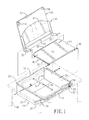
Fig. 1 is an exploded perspective view of a desk board raising apparatus in accordance with the present invention; -
Fig. 2 is an operational perspective view of the desk board raising apparatus inFig. 1 mounted on a desk; -
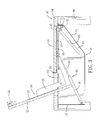
Fig. 3 is a side view in partial section of the desk board raising apparatus inFig. 2 ; -
Fig. 4 is an operational side view in partial section of the desk board raising apparatus inFig. 2 ; -
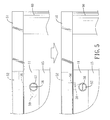
Fig. 5 shows operational partial front views of the desk board raising apparatus inFig. 2 ; -
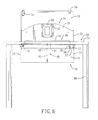
Fig. 6 is a front view of the desk board raising apparatus inFig. 2 ; and -
Fig. 7 is an operational side view in partial section of the desk board raising apparatus inFig. 2 to deposit a computer screen and a keyboard. - With reference to
Figs. 1 and2 , a desk board raising apparatus in accordance with the present invention comprises aseat 10, anactive module 20, apassive module 30, acylinder 40 and adesk board module 50. - The
seat 10 has a longitudinal axis, afront board 11, arear board 12, twoside boards 13, a chamber, anopening 14, and aninclined surface 15. Therear board 12 is opposite to thefront board 11. Theside boards 13 are connected with thefront board 11 and therear board 12. Eachside board 13 has achute 16. The chamber is defined in theseat 10 and is enclosed by thefront board 11, therear board 12 and theside boards 13. Theopening 14 is defined in a top surface of theseat 10 and is in communication with the chamber. Theinclined surface 15 is defined on a front surface of thefront board 11 and inclines to a bottom end of therear board 12 to provide an active space. Eachchute 16 has a locating segment close to a top end of thefront board 11. Thechutes 16 are symmetrical with respect to the longitudinal axis of theseat 10. - The
active module 20 is pivotally mounted in theseat 10 and has abase 21, two linkingarms 22 and apivot 23. The linkingarms 22 are L-shaped and respectively protrude from two side edges of thebase 21 and further are symmetrical with respect to the longitudinal axis of theseat 10. Thepivot 23 is deposited between the linkingarms 22. Two ends of thepivot 23 are respectively connected to the corners of the linkingarms 22 and are respectively connected with theside boards 13. - The
passive module 30 is mounted in theseat 10 and has apassive board 31 and twosliders 32. Thepassive board 31 is deposited between theside boards 13 and has a front end to slip along thechutes 16 and has a rear end pivotally connected with the linking arms 22.Thesliders 32 are respectively mounted on two sides of thepassive board 31. With reference toFigs. 3 and4 , eachslider 32 is slidably mounted in a corresponding one of thechutes 16. - The
cylinder 40 is mounted in theseat 10 and has acylinder body 41 and acylinder shaft 42. Thecylinder body 41 has a front end and a rear end. The rear end of thecylinder body 41 is mounted on therear board 12 of theseat 10. Thecylinder shaft 42 is movably mounted on thecylinder body 41 and has a distal end. The distal end of thecylinder shaft 42 extends out of the front end of thecylinder body 41 and is connected with thepassive board 31 of thepassive module 30 and is adapted to push thepassive board 31 of thepassive module 30. - The
desk board module 50 has anouter board 51, a raisingboard 52, and aninner board 53. Theouter board 51 is hollow and is mounted on the top surface of theseat 10 around theopening 14 of theseat 10. The raisingboard 52 is mounted on thebase 21 of theactive module 20. Theinner board 53 is mounted on thepassive board 31 of thepassive module 30. Thepassive board 31 has awall 33 extending above a top surface of theinner board 53. Thewall 33 is located at a position adjacent to a pivotal location of thepassive board 31 and the linkingarms 22. The raisingboard 52 has a cavity defined in the raising board at a position adjacent to thefront board 11 to enable the raisingboard 52 to be convenient in lifting - With reference to
Fig. 6 , thedesk board module 50 further has apressing locker 54 mounted on a bottom surface of the raisingboard 52. Theseat 10 further has a positioningmember 55 mounted on thefront board 11 and selectively engaging thepressing locker 54. With reference toFig. 5 , the board raising apparatus has a lockingboard 56 and alock 57. The lockingboard 56 is bent and is mounted on the bottom surface of the raisingboard 52. Thelock 57 is rotatably mounted on thefront board 11 and has a lockinghole 58 and alocking hook 59 to selectively engage the lockingboard 56. - With reference to
Fig. 6 , the desk board raising apparatus has ascreen bracket 60 mounted on thebase 21 of theactive module 20. Thescreen bracket 60 has multiple hanging holes 61. - With reference to
Figs. 1 to 2 , the desk board raising apparatus hasmultiple legs 90 mounted on a bottom surface of theouter board 51. With reference toFig. 3 , in a preferred operating mode, the raisingboard 52 can be slightly pressed to disengage thepressing locker 54 on the raisingboard 52 from the positioningmember 55 on theseat 10, and then thepressing locker 54 provides a push force to the raisingboard 52. Thus, the raisingboard 52 is slightly moved up to enable a user to conveniently lift the raisingboard 52 with fingers pressing into the cavity. Theactive module 20 is rotated with the raisingboard 52, and thepassive board 31 of thepassive module 30 is moved by the linkingarms 22 of theactive module 20. Thepassive board 31 is moved along thechutes 16 of theside boards 13. Then, a top surface of theinner board 53 and a top surface of theouter board 51 are located on the same horizontal plane. - With reference to
Fig. 4 , the raisingboard 52 can be pressed down, and then thebase 21 of theactive module 20 and the linkingarms 22 are rotated downward together. Thus, the linkingarms 22 pull thepassive board 31 to move down and slip along thechutes 16. Thepassive board 31 and theinner board 53 are stored in the chamber of theseat 10. When theopening 14 of theseat 10 is closed by the raisingboard 52, the positioningmember 55 in theseat 10 steadily engages thepressing locker 54 on the raisingboard 52 to fix the raisingboard 52 in position. Then, theinner board 53 is hidden under the raisingboard 52. - With reference to
Fig. 5 , a key can be inserted into the lockinghole 58 of thelock 57, and then the lockinghook 59 is rotated by the key and clasps the lockingboard 56 to fix the raisingboard 52 on theseat 10. - With reference to
Fig. 7 , acomputer screen 70, akeyboard 80 and a mouse can be deposited in the desk board raising apparatus. Ahanger 71 is mounted on a rear surface of thecomputer screen 70 to clasp thescreen bracket 60 and fix thecomputer screen 70 on thescreen bracket 60. Alternatively, thecomputer screen 70 is fixed on the base 21 or the raisingboard 52 by a shrunk band. Thekeyboard 80 and the mouse can be put on theinner board 53, and thewall 33 of thepassive board 31 prevents thekeyboard 80 and the mouse from falling. - When the raising
board 52 is pressed down and theopening 14 is closed, thecomputer screen 70, thekeyboard 80 and the mouse are stored in theseat 10. When the raisingboard 52 is raised, thekeyboard 80 and the mouse are exposed to be used. In addition, theinclined surface 15 can provide an extra legroom to prevent the interference between the legs of the users and theseat 10. - The
active module 20 drives thepassive module 30 to be moved by the linkingarms 22. The motion path of thepassive board 31 of thepassive module 30 is restricted by thechutes 16. The raisingboard 52 is lifted up with theopening 14 open to drive thepassive board 31 and theinner board 53 to move up, and the raisingboard 52 is pressed down with theopening 14 closed to drive thepassive board 31 and theinner board 53 to move down. Thecylinder 40 provides a push force to push thepassive board 31 up smoothly and to securely hold the passive board in place. Accordingly, the desk board raising apparatus uses a simple structure to synchronize thepassive board 31 and thebase 21 and has the advantages of convenient operation, low manufacturing cost, low maintenance cost, and consuming no power. Furthermore, the engagement between the pressing locker54 and the positioningmember 55 can increase the convenience in operation of the desk board raising apparatus.
Claims (7)
- A desk board raising apparatus characterized in that:a seat (10) having:two side boards (13) opposite to each other and respectively having a chute (16);an active module (20) pivotally mounted in the seat (10) and having:a base (21);two linking arms (22) being L-shaped and respectively protruding from two side edges of the base (21); anda pivot (23) deposited between the linking arms (22) and connected with the side boards (13);a passive module (30) is mounted in the seat (10) and having:a passive board (31) deposited between the side boards (13) and having a front end to slip along the chutes (16) and having a rear end to be pivotally connected with the linking arms (22); anda cylinder (40) is mounted in the seat (10) and having:a cylinder body (41) having a front end and a rear end, the rear end of the cylinder body (41) mounted in the seat (10); anda cylinder shaft (42) movably mounted on the cylinder body (41) and having:a distal end extending out of the front end of the cylinder body (41) and connected with the passive board (31) of the passive module (30), and adapted to push the passive board (31) of the passive module (30).
- The desk board raising apparatus as claimed in claim 1, wherein
the seat (10) has:a front board (11) connected with the side boards (13);a rear board (12) opposite to the front board (11) and connected with the side boards (13);a chamber defined in the seat (10) and enclosed by the front board (11), the rear board (12), and the side boards (13);an opening (14) defined in a top surface of the seat (10) and in communication with the chamber; andan inclined surface (15) defined on a front surface of the front board (11). - The desk board raising apparatus as claimed in claim 2, wherein
the desk board raising apparatus has:a desk board module (50) having:an outer board (51) mounted on the top surface of the seat around the opening of the seat (10);a raising board (52) mounted on the base (21) of the active module (20); andan inner board (53) mounted on the passive board (31) of the passive module (30); andthe passive board (31) has a wall extending above a top surface of the inner board (53). - The desk board raising apparatus as claimed in claim 3, wherein
the desk board module (50) has a pressing locker (54) mounted on a bottom surface of the raising board (52); and
the seat (10) has a positioning member (55) mounted on the front board (11) and selectively engaging the pressing locker (54). - The desk board raising apparatus as claimed in claim 4, wherein
the board raising apparatus (50) has
a locking board (56) being bent and mounted on the bottom surface of the raising board (52); and
a lock (57) rotatably mounted on the front board (11) and having:a locking hole (58); anda locking hook (59) selectively engaging the locking board (56). - The desk board raising apparatus as claimed in any one of claims 1 to 5,
wherein the passive module (30) has two sliders (32), and the sliders (32) are respectively mounted on two sides of the passive board (31), each slider (32) slidably mounted in a corresponding one of the chutes (16). - The desk board raising apparatus as claimed in any one of claims 1 to 5,
wherein the desk board raising apparatus has a screen bracket (60) mounted on the base (21) of the active module (20).
Applications Claiming Priority (1)
| Application Number | Priority Date | Filing Date | Title |
|---|---|---|---|
| TW100133593A TW201313158A (en) | 2011-09-19 | 2011-09-19 | Desk board lifting device |
Publications (2)
| Publication Number | Publication Date |
|---|---|
| EP2570048A2 true EP2570048A2 (en) | 2013-03-20 |
| EP2570048A3 EP2570048A3 (en) | 2014-04-02 |
Family
ID=47022475
Family Applications (1)
| Application Number | Title | Priority Date | Filing Date |
|---|---|---|---|
| EP12184643.0A Withdrawn EP2570048A3 (en) | 2011-09-19 | 2012-09-17 | Desk board raising apparatus |
Country Status (5)
| Country | Link |
|---|---|
| US (1) | US20130068141A1 (en) |
| EP (1) | EP2570048A3 (en) |
| JP (1) | JP2013063270A (en) |
| CN (1) | CN103005854A (en) |
| TW (1) | TW201313158A (en) |
Cited By (2)
| Publication number | Priority date | Publication date | Assignee | Title |
|---|---|---|---|---|
| GB2515093A (en) * | 2013-06-14 | 2014-12-17 | Alan Neil Russell Stannah | Improvements in or relating to furniture |
| IT201800010386A1 (en) * | 2018-11-16 | 2020-05-16 | Knoll Int S P A | A piece of furniture having a work surface, comprising at least one through opening, and at least one movable door for closing / opening said opening |
Families Citing this family (13)
| Publication number | Priority date | Publication date | Assignee | Title |
|---|---|---|---|---|
| US8749959B2 (en) * | 2009-09-29 | 2014-06-10 | Nati Brook Ventures, Llc | Modular technology furniture |
| US9565928B2 (en) * | 2012-11-02 | 2017-02-14 | Paragon Furniture, Lp | Desktop organization and display stand system |
| ES1078560Y (en) * | 2013-01-18 | 2013-05-07 | Albiral Display Solutions Sl | SET OF DISPLAY AND KEYBOARD KEYBOARD FOR TABLES |
| US9095209B2 (en) | 2013-12-19 | 2015-08-04 | Artifox Llc | Article of furniture with channel adapted to hold a device and interlocking construction |
| JP2016085630A (en) * | 2014-10-27 | 2016-05-19 | 三浦工業株式会社 | Desk electronic device |
| CN106108396B (en) * | 2016-08-31 | 2018-06-05 | 王骏飞 | A kind of hand desktop adjustable type student's desk |
| CN110448071A (en) * | 2019-07-18 | 2019-11-15 | 安徽昌浩电子科技有限公司 | A kind of intelligent finance office multi-functional cabinet |
| CN110575010A (en) * | 2019-08-27 | 2019-12-17 | 河南牧业经济学院 | A computer anti-theft device |
| CN111588170A (en) * | 2020-05-26 | 2020-08-28 | 上海绯逸信息技术有限公司 | Auxiliary design device for software development |
| US11871841B2 (en) * | 2021-06-16 | 2024-01-16 | Huizhou China Star Optoelectronics Display Co., Ltd. | Computer desk |
| CN114209150B (en) * | 2021-11-27 | 2023-05-30 | 江苏经贸职业技术学院 | Special electronic reading table for library |
| JP1783412S (en) * | 2022-11-01 | 2024-10-29 | Desk with roll-up display | |
| JP1807619S (en) * | 2022-12-27 | 2025-09-02 | Television receiver |
Family Cites Families (10)
| Publication number | Priority date | Publication date | Assignee | Title |
|---|---|---|---|---|
| DE19942421A1 (en) * | 1998-09-09 | 2000-05-11 | Axel Stolze | Coffee table has integral video-entertainment, telecommunications and personal computer in multimedia configuration for switching, regulating and/or controlling individually/collectively |
| GB0215053D0 (en) * | 2002-06-28 | 2002-08-07 | Therefore Ltd | A console |
| US7430937B2 (en) * | 2004-01-16 | 2008-10-07 | Maytag Corporation | Rack and pinion stabilizer system |
| US7578243B2 (en) * | 2005-04-07 | 2009-08-25 | Krueger International, Inc. | Laptop computer bin assembly for a worksurface |
| US7784412B2 (en) * | 2006-09-25 | 2010-08-31 | Korber Jeffrey H | Convertible computer display |
| US7602605B2 (en) * | 2007-10-12 | 2009-10-13 | Dell Products L.P. | Case for an information handling system |
| CN100579416C (en) * | 2007-11-08 | 2010-01-13 | 朱晓杭 | A computer desk with a table top that can be tilted forward |
| CN201175099Y (en) * | 2008-02-02 | 2009-01-07 | 公隆实业股份有限公司 | Desk with lifting bearing |
| CN201557751U (en) * | 2009-09-23 | 2010-08-25 | 实用电脑资讯有限公司 | Computer desk |
| US8250993B2 (en) * | 2009-12-18 | 2012-08-28 | Krueger International, Inc. | Laptop computer storage assembly for a work surface |
-
2011
- 2011-09-19 TW TW100133593A patent/TW201313158A/en unknown
-
2012
- 2012-09-07 US US13/607,195 patent/US20130068141A1/en not_active Abandoned
- 2012-09-12 JP JP2012200712A patent/JP2013063270A/en active Pending
- 2012-09-17 CN CN2012103441666A patent/CN103005854A/en active Pending
- 2012-09-17 EP EP12184643.0A patent/EP2570048A3/en not_active Withdrawn
Non-Patent Citations (1)
| Title |
|---|
| None |
Cited By (3)
| Publication number | Priority date | Publication date | Assignee | Title |
|---|---|---|---|---|
| GB2515093A (en) * | 2013-06-14 | 2014-12-17 | Alan Neil Russell Stannah | Improvements in or relating to furniture |
| IT201800010386A1 (en) * | 2018-11-16 | 2020-05-16 | Knoll Int S P A | A piece of furniture having a work surface, comprising at least one through opening, and at least one movable door for closing / opening said opening |
| WO2020099993A1 (en) * | 2018-11-16 | 2020-05-22 | Knoll International S.P.A. | Furniture element having a work surface comprising at least one through opening and at least one movable door for closing/opening of said opening |
Also Published As
| Publication number | Publication date |
|---|---|
| CN103005854A (en) | 2013-04-03 |
| EP2570048A3 (en) | 2014-04-02 |
| TW201313158A (en) | 2013-04-01 |
| US20130068141A1 (en) | 2013-03-21 |
| JP2013063270A (en) | 2013-04-11 |
Similar Documents
| Publication | Publication Date | Title |
|---|---|---|
| EP2570048A2 (en) | Desk board raising apparatus | |
| CN104006619B (en) | A kind of refrigerator | |
| CN204127585U (en) | Positionable lifting bracket structure | |
| US9717328B1 (en) | Desktop device for lifting and lowering keyboard and monitor | |
| US20120229970A1 (en) | Box for Placing and Supporting a Tablet PC on a Table | |
| CN101657777A (en) | Electronic device locking system | |
| CN104006618A (en) | Refrigerator | |
| US8491068B2 (en) | Drawer assembly that is locked automatically when it is closed | |
| US20150362121A1 (en) | Spanner-controlled panel member coupling structure | |
| US8237661B2 (en) | Keyboard with multi-angle positioning support | |
| KR102037164B1 (en) | Apparatus for link rotation type drawer for table and table apparatus including same | |
| KR20070106470A (en) | Computer desk | |
| CN203857742U (en) | Refrigerator | |
| CN115617186B (en) | Key mouse integrated dual-purpose functional mouse for computer | |
| CN109497840A (en) | Baking machine | |
| CN104873000A (en) | Human engineering teaching equipment and control method thereof | |
| CN204708290U (en) | A kind of ergonomic teaching equipment | |
| CN203168385U (en) | Concealed computer table | |
| KR100914248B1 (en) | Computer desk | |
| CN220109404U (en) | Cabinet with lifting table | |
| CN215382210U (en) | Be used for portable drawing desk of indoor decoration | |
| CN204146653U (en) | Multifunctional office locker | |
| KR200372939Y1 (en) | A keyboard pedestal of computer | |
| CN219105347U (en) | Clock capable of being hung and stored | |
| CN103431632A (en) | Table |
Legal Events
| Date | Code | Title | Description |
|---|---|---|---|
| PUAI | Public reference made under article 153(3) epc to a published international application that has entered the european phase |
Free format text: ORIGINAL CODE: 0009012 |
|
| AK | Designated contracting states |
Kind code of ref document: A2 Designated state(s): AL AT BE BG CH CY CZ DE DK EE ES FI FR GB GR HR HU IE IS IT LI LT LU LV MC MK MT NL NO PL PT RO RS SE SI SK SM TR |
|
| AX | Request for extension of the european patent |
Extension state: BA ME |
|
| PUAL | Search report despatched |
Free format text: ORIGINAL CODE: 0009013 |
|
| AK | Designated contracting states |
Kind code of ref document: A3 Designated state(s): AL AT BE BG CH CY CZ DE DK EE ES FI FR GB GR HR HU IE IS IT LI LT LU LV MC MK MT NL NO PL PT RO RS SE SI SK SM TR |
|
| AX | Request for extension of the european patent |
Extension state: BA ME |
|
| RIC1 | Information provided on ipc code assigned before grant |
Ipc: A47B 21/007 20060101AFI20140225BHEP |
|
| STAA | Information on the status of an ep patent application or granted ep patent |
Free format text: STATUS: THE APPLICATION IS DEEMED TO BE WITHDRAWN |
|
| 18D | Application deemed to be withdrawn |
Effective date: 20141003 |