EP2570810A1 - Procédé de vérification de la présence de substances biologiques dans l'air au moyen de bandes à puits multiples amovibles sur lesquelles un dosage immunologique est effectué directement - Google Patents
Procédé de vérification de la présence de substances biologiques dans l'air au moyen de bandes à puits multiples amovibles sur lesquelles un dosage immunologique est effectué directement Download PDFInfo
- Publication number
- EP2570810A1 EP2570810A1 EP12185079A EP12185079A EP2570810A1 EP 2570810 A1 EP2570810 A1 EP 2570810A1 EP 12185079 A EP12185079 A EP 12185079A EP 12185079 A EP12185079 A EP 12185079A EP 2570810 A1 EP2570810 A1 EP 2570810A1
- Authority
- EP
- European Patent Office
- Prior art keywords
- biological substances
- sample carrier
- air
- antigens
- collecting
- Prior art date
- Legal status (The legal status is an assumption and is not a legal conclusion. Google has not performed a legal analysis and makes no representation as to the accuracy of the status listed.)
- Withdrawn
Links
- 239000000126 substance Substances 0.000 title claims abstract description 86
- 238000000034 method Methods 0.000 title claims abstract description 69
- 238000010324 immunological assay Methods 0.000 title 1
- 238000001514 detection method Methods 0.000 claims abstract description 42
- 239000000427 antigen Substances 0.000 claims abstract description 36
- 102000036639 antigens Human genes 0.000 claims abstract description 36
- 108091007433 antigens Proteins 0.000 claims abstract description 36
- 230000001900 immune effect Effects 0.000 claims abstract description 35
- 230000008569 process Effects 0.000 claims abstract description 31
- 238000005259 measurement Methods 0.000 claims abstract description 11
- 238000006243 chemical reaction Methods 0.000 claims abstract description 9
- 239000013642 negative control Substances 0.000 claims abstract description 7
- 238000002965 ELISA Methods 0.000 claims abstract description 6
- 238000011835 investigation Methods 0.000 claims abstract description 5
- 230000002255 enzymatic effect Effects 0.000 claims abstract description 4
- 241000134912 Aspergillus penicillioides Species 0.000 claims description 18
- 241000228150 Penicillium chrysogenum Species 0.000 claims description 18
- 241001149955 Cladosporium cladosporioides Species 0.000 claims description 17
- 241000203233 Aspergillus versicolor Species 0.000 claims description 16
- 239000000203 mixture Substances 0.000 claims description 15
- 230000027455 binding Effects 0.000 claims description 11
- 210000002966 serum Anatomy 0.000 claims description 11
- 241000238876 Acari Species 0.000 claims description 7
- 241001465754 Metazoa Species 0.000 claims description 7
- 239000004816 latex Substances 0.000 claims description 7
- 229920000126 latex Polymers 0.000 claims description 7
- 239000004033 plastic Substances 0.000 claims description 7
- 241001674044 Blattodea Species 0.000 claims description 6
- 102000004169 proteins and genes Human genes 0.000 claims description 6
- 108090000623 proteins and genes Proteins 0.000 claims description 6
- 241000283973 Oryctolagus cuniculus Species 0.000 claims description 5
- 241000124008 Mammalia Species 0.000 claims description 4
- 239000004793 Polystyrene Substances 0.000 claims description 4
- 239000011248 coating agent Substances 0.000 claims description 4
- 238000000576 coating method Methods 0.000 claims description 4
- 238000004519 manufacturing process Methods 0.000 claims description 4
- 229920002223 polystyrene Polymers 0.000 claims description 4
- SXRSQZLOMIGNAQ-UHFFFAOYSA-N Glutaraldehyde Chemical compound O=CCCCC=O SXRSQZLOMIGNAQ-UHFFFAOYSA-N 0.000 claims description 3
- 239000004743 Polypropylene Substances 0.000 claims description 3
- 238000006911 enzymatic reaction Methods 0.000 claims description 3
- 230000008105 immune reaction Effects 0.000 claims description 3
- -1 polypropylene Polymers 0.000 claims description 3
- 229920001155 polypropylene Polymers 0.000 claims description 3
- 241000283984 Rodentia Species 0.000 claims description 2
- 230000002035 prolonged effect Effects 0.000 abstract 2
- 239000000523 sample Substances 0.000 description 33
- 239000013566 allergen Substances 0.000 description 11
- 239000000969 carrier Substances 0.000 description 7
- 241000894007 species Species 0.000 description 7
- 230000008901 benefit Effects 0.000 description 6
- 206010020751 Hypersensitivity Diseases 0.000 description 4
- 241000228143 Penicillium Species 0.000 description 4
- 238000000605 extraction Methods 0.000 description 4
- 230000037189 immune system physiology Effects 0.000 description 4
- 241000228212 Aspergillus Species 0.000 description 3
- 241000351920 Aspergillus nidulans Species 0.000 description 3
- 241001136487 Eurotium Species 0.000 description 3
- 241001236817 Paecilomyces <Clavicipitaceae> Species 0.000 description 3
- 239000000872 buffer Substances 0.000 description 3
- 238000011534 incubation Methods 0.000 description 3
- 239000000463 material Substances 0.000 description 3
- 239000002245 particle Substances 0.000 description 3
- 239000000243 solution Substances 0.000 description 3
- 238000012546 transfer Methods 0.000 description 3
- 238000005406 washing Methods 0.000 description 3
- 241000228197 Aspergillus flavus Species 0.000 description 2
- 241000123650 Botrytis cinerea Species 0.000 description 2
- 241000222290 Cladosporium Species 0.000 description 2
- 241000238710 Dermatophagoides Species 0.000 description 2
- 241001273855 Didymella glomerata Species 0.000 description 2
- 241001079987 Doratomyces sp. Species 0.000 description 2
- 241001506775 Epicoccum nigrum Species 0.000 description 2
- 241000453701 Galactomyces candidum Species 0.000 description 2
- 235000017388 Geotrichum candidum Nutrition 0.000 description 2
- 241000144128 Lichtheimia corymbifera Species 0.000 description 2
- 241000378863 Mucor plumbeus Species 0.000 description 2
- 241000985530 Penicillium glabrum Species 0.000 description 2
- 241000404567 Penicillium olsonii Species 0.000 description 2
- 241001279364 Stachybotrys chartarum Species 0.000 description 2
- QAOWNCQODCNURD-UHFFFAOYSA-N Sulfuric acid Chemical compound OS(O)(=O)=O QAOWNCQODCNURD-UHFFFAOYSA-N 0.000 description 2
- 241000736855 Syncephalastrum racemosum Species 0.000 description 2
- 241001136559 Talaromyces variabilis Species 0.000 description 2
- 238000010171 animal model Methods 0.000 description 2
- 239000012472 biological sample Substances 0.000 description 2
- 238000010586 diagram Methods 0.000 description 2
- 201000010099 disease Diseases 0.000 description 2
- 208000037265 diseases, disorders, signs and symptoms Diseases 0.000 description 2
- 239000000428 dust Substances 0.000 description 2
- 229920001971 elastomer Polymers 0.000 description 2
- 239000003344 environmental pollutant Substances 0.000 description 2
- 230000036541 health Effects 0.000 description 2
- 229940094461 penicillium glabrum Drugs 0.000 description 2
- 231100000719 pollutant Toxicity 0.000 description 2
- 238000011002 quantification Methods 0.000 description 2
- 238000012360 testing method Methods 0.000 description 2
- 241000190544 Acremonium furcatum Species 0.000 description 1
- 241000223602 Alternaria alternata Species 0.000 description 1
- 241000266330 Alternaria chartarum Species 0.000 description 1
- 241000959919 Ascotricha chartarum Species 0.000 description 1
- 241000228218 Aspergillus amstelodami Species 0.000 description 1
- 241000131314 Aspergillus candidus Species 0.000 description 1
- 241001065417 Aspergillus chevalieri Species 0.000 description 1
- 241000228193 Aspergillus clavatus Species 0.000 description 1
- 241001225321 Aspergillus fumigatus Species 0.000 description 1
- 241000132177 Aspergillus glaucus Species 0.000 description 1
- 241000228245 Aspergillus niger Species 0.000 description 1
- 241000122824 Aspergillus ochraceus Species 0.000 description 1
- 241000228254 Aspergillus restrictus Species 0.000 description 1
- 241001277988 Aspergillus sydowii Species 0.000 description 1
- 241000134719 Aspergillus tamarii Species 0.000 description 1
- 241001465318 Aspergillus terreus Species 0.000 description 1
- 241000122818 Aspergillus ustus Species 0.000 description 1
- 241000223678 Aureobasidium pullulans Species 0.000 description 1
- 241000751139 Beauveria bassiana Species 0.000 description 1
- 235000003932 Betula Nutrition 0.000 description 1
- 241000219429 Betula Species 0.000 description 1
- 235000009109 Betula pendula Nutrition 0.000 description 1
- 241000219430 Betula pendula Species 0.000 description 1
- 241000238658 Blattella Species 0.000 description 1
- 241000238657 Blattella germanica Species 0.000 description 1
- 241000536435 Blomia <angiosperm> Species 0.000 description 1
- 241000123966 Blomia tropicalis Species 0.000 description 1
- 241000079253 Byssochlamys spectabilis Species 0.000 description 1
- 241000222122 Candida albicans Species 0.000 description 1
- 241000282465 Canis Species 0.000 description 1
- 241000282472 Canis lupus familiaris Species 0.000 description 1
- 241001515917 Chaetomium globosum Species 0.000 description 1
- 241000088530 Chaetomium sp. Species 0.000 description 1
- 241000667819 Cunninghamella sp. Species 0.000 description 1
- 241001040637 Curvularia geniculata Species 0.000 description 1
- 241000238713 Dermatophagoides farinae Species 0.000 description 1
- 241000238740 Dermatophagoides pteronyssinus Species 0.000 description 1
- 241000002314 Dichotomopilus funicola Species 0.000 description 1
- 102000004190 Enzymes Human genes 0.000 description 1
- 108090000790 Enzymes Proteins 0.000 description 1
- 241000223664 Exophiala jeanselmei Species 0.000 description 1
- 241000282324 Felis Species 0.000 description 1
- 241000282326 Felis catus Species 0.000 description 1
- 241000233866 Fungi Species 0.000 description 1
- 241000223194 Fusarium culmorum Species 0.000 description 1
- 241000223221 Fusarium oxysporum Species 0.000 description 1
- 241000223192 Fusarium sporotrichioides Species 0.000 description 1
- 241000188153 Isaria fumosorosea Species 0.000 description 1
- 241000235526 Mucor racemosus Species 0.000 description 1
- 241001459119 Musella Species 0.000 description 1
- 241001373584 Myrothecium sp. Species 0.000 description 1
- 241001134446 Niveas Species 0.000 description 1
- 241000228145 Penicillium brevicompactum Species 0.000 description 1
- 241000228147 Penicillium camemberti Species 0.000 description 1
- 235000002245 Penicillium camembertii Nutrition 0.000 description 1
- 241000228153 Penicillium citrinum Species 0.000 description 1
- 241001223091 Penicillium corylophilum Species 0.000 description 1
- 241001507662 Penicillium crustosum Species 0.000 description 1
- 241001507673 Penicillium digitatum Species 0.000 description 1
- 241001123663 Penicillium expansum Species 0.000 description 1
- 241000864269 Penicillium nalgiovense Species 0.000 description 1
- 240000000064 Penicillium roqueforti Species 0.000 description 1
- 235000002233 Penicillium roqueforti Nutrition 0.000 description 1
- 241000864266 Penicillium verrucosum Species 0.000 description 1
- 102000003992 Peroxidases Human genes 0.000 description 1
- 241000746981 Phleum Species 0.000 description 1
- 241000746983 Phleum pratense Species 0.000 description 1
- 241001327281 Pseudogymnoascus pannorum Species 0.000 description 1
- 241001465752 Purpureocillium lilacinum Species 0.000 description 1
- 241000700159 Rattus Species 0.000 description 1
- 241000235546 Rhizopus stolonifer Species 0.000 description 1
- 241000228417 Sarocladium strictum Species 0.000 description 1
- 241000825258 Scopulariopsis brevicaulis Species 0.000 description 1
- 241001114480 Scopulariopsis fusca Species 0.000 description 1
- 241001149963 Sporothrix schenckii Species 0.000 description 1
- 241001136494 Talaromyces funiculosus Species 0.000 description 1
- 241000519854 Talaromyces rugulosus Species 0.000 description 1
- 241000215410 Trichothecium roseum Species 0.000 description 1
- 241000790753 Trichurus sp. Species 0.000 description 1
- 241001339189 Wallemia sebi Species 0.000 description 1
- 230000002009 allergenic effect Effects 0.000 description 1
- 208000026935 allergic disease Diseases 0.000 description 1
- 230000007815 allergy Effects 0.000 description 1
- 229940091771 aspergillus fumigatus Drugs 0.000 description 1
- 230000015572 biosynthetic process Effects 0.000 description 1
- 229940095731 candida albicans Drugs 0.000 description 1
- 230000008859 change Effects 0.000 description 1
- 239000003153 chemical reaction reagent Substances 0.000 description 1
- 230000007123 defense Effects 0.000 description 1
- 230000001419 dependent effect Effects 0.000 description 1
- 238000011161 development Methods 0.000 description 1
- 230000018109 developmental process Effects 0.000 description 1
- 239000012895 dilution Substances 0.000 description 1
- 238000010790 dilution Methods 0.000 description 1
- 238000004090 dissolution Methods 0.000 description 1
- 230000000694 effects Effects 0.000 description 1
- 238000002474 experimental method Methods 0.000 description 1
- 230000003053 immunization Effects 0.000 description 1
- 238000002649 immunization Methods 0.000 description 1
- 230000004807 localization Effects 0.000 description 1
- 238000000691 measurement method Methods 0.000 description 1
- 230000009871 nonspecific binding Effects 0.000 description 1
- 230000003287 optical effect Effects 0.000 description 1
- 229940098377 penicillium brevicompactum Drugs 0.000 description 1
- 108040007629 peroxidase activity proteins Proteins 0.000 description 1
- 238000005375 photometry Methods 0.000 description 1
- 239000011148 porous material Substances 0.000 description 1
- 238000012797 qualification Methods 0.000 description 1
- 238000005067 remediation Methods 0.000 description 1
- 238000005070 sampling Methods 0.000 description 1
- 238000012216 screening Methods 0.000 description 1
- 230000035945 sensitivity Effects 0.000 description 1
- 230000001235 sensitizing effect Effects 0.000 description 1
- 238000001228 spectrum Methods 0.000 description 1
- 239000000758 substrate Substances 0.000 description 1
- 208000024891 symptom Diseases 0.000 description 1
- 239000011534 wash buffer Substances 0.000 description 1
Images


Classifications
-
- G—PHYSICS
- G01—MEASURING; TESTING
- G01N—INVESTIGATING OR ANALYSING MATERIALS BY DETERMINING THEIR CHEMICAL OR PHYSICAL PROPERTIES
- G01N33/00—Investigating or analysing materials by specific methods not covered by groups G01N1/00 - G01N31/00
- G01N33/48—Biological material, e.g. blood, urine; Haemocytometers
- G01N33/50—Chemical analysis of biological material, e.g. blood, urine; Testing involving biospecific ligand binding methods; Immunological testing
- G01N33/53—Immunoassay; Biospecific binding assay; Materials therefor
- G01N33/543—Immunoassay; Biospecific binding assay; Materials therefor with an insoluble carrier for immobilising immunochemicals
- G01N33/54366—Apparatus specially adapted for solid-phase testing
-
- G—PHYSICS
- G01—MEASURING; TESTING
- G01N—INVESTIGATING OR ANALYSING MATERIALS BY DETERMINING THEIR CHEMICAL OR PHYSICAL PROPERTIES
- G01N1/00—Sampling; Preparing specimens for investigation
- G01N1/02—Devices for withdrawing samples
- G01N1/22—Devices for withdrawing samples in the gaseous state
- G01N1/2202—Devices for withdrawing samples in the gaseous state involving separation of sample components during sampling
-
- G—PHYSICS
- G01—MEASURING; TESTING
- G01N—INVESTIGATING OR ANALYSING MATERIALS BY DETERMINING THEIR CHEMICAL OR PHYSICAL PROPERTIES
- G01N1/00—Sampling; Preparing specimens for investigation
- G01N1/02—Devices for withdrawing samples
- G01N1/22—Devices for withdrawing samples in the gaseous state
- G01N1/2202—Devices for withdrawing samples in the gaseous state involving separation of sample components during sampling
- G01N1/2214—Devices for withdrawing samples in the gaseous state involving separation of sample components during sampling by sorption
-
- G—PHYSICS
- G01—MEASURING; TESTING
- G01N—INVESTIGATING OR ANALYSING MATERIALS BY DETERMINING THEIR CHEMICAL OR PHYSICAL PROPERTIES
- G01N1/00—Sampling; Preparing specimens for investigation
- G01N1/02—Devices for withdrawing samples
- G01N1/22—Devices for withdrawing samples in the gaseous state
- G01N1/2202—Devices for withdrawing samples in the gaseous state involving separation of sample components during sampling
- G01N1/2205—Devices for withdrawing samples in the gaseous state involving separation of sample components during sampling with filters
-
- G—PHYSICS
- G01—MEASURING; TESTING
- G01N—INVESTIGATING OR ANALYSING MATERIALS BY DETERMINING THEIR CHEMICAL OR PHYSICAL PROPERTIES
- G01N1/00—Sampling; Preparing specimens for investigation
- G01N1/02—Devices for withdrawing samples
- G01N1/22—Devices for withdrawing samples in the gaseous state
- G01N1/2202—Devices for withdrawing samples in the gaseous state involving separation of sample components during sampling
- G01N2001/222—Other features
- G01N2001/2223—Other features aerosol sampling devices
Definitions
- the invention relates to a method for the investigation of air for the presence of biological substances, wherein a collecting device is provided with at least one sample carrier, the air is passed through the collecting device and thus a collecting process is performed for a defined time, in which the sample carrier the biological Substances are collected and then the biological substances are determined by at least one immunological detection method. Furthermore, the invention relates to a collecting device for collecting the biological substances from the air, as well as to an immunological method for detecting the collected biological substances.
- EP 1 411 229 A1 there is disclosed both a method of automatically screening proteins from biological substances and the apparatus in which the automated method is performed. The method and the device are thereby used in each case to detect a specific protein from biological samples.
- the proof in this document is preferably carried out via an ELISA.
- the object of the present invention is to avoid the above-mentioned disadvantages, in particular to provide a method, a collecting device and an immunological method, whereby the investigation on the presence of biological substances is simplified. Furthermore, both a faster, due to less Work steps, and also a cost-effective immunological process are enabled.
- the sample carrier is removed from the collection device after the collection process and the immunological detection method is carried out in the sample carrier.
- the essential essence of the invention is that the sample carrier, in which the biological substances are collected, is used to carry out the immunological process in the same vessel and to provide the detection of biological substances.
- a nearly lossless collection of biological substances is therefore made possible, since the biological substances are not first dissolved out of a sample carrier, in order subsequently to be transferred to a vessel in which the immunological detection takes place.
- far smaller amounts of biological substances can be detected, as losses can be minimized.
- the time to be spent from collection to performing the immunological detection procedure is reduced, which in turn leads to cost savings.
- the allergens in the method for the investigation of biological substances from the air proteins are detected, which can be detected in particular in the form of antigens and particularly preferably in the form of allergens. Since many people show allergic reactions to biological substances, the allergens to be detected by mites and / or animals and / or cockroaches and / or molds and / or pollen and / or allergic reactions to rubber, especially latex with respect to a targeted avoidance of exposure and / or minimization of allergen load of crucial importance.
- antibodies are used which make use of the natural allergen / antigen-antibody detection.
- Antibodies are proteins that are formed for the detection of antigens, in particular allergens.
- u. a the formation of antibodies as part of an immune reaction of defense or protection of the organism against diseases.
- an overreacting immune reaction that can trigger disease symptoms and thus may have negative effects on the affected Orgnismus.
- it is advantageous that antibodies are very specific and only accurate allergens prove.
- At least 100 liters, preferably at least 1,000 liters and more preferably at least 2,000 liters of air are collected during the collection process.
- at least 50 liters per minute and preferably at least 100 liters per minute of air are passed through the collecting device.
- a collection operation may take less than four hours, preferably less than two hours and most preferably less than one hour.
- the collection process is shortened to 20 minutes. This saving of time, in the same time that other methods require for a single measurement, makes it possible to make multiple measurements, resulting in a much more accurate and faster result.
- the collecting process of the air is carried out indoors.
- biological substances of the outside world these often occur in closed rooms in much higher concentrations, so that potential health-endangering limit values are reached more often and faster than in the outside world.
- biological substances with sensitizing potential can accumulate under certain conditions, such as, for example, high humidity and / or high temperature, so that possible health risks for space users may occur. Therefore, it is very important to be able to take measurements indoors, because you are exposed to the substances there.
- the method and also the collecting device are designed such that the collection of the biological substances can also be carried out in the outside world.
- the collected samples from the outside world are often used as reference values.
- a further advantage of fast and cost-effective indoor measurements and related reference measurements outside closed premises is that a precise localization of the origin of the biological substances can be made possible. Based on the measurement results, a targeted source search and remediation may be possible.
- the sample carrier is designed to be filterless for the collection process.
- the collection process takes place directly in the sample carrier.
- the sample carrier is impermeable designed for any type of media, especially for air and biological substances contained therein.
- the introduced during collection in the sample carrier air does not penetrate the sample carrier, but escapes in the same direction in which the air has flowed. Due to the impermeability of the sample carrier, even small biological substances, preferably less than 1 ⁇ m, more preferably less than 0.5 ⁇ m and particularly preferably less than 0.1 ⁇ m, can not escape from the sample carrier.
- a sample carrier comprising a filter
- the size of the collectable biological substances is significantly limited, whereas filterless sample carriers can collect biological substances regardless of their size.
- the sample carriers in which the biological substances are collected are designed as microreaction vessels.
- the microreaction vessels are therefore designed in an advantageous embodiment as a microreaction vessel strip.
- a strip in this case has a plurality, preferably eight, microreaction vessels, which preferably have cavities arranged in a row, aligned in a plane with one another and which generally have a volume of 400 ⁇ l each.
- the biological substances can thus be collected in the vessels in a collection process.
- almost no air and thus no biological substances are introduced during the collection process in a vessel, this vessel in the subsequent measurement method as a control vessel, preferably as a negative control, is used.
- a negative control Since almost no air and thus no biological substances have entered this vessel, it is used as a negative control.
- the advantage of a negative control which is exposed to the same conditions as all other collection vessels, allows both conclusions on the air sampling, as well as on an error-free experimentation of the immunological detection method. Since the required, error-free performance of an immunological detection method depends on many factors, such as temperature and / or shelf life of the solution and / or specificity of the antibodies, a negative control, as an internal test control, is of great advantage, in order to avoid false results.
- the detection of the collected biological substances via an enzymatic reaction preferably an enzymatic color reaction.
- the resulting color change can then be determined by a photometric measurement, this measurement preferably being carried out at an optical density of 400 to 500 nm and preferably at about 405 or 492 nm.
- Enzymatic color reactions in the immunological detection method advantageously serve not only for the qualification, but also for the quantification of antigens to be detected. Further, photometric proof at a particular wavelength provides further specificity of the immunological detection method.
- the sample carrier is designed like a vessel with a defined binding capacity in such a way that during the collection process biological Substances remain reliably in this.
- the possible core of the invention is that the vessel-like sample carriers are designed such that they have a high binding capacity so that biological substances adhere to vessel walls.
- a loss-free collection of biological substances is thereby made possible, since the biological substances are not first dissolved out of a sample carrier, in order subsequently to be transferred to a vessel in which the immunological detection takes place. This can also save costs for material.
- much lower concentrations of biological substances can be detected, since hardly any losses occur.
- the time to be spent from collection to performing the immunological detection procedure is minimized, which in turn leads to cost savings.
- the sample carriers are designed in the form of microreaction vessels, wherein a plurality of microreaction vessels are arranged in a row.
- the microreaction vessels are made of plastic, preferably of polystyrene, and form a cylindrical shape.
- lids adapted for closing the microreaction vessels preferably made of polypropylene, can furthermore be designed for the microreaction vessels.
- the advantage of an embodiment of the microreaction vessels made of polystyrene is that this material surprisingly has a high binding capacity and thus the air-introduced biological substances remain adhered to the vessel walls.
- the cylindrical configuration of the microreaction vessels is for both the collection process, since the air flow can be passed optimally along the vessel walls, as well as for the subsequent immunological process, since the vessels are tuned to this process, a great advantage.
- the micro reaction vessels can be closed in order to transport the collected biological substances lossless.
- the lids are made of polypropylene, another plastic which does not have a high binding capacity, so that the collected biological substances do not remain on the lids, where they would have to be peeled off, which would cause additional time and expense.
- the microreaction vessels can additionally be coated, preferably with Glutaraldehyde and / or a corresponding antibody to produce an even higher binding capacity, so that the amount of collected biological substances can be further increased.
- the present invention is also made possible by an immunological method having the features of claim 13.
- a mixture of at least two antibodies two different types of biological pollutants is used to detect the collected antigens.
- the essential essence of the invention is that at least two different antibodies which can recognize antigens of at least two different mold fungi and / or mites and / or animals, especially domestic animals, and / or cockroaches and / or pollen and / or gums, especially latex.
- a detection of several allergen substances in a detection method is made possible. This achieves cost and time savings because multiple antigens can be detected at one time with one evidence taken.
- a serum is used to detect the biological substances.
- the serum has been obtained in an immunized mammal, preferably in a rodent and more preferably in a rabbit.
- polyclonal antibodies are thus obtained which have a broad recognition spectrum.
- Polyclonal antibodies are suitable for detecting multiple specific sites on biological substances, which reduces test specificity but increases sensitivity.
- the use of at least two antigens from at least two different biological substances, which are used for the production of serum reduces the consumption of experimental animals and thus also the costs.
- the serum is prepared from a mixture of antigens from at least two different species. In this case, a mixture of at least four or at least 100 different antigens is particularly preferred. The more antigens of different types of biological pollutants are used at one time for immunization of mammals, preferably of rabbits, the further the cost can be reduced, since both fewer experimental animals needed, and less detection methods must be performed.
- antibodies for detecting the mold fungi Aspergillus penicilloides and / or Cladosporium cladosporioides are contained in the serum to detect the antigens of these species.
- a mixture of antibodies summarizes the detection of a combination of the antigens of Aspergillus penicilloides and Aspergillus versicolor and / or a mixture of Aspergillus penicilloides and Penicillium chrysogenum and / or from Cladosporium cladosporioides and Aspergillus versicolor and / or from Cladosporium cladosporioides and Penicillium chrysogenum and / or from Aspergillus versicolor and Penicillium chrysogenum and / or from Aspergillus versicolor and Penicillium chrysogenum and / or from Aspergillus penicilloides and Cladosporium cladosporioides and As
- the mold fungi Aspergillus penicilloides, Cladosporium cladosporioides, Penicillium chrysogenum and Aspergillus versicolor are the most common indoor species and are also considered potential risk factors for the health of predisposed individuals.
- antibodies to all other members of the genus Aspergillus and / or Eurotium and / or Paecilomyces and / or Penicillium and / or Cladosporium can be used to detect the collected antigens.
- the genus Aspergillus comprises the species Aspergillus nidulans, Aspergillus ochraceus, Aspergillus candidus, Aspergillus clavatus, Aspergillus flavus var.
- Flavus Flavus, Aspergillus niger, Aspergillus penicilloides, Aspergillus versicolor, Aspergillus ustus, Aspergillus flavus, Aspergillus sydowii, Aspergillus terreus, Aspergillus restrictus, Aspergillus fumigatus, Aspergillus tamarii.
- the genus Eurotium includes the species Eurotium chevalieri, Eurotium herbariorum, Eurotium amstelodami.
- the genus Paecilomyces comprises the species Paecilomyces fumosoroseus, Paecilomyces variotii, Paecilomyces lilacinus.
- Penicillium includes the species Penicillium nalgiovense, Penicillium camemberti, Penicillium chrysogenum, Penicillium digitatum, Penicillium glabrum, Penicillium rugulosum, Penicillium roquefortii, Penicillium corylophilum, Penicillium brevicompactum, Penicillium olsonii, Penicillium glabrum, Penicillium citrinum, Penicillium corylophylum, Penicillium crustosum, Penicillium funiculosum, Penicillium variabile, Penicillium variabile 1, Penicillium verrucosum, Penicillium olsonii, Penicillium expansum.
- All species of a mixture of at least two, preferably from at least four and more preferably from more than 100 antibodies in any combination of different species of the genus Aspergillus and / or Eurotium and / or Paecilomyces and / or Penicillium and / or Cladosporium can be used for the production of a serum.
- antibodies against all other species such.
- antibodies against all other relevant pollens such.
- antibodies against all other relevant mites such.
- Dermatophagoides members of the genus Dermatophagoides, in particular Dermatophagoides sp., Dermatophagoides pteronyssinus, Dermatophagoides farinae, and / or Blomia, in particular Blomia tropicalis, be used to detect the collected antigens.
- antibodies to gum, especially latex such as. B. the allergens Hev b 1 and / or Hev b3 and / or Hev b3 and / or Hev b 6.02 be used to detect the collected antigens.
- a sample carrier 1 is shown, which is shown as a microreaction vessel 2, in which biological samples from the air 5 can be collected.
- the sample carrier 1 is shown in the present embodiment as a microreaction vessel strip 1, wherein several, in particular eight microreaction vessels 2, in a plane aligned with each other are connected.
- the microreaction vessels 2 are preferably made of plastic. Plastic, in particular polystyrene, has the property of having a high binding capacity, so that the biological substances remain on the walls of the microreaction vessels 2.
- the microreaction vessels 2 may additionally be coated, preferably with glutaraldehyde and / or an antibody. All microreaction vessels 2 in a microreaction vessel strip 1 have the same coating.
- a microreaction vessel 2 in a microreaction vessel strip 1 can be used as a control 4 be used. The control 4 is preferably located at the outer ends of the microreaction vessel strip 1.
- FIG. 2 shows a sample carrier 1 in the form of a micro reaction vessel strip 1, wherein the air flow 5 is shown schematically.
- the air flow 5 with the biological substances is introduced from above into the microreaction vessels 2. Since the microreaction vessels 2 are designed to be impermeable to air, the air flow 5 is deflected to the sides and escapes upwards out of the individual microreaction vessels 2. The biological substances entrained in the air flow 5 remain adhered to the inner surfaces of the microreaction vessels. Only in the control vessel 4, which serves as a negative control, almost no air passes 5.
- FIG. 3 the collecting device 6 for collecting the biological substances from the air 5 is shown.
- the collecting device 6 can have a housing 7, into which the air 5 is introduced, so that a sample carrier 1 in the form of a microreaction vessel strip 1 is enclosed.
- the air 5 is introduced into the microreaction vessels 2 in such a way that it flows from above into the opening of the vessels 2 and is deflected to the sides and escapes upward again out of the microreaction vessels 2.
- the microreaction vessel 2 which serves as a control 4
- almost no air 5 and thus almost no biological substances is introduced, so that almost no biological substances remain in this microreaction vessel 2.
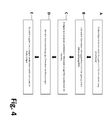
- FIG. 4 shows a diagram of the course of the collection process with subsequent detection method.
- a sample carrier 1 in the form of a microreaction vessel strip 1 is placed in the collecting device 6 and the collecting device 6 is closed.
- air 5 is passed through the collecting device 6, so that the air flow 5 is introduced from above into the individual microreaction vessels 2.
- the air stream 5 is deflected in the microreaction vessel 2 in such a way that it escapes upwards again from it. Meanwhile, due to the high binding capacity or because of a coating 9 applied, the biological substances remain in the microreaction vessels 2 (C). Only in the control vessel 4 almost no air 5 is introduced, so that there are also almost no biological substances in a control microreaction vessel 2 (C).
- the sample carrier 1 is removed from the collection device 6 (D).
- the immunological detection method can be carried out in the sample carriers 1 used for collecting (E).
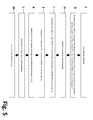
- FIG. 5 shows a diagram of the procedure of the immunological process (ELISA) for the detection of biological substances.
- ELISA immunological process
- the incubations with the corresponding immune serum then take place from an immunized mammal, preferably a rabbit, for several hours, preferably overnight, and an enzyme-labeled secondary antibody, preferably peroxidase-labeled antibody, preferably an IgG antibody, more preferably an IgG antibody from rabbit ( K), for several minutes, preferably 60, at about 10 ° to 30 ° C, preferably at 20 ° C (J).
- an enzyme-labeled secondary antibody preferably peroxidase-labeled antibody, preferably an IgG antibody, more preferably an IgG antibody from rabbit ( K)
- the unbound reagents present after each incubation step are removed in each case in a washing step which is repeated several times, preferably three times (J).
- the enzyme reaction is started by means of the substrate buffer, which is stopped after about 1 to 30 minutes, preferably after about 8 to 10 minutes, preferably by sulfuric acid solution (L).
- the measurement is carried out photometrically at 400 to 500 nm, preferably at 405 or at 492 nm, wavelength (M).
- M wavelength
- the bound or collected antigens are quantified on the basis of the entrained standard curve by a PC-supported software.
- the method described here can be used for molds and / or mites and / or animals and / or cockroaches and / or pollen and / or rubber, in particular latex.
Landscapes
- Health & Medical Sciences (AREA)
- Life Sciences & Earth Sciences (AREA)
- Immunology (AREA)
- Engineering & Computer Science (AREA)
- Molecular Biology (AREA)
- Biomedical Technology (AREA)
- Chemical & Material Sciences (AREA)
- Pathology (AREA)
- General Physics & Mathematics (AREA)
- General Health & Medical Sciences (AREA)
- Biochemistry (AREA)
- Physics & Mathematics (AREA)
- Analytical Chemistry (AREA)
- Urology & Nephrology (AREA)
- Hematology (AREA)
- Medicinal Chemistry (AREA)
- Food Science & Technology (AREA)
- Microbiology (AREA)
- Cell Biology (AREA)
- Biotechnology (AREA)
- Sampling And Sample Adjustment (AREA)
- Investigating Or Analysing Biological Materials (AREA)
Applications Claiming Priority (1)
| Application Number | Priority Date | Filing Date | Title |
|---|---|---|---|
| DE201110053758 DE102011053758A1 (de) | 2011-09-19 | 2011-09-19 | Verfahren zur Untersuchung von Luft auf das Vorhandensein von biologischen Substanzen |
Publications (1)
| Publication Number | Publication Date |
|---|---|
| EP2570810A1 true EP2570810A1 (fr) | 2013-03-20 |
Family
ID=46968004
Family Applications (1)
| Application Number | Title | Priority Date | Filing Date |
|---|---|---|---|
| EP12185079A Withdrawn EP2570810A1 (fr) | 2011-09-19 | 2012-09-19 | Procédé de vérification de la présence de substances biologiques dans l'air au moyen de bandes à puits multiples amovibles sur lesquelles un dosage immunologique est effectué directement |
Country Status (2)
| Country | Link |
|---|---|
| EP (1) | EP2570810A1 (fr) |
| DE (1) | DE102011053758A1 (fr) |
Citations (4)
| Publication number | Priority date | Publication date | Assignee | Title |
|---|---|---|---|---|
| WO1993018404A1 (fr) * | 1992-03-05 | 1993-09-16 | University College Dublin | Appareil de detection d'antigenes |
| US20040038385A1 (en) * | 2002-08-26 | 2004-02-26 | Langlois Richard G. | System for autonomous monitoring of bioagents |
| EP1411229A1 (fr) | 2001-06-18 | 2004-04-21 | Toyota Jidosha Kabushiki Kaisha | Dispositif de commande du rapport air-combustible dans un moteur a combustion interne |
| US20080184515A1 (en) | 2007-02-07 | 2008-08-07 | Indoor Biotechnologies, Inc. | System and Method for Particle Collection |
Family Cites Families (2)
| Publication number | Priority date | Publication date | Assignee | Title |
|---|---|---|---|---|
| DE19710525C2 (de) * | 1997-03-14 | 1999-11-11 | Cammann Karl | Passiv-Diffusionssammler für in Gasen enthaltene Analyte sowie Verfahren zur passiven Probenahme und Analyse |
| US20050266415A1 (en) * | 2004-05-28 | 2005-12-01 | Zefon International, Inc. | Method for sampling gas-borne matter |
-
2011
- 2011-09-19 DE DE201110053758 patent/DE102011053758A1/de not_active Withdrawn
-
2012
- 2012-09-19 EP EP12185079A patent/EP2570810A1/fr not_active Withdrawn
Patent Citations (4)
| Publication number | Priority date | Publication date | Assignee | Title |
|---|---|---|---|---|
| WO1993018404A1 (fr) * | 1992-03-05 | 1993-09-16 | University College Dublin | Appareil de detection d'antigenes |
| EP1411229A1 (fr) | 2001-06-18 | 2004-04-21 | Toyota Jidosha Kabushiki Kaisha | Dispositif de commande du rapport air-combustible dans un moteur a combustion interne |
| US20040038385A1 (en) * | 2002-08-26 | 2004-02-26 | Langlois Richard G. | System for autonomous monitoring of bioagents |
| US20080184515A1 (en) | 2007-02-07 | 2008-08-07 | Indoor Biotechnologies, Inc. | System and Method for Particle Collection |
Also Published As
| Publication number | Publication date |
|---|---|
| DE102011053758A1 (de) | 2013-03-21 |
Similar Documents
| Publication | Publication Date | Title |
|---|---|---|
| Reponen et al. | Fungal fragments in moldy houses: a field study in homes in New Orleans and Southern Ohio | |
| DE60218216T2 (de) | System, verfahren und vorrichtung zur schnellen entdeckung und analyse von in der luft schwebenden biologischen mitteln | |
| DE60108256T2 (de) | Allergen-microarray-test | |
| DE102007052517A1 (de) | ELISPOT-Verfahren mit zwei Filtersystemen | |
| EP2239557B1 (fr) | Procédé de mesure de matières nocives biologiques portées par l'air | |
| EP3844475B1 (fr) | Système de mesure permettant d'examiner des particules d'aérosol concentrées dans la phase gazeuse | |
| DE202020102077U1 (de) | Vorrichtung zur gezielten Prüfung auf eine erfolgte Infektion mit dem Coronavirus-SARS-CoV-2 | |
| DE4208732C2 (de) | Einwegreaktionsgefäß für die Festphasenimmunanalytik und Verfahren zur Messung von über Immunreaktionen bestimmbaren Komponenten | |
| EP2658957B1 (fr) | Appareil de mesure portatif pour identifier la présence d'attaques de moisissures non apparentes | |
| EP2845907B1 (fr) | Appareil de mesure portatif et procédé de détection de formation de moisissure dans les espaces intérieurs | |
| Green et al. | Aerosolized fungal fragments | |
| EP2570810A1 (fr) | Procédé de vérification de la présence de substances biologiques dans l'air au moyen de bandes à puits multiples amovibles sur lesquelles un dosage immunologique est effectué directement | |
| DE102015218442A1 (de) | Biosensor und Verfahren zum Nachweis von Keimen | |
| DE102018132710A1 (de) | Filtrierverfahren geeignet zur Isolierung und/oder Quantifizierung zumindest einer zu untersuchenden Substanz aus einer Probe | |
| EP2210097A1 (fr) | Procédé de diagnostic in vitro et/ou de suivi de traitement in vitro relativement à des infections | |
| EP1574836B1 (fr) | Procédé et kit d'essai pour detection de substances nocives à l'air interieur | |
| EP1766401B1 (fr) | Procede de detection simple et rapide de cellules et de biomolecules a l'aide de particules paramagnetiques | |
| DE102012015446A1 (de) | Gemischerkennung bei massenspektrometrischer Mikroben-Identifizierung | |
| WO2014169896A2 (fr) | Procédé automatisable pour identifier, quantifier et distinguer des signaux spécifiques par rapport à des signaux non spécifiques dans des procédés de détection au moyen d'un détecteur | |
| EP3572790B1 (fr) | Méthode pour l'examen d'un support d'échantillon en utilisant une structure de squelette coopérant avec un dispositif d'évaluation d'images et un support comportant une surface de détection optochimique | |
| CH717312A2 (de) | Vorrichtung und Verfahren zur gezielten Prüfung auf eine erfolgte Infektion mit dem Coronavirus-SARS-CoV-2. | |
| DE202009006503U1 (de) | Assay-Vorrichtungen zur Bestimmung von Immunglobulinen E | |
| DE102015218441A1 (de) | Staubsauger und Verwendung eines Biosensors | |
| DE102020117564A1 (de) | Neues Verfahren zum Erkennen der durch den menschlichen Körper aufgenommenen Substanzen und der Häufigkeit der Aufnahme | |
| DE102020110335B3 (de) | Vorrichtung und Verfahren zur gezielten Prüfung auf eine erfolgte Infektion mit dem Coronavirus-SARS-CoV-2 |
Legal Events
| Date | Code | Title | Description |
|---|---|---|---|
| PUAI | Public reference made under article 153(3) epc to a published international application that has entered the european phase |
Free format text: ORIGINAL CODE: 0009012 |
|
| AK | Designated contracting states |
Kind code of ref document: A1 Designated state(s): AL AT BE BG CH CY CZ DE DK EE ES FI FR GB GR HR HU IE IS IT LI LT LU LV MC MK MT NL NO PL PT RO RS SE SI SK SM TR |
|
| AX | Request for extension of the european patent |
Extension state: BA ME |
|
| 17P | Request for examination filed |
Effective date: 20130920 |
|
| RAX | Requested extension states of the european patent have changed |
Extension state: BA Payment date: 20130920 Extension state: ME Payment date: 20130920 |
|
| RBV | Designated contracting states (corrected) |
Designated state(s): AL AT BE BG CH CY CZ DE DK EE ES FI FR GB GR HR HU IE IS IT LI LT LU LV MC MK MT NL NO PL PT RO RS SE SI SK SM TR |
|
| STAA | Information on the status of an ep patent application or granted ep patent |
Free format text: STATUS: THE APPLICATION HAS BEEN WITHDRAWN |
|
| 18W | Application withdrawn |
Effective date: 20130927 |