EP2571906B1 - Architectures organisées dans des polymères acryliques - Google Patents
Architectures organisées dans des polymères acryliques Download PDFInfo
- Publication number
- EP2571906B1 EP2571906B1 EP11721941.0A EP11721941A EP2571906B1 EP 2571906 B1 EP2571906 B1 EP 2571906B1 EP 11721941 A EP11721941 A EP 11721941A EP 2571906 B1 EP2571906 B1 EP 2571906B1
- Authority
- EP
- European Patent Office
- Prior art keywords
- groups
- polymer
- blocks
- reactive functional
- functional group
- Prior art date
- Legal status (The legal status is an assumption and is not a legal conclusion. Google has not performed a legal analysis and makes no representation as to the accuracy of the status listed.)
- Active
Links
Images






Classifications
-
- C—CHEMISTRY; METALLURGY
- C08—ORGANIC MACROMOLECULAR COMPOUNDS; THEIR PREPARATION OR CHEMICAL WORKING-UP; COMPOSITIONS BASED THEREON
- C08F—MACROMOLECULAR COMPOUNDS OBTAINED BY REACTIONS ONLY INVOLVING CARBON-TO-CARBON UNSATURATED BONDS
- C08F20/00—Homopolymers and copolymers of compounds having one or more unsaturated aliphatic radicals, each having only one carbon-to-carbon double bond, and only one being terminated by only one carboxyl radical or a salt, anhydride, ester, amide, imide or nitrile thereof
-
- C—CHEMISTRY; METALLURGY
- C08—ORGANIC MACROMOLECULAR COMPOUNDS; THEIR PREPARATION OR CHEMICAL WORKING-UP; COMPOSITIONS BASED THEREON
- C08F—MACROMOLECULAR COMPOUNDS OBTAINED BY REACTIONS ONLY INVOLVING CARBON-TO-CARBON UNSATURATED BONDS
- C08F293/00—Macromolecular compounds obtained by polymerisation on to a macromolecule having groups capable of inducing the formation of new polymer chains bound exclusively at one or both ends of the starting macromolecule
- C08F293/005—Macromolecular compounds obtained by polymerisation on to a macromolecule having groups capable of inducing the formation of new polymer chains bound exclusively at one or both ends of the starting macromolecule using free radical "living" or "controlled" polymerisation, e.g. using a complexing agent
-
- C—CHEMISTRY; METALLURGY
- C08—ORGANIC MACROMOLECULAR COMPOUNDS; THEIR PREPARATION OR CHEMICAL WORKING-UP; COMPOSITIONS BASED THEREON
- C08F—MACROMOLECULAR COMPOUNDS OBTAINED BY REACTIONS ONLY INVOLVING CARBON-TO-CARBON UNSATURATED BONDS
- C08F20/00—Homopolymers and copolymers of compounds having one or more unsaturated aliphatic radicals, each having only one carbon-to-carbon double bond, and only one being terminated by only one carboxyl radical or a salt, anhydride, ester, amide, imide or nitrile thereof
- C08F20/02—Monocarboxylic acids having less than ten carbon atoms, Derivatives thereof
- C08F20/10—Esters
-
- C—CHEMISTRY; METALLURGY
- C08—ORGANIC MACROMOLECULAR COMPOUNDS; THEIR PREPARATION OR CHEMICAL WORKING-UP; COMPOSITIONS BASED THEREON
- C08F—MACROMOLECULAR COMPOUNDS OBTAINED BY REACTIONS ONLY INVOLVING CARBON-TO-CARBON UNSATURATED BONDS
- C08F220/00—Copolymers of compounds having one or more unsaturated aliphatic radicals, each having only one carbon-to-carbon double bond, and only one being terminated by only one carboxyl radical or a salt, anhydride ester, amide, imide or nitrile thereof
- C08F220/02—Monocarboxylic acids having less than ten carbon atoms; Derivatives thereof
- C08F220/04—Acids; Metal salts or ammonium salts thereof
- C08F220/06—Acrylic acid; Methacrylic acid; Metal salts or ammonium salts thereof
-
- C—CHEMISTRY; METALLURGY
- C08—ORGANIC MACROMOLECULAR COMPOUNDS; THEIR PREPARATION OR CHEMICAL WORKING-UP; COMPOSITIONS BASED THEREON
- C08F—MACROMOLECULAR COMPOUNDS OBTAINED BY REACTIONS ONLY INVOLVING CARBON-TO-CARBON UNSATURATED BONDS
- C08F220/00—Copolymers of compounds having one or more unsaturated aliphatic radicals, each having only one carbon-to-carbon double bond, and only one being terminated by only one carboxyl radical or a salt, anhydride ester, amide, imide or nitrile thereof
- C08F220/02—Monocarboxylic acids having less than ten carbon atoms; Derivatives thereof
- C08F220/10—Esters
- C08F220/12—Esters of monohydric alcohols or phenols
- C08F220/14—Methyl esters, e.g. methyl (meth)acrylate
-
- C—CHEMISTRY; METALLURGY
- C08—ORGANIC MACROMOLECULAR COMPOUNDS; THEIR PREPARATION OR CHEMICAL WORKING-UP; COMPOSITIONS BASED THEREON
- C08F—MACROMOLECULAR COMPOUNDS OBTAINED BY REACTIONS ONLY INVOLVING CARBON-TO-CARBON UNSATURATED BONDS
- C08F220/00—Copolymers of compounds having one or more unsaturated aliphatic radicals, each having only one carbon-to-carbon double bond, and only one being terminated by only one carboxyl radical or a salt, anhydride ester, amide, imide or nitrile thereof
- C08F220/02—Monocarboxylic acids having less than ten carbon atoms; Derivatives thereof
- C08F220/10—Esters
- C08F220/12—Esters of monohydric alcohols or phenols
- C08F220/16—Esters of monohydric alcohols or phenols of phenols or of alcohols containing two or more carbon atoms
- C08F220/18—Esters of monohydric alcohols or phenols of phenols or of alcohols containing two or more carbon atoms with acrylic or methacrylic acids
-
- C—CHEMISTRY; METALLURGY
- C08—ORGANIC MACROMOLECULAR COMPOUNDS; THEIR PREPARATION OR CHEMICAL WORKING-UP; COMPOSITIONS BASED THEREON
- C08F—MACROMOLECULAR COMPOUNDS OBTAINED BY REACTIONS ONLY INVOLVING CARBON-TO-CARBON UNSATURATED BONDS
- C08F220/00—Copolymers of compounds having one or more unsaturated aliphatic radicals, each having only one carbon-to-carbon double bond, and only one being terminated by only one carboxyl radical or a salt, anhydride ester, amide, imide or nitrile thereof
- C08F220/02—Monocarboxylic acids having less than ten carbon atoms; Derivatives thereof
- C08F220/52—Amides or imides
- C08F220/54—Amides, e.g. N,N-dimethylacrylamide or N-isopropylacrylamide
-
- C—CHEMISTRY; METALLURGY
- C08—ORGANIC MACROMOLECULAR COMPOUNDS; THEIR PREPARATION OR CHEMICAL WORKING-UP; COMPOSITIONS BASED THEREON
- C08L—COMPOSITIONS OF MACROMOLECULAR COMPOUNDS
- C08L33/00—Compositions of homopolymers or copolymers of compounds having one or more unsaturated aliphatic radicals, each having only one carbon-to-carbon double bond, and only one being terminated by only one carboxyl radical, or of salts, anhydrides, esters, amides, imides or nitriles thereof; Compositions of derivatives of such polymers
-
- C—CHEMISTRY; METALLURGY
- C09—DYES; PAINTS; POLISHES; NATURAL RESINS; ADHESIVES; COMPOSITIONS NOT OTHERWISE PROVIDED FOR; APPLICATIONS OF MATERIALS NOT OTHERWISE PROVIDED FOR
- C09J—ADHESIVES; NON-MECHANICAL ASPECTS OF ADHESIVE PROCESSES IN GENERAL; ADHESIVE PROCESSES NOT PROVIDED FOR ELSEWHERE; USE OF MATERIALS AS ADHESIVES
- C09J133/00—Adhesives based on homopolymers or copolymers of compounds having one or more unsaturated aliphatic radicals, each having only one carbon-to-carbon double bond, and at least one being terminated by only one carboxyl radical, or of salts, anhydrides, esters, amides, imides, or nitriles thereof; Adhesives based on derivatives of such polymers
-
- C—CHEMISTRY; METALLURGY
- C09—DYES; PAINTS; POLISHES; NATURAL RESINS; ADHESIVES; COMPOSITIONS NOT OTHERWISE PROVIDED FOR; APPLICATIONS OF MATERIALS NOT OTHERWISE PROVIDED FOR
- C09J—ADHESIVES; NON-MECHANICAL ASPECTS OF ADHESIVE PROCESSES IN GENERAL; ADHESIVE PROCESSES NOT PROVIDED FOR ELSEWHERE; USE OF MATERIALS AS ADHESIVES
- C09J153/00—Adhesives based on block copolymers containing at least one sequence of a polymer obtained by reactions only involving carbon-to-carbon unsaturated bonds; Adhesives based on derivatives of such polymers
-
- C—CHEMISTRY; METALLURGY
- C09—DYES; PAINTS; POLISHES; NATURAL RESINS; ADHESIVES; COMPOSITIONS NOT OTHERWISE PROVIDED FOR; APPLICATIONS OF MATERIALS NOT OTHERWISE PROVIDED FOR
- C09J—ADHESIVES; NON-MECHANICAL ASPECTS OF ADHESIVE PROCESSES IN GENERAL; ADHESIVE PROCESSES NOT PROVIDED FOR ELSEWHERE; USE OF MATERIALS AS ADHESIVES
- C09J153/00—Adhesives based on block copolymers containing at least one sequence of a polymer obtained by reactions only involving carbon-to-carbon unsaturated bonds; Adhesives based on derivatives of such polymers
- C09J153/005—Modified block copolymers
-
- C—CHEMISTRY; METALLURGY
- C08—ORGANIC MACROMOLECULAR COMPOUNDS; THEIR PREPARATION OR CHEMICAL WORKING-UP; COMPOSITIONS BASED THEREON
- C08F—MACROMOLECULAR COMPOUNDS OBTAINED BY REACTIONS ONLY INVOLVING CARBON-TO-CARBON UNSATURATED BONDS
- C08F2438/00—Living radical polymerisation
- C08F2438/03—Use of a di- or tri-thiocarbonylthio compound, e.g. di- or tri-thioester, di- or tri-thiocarbamate, or a xanthate as chain transfer agent, e.g . Reversible Addition Fragmentation chain Transfer [RAFT] or Macromolecular Design via Interchange of Xanthates [MADIX]
-
- C—CHEMISTRY; METALLURGY
- C09—DYES; PAINTS; POLISHES; NATURAL RESINS; ADHESIVES; COMPOSITIONS NOT OTHERWISE PROVIDED FOR; APPLICATIONS OF MATERIALS NOT OTHERWISE PROVIDED FOR
- C09J—ADHESIVES; NON-MECHANICAL ASPECTS OF ADHESIVE PROCESSES IN GENERAL; ADHESIVE PROCESSES NOT PROVIDED FOR ELSEWHERE; USE OF MATERIALS AS ADHESIVES
- C09J2301/00—Additional features of adhesives in the form of films or foils
- C09J2301/10—Additional features of adhesives in the form of films or foils characterized by the structural features of the adhesive tape or sheet
- C09J2301/12—Additional features of adhesives in the form of films or foils characterized by the structural features of the adhesive tape or sheet by the arrangement of layers
- C09J2301/122—Additional features of adhesives in the form of films or foils characterized by the structural features of the adhesive tape or sheet by the arrangement of layers the adhesive layer being present only on one side of the carrier, e.g. single-sided adhesive tape
-
- C—CHEMISTRY; METALLURGY
- C09—DYES; PAINTS; POLISHES; NATURAL RESINS; ADHESIVES; COMPOSITIONS NOT OTHERWISE PROVIDED FOR; APPLICATIONS OF MATERIALS NOT OTHERWISE PROVIDED FOR
- C09J—ADHESIVES; NON-MECHANICAL ASPECTS OF ADHESIVE PROCESSES IN GENERAL; ADHESIVE PROCESSES NOT PROVIDED FOR ELSEWHERE; USE OF MATERIALS AS ADHESIVES
- C09J2453/00—Presence of block copolymer
-
- C—CHEMISTRY; METALLURGY
- C09—DYES; PAINTS; POLISHES; NATURAL RESINS; ADHESIVES; COMPOSITIONS NOT OTHERWISE PROVIDED FOR; APPLICATIONS OF MATERIALS NOT OTHERWISE PROVIDED FOR
- C09J—ADHESIVES; NON-MECHANICAL ASPECTS OF ADHESIVE PROCESSES IN GENERAL; ADHESIVE PROCESSES NOT PROVIDED FOR ELSEWHERE; USE OF MATERIALS AS ADHESIVES
- C09J2467/00—Presence of polyester
- C09J2467/006—Presence of polyester in the substrate
Definitions
- the present invention relates to ordered polymers and particularly, ordered acrylic polymers having specific concentrations of one or more reactive functional groups in select regions of the polymer.
- the invention also relates to adhesive compositions utilizing the ordered polymers.
- the invention additionally relates to methods for forming the ordered polymers and the adhesives.
- long chain branching may improve certain polymer characteristics, such as processability and melt strength.
- the presence of long chain branching in a polymer is typically characterized by the occurrence of polymer moieties of a length greater than that of any olefin comonomer remnant attached to the main, backbone polymer chain.
- long chain branching may be generated in a polymer by incorporation of a vinyl-terminated macromer (either added or formed in situ during polymerization) either by action of the polymerization catalyst itself or by the use of a linking agent. These methods generally suffer from incomplete incorporation of the vinyl-terminated macromer or linking moiety into the polymer, and/or a lack of control over the extent of long chain branching for given process conditions.
- acrylic polymers may be produced having a variety of different forms such as block copolymers, random polymers, and telechelic polymers.
- Acrylic polymers are used in a wide array of applications such as adhesive applications, and thus are of great interest to developers and formulators. Techniques are also known for placing functional groups at the ends of acrylic polymer chains in order to increase molecular weight. Modifying molecular weight and other characteristics of acrylic polymers enables adjustment of properties of adhesive compositions when such polymers are used therein. Although satisfactory in certain aspects, a significant need remains for producing polymers for adhesive formulations that have particular structures in order to provide desired end properties associated with the adhesive formed from the polymer.
- the present invention provides an ordered polymer comprising at least two different blocks and at least one reactive functional group apportioned between the at least two blocks in an apportionment ratio of from 2:1 to 90:1.
- the at least two different blocks include a first block selected from the group consisting of acrylate monomers, methacrylate monomers, and combinations thereof; and a second block including a polymerizable acrylate comonomer.
- the first and second blocks include at least one reactive functional group selected from the group consisting of acrylonitrile groups, acrylamide groups, methacrylamide groups, vinyl ester groups, vinyl ether groups, vinyl amide groups, vinyl ketone groups, styrene groups, halogen-containing groups, ionic groups, acid-containing groups, base-containing groups, olefin groups, silane groups, epoxy groups, hydroxyl groups, anhydride groups, silyl groups, carboxyl groups, carbonyl groups, carbonate ester groups, isocyanato groups, amino groups, amide groups, imide groups, mercapto groups, acetoacetyl groups, and combinations thereof.
- reactive functional group selected from the group consisting of acrylonitrile groups, acrylamide groups, methacrylamide groups, vinyl ester groups, vinyl ether groups, vinyl amide groups, vinyl ketone groups, styrene groups, halogen-containing groups, ionic groups, acid-containing groups, base-containing groups, ole
- the present invention provides an adhesive composition
- an ordered polymer including at least two different blocks and at least one reactive functional group apportioned between the at least two blocks in an apportionment ratio of from 2:1 of 90:1.
- the at least two different blocks include a first block selected from the group consisting of acrylate monomers, methacrylate monomers, and combinations thereof; and a second block including a polymerizable acrylate comonomer.
- the first and second blocks include at least one reactive functional group selected from the group consisting of acrylonitrile groups, acrylamide groups, methacrylamide groups, vinyl ester groups, vinyl ether groups, vinyl amide groups, vinyl ketone groups, styrene groups, halogen-containing groups, ionic groups, acid-containing groups, base-containing groups, olefin groups, silane groups, epoxy groups, hydroxyl groups, anhydride groups, silyl groups, carboxyl groups, carbonyl groups, carbonate ester groups, isocyanato groups, amino groups, amide groups, imide groups, mercapto groups, acetoacetyl groups, and combinations thereof.
- reactive functional group selected from the group consisting of acrylonitrile groups, acrylamide groups, methacrylamide groups, vinyl ester groups, vinyl ether groups, vinyl amide groups, vinyl ketone groups, styrene groups, halogen-containing groups, ionic groups, acid-containing groups, base-containing groups, ole
- the present invention provides a method of preparing an adhesive composition.
- the method comprises forming an ordered polymer by living polymerization whereby the ordered polymer comprises at least two different blocks and at least one reactive functional group apportioned between the at least two blocks in an apportionment ratio of from 2:1 to 90:1.
- the method also comprises crosslinking the ordered polymer by mixing the ordered polymer with an effective amount of one or more crosslinking agent(s).
- the method comprises drying the crosslinked ordered polymer.
- the present invention provides a novel class of ordered polymers that can be used in a wide array of different applications, and in particular as a constituent or as an additive in pressure sensitive adhesives. Incorporation of the ordered polymers into an adhesive composition has been discovered to significantly enhance properties of the resulting adhesive.
- the resulting polymer by selectively incorporating one or more reactive functional groups at desired concentrations or proportions within select regions of the polymer molecule, for example incorporating a functional group in a higher concentration in end regions of the polymer as compared to inner regions of the polymer, the resulting polymer can be used in pressure sensitive adhesives that exhibit enhanced cohesion adhesion balance.
- a particular example is as follows.
- An acrylic polymer can be produced that exhibits very high peel adhesion in conjunction with high static shear and high temperature shear.
- concentration and position of the functional groups within the polymer molecular mass can be increased by crosslinking in a manner such that desirable adhesive properties are not detrimentally affected.
- the ordered polymers as described herein can be lower in molecular weight than conventional free-radically derived polymers and therefore, the ordered polymers can be made and used at a relatively high solids content in solvents or can be used at 100% solids content such as in a hot/warm melt adhesive.
- the present invention provides ordered polymers having one or more reactive functional groups incorporated in select blocks or regions of the polymer at designated concentrations within those regions.
- the polymers are acrylic polymers.
- the reactive functional groups can be incorporated in the polymers by one or more polymerizable monomers as described herein.
- a polymerizable monomer and/or comonomer as described herein may constitute one or more reactive functional groups.
- the present invention additionally provides adhesives utilizing the ordered polymers.
- the present invention also provides methods of forming the ordered polymers and the adhesives. The methods of forming the polymers are based upon one or more techniques of controlled radical polymerization. These aspects are all described in greater detail herein.
- the ordered polymers comprise at least two blocks or regions different from one another, located anywhere along the polymer backbone or chain, or elsewhere within the polymer.
- an ordered polymer as described herein may contain one or more A blocks, one or more B blocks, and one or more C blocks anywhere within the polymer.
- the preferred polymers may comprise other types of blocks or regions such as D blocks, E blocks...etc.
- particular amounts of reactive functional groups are provided in association with at least two of the blocks, referred as blocks A and B for purposes of convenience.
- the amounts of reactive functional groups are controlled in the blocks A and B such that the total amount of a reactive functional group is distributed between two blocks, for example blocks A and B, within a certain range of weight ratios.
- this ratio is referred to herein as an "apportionment ratio" and is defined as the ratio of the weight percent of a reactive functional group associated with block A to the weight percent of the reactive functional group associated with block B.
- a useful range of ratios, i.e. apportionment ratios, for the ordered polymers described herein is from about 1.1:1 to about 10,000:1.
- the apportionment ratios of the ordered polymers are from 1.1:1 to 1,000:1, more preferably from 1.1:1 to 100:1, and most preferably from 6:1 to 80:1.
- the present invention includes polymers with one or more reactive functional groups distributed between polymeric blocks at apportionment ratios less than or greater than these ranges.
- the invention includes polymers as described herein however having apportionment ratios in excess of 10,000:1, such as for example about 50,000:1, about 75,000:1, and about 100,000:1.
- the ordered polymers are preferably formed from (i) monomers of acrylates and/or methacrylates and (ii) polymerizable acrylate comonomers having one or more reactive functional groups.
- the term "monomer” or “comonomer” as used herein refers to a molecule, starting unit, or chemical species that can bond together to form a polymer. The term also includes a repeating unit within the polymer. As noted, these monomers or comonomers are generally referred to herein as blocks or regions such as "A”, "B", and/or "C”.
- the acrylate monomers include C 1 to about C 20 alkyl, aryl or cyclic acrylates such as methyl acrylate, ethyl acrylate, phenyl acrylate, butyl acrylate, 2-ethylhexyl acrylate, isobornyl acrylate and functional derivatives of these acrylates such as 2-hydroxy ethyl acrylate, 2-chloro ethyl acrylate, and the like. These compounds typically contain from about 3 to about 20 carbon atoms, and in one embodiment about 3 to about 8 carbon atoms.
- the methacrylate monomers include C 1 to about C 20 alkyl, aryl or cyclic methacrylates such as methyl methacrylate, ethyl methacrylate, butyl methacrylate, 2-ethylhexyl methacrylate, phenyl methacrylate, isobornyl methacrylate, and functional derivatives of these methacrylates such as 2-hydroxyethyl methacrylate, 2-chloroethyl methacrylate, and the like. These compounds typically contain from about 4 to about 20 carbon atoms, and in one embodiment about 4 to about 8 carbon atoms. Combinations of acrylates and methacrylates can also be used.
- the ordered polymers preferably comprise (i) monomers of acrylates and/or methacrylates, and (ii) polymerizable acrylate comonomers, i.e. blocks A and B
- the present invention includes the use of additional and/or different monomers as blocks in the polymer. Nearly any free radically polymerizable monomer or combination of monomers could be used as blocks A, B, C, D, E, etc. in the ordered polymers described herein. Accordingly, it will be understood that in no way is the invention limited to the ordered polymers including acrylate and/or methacrylate blocks.
- Table 1 set forth below lists representative, exemplary weight percentages of a reactive functional group in blocks A and B in an ordered polymer as described herein, and also lists the corresponding weight ratio of that reactive functional group as apportioned between blocks A and B. It will be appreciated that in no way is the invention limited to the particular weight percentages or to the particular weight ratios noted in Table 1. Instead, Table 1 is presented merely to further illustrate the apportionment ratios described herein, i.e. the weight ratio of a reactive functional group in blocks A and B, in a polymer.
- the first row in Table 1 refers to an ordered polymer having at least two different blocks, e.g. blocks A and B, and a reactive functional group within each block.
- the weight percent concentration of the reactive functional group in block A is 28.38%, based upon the weight of block A.
- the weight percent concentration of the reactive functional group in block B is 0.46%, based upon the weight of block B. Therefore, the apportionment ratio of the particular reactive functional group within the polymer, is 62:1. Selective placement of the blocks A and B, within a polymer then enables the formation of polymers having desired concentrations of specific reactive functional groups within one or more select regions of the polymer.
- Table 1 Representative Weight Percents of Reactive Functional Group in Blocks A and B, and Corresponding Apportionment Ratio Block/Region A Block/Region B Ratio A:B 28.38% 0.46% 62:1 25.23% 0.92% 27:1 22.07% 1.37% 16:1 15.77% 2.29% 7:1 6.31% 3.67% 1.7:1
- the polymerizable monomers and comonomers can include as reactive functional groups acrylonitrile groups, acrylamide groups, methacrylamide groups, vinyl ester groups, vinyl ether groups, vinyl amide groups, vinyl ketone groups, styrene groups, halogen-containing groups, ionic groups, acid-containing groups, base-containing groups, olefin groups, silane groups, epoxy groups, hydroxyl groups, anhydride groups, and mixtures of two or more groups thereof.
- silyl groups carboxyl groups, carbonyl groups, carbonate ester groups, isocyanato groups, amino groups, amide groups, imide groups, mercapto groups, and acetoacetyl groups in any combination and/or in combination with one or more of any of the previously noted groups.
- the acrylonitrile groups can include acrylonitrile and alkyl substituted acrylonitriles.
- the alkyl groups typically contain from 1 to about 20 carbon atoms, and in one embodiment from 1 to about 10 carbon atoms, and in another embodiment from 1 to about 5 carbon atoms. Examples include methacrylonitrile and ethacrylonitrile.
- the acrylamide groups can include acrylamide and its derivatives including the N-substituted alkyl and aryl derivatives thereof. These include N-methyl acrylamide, N,N-dimethyl acrylamide, t-octyl acrylamide, N-aminoethyl acrylate, N-aminoethyl methacrylate, and the like.
- the methacrylamide groups can include methacrylamide and its derivatives including the N-substituted alkyl and aryl derivatives thereof.
- the vinyl ester groups can include vinyl acetate, vinyl propionate, vinyl butyrate, vinyl valerate, vinyl versitate, vinyl isobutyrate, and the like.
- the vinyl ether groups can include vinyl ethers having 1 to about 8 carbon atoms including ethylvinyl ether, butylvinyl ether, 2-ethylhexylvinyl ether, and the like.
- the vinyl amide groups can include vinyl amides having 1 to about 8 carbon atoms including vinyl pyrrolidone, and the like.
- the vinyl ketone groups can include vinyl ketones having 1 to about 8 carbon atoms including ethylvinyl ketone, butylvinyl ketone, and the like.
- the styrene groups can include styrene, indene, and substituted styrenes represented by the formula (I): wherein each of A, B, C, D, E and F is independently selected from hydrogen, C 1 to about C 4 alkyl or alkoxy groups (especially methyl or methoxy groups,) halogroups (especially chloro), thio, cyano, carboxylic acid or ester, or fluorinated alkyl groups of 1 to about 4 carbon atoms. Examples include methyl styrene (sometimes referred to as vinyl toluene), alpha-methyl styrene, divinylbenzene, chlorostyrene, chloromethyl styrene, and the like.
- A, B, C, D, E and F is independently selected from hydrogen, C 1 to about C 4 alkyl or alkoxy groups (especially methyl or methoxy groups,) halogroups (especially chloro), thio, cyano, carboxy
- the halogen-containing groups can include vinyl chloride, vinyl bromide, vinyl fluoride, vinylidene chloride, vinylidene bromide, vinylidene fluoride, halogen substituted propylene monomers, and the like, with vinyl bromide and vinylidene chloride being preferred.
- the ionic groups can include sodium vinyl sulfonate, sodium styrene sulfonate, sodium methallyl sulfonate, sodium acrylate, sodium methacrylate, and the like, with sodium vinyl sulfonate, sodium styrene sulfonate and sodium methallyl sulfonate being preferred.
- the acid-containing groups can include unsaturated carboxylic acids containing from 3 to about 20 carbon atoms.
- Preferred groups include acrylic acid, methacrylic acid, vinyl sulfonic acid, itaconic acid, beta carboxyl ethyl acrylate, mono-2-acroyloxypropyl succinate, and the like.
- the base-containing groups can include vinyl pyridine and the like.
- the olefin groups can include isoprene, butadiene, C 2 to about C 8 straight chained and branched alpha-olefins such as ethylene, propylene, butylene, isobutylene, diisobutylene, 4-methyl pentene-1, 1-butene, 1-hexene, 1-octene, and the like.
- the silane groups can include vinyltrimethoxysilane, vinyltriethoxysilane, vinyltripropoxysilane, vinylmethyldimethoxysilane, vinylmethyldiethoxy-silane, vinylmethyldipropoxysilane, ⁇ -methacryloxypropyl-trimethoxysilane, ⁇ -methacryloxypropyltriethoxysilane, ⁇ -methacryloxypropyl-tripropoxysilane, ⁇ -methacryloxydimethoxysilane, ⁇ -methacryloxypropyl-methyldimethoxysilane, ⁇ -methacryloxypropylmethyldiethoxysilane, ⁇ -methacryl-oxypropylmethyldipropoxysilane, ⁇ -methacryloxymethyl-dimethoxysilane, ⁇ -methacryloxymethyltrimethoxysilane, ⁇ -methacryloxymethyltrimethoxysilane, ⁇ -methacryloxymethyltrimethoxysilane
- the epoxy groups can include for example, glycidyl methacrylate and glycidal acrylate.
- the hydroxyl groups can include for example hydroxy ethyl acrylate, hydroxyl ethyl methacrylate, hydroxyl isopropyl acrylates, hydroxyl isopropyl methacrylate, hydroxyl butyl acrylate, hydroxyl butyl methacrylate and the like.
- the anhydride groups can include for example maleic anhydride, itaconic anhydride, citraconic anhydride and the like.
- Representative preferred reactive functional groups for incorporating in the polymers described herein include, but are not limited to, acrylic acid, 2-methacryloxyethylphthalic acid (PAMA), and combinations thereof. It will be appreciated that a wide array of other reactive functional groups can be used instead of or in conjunction with any of these reactive functional groups.
- PAMA 2-methacryloxyethylphthalic acid
- the preferred embodiment polymers may exhibit particular distributions of reactive functional groups throughout the polymer.
- the distribution of each type of reactive functional group incorporated into a polymer can be expressed in terms of a weight ratio of the weight percent amount of that reactive functional group in one block or region, i.e. block A, and the weight percent amount of that reactive functional group in another block or region, i.e. block B.
- this weight ratio is referred to herein as the apportionment ratio.
- the present invention is applicable to a wide array of polymer sizes and weights.
- the invention is applicable to polymers having a molecular weight of from about 10,000 to about 300,000, preferably from about 50,000 to about 200,000, and most preferably from about 100,000 to about 150,000.
- molecular weights are average molecular weights and unless indicated otherwise, are weight average molecular weights.
- the polymers of the invention may include two or more different types of reactive functional groups.
- different reactive functional groups can be incorporated into one or more end region(s) and/or into one or more inner regions of the polymer(s) of interest.
- a polymer of the present invention can include 1, 2, 3, or more different reactive functional groups.
- each group can be defined as apportioned along the polymer in a particular ratio as described herein.
- an ordered polymer can include a first reactive functional group apportioned between blocks A and B at a first apportionment ratio, and a second reactive functional group apportioned between blocks A and B at a second apportionment ratio different from the first apportionment ratio.
- the second reactive functional group or a third reactive functional group could be apportioned between one of blocks A and B, and another block, block C.
- the second or third reactive functional group could be apportioned between a set of blocks different from blocks A and B, such as blocks C and D.
- a preferred polymer comprises a first monomer of 2-ethylhexyl acrylate and a second monomer of n-butyl acrylate. As will be appreciated, these constitute repeating blocks within the resulting polymer. Although these blocks may be incorporated into the polymer at various proportions to one another, for the particular polymer under discussion, 2-ethylhexyl acrylate constitutes about 51% and n-butyl acrylate constitutes about 45% of the polymer.
- a reactive functional group was selected as acrylic acid, and was incorporated into the polymer at a proportion of about 4%.
- the resulting polymer exhibited a particular polymer architecture readily distinguishable from architectures obtainable using conventional random polymerization techniques. In the polymer under review, the end block regions were limited to a molecular weight of about 15,000, and the mid-block or intermediate region of polymer was limited to a molecular weight of the resulting polymer is about 200,000.
- a copolymer can be formed of 2-ethylhexyl acrylate and n-butyl acrylate including acrylic acid as a reactive functional group distributed within the polymer at particular proportions, such as (i) 80% of the acrylic acid located within the end blocks and 20% of the acrylic acid located within the mid-block of the polymer, (ii) 50% of the acrylic acid located within the end blocks and 50% of the acrylic acid located within the mid-block, and (iii) 20% of the acrylic acid located within the end blocks and 80% of the acrylic acid located within the mid-block.
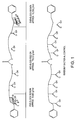
- Figure 1 illustrates a representative copolymer as described in the present discussion with acrylic acid reactive functional groups selectively located in end block and mid-block regions of the polymer, in accordance with the invention.
- Figure 1 also illustrates a similar copolymer, however formed using conventional random polymerization techniques. The resulting polymer has acrylic acid groups dispersed along the polymer in a relatively uniform fashion.
- Another preferred polymer comprises a first monomer of 2-ethylhexyl acrylate and a second monomer of isobornyl acrylate. These blocks can be incorporated into the polymer at various proportions to one another, however a representative preferred polymer includes about 70% 2-ethylhexyl acrylate and about 20% isobornyl acrylate.
- a reactive functional group was selected as 2-methacryloxyethylphthalic acid (PAMA), and was used at 10%.
- PAMA 2-methacryloxyethylphthalic acid
- the resulting polymer exhibited a particular polymeric architecture distinguishable from architectures resulting from conventional random polymerization techniques.
- the end block regions were limited to a molecular weight of about 20,000, and the mid-block region of the polymer was limited to a molecular weight of about 160,000.
- the resulting polymer molecular weight is about 200,000.
- a copolymer of 2-ethylhexyl acrylate and isobornyl acrylate can be formed which includes 2-methyacryloxyethylphthalic acid as a reactive functional group distributed within the polymer at particular proportions, such as (i) 70% of the acid in the end blocks and 30% of the acid with the mid-block, (ii) 50% of the acid located within the end blocks and 50% of the acid within the mid-block, and (iii) 30% of the acid located within the end blocks and 70% located within the mid-block.
- the preferred embodiment ordered polymers can also include other monomers besides the acrylate and/or methacrylate monomers described herein.
- the selection of the particular one or more other monomers will primarily depend upon the end use application of the resulting ordered polymer.
- the reactive functional group(s) of interest are added to a reaction system at particular times, phases, or junctures of the process to form desired regions of the polymer having particular concentrations or loadings of the reactive functional group(s).
- the reactive functional group(s) could be incorporated into the polymerizable monomer prior to polymerization and introduced into the polymer in that manner.
- Controlled radical polymerization is also known as living polymerization.
- Living polymerization is a form of addition polymerization where the ability of a growing polymer chain to terminate has been removed. This can be accomplished in a variety of ways. Chain termination and chain transfer reactions are absent and the rate of chain initiation is also much larger than the rate of chain propagation. The result is that the polymer chains grow at a more constant rate than seen in traditional chain polymerization and their lengths remain very similar, i.e. they have a very low polydispersity index.
- Living polymerization is a popular method for synthesizing block copolymers since the polymer can be synthesized in stages, each stage containing a different monomer. Additional advantages are predetermined molar mass and control over end groups.
- a particular type of living polymerization is free radical living polymerization.
- Preferred techniques associated with this type of polymerization include, but are not limited to, atom transfer radical polymerization (ATRP), reversible addition fragmentation chain transfer (RAFT) polymerization, and stable free radical polymerization (SFRP) which includes nitroxide-mediated polymerization (NMP).
- Additional techniques of free radical living polymerization include, but are not limited to, catalytic chain transfer polymerization, iniferter polymerization, iodine-transfer polymerization, selenium-centered radical mediated polymerization, telluride-mediated polymerization, and stibine-mediated polymerization for example.
- Atom transfer radical polymerization forms carbon-carbon bonds through a transition metal catalyst.
- the atom transfer step is the key step in the reaction responsible for uniform polymer chain growth.
- the uniformed polymer chain growth which leads to low polydispersity, stems from the transition metal-based catalyst.
- This catalyst provides an equilibrium between an active, and therefore propagating, form of the polymer and an inactive form of the polymer, known as the dormant form. Since the dormant state of the polymer is vastly preferred in this equilibrium, side reactions are suppressed.
- ATRP reactions are very robust in that they are tolerant of many functional groups like allyl, amino, epoxy, hydroxy and vinyl groups which can be present in either the monomer or the initator. ATRP methods are also advantageous due to the ease of preparation, commercially available and inexpensive catalysts (such as copper complexes for example), and pyridine based ligands and initiators (such as for example alkyl halides).
- variable factors relate to the monomer, initiator, catalyst, solvent and temperature, and are addressed as follows.
- Monomers that are typically used in ATRP include molecules with substituents that can stabilize the propagating radicals; for example, styrenes, (meth)acrylates, (meth)acrylamides, and acrylonitrile.
- ATRP methods are successful at leading to polymers of high number average molecular weight and a narrow polydispersity index when the concentration of the propagating radical balances the rate of radical termination. Yet, the propagating rate is unique to each individual monomer. Therefore, it is important that the other components of the polymerization (such as for example initiator, catalysts, ligands and solvents) are optimized in order for the concentration of the dormant species to be greater than the concentration of the propagating radical and yet not too great to slow down or halt the reaction.
- the other components of the polymerization such as for example initiator, catalysts, ligands and solvents
- the number of growing polymer chains is determined by the initiator. The faster the initiation, the fewer terminations and transfers, the more consistent the number of propagating chains leading to narrow molecular weight distributions.
- Organic halides that are similar in the organic framework as the propagating radical are often chosen as initiators. Alkyl halides such as alkyl bromides are more reactive than alkyl chlorides and both have good molecular weight control.
- the catalyst is the most important component of ATRP because it determines the equilibrium constant between the active and dormant species. This equilibrium determines the polymerization rate and an equilibrium constant too small may inhibit or slow the polymerization while an equilibrium constant too large leads to a high distribution of chain lengths.
- the most studied catalysts are those used in polymerizations involving copper, which has shown to have the most versatility, evidenced by successful polymerizations regardless of the monomer.
- Solvents typically include toluene,1,4-dioxane, for example.
- ATRP processes can be conducted in a relatively wide range of temperatures.
- RAFT Reversible addition fragmentation chain transfer
- RAFT can be used in all modes of free radical polymerization: solution, emulsion and suspension polymerizations.
- Implementing the RAFT technique can be as simple as introducing a suitable chain transfer agent (CTA), known as a RAFT agent, into a conventional free radical polymerization reaction, which should be devoid of oxygen, which terminates propagation. This CTA is the main species in RAFT polymerization.
- CTA chain transfer agent
- the CTA is a di- or tri-thiocarbonylthio compound, which produces the dormant form of the radical chains.
- a preferred RAFT agent is dibenzyl trithiocarbonate (DBTTC).
- DBTTC dibenzyl trithiocarbonate
- Control in RAFT polymerization is achieved in a far more complicated manner than the homolytic bond formation-bond cleavage of stable free radical polymerization and atom transfer radical polymerization.
- the CTA for RAFT polymerization must cautiously be chosen because it has an effect on polymer length, chemical composition, rate of the reaction and the number of side reactions that may occur.
- the mechanism of RAFT begins with a standard initiation step as homolytic bond cleavage of the initiator molecule and yields a reactive free radical.
- This free radical then reacts with a molecule of the monomer to form the active center with additional molecules of monomer then adding in a sequential fashion to produce a growing polymer chain.
- the propagating chain adds to the CTA to yield a radical intermediate. Fragmentation of this intermediate gives rise to either the original polymer chain or to a new radical, which itself must be able to re-initiate polymerization.
- This free radical generates its own active center by reaction with the monomer and eventually a new propagating chain is formed.
- chain equilibration occurs in which there is a rapid equilibrium between the actively growing radicals and the dormant compounds, thereby allowing all of the chains to grow at the same rate.
- a limited amount of termination typically occurs. However, the effect of termination on polymerization kinetics is negligible.
- RAFT is a degenerative chain transfer process and is free radical in nature.
- RAFT agents contain di- or tri-thiocarbonyl groups, and it is the reaction with an initiator, usually AIBN, that creates a propagating chain or polymer radical.
- AIBN an initiator
- Trithiocarbonate type RAFT agents are commercially available. These agents are typically low in color and are typically yellow to off-white. These agents also exhibit a low odor. Trithiocarbonate RAFT agents are highly effective with acrylates, styrenics, and methacrylates. These agents enable an "inside-out" growth of the polymer species of interest during formation. The use of these agents enable the formation of symmetrical tri-block versions in two steps.
- Stable free radical polymerization is a process-oriented technology that facilitates the preparation of linear or branched polymers having narrow molecular weight distributions and reactive end groups on each polymer chain.
- the process can also produce block copolymers having unique properties.
- Process conditions allow high (essentially 100%) conversions at reasonable process temperatures (less than 130°C).
- the process is especially applicable to acrylates, styrenes, and dienes.
- nitroxide-based stable free radical polymerization is particularly suited for emulsion or miscrosuspension polymerization.
- the polymerization catalyst can be, for example, organic tin compounds, metal complexes, amine compounds and other basic compounds, organic phosphate compounds, and organic acids.
- organic tin compounds include dibutyltin dilaurate, dibutyltin maleate, dibutyltin phthalate, stannous octoate, dibutyltin methoxide, dibutyltin diacetylacetate and dibutyltin diversatate.
- metal complexes examples include titanate compounds such as tetrabutyl titanate, tetraisopropyl titanate, and tetraethanolamine titanate; metal salts of carboxylic acids, such as lead octoate, lead naphthoate, and cobalt naphthoate; and metal acetylacetonate complexes such as aluminum acetylacetonate complex and vanadium acetylacetonate complex.
- titanate compounds such as tetrabutyl titanate, tetraisopropyl titanate, and tetraethanolamine titanate
- metal salts of carboxylic acids such as lead octoate, lead naphthoate, and cobalt naphthoate
- metal acetylacetonate complexes such as aluminum acetylacetonate complex and vanadium acetylacetonate complex.
- the amine compounds and other basic compounds include, for example aminisilanes such as ⁇ -aminopropyl trimethoxysilane and ⁇ -aminopropyltriethoxysilane; quaternary ammonium salts such as tetramethylammonium chloride and benzalkonium chloride; and straight-chain or cyclic tertiary amines or quaternary ammonium salts each containing plural nitrogen atoms.
- the organic phosphate compounds include monomethyl phosphate, di-n-butyl phosphate and triphenyl phosphate.
- organic acid catalysts examples include alkyl sulfonic acids such as methane sulfonic acid, aryl sulfonic acids such as p-toluene sulfonic acid, benzene sulfonic acid, styrene sulfonic acid and the like.
- the ordered polymers described herein find particular application in pressure sensitive adhesive compositions.
- the polymers are acrylic polymers having one or more reactive functional groups incorporated and apportioned in the polymer as described herein.
- the adhesive composition may also include a tackifier.
- Tackifiers are generally hydrocarbon resins, wood resins, rosins, rosin derivatives, and the like. It is contemplated that any tackifier known by those of skill in the art to be compatible with elastomeric polymer compositions may be used with the present embodiment of the invention.
- One such tackifier found to be useful is a synthetic polyterpene resin that is liquid at room temperature. This resin is a synthetic tackifier resin that predominantly comprises a polymer derived from piperylene and isoprene.
- Other suitable tackifying additives may include an aliphatic hydrocarbon resin, and a C 5 -C 9 (including for example an aromatic modified aliphatic) resin. Of course, as can be appreciated by those skilled in the art, a variety of different tackifying additives may be used in accordance with the present invention.
- tackifiers In addition to the tackifiers, other additions may be included in the adhesives to impart desired properties.
- plasticizers may be included and they are known to decrease the glass transition temperature of an adhesive composition containing elastomeric polymers.
- Antioxidants also may be included in the adhesive compositions. Suitable antioxidants include, but are not limited to, Irgafos 168 and Irganox 565 available from Ciba-Geigy, Hawthorne, NY.
- elastomeric phase Other optional materials which may be added to the adhesive composition in minor amounts, i.e. typically less than about 25% by weight of the elastomeric phase, include pH controllers, medicaments, bactericides, growth factors, wound healing components such as collagen, deodorants, perfumes, antimicrobials and fungicides. Cutting agents such as waxes and surfactants may also be included in the adhesives.
- the adhesive may be crosslinked during post curing of the adhesive to increase the cohesive strength of the pressure sensitive adhesive. This can be achieved via covalent crosslinking such as by using heat, actinic or electron beam radiation, or metal based ionic crosslinking between functional groups.
- the crosslinking agent is typically used at a level from about 0.05% to about 5%, or from about 0.075% to about 2%, or from about 0.1 % to about 1.5% by weight of adhesive solids.
- a preferred crosslinking agent is aluminum acetyl acetonoate.
- the adhesives of the present invention may further comprise additives such as pigments, fillers, diluents, and the like.
- Pigment if desired, is provided in an amount sufficient to impart the desired color to the adhesive.
- pigments include, without limitation, solid inorganic fillers such as carbon black, titanium dioxide and the like, and organic dyes. Additional inorganic fillers such as aluminum trihydrate, christobalite, glass fibers, kaolin, precipitated or fumed silica, copper, quartz, wollasonite, mica, magnesium hydroxide, silicates (e.g. feldspar), talc, nickel and calcium carbonate are also useful.
- Metal oxides such as aluminum trihydrate and magnesium hydroxide are particularly useful as flame retardants.
- the reactor charge was heated to 75°C with a constant nitrogen purge. Once solvent reflux was attained, an initiator solution of 0.05g 2,2'-azo-bis(isobutyronitrile) (AIBN, Vazo-64) and 1.50g ethyl acetate was added to the reactor. After a peak temperature range of 80-85°C was attained, the reaction conditions were maintained for 60 minutes at which point more than 80% of the monomers were consumed to generate reactive segments yielding a theoretical M n of 10,000-15,000g/mole.
- AIBN 2,2'-azo-bis(isobutyronitrile)
- a reagent feed mixture with an active nitrogen purge of 83.92g ethyl acetate, 143.4g 2-ethylhexyl acrylate, 126.5g butyl acrylate, 6.0g acrylic acid, and 0.05g Vazo-64 was added over a period of two and one half hours to the reactor.
- the temperature of the reaction was allowed to increase from 76-78 °C up to 84-88 °C.
- the reaction conditions were maintained for 30 minutes after completion of the reagent feed at which point more than 85.0% of the monomers were consumed.
- a finishing solution was fed into the kettle consisting of 0.25g tert amyl peroxypivavlate, and 26.2g of ethyl acetate to consume all remaining monomers to yield a second reactive segment with a theoretical M n of approximately 270,000g/mole.
- the resulting solution polymer was then cooled to ambient temperature and discharged from the reactor.
- the resulting acrylic copolymer contained 51.0% 2-ethylhexyl acrylate, 45.0% butyl acrylate, and 4.00% acrylic acid based on 100% by weight of the acrylic copolymer.
- This polymer had the acrylic acid split at a ratio of 50:50 between the end regions and inner region.
- the apportionment ratio of the polymer was 7.68:1.
- the resultant solution polymer was crosslinked at 0.75% based on total solid content with aluminum acetyl acetonoate (1:3:9 aluminum:2,4-pentanedione:toluene).
- the adhesive composition was dried at room temperature for 10 minutes, then placed in an oven for 10 minutes at 140°C.
- Example 1 The adhesive of Example 1 was coated onto 2-mil polyethylene terephthalate at 58-62 grams per square meter (gsm) and dried at 140°C for 10 minutes.
- Table 3 Test Results Test Example 1 Commercial Control (a) 180 peel to stainless steel 15 minutes dwell (lb/in) 3.3 3.5 (a) 180 peel to stainless steel 24 hours dwell (lb/in) 5.1 5.0 (a) 180 peel to stainless steel 96 hours dwell (lb/in) 5.3 5.5 (b) 180 peel to high density polypropylene 96 hours dwell (lb/in) 2.25 1.1 zip (d) Static Shear 1 ⁇ 2 X1X2kg stainless (minutes) 1000-1500 minutes 40-60 minutes
- the reactor charge was heated to reflux conditions (reactor jacket 90°C) with a constant nitrogen purge. Once solvent reflux was attained, an initiator solution of 0.06g 2,2'-azo-bis(isobutyronitrile) (AIBN, Vazo-64) and 5.00g ethyl acetate was added to the reactor. After a peak temperature range of 80-85°C was attained, the reaction conditions were maintained for 60 minutes at which point more than 70% of the monomers were consumed to generate reactive segments yielding a theoretical M n of approximately 13,000g/mole each.
- AIBN 2,2'-azo-bis(isobutyronitrile)
- a reagent feed mixture with an active nitrogen purge of 255.28g ethyl acetate, 434.99g 2-ethylhexyl acrylate, 58.35g isobornyl acrylate, 26.52g nn-dimethyl acrylamide, 4.72g acrylic acid, and 0.06g Vazo-64 was added over a period of two and one half hours to the reactor.
- the temperature of the reaction was held at 82-86°C. The reaction conditions were maintained for 30 minutes after completion of the reagent feed at which point more than 80.0% of the monomers were consumed.
- a finishing solution was fed into the kettle consisting of 0.32g tert amyl peroxypivavlate, and 50.52g of ethyl acetate to consume all remaining monomers to yield a second reactive segment with a theoretical M n of approximately 270,000g/mole.
- the resulting solution polymer was then cooled to ambient temperature and discharged from the reactor.
- the resulting acrylic copolymer contained 80.40% 2-ethylhexyl acrylate, 10.78% isobornyl acrylate, 4.90% nn-dimethyl acrylamide, and 3.92% acrylic acid based on 100% by weight of the acrylic copolymer.
- This polymer had the acrylic acid split at a ratio of 80:20 between the outer and inner segments.
- the theoretical molecular weight (Mn) of the acrylic copolymer was 86,112g/mol
- the measured molecular weight (Mw) of the acrylic copolymer was 231,210g/mol (determined by gel permeation chromatography relative to polystyrene standards) and the polydispersity was 2.685.
- the apportionment ratio of this polymer is 27.34:1.
- the resulting solution polymer was crosslinked at 0.75% based on total solid content with aluminum acetyl acetonoate (1:3:9 aluminum:2,4-pentanedione:toluene).
- the adhesive composition was dried at room temperature for 10 minutes, then placed in an oven for 10 minutes at 140°C.
- the adhesive composition was then subjected to the PSA performance test methods described in Example 1 and noted in Table 2.
- Example 2 The adhesive of Example 2 was coated onto 2-mil polyethylene terephthalate at 58-62 grams per square meter (gsm) and dried at 140°C for 10 minutes.
- Table 4 Test Results Test Example 2 (a) 180 peel to stainless steel 15 minutes dwell (lb/in) 4.29 (a) 180 peel to stainless steel 24 hours dwell (lb/in) 5.17 (a) 180 peel to stainless steel 96 hours dwell (lb/in) 6.28 (b) 180 peel to high density polyethylene 96 hours dwell (lb/in) 1.23 (c) 180 peel to polypropylene 96 hours dwell (lb/in) 3.33 (d) Static Shear 1 ⁇ 2 X1X1kg stainless (minutes) 6313.13 2-Pop, 1-removed
- the reactor charge was heated to 76.0°C with a constant nitrogen purge. Once solvent reflux was attained, an initiator solution of 0.073g 2,2'-azo-bis(isobutyronitrile) (AIBN, Vazo-64) and 1.50g butyl acetate was added to the reactor. After a peak temperature range of 78-82°C was attained, a reagent feed mixture with an active nitrogen purge of 60.44g ethyl acetate, 19.64g methanol, 33.24g 2-ethylhexyl acrylate, 17.38g methyl acrylate, 12.69g acrylic acid, and 0.073g Vazo-64 was added over a period of 20 minutes.
- reaction conditions were maintained for 18 minutes at which point 0.07g of Vazo 64 and 1.5g ethyl acetate were added to the reactor. Reaction conditions were maintained for 2 minutes after which, more than 80% of the acrylic acid and more than 50% of the 2-ethylhexyl acrylate were consumed to generate reactive segments yielding a theoretical M n of 15,000-20,000g/mole.
- a second reagent feed mixture with an active nitrogen purge of 317.29g ethyl acetate, 599.67g 2-ethylhexyl acrylate, 314.11 g methyl acrylate, 6.04g acrylic acid, and 0.145g Vazo-64 was added over a period of two hours and 40 minutes to the reactor.
- the temperature of the reaction was allowed to increase from 76-78 °C up to 82-84 °C.
- the reaction conditions were maintained for 20 minutes after completion of the reagent feed at which point 0.03g Vazo 64 and 2.92g ethyl acetate were added to the reactor.
- the resulting acrylic copolymer contained 63.65% 2-ethylhexyl acrylate, 33.35% methyl acrylate, 3.00% acrylic acid based on 100% by weight of the acrylic copolymer.
- This polymer had the acrylic acid split at a ratio of 80:20 between the outer and inner segments. The apportionment ratio of this polymer is 30.3:1.
- the resultant solution polymer was crosslinked at 0.55% based on total solid content with aluminum acetyl acetonoate (1:3:9 aluminum:2,4-pentanedione:toluene).
- the adhesive composition was dried at room temperature for 10 minutes, then placed in an oven for 10 minutes at 140°C.
- the adhesive composition was then subjected to the PSA performance test methods described in Example 1 and noted in Table 2.
- the reactor charge was heated to 76.0°C with a constant nitrogen purge. Once solvent reflux was attained, an initiator solution of 0.12g 2,2'-azo-bis(isobutyronitrile) (AIBN, Vazo-64) and 5.00g ethyl acetate was added to the reactor. After a peak temperature range of 80-85°C was attained, the reaction conditions were maintained for 30 minutes at which point more than 80% of the monomers were consumed to generate reactive segments yielding a theoretical M n of 10,000-4500 g/mole.
- AIBN 2,2'-azo-bis(isobutyronitrile)
- a reagent feed mixture with an active nitrogen purge of 201.39g ethyl acetate, 505.23g 2-ethylhexyl acrylate, 445.71g butyl acrylate, 9.04g acrylic acid, and 0.12g Vazo-64 was added over a period of two and one half hours to the reactor.
- the temperature of the reaction was allowed to increase from 76-78 °C up to 84-88 °C.
- the reaction was held for 20 minutes.
- 0.026g of Vazo-64 and 2.00 grams of ethyl acetate were added to the reactor. This was repeated two more times.
- the resulting acrylic copolymer contained 51.0% 2-ethylhexyl acrylate, 45.0% butyl acrylate, 4.00% acrylic acid based on 100% by weight of the acrylic copolymer.
- This polymer had the acrylic acid split at a ratio of 80:20 between the outer and inner segments. The apportionment ratio of this polymer is 22.69:1.
- the resultant solution polymer was crosslinked at 0.50% based on total solid content with aluminum acetyl acetonoate (1:3:9 aluminum:2,4-pentanedione:toluene).
- the adhesive composition was dried at room temperature for 10 minutes, then placed in an oven for 10 minutes at 140°C.
- the adhesive composition was then subjected to the PSA performance test methods described in Example 1 and noted in Table 2.
- Acrylic copolymers formed from 51% 2-ethylhexyl acrylate, 45% n-butyl acrylate, and 4% acrylic acid as a functional group were prepared with varying distributions of acrylic acid within the polymer, i.e. (i) 80% of acrylic acid in the end blocks and 20% acrylic acid in the mid-block, (ii) 50% of acrylic acid in the end blocks and 50% acrylic acid in the mid-block, and (iii) 20% of the acrylic acid in the end blocks and 80% of the acrylic acid in the mid-block.
- These polymers were prepared using stable free radical polymerization (SFRP) techniques described herein.
- SFRP stable free radical polymerization
- a control polymer having identical proportions of monomers and the acrylic acid functional group was formed, however using conventional random polymerization techniques. All polymers were cross-linked using 0.75% by weight (based upon the weight of the polymer) of 1:3:9 aluminum acetylacetonate (AlAcAc).
- Samples containing the cross-linked polymers were prepared by direct coating the polymerized and cross-linked material onto Mylar substrates 2 mil in thickness at a coating weight of 60 gsm. The coated samples were air dried for 10 minutes and then oven dried for 10 minutes at 140°C.
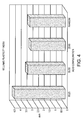
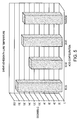
- Figures 2-7 graphically illustrate the data presented in Table 7.
- Figure 2 is a column plot of 180° peels from stainless steel of samples formed with the same extent of cross-linking, but different placement configurations of the reactive functional group.
- Figure 3 is a column plot of 180° peels from polypropylene of samples formed with the same extent of cross-linking, but different placement configurations of the reactive functional group.
- Figure 4 is a graph illustrating Williams Plasticity Index (WPI) of the samples formed with the same extent of cross-linking, but different placement configurations of the reactive functional group.
- SAFT shear adhesion failure temperature
- Figure 6 is a graph illustrating static shear measurements using a 1 inch by 1/2 inch area and 1 kg of force for the samples and control under discussion.
- Figure 7 is a graph of Tan (Delta) as a function of temperature of the various samples and control under discussion.
- Acrylic copolymers formed from 51% 2-ethylhexyl acrylate, 45% n-butyl acrylate, and 4% acrylic acid as a functional group were prepared with varying distributions of acrylic acid within the polymer, i.e. (i) 80% of acrylic acid in the end blocks and 20% acrylic acid in the mid-block, (ii) 50% of acrylic acid in the end blocks and 50% acrylic acid in the mid-block, and (iii) 20% of the acrylic acid in the end blocks and 80% of the acrylic acid in the mid-block.
- a control polymer having identical proportions of monomers and the acrylic acid functional group was formed, however using conventional random polymerization techniques.
- the polymers were cross-linked using different amounts by weight, i.e.
- AlAcAc aluminum acetylacetonate
- Samples containing the cross-linked polymers were prepared by direct coating the polymerized and cross-linked material onto Mylar substrates 2 mil in thickness at a coating weight of 60 gsm. The coated samples were air dried for 10 minutes and then oven dried for 10 minutes at 140°C.
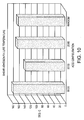
- Figures 8-12 graphically illustrate the data presented in Table 8. Specifically, Figure 8 is a column plot of 180° peels from stainless steel of samples exhibiting the same WPI, but different placement configurations of the reactive functional group.
- Figure 9 is a column plot of 180° peels from polypropylene of samples formed with the same WPI, but different placement configurations of the reactive functional group.
- Figure 10 is a column plot of shear adhesion failure temperature (SAFT) of the various samples and control under discussion.
- Figure 11 is a graph illustrating static shear measurements using a 1 inch by 1/2 inch area and 1 kg of force for the samples and control under discussion.
- Figure 12 is a graph of Tan (Delta) as a function of temperature of the various samples and control under discussion.
- Acrylic copolymers formed from 70% 2-ethylhexyl acrylate, 20% isobornyl acrylate, and 10% 2-methacryloxyethylphthalic acid (PAMA) as a functional group were prepared with varying distributions of PAMA within the polymer, i.e. (i) 70% of the PAMA in the end blocks and 30% of the PAMA in the mid-block (ii) 50% PAMA in the end blocks and 50% PAMA in the mid-block, and (iii) 30% PAMA in the end blocks and 70% PAMA in the mid-block.
- a control polymer having identical proportions of monomers and the PAMA functional group was formed, however using conventional random polymerization techniques.
- the polymers were cross-linked using different amounts by weight, i.e. 1.30% and 1.00% (based upon the weight of the polymer) of 1:3:9 aluminum acetylacetonate (AlAcAc).
- Samples containing the cross-linked polymers were prepared by direct coating the polymerized and cross-linked material onto Mylar substrates 2 mil in thickness at a coating weight of 60 gsm. The coated samples were air dried for 10 minutes and then oven dried for 10 minutes at 140°C.
- Figures 13-15 graphically illustrate the data presented in Table 9. Specifically, Figure 13 is a column plot of 180° peels from stainless steel of samples having different placement configurations of the reactive functional group.
- Figure 14 is a column plot of 180° peels from polypropylene of samples having different placement configurations of the reactive functional group.
- Figure 15 is a graph illustrating static shear measurements using a 1 inch by 1/2 inch area and 1 kg of force for the samples and control under discussion.
Landscapes
- Chemical & Material Sciences (AREA)
- Organic Chemistry (AREA)
- Chemical Kinetics & Catalysis (AREA)
- Health & Medical Sciences (AREA)
- Medicinal Chemistry (AREA)
- Polymers & Plastics (AREA)
- Graft Or Block Polymers (AREA)
- Adhesive Tapes (AREA)
- Adhesives Or Adhesive Processes (AREA)
- Addition Polymer Or Copolymer, Post-Treatments, Or Chemical Modifications (AREA)
Claims (10)
- Polymère organisé comprenant au moins deux blocs différents, comportant un ou plusieurs blocs A et un ou plusieurs blocs B, et au moins un groupe fonctionnel réactif réparti entre lesdits blocs A et B suivant un rapport de répartition compris entre 1,1 : 1 environ et 10 000 : 1 environ.
- Polymère organisé selon la revendication 1, dans lequel le rapport de répartition est compris entre 1,1 : 1 et 1 000 : 1, de préférence, le rapport de répartition est compris entre 1,1 : 1 et 100 : 1.
- Polymère organisé selon la revendication 1 ou 2, dans lequel les au moins deux blocs différents comportent ledit bloc A sélectionné à partir du groupe constitué par des monomères d'acrylate, des monomères de méthacrylate, et des mélanges de ceux-ci ; et ledit bloc B comportant un comonomère d'acrylate polymérisable, les blocs A et B comportant au moins un groupe fonctionnel réactif sélectionné à partir du groupe constitué par des groupes acrylonitrile, des groupes acrylamide, des groupes méthacrylamide, des groupes ester de vinyle, des groupes éther de vinyle, des groupes vinylamide, des groupes cétone de vinyle, des groupes styrène, des groupes halogène, des groupes ioniques, des groupes acides, des groupes basiques, des groupes oléfine, des groupes silane, des groupes époxy, des groupes hydroxyle, des groupes anhydride, des groupes silyle, des groupes carboxyle, des groupes carbonyle, des groupes ester de carbonate, des groupes isocyanato, des groupes amino, des groupes amide, des groupes imide, des groupes mercapto, des groupes acétoacétyle, et des mélanges de ceux-ci.
- Polymère organisé selon l'une quelconque des revendications 1 à 3, dans lequel le polymère présente un poids moléculaire de 10 000 à 300 000, de préférence, de 50 000 à 200 000, plus préférablement, de 100 000 à 150 000.
- Composition adhésive comprenant un polymère organisé selon l'une quelconque des revendications 1 à 4.
- Composition adhésive selon la revendication 5, dans laquelle la composition comprend en outre au moins un agent sélectionné à partir du groupe constitué par des adhésifs, des plastifiants, des antioxydants, des agents de contrôle de pH, des médicaments, des bactéricides, des facteurs de croissance, des composants cicatrisants, des désodorisants, des parfums, des agents antimicrobiens, des fongicides, les agents de coupe, des pigments, des agents de charge, des diluants, des retardateurs de flamme, et des mélanges de ceux-ci.
- Procédé de préparation d'une composition adhésive, le procédé comprenant :la formation d'un polymère organisé par polymérisation vivante, de telle sorte que le polymère organisé comprend au moins deux blocs différents, comportant un ou plusieurs blocs A et un ou plusieurs blocs B, et au moins un groupe fonctionnel réactif réparti entre lesdits blocs A et B suivant un rapport de répartition compris entre 1,1 : 1 environ et 10 000 : 1 environ,la réticulation du polymère organisé en mélangeant le polymère organisé à une quantité efficace d'un agent de réticulation ;le séchage du polymère organisé réticulé.
- Procédé selon la revendication 7, dans lequel le rapport de répartition est compris dans la plage de 1,1 : 1 à 1 000 : 1, de préférence, le rapport de répartition est compris dans la plage de 1,1 : 1 à 100 : 1.
- Procédé selon revendication 7 ou 8, dans lequel le polymère présente un poids moléculaire compris entre 10 000 et 300 000, de préférence, entre 50 000 et 200 000, plus préférablement, entre 100 000 et 150 000.
- Procédé selon l'une quelconque des revendications 7 à 9, dans lequel la quantité efficace de l'agent de réticulation est comprise entre 0,05 % et 5 %, de préférence, entre 0,075 % et 2 %, plus préférablement, entre 0,1 % et 1,5 %.
Priority Applications (1)
| Application Number | Priority Date | Filing Date | Title |
|---|---|---|---|
| PL11721941T PL2571906T3 (pl) | 2010-05-19 | 2011-05-17 | Uporządkowana architektura w polimerach akrylowych |
Applications Claiming Priority (2)
| Application Number | Priority Date | Filing Date | Title |
|---|---|---|---|
| US34605610P | 2010-05-19 | 2010-05-19 | |
| PCT/US2011/036769 WO2011146450A1 (fr) | 2010-05-19 | 2011-05-17 | Architectures organisées dans des polymères acryliques |
Publications (2)
| Publication Number | Publication Date |
|---|---|
| EP2571906A1 EP2571906A1 (fr) | 2013-03-27 |
| EP2571906B1 true EP2571906B1 (fr) | 2014-10-01 |
Family
ID=44211796
Family Applications (1)
| Application Number | Title | Priority Date | Filing Date |
|---|---|---|---|
| EP11721941.0A Active EP2571906B1 (fr) | 2010-05-19 | 2011-05-17 | Architectures organisées dans des polymères acryliques |
Country Status (10)
| Country | Link |
|---|---|
| US (3) | US9644063B2 (fr) |
| EP (1) | EP2571906B1 (fr) |
| KR (1) | KR101849686B1 (fr) |
| CN (2) | CN103003321B (fr) |
| AU (1) | AU2011256318B2 (fr) |
| BR (1) | BR112012029414B1 (fr) |
| ES (1) | ES2512440T3 (fr) |
| PL (1) | PL2571906T3 (fr) |
| RU (1) | RU2559893C2 (fr) |
| WO (1) | WO2011146450A1 (fr) |
Families Citing this family (16)
| Publication number | Priority date | Publication date | Assignee | Title |
|---|---|---|---|---|
| CN102037091B (zh) | 2008-03-20 | 2014-09-03 | 艾利丹尼森公司 | 具有官能团的控制位置的丙烯酸聚合物 |
| PL2571906T3 (pl) | 2010-05-19 | 2015-02-27 | Avery Dennison Corp | Uporządkowana architektura w polimerach akrylowych |
| EP2766404B1 (fr) | 2011-10-14 | 2019-11-13 | Avery Dennison Corporation | Polymères à architecture régulée |
| CN105229038A (zh) * | 2013-03-15 | 2016-01-06 | 艾利丹尼森公司 | 丙烯酸嵌段共聚物 |
| TWI535740B (zh) * | 2013-08-30 | 2016-06-01 | Lg化學股份有限公司 | 嵌段共聚物 |
| WO2016179076A1 (fr) | 2015-05-01 | 2016-11-10 | Avery Dennison Corporation | Adhésifs sous forme d'émulsions d'acrylique |
| US10913248B2 (en) * | 2015-11-26 | 2021-02-09 | Showa Denko Materials Co., Ltd. | Method for manufacturing electronic component, resin composition for temporary fixing, resin film for temporary fixing, and resin film sheet for temporary fixing |
| US10414953B2 (en) | 2016-02-19 | 2019-09-17 | Avery Dennison Corporation | Two stage methods for processing adhesives and related compositions |
| CN110099939B (zh) | 2016-10-25 | 2022-09-06 | 艾利丹尼森公司 | 在主链中具有光引发剂基团的嵌段聚合物及其用于粘合剂组合物中的用途 |
| WO2018118767A1 (fr) | 2016-12-22 | 2018-06-28 | Avery Dennison Corporation | Adhésifs sensibles à la pression convertibles comprenant des oligomères d'uréthane-(méth)acrylate |
| KR20200015553A (ko) * | 2017-05-29 | 2020-02-12 | 다우 글로벌 테크놀로지스 엘엘씨 | 아세토아세틸 작용성 중합체의 제조 방법 |
| AU2018392478B2 (en) | 2017-12-19 | 2023-03-16 | Avery Dennison Corporation | Post-polymerization functionalization of pendant functional groups |
| DE102018129419A1 (de) * | 2018-11-22 | 2020-05-28 | Johannes Gutenberg-Universität Mainz | Acrylat-Copolymer für galenische Anwendungen |
| CA3123036A1 (fr) * | 2018-12-20 | 2020-06-25 | Stijn COERTJENS | Adhesif a haute teneur en charge |
| DE102020205568B4 (de) | 2020-04-30 | 2022-10-06 | Tesa Se | Blockcopolymer-basierende Haftklebmasse und Verfahren zu ihrer Herstellung |
| DE102023136366A1 (de) * | 2023-12-21 | 2025-06-26 | Tesa Se | Verfahren zur Herstellung eines mehrphasigen Polymersystems |
Family Cites Families (54)
| Publication number | Priority date | Publication date | Assignee | Title |
|---|---|---|---|---|
| DK271587A (da) | 1986-05-29 | 1987-11-30 | Du Pont | Fremstilling af holdbar epoxy-(meth)acrylpolymer med oxiran-holdige endestillede grupper |
| US4912169A (en) | 1987-10-14 | 1990-03-27 | Rohm And Haas Company | Adhesive compositions containing low molecular weight polymer additives |
| BE1001592A3 (fr) * | 1988-04-27 | 1989-12-12 | Fina Research | Procede de preparation de copolymeres sequences. |
| IT1230862B (it) | 1989-06-06 | 1991-11-08 | Ausidet Spa | Copolimeri idrosolubili dell'anidride maleica. |
| RU2007431C1 (ru) * | 1991-12-27 | 1994-02-15 | Государственный научно-исследовательский институт химии и технологии полимеров им.акад.В.А.Каргина с опытным заводом | Клеевая композиция для изготовления силикатных триплексов |
| US5602221A (en) | 1993-11-10 | 1997-02-11 | Minnesota Mining And Manufacturing Company | Pressure sensitive adhesives with good low energy surface adhesion |
| ES2127507T3 (es) * | 1993-12-22 | 1999-04-16 | Tremco Inc | Composicion de estanqueidad a base de polimero acrilico modificado endurecible con la humedad. |
| US6074747A (en) | 1995-06-06 | 2000-06-13 | Avery Dennison Corporation | Ink-imprintable release coatings, and pressure sensitive adhesive constructions |
| US5807937A (en) * | 1995-11-15 | 1998-09-15 | Carnegie Mellon University | Processes based on atom (or group) transfer radical polymerization and novel (co) polymers having useful structures and properties |
| US5834538A (en) * | 1996-06-18 | 1998-11-10 | Hercules Incorporated | Pressure sensitive adhesives |
| ES2166092T3 (es) | 1996-07-10 | 2002-04-01 | Du Pont | Polimerizacion con caracteristicas vivientes. |
| JP3895836B2 (ja) | 1997-02-27 | 2007-03-22 | 積水化学工業株式会社 | 粘着性アクリル系共重合体の製造方法 |
| US6147165A (en) | 1997-03-31 | 2000-11-14 | Avery Dennison Corporation | Pressure-sensitive adhesives for marking films |
| CA2337339A1 (fr) | 1997-07-21 | 1999-02-04 | Commonwealth Scientific And Industrial Research Organisation | Synthese d'agents de migration de chaine dithioester et utilisation de di(thioacyle) bisulfures ou de dithioesters comme agents de migration de chaine |
| CA2309279C (fr) | 1997-12-18 | 2009-07-14 | E.I. Du Pont De Nemours And Company | Procede de polymerisation presentant des caracteristiques vivantes et polymeres obtenus par ce procede |
| US6844391B1 (en) | 1998-09-23 | 2005-01-18 | Avery Dennison Corporation | Adhesives with improved rivet properties and laminates using the same |
| WO2000068316A1 (fr) | 1999-05-07 | 2000-11-16 | Avery Dennison Corporation | Adhesifs et leur procede de fabrication |
| US6180691B1 (en) | 1999-08-02 | 2001-01-30 | Xerox Corporation | Processes for preparing ink jet inks |
| US6713564B1 (en) * | 1999-08-31 | 2004-03-30 | Nippon Soda Co. Ltd. | Star block copolymer |
| US6495229B1 (en) | 1999-09-17 | 2002-12-17 | Avery Dennison Corporation | Pattern coated adhesive article |
| US6596899B1 (en) | 2000-02-16 | 2003-07-22 | Noveon Ip Holdings Corp. | S,S′BIS-(α, α′-DISUBSTITUTED-α″-ACETIC ACID)- TRITHIOCARBONATES AND DERIVATIVES AS INITIATOR-CHAIN TRANSFER AGENT-TERMINATOR FOR CONTROLLED RADICAL POLYMERIZATIONS AND THE PROCESS FOR MAKING THE SAME |
| US6706836B1 (en) | 2000-03-31 | 2004-03-16 | Avery Dennison Corporation | Hydrophilic polymers, pressure sensitive adhesives and coatings |
| US6743880B2 (en) | 2000-03-31 | 2004-06-01 | Avery Denison Corporation | Hydrophilic polymers and methods of preparation |
| US6465591B1 (en) | 2000-04-24 | 2002-10-15 | Avery Dennison Corporation | Acrylic emulsion coating for films, paper and rubber |
| JP4809974B2 (ja) * | 2000-11-30 | 2011-11-09 | 株式会社東芝 | 紙葉類処理装置 |
| US6639016B2 (en) | 2000-12-31 | 2003-10-28 | Basf Corporation | Method of making a graft polymer |
| US6828339B2 (en) | 2001-11-21 | 2004-12-07 | Synthon Bv | Amlodipine salt forms and processes for preparing them |
| BR0215285B1 (pt) | 2001-12-21 | 2014-10-14 | Univ Sydney | métodos para preparar uma dispersão aquosa de partículas de polímero, e para preparar uma tinta, carga, adesivo, revestimento base ou selante. |
| WO2003068836A1 (fr) | 2002-02-13 | 2003-08-21 | Kaneka Corporation | Copolymere sequence |
| US6806320B2 (en) * | 2002-11-15 | 2004-10-19 | 3M Innovative Properties Company | Block copolymer melt-processable compositions, methods of their preparation, and articles therefrom |
| WO2004090006A1 (fr) | 2003-04-02 | 2004-10-21 | Mitsubishi Chemical Corporation | Copolymere sequence d'alcool de polyvinyle et dispersions aqueuses de pigment, fluides d'enregistrement prepares a partir de ces derniers |
| DE10326298B4 (de) | 2003-06-11 | 2008-03-20 | Avery Dennison Zweckform Office Products Europe Gmbh | Etikettenbogen |
| JP4248347B2 (ja) | 2003-09-03 | 2009-04-02 | 富士フイルム株式会社 | 皮膜形成用組成物、反射防止膜、偏光板、画像表示装置及び防汚性コーティング組成物及び防汚性物品 |
| US20070009582A1 (en) | 2003-10-07 | 2007-01-11 | Madsen Niels J | Composition useful as an adhesive and use of such a composition |
| US20060173142A1 (en) | 2005-02-01 | 2006-08-03 | Hildeberto Nava | Functionalized thermosetting resin systems |
| FR2884254B1 (fr) * | 2005-04-08 | 2007-05-25 | Arkema Sa | Copolymere sequence a fonctions acides modulables et composition adhesive et thermoplastique le contenant |
| WO2006127513A1 (fr) | 2005-05-20 | 2006-11-30 | Avery Dennison Corporation | Adhesifs sensibles a la pression, resistants au blanchiment et a l'eau |
| US20060286302A1 (en) * | 2005-06-17 | 2006-12-21 | Sheau-Hwa Ma | Rapid drying lacquers containing triblock copolymer for rheology control |
| US8357759B2 (en) * | 2005-08-26 | 2013-01-22 | CID Centro de Investigación y Desarrollo Tecnológico S.A. de C.V. | Reactive block copolymers |
| US7671152B2 (en) * | 2005-12-22 | 2010-03-02 | The Goodyear Tire & Rubber Company | Surfactantless synthesis of amphiphilic cationic block copolymers |
| DE102006016588A1 (de) | 2006-04-06 | 2007-10-18 | Rohmax Additives Gmbh | Kraftstoffzusammensetzungen umfassend nachwachsende Rohstoffe |
| DK2027208T3 (en) | 2006-05-25 | 2016-04-25 | Arkema Inc | amphiphilic block copolymers |
| CN101528782A (zh) | 2006-05-25 | 2009-09-09 | 阿科玛股份有限公司 | 酸官能化的梯度嵌段共聚物 |
| DE102006035726A1 (de) * | 2006-07-28 | 2008-01-31 | Evonik Röhm Gmbh | Verfahren zur Herstellung von ABA-Triblockcopolymeren auf (Meth)acrylatbasis |
| US9056988B2 (en) | 2007-02-05 | 2015-06-16 | Ppg Industries Ohio, Inc. | Solar reflective coatings and coating systems |
| JP2009108203A (ja) | 2007-10-30 | 2009-05-21 | Sekisui Chem Co Ltd | ガラスペースト組成物、及び、プラズマディスプレイパネルの製造方法 |
| US20090171049A1 (en) | 2007-12-27 | 2009-07-02 | Linhardt Jeffrey G | Segmented reactive block copolymers |
| CN102037091B (zh) | 2008-03-20 | 2014-09-03 | 艾利丹尼森公司 | 具有官能团的控制位置的丙烯酸聚合物 |
| TWI461848B (zh) | 2008-03-28 | 2014-11-21 | 富士軟片股份有限公司 | 正型感光性樹脂組成物及使用它的硬化膜形成方法 |
| DE102008002016A1 (de) | 2008-05-28 | 2009-12-03 | Evonik Röhm Gmbh | Verfahren zur Herstellung von silyl-funktionalisierten ABA-Triblockcopolymeren auf (Meth)acrylatbasis |
| DE102008043668A1 (de) | 2008-11-12 | 2010-05-20 | Evonik Röhm Gmbh | Verfahren zur Herstellung von ABA-Triblockcopolymeren mit einem bimodalen B-Block |
| PL2571906T3 (pl) | 2010-05-19 | 2015-02-27 | Avery Dennison Corp | Uporządkowana architektura w polimerach akrylowych |
| MX346131B (es) | 2010-12-29 | 2017-03-08 | Akzo Nobel Coatings Int Bv | Emulsiones de latex y composiciones de recubrimiento formadas a partir de las emulsiones de latex. |
| EP2766404B1 (fr) | 2011-10-14 | 2019-11-13 | Avery Dennison Corporation | Polymères à architecture régulée |
-
2011
- 2011-05-17 PL PL11721941T patent/PL2571906T3/pl unknown
- 2011-05-17 KR KR1020127033162A patent/KR101849686B1/ko active Active
- 2011-05-17 CN CN201180035427.XA patent/CN103003321B/zh active Active
- 2011-05-17 CN CN201710053565.XA patent/CN106800627B/zh active Active
- 2011-05-17 AU AU2011256318A patent/AU2011256318B2/en active Active
- 2011-05-17 US US13/697,696 patent/US9644063B2/en active Active
- 2011-05-17 RU RU2012150153/04A patent/RU2559893C2/ru not_active IP Right Cessation
- 2011-05-17 EP EP11721941.0A patent/EP2571906B1/fr active Active
- 2011-05-17 BR BR112012029414-8A patent/BR112012029414B1/pt active IP Right Grant
- 2011-05-17 ES ES11721941.0T patent/ES2512440T3/es active Active
- 2011-05-17 WO PCT/US2011/036769 patent/WO2011146450A1/fr not_active Ceased
-
2017
- 2017-02-10 US US15/429,287 patent/US10011747B2/en active Active
- 2017-02-10 US US15/429,256 patent/US10266632B2/en active Active
Also Published As
| Publication number | Publication date |
|---|---|
| AU2011256318A1 (en) | 2012-12-06 |
| BR112012029414B1 (pt) | 2020-11-17 |
| EP2571906A1 (fr) | 2013-03-27 |
| BR112012029414A2 (pt) | 2017-02-21 |
| RU2012150153A (ru) | 2014-06-27 |
| US10011747B2 (en) | 2018-07-03 |
| US20170226259A1 (en) | 2017-08-10 |
| RU2559893C2 (ru) | 2015-08-20 |
| US20170152415A1 (en) | 2017-06-01 |
| US9644063B2 (en) | 2017-05-09 |
| PL2571906T3 (pl) | 2015-02-27 |
| KR101849686B1 (ko) | 2018-04-17 |
| ES2512440T3 (es) | 2014-10-24 |
| AU2011256318B2 (en) | 2015-11-19 |
| KR20130118745A (ko) | 2013-10-30 |
| CN103003321B (zh) | 2018-11-27 |
| CN106800627B (zh) | 2020-08-07 |
| US20130059971A1 (en) | 2013-03-07 |
| US10266632B2 (en) | 2019-04-23 |
| WO2011146450A1 (fr) | 2011-11-24 |
| CN106800627A (zh) | 2017-06-06 |
| CN103003321A (zh) | 2013-03-27 |
Similar Documents
| Publication | Publication Date | Title |
|---|---|---|
| EP2571906B1 (fr) | Architectures organisées dans des polymères acryliques | |
| CN102037091B (zh) | 具有官能团的控制位置的丙烯酸聚合物 | |
| US11117994B2 (en) | Controlled architecture polymers | |
| US6646079B2 (en) | Multimodal polymers by controlled radical polymerization in the presence of alkoxyamines | |
| CN110099939B (zh) | 在主链中具有光引发剂基团的嵌段聚合物及其用于粘合剂组合物中的用途 | |
| CN105229038A (zh) | 丙烯酸嵌段共聚物 | |
| AU2015230788A1 (en) | Ordered architectures in acrylic polymers | |
| CN102911302B (zh) | 乙酸乙烯酯类单体乳液活性聚合反应方法 | |
| AU2012322689B2 (en) | Controlled architecture polymers | |
| AU2014268205A1 (en) | Acrylic polymers having controlled placement of functional groups |
Legal Events
| Date | Code | Title | Description |
|---|---|---|---|
| PUAI | Public reference made under article 153(3) epc to a published international application that has entered the european phase |
Free format text: ORIGINAL CODE: 0009012 |
|
| 17P | Request for examination filed |
Effective date: 20121129 |
|
| AK | Designated contracting states |
Kind code of ref document: A1 Designated state(s): AL AT BE BG CH CY CZ DE DK EE ES FI FR GB GR HR HU IE IS IT LI LT LU LV MC MK MT NL NO PL PT RO RS SE SI SK SM TR |
|
| DAX | Request for extension of the european patent (deleted) | ||
| 17Q | First examination report despatched |
Effective date: 20130902 |
|
| GRAP | Despatch of communication of intention to grant a patent |
Free format text: ORIGINAL CODE: EPIDOSNIGR1 |
|
| INTG | Intention to grant announced |
Effective date: 20140422 |
|
| GRAS | Grant fee paid |
Free format text: ORIGINAL CODE: EPIDOSNIGR3 |
|
| GRAA | (expected) grant |
Free format text: ORIGINAL CODE: 0009210 |
|
| AK | Designated contracting states |
Kind code of ref document: B1 Designated state(s): AL AT BE BG CH CY CZ DE DK EE ES FI FR GB GR HR HU IE IS IT LI LT LU LV MC MK MT NL NO PL PT RO RS SE SI SK SM TR |
|
| REG | Reference to a national code |
Ref country code: GB Ref legal event code: FG4D |
|
| REG | Reference to a national code |
Ref country code: CH Ref legal event code: EP Ref country code: AT Ref legal event code: REF Ref document number: 689528 Country of ref document: AT Kind code of ref document: T Effective date: 20141015 |
|
| REG | Reference to a national code |
Ref country code: IE Ref legal event code: FG4D |
|
| REG | Reference to a national code |
Ref country code: ES Ref legal event code: FG2A Ref document number: 2512440 Country of ref document: ES Kind code of ref document: T3 Effective date: 20141024 |
|
| REG | Reference to a national code |
Ref country code: DE Ref legal event code: R096 Ref document number: 602011010265 Country of ref document: DE Effective date: 20141106 |
|
| REG | Reference to a national code |
Ref country code: NL Ref legal event code: T3 |
|
| REG | Reference to a national code |
Ref country code: PL Ref legal event code: T3 |
|
| REG | Reference to a national code |
Ref country code: AT Ref legal event code: MK05 Ref document number: 689528 Country of ref document: AT Kind code of ref document: T Effective date: 20141001 |
|
| REG | Reference to a national code |
Ref country code: LT Ref legal event code: MG4D |
|
| PG25 | Lapsed in a contracting state [announced via postgrant information from national office to epo] |
Ref country code: NO Free format text: LAPSE BECAUSE OF FAILURE TO SUBMIT A TRANSLATION OF THE DESCRIPTION OR TO PAY THE FEE WITHIN THE PRESCRIBED TIME-LIMIT Effective date: 20150101 Ref country code: CZ Free format text: LAPSE BECAUSE OF FAILURE TO SUBMIT A TRANSLATION OF THE DESCRIPTION OR TO PAY THE FEE WITHIN THE PRESCRIBED TIME-LIMIT Effective date: 20141001 Ref country code: PT Free format text: LAPSE BECAUSE OF FAILURE TO SUBMIT A TRANSLATION OF THE DESCRIPTION OR TO PAY THE FEE WITHIN THE PRESCRIBED TIME-LIMIT Effective date: 20150202 Ref country code: IS Free format text: LAPSE BECAUSE OF FAILURE TO SUBMIT A TRANSLATION OF THE DESCRIPTION OR TO PAY THE FEE WITHIN THE PRESCRIBED TIME-LIMIT Effective date: 20150201 Ref country code: LT Free format text: LAPSE BECAUSE OF FAILURE TO SUBMIT A TRANSLATION OF THE DESCRIPTION OR TO PAY THE FEE WITHIN THE PRESCRIBED TIME-LIMIT Effective date: 20141001 Ref country code: FI Free format text: LAPSE BECAUSE OF FAILURE TO SUBMIT A TRANSLATION OF THE DESCRIPTION OR TO PAY THE FEE WITHIN THE PRESCRIBED TIME-LIMIT Effective date: 20141001 |
|
| PG25 | Lapsed in a contracting state [announced via postgrant information from national office to epo] |
Ref country code: SE Free format text: LAPSE BECAUSE OF FAILURE TO SUBMIT A TRANSLATION OF THE DESCRIPTION OR TO PAY THE FEE WITHIN THE PRESCRIBED TIME-LIMIT Effective date: 20141001 Ref country code: AT Free format text: LAPSE BECAUSE OF FAILURE TO SUBMIT A TRANSLATION OF THE DESCRIPTION OR TO PAY THE FEE WITHIN THE PRESCRIBED TIME-LIMIT Effective date: 20141001 Ref country code: RS Free format text: LAPSE BECAUSE OF FAILURE TO SUBMIT A TRANSLATION OF THE DESCRIPTION OR TO PAY THE FEE WITHIN THE PRESCRIBED TIME-LIMIT Effective date: 20141001 Ref country code: LV Free format text: LAPSE BECAUSE OF FAILURE TO SUBMIT A TRANSLATION OF THE DESCRIPTION OR TO PAY THE FEE WITHIN THE PRESCRIBED TIME-LIMIT Effective date: 20141001 Ref country code: HR Free format text: LAPSE BECAUSE OF FAILURE TO SUBMIT A TRANSLATION OF THE DESCRIPTION OR TO PAY THE FEE WITHIN THE PRESCRIBED TIME-LIMIT Effective date: 20141001 Ref country code: CY Free format text: LAPSE BECAUSE OF FAILURE TO SUBMIT A TRANSLATION OF THE DESCRIPTION OR TO PAY THE FEE WITHIN THE PRESCRIBED TIME-LIMIT Effective date: 20141001 Ref country code: GR Free format text: LAPSE BECAUSE OF FAILURE TO SUBMIT A TRANSLATION OF THE DESCRIPTION OR TO PAY THE FEE WITHIN THE PRESCRIBED TIME-LIMIT Effective date: 20150102 |
|
| REG | Reference to a national code |
Ref country code: DE Ref legal event code: R097 Ref document number: 602011010265 Country of ref document: DE |
|
| PG25 | Lapsed in a contracting state [announced via postgrant information from national office to epo] |
Ref country code: EE Free format text: LAPSE BECAUSE OF FAILURE TO SUBMIT A TRANSLATION OF THE DESCRIPTION OR TO PAY THE FEE WITHIN THE PRESCRIBED TIME-LIMIT Effective date: 20141001 Ref country code: DK Free format text: LAPSE BECAUSE OF FAILURE TO SUBMIT A TRANSLATION OF THE DESCRIPTION OR TO PAY THE FEE WITHIN THE PRESCRIBED TIME-LIMIT Effective date: 20141001 Ref country code: RO Free format text: LAPSE BECAUSE OF FAILURE TO SUBMIT A TRANSLATION OF THE DESCRIPTION OR TO PAY THE FEE WITHIN THE PRESCRIBED TIME-LIMIT Effective date: 20141001 Ref country code: SK Free format text: LAPSE BECAUSE OF FAILURE TO SUBMIT A TRANSLATION OF THE DESCRIPTION OR TO PAY THE FEE WITHIN THE PRESCRIBED TIME-LIMIT Effective date: 20141001 |
|
| PLBE | No opposition filed within time limit |
Free format text: ORIGINAL CODE: 0009261 |
|
| STAA | Information on the status of an ep patent application or granted ep patent |
Free format text: STATUS: NO OPPOSITION FILED WITHIN TIME LIMIT |
|
| 26N | No opposition filed |
Effective date: 20150702 |
|
| REG | Reference to a national code |
Ref country code: CH Ref legal event code: PL |
|
| PG25 | Lapsed in a contracting state [announced via postgrant information from national office to epo] |
Ref country code: CH Free format text: LAPSE BECAUSE OF NON-PAYMENT OF DUE FEES Effective date: 20150531 Ref country code: MC Free format text: LAPSE BECAUSE OF FAILURE TO SUBMIT A TRANSLATION OF THE DESCRIPTION OR TO PAY THE FEE WITHIN THE PRESCRIBED TIME-LIMIT Effective date: 20141001 Ref country code: LI Free format text: LAPSE BECAUSE OF NON-PAYMENT OF DUE FEES Effective date: 20150531 Ref country code: LU Free format text: LAPSE BECAUSE OF FAILURE TO SUBMIT A TRANSLATION OF THE DESCRIPTION OR TO PAY THE FEE WITHIN THE PRESCRIBED TIME-LIMIT Effective date: 20150517 |
|
| REG | Reference to a national code |
Ref country code: IE Ref legal event code: MM4A |
|
| PG25 | Lapsed in a contracting state [announced via postgrant information from national office to epo] |
Ref country code: SI Free format text: LAPSE BECAUSE OF FAILURE TO SUBMIT A TRANSLATION OF THE DESCRIPTION OR TO PAY THE FEE WITHIN THE PRESCRIBED TIME-LIMIT Effective date: 20141001 |
|
| REG | Reference to a national code |
Ref country code: FR Ref legal event code: PLFP Year of fee payment: 6 |
|
| PG25 | Lapsed in a contracting state [announced via postgrant information from national office to epo] |
Ref country code: IE Free format text: LAPSE BECAUSE OF NON-PAYMENT OF DUE FEES Effective date: 20150517 |
|
| PG25 | Lapsed in a contracting state [announced via postgrant information from national office to epo] |
Ref country code: MT Free format text: LAPSE BECAUSE OF FAILURE TO SUBMIT A TRANSLATION OF THE DESCRIPTION OR TO PAY THE FEE WITHIN THE PRESCRIBED TIME-LIMIT Effective date: 20141001 |
|
| REG | Reference to a national code |
Ref country code: FR Ref legal event code: PLFP Year of fee payment: 7 |
|
| PG25 | Lapsed in a contracting state [announced via postgrant information from national office to epo] |
Ref country code: HU Free format text: LAPSE BECAUSE OF FAILURE TO SUBMIT A TRANSLATION OF THE DESCRIPTION OR TO PAY THE FEE WITHIN THE PRESCRIBED TIME-LIMIT; INVALID AB INITIO Effective date: 20110517 Ref country code: BG Free format text: LAPSE BECAUSE OF FAILURE TO SUBMIT A TRANSLATION OF THE DESCRIPTION OR TO PAY THE FEE WITHIN THE PRESCRIBED TIME-LIMIT Effective date: 20141001 Ref country code: SM Free format text: LAPSE BECAUSE OF FAILURE TO SUBMIT A TRANSLATION OF THE DESCRIPTION OR TO PAY THE FEE WITHIN THE PRESCRIBED TIME-LIMIT Effective date: 20141001 |
|
| PG25 | Lapsed in a contracting state [announced via postgrant information from national office to epo] |
Ref country code: TR Free format text: LAPSE BECAUSE OF FAILURE TO SUBMIT A TRANSLATION OF THE DESCRIPTION OR TO PAY THE FEE WITHIN THE PRESCRIBED TIME-LIMIT Effective date: 20141001 |
|
| REG | Reference to a national code |
Ref country code: FR Ref legal event code: PLFP Year of fee payment: 8 |
|
| PGFP | Annual fee paid to national office [announced via postgrant information from national office to epo] |
Ref country code: PL Payment date: 20180316 Year of fee payment: 8 |
|
| PG25 | Lapsed in a contracting state [announced via postgrant information from national office to epo] |
Ref country code: MK Free format text: LAPSE BECAUSE OF FAILURE TO SUBMIT A TRANSLATION OF THE DESCRIPTION OR TO PAY THE FEE WITHIN THE PRESCRIBED TIME-LIMIT Effective date: 20141001 |
|
| PGFP | Annual fee paid to national office [announced via postgrant information from national office to epo] |
Ref country code: ES Payment date: 20180604 Year of fee payment: 8 |
|
| PG25 | Lapsed in a contracting state [announced via postgrant information from national office to epo] |
Ref country code: AL Free format text: LAPSE BECAUSE OF FAILURE TO SUBMIT A TRANSLATION OF THE DESCRIPTION OR TO PAY THE FEE WITHIN THE PRESCRIBED TIME-LIMIT Effective date: 20141001 |
|
| REG | Reference to a national code |
Ref country code: ES Ref legal event code: FD2A Effective date: 20200930 |
|
| PG25 | Lapsed in a contracting state [announced via postgrant information from national office to epo] |
Ref country code: ES Free format text: LAPSE BECAUSE OF NON-PAYMENT OF DUE FEES Effective date: 20190518 |
|
| PG25 | Lapsed in a contracting state [announced via postgrant information from national office to epo] |
Ref country code: PL Free format text: LAPSE BECAUSE OF NON-PAYMENT OF DUE FEES Effective date: 20190517 |
|
| REG | Reference to a national code |
Ref country code: DE Ref legal event code: R081 Ref document number: 602011010265 Country of ref document: DE Owner name: AVERY DENNISON CORPORATION, MENTOR, US Free format text: FORMER OWNER: AVERY DENNISON CORP., PASADENA, CALIF., US |
|
| REG | Reference to a national code |
Ref country code: BE Ref legal event code: PD Owner name: AVERY DENNISON CORPORATION; US Free format text: DETAILS ASSIGNMENT: CHANGE OF OWNER(S), OTHER; FORMER OWNER NAME: GEVERS PATENTS Effective date: 20220602 |
|
| REG | Reference to a national code |
Ref country code: FR Ref legal event code: PLFP Year of fee payment: 13 |
|
| P01 | Opt-out of the competence of the unified patent court (upc) registered |
Effective date: 20230526 |
|
| PGFP | Annual fee paid to national office [announced via postgrant information from national office to epo] |
Ref country code: NL Payment date: 20250421 Year of fee payment: 15 |
|
| PGFP | Annual fee paid to national office [announced via postgrant information from national office to epo] |
Ref country code: DE Payment date: 20250409 Year of fee payment: 15 |
|
| PGFP | Annual fee paid to national office [announced via postgrant information from national office to epo] |
Ref country code: IT Payment date: 20250509 Year of fee payment: 15 Ref country code: BE Payment date: 20250411 Year of fee payment: 15 |
|
| PGFP | Annual fee paid to national office [announced via postgrant information from national office to epo] |
Ref country code: FR Payment date: 20250409 Year of fee payment: 15 |
|
| PGFP | Annual fee paid to national office [announced via postgrant information from national office to epo] |
Ref country code: GB Payment date: 20260320 Year of fee payment: 16 |