EP2572738A2 - Corps de formage avec matériau composite contenant du collagène destiné à être introduit à l'emplacement d'un défaut osseux - Google Patents
Corps de formage avec matériau composite contenant du collagène destiné à être introduit à l'emplacement d'un défaut osseux Download PDFInfo
- Publication number
- EP2572738A2 EP2572738A2 EP12182753A EP12182753A EP2572738A2 EP 2572738 A2 EP2572738 A2 EP 2572738A2 EP 12182753 A EP12182753 A EP 12182753A EP 12182753 A EP12182753 A EP 12182753A EP 2572738 A2 EP2572738 A2 EP 2572738A2
- Authority
- EP
- European Patent Office
- Prior art keywords
- bone
- shaped body
- bone substitute
- collagen
- kem
- Prior art date
- Legal status (The legal status is an assumption and is not a legal conclusion. Google has not performed a legal analysis and makes no representation as to the accuracy of the status listed.)
- Granted
Links
Images


Classifications
-
- A—HUMAN NECESSITIES
- A61—MEDICAL OR VETERINARY SCIENCE; HYGIENE
- A61L—METHODS OR APPARATUS FOR STERILISING MATERIALS OR OBJECTS IN GENERAL; DISINFECTION, STERILISATION OR DEODORISATION OF AIR; CHEMICAL ASPECTS OF BANDAGES, DRESSINGS, ABSORBENT PADS OR SURGICAL ARTICLES; MATERIALS FOR BANDAGES, DRESSINGS, ABSORBENT PADS OR SURGICAL ARTICLES
- A61L27/00—Materials for grafts or prostheses or for coating grafts or prostheses
- A61L27/40—Composite materials, i.e. containing one material dispersed in a matrix of the same or different material
- A61L27/44—Composite materials, i.e. containing one material dispersed in a matrix of the same or different material having a macromolecular matrix
-
- A—HUMAN NECESSITIES
- A61—MEDICAL OR VETERINARY SCIENCE; HYGIENE
- A61L—METHODS OR APPARATUS FOR STERILISING MATERIALS OR OBJECTS IN GENERAL; DISINFECTION, STERILISATION OR DEODORISATION OF AIR; CHEMICAL ASPECTS OF BANDAGES, DRESSINGS, ABSORBENT PADS OR SURGICAL ARTICLES; MATERIALS FOR BANDAGES, DRESSINGS, ABSORBENT PADS OR SURGICAL ARTICLES
- A61L27/00—Materials for grafts or prostheses or for coating grafts or prostheses
- A61L27/40—Composite materials, i.e. containing one material dispersed in a matrix of the same or different material
- A61L27/44—Composite materials, i.e. containing one material dispersed in a matrix of the same or different material having a macromolecular matrix
- A61L27/46—Composite materials, i.e. containing one material dispersed in a matrix of the same or different material having a macromolecular matrix with phosphorus-containing inorganic fillers
-
- A—HUMAN NECESSITIES
- A61—MEDICAL OR VETERINARY SCIENCE; HYGIENE
- A61F—FILTERS IMPLANTABLE INTO BLOOD VESSELS; PROSTHESES; DEVICES PROVIDING PATENCY TO, OR PREVENTING COLLAPSING OF, TUBULAR STRUCTURES OF THE BODY, e.g. STENTS; ORTHOPAEDIC, NURSING OR CONTRACEPTIVE DEVICES; FOMENTATION; TREATMENT OR PROTECTION OF EYES OR EARS; BANDAGES, DRESSINGS OR ABSORBENT PADS; FIRST-AID KITS
- A61F2/00—Filters implantable into blood vessels; Prostheses, i.e. artificial substitutes or replacements for parts of the body; Appliances for connecting them with the body; Devices providing patency to, or preventing collapsing of, tubular structures of the body, e.g. stents
- A61F2/02—Prostheses implantable into the body
- A61F2/28—Bones
-
- A—HUMAN NECESSITIES
- A61—MEDICAL OR VETERINARY SCIENCE; HYGIENE
- A61L—METHODS OR APPARATUS FOR STERILISING MATERIALS OR OBJECTS IN GENERAL; DISINFECTION, STERILISATION OR DEODORISATION OF AIR; CHEMICAL ASPECTS OF BANDAGES, DRESSINGS, ABSORBENT PADS OR SURGICAL ARTICLES; MATERIALS FOR BANDAGES, DRESSINGS, ABSORBENT PADS OR SURGICAL ARTICLES
- A61L27/00—Materials for grafts or prostheses or for coating grafts or prostheses
- A61L27/40—Composite materials, i.e. containing one material dispersed in a matrix of the same or different material
- A61L27/44—Composite materials, i.e. containing one material dispersed in a matrix of the same or different material having a macromolecular matrix
- A61L27/446—Composite materials, i.e. containing one material dispersed in a matrix of the same or different material having a macromolecular matrix with other specific inorganic fillers other than those covered by A61L27/443 or A61L27/46
-
- A—HUMAN NECESSITIES
- A61—MEDICAL OR VETERINARY SCIENCE; HYGIENE
- A61C—DENTISTRY; APPARATUS OR METHODS FOR ORAL OR DENTAL HYGIENE
- A61C8/00—Means to be fixed to the jaw-bone for consolidating natural teeth or for fixing dental prostheses thereon; Dental implants; Implanting tools
-
- A—HUMAN NECESSITIES
- A61—MEDICAL OR VETERINARY SCIENCE; HYGIENE
- A61C—DENTISTRY; APPARATUS OR METHODS FOR ORAL OR DENTAL HYGIENE
- A61C8/00—Means to be fixed to the jaw-bone for consolidating natural teeth or for fixing dental prostheses thereon; Dental implants; Implanting tools
- A61C8/0003—Not used, see subgroups
- A61C8/0004—Consolidating natural teeth
- A61C8/0006—Periodontal tissue or bone regeneration
-
- A—HUMAN NECESSITIES
- A61—MEDICAL OR VETERINARY SCIENCE; HYGIENE
- A61F—FILTERS IMPLANTABLE INTO BLOOD VESSELS; PROSTHESES; DEVICES PROVIDING PATENCY TO, OR PREVENTING COLLAPSING OF, TUBULAR STRUCTURES OF THE BODY, e.g. STENTS; ORTHOPAEDIC, NURSING OR CONTRACEPTIVE DEVICES; FOMENTATION; TREATMENT OR PROTECTION OF EYES OR EARS; BANDAGES, DRESSINGS OR ABSORBENT PADS; FIRST-AID KITS
- A61F2/00—Filters implantable into blood vessels; Prostheses, i.e. artificial substitutes or replacements for parts of the body; Appliances for connecting them with the body; Devices providing patency to, or preventing collapsing of, tubular structures of the body, e.g. stents
- A61F2/02—Prostheses implantable into the body
- A61F2/28—Bones
- A61F2002/2835—Bone graft implants for filling a bony defect or an endoprosthesis cavity, e.g. by synthetic material or biological material
-
- A—HUMAN NECESSITIES
- A61—MEDICAL OR VETERINARY SCIENCE; HYGIENE
- A61L—METHODS OR APPARATUS FOR STERILISING MATERIALS OR OBJECTS IN GENERAL; DISINFECTION, STERILISATION OR DEODORISATION OF AIR; CHEMICAL ASPECTS OF BANDAGES, DRESSINGS, ABSORBENT PADS OR SURGICAL ARTICLES; MATERIALS FOR BANDAGES, DRESSINGS, ABSORBENT PADS OR SURGICAL ARTICLES
- A61L2430/00—Materials or treatment for tissue regeneration
- A61L2430/02—Materials or treatment for tissue regeneration for reconstruction of bones; weight-bearing implants
Definitions
- the invention relates to a shaped body for introduction into an alveolar space or into another bone defect site.
- Medical treatment can lead to (minor) iatrogenic bone defects.
- An example of this is the wound cavity after the removal of a bone cyst.
- the alveolus is first healed so as to be subsequently treated with a denture treatment for e.g. to start a dental implantation again.
- a denture treatment for e.g. to start a dental implantation again.
- This can lead to an undesirable loss of bone substance during the healing period.
- either the dentures can no longer be optimally anchored or even a complex regeneration treatment of the jawbone must be interposed.
- Another approach uses an implant immediately after tooth extraction.
- An example of such an implant is eg in DE 196 30 034 A1 described. It contains a hard titanium core, which is provided, inter alia, with a collagen-containing coating and which serves as a base for a dental crown after a waxing-in phase.
- a hard titanium core which is provided, inter alia, with a collagen-containing coating and which serves as a base for a dental crown after a waxing-in phase.
- the implant bearing is made of ceramic, preferably of the synthetic bone substitute material hydroxyapatite, and has an inwardly decreasing density or increasing porosity. It has a very solid support structure and, after growing together with the jawbone, serves as the immediate base in which the dental implant is anchored. Ingrowth of the natural bone into the dental implant becomes more difficult and slows down when using the implant site.
- This implant bed represents a permanent avital bone replacement. For better fixation, it is fastened to the jaw by means of screws. This implant site is very close to the alveolar wall and can lead to additional injuries during insertion, which can cause inflammation and delayed wound healing.
- the main body may consist of a collagen material in which a core of bone substitute material is completely embedded or embedded homogeneously distributed in the bone substitute material.
- the composite body is used, for example, after a tooth extraction for bone regeneration and to preserve the existing bone substance, later, after wound healing To be able to anchor a dental implant in the jawbone.
- the bone substitute material is relatively hard and inflexible, so that when inserting the composite into the socket, additional injuries with the above consequences may also occur.
- the composition contains at least one collagen which has at least one osteoinductive or chondroinductive active ingredient and at least one additive from a differentiation and / or growth factor.
- the composition may optionally contain a filler material.
- the filling material can be understood as a bone substitute material.
- Filler materials include type 1 collagen, native bone extract, and ceramic materials such as tricalcium phosphate and hydroxyapatite.
- the composition may be present as a substantially dimensionally stable body. No information is given about the distribution of the filling material within the composition.
- the object of the invention is to provide a shaped body of the type described, which causes improved wound healing and improved bone regeneration and preservation.
- a molding according to the features of claim 1 is given.
- a composite material with at least one first material component in the form of a collagen material and a second material component in the form of a bone substitute material is provided.
- the collagen material forms a matrix into which the bone substitute material is distributed in an inhomogeneous manner, so that a local volume which is related to any partial volume of 30 mm 3 Collagen content is at least 10% throughout, and a total volume of global collagen content ranges between 30% and 95%.
- the molded body is compressible.
- Each local bone replacement material portion, which is related to a partial volume of 30 mm 3 has its maximum value at an edge surface and decreases inwards starting from the edge surface, with a KEM zone provided with bone substitute material extending from the edge surface into the interior.
- the shaped body according to the invention is intended for insertion into a bone defect site, which may be located in particular in the area of the face, preferably in the area of the mouth or jaw.
- a bone defect site which may be located in particular in the area of the face, preferably in the area of the mouth or jaw.
- the shaped body can in particular also be referred to as alveolar filling body or dental filling body.
- the existing in particular of the collagen-containing composite material body supports by its combined structure of collagen and bone substitute material, the natural bone regeneration.
- the collagen serves as a regenerative guide rail, the bone material as a stabilizing component, whereby both components can work together synergistically.
- the inventive molding is in contrast to the implant bearing according to the DE 10 2006 047 054 A1 not a primary basis for the anchoring of an implant, but rather serves in the run-up to a dental implantation by at least partial regeneration of the natural, physiological bone matrix only to build a suitable implant base.
- a later inserted implant then grows into a vital, physiological bone base.
- An avital, synthetic base like the implant bed according to of the DE 10 2006 047 054 A1 On the other hand, it shows no comparable favorable properties for implant ingrowth.
- an implant is to be inserted directly into the existing jawbone, remaining cavities around the implant can still be filled with at least one shaped body according to the invention in the same treatment session in which the implant is also used. This shortens the treatment time.
- the molded body or bodies used in the cavities promote wound healing and implant ingrowth.
- the use of the bone substitute material can be dosed as required and adapted to the intended use.
- the amount of bone graft material applied can thus be reduced to the necessary level.
- the molding can So in particular also contain at least one bone substitute material-free zone. The latter may well be very small and make up, for example, only about 10% of the total volume of the molding.
- the percent volume of bone replacement material-free zone based on the total volume ranges from 30% to 90%, preferably from 40% to 85% and preferably from 50% to 75%.
- the global collagen content is in each case between 55% and 95%, preferably between 60% and 90%, and preferably between 70% and 80%.
- Collagen also has a beneficial effect on bone regeneration.
- Collagen in contrast to the bone substitute material, is a soft, plastically deformable material. It contributes less to the mechanical stabilization. Because of its very easy absorbability, it affects the natural bone regeneration (osteogenesis and vascularization) significantly less than the bone substitute material.
- a composite material is provided for the molded body, which consists exclusively of the collagen material and the bone substitute material.
- additional materials and / or materials within the composite material are also possible in principle.
- the shaped body is compressible as a whole.
- the shaped body can be significantly better compressed than comparable previously known embodiments, such as the implant bearing according to the DE 10 2006 047 054 A1 in which virtually no compression is possible.
- the inhomogeneous embedding of the bone substitute material in the collagen matrix improves the compressibility of the molded body, especially in the areas in which little or no bone replacement material is provided.
- the compressibility of the molding facilitates the insertion of the molding into the wound cavity (simple compression between thumb and forefinger, then insertion into the wound cavity) and allows a better and gentler nestling against the wall of the wound cavity, eg the socket, without causing additional injuries. This results in improved wound healing and bone regeneration or preservation.
- the molded body can be adapted by the (dental) doctor during the treatment session with little effort to the respective bone defect site. This is achieved on the one hand by the compressibility.
- the shaped body is in particular also able to be cut.
- the blank of the shaped body can preferably be made by means of a conventional cutting tool, such as a knife or a scalpel. A special tool is dispensable for this.
- the bone substitute material is specifically introduced there especially, specifically in the opening area of a bone defect site, where its mechanically supporting function is particularly in demand.
- the molded body according to the invention provides a "regenerative space", due to which the physiological wound healing is promoted and a loss of bone mass is avoided.
- the molded body with a compression by up to 40% of its original volume has a compression modulus of at most 1.0 MPa, in particular of at most 0.5 MPa, preferably of at most 0.25 MPa.
- the compression is thus up to 60% of the starting volume of the molding.
- the shaped body has approximately the same favorable compression behavior as a comparison made entirely of collagen material comparison molding.
- a compressive force of at most 50 N, in particular of at most 25 N, preferably of at most 10 N is required.
- the compression deformation of the molding is advantageously plastic. The Compression deformation thus forms after insertion into the bone defect site, at least as far as the local conditions allow, back again and clings to the walls of the bone defect site. As a result, cavities are largely avoided, which has a favorable effect on wound healing and bone regeneration.
- the maximum value of the localized bone replacement material fraction, based on a partial volume of 30 mm 3 , at the edge surface is between 10% and 90%.
- the maximum local bone replacement material fraction can be present at an area ratio of between 10% and 100% based on the entire edge area. This also allows the amount of bone replacement material introduced in the respective application to be adapted individually to the case-specific requirements.
- a further refinement is advantageous in which the decrease in the bone replacement material proportion in the KEM zone takes place continuously or with at least one discrete graduation, preferably with a plurality of discrete graduations, or in regions continuously and in regions, in particular up to a minimum local bone replacement material fraction of between 1% and 40%. Also by means of these design measures can be made very accurate adaptation to the particular needs.
- the shaped body has an elongated basic shape with a longitudinal axis and with a perpendicular to the longitudinal axis arranged frontal boundary surface.
- the frontal boundary surface which may be in the application in particular to the upper, ie the opening of the bone defect site facing, end face is then that edge surface, starting from the local bone replacement material fraction decreases.
- Such an elongated shaped body is very well suited as Alveolar Valll stresses, ie for use for the treatment of the wound cavity after a tooth extraction.
- the shaped body has an elongated basic shape with a longitudinal axis and with a lateral boundary surface extending substantially in the direction of the longitudinal axis, or in particular also at an acute angle of inclination to the longitudinal axis.
- the lateral boundary surface is then the edge surface from which the local bone replacement material portion decreases.
- This embodiment is particularly suitable for applications in which the maximum bone replacement material concentration is not required at the top or bottom of a bone defect site to be treated, but on a side wall of the bone defect site.
- the latter can e.g. a bone defect that is present after the removal of a malformation, especially in the oral and maxillofacial region, e.g. a cyst, an ulcer or a tumor remains.
- a bone defect differs in its construction and its orientation from a dental socket, so that a maximum concentration of the bone substitute material on the side wall of the molding in such an application can be advantageous.
- a further embodiment is expedient in which the KEM zone has cross-sectional areas perpendicular to the direction of extent, which are larger or smaller than those along its expansion direction into the interior relative to a KEM initial surface of the edge surface provided with bone substitute material KEM output area or the same size as the KEM output surface.
- the KEM zone can therefore in particular expand, narrow or remain the same size within the shaped body.
- the most suitable embodiment in this regard can be readily selected according to the specific requirements. Particularly favorable are embodiments whose KEM zone narrows along its direction of expansion into the interior.
- an embodiment with a KEM zone in a funnel-like shape results for the alveolar application a particularly advantageous combination of compressibility in the lower part and an upward support of the alveolus by bone substitute material.
- This also applies to an alternative embodiment with drop-shaped KEM zone, which also narrows at least to some extent in the expansion direction.
- the KEM zone essentially has a drop-like shape or substantially a funnel-like shape, in particular a conical or truncated cone shape, or at least partially the shape of a part of a hyperboloid of revolution or substantially a toroidal shape.
- the KEM zone has, in particular, substantially the shape of the upper half of a hyperboloid of revolution.
- the shape of the KEM zone in this embodiment may deviate slightly from the mathematically exact shape of a (part of) the hyperboloid of revolution, especially at the upper and lower edge surfaces of the KEM zone.
- the embodiments with a KEM zone in the form of part of a hyperboloid of revolution and with a teardrop-shaped KEM zone are particularly suitable for alveolar use
- the collagen material and the bone substitute material differ recognizably from each other, wherein in particular at least one material from the group of the collagen material and the bone substitute material is colored. Then the attending physician can better recognize the position of the inhomogeneous embedded in the molding material bone replacement material. This facilitates the handling, in particular the correct cutting of the shaped body (if such a cutting should be required) and the correctly oriented insertion of the shaped body into the bone defect site.
- the bone substitute material is processed native bone material, in particular purified cancellous material, or synthetic bone substitute material, in particular tricalcium phosphate granules, hydroxyapatite granules, resorbable bioceramic granules, such as bioglass granules, biphasic bone substitute granules or multiphasic bone substitute material.
- Granules is.
- Biphasic Bone Graft Granules is a composite of two synthetic bone graft substitutes, multiphasic bone graft substitute a composite of more than two synthetic graft substitutes.
- the preparations of the bone substitute granules may also contain other bioresorbable polymers, such as binders in the form of polylactide.
- the bone substitute material is in particular granular in each case and has a preferred particle diameter between 0.05 mm and 3 mm, in particular between 0.1 mm and 2 mm, preferably between 0.2 mm and 1 mm.
- Each bone substitute material according to these specifications has a very good mechanical stabilizing effect and promotes bone formation in the bone defect site during the wound healing process.
- the collagen material consists at least partially of a porous collagen, for example of lyophilized, dried or felted collagen, preferably of reconstituted type 1 collagen, is favorable.
- the collagen material is of equine origin.
- the collagen material has a density of 1 to 25 mg / cm 3 , preferably from 5 to 12 mg / cm 3 . Collagen with these density values is particularly easy to produce. Collagen is very well tolerated as a bioresorbable material and is used for hemostasis, for filling bones and tissue defects and for covering wounds. Collagen promotes hemostasis by aggregating platelets on the collagen fibrils and forming a coagulum.
- the collagen Due to the action of immigrated macrophages and endogenous collagenase, the collagen is completely absorbed during wound healing. Also favorable is a variant in which at least partially particularly hydrophilic, easily wettable collagen material is used. This more hydrophilic collagen material can be produced by a special selection of raw materials or the addition of hydrophilic substances.
- a further embodiment is expedient in which the shaped body has a substantially elongate basic shape with a longitudinal axis, wherein the extent in the direction of the longitudinal axis between 0.4 cm and 3 cm and the maximum extent perpendicular to the longitudinal axis between 0.3 cm and 2, 9 cm. Elongated moldings with these dimensions are very well suited for insertion into an alveolar space. An additional cut can then be dispensed with in many cases.
- the shaped body has a substantially cube-shaped basic shape, wherein the extension in the direction of the three cube axes is in each case between 0.3 cm and 3 cm.
- Such moldings are particularly suitable for filling u.U. cavities difficult to access within bone defect sites into which another (functional) element, e.g. an implant has been introduced.
- a further embodiment is expedient in which the shaped body is a composite body having a first partial body of the composite material with bone replacement material inhomogeneously distributed in a collagen matrix and with a second partial body fixedly connected to the first partial body and designed as a covering membrane.
- a membrane surface of the second part body is larger than a base surface of the first part body.
- the second part body is placed on the first part body, that the second part body protrudes laterally everywhere over the base of the first part body.
- the covering membrane likewise arise with a combination of a basic body, which is produced from the composite material with bone replacement material embedded in a collagen matrix in a heterogeneous manner, with the covering membrane.
- the covering membrane covers the alveolus with its edge region projecting laterally beyond the base body and thus forms an effective barrier against uncontrolled binding and epithelial tissue proliferation into the alveolus. Since bone tissue proliferates much more slowly than connective and epithelial tissue, it would be without the covering membrane the danger that the connective and epithelial tissue fills the alveolar space more quickly and thus impairs bone growth.
- the composite material contains a wound-healing, angiogenesis-promoting or bone-promoting bioactive constituent.
- BMP-2 Bone Morphogenic Protein 2
- TGF beta Transforming Growth Factor
- angiogenesis promoting factors e.g. natively isolated or biotechnologically engineered FGF-1 (Fibroblast Growth Factor 1), VEGF-A (Vascular Endothelial Growth Factor A) or the like.
- the composite material contains an antimicrobial or antibiotic-acting component.
- This antimicrobial ingredient helps to prevent and / or combat infections. It is preferably a locally acceptable antiseptic, e.g. Polihexanide, octenidine, silver ions, iodine derivatives, chlorhexidine, triclosan or the like.
- an antibiotic substance suitable for topical application such as e.g. Gentamicin, metronidazole, vancomycin, clindamycin or the like.
- FIGS. 1 to 15 provided with the same reference numerals. Also details of the embodiments explained in more detail below may constitute an invention per se or be parts of an inventive subject matter.
- a molded body 1 made of a composite material is shown in a longitudinal sectional view.
- the molded body 1 has a truncated cone shape.
- the composite material contains a matrix of collagen material into which bone substitute material is embedded in regions, namely within a KEM zone 2.
- the KEM zone 2 has essentially the shape of the upper half of a hyperboloid of revolution, with the KEM zone 2 at the top and at the bottom deviating from the mathematically exact hyperboloidal shape.
- the bone substitute material is inhomogeneously distributed within the KEM zone 2.
- the maximum bone replacement material concentration is located on an upper edge surface 3, which in the embodiment shown of FIG elongated shaped body 1 forms the upper end boundary surface.
- the KEM zone 2 extends into the interior of the molded body 1, the concentration of the bone substitute material starting from the edge surface 3 decreasing inwards substantially continuously.
- Fig. 1 is merely indicated for better illustration, a stepped course. In fact, the decrease in concentration of the bone substitute material is more fluid.
- the KEM zone 2 does not fill the entire molded body 1.
- the molded body 1 has a substantially rotationally symmetrical with respect to a longitudinal axis 6 construction. It has a longitudinal extension in the direction of the longitudinal axis of 1.6 cm. At the upper edge surface 3 is its extension perpendicular to the longitudinal axis 6, so the diameter, about 1 cm.
- the collagen material in the embodiment has a density of 11.2 mg / cm 3 .
- the global collagen content of the entire shaped body 1 is about 80%.
- the local collagen content in the bone substitute material-free zone 4 which occupies about 75% of the total volume of the molded body 1 in this embodiment, naturally very high, especially at approximately 100%. But also in the KEM zone 2 collagen material is everywhere.
- the local collagen fraction, based on any partial volume of 30 mm 3 is at least 10% everywhere. This is especially true in the adjacent to the upper edge surface 3 zone within which the concentration of the bone substitute material is maximum.
- the KEM zone 2 contains a total of 0.1 g inhomogeneously distributed bone substitute material in the form of tricalcium phosphate granules.
- the KEM zone 2 accounts for about 25% of the total volume of the shaped body 1.
- the local proportion of bone replacement material which in each case relates to a 30 mm 3 partial volume, has its maximum value with about 40% at the upper edge surface 3.
- the shaped body 1 is therefore an alveolar filling body which is preferably to be inserted into the alveolus in such a way that the lower edge surface 5 rests against the alveolus floor.
- the insertion of the molded body 1 in the alveolus is facilitated by the fact that the molded body 1 is compressible.
- the good compressibility results from the particularly advantageous construction of the molded body 1 with the soft, plastically deformable collagen matrix into which the mechanically stronger and less well compressible bone substitute material is inhomogeneously distributed and embedded with a local maximum concentration at an edge surface of the molded body 1.
- the two material components of the molded body 1 contribute each in their own way to a particularly favorable course of healing and to a very good bone regeneration. It has been shown that no bone replacement material is needed for such a favorable bone regeneration, especially in the area of the alveoli floor. Its mechanical stabilizing effect is not required in contrast to the alveolar opening at the alveolus floor.
- the existing collagen material is sufficient for bone regeneration.
- the collagen material is compared with reabsorbed much faster to the bone substitute material. This accelerates wound healing and bone regeneration.
- the stabilizing effect of the bone substitute material at the alveolar opening is quite desirable and useful.
- a further embodiment of a shaped body 7 is shown, which is also made of the collagen-containing composite material.
- the shaped body 7 also contains a KEM zone 8 with an inhomogeneously distributed embedding of bone substitute material within the collagen matrix.
- the molded body 7, like the KEM zone 8, has a cylindrical shape.
- the KEM zone 8 is surrounded by a bone substitute material-free zone 9.
- the maximum local bone replacement material portion of the KEM zone 8 in turn adjoins the upper edge surface 3, wherein the KEM zone 8 in the molding 7 different in the molding 1 not over the entire surface of the edge surface 3, but only a central portion of the Edge surface 3 extends.
- This central area amounts to approximately 60% of the total edge area 3.
- the proportion of the bone substitute material decreases starting from the edge area 3 within the shaped body 7 in the direction of the longitudinal axis 6.
- the extent of the KEM zone 8 perpendicular to the longitudinal axis 6 remains substantially equal within the molded body 7.
- Fig. 3 is a further embodiment of a shaped body 10 is shown with inhomogeneous embedded in a collagen matrix bone substitute material.
- the molded body 10 is cylindrical.
- a funnel-shaped or frustoconical KEM zone 11 extending in this embodiment from the edge surface 3 with the maximum bone substitute material concentration into the interior of the molded body 10, wherein the maximum extent of the KEM zone 11 perpendicular to the longitudinal axis 6 at the top Edge surface 3 is given.
- the extent of the KEM zone 11 perpendicular to the longitudinal axis 6 decreases within the shaped body 10 as well as the proportion of the bone substitute material.
- FIG. 4 An embodiment of a similar cylindrical shaped body 12 is in Fig. 4 shown. It also includes a truncated or frusto-conical KEM zone 13, the opening angle of the frusto-conical KEM zone 13 being oriented exactly in the opposite direction as in the KEM zone 11 of the shaped body 10. Accordingly, the KEM zone 13 in this embodiment at the upper edge surface 3, the minimum extent perpendicular to the longitudinal axis 6. The extension of the KEM zone 13 perpendicular to the longitudinal axis 6 increases within the shaped body 12. The proportion of the bone substitute material, however, decreases within the shaped body 12.
- moldings 14 to 16 are shown from collagen-containing composite material. These shaped bodies 14 to 16 each contain a teardrop-shaped KEM zone 17 with a maximum concentration of the bone substitute material adjacent to the upper edge surface 3 in the region of the longitudinal axis 6. Starting from this region with maximum concentration of bone substitute material, the proportion of bone substitute material increases both parallel and perpendicular to the direction of the longitudinal axis 6 from.
- the molded body 14 has a frusto-conical shape
- the molded bodies 15 and 16 have a cylindrical basic shape which changes into a hemispherical shape at the lower end opposite the upper edge surface 3 and into a truncated cone shape in the case of the molded body 16.
- shaped bodies 18 and 19 likewise consist of the collagen-containing composite material and accordingly each have a KEM zone 20 or 21.
- the shaped bodies 18 and 19 each have a truncated cone shape.
- the KEM zones 20 and 21 are not adjacent to the upper edge surface 3, but to the frusto-conical lateral surface 22, which is also an edge surface of the moldings 18 and 19.
- the KEM zones 20 and 21 in turn adjacent to the lateral surface 22 have the area with the maximum concentration of bone replacement material. On the basis of this, the concentration of the bone substitute material decreases at least to the inside.
- the molded body 18 is rotationally symmetric with respect to the longitudinal axis 6.
- the KEM zone 20 has a substantially toroidal shape.
- the KEM zone 21 is not rotationally symmetrical.
- the KEM zone 21 is formed only as a teardrop-shaped zone at a position of the lateral surface 22.
- a collagen-containing molded body 23 which also includes a KEM zone 24.
- the molded body 23 is cylindrical, as is the KEM zone 24.
- the KEM zone 24 adjoins the upper edge surface 3 over the whole area and has the maximum bone replacement material concentration in this region.
- the KEM zone 24 does not provide a continuous, but a stepped decrease in the bone replacement material concentration.
- Fig. 10 represented stepped course of the bone substitute material concentration in this embodiment, the actual circumstances. The decrease takes place starting from the edge surface 3 to the inside and in the direction of the longitudinal axis 6.
- the KEM zone 24 comprises in the illustrated embodiment, three sub-zones each within the sub-zone uniform, but mutually different bone replacement material concentration.
- the KEM zone 24 merges at its lower end, ie at the end opposite the edge surface 3, with a last step of grading from the lowermost subzone with the lowest bone substitute concentration into a bone substitute-free zone 25.
- Fig. 11 is a further embodiment of a shaped body 39 shown from collagen-containing composite material. It comprises a cylindrical KEM zone 40 with an inhomogeneously distributed embedding of bone substitute material within the collagen matrix.
- the KEM zone 40 is similar in construction to the KEM zone 8 of the embodiment of FIG Fig. 2 , However, the molded body 39 has a slightly different outer contour. It is composed of an upper frusto-conical portion 41 and a lower cylindrical portion 42. The two sections 41 and 42 adjoin one another at an abutment surface 43.
- the KEM zone 40 is arranged in the embodiment shown substantially within the upper portion.
- a further embodiment of a collagen-containing molded body 44 is shown. Shown here is not a longitudinal section, but a plan view of the upper edge surface 3 of the shaped body 44.
- the molded body 44 also has a KEM zone 45 with an inhomogeneously distributed embedding of bone substitute material within the collagen matrix.
- the shaped body has no circular, but an oval cross-sectional area. His longitudinal section, however, looks exactly like in the embodiment according to Fig. 11 , In principle, the other embodiments of shaped bodies instead of the round can have an oval cross-sectional area perpendicular to the central longitudinal axis 6.
- FIG. 13 shown further embodiment of a shaped body 26 is similar to that of the shaped body 14 according to Fig. 5 ,
- the molded body 26 has a frusto-conical base body 27, on whose upper edge surface 28 a cover membrane 29 is arranged.
- the main body 27 substantially corresponds to the shaped body 14 according to FIG Fig. 5 , wherein no restriction is to be seen here.
- everyone else could be in the Fig. 1 to 12 shown moldings 1, 7, 10, 12, 15, 16, 18, 19, 23, 39 and 44 may be provided with a covering membrane 29 comparable cover.
- the cover membrane 29 projects beyond the edge surface 28 everywhere. It is firmly connected to the main body 27.
- the mode of action and special embodiments of the cover membrane 29 are in the DE 10 2008 010 893 B3 described.
- Shaped bodies 1, 7, 10, 12, 14, 15, 16, 18, 19, 23, 26, 39 and 44 are each manufactured with the aid of the collagen-containing composite material. They each have a share of bone substitute material. Nevertheless, they are compressible and therefore easy to insert into a bone defect site without causing secondary injury to the walls of the bone defect site.
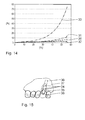
- the good compressibility is based on the in Fig. 14 documented measuring curves documented. The measurements were based on two moldings 14 according to Fig. 5 performed. In the first molded body 14, the KEM zone 17 contained a total of 0.1 g bone substitute material (see trace 30 with short dashed lines), whereas in the second molded body 14, the KEM zone 17 a total of 0.2 g bone replacement material contained (see trace 31 with long dashed lines). In the diagram according to Fig. 14 In addition, a first comparison measuring curve 32 (solid lines) for a first comparison molded body consisting exclusively of collagen material is entered.
- a second comparative measurement curve 33 (dot-dash line) was determined for a second comparative shaped body in which a total amount of 0.3 g of bone substitute material was embedded homogeneously distributed.
- the second comparative measuring body therefore contained no bone replacement material-free zone. His bone replacement material concentration was essentially the same everywhere.
- FIG. 14 is the course of the compressive force on the output volume relative to the compression by which the shaped body was compressed, applied. It can be seen from the measurement diagram that the two shaped bodies 14 investigated (measurement curves 30 and 31) have an almost identical compression behavior up to 30% compression as the first comparison shaped body consisting entirely of collagen material (measurement curve 32). In contrast, in the case of the second comparative shaped body with homogeneously embedded bone substitute material (measurement curve 33), a noticeably higher compressive force is required even at a compression of 7%. Due to the inhomogeneously distributed embedding of the bone substitute material, the compression behavior is not significantly affected in the moldings 14 to a compression of about 40%. In contrast, the second comparative shaped body with homogeneously embedded bone replacement material has a significantly poorer compressibility.
- the molded body 14 as well as the rest in the FIGS. 1 to 13 Shaped body 1, 7, 10, 12, 15, 16, 18, 19, 23, 26, 39 and 44 compared to a molded body with homogeneously embedded bone replacement material also significant advantages in handling, especially in the onset in the bone defect site as well as in nestling against the wall of the bone defect site. The latter also favors a particularly advantageous wound healing and bone regeneration.
- the molded bodies 1, 7, 10, 12, 14, 15, 16, 18, 19, 23, 26, 39 and 44 can be adapted in their respective outer dimensions approximately to the size of the bone defect site. In these embodiments, a single one of the moldings 1, 7, 10, 12, 14, 15, 16, 18, 19, 23, 26, 39 and 44 is inserted into the bone defect site.
- FIG. 15 illustrated application with moldings 34 of collagen-containing composite material with inhomogeneously distributed embedded bone substitute material.
- a pin-shaped implant 36 is inserted into the remaining jaw bone 37 immediately after the tooth extraction.
- An implant crown 38 is placed on the implant 36 after the healing process.
- the moldings 34 may have a substantially similar or the same structure as the moldings 1, 7, 10, 12, 14, 15, 16, 18, 19, 23, 39 and 44 have.
Landscapes
- Health & Medical Sciences (AREA)
- Chemical & Material Sciences (AREA)
- Veterinary Medicine (AREA)
- General Health & Medical Sciences (AREA)
- Public Health (AREA)
- Engineering & Computer Science (AREA)
- Animal Behavior & Ethology (AREA)
- Life Sciences & Earth Sciences (AREA)
- Oral & Maxillofacial Surgery (AREA)
- Transplantation (AREA)
- Epidemiology (AREA)
- Medicinal Chemistry (AREA)
- Dermatology (AREA)
- Composite Materials (AREA)
- Materials Engineering (AREA)
- Inorganic Chemistry (AREA)
- Orthopedic Medicine & Surgery (AREA)
- Cardiology (AREA)
- Biomedical Technology (AREA)
- Heart & Thoracic Surgery (AREA)
- Vascular Medicine (AREA)
- Materials For Medical Uses (AREA)
- Prostheses (AREA)
Priority Applications (1)
| Application Number | Priority Date | Filing Date | Title |
|---|---|---|---|
| PL12182753T PL2572738T3 (pl) | 2011-09-19 | 2012-09-03 | Ukształtowana bryła z materiałem kompozytowym zawierającym kolagen do umieszczania w miejscu ubytku kości |
Applications Claiming Priority (1)
| Application Number | Priority Date | Filing Date | Title |
|---|---|---|---|
| DE102011082960A DE102011082960A1 (de) | 2011-09-19 | 2011-09-19 | Formkörper mit kollagenhaltigem Kompositmaterial zum Einbringen in eine Knochendefektstelle |
Publications (4)
| Publication Number | Publication Date |
|---|---|
| EP2572738A2 true EP2572738A2 (fr) | 2013-03-27 |
| EP2572738A3 EP2572738A3 (fr) | 2015-01-07 |
| EP2572738B1 EP2572738B1 (fr) | 2017-11-08 |
| EP2572738B8 EP2572738B8 (fr) | 2018-02-21 |
Family
ID=46799118
Family Applications (1)
| Application Number | Title | Priority Date | Filing Date |
|---|---|---|---|
| EP12182753.9A Active EP2572738B8 (fr) | 2011-09-19 | 2012-09-03 | Corps de formage avec matériau composite contenant du collagène destiné à être introduit à l'emplacement d'un défaut osseux |
Country Status (5)
| Country | Link |
|---|---|
| US (1) | US20130251755A1 (fr) |
| EP (1) | EP2572738B8 (fr) |
| DE (1) | DE102011082960A1 (fr) |
| ES (1) | ES2657396T3 (fr) |
| PL (1) | PL2572738T3 (fr) |
Cited By (2)
| Publication number | Priority date | Publication date | Assignee | Title |
|---|---|---|---|---|
| IT201700009013A1 (it) * | 2017-05-25 | 2018-11-25 | Gian Paolo Gennari | Un dispositivo di rigenerazione ossea mandibolare e/o mascellare ed un metodo per la realizzazione del dispositivo |
| US10639401B2 (en) | 2015-01-20 | 2020-05-05 | Antonis Alexakis | Biocompatible molded part |
Citations (4)
| Publication number | Priority date | Publication date | Assignee | Title |
|---|---|---|---|---|
| DE19630034A1 (de) | 1996-07-25 | 1998-04-23 | Huels Chemische Werke Ag | Biohybrides Zahnimplantat |
| DE102006047054A1 (de) | 2006-10-05 | 2008-04-10 | Stiftung Caesar Center Of Advanced European Studies And Research | Patientenindividuelles Implantatlager |
| DE102007012276A1 (de) | 2007-03-08 | 2008-09-11 | Sbf Synthetic Bone Factory Gmbh | Zusammensetzung zur Behandlung von Knochen- und/oder Knorpeldefekten |
| DE102008010893B3 (de) | 2008-02-23 | 2009-07-09 | Resorba Wundversorgung Gmbh & Co. Kg | Implantat zum Einbringen in einen Alveolarraum |
Family Cites Families (4)
| Publication number | Priority date | Publication date | Assignee | Title |
|---|---|---|---|---|
| US7166133B2 (en) * | 2002-06-13 | 2007-01-23 | Kensey Nash Corporation | Devices and methods for treating defects in the tissue of a living being |
| WO2005065079A2 (fr) * | 2003-11-10 | 2005-07-21 | Angiotech International Ag | Implants medicaux et agents inducteurs de fibrose |
| US20080026032A1 (en) * | 2006-07-27 | 2008-01-31 | Zubery Yuval | Composite implants for promoting bone regeneration and augmentation and methods for their preparation and use |
| US20080147197A1 (en) * | 2006-12-14 | 2008-06-19 | Mckay William F | Biodegradable osteogenic porous biomedical implant with impermeable membrane |
-
2011
- 2011-09-19 DE DE102011082960A patent/DE102011082960A1/de not_active Withdrawn
-
2012
- 2012-09-03 PL PL12182753T patent/PL2572738T3/pl unknown
- 2012-09-03 EP EP12182753.9A patent/EP2572738B8/fr active Active
- 2012-09-03 ES ES12182753.9T patent/ES2657396T3/es active Active
- 2012-09-18 US US13/622,149 patent/US20130251755A1/en not_active Abandoned
Patent Citations (5)
| Publication number | Priority date | Publication date | Assignee | Title |
|---|---|---|---|---|
| DE19630034A1 (de) | 1996-07-25 | 1998-04-23 | Huels Chemische Werke Ag | Biohybrides Zahnimplantat |
| DE102006047054A1 (de) | 2006-10-05 | 2008-04-10 | Stiftung Caesar Center Of Advanced European Studies And Research | Patientenindividuelles Implantatlager |
| DE102007012276A1 (de) | 2007-03-08 | 2008-09-11 | Sbf Synthetic Bone Factory Gmbh | Zusammensetzung zur Behandlung von Knochen- und/oder Knorpeldefekten |
| DE102008010893B3 (de) | 2008-02-23 | 2009-07-09 | Resorba Wundversorgung Gmbh & Co. Kg | Implantat zum Einbringen in einen Alveolarraum |
| EP2249739A1 (fr) | 2008-02-23 | 2010-11-17 | Resorba Wundversorgung GmbH & Co. KG | Implant résorbable destiné à être introduit dans une ventilation alvéolaire |
Cited By (5)
| Publication number | Priority date | Publication date | Assignee | Title |
|---|---|---|---|---|
| US10639401B2 (en) | 2015-01-20 | 2020-05-05 | Antonis Alexakis | Biocompatible molded part |
| IL253453B (en) * | 2015-01-20 | 2021-01-31 | Antonis Alexakis | Biocompatible molded part |
| US11229723B2 (en) | 2015-01-20 | 2022-01-25 | Antonis Alexakis | Biocompatible molded part |
| EP3247416B1 (fr) * | 2015-01-20 | 2022-08-31 | Antonis Alexakis | Pièce moulée biocompatible |
| IT201700009013A1 (it) * | 2017-05-25 | 2018-11-25 | Gian Paolo Gennari | Un dispositivo di rigenerazione ossea mandibolare e/o mascellare ed un metodo per la realizzazione del dispositivo |
Also Published As
| Publication number | Publication date |
|---|---|
| ES2657396T3 (es) | 2018-03-05 |
| EP2572738B8 (fr) | 2018-02-21 |
| US20130251755A1 (en) | 2013-09-26 |
| EP2572738B1 (fr) | 2017-11-08 |
| DE102011082960A1 (de) | 2013-03-21 |
| PL2572738T3 (pl) | 2018-04-30 |
| EP2572738A3 (fr) | 2015-01-07 |
Similar Documents
| Publication | Publication Date | Title |
|---|---|---|
| EP2249739B1 (fr) | Implant résorbable destiné à être introduit dans une cavité alvéolaire | |
| EP0893975B1 (fr) | Implant medical | |
| DE69120177T2 (de) | Membran für Knochenregenerierung | |
| EP1227851B1 (fr) | Materiau d'implant osseux resorbable et son procede de production | |
| EP2108333B1 (fr) | Implant destiné à l'implantation dans du tissu osseux ou dans du tissu osseux remplacé par du matériau de remplacement d'os | |
| EP0609667B1 (fr) | Membrane de recouvrement | |
| EP1933758A1 (fr) | Implant dentaire | |
| WO2003082160A1 (fr) | Implant chirurgical | |
| DE2540077A1 (de) | Implantierbare vorrichtung | |
| DE3445731A1 (de) | Werkstoff und seine verwendung | |
| DE2717506A1 (de) | Keramisches knochenimplantat | |
| WO1986003667A1 (fr) | Tampon en materiau chirurgical | |
| EP1773254A1 (fr) | Corps implantable pour la fusion des vertebres | |
| EP2572738B1 (fr) | Corps de formage avec matériau composite contenant du collagène destiné à être introduit à l'emplacement d'un défaut osseux | |
| EP1732618B1 (fr) | Procede pour realiser un materiau d'implant osseux | |
| DE102011075808B4 (de) | Implantat zur Anwendung bei einer photo-dynamischen Behandlung sowie Verfahren zur Herstellung des Implantats | |
| EP3247416B1 (fr) | Pièce moulée biocompatible | |
| CH715121A2 (de) | Enossales Dentalimplantat. | |
| DE102011016279A1 (de) | Zahnimplantat | |
| DE102011051713B4 (de) | Knochentransplantate zur Augmentation eines Kieferknochens | |
| DE102017012338B3 (de) | Endoprothesenvorrichtung aus Keramik zum Einsetzen in eine Mulde eines Knochens | |
| DE102013105040B4 (de) | Zahnimplantat | |
| DE102022117264A1 (de) | Mineral Trioxid Aggregat (MTA) zur Verwendung bei der Neubildung eines Kieferknochens oder Kieferknochenabschnittes, Biokompatibles Formteil aufweisend MTA und Verwendung von MTA bei der Behandlung von Parodontose | |
| Pommer et al. | Intramedullary reaming in infected intramedullary nails of tibia and femur | |
| WO1981001649A1 (fr) | Organe de retenue pour prothese dentaire a inserer de maniere amovible dans l'os maxillaire et foret pour sa mise en place |
Legal Events
| Date | Code | Title | Description |
|---|---|---|---|
| PUAI | Public reference made under article 153(3) epc to a published international application that has entered the european phase |
Free format text: ORIGINAL CODE: 0009012 |
|
| AK | Designated contracting states |
Kind code of ref document: A2 Designated state(s): AL AT BE BG CH CY CZ DE DK EE ES FI FR GB GR HR HU IE IS IT LI LT LU LV MC MK MT NL NO PL PT RO RS SE SI SK SM TR |
|
| AX | Request for extension of the european patent |
Extension state: BA ME |
|
| RAP1 | Party data changed (applicant data changed or rights of an application transferred) |
Owner name: RESORBA MEDICAL GMBH |
|
| PUAL | Search report despatched |
Free format text: ORIGINAL CODE: 0009013 |
|
| AK | Designated contracting states |
Kind code of ref document: A3 Designated state(s): AL AT BE BG CH CY CZ DE DK EE ES FI FR GB GR HR HU IE IS IT LI LT LU LV MC MK MT NL NO PL PT RO RS SE SI SK SM TR |
|
| AX | Request for extension of the european patent |
Extension state: BA ME |
|
| RIC1 | Information provided on ipc code assigned before grant |
Ipc: A61L 27/46 20060101AFI20141128BHEP Ipc: A61C 8/02 20060101ALI20141128BHEP Ipc: A61F 2/28 20060101ALI20141128BHEP |
|
| 17P | Request for examination filed |
Effective date: 20150706 |
|
| RBV | Designated contracting states (corrected) |
Designated state(s): AL AT BE BG CH CY CZ DE DK EE ES FI FR GB GR HR HU IE IS IT LI LT LU LV MC MK MT NL NO PL PT RO RS SE SI SK SM TR |
|
| GRAP | Despatch of communication of intention to grant a patent |
Free format text: ORIGINAL CODE: EPIDOSNIGR1 |
|
| INTG | Intention to grant announced |
Effective date: 20170428 |
|
| GRAS | Grant fee paid |
Free format text: ORIGINAL CODE: EPIDOSNIGR3 |
|
| GRAA | (expected) grant |
Free format text: ORIGINAL CODE: 0009210 |
|
| AK | Designated contracting states |
Kind code of ref document: B1 Designated state(s): AL AT BE BG CH CY CZ DE DK EE ES FI FR GB GR HR HU IE IS IT LI LT LU LV MC MK MT NL NO PL PT RO RS SE SI SK SM TR |
|
| REG | Reference to a national code |
Ref country code: GB Ref legal event code: FG4D Free format text: NOT ENGLISH |
|
| REG | Reference to a national code |
Ref country code: CH Ref legal event code: EP Ref country code: AT Ref legal event code: REF Ref document number: 943532 Country of ref document: AT Kind code of ref document: T Effective date: 20171115 |
|
| REG | Reference to a national code |
Ref country code: IE Ref legal event code: FG4D Free format text: LANGUAGE OF EP DOCUMENT: GERMAN |
|
| REG | Reference to a national code |
Ref country code: DE Ref legal event code: R096 Ref document number: 502012011603 Country of ref document: DE |
|
| REG | Reference to a national code |
Ref country code: CH Ref legal event code: PK Free format text: BERICHTIGUNG INHABER |
|
| REG | Reference to a national code |
Ref country code: SE Ref legal event code: TRGR |
|
| RAP2 | Party data changed (patent owner data changed or rights of a patent transferred) |
Owner name: RESORBA MEDICAL GMBH |
|
| REG | Reference to a national code |
Ref country code: NL Ref legal event code: FP |
|
| REG | Reference to a national code |
Ref country code: ES Ref legal event code: FG2A Ref document number: 2657396 Country of ref document: ES Kind code of ref document: T3 Effective date: 20180305 |
|
| REG | Reference to a national code |
Ref country code: LT Ref legal event code: MG4D |
|
| PG25 | Lapsed in a contracting state [announced via postgrant information from national office to epo] |
Ref country code: FI Free format text: LAPSE BECAUSE OF FAILURE TO SUBMIT A TRANSLATION OF THE DESCRIPTION OR TO PAY THE FEE WITHIN THE PRESCRIBED TIME-LIMIT Effective date: 20171108 Ref country code: NO Free format text: LAPSE BECAUSE OF FAILURE TO SUBMIT A TRANSLATION OF THE DESCRIPTION OR TO PAY THE FEE WITHIN THE PRESCRIBED TIME-LIMIT Effective date: 20180208 Ref country code: LT Free format text: LAPSE BECAUSE OF FAILURE TO SUBMIT A TRANSLATION OF THE DESCRIPTION OR TO PAY THE FEE WITHIN THE PRESCRIBED TIME-LIMIT Effective date: 20171108 |
|
| PG25 | Lapsed in a contracting state [announced via postgrant information from national office to epo] |
Ref country code: HR Free format text: LAPSE BECAUSE OF FAILURE TO SUBMIT A TRANSLATION OF THE DESCRIPTION OR TO PAY THE FEE WITHIN THE PRESCRIBED TIME-LIMIT Effective date: 20171108 Ref country code: IS Free format text: LAPSE BECAUSE OF FAILURE TO SUBMIT A TRANSLATION OF THE DESCRIPTION OR TO PAY THE FEE WITHIN THE PRESCRIBED TIME-LIMIT Effective date: 20180308 Ref country code: LV Free format text: LAPSE BECAUSE OF FAILURE TO SUBMIT A TRANSLATION OF THE DESCRIPTION OR TO PAY THE FEE WITHIN THE PRESCRIBED TIME-LIMIT Effective date: 20171108 Ref country code: BG Free format text: LAPSE BECAUSE OF FAILURE TO SUBMIT A TRANSLATION OF THE DESCRIPTION OR TO PAY THE FEE WITHIN THE PRESCRIBED TIME-LIMIT Effective date: 20180208 Ref country code: RS Free format text: LAPSE BECAUSE OF FAILURE TO SUBMIT A TRANSLATION OF THE DESCRIPTION OR TO PAY THE FEE WITHIN THE PRESCRIBED TIME-LIMIT Effective date: 20171108 Ref country code: GR Free format text: LAPSE BECAUSE OF FAILURE TO SUBMIT A TRANSLATION OF THE DESCRIPTION OR TO PAY THE FEE WITHIN THE PRESCRIBED TIME-LIMIT Effective date: 20180209 |
|
| PG25 | Lapsed in a contracting state [announced via postgrant information from national office to epo] |
Ref country code: DK Free format text: LAPSE BECAUSE OF FAILURE TO SUBMIT A TRANSLATION OF THE DESCRIPTION OR TO PAY THE FEE WITHIN THE PRESCRIBED TIME-LIMIT Effective date: 20171108 Ref country code: SK Free format text: LAPSE BECAUSE OF FAILURE TO SUBMIT A TRANSLATION OF THE DESCRIPTION OR TO PAY THE FEE WITHIN THE PRESCRIBED TIME-LIMIT Effective date: 20171108 Ref country code: EE Free format text: LAPSE BECAUSE OF FAILURE TO SUBMIT A TRANSLATION OF THE DESCRIPTION OR TO PAY THE FEE WITHIN THE PRESCRIBED TIME-LIMIT Effective date: 20171108 Ref country code: CY Free format text: LAPSE BECAUSE OF FAILURE TO SUBMIT A TRANSLATION OF THE DESCRIPTION OR TO PAY THE FEE WITHIN THE PRESCRIBED TIME-LIMIT Effective date: 20171108 |
|
| REG | Reference to a national code |
Ref country code: DE Ref legal event code: R097 Ref document number: 502012011603 Country of ref document: DE |
|
| PG25 | Lapsed in a contracting state [announced via postgrant information from national office to epo] |
Ref country code: SM Free format text: LAPSE BECAUSE OF FAILURE TO SUBMIT A TRANSLATION OF THE DESCRIPTION OR TO PAY THE FEE WITHIN THE PRESCRIBED TIME-LIMIT Effective date: 20171108 Ref country code: RO Free format text: LAPSE BECAUSE OF FAILURE TO SUBMIT A TRANSLATION OF THE DESCRIPTION OR TO PAY THE FEE WITHIN THE PRESCRIBED TIME-LIMIT Effective date: 20171108 |
|
| PLBE | No opposition filed within time limit |
Free format text: ORIGINAL CODE: 0009261 |
|
| STAA | Information on the status of an ep patent application or granted ep patent |
Free format text: STATUS: NO OPPOSITION FILED WITHIN TIME LIMIT |
|
| REG | Reference to a national code |
Ref country code: FR Ref legal event code: PLFP Year of fee payment: 7 |
|
| PG25 | Lapsed in a contracting state [announced via postgrant information from national office to epo] |
Ref country code: MT Free format text: LAPSE BECAUSE OF FAILURE TO SUBMIT A TRANSLATION OF THE DESCRIPTION OR TO PAY THE FEE WITHIN THE PRESCRIBED TIME-LIMIT Effective date: 20171108 |
|
| 26N | No opposition filed |
Effective date: 20180809 |
|
| PG25 | Lapsed in a contracting state [announced via postgrant information from national office to epo] |
Ref country code: SI Free format text: LAPSE BECAUSE OF FAILURE TO SUBMIT A TRANSLATION OF THE DESCRIPTION OR TO PAY THE FEE WITHIN THE PRESCRIBED TIME-LIMIT Effective date: 20171108 |
|
| PG25 | Lapsed in a contracting state [announced via postgrant information from national office to epo] |
Ref country code: MC Free format text: LAPSE BECAUSE OF FAILURE TO SUBMIT A TRANSLATION OF THE DESCRIPTION OR TO PAY THE FEE WITHIN THE PRESCRIBED TIME-LIMIT Effective date: 20171108 |
|
| REG | Reference to a national code |
Ref country code: BE Ref legal event code: MM Effective date: 20180930 |
|
| PG25 | Lapsed in a contracting state [announced via postgrant information from national office to epo] |
Ref country code: LU Free format text: LAPSE BECAUSE OF NON-PAYMENT OF DUE FEES Effective date: 20180903 |
|
| PG25 | Lapsed in a contracting state [announced via postgrant information from national office to epo] |
Ref country code: BE Free format text: LAPSE BECAUSE OF NON-PAYMENT OF DUE FEES Effective date: 20180930 |
|
| PG25 | Lapsed in a contracting state [announced via postgrant information from national office to epo] |
Ref country code: PT Free format text: LAPSE BECAUSE OF FAILURE TO SUBMIT A TRANSLATION OF THE DESCRIPTION OR TO PAY THE FEE WITHIN THE PRESCRIBED TIME-LIMIT Effective date: 20171108 Ref country code: HU Free format text: LAPSE BECAUSE OF FAILURE TO SUBMIT A TRANSLATION OF THE DESCRIPTION OR TO PAY THE FEE WITHIN THE PRESCRIBED TIME-LIMIT; INVALID AB INITIO Effective date: 20120903 |
|
| PG25 | Lapsed in a contracting state [announced via postgrant information from national office to epo] |
Ref country code: MK Free format text: LAPSE BECAUSE OF NON-PAYMENT OF DUE FEES Effective date: 20171108 |
|
| PG25 | Lapsed in a contracting state [announced via postgrant information from national office to epo] |
Ref country code: AL Free format text: LAPSE BECAUSE OF FAILURE TO SUBMIT A TRANSLATION OF THE DESCRIPTION OR TO PAY THE FEE WITHIN THE PRESCRIBED TIME-LIMIT Effective date: 20171108 |
|
| P01 | Opt-out of the competence of the unified patent court (upc) registered |
Effective date: 20231026 |
|
| PGFP | Annual fee paid to national office [announced via postgrant information from national office to epo] |
Ref country code: IE Payment date: 20240919 Year of fee payment: 13 |
|
| PGFP | Annual fee paid to national office [announced via postgrant information from national office to epo] |
Ref country code: NL Payment date: 20240920 Year of fee payment: 13 |
|
| PGFP | Annual fee paid to national office [announced via postgrant information from national office to epo] |
Ref country code: CZ Payment date: 20240821 Year of fee payment: 13 |
|
| PGFP | Annual fee paid to national office [announced via postgrant information from national office to epo] |
Ref country code: AT Payment date: 20240805 Year of fee payment: 13 |
|
| PGFP | Annual fee paid to national office [announced via postgrant information from national office to epo] |
Ref country code: PL Payment date: 20240808 Year of fee payment: 13 |
|
| PGFP | Annual fee paid to national office [announced via postgrant information from national office to epo] |
Ref country code: SE Payment date: 20240923 Year of fee payment: 13 |
|
| PGFP | Annual fee paid to national office [announced via postgrant information from national office to epo] |
Ref country code: TR Payment date: 20240826 Year of fee payment: 13 |
|
| PGFP | Annual fee paid to national office [announced via postgrant information from national office to epo] |
Ref country code: CH Payment date: 20241001 Year of fee payment: 13 |
|
| PGFP | Annual fee paid to national office [announced via postgrant information from national office to epo] |
Ref country code: GB Payment date: 20250923 Year of fee payment: 14 |
|
| PGFP | Annual fee paid to national office [announced via postgrant information from national office to epo] |
Ref country code: FR Payment date: 20250924 Year of fee payment: 14 |
|
| PGFP | Annual fee paid to national office [announced via postgrant information from national office to epo] |
Ref country code: DE Payment date: 20251121 Year of fee payment: 14 |
|
| PGFP | Annual fee paid to national office [announced via postgrant information from national office to epo] |
Ref country code: IT Payment date: 20250930 Year of fee payment: 14 |
|
| PGFP | Annual fee paid to national office [announced via postgrant information from national office to epo] |
Ref country code: ES Payment date: 20251020 Year of fee payment: 14 |
|
| PG25 | Lapsed in a contracting state [announced via postgrant information from national office to epo] |
Ref country code: CZ Free format text: LAPSE BECAUSE OF NON-PAYMENT OF DUE FEES Effective date: 20250903 |