EP2572877A2 - Modules photovoltaïques comprenant une couche de support et une ou plusieurs couches isolantes électriques qui sont hautement perméables aux sous-produits de dégradation corrosifs - Google Patents
Modules photovoltaïques comprenant une couche de support et une ou plusieurs couches isolantes électriques qui sont hautement perméables aux sous-produits de dégradation corrosifs Download PDFInfo
- Publication number
- EP2572877A2 EP2572877A2 EP12003009A EP12003009A EP2572877A2 EP 2572877 A2 EP2572877 A2 EP 2572877A2 EP 12003009 A EP12003009 A EP 12003009A EP 12003009 A EP12003009 A EP 12003009A EP 2572877 A2 EP2572877 A2 EP 2572877A2
- Authority
- EP
- European Patent Office
- Prior art keywords
- layer
- backsheet
- layers
- polyamide
- fpp
- Prior art date
- Legal status (The legal status is an assumption and is not a legal conclusion. Google has not performed a legal analysis and makes no representation as to the accuracy of the status listed.)
- Withdrawn
Links
- 239000006227 byproduct Substances 0.000 title claims description 15
- 230000015556 catabolic process Effects 0.000 title abstract description 12
- 238000006731 degradation reaction Methods 0.000 title abstract description 12
- 239000008393 encapsulating agent Substances 0.000 claims abstract description 90
- 229920002647 polyamide Polymers 0.000 claims abstract description 89
- 239000004952 Polyamide Substances 0.000 claims abstract description 72
- 230000035699 permeability Effects 0.000 claims abstract description 37
- 230000014759 maintenance of location Effects 0.000 claims abstract description 10
- ZJPGOXWRFNKIQL-JYJNAYRXSA-N Phe-Pro-Pro Chemical compound C([C@H](N)C(=O)N1[C@@H](CCC1)C(=O)N1[C@@H](CCC1)C(O)=O)C1=CC=CC=C1 ZJPGOXWRFNKIQL-JYJNAYRXSA-N 0.000 claims abstract 7
- 239000010410 layer Substances 0.000 claims description 521
- QTBSBXVTEAMEQO-UHFFFAOYSA-N Acetic acid Chemical compound CC(O)=O QTBSBXVTEAMEQO-UHFFFAOYSA-N 0.000 claims description 123
- 239000004698 Polyethylene Substances 0.000 claims description 115
- 239000004743 Polypropylene Substances 0.000 claims description 114
- 229920001155 polypropylene Polymers 0.000 claims description 113
- 239000000203 mixture Substances 0.000 claims description 94
- -1 PolyPropylene Polymers 0.000 claims description 63
- 239000003365 glass fiber Substances 0.000 claims description 54
- 229920002292 Nylon 6 Polymers 0.000 claims description 41
- 239000003963 antioxidant agent Substances 0.000 claims description 38
- 235000006708 antioxidants Nutrition 0.000 claims description 38
- 239000000945 filler Substances 0.000 claims description 31
- 230000001627 detrimental effect Effects 0.000 claims description 26
- 238000004519 manufacturing process Methods 0.000 claims description 22
- 230000032683 aging Effects 0.000 claims description 21
- 229920000098 polyolefin Polymers 0.000 claims description 19
- 238000012360 testing method Methods 0.000 claims description 12
- 239000012790 adhesive layer Substances 0.000 claims description 11
- 229920000299 Nylon 12 Polymers 0.000 claims description 9
- 230000004888 barrier function Effects 0.000 claims description 9
- 239000002530 phenolic antioxidant Substances 0.000 claims description 9
- 230000035882 stress Effects 0.000 claims description 9
- ISWSIDIOOBJBQZ-UHFFFAOYSA-N phenol group Chemical group C1(=CC=CC=C1)O ISWSIDIOOBJBQZ-UHFFFAOYSA-N 0.000 claims description 8
- 229920000219 Ethylene vinyl alcohol Polymers 0.000 claims description 7
- UFRKOOWSQGXVKV-UHFFFAOYSA-N ethene;ethenol Chemical compound C=C.OC=C UFRKOOWSQGXVKV-UHFFFAOYSA-N 0.000 claims description 7
- 239000004715 ethylene vinyl alcohol Substances 0.000 claims description 7
- 239000000835 fiber Substances 0.000 claims description 7
- 229920000571 Nylon 11 Polymers 0.000 claims description 6
- 239000004594 Masterbatch (MB) Substances 0.000 claims description 4
- 239000012760 heat stabilizer Substances 0.000 claims description 4
- 239000003431 cross linking reagent Substances 0.000 claims description 3
- 239000011229 interlayer Substances 0.000 claims description 2
- QSRJVOOOWGXUDY-UHFFFAOYSA-N 2-[2-[2-[3-(3-tert-butyl-4-hydroxy-5-methylphenyl)propanoyloxy]ethoxy]ethoxy]ethyl 3-(3-tert-butyl-4-hydroxy-5-methylphenyl)propanoate Chemical compound CC(C)(C)C1=C(O)C(C)=CC(CCC(=O)OCCOCCOCCOC(=O)CCC=2C=C(C(O)=C(C)C=2)C(C)(C)C)=C1 QSRJVOOOWGXUDY-UHFFFAOYSA-N 0.000 claims 1
- 229920001225 polyester resin Polymers 0.000 claims 1
- 239000004645 polyester resin Substances 0.000 claims 1
- 230000004580 weight loss Effects 0.000 claims 1
- 230000002829 reductive effect Effects 0.000 abstract description 22
- 239000000654 additive Substances 0.000 abstract description 20
- 239000000463 material Substances 0.000 abstract description 20
- 239000002253 acid Substances 0.000 abstract description 18
- 150000007513 acids Chemical class 0.000 abstract description 13
- 229920000573 polyethylene Polymers 0.000 description 82
- DQXBYHZEEUGOBF-UHFFFAOYSA-N but-3-enoic acid;ethene Chemical compound C=C.OC(=O)CC=C DQXBYHZEEUGOBF-UHFFFAOYSA-N 0.000 description 81
- 239000005038 ethylene vinyl acetate Substances 0.000 description 81
- 229920001200 poly(ethylene-vinyl acetate) Polymers 0.000 description 81
- GWEVSGVZZGPLCZ-UHFFFAOYSA-N Titan oxide Chemical compound O=[Ti]=O GWEVSGVZZGPLCZ-UHFFFAOYSA-N 0.000 description 68
- 239000011521 glass Substances 0.000 description 60
- 235000011054 acetic acid Nutrition 0.000 description 40
- 239000004708 Very-low-density polyethylene Substances 0.000 description 36
- 229920001971 elastomer Polymers 0.000 description 36
- 229920001866 very low density polyethylene Polymers 0.000 description 36
- 238000003475 lamination Methods 0.000 description 34
- 238000004132 cross linking Methods 0.000 description 31
- 239000005060 rubber Substances 0.000 description 30
- 239000000047 product Substances 0.000 description 26
- BLRPTPMANUNPDV-UHFFFAOYSA-N Silane Chemical compound [SiH4] BLRPTPMANUNPDV-UHFFFAOYSA-N 0.000 description 24
- 229910000077 silane Inorganic materials 0.000 description 24
- 150000002978 peroxides Chemical class 0.000 description 21
- FPYJFEHAWHCUMM-UHFFFAOYSA-N maleic anhydride Chemical class O=C1OC(=O)C=C1 FPYJFEHAWHCUMM-UHFFFAOYSA-N 0.000 description 20
- 229920000139 polyethylene terephthalate Polymers 0.000 description 16
- 229920000181 Ethylene propylene rubber Polymers 0.000 description 14
- 239000011324 bead Substances 0.000 description 14
- 229920002620 polyvinyl fluoride Polymers 0.000 description 14
- 239000004971 Cross linker Substances 0.000 description 13
- 239000000853 adhesive Substances 0.000 description 13
- 230000001070 adhesive effect Effects 0.000 description 13
- 230000004927 fusion Effects 0.000 description 12
- CGRTZESQZZGAAU-UHFFFAOYSA-N [2-[3-[1-[3-(3-tert-butyl-4-hydroxy-5-methylphenyl)propanoyloxy]-2-methylpropan-2-yl]-2,4,8,10-tetraoxaspiro[5.5]undecan-9-yl]-2-methylpropyl] 3-(3-tert-butyl-4-hydroxy-5-methylphenyl)propanoate Chemical compound CC(C)(C)C1=C(O)C(C)=CC(CCC(=O)OCC(C)(C)C2OCC3(CO2)COC(OC3)C(C)(C)COC(=O)CCC=2C=C(C(O)=C(C)C=2)C(C)(C)C)=C1 CGRTZESQZZGAAU-UHFFFAOYSA-N 0.000 description 11
- PWWSSIYVTQUJQQ-UHFFFAOYSA-N distearyl thiodipropionate Chemical compound CCCCCCCCCCCCCCCCCCOC(=O)CCSCCC(=O)OCCCCCCCCCCCCCCCCCC PWWSSIYVTQUJQQ-UHFFFAOYSA-N 0.000 description 11
- 230000003078 antioxidant effect Effects 0.000 description 10
- 238000002845 discoloration Methods 0.000 description 10
- 238000001125 extrusion Methods 0.000 description 10
- 239000003999 initiator Substances 0.000 description 10
- 230000005012 migration Effects 0.000 description 10
- 238000013508 migration Methods 0.000 description 10
- 229920005989 resin Polymers 0.000 description 10
- 239000011347 resin Substances 0.000 description 10
- 150000004756 silanes Chemical class 0.000 description 10
- 239000004711 α-olefin Substances 0.000 description 10
- XDLMVUHYZWKMMD-UHFFFAOYSA-N 3-trimethoxysilylpropyl 2-methylprop-2-enoate Chemical compound CO[Si](OC)(OC)CCCOC(=O)C(C)=C XDLMVUHYZWKMMD-UHFFFAOYSA-N 0.000 description 9
- 238000010292 electrical insulation Methods 0.000 description 9
- 238000002844 melting Methods 0.000 description 9
- 230000008018 melting Effects 0.000 description 9
- BGYHLZZASRKEJE-UHFFFAOYSA-N [3-[3-(3,5-ditert-butyl-4-hydroxyphenyl)propanoyloxy]-2,2-bis[3-(3,5-ditert-butyl-4-hydroxyphenyl)propanoyloxymethyl]propyl] 3-(3,5-ditert-butyl-4-hydroxyphenyl)propanoate Chemical compound CC(C)(C)C1=C(O)C(C(C)(C)C)=CC(CCC(=O)OCC(COC(=O)CCC=2C=C(C(O)=C(C=2)C(C)(C)C)C(C)(C)C)(COC(=O)CCC=2C=C(C(O)=C(C=2)C(C)(C)C)C(C)(C)C)COC(=O)CCC=2C=C(C(O)=C(C=2)C(C)(C)C)C(C)(C)C)=C1 BGYHLZZASRKEJE-UHFFFAOYSA-N 0.000 description 8
- 238000006243 chemical reaction Methods 0.000 description 8
- 229910052623 talc Inorganic materials 0.000 description 8
- 239000000454 talc Substances 0.000 description 8
- 235000012222 talc Nutrition 0.000 description 8
- SSADPHQCUURWSW-UHFFFAOYSA-N 3,9-bis(2,6-ditert-butyl-4-methylphenoxy)-2,4,8,10-tetraoxa-3,9-diphosphaspiro[5.5]undecane Chemical compound CC(C)(C)C1=CC(C)=CC(C(C)(C)C)=C1OP1OCC2(COP(OC=3C(=CC(C)=CC=3C(C)(C)C)C(C)(C)C)OC2)CO1 SSADPHQCUURWSW-UHFFFAOYSA-N 0.000 description 7
- 239000003054 catalyst Substances 0.000 description 7
- 239000010949 copper Substances 0.000 description 7
- 230000007797 corrosion Effects 0.000 description 7
- 238000005260 corrosion Methods 0.000 description 7
- 230000007547 defect Effects 0.000 description 7
- 230000032798 delamination Effects 0.000 description 7
- 230000036961 partial effect Effects 0.000 description 7
- 230000009467 reduction Effects 0.000 description 7
- 239000012321 sodium triacetoxyborohydride Substances 0.000 description 7
- XEEYBQQBJWHFJM-UHFFFAOYSA-N Iron Chemical compound [Fe] XEEYBQQBJWHFJM-UHFFFAOYSA-N 0.000 description 6
- JKIJEFPNVSHHEI-UHFFFAOYSA-N Phenol, 2,4-bis(1,1-dimethylethyl)-, phosphite (3:1) Chemical compound CC(C)(C)C1=CC(C(C)(C)C)=CC=C1OP(OC=1C(=CC(=CC=1)C(C)(C)C)C(C)(C)C)OC1=CC=C(C(C)(C)C)C=C1C(C)(C)C JKIJEFPNVSHHEI-UHFFFAOYSA-N 0.000 description 6
- XTXRWKRVRITETP-UHFFFAOYSA-N Vinyl acetate Chemical compound CC(=O)OC=C XTXRWKRVRITETP-UHFFFAOYSA-N 0.000 description 6
- 238000009833 condensation Methods 0.000 description 6
- 230000005494 condensation Effects 0.000 description 6
- 239000000806 elastomer Substances 0.000 description 6
- NKSJNEHGWDZZQF-UHFFFAOYSA-N ethenyl(trimethoxy)silane Chemical compound CO[Si](OC)(OC)C=C NKSJNEHGWDZZQF-UHFFFAOYSA-N 0.000 description 6
- 238000005562 fading Methods 0.000 description 6
- 239000007789 gas Substances 0.000 description 6
- OJMIONKXNSYLSR-UHFFFAOYSA-N phosphorous acid Chemical compound OP(O)O OJMIONKXNSYLSR-UHFFFAOYSA-N 0.000 description 6
- 229920000642 polymer Polymers 0.000 description 6
- 239000003381 stabilizer Substances 0.000 description 6
- OYNOCRWQLLIRON-UHFFFAOYSA-N 1-n,3-n-bis(2,2,6,6-tetramethylpiperidin-4-yl)benzene-1,3-dicarboxamide Chemical compound C1C(C)(C)NC(C)(C)CC1NC(=O)C1=CC=CC(C(=O)NC2CC(C)(C)NC(C)(C)C2)=C1 OYNOCRWQLLIRON-UHFFFAOYSA-N 0.000 description 5
- JLZIIHMTTRXXIN-UHFFFAOYSA-N 2-(2-hydroxy-4-methoxybenzoyl)benzoic acid Chemical compound OC1=CC(OC)=CC=C1C(=O)C1=CC=CC=C1C(O)=O JLZIIHMTTRXXIN-UHFFFAOYSA-N 0.000 description 5
- 229920002799 BoPET Polymers 0.000 description 5
- 229920002943 EPDM rubber Polymers 0.000 description 5
- RWCCWEUUXYIKHB-UHFFFAOYSA-N benzophenone Chemical compound C=1C=CC=CC=1C(=O)C1=CC=CC=C1 RWCCWEUUXYIKHB-UHFFFAOYSA-N 0.000 description 5
- 239000012965 benzophenone Substances 0.000 description 5
- CQEYYJKEWSMYFG-UHFFFAOYSA-N butyl acrylate Chemical compound CCCCOC(=O)C=C CQEYYJKEWSMYFG-UHFFFAOYSA-N 0.000 description 5
- 238000001723 curing Methods 0.000 description 5
- 238000006460 hydrolysis reaction Methods 0.000 description 5
- 229910001862 magnesium hydroxide Inorganic materials 0.000 description 5
- 238000000034 method Methods 0.000 description 5
- 230000002028 premature Effects 0.000 description 5
- 230000008569 process Effects 0.000 description 5
- XLYOFNOQVPJJNP-UHFFFAOYSA-N water Chemical compound O XLYOFNOQVPJJNP-UHFFFAOYSA-N 0.000 description 5
- SMZOUWXMTYCWNB-UHFFFAOYSA-N 2-(2-methoxy-5-methylphenyl)ethanamine Chemical compound COC1=CC=C(C)C=C1CCN SMZOUWXMTYCWNB-UHFFFAOYSA-N 0.000 description 4
- NIXOWILDQLNWCW-UHFFFAOYSA-N 2-Propenoic acid Natural products OC(=O)C=C NIXOWILDQLNWCW-UHFFFAOYSA-N 0.000 description 4
- VTYYLEPIZMXCLO-UHFFFAOYSA-L Calcium carbonate Chemical compound [Ca+2].[O-]C([O-])=O VTYYLEPIZMXCLO-UHFFFAOYSA-L 0.000 description 4
- 229910017489 Cu I Inorganic materials 0.000 description 4
- BAPJBEWLBFYGME-UHFFFAOYSA-N Methyl acrylate Chemical compound COC(=O)C=C BAPJBEWLBFYGME-UHFFFAOYSA-N 0.000 description 4
- 230000008901 benefit Effects 0.000 description 4
- 150000001875 compounds Chemical class 0.000 description 4
- 230000008602 contraction Effects 0.000 description 4
- 238000009792 diffusion process Methods 0.000 description 4
- 238000009472 formulation Methods 0.000 description 4
- 125000000524 functional group Chemical group 0.000 description 4
- 230000007062 hydrolysis Effects 0.000 description 4
- VTHJTEIRLNZDEV-UHFFFAOYSA-L magnesium dihydroxide Chemical compound [OH-].[OH-].[Mg+2] VTHJTEIRLNZDEV-UHFFFAOYSA-L 0.000 description 4
- 239000000347 magnesium hydroxide Substances 0.000 description 4
- 238000002156 mixing Methods 0.000 description 4
- 229920003023 plastic Polymers 0.000 description 4
- 239000004033 plastic Substances 0.000 description 4
- 238000000926 separation method Methods 0.000 description 4
- 229910000679 solder Inorganic materials 0.000 description 4
- CKGKXGQVRVAKEA-UHFFFAOYSA-N (2-methylphenyl)-phenylmethanone Chemical compound CC1=CC=CC=C1C(=O)C1=CC=CC=C1 CKGKXGQVRVAKEA-UHFFFAOYSA-N 0.000 description 3
- 238000003848 UV Light-Curing Methods 0.000 description 3
- 239000012963 UV stabilizer Substances 0.000 description 3
- 239000006096 absorbing agent Substances 0.000 description 3
- 150000001253 acrylic acids Chemical class 0.000 description 3
- WNROFYMDJYEPJX-UHFFFAOYSA-K aluminium hydroxide Chemical compound [OH-].[OH-].[OH-].[Al+3] WNROFYMDJYEPJX-UHFFFAOYSA-K 0.000 description 3
- 229910021502 aluminium hydroxide Inorganic materials 0.000 description 3
- QVGXLLKOCUKJST-UHFFFAOYSA-N atomic oxygen Chemical compound [O] QVGXLLKOCUKJST-UHFFFAOYSA-N 0.000 description 3
- 238000005452 bending Methods 0.000 description 3
- 229920001400 block copolymer Polymers 0.000 description 3
- 239000003795 chemical substances by application Substances 0.000 description 3
- 229920001577 copolymer Polymers 0.000 description 3
- 239000006185 dispersion Substances 0.000 description 3
- 238000005538 encapsulation Methods 0.000 description 3
- 238000013213 extrapolation Methods 0.000 description 3
- VOZRXNHHFUQHIL-UHFFFAOYSA-N glycidyl methacrylate Chemical compound CC(=C)C(=O)OCC1CO1 VOZRXNHHFUQHIL-UHFFFAOYSA-N 0.000 description 3
- 229910052742 iron Inorganic materials 0.000 description 3
- 238000005259 measurement Methods 0.000 description 3
- 239000012528 membrane Substances 0.000 description 3
- 239000010445 mica Substances 0.000 description 3
- 229910052618 mica group Inorganic materials 0.000 description 3
- MPQXHAGKBWFSNV-UHFFFAOYSA-N oxidophosphanium Chemical class [PH3]=O MPQXHAGKBWFSNV-UHFFFAOYSA-N 0.000 description 3
- 229910052760 oxygen Inorganic materials 0.000 description 3
- 239000001301 oxygen Substances 0.000 description 3
- XRBCRPZXSCBRTK-UHFFFAOYSA-N phosphonous acid Chemical compound OPO XRBCRPZXSCBRTK-UHFFFAOYSA-N 0.000 description 3
- 239000000049 pigment Substances 0.000 description 3
- 229910001415 sodium ion Inorganic materials 0.000 description 3
- 238000003860 storage Methods 0.000 description 3
- 238000003878 thermal aging Methods 0.000 description 3
- RYGMFSIKBFXOCR-UHFFFAOYSA-N Copper Chemical compound [Cu] RYGMFSIKBFXOCR-UHFFFAOYSA-N 0.000 description 2
- JIGUQPWFLRLWPJ-UHFFFAOYSA-N Ethyl acrylate Chemical compound CCOC(=O)C=C JIGUQPWFLRLWPJ-UHFFFAOYSA-N 0.000 description 2
- 239000004677 Nylon Substances 0.000 description 2
- 150000001243 acetic acids Chemical class 0.000 description 2
- 230000002378 acidificating effect Effects 0.000 description 2
- 150000001252 acrylic acid derivatives Chemical class 0.000 description 2
- 150000001412 amines Chemical class 0.000 description 2
- 230000001458 anti-acid effect Effects 0.000 description 2
- 230000009286 beneficial effect Effects 0.000 description 2
- 230000005540 biological transmission Effects 0.000 description 2
- 229910000019 calcium carbonate Inorganic materials 0.000 description 2
- 238000001816 cooling Methods 0.000 description 2
- 238000007334 copolymerization reaction Methods 0.000 description 2
- 229910052802 copper Inorganic materials 0.000 description 2
- 229910021419 crystalline silicon Inorganic materials 0.000 description 2
- 230000000694 effects Effects 0.000 description 2
- 230000005684 electric field Effects 0.000 description 2
- 238000005516 engineering process Methods 0.000 description 2
- 229920000840 ethylene tetrafluoroethylene copolymer Polymers 0.000 description 2
- 239000003063 flame retardant Substances 0.000 description 2
- 238000009432 framing Methods 0.000 description 2
- 238000010438 heat treatment Methods 0.000 description 2
- 229920001519 homopolymer Polymers 0.000 description 2
- 230000006872 improvement Effects 0.000 description 2
- 238000011068 loading method Methods 0.000 description 2
- 230000007774 longterm Effects 0.000 description 2
- 239000011159 matrix material Substances 0.000 description 2
- 230000004048 modification Effects 0.000 description 2
- 238000012986 modification Methods 0.000 description 2
- 239000000178 monomer Substances 0.000 description 2
- 229920001778 nylon Polymers 0.000 description 2
- PNJWIWWMYCMZRO-UHFFFAOYSA-N pent‐4‐en‐2‐one Natural products CC(=O)CC=C PNJWIWWMYCMZRO-UHFFFAOYSA-N 0.000 description 2
- AQSJGOWTSHOLKH-UHFFFAOYSA-N phosphite(3-) Chemical class [O-]P([O-])[O-] AQSJGOWTSHOLKH-UHFFFAOYSA-N 0.000 description 2
- 229920000728 polyester Polymers 0.000 description 2
- 229920001296 polysiloxane Polymers 0.000 description 2
- 238000003825 pressing Methods 0.000 description 2
- 230000009257 reactivity Effects 0.000 description 2
- FZHAPNGMFPVSLP-UHFFFAOYSA-N silanamine Chemical class [SiH3]N FZHAPNGMFPVSLP-UHFFFAOYSA-N 0.000 description 2
- 238000005476 soldering Methods 0.000 description 2
- 239000000126 substance Substances 0.000 description 2
- 238000004381 surface treatment Methods 0.000 description 2
- 229920001169 thermoplastic Polymers 0.000 description 2
- 239000004416 thermosoftening plastic Substances 0.000 description 2
- 239000005341 toughened glass Substances 0.000 description 2
- KWKAKUADMBZCLK-UHFFFAOYSA-N 1-octene Chemical compound CCCCCCC=C KWKAKUADMBZCLK-UHFFFAOYSA-N 0.000 description 1
- DMWVYCCGCQPJEA-UHFFFAOYSA-N 2,5-bis(tert-butylperoxy)-2,5-dimethylhexane Chemical group CC(C)(C)OOC(C)(C)CCC(C)(C)OOC(C)(C)C DMWVYCCGCQPJEA-UHFFFAOYSA-N 0.000 description 1
- XMNIXWIUMCBBBL-UHFFFAOYSA-N 2-(2-phenylpropan-2-ylperoxy)propan-2-ylbenzene Chemical compound C=1C=CC=CC=1C(C)(C)OOC(C)(C)C1=CC=CC=C1 XMNIXWIUMCBBBL-UHFFFAOYSA-N 0.000 description 1
- NIXOWILDQLNWCW-UHFFFAOYSA-M Acrylate Chemical compound [O-]C(=O)C=C NIXOWILDQLNWCW-UHFFFAOYSA-M 0.000 description 1
- 229920003319 Araldite® Polymers 0.000 description 1
- VGGSQFUCUMXWEO-UHFFFAOYSA-N Ethene Chemical compound C=C VGGSQFUCUMXWEO-UHFFFAOYSA-N 0.000 description 1
- 239000005977 Ethylene Substances 0.000 description 1
- OKOBUGCCXMIKDM-UHFFFAOYSA-N Irganox 1098 Chemical compound CC(C)(C)C1=C(O)C(C(C)(C)C)=CC(CCC(=O)NCCCCCCNC(=O)CCC=2C=C(C(O)=C(C=2)C(C)(C)C)C(C)(C)C)=C1 OKOBUGCCXMIKDM-UHFFFAOYSA-N 0.000 description 1
- FYYHWMGAXLPEAU-UHFFFAOYSA-N Magnesium Chemical compound [Mg] FYYHWMGAXLPEAU-UHFFFAOYSA-N 0.000 description 1
- 229920000034 Plastomer Polymers 0.000 description 1
- OFOBLEOULBTSOW-UHFFFAOYSA-N Propanedioic acid Natural products OC(=O)CC(O)=O OFOBLEOULBTSOW-UHFFFAOYSA-N 0.000 description 1
- ATJFFYVFTNAWJD-UHFFFAOYSA-N Tin Chemical compound [Sn] ATJFFYVFTNAWJD-UHFFFAOYSA-N 0.000 description 1
- 238000010521 absorption reaction Methods 0.000 description 1
- 230000004913 activation Effects 0.000 description 1
- 239000011149 active material Substances 0.000 description 1
- 230000000996 additive effect Effects 0.000 description 1
- 239000002318 adhesion promoter Substances 0.000 description 1
- 239000004840 adhesive resin Substances 0.000 description 1
- 229920006223 adhesive resin Polymers 0.000 description 1
- 230000003679 aging effect Effects 0.000 description 1
- 125000005250 alkyl acrylate group Chemical group 0.000 description 1
- 239000004411 aluminium Substances 0.000 description 1
- XAGFODPZIPBFFR-UHFFFAOYSA-N aluminium Chemical compound [Al] XAGFODPZIPBFFR-UHFFFAOYSA-N 0.000 description 1
- 229910052782 aluminium Inorganic materials 0.000 description 1
- 150000001408 amides Chemical class 0.000 description 1
- 150000008064 anhydrides Chemical class 0.000 description 1
- 238000013459 approach Methods 0.000 description 1
- 238000004061 bleaching Methods 0.000 description 1
- 125000003636 chemical group Chemical group 0.000 description 1
- 230000000052 comparative effect Effects 0.000 description 1
- 239000002131 composite material Substances 0.000 description 1
- 238000013329 compounding Methods 0.000 description 1
- 230000001010 compromised effect Effects 0.000 description 1
- 238000010276 construction Methods 0.000 description 1
- 230000008094 contradictory effect Effects 0.000 description 1
- 238000005336 cracking Methods 0.000 description 1
- 238000005520 cutting process Methods 0.000 description 1
- 230000007423 decrease Effects 0.000 description 1
- 238000013461 design Methods 0.000 description 1
- 238000011161 development Methods 0.000 description 1
- 230000018109 developmental process Effects 0.000 description 1
- 238000000113 differential scanning calorimetry Methods 0.000 description 1
- 230000005611 electricity Effects 0.000 description 1
- NNYBQONXHNTVIJ-UHFFFAOYSA-N etodolac Chemical compound C1COC(CC)(CC(O)=O)C2=C1C(C=CC=C1CC)=C1N2 NNYBQONXHNTVIJ-UHFFFAOYSA-N 0.000 description 1
- 238000011156 evaluation Methods 0.000 description 1
- 238000000605 extraction Methods 0.000 description 1
- 229920000578 graft copolymer Polymers 0.000 description 1
- 239000008187 granular material Substances 0.000 description 1
- 238000013007 heat curing Methods 0.000 description 1
- 125000002887 hydroxy group Chemical group [H]O* 0.000 description 1
- 238000007654 immersion Methods 0.000 description 1
- 230000001771 impaired effect Effects 0.000 description 1
- 239000012796 inorganic flame retardant Substances 0.000 description 1
- 229910052500 inorganic mineral Inorganic materials 0.000 description 1
- 238000009413 insulation Methods 0.000 description 1
- 230000010354 integration Effects 0.000 description 1
- OCVXZQOKBHXGRU-UHFFFAOYSA-N iodine(1+) Chemical compound [I+] OCVXZQOKBHXGRU-UHFFFAOYSA-N 0.000 description 1
- 238000004898 kneading Methods 0.000 description 1
- 238000010030 laminating Methods 0.000 description 1
- 230000000670 limiting effect Effects 0.000 description 1
- 229940063718 lodine Drugs 0.000 description 1
- 208000020442 loss of weight Diseases 0.000 description 1
- 239000011777 magnesium Substances 0.000 description 1
- VZCYOOQTPOCHFL-UPHRSURJSA-N maleic acid Chemical compound OC(=O)\C=C/C(O)=O VZCYOOQTPOCHFL-UPHRSURJSA-N 0.000 description 1
- 239000011976 maleic acid Substances 0.000 description 1
- 150000002689 maleic acids Chemical class 0.000 description 1
- 239000011707 mineral Substances 0.000 description 1
- 239000002557 mineral fiber Substances 0.000 description 1
- 239000002667 nucleating agent Substances 0.000 description 1
- 239000002245 particle Substances 0.000 description 1
- 239000004014 plasticizer Substances 0.000 description 1
- 229920003229 poly(methyl methacrylate) Polymers 0.000 description 1
- 229920013716 polyethylene resin Polymers 0.000 description 1
- 229920002959 polymer blend Polymers 0.000 description 1
- 239000004926 polymethyl methacrylate Substances 0.000 description 1
- 239000002987 primer (paints) Substances 0.000 description 1
- 238000012545 processing Methods 0.000 description 1
- 230000005855 radiation Effects 0.000 description 1
- 229920005604 random copolymer Polymers 0.000 description 1
- 239000002994 raw material Substances 0.000 description 1
- 230000006798 recombination Effects 0.000 description 1
- 238000005215 recombination Methods 0.000 description 1
- 230000003014 reinforcing effect Effects 0.000 description 1
- 229920003031 santoprene Polymers 0.000 description 1
- 230000035945 sensitivity Effects 0.000 description 1
- 238000007086 side reaction Methods 0.000 description 1
- 229910001220 stainless steel Inorganic materials 0.000 description 1
- 150000003464 sulfur compounds Chemical class 0.000 description 1
- 238000009864 tensile test Methods 0.000 description 1
- 239000003017 thermal stabilizer Substances 0.000 description 1
- VZCYOOQTPOCHFL-UHFFFAOYSA-N trans-butenedioic acid Natural products OC(=O)C=CC(O)=O VZCYOOQTPOCHFL-UHFFFAOYSA-N 0.000 description 1
- UKRDPEFKFJNXQM-UHFFFAOYSA-N vinylsilane Chemical class [SiH3]C=C UKRDPEFKFJNXQM-UHFFFAOYSA-N 0.000 description 1
- 238000003466 welding Methods 0.000 description 1
Images


Classifications
-
- B—PERFORMING OPERATIONS; TRANSPORTING
- B32—LAYERED PRODUCTS
- B32B—LAYERED PRODUCTS, i.e. PRODUCTS BUILT-UP OF STRATA OF FLAT OR NON-FLAT, e.g. CELLULAR OR HONEYCOMB, FORM
- B32B17/00—Layered products essentially comprising sheet glass, or glass, slag, or like fibres
- B32B17/06—Layered products essentially comprising sheet glass, or glass, slag, or like fibres comprising glass as the main or only constituent of a layer, next to another layer of a specific material
- B32B17/10—Layered products essentially comprising sheet glass, or glass, slag, or like fibres comprising glass as the main or only constituent of a layer, next to another layer of a specific material of synthetic resin
- B32B17/10005—Layered products essentially comprising sheet glass, or glass, slag, or like fibres comprising glass as the main or only constituent of a layer, next to another layer of a specific material of synthetic resin laminated safety glass or glazing
- B32B17/1055—Layered products essentially comprising sheet glass, or glass, slag, or like fibres comprising glass as the main or only constituent of a layer, next to another layer of a specific material of synthetic resin laminated safety glass or glazing characterized by the resin layer, i.e. interlayer
- B32B17/10788—Layered products essentially comprising sheet glass, or glass, slag, or like fibres comprising glass as the main or only constituent of a layer, next to another layer of a specific material of synthetic resin laminated safety glass or glazing characterized by the resin layer, i.e. interlayer containing ethylene vinylacetate
-
- B—PERFORMING OPERATIONS; TRANSPORTING
- B32—LAYERED PRODUCTS
- B32B—LAYERED PRODUCTS, i.e. PRODUCTS BUILT-UP OF STRATA OF FLAT OR NON-FLAT, e.g. CELLULAR OR HONEYCOMB, FORM
- B32B17/00—Layered products essentially comprising sheet glass, or glass, slag, or like fibres
- B32B17/06—Layered products essentially comprising sheet glass, or glass, slag, or like fibres comprising glass as the main or only constituent of a layer, next to another layer of a specific material
- B32B17/10—Layered products essentially comprising sheet glass, or glass, slag, or like fibres comprising glass as the main or only constituent of a layer, next to another layer of a specific material of synthetic resin
- B32B17/10005—Layered products essentially comprising sheet glass, or glass, slag, or like fibres comprising glass as the main or only constituent of a layer, next to another layer of a specific material of synthetic resin laminated safety glass or glazing
- B32B17/10009—Layered products essentially comprising sheet glass, or glass, slag, or like fibres comprising glass as the main or only constituent of a layer, next to another layer of a specific material of synthetic resin laminated safety glass or glazing characterized by the number, the constitution or treatment of glass sheets
- B32B17/10018—Layered products essentially comprising sheet glass, or glass, slag, or like fibres comprising glass as the main or only constituent of a layer, next to another layer of a specific material of synthetic resin laminated safety glass or glazing characterized by the number, the constitution or treatment of glass sheets comprising only one glass sheet
-
- B—PERFORMING OPERATIONS; TRANSPORTING
- B32—LAYERED PRODUCTS
- B32B—LAYERED PRODUCTS, i.e. PRODUCTS BUILT-UP OF STRATA OF FLAT OR NON-FLAT, e.g. CELLULAR OR HONEYCOMB, FORM
- B32B17/00—Layered products essentially comprising sheet glass, or glass, slag, or like fibres
- B32B17/06—Layered products essentially comprising sheet glass, or glass, slag, or like fibres comprising glass as the main or only constituent of a layer, next to another layer of a specific material
- B32B17/10—Layered products essentially comprising sheet glass, or glass, slag, or like fibres comprising glass as the main or only constituent of a layer, next to another layer of a specific material of synthetic resin
- B32B17/10005—Layered products essentially comprising sheet glass, or glass, slag, or like fibres comprising glass as the main or only constituent of a layer, next to another layer of a specific material of synthetic resin laminated safety glass or glazing
- B32B17/10009—Layered products essentially comprising sheet glass, or glass, slag, or like fibres comprising glass as the main or only constituent of a layer, next to another layer of a specific material of synthetic resin laminated safety glass or glazing characterized by the number, the constitution or treatment of glass sheets
- B32B17/10036—Layered products essentially comprising sheet glass, or glass, slag, or like fibres comprising glass as the main or only constituent of a layer, next to another layer of a specific material of synthetic resin laminated safety glass or glazing characterized by the number, the constitution or treatment of glass sheets comprising two outer glass sheets
-
- B—PERFORMING OPERATIONS; TRANSPORTING
- B32—LAYERED PRODUCTS
- B32B—LAYERED PRODUCTS, i.e. PRODUCTS BUILT-UP OF STRATA OF FLAT OR NON-FLAT, e.g. CELLULAR OR HONEYCOMB, FORM
- B32B17/00—Layered products essentially comprising sheet glass, or glass, slag, or like fibres
- B32B17/06—Layered products essentially comprising sheet glass, or glass, slag, or like fibres comprising glass as the main or only constituent of a layer, next to another layer of a specific material
- B32B17/10—Layered products essentially comprising sheet glass, or glass, slag, or like fibres comprising glass as the main or only constituent of a layer, next to another layer of a specific material of synthetic resin
- B32B17/10005—Layered products essentially comprising sheet glass, or glass, slag, or like fibres comprising glass as the main or only constituent of a layer, next to another layer of a specific material of synthetic resin laminated safety glass or glazing
- B32B17/1055—Layered products essentially comprising sheet glass, or glass, slag, or like fibres comprising glass as the main or only constituent of a layer, next to another layer of a specific material of synthetic resin laminated safety glass or glazing characterized by the resin layer, i.e. interlayer
- B32B17/10761—Layered products essentially comprising sheet glass, or glass, slag, or like fibres comprising glass as the main or only constituent of a layer, next to another layer of a specific material of synthetic resin laminated safety glass or glazing characterized by the resin layer, i.e. interlayer containing vinyl acetal
-
- H—ELECTRICITY
- H10—SEMICONDUCTOR DEVICES; ELECTRIC SOLID-STATE DEVICES NOT OTHERWISE PROVIDED FOR
- H10F—INORGANIC SEMICONDUCTOR DEVICES SENSITIVE TO INFRARED RADIATION, LIGHT, ELECTROMAGNETIC RADIATION OF SHORTER WAVELENGTH OR CORPUSCULAR RADIATION
- H10F19/00—Integrated devices, or assemblies of multiple devices, comprising at least one photovoltaic cell covered by group H10F10/00, e.g. photovoltaic modules
- H10F19/80—Encapsulations or containers for integrated devices, or assemblies of multiple devices, having photovoltaic cells
- H10F19/85—Protective back sheets
-
- Y—GENERAL TAGGING OF NEW TECHNOLOGICAL DEVELOPMENTS; GENERAL TAGGING OF CROSS-SECTIONAL TECHNOLOGIES SPANNING OVER SEVERAL SECTIONS OF THE IPC; TECHNICAL SUBJECTS COVERED BY FORMER USPC CROSS-REFERENCE ART COLLECTIONS [XRACs] AND DIGESTS
- Y02—TECHNOLOGIES OR APPLICATIONS FOR MITIGATION OR ADAPTATION AGAINST CLIMATE CHANGE
- Y02E—REDUCTION OF GREENHOUSE GAS [GHG] EMISSIONS, RELATED TO ENERGY GENERATION, TRANSMISSION OR DISTRIBUTION
- Y02E10/00—Energy generation through renewable energy sources
- Y02E10/50—Photovoltaic [PV] energy
Definitions
- the present invention relates to photovoltaic (PV) modules comprising:
- Such backsheets are preferably coextruded multi-layers based and comprise:
- PV cells are generally interconnected by so called interconnecting conducting ribbons (mainly tin plated copper ribbon).
- interconnecting conducting ribbons mainly tin plated copper ribbon.
- Such conducting ribbons will in many cases extend and cross under the backside of PV cells and need therefore to be electrically separated from the backside of the PV cells (electrodes) by an insulating layer.
- a piece of classical backsheet like Tedlar/PET/Tedlar (TPT) or more generally a piece of a film comprising a PET film (like a multi-layer film of the type PE / PET / PE) between EVA encapsulants could be used for this purpose but this will lead to locally high concentration of detrimental (by-)products, in this case acetic acid. Local severe corrosion may then be observed in hot and humid conditions, especially when backsheets with high permeability to such by-products (e.g. acetic acids), are used. The diffusion of the by-products from under those PET comprising films is much slower than the diffusion out of the module.
- a photovoltaic module (also abbreviated PV module) comprises at least the following layers/components:
- Described Backsheets (see especially PCT/EP 2010/004335 ("Photovoltaic modules with Polypropylene based backsheet”)) comprising a polyamide layer or layers and a Flexible Polypropylene layer or layers, can't, as such, achieve a RTI or RTE of 105 °C or more. They need to be modified.
- Alternative modification of such backsheet is disclosed to meet such very difficult requirement.
- Polyamide is a poor dielectric.
- polyolefins PolyPropylene, PolyEthylene
- Partial Discharge behavior This behavior defines the thickness of the backsheet.
- Combined means coextruded or blended.
- backsheets are multi-layers sheets and are produced in several steps.
- films are produced by extrusion and then such films are laminated with the help of adhesives to produce the backsheet.
- An example is the so called TPT backsheets, which are in fact a assembly of two Tedlar ® films glued on both sides of a central PET film.
- the PET film brings the dielectric properties and the Tedlar films bring weathering protection.
- the back sheet It is more cost effective to produce the back sheet by coextrusion (one step process), where the main layer(s) are based on cost effective dielectric raw material like Flexible PolyPropylene.
- the main layer(s) are based on cost effective dielectric raw material like Flexible PolyPropylene.
- heat resistant layers like Polyamide layer or layers in the backsheet.
- Possible polyamides are polyamide 6, 11 or 12.
- Polyamide 6 is extremely cost effective for the purpose of heat resistance (avoiding risk of perforation, etc.) but is a poor dielectric and can only be used as part of a backsheet when protected against humidity by the FPP layers.
- backsheets have a Relative Thermal Index or RTI (see UL 746 B; IEC 61730-1) or RTE of at least 20°C above the maximum operating temperature of the PV modules, which is commonly 85°C or even 90°C (Desert conditions) or even 95°C (Building integrated modules).
- RTI Relative Thermal Index
- RTE Relative Thermal Index
- the RTI or RTE of the backsheet should be at least 105°C, preferably 110 °C, more preferably 115°C.
- Polyamide 6 Although very cost effective is currently not used for backsheets. Only expensive types of polyamides, e.g. polyamide 11 or polyamide 12 are used for such application and backsheets thereof are supplied by e.g. Biosolar or lsovoltaic. Other requirements which are difficult to meet with Polyamide 6 are: good electrical insulation stability in humid conditions, UV stability, impact resistance, etc.
- the backsheet has a high rigidity in order to limit the deflection of the PV module under load (e.g. snow).
- FPP based backsheet may be not rigid enough.
- the backsheet has good dimensional stability during module production (vacuum lamination typically at 150°C and under pressure close to 1 atm).
- Polypropylene and Flexible PolyPropylene films or layers have the tendency to flow and shrink at 150°C and during cooling, leading to adhesion defects at the edges of the PV modules.
- the present invention describes therefore also a very cost effective backsheet comprising preferably thermally stabilized (i.e including anti-oxidants) Polyamide based layer(s), possibly PA6 based layer(s), and thermally stabilized Flexible Polypropylene based layers, which can be combined in such a way that the resultant backsheet achieves a RTI or RTE of 105°C, even 110°C and even 115°C.
- thermally stabilized i.e including anti-oxidants
- Polyamide based layer(s) possibly PA6 based layer(s)
- thermally stabilized Flexible Polypropylene based layers which can be combined in such a way that the resultant backsheet achieves a RTI or RTE of 105°C, even 110°C and even 115°C.
- the Polyamide 6 based layer(s), if used, is/are protected by the FPP based layers which are laid at the backside of the backsheet (opposite side to the PV cells) in such a way that the Polyamide 6 based layer is protected from humidity and UV radiation.
- the FPP layer(s) allows also for easy welding to junction boxes, mounting accessories and/or framing.
- Crystalline PV modules (C-Si), with the usual construction Glass / EVA / cells / EVA / backsheet may be sensitive to the phenomen of Potential Induced Degradation. Under Electric Field, e.g. sodium ions from the glass plate may migrate through the EVA encapsulant (especially in humid climate) and contact the front face of the PV cells, forcing electrons - holes recombination and loss of production of electricity.
- Electric Field e.g. sodium ions from the glass plate may migrate through the EVA encapsulant (especially in humid climate) and contact the front face of the PV cells, forcing electrons - holes recombination and loss of production of electricity.
- the present invention describes therefore also a partly EVA or polar Polyethylene based front encapsulant comprising a layer on base of a non polar Polyethylene which limits sodium ions migration.
- the front encapsulant has still an excellent clarity, close to the one of EVA based encapsulants, and ease of crosslinking.
- the invention provides insulating films with high permeability to this detrimental (by-) products, i.e. allowing this detrimental (by-) products to escape from the PV modules or at least to limit local high concentrations.
- the invention is particularly useful with backsheets with high permeability to detrimental (by-) products.
- the invention further provides adapted encapsulants to limit generation of detrimental (by-) products and the phenomen of Potential Induced Degradation.
- the invention further provides very cost effective backsheets with a.o. excellent acetic acid permeability, heat aging properties (RTI / RTE) and dimensional stability during module manufacturing.
- the invention addresses especially the problem of generation and trapping of acid(s) within crystalline PV modules, where such modules comprise encapsulant material at least partly on base of EVA or at least partly on base of other acid generating material like co-Polyethylene (grafted) with acrylates, acrylic acids, maleic anhydrides.
- a backsheet which is mainly based on Flexible PolyPropylene, i.e. a blend of Polypropylene (PP) and rubber (EPR, EPDM, VLDPE, ...), where the PP phase and the rubber phase are co-continuous (i.e. providing an InterPenetrated Network of PP and Rubber) or are nearly co-continuous (semi-interpenetrated).
- PP Polypropylene
- EPR Polypropylene
- EPDM Polypropylene
- VLDPE Rubber
- Such type of blend allows by-products to migrate, probably along the rubber network, outside the PV module and leads to much lower stresses on PV cells and interconnecting ribbons than PP (high rigidity - low relaxation of induced stresses).
- the required quality of blend (a FPP blend by opposition to a PP blend) can be recognized and adapted by the man skilled in the art on base of cold foldability tests (according EN 495/5).
- the backsheet comprising FPP layers or at least the FPP layers, at least without fillers, should achieve a cold foldability temperature of at least -20°C, preferably -40°C or lower.
- polymeric materials and blends are also useful as base material for layers of backsheets and electrical insulating films, like Polyamide or Polyamide blends with Polyolefins, e.g. Flexible PolyPropylene.
- a good quality of blend of Polyamide and Polyolefin is achieved by the addition or use of functionalized polyolefin with e.g. maleic anhydride (reactivity with amides) or by adding a compatibilizing resin being a block copolymer of Polyamide and Polyolefins.
- Polyamides e.g. PA 6, 6-10, 11 or 12, are already useful as such as base material for layers of backsheets and electrical insulating films as they provide a good permeability to e.g. acetic acid. Nucleating agents may be added to the polymer to avoid excessive crystallinity.
- Such backsheet comprises at least one Polyamide based layer, preferably on base of cheap polyamide 6, advantageously in blend with polyolefins and at least one FPP based layer where the FPP layer(s) is/are highly thermally stabilized.
- the highly thermally stabilized FPP layer(s) is/are able to keep significantly more than 50 % of their mechanical properties during 20.000 hours at 105°C, even at 110°C and even at 115°C (Such layer has a RTI or RTE of 105°C or even of 110°C and even of 115°C according IEC 60216 (2001-07)).
- the contribution of the FPP layer(s) to the mechanical properties of the backsheet is made dominant by either stiffening the FPP layer(s) with fillers or by reducing the mechanical properties (elongation at break) of the polyamide layer or layer(s). It has been discovered that after extreme degradation of the Polyamide layer(s) during heat aging, there is no delamination between the FPP layer(s) and the PA layer(s), meaning that the integrity of the backsheet is safeguarded.
- the tensile strength of the backsheet can still be of at least 50 % of the initial value, without delamination of layers.
- the FPP layer(s) are preferably reinforced by fillers, e.g. by glass fibers, in such a way that the stiffened FPP layer(s) has/have the main contribution in the tensile strength of the backsheet.
- Another way to increase the contribution of the FPP layers to the mechanical properties of the backsheet is to add fillers, especially glass fibers, in the polyamide layers. Such fillers will reduce the elongation at break of the polyamide layers (cutting effect).
- a thermally more stable Polyamide can be used, like Polyamide 11 or 12 to produce backsheets having a RTI (UL 746 B) of 105°C or more. Addition of fillers may anyway still be required to limit initial mechanical properties (elongation at break). Blending with polyolefins is still useful for the dielectric properties and in this case, cost reduction.
- the backsheet comprises preferably one or more polyamide based layer(s) acting as heat resistant anti-perforation layer(s) during the module production (lamination at typically 150°C) and thermally stabilized FPP based layers acting as insulating layers and having a RTI of 105°C or more.
- Thermally stabilized (F)PP tie-layers having preferably a RTI of 105°C or more are used as adhesive layers between the polyamide and the FPP layers.
- a polyamide layer within the backsheet, facing the encapsulant films or layers acts as barrier against migration of peroxides or other crosslinking agents from the encapsulants films.
- the (F)PP layers and their stabilizers are indeed sensitive (reactive) to such agents and such agents should also not be lost by migration from the encapsulant films and by unwanted reactions with the FPP layers and their stabilizers (otherwise a.o. the crosslinking quality may be impaired).
- the polyamide layer, facing the encapsulant layers may not be heat stabilized in a classical way.
- Classical phenolic anti-oxidants lead to severe discoloration problems when cross-linkable encapsulant films are used (curing agent like peroxide attack of the phenolic group).
- Copper / lodine PolyAmide stabilizer systems lead to delamination of the tie-layers (functionalized polyolefin) when cross-linkable encapsulant films are used (peroxide attack of the Cu/I system and subsequent hydrolysis of chemical bonds between tie-layers and polyamide).
- anti-oxidants are required, like HALS (see Plastics Additives Handbook 5th edition, p. 123 à 136 ) especially HALS 52 (Nylostab S-EED), and/or non phenolic primary anti-oxidants (amine based). Such abovementioned anti-oxidants are preferably used in combination with phosphite/phosphonite secondary anti-oxidants or other secondary anti-oxidants.
- a system voltage (IEC 60664-1:2007) of 600 VDC can already be achieved from a total thickness of the FPP layers and tie-layers of only 100 ⁇ m.
- FPP based backsheets and layers allowing a system voltage of more than 1000 VDC and even of more 1500 VDC. This is theoretically possible with classical backsheets (Tedlar ® / PET / Tedlar ®, etc.) by increasing their thickness. Very rigid backsheets are anyway produced on such base. With FPP based backsheet, by increasing the content of rubber, the Emodulus can be reduced, allowing the production of thicker backsheets with acceptable rigidity.
- the backsheet comprising such layers will be assigned a RTI or RTE of 105°C or more. If the complete backsheet doesn't achieve such RTI or RTE of 105°C or more, then to define the system voltage rating of the backsheet, only the layers achieving such RTI or RTE of 105°C or more will be taken into account, e.g. 600 VDC from a total thickness of the FPP layers and tie-layers of only 100 ⁇ m.
- the FPP layer(s) protect(s) the polyamide layer(s) against moisture ingress and UV aging and allows for excellent electrical insulation performances and partial discharge performances.
- the FPP layer(s) is/are like Polyamide, highly permeable to acetic acid.
- the FPP layer(s) is/are highly durable (thermal aging, UV aging, hydrolysis resistance) and resilient even at low temperature.
- the FPP layer(s) bring(s) excellent electrical insulation which is not reduced by development of impact crazes during aging (with as result a reduced partial discharge resistance), like it is the case for common Polypropylene.
- the external layer of the backssheet (the layer at the backside of the PV module) is based on a FPP blend, especially on a FPP reactor blend, it is easy to weld components of the module (like framing, mounting hooks and junction box) to such backsheet.
- the FPP layer(s) and polyamide layer(s) are preferably coextruded and attached to each other by polyolefin tie-layers.
- the resultant backsheet is in this case extremely cost effective, especially when the polyamide layer is modified (blend) with polyolefins to improve its electrical performances (partial discharge behavior).
- the backsheet is preferably equipped at the encapsualnt side with a (co-)PE based tie-layer.
- the backsheet contains a polyamide layer located between the encapsulants and the FPP layer(s) of the backsheet, in order to limit the amount of radicals which migrate to and attack the FPP layers and their anti-oxidants.
- FPP and its anti-oxidants are sensitive to radicals (cracking) and side reactions may lead to discoloration (especially in Heat Damp Test, i.e. a climatic aging test at 85°C 85 % relative Humidity - 1000 hours; according to IEC 60215 (2005-04) or IEC 61646 (2008-05)).
- the invention provides a very useful front encapsulant obtained by coextrusion of highly transparent polar co-polyethylene (e.g. EVA with a high amount of Vinyl Acetate) and non polar co-polyethylene (e.g; VLDPE).
- highly transparent polar co-polyethylene e.g. EVA with a high amount of Vinyl Acetate
- VLDPE non polar co-polyethylene
- the EVA layers excel in transparency and compatibility with peroxides, photo-initiators and silanes, while the VLDPE layer provides a barrier to migration of Sodium ions and reduces the production of acetic acid of the encapsulant.
- Excellent adhesion between layers is obtained after crosslinking (especially peroxide crosslinking). Thanks to the crosslinking, VLDPE of low melting temperature can be used (e.g. Exact 8230), which improves transparency.
- PV cells All types of PV cells may benefit form the invention, in particular crystalline PV cells.
- Back contact PV cells benefit in particular from backsheets with integrated adhesive and electrically insulating films embedded within soft Polyethylene (like Organic Block Copolymers (OBC); trade name, infuse TM from The Dow Chemical Company) based layers
- OBC Organic Block Copolymers
- Flexible Polypropylene is a blend of Polypropylene (PP) and one of several elastomers or rubbers (EPR, EPDM, VLDPE, Elastomer PP%), where the PP phase and the rubber phase are co-continuous (i.e. providing an Interpenetrated Network of PP and Rubber) or are nearly co-continuous.
- suitable blends are:
- (Co-) Polyethylene Polyethylene (PE) is well known and may be copolymerized with several comonomers to produce (co-) PE.
- Useful comonomers are vinyl acetate, acrylate (e.g. butyl acrylate, ...), alpha olefins (octene comonomers like for metallocene VLDPE with as commercial example Exact 0203); etc.
- Organic Block Copolymers are a particular type of (co-)PE.
- Polar co-PE is a co-PE comprising at least 10 % weight of polar comonomers like acrylates or vinyl acetates.
- Non Polar co-PE is a co-PE comprising less than 10 % weight of polar comonomers, e.g. VLDPE (PE co alpha olefins).
- VLDPE PE co alpha olefins
- the (co-)Polyethylene may be functionalized by copolymerization or grafting of reactive functional groups, provided with an unsaturation (double bond).
- reactive functional groups provided with an unsaturation (double bond) are: maleic anhydride (reactive with Polyamide, EVOH, glass, 7), acrylic acids (reactive with Polyamide, EVOH, glass, 7), glycidyl methacrylate (reactive with MAH grafted polymers, PET, Among other well known silanes like MEMO (reactive with glass, ).
- Flexible PolyPropylene Tie-layers are layers based on Functionalized Flexible PolyPropylene, e.g. a blend of Functionalized PolyPropylene and possibly functionalized rubber.
- Functionalized means that the polymer is modified by grafting or copolymerization reaction with an unsaturated reactive group.
- the reactive group may be any chemical group providing adhesion by chemical reaction with the polymer it is designed to stick to.
- the unsaturated reactive group will be preferably Maleic anhydride or an unsaturated acidic group (acrylic acid, ).
- PE-g-MAH means a PE grafted with maleic anhydride.
- PP-g-MAH means a PP grafted with maleic anhydride.
- Transparent front layers used for this invention are based on glass or other transparent frontsheets (ETFE, PMMA ...), if required with adequate surface treatment like Plasma based treatment to graft adapted functionalities at the surface of the face of the front layer, coming into contact with Front encapsulant, if used.
- front encapsulants used for this invention are e.g. EVA films or other films releasing detrimental products.
- EVA is well known to release acetic acid.
- Such EVA film as upper adhesive layer is most generally a 0,46 mm thick film based on peroxide crosslinkable EVA (ethylene vinyl acetate), with a high fluidity (Melt Index (g/10m; 190°C; 2,16 kg) of more than 40) and comprising free silanes (i.e. not grafted before the lamination step of the PV modules).
- Useful EVA films formulation are e.g. described in WO 99/27588 . They are well established as durable highly transparent adhesive layers. They are very useful to encapsulate thick crystalline Si PV cells (typically 250 ⁇ m) thanks to their ability to flow around the cells.
- the side (face) of the front encapsulant coming into direct contact with the e.g. glass top layer, at least at the corner of the PV modules, is on base of a, before the lamination step of the PV modules, functionalized (co-)polyethylene, in particular with unsaturated silanes (MEMO, VTMO, ).
- the front encapsulant comprises at least a layer close to or coming into direct contact with the e.g. glass top layer on base of co-PE of low fluidity (Melt Index (g/10m; 190°C; 2,16 kg) ⁇ 30, preferably ⁇ 10).
- This will reduce lateral flow (i.e. lateral movement of polymers when pressing the layers of the module together during the lamination step) of the encapsulant at the edges and corners of the front layer of the PV modules. Excessive lateral flow reduces adhesion.
- the co-PE front encapsulant film i.e. the film between the front layer, e.g. glass, and the PV cells
- the co-PE front encapsulant film comprises preferably co-polyethylene layer(s) and at least one layer on base of polar co-PE like EVA with an high amount (> 20 % weight) of polar co-monomer (e.g. > 25 % of Vinyl Acetate comonomer), because such layer allows achieving excellent light transmission and additives compatibility (i.e. additives retention or in other words, limited exudation/blooming).
- EBA butyl Acrylate
- EEA Ethyl Acrylate
- EMA Metal Acrylate
- the external layers of such films are produced preferably on base of Silane (VTMO i.e. Vinyl TriMethoxySilane; MEMO i.e. Gamma-Methacryloxypropyl trimethoxysilane (silane Z6030 from Dow Corning)) grafted (co-)polyethylene (adhesion to glass), Maleic Anhydride grafted (co-)polyethylene (adhesion to metallic or oxide surface), Acrylic Acid grafted (co-)polyethylene (adhesion to metallic or oxide surface).
- Silane i.e. Vinyl TriMethoxySilane
- MEMO i.e. Gamma-Methacryloxypropyl trimethoxysilane (silane Z6030 from Dow Corning)
- Non hygroscopic co-polyethylene VLDPE, LLDPE
- EVA polar co-PE like EVA
- Ungrafted silane is preferably added to the composition of encapsulant films provided with such a more hygroscopic external layer or when the co-polyethylene of the external layer of the encapsulant film is not grafted with silane.
- crosslinking is obtained on base of peroxide (heat crosslinking) or by silane crosslinkers (humidity crosslinking) or on base of photoinitiators (UV crosslinking or curing). UV curing is an advantageous alternative (short cycles).
- Usual multi-functional molecules i.e. molecules provides with 2 or more unsaturations
- crosslinkers can be useful (e.g. allyl cyanurates like TAIC, TAC, ...) as they increase crosslinking density.
- the front encapsulant can be of the structure EVA / VLDPE, i.e. a co-PE where the comonomers are alpha olefins (no generation of acids) / EVA (more generally comprising one or more polar co-PE based layer and one or more non polar co-PE based layer).
- EVA electroactive polymer
- TAIC crosslinkers
- photoinitiators like Benzophenone or phosphine oxides
- a polar co-PE layer or layers are therefore desired for the purpose of additive retention and easier curing.
- the layer(s) of the encapsulant may contain one or more photoinitiators, like Benzophenone (BP), Methyl Benzophenone (MBP), phosphine oxides types, etc, which different UV absorption edges to in crease the depth of curing.
- photoinitiators like Benzophenone (BP), Methyl Benzophenone (MBP), phosphine oxides types, etc, which different UV absorption edges to in crease the depth of curing.
- the additives (cross-linking initiator, silanes, ...) are added to the layer self or are provided by migration from other layers.
- Peroxides are preferably added to thick layers (low shear and risk of premature crosslinking).
- VLDPE layers can contain additives which are less compatible with EVA.
- the structure can be "Functionalized (especially silane grafted, for adhesion to glass) VLDPE / EVA with photoinitiator(s)/ Functionalized VLDPE".
- VLDPE VLDPE
- PID Potential Induced Degradation
- the front encapsulant When the front encapsulant is (partly) cured (e.g.) by UV curing and/or by the help of silane crosslinkers, its crystallinity will be reduced and the film will become more transparent. Further, co-PE with lower melting temperature, and therefore lower crystallinity can be selected, with as result improved transparency.
- the condensation catalyst will migrate and trigger crosslinking of at least layer i (silane crosslinking) and possibly layer v if provided with silane crosslinkers (silane functionalized).
- the layers ii, iii and iv may be on base of EVA (or other polar co-PE) with cross-linking initiator(s).
- EVA or other polar co-PE
- cross-linking initiator(s) During or after production of the module, heat or UV curing (or visible light curing) is applied, in the latter case through the solar glass, preferably while the PV module is still hot, to cure at least layer ii, iii and iv.
- Layers ii, iii, iv may alternatively be relatively thin layers and on base of (co-)PE with an higher melting temperature than maximal use temperature
- Layers ii, iii, iv are based on EVA (or other polar co-PE) of lower melting temperature than the maximal use temperature (i.e. on base of a polar co-PE of low crystallinity and therefore high transparency) and provided with a photoinitiator and crosslinked by UV or visible light after module production.
- EVA or other polar co-PE
- the maximal use temperature i.e. on base of a polar co-PE of low crystallinity and therefore high transparency
- the condensation catalyst may also be added in the (co-)PE based layers of the backsheet and will migrate to the encapsulant layers during module production to trigger crosslinking.
- the rear encapsulant can be EVA but may be based on material with low release of detrimental product, e.g. on base of (co-)PE where the comonomers are alpha olefins (no generation of acids), even if such (co-)PE generally lead to slightly less transparent films.
- preferred backsheets comprise:
- Layer i and/or ii may be (partly) cross-linked e.g. by humidity e.g. in use and the co-PE base material of such layers will be equipped (reactive extrusion) with silane crosslinkers (grafted silane like MEMO or VTMO).
- silane crosslinkers grafted silane like MEMO or VTMO.
- Such layers may also be multi-layers layers comprising layer(s) without silane crosslinkers and at least one of such layers is provided with a condensation catalyst.
- Connecting layers may be provided between the mainly Flexible PolyPropylene based layer and the rear encapsulant layer(s), typically EVA, and can be:
- the PA based layer can be further based on a blend of PA / (F)PP or PA / PE, where the (F)PP or the PE is partly functionalized, for good adhesion to and dispersion into the PA phase, with e.g. maleic anhydride (by reactive extrusion).
- Blending with (F)PP and/or PE increases oxygen permeability of the backsheet, which may be useful for building passivated oxide layers (corrosion protection) within the PV module and/or for bleaching of encapsulant films or layers like EVA based encapsulant films or layers.
- preferred polyamide are polyamides with a longer CH2 sequence than for Polyamide 6.
- a useful polyamide is polyamide 12
- tie-layers may be used (e.g. PE co Glycidyl Methacrylate PE-GMA), especially with PET or PBT. Such layers are preferably microperforated to increase permeability (being understood than the dielectric FPP layers are not).
- microperforated PE-GMA based tie-layer i) / preferably microperforated Polyester based layer (ii) / PE-GMA based tie-layer / PP-g-MAH based tie-layer / FPP based layers, being understood that the microperforation is limited to layers (i) and (ii).
- glass fibers or other mineral particles may be added in one or more layers of the backsheet, preferably at least in the FPP main layer.
- the FPP based layers without glass fibers/beads are soft and have indeed a high coefficient of linear thermal expansion (CLTE) of typically 150 10 -6 m/m K.
- CLTE linear thermal expansion
- Addition of glass fibers/beads in FPP based layers allows a reduction of CLTE typically of a factor 2 or more.
- Addition of glass fibers/beads in FPP based layers increases their Emodulus typically of a factor 2 or more.
- Acetic acid permeability is anyway kept by such addition and low temperature contraction forces are still by far lower than for Polypropylene.
- Fillers having a plate shape like talcum, mica, etc., are useful to reduce the water vapor permeability if needed, but will also reduce acetic acid permeability.
- Glass fibers may in some extent increase acetic acid permeability and water vapor permeability.
- the length of the glass fibers is preferably less than 1000 ⁇ m and more preferably less than 600 ⁇ m to limit risk of capillarity along the fibers.
- the glass fibers are surface treated especially by amino-silanes and the FPP contains preferably a functionalized PP, e.g. a MAHgrafted PP to improve adhesion of the silane treated fibers to the FPP matrix (amine - MAH reaction).
- a mixture of (e.g. glass) fibers and glass beads or other fillers is also very beneficial to improve dimensional stability and increased the E-modulus.
- the advantage of a mixture of glass fibers and e.g. glass beads compared to the same amount of glass fibers alone is the improved processability (extrusion) the polymer blend.
- the last layer of the backsheet, facing the junction box may be without glass fibers, to avoid water ingress risk (capillarity along the glass fibers).
- anti-oxidants are required.
- Polyamides with better intrinsic thermal stability like PA 11 or PA 12 are useful
- a cost effective very useful layer is a Polyamide 6 based layer. Poor thermal stability of Polyamide 6 and sensitivity to humidity (meaning a.o. very poor dielectrical performances) and UV aging don't allow the use of PA 6 as base component of backsheet alone. It has been discovered that a PA 6 based layer may be used when protected by layer(s) with good electrical properties, water barrier properties, UV and thermal durability and cold impact mechanical properties.
- a very effective protection and dielectric layer is a UV stabilized and heat stabilized FPP based layer(s).
- Blending the polyamide with polyolefins allows also for a reduction of the dielectric constant of the polyamide.
- a reduced dielectric constant means a better resistance to the phenomen of partial discharge, as the electric field around defects will be reduced. This means that thinner layers may be used for the same System Voltage rating of the backsheet.
- Adhesion of the (F)PP based layer(s) to the PA based layer(s) is preferably provided by a PP based tie layer (e.g. PP grafted MAH) by coextrusion.
- the PP based tie layer preferably comprises rubbery material (EPR, EPDM, VLDPE, Elastomer PP, ...) to improve permeability to acetic acid.
- the heat stabilizer package of the FPP based layer(s) preferably comprises a phenolic anti-oxidant, and a phosphite or phosphonite and more preferably a phenolic anti-oxidant, a phosphite or phosphonite and a sulfur compound (thiosynergist).
- Classical (non low gas fading) very effective anti-oxidants like lrganox 1010 may be used to stabilize the FPP based layers as the polyamide based layer acts as barrier against the migration of the peroxides or photoinitiators from encapsulation films towards the FPP based layers.
- Polyamide 6 plaques (1 mm) can't achieve a long term thermal stability (20.000 hours) of even 100°C. 90°C may well be achieved.
- a backsheet comprising a polyamide a.o. a polyamide 6 based layer (or layers) may achieve a RTI or RTE (i.e. typically keeping more than 50 % of the initial tensile strength after 20.000 hours) of 105°C, even 110°C and even 115 °C when such PA based layer(s) is (are) combined with FPP based layers (and PP based layers) designed a.o. by addition of fillers in such a way that they dominate in the tensile properties of the backsheet.
- RTI or RTE i.e. typically keeping more than 50 % of the initial tensile strength after 20.000 hours
- the present invention defines several ways to achieve dominance of FPP based layers (and PP based layers) in the tensile strength of the backsheet.
- Layers are preferably designed in such a way that the tensile strength and/or the Emodulus (tensile test according Iso 527-3) of the FPP and PP based layers (including the PP tie layer(s)), multiplied by their total thickness is not less than 50 %, preferably not less than 75 %, most preferably not less than 100 % of the tensile strength of the polyamide based layer(s) multiplied by its (their) total thickness.
- the contribution to tensile strength of the (F)PP based layers can be enough to allow keeping a tensile strength of at least 50 % of the initial value of the backsheet, even when the polyamide based layer(s) have lost nearly completely their mechanical properties.
- the several PP and FPP based layers of the backsheet should be filler reinforced in such a way that they achieve a maximum tensile strength for an elongation which is closed to the yield point of the polyamide layer(s), i.e. for an elongation of typically 10% (between 5 % and 30 %).
- FPP layers having a E-modulus as close as possible to the E-modulus of the Polyamide layer(s) while still having a high content of rubber (better acetic acid permeability, cold impact properties, stress relaxation properties) in the FPP material. Stiffness and high rubber content are of course contradictory.
- Addition level of glass fibers will be typically between 2 and 50 % weight, preferably 5 and 40 % weight, more preferably 8 to 30 % weight of the FPP layers. Addition of talcum and other platelike fillers is possible but not preferred because of a negative impact on permeability (reduced permeability to acetic acid). Addition of glass beads to replace partly glass fibers is useful for the processing (extrusion)
- Inorganic flame retardants Magnetic or Aluminium Hydroxide, Certainly are useful to reduce flame spread of the backsheet.
- fillers are generally fillers having reactive hydroxyl (OH) groups available
- OH reactive hydroxyl
- they have a positive impact on (increase) acetic acid permeability. More precisely, they improve extraction of acetic acid from the encapsulant films as they are able to react with migrated acetic acids, keeping a high diffusion gradient between encapsulant films and backsheet. It is preferred to add such fillers in layers of the backsheet which are close to or in contact with the encapsulant films.
- Pigments, especially TiO2 are useful, in all layers, to increase the solar reflectance of the backsheet.
- the polyamide based layer is preferably also coextruded at the cells facing side with a (co-)PE tie layer.
- a (co-)PE tie layer Such layer provides also good adhesion to the aluminium frame if such is used.
- the Polyamide layer will preferably not be stabilized with classical Cu/I based Polyamide stabilizers.
- Such stabilizers are well known to provide to polyamide a RTI of 105°C or more.
- Such anti-oxidant package is further of the type "low gas fading (no phenolic included)" but the Cu will catalyze polyolefin thermal degradation and the Iodine (I) will lead, especially after reaction with migrated peroxides, to hydrolysis of the bonds between the PA layer and the tie-layers. Delamination is observed after a short period of time (typically ⁇ 1 week immersion in water 80°C).
- a useful approach can be to encapsulate the Cu/I stabilized PA based layer between two non Cu/I (e.g. Nylostab S-EED stabilized) stabilized PA based layer
- Adapted anti-oxidant package needs to be selected especially for the PA based layers acting as barrier layer against radicals migration (crosslinking agents) and for the (co-)PE tie layer coming in contact or submitted to the radicals migrated from the encapsulant layers (EVA ... comprising radical generating products).
- Nylon very suitable anti-oxidants for Nylon are the "Nylostab S-EED" family (supplied from Clariant), possibly in blend with phosphites and other Hals. Such anti-oxidants and blend thereof provides a good heat aging of the polyamide layer at 90°C or more. The polyamide layer will achieve therefore a RTI of 90° C or more.
- a multi-layer PA6 based layer with a core or main PA6 based layer stabilized with a Cu-I based anti-oxidant system and at least one external layer (in contact with the functionalized PE based tie-layer) stabilized on base of another type of anti-oxidant like e.g. "Nylostab S-EED", will achieve a RTI of more than 105°C.
- Useful Cu-I based anti-oxidant system are sold by e.g. Brueggemann under the trade name Bruggolen ® e.g. TPH 6010. In such a case, the (co-)PE tie-layer is protected from degradation by the Cu-I system (non Cu-I based stabilized intermediate-separation Polyamide layer).
- thermally stabilized FPP based layers especially layers without fillers, provide excellent electrical insulation and have a RTI of 105°C or more
- a system voltage (IEC 60664-1:2007) of at least 600 VDC can be achieved at a RTI rating of 105°C or more by the inclusion into the backsheet of thermally stabilized FPP based layers of a thickness of only 100 ⁇ m or a bit more.
- Heat Stabilzed (F)PP based tie-layers contribute also to electrical insulation and have a RTI of 105°C or more.
- the system voltage (IEC 60664-1:2007) of the obtained backsheet will be increased to possibly 1000 VDC, but only for a RTI rating of 90°C or only slightly more ( ⁇ 105°C) because the Polyamide 6 based layer is not thermally stable enough at 105°C to be considered as providing electrical insulation for a 105°C RTI rating or more.
- Flexible PolyPropylene is an excellent dielectric and is flexible compared to PET, it is possible to produce thick backsheets (typically 0,6 mm) with a system voltage of 1500 VDC or more. In such thickness PET is very stiff and difficult to process without defect (poor lamination).
- the anti-oxidants to the polyamide with the help of a polyolfin based master batch, preferably a functionalized polyolefin based master batch.
- the invention provides a possibly multi-layer based electrical insulating film which is highly permeable to such detrimental products.
- a convenient way to achieve the high permeability is micro-perforation of the film.
- Classical well known films are the so called "Tedlar ® / PET / Tedlar ®” or "PE / PET / PE", where Tedlar ® is a surface treated PVF film and PE is a PolyEthylene (possibly copolymerized with a low amount of Vinyl Acetate ( ⁇ 10 % weight VAc)) based film.
- the core of the film is based on Polyamide, like polyamide 6, 11 or 12 or blends of polyamide with preferably (flexible) Polypropylene or Polyethylene, functionalized for compatibility with polyamide.
- such electrical insulating film is adhered (embedded) to adjacent layers on base of material which doesn't release significantly detrimental (by-) products.
- a preferred structure is produced by coextrusion and is as follows:
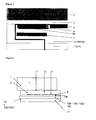
- Figure 1 shows a cross section of a PV module showing:
- Figure 2 shows a cross section of a PV module
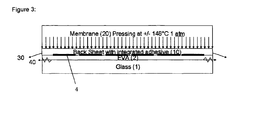
- Figure 3 shows a cross section of a PV module being laminated in a classical membrane (20) press:
- the cross-section shows:
- Figures 4a) to 4e ) show tensile strength graphs of:
- the permeability to acetic acid is estimated at 60°C as follows: A stainless steal cup is filled with acetic acid and closed with the film under evaluation. The closed cup is weighed and put into a chamber evacuated by a vacuum pump at 60°C during 14 days. The loss of weight of the closed cup is then measured and expressed in g/m 2 .day.
- Films A and B can be used as backsheet allowing high egress of acetic acid released from EVA encapsulant.
- Film C can be used as internal insulating layer (7) avoiding trapping of acetic acid.
- the TPT film can be useful as internal insulating layer (7) when micro-perforated.
- the amount of micro-perforation is adjusted to achieve a permeability to acetic acid of more than 20 g/m 2 •day.
- Further Film A and B can be equipped with an integrated adhesive (13b/12a) to reduce production of acetic acid inside the PV module.
- Further Film C can be embedded in polyethylene (VLDPE ...) based adhesive to reduce production of acetic acid inside the PV module.
- VLDPE polyethylene
- the heat of fusion is measured at the second heating at 10 K/minute by integration of the heat of fusion from 80°C to 180°C, with as heat flow baseline, the line between heat flow value at 0°C and heat flow value at 180°C.
- the heat of fusion of a suitable FPP blend will be less than 70 % of the heat of fusion of a PP resin (reference PP resin is PP Moplen HP 456J), preferably less than 60 %, more preferably less than 50%.
- the cold bending test (EN 495/5) is a good way to recognize a suitable FPP based layer as low temperature cold foldability (-20°C, especially - 40°C) is difficult to achieve when the blend of PP and rubber is not (semi-)interpenetrated (if the PP and rubber phases are not co-continuous i.e. are separated).
- the reference PP resin film of Homo PP Moplen HP 456J, has a poor cold foldability and low permeability to acetic acid. Its high rigidity combined to a high CLTE may lead to unacceptable stresses to the PV cells. Its brittleness at low temperature constitutes a major safety hazard (cracks in backsheet and loss of electrical insulation).
- the mechanical integrity of the backsheet may be compromised.
- the man skilled in the art will have a look to the DSC measurements (curves) of the FPP based layer(s) and select FPP blends which are not completely melted at lamination temperature (i.e. which have a residual heat of fusion above lamination temperature).
- fillers talcum, glass fibers
- PA-FPP backsheet with good heat distorsion (mechanical integrity at lamination temperature) and flow resistance (good adhesion of EVA with PV module front layer at edges and corners) and/or elevated RTI or RTE (heat aging), resistance to humidity and discoloration even when combined with EVA encapsulants.
- Addition of glass fibers in the FPP blend and combining the FPP blend based layers with a polyamide layer will much improve the retention of mechanical properties at lamination temperature and dimensional stability. Glass fibers help to control initial mechanical properties of all layers, in order to allow the FPP layers to dominate in the mechanical properties. Because FPP layers can be stabilized to achieve a RTI of typically 115°C, the backsheet achieves such result when the FPP layers dominate in the tensile strength of the backsheet.
- the FPP layers dominate in the mechanical properties because the FPP layers are reinforced (stiffened) and/or because the PA layer(s) have their mechanical properties reduced by inclusion of fillers especially glass fibers.
- the length of the glass fibers are preferably reduced to maximum 500 ⁇ m during the compounding step (production of the glass reinforced compound on co-rotating twin screw extruders with kneading elements for adjusting glass fibers length) and more preferably to 300 ⁇ m and if required (capillarity) to less than 300 ⁇ m.
- Shorter glass fibers may be used (e.g. Lanxess MF 7982) in mixture.
- a sample of the backsheet is aged at 150°C during 5 weeks.
- the tensile strength is measured according to Iso 527-3 and found superior to 50 % of the initial value. It is further observed that no delamination occurs after 5 weeks heat aging. By extrapolation, a RTI or RTE of +/- 115°C should be achieved.
- glass fibers in the FPP blend and combining the FPP blend based layers with a polyamide layer much improves the retention of mechanical properties at lamination temperature and dimensional stability / flow resistance (EVA adhesion at edges and corners of glass front layer) during module lamination (glass / EVA / cells / EVA / backsheet vacuum lamination - 150°C 15 minutes).
- the produced backsheet (400 ⁇ m) provides a system voltage of more than 1200 VDC.
- the rubber content of layer d) can be increased to adjust softness and improve acetic acid permeability.
- layer b is aged 2 weeks at 150°C and found to have a tensile strength less than 50 % of the initial value. The same is observed for the complete backsheet (a/b/c/d/e layers) when glass fibers are eliminated from composition of layer d).
- the discoloration (delta Yi - ASTM E313-73 (D1925)) is found acceptable ( ⁇ 10).
- Layer a) of example 3.1) is replaced by a 50 ⁇ m of a PE-g-MAH based tie-layer with formulation (without phenolic stabilizer): 100 parts of LLDPE grafted with maleic anhydride; 10 parts of Ti02 Kronos 2220; 0,3 parts of Weston 705; HALS: 0,3 parts of Cyasorb UV 3529.
- the discoloration (delta Yi - ASTM E313-73 (D1925)) is found acceptable (delta Yi ⁇ 10).
- Nylostab S-EED (Clariant) is used in layer b) instead of ADK Stab AO-80.
- the discoloration (delta Yi - ASTM E313-73 (D1925)) is found acceptable (delta Yi ⁇ 10).
- the discoloration (delta Yi - ASTM E313-73 (D1925)) is found unacceptable (delta Yi > 10 and severe pinking is observed).
- the glass fibers are included (10 parts) in the polyamide 6 based b) layer instead than in the FPP based d) layer.
- a sample of the backsheet is aged at 150°C during 5 weeks.
- the tensile strength is measured according to Iso 527-3 and found superior to 50 % of the initial value. It is further observed that no delamination occurs after 5 weeks heat aging. By extrapolation, a RTI of +/- 115°C should be achieved.
- the system voltage of the backsheet is > 1000 VDC (IEC 60664-1:2007).
- glass fibers are included (10 parts) in the polyamide 6 based b) layer and the amount of glass fiber in the FPP based d) layer is reduced to 10 parts instead of 20 parts.
- a sample of the backsheet is aged at 150°C during 5 weeks.
- the tensile strength is measured according to Iso 527-3 and found superior to 50 % of the initial value. It is further observed that no delamination occurs after 5 weeks heat aging. By extrapolation, a RTI of +/- 115°C should be achieved.
- glass fibers in the FPP blend and combining the FPP blend based layers with a polyamide layer much improves the retention of mechanical properties at lamination temperature and dimensional stability during module lamination (glass / EVA / cells / EVA / backsheet vacuum lamination - 150°C 15 minutes).
- the front EVA has poor adhesion with the front layer (glass) at PV module corners and edges.
- Example of a front encapsulant with EVA and VLDPE layers with excellent transparency, compatibility of additives and allowing for reduction of Potential Induced Degradation of PV modules.
- the EVA has a VAc content of more than 25 % and e.g. 33 %.
- the VLDPE has a DSC melting temperature of less than 100°C and is produced on base of single catalyst technology (Engage or Exact types of VLDPE) with as example Exact ® 82xx, where xx refers to the fluidity and 82 to the density (0,882 g/cm 3 ).
- the viscosity of the layers is adapted.
- polymers with a MI of more than 10, preferably of more than 20, even more preferably of more than 25 (g/10m; 190°C; 2,16 kg) are preferred.
- Each layers comprises usual additives, for example 0,1 % of Tinuvin ® 770 (common HALS), 0,2 % of Irgafos 168 (phosphite anti-oxidant) and 0,3 % of Chimassorb ® 81 (UV absorber).
- Tinuvin ® 770 common HALS
- Irgafos 168 phosphite anti-oxidant
- Chimassorb ® 81 UV absorber
- silane and peroxide and possibly multi-functional crosslinkers are added to layers, for example 0,5 % MEMO Silane (Gamma-Methacryloxypropyl trimethoxysilane) and 1,5 % Luperox ® TBEC and 0,5 % of TAIC (Tria Allyl IsoCyanurate)
- silane and UV photoinitiators and possibly multi-functional crosslinkers are added to layers, for example 0,5 % MEMO Silane (Gamma-Methacryloxypropyl trimethoxysilane) and 1 % Benzophenone and 0,5 % of TAIC (Tria Allyl IsoCyanurate)
- VLDPE based layer by humidity (on site) when the VLDPE is grafted with silane (by reactive extrusion), e.g. with 2 % of VTMO.
- Condensation catalyst may be added to the VLDPE layer, possibly by migration from another (supplementary) layer (not equipped with grafted silane to avoid premature crosslinking).
- PV modules Glass / front encapsulant / PID sensitive cells / EVA / TPT backsheet
- EVA-VLDPE-EVA coextruded front encapsulant
- EVA-VLDPE-EVA coextruded front encapsulant
- heat and damps 85°C / 85 % Relative Humidity
- cell bias Glass at 300 VDC and cells grounded. It is observed that the shunt resistance of the cells decreases quickly when a EVA front encapsulant is used, while it is more stable when the coextruded front encapsulant (EVA-VLDPE-EVA) is used.
Landscapes
- Laminated Bodies (AREA)
Priority Applications (6)
| Application Number | Priority Date | Filing Date | Title |
|---|---|---|---|
| EP12003009.3A EP2572877A3 (fr) | 2011-09-20 | 2012-04-28 | Modules photovoltaïques comprenant une couche de support et une ou plusieurs couches isolantes électriques qui sont hautement perméables aux sous-produits de dégradation corrosifs |
| PCT/EP2012/003788 WO2013041191A1 (fr) | 2011-09-20 | 2012-09-10 | Modules photovoltaïques comprenant une feuille arrière et une ou plusieurs couches d'isolant électrique qui sont hautement perméables aux sous-produits de dégradation par corrosion |
| PCT/EP2013/000629 WO2013135349A1 (fr) | 2012-03-12 | 2013-03-05 | Panneau arrière et modules photovoltaïques le comprenant |
| CN201380013730.9A CN104272467A (zh) | 2012-03-12 | 2013-03-05 | 底片和包含其的光伏组件 |
| US14/384,718 US20150027516A1 (en) | 2012-03-12 | 2013-03-05 | Backsheet and photovoltaic modules comprising it |
| EP13707553.7A EP2826074A1 (fr) | 2012-03-12 | 2013-03-05 | Panneau arrière et modules photovoltaïques le comprenant |
Applications Claiming Priority (4)
| Application Number | Priority Date | Filing Date | Title |
|---|---|---|---|
| EP11007640 | 2011-09-20 | ||
| EP11008801 | 2011-11-04 | ||
| EP12001690 | 2012-03-12 | ||
| EP12003009.3A EP2572877A3 (fr) | 2011-09-20 | 2012-04-28 | Modules photovoltaïques comprenant une couche de support et une ou plusieurs couches isolantes électriques qui sont hautement perméables aux sous-produits de dégradation corrosifs |
Publications (2)
| Publication Number | Publication Date |
|---|---|
| EP2572877A2 true EP2572877A2 (fr) | 2013-03-27 |
| EP2572877A3 EP2572877A3 (fr) | 2013-05-29 |
Family
ID=46201066
Family Applications (1)
| Application Number | Title | Priority Date | Filing Date |
|---|---|---|---|
| EP12003009.3A Withdrawn EP2572877A3 (fr) | 2011-09-20 | 2012-04-28 | Modules photovoltaïques comprenant une couche de support et une ou plusieurs couches isolantes électriques qui sont hautement perméables aux sous-produits de dégradation corrosifs |
Country Status (2)
| Country | Link |
|---|---|
| EP (1) | EP2572877A3 (fr) |
| WO (1) | WO2013041191A1 (fr) |
Cited By (5)
| Publication number | Priority date | Publication date | Assignee | Title |
|---|---|---|---|---|
| WO2013135349A1 (fr) * | 2012-03-12 | 2013-09-19 | Renolit Belgium N.V. | Panneau arrière et modules photovoltaïques le comprenant |
| CN103618499A (zh) * | 2013-10-18 | 2014-03-05 | 浙江晶科能源有限公司 | 一种太阳能电池片pid测试装置及测试方法 |
| WO2015191699A1 (fr) * | 2014-06-11 | 2015-12-17 | Arizona Board Of Regents On Behalf Of Arizona State University | Contrôle de la dégradation induite par potentiel de modules photovoltaïques |
| EP3437186A1 (fr) * | 2016-03-30 | 2019-02-06 | ExxonMobil Chemical Patents Inc. | Feuilles arrière de module photovoltaïque comprenant des compositions de vulcanisat thermoplastique |
| US20230299222A1 (en) * | 2020-07-21 | 2023-09-21 | Tomark-Worthen, Llc | Polymeric solar panel backsheets and method of manufacture |
Families Citing this family (4)
| Publication number | Priority date | Publication date | Assignee | Title |
|---|---|---|---|---|
| JP6310869B2 (ja) * | 2014-02-25 | 2018-04-11 | 日清紡メカトロニクス株式会社 | Pid対策・発電劣化対策太陽電池封止シートおよびpid対策・発電劣化対策太陽電池モジュール |
| MX2016015038A (es) * | 2014-05-16 | 2017-04-11 | Basf Coatings Gmbh | Uso de una composicion de recubrimiento para recubrir la pelicula de soporte de un modulo fotovoltaico y modulo fotovoltaico. |
| CN108761391B (zh) * | 2018-05-29 | 2022-04-01 | 南京信息工程大学 | 一种模型类无设备目标定位方法 |
| CN115694356A (zh) * | 2021-07-26 | 2023-02-03 | 浙江晶科能源有限公司 | 太阳能电池潜在电势诱导衰减测试装置及测试方法 |
Citations (2)
| Publication number | Priority date | Publication date | Assignee | Title |
|---|---|---|---|---|
| WO1999027588A1 (fr) | 1997-11-24 | 1999-06-03 | Midwest Research Institute | Composition et procede d'encapsulation de composants photovoltaiques |
| US20100108128A1 (en) | 2008-11-06 | 2010-05-06 | Lih-Long Chu | Co-Extruded, Multilayered Polyolefin-Based Backsheet for Electronic Device Modules |
Family Cites Families (11)
| Publication number | Priority date | Publication date | Assignee | Title |
|---|---|---|---|---|
| US20080185033A1 (en) * | 2007-02-06 | 2008-08-07 | Kalejs Juris P | Solar electric module |
| US8080726B2 (en) * | 2007-04-30 | 2011-12-20 | E. I. Du Pont De Nemours And Company | Solar cell modules comprising compositionally distinct encapsulant layers |
| CN101681946B (zh) * | 2007-06-15 | 2012-10-24 | 阿科玛股份有限公司 | 具有聚偏二氟乙烯背板的光伏打模块 |
| DE102009002823A1 (de) * | 2009-05-05 | 2010-11-18 | Komax Holding Ag | Solarzelle, diese Solarzelle umfassendes Solarmodul sowie Verfahren zu deren Herstellung und zur Herstellung einer Kontaktfolie |
| ES2531104T3 (es) * | 2009-07-23 | 2015-03-10 | Renolit Belgium Nv | Módulos fotovoltaicos con lámina de respaldo basada en polipropileno |
| EP2277693A1 (fr) * | 2009-07-23 | 2011-01-26 | RENOLIT Belgium N.V. | Modules photovoltaïques avec film barrière à base de polypropylène |
| WO2011053941A2 (fr) * | 2009-11-02 | 2011-05-05 | Invention Planet, LLC | Système détecteur |
| DE102009059105A1 (de) * | 2009-12-18 | 2011-06-22 | Schott Ag, 55122 | Rückseitenfolie für Solarmodule |
| US20110159280A1 (en) * | 2009-12-31 | 2011-06-30 | Du Pont Apollo Limited | Backsheet for a solar module |
| EP2617568A1 (fr) * | 2010-08-16 | 2013-07-24 | 3M Innovative Properties Company | Feuille arrière solaire à base de polyoléfine |
| EP2509115A1 (fr) * | 2011-04-08 | 2012-10-10 | RENOLIT Belgium N.V. | Modules photovoltaïques comportant une feuille arrière intégrée adhésive à base de TPO et film d'encapsulation avant avec excellente adhésion à la feuille avant en verre |
-
2012
- 2012-04-28 EP EP12003009.3A patent/EP2572877A3/fr not_active Withdrawn
- 2012-09-10 WO PCT/EP2012/003788 patent/WO2013041191A1/fr not_active Ceased
Patent Citations (2)
| Publication number | Priority date | Publication date | Assignee | Title |
|---|---|---|---|---|
| WO1999027588A1 (fr) | 1997-11-24 | 1999-06-03 | Midwest Research Institute | Composition et procede d'encapsulation de composants photovoltaiques |
| US20100108128A1 (en) | 2008-11-06 | 2010-05-06 | Lih-Long Chu | Co-Extruded, Multilayered Polyolefin-Based Backsheet for Electronic Device Modules |
Non-Patent Citations (2)
| Title |
|---|
| UNKNOWN: "Plastics Additives Handbook 5th edition", pages: 123 - 136 |
| UNKNOWN: "Plastics Additives Handbook 5th edition", pages: 40 |
Cited By (6)
| Publication number | Priority date | Publication date | Assignee | Title |
|---|---|---|---|---|
| WO2013135349A1 (fr) * | 2012-03-12 | 2013-09-19 | Renolit Belgium N.V. | Panneau arrière et modules photovoltaïques le comprenant |
| CN103618499A (zh) * | 2013-10-18 | 2014-03-05 | 浙江晶科能源有限公司 | 一种太阳能电池片pid测试装置及测试方法 |
| CN103618499B (zh) * | 2013-10-18 | 2016-01-20 | 浙江晶科能源有限公司 | 一种太阳能电池片pid测试装置及测试方法 |
| WO2015191699A1 (fr) * | 2014-06-11 | 2015-12-17 | Arizona Board Of Regents On Behalf Of Arizona State University | Contrôle de la dégradation induite par potentiel de modules photovoltaïques |
| EP3437186A1 (fr) * | 2016-03-30 | 2019-02-06 | ExxonMobil Chemical Patents Inc. | Feuilles arrière de module photovoltaïque comprenant des compositions de vulcanisat thermoplastique |
| US20230299222A1 (en) * | 2020-07-21 | 2023-09-21 | Tomark-Worthen, Llc | Polymeric solar panel backsheets and method of manufacture |
Also Published As
| Publication number | Publication date |
|---|---|
| WO2013041191A1 (fr) | 2013-03-28 |
| EP2572877A3 (fr) | 2013-05-29 |
Similar Documents
| Publication | Publication Date | Title |
|---|---|---|
| US20150027516A1 (en) | Backsheet and photovoltaic modules comprising it | |
| EP2572877A2 (fr) | Modules photovoltaïques comprenant une couche de support et une ou plusieurs couches isolantes électriques qui sont hautement perméables aux sous-produits de dégradation corrosifs | |
| EP2277694B1 (fr) | Modules photovoltaïques avec film support multicouche résistant à la chaleur | |
| US8431235B2 (en) | Co-extruded, multilayered polyolefin-based backsheet for electronic device modules | |
| KR101217028B1 (ko) | 실란기를 갖는 절연층을 포함하는 광전지 모듈 | |
| CN114424349B (zh) | 光伏元件 | |
| EP2277693A1 (fr) | Modules photovoltaïques avec film barrière à base de polypropylène | |
| EP2804223A1 (fr) | Module de cellule solaire doté d'une excellente apparence et son procédé de fabrication | |
| EP2509115A1 (fr) | Modules photovoltaïques comportant une feuille arrière intégrée adhésive à base de TPO et film d'encapsulation avant avec excellente adhésion à la feuille avant en verre | |
| WO2017150217A1 (fr) | Feuille de résine, verre stratifié, et module de cellule solaire | |
| EP3164892B1 (fr) | Feuille arrière coextrudée pour modules de cellules solaires | |
| US20170141251A1 (en) | Mono-backsheet for solar cell modules |
Legal Events
| Date | Code | Title | Description |
|---|---|---|---|
| PUAI | Public reference made under article 153(3) epc to a published international application that has entered the european phase |
Free format text: ORIGINAL CODE: 0009012 |
|
| AK | Designated contracting states |
Kind code of ref document: A2 Designated state(s): AL AT BE BG CH CY CZ DE DK EE ES FI FR GB GR HR HU IE IS IT LI LT LU LV MC MK MT NL NO PL PT RO RS SE SI SK SM TR |
|
| AX | Request for extension of the european patent |
Extension state: BA ME |
|
| PUAL | Search report despatched |
Free format text: ORIGINAL CODE: 0009013 |
|
| AK | Designated contracting states |
Kind code of ref document: A3 Designated state(s): AL AT BE BG CH CY CZ DE DK EE ES FI FR GB GR HR HU IE IS IT LI LT LU LV MC MK MT NL NO PL PT RO RS SE SI SK SM TR |
|
| AX | Request for extension of the european patent |
Extension state: BA ME |
|
| RIC1 | Information provided on ipc code assigned before grant |
Ipc: H01L 31/048 20060101ALI20130425BHEP Ipc: H01L 31/042 20060101ALI20130425BHEP Ipc: B32B 17/10 20060101AFI20130425BHEP |
|
| STAA | Information on the status of an ep patent application or granted ep patent |
Free format text: STATUS: THE APPLICATION IS DEEMED TO BE WITHDRAWN |
|
| 18D | Application deemed to be withdrawn |
Effective date: 20131130 |