EP2573244A1 - Matériau d'absorption acoustique - Google Patents
Matériau d'absorption acoustique Download PDFInfo
- Publication number
- EP2573244A1 EP2573244A1 EP12006446A EP12006446A EP2573244A1 EP 2573244 A1 EP2573244 A1 EP 2573244A1 EP 12006446 A EP12006446 A EP 12006446A EP 12006446 A EP12006446 A EP 12006446A EP 2573244 A1 EP2573244 A1 EP 2573244A1
- Authority
- EP
- European Patent Office
- Prior art keywords
- polymer
- nonwoven fabric
- use according
- fibers
- filaments
- Prior art date
- Legal status (The legal status is an assumption and is not a legal conclusion. Google has not performed a legal analysis and makes no representation as to the accuracy of the status listed.)
- Granted
Links
Images

Classifications
-
- D—TEXTILES; PAPER
- D04—BRAIDING; LACE-MAKING; KNITTING; TRIMMINGS; NON-WOVEN FABRICS
- D04H—MAKING TEXTILE FABRICS, e.g. FROM FIBRES OR FILAMENTARY MATERIAL; FABRICS MADE BY SUCH PROCESSES OR APPARATUS, e.g. FELTS, NON-WOVEN FABRICS; COTTON-WOOL; WADDING ; NON-WOVEN FABRICS FROM STAPLE FIBRES, FILAMENTS OR YARNS, BONDED WITH AT LEAST ONE WEB-LIKE MATERIAL DURING THEIR CONSOLIDATION
- D04H3/00—Non-woven fabrics formed wholly or mainly of yarns or like filamentary material of substantial length
- D04H3/08—Non-woven fabrics formed wholly or mainly of yarns or like filamentary material of substantial length characterised by the method of strengthening or consolidating
- D04H3/14—Non-woven fabrics formed wholly or mainly of yarns or like filamentary material of substantial length characterised by the method of strengthening or consolidating with bonds between thermoplastic yarns or filaments produced by welding
-
- D—TEXTILES; PAPER
- D04—BRAIDING; LACE-MAKING; KNITTING; TRIMMINGS; NON-WOVEN FABRICS
- D04H—MAKING TEXTILE FABRICS, e.g. FROM FIBRES OR FILAMENTARY MATERIAL; FABRICS MADE BY SUCH PROCESSES OR APPARATUS, e.g. FELTS, NON-WOVEN FABRICS; COTTON-WOOL; WADDING ; NON-WOVEN FABRICS FROM STAPLE FIBRES, FILAMENTS OR YARNS, BONDED WITH AT LEAST ONE WEB-LIKE MATERIAL DURING THEIR CONSOLIDATION
- D04H3/00—Non-woven fabrics formed wholly or mainly of yarns or like filamentary material of substantial length
- D04H3/005—Synthetic yarns or filaments
-
- D—TEXTILES; PAPER
- D04—BRAIDING; LACE-MAKING; KNITTING; TRIMMINGS; NON-WOVEN FABRICS
- D04H—MAKING TEXTILE FABRICS, e.g. FROM FIBRES OR FILAMENTARY MATERIAL; FABRICS MADE BY SUCH PROCESSES OR APPARATUS, e.g. FELTS, NON-WOVEN FABRICS; COTTON-WOOL; WADDING ; NON-WOVEN FABRICS FROM STAPLE FIBRES, FILAMENTS OR YARNS, BONDED WITH AT LEAST ONE WEB-LIKE MATERIAL DURING THEIR CONSOLIDATION
- D04H3/00—Non-woven fabrics formed wholly or mainly of yarns or like filamentary material of substantial length
- D04H3/08—Non-woven fabrics formed wholly or mainly of yarns or like filamentary material of substantial length characterised by the method of strengthening or consolidating
- D04H3/14—Non-woven fabrics formed wholly or mainly of yarns or like filamentary material of substantial length characterised by the method of strengthening or consolidating with bonds between thermoplastic yarns or filaments produced by welding
- D04H3/153—Mixed yarns or filaments
Definitions
- the present invention relates to the field of textile products and their applications in the field of sound insulation, in particular the soundproofing in vehicles, aircraft and trains, in the construction industry and in small appliances.
- the invention relates to a sound absorption material of a nonwoven fabric containing at least two polymers, wherein the melting point of at least one first polymer is above the melting point of at least one second polymer, and a process for its preparation.
- the invention further relates to the use of such a scall absorption material for the production of lining parts, which are used in the interior of automobiles and the use of this nonwoven fabric for producing a composite material.
- Nonwovens are textile fabrics made of individual fibers and can be obtained by a wide variety of manufacturing processes, such as carding (dry laid), meltblowing (spunbonding) or aerodynamic nonwoven laying (air laying).
- melt spinning a polymeric substance is heated in an extruder and The polymer exits the nozzle plate as a filament (continuous filament) in molten form, is cooled by an air flow and stretched out of the melt.
- the air stream conveys the endless filaments onto a conveyor belt, which is designed as a sieve.
- the threads can be fixed to form a fiber fabric.
- the solidification of the fiber fabric can be done by heated rollers (calender), by a vapor stream, by hot air or by mechanical or chemical bonding.
- calender heated rollers
- one of the two rolls may be engraved, which may consist of dots, short rectangles or diamond-like surfaces.
- Nonwovens are used for a variety of purposes. Nonwoven fabrics with high strength can be used alone or as a reinforcing layer in fiber composites. In the packaging field, single-layer constructions are usually made using ⁇ meltblown or meltblown-like material structures, i. Fiber structures used from only one domain. Nonwoven fabrics are also used as sound absorption materials.
- a suitable sound absorbing material is the choice not only by the sound absorption ability but also by other factors, such as. As price, weight, thickness, fire resistance, etc. influenced.
- sound damping felts, foams, Pressfasem, glass powder or "stone powder” and recycled materials are used. These can, for example, be treated with the hammer mill and synthetic resin and thermo-treated in order to adapt the properties of the materials to the respective fields of application.
- the present invention seeks to broaden the conventional field of nonwoven applications by imparting sound insulating properties in combination with a small thickness, making them particularly suitable for use in demanding environments such as the interior of automobiles.
- Sound absorption materials of the type mentioned are basically known.
- the sound absorption is based on a disturbance or redirection of the sound energy.
- the energy can be converted into heat on the one hand or there is a reflection of the energy.
- the expert speaks at a power diversion of insulation. The sound is thus damped.
- reflective materials are used for sound insulation, such as e.g. B. capsule walls, partitions or screens, which engage in the propagation path of the sound energy. Due to their porous structure, conventional sound absorption materials convert the sound energy into heat in the medium to high-frequency range.
- Also suitable for sound insulation are synthetic mineral fibers, open-cell foams, porous inorganic bulk materials or natural fibers.
- a small material thickness is advantageous, as this reduces the space requirement.
- the suppliers are asked for car accessories to make the lining parts such that they are designed to save space.
- these parts should be recyclable, high color and lightfastness, in particular a high heat-fastness, a low tendency to fouling, high abrasion resistance, moisture resistance, flame resistance, Having cleanability and good H mayverform stressess- or thermoforming capabilities. It is also of great interest to increase the sound insulation in terms of comfort for the automobile occupants.
- the automotive sector it is customary to produce sound absorption materials as composite materials from a textile carrier with a damping layer and optionally a cover layer.
- the absorption property is achieved in particular by combining the textile carrier with the soundproofing layer.
- microfiber nonwovens made of melt spun nonwoven composite filaments which are at least 80% split into elementary filaments and solidified. These nonwovens are in the DE 100 09 281 A1 described and have multi-component endless filaments. Their preparation comprises the following steps: First, multicomponent continuous filaments are spun, drawn and deposited directly into a nonwoven. Subsequently, a pre-consolidation and the deposited web is then split by means of high-pressure fluid jets in elementary filaments and solidified. Such soundproofing layers have a uniform thickness and an isotropic thread distribution and show excellent soundproofing properties.
- the invention therefore an object of the invention to provide a sound absorbing material and a method for its production, which avoids the disadvantages mentioned above. In particular, it should be easy, inexpensive and time-saving can be produced.
- This object is achieved according to the invention with a sound absorption material a nonwoven fabric containing at least two polymers wherein the melting point of at least one first polymer is above the melting point of at least one second polymer and wherein the first polymer is in the form of elemental segments distributed in a matrix of the second polymer.
- nonwovens of the abovementioned type have outstanding sound absorption properties.
- such nonwovens show an airborne sound absorption coefficient ⁇ (0), measured in the impedance tube according to DIN EN ISO 10354-1, of ⁇ 0.8 at a frequency of 1000 Hz to 4000 Hz.
- Sound absorption tests have shown that the sound absorption material according to the invention is particularly suitable for sound insulation in the sound frequency range of 100 to 5000 Hz.
- the sound absorption materials according to the invention show excellent sound absorption properties even at low thicknesses.
- Practical experiments have shown that the sound absorbing materials according to the invention already at a thickness of the nonwoven fabric of 0.01 mm to 1 mm, preferably from 0.05 mm to 0.5 mm, in particular from 0.1 mm to 0.2 mm, the above achieved airborne sound absorption levels and singular values.
- the thickness of the sound absorbing materials according to the invention may vary.
- the sound absorbing materials according to the invention have a thickness of 0.01 mm to 1 mm, more preferably from 0.05 mm to 0.5 mm, in particular from 0.1 mm to 0.2 mm.
- the air permeability of the sound absorption materials according to the invention measured according to DIN EN ISO 9237 at 20 cm 2 and 50 Pa vary.
- the sound absorption materials according to the invention an air permeability measured according to DIN EN ISO 9237 at a basis weight of 100 g / m 2 of 20 l / m 2 sec to 120 l / m 2 sec, more preferably from 40 l / m 2 sec to 100 l / m 2 sec, in particular from 60 l / m 2 sec to 90 l / m 2 sec, up.
- the nonwoven fabric may have a low basis weight and still exhibit good sound absorption properties.
- the basis weight of the nonwoven fabric can vary widely and be selected, for example, according to the requirements of a composite material.
- the basis weight is from 30 g / m 2 to 400 g / m 2 , more preferably from 35 g / m 2 to 200 g / m 2 , even more preferably from 40 g / m 2 to 150 g / m 2 , especially from 40 g / m 2 to 120 g / m 2 .
- the nonwoven fabric is characterized by further advantageous properties, such as a good hot workability or thermoformability. Because of this, it can be processed very easily and adapted to a wide variety of room requirements.
- the nonwoven fabric is extremely stable at room temperature.
- the nonwoven fabric may have a film-like character over the fused domains, but without the weaknesses of a film or paper. So it is easily possible to design the surface of the nonwoven fabric smooth and wet-strength.
- Such a nonwoven fabric may be considered a "fiber reinforced film”.
- the nonwoven fabric can have a high strength with low weight. This allows easy processing and handling. Furthermore, a high strength is very advantageous when using the Schellabsorptionsmaterials invention as a lining for the interior of automobiles, in particular as a car roof, doormat, door trim, pillar trim, parcel shelf and / or trunk lining and Radkastenausfound.
- the nonwoven fabric is characterized by isotropic mechanical properties, such as an isotropic ratio of maximum tensile force or additional tensile force Machine to transverse direction, off.
- Isotropy in the sense of the invention denotes the independence of a property from the direction.
- Isotropic strength properties are advantageous in particular for the use of the nonwoven fabric as a reinforcing layer, since in this way a particularly uniform stabilization is achieved.
- machine direction / transverse direction ratio of the maximum tensile force and / or tear propagation force in the context of the invention, it is understood that the machine direction / transverse direction ratio of the maximum tensile force and / or tearing force in the range of 0.7 to 1.6, preferably from 0.8 to 1.5, in particular from 0.9 to 1.1, is located.
- Maximum tensile force is the force that must be used to rupture a fiber layer.
- tear propagation force is meant the force that is necessary to tear down an already cracked fiber layer or further tear. The higher these values are, the more stable a situation is.
- the maximum tensile force is measured in the machine direction or transversely to the machine direction.
- the machine direction is understood to mean the direction under which the fibers are deposited longitudinally on a conveyor belt moving in the longitudinal direction.
- the direction transverse thereto or orthogonal thereto is the transverse direction.
- the nonwoven fabric is further characterized by excellent strength properties.
- the tear propagation force measured in accordance with ASTM D5733 in the machine and / or transverse direction can be 10 N to 190 N, preferably 60 N to 180 N, in particular 120 N to 180 N.
- the maximum tensile force measured according to ASTM D5034 in the machine and / or transverse direction may be 70 to 400 N / 50 mm, preferably 100 to 350 N / 50 mm, in particular 150 to 300 N / 50 mm.
- PIE fibers hollow PIE fibers, core / sheath fibers, multilobal fibers, islands-in-sea fibers or side-by-side fibers have proven particularly suitable. Very particular preference is given to PIE fibers, which preferably comprise 4, 6, 8, 10, 14, 16, 18 or 32 elementary segments.
- the multicomponent fibers may be formed as staple fibers. Preferably, the multicomponent fibers are formed as continuous filaments and composed of at least two polymers.
- PIE fibers are understood as meaning fibers of elementary segments which are arranged in the form of cake pieces or circular segments in cross section.
- the effect of reflowing a PIE fiber is the incorporation of stable pie-shaped segments that function as reinforcing filaments in the polymer matrix. As a result, a stabilization is achieved in the manner of a reinforced concrete. In the case of PIE filaments in particular, a marked change in the geometry of the original filament structure is noticeable.
- the cake-piece-shaped segments have a very small diameter in cross-section and therefore the matrix can prevail in a particularly large number.
- the alternating arrangement of the individual core segments in the fibers causes a particularly homogeneous distribution of the various polymers. This leads to an extremely uniform melting with formation of the matrix.
- the sheaths be made of the lower melting polymer.
- the cores are embedded in the matrix polymer matrix in the form of stable circular segments.
- the multicomponent fibers may comprise two or more polymers, provided that at least one polymer has a higher melting point than at least one further polymer. Practical experiments have shown that already with the use of two polymers (bicomponent fibers) nonwovens having a stable matrix structure can be obtained.
- the nonwoven fabric is characterized in that it comprises at least two polymers, wherein the melting point of at least one first polymer is above the melting point of at least one second polymer.
- the first polymer is in the form of elemental segments distributed in a matrix of the second polymer.
- the difference between the melting point of the first and second polymers can vary widely. Conveniently, the difference is at least 15 ° C, in particular at least 20 ° C. Preferably, polymers having a temperature difference of from 15 ° C to 450 ° C, more preferably from 15 ° C to 200 ° C, even more preferably from 20 ° C to 150 ° C, especially from 70 ° C to 150 ° C are used.
- thermoplastic polymers in particular selected from the group consisting of nylon 6, nylon 6.6, nylon 6.10, nylon 6.11, nylon 6-12, polypropylene or polyethylene.
- polymers are selected from the group consisting of polyester, polyamide, thermoplastic copolyetherester elastomers, polyolefins, polyacrylates and thermoplastic liquid crystals.
- Copolyetheresterelastomeren from long-chain and short-chain ester monomers. If elemental segments of polyethylene terephthalate are used, they can preferably be produced from recyclable polyethylene terephthalate.
- thermoplastic polymers polyamides, polyvinyl acetates, saponified polyvinyl acetates, saponified ethylene vinyl acetates and other hydrophilic polymers.
- elastic polymers can also be used. These polymers are preferably selected from the group consisting of: styrene / butadiene copolymers, elastic polypropylene, polyethylene, metallocene-catalyzed ⁇ -olefin homopolymers, as well as copolymers having a density of less than 0.89 g / cm 3 .
- styrene / butadiene copolymers preferably selected from the group consisting of: styrene / butadiene copolymers, elastic polypropylene, polyethylene, metallocene-catalyzed ⁇ -olefin homopolymers, as well as copolymers having a density of less than 0.89 g / cm 3 .
- amorphous polyalphaolefins having a density of less than 0.89 g / cm 3 ethylene vinyl acetate, and ethylene-propylene rubber and propylene-1-butene copolymer and ter
- the multicomponent fibers comprise polypropylene, polyethylene, polyamide, syndiotaticians polystyrene, polyester, and / or mixtures of these polymers, preferably polyethylene terephthalate.
- the first polymer is selected from the group consisting of: polyester, preferably polyethylene terephthalate and / or the second polymer selected from the group consisting of: polypropylene, polyethylene, polyamide and / or polyester, preferably polyethylene terephthalate.
- the sheath or the sea is preferably formed from the second, matrix-producing polymer.
- Preferred polymers for the matrix are Copolyester, polypropylene, polyamide, polyethylene, linear low-pressure polyethylene having an ⁇ -olefin monomer content greater than 10 wt .-%, ethylene copolymer with at least one vinyl monomer or ethylene copolymer with unsaturated aliphatic carboxylic acids.
- the nonwoven fabric is characterized in that the nonwoven fabric is a film-like molten polymer matrix. This contains unmelted elementary segments, which may be circular-segment-shaped or cake-piece-shaped, multilobal or circular in cross-section.
- the weight ratio of the first polymer to the second polymer in the nonwoven fabric can vary within wide limits, as long as it is ensured that the first polymer in the nonwoven fabric is in the form of elementary filaments which are distributed in a matrix of the second polymer.
- the weight ratio of first polymer to second polymer in the nonwoven fabric is 50%: 50%, preferably 70% to 30%, more preferably 60% to 40%.
- the proportion of the matrix in the nonwoven fabric from 1 wt .-% to 60 wt .-%, preferably from 5 wt .-% to 50 wt .-%, in particular from 10 wt .-% to 40 wt .-%.
- a nonwoven fabric having a particularly good flexural strength can be obtained.
- the nonwoven fabric is treated with impregnating agents, in particular flame retardants or hydrophilizing and hydrophobing reagents.
- the nonwoven fabric is sprayed or impregnated with an aqueous flame retardant.
- the nonwoven fabric is eminently suitable for the production of composites because its surface structure is e.g.
- the choice of polymers and plasma or corona treatment of the surface can be easily matched to the other composite components.
- the very dense surface structure also allows the application of adhesive components such. the application of thermoplastic polymers, preferably polyethylene, copolyester or polyamide, for example in the form of solid adhesive powder via appropriate devices.
- the nonwoven fabric can be heat-set at least at the surface via the adhesive components, resulting in stabilization of the nonwoven fabric.
- the treatment can be carried out on one or both sides, preferably on one side, and preferably takes place after impregnation with binders.
- the solid adhesive powder can be fixed by heat in the same processing step.
- the nonwoven fabric which is initially flame-retarded, is provided with powder-based polyethylene-based adhesive and heat-set (for example Schaetti Fix® adhesives from Schaetti AG, Zurich or others).
- Another object of the invention is the use of a composite material comprising at least a first layer containing the nonwoven fabric described above, and a second layer which may be formed as a spacer layer and preferably a fiber composite, in particular a scrim, a nonwoven fabric, a film and / or a film, as a soundproofing material.
- the second layer is formed as a fiber composite with a thickness (uncompressed) of 0.5 to 5, preferably from 0.8 to 3, in particular from 1 to 2 cm.
- the respective layers of the nonwoven fabric may be bonded together in various ways depending on the materials used. Practical experiments have shown that particularly strong composites are obtained when the first and second layers are cohesively bonded together by means of a binder.
- the thickness and composition of the fiber composite may vary widely depending on the particular application of the composite.
- the fiber composite contains textile fiber waste, such as preferably cellulose fibers, hemp, flax, cotton, bast, sisal, kenaf and / or plastics, preferably polyolefins, in particular polyethylene and / or polypropylene and / or their copolymers or metals.
- the fiber waste preferably comprises a binder or a low-melting binder fiber for stabilization and fixation.
- the composite material according to the invention can be joined by coating the nonwoven fabric with the fiber composite by laminating and / or laminating the nonwoven fabric, if appropriate using a binder and / or pressure and / or temperature. Also conceivable is the extrusion of a film-forming polymer melt or the application of a thermoplastic material in powder form with subsequent thermal fixation.
- the method is characterized by the fact that multi-component fibers are connected by applying a pressure of at least 40 N / mm, and at a temperature of at least 100 ° C so flat that at least a first Polymer is distributed in the form of elementary segments in a matrix of at least one second polymer.
- PIE fibers preferably PIE filaments, preferably with 30-50% polyamide content and 70-50% polyester content, preferably at pressures between 50 and 80 N / mm and temperatures between 130 ° C and 180 ° C, in particular by means of a roller combination of a smooth steel roller and a rough steel roller (roughness 40 microns) are solidified.
- the multicomponent fibers can be prepared by methods known to those skilled in the art. Particularly preferred according to the invention is the melt spinning technology.
- a polymeric substance can be heated under pressure in an extruder and pressed through a die to form endless filaments.
- the continuous filaments After exiting the extrusion die, the continuous filaments may be drawn and positioned by means of dynamic laydown methods on a conveyor belt, deflecting them transversely to form a fiber layer.
- An advantage of a transversely deflected positioning of the continuous filaments is that this increases the isotropy of the mechanical properties of the nonwoven fabric.
- the sound absorption material produced by the method according to the invention is characterized in that it comprises a polymer matrix.
- the method described above makes it possible to use energy-intensive mechanical consolidation technologies, e.g. Hydroentanglement, to dispense. Furthermore, it is characterized by the fact that it is inexpensive and fast.
- the temperature and the pressure with which the solidification of the multicomponent fibers takes place can vary within wide limits and is expediently adapted to the respectively used polymer components in the multicomponent fiber. It is essential here that at the selected temperature and pressure, a substantially complete melting of the first polymer but not of the second polymer takes place.
- the surface connection of the multi-component fibers is carried out by Applying at a temperature of 100 to 300 ° C, preferably from 100 to 250 ° C, more preferably from 110 to 200 ° C, in particular from 120 to 180 ° C.
- rollers in particular calenders
- rollers are expediently used.
- rollers with a smooth or only slightly roughened surface are expediently used.
- the surface has a surface roughness of 20 to 60 .mu.m, in particular from 30 to 45 .mu.m.
- the nonwoven fabric is impregnated with binders.
- Suitable binders are in particular acrylates and aminoplasts (phenolic resins, melamine resins), styrene-butadiene copolymers, NBR binder systems and / or polyurethanes.
- the nonwoven fabric it is expedient to increase the surface energy of the nonwoven fabric by corona and / or plasma treatment.
- the plasma or corona treatment is preferably carried out in such a way that the surface is given a surface energy according to ISO 9000 of more than 38 dyn, preferably 38 to 70 dyn, in particular 40 to 60 dyn. It is advantageous that the surface can be made hydrophilic without adding chemicals.
- Conceivable is the antistatic finish of the surface, as well as its inspiration with care substances. Also conceivable and advantageous is the subsequent finishing of the nonwoven fabric with additives selected from the group consisting of: color pigments, permanently acting antistatic agents, flame retardants and / or the hydrophobic properties influencing additives. Particularly preferred is the use of flame retardants. It is also conceivable equipment with hydrophilic or antistatic spin finishes, as well as their Buffalo with care substances. It is also conceivable additives for surface modification already in the continuous film production in an extruder to enter. Also with a coloring no subsequent coloring is necessary, since pigments already with the Endlosfilêtrzeugung can be introduced into an extruder.
- the nonwoven fabric may be subjected to a chemical-type bonding or finishing such as an anti-pilling treatment, a hydrophilization, an antistatic treatment, a refractory-improving treatment, and / or a change in tactile properties or glossiness of a treatment
- a chemical-type bonding or finishing such as an anti-pilling treatment, a hydrophilization, an antistatic treatment, a refractory-improving treatment, and / or a change in tactile properties or glossiness of a treatment
- Mechanical type such as roughening, sanforizing, sanding or a treatment in the tumbler and / or a treatment to change the appearance such as dyeing or printing.
- the fiber titres of the multicomponent fibers preferably have independently of one another values of from 1 dtex to 4 dtex, preferably from 1.5 to 3 dtex, more preferably from 2 dtex to 3 dtex.
- polyethylene terephthalate and polyamide are coextruded in a known manner with a perforation throughput of 0.76 g / L min and aerodynamically stretched to form 16 PIE filaments.
- the proportion of polyamide is between 30 and 50 wt .-%.
- the endless filaments are placed on top of it Conveyor belt stored dynamically. Dynamic deposition is understood to mean that the orientation of the filaments to be deposited in the transverse direction can be influenced in a targeted manner. This is followed by solidification of the continuous filaments by a rough steel roller under pressure and heat.
- the steel roller has temperatures between 130 ° C and 180 ° C at a line pressure between 50 N / mm and 80 N / mm (roughness of 40 microns) on.
- the endless filaments By subjecting the endless filaments to pressure and temperature, the polyamide is fused and the polyethylene terephthalate is distributed in the form of cross-section cake-like elementary filaments in a matrix of the polyamide.
- a spunbonded fabric having a basis weight of 105 g / m 2 is obtained.
- the result is a spunbonded fabric with dense structure and low porosity at characteristic mechanical values (HZK, WRK, MD: CD ratio).
- the parameters of the experiment are shown in Table 1.
- Table 1 Working Example 1, 105 g / m ⁇ sup> 2 ⁇ / sup> PET / PA nonwoven fabric, PIE filaments, mech. Properties. Kalandertemp. Kalandetik PA part is done Weight thickness LD 20cmff50Pa LD Tomb Tensile MD Del MD Grab Tensile CD Dehrung CD Trap tar MD Trap tar CD EN250173 angel LINEN ISO9073-2 LINEN ISO9237 ASTM CE034 ASTM CE034 ASTM CE034 ASTM CE034 ASTM CE034 ASTM D5733 ASTM D5733 ° C Nnm % g / m 2 mm msec rays N50nm % N50nm % N N 131 50 30 1039 0.2 69 562 224.9 43.7 174.2 41.3 165 163.9 130 50 30 104.7 0.22 81 617 22.5 47.8 206 50.1 185.4 170.3 180 80 30 106.6 0.14 27 188.2 319.2 45.4 2722
- polyethylene terephthalate and a low-melting copolyester are coextruded in a known manner at a hole throughput of 0.8 g / L min and aerodynamically stretched to form core / sheath filaments.
- the proportion of co-polyethylene terephthalate is 20 wt .-%.
- the Endless filaments are then dynamically deposited on a conveyor belt. Dynamic deposition is understood to mean that the orientation of the filaments to be deposited in the transverse direction can be influenced in a targeted manner. This is followed by solidification of the continuous filaments by a rough steel roller under pressure and heat.
- the steel roller has a temperature of 130 ° C at a line pressure of 80 N / mm (roughness of 40 microns) on.
- the polyethylene terephthalate is distributed in the form of elementary filaments in a matrix of co-polyethylene terephthalate.
- a post-treatment in a hot-air oven at a temperature of 160 ° C.
- a spunbonded fabric having a basis weight of 100 g / m 2 is obtained. This results in a nonwoven fabric with dense structure and low porosity at characteristic mechanical values (HZK, WRK, MD: CD ratio).
- Embodiment 2 Embodiment 2, 105 g / m ⁇ sup> 2 ⁇ / sup> PET / CoPET nonwoven fabric, SC filaments, mech. Properties. bonding component bonding component Weight thickness LD 5cm 780 Pa Tensile MD Stretching MD Tensile CD Stretching CD Tear MD Tear CD BN 29973 angel.
- polyethylene terephthalate and polyethylene or polypropylene are coextruded in a known manner with an average throughput of 0.65 g / L min and aerodynamically stretched.
- the endless filaments are then dynamically deposited on a conveyor belt.
- Dynamic deposition is understood to mean that the orientation of the filaments to be deposited in the transverse direction can be influenced in a targeted manner. This is followed by solidification of the continuous filaments by a rough steel roller under pressure and heat. The steel roller has temperatures between 125 ° C and 132 ° C.
- the polyolefin is fused and the polyethylene terephthalate distributed in the form of cross-section cake-like elementary filaments in a matrix of polyolefin.
- This spunbonded nonwovens are obtained with a basis weight of 100 - 105 g / m 2 .
- the spunbonded nonwovens have a dense structure, as well as a low porosity, with characteristic mechanical values (maximum tensile force (HZK), tear propagation force (WRK), machine direction (MD): transverse direction (CD) ratio).
- HZK maximum tensile force
- WRK tear propagation force
- MD machine direction
- CD transverse direction
- Table 3 Embodiment 3, 100 -105 g / m ⁇ sup> 2 ⁇ / sup> PET / polyolefin nonwoven fabrics, PIE filaments, mech. Properties. Binding component component Weight acte LD 20cm 3/50 Pa LD Tomb Tensile MD Stretching MD G-ab Tensite CD Identification CD Trap Tear MD Trap Taar CD EN29073 angel.
- DNEN ISO8073-2 DNEN 150 8237 ASTM D5034 ASTM D6034 ASTM D5034 ASTM D5034 ASTM D5733 ASTM D57333 % g / m 2 mm vm Rayis N50 mm % N50mm % N N Royethylen 40 100 0.19 69 725 299 88 280 72 152 149 polypropylene 38 105 17 45 1087 324 57 375 101 185.4 91
- polyethylene terephthalate and polyamide are coextruded in a known manner with a perforation throughput of 0.76 g / L min and aerodynamically stretched to form 16 PIE filaments.
- the proportion of polyamide is 30% by weight.
- the endless filaments are then dynamically deposited on a conveyor belt. Dynamic deposition is understood to mean that the orientation of the filaments to be deposited in the transverse direction can be influenced in a targeted manner. This is followed by solidification of the continuous filaments by a rough steel roller under pressure and heat.
- the steel roller has temperatures of 130 ° C at a line pressure of 50 N / mm (roughness of 40 microns) on.
- the polyamide By subjecting the endless filaments to pressure and temperature, the polyamide is fused and the polyethylene terephthalate in the form of in cross-section cake-piece elementary filaments distributed in a matrix of the polyamide.
- This spunbonded nonwovens are obtained with a basis weight of 40-105 g / m 2 .
- Table 5 Exemplary embodiment 1, sound absorption coefficient (alpha cabin) compared to Evolon 100® Third center frequency Evo100 °
- Example 1 1087 rayls Example 1 1613 rayls set* 30/80/130 50/80/130 30/50/180 Sound absorption coefficient [Hz] ⁇ s 200 0.07 0.03 0 0 250 0.05 0.02 0.03 0.05 315 0.02 0.04 0.06 0.04 400 0.09 0.07 0.09 0.09 500 0.11 0.1 0.13 0.07 630 0.12 0.24 0.2 0.19 800 0.34 0.35 0.34 12:36 1000 0.51 0.53 0.53 0.66 1250 0.77 0.73 0.78 0.73 1600 0.79 0.77 0.84 0.77 2000 0.84 0.91 0.96 0.88 2500 0.86 0.88 1 0.82 3150 0.85 0.88 0.87 0.79 4000 0.89 0.89 0.77 0.74 5000 0.87 0.88 0.86 0.8 * Embodiment 1; PA share [%]; Calender pressure [N / cm]; Calender temperature
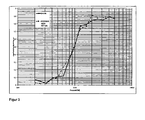
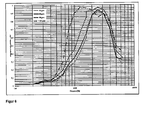
- FIG. 3 is the sound absorption coefficient (alpha cabin) of a spunbonded nonwoven according to the invention, which was prepared according to Embodiment 1, shown in comparison to Evolon 100®.
- the various materials are subjected to a test in the impedance tube based on DIN EN ISO 10354: 1.
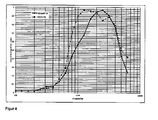
- the corresponding measured values are in FIG. 4 played.
- the sound absorption coefficient of a spunbonded nonwoven of PIE filaments (PET / PA) according to the invention according to embodiments 2 and 4 is compared with a spunbonded nonwoven fabric of SC filaments (PET / CoPET).
- the fiber dependence of the sound absorption coefficient is measured in the impedance tube according to DIN EN ISO 10345-1.
- the effect of the PIE fiber geometry which is advantageous in terms of an increased degree of sound absorption, is shown in direct comparison to a SC spunbonded nonwoven.
- the density of the two different binder fiber polymers is in the same range (-1.1 g / cm 3 ).
- Example 1 To determine the tensile properties of the base materials of Example 1 under elevated temperature variants are tested based on ASTM D5034 at a test temperature of 160 ° C to maximum tensile strength and maximum tensile elongation at break. The corresponding results are shown in Table 6.
- thermoformability In order to evaluate the deformation properties under heat (thermoformability), fixed specimens of the substrates are deformed in a simple test setup (OTI test) by means of a circular stamp heated to 160 ° C. (ball diameter 9 cm, absolute specimen size 24 cm diameter, freely deformable specimen size 20 cm ).
Landscapes
- Engineering & Computer Science (AREA)
- Textile Engineering (AREA)
- Nonwoven Fabrics (AREA)
Priority Applications (1)
| Application Number | Priority Date | Filing Date | Title |
|---|---|---|---|
| EP12006446.4A EP2573244B1 (fr) | 2011-09-20 | 2012-09-14 | Matériau d'absorption acoustique |
Applications Claiming Priority (2)
| Application Number | Priority Date | Filing Date | Title |
|---|---|---|---|
| EP11007649.4A EP2573243B1 (fr) | 2011-09-20 | 2011-09-20 | Non-tissé doté de filaments élémentaires contenant une matrice |
| EP12006446.4A EP2573244B1 (fr) | 2011-09-20 | 2012-09-14 | Matériau d'absorption acoustique |
Publications (2)
| Publication Number | Publication Date |
|---|---|
| EP2573244A1 true EP2573244A1 (fr) | 2013-03-27 |
| EP2573244B1 EP2573244B1 (fr) | 2015-02-18 |
Family
ID=46826217
Family Applications (3)
| Application Number | Title | Priority Date | Filing Date |
|---|---|---|---|
| EP11007649.4A Active EP2573243B1 (fr) | 2011-09-20 | 2011-09-20 | Non-tissé doté de filaments élémentaires contenant une matrice |
| EP12765995.1A Active EP2758580B1 (fr) | 2011-09-20 | 2012-09-11 | Matériau non-tissé doté de filaments élémentaires contenant une matrice |
| EP12006446.4A Active EP2573244B1 (fr) | 2011-09-20 | 2012-09-14 | Matériau d'absorption acoustique |
Family Applications Before (2)
| Application Number | Title | Priority Date | Filing Date |
|---|---|---|---|
| EP11007649.4A Active EP2573243B1 (fr) | 2011-09-20 | 2011-09-20 | Non-tissé doté de filaments élémentaires contenant une matrice |
| EP12765995.1A Active EP2758580B1 (fr) | 2011-09-20 | 2012-09-11 | Matériau non-tissé doté de filaments élémentaires contenant une matrice |
Country Status (2)
| Country | Link |
|---|---|
| EP (3) | EP2573243B1 (fr) |
| WO (1) | WO2013041193A1 (fr) |
Cited By (1)
| Publication number | Priority date | Publication date | Assignee | Title |
|---|---|---|---|---|
| US11541829B2 (en) | 2020-06-18 | 2023-01-03 | Freudenberg Performance Materials Lp | Acoustical baffle |
Families Citing this family (5)
| Publication number | Priority date | Publication date | Assignee | Title |
|---|---|---|---|---|
| DE102014110585A1 (de) * | 2014-07-28 | 2016-01-28 | Bundesdruckerei Gmbh | Datenblatt und Verfahren zu dessen Herstellung sowie ein Wert- und/oder Sicherheitsdokument |
| CN110462124B (zh) * | 2017-03-28 | 2023-01-31 | 曼·胡默尔有限公司 | 纺粘型无纺布材料、包括纺粘型无纺布材料的物件、过滤介质、过滤元件及其应用 |
| CN114622341A (zh) * | 2020-12-15 | 2022-06-14 | 浙江青昀新材料科技有限公司 | 一种聚乙烯无纺布及其应用 |
| WO2025080546A1 (fr) * | 2023-10-09 | 2025-04-17 | Ascend Performance Materials Operations Llc | Non-tissé hydrolié à construction stable et performance d'imbibition par capillarité |
| CN118065056B (zh) * | 2024-04-16 | 2024-09-06 | 江苏青昀新材料有限公司 | 一种耐屈挠的非织造无纺布及其制备方法 |
Citations (2)
| Publication number | Priority date | Publication date | Assignee | Title |
|---|---|---|---|---|
| DE10009281C1 (de) | 2000-02-28 | 2001-03-22 | Freudenberg Carl Fa | Schallabsorptionsmaterial |
| US20040071947A1 (en) * | 2002-10-12 | 2004-04-15 | Sung-Su Hwang | Fiber sheet with heat-treated surface layer |
Family Cites Families (8)
| Publication number | Priority date | Publication date | Assignee | Title |
|---|---|---|---|---|
| US4039711A (en) * | 1971-06-07 | 1977-08-02 | The Kendall Company | Non-woven fabrics |
| US20050039836A1 (en) * | 1999-09-03 | 2005-02-24 | Dugan Jeffrey S. | Multi-component fibers, fiber-containing materials made from multi-component fibers and methods of making the fiber-containing materials |
| US20030041953A1 (en) * | 2001-08-31 | 2003-03-06 | Bba Nonwovens Simpsonville, Inc. | Method of making a bonded nonwoven web |
| US7452832B2 (en) * | 2003-12-15 | 2008-11-18 | E.I. Du Pont De Nemors And Company | Full-surface bonded multiple component melt-spun nonwoven web |
| US7438777B2 (en) | 2005-04-01 | 2008-10-21 | North Carolina State University | Lightweight high-tensile, high-tear strength bicomponent nonwoven fabrics |
| CN101678255A (zh) * | 2007-05-31 | 2010-03-24 | 东丽株式会社 | 圆筒状袋式过滤器用无纺布、其制造方法及由其制成的圆筒状袋式过滤器 |
| DE102007049031A1 (de) * | 2007-10-11 | 2009-04-16 | Fiberweb Corovin Gmbh | Polypropylenmischung |
| BRPI0821434A2 (pt) * | 2007-12-28 | 2015-06-16 | 3M Innovative Properties Co | Mantas fibrosas não-tecidas compósitas e métodos de preparo e utilização das mesmas |
-
2011
- 2011-09-20 EP EP11007649.4A patent/EP2573243B1/fr active Active
-
2012
- 2012-09-11 WO PCT/EP2012/003804 patent/WO2013041193A1/fr not_active Ceased
- 2012-09-11 EP EP12765995.1A patent/EP2758580B1/fr active Active
- 2012-09-14 EP EP12006446.4A patent/EP2573244B1/fr active Active
Patent Citations (2)
| Publication number | Priority date | Publication date | Assignee | Title |
|---|---|---|---|---|
| DE10009281C1 (de) | 2000-02-28 | 2001-03-22 | Freudenberg Carl Fa | Schallabsorptionsmaterial |
| US20040071947A1 (en) * | 2002-10-12 | 2004-04-15 | Sung-Su Hwang | Fiber sheet with heat-treated surface layer |
Cited By (1)
| Publication number | Priority date | Publication date | Assignee | Title |
|---|---|---|---|---|
| US11541829B2 (en) | 2020-06-18 | 2023-01-03 | Freudenberg Performance Materials Lp | Acoustical baffle |
Also Published As
| Publication number | Publication date |
|---|---|
| EP2573244B1 (fr) | 2015-02-18 |
| EP2573243A1 (fr) | 2013-03-27 |
| EP2573243B1 (fr) | 2015-02-11 |
| EP2758580A1 (fr) | 2014-07-30 |
| WO2013041193A1 (fr) | 2013-03-28 |
| EP2758580B1 (fr) | 2016-11-02 |
Similar Documents
| Publication | Publication Date | Title |
|---|---|---|
| DE60001749T2 (de) | Verbundvlies mit binder | |
| EP0942057B2 (fr) | Ruban adhésif pour faisceau de cables | |
| DE60012330T2 (de) | Verbundvliesmaterial | |
| EP2573244B1 (fr) | Matériau d'absorption acoustique | |
| EP2115201B1 (fr) | Étoffe nappée légère, très résistante, composée de non-tissé, procédé de fabrication et utilisation | |
| EP1261766B1 (fr) | Materiau d'isolation phonique | |
| DE102005006234B4 (de) | Selbsttragende, Luftschall absorbierende Motorraumverkleidung für Kraftfahrzeuge | |
| DE102015009370A1 (de) | Aerogelvliesstoff | |
| DE10151411B4 (de) | Schichtstoff mit verbesserten Eigenschaften | |
| DE202010018588U1 (de) | Mehrschichtiges Vliesverbundmaterial mit elastischen Eigenschaften | |
| EP2376275A2 (fr) | Procédé pour produire des nappes de fibres, nappe de fibres et son utilisation | |
| EP3052688B1 (fr) | Structure plane présentant une stabilité thermique élevée | |
| EP2943352B1 (fr) | Système de revêtement | |
| EP0805752B1 (fr) | Systeme de materiau isolant composite plat et procede de production correspondant | |
| EP1927639B1 (fr) | Bande de collage technique de voile de carde | |
| DE60005527T2 (de) | Hydrodynamisch verfestigte trägerbahnen und deren verwendung | |
| DE29720598U1 (de) | Vliesstoff aus Naturfasern und Kunstfasern | |
| EP1707666A1 (fr) | Cuir synthetique, son procédé de fabrication et son utilisation | |
| DE102004030393A1 (de) | Verfahren zur Herstellung eines dreidimensional geformten Vliesstoffes, Vorrichtung zur Benutzung in dem Verfahren, danach erhaltener dreidimensional geformter Vliesstoff und seine Verwendung | |
| EP2183418B1 (fr) | Procédé de fabrication d'un produit plat résistant à la propagation de déchirement, produit plat résistant à la propagation de déchirement et utilisation | |
| DE19952432B4 (de) | Schichtstoff | |
| WO2004008059A1 (fr) | Textile de protection contre les effets balistiques | |
| DE19935408A1 (de) | Mehrlagenschichtstoff | |
| DE19955730C2 (de) | Hydrodynamisch verbundene Trägervliese und deren Verwendung | |
| WO2005021853A2 (fr) | Element support thermoformable |
Legal Events
| Date | Code | Title | Description |
|---|---|---|---|
| PUAI | Public reference made under article 153(3) epc to a published international application that has entered the european phase |
Free format text: ORIGINAL CODE: 0009012 |
|
| AK | Designated contracting states |
Kind code of ref document: A1 Designated state(s): AL AT BE BG CH CY CZ DE DK EE ES FI FR GB GR HR HU IE IS IT LI LT LU LV MC MK MT NL NO PL PT RO RS SE SI SK SM TR |
|
| AX | Request for extension of the european patent |
Extension state: BA ME |
|
| 17P | Request for examination filed |
Effective date: 20130926 |
|
| RBV | Designated contracting states (corrected) |
Designated state(s): AL AT BE BG CH CY CZ DE DK EE ES FI FR GB GR HR HU IE IS IT LI LT LU LV MC MK MT NL NO PL PT RO RS SE SI SK SM TR |
|
| 17Q | First examination report despatched |
Effective date: 20140103 |
|
| GRAP | Despatch of communication of intention to grant a patent |
Free format text: ORIGINAL CODE: EPIDOSNIGR1 |
|
| INTG | Intention to grant announced |
Effective date: 20140825 |
|
| GRAS | Grant fee paid |
Free format text: ORIGINAL CODE: EPIDOSNIGR3 |
|
| GRAA | (expected) grant |
Free format text: ORIGINAL CODE: 0009210 |
|
| AK | Designated contracting states |
Kind code of ref document: B1 Designated state(s): AL AT BE BG CH CY CZ DE DK EE ES FI FR GB GR HR HU IE IS IT LI LT LU LV MC MK MT NL NO PL PT RO RS SE SI SK SM TR |
|
| REG | Reference to a national code |
Ref country code: GB Ref legal event code: FG4D Free format text: NOT ENGLISH |
|
| REG | Reference to a national code |
Ref country code: CH Ref legal event code: EP |
|
| REG | Reference to a national code |
Ref country code: AT Ref legal event code: REF Ref document number: 710720 Country of ref document: AT Kind code of ref document: T Effective date: 20150315 |
|
| REG | Reference to a national code |
Ref country code: IE Ref legal event code: FG4D Free format text: LANGUAGE OF EP DOCUMENT: GERMAN |
|
| REG | Reference to a national code |
Ref country code: DE Ref legal event code: R096 Ref document number: 502012002273 Country of ref document: DE Effective date: 20150402 |
|
| REG | Reference to a national code |
Ref country code: NL Ref legal event code: T3 |
|
| REG | Reference to a national code |
Ref country code: LT Ref legal event code: MG4D |
|
| PG25 | Lapsed in a contracting state [announced via postgrant information from national office to epo] |
Ref country code: HR Free format text: LAPSE BECAUSE OF FAILURE TO SUBMIT A TRANSLATION OF THE DESCRIPTION OR TO PAY THE FEE WITHIN THE PRESCRIBED TIME-LIMIT Effective date: 20150218 Ref country code: SE Free format text: LAPSE BECAUSE OF FAILURE TO SUBMIT A TRANSLATION OF THE DESCRIPTION OR TO PAY THE FEE WITHIN THE PRESCRIBED TIME-LIMIT Effective date: 20150218 Ref country code: NO Free format text: LAPSE BECAUSE OF FAILURE TO SUBMIT A TRANSLATION OF THE DESCRIPTION OR TO PAY THE FEE WITHIN THE PRESCRIBED TIME-LIMIT Effective date: 20150518 Ref country code: FI Free format text: LAPSE BECAUSE OF FAILURE TO SUBMIT A TRANSLATION OF THE DESCRIPTION OR TO PAY THE FEE WITHIN THE PRESCRIBED TIME-LIMIT Effective date: 20150218 Ref country code: LT Free format text: LAPSE BECAUSE OF FAILURE TO SUBMIT A TRANSLATION OF THE DESCRIPTION OR TO PAY THE FEE WITHIN THE PRESCRIBED TIME-LIMIT Effective date: 20150218 Ref country code: ES Free format text: LAPSE BECAUSE OF FAILURE TO SUBMIT A TRANSLATION OF THE DESCRIPTION OR TO PAY THE FEE WITHIN THE PRESCRIBED TIME-LIMIT Effective date: 20150218 |
|
| PG25 | Lapsed in a contracting state [announced via postgrant information from national office to epo] |
Ref country code: IS Free format text: LAPSE BECAUSE OF FAILURE TO SUBMIT A TRANSLATION OF THE DESCRIPTION OR TO PAY THE FEE WITHIN THE PRESCRIBED TIME-LIMIT Effective date: 20150618 Ref country code: GR Free format text: LAPSE BECAUSE OF FAILURE TO SUBMIT A TRANSLATION OF THE DESCRIPTION OR TO PAY THE FEE WITHIN THE PRESCRIBED TIME-LIMIT Effective date: 20150519 Ref country code: RS Free format text: LAPSE BECAUSE OF FAILURE TO SUBMIT A TRANSLATION OF THE DESCRIPTION OR TO PAY THE FEE WITHIN THE PRESCRIBED TIME-LIMIT Effective date: 20150218 Ref country code: LV Free format text: LAPSE BECAUSE OF FAILURE TO SUBMIT A TRANSLATION OF THE DESCRIPTION OR TO PAY THE FEE WITHIN THE PRESCRIBED TIME-LIMIT Effective date: 20150218 |
|
| REG | Reference to a national code |
Ref country code: FR Ref legal event code: PLFP Year of fee payment: 4 |
|
| PG25 | Lapsed in a contracting state [announced via postgrant information from national office to epo] |
Ref country code: CZ Free format text: LAPSE BECAUSE OF FAILURE TO SUBMIT A TRANSLATION OF THE DESCRIPTION OR TO PAY THE FEE WITHIN THE PRESCRIBED TIME-LIMIT Effective date: 20150218 Ref country code: EE Free format text: LAPSE BECAUSE OF FAILURE TO SUBMIT A TRANSLATION OF THE DESCRIPTION OR TO PAY THE FEE WITHIN THE PRESCRIBED TIME-LIMIT Effective date: 20150218 Ref country code: DK Free format text: LAPSE BECAUSE OF FAILURE TO SUBMIT A TRANSLATION OF THE DESCRIPTION OR TO PAY THE FEE WITHIN THE PRESCRIBED TIME-LIMIT Effective date: 20150218 Ref country code: SK Free format text: LAPSE BECAUSE OF FAILURE TO SUBMIT A TRANSLATION OF THE DESCRIPTION OR TO PAY THE FEE WITHIN THE PRESCRIBED TIME-LIMIT Effective date: 20150218 Ref country code: RO Free format text: LAPSE BECAUSE OF FAILURE TO SUBMIT A TRANSLATION OF THE DESCRIPTION OR TO PAY THE FEE WITHIN THE PRESCRIBED TIME-LIMIT Effective date: 20150218 |
|
| REG | Reference to a national code |
Ref country code: DE Ref legal event code: R097 Ref document number: 502012002273 Country of ref document: DE |
|
| PG25 | Lapsed in a contracting state [announced via postgrant information from national office to epo] |
Ref country code: PL Free format text: LAPSE BECAUSE OF FAILURE TO SUBMIT A TRANSLATION OF THE DESCRIPTION OR TO PAY THE FEE WITHIN THE PRESCRIBED TIME-LIMIT Effective date: 20150218 |
|
| PLBE | No opposition filed within time limit |
Free format text: ORIGINAL CODE: 0009261 |
|
| STAA | Information on the status of an ep patent application or granted ep patent |
Free format text: STATUS: NO OPPOSITION FILED WITHIN TIME LIMIT |
|
| PG25 | Lapsed in a contracting state [announced via postgrant information from national office to epo] |
Ref country code: IT Free format text: LAPSE BECAUSE OF FAILURE TO SUBMIT A TRANSLATION OF THE DESCRIPTION OR TO PAY THE FEE WITHIN THE PRESCRIBED TIME-LIMIT Effective date: 20150218 |
|
| 26N | No opposition filed |
Effective date: 20151119 |
|
| PG25 | Lapsed in a contracting state [announced via postgrant information from national office to epo] |
Ref country code: SI Free format text: LAPSE BECAUSE OF FAILURE TO SUBMIT A TRANSLATION OF THE DESCRIPTION OR TO PAY THE FEE WITHIN THE PRESCRIBED TIME-LIMIT Effective date: 20150218 |
|
| PG25 | Lapsed in a contracting state [announced via postgrant information from national office to epo] |
Ref country code: MC Free format text: LAPSE BECAUSE OF FAILURE TO SUBMIT A TRANSLATION OF THE DESCRIPTION OR TO PAY THE FEE WITHIN THE PRESCRIBED TIME-LIMIT Effective date: 20150218 Ref country code: LU Free format text: LAPSE BECAUSE OF FAILURE TO SUBMIT A TRANSLATION OF THE DESCRIPTION OR TO PAY THE FEE WITHIN THE PRESCRIBED TIME-LIMIT Effective date: 20150914 |
|
| REG | Reference to a national code |
Ref country code: CH Ref legal event code: PL |
|
| REG | Reference to a national code |
Ref country code: IE Ref legal event code: MM4A |
|
| PG25 | Lapsed in a contracting state [announced via postgrant information from national office to epo] |
Ref country code: IE Free format text: LAPSE BECAUSE OF NON-PAYMENT OF DUE FEES Effective date: 20150914 Ref country code: LI Free format text: LAPSE BECAUSE OF NON-PAYMENT OF DUE FEES Effective date: 20150930 Ref country code: CH Free format text: LAPSE BECAUSE OF NON-PAYMENT OF DUE FEES Effective date: 20150930 |
|
| REG | Reference to a national code |
Ref country code: FR Ref legal event code: PLFP Year of fee payment: 5 |
|
| PG25 | Lapsed in a contracting state [announced via postgrant information from national office to epo] |
Ref country code: MT Free format text: LAPSE BECAUSE OF FAILURE TO SUBMIT A TRANSLATION OF THE DESCRIPTION OR TO PAY THE FEE WITHIN THE PRESCRIBED TIME-LIMIT Effective date: 20150218 |
|
| PG25 | Lapsed in a contracting state [announced via postgrant information from national office to epo] |
Ref country code: BG Free format text: LAPSE BECAUSE OF FAILURE TO SUBMIT A TRANSLATION OF THE DESCRIPTION OR TO PAY THE FEE WITHIN THE PRESCRIBED TIME-LIMIT Effective date: 20150218 Ref country code: SM Free format text: LAPSE BECAUSE OF FAILURE TO SUBMIT A TRANSLATION OF THE DESCRIPTION OR TO PAY THE FEE WITHIN THE PRESCRIBED TIME-LIMIT Effective date: 20150218 Ref country code: HU Free format text: LAPSE BECAUSE OF FAILURE TO SUBMIT A TRANSLATION OF THE DESCRIPTION OR TO PAY THE FEE WITHIN THE PRESCRIBED TIME-LIMIT; INVALID AB INITIO Effective date: 20120914 |
|
| PG25 | Lapsed in a contracting state [announced via postgrant information from national office to epo] |
Ref country code: CY Free format text: LAPSE BECAUSE OF FAILURE TO SUBMIT A TRANSLATION OF THE DESCRIPTION OR TO PAY THE FEE WITHIN THE PRESCRIBED TIME-LIMIT Effective date: 20150218 |
|
| PG25 | Lapsed in a contracting state [announced via postgrant information from national office to epo] |
Ref country code: BE Free format text: LAPSE BECAUSE OF NON-PAYMENT OF DUE FEES Effective date: 20150930 |
|
| REG | Reference to a national code |
Ref country code: FR Ref legal event code: PLFP Year of fee payment: 6 |
|
| PG25 | Lapsed in a contracting state [announced via postgrant information from national office to epo] |
Ref country code: MK Free format text: LAPSE BECAUSE OF FAILURE TO SUBMIT A TRANSLATION OF THE DESCRIPTION OR TO PAY THE FEE WITHIN THE PRESCRIBED TIME-LIMIT Effective date: 20150218 Ref country code: PT Free format text: LAPSE BECAUSE OF FAILURE TO SUBMIT A TRANSLATION OF THE DESCRIPTION OR TO PAY THE FEE WITHIN THE PRESCRIBED TIME-LIMIT Effective date: 20150218 |
|
| REG | Reference to a national code |
Ref country code: FR Ref legal event code: PLFP Year of fee payment: 7 |
|
| PG25 | Lapsed in a contracting state [announced via postgrant information from national office to epo] |
Ref country code: AL Free format text: LAPSE BECAUSE OF FAILURE TO SUBMIT A TRANSLATION OF THE DESCRIPTION OR TO PAY THE FEE WITHIN THE PRESCRIBED TIME-LIMIT Effective date: 20150218 |
|
| REG | Reference to a national code |
Ref country code: AT Ref legal event code: MM01 Ref document number: 710720 Country of ref document: AT Kind code of ref document: T Effective date: 20170914 |
|
| PG25 | Lapsed in a contracting state [announced via postgrant information from national office to epo] |
Ref country code: AT Free format text: LAPSE BECAUSE OF NON-PAYMENT OF DUE FEES Effective date: 20170914 |
|
| PGFP | Annual fee paid to national office [announced via postgrant information from national office to epo] |
Ref country code: DE Payment date: 20250926 Year of fee payment: 14 |
|
| PGFP | Annual fee paid to national office [announced via postgrant information from national office to epo] |
Ref country code: NL Payment date: 20250925 Year of fee payment: 14 Ref country code: TR Payment date: 20250827 Year of fee payment: 14 |
|
| PGFP | Annual fee paid to national office [announced via postgrant information from national office to epo] |
Ref country code: GB Payment date: 20250923 Year of fee payment: 14 |
|
| PGFP | Annual fee paid to national office [announced via postgrant information from national office to epo] |
Ref country code: FR Payment date: 20250925 Year of fee payment: 14 |