EP2573409A1 - Dispositif de connexion entre deux ou plusieurs composants de meuble - Google Patents
Dispositif de connexion entre deux ou plusieurs composants de meuble Download PDFInfo
- Publication number
- EP2573409A1 EP2573409A1 EP12185734A EP12185734A EP2573409A1 EP 2573409 A1 EP2573409 A1 EP 2573409A1 EP 12185734 A EP12185734 A EP 12185734A EP 12185734 A EP12185734 A EP 12185734A EP 2573409 A1 EP2573409 A1 EP 2573409A1
- Authority
- EP
- European Patent Office
- Prior art keywords
- bar
- tie rod
- connection device
- type tie
- shaped head
- Prior art date
- Legal status (The legal status is an assumption and is not a legal conclusion. Google has not performed a legal analysis and makes no representation as to the accuracy of the status listed.)
- Withdrawn
Links
- 239000007787 solid Substances 0.000 claims abstract description 28
- 230000008878 coupling Effects 0.000 claims abstract description 8
- 238000010168 coupling process Methods 0.000 claims abstract description 8
- 238000005859 coupling reaction Methods 0.000 claims abstract description 8
- 230000009471 action Effects 0.000 claims abstract description 7
- 238000004873 anchoring Methods 0.000 claims description 12
- 238000003780 insertion Methods 0.000 claims description 4
- 230000037431 insertion Effects 0.000 claims description 4
- 230000000630 rising effect Effects 0.000 claims description 3
- 230000013011 mating Effects 0.000 claims description 2
- 239000000463 material Substances 0.000 description 7
- 238000000034 method Methods 0.000 description 3
- 239000002184 metal Substances 0.000 description 2
- 239000000203 mixture Substances 0.000 description 2
- 238000007792 addition Methods 0.000 description 1
- 238000005352 clarification Methods 0.000 description 1
- 230000000295 complement effect Effects 0.000 description 1
- 230000007547 defect Effects 0.000 description 1
- 230000001419 dependent effect Effects 0.000 description 1
- 238000012986 modification Methods 0.000 description 1
- 230000004048 modification Effects 0.000 description 1
- 230000000750 progressive effect Effects 0.000 description 1
- 230000000717 retained effect Effects 0.000 description 1
Images
Classifications
-
- F—MECHANICAL ENGINEERING; LIGHTING; HEATING; WEAPONS; BLASTING
- F16—ENGINEERING ELEMENTS AND UNITS; GENERAL MEASURES FOR PRODUCING AND MAINTAINING EFFECTIVE FUNCTIONING OF MACHINES OR INSTALLATIONS; THERMAL INSULATION IN GENERAL
- F16B—DEVICES FOR FASTENING OR SECURING CONSTRUCTIONAL ELEMENTS OR MACHINE PARTS TOGETHER, e.g. NAILS, BOLTS, CIRCLIPS, CLAMPS, CLIPS OR WEDGES; JOINTS OR JOINTING
- F16B12/00—Jointing of furniture or the like, e.g. hidden from exterior
- F16B12/10—Jointing of furniture or the like, e.g. hidden from exterior using pegs, bolts, tenons, clamps, clips, or the like
- F16B12/12—Jointing of furniture or the like, e.g. hidden from exterior using pegs, bolts, tenons, clamps, clips, or the like for non-metal furniture parts, e.g. made of wood, of plastics
- F16B12/20—Jointing of furniture or the like, e.g. hidden from exterior using pegs, bolts, tenons, clamps, clips, or the like for non-metal furniture parts, e.g. made of wood, of plastics using clamps, clips, wedges, sliding bolts, or the like
- F16B12/2009—Jointing of furniture or the like, e.g. hidden from exterior using pegs, bolts, tenons, clamps, clips, or the like for non-metal furniture parts, e.g. made of wood, of plastics using clamps, clips, wedges, sliding bolts, or the like actuated by rotary motion
- F16B12/2027—Jointing of furniture or the like, e.g. hidden from exterior using pegs, bolts, tenons, clamps, clips, or the like for non-metal furniture parts, e.g. made of wood, of plastics using clamps, clips, wedges, sliding bolts, or the like actuated by rotary motion with rotating excenters or wedges
- F16B12/2036—Jointing of furniture or the like, e.g. hidden from exterior using pegs, bolts, tenons, clamps, clips, or the like for non-metal furniture parts, e.g. made of wood, of plastics using clamps, clips, wedges, sliding bolts, or the like actuated by rotary motion with rotating excenters or wedges with rotating excenters or wedges acting on a head of a pin or screw
Definitions
- the present invention concerns a connection device between two or more furniture components and particularly, but not only, between at least two of the following elements: a leg, a headrest, a footrest, one or more lateral boards of a bed.
- attachment means consisting of tie rods and eccentrics.
- the attachment means allow to connect an upright, called leg, and/or one or more transverse elements, such as for example a headrest, a footrest, and lateral boards.
- the upright is provided with one or more seatings suitable to house a metal bushing, normally threaded on the outside and inside, into which the threaded end of a tie rod is screwed.
- Each transverse element has at least one hole suitable to contain the remaining part of the tie rod and at least one cavity, normally orthogonal to said hole, which functions as a seating for the eccentric and is directly connected to the hole.
- the coupling of the eccentric and the shaped head of the tie rod guarantees, through the rotation of the eccentric, that the two elements of the piece of furniture are brought together and thus attached.
- the attachment can be reinforced by using tie rods suitably worked on their cylindrical surface, or by putting stud blocks adjacent to the tie rods.
- Document US-A-5,823,700 describes a releasable rapid connection device of a known type for connecting the front part of a drawer of a furnishing element to the body of the drawer.
- the connection device includes a single bar with a first connection portion by means of a rotary fastener and a second T-shaped portion for connecting with a threaded bushing.
- This known solution has the same disadvantages as described above: that is, in the case of chip material, MDF or expanded material, or a mixture of chip and expanded, when there is a strong traction the bushing may not keep its position and may therefore come out of the housing seating.
- the known connection device includes a first and a second connection bar, inserted in housing holes made in the two parts to be connected.
- the first bar protrudes with its own connection portion that has a threaded hole to cooperate with a threaded connection portion of the second bar, which is therefore screwed to the first bar.
- the first bar also has another hole, at the end opposite the connection portion with threaded hole, to cooperate with a transverse clamping pin that is screwed.
- the second bar also has a threaded hole, at the opposite end of the threaded connection portion, for insertion by means of screwing a screw or threaded pin.
- connection device It can be complex and costly to produce said connection device, as it needs a large number of operations for making not only the threaded hole for the reciprocal connection of the two bars, but also the connection holes at the ends of the two bars.
- this solution is not reliable because using a threaded screw for at least one of the two bars in practice does not put the corresponding bar under traction and therefore does not allow an adequate traction of the connection device. It therefore does not put under a correct drawing action the parts of the piece of furniture that are connected, because the screw functions solely as a transverse constraint to prevent the bar from coming dis-inserted. It is also believed that this known solution is not suitable to connect three components of a furnishing element, such as an upright and two transverse elements.
- Purpose of the present invention is to obtain a connection device that allows the attachment and traction of two or more elements of a piece of furniture, which is simple and economical, at the same time guaranteeing solidity and stability over time, irrespective of the type of material.
- the Applicant has devised, tested and embodied the present invention to overcome the shortcomings of the state of the art and to obtain these and other purposes and advantages.
- connection device which overcomes the shortcomings of the state of the art and eliminates the defects therein, is suitable to connect two or more components of a piece of furniture or furnishing element, such as for example an upright and/or one or more transverse elements of a bed.
- One of the components to be assembled functions as a bearing component, to which the other components are coupled and made solid by means of a drawing action.
- connection device comprises two elements, a first bar-type tie rod and a second bar-type tie rod.
- Both the bar-type tie rods have an attachment or tensioning member at one end, and substantially on the opposite side to it, reciprocal connection means.
- the first tie rod comprises a threaded transverse hole, the axis of which can be orthogonal, or not, to the longitudinal axis of the tie rod, while the second tie rod has a threaded end, suitable to be screwed into the above-mentioned threaded transverse hole.
- At least one of either said first bar-type tie rod and said second bar-type tie rod comprises at one end a cooperation member which has a shaped head suitable to achieve a fixed-joint coupling with a mating drawing mean that includes an eccentric rotating fastener.
- the shaped head is made solid. In other words, in variant embodiments the shaped head does not have blind or through connection holes. In some forms of embodiment, the first bar-type tie rod and the second bar-type tie rod do not have other connection holes apart from the threaded transverse hole cited above and provided for screwing the second bar-type tie rod into the first bar-type tie rod.
- the present invention overcomes the shortcomings of the complexity and cost of making the known connection devices, since it only needs a single threaded transverse hole for the reciprocal connection of the two bar-type tie rods. Moreover, the present invention is also easy and quick to instal and clamp, due to the specific configuration of the shaped head, which can obtain the fixed-joint constraint and traction of the second tie rod and possibly the first tie rod to the corresponding component of the piece of furniture, by means of the eccentric rotating fastener, which is totally intuitive to insert and clamp and does not need laborious alignment operations as required in the state of the art. Furthermore, since it can put the bar-type tie rods under traction, the present invention allows to put the components of the piece of furniture which are connected correctly under traction, thus giving a more reliable and stronger constraint.
- the shaped head includes a solid shaft with an axial development which projects from a cylindrical body.
- the present invention comprises at least an element that protrudes transversely from the solid shaft, configured to obtain a fixed joint and receive an action of traction exerted by the eccentric rotating fastener parallel to a longitudinal axis of the cylindrical body.
- said at least one transversely protruding element comprises at least a discoidal anchoring crest with a radial development orthogonal to the solid shaft to cooperate in a fixed joint and in traction with the eccentric rotating fastener.
- the present invention comprises a plurality of said transversely protruding elements.
- the plurality of transversely protruding elements comprises a plurality of discoidal anchoring crests protruding from the solid shaft and disposed at a defined pitch with respect to each other along the longitudinal axis of the solid shaft.
- the first and the second tie rod have lengths coordinated with the sizes of the element into which they are inserted.
- one of the two tie rods does not have the cooperation members with tensioning means and performs the function of a contrasting element for the tie rod associated with the transverse element of the piece of furniture.
- connection device has a bayonet-type attachment system between the first and second tie rod.
- connection device it is possible to assemble mechanically the elements that make up a piece of furniture, advantageously a bed, obtaining the following advantages: better division of the forces acting on the material that makes up the piece of furniture, easier assembly and dis-assembly, stability over time, solidity and versatility in the field of application.
- the present invention also concerns a kit for connecting two or more furniture components of which one is a bearing component and at least one is coupled and made solid with the bearing component, comprising a connection device as described above and at least a drawing mean that includes an eccentric rotating fastener.
- the eccentric rotating fastener is formed by a shaped cylinder that includes a window for inserting the shaped head, a curvilinear plane shaped like a rising and falling ramp which develops partly around the axis of the eccentric rotating fastener and defines a shaped housing and an abutment wall.
- the present invention also concerns a set of two or more furniture components of which one is a bearing component and at least one can be coupled and made solid with the bearing component, by means of a connection device or a connection kit as described above.
- the present invention also concerns a structure for a bed, and a bed including the structure, which comprises a set of two or more components as in the claim.
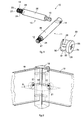
- a connection device 10 comprises two elements, in this case made of metal and with a substantially cylindrical geometry, configured as first and second bar-type tie rod 11, 12, each including a cylindrical body 26.
- the first bar-type tie rod 11 and/or the second bar-type tie rod 12 in this case have a shaped head 13 at one end, suitable to be connected to suitable tensioning means, such as for example eccentrics, which include an eccentric rotating fastener 23 shown for example in figs. 1 and 6 .
- both the first bar-type tie rod 11 and the second bar-type tie rod 12 have said shaped head 13 at one end.
- only one of either the first bar-type tie rod 11 or the second bar-type tie rod 12 has said shaped head 13 at one end.
- the shaped head 13 is made solid, that is, it has no attachment holes, and is shaped to define a fixed-joint coupling with the eccentric rotating fastener 23.
- the shaped head 13 includes a solid shaft 24 with an axial development which projects from the cylindrical body 26 of the corresponding first bar-type tie rod 11 or the second bar-type tie rod 12.
- the solid shaft 24 has at least one, advantageously a plurality of transversely protruding elements configured to achieve a fixed joint and receive an action of traction exerted by said eccentric rotating fastener 23 parallel to a longitudinal axis of said cylindrical body 26 and hence of the solid shaft 24.
- the transversely protruding elements comprise discoidal anchoring crests 27 with a radial development orthogonal to the solid shaft 24, associated to corresponding annular gripping seatings 25 provided between them, in order to cooperate with the eccentric rotating fastener 23.
- the transversely protruding elements can include other elements of a polygonal shape, or shaped teeth or similar or equivalent elements.
- the presence of several discoidal anchoring crests 27 can be advantageous since it can allow a modulation of the clamping force by means of the eccentric rotating fastener 23.
- the cited pitch between the discoidal anchoring crests 27 is configured as a function of the desired drawing action, progressively selectable, which the eccentric rotating fastener 23 has to exert on the shaped head 13.
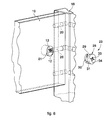
- the eccentric rotating fastener 23 is formed by a shaped cylinder 28 that includes a window 29 for the insertion of the solid shaft 24 and one or more discoidal anchoring crests 27 of the shaped head 13, a curvilinear plane shaped like a rising and falling ramp 30 which develops following a curved path partly around the axis of the eccentric rotating fastener 23 and defines a shaped housing 31 and an abutment wall 32.
- the eccentric rotating fastener 23 may be made to rotate around its axis thanks to a slot 33 for a screwdriver, for example a Philips screwdriver, made on the head 34 of the eccentric rotating fastener 23.
- the rotation of the eccentric rotating fastener 23 takes the solid shaft 24 itself, and one of the discoidal anchoring crests 27, to slide along the ramp-shaped curvilinear plane 30, until they cooperate, in correspondence with the falling part of the ramp-shaped curvilinear plane 30, with the abutment wall 32, causing the shaped head 13 to be retained and obtaining the cited fixed-joint coupling of the shaped head 13 and the eccentric rotating fastener 23.
- the first bar-type tie rod 11 in this case has a through threaded transverse hole 14, while the second bar-type tie rod 12 has a threaded end 15, suitable to be screwed into the threaded transverse hole 14.
- the first bar-type tie rod 11 does not have other holes for attachment components, except for the cited threaded transverse hole 14 for screwing in the second bar-type tie rod 12, while the second bar-type tie rod 12 does not have any holes for attachment components.
- connection device 10 is used in this case to connect an upright 18 and two transverse boards 19, according to the method described hereafter.
- a housing hole 20 is made on each of two adjacent longitudinal faces of the upright 18.
- the housing holes 20 are communicating, that is, their axes intersect in correspondence with an intersection zone in which, during use, the second bar-type tie rod 12 is screwed into the first bar-type tie rod 11.
- the first bar-type tie rod 11 is inserted into one of the above-mentioned housing holes 20 and the second bar-type tie rod 12 is inserted into the homologous housing hole 20.
- the second bar-type tie rod 12 is connected to the first bar-type tie rod 11 by screwing the threaded end 15 onto the complementary threaded transverse hole 14.
- first bar-type tie rod 11 and the second bar-type tie rod 12 lie with their respective transverse axes, in this case orthogonal, disposed on a common lying plane, indicated by the letter A in fig. 2 .
- each transverse board 19 has a cavity 21 suitable to contain the shaped head 13 of the first bar-type tie rod 11 or the second bar-type tie rod 12.
- the cavity 21 in this case functions as a seating for the eccentric rotating fastener 23, shown in figs. 1 and 6 .
- connection device 10 and the assembly method as described heretofore, without departing from the field and scope of the present invention.
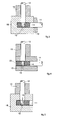
- connection device 10 two transverse boards 19 can be connected together, without using the upright 18 ( fig. 4 ).
- an aperture 22 may or may not be provided, made in one of the transverse boards 19, for the insertion of the first bar-type tie rod 11, which may possibly be closed later by a stopper or similar covering member.
- the modified tie rod without the shaped head 13, functions as a contrasting element ( fig. 5 ).
- the threaded end 15 of the second bar-type tie rod 12 is sized so that, when it is screwed into the threaded transverse hole 14, it may not protrude from the lateral surface of the first bar-type tie rod 11, remaining flush with the latter.
- the end of the first bar-type tie rod 11 which has the threaded transverse hole 14 is sized so that, when the first bar-type tie rod 11 is connected to the second bar-type tie rod 12, it may not protrude from the lateral surface of the second bar-type tie rod 12, remaining flush with the latter.
- connection device 10 has been described with reference to a specific example, a person of skill in the art shall certainly be able to achieve many other equivalent forms of connection device 10, having the characteristics as set forth in the claims and hence all coming within the field of protection defined thereby.
Landscapes
- Engineering & Computer Science (AREA)
- General Engineering & Computer Science (AREA)
- Mechanical Engineering (AREA)
- Combinations Of Kitchen Furniture (AREA)
- Furniture Connections (AREA)
Applications Claiming Priority (1)
| Application Number | Priority Date | Filing Date | Title |
|---|---|---|---|
| IT000146A ITUD20110146A1 (it) | 2011-09-22 | 2011-09-22 | Dispositivo di collegamento fra due o piu' componenti di mobili |
Publications (1)
| Publication Number | Publication Date |
|---|---|
| EP2573409A1 true EP2573409A1 (fr) | 2013-03-27 |
Family
ID=44908031
Family Applications (1)
| Application Number | Title | Priority Date | Filing Date |
|---|---|---|---|
| EP12185734A Withdrawn EP2573409A1 (fr) | 2011-09-22 | 2012-09-24 | Dispositif de connexion entre deux ou plusieurs composants de meuble |
Country Status (2)
| Country | Link |
|---|---|
| EP (1) | EP2573409A1 (fr) |
| IT (1) | ITUD20110146A1 (fr) |
Citations (6)
| Publication number | Priority date | Publication date | Assignee | Title |
|---|---|---|---|---|
| US3884002A (en) * | 1973-03-15 | 1975-05-20 | American Store Equip | Partition system |
| DE2812922A1 (de) * | 1977-11-03 | 1979-05-10 | Niko Prof Dipl Ing Kralj | Montage-randverbindung der platten, insbesondere fuer zusammensetzbare moebel |
| WO1980002866A1 (fr) | 1979-06-20 | 1980-12-24 | Stockum Design Ab | Liaison entre deux elements |
| DE3346067A1 (de) * | 1983-08-25 | 1985-03-14 | Häfele KG, 7270 Nagold | Eckverbinder fuer platten, insbesondere moebelplatten |
| US5823700A (en) | 1996-09-18 | 1998-10-20 | Bush Industries, Inc. | Drawer front fastener |
| DE20000173U1 (de) * | 2000-01-07 | 2001-05-10 | Paul Henke GmbH & Co KG, 32584 Löhne | Verbinder für Wandelemente von Möbeln |
-
2011
- 2011-09-22 IT IT000146A patent/ITUD20110146A1/it unknown
-
2012
- 2012-09-24 EP EP12185734A patent/EP2573409A1/fr not_active Withdrawn
Patent Citations (6)
| Publication number | Priority date | Publication date | Assignee | Title |
|---|---|---|---|---|
| US3884002A (en) * | 1973-03-15 | 1975-05-20 | American Store Equip | Partition system |
| DE2812922A1 (de) * | 1977-11-03 | 1979-05-10 | Niko Prof Dipl Ing Kralj | Montage-randverbindung der platten, insbesondere fuer zusammensetzbare moebel |
| WO1980002866A1 (fr) | 1979-06-20 | 1980-12-24 | Stockum Design Ab | Liaison entre deux elements |
| DE3346067A1 (de) * | 1983-08-25 | 1985-03-14 | Häfele KG, 7270 Nagold | Eckverbinder fuer platten, insbesondere moebelplatten |
| US5823700A (en) | 1996-09-18 | 1998-10-20 | Bush Industries, Inc. | Drawer front fastener |
| DE20000173U1 (de) * | 2000-01-07 | 2001-05-10 | Paul Henke GmbH & Co KG, 32584 Löhne | Verbinder für Wandelemente von Möbeln |
Also Published As
| Publication number | Publication date |
|---|---|
| ITUD20110146A1 (it) | 2013-03-23 |
Similar Documents
| Publication | Publication Date | Title |
|---|---|---|
| EP2916685B1 (fr) | Dispositif de fixation, système de fixation et ensemble meuble | |
| DE2625182C3 (de) | Beschlag zum losbaren Verbinden von zwei Bauteilen, insbesondere plattenförmigen Bauteilen fur Möbel | |
| RU2738755C2 (ru) | Усовершенствованное приспособление для соединения деталей мебели и мебельных аксессуаров | |
| DE102007058662A1 (de) | Steckverbindungssystem mit einem Steckteil und einem Aufnahmeteil | |
| US20020153339A1 (en) | Collapsible framework, such as a display stand, and an articulation joint for such framework | |
| WO2017140399A1 (fr) | Moyen de liaison et procédé pour relier deux éléments | |
| EP1287763A1 (fr) | Système d'assemblage pour les structures modulaires des meubles | |
| DK2946448T3 (en) | STRUCTURE FOR THE CABINET | |
| DE202014103040U1 (de) | Langloch-Verbindersystem | |
| EP2573409A1 (fr) | Dispositif de connexion entre deux ou plusieurs composants de meuble | |
| DE19528362A1 (de) | Stangenkupplung, insbesondere Eckverbindungskupplung für Hohlprofilstangen | |
| EP2505741A1 (fr) | Joint pour l'installation de tubes d'échafaudage et échafaudage comprenant ledit joint | |
| KR101525762B1 (ko) | 시공성과 안전성을 보강한 철근용 커플링 및 철근 커플링 결합구조와 결합방법 | |
| KR20170130411A (ko) | 공간 구조체 | |
| US6926459B1 (en) | Tubing connector | |
| DE102016110140B4 (de) | Möbelbeschlag und Verfahren zur Montage und Demontage von Möbelteilen mit einem Möbelbeschlag | |
| WO2018020276A1 (fr) | Dispositif de fixation pour structures démontables et similaires | |
| CN204985198U (zh) | 锁扣连接组件和被锁连构件 | |
| EP1876360A3 (fr) | Système de fixation destiné à raccorder des parties de meuble | |
| KR20170105872A (ko) | 십자형 철근 연결구 | |
| EP3228217B1 (fr) | Élément structurel | |
| EP3615816B1 (fr) | Dispositif d'assemblage d'éléments structurels | |
| KR20210153350A (ko) | 파이프 연결구 | |
| DE102005043765A1 (de) | Gehrungsverbindersystem | |
| DE19532456C2 (de) | Verbinder für Holzteile |
Legal Events
| Date | Code | Title | Description |
|---|---|---|---|
| PUAI | Public reference made under article 153(3) epc to a published international application that has entered the european phase |
Free format text: ORIGINAL CODE: 0009012 |
|
| AK | Designated contracting states |
Kind code of ref document: A1 Designated state(s): AL AT BE BG CH CY CZ DE DK EE ES FI FR GB GR HR HU IE IS IT LI LT LU LV MC MK MT NL NO PL PT RO RS SE SI SK SM TR |
|
| AX | Request for extension of the european patent |
Extension state: BA ME |
|
| STAA | Information on the status of an ep patent application or granted ep patent |
Free format text: STATUS: THE APPLICATION IS DEEMED TO BE WITHDRAWN |
|
| 18D | Application deemed to be withdrawn |
Effective date: 20130928 |