EP2573696A2 - Appareil et procédé d'assistance utilisateur afin de maintenir une posture correcte - Google Patents
Appareil et procédé d'assistance utilisateur afin de maintenir une posture correcte Download PDFInfo
- Publication number
- EP2573696A2 EP2573696A2 EP20120184924 EP12184924A EP2573696A2 EP 2573696 A2 EP2573696 A2 EP 2573696A2 EP 20120184924 EP20120184924 EP 20120184924 EP 12184924 A EP12184924 A EP 12184924A EP 2573696 A2 EP2573696 A2 EP 2573696A2
- Authority
- EP
- European Patent Office
- Prior art keywords
- user
- portable terminal
- state
- normal range
- cervical spine
- Prior art date
- Legal status (The legal status is an assumption and is not a legal conclusion. Google has not performed a legal analysis and makes no representation as to the accuracy of the status listed.)
- Granted
Links
Images



Classifications
-
- H—ELECTRICITY
- H04—ELECTRIC COMMUNICATION TECHNIQUE
- H04B—TRANSMISSION
- H04B1/00—Details of transmission systems, not covered by a single one of groups H04B3/00 - H04B13/00; Details of transmission systems not characterised by the medium used for transmission
- H04B1/38—Transceivers, i.e. devices in which transmitter and receiver form a structural unit and in which at least one part is used for functions of transmitting and receiving
- H04B1/40—Circuits
-
- A—HUMAN NECESSITIES
- A61—MEDICAL OR VETERINARY SCIENCE; HYGIENE
- A61B—DIAGNOSIS; SURGERY; IDENTIFICATION
- A61B5/00—Measuring for diagnostic purposes; Identification of persons
- A61B5/103—Measuring devices for testing the shape, pattern, colour, size or movement of the body or parts thereof, for diagnostic purposes
- A61B5/107—Measuring physical dimensions, e.g. size of the entire body or parts thereof
- A61B5/1071—Measuring physical dimensions, e.g. size of the entire body or parts thereof measuring angles, e.g. using goniometers
-
- G—PHYSICS
- G06—COMPUTING OR CALCULATING; COUNTING
- G06T—IMAGE DATA PROCESSING OR GENERATION, IN GENERAL
- G06T7/00—Image analysis
-
- G—PHYSICS
- G16—INFORMATION AND COMMUNICATION TECHNOLOGY [ICT] SPECIALLY ADAPTED FOR SPECIFIC APPLICATION FIELDS
- G16H—HEALTHCARE INFORMATICS, i.e. INFORMATION AND COMMUNICATION TECHNOLOGY [ICT] SPECIALLY ADAPTED FOR THE HANDLING OR PROCESSING OF MEDICAL OR HEALTHCARE DATA
- G16H50/00—ICT specially adapted for medical diagnosis, medical simulation or medical data mining; ICT specially adapted for detecting, monitoring or modelling epidemics or pandemics
- G16H50/30—ICT specially adapted for medical diagnosis, medical simulation or medical data mining; ICT specially adapted for detecting, monitoring or modelling epidemics or pandemics for calculating health indices; for individual health risk assessment
-
- G—PHYSICS
- G16—INFORMATION AND COMMUNICATION TECHNOLOGY [ICT] SPECIALLY ADAPTED FOR SPECIFIC APPLICATION FIELDS
- G16Z—INFORMATION AND COMMUNICATION TECHNOLOGY [ICT] SPECIALLY ADAPTED FOR SPECIFIC APPLICATION FIELDS, NOT OTHERWISE PROVIDED FOR
- G16Z99/00—Subject matter not provided for in other main groups of this subclass
Definitions
- the following description relates to an apparatus and a method for assisting user to maintain correct posture.
- An increasing number of users are experiencing a variety of contents through a portable terminal including, for example, a smartphone, a tablet PC, or the like.
- the contents may include digital media broadcasting, games, movies etc.
- younger users may select to use their smartphone or a tablet PC while lowering their head and placing the portable terminal close to their waist or on their knees while traveling, for example, on the bus or subway.
- the user's cervical spine may be strained.
- a cervical spine normally has a C-shaped curve, and in response to a person viewing a screen while lowering or craning his or her neck for prolonged period, the user may be highly likely to have a forward head posture. Due to the prolonged period of having a forward head posture, the user may develop a straight cervical spine.
- a straightened cervical spine may reduce the ability of the neck to absorb an impact. Thus, an increase in the occurrence of a cervical disc may be likely.
- a Korean spinal pain clinic report in an analysis on the number of cervical disc patients in October 2009, when smartphones were first released in Korea, and April 2010, around which the smartphones were considered to be widely used, the analysis indicates that the number of cervical disc patients under thirty increased from 38 to 149, which is a 390 percent increase.
- the number of patients in the 41-49 age group which was 69 in October 2009, increased to 129 in April 2010.
- a user of the smartphone may be subject to dry eyes (xerophthalmia). Dry eyes may be caused by watching a screen too closely.
- the smartphone user may need to reduce usage time of the smartphone, and, during use of the smartphone, keep the smartphone at eye level.
- the user may need to regularly stretch or intentionally blink their eyes frequently.
- reducing the usage time of the smartphone/tablet PC in light of the advanced mobility and a variety of functions and contents served by the device may not be practical. Many users may not recognize such risks, and even when the users do the risks, many users may not pay enough attention to maintain a correct posture. Thus, a device to actively promote a user to take a correct posture or to alarm the user of the possible risk may be needed.
- an apparatus for assisting a user to maintain a correct posture includes a determining unit configured to determine whether the user is using a portable terminal in a correct posture based on a user's face image captured by the portable terminal, an angle of inclination of the portable terminal, or any combination thereof, and an alarming unit configured to provide a predetermined alarm according to a result of determination by the determining unit.
- the determining unit may estimate a state of the user's cervical spine, a state of user's viewing the portable terminal as a criterion for determining the correct posture, or any combination thereof.
- the determining unit may include a cervical state estimating unit configured to estimate a degree of tilt of the user's cervical spine as the state of the cervical spine based on the user's face image, the angle of inclination of the portable terminal, or any combination thereof.
- a cervical state estimating unit configured to estimate a degree of tilt of the user's cervical spine as the state of the cervical spine based on the user's face image, the angle of inclination of the portable terminal, or any combination thereof.
- the determining unit may include a viewing state estimating unit configured to estimate a distance between user's eyes and the portable terminal or a state of user's concentration on the portable terminal, as the state of the user's viewing the portable terminal, based on the user's face image.
- a viewing state estimating unit configured to estimate a distance between user's eyes and the portable terminal or a state of user's concentration on the portable terminal, as the state of the user's viewing the portable terminal, based on the user's face image.
- an apparatus for assisting a user to maintain a correct posture includes a sensor unit configured to collect a user's face image captured by a portable terminal and an angle of inclination of the portable terminal, a cervical spine state estimating unit configured to estimate a state of the user's cervical spine based on the user's face image, the angle of inclination of the portable terminal, or any combination thereof, and an alarming unit configured to provide a predetermined alarm according to a result of estimation of the cervical spine state estimating unit.
- the cervical spine state estimating unit may determine whether the state of the user's cervical spine is in a normal range or falls outside a normal range based on a result of comparison between a previously stored reference face image and a currently capture face image.
- the cervical spine state estimating unit may determine whether the state of the user's cervical spine is in a normal range or falls outside a normal range based on a result of comparison between a predefined threshold value and the angle of inclination of the portable terminal.
- the cervical spine state estimating unit may preliminarily determine whether the state of the user's cervical spine is in a normal range or falls outside a normal range based on a result of comparison between a previously stored reference face image and a currently captured face image and finally determines whether the state of the user's cervical spine is in a normal range or falls outside a normal range based on a result of comparison between a predefined threshold value and the angle of inclination of the portable terminal.
- the apparatus may include a pattern storage unit configured to receive the user's face image and the angle of inclination of the portable terminal from the sensor unit and to extract a feature point from the face image and store a result of matching between the extracted feature point and the angle of inclination of the portable terminal.
- the apparatus may include a user setting unit configured to set a parameter for the cervical spine state estimating unit and a type of the alarm to be provided by the alarming unit in response to a user's input.
- the predetermined alarm may include an alarm message on a display of the portable terminal, an alarming sound, a vibration, or a decrease in power sent to the display.
- an apparatus for assisting a user to maintain a correct posture includes a sensor unit configured to sense a user's face image captured by a portable terminal and an angle of inclination of the portable terminal, a cervical spine state estimating unit configured to estimate whether a state of the user's cervical spine state is in a normal range or falls outside a normal range based on the user's face image, the angle of inclination of the portable terminal, or any combination thereof, a viewing state estimating unit configured to estimate whether a state of the user's viewing the portable terminal is in a normal range or falls outside a normal range based on the user's face image in response to the cervical spine state estimating unit determining that the state of the user's cervical spine is in the normal range, and an alarming unit configured to provide a predetermined alarm in response to the state of the user's cervical spine or the state of the user's viewing the portable terminal falling outside the normal range.
- the cervical spine state estimating unit may determine whether the state of the user's cervical spine is in the normal range or falls outside the normal range based on a result of comparison between a previously stored reference face image and a currently captured face image.
- the cervical spine state estimating unit may determine whether the state of the user's cervical spine is in the normal range or falls outside the normal range based on a result of comparison between a predefined threshold value and the angle of inclination of the portable terminal.
- the cervical spine state estimating unit may preliminarily determine whether the state of the user's cervical spine is in the normal range or falls outside the normal range based on a result of comparison between a previously stored reference face image and a currently captured face image and finally determine whether the state of the user's cervical spine is in the normal range or falls outside the normal range based on a result of comparison between a predefined threshold value and the angle of inclination of the portable terminal.
- the viewing state estimating unit may calculate a distance between the user's eyes and the portable terminal based on a ratio of an area of a face region to the entire face image and determine whether the state of the user's viewing the portable terminal is in the normal range or falls outside the normal range according to the calculated distance.
- the viewing state estimating unit may calculate a degree of the user's concentration on the portable terminal based on information about eye movement in the user's face image and determine whether the state of the user's viewing the portable terminal is in the normal range or falls outside the normal range according to the calculated degree of concentration.
- the viewing state estimating unit may calculate a distance between the user's eyes and the portable terminal based on a ratio of an area of a face region to the entire face image, preliminarily determine whether the state of the user's viewing the portable terminal is in the normal range or falls outside the normal range according to the calculated distance, calculate a degree of the user's concentration on the portable terminal based on information about eye movement in the user's face image and finally determine whether the state of the user's viewing the portable terminal is in the normal range or falls outside the normal range according to the calculated degree of concentration.
- the apparatus may further include a pattern storage unit configured to receive the user's face image and the angle of inclination of the portable terminal from the sensor unit and to extract a feature point from the face image and store a result of matching between the extracted feature point and the angle of inclination of the portable terminal.
- a pattern storage unit configured to receive the user's face image and the angle of inclination of the portable terminal from the sensor unit and to extract a feature point from the face image and store a result of matching between the extracted feature point and the angle of inclination of the portable terminal.
- the apparatus may further include a user setting unit configured to, in response to a user's input, set a parameter for the cervical spine state estimating unit, a parameter for the viewing state estimating unit and a type of an alarm to be provided by the alarming unit.
- a user setting unit configured to, in response to a user's input, set a parameter for the cervical spine state estimating unit, a parameter for the viewing state estimating unit and a type of an alarm to be provided by the alarming unit.
- the state of the cervical spine may be the angle of the user's head with respect to the user's torso.
- a method for assisting a user to maintain a correct posture includes determining whether a state of a user's cervical spine or a state of user's viewing a portable terminal is in a normal range or falls outside a normal range based on a user's face image captured by the portable terminal, an angle of inclination of the portable terminal, or any combination thereof, and providing a predetermined alarm in response to the state of the user's cervical spine or the state of the user's viewing the portable terminal falling outside the normal range.
- the determining may include determining whether the state of the user's cervical spine is in a normal range or falls outside a normal range based on a result of comparison between a previously stored reference face image and a currently capture face image.
- the determining may include whether the state of the user's cervical spine is in the normal range or falls outside the normal range based on a result of comparison between a predefined threshold value and the angle of inclination of the portable terminal.
- the determining may include preliminarily determining whether the state of the user's cervical spine is in the normal range or falls outside the normal range based on a result of comparison between a previously stored reference face image and a currently captured face image and finally determining whether the state of the user's cervical spine is in the normal range or falls outside the normal range based on a result of comparison between a predefined threshold value and the angle of inclination of the portable terminal.
- the determining may include calculating a distance between user's eyes and the portable terminal based on a ratio of an area of a face region to the entire face image and determining whether the state of the user's viewing the portable terminal is in the normal range or falls outside the normal range according to the calculated distance.
- the determining may include calculating a degree of the user's concentration on the portable terminal based on information about eye movement in the user's face image and determining whether the state of the user's viewing the portable terminal is in the normal range or falls outside the normal range according to the calculated degree of concentration.
- the determining may include calculating a distance between the user's eyes and the portable terminal based on a ratio of an area of a face region to the entire face image, preliminarily determining whether the state of the user's viewing the portable terminal is in the normal range or falls outside the normal range according to the calculated distance, calculating a degree of the user's concentration on the portable terminal based on information about eye movement in the user's face image and finally determining whether the state of the user's viewing the portable terminal is in the normal range or falls outside the normal range according to the calculated degree of concentration.
- a device in another aspect, includes an apparatus for assisting a user to maintain a correct posture comprising an alarming unit configured to provide a predetermined alarm according to a result of determination based on a determination on whether a user is using a portable terminal in a correct posture based on the user's face image captured by a portable terminal, an angle of inclination of the portable terminal, or any combination thereof.
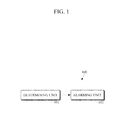
- FIG. 1 illustrates an example of an apparatus for assisting a user to maintain a correct posture during use of a portable terminal.
- apparatus 100 may be a portable terminal.
- the portable terminal may be a mobile phone, a smartphone, an MP3 player, a portable multimedia player (PMP), a tablet and the like.
- the portable terminal may include a variety of sensors.
- the apparatus 100 includes a determining unit 101 and an alarming unit 102.
- Each of the determining unit 101 and the alarming unit 102 may be implemented as either hardware to be installed inside the portable terminal or software to be executed by hardware equipped in the portable terminal.
- the hardware may include a processor.
- the determining unit 101 and the alarming unit 102 may be integrated as one unit, and a part of function to be executed by one functional unit may be performed by one or more other functional units.
- the determining unit 101 and the alarming unit 102 may be implemented as separate units.
- the determining unit 101 may receive information on a user's face image of a user taken by the portable terminal, a tilt angle of the portable terminal, or any combination thereof.
- the determining unit 101 may receive information on a user's face image from a front camera equipped in the portable terminal and may receive information on a tilt angle of the portable terminal.
- An orientation sensor, or combination of an accelerometer and a magnetic sensor located on the portable terminal may provide the tilt angle information.
- the determining unit 101 may determine whether the user is using the portable terminal in a correct posture based on the received information on the user's face image, the tilt angle of the portable terminal, or any combination thereof. For example, the determining unit 101 may estimate the state of the user's cervical spine, the user's viewing of the portable terminal, or any combination thereof.
- the state of the cervical spine may indicate an angle of the user's head with respect to the user's torso. In other words, the state of the cervical spine may indicate the degree of the tilt of the neck.
- the state of the user's viewing of the portable terminal may indicate a distance between the user's eyes and the portable terminal or correspond to a degree of the user's concentration on the portable terminal.
- the determining unit 101 may determine that the user is not in a correct posture in response to the state of the user's cervical spine not being in the predefined range of a correct posture. For example, in response to the user using the portable terminal for a significant amount of time with the user's neck tilted at an angleover a specific threshold tilt angle, the determining unit 101 may determine that the user is not in a correct posture.
- the determining unit 101 may determine that the user is not in a correct posture in response to the state of the user's viewing of the portable terminal not being in a predefined normal range. For example, in response to the user viewing the portable terminal at a distance closer than a threshold distance or keeping an eye on a part of the portable terminal for a long period of time, the determining unit 101 may determine that the user is not in a correct posture.
- the determining unit 101 may determine whether the user is in a correct posture based on both the state of the cervical spine and the state of the viewing of the portable terminal. For example, the determining unit 101 may determine that the user is not in a correct posture in response to either the state of the cervical spine or the state of the viewing of the portable terminal not being in a normal range, or the determining unit 101 may preliminarily estimate the state of the cervical spine. In response to the state of the cervical spine indicating a probability that the user is not in a correct posture, the determining unit 101 may estimate the state of the viewing of the portable terminal. In another example, the state of the viewing of the portable terminal may be preliminarily estimated and then in response to the result of the estimation showing that the user is not in a correct posture, the state of the cervical spine may be finally estimated.
- the alarming unit 102 may provide a predefined alarm based on a determination of the determining unit 101 that the user is not in a correct posture.
- the alarm may not be limited by its type.
- the alarming unit 102 may provide an alarm in the form of an image, text, sound, vibration, or the combination thereof.
- the alarming unit 102 may display an alarm message on a display of the portable terminal, generate an alarming sound, a vibration, or decrease the power sent to the display.
- the alarming unit 102 may display a specific activity on the display of the portable terminal, for example, the specific activity may be a stretching exercise, or change the way a screen is displayed so as to induce the user to change their posture, for example, the screen may be displayed 3-dimensionally.
- FIG. 2 illustrates an example of a method of estimating a state of the cervical spine.
- the determining unit 101 may determine whether the state of the cervical spine falls within a normal range or falls outside the normal range based on a result of a comparison between a previously stored reference face image 201 and a currently captured face image 202.
- the reference face image 201 may be a face image of a user taken in a correct posture.
- the determining unit 101 may determine whether the state of the cervical spine falls within a normal range or falls outside the normal range. The determination may occur based on a result of a comparison between features of the reference face image 201 and features of the captured face image 202.
- the features may include a shape of a face, a ratio of the area of the face and the area of a neck, and the brightness of a face.
- the face image 202 captured in response to the user lowering his/her head may show a more oval-shaped face, less neck, or a less bright face in comparison to the reference face image 201.
- the determining unit 101 may determine that the state of the user's cervical spine falls outside the normal range. In other words, the determining unit 101 may determine that the captured face image 202 is not similar to the reference face image 201. In addition, in response to the state of the user's cervical spine falling outside a normal range, the determining unit 101 may determine that the user is using the portable terminal in an improper posture.
- the reference face image 201 may include a plurality of images taken with respect to various tilt angles of the cervical spine.
- the determining unit 101 may extract the reference face image 201 having features most similar to features of the captured face image 202, and infer a current tilt angel of the user's cervical spine based on the extracted reference face image 201.
- the determining unit 101 may determine that the state of the user's cervical spine falls outside a normal range.
- the determining unit 101 may determine that the user is using the portable terminal in an improper posture.
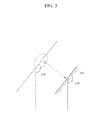
- FIG. 3 illustrates another example of a method of estimating the state of the cervical spine.
- a degree of inclination of the portable terminal 301 may substantially correspond with a degree of tilt of the user's neck.
- the determining unit 101 may determine that the degree of inclination of the portable terminal 301 substantially corresponds with the degree of tilt of the user's cervical spine.
- the determining unit 101 may collect sensor information from a variety of sensors, calculate an inclination angle 310 of the portable terminal 301 based on the collected sensor information, and calculate the tilt angle of the user's cervical spine based on the calculated inclination angle 310.
- the variety of sensors may include an orientation sensor, an acceleration sensor, a magnetic sensor, or the like, which is equipped in the portable terminal 301.
- the determining unit 101 may determine that the state of the user's cervical spine falls outside a normal range.
- the determining unit 101 may make a determination that the user is using the portable terminal 301 in an improper posture.
- FIGS. 2 and 3 illustrate a method of estimating a state of the user's cervical spine based on a face image and based on a degree of inclination of the portable terminal.
- the examples are only for illustrative purposes and the method of estimation of a state of the user's cervical spine is not limited thereto.
- the state of the user's cervical spine may be preliminarily estimated based on the face image as shown in FIG. 2 , and in response to the state of the cervical spine possibly falls outside a normal range, the state of the user's cervical spine may be finally determined based on the degree of inclination of the portable terminal as shown in FIG. 3 .
- whether the user using the portable terminal is in an incorrect posture may be determined based on a result of an estimation of whether the state outside the normal range is maintained longer than a reference period of time.
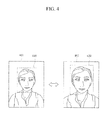
- FIG. 4 illustrates an example of a method of estimating a state of viewing a portable terminal.
- the determining unit 101 may compare a previously stored reference face image 401 and a currently captured face image 402, and based on the comparison, the determining unit 101 may estimate a state of the user's viewing a portable terminal that corresponds to a distance between the user's eyes and the portable terminal.
- the reference face image 401 may be an image of the user in a correct posture.
- the determining unit 101 may compare a ratio of the area of a face region 410 to the entire reference face image 401 and a ratio of the area of a face region 420 to the currently captured face image 402 to determine whether the state of viewing the portable terminal is in a normal range or falls outside a normal range.
- the ratio of the area of a face region 410 to the reference face image may be obtained from the average of ratios of the areas of the face region to each of the reference face images 401.
- the ratio of the area of each of the face regions 410 and 420 to the respective entire face image 401 and 402 increases. Accordingly, in response to the ratio of the area of each of the face regions 410 and 420 to the respective face images 401 and 402 falls outside a predefined threshold range, for example, the user may be watching the portable terminal too close, and thus the determining unit 101 may determine that the state of the viewing the portable terminal falls outside a normal range. In addition, since the state of the viewing the portable terminal may fall outside a normal range, the determining unit 101 may determine that the user is using the portable terminal in an improper posture.
- FIG. 5 illustrates another example of a method of estimating a state of a user's viewing a portable terminal.
- the determining unit 101 may determine whether the state of the viewing the portable terminal is in a normal range or falls outside a normal range based on the user's eye movement in a captured face image.
- the determining unit 101 may identify where the user's eyes are looking or number of eye-blinks through the eye-trackingtechnology. For example, in response to the user looking at a specific part 502 of a screen of the portable terminal, the determining unit 101 may measure a time the user is continuously looking at the point 502 (i.e., viewing time) and the number of eye-blinks that occurred while continuously looking at the point 502.
- the determining unit 101 may determine that the state of the user's viewing the portable terminal falls outside a normal range. Moreover, in response to the state of the user's viewing the portable terminal falling outside the normal range, the determining unit 101 may determine that the user using the portable terminal is in an improper posture.
- FIGS. 4 and 5 describe a method of estimating a state of a user's viewing the portable terminal based on a distance between the user's eyes and the portable terminal and based on the information about the user's eye movement.
- these examples are for illustrative purposes, and the method of estimating the state of the user's viewing the portable terminal is not limited thereto. For example, as shown in FIG.
- the state of the viewing the portable terminal may be preliminarily determined based on a distance between the user's eyes and the portable terminal, and only in response to the determination showing that the state of the user's viewing may fall outside a normal range, the final determination on the state of the user's viewing may be made based on the information about the user's eye movement as shown in FIG. 5 . Also, although the state of the user's viewing the portable terminal may fall outside a normal range, a determination on whether the user is using the portable terminal in a correct posture or in an incorrect posture further based on the determination of whether the state outside the normal range of viewing occurs for a time longer than a predefined reference period of time.
- FIG. 6 illustrates another example of an apparatus for assisting a user to maintain a correct posture during use of a portable terminal.
- apparatus 600 may include a sensor unit 601, a cervical spine state estimating unit 602, and an alarming unit 603.
- the sensor unit 601 may collect information about a face image of a user and information about an angle of inclination of a portable terminal.
- the sensor unit 601 may include a front camera and a variety of sensors, which are equipped in the portable terminal.
- the variety of sensors may include an orientation sensor, an acceleration sensor, a magnetic sensor, and the like.
- the front camera may be installed on a front of the portable terminal to capture an image of a user's face.
- the orientation sensor may be installed inside of the portable terminal to measure an azimuth, a pitch, and a roll of the portable terminal.
- the acceleration sensor and the magnetic sensor may be installed inside of the portable terminal to measure the acceleration or the magnitude of a magnetic field of the portable terminal in motion.
- the acceleration or the magnitude of a magnetic field may be measured with respect to a direction of a 3-dimensional axis.
- the front camera may obtain the face image of the user.
- a pitch value of the orientation sensor may be used as the inclination angle of the portable terminal.
- a result of application of the measured values of the acceleration sensor and the magnetic sensor to a rotation matrix may be used as the the inclination angle of the portable terminal.
- the cervical spine state estimating unit 602 may estimate a state of the user's cervical spine. For example, the cervical spine state estimating unit 602 may determine whether the state of the user's cervical spine is in a normal range or falls outside the normal range.
- Information used in estimating the state of the cervical spine may be the face image of the user, the inclination angle of the portable terminal, or any combination thereof.
- the cervical spine state estimating unit 602 may compare the reference face image 201 and the currently received face image 202 to determine whether the user is lowering his or her head. For example, a shape of the face, a ratio of the area of the face to the area of the neck, and the brightness of the face may be used as features to be compared. In response to the user lowering his or hercervical spine for longer than a predefined reference period of time, a determination may be made that the cervical spine of the user falls outside a normal state.
- the cervical state estimating unit 602 takes into consideration that the inclination angle 310 of the portable terminal is substantially the same as the tilt angle 320 of the user's head, and then determines whether the inclination angle 310 of the portable terminal is lower than a predefined threshold angle. In response to the inclination angle 310 of the portable terminal being lower than the predefined threshold angle and the inclination angle 310 being maintained for longer than a predefined reference period of time, the cervical state estimating unit 602 may determine that the user's cervical spine falls outside a normal state.
- both the face image and the inclination angle of the portable terminal may be used to estimate the state of the user's cervical spine.
- the approximate state of the user's cervical spine may be estimated based on the face image of the user, and then the detailed state of the user's cervical spine may be estimated based on the inclination angle of the portable terminal.
- the current posture may be approximately estimated and the current posture may be determined whether the current posture may harm the user's cervical spine based on the face image.
- a final determination may be made whether the state of the user's cervical spine is in a normal range or falls outside a normal range. The final determination may be based on a result of comparison between a current inclination angle of the portable terminal and an average of various reference inclination angles of the portable terminal held by the user in a correct posture.
- the alarming unit 603 may provide an alarm.
- the alarm is not limited by its type.
- the alarming unit 603 may provide an alarm in the form of an image, text, sound, vibration, or any form of alarm that can notify the user to change the posture.
- FIG. 7 illustrates another example of an apparatus for assisting a user to maintain a correct posture during use of a portable terminal.
- apparatus 700 includes a sensor unit 601, a cervical spine state estimating unit 602, an alarming unit 603, a pattern storage unit 701, and a user setting unit 702.
- the sensor unit 601, the cervical spine state estimating unit 602, and the alarming unit 603 may be substantially similar as those shown in the example illustrated in FIG. 6 .
- a description of the sensor unit 601, the cervical spine state estimating unit 602, and the alarming unit 603 will not be reiterated for conciseness.
- the pattern storage unit 701 may store an estimated state of the cervical spine, a tilt angle of the cervical spine at the time of estimation, and feature information of a face image at the time of estimation.
- the pattern storage unit 701 may receive a face image of the user and the inclination angle of the portable terminal from the sensor unit 601.
- the pattern storage unit 701 may extract features from the received face image, and the pattern storage unit 701 may store the extracted features and the inclination angle of the portable terminal in a database.
- An example of the database may be shown in Table 1 below.
- Table 1 Face Shape Ratio of Area of Face to Entire Face Image Ratio of Area of Neck to Entire Face Image Face Brightness (1 ⁇ 10) Inclination Angle of Portable Terminal (pitch) Oval 23% 5% 8 -91
- capturing a reference face image of the user may generate learning data. For example, a correct posture image or a poor posture image may establish learning data.
- the pattern storage unit 701 may establish the database (including the learning data). The database may be utilized by the cervical spine state estimating unit 602 to classify face images.
- the user setting unit 702 may set a parameter of the cervical spine state estimating unit 602, a type of alarming to be provided by the alarming unit 603, or any combination thereof.
- the parameter of the cervical spine state estimating unit 602 may include various threshold values and a reference time for determining the normal or a state outside the normal range of the cervical spine, or a type of features for use in imageclassification.
- FIG. 8 illustrates another example of an apparatus for assisting a user to maintain a correct posture during use of a portable terminal.
- apparatus 800 includes a sensor unit 601, a cervical spine state estimating unit 602, a viewing state estimating unit 801, and an alarming unit 802.
- the sensor unit 601 and the cervical spine state estimating unit 602 are substantially similar as those in the example illustrated in FIG. 6 . Thus, a description of the sensor unit 601 and the cervical spine state estimating unit 602 will not be reiterated for conciseness.
- the viewing state estimating unit 801 may estimate the state in which the user is viewing a portable terminal.
- the state of viewing the portable terminal may indicate whether a distance between the user's eyes and the portable terminal, a degree of user's concentration on the portable terminal is within a normal range or not, or any combination thereof.
- the viewing state estimating unit 801 may estimate the distance between the user's eyes and the portable terminal based on the ratio of the area of the face region 420 to a captured face image 402 as shown in FIG. 4 . In response to the distance being closer than a threshold distance and the current distance being maintained for longer than a reference period of time, the viewing state estimating unit 801 may determine that the state of viewing the portable terminal falls outside a normal range.
- the viewing state estimating unit 801 may estimate the degree of concentration on the portable terminal on the basis of information about the eye movement.
- the information about the eye movement may be a period of viewing the portable terminal or the number/time of eye-blinks.
- the viewing state estimating unit 801 may determine that the state of the user's viewing the portable terminal falls outside a normal state.
- both the distance between the user's eyes and the portable terminal and the degree of concentration on the portable terminal may be identified.
- the state of the viewing the portable terminal falls outside a normal range.
- the state of viewing the portable terminal may be preliminarily determined based on the distance between the user's eyes and the portable terminal, and then the final determination on the viewing state may be made based on the degree of concentration on the portable terminal.
- the alarming unit 802 may provide a predetermined type of alarm.
- the type of the alarm may vary.
- FIG. 9 illustrates another example of an apparatus for assisting a user to maintain a correct posture during use of a portable terminal.
- apparatus 900 includes a sensor unit 601, a cervical spine state estimating unit 602, a viewing state estimating unit 801, an alarming unit 802, a pattern storage unit 701, and a user setting unit 702.
- the configuration and operation of each unit of the apparatus 900 shown in the example illustrated in FIG. 9 are substantially similar to those in the apparatuses shown in the examples illustrated in FIGS. 6 to 8 , and thus they are represented by the same numerals and detailed description thereof will not be reiterated for conciseness.
- the user setting unit 702 of the apparatus illustrated in FIG. 9 may additionally set the parameter for the viewing state estimating unit 801.
- FIG. 10 illustrates an example of a method for assisting a user to maintain a correct posture during use of a portable terminal.
- sensing data of a portable terminal may be collected at 1001.
- the sensing data to be collected may be data obtained by native S/W or H/W capabilities of the apparatus without requiring additional sensors.
- the sensing data may include a front image and positional information of the portable terminal during use of the portable terminal.
- the front image may be a face image of a user.
- the positional information may be sensing dataobtained by an orientation sensor, an acceleration sensor, a magnetic sensor, and the like.
- the method may determine whether the state of the user's cervical spine or the state of user's viewing the portable terminal falls outside a normal range at 1002.
- the state of the cervical spine may indicate an angle of the user's head with respect to the user's body. The angle may correspond with a tilt angle of the cervical spine, and the method may determine whether the angle falls within a normal range or outside a normal range.
- the state of viewing the portable terminal may indicate whether the degree of strain on the user's eyes or the user's posture falls within a normal range or outside a normal range during use of the portable terminal.
- the state of the cervical spine may be estimated based on the face image as illustrated in FIG. 2 , the inclination angle of the portable terminal as illustrated in FIG. 3 , or any combination thereof.
- the state of viewing the portable terminal may be estimated based on the distance between the user's eyes and the portable terminal as illustrated in FIG. 4 , the degree of concentration on the portable terminal as illustrated in FIG. 5 , or any combination thereof.
- a predetermined type of alarm may be provided at 1003.
- the type of alarm may vary.
- the alarm may be an image, text, sound, vibration, or any form of alarm that can notify the user to change the posture.
- a determination whether a user is using a portable terminal in a correct posture based on sensing data obtained by sensors natively equipped in the portable terminal without additional sensors may be possible, and in response to a determination being made that the user is not in a correct posture, providing an alarm to promote the user to change his or her pose may be possible. Accordingly, any trouble or disorder due to a poor posture during use of the portable terminal may be prevented from occurring.
- Program instructions to perform a method described herein, or one or more operations thereof, may be recorded, stored, or fixed in one or more computer-readable storage media.
- the program instructions may be implemented by a computer.
- the computer may cause a processor to execute the program instructions.
- the media may include, alone or in combination with the program instructions, data files, data structures, and the like.
- Examples of computer-readable media include magnetic media, such as hard disks, floppy disks, and magnetic tape; optical media such as CD ROM disks and DVDs; magneto-optical media, such as optical disks; and hardware devices that are specially configured to store and perform program instructions, such as read-only memory (ROM), random access memory (RAM), flash memory, and the like.
- Examples of program instructions include machine code, such as produced by a compiler, and files containing higher level code that may be executed by the computer using an interpreter.
- the program instructions that is, software
- the program instructions may be distributed over network coupled computer systems so that the software is stored and executed in a distributed fashion.
- the software and data may be stored by one or more computer readable recording mediums.
- functional programs, codes, and code segments for accomplishing the example embodiments disclosed herein can be easily construed by programmers skilled in the art to which the embodiments pertain based on and using the flow diagrams and block diagrams of the figures and their corresponding descriptions as provided herein.
- the described unit to perform an operation or a method may be hardware, software, or some combination of hardware and software.
- the unit may be a software package running on a computer or the computer on which that software is running.
Landscapes
- Health & Medical Sciences (AREA)
- Engineering & Computer Science (AREA)
- Life Sciences & Earth Sciences (AREA)
- Medical Informatics (AREA)
- Public Health (AREA)
- General Health & Medical Sciences (AREA)
- Pathology (AREA)
- Biomedical Technology (AREA)
- Physics & Mathematics (AREA)
- Heart & Thoracic Surgery (AREA)
- Veterinary Medicine (AREA)
- Animal Behavior & Ethology (AREA)
- Surgery (AREA)
- Molecular Biology (AREA)
- Biophysics (AREA)
- Oral & Maxillofacial Surgery (AREA)
- Dentistry (AREA)
- Primary Health Care (AREA)
- Databases & Information Systems (AREA)
- Data Mining & Analysis (AREA)
- Epidemiology (AREA)
- Theoretical Computer Science (AREA)
- General Physics & Mathematics (AREA)
- Computer Networks & Wireless Communication (AREA)
- Signal Processing (AREA)
- Computer Vision & Pattern Recognition (AREA)
- Image Analysis (AREA)
- Image Processing (AREA)
- Measurement Of The Respiration, Hearing Ability, Form, And Blood Characteristics Of Living Organisms (AREA)
- Alarm Systems (AREA)
- Telephone Function (AREA)
Applications Claiming Priority (1)
| Application Number | Priority Date | Filing Date | Title |
|---|---|---|---|
| KR1020110094854A KR101868597B1 (ko) | 2011-09-20 | 2011-09-20 | 올바른 기기사용자세 유도 장치 및 방법 |
Publications (3)
| Publication Number | Publication Date |
|---|---|
| EP2573696A2 true EP2573696A2 (fr) | 2013-03-27 |
| EP2573696A3 EP2573696A3 (fr) | 2013-10-02 |
| EP2573696B1 EP2573696B1 (fr) | 2018-08-15 |
Family
ID=47428466
Family Applications (1)
| Application Number | Title | Priority Date | Filing Date |
|---|---|---|---|
| EP12184924.4A Active EP2573696B1 (fr) | 2011-09-20 | 2012-09-19 | Appareil et procédé d'assistance utilisateur afin de maintenir une posture correcte |
Country Status (5)
| Country | Link |
|---|---|
| US (1) | US9141761B2 (fr) |
| EP (1) | EP2573696B1 (fr) |
| JP (1) | JP6050069B2 (fr) |
| KR (1) | KR101868597B1 (fr) |
| CN (1) | CN103021140A (fr) |
Cited By (3)
| Publication number | Priority date | Publication date | Assignee | Title |
|---|---|---|---|---|
| WO2016001796A1 (fr) | 2014-07-02 | 2016-01-07 | Koninklijke Philips N.V. | Système de détermination de l'état d'un œil |
| GB2543057A (en) * | 2015-10-01 | 2017-04-12 | Yu Cheong Leung Spencer | System and method for monitoring habits of user of electronic device |
| DE102015222388A1 (de) | 2015-11-13 | 2017-05-18 | Bayerische Motoren Werke Aktiengesellschaft | Vorrichtung und Verfahren zum Steuern einer Anzeigeeinrichtung in einem Kraftfahrzeug |
Families Citing this family (62)
| Publication number | Priority date | Publication date | Assignee | Title |
|---|---|---|---|---|
| CN103377643B (zh) * | 2012-04-26 | 2017-02-15 | 富泰华工业(深圳)有限公司 | 字体调整系统及方法 |
| KR102044498B1 (ko) * | 2012-07-02 | 2019-11-13 | 삼성전자주식회사 | 영상 통화 서비스를 제공하기 위한 방법 및 그 전자 장치. |
| KR102011495B1 (ko) * | 2012-11-09 | 2019-08-16 | 삼성전자 주식회사 | 사용자의 심리 상태 판단 장치 및 방법 |
| CN104102435A (zh) * | 2013-04-02 | 2014-10-15 | 百度在线网络技术(北京)有限公司 | 一种在使用设备时调整用户姿势的方法及设备 |
| HK1181255A2 (en) * | 2013-07-18 | 2013-11-01 | Spencer Yu Cheong Leung | Monitor system and method for smart device |
| JP2015039472A (ja) * | 2013-08-21 | 2015-03-02 | 日本電信電話株式会社 | 姿勢検出方法及び携帯端末装置及びプログラム |
| CN104424771B (zh) * | 2013-09-10 | 2018-07-06 | 南京中兴软件有限责任公司 | 一种告警方法及装置 |
| CN103729981B (zh) * | 2014-01-03 | 2015-10-14 | 东南大学 | 一种儿童坐姿监控智能终端 |
| CN103795865B (zh) * | 2014-02-12 | 2017-05-31 | 惠州Tcl移动通信有限公司 | 一种移动终端 |
| CN103902043B (zh) * | 2014-04-02 | 2018-08-31 | 努比亚技术有限公司 | 智能终端及其提醒方法 |
| CN103955273B (zh) * | 2014-04-16 | 2017-06-13 | 北京智产科技咨询有限公司 | 一种通过操作系统实现用户姿态检测的移动终端和方法 |
| CN103927012B (zh) * | 2014-04-16 | 2017-06-13 | 北京智产科技咨询有限公司 | 一种通过操作系统实现用户姿态检测的移动终端和方法 |
| CN103955272B (zh) * | 2014-04-16 | 2017-08-29 | 北京智产科技咨询有限公司 | 一种终端设备用户姿态检测系统 |
| CN103927250B (zh) * | 2014-04-16 | 2017-09-01 | 北京智产科技咨询有限公司 | 一种终端设备用户姿态检测方法 |
| CN103927011B (zh) * | 2014-04-16 | 2017-06-09 | 北京智产科技咨询有限公司 | 实现用户姿态检测的操作系统运行装置和应用程序模块 |
| WO2015158258A1 (fr) * | 2014-04-16 | 2015-10-22 | 苏州尚德智产通信技术有限公司 | Procédé, dispositif et système de détection de la position d'un utilisateur |
| CN103955271B (zh) * | 2014-04-16 | 2017-06-09 | 北京智产科技咨询有限公司 | 一种通过操作系统实现用户姿态检测的移动终端和方法 |
| CN103927010B (zh) * | 2014-04-16 | 2017-06-13 | 北京智产科技咨询有限公司 | 一种通过监控程序实现用户姿态检测的移动终端和方法 |
| US9406211B2 (en) | 2014-11-19 | 2016-08-02 | Medical Wearable Solutions Ltd. | Wearable posture regulation system and method to regulate posture |
| CN104382599B (zh) * | 2014-12-05 | 2017-01-18 | 京东方科技集团股份有限公司 | 用于测量颈椎活动的方法、设备和可穿戴装置 |
| JP6481357B2 (ja) * | 2014-12-22 | 2019-03-13 | 富士通コネクテッドテクノロジーズ株式会社 | 電子機器 |
| CN104994218A (zh) * | 2015-05-14 | 2015-10-21 | 努比亚技术有限公司 | 一种移动终端及其实现使用提醒的方法 |
| DE102016110903A1 (de) * | 2015-06-14 | 2016-12-15 | Facense Ltd. | Head-Mounted-Devices zur Messung physiologischer Reaktionen |
| KR101782086B1 (ko) * | 2015-10-01 | 2017-09-26 | 장헌영 | 이동단말 제어장치 및 방법 |
| CN105516463B (zh) * | 2015-11-27 | 2019-06-04 | 惠州Tcl移动通信有限公司 | 一种移动终端提醒方法及系统 |
| US11475753B2 (en) * | 2019-07-02 | 2022-10-18 | John Pellegrini | Device for facilitating correcting of a posture of a user |
| US12190715B2 (en) * | 2020-07-02 | 2025-01-07 | John Pellegrini | Device for facilitating correcting of a posture of a user |
| CN106020460A (zh) * | 2016-05-13 | 2016-10-12 | 上海龙旗科技股份有限公司 | 一种基于俯仰角信息提示用户的方法与设备 |
| CN106095093B (zh) * | 2016-06-08 | 2019-06-04 | 北京安云世纪科技有限公司 | 一种数据处理方法和装置 |
| CN106339167A (zh) * | 2016-08-19 | 2017-01-18 | 昆山工研院新型平板显示技术中心有限公司 | 一种显示设备 |
| CN106343977B (zh) * | 2016-09-21 | 2019-07-09 | 中国人民解放军国防科学技术大学 | 基于多传感器融合的无人机操作员状态监视系统 |
| WO2018125778A1 (fr) | 2016-12-29 | 2018-07-05 | Posture Solutions, LLC | Modification d'affichage progressif en temps réel pour effectuer un comportement souhaitable |
| KR101851099B1 (ko) * | 2017-01-19 | 2018-04-20 | 신소현 | 영상처리 기계학습을 이용한 소프트웨어 기반의 거북목 방지 방법 및 시스템 |
| JP6598258B2 (ja) * | 2017-06-20 | 2019-10-30 | 修 宇留野 | 姿勢監視装置、姿勢監視方法及び姿勢監視プログラム |
| US20190021652A1 (en) * | 2017-07-19 | 2019-01-24 | International Business Machines Corporation | Monitoring the posture of a user |
| US10602976B2 (en) | 2017-08-03 | 2020-03-31 | International Business Machines Corporation | Personalized posture correction |
| CN107977153A (zh) * | 2017-10-23 | 2018-05-01 | 广东小天才科技有限公司 | 一种移动终端的护眼方法、装置、移动终端及存储介质 |
| JP7084709B2 (ja) * | 2017-10-31 | 2022-06-15 | 株式会社イトーキ | 机システム、及びプログラム。 |
| CN108661545B (zh) * | 2018-04-11 | 2019-11-15 | 新昌县坞捷农业科技有限公司 | 多功能金属梯的控制方法 |
| WO2019216453A1 (fr) * | 2018-05-09 | 2019-11-14 | Jeong Gyumin | Système et procédé pour fournir un guide de correction de posture |
| CN109171692A (zh) * | 2018-10-10 | 2019-01-11 | 合肥京东方光电科技有限公司 | 护颈显示系统、利用护颈显示系统护颈的方法 |
| JP7055111B2 (ja) * | 2019-02-19 | 2022-04-15 | Kddi株式会社 | ユーザの首曲げ状態を推定可能な携帯装置、プログラム及び方法 |
| CN110236551A (zh) * | 2019-05-21 | 2019-09-17 | 西藏纳旺网络技术有限公司 | 用户颈椎倾斜角度的获取方法、装置、电子设备及介质 |
| CN110941998B (zh) * | 2019-11-07 | 2024-02-02 | 咪咕互动娱乐有限公司 | 姿势调整方法、装置及计算机存储介质 |
| KR102366612B1 (ko) * | 2020-01-03 | 2022-02-23 | 주식회사 데이탄소프트 | 사용자와 디스플레이간의 거리에 기초한 알람 제공 방법 및 장치 |
| CN111345928B (zh) * | 2020-03-09 | 2022-02-25 | 腾讯科技(深圳)有限公司 | 头部姿势监测方法及装置、存储介质、电子设备 |
| CN114642421B (zh) * | 2020-12-17 | 2025-09-09 | 深圳Tcl新技术有限公司 | 健康监管方法、装置、智能终端及计算机可读存储介质 |
| US20240054672A1 (en) * | 2021-03-10 | 2024-02-15 | Panasonic Intellectual Property Management Co., Ltd. | Determination system, determination method, and recording medium |
| CN113031773A (zh) * | 2021-03-24 | 2021-06-25 | Oppo广东移动通信有限公司 | 提示方法、电子设备及计算机可读存储介质 |
| US20220319045A1 (en) * | 2021-04-01 | 2022-10-06 | MohammadSado Lulu | System For Posture Detection Using The Camera Of A Hand-Held Device |
| EP4323853A1 (fr) * | 2021-04-13 | 2024-02-21 | Apple Inc. | Suggestions à un utilisateur basées sur l'interaction |
| CN113486789A (zh) * | 2021-07-05 | 2021-10-08 | 维沃移动通信有限公司 | 基于脸部面积的坐姿检测方法、电子设备及存储介质 |
| JP7282235B2 (ja) * | 2021-07-30 | 2023-05-26 | 功憲 末次 | 不適切使用抑制システムおよび不適切使用抑制プログラム |
| JP7331282B2 (ja) * | 2021-07-30 | 2023-08-22 | 功憲 末次 | 不適切使用抑制システムおよび不適切使用抑制プログラム |
| JP7331283B2 (ja) * | 2021-07-30 | 2023-08-22 | 功憲 末次 | 不適切使用抑制システムおよび不適切使用抑制プログラム |
| JP7331281B2 (ja) * | 2021-07-30 | 2023-08-22 | 功憲 末次 | 不適切使用抑制システムおよび不適切使用抑制プログラム |
| JP7174817B1 (ja) | 2021-07-30 | 2022-11-17 | 功憲 末次 | 不適切使用抑制システムおよび不適切使用抑制プログラム |
| CN113723297B (zh) * | 2021-08-31 | 2025-03-18 | 深圳平安智慧医健科技有限公司 | 颈椎姿态评估方法、装置、设备及存储介质 |
| US11927993B2 (en) * | 2022-06-23 | 2024-03-12 | UpBright LLC | System for biomechanically optimizing use of mobile devices |
| US12307149B2 (en) * | 2022-12-06 | 2025-05-20 | Huawei Technologies Co., Ltd. | Methods and systems for preventing motion sickness via postural analysis |
| KR102552192B1 (ko) * | 2023-04-03 | 2023-07-05 | 김택균 | 바른자세 모니터링 서비스 제공 시스템 |
| CN119863907A (zh) * | 2024-12-13 | 2025-04-22 | 珠海格力电器股份有限公司 | 一种姿态提醒方法、装置、设备及可读存储介质 |
Family Cites Families (18)
| Publication number | Priority date | Publication date | Assignee | Title |
|---|---|---|---|---|
| JPH0742605Y2 (ja) * | 1989-11-28 | 1995-10-04 | 宏治 須田 | ブラスト用ノズル |
| TW455769B (en) | 1999-08-18 | 2001-09-21 | Jian Huei Jiuan | Eye-protection method and apparatus set up for monitor screen |
| AU2003286303A1 (en) | 2002-12-11 | 2004-06-30 | Koninklijke Philips Electronics N.V. | Method and apparatus for correcting a head pose in a video phone image |
| JP2005261869A (ja) * | 2004-03-16 | 2005-09-29 | Eye Power Sports Inc | 電子表示装置に対する視距離通知装置と方法 |
| KR100657917B1 (ko) | 2004-12-11 | 2006-12-14 | 삼성전자주식회사 | 자세 교정 장치 및 그 방법 |
| KR20060124207A (ko) | 2005-05-31 | 2006-12-05 | 주식회사 팬택 | 자세를 교정할 수 있는 이동통신단말기 및 자세교정방법 |
| KR20070071308A (ko) | 2005-12-30 | 2007-07-04 | 주식회사 팬택 | 이동통신단말기에서의 자세 교정 정보 제공 방법 및 그장치 |
| KR101275490B1 (ko) | 2006-06-30 | 2013-06-14 | 삼성전자주식회사 | 동작 인식을 이용한 자세교정 단말 장치 및 방법 |
| US7692548B2 (en) * | 2006-09-12 | 2010-04-06 | Deere & Company | Method and system for detecting operator alertness |
| CN100578531C (zh) * | 2007-11-08 | 2010-01-06 | 北京中星微电子有限公司 | 一种实现视力保护的显示器、装置及方法 |
| US20090324024A1 (en) * | 2008-06-25 | 2009-12-31 | Postureminder Ltd | System and method for improving posture |
| JP2010086192A (ja) * | 2008-09-30 | 2010-04-15 | Sony Ericsson Mobile Communications Ab | 携帯機器、コンピュータプログラムおよび記録媒体 |
| US9044172B2 (en) * | 2009-10-01 | 2015-06-02 | Intel Corporation | Ergonomic detection, processing and alerting for computing devices |
| KR20110037297A (ko) * | 2009-10-06 | 2011-04-13 | 삼성전자주식회사 | 단말에서 문자 입력 방법 및 시스템 |
| WO2011046208A1 (fr) | 2009-10-16 | 2011-04-21 | ローム株式会社 | Dispositif mobile |
| JP2011090421A (ja) | 2009-10-21 | 2011-05-06 | Rohm Co Ltd | モバイル機器 |
| CN201590203U (zh) * | 2009-12-03 | 2010-09-22 | 冠捷投资有限公司 | 符合人体工学的显示器 |
| US8810413B2 (en) * | 2010-10-15 | 2014-08-19 | Hewlett Packard Development Company, L.P. | User fatigue |
-
2011
- 2011-09-20 KR KR1020110094854A patent/KR101868597B1/ko active Active
-
2012
- 2012-03-15 US US13/420,789 patent/US9141761B2/en active Active
- 2012-09-19 EP EP12184924.4A patent/EP2573696B1/fr active Active
- 2012-09-20 CN CN2012103518795A patent/CN103021140A/zh active Pending
- 2012-09-20 JP JP2012206804A patent/JP6050069B2/ja not_active Expired - Fee Related
Non-Patent Citations (1)
| Title |
|---|
| None |
Cited By (5)
| Publication number | Priority date | Publication date | Assignee | Title |
|---|---|---|---|---|
| WO2016001796A1 (fr) | 2014-07-02 | 2016-01-07 | Koninklijke Philips N.V. | Système de détermination de l'état d'un œil |
| GB2543057A (en) * | 2015-10-01 | 2017-04-12 | Yu Cheong Leung Spencer | System and method for monitoring habits of user of electronic device |
| DE102015222388A1 (de) | 2015-11-13 | 2017-05-18 | Bayerische Motoren Werke Aktiengesellschaft | Vorrichtung und Verfahren zum Steuern einer Anzeigeeinrichtung in einem Kraftfahrzeug |
| WO2017080788A2 (fr) | 2015-11-13 | 2017-05-18 | Bayerische Motoren Werke Aktiengesellschaft | Dispositif et procédé pour commander un dispositif d'affichage dans un véhicule à moteur |
| US11623516B2 (en) | 2015-11-13 | 2023-04-11 | Bayerische Motoren Werke Aktiengesellschaft | Device and method for controlling a display device in a motor vehicle |
Also Published As
| Publication number | Publication date |
|---|---|
| US9141761B2 (en) | 2015-09-22 |
| EP2573696B1 (fr) | 2018-08-15 |
| KR20130031120A (ko) | 2013-03-28 |
| EP2573696A3 (fr) | 2013-10-02 |
| KR101868597B1 (ko) | 2018-06-19 |
| JP6050069B2 (ja) | 2016-12-21 |
| CN103021140A (zh) | 2013-04-03 |
| US20130072820A1 (en) | 2013-03-21 |
| JP2013069286A (ja) | 2013-04-18 |
Similar Documents
| Publication | Publication Date | Title |
|---|---|---|
| US9141761B2 (en) | Apparatus and method for assisting user to maintain correct posture | |
| EP2395420B1 (fr) | Dispositif et procédé d'affichage d'informations | |
| JP6573193B2 (ja) | 判定装置、判定方法、および判定プログラム | |
| US10986276B2 (en) | Mobile device | |
| CN105022981B (zh) | 一种检测人眼健康状态的方法、装置及移动终端 | |
| CN103927250B (zh) | 一种终端设备用户姿态检测方法 | |
| CN106843821A (zh) | 自动调整屏幕的方法和装置 | |
| JP2012123727A (ja) | 広告効果測定サーバ、広告効果測定装置、プログラム、広告効果測定システム | |
| CN104102435A (zh) | 一种在使用设备时调整用户姿势的方法及设备 | |
| CN105719439A (zh) | 护眼系统及方法 | |
| CN106445092A (zh) | 终端保护视力的处理方法及装置 | |
| KR20150098542A (ko) | 얼굴 파라미터로부터 사용자의 시각적 어려움을 탐지하는 방법 및 그 전자 장치 | |
| US10482350B2 (en) | Drowsiness detection apparatus and drowsiness detection method thereof | |
| CN111444748B (zh) | 一种坐姿检测方法、装置、设备及存储介质 | |
| CN106919250A (zh) | 一种提醒方法及装置 | |
| EP2966591A1 (fr) | Procédé et appareil d'identification des événements saillants par analyser des sections vidéeo saillants identifié par ifnormations de capteur | |
| CN113903078A (zh) | 人眼注视检测方法、控制方法及相关设备 | |
| JP6399311B2 (ja) | 居眠り検知装置 | |
| Lee et al. | A new posture monitoring system for preventing physical illness of smartphone users | |
| CN106650661A (zh) | 一种终端使用状态的检测方法和装置 | |
| JP2015015031A (ja) | 広告効果測定サーバ、広告効果測定システム、プログラム | |
| JP2007265125A (ja) | コンテンツ表示装置 | |
| KR101541061B1 (ko) | 휴대용 단말기에서 감각 기관의 운동을 보조하는 장치 및 방법 | |
| JP2013120954A (ja) | 寝顔認識装置 | |
| CN113657212A (zh) | 一种疲劳检测方法及相关装置 |
Legal Events
| Date | Code | Title | Description |
|---|---|---|---|
| PUAI | Public reference made under article 153(3) epc to a published international application that has entered the european phase |
Free format text: ORIGINAL CODE: 0009012 |
|
| AK | Designated contracting states |
Kind code of ref document: A2 Designated state(s): AL AT BE BG CH CY CZ DE DK EE ES FI FR GB GR HR HU IE IS IT LI LT LU LV MC MK MT NL NO PL PT RO RS SE SI SK SM TR |
|
| AX | Request for extension of the european patent |
Extension state: BA ME |
|
| PUAL | Search report despatched |
Free format text: ORIGINAL CODE: 0009013 |
|
| AK | Designated contracting states |
Kind code of ref document: A3 Designated state(s): AL AT BE BG CH CY CZ DE DK EE ES FI FR GB GR HR HU IE IS IT LI LT LU LV MC MK MT NL NO PL PT RO RS SE SI SK SM TR |
|
| AX | Request for extension of the european patent |
Extension state: BA ME |
|
| RIC1 | Information provided on ipc code assigned before grant |
Ipc: G06F 19/00 20110101AFI20130827BHEP Ipc: A61B 5/11 20060101ALI20130827BHEP |
|
| 17P | Request for examination filed |
Effective date: 20140326 |
|
| RBV | Designated contracting states (corrected) |
Designated state(s): AL AT BE BG CH CY CZ DE DK EE ES FI FR GB GR HR HU IE IS IT LI LT LU LV MC MK MT NL NO PL PT RO RS SE SI SK SM TR |
|
| 17Q | First examination report despatched |
Effective date: 20160316 |
|
| GRAP | Despatch of communication of intention to grant a patent |
Free format text: ORIGINAL CODE: EPIDOSNIGR1 |
|
| INTG | Intention to grant announced |
Effective date: 20180302 |
|
| GRAS | Grant fee paid |
Free format text: ORIGINAL CODE: EPIDOSNIGR3 |
|
| GRAA | (expected) grant |
Free format text: ORIGINAL CODE: 0009210 |
|
| AK | Designated contracting states |
Kind code of ref document: B1 Designated state(s): AL AT BE BG CH CY CZ DE DK EE ES FI FR GB GR HR HU IE IS IT LI LT LU LV MC MK MT NL NO PL PT RO RS SE SI SK SM TR |
|
| REG | Reference to a national code |
Ref country code: CH Ref legal event code: EP Ref country code: GB Ref legal event code: FG4D Ref country code: AT Ref legal event code: REF Ref document number: 1030599 Country of ref document: AT Kind code of ref document: T Effective date: 20180815 |
|
| REG | Reference to a national code |
Ref country code: IE Ref legal event code: FG4D |
|
| REG | Reference to a national code |
Ref country code: DE Ref legal event code: R096 Ref document number: 602012049731 Country of ref document: DE |
|
| REG | Reference to a national code |
Ref country code: FR Ref legal event code: PLFP Year of fee payment: 7 |
|
| REG | Reference to a national code |
Ref country code: DE Ref legal event code: R079 Ref document number: 602012049731 Country of ref document: DE Free format text: PREVIOUS MAIN CLASS: G06F0019000000 Ipc: G16Z0099000000 |
|
| REG | Reference to a national code |
Ref country code: NL Ref legal event code: MP Effective date: 20180815 |
|
| REG | Reference to a national code |
Ref country code: LT Ref legal event code: MG4D |
|
| REG | Reference to a national code |
Ref country code: AT Ref legal event code: MK05 Ref document number: 1030599 Country of ref document: AT Kind code of ref document: T Effective date: 20180815 |
|
| PG25 | Lapsed in a contracting state [announced via postgrant information from national office to epo] |
Ref country code: LT Free format text: LAPSE BECAUSE OF FAILURE TO SUBMIT A TRANSLATION OF THE DESCRIPTION OR TO PAY THE FEE WITHIN THE PRESCRIBED TIME-LIMIT Effective date: 20180815 Ref country code: BG Free format text: LAPSE BECAUSE OF FAILURE TO SUBMIT A TRANSLATION OF THE DESCRIPTION OR TO PAY THE FEE WITHIN THE PRESCRIBED TIME-LIMIT Effective date: 20181115 Ref country code: NL Free format text: LAPSE BECAUSE OF FAILURE TO SUBMIT A TRANSLATION OF THE DESCRIPTION OR TO PAY THE FEE WITHIN THE PRESCRIBED TIME-LIMIT Effective date: 20180815 Ref country code: IS Free format text: LAPSE BECAUSE OF FAILURE TO SUBMIT A TRANSLATION OF THE DESCRIPTION OR TO PAY THE FEE WITHIN THE PRESCRIBED TIME-LIMIT Effective date: 20181215 Ref country code: SE Free format text: LAPSE BECAUSE OF FAILURE TO SUBMIT A TRANSLATION OF THE DESCRIPTION OR TO PAY THE FEE WITHIN THE PRESCRIBED TIME-LIMIT Effective date: 20180815 Ref country code: RS Free format text: LAPSE BECAUSE OF FAILURE TO SUBMIT A TRANSLATION OF THE DESCRIPTION OR TO PAY THE FEE WITHIN THE PRESCRIBED TIME-LIMIT Effective date: 20180815 Ref country code: NO Free format text: LAPSE BECAUSE OF FAILURE TO SUBMIT A TRANSLATION OF THE DESCRIPTION OR TO PAY THE FEE WITHIN THE PRESCRIBED TIME-LIMIT Effective date: 20181115 Ref country code: AT Free format text: LAPSE BECAUSE OF FAILURE TO SUBMIT A TRANSLATION OF THE DESCRIPTION OR TO PAY THE FEE WITHIN THE PRESCRIBED TIME-LIMIT Effective date: 20180815 Ref country code: GR Free format text: LAPSE BECAUSE OF FAILURE TO SUBMIT A TRANSLATION OF THE DESCRIPTION OR TO PAY THE FEE WITHIN THE PRESCRIBED TIME-LIMIT Effective date: 20181116 Ref country code: FI Free format text: LAPSE BECAUSE OF FAILURE TO SUBMIT A TRANSLATION OF THE DESCRIPTION OR TO PAY THE FEE WITHIN THE PRESCRIBED TIME-LIMIT Effective date: 20180815 |
|
| PG25 | Lapsed in a contracting state [announced via postgrant information from national office to epo] |
Ref country code: AL Free format text: LAPSE BECAUSE OF FAILURE TO SUBMIT A TRANSLATION OF THE DESCRIPTION OR TO PAY THE FEE WITHIN THE PRESCRIBED TIME-LIMIT Effective date: 20180815 Ref country code: HR Free format text: LAPSE BECAUSE OF FAILURE TO SUBMIT A TRANSLATION OF THE DESCRIPTION OR TO PAY THE FEE WITHIN THE PRESCRIBED TIME-LIMIT Effective date: 20180815 Ref country code: LV Free format text: LAPSE BECAUSE OF FAILURE TO SUBMIT A TRANSLATION OF THE DESCRIPTION OR TO PAY THE FEE WITHIN THE PRESCRIBED TIME-LIMIT Effective date: 20180815 |
|
| PG25 | Lapsed in a contracting state [announced via postgrant information from national office to epo] |
Ref country code: EE Free format text: LAPSE BECAUSE OF FAILURE TO SUBMIT A TRANSLATION OF THE DESCRIPTION OR TO PAY THE FEE WITHIN THE PRESCRIBED TIME-LIMIT Effective date: 20180815 Ref country code: RO Free format text: LAPSE BECAUSE OF FAILURE TO SUBMIT A TRANSLATION OF THE DESCRIPTION OR TO PAY THE FEE WITHIN THE PRESCRIBED TIME-LIMIT Effective date: 20180815 Ref country code: IT Free format text: LAPSE BECAUSE OF FAILURE TO SUBMIT A TRANSLATION OF THE DESCRIPTION OR TO PAY THE FEE WITHIN THE PRESCRIBED TIME-LIMIT Effective date: 20180815 Ref country code: PL Free format text: LAPSE BECAUSE OF FAILURE TO SUBMIT A TRANSLATION OF THE DESCRIPTION OR TO PAY THE FEE WITHIN THE PRESCRIBED TIME-LIMIT Effective date: 20180815 Ref country code: CZ Free format text: LAPSE BECAUSE OF FAILURE TO SUBMIT A TRANSLATION OF THE DESCRIPTION OR TO PAY THE FEE WITHIN THE PRESCRIBED TIME-LIMIT Effective date: 20180815 Ref country code: ES Free format text: LAPSE BECAUSE OF FAILURE TO SUBMIT A TRANSLATION OF THE DESCRIPTION OR TO PAY THE FEE WITHIN THE PRESCRIBED TIME-LIMIT Effective date: 20180815 |
|
| REG | Reference to a national code |
Ref country code: CH Ref legal event code: PL |
|
| REG | Reference to a national code |
Ref country code: DE Ref legal event code: R097 Ref document number: 602012049731 Country of ref document: DE |
|
| PG25 | Lapsed in a contracting state [announced via postgrant information from national office to epo] |
Ref country code: SM Free format text: LAPSE BECAUSE OF FAILURE TO SUBMIT A TRANSLATION OF THE DESCRIPTION OR TO PAY THE FEE WITHIN THE PRESCRIBED TIME-LIMIT Effective date: 20180815 Ref country code: SK Free format text: LAPSE BECAUSE OF FAILURE TO SUBMIT A TRANSLATION OF THE DESCRIPTION OR TO PAY THE FEE WITHIN THE PRESCRIBED TIME-LIMIT Effective date: 20180815 Ref country code: DK Free format text: LAPSE BECAUSE OF FAILURE TO SUBMIT A TRANSLATION OF THE DESCRIPTION OR TO PAY THE FEE WITHIN THE PRESCRIBED TIME-LIMIT Effective date: 20180815 |
|
| REG | Reference to a national code |
Ref country code: BE Ref legal event code: MM Effective date: 20180930 |
|
| PLBE | No opposition filed within time limit |
Free format text: ORIGINAL CODE: 0009261 |
|
| STAA | Information on the status of an ep patent application or granted ep patent |
Free format text: STATUS: NO OPPOSITION FILED WITHIN TIME LIMIT |
|
| REG | Reference to a national code |
Ref country code: IE Ref legal event code: MM4A |
|
| PG25 | Lapsed in a contracting state [announced via postgrant information from national office to epo] |
Ref country code: LU Free format text: LAPSE BECAUSE OF NON-PAYMENT OF DUE FEES Effective date: 20180919 Ref country code: MC Free format text: LAPSE BECAUSE OF FAILURE TO SUBMIT A TRANSLATION OF THE DESCRIPTION OR TO PAY THE FEE WITHIN THE PRESCRIBED TIME-LIMIT Effective date: 20180815 |
|
| 26N | No opposition filed |
Effective date: 20190516 |
|
| PG25 | Lapsed in a contracting state [announced via postgrant information from national office to epo] |
Ref country code: IE Free format text: LAPSE BECAUSE OF NON-PAYMENT OF DUE FEES Effective date: 20180919 |
|
| PG25 | Lapsed in a contracting state [announced via postgrant information from national office to epo] |
Ref country code: SI Free format text: LAPSE BECAUSE OF FAILURE TO SUBMIT A TRANSLATION OF THE DESCRIPTION OR TO PAY THE FEE WITHIN THE PRESCRIBED TIME-LIMIT Effective date: 20180815 Ref country code: CH Free format text: LAPSE BECAUSE OF NON-PAYMENT OF DUE FEES Effective date: 20180930 Ref country code: BE Free format text: LAPSE BECAUSE OF NON-PAYMENT OF DUE FEES Effective date: 20180930 Ref country code: LI Free format text: LAPSE BECAUSE OF NON-PAYMENT OF DUE FEES Effective date: 20180930 |
|
| PG25 | Lapsed in a contracting state [announced via postgrant information from national office to epo] |
Ref country code: MT Free format text: LAPSE BECAUSE OF NON-PAYMENT OF DUE FEES Effective date: 20180919 |
|
| PG25 | Lapsed in a contracting state [announced via postgrant information from national office to epo] |
Ref country code: TR Free format text: LAPSE BECAUSE OF FAILURE TO SUBMIT A TRANSLATION OF THE DESCRIPTION OR TO PAY THE FEE WITHIN THE PRESCRIBED TIME-LIMIT Effective date: 20180815 |
|
| PG25 | Lapsed in a contracting state [announced via postgrant information from national office to epo] |
Ref country code: HU Free format text: LAPSE BECAUSE OF FAILURE TO SUBMIT A TRANSLATION OF THE DESCRIPTION OR TO PAY THE FEE WITHIN THE PRESCRIBED TIME-LIMIT; INVALID AB INITIO Effective date: 20120919 Ref country code: PT Free format text: LAPSE BECAUSE OF FAILURE TO SUBMIT A TRANSLATION OF THE DESCRIPTION OR TO PAY THE FEE WITHIN THE PRESCRIBED TIME-LIMIT Effective date: 20180815 |
|
| PG25 | Lapsed in a contracting state [announced via postgrant information from national office to epo] |
Ref country code: MK Free format text: LAPSE BECAUSE OF NON-PAYMENT OF DUE FEES Effective date: 20180815 Ref country code: CY Free format text: LAPSE BECAUSE OF FAILURE TO SUBMIT A TRANSLATION OF THE DESCRIPTION OR TO PAY THE FEE WITHIN THE PRESCRIBED TIME-LIMIT Effective date: 20180815 |
|
| P01 | Opt-out of the competence of the unified patent court (upc) registered |
Effective date: 20230520 |
|
| PGFP | Annual fee paid to national office [announced via postgrant information from national office to epo] |
Ref country code: DE Payment date: 20250813 Year of fee payment: 14 |
|
| PGFP | Annual fee paid to national office [announced via postgrant information from national office to epo] |
Ref country code: GB Payment date: 20250814 Year of fee payment: 14 |
|
| PGFP | Annual fee paid to national office [announced via postgrant information from national office to epo] |
Ref country code: FR Payment date: 20250808 Year of fee payment: 14 |