EP2574278A2 - Étalonnage in vivo de cathéters de mesure de force de contact - Google Patents
Étalonnage in vivo de cathéters de mesure de force de contact Download PDFInfo
- Publication number
- EP2574278A2 EP2574278A2 EP12186529A EP12186529A EP2574278A2 EP 2574278 A2 EP2574278 A2 EP 2574278A2 EP 12186529 A EP12186529 A EP 12186529A EP 12186529 A EP12186529 A EP 12186529A EP 2574278 A2 EP2574278 A2 EP 2574278A2
- Authority
- EP
- European Patent Office
- Prior art keywords
- probe
- force
- location
- tissue
- patient
- Prior art date
- Legal status (The legal status is an assumption and is not a legal conclusion. Google has not performed a legal analysis and makes no representation as to the accuracy of the status listed.)
- Ceased
Links
Images


Classifications
-
- G—PHYSICS
- G01—MEASURING; TESTING
- G01L—MEASURING FORCE, STRESS, TORQUE, WORK, MECHANICAL POWER, MECHANICAL EFFICIENCY, OR FLUID PRESSURE
- G01L25/00—Testing or calibrating of apparatus for measuring force, torque, work, mechanical power, or mechanical efficiency
-
- A—HUMAN NECESSITIES
- A61—MEDICAL OR VETERINARY SCIENCE; HYGIENE
- A61B—DIAGNOSIS; SURGERY; IDENTIFICATION
- A61B5/00—Measuring for diagnostic purposes; Identification of persons
- A61B5/06—Devices, other than using radiation, for detecting or locating foreign bodies ; Determining position of diagnostic devices within or on the body of the patient
- A61B5/061—Determining position of a probe within the body employing means separate from the probe, e.g. sensing internal probe position employing impedance electrodes on the surface of the body
- A61B5/062—Determining position of a probe within the body employing means separate from the probe, e.g. sensing internal probe position employing impedance electrodes on the surface of the body using magnetic field
-
- A—HUMAN NECESSITIES
- A61—MEDICAL OR VETERINARY SCIENCE; HYGIENE
- A61B—DIAGNOSIS; SURGERY; IDENTIFICATION
- A61B5/00—Measuring for diagnostic purposes; Identification of persons
- A61B5/68—Arrangements of detecting, measuring or recording means, e.g. sensors, in relation to patient
- A61B5/6846—Arrangements of detecting, measuring or recording means, e.g. sensors, in relation to patient specially adapted to be brought in contact with an internal body part, i.e. invasive
- A61B5/6885—Monitoring or controlling sensor contact pressure
-
- A—HUMAN NECESSITIES
- A61—MEDICAL OR VETERINARY SCIENCE; HYGIENE
- A61B—DIAGNOSIS; SURGERY; IDENTIFICATION
- A61B18/00—Surgical instruments, devices or methods for transferring non-mechanical forms of energy to or from the body
- A61B18/04—Surgical instruments, devices or methods for transferring non-mechanical forms of energy to or from the body by heating
- A61B18/12—Surgical instruments, devices or methods for transferring non-mechanical forms of energy to or from the body by heating by passing a current through the tissue to be heated, e.g. high-frequency current
- A61B18/14—Probes or electrodes therefor
- A61B18/1492—Probes or electrodes therefor having a flexible, catheter-like structure, e.g. for heart ablation
-
- A—HUMAN NECESSITIES
- A61—MEDICAL OR VETERINARY SCIENCE; HYGIENE
- A61B—DIAGNOSIS; SURGERY; IDENTIFICATION
- A61B17/00—Surgical instruments, devices or methods
- A61B2017/00681—Aspects not otherwise provided for
- A61B2017/00725—Calibration or performance testing
-
- A—HUMAN NECESSITIES
- A61—MEDICAL OR VETERINARY SCIENCE; HYGIENE
- A61B—DIAGNOSIS; SURGERY; IDENTIFICATION
- A61B18/00—Surgical instruments, devices or methods for transferring non-mechanical forms of energy to or from the body
- A61B2018/00315—Surgical instruments, devices or methods for transferring non-mechanical forms of energy to or from the body for treatment of particular body parts
- A61B2018/00345—Vascular system
- A61B2018/00351—Heart
- A61B2018/00357—Endocardium
-
- A—HUMAN NECESSITIES
- A61—MEDICAL OR VETERINARY SCIENCE; HYGIENE
- A61B—DIAGNOSIS; SURGERY; IDENTIFICATION
- A61B18/00—Surgical instruments, devices or methods for transferring non-mechanical forms of energy to or from the body
- A61B2018/00571—Surgical instruments, devices or methods for transferring non-mechanical forms of energy to or from the body for achieving a particular surgical effect
- A61B2018/00577—Ablation
-
- A—HUMAN NECESSITIES
- A61—MEDICAL OR VETERINARY SCIENCE; HYGIENE
- A61B—DIAGNOSIS; SURGERY; IDENTIFICATION
- A61B18/00—Surgical instruments, devices or methods for transferring non-mechanical forms of energy to or from the body
- A61B2018/00636—Sensing and controlling the application of energy
- A61B2018/00773—Sensed parameters
- A61B2018/00839—Bioelectrical parameters, e.g. ECG, EEG
-
- A—HUMAN NECESSITIES
- A61—MEDICAL OR VETERINARY SCIENCE; HYGIENE
- A61B—DIAGNOSIS; SURGERY; IDENTIFICATION
- A61B90/00—Instruments, implements or accessories specially adapted for surgery or diagnosis and not covered by any of the groups A61B1/00 - A61B50/00, e.g. for luxation treatment or for protecting wound edges
- A61B90/06—Measuring instruments not otherwise provided for
- A61B2090/064—Measuring instruments not otherwise provided for for measuring force, pressure or mechanical tension
- A61B2090/065—Measuring instruments not otherwise provided for for measuring force, pressure or mechanical tension for measuring contact or contact pressure
-
- A—HUMAN NECESSITIES
- A61—MEDICAL OR VETERINARY SCIENCE; HYGIENE
- A61B—DIAGNOSIS; SURGERY; IDENTIFICATION
- A61B2560/00—Constructional details of operational features of apparatus; Accessories for medical measuring apparatus
- A61B2560/02—Operational features
- A61B2560/0223—Operational features of calibration, e.g. protocols for calibrating sensors
Definitions
- the present invention relates to a method of using medical probes, such as catheters, particularly force-sensing catheters, for the treatment of the human body, particularly the treatment of cardiac arrhythmias. More particularly, the present invention relates to the dynamic, in-vivo, calibration of force-sensing probes or catheters in use during cardiac procedures.
- Magnetic location sensing is one of the methods known in the art.
- magnetic location sensing magnetic field generators are typically placed at known locations external to the patient.
- a magnetic field sensor within the distal end of the probe generates electrical signals in response to these magnetic fields, which are processed to determine the coordinate locations of the distal end of the probe.
- the heart which is comprised of atrial, ventricular, and excitatory conduction tissue, is electrically excited to beat in a synchronous, patterned fashion.
- cardiac arrythmias abnormal regions of cardiac tissue do not follow the synchronous beating cycle associated with normally conductive tissue as in patients with normal sinus rhythm. Instead, the abnormal regions of cardiac tissue aberrantly conduct to adjacent tissue, thereby disrupting the cardiac cycle into an asynchronous cardiac rhythm.
- SA sino-atrial
- AV atrioventricular
- Bundle of His the cardiac muscle tissue forming the walls of the ventricular and atrial cardiac chambers.
- Cardiac arrhythmias may be of a multiwavelet reentrant type, characterized by multiple asynchronous loops of electrical impulses that are scattered about the atrial chamber and are often self propagating.
- cardiac arrhythmias may also have a focal origin, such as when an isolated region of tissue in an atrium fires autonomously in a rapid, repetitive fashion.
- Ventricular tachycardia V-tach or VT is a tachycardia, or fast heart rhythm that originates in one of the ventricles of the heart. This is a potentially life-threatening arrhythmia because it may lead to ventricular fibrillation and sudden death.
- Atrial fibrillation occurs when the normal electrical impulses generated by the sinoatrial node are overwhelmed by disorganized electrical impulses that originate in the atria and pulmonary veins causing irregular impulses to be conducted to the ventricles.
- An irregular heartbeat results and may last from minutes to weeks, or even years.
- Atrial fibrillation (AF) is often a chronic condition that leads to a small increase in the risk of death often due to strokes. Risk increases with age. Approximately 8% of people over 80 having some amount of AF. Atrial fibrillation is often asymptomatic and is not in itself generally life-threatening, but it may result in palpatations, weakness, fainting, chest pain and congestive heart failure.
- the first line of treatment for AF is medication that either slow the heart rate or revert the heart rhythm back to normal.
- persons with AF are often given anticoagulants to protect them from the risk of stroke. The use of such anticoagulants comes with its own risk of internal bleeding.
- medication is not sufficient and their AF is deemed to be drug-refractory, i.e., untreatable with standard pharmacological interventions. Synchronized electrical cardioversion may also be used to convert AF to a normal heart rhythm.
- AF patients are treated by catheter ablation. Such ablation is not successful in all patients, however. Thus, there is a need to have an alternative treatment for such patients. Surgical ablation is one option but also has additional risks traditionally associated with surgery.
- Diagnosis and treatment of cardiac arrhythmias include mapping the electrical properties of heart tissue, especially the endocardium and the heart volume, and selectively ablating cardiac tissue by application of energy. Such ablation can cease or modify the propagation of unwanted electrical signals from one portion of the heart to another. The ablation process destroys the unwanted electrical pathways by formation of non-conducting lesions.
- Various energy delivery modalities have been disclosed for forming lesions, and include use of microwave, laser and more commonly, radiofrequency energies to create conduction blocks along the cardiac tissue wall.
- Electrode catheters have been in common use in medical practice for many years. They are used to stimulate and map electrical activity in the heart and to ablate sites of aberrant electrical activity.
- the electrode catheter is inserted into a major vein or artery, e.g., femoral artery, and then guided into the chamber of the heart of concern.
- a typical ablation procedure involves the insertion of a catheter having a tip electrode at its distal end into a heart chamber.
- a reference electrode is provided, generally taped to the skin of the patient or by means of a second catheter that is positioned in or near the heart.
- RF (radio frequency) current is applied to the tip electrode of the ablating catheter, and current flows through the media that surrounds it, i.e., blood and tissue, toward the reference electrode.
- the distribution of current depends on the amount of electrode surface in contact with the tissue as compared to blood, which has a higher conductivity than the tissue. Heating of the tissue occurs due to its electrical resistance. The tissue is heated sufficiently to cause cellular destruction in the cardiac tissue resulting in formation of a lesion within the cardiac tissue which is electrically non-conductive.
- the present invention is directed to a system and method for the calibration of force sensing catheters or other probes while in use in a patient.
- the present method for calibrating a probe having a force sensor near the distal end of the probe starts with inserting the probe into a body cavity of a patient.
- a first signal from the force sensor indicative of the force being applied to the distal end of the probe is received by a processor operably connected to the probe.
- a verification that the distal tip of the probe is not in contact with tissue of the patient must be made and then the processor sets the first signal emanating from the probe equivalent to a force reading of zero.
- Subsequent readings of the signals from the force sensor are then adjusted based on this re-calibrated baseline for zero grams of force, i.e., no tissue contact.
- location information from the probe is received at the signal processor that is indicative of the location of the distal tip of the probe in three-dimensional space.
- This location of the distal tip of the probe is set as a location of a zero zone after verification that the probe is not in contact with the tissue of the body cavity of the patient. Verification can be done automatically or with user input.
- the zero zone can be automatically created by recording locations that show zero grams of force and that are greater than a threshold distance (d) away from the reconstructed geometry in an electro-anatomic mapping system. In this way the reconstructed geometry plus location data can be used while the reading is still zero soon after resetting to expand the auto zero zone from a single point into a larger three dimensional space.
- This stored zeroing zone location information can then be used in two ways. First the probe may be manipulated to a stored zeroing zone location where the processor receives an additional signal from the force sensor indicative of the force being applied to the distal end of the probe at that moment. Because the probe is assumed to be out of contact with the tissue of the patient at this stored zeroing zone location the processor sets the reading of this signal from the force sensor to be equivalent to a force reading of zero.
- the location of the distal tip of the probe may be continuously monitored and when the location is equivalent to a stored zeroing zone location the signal received from the force sensor indicative of the force being applied to the distal end of the probe is automatically recalibrated to a force reading of zero.
- the step of verifying whether or not the probe is in contact with the tissue of the patient can be accomplished using at least one of electrocardiogram data, electrode impedance data, fluoroscopic imaging, real-time MRI, real-time CT or electro-anatomic mapping to determine of the distal tip of the probe is in contact with tissue.
- the step of receiving location information regarding the distal tip of the catheter can include receiving the three-dimensional (x, y, z) spatial coordinates and pitch, roll and yaw of a location sensor such as a magnetic location sensor.
- the novel method can be applied to cardiac catheters, including, but not limited to electrophysiology ablation catheters used in the chambers of a heart.
- the cardiac catheter is an ablation catheter having an electrode at or near the tip, such electrode(s) can also be used to record ECG data and/or impedance data. Unlike other force-sensing calibration procedures, this method can be used during a cardiac procedure.
- a system for re-calibrating force sensing probes includes a probe capable of being inserted into the body cavity of a patient and comprising a force sensor that provides a plurality of signals indicative of the force applied to the probe as the force varies over time.
- the system further includes a means for determining if the probe is in contact with tissue in the body cavity of the patient.
- a signal processor is configured to receive the plurality of signals indicative of the force and generate a force reading indicative of the force on the probe. The signal processor sets the force reading to zero when the means for determining if the probe is in contact determines that there is no contact between the probe and the body cavity of the patient.
- the system further includes a location sensor capable of providing the processor with a plurality of electrical signals indicative of the location of the probe within three dimensional space and wherein the location of the probe is stored in memory as a zeroing zone when there is no contact between the probe and the body cavity of the patient at the given location.
- the processor automatically monitors the location of the probe and resets the force reading to zero (or warns the user to check and reset to the baseline reading to zero) when the probe is at a location stored in memory as a zero zone.
- the system user determines contact between the catheter and the tissue of the patient based on various inputs such as the electrocardiogram or impedance signals from at least one of the electrodes on the probe or fluoroscopic, real-time CT or real-time MRI images or information and images from an electro-anatomic mapping system.
- the system stores zeroing zone locations with information regarding the point in the cardiac cycle at which the location information was taken. Additionally, the system stores zeroing zone locations with information regarding the point in respiratory cycle at which the location information was taken.
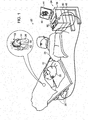
- FIG. 1 is a schematic, pictorial illustration of an automatic calibration system for use with a force-sensing catheter in accordance with an embodiment of the present invention
- FIG. 2 is a schematic side view showing details of the distal portion of the force-sensing catheter, in accordance with an embodiment of the present invention
- FIG. 3 is a flow diagram that illustrates a method of calibration of a force-sensing catheter in accordance with an embodiment of the present invention.
- a minimally invasive probe such as a catheter, which has at least one electrode mounted on its distal tip.
- the electrode is typically operated when the probe is pressed against a body cavity surface, such as the endocardium in the treatment of cardiac arrhythmias. It is important to the user of the catheter or probe, such as the electro-physiologist, to know that there is contact between the catheter and the tissue and to know the amount of force the catheter is asserting on the tissue. Newer force-sensing catheters provide such force measurement feedback to the user.
- the force sensor is typically calibrated during manufacture to produce a reading of zero grams of force when there is no contact between the catheter and another object such as the tissue. Once this calibration is done, and baseline information from the force-sensing catheter has been determined, later measurements from the force sensor can be used to provide a value of the force exerted on the tip of the catheter.
- force sensors in force-sensing catheters use analog components, the sensors are subject to changes in environmental conditions such as temperature and humidity, as well as to changes due to the aging of the components. Such changes may cause the force-sensing catheters to no longer be calibrated to the proper baseline for zero grams of force thereby introducing inaccuracies into the sensed force shown to the user of the catheter.
- the system and method of the present invention provide for an automatic recalibration of the force-sensing catheter in pre-determined auto zero zones. A zeroing zone is detected by determining a plurality of catheter tip positions where the tip is not in contact with tissue.
- ECG electrocardiogram
- impedance signals fluoroscopic, real-time CT or real-time MRI imaging systems and/or an electroanatomic map or a combination of these modalities to determine whether or not there is contact between the tissue and the tip of the catheter. If the system, and alternatively the user, confirms that there is no tissue contact this location is determined to be an auto zero zone location where the force-sensing catheter can be recalibrated so that the baseline reading is zero grams of force, thereby compensating for any calibration drift.
- FIG. 1 is an illustration of a medical system 20 that uses auto zero zone calibration compensation in accordance with an embodiment of the present invention.
- System 20 particularly control console 24, may be based, for example, on the CartoTM systems produced by Biosense Webster, Inc. of Diamond Bar, California.
- System 20 comprises a probe 22, such as an EP ablation or mapping catheter, and a control console 24.
- probe 22 is used for diagnostic or therapeutic treatment, such as for mapping electrical potentials in a heart 26 or for performing ablation of endocardial or other tissue of heart 26.
- diagnostic or therapeutic treatment such as for mapping electrical potentials in a heart 26 or for performing ablation of endocardial or other tissue of heart 26.
- such a probe 22 may have other uses in the heart or other organs or vasculature of a patient.
- An operator 28 such as a cardiologist, electrophysiologist or interventional radiologist inserts probe 22 through the vascular system of a patient 30 so that a distal end 32 of probe 22 enters a chamber of heart 26 (or other body cavity or vasculature). Operator 28 advances probe 22 so that the distal tip 34 of probe 22 engages endocardial tissue at a desired location or locations.
- Probe 22 is typically connected by a suitable connector at its proximal end to console 24.
- Console 24 typically uses magnetic location sensing to determine location coordinates of distal end 32 inside heart 26.
- a driver circuit 36 in console 24 drives magnetic field generators 38 to generate magnetic fields within the body of patient 30.
- the field generators 38 comprise coils, which are placed below the patient's torso at known locations external to the patient 30. These coils generate magnetic fields in a predefined working volume that contains heart 26.
- a magnetic field sensor 62 within distal end 32 of probe 22 (shown in Fig. 2 ) generates electrical signals in response to these magnetic fields.
- a signal processor 40 processes these signals in order to determine the location coordinates of the distal end, typically including both location (x,y,z) and orientation (roll, pitch, yaw) coordinates.
- Signal processor 40 typically comprises a general-purpose computer, with suitable front end and interface circuits for receiving signals from probe 22 and controlling the other components of console 24.
- the processor 40 may be programmed in software to carry out the functions that are described herein.
- the software may be downloaded to console 24 in electronic form, over a network, for example, or it may be provided on tangible media, such as optical, magnetic or electronic memory media. Alternatively, some or all of the functions of processor 40 may be carried out by dedicated or programmable digital hardware components.
- processor 40 drives a display 44 to give operator 28 visual feedback through image 46 regarding the location of distal end 32 in the patient's body, as well as status information and guidance regarding the procedure that is in progress.
- system 20 may comprise an automated mechanism for maneuvering and operating probe 22 within the body of patient 30.
- Such mechanisms are typically capable of controlling both the longitudinal motion (advance/retract) of the catheter and transverse motion (deflection/steering) of the distal end of the catheter.
- Some mechanisms of this sort use DC magnetic fields for this purpose, for example.
- processor 40 generates a control input for controlling the motion of the catheter based on the signals provided by the magnetic field sensor in the catheter. These signals are indicative of both the location of the distal end of the catheter and of force exerted on the distal end, as explained further hereinbelow.
- Processor 40 stores data representing image 46 in a memory 48.
- operator 28 can manipulate image 46 using one or more input devices 50.
- FIG. 1 shows a particular system configuration, other system configurations can also be employed to implement embodiments of the present invention, and are this considered to be within the spirit and the scope of this invention.
- the methods described hereinbelow may be applied using location transducers of the types other than the magnetic field sensor described above, such as impedance based or ultrasonic location sensors.
- location transducer refers to an element mounted on probe 22 which causes console 24 to receive signals indicative of the coordinates of the element.
- the locations transducer may comprise a receiver on the probe that generates a location signal to the control unit based on the energy received by the transducer or it may comprise a transmitter, emitting energy that is sensed by a receiver external to the probe.
- the methods described hereinbelow may similarly be applied to therapeutic and diagnostic applications using not only catheters, but also other types of probes in the heart as well as in other organs and vasculature in the human body.
- FIG. 2 is a schematic sectional view of the distal end 32 of probe 22 in accordance with an embodiment of the present invention. Specifically, FIG. 2 shows the functional elements of the distal end 32of probe 22 used for therapeutic and/or diagnostic activity.
- An electrode 60 e.g. an ablation electrode
- An electrode 60 at the distal tip 34 of the probe 22 is typically made of a metallic material such as a platinum/iridium alloy or another suitable biocompatible metal such as gold or gold alloy.
- multiple electrodes (not shown) along the length of the probe may be used for this purpose, such as a plurality of ring electrodes.
- Location sensor (P) 62 transmits a signal to console 24 that is indicative of the location coordinates of the distal end 32 of probe 22.
- Location sensor 62 may comprise one or more miniature coils, and typically comprises multiple coils oriented along different axes.
- location sensor 62 may comprise wither another type of magnetic sensor, an electrode that serves as a location transducer, or location transducers of other types, such as impedance-based or ultrasonic location sensors.
- FIG. 2 shows a probe with a single location sensor 62, embodiments of the present invention may also utilize proves with more than one location sensor.
- Driver circuit 36 may drive magnetic field generators in the distal end 32 of probe 22 to generate one or more magnetic fields.
- the coils in generator 38 may be configured to sense the fields and generate signals indicative of the amplitude of the components of these magnetic fields.
- Processor 40 then receives and processes these signals in order to determine the location coordinates of the distal end 32 of probe 22 within heart 26.
- Force sensor 64 measures a force applied by distal tip 34 to the endocardial (or other) tissue of the heart 26 by conveying a signal to the console that is indicative of the force exerted by the distal tip 34 on the intra-body tissue.
- the force sensor 64 comprises a magnetic field transmitter and a receiver separated by a spring or helically cut tube in distal end 32. The information received by the processor 40 from the receiver is used to generate an indication of the force based on measuring the deflection of the spring.
- Such a force sensor 64 may be constructed in accordance with U.S. Patent Publication Nos. 2009/0093806 and 2009/0138007 whose disclosures are incorporated by reference herein.
- distal end 32 may comprise some other type of force sensor 64 capable of providing such an indication of the force.
- FIG. 3 depicts flow a diagram that illustrates a method of calibration of a force-sensing catheter in accordance with an embodiment of the present invention.
- the process of calibration and compensation for component drift begins at step 100.
- the probe is positioned (or repositioned) in a body cavity of the patient, more particularly, in the preferred embodiment, a catheter is manipulated so that the distal end is in the body cavity of the patient.
- the catheter preferably includes a force sensor 64 and a location sensor 62.
- a signal from the force sensor 64 is received by processor 40 at step 120. This signal will vary over time as the force sensed at the distal tip 34 of probe 32 varies over time as the tip comes in and out of contact with tissue in the body cavity.
- data or images from one or more sources is input to verify contact of the tip of the catheter with the tissue of the patient.
- this input can be electrocardiogram (ECG) data or impedance taken as an electrical signal form an electrode on probe 32 such as tip electrode 60 or can be image data such as fluoroscopic images, real-time CT-images, real-time magnetic resonance (MRI) images or images or data from an electro-anatomic mapping system.
- ECG electrocardiogram
- MRI magnetic resonance
- the processor 40 may be programmed to automatically recognize tissue contact based on electrical ECG or impedance signals or the processor may request user input based on the visual image data to determine tissue contact.
- the processor 40 may also be programmed to determine tissue contact based on the distance the probe 32 is from reconstructed tissue maps from an electro-anatomic mapping system such as the Carto® system. If the distance (d) is greater than a pre-determined threshold the processor 40 can be programmed to assume that the probe 32 is not in contact with the tissue of the patient. Using either type of decision process, at step 140 it is determined whether the probe 32 has contact with the tissue of the patient. If there is no contact the process branches to step 150 where the force signal taken at step 120 is set as the baseline or "zero" point for future readings, i.e., future force readings use this reading as the offset to determine the number of grams of force based on subsequent force sensor input.
- the system may ask for user input to confirm that the user would like to "re-zero" the readings from the force sensor rather than having this done automatically.
- location data is input from the location sensor 62 on probe 32 providing at least three-dimensional spatial coordinates and preferably three degrees of orientation of the distal tip 34 of probe 32. This location information is then stored at step 170 in a look-up table of auto zero zones for later use.
- the probe may be repositioned as the probes in cardiac and other medical procedures are routinely repositioned during the procedure.
- the location of the probe is continuously monitored and compared to the list of stored zeroing zone locations in the table created at step 170. If the processor 40 determines at step 190 that the probe 32 is in a location equivalent to one in the zeroing zone table then the force signal at that location will again be used as the baseline reading, i.e., the force reading reported to the user will be zero for the force signal input from force sensor 64 in probe 32. In this manner, the force sensing probe will be automatically recalibrated each time the location of the probe enters one of the stored zeroing zone locations.
- the signal from the force sensor will be input along with the verification data and/or images at step 130 and the tissue contact verification query will be reiterated at step 140.
- tissue contact is determined at step 140, the input from the force sensor 64 will be used to determine a force reading usually displayed on display 44 to the operator 28.
- the force reading is usually displayed in grams but may be displayed in other units of measurement.
Landscapes
- Life Sciences & Earth Sciences (AREA)
- Health & Medical Sciences (AREA)
- Engineering & Computer Science (AREA)
- Physics & Mathematics (AREA)
- Molecular Biology (AREA)
- Surgery (AREA)
- Pathology (AREA)
- Biomedical Technology (AREA)
- Heart & Thoracic Surgery (AREA)
- Medical Informatics (AREA)
- Veterinary Medicine (AREA)
- Biophysics (AREA)
- Animal Behavior & Ethology (AREA)
- General Health & Medical Sciences (AREA)
- Public Health (AREA)
- Human Computer Interaction (AREA)
- General Physics & Mathematics (AREA)
- Measurement And Recording Of Electrical Phenomena And Electrical Characteristics Of The Living Body (AREA)
- Surgical Instruments (AREA)
- Magnetic Resonance Imaging Apparatus (AREA)
Priority Applications (1)
| Application Number | Priority Date | Filing Date | Title |
|---|---|---|---|
| EP13199310.7A EP2712548B1 (fr) | 2011-09-30 | 2012-09-28 | Étalonnage in vivo de cathéters de mesure de force de contact |
Applications Claiming Priority (1)
| Application Number | Priority Date | Filing Date | Title |
|---|---|---|---|
| US13/249,384 US10791950B2 (en) | 2011-09-30 | 2011-09-30 | In-vivo calibration of contact force-sensing catheters using auto zero zones |
Related Child Applications (2)
| Application Number | Title | Priority Date | Filing Date |
|---|---|---|---|
| EP13199310.7A Division EP2712548B1 (fr) | 2011-09-30 | 2012-09-28 | Étalonnage in vivo de cathéters de mesure de force de contact |
| EP13199310.7A Division-Into EP2712548B1 (fr) | 2011-09-30 | 2012-09-28 | Étalonnage in vivo de cathéters de mesure de force de contact |
Publications (2)
| Publication Number | Publication Date |
|---|---|
| EP2574278A2 true EP2574278A2 (fr) | 2013-04-03 |
| EP2574278A3 EP2574278A3 (fr) | 2014-02-26 |
Family
ID=47046353
Family Applications (2)
| Application Number | Title | Priority Date | Filing Date |
|---|---|---|---|
| EP12186529.9A Ceased EP2574278A3 (fr) | 2011-09-30 | 2012-09-28 | Étalonnage in vivo de cathéters de mesure de force de contact |
| EP13199310.7A Active EP2712548B1 (fr) | 2011-09-30 | 2012-09-28 | Étalonnage in vivo de cathéters de mesure de force de contact |
Family Applications After (1)
| Application Number | Title | Priority Date | Filing Date |
|---|---|---|---|
| EP13199310.7A Active EP2712548B1 (fr) | 2011-09-30 | 2012-09-28 | Étalonnage in vivo de cathéters de mesure de force de contact |
Country Status (7)
| Country | Link |
|---|---|
| US (1) | US10791950B2 (fr) |
| EP (2) | EP2574278A3 (fr) |
| JP (1) | JP6071387B2 (fr) |
| CN (1) | CN103027695B (fr) |
| AU (1) | AU2012227338B2 (fr) |
| CA (1) | CA2791329A1 (fr) |
| IL (1) | IL222026B (fr) |
Cited By (7)
| Publication number | Priority date | Publication date | Assignee | Title |
|---|---|---|---|---|
| EP2777585A1 (fr) * | 2013-03-12 | 2014-09-17 | Biosense Webster (Israel), Ltd. | Dispositif de retour d'effort pour cathéters |
| EP2842508A1 (fr) * | 2013-08-27 | 2015-03-04 | Biosense Webster (Israel), Ltd. | Détermination d'un état sans contact pour cathéter |
| EP2842507A1 (fr) * | 2013-08-27 | 2015-03-04 | Biosense Webster (Israel), Ltd. | Détermination d'absence de contact pour cathéter |
| WO2015143061A1 (fr) * | 2014-03-18 | 2015-09-24 | Boston Scientific Scimed, Inc. | Système d'électrophysiologie |
| EP2959856A1 (fr) * | 2014-06-26 | 2015-12-30 | Biosense Webster (Israel) Ltd. | Visualisation de mise à zéro manuelle d'assistance |
| US11589768B2 (en) | 2014-10-13 | 2023-02-28 | Boston Scientific Scimed Inc. | Tissue diagnosis and treatment using mini-electrodes |
| US11684416B2 (en) | 2009-02-11 | 2023-06-27 | Boston Scientific Scimed, Inc. | Insulated ablation catheter devices and methods of use |
Families Citing this family (66)
| Publication number | Priority date | Publication date | Assignee | Title |
|---|---|---|---|---|
| US8784336B2 (en) | 2005-08-24 | 2014-07-22 | C. R. Bard, Inc. | Stylet apparatuses and methods of manufacture |
| US8388546B2 (en) | 2006-10-23 | 2013-03-05 | Bard Access Systems, Inc. | Method of locating the tip of a central venous catheter |
| US7794407B2 (en) | 2006-10-23 | 2010-09-14 | Bard Access Systems, Inc. | Method of locating the tip of a central venous catheter |
| US10449330B2 (en) | 2007-11-26 | 2019-10-22 | C. R. Bard, Inc. | Magnetic element-equipped needle assemblies |
| CN101925333B (zh) | 2007-11-26 | 2014-02-12 | C·R·巴德股份有限公司 | 用于脉管系统内的导管放置的集成系统 |
| US9649048B2 (en) | 2007-11-26 | 2017-05-16 | C. R. Bard, Inc. | Systems and methods for breaching a sterile field for intravascular placement of a catheter |
| US10751509B2 (en) | 2007-11-26 | 2020-08-25 | C. R. Bard, Inc. | Iconic representations for guidance of an indwelling medical device |
| US8849382B2 (en) | 2007-11-26 | 2014-09-30 | C. R. Bard, Inc. | Apparatus and display methods relating to intravascular placement of a catheter |
| US9521961B2 (en) | 2007-11-26 | 2016-12-20 | C. R. Bard, Inc. | Systems and methods for guiding a medical instrument |
| US12440238B2 (en) | 2007-11-26 | 2025-10-14 | C. R. Bard, Inc. | Apparatus for use with needle insertion guidance system |
| US8781555B2 (en) | 2007-11-26 | 2014-07-15 | C. R. Bard, Inc. | System for placement of a catheter including a signal-generating stylet |
| US10524691B2 (en) | 2007-11-26 | 2020-01-07 | C. R. Bard, Inc. | Needle assembly including an aligned magnetic element |
| US9901714B2 (en) | 2008-08-22 | 2018-02-27 | C. R. Bard, Inc. | Catheter assembly including ECG sensor and magnetic assemblies |
| US8437833B2 (en) | 2008-10-07 | 2013-05-07 | Bard Access Systems, Inc. | Percutaneous magnetic gastrostomy |
| RU2549998C2 (ru) | 2009-06-12 | 2015-05-10 | Бард Аксесс Системс, Инк. | Способ позиционирования конца катетера |
| US9532724B2 (en) | 2009-06-12 | 2017-01-03 | Bard Access Systems, Inc. | Apparatus and method for catheter navigation using endovascular energy mapping |
| WO2011019760A2 (fr) | 2009-08-10 | 2011-02-17 | Romedex International Srl | Dispositifs et procédés pour électrographie endovasculaire |
| CN102665541B (zh) | 2009-09-29 | 2016-01-13 | C·R·巴德股份有限公司 | 与用于导管的血管内放置的设备一起使用的探针 |
| WO2011097312A1 (fr) | 2010-02-02 | 2011-08-11 | C.R. Bard, Inc. | Appareil et procédé destinés à la navigation d'un cathéter et à la localisation d'une pointe |
| CA3054544C (fr) | 2010-05-28 | 2022-01-04 | C.R. Bard, Inc. | Appareil convenant a une utilisation avec un systeme de guidage d'insertion d'aiguille |
| EP2912999B1 (fr) | 2010-05-28 | 2022-06-29 | C. R. Bard, Inc. | Appareil destiné à être utilisé avec un système de guidage d'insertion d'aiguille |
| BR112013002431B1 (pt) | 2010-08-20 | 2021-06-29 | C.R. Bard, Inc | Sistema para a reconfirmação da posição de um cateter no interior de um paciente |
| CN103189009B (zh) | 2010-10-29 | 2016-09-07 | C·R·巴德股份有限公司 | 医疗设备的生物阻抗辅助放置 |
| AU2012278809B2 (en) | 2011-07-06 | 2016-09-29 | C.R. Bard, Inc. | Needle length determination and calibration for insertion guidance system |
| ES2727868T3 (es) | 2011-09-22 | 2019-10-21 | Univ George Washington | Sistemas para visualizar el tejido ablacionado |
| WO2013044182A1 (fr) | 2011-09-22 | 2013-03-28 | The George Washington University | Systèmes et procédés de visualisation de tissu enlevé |
| US10448860B2 (en) * | 2013-03-13 | 2019-10-22 | The Johns Hopkins University | System and method for bioelectric localization and navigation of interventional medical devices |
| JP6737705B2 (ja) | 2013-11-14 | 2020-08-12 | ザ・ジョージ・ワシントン・ユニバーシティThe George Washingtonuniversity | 損傷部位の深さを決定するシステムの動作方法及び心臓組織の画像を生成するシステム |
| WO2015077474A1 (fr) | 2013-11-20 | 2015-05-28 | The George Washington University | Systèmes et procédés d'analyse hyperspectrale de tissus cardiaques |
| CN105979868B (zh) | 2014-02-06 | 2020-03-10 | C·R·巴德股份有限公司 | 用于血管内装置的导向和放置的系统和方法 |
| US9974597B2 (en) | 2014-03-19 | 2018-05-22 | Boston Scientific Scimed, Inc. | Systems and methods for assessing and treating tissue |
| JP6771731B2 (ja) | 2014-11-03 | 2020-10-21 | 460メディカル・インコーポレイテッド460Medical, Inc. | 接触性評価システム及び方法 |
| CN113143440B (zh) | 2014-11-03 | 2024-07-30 | 乔治华盛顿大学 | 用于损伤评估的系统和方法 |
| EP3220828B1 (fr) | 2014-11-18 | 2021-12-22 | C.R. Bard, Inc. | Système d'imagerie à ultrasons ayant une présentation d'image automatique |
| WO2016081321A2 (fr) | 2014-11-18 | 2016-05-26 | C.R. Bard, Inc. | Système d'imagerie à ultrasons avec présentation d'image automatique |
| US10973584B2 (en) | 2015-01-19 | 2021-04-13 | Bard Access Systems, Inc. | Device and method for vascular access |
| US9833161B2 (en) * | 2015-02-09 | 2017-12-05 | Biosense Webster (Israel) Ltd. | Basket catheter with far-field electrode |
| WO2016179563A1 (fr) | 2015-05-07 | 2016-11-10 | Ecom Medical, Inc. | Systèmes et procédés d'acquisition d'ecg interne |
| WO2016210325A1 (fr) | 2015-06-26 | 2016-12-29 | C.R. Bard, Inc. | Interface de raccord pour système de positionnement de cathéter basé sur ecg |
| US10779904B2 (en) | 2015-07-19 | 2020-09-22 | 460Medical, Inc. | Systems and methods for lesion formation and assessment |
| US11033201B2 (en) * | 2015-09-04 | 2021-06-15 | Biosense Webster (Israel) Ltd. | Inconsistent field-based patch location coordinate correction |
| US11051867B2 (en) * | 2015-09-18 | 2021-07-06 | Adagio Medical, Inc. | Tissue contact verification system |
| US10507056B2 (en) | 2015-10-01 | 2019-12-17 | General Electric Company | System and method for representation and visualization of catheter applied force and power |
| US11000207B2 (en) | 2016-01-29 | 2021-05-11 | C. R. Bard, Inc. | Multiple coil system for tracking a medical device |
| CN109069840B (zh) | 2016-02-04 | 2022-03-15 | 心脏起搏器股份公司 | 具有用于无引线心脏装置的力传感器的递送系统 |
| US10799181B2 (en) | 2016-08-13 | 2020-10-13 | Ecom Medical, Inc. | Medical devices with layered conductive elements and methods for manufacturing the same |
| US10219716B2 (en) * | 2017-06-01 | 2019-03-05 | Biosense Webster (Israel) Ltd. | Using a piecewise-linear model of a catheter arm to identify contact with tissue |
| US11219488B2 (en) * | 2018-04-25 | 2022-01-11 | Biosense Webster (Israel) Ltd. | Determining catheter touch location using force-vector information |
| CN112867443B (zh) | 2018-10-16 | 2024-04-26 | 巴德阿克塞斯系统股份有限公司 | 用于建立电连接的安全装备连接系统及其方法 |
| US10973588B2 (en) * | 2018-10-24 | 2021-04-13 | Biosense Webster (Israel) Ltd. | On-the-fly calibration for catheter location and orientation |
| US12544101B2 (en) | 2019-01-30 | 2026-02-10 | Bard Access Systems, Inc. | Systems and methods for tracking medical devices |
| US11950964B2 (en) * | 2019-02-15 | 2024-04-09 | Gyrus Acmi, Inc. | Medical device with mitigation for tissue perforation |
| US11426126B2 (en) | 2019-05-23 | 2022-08-30 | Biosense Webster (Israel) Ltd. | Indicating electrode contact |
| US11896286B2 (en) * | 2019-08-09 | 2024-02-13 | Biosense Webster (Israel) Ltd. | Magnetic and optical catheter alignment |
| US12076081B2 (en) | 2020-01-08 | 2024-09-03 | 460Medical, Inc. | Systems and methods for optical interrogation of ablation lesions |
| US12539043B2 (en) | 2020-05-27 | 2026-02-03 | The George Washington University | Lesion visualization using dual wavelength approach |
| US20220160251A1 (en) * | 2020-11-25 | 2022-05-26 | Biosense Webster (Israel) Ltd. | Acquisition guidance for electroanatomical mapping |
| US12484959B2 (en) | 2020-12-16 | 2025-12-02 | Biosense Webster (Israel) Ltd. | Accurate tissue proximity |
| US11864844B2 (en) | 2020-12-22 | 2024-01-09 | Biosense Webster (Israel) Ltd. | Distal end assembly guidance |
| US20230088042A1 (en) | 2021-09-20 | 2023-03-23 | Biosense Webster (Israel) Ltd. | Ablating a region of patient organ using selected ablation electrodes of an expandable catheter |
| US20230157569A1 (en) | 2021-11-22 | 2023-05-25 | Biosense Webster (Israel) Ltd. | Mapping System with Real Time Electrogram Overlay |
| US20230210437A1 (en) | 2021-12-30 | 2023-07-06 | Biosense Webster (Israel) Ltd. | Intuitive Mapping System |
| CN115245387B (zh) * | 2022-09-22 | 2022-12-20 | 深圳市爱博医疗机器人有限公司 | 细长型医疗器械递送系统、递送方法、设备及介质 |
| US12370078B2 (en) | 2023-10-27 | 2025-07-29 | NEXT Life Sciences, Inc. | Apparatus and method for delivery and/or removal of occlusions in the body |
| WO2026009184A1 (fr) * | 2024-07-05 | 2026-01-08 | Biosense Webster (Israel) Ltd. | Bras robotique pour étalonner une jauge de force dans un gabarit d'étalonnage |
| CN121242737B (zh) * | 2025-12-05 | 2026-03-24 | 北京埃斯顿医疗科技有限公司 | 配准探针装置及特征点位置信息采集方法 |
Citations (13)
| Publication number | Priority date | Publication date | Assignee | Title |
|---|---|---|---|---|
| US5391199A (en) | 1993-07-20 | 1995-02-21 | Biosense, Inc. | Apparatus and method for treating cardiac arrhythmias |
| WO1996005768A1 (fr) | 1994-08-19 | 1996-02-29 | Biosense, Inc. | Systemes medicaux de diagnostic, de traitement et d'imagerie |
| US6239724B1 (en) | 1997-12-30 | 2001-05-29 | Remon Medical Technologies, Ltd. | System and method for telemetrically providing intrabody spatial position |
| US6332089B1 (en) | 1996-02-15 | 2001-12-18 | Biosense, Inc. | Medical procedures and apparatus using intrabody probes |
| US20020065455A1 (en) | 1995-01-24 | 2002-05-30 | Shlomo Ben-Haim | Medical diagnosis, treatment and imaging systems |
| US6484118B1 (en) | 2000-07-20 | 2002-11-19 | Biosense, Inc. | Electromagnetic position single axis system |
| US20030120150A1 (en) | 2001-12-21 | 2003-06-26 | Assaf Govari | Wireless position sensor |
| US6618612B1 (en) | 1996-02-15 | 2003-09-09 | Biosense, Inc. | Independently positionable transducers for location system |
| US20040068178A1 (en) | 2002-09-17 | 2004-04-08 | Assaf Govari | High-gradient recursive locating system |
| US20070100332A1 (en) | 2005-10-27 | 2007-05-03 | St. Jude Medical, Atrial Fibrillation Division, Inc. | Systems and methods for electrode contact assessment |
| US20090093806A1 (en) | 2007-10-08 | 2009-04-09 | Assaf Govari | Catheter with pressure sensing |
| US20090138007A1 (en) | 2007-10-08 | 2009-05-28 | Assaf Govari | High-sensitivity pressure-sensing probe |
| EP2332461A1 (fr) * | 2009-12-08 | 2011-06-15 | Biosense Webster (Israel), Ltd | Cartographie de données de sonde utilisant des informations de contact |
Family Cites Families (18)
| Publication number | Priority date | Publication date | Assignee | Title |
|---|---|---|---|---|
| JPH0843220A (ja) * | 1994-07-30 | 1996-02-16 | Sanyo Electric Co Ltd | 力覚センサの零点自動補正回路 |
| US20030212393A1 (en) * | 1996-01-05 | 2003-11-13 | Knowlton Edward W. | Handpiece with RF electrode and non-volatile memory |
| US6266551B1 (en) * | 1996-02-15 | 2001-07-24 | Biosense, Inc. | Catheter calibration and usage monitoring system |
| US6123699A (en) | 1997-09-05 | 2000-09-26 | Cordis Webster, Inc. | Omni-directional steerable catheter |
| US8175680B2 (en) * | 2001-11-09 | 2012-05-08 | Boston Scientific Scimed, Inc. | Systems and methods for guiding catheters using registered images |
| US8075498B2 (en) | 2005-03-04 | 2011-12-13 | Endosense Sa | Medical apparatus system having optical fiber load sensing capability |
| US7337085B2 (en) | 2005-06-10 | 2008-02-26 | Qsi Corporation | Sensor baseline compensation in a force-based touch device |
| US8052621B2 (en) | 2006-02-22 | 2011-11-08 | Hansen Medical, Inc. | Method of sensing forces on a working instrument |
| RU2417732C2 (ru) * | 2006-10-10 | 2011-05-10 | Байосенс Уэбстер, Инк. | Катетер для картрирования пищевода |
| US20090076476A1 (en) | 2007-08-15 | 2009-03-19 | Hansen Medical, Inc. | Systems and methods employing force sensing for mapping intra-body tissue |
| CN201108496Y (zh) * | 2007-12-11 | 2008-09-03 | 微创医疗器械(上海)有限公司 | 电生理电极导管及相应设备 |
| US8343096B2 (en) * | 2008-03-27 | 2013-01-01 | St. Jude Medical, Atrial Fibrillation Division, Inc. | Robotic catheter system |
| US9101734B2 (en) * | 2008-09-09 | 2015-08-11 | Biosense Webster, Inc. | Force-sensing catheter with bonded center strut |
| US8083691B2 (en) | 2008-11-12 | 2011-12-27 | Hansen Medical, Inc. | Apparatus and method for sensing force |
| JP5786108B2 (ja) * | 2009-05-08 | 2015-09-30 | セント・ジュード・メディカル・ルクセンブルク・ホールディング・エスエーアールエル | カテーテルアブレーション治療において病変部サイズを制御するための方法および装置 |
| CN102625669B (zh) | 2009-06-08 | 2015-09-23 | 核磁共振成像介入技术有限公司 | 能够近实时地跟踪和生成柔性体内装置的动态可视化的mri导向的介入系统 |
| US8374670B2 (en) * | 2010-01-22 | 2013-02-12 | Biosense Webster, Inc. | Catheter having a force sensing distal tip |
| US20120158011A1 (en) * | 2010-12-16 | 2012-06-21 | Sandhu Kulbir S | Proximity sensor interface in a robotic catheter system |
-
2011
- 2011-09-30 US US13/249,384 patent/US10791950B2/en active Active
-
2012
- 2012-09-20 IL IL222026A patent/IL222026B/en active IP Right Grant
- 2012-09-26 AU AU2012227338A patent/AU2012227338B2/en not_active Ceased
- 2012-09-27 CA CA2791329A patent/CA2791329A1/fr not_active Abandoned
- 2012-09-28 EP EP12186529.9A patent/EP2574278A3/fr not_active Ceased
- 2012-09-28 JP JP2012216130A patent/JP6071387B2/ja active Active
- 2012-09-28 EP EP13199310.7A patent/EP2712548B1/fr active Active
- 2012-10-08 CN CN201210378085.8A patent/CN103027695B/zh active Active
Patent Citations (15)
| Publication number | Priority date | Publication date | Assignee | Title |
|---|---|---|---|---|
| US5391199A (en) | 1993-07-20 | 1995-02-21 | Biosense, Inc. | Apparatus and method for treating cardiac arrhythmias |
| WO1996005768A1 (fr) | 1994-08-19 | 1996-02-29 | Biosense, Inc. | Systemes medicaux de diagnostic, de traitement et d'imagerie |
| US20020065455A1 (en) | 1995-01-24 | 2002-05-30 | Shlomo Ben-Haim | Medical diagnosis, treatment and imaging systems |
| US6690963B2 (en) | 1995-01-24 | 2004-02-10 | Biosense, Inc. | System for determining the location and orientation of an invasive medical instrument |
| US6332089B1 (en) | 1996-02-15 | 2001-12-18 | Biosense, Inc. | Medical procedures and apparatus using intrabody probes |
| US6618612B1 (en) | 1996-02-15 | 2003-09-09 | Biosense, Inc. | Independently positionable transducers for location system |
| US20020165448A1 (en) * | 1997-05-14 | 2002-11-07 | Shlomo Ben-Haim | Medical diagnosis, treatment and imaging systems |
| US6239724B1 (en) | 1997-12-30 | 2001-05-29 | Remon Medical Technologies, Ltd. | System and method for telemetrically providing intrabody spatial position |
| US6484118B1 (en) | 2000-07-20 | 2002-11-19 | Biosense, Inc. | Electromagnetic position single axis system |
| US20030120150A1 (en) | 2001-12-21 | 2003-06-26 | Assaf Govari | Wireless position sensor |
| US20040068178A1 (en) | 2002-09-17 | 2004-04-08 | Assaf Govari | High-gradient recursive locating system |
| US20070100332A1 (en) | 2005-10-27 | 2007-05-03 | St. Jude Medical, Atrial Fibrillation Division, Inc. | Systems and methods for electrode contact assessment |
| US20090093806A1 (en) | 2007-10-08 | 2009-04-09 | Assaf Govari | Catheter with pressure sensing |
| US20090138007A1 (en) | 2007-10-08 | 2009-05-28 | Assaf Govari | High-sensitivity pressure-sensing probe |
| EP2332461A1 (fr) * | 2009-12-08 | 2011-06-15 | Biosense Webster (Israel), Ltd | Cartographie de données de sonde utilisant des informations de contact |
Cited By (20)
| Publication number | Priority date | Publication date | Assignee | Title |
|---|---|---|---|---|
| US11684416B2 (en) | 2009-02-11 | 2023-06-27 | Boston Scientific Scimed, Inc. | Insulated ablation catheter devices and methods of use |
| US9486272B2 (en) | 2013-03-12 | 2016-11-08 | Biosense Webster (Israel) Ltd. | Force feedback device and method for catheters |
| US10182857B2 (en) | 2013-03-12 | 2019-01-22 | Biosense Webster (Israel) Ltd. | Force feedback device and method for catheters |
| US11317959B2 (en) | 2013-03-12 | 2022-05-03 | Biosense Webster (Israel) Ltd. | Force feedback device and method for catheters |
| US10179018B2 (en) | 2013-03-12 | 2019-01-15 | Biosense Webster (Israel) Ltd. | Force feedback device and method for catheters |
| EP2777585A1 (fr) * | 2013-03-12 | 2014-09-17 | Biosense Webster (Israel), Ltd. | Dispositif de retour d'effort pour cathéters |
| CN104414739A (zh) * | 2013-08-27 | 2015-03-18 | 韦伯斯特生物官能(以色列)有限公司 | 确定导管的非接触状态 |
| US9949664B2 (en) | 2013-08-27 | 2018-04-24 | Biosense Webster (Israel) Ltd. | Determining non-contact state for a catheter |
| US9974608B2 (en) | 2013-08-27 | 2018-05-22 | Biosense Webster (Israel) Ltd. | Determining absence of contact for a catheter |
| EP2842507A1 (fr) * | 2013-08-27 | 2015-03-04 | Biosense Webster (Israel), Ltd. | Détermination d'absence de contact pour cathéter |
| AU2014215987B2 (en) * | 2013-08-27 | 2019-05-30 | Biosense Webster (Israel) Ltd. | Determining absence of contact for a catheter |
| EP2842508A1 (fr) * | 2013-08-27 | 2015-03-04 | Biosense Webster (Israel), Ltd. | Détermination d'un état sans contact pour cathéter |
| CN106102569A (zh) * | 2014-03-18 | 2016-11-09 | 波士顿科学医学有限公司 | 电生理系统 |
| WO2015143061A1 (fr) * | 2014-03-18 | 2015-09-24 | Boston Scientific Scimed, Inc. | Système d'électrophysiologie |
| EP2959856A1 (fr) * | 2014-06-26 | 2015-12-30 | Biosense Webster (Israel) Ltd. | Visualisation de mise à zéro manuelle d'assistance |
| AU2019204909B2 (en) * | 2014-06-26 | 2020-10-22 | Biosense Webster (Israel) Ltd. | Assistive manual zeroing visualization |
| AU2015203335B2 (en) * | 2014-06-26 | 2019-07-11 | Biosense Webster (Israel) Ltd. | Assistive manual zeroing visualization |
| US10327744B2 (en) | 2014-06-26 | 2019-06-25 | Biosense Webster (Israel) Ltd | Assistive manual zeroing visualization |
| US11771407B2 (en) | 2014-06-26 | 2023-10-03 | Biosense Webster (Israel) Ltd. | Assistive manual zeroing visualization |
| US11589768B2 (en) | 2014-10-13 | 2023-02-28 | Boston Scientific Scimed Inc. | Tissue diagnosis and treatment using mini-electrodes |
Also Published As
| Publication number | Publication date |
|---|---|
| EP2712548A2 (fr) | 2014-04-02 |
| CN103027695A (zh) | 2013-04-10 |
| JP2013078582A (ja) | 2013-05-02 |
| EP2712548A3 (fr) | 2017-07-05 |
| CN103027695B (zh) | 2017-06-20 |
| CA2791329A1 (fr) | 2013-03-30 |
| EP2712548B1 (fr) | 2022-08-31 |
| EP2574278A3 (fr) | 2014-02-26 |
| IL222026B (en) | 2020-01-30 |
| AU2012227338A1 (en) | 2013-04-18 |
| US10791950B2 (en) | 2020-10-06 |
| JP6071387B2 (ja) | 2017-02-01 |
| US20130085416A1 (en) | 2013-04-04 |
| AU2012227338B2 (en) | 2015-08-13 |
Similar Documents
| Publication | Publication Date | Title |
|---|---|---|
| EP2712548B1 (fr) | Étalonnage in vivo de cathéters de mesure de force de contact | |
| US8808273B2 (en) | Electrophysiology catheter with mechanical use limiter | |
| CN111973272B (zh) | 指示电极接触 | |
| EP2848191B1 (fr) | Dispositif pour le mappage des contractions prématurées auriculaires et ventriculaires au cours du rythme sinusal | |
| AU2013256142B2 (en) | Catheter having two-piece connector for a split handle assembly | |
| EP4183342B1 (fr) | Système de mappage avec superposition d'électrogrammes en temps réel | |
| CN115804606A (zh) | 远侧端部组件指南 | |
| CN113425253A (zh) | 起搏诱导电激活分级 | |
| EP4122413A1 (fr) | Proximité de tissus précise | |
| US20240350770A1 (en) | Managing medical device equipment by online magnetic calibration of a catheter | |
| IL315787A (en) | Contact force assessment of expanding assembly in catheter |
Legal Events
| Date | Code | Title | Description |
|---|---|---|---|
| PUAI | Public reference made under article 153(3) epc to a published international application that has entered the european phase |
Free format text: ORIGINAL CODE: 0009012 |
|
| AK | Designated contracting states |
Kind code of ref document: A2 Designated state(s): AL AT BE BG CH CY CZ DE DK EE ES FI FR GB GR HR HU IE IS IT LI LT LU LV MC MK MT NL NO PL PT RO RS SE SI SK SM TR |
|
| AX | Request for extension of the european patent |
Extension state: BA ME |
|
| RIC1 | Information provided on ipc code assigned before grant |
Ipc: A61B 5/042 20060101ALI20131001BHEP Ipc: A61B 5/06 20060101AFI20131001BHEP Ipc: A61N 1/05 20060101ALN20131001BHEP Ipc: A61B 18/14 20060101ALI20131001BHEP Ipc: A61M 25/00 20060101ALN20131001BHEP |
|
| PUAL | Search report despatched |
Free format text: ORIGINAL CODE: 0009013 |
|
| AK | Designated contracting states |
Kind code of ref document: A3 Designated state(s): AL AT BE BG CH CY CZ DE DK EE ES FI FR GB GR HR HU IE IS IT LI LT LU LV MC MK MT NL NO PL PT RO RS SE SI SK SM TR |
|
| AX | Request for extension of the european patent |
Extension state: BA ME |
|
| RIC1 | Information provided on ipc code assigned before grant |
Ipc: A61M 25/00 20060101ALN20140120BHEP Ipc: A61B 5/042 20060101ALI20140120BHEP Ipc: A61B 5/06 20060101AFI20140120BHEP Ipc: A61B 18/14 20060101ALI20140120BHEP Ipc: A61N 1/05 20060101ALN20140120BHEP |
|
| 17P | Request for examination filed |
Effective date: 20140811 |
|
| RBV | Designated contracting states (corrected) |
Designated state(s): AL AT BE BG CH CY CZ DE DK EE ES FI FR GB GR HR HU IE IS IT LI LT LU LV MC MK MT NL NO PL PT RO RS SE SI SK SM TR |
|
| 17Q | First examination report despatched |
Effective date: 20140901 |
|
| STAA | Information on the status of an ep patent application or granted ep patent |
Free format text: STATUS: THE APPLICATION HAS BEEN REFUSED |
|
| 18R | Application refused |
Effective date: 20190114 |