EP2575187B1 - Commutateur supraconductif - Google Patents
Commutateur supraconductif Download PDFInfo
- Publication number
- EP2575187B1 EP2575187B1 EP12184948.3A EP12184948A EP2575187B1 EP 2575187 B1 EP2575187 B1 EP 2575187B1 EP 12184948 A EP12184948 A EP 12184948A EP 2575187 B1 EP2575187 B1 EP 2575187B1
- Authority
- EP
- European Patent Office
- Prior art keywords
- magnetic flux
- switch
- superconductor
- high voltage
- reluctance
- Prior art date
- Legal status (The legal status is an assumption and is not a legal conclusion. Google has not performed a legal analysis and makes no representation as to the accuracy of the status listed.)
- Not-in-force
Links
Images


Classifications
-
- H—ELECTRICITY
- H10—SEMICONDUCTOR DEVICES; ELECTRIC SOLID-STATE DEVICES NOT OTHERWISE PROVIDED FOR
- H10N—ELECTRIC SOLID-STATE DEVICES NOT OTHERWISE PROVIDED FOR
- H10N60/00—Superconducting devices
- H10N60/30—Devices switchable between superconducting and normal states
- H10N60/35—Cryotrons
- H10N60/355—Power cryotrons
-
- H—ELECTRICITY
- H10—SEMICONDUCTOR DEVICES; ELECTRIC SOLID-STATE DEVICES NOT OTHERWISE PROVIDED FOR
- H10N—ELECTRIC SOLID-STATE DEVICES NOT OTHERWISE PROVIDED FOR
- H10N60/00—Superconducting devices
- H10N60/01—Manufacture or treatment
- H10N60/0268—Manufacture or treatment of devices comprising copper oxide
Definitions
- This invention relates to a superconducting switch.
- the superconducting switch is for use in a high voltage electrical system.
- the superconducting switch is used to provide an isolation switch.
- the isolating switch is particularly, though not exclusively, well suited to providing a failsafe isolation switch.
- One such technology is the creation of a superconducting system to provide the electrical power to the fan units so as to try and reduce the weight of the electrical system.
- a superconductor conducts electricity without loss, that is, with zero electrical resistance.
- current state of the art superconductor materials must be maintained below a critical temperature, current density and magnetic field. If any of the critical limits are exceeded then the superconductor is said to "quench”, at which point it reverts to its "normal” electrical (and magnetic) properties.
- the critical temperature is 93K; the upper critical magnetic flux density field is 120 T for a field perpendicular and 250 T for a field parallel to the copper oxide planes, and the critical current density is 30 GA m -2 .
- the critical current density reduces with applied magnetic field and also will reduce as the temperature approaches the critical temperature.
- the quenched electrical resistance can be very high.
- an applied magnetic field is used to control the superconducting state of a superconductor and thus switch it between operating points having high and low (zero) resistance.
- HTS thin film high temperature superconductor
- This variance of resistance may be utilized to develop a transistor-like device which can be combined to form logic gates.
- a thin film magnet core is constructed in this integrated form to concentrate the magnetic field applied to the HTS material, thus reducing drive current requirements.
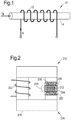
- FIG. 1 shows the basic concept for a cryotron 10 which uses an electrical coil 12 wrapped around a length of superconductor 14.
- the superconductor current, Ig flows until a direct current, Ic, of sufficient magnitude to produce a quenching magnetic field flows through the electrical coil 10. Once this occurs, the resistance increases until there is negligible current flow, thereby providing a switch.
- the present invention seeks to provide a superconducting switch of general application but which may preferably be used in a distributed propulsion system of an aircraft.
- a high voltage superconductor switch comprising: a length of superconductor having a switching portion located within an air gap; a magnetic circuit including at least one flux guide having ferrite pole pieces defining an air gap in which a switching portion of a superconductor can reside in use and at least one primary magnetic flux source located within the circuit so as to provide a quenching magnetic field across the air gap via the ferrite pole pieces characterised in that: the superconductor is located within a cryostat having at least one wall and the ferrite pole pieces pass through the at least one wall.
- the magnetic circuit can include one or more ferromagnetic or ferrimagnetic portions. In one embodiment, substantially all of the magnetic flux guide is made from ferrite.
- the superconductor can have a circular cross-section.
- the cross-section may be polygonal.
- the cross-section may be rectangular.
- the superconductor can be surrounded by electrical insulation taken from the non-exclusive group comprising ceramics or plastics or glass cloth.
- the superconductor can include thermal insulation taken from the non-exclusive group comprising ceramics or plastics or glass cloth.
- the magnetic flux guide can include a U-shaped core or a C-shaped core.
- high voltage is taken to mean a voltage above 1500V DC or 1000 V AC rms between electrical conductors or between one or more electrical conductors and Earth (ground).
- the magnetic flux source may be located outside cryostat. In another embodiment, the magnetic flux source may be located within the cryostat.
- the magnetic flux guide may be an electromagnet.
- the magnetic flux source may be a permanent magnet.
- the electromagnet may be selectively energised.
- the electromagnet may comprise a superconductor.
- the permanent magnet may be a superconductor.
- the permanent magnet may be magnetised by one of the known flux pumping techniques.
- the high voltage superconductor switch may further comprise a selectively operable secondary magnetic flux source positioned to induce magnetic flux within the magnetic flux guide so as to disrupt or divert the magnetic flux generated by the primary magnetic source thereby reducing or removing the magnetic field produced across the air gap.
- the selectively operable secondary magnetic flux source may be an electromagnet.
- the electromagnet may be coupled to a direct current electrical supply. The coupling to the direct current electrical supply may be via a switch.
- the electromagnet may include a superconductor.
- the electromagnet may be configured to provide a magnetic field within the magnetic flux guide which opposes and cancels the magnetic field produced by the primary magnetic flux source.
- the secondary magnetic flux source may be configured to saturate the magnetic material thereby increasing the magnetic reluctance of a portion of the magnetic circuit.
- the secondary magnetic flux source may be in magnetic series with the primary magnetic flux source.
- the magnetic flux guide may include a diverting flux guide path in parallel to the primary magnetic flux source.
- the secondary magnetic flux source may be located along the diverting magnetic flux guide path.
- the diverting magnetic flux guide path may include a diverting air gap.
- the diverting air gap may have a larger reluctance than the air gap between the ferrite pole pieces.
- a magnetic field is preferentially set up across the superconductor rather than the diverting air gap.
- the secondary magnetic flux guide may be arranged so as to saturate the magnetic flux guide when energised.
- the magnetic flux guide may include a reluctance switch which is operable to increase the reluctance of at least a portion of the magnetic flux path.
- the reluctance switch may include a mechanically removable portion of the magnetic circuit so as to increase the reluctance of the magnetic circuit beyond the reluctance of the air gap between the ferrite poles.
- the mechanically removable portion may be connected to the magnetic circuit via a hinge, a slide or a two part coupling.
- the reluctance switch may include a rotatable portion of the magnetic flux guide.
- the present invention provides a high voltage superconducting system comprising: the high voltage superconducting switch of the first aspect; a sensor for detecting the electrical condition of the superconductor; a switching system for operating the high voltage superconductor switch from a first, superconducting, state to a second, quenched, state.
- the system may have a low electrical inertia.
- the system can be all or part of an isolated network.
- the isolated may have more than one electrical generator.
- the system may have less than ten electrical generators.
- the high voltage switch can be for the use of providing isolation within the system.
- the isolation may be for part of the system or a dedicated switch for a piece of electrical equipment.
- the system may be part of an electrical system in a vehicle, vessel or aircraft.
- the aircraft may include a distributed propulsion system.
- the distributed power system may include one or more electrically driven fan units located on and around the aircraft.
- the electrical condition can include one from the group comprising a current or power flow or voltage above or below a predetermined amount and a loss of superconduction in the superconductor.
- the predetermined amount of current or power flow or the voltage can be based on an average or instantaneous rated value for the system or for a particular equipment. The skilled person will appreciate that other electrical characteristics may be used as the electrical condition.
- the switching system may be operable to switch the reluctance switch or secondary magnetic flux source.
- FIG. 2 shows a high voltage superconductor switch 210.
- the switch includes a length of superconductor 212 having a switching portion located within an air gap 214, and a magnetic circuit generally shown by numeral 216.
- the switching portion is that defined as the length of superconductor 212 which experiences the quenching conditions when the switch 210 is operated.
- the magnetic circuit 216 includes a magnetic flux guide 218 in the form of a ferromagnetic C-shaped core which has ferrite pole pieces 220 which define the air gap 214 in which a superconductor resides in use.
- the magnetic circuit 216 includes a magnetic flux source 222 in the form of an electromagnetic coil which is wound around a portion of the ferromagnetic core 218.
- the electromagnetic coil 222 and core 218 are such that a magnetic field sufficient to quench the superconductor 212 is placed across the air gap 214 via the ferrite pole pieces 220 when the coil 222 is energised with its rated current.
- the superconductor is high voltage in that it is part of a network which operates at a voltage in excess of 1000Vrms or 1500V DC. Hence, although not shown, the superconductor forms part of a larger electrical system. Although the invention has been conceived with aero applications in mind, specifically distributed propulsion, the system is not considered to be a limitation of the invention.
- the superconductor 212 can be any suitable material such as Bismuth Strontium Calcium Copper Oxide (BSCCO), Yttrium Barium Copper Oxide (YBCO) or Magnesium Diboride (Mg2B).
- BSCCO Bismuth Strontium Calcium Copper Oxide
- YBCO Yttrium Barium Copper Oxide
- Mg2B Magnesium Diboride
- the critical temperature is 93K
- the upper critical magnetic flux density field is 120 T for a field perpendicular and 250 T for a field parallel to the copper oxide planes
- the critical current density is 30 GA m -2 .
- the so-called "supercurrent” that is the current that flows in the super conductor when in its superconducting state, flows in a very thin layer at the surface of the superconductor, typically 800 nm (the London Depth).
- the critical current density will reduce with applied magnetic field and also will reduce as the temperature approaches the critical temperature.
- the superconductor 212 shown in Figure 2 includes a cryostat as indicated schematically by the dashed line 224 and is surrounded by electrical and thermal insulation 226 as required.
- Typical materials for the electrical insulation and thermal insulation are ceramics or plastics or glass cloth. These materials have both the required electrical insulating properties and the required thermal properties.
- ferrite pole pieces 220 is particularly advantageous for application to a high voltage superconductive switch for numerous reasons.
- material is a ceramic and thus has a high dielectric strength which provides a high degree of electrical insulation for the superconductor 212.
- ferrites generally have a lower thermal conductivity than their ferromagnetic counterparts.
- the ferrite pole pieces 220 can extend through a wall of the cryostat 224 whilst minimising the thermal conduction and consequential leakage of heat into the cryostat 224. This allows for a more efficient design of switch 210.
- ferrites can be of a lower density than many ferromagnetic materials which is preferable for aero applications which is a considered application of this technology.
- the ferrite pole pieces 220 can, for example, be taken from the groups comprising iron oxide, manganese zinc or nickel zinc ferrites as known in the art.
- the ferrite pole pieces 220 taper along their length from junction with the body of the magnetic flux guide 218 to the pole faces 228 so as to reduce the pole face area and maximise the magnetic flux density within the air gap 214. This allows a concentration of the magnetic field within the air gap to aid the quenching of the superconductor 212 in the switching portion and also reduces the likelihood of an electrical discharge between the high voltage superconductor 212 and magnetic flux guide 214.
- the latter advantage meaning that the electrical insulation 226 around the superconductor 212 can be reduced and the pole pieces 220 placed closer to the superconductor 212, thereby reducing the energy required to set up the magnetic field.
- An example of a working system includes a stainless steel strip wire that is 6 mm thick with a 1mm thick coating of superconductor YBCO on each side, with the coatings on each side connected in parallel. This forms a superconducting arrangement 212 approximately 8mm thick.
- the reason that the superconductor is not made entirely of superconducting material is because supercurrents flow in a very small layer at the surfaces of the superconductor. This layer is known as the London depth and is very shallow, typically 120 to 800 nm depending on the orientation of the supercurrent with respect to the crystal lattice.
- the superconductor is cooled to an operating temperature of 75K and carries a full load current of 600 A with no applied magnetic field.
- the magnetic field produced by the current, 0.03 T, may be neglected when considering quenching.
- the operating temperature, 75K is well below the critical temperature of 93 K and is also below the boiling point of nitrogen, 77K and so liquid nitrogen may be used as a coolant.
- An applied magnetic field of 0.25 T reduces the critical current density to 800 MA m -2 reducing the critical current of the conductor to 16A, well below the 600 A full load current.
- the superconductor would quench, that is, change to a high resistance state if it were carrying more than 16 A.
- the ferrite pole pieces 220 are arranged to taper from 24 x 24 mm to 12 x 12 mm so that the flux density in the pole pieces falls from 0.25 T to 0.0625 T.
- the gap between the ferrite pole pieces 222 is 12 mm which equals the sum of the thicknesses of the steel (6 mm), the superconducting coatings (1 mm each) and the electrical and thermal insulation (2 mm each side of the steel) of the superconductor 212, 8 mm and 2mm thick electrical insulation.
- the magnetic circuit 216 is not worked close to magnetic saturation and so most of the magneto motive force produced by the electromagnetic coil 222 appear across the gap between the ferrite pole-pieces 220 and in particular the high reluctance paths presented by the electrical and thermal insulation (2 mm each side of the steel) and the superconducting coatings (1 mm each side).
- the magneto motive force across the 12 mm gap will therefore be developed across the 6 mm high reluctance path presented by the superconducting coatings and the electrical and thermal insulation between the ferrite pole-pieces 220.
- the magneto-motive-force required to produce a flux density of 0.25 T across the 6 mm high reluctance path is 1194Am -1 .
- having an electromagnetic coil which can produce 2000 A turns allows for some magneto motive force to be used to magnetise the magnetic flux guide and the pole pieces and also to allow for leakage flux.
- a possible rating of wire used for the electromagnetic coil of the magnetic flux generator 222 would be 1A, and so the coil would have 2000 turns of such wire, each carrying 1 A.
- the coil would typically require 12 V DC to circulate 1 A DC.
- DC excitation is preferred because the magnetic flux guide 218 and the ferrite pole-pieces 220 can be made from solid materials instead of laminated materials, simplifying construction.
- laminated construction would result in a faster operating time of the switch because there would be less opposition from eddy currents to changes in magnetic fields. Also laminated construction would allow AC to be used which may be advantageous if AC were more easily provided than DC.
- the magnetic flux guide has a cross sectional area of 24 x 24 mm.
- the limb carrying the electromagnetic coil would be typically 50 mm long and the limbs connecting the ferrite pole pieces 220 would typically be 80 mm long.
- Figure 3 shows a superconducting switch 310 having a magnetic circuit 316 and superconductor 312 as described for the embodiment shown in Figure 2 and having corresponding numerals (3XX) for each of the constituent parts.
- the primary magnetic flux source in this embodiment is a permanent magnet 322.
- An additional magnetic flux path 330 is provided as part of the magnetic circuit 316 in this embodiment.
- the additional magnetic flux path 330 extends between the arms 332a, 332b of the C-shaped core 318 so as to be parallel to, and provide a diversionary path for the magnetic flux created by, the permanent magnet 322.
- the diversionary path 330 includes a secondary magnetic flux source in the form of an electromagnetic coil 334 which is configured to be selectively energised via a power source (not shown).
- An air-gap 336 is also provided at the mid-point of the diversionary path 330.
- the electromagnetic winding is energised with a direct current so as to set up a magnetic field which opposes that of the primary magnetic flux source 322.
- the flux path extends from the North pole, N, of the permanent magnet to the South pole, S, of the electromagnetic winding 334 with a corresponding relationship between the south and north poles of the permanent and electromagnets, respectively.
- the direct current in the electromagnetic winding 334 is switched off and the magnetic field created by the permanent magnet is then placed across the superconductor 312 which has a lower reluctance than the diversionary path 330.
- the ratio of the air gaps 314 and 336 will be dependent on the geometry of the magnetic circuit 316 and the magnetic field required to quench the superconductor 312.
- the embodiment of Figure 3 is particularly advantageous as it allows a failsafe mechanism to be implemented for the switch 310.
- the D.C. supply is removed from the electromagnetic winding 334, for example, if it fails for some reason, then the load supplied by the superconductor 312 is automatically isolated.
- the electromagnetic winding 334 on the diversionary path 330 can be configured to sense and detect an undesirable electrical condition.
- other sensors may be employed as part of a larger system and the sensors may monitor various different parameters such as a maximum or minimum predetermined current flow or the superconducting state of the system. These sensors could be used by a generic control system to remove the D.C. supply to the winding 334.
- FIG. 4 shows another embodiment of a switch 410 in which the diversionary path 430 is provided with a mechanical reluctance switch 438.
- the reluctance switch 438 is in the form of a rotatable ferromagnetic member 440 which resides in series within the diversionary flux guide path 430 so as to provide the magnetic flux path with a rotatable portion or gate.
- the rotatable member 440 is centrally mounted on a lever arm 442 which is rotated about a rotational axis by an acutator (not shown).
- the actuator is configured to move the rotatable member 440 between a first, low reluctance, position and a second, high reluctance, position.
- the rotatable member 440 is substantially rectangular in shape having perpendicular major and minor axes, wherein the length of the rotatable member is substantially greater along the major axis relative to the minor axis.
- the faces 444 at the opposing ends of the major axis of the rotatable member 440 are curved with a radius having a centre which is coaxial with the rotational axis of the member as defined by the lever arm 442.
- the curved surfaces form uniform air gaps 446 with the corresponding faces of the diversionary path 430 when the major axis and longitudinal axis of the diversionary path 430 are aligned.
- the major axis is aligned with the longitudinal axis of the diversionary path body and the reluctance of the branch is at a minimum, thereby causing the majority of the flux to flow from the north pole of primary magnetic flux source, permanent magnet 422 to the south pole of the same via the diversionary path 430 and rotatable member 440.
- the lever arm 442 is rotated through ninety degrees such that the minor axis of the rotatable member 440 is aligned with the longitudinal axis of the diversionary path 430.
- the diversionary air gap 444 is formed by the curved surfaces of the diversionary path 430 and the flat sides 448 of the rotatable member 440.
- the air gaps 444 at either end of the rotatable member are increased relative to the first position and the reluctance of the diversionary path 430 is increased.
- the magnetic field created by the permanent magnet is set up across the air gap in which the superconductor 412 sits, thereby causing it to quench.
- the operation of the lever arm 442 can be in response to any desired signal. So, for example, the actuator which drives the lever arm 442 could be activated in the event of a monitored electrical condition which falls outside of predetermined limits. If the lever arm is provided with a mechanical bias so as to be normally in the open position, the switch can be provided with a failsafe function as described in the previous embodiment.
- the switch 510 is provided with a rotatable member 540 in magnetic series with the primary magnetic flux source 522 and the diversionary path shown in Figure 4 is no longer required.
- the rotatable member 540 can be thought of as being open when isolation of the current flow in the superconductor and is not required, with the minor axis been aligned to the longitudinal axis of the magnetic flux guide 518.
- the rotatable member 540 When a separation is required, the rotatable member 540 is rotated through ninety degrees by the lever arm 542 such that the major axis of the rotating member 540 aligns with the longitudinal axis of the magnetic flux guide 518 thereby reducing the reluctance and greatly increasing the magnetic field across the air gap 514 in which the superconductor 512 sits.
- the magnetic circuit 616 of the switch is provided with moveable portions 650 as shown in Figure 6 .
- the mechanism by which the moving portions 650 are provided can vary and include but are not limited to the hinges, slides and two-part fasteners; all of which can be operated using actuators.
- Figures 7 and 8 show embodiments of the invention which include electrical coils 752, 852 or other means which introduce a perpendicular magnetic field into the magnetic flux guide 718, 818 in the diversionary path ( Figure 7 ), and in magnetic series with the primary magnetic flux source ( Figure 8 ).
- Energising the saturation coils 752, 852 results in a decrease in the relative permeability of the material local to the coils 752, 852 which causes the flux generated by the primary magnetic flux source 722, 822 to be diverted away from or towards the superconductor air gap as required.
- the operation of the saturating coils 752, 852 can be on demand and as a result of monitoring an electrical condition.
- the system may be included in an electrical system of a vehicle, vessel or aircraft.
- the aircraft may include a distributed propulsion system.
- the distributed power system may include one or more electrically driven fan units located on and around the aircraft.
- the system can be all or part of an isolated network.
- the isolated system may have more than one electrical generator.
- the system may have less than ten electrical generators.
- the high voltage switch can be for the use of providing isolation within the system.
- the isolation may be for part of the system or a dedicated switch for a piece of electrical equipment.
- the invention is well suited to high voltage applications, there are aspects of the invention which can be utilised in a system or network operating at any voltage.
- the ferrite pole pieces are particularly advantageous to high voltage applications, this should not be seen as limiting. Further, it is possible for many aspects of the invention to be used without the ferrite pole pieces.
- one embodiment may include both a reluctance switch and a secondary magnetic coil.
- the superconductor may comprise magnetic stainless steel wire coated with superconducting material. This arrangement would improve the magnetic reluctance between the ferrite pole pieces.
Landscapes
- Engineering & Computer Science (AREA)
- Manufacturing & Machinery (AREA)
- Containers, Films, And Cooling For Superconductive Devices (AREA)
Claims (14)
- Commutateur supraconducteur haute tension (210), comprenant :une longueur de supraconducteur (212) ayant une partie de commutation située dans un intervalle (214) ;un circuit magnétique (216) comprenant au moins un guide de flux (218) ayant des pièces polaires en ferrite (220) définissant un intervalle dans lequel une partie de commutation d'un supraconducteur peut résider lors de l'utilisation et au moins une source de flux magnétique primaire (222) située dans le circuit de sorte à fournir un champ magnétique de coupure à travers l'intervalle par l'intermédiaire des pièces polaires en ferrite,caractérisé en ce que :le supraconducteur est situé dans un cryostat (224) ayant au moins une paroi et les pièces polaires en ferrite passant à travers l'au moins une paroi.
- Commutateur supraconducteur haute tension selon la revendication 1, la partie de commutation du supraconducteur ayant une longueur supérieure à 6 mm et inférieure à 20 mm.
- Commutateur supraconducteur haute tension selon l'une quelconque des revendications précédentes, la source de flux magnétique primaire étant un électroaimant.
- Commutateur supraconducteur haute tension selon l'une quelconque des revendications précédentes, comprenant en outre une source de flux magnétique secondaire (334) exploitable de façon sélective positionnée pour induire un flux magnétique dans le guide de flux magnétique de sorte à interrompre ou à dévier le flux magnétique généré par la source magnétique primaire (322), réduisant ou supprimant ainsi le champ magnétique produit à travers l'intervalle lors de l'utilisation.
- Commutateur supraconducteur haute tension selon la revendication 4, la source de flux magnétique secondaire étant en série magnétique avec la source de flux magnétique primaire.
- Commutateur supraconducteur haute tension selon l'une quelconque des revendications précédentes, le guide de flux magnétique comprenant un chemin de guidage de flux déviant parallèle à la source de flux magnétique primaire.
- Commutateur supraconducteur haute tension selon la revendication 6 lorsqu'elle dépend de la revendication 5, la source de flux magnétique secondaire étant située le long du chemin de guidage de flux magnétique déviant (330).
- Commutateur supraconducteur haute tension selon la revendication 6 ou 7, le chemin de guidage de flux magnétique déviant comprenant un intervalle déviant (336).
- Commutateur supraconducteur haute tension selon l'une quelconque des revendications 4 à 8, la source de flux magnétique secondaire étant conçue de sorte à saturer le guide de flux magnétique lorsqu'il est excité.
- Commutateur supraconducteur haute tension selon l'une quelconque des revendications précédentes, le guide de flux magnétique comprenant un commutateur à réluctance (438) qui permet d'augmenter la réluctance d'au moins une partie du chemin de flux magnétique.
- Commutateur supraconducteur haute tension selon la revendication 10, le commutateur à réluctance comprenant une partie mécaniquement amovible (440) du circuit magnétique de sorte à augmenter la réluctance du circuit magnétique au-delà de la réluctance de l'intervalle entre les pôles en ferrite.
- Commutateur supraconducteur haute tension selon la revendication 10 ou 11, le commutateur à réluctance comprenant une partie rotative du guide de flux magnétique.
- Système supraconducteur haute tension comprenant :le commutateur supraconducteur haute tension selon l'une quelconque des revendications 1 à 12 ;un capteur pour détecter l'état électrique du supraconducteur ;et un système de commutation permettant de commuter le commutateur supraconducteur haute tension d'un premier état supraconducteur à un second état de coupure.
- Système selon la revendication 13 lorsqu'elle dépend des revendications 4 à 12, le système de commutation permettant de commuter le commutateur à réluctance ou une source de flux magnétique secondaire.
Applications Claiming Priority (1)
| Application Number | Priority Date | Filing Date | Title |
|---|---|---|---|
| GBGB1116753.3A GB201116753D0 (en) | 2011-09-29 | 2011-09-29 | A superconducting switch |
Publications (3)
| Publication Number | Publication Date |
|---|---|
| EP2575187A2 EP2575187A2 (fr) | 2013-04-03 |
| EP2575187A3 EP2575187A3 (fr) | 2014-08-06 |
| EP2575187B1 true EP2575187B1 (fr) | 2017-07-26 |
Family
ID=44994146
Family Applications (1)
| Application Number | Title | Priority Date | Filing Date |
|---|---|---|---|
| EP12184948.3A Not-in-force EP2575187B1 (fr) | 2011-09-29 | 2012-09-19 | Commutateur supraconductif |
Country Status (3)
| Country | Link |
|---|---|
| US (1) | US8838192B2 (fr) |
| EP (1) | EP2575187B1 (fr) |
| GB (1) | GB201116753D0 (fr) |
Families Citing this family (5)
| Publication number | Priority date | Publication date | Assignee | Title |
|---|---|---|---|---|
| RU2613840C1 (ru) * | 2015-10-29 | 2017-03-21 | Федеральное государственное автономное образовательное учреждение высшего образования "Национальный исследовательский Томский политехнический университет" | Сверхпроводящий выключатель |
| US11522054B2 (en) | 2016-10-14 | 2022-12-06 | Polaronix Corporation | Non-equilibrium polaronic quantum phase-condensate based electrical devices |
| US10629367B2 (en) * | 2016-12-07 | 2020-04-21 | Theodore C. Annis | Permanent magnet induction generator (PMIG) |
| GB201801604D0 (en) * | 2018-01-31 | 2018-03-14 | Tokamak Energy Ltd | magnetic quench induction system |
| WO2026104859A1 (fr) * | 2024-11-18 | 2026-05-21 | Universal Quantum Limited | Systèmes et procédés pour circuits magnétiques commutables |
Family Cites Families (10)
| Publication number | Priority date | Publication date | Assignee | Title |
|---|---|---|---|---|
| US3091702A (en) * | 1958-03-31 | 1963-05-28 | Little Inc A | Magnetic control device having superconductive gates |
| US3200299A (en) | 1960-10-04 | 1965-08-10 | Massachusetts Inst Technology | Superconducting electromagnet |
| JPS6450484A (en) * | 1987-08-21 | 1989-02-27 | Hitachi Ltd | Permanent current switch |
| JPH01157227A (ja) | 1987-12-11 | 1989-06-20 | Matsushita Electric Works Ltd | 超電導限流装置 |
| JPH01177828A (ja) * | 1988-01-06 | 1989-07-14 | Mitsubishi Cable Ind Ltd | 超電導線の超電導相破壊装置 |
| JPH01206831A (ja) | 1988-02-09 | 1989-08-21 | Mitsubishi Cable Ind Ltd | 超電導線の超電導相破壊装置 |
| AU5674790A (en) | 1989-05-15 | 1990-12-18 | University Of Houston, The | Magnetic effect transistor |
| GB9027803D0 (en) * | 1990-12-21 | 1991-02-13 | Ici Plc | Electromagnetic device |
| JP3051916B2 (ja) * | 1997-10-01 | 2000-06-12 | 工業技術院長 | 磁束バランス型超電導限流器 |
| US20070242406A1 (en) * | 2006-04-17 | 2007-10-18 | Annis Theodore C | Electricity generating apparatus utilizing a single magnetic flux path |
-
2011
- 2011-09-29 GB GBGB1116753.3A patent/GB201116753D0/en not_active Ceased
-
2012
- 2012-09-19 US US13/622,716 patent/US8838192B2/en active Active
- 2012-09-19 EP EP12184948.3A patent/EP2575187B1/fr not_active Not-in-force
Non-Patent Citations (1)
| Title |
|---|
| None * |
Also Published As
| Publication number | Publication date |
|---|---|
| EP2575187A3 (fr) | 2014-08-06 |
| EP2575187A2 (fr) | 2013-04-03 |
| US20130085069A1 (en) | 2013-04-04 |
| US8838192B2 (en) | 2014-09-16 |
| GB201116753D0 (en) | 2011-11-09 |
Similar Documents
| Publication | Publication Date | Title |
|---|---|---|
| CN107077944B (zh) | 超导电流泵 | |
| Stumberger et al. | Design of a linear bulk superconductor magnet synchronous motor for electromagnetic aircraft launch systems | |
| US8838192B2 (en) | Superconducting switch | |
| US20100253177A1 (en) | Multi-pattern high temperature superconducting motor using flux trapping and concentration | |
| US6441521B1 (en) | Hybrid superconducting motor/generator | |
| Geng et al. | A wireless rectifier for inductively energizing high direct-current high-temperature superconducting magnets | |
| Park et al. | Experimental analysis on initial current decay characteristics of persistent-mode HTS coil by external alternating magnetic field | |
| WO2004064231A1 (fr) | Dispositif de magnétisation à supraconducteur et dispositif de synchronisation supraconducteur | |
| Zhang et al. | Magnetizing high-T c superconducting coated conductor stacks using a transformer–rectifier flux pumping method | |
| Zhang et al. | Magnetization of coated conductor stacks using flux pumping | |
| WO2012018265A1 (fr) | Pompe de flux supraconducteur et procédé | |
| CN116803235A (zh) | 高温超导开关和整流器 | |
| Kawagoe et al. | Winding configurations and AC loss of superconducting synchronous REBCO motors | |
| RU2631673C1 (ru) | Высокотемпературный сверхпроводящий электромагнитный индукционный двигатель с радиальным зазором | |
| Ahn et al. | Novel design of the structure of a non-inductive superconducting coil | |
| KR20140043794A (ko) | 전기 기기 및 이의 작동 방법 | |
| Lee et al. | Conceptual design for HTS coil in superconducting electromagnet for Maglev | |
| Jiang et al. | Design of an HTS motor | |
| Yokoyama et al. | Proposal for a new pulsed-field magnetization with the addition of the FAVS method (First Applying a Very Small magnetic field) | |
| KR101640869B1 (ko) | 고온 초전도 무접점코일을 위한 초전도 플럭스펌프 | |
| Yoon et al. | Design and test of a superconducting power supply with YBCO coated conductor load | |
| Yuan et al. | Development of a field pole of 1 MW-class HTS motor | |
| Kajikawa et al. | Development of degaussing system of magnetic filters for high gradient magnetic separation to improve recovery ratio of trapped magnetic nanobeads | |
| Jensen et al. | Reducing conductor usage in superconducting machines by multiple power supplies | |
| Cieśla | Use of the high temperature superconductors (HTS) to the magnetic separation |
Legal Events
| Date | Code | Title | Description |
|---|---|---|---|
| PUAI | Public reference made under article 153(3) epc to a published international application that has entered the european phase |
Free format text: ORIGINAL CODE: 0009012 |
|
| AK | Designated contracting states |
Kind code of ref document: A2 Designated state(s): AL AT BE BG CH CY CZ DE DK EE ES FI FR GB GR HR HU IE IS IT LI LT LU LV MC MK MT NL NO PL PT RO RS SE SI SK SM TR |
|
| AX | Request for extension of the european patent |
Extension state: BA ME |
|
| RIC1 | Information provided on ipc code assigned before grant |
Ipc: H01L 39/20 20060101AFI20140221BHEP |
|
| PUAL | Search report despatched |
Free format text: ORIGINAL CODE: 0009013 |
|
| AK | Designated contracting states |
Kind code of ref document: A3 Designated state(s): AL AT BE BG CH CY CZ DE DK EE ES FI FR GB GR HR HU IE IS IT LI LT LU LV MC MK MT NL NO PL PT RO RS SE SI SK SM TR |
|
| AX | Request for extension of the european patent |
Extension state: BA ME |
|
| RIC1 | Information provided on ipc code assigned before grant |
Ipc: H01L 39/20 20060101AFI20140703BHEP |
|
| 17P | Request for examination filed |
Effective date: 20150203 |
|
| RBV | Designated contracting states (corrected) |
Designated state(s): AL AT BE BG CH CY CZ DE DK EE ES FI FR GB GR HR HU IE IS IT LI LT LU LV MC MK MT NL NO PL PT RO RS SE SI SK SM TR |
|
| RAP1 | Party data changed (applicant data changed or rights of an application transferred) |
Owner name: ROLLS-ROYCE PLC |
|
| GRAP | Despatch of communication of intention to grant a patent |
Free format text: ORIGINAL CODE: EPIDOSNIGR1 |
|
| STAA | Information on the status of an ep patent application or granted ep patent |
Free format text: STATUS: GRANT OF PATENT IS INTENDED |
|
| INTG | Intention to grant announced |
Effective date: 20170502 |
|
| GRAS | Grant fee paid |
Free format text: ORIGINAL CODE: EPIDOSNIGR3 |
|
| GRAA | (expected) grant |
Free format text: ORIGINAL CODE: 0009210 |
|
| STAA | Information on the status of an ep patent application or granted ep patent |
Free format text: STATUS: THE PATENT HAS BEEN GRANTED |
|
| AK | Designated contracting states |
Kind code of ref document: B1 Designated state(s): AL AT BE BG CH CY CZ DE DK EE ES FI FR GB GR HR HU IE IS IT LI LT LU LV MC MK MT NL NO PL PT RO RS SE SI SK SM TR |
|
| REG | Reference to a national code |
Ref country code: GB Ref legal event code: FG4D |
|
| REG | Reference to a national code |
Ref country code: CH Ref legal event code: EP |
|
| REG | Reference to a national code |
Ref country code: AT Ref legal event code: REF Ref document number: 913061 Country of ref document: AT Kind code of ref document: T Effective date: 20170815 |
|
| REG | Reference to a national code |
Ref country code: IE Ref legal event code: FG4D |
|
| REG | Reference to a national code |
Ref country code: DE Ref legal event code: R096 Ref document number: 602012034950 Country of ref document: DE |
|
| REG | Reference to a national code |
Ref country code: FR Ref legal event code: PLFP Year of fee payment: 6 |
|
| REG | Reference to a national code |
Ref country code: NL Ref legal event code: MP Effective date: 20170726 |
|
| REG | Reference to a national code |
Ref country code: LT Ref legal event code: MG4D |
|
| REG | Reference to a national code |
Ref country code: AT Ref legal event code: MK05 Ref document number: 913061 Country of ref document: AT Kind code of ref document: T Effective date: 20170726 |
|
| PG25 | Lapsed in a contracting state [announced via postgrant information from national office to epo] |
Ref country code: NO Free format text: LAPSE BECAUSE OF FAILURE TO SUBMIT A TRANSLATION OF THE DESCRIPTION OR TO PAY THE FEE WITHIN THE PRESCRIBED TIME-LIMIT Effective date: 20171026 Ref country code: LT Free format text: LAPSE BECAUSE OF FAILURE TO SUBMIT A TRANSLATION OF THE DESCRIPTION OR TO PAY THE FEE WITHIN THE PRESCRIBED TIME-LIMIT Effective date: 20170726 Ref country code: HR Free format text: LAPSE BECAUSE OF FAILURE TO SUBMIT A TRANSLATION OF THE DESCRIPTION OR TO PAY THE FEE WITHIN THE PRESCRIBED TIME-LIMIT Effective date: 20170726 Ref country code: FI Free format text: LAPSE BECAUSE OF FAILURE TO SUBMIT A TRANSLATION OF THE DESCRIPTION OR TO PAY THE FEE WITHIN THE PRESCRIBED TIME-LIMIT Effective date: 20170726 Ref country code: NL Free format text: LAPSE BECAUSE OF FAILURE TO SUBMIT A TRANSLATION OF THE DESCRIPTION OR TO PAY THE FEE WITHIN THE PRESCRIBED TIME-LIMIT Effective date: 20170726 Ref country code: AT Free format text: LAPSE BECAUSE OF FAILURE TO SUBMIT A TRANSLATION OF THE DESCRIPTION OR TO PAY THE FEE WITHIN THE PRESCRIBED TIME-LIMIT Effective date: 20170726 Ref country code: SE Free format text: LAPSE BECAUSE OF FAILURE TO SUBMIT A TRANSLATION OF THE DESCRIPTION OR TO PAY THE FEE WITHIN THE PRESCRIBED TIME-LIMIT Effective date: 20170726 |
|
| PG25 | Lapsed in a contracting state [announced via postgrant information from national office to epo] |
Ref country code: GR Free format text: LAPSE BECAUSE OF FAILURE TO SUBMIT A TRANSLATION OF THE DESCRIPTION OR TO PAY THE FEE WITHIN THE PRESCRIBED TIME-LIMIT Effective date: 20171027 Ref country code: IS Free format text: LAPSE BECAUSE OF FAILURE TO SUBMIT A TRANSLATION OF THE DESCRIPTION OR TO PAY THE FEE WITHIN THE PRESCRIBED TIME-LIMIT Effective date: 20171126 Ref country code: LV Free format text: LAPSE BECAUSE OF FAILURE TO SUBMIT A TRANSLATION OF THE DESCRIPTION OR TO PAY THE FEE WITHIN THE PRESCRIBED TIME-LIMIT Effective date: 20170726 Ref country code: PL Free format text: LAPSE BECAUSE OF FAILURE TO SUBMIT A TRANSLATION OF THE DESCRIPTION OR TO PAY THE FEE WITHIN THE PRESCRIBED TIME-LIMIT Effective date: 20170726 Ref country code: ES Free format text: LAPSE BECAUSE OF FAILURE TO SUBMIT A TRANSLATION OF THE DESCRIPTION OR TO PAY THE FEE WITHIN THE PRESCRIBED TIME-LIMIT Effective date: 20170726 Ref country code: RS Free format text: LAPSE BECAUSE OF FAILURE TO SUBMIT A TRANSLATION OF THE DESCRIPTION OR TO PAY THE FEE WITHIN THE PRESCRIBED TIME-LIMIT Effective date: 20170726 Ref country code: BG Free format text: LAPSE BECAUSE OF FAILURE TO SUBMIT A TRANSLATION OF THE DESCRIPTION OR TO PAY THE FEE WITHIN THE PRESCRIBED TIME-LIMIT Effective date: 20171026 |
|
| PG25 | Lapsed in a contracting state [announced via postgrant information from national office to epo] |
Ref country code: CZ Free format text: LAPSE BECAUSE OF FAILURE TO SUBMIT A TRANSLATION OF THE DESCRIPTION OR TO PAY THE FEE WITHIN THE PRESCRIBED TIME-LIMIT Effective date: 20170726 Ref country code: RO Free format text: LAPSE BECAUSE OF FAILURE TO SUBMIT A TRANSLATION OF THE DESCRIPTION OR TO PAY THE FEE WITHIN THE PRESCRIBED TIME-LIMIT Effective date: 20170726 Ref country code: DK Free format text: LAPSE BECAUSE OF FAILURE TO SUBMIT A TRANSLATION OF THE DESCRIPTION OR TO PAY THE FEE WITHIN THE PRESCRIBED TIME-LIMIT Effective date: 20170726 |
|
| REG | Reference to a national code |
Ref country code: CH Ref legal event code: PL Ref country code: DE Ref legal event code: R097 Ref document number: 602012034950 Country of ref document: DE |
|
| PG25 | Lapsed in a contracting state [announced via postgrant information from national office to epo] |
Ref country code: SM Free format text: LAPSE BECAUSE OF FAILURE TO SUBMIT A TRANSLATION OF THE DESCRIPTION OR TO PAY THE FEE WITHIN THE PRESCRIBED TIME-LIMIT Effective date: 20170726 Ref country code: SK Free format text: LAPSE BECAUSE OF FAILURE TO SUBMIT A TRANSLATION OF THE DESCRIPTION OR TO PAY THE FEE WITHIN THE PRESCRIBED TIME-LIMIT Effective date: 20170726 Ref country code: MC Free format text: LAPSE BECAUSE OF FAILURE TO SUBMIT A TRANSLATION OF THE DESCRIPTION OR TO PAY THE FEE WITHIN THE PRESCRIBED TIME-LIMIT Effective date: 20170726 Ref country code: IT Free format text: LAPSE BECAUSE OF FAILURE TO SUBMIT A TRANSLATION OF THE DESCRIPTION OR TO PAY THE FEE WITHIN THE PRESCRIBED TIME-LIMIT Effective date: 20170726 Ref country code: EE Free format text: LAPSE BECAUSE OF FAILURE TO SUBMIT A TRANSLATION OF THE DESCRIPTION OR TO PAY THE FEE WITHIN THE PRESCRIBED TIME-LIMIT Effective date: 20170726 |
|
| PLBE | No opposition filed within time limit |
Free format text: ORIGINAL CODE: 0009261 |
|
| REG | Reference to a national code |
Ref country code: IE Ref legal event code: MM4A |
|
| REG | Reference to a national code |
Ref country code: BE Ref legal event code: MM Effective date: 20170930 |
|
| PG25 | Lapsed in a contracting state [announced via postgrant information from national office to epo] |
Ref country code: LU Free format text: LAPSE BECAUSE OF NON-PAYMENT OF DUE FEES Effective date: 20170919 |
|
| 26N | No opposition filed |
Effective date: 20180430 |
|
| PG25 | Lapsed in a contracting state [announced via postgrant information from national office to epo] |
Ref country code: IE Free format text: LAPSE BECAUSE OF NON-PAYMENT OF DUE FEES Effective date: 20170919 Ref country code: CH Free format text: LAPSE BECAUSE OF NON-PAYMENT OF DUE FEES Effective date: 20170930 Ref country code: LI Free format text: LAPSE BECAUSE OF NON-PAYMENT OF DUE FEES Effective date: 20170930 |
|
| PG25 | Lapsed in a contracting state [announced via postgrant information from national office to epo] |
Ref country code: BE Free format text: LAPSE BECAUSE OF NON-PAYMENT OF DUE FEES Effective date: 20170930 Ref country code: SI Free format text: LAPSE BECAUSE OF FAILURE TO SUBMIT A TRANSLATION OF THE DESCRIPTION OR TO PAY THE FEE WITHIN THE PRESCRIBED TIME-LIMIT Effective date: 20170726 |
|
| REG | Reference to a national code |
Ref country code: FR Ref legal event code: PLFP Year of fee payment: 7 |
|
| PG25 | Lapsed in a contracting state [announced via postgrant information from national office to epo] |
Ref country code: MT Free format text: LAPSE BECAUSE OF NON-PAYMENT OF DUE FEES Effective date: 20170919 |
|
| PG25 | Lapsed in a contracting state [announced via postgrant information from national office to epo] |
Ref country code: HU Free format text: LAPSE BECAUSE OF FAILURE TO SUBMIT A TRANSLATION OF THE DESCRIPTION OR TO PAY THE FEE WITHIN THE PRESCRIBED TIME-LIMIT; INVALID AB INITIO Effective date: 20120919 |
|
| PG25 | Lapsed in a contracting state [announced via postgrant information from national office to epo] |
Ref country code: CY Free format text: LAPSE BECAUSE OF NON-PAYMENT OF DUE FEES Effective date: 20170726 |
|
| PG25 | Lapsed in a contracting state [announced via postgrant information from national office to epo] |
Ref country code: MK Free format text: LAPSE BECAUSE OF FAILURE TO SUBMIT A TRANSLATION OF THE DESCRIPTION OR TO PAY THE FEE WITHIN THE PRESCRIBED TIME-LIMIT Effective date: 20170726 |
|
| PG25 | Lapsed in a contracting state [announced via postgrant information from national office to epo] |
Ref country code: TR Free format text: LAPSE BECAUSE OF FAILURE TO SUBMIT A TRANSLATION OF THE DESCRIPTION OR TO PAY THE FEE WITHIN THE PRESCRIBED TIME-LIMIT Effective date: 20170726 |
|
| PG25 | Lapsed in a contracting state [announced via postgrant information from national office to epo] |
Ref country code: PT Free format text: LAPSE BECAUSE OF FAILURE TO SUBMIT A TRANSLATION OF THE DESCRIPTION OR TO PAY THE FEE WITHIN THE PRESCRIBED TIME-LIMIT Effective date: 20170726 |
|
| PG25 | Lapsed in a contracting state [announced via postgrant information from national office to epo] |
Ref country code: AL Free format text: LAPSE BECAUSE OF FAILURE TO SUBMIT A TRANSLATION OF THE DESCRIPTION OR TO PAY THE FEE WITHIN THE PRESCRIBED TIME-LIMIT Effective date: 20170726 |
|
| STAA | Information on the status of an ep patent application or granted ep patent |
Free format text: STATUS: NO OPPOSITION FILED WITHIN TIME LIMIT |
|
| REG | Reference to a national code |
Ref country code: DE Ref legal event code: R079 Ref document number: 602012034950 Country of ref document: DE Free format text: PREVIOUS MAIN CLASS: H01L0039200000 Ipc: H10N0060355000 |
|
| P01 | Opt-out of the competence of the unified patent court (upc) registered |
Effective date: 20230528 |
|
| PGFP | Annual fee paid to national office [announced via postgrant information from national office to epo] |
Ref country code: GB Payment date: 20230926 Year of fee payment: 12 |
|
| PGFP | Annual fee paid to national office [announced via postgrant information from national office to epo] |
Ref country code: FR Payment date: 20230926 Year of fee payment: 12 Ref country code: DE Payment date: 20230928 Year of fee payment: 12 |
|
| REG | Reference to a national code |
Ref country code: DE Ref legal event code: R119 Ref document number: 602012034950 Country of ref document: DE |
|
| GBPC | Gb: european patent ceased through non-payment of renewal fee |
Effective date: 20240919 |
|
| PG25 | Lapsed in a contracting state [announced via postgrant information from national office to epo] |
Ref country code: DE Free format text: LAPSE BECAUSE OF NON-PAYMENT OF DUE FEES Effective date: 20250401 |
|
| PG25 | Lapsed in a contracting state [announced via postgrant information from national office to epo] |
Ref country code: GB Free format text: LAPSE BECAUSE OF NON-PAYMENT OF DUE FEES Effective date: 20240919 |
|
| PG25 | Lapsed in a contracting state [announced via postgrant information from national office to epo] |
Ref country code: FR Free format text: LAPSE BECAUSE OF NON-PAYMENT OF DUE FEES Effective date: 20240930 |