EP2575429B1 - Procédé pour augmenter la biomasse végétale - Google Patents
Procédé pour augmenter la biomasse végétale Download PDFInfo
- Publication number
- EP2575429B1 EP2575429B1 EP11722787.6A EP11722787A EP2575429B1 EP 2575429 B1 EP2575429 B1 EP 2575429B1 EP 11722787 A EP11722787 A EP 11722787A EP 2575429 B1 EP2575429 B1 EP 2575429B1
- Authority
- EP
- European Patent Office
- Prior art keywords
- xaa
- amino acid
- seq
- plant
- acid sequence
- Prior art date
- Legal status (The legal status is an assumption and is not a legal conclusion. Google has not performed a legal analysis and makes no representation as to the accuracy of the status listed.)
- Active
Links
Images

Classifications
-
- A—HUMAN NECESSITIES
- A01—AGRICULTURE; FORESTRY; ANIMAL HUSBANDRY; HUNTING; TRAPPING; FISHING
- A01H—NEW PLANTS OR NON-TRANSGENIC PROCESSES FOR OBTAINING THEM; PLANT REPRODUCTION BY TISSUE CULTURE TECHNIQUES
- A01H3/00—Processes for modifying phenotypes, e.g. symbiosis with bacteria
- A01H3/04—Processes for modifying phenotypes, e.g. symbiosis with bacteria by treatment with chemicals
-
- A—HUMAN NECESSITIES
- A01—AGRICULTURE; FORESTRY; ANIMAL HUSBANDRY; HUNTING; TRAPPING; FISHING
- A01N—PRESERVATION OF BODIES OF HUMANS OR ANIMALS OR PLANTS OR PARTS THEREOF; BIOCIDES, e.g. AS DISINFECTANTS, AS PESTICIDES OR AS HERBICIDES; PEST REPELLANTS OR ATTRACTANTS; PLANT GROWTH REGULATORS
- A01N63/00—Biocides, pest repellants or attractants, or plant growth regulators containing microorganisms, viruses, microbial fungi, animals or substances produced by, or obtained from, microorganisms, viruses, microbial fungi or animals, e.g. enzymes or fermentates
- A01N63/50—Isolated enzymes; Isolated proteins
-
- A—HUMAN NECESSITIES
- A01—AGRICULTURE; FORESTRY; ANIMAL HUSBANDRY; HUNTING; TRAPPING; FISHING
- A01N—PRESERVATION OF BODIES OF HUMANS OR ANIMALS OR PLANTS OR PARTS THEREOF; BIOCIDES, e.g. AS DISINFECTANTS, AS PESTICIDES OR AS HERBICIDES; PEST REPELLANTS OR ATTRACTANTS; PLANT GROWTH REGULATORS
- A01N65/00—Biocides, pest repellants or attractants, or plant growth regulators containing material from algae, lichens, bryophyta, multi-cellular fungi or plants, or extracts thereof
- A01N65/08—Magnoliopsida [dicotyledons]
-
- A—HUMAN NECESSITIES
- A01—AGRICULTURE; FORESTRY; ANIMAL HUSBANDRY; HUNTING; TRAPPING; FISHING
- A01N—PRESERVATION OF BODIES OF HUMANS OR ANIMALS OR PLANTS OR PARTS THEREOF; BIOCIDES, e.g. AS DISINFECTANTS, AS PESTICIDES OR AS HERBICIDES; PEST REPELLANTS OR ATTRACTANTS; PLANT GROWTH REGULATORS
- A01N65/00—Biocides, pest repellants or attractants, or plant growth regulators containing material from algae, lichens, bryophyta, multi-cellular fungi or plants, or extracts thereof
- A01N65/40—Liliopsida [monocotyledons]
- A01N65/44—Poaceae or Gramineae [Grass family], e.g. bamboo, lemon grass or citronella grass
-
- C—CHEMISTRY; METALLURGY
- C07—ORGANIC CHEMISTRY
- C07K—PEPTIDES
- C07K14/00—Peptides having more than 20 amino acids; Gastrins; Somatostatins; Melanotropins; Derivatives thereof
- C07K14/415—Peptides having more than 20 amino acids; Gastrins; Somatostatins; Melanotropins; Derivatives thereof from plants
-
- C—CHEMISTRY; METALLURGY
- C07—ORGANIC CHEMISTRY
- C07K—PEPTIDES
- C07K14/00—Peptides having more than 20 amino acids; Gastrins; Somatostatins; Melanotropins; Derivatives thereof
- C07K14/435—Peptides having more than 20 amino acids; Gastrins; Somatostatins; Melanotropins; Derivatives thereof from animals; from humans
-
- C—CHEMISTRY; METALLURGY
- C07—ORGANIC CHEMISTRY
- C07K—PEPTIDES
- C07K14/00—Peptides having more than 20 amino acids; Gastrins; Somatostatins; Melanotropins; Derivatives thereof
- C07K14/435—Peptides having more than 20 amino acids; Gastrins; Somatostatins; Melanotropins; Derivatives thereof from animals; from humans
- C07K14/575—Hormones
-
- C—CHEMISTRY; METALLURGY
- C12—BIOCHEMISTRY; BEER; SPIRITS; WINE; VINEGAR; MICROBIOLOGY; ENZYMOLOGY; MUTATION OR GENETIC ENGINEERING
- C12N—MICROORGANISMS OR ENZYMES; COMPOSITIONS THEREOF; PROPAGATING, PRESERVING, OR MAINTAINING MICROORGANISMS; MUTATION OR GENETIC ENGINEERING; CULTURE MEDIA
- C12N1/00—Microorganisms; Compositions thereof; Processes of propagating, maintaining or preserving microorganisms or compositions thereof; Processes of preparing or isolating a composition containing a microorganism; Culture media therefor
- C12N1/12—Unicellular algae; Culture media therefor
-
- C—CHEMISTRY; METALLURGY
- C12—BIOCHEMISTRY; BEER; SPIRITS; WINE; VINEGAR; MICROBIOLOGY; ENZYMOLOGY; MUTATION OR GENETIC ENGINEERING
- C12N—MICROORGANISMS OR ENZYMES; COMPOSITIONS THEREOF; PROPAGATING, PRESERVING, OR MAINTAINING MICROORGANISMS; MUTATION OR GENETIC ENGINEERING; CULTURE MEDIA
- C12N15/00—Mutation or genetic engineering; DNA or RNA concerning genetic engineering, vectors, e.g. plasmids, or their isolation, preparation or purification; Use of hosts therefor
- C12N15/09—Recombinant DNA-technology
- C12N15/63—Introduction of foreign genetic material using vectors; Vectors; Use of hosts therefor; Regulation of expression
- C12N15/79—Vectors or expression systems specially adapted for eukaryotic hosts
- C12N15/82—Vectors or expression systems specially adapted for eukaryotic hosts for plant cells, e.g. plant artificial chromosomes (PACs)
-
- C—CHEMISTRY; METALLURGY
- C12—BIOCHEMISTRY; BEER; SPIRITS; WINE; VINEGAR; MICROBIOLOGY; ENZYMOLOGY; MUTATION OR GENETIC ENGINEERING
- C12N—MICROORGANISMS OR ENZYMES; COMPOSITIONS THEREOF; PROPAGATING, PRESERVING, OR MAINTAINING MICROORGANISMS; MUTATION OR GENETIC ENGINEERING; CULTURE MEDIA
- C12N15/00—Mutation or genetic engineering; DNA or RNA concerning genetic engineering, vectors, e.g. plasmids, or their isolation, preparation or purification; Use of hosts therefor
- C12N15/09—Recombinant DNA-technology
- C12N15/63—Introduction of foreign genetic material using vectors; Vectors; Use of hosts therefor; Regulation of expression
- C12N15/79—Vectors or expression systems specially adapted for eukaryotic hosts
- C12N15/82—Vectors or expression systems specially adapted for eukaryotic hosts for plant cells, e.g. plant artificial chromosomes (PACs)
- C12N15/8241—Phenotypically and genetically modified plants via recombinant DNA technology
- C12N15/8242—Phenotypically and genetically modified plants via recombinant DNA technology with non-agronomic quality (output) traits, e.g. for industrial processing; Value added, non-agronomic traits
- C12N15/8257—Phenotypically and genetically modified plants via recombinant DNA technology with non-agronomic quality (output) traits, e.g. for industrial processing; Value added, non-agronomic traits for the production of primary gene products, e.g. pharmaceutical products, interferon
-
- C—CHEMISTRY; METALLURGY
- C12—BIOCHEMISTRY; BEER; SPIRITS; WINE; VINEGAR; MICROBIOLOGY; ENZYMOLOGY; MUTATION OR GENETIC ENGINEERING
- C12N—MICROORGANISMS OR ENZYMES; COMPOSITIONS THEREOF; PROPAGATING, PRESERVING, OR MAINTAINING MICROORGANISMS; MUTATION OR GENETIC ENGINEERING; CULTURE MEDIA
- C12N15/00—Mutation or genetic engineering; DNA or RNA concerning genetic engineering, vectors, e.g. plasmids, or their isolation, preparation or purification; Use of hosts therefor
- C12N15/09—Recombinant DNA-technology
- C12N15/63—Introduction of foreign genetic material using vectors; Vectors; Use of hosts therefor; Regulation of expression
- C12N15/79—Vectors or expression systems specially adapted for eukaryotic hosts
- C12N15/82—Vectors or expression systems specially adapted for eukaryotic hosts for plant cells, e.g. plant artificial chromosomes (PACs)
- C12N15/8241—Phenotypically and genetically modified plants via recombinant DNA technology
- C12N15/8261—Phenotypically and genetically modified plants via recombinant DNA technology with agronomic (input) traits, e.g. crop yield
-
- C—CHEMISTRY; METALLURGY
- C12—BIOCHEMISTRY; BEER; SPIRITS; WINE; VINEGAR; MICROBIOLOGY; ENZYMOLOGY; MUTATION OR GENETIC ENGINEERING
- C12N—MICROORGANISMS OR ENZYMES; COMPOSITIONS THEREOF; PROPAGATING, PRESERVING, OR MAINTAINING MICROORGANISMS; MUTATION OR GENETIC ENGINEERING; CULTURE MEDIA
- C12N5/00—Undifferentiated human, animal or plant cells, e.g. cell lines; Tissues; Cultivation or maintenance thereof; Culture media therefor
- C12N5/0018—Culture media for cell or tissue culture
- C12N5/0025—Culture media for plant cell or plant tissue culture
-
- Y—GENERAL TAGGING OF NEW TECHNOLOGICAL DEVELOPMENTS; GENERAL TAGGING OF CROSS-SECTIONAL TECHNOLOGIES SPANNING OVER SEVERAL SECTIONS OF THE IPC; TECHNICAL SUBJECTS COVERED BY FORMER USPC CROSS-REFERENCE ART COLLECTIONS [XRACs] AND DIGESTS
- Y02—TECHNOLOGIES OR APPLICATIONS FOR MITIGATION OR ADAPTATION AGAINST CLIMATE CHANGE
- Y02A—TECHNOLOGIES FOR ADAPTATION TO CLIMATE CHANGE
- Y02A40/00—Adaptation technologies in agriculture, forestry, livestock or agroalimentary production
- Y02A40/10—Adaptation technologies in agriculture, forestry, livestock or agroalimentary production in agriculture
- Y02A40/146—Genetically Modified [GMO] plants, e.g. transgenic plants
Definitions
- the present invention is comprised in the field of biotechnology, specifically, in the production of plant biomass.
- the present invention thus relates to the use of a peptide comprising a six-member ring created by the disulfide bond between two cysteines in the increase of the plant biomass, which has an application in the wood industry, in obtaining energy coming from renewable sources and in agriculture.
- auxins Five groups of growth factors in plants have been established: auxins, gibberellins, cytokinins, abscisic acid and its derivatives and ethylene. These substances are widely distributed and can, in fact, be found in all higher plants. They are specific in terms of their action, perform their activity at very low concentrations, and regulate cell growth, cell division and differentiation, as well as organogenesis, the senescence and the latency state. Less frequent though not entirely unknown, is the case in which a conservation of the structure of a growth factor occurs in such a way that said growth factor is functional both in plants and in animals.
- a typical example is the glycoprotein known as granulin, having representatives from fungi to mammals, and performing functions as varied as modulation of the vegetative growth in vegetables, or the regulation of cancer in animals ( Bateman and Bennett 2009, Bioessays 31: 1245-1254 ).
- Patent application US2010/0016166A1 describes a method for increasing the number of seeds and flowers of a plant which comprises cultivating a plant in the presence of glutamate.
- International patent application WO2010/001184A1 describes a composition comprising (i) a micronized natural calcite mineral; (ii) micronized zeolite; and (iii) one or more additives for stimulating plant growth and improving the crop yield.
- mineral fertilization has a negative effect on agricultural production because the high concentrations of fertilizer can damage the soil and the desired results in terms of crop yield are not always obtained.
- US patent application US2009/0094716A1 describes a method for increasing the plant biomass comprising the manipulation of the expression of the fve gene encoding a protein (FEV) having 6 copies of a WD40 domain.
- FEV protein
- the inhibition of the expression of FVE provides the plant with an improved agricultural property, specifically, the increase in the yield of the biomass produced by the plant with respect to a control plant.
- international patent application WO2007/027866 describes the use of a recombinant DNA for the expression of proteins useful in controlling plant morphology, physiology and growth.
- Said recombinant DNA comprises a functional promoter in plants covalently bound to a nucleotide sequence encoding a protein which has at least one domain of the Pfam family of proteins.
- Patent application WO2009/003429A2 describes a method for regulating the biomass production in plants comprising the modification of the expression of the ckil gene or of orthologs or homologs thereof.
- US patent application US2010/0037351A1 describes the increase of plant biomass, and with it the yield of the plant under hyperosmotic stress by means of the overexpression in the plants of the gene encoding the phospholipase D ⁇ (PLD ⁇ ). Nevertheless, the methods involving genetic manipulation of the plant are usually expensive and are not accepted by society.
- international patent application WO2004/035798 discloses, in general, a method for producing a plant with increased yield as compared to a corresponding wild type plant comprising at least increasing the activities of a group of proteins, including the proteins of SEQ ID NO: 4659 and 4660, although the ability of said proteins to increase plant biomass is not disclosed.
- Adrenomedullin (AM) and the peptide of 20 amino acids of the N-terminal region of proadrenomedullin (PAMP) come from post-translational processing of the same protein, preproadrenomedullin, which is encoded by the adm gene.
- AM Adrenomedullin
- PAMP proadrenomedullin
- both peptides produce similar and a large number of physiological responses.
- vasodilator effect bronchodilator effect, cell motility and growth regulator effect
- modulator effect for the secretion of other hormones and intestinal absorption regulatory effect ( Lopez, J and Martinez, A. 2002. Int Rev Cytol 221: 1-92 ).
- AM acts like a growth factor, promotes cell motility, reduces apoptosis and induces angiogenesis ( Martinez et al. 2002, J Natl Cancer Inst 94: 1226-1237 ).
- adrenomedullin to plants and algae (including microalgae), in general, "photosynthetic organisms" produces in said organims growth of their biomass, thus discovering a new application for said protein as a growth factor in plants and algae.
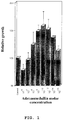
- Example 1 carrot and tobacco calli were placed in the presence of increasing concentrations of adrenomedullin and it was observed that in comparison with the control sample, an increase of growth in the calli occurred following a dose-dependent response ( Figure 1 ). Further, Example 2 shows that microalgae ( Chlorella ) treated with adrenomedullin grows up faster than the non-treated microalgae.
- the present invention allows increasing the plant biomass of a plant, or an alga, without having to apply hormones (gibberellins, auxins, cytokinins, etc.) or agrochemical products. Furthermore, given that it is a factor extrinsic to the photosynthetic organism (i.e., it is not produced naturally by plants or algae) it would not have side effects in the plant physiology (sap flow, stomata opening, turgidity, relations with symbiont fungi, etc.) or alga physiology and would only affect plant or alga growth, which is the effect that has been observed. Additionally, the fact that it is not produced naturally in plants or algae facilitates environmental controls and controls of genetically modified material spreading.
- adrenomedullin has a characteristic motif (or identifying feature) in its amino acid sequence which is involved in receptor recognition, consisting of a 6 amino acid ring created by the disulfide bond between two cysteines [Cys-Xaa 1 -Xaa 2 -Xaa 3 -Xaa 4 -Cys]. Therefore, without wishing to be bound by any theory, it is believed that any protein having said motif in its amino acid sequence will recognize the receptor and trigger the processes which lead to an increase of the biomass of said photosynthetic organisms (e.g., plants or algae), performing its role as a growth factor.
- photosynthetic organisms e.g., plants or algae
- the invention relates to a method for increasing the biomass of a photosynthetic organism (hereinafter referred to as method of the invention) which comprises cultivating said photosynthetic organism in the presence of a peptide (hereinafter referred to as growth factor of the invention) comprising:
- the amino acids Xaa 1 , Xaa 2 , Xaa 3 and Xaa 4 can be identical to or different from one another.
- Xaa 1 , Xaa 2 , Xaa 3 and/or Xaa 4 is an amino acid different from Cys.
- photosynthetic organism includes any organism capable of performing photosynthesis, i.e., a process that converts carbon dioxide into organic compounds, especially sugars, using the energy from sunlight. Photosynthesis occurs in plants, algae, and many species of bacteria, e.g., cyanobacteria, etc., but not in archaea. Photosynthetic organisms are also called photoautotrophs, since they can create their own food.
- plant includes living organisms belonging to the kingdom Plantae, e.g., trees, flowers, herbs, bushes, grasses, vines, ferns, mosses, green algae, etc..
- plants can be classified in three groups, namely: (i) Land plants or embryophytes, more formally Embryophyta or Metaphyta, which constitute the most familiar group of plants and include non-vascular land plants or briophytes, vascular plants or tracheophytes, which include seed plants or spermatopphytes; (ii) Green plants - also known as Viridiplantae, Viridiphyta or Chlorobiont; and (iii) Archaeplastida, Plastida or Primoplantae.
- alga includes a large and diverse group of simple, typically autotrophic organisms, ranging from unicellular to multicellular forms.
- the alga is a microalga, i.e., a microscopic alga, typically found in freshwater and marine systems.
- cyanobacteria commonly referred to as blue-green algae, as used herein, although was traditionally included as alga in older textbooks, many modern sources regard this as outdated as they are now considered to be bacteria.
- biomass of a photosynthetic organism is understood both the amount of biological material or organic matter which constitutes a photosynthetic organism, and the biological material or organic matter generated in a biological process, spontaneous or not spontaneous (i.e., provoked).
- biomass is useable as an energy source, for example, wood, waste, (hydrogen) gas, alcohol fuels, etc.
- the biomass of said plant includes the amount of biological material or organic matter present in the plant, i.e., the biological material or organic matter constituting both the aerial part of the plant, i.e., the stem, the trunk, the leaves, the branches, the fruit, the flower heads, etc. (aerial biomass), and the underground part thereof, i.e., the roots, calli, tubers, etc. (underground biomass).
- the "plant biomass” is often measured as the dry mass or weight (or "fresh weight” where appropriate) of the plant.
- RGR relative growth rate
- W 1 and W 2 are the weight of the plant in the times 2 and 1 (t 2 -t 1 respectively)
- growth analysis parameters include:
- the method of the invention can be applied to any type of photosynthetic organism, e.g., a plant, an alga, etc. Therefore, according to the present invention, when practically any photosynthetic organism is contacted with the growth factor of the invention, an increase in the biomass of said photosynthetic organism is obtained.
- the growth factor of the invention is a peptide comprising the motif [Cys-Xaa 1 -Xaa 2 -Xaa 3 -Xaa 4 -Cys].
- the growth factor of the invention is a peptide comprising the motif [Cys-Xaa 1 -Xaa 2 -Xaa 3 -Xaa 4 -Cys], with the proviso that said peptide is not the peptide of SEQ ID NO: 4 or the peptide of SEQ ID NO: 6.
- said motif optionally, will be flanked by other amino acid sequences forming part of the peptide identified as the growth factor of the invention.
- said peptide comprises the amino acid sequence X 1 -Cys-Xaa 1 -Xaa 2 -Xaa 3 -Xaa 4 -Cys-X 2 wherein:
- peptide relates to a molecule formed by amino acid binding by means of peptide bonds, and it includes, for the sake of simplicity, peptides, polypeptides and proteins, although it is generally accepted that the term "protein " is applied to complete biological molecules with a stable conformation whereas the term “peptide” is generally reserved for short-chain amino acid oligomers which often lack a stable three-dimensional structure; likewise, the term “ polypeptide " is typically reserved for any side chain of amino acids, regardless of their length (generally), which often lacks a defined conformation.
- X 1 has a length comprised between 1 and 250 amino acids, or even more typically between 1 and 175 amino acids, usually between 1 and 100 amino acids, more usually between 1 and 50 amino acids, even more usually between 2 and 40 amino acids, and yet even more usually between 5 and 35 amino acids.
- X 2 has a length comprised between 1 and 250 amino acids, or even more typically between 1 and 175 amino acids, usually between 1 and 100 amino acids, more usually between 1 and 50 amino acids, even more usually between 2 and 40 amino acids.
- the amino acid sequence of the C-terminal end of the peptide (X 2 ) comprises the amino acid sequence GRRRR (SEQ ID NO: 7), which, in a further particular embodiment, is located at a distance of 10 to 50 amino acids from the last Cys of the sequence Cys-Xaa 1 -Xaa 2 -Xaa 3 -Xaa 4 -Cys, i.e., there are from 10 to 50 amino acids between the last amino acid (Cys) of said sequence and the first amino acid (G) of sequence GRRRR (SEQ ID NO: 7).
- the C-terminal end of X 2 is amidated.
- Illustrative examples of peptides comprising said motif [Cys-Xaa 1 -Xaa 2 -Xaa 3 -Xaa 4 -Cys] include but are not limited to the adrenomedullin, the Arabidopsis proteins the amino acid sequences of which are shown in sequences SEQ ID NO: 4, SEQ ID NO: 5 and SEQ ID NO: 6, the Oryza sativa (rice) proteins the amino acid sequences of which are shown in SEQ ID NO: 8, SEQ ID NO: 9 and SEQ ID NO: 10, and the Thalassiosira pseudonana (diatom) protein the amino acid sequence of which is shown in sequence SEQ ID NO: 11.
- the growth factor is selected from the group consisting of adrenomedullin, the peptides the amino acid sequences of which are shown in SEQ ID NO: 2, SEQ ID NO: 3, SEQ ID NO: 4, SEQ ID NO: 5, SEQ ID NO: 6, SEQ ID NO: 8, SEQ ID NO: 9, SEQ ID NO: 10 and SEQ ID NO: 11, and combinations thereof, which will be described in detail below.
- Adrenomedullin is a hypotensive peptide originally found in human pheochromocytoma which consists of 52 amino acids, has an intramolecular disulfide bridge [Cys-Cys] and has high homology with the calcitonin gene-related peptide.
- the precursor protein, the preproadrenomedullin (SEQ ID NO: 2) has a length of 185 amino acids (GenBank accession no. AAC60642.1) which, after being processed intracellularly, will give rise to a mature protein having 52 amino acids, which will be adrenomedullin.
- AM is human adrenomedullin defined by SEQ ID NO: 3.
- any variant of SEQ ID NO: 3 with the capacity to increase the biomass of a photosynthetic organism is also included within the present invention.
- variant of SEQ ID NO: 3 relates to any peptide the amino acid sequence of which can be obtained from SEQ ID NO: 3 by means of conservative amino acid changes and checking that the resulting variant has the capacity to increase the biomass of a photosynthetic organism by means of the measurement of any of the parameters mentioned above.
- the conservative amino acid substitutions relate to the interchangeability of residues having similar side chains.
- a group of amino acids having aliphatic side chains consists of glycine, alanine, valine, leucine, and isoleucine; a group of amino acids having aliphatic-hydroxyl side chains consists of serine and threonine; a group of amino acids having side chains containing an amide group consists of asparagine and glutamine; a group of amino acids having aromatic side chains consists of phenylalanine, tyrosine and tryptophan; a group of amino acids having basic side chains consists of lysine, arginine, and histidine; and a group of amino acids having sulfur-containing side chains consists of cysteine and methionine.
- the preferred conservative amino acid substitution groups are: valine-leucine-isoleucine, phenylalanine-tyrosine, lysine-arginine, alanine-valine, and asparagine-glutamine.
- the functionally equivalent variants of adrenomedullin include polypeptides which are substantially homologous to native adrenomedullin [SEQ ID NO: 3] .
- the expression "substantially homologous” relates to any of the amino acid sequences having a degree of identity with respect to the amino acid sequence shown in SEQ ID NO: 3 of at least 70%, more preferably at least 85% and even more preferably at least 95%.
- the degree of identity between two peptides can be determined using computer algorithms and methods which are widely known by the persons skilled in the art.
- the identity between two amino acid sequences of two peptides is preferably determined using the BLASTP algorithm ( BLAST Manual, Altschul, S. et al., NCBI NLM NIH Bethesda, Md. 20894 , Altschul, S., et al., J., 1990, Mol. Biol. 215:403-410 ) .
- adrenomedullin has a characteristic motif (or identifying feature) in its amino acid sequence which is involved in the adrenomedullin receptor recognition, consisting of a 6 amino acid ring created by the disulfide bond between two cysteines [Cys-Xaa 1 -Xaa 2 -Xaa 3 -Xaa 4 -Cys].
- Adrenomedullin additionally has an amidated carboxyl-terminal end (CONH 2 ) separated from the motif by about 20-40 amino acids.
- any adrenomedullin variant having the Cys-Xaa 1 -Xaa 2 -Xaa 3 -Xaa 4 -Cys motif in its amino acid sequence will recognize the adrenomedullin receptor and trigger the processes which lead to an increase of the biomass of the photosynthetic organism.
- the present invention also contemplates those adrenomedullin variants with the capacity for increasing the biomass of a photosynthetic organism comprising said 6 amino acid ring created by the disulfide bond between two cysteines.
- the SEQ ID NO: 3 variants can additionally have an amidated carboxyl-terminal end.
- fragments of adrenomedullin or of the variants thereof as previously defined are also included within the present invention provided they maintain the capacity to increase the biomass of a photosynthetic organism. Said capacity can be determined by means of the parameters mentioned in previous paragraphs.
- growth factor include the Arabidopsis proteins described in SEQ ID NO: 4, SEQ ID NO: 5 and SEQ ID NO: 6.
- the protein identified under sequence SEQ ID NO: 4 is a protein of an unknown name with GenBank accession no. NP_564910.
- the protein identified under sequence SEQ ID NO: 5 [MDPKSCENSSDVKGQTSDSVSKKVLIEEEEDVKKPQQGKENDSRMAKDVVSCSSNISAHVV HEEVADNVTAVSCNEAESDISKAKAKEFHTIDLSGVGERICRICHFGSDQSPEASGDDKSVS PELIEIGCKCKNELGLAHFHCAEAWFKLRGNSV C EICG C TAKNVTVRLMEDWSGERDNTLD G RRRR GRGQSCCIFMVFLLTILLLHWFFKKISGYYQNT-NH 2 ] is a protein of the zinc finger family (C3HC4-type Ring finger) with GenBank accession no. NP_180967.
- the protein identified under SEQ ID NO: 6 [MGDVILFIDDTKSKVRITRCRICHEEEEEEESFFEVPCACSGTVKFAHRN C IQRW C NEKGNTT CEICLQVYKDGYTAVLKQSKLIEQEVTIRVN GRRRR RSRRLVSIAESDISQCNSVADRGASF CRSLTFTLSVFLLMKHTFDVIYGTEEYPFSVFTVLTLKAIGILLPMFIIIRTISTIQKTLRR RHQYPESEEEDRLSSDDDDDLEEEDEEQQQHLA-NH 2 ] is a protein called pitchoun 1 (PIT1) with GenBank accession no. NP_567222.
- the characteristic motif of the growth factor of the invention (Cys-Xaa 1 -Xaa 2 -Xaa 3 -Xaa 4 -Cys) is in bold print, the two cysteines forming the disulfide bridge are underlined and the amino acid sequence of the motif GRRRR is twofold underlined and in bold print]
- variants and fragments of said proteins also are included in the context of the present disclosure, provided they conserve the characteristic motif of the growth factor of the invention and when they are administered to a photosynthetic organism they increase the biomass thereof.
- the increase of the biomass of a photosynthetic organism can be ascertained by means of any of the parameters mentioned above, for example, by means of a plant biomass increase assay such as the one described in Example 1, or by means of an alga biomass increase assay such as the one described in Example 2.
- the term variant and its meaning in the context of the present invention have been defined in previous paragraphs.
- the peptides comprising the motif [Cys-Xaa 1 -Xaa 2 -Xaa 3 -Xaa 4 -Cys] include, without limitation, the proteins of Oryza sativa (rice) whose amino acid sequences are shown in SEQ ID NO: 8, SEQ ID NO: 9 and SEQ ID NO: 10.
- the growth factor of the invention In order for the growth factor of the invention to have the desired effect, i.e., increasing the biomass of a photosynthetic organism, it is necessary to contact said growth factor with said photosynthetic organism.
- active ingredients in the present invention, the growth factor of the invention
- photosynthetic organism specially plants.
- the active ingredient will be formulated in a manner suited to the method of administration to be used.
- the growth factor of the invention will be part of a composition that can be used either in solid form or in liquid form, for example, in the form of a wettable powder or of an emulsifiable concentrate incorporating conventional diluents.
- Said compositions can be obtained in the traditional manner, for example, by mixing the growth factor of the invention with a diluent and optionally with other ingredients or constituents.
- the photosynthetic organism is a plant and then the composition composition comprising the growth factor of the invention can be obtained, by conventional means, by mixing the growth factor of the invention with a diluent and optionally with other ingredients or constituents which are usually used in agricultural compositions and which are known by the person skilled in the art, such as, but not limited to, solvents, active agents or pH regulators, fertilizers, etc.
- the growth factor of the invention is administered as an additive to supplement the nutritive solution fed to the plant in a hydroponic system or, in another particular embodiment, it is administered to the irrigation water of said plant.
- the concentration of the growth factor of the invention in the composition can vary within a broad range, typically from at least 10 -8 to 10 -16 M, still more usually from at least 10 -8 to 10 -10 M. Additional technical features of said composition are, for example, the agriculturally acceptable carriers that can be used, the additional components that can be incorporated, its presentation form, the process for obtaining it, etc.
- agriculturally acceptable carrier includes any substance or combination of substances that can be used in the agricultural sector, and it includes any agriculturally acceptable liquid or solid material that can be added and/or mixed with the growth factor of the invention in order to make it a simpler or improved application form, or with an applicable or desirable activation intensity.
- composition herein described can furthermore contain, if desired, other ingredients or constituents usually used in agricultural compositions, such as, but not limited to, solvents, active agents or pH regulators, fertilizers, etc., provided they all allow or do not jeopardize or compromise the capacity of the growth factor of the invention to increase the plant biomass of a plant.
- ingredients or constituents usually used in agricultural compositions are generally known by the persons skilled in the art.
- composition provided by this invention can be obtained by conventional methods generally based on the mixture of the different components of the composition in the suitable amounts.
- the method of the invention can be used on any photosynthetic organism.
- the method of the invention will be applied to those photosynthetic organisms in which an increase of the biomass is particularly desirable, such as, for example, plants and algae which can be industrially used in any kind of industry.
- the photosynthetic organism is a plant, for example, a plant for use in the production of energy, e.g., renewable energies, for human or animal nutrition, wood species, ornamental plants, etc.
- plants the biomass of which is used in the production of fuels or renewable energies include but are not limited to:
- thermo energy consists of applying direct combustion systems to obtain heat
- fuel gases consists of breaking down the biomass in a digester to obtain a gas
- the biomass used in the production of said energy can come from any plant.
- wood plants include but are not limited to pine, eucalyptus, cork oak, cedar, oak, holm oak, etc.
- Illustrative non-limiting examples of ornamental plants of interest include plants belonging to the Aeschynanthus; Canna; Columnea; Anemone; Azalea; Begonia; Calceolaria; Camelia; Dianthus; Freesia; Gerbera; Hibiscus; Hypoestes; Kalanchoe; Nicotiana; Pelargonium; Petunia; Primula; Ranunculus; Rhipsalidopsis; Rosa; Saintpaulia; Sinningia-gloxinia; Streptocarpus; Tigridia; Verbena; or Zinnia genus.
- orchids Orchidaceae family
- ornamental shrubs which include bay laurel ( Laurus nobilis ), honeysuckle ( Lonicera fragrantissima ), star magnolia ( Magnolia stellata ), hydrangea ( Hydrangea macrophylla ), Laburnum ( Laburnum x watereri ), Japanese rose or kerria ( Kerria japonica ), etc.
- plants used in human or animal nutrition include fruit trees, which include but are not limited to the cherry tree, plum tree, peach tree, apricot tree, olive tree, mango tree, pear tree, apple tree, loquat tree, quince tree, orange tree, lemon tree, fig tree, papaya tree, chestnut tree, oak tree, holm oak tree, kermes oak tree, hazelnut tree, almond tree, walnut tree, etc.; forage plants, which include but are not limited to legumes (for example, clovers, alfalfas, clitorias, arachis, leucaena, bellflowers, etc.), grasses (for example, rye grass, fescue, orchard grass, blue grama grass, rhodes grass, buffel grass, andropogons, brachiarias, Bermuda grass considered grazing grass, and elephant grass, merkeron, sugar cane, Taiwan grass and corn grass, which are harvesting grass, etc.), grains (for
- the photosynthetic organism is an alga, for example, a microalga such as a microalga from the Chlorella, Botryococcus, Nannochloropsis, Haematococcus, Neochloris or Tetraselmis genus; further, illustrative, non-limitative, examples of algae within the context of the present invention include Aonori ( Enteromorpha intestinalis ) (several species of the green alga Monostroma) (Japan), Arame ( Eisenia bicyclis ), Badderlocks, jap.
- a microalga such as a microalga from the Chlorella, Botryococcus, Nannochloropsis, Haematococcus, Neochloris or Tetraselmis genus
- examples of algae within the context of the present invention include Aonori ( Enteromorpha intestinalis ) (several species of the green alga Monostroma) (Japan), Arame ( Eisen
- Sarumen Alaria esculenta
- Carola Callophyllis variegata
- Carrageen moss Mastocarpus stellatus
- Chlorella Laminaria saccharina, Durvillea antarctica, Palmaria palmata, Euchema cottonii, Caulerpa lentillifera, Gulaman, Gulaman-Dagat ( Agardhiella tenera ), Hijiki o Hiziki ( Sargassum fusiforme ), Hyundaiwara ( Sargassum enerve ), Chondrus crispus, Porphyra laciniata / Porphyra umbilicalis, Ulva lactuca, Sargassum echinocarpum, Saccharina japonica, Miru ( Codium sp.), Mozuku ( Cladosiphon okamuranus ), Nori (several species of the red alga Porphyra ), Oarweed ( Laminaria digitata ), Ogonori (
- Porphyra laciniata Arthrospira platensis, Arthrospira maxima, Thongweed ( Himanthalia elongata ), Tsunomato (several species of the red alga Chondrus ), Wakame (Undaria pinnatifida ), etc.
- the growth factor of the invention increases the biomass of a photosynthetic organism consists of inserting in the genome of said photosynthetic organism the nucleotide sequence encoding said growth factor such that when said nucleotide sequence is expressed it has the desired effect in the photosynthetic organism.
- the invention relates to a gene construct, hereinafter, gene construct of the invention, comprising
- said regulating elements are suitable for regulating the expression of the nucleic acid sequence encoding said peptide in an alga; said elements are known by those skilled in the art.
- said regulating elements are suitable for regulating the expression of the nucleic acid sequence encoding said peptide in a plant; said elements are also known by those skilled in the art.
- the regulating elements for regulating the expression of the nucleic acid sequence encoding said peptide are heterologous with respect to said nucleic acid sequence, i.e., in the event that said nucleic acid sequence encodes an Arabidopsis protein (e.g., SEQ ID NO: 4, SEQ ID NO: 5 or SEQ ID NO: 6),said nucleic acid sequence is under the control of regulating elements for regulating its expression in a plant different from the regulating elements that naturally regulate the expression of said Arabidopsis proteins in said plant, or in the event that said nucleic acid sequence encodes an Oryza sativa protein (e.g., SEQ ID NO: 8, SEQ ID NO: 9 or SEQ ID NO: 10),said nucleic acid sequence is under the control of regulating elements for regulating its expression in a plant different from the regulating elements that naturally regulate the expression of said Oryza sativa proteins in said plant; or in the event that said nucleic acid sequence encodes an Thalassi
- the amino acids Xaa 1 , Xaa 2 , Xaa 3 and Xaa 4 can be identical to or different from one another.
- Xaa 1 , Xaa 2 , Xaa 3 and/or Xaa 4 is an amino acid different from Cys.
- said gene construct of the invention comprises
- said peptide comprises the amino acid sequence X 1 -Cys-Xaa 1 -Xaa 2 -Xaa 3 -Xaa 4 -Cys-X 2 wherein:
- X 1 has a length comprised between 1 and 250 amino acids, or even more typically between 1 and 175 amino acids, usually between 1 and 100 amino acids, more usually between 1 and 50 amino acids, even more usually between 2 and 40 amino acids, and yet even more usually between 5 and 35 amino acids.
- X 2 has a length comprised between 1 and 250 amino acids, or even more typically between 1 and 175 amino acids, usually between 1 and 100 amino acids, more usually between 1 and 50 amino acids, even more usually between 2 and 40 amino acids.
- the amino acid sequence of the C-terminal end of the peptide (X2) comprises the amino acid sequence GRRRR (SEQ ID NO: 7), which, in a further particular embodiment, is located at a distance of 10 to 50 amino acids from the last Cys of the sequence Cys-Xaa 1 -Xaa 2 -Xaa 3 -Xaa 4 -Cys.
- the C-terminal end of X 2 is amidated.
- said peptide is selected from the group consisting of adrenomedullin and the proteins the amino acid sequences of which are shown in sequences SEQ ID NO: 2, SEQ ID NO: 3, SEQ ID NO: 4, SEQ ID NO: 5, SEQ ID NO: 6, SEQ ID NO: 8, SEQ ID NO: 9, SEQ ID NO: 10, and SEQ ID NO: 11, as well as their functionally equivalent variants and fragments.
- the gene construct of the invention can be obtained by means of using techniques well known in the state of the art [ Sambrock et al., 2001. "Molecular cloning: a Laboratory Manual", 3rd ed., Cold Spring Harbor Laboratory Press, N.Y., Vol.1-3 ]. Said gene construct of the invention incorporates, operatively bound thereto, regulating elements for regulating its expression in a photosynthetic organism.
- the expression " operatively bound” means that the nucleic acid encoding the growth factor of the invention [i.e., the peptide comprising the amino acid sequence Cys-Xaa 1 -Xaa 2 -Xaa 3 -Xaa 4 -Cys] is expressed in the correct reading frame under the control of the control regulating elements or the expression regulating sequences.
- the control regulating elements are sequences which control and regulate the transcription and, where appropriate, the translation of the protein, and include promoter sequences, encoding sequences for transcriptional regulators, ribosome-binding sequences (RBS) and/or transcription termination sequences.
- the gene construct of the invention can be inserted in the genome of a photosynthetic organism cell, e.g., a plant cell or tissue, or an algal cell, by any suitable method to obtain transformed photosynthetic organisms.
- Said methods can involve, for example, the use of liposomes, electroporation, diffusion, particle bombardment, microinjection, gene guns, chemical compounds which increase free DNA uptake, for example, co-precipitation with calcium phosphate, viral vectors, etc.
- the invention relates to a vector comprising the gene construct of the invention.
- said vector is a vector suitable for the transformation of algae; said vectors are known by the skilled person in the art (e.g., WO 2009149470 discloses methods and compositions for vector-transformed algal cells, wherein the vector comprises a Vcp promoter driving expression of an antibiotic resistance gene in an algal cell.
- said vector is a vector suitable for the transformation of plants; said vectors are also known by the skilled person in the art.
- vectors suitable for the transformation of plants include those derived from the Agrobacterium tumefaciens Ti plasmid, such as those described in EP 120516 .
- alternative methods can be used to insert the gene construct in plant cells and tissues, such as, for example, but not limited to, by means of the vacuum infiltration protocol.
- the vectors including a prokaryotic replicon furthermore generally include restriction sites for the insertion of the gene construct. These vectors are known of the state of the art, as is described, for example, in patent US 6,268,552 .
- the vectors can also include markers to check for the presence of heterologous DNA in the photosynthetic organisms, e.g., plant cells and/or tissues, or algal cells, which have been transformed.
- the genetic markers that allow selecting heterologous DNA in said photosynthetic organisms, e.g., plant cells include the genes which confer resistance to antibiotics, for example, ampicillin, tetracycline, kanamycin, hygromycin, gentamicin, etc.
- the neomycin phosphotransferase gene has the advantage of being expressed both in eukaryotic and prokaryotic cells.
- the marker allows selecting the satisfactorily transformed photosynthetic organisms, e.g., plants, grown in a medium containing the corresponding antibiotic because they incorporate the suitable resistance gene.
- nucleic acid (a) as well as the introduction of said gene construct to transform a photosynthetic organism, e.g., a plant cell or tissue, or an algal cell, and generate a transgenic photosynthetic organism, e.g., a transgenic plant or a transgenic alga, can be carried out, as has been mentioned above, by any means known in the state of the art, including but not limited to DNA transfer mediated by A. tumefaciens, preferably with an unarmed T-DNA vector, electroporation, direct DNA transfer, particle bombardment, etc. (for a revision on these topics, see, for example, Marta Izquierdo Rojo in "Ingenieria Genética y Transferencia Génica", 1999, Ediations Pirámide, S.A, Madrid ).
- the disclosure relates to a host cell comprising said nucleic acid (a), a gene construct according to the invention or a vector as has been described above.
- Suitable host cells for containing a gene construct according to the invention or a vector as has been described above include but are not limited to prokaryotic cells, yeasts or eukaryotic cells, such as insect cells for example.
- the gene construct of the invention or the vector containing it can contain expression control sequences which can be functional in prokaryotic cells and organisms, for example, bacteria, etc., or functional in eukaryotic cells and organisms, for example, insect cells, mammal cells, etc.
- the invention in another aspect, relates to a transgenic plant cell or alga comprising, integrated in its genome, said nucleic acid (a) or said gene construct of the invention.
- the techniques for culturing transformed plant cells and tissues, or algae, and regenerating transgenic plants or algae are well known in the state of the art, as are the cultivation and growth conditions of said plants or algae (see, for example, Marta Izquierdo (1999) cited above).
- transgenic plant obtained from a plant cell transformed with the gene construct of the invention, or the alga transformed with the gene construct of the invention constitutes an additional inventive aspect of the present invention.
- the plant is selected from the group defined in appended claim 7.
- the capacity of the growth factor of the invention to increase the biomass of photosynthetic organism has applications in different industries depending on the photosynthetic organism.
- the growth factor of the invention can be used in increasing the biomass of algae or plants that are going to be used in the production of energy, in obtaining wood, in human or animal nutrition, or in the floriculture as a way to improve the appearance of ornamental plants.
- Carrot ( Daucus carota ) and tobacco ( Nicotiana tabacum ) calli were supplied by Carolina Biological Supply Company (Burlington, NC, USA) and kept under sterile conditions in solid callus initiation medium for carrots or for tobacco respectively (also acquired from Carolina Biological). The specific composition thereof is available in the company's catalog.
- a single callus was split into small fragments and these fragments were weighed under sterile conditions and seeded on fresh medium (solid callus initiation medium acquired from Carolina Biologicals) which contained different concentrations of the synthetic peptide human adrenomedullin (AM) (Phoenix Pharmaceuticals, Burlingame, CA, USA). After 30 days of growth in the dark, the calli were weighed again and the growth rate was calculated as the quotient of the final weight divided by the initial weight.
- fresh medium solid callus initiation medium acquired from Carolina Biologicals
- AMD synthetic peptide human adrenomedullin
- the dry weight of each sample was calculated by subjecting the calli to an oven drying process at 250°C for 24 hours.
- a growth increase in the calli following a dose-dependent response was observed both in the carrot and in the tobacco ( Figure 1 ).
- the most effective concentration of AM for stimulating cell growth was 10 -10 M.
- a more moderate growth increase occurred at lower or higher concentrations.
- a 60% increase in the biomass when compared with the control was obtained at the optimal dose of AM.
- the effect observed in the callus cells consisting in an increase of growth (cell proliferation) in callus cells, is perfectly transferred to whole plants.
- the increase in the cell proliferation will affect the organoleptic or physical properties of the plants.
- the biomass increase will be produced in the plants as it is produced in the callus cells.
- Air containing 5% CO 2 was continuously bubbled in the culture.
- the flasks were illuminated with a photoperiod of 12 hours light / 12 hours dark.
- AM-treated microalgae grow up faster and reach the stationary phase sooner than the non-treated microalgae.
Landscapes
- Health & Medical Sciences (AREA)
- Life Sciences & Earth Sciences (AREA)
- Chemical & Material Sciences (AREA)
- Genetics & Genomics (AREA)
- Engineering & Computer Science (AREA)
- Organic Chemistry (AREA)
- Zoology (AREA)
- General Health & Medical Sciences (AREA)
- Biotechnology (AREA)
- Wood Science & Technology (AREA)
- Molecular Biology (AREA)
- Biomedical Technology (AREA)
- Bioinformatics & Cheminformatics (AREA)
- Biochemistry (AREA)
- Microbiology (AREA)
- General Engineering & Computer Science (AREA)
- Biophysics (AREA)
- Medicinal Chemistry (AREA)
- Plant Pathology (AREA)
- Proteomics, Peptides & Aminoacids (AREA)
- Botany (AREA)
- Environmental Sciences (AREA)
- Cell Biology (AREA)
- Gastroenterology & Hepatology (AREA)
- Natural Medicines & Medicinal Plants (AREA)
- Dentistry (AREA)
- Agronomy & Crop Science (AREA)
- Physics & Mathematics (AREA)
- Toxicology (AREA)
- Mycology (AREA)
- Developmental Biology & Embryology (AREA)
- Virology (AREA)
- General Chemical & Material Sciences (AREA)
- Chemical Kinetics & Catalysis (AREA)
- Pest Control & Pesticides (AREA)
- Pharmacology & Pharmacy (AREA)
- Endocrinology (AREA)
- Tropical Medicine & Parasitology (AREA)
- Peptides Or Proteins (AREA)
- Breeding Of Plants And Reproduction By Means Of Culturing (AREA)
Claims (8)
- Procédé pour augmenter la biomasse d'un organisme photosynthétique qui comprend la culture dudit organisme photosynthétique en présence d'un peptide comprenant :i. la séquence d'acides aminés représentée par SEQ ID NO : 3 ; ouii. un variant fonctionnel du peptide défini en (i), dans lequel ledit variant est un peptide dont la séquence d'acides aminés présente un degré d'identité par rapport à la séquence d'acides aminés représentée par SEQ ID NO : 3 d'au moins 70 % et conserve sa capacité d'augmentation de la biomasse d'un organisme photosynthétique, et dans lequel ledit variant comprend la séquence d'acides aminésdans lequel ledit peptide est présent dans une concentration entre 10-8 M et 10-16 M.
Cys-Xaa1-Xaa2-Xaa3-Xaa4-Cys [SEQ ID NO : 1]
dans lequel Xaa1, Xaa2, Xaa3 et Xaa4, indépendamment représentent un acide aminé, et les résidus de cystéine de la séquence d'acides aminés représentée par SEQ ID NO : 1 forment un pont disulfure entre eux, - Procédé selon la revendication 1, dans lequel ledit peptide est une adrénomédulline, de préférence l'adrénomédulline humaine.
- Procédé selon l'une quelconque des revendications 1 ou 2, dans lequel ledit organisme photosynthétique est une plante ou une algue.
- Procédé selon l'une quelconque des revendications 1 à 3, dans lequel ledit organisme photosynthétique est une plante et ledit peptide est administré en tant qu'additif pour complémenter la solution nutritive qui alimente ladite plante dans un système hydroponique, ou il est administré à l'eau d'irrigation de ladite plante.
- Procédé selon la revendication 4, dans lequel ladite plante est choisie parmi une plante utilisée pour la production d'énergies renouvelables, une plante pour la nutrition humaine ou animale, une espèce de bois, et une plante ornementale.
- Procédé selon l'une quelconque des revendications 1 à 5, dans lequel ledit peptide est présent dans une concentration entre 10-8 M et 10-10 M.
- Organisme photosynthétique transgénique comprenant une construction génique pour augmenter la biomasse comprenant :a. un acide nucléique codant pour un peptide dont la séquence d'acides aminés est représentée par SEQ ID NO : 3 ; ou l'un de ses variants fonctionnels, dans lequel ledit variant est un peptide dont la séquence d'acides aminés présente un degré d'identité par rapport à la séquence d'acides aminés représentée par SEQ ID NO : 3 d'au moins 70 % et conserve sa capacité d'augmentation de la biomasse d'un organisme photosynthétique, et dans lequel ledit variant comprend la séquence d'acides aminés
Cys-Xaa1-Xaa2-Xaa3-Xaa4-Cys [SEQ ID NO : 1]
dans lequel Xaa1, Xaa2, Xaa3 et Xaa4, indépendamment représentent un acide aminé, et les résidus de cystéine de la séquence d'acides aminés représentée par SEQ ID NO : 1 forment un pont disulfure entre eux, etb. des éléments de régulation pour réguler son expression dans l'organisme photosynthétique,dans lequel l'organisme photosynthétique est une algue ou une plante choisie parmi des espèces de bois, des légumes, des herbes, des arbres fruitiers, des orchidées de la famille des Orchidacées, Laurus nobilis, Lonicera fragrantissima, Magnolia stallata, Hydrangea macrophylla, Labrurnum x watereri, Kerria japonica, le peuplier, le saule, l'eucalyptus, le robinier, les arbres conifères, l'acacia, le bananier, le chardon, le miscanthus, le roseau géant, l'euphorbe, les cactus de figuiers de Barbarie, la betterave, le maïs, le sorgho sucré, la canne à sucre, la pomme de terre, le topinambour, les graines de colza, le tournesol, le soja, la laitue, le chou, l'épinard, la bette à carde, les haricots verts, les plants de tomates, le sorgho, le blé, le seigle, l'orge, et des plantes appartenant aux genres Aeschynanthus, Carina, Columnea, Anemone, Azalea, Begonia, Calceolaria, Camelia, Dianthus, Freesia, Gerbera, Hibiscus, Hypoestes, Kalanchoe, Nicotiana, Pelargonium, Petunia, Primula, Rannunculus, Rhipsalidopsis, Rosa, Saintpaulia, Sinningia-gloxinia, Streptocarpus, Tigridia, Verbena, Zinnia. - Organisme photosynthétique transgénique selon la revendication 7, dans lequel ledit peptide est une adrénomédulline, de préférence l'adrénomédulline humaine.
Priority Applications (1)
| Application Number | Priority Date | Filing Date | Title |
|---|---|---|---|
| EP11722787.6A EP2575429B1 (fr) | 2010-05-25 | 2011-05-24 | Procédé pour augmenter la biomasse végétale |
Applications Claiming Priority (3)
| Application Number | Priority Date | Filing Date | Title |
|---|---|---|---|
| EP20100382143 EP2389799A1 (fr) | 2010-05-25 | 2010-05-25 | Procédé pour augmenter la biomasse végétale |
| EP11722787.6A EP2575429B1 (fr) | 2010-05-25 | 2011-05-24 | Procédé pour augmenter la biomasse végétale |
| PCT/EP2011/058464 WO2011147826A1 (fr) | 2010-05-25 | 2011-05-24 | Procédé d'augmentation de la biomasse de végétaux |
Publications (2)
| Publication Number | Publication Date |
|---|---|
| EP2575429A1 EP2575429A1 (fr) | 2013-04-10 |
| EP2575429B1 true EP2575429B1 (fr) | 2018-08-08 |
Family
ID=42647351
Family Applications (2)
| Application Number | Title | Priority Date | Filing Date |
|---|---|---|---|
| EP20100382143 Withdrawn EP2389799A1 (fr) | 2010-05-25 | 2010-05-25 | Procédé pour augmenter la biomasse végétale |
| EP11722787.6A Active EP2575429B1 (fr) | 2010-05-25 | 2011-05-24 | Procédé pour augmenter la biomasse végétale |
Family Applications Before (1)
| Application Number | Title | Priority Date | Filing Date |
|---|---|---|---|
| EP20100382143 Withdrawn EP2389799A1 (fr) | 2010-05-25 | 2010-05-25 | Procédé pour augmenter la biomasse végétale |
Country Status (21)
| Country | Link |
|---|---|
| US (1) | US9622429B2 (fr) |
| EP (2) | EP2389799A1 (fr) |
| JP (1) | JP5896533B2 (fr) |
| KR (1) | KR20130090329A (fr) |
| CN (1) | CN103037683A (fr) |
| AR (1) | AR081419A1 (fr) |
| AU (1) | AU2011257352B2 (fr) |
| BR (1) | BR112012029973B1 (fr) |
| CA (1) | CA2800759C (fr) |
| CL (1) | CL2012003304A1 (fr) |
| ES (1) | ES2698835T3 (fr) |
| IL (1) | IL223242B (fr) |
| MA (1) | MA34576B1 (fr) |
| MX (1) | MX344740B (fr) |
| MY (1) | MY161883A (fr) |
| PE (1) | PE20131033A1 (fr) |
| RU (1) | RU2581945C2 (fr) |
| SA (1) | SA111320482B1 (fr) |
| UA (1) | UA111823C2 (fr) |
| WO (1) | WO2011147826A1 (fr) |
| ZA (1) | ZA201300013B (fr) |
Families Citing this family (6)
| Publication number | Priority date | Publication date | Assignee | Title |
|---|---|---|---|---|
| EP2814944A4 (fr) * | 2012-02-14 | 2016-02-17 | Sapphire Energy Inc | Gènes de rendement de biomasse |
| CN107205355B (zh) * | 2014-11-04 | 2021-04-30 | 农牧研究公司 | 用于植物改良的方法 |
| RU2727428C2 (ru) * | 2014-11-04 | 2020-07-21 | Агрисерч Лимитед | Способы усовершенствования однодольных растений |
| ES2940245T3 (es) | 2018-11-28 | 2023-05-04 | Bio Iliberis Res And Development S L | Microorganismos promotores del crecimiento vegetal y enzimas para los ciclos biogénicos del suelo |
| EP3670647A1 (fr) | 2018-12-17 | 2020-06-24 | Bio-Iliberis Research and Development S.L. | Souches capables de produire des composés de stimulation de croissance de plantes |
| CN112273229B (zh) * | 2020-10-28 | 2022-02-22 | 上海辰山植物园 | 八仙花一步成苗方法 |
Family Cites Families (18)
| Publication number | Priority date | Publication date | Assignee | Title |
|---|---|---|---|---|
| NL8300698A (nl) | 1983-02-24 | 1984-09-17 | Univ Leiden | Werkwijze voor het inbouwen van vreemd dna in het genoom van tweezaadlobbige planten; agrobacterium tumefaciens bacterien en werkwijze voor het produceren daarvan; planten en plantecellen met gewijzigde genetische eigenschappen; werkwijze voor het bereiden van chemische en/of farmaceutische produkten. |
| WO1997007214A1 (fr) * | 1995-08-18 | 1997-02-27 | The Government Of The United States Of America, Represented By The Secretary, Department Of Health And Human Services | Role fonctionnel de l'adrenomedulline (am) et du produit apparente a un gene (pamp) en pathologgie et physiologie chez l'homme |
| JP3746847B2 (ja) | 1996-08-02 | 2006-02-15 | 協和醗酵工業株式会社 | 植物細胞増殖因子 |
| AUPO427596A0 (en) * | 1996-12-20 | 1997-01-23 | Cooperative Research Centre For Tropical Plant Pathology | Anti-microbial protein |
| CA2289869A1 (fr) | 1997-05-06 | 1998-11-12 | Kansas State University Research Foundation | Fruits transgenique sans pepins et techniques afferentes |
| EP2316953A3 (fr) * | 2003-10-20 | 2011-10-05 | CropDesign N.V. | Identification de nouveaux gènes cibles E2F et utilisation associée |
| US20080148432A1 (en) * | 2005-12-21 | 2008-06-19 | Mark Scott Abad | Transgenic plants with enhanced agronomic traits |
| US7335760B2 (en) | 2004-12-22 | 2008-02-26 | Ceres, Inc. | Nucleic acid sequences encoding zinc finger proteins |
| US20080301839A1 (en) | 2005-08-30 | 2008-12-04 | Ravanello Monica P | Transgenic plants with enhanced agronomic traits |
| US8853492B2 (en) * | 2005-11-07 | 2014-10-07 | Cropdesign N.V. | Plants having improved growth characteristics and a method for making the same |
| RU2415573C2 (ru) | 2006-12-11 | 2011-04-10 | Джапэн Сайенс Энд Текнолоджи Эйдженси | Регулятор роста растений и его применение |
| WO2009003429A2 (fr) | 2007-07-04 | 2009-01-08 | Masarykova Univerzita | Procédé de régulation de la production de biomasse dans les plantes, séquences d'adn et leur procédé de préparation |
| CA2700981C (fr) | 2007-09-24 | 2016-12-13 | Performance Plants, Inc. | Plantes ayant une biomasse accrue |
| WO2009120950A2 (fr) | 2008-03-28 | 2009-10-01 | Donald Danforth Plant Science Center | Altération de l’expression de phospholipase de (plde) ou de phospholipase da3 (pld a3) dans des plantes |
| WO2009149465A1 (fr) | 2008-06-06 | 2009-12-10 | Aurora Biofuels, Inc. | Transformation de cellules d'algue |
| US20110224080A1 (en) | 2008-07-02 | 2011-09-15 | Antonio Lelas | Formulation based on micronized natural calcite mineral and micronized zeolite as an enhanced plant booster and mineral fertilizer |
| MX2011004270A (es) * | 2008-10-23 | 2011-07-13 | Basf Plant Science Gmbh | Plantas con rendimiento aumentado (nue). |
| US20120260373A1 (en) * | 2009-10-07 | 2012-10-11 | Nestor Apuya | Transgenic plants having enhanced biomass composition |
-
2010
- 2010-05-25 EP EP20100382143 patent/EP2389799A1/fr not_active Withdrawn
-
2011
- 2011-05-24 BR BR112012029973-5A patent/BR112012029973B1/pt active IP Right Grant
- 2011-05-24 PE PE2012002224A patent/PE20131033A1/es not_active Application Discontinuation
- 2011-05-24 CA CA2800759A patent/CA2800759C/fr active Active
- 2011-05-24 MX MX2012013728A patent/MX344740B/es active IP Right Grant
- 2011-05-24 MA MA35494A patent/MA34576B1/fr unknown
- 2011-05-24 CN CN2011800362793A patent/CN103037683A/zh active Pending
- 2011-05-24 AR ARP110101788 patent/AR081419A1/es unknown
- 2011-05-24 RU RU2012156243/10A patent/RU2581945C2/ru active
- 2011-05-24 WO PCT/EP2011/058464 patent/WO2011147826A1/fr not_active Ceased
- 2011-05-24 KR KR1020127033829A patent/KR20130090329A/ko not_active Ceased
- 2011-05-24 UA UAA201214867A patent/UA111823C2/uk unknown
- 2011-05-24 MY MYPI2012005093A patent/MY161883A/en unknown
- 2011-05-24 AU AU2011257352A patent/AU2011257352B2/en active Active
- 2011-05-24 US US13/699,706 patent/US9622429B2/en active Active
- 2011-05-24 EP EP11722787.6A patent/EP2575429B1/fr active Active
- 2011-05-24 ES ES11722787T patent/ES2698835T3/es active Active
- 2011-05-24 JP JP2013511653A patent/JP5896533B2/ja active Active
- 2011-05-25 SA SA111320482A patent/SA111320482B1/ar unknown
-
2012
- 2012-11-25 IL IL223242A patent/IL223242B/en active IP Right Grant
- 2012-11-26 CL CL2012003304A patent/CL2012003304A1/es unknown
-
2013
- 2013-01-02 ZA ZA2013/00013A patent/ZA201300013B/en unknown
Non-Patent Citations (1)
| Title |
|---|
| None * |
Also Published As
| Publication number | Publication date |
|---|---|
| AU2011257352A1 (en) | 2013-01-17 |
| JP5896533B2 (ja) | 2016-03-30 |
| MY161883A (en) | 2017-05-15 |
| US20130205451A1 (en) | 2013-08-08 |
| BR112012029973B1 (pt) | 2021-02-09 |
| WO2011147826A1 (fr) | 2011-12-01 |
| ES2698835T3 (es) | 2019-02-06 |
| CA2800759C (fr) | 2020-07-14 |
| AU2011257352B2 (en) | 2016-06-09 |
| KR20130090329A (ko) | 2013-08-13 |
| IL223242B (en) | 2019-03-31 |
| RU2012156243A (ru) | 2014-06-27 |
| ZA201300013B (en) | 2013-09-25 |
| JP2013529902A (ja) | 2013-07-25 |
| MA34576B1 (fr) | 2013-10-02 |
| US9622429B2 (en) | 2017-04-18 |
| IL223242A0 (en) | 2013-02-03 |
| CL2012003304A1 (es) | 2013-11-22 |
| EP2389799A1 (fr) | 2011-11-30 |
| AR081419A1 (es) | 2012-08-29 |
| BR112012029973A2 (pt) | 2017-10-03 |
| UA111823C2 (uk) | 2016-06-24 |
| MX344740B (es) | 2017-01-04 |
| MX2012013728A (es) | 2013-04-29 |
| PE20131033A1 (es) | 2013-09-18 |
| SA111320482B1 (ar) | 2015-05-11 |
| RU2581945C2 (ru) | 2016-04-20 |
| CN103037683A (zh) | 2013-04-10 |
| EP2575429A1 (fr) | 2013-04-10 |
| CA2800759A1 (fr) | 2011-12-01 |
Similar Documents
| Publication | Publication Date | Title |
|---|---|---|
| RU2758722C2 (ru) | Трансгенное растение и способ его получения | |
| CN107548281B (zh) | 植物接种方法 | |
| AU2011257352B2 (en) | Method for increasing plant biomass | |
| JP2021072792A (ja) | 過敏感反応エリシターペプチド及びその使用 | |
| CN102791729A (zh) | 用于作物改良的成花诱导剂的分子工程 | |
| CN115976046B (zh) | SlCAS基因及其所编码的蛋白质在调控番茄抗灰霉病中的应用 | |
| CN105218649B (zh) | 蛋白质VdAL在提高植物产量和促进植物生长中的应用 | |
| JPWO2014142357A1 (ja) | 植物細胞壁の処理剤及び同処理剤を用いた物質デリバリー方法並びに物質デリバリーシステム | |
| Sergeeva et al. | Effect of MF3 (peptidyl-prolyl cis/trans isomerase) protein from Pseudomonas fluorescens on ex vitro adaptation and post-adaptation of hardy kiwi (Actinidia arguta Planch. ex Miq.) plants | |
| KR102038481B1 (ko) | 레스퀘렐라 유래 PfFAD3-1 유전자로 형질전환된 수확량이 증가된 콩 식물체 및 이의 제조방법 | |
| KR102022247B1 (ko) | 식물체의 건조 스트레스 내성 증진 단백질, 이 단백질을 암호화하는 유전자 및 이 유전자로 형질전환된 식물체 | |
| KR101985668B1 (ko) | 벼 유래 OsSUS4 유전자를 이용한 도열병 저항성이 조절된 형질전환 식물체의 제조방법 및 그에 따른 식물체 | |
| Kisvarga et al. | The effect of Ferbanat L nano-fertilizer on the growing of Petunia x grandiflora’Musica Blue’ | |
| CN120536490B (zh) | PpSec61γ在调控植物叶绿素降解中的用途 | |
| ES3004535T3 (en) | Use an extract enriched in phycobiliproteins as fertilizer | |
| CN121046405B (zh) | 一种调控杏果实成熟的功能基因PaSPL8及其应用 | |
| KR102493755B1 (ko) | 기공 조절을 통한 식물 건조 스트레스 내성에 관한 신규 유전자 및 이의 용도 | |
| Al-Taher | The effect of gibberellin treatment and bulb weight on protein-pattern of narcissus leaves Narcissus tazetta L | |
| Jerônimo et al. | Allelopathic effect of Solanum lycocarpum leaf extract on protein synthesis in sesame seedlings. | |
| CN107119047B (zh) | 人工设计结构密码子优化及化学合成基因rdh及其表达产物多肽G1的制备和应用 | |
| HK40056900A (en) | Plant inoculation method | |
| CN119979519A (zh) | TeLCYE蛋白及其生物材料在提高植物类胡萝卜素含量与耐盐性中的应用 | |
| CN102888411B (zh) | 桉树pgef13基因及其植物表达载体、宿主细胞和应用 | |
| CN121450683A (zh) | 一种调控杏果实成熟的功能基因PaACO2及其应用 | |
| CN121065244A (zh) | 转录因子S1Fa在调控植物抗逆性中的应用 |
Legal Events
| Date | Code | Title | Description |
|---|---|---|---|
| PUAI | Public reference made under article 153(3) epc to a published international application that has entered the european phase |
Free format text: ORIGINAL CODE: 0009012 |
|
| 17P | Request for examination filed |
Effective date: 20121227 |
|
| AK | Designated contracting states |
Kind code of ref document: A1 Designated state(s): AL AT BE BG CH CY CZ DE DK EE ES FI FR GB GR HR HU IE IS IT LI LT LU LV MC MK MT NL NO PL PT RO RS SE SI SK SM TR |
|
| DAX | Request for extension of the european patent (deleted) | ||
| 17Q | First examination report despatched |
Effective date: 20131030 |
|
| 18D | Application deemed to be withdrawn |
Effective date: 20140311 |
|
| 18RA | Request filed for re-establishment of rights before grant |
Effective date: 20150430 |
|
| 18RA | Request filed for re-establishment of rights before grant |
Effective date: 20150430 |
|
| R18D | Application deemed to be withdrawn (corrected) |
Effective date: 20140311 |
|
| D18D | Application deemed to be withdrawn (deleted) | ||
| STAA | Information on the status of an ep patent application or granted ep patent |
Free format text: STATUS: EXAMINATION IS IN PROGRESS |
|
| REG | Reference to a national code |
Ref country code: DE Ref legal event code: R079 Ref document number: 602011050800 Country of ref document: DE Free format text: PREVIOUS MAIN CLASS: A01H0003040000 Ipc: A01H0004000000 |
|
| RIC1 | Information provided on ipc code assigned before grant |
Ipc: C12N 5/00 20060101ALI20180115BHEP Ipc: C07K 14/415 20060101ALI20180115BHEP Ipc: A01H 3/04 20060101ALI20180115BHEP Ipc: A01N 65/08 20090101ALI20180115BHEP Ipc: C12N 15/82 20060101ALI20180115BHEP Ipc: C07K 14/435 20060101ALI20180115BHEP Ipc: C07K 14/575 20060101ALI20180115BHEP Ipc: A01H 4/00 20060101AFI20180115BHEP Ipc: C12N 1/12 20060101ALI20180115BHEP Ipc: A01N 65/44 20090101ALI20180115BHEP Ipc: A01N 63/00 20060101ALI20180115BHEP |
|
| GRAP | Despatch of communication of intention to grant a patent |
Free format text: ORIGINAL CODE: EPIDOSNIGR1 |
|
| STAA | Information on the status of an ep patent application or granted ep patent |
Free format text: STATUS: GRANT OF PATENT IS INTENDED |
|
| INTG | Intention to grant announced |
Effective date: 20180301 |
|
| GRAS | Grant fee paid |
Free format text: ORIGINAL CODE: EPIDOSNIGR3 |
|
| GRAA | (expected) grant |
Free format text: ORIGINAL CODE: 0009210 |
|
| STAA | Information on the status of an ep patent application or granted ep patent |
Free format text: STATUS: THE PATENT HAS BEEN GRANTED |
|
| AK | Designated contracting states |
Kind code of ref document: B1 Designated state(s): AL AT BE BG CH CY CZ DE DK EE ES FI FR GB GR HR HU IE IS IT LI LT LU LV MC MK MT NL NO PL PT RO RS SE SI SK SM TR |
|
| REG | Reference to a national code |
Ref country code: CH Ref legal event code: EP Ref country code: AT Ref legal event code: REF Ref document number: 1025930 Country of ref document: AT Kind code of ref document: T Effective date: 20180815 |
|
| REG | Reference to a national code |
Ref country code: IE Ref legal event code: FG4D |
|
| REG | Reference to a national code |
Ref country code: DE Ref legal event code: R096 Ref document number: 602011050800 Country of ref document: DE |
|
| REG | Reference to a national code |
Ref country code: NL Ref legal event code: MP Effective date: 20180808 |
|
| REG | Reference to a national code |
Ref country code: LT Ref legal event code: MG4D |
|
| REG | Reference to a national code |
Ref country code: AT Ref legal event code: MK05 Ref document number: 1025930 Country of ref document: AT Kind code of ref document: T Effective date: 20180808 |
|
| PG25 | Lapsed in a contracting state [announced via postgrant information from national office to epo] |
Ref country code: IS Free format text: LAPSE BECAUSE OF FAILURE TO SUBMIT A TRANSLATION OF THE DESCRIPTION OR TO PAY THE FEE WITHIN THE PRESCRIBED TIME-LIMIT Effective date: 20181208 Ref country code: RS Free format text: LAPSE BECAUSE OF FAILURE TO SUBMIT A TRANSLATION OF THE DESCRIPTION OR TO PAY THE FEE WITHIN THE PRESCRIBED TIME-LIMIT Effective date: 20180808 Ref country code: NL Free format text: LAPSE BECAUSE OF FAILURE TO SUBMIT A TRANSLATION OF THE DESCRIPTION OR TO PAY THE FEE WITHIN THE PRESCRIBED TIME-LIMIT Effective date: 20180808 Ref country code: PL Free format text: LAPSE BECAUSE OF FAILURE TO SUBMIT A TRANSLATION OF THE DESCRIPTION OR TO PAY THE FEE WITHIN THE PRESCRIBED TIME-LIMIT Effective date: 20180808 Ref country code: BG Free format text: LAPSE BECAUSE OF FAILURE TO SUBMIT A TRANSLATION OF THE DESCRIPTION OR TO PAY THE FEE WITHIN THE PRESCRIBED TIME-LIMIT Effective date: 20181108 Ref country code: LT Free format text: LAPSE BECAUSE OF FAILURE TO SUBMIT A TRANSLATION OF THE DESCRIPTION OR TO PAY THE FEE WITHIN THE PRESCRIBED TIME-LIMIT Effective date: 20180808 Ref country code: GR Free format text: LAPSE BECAUSE OF FAILURE TO SUBMIT A TRANSLATION OF THE DESCRIPTION OR TO PAY THE FEE WITHIN THE PRESCRIBED TIME-LIMIT Effective date: 20181109 Ref country code: NO Free format text: LAPSE BECAUSE OF FAILURE TO SUBMIT A TRANSLATION OF THE DESCRIPTION OR TO PAY THE FEE WITHIN THE PRESCRIBED TIME-LIMIT Effective date: 20181108 Ref country code: AT Free format text: LAPSE BECAUSE OF FAILURE TO SUBMIT A TRANSLATION OF THE DESCRIPTION OR TO PAY THE FEE WITHIN THE PRESCRIBED TIME-LIMIT Effective date: 20180808 Ref country code: FI Free format text: LAPSE BECAUSE OF FAILURE TO SUBMIT A TRANSLATION OF THE DESCRIPTION OR TO PAY THE FEE WITHIN THE PRESCRIBED TIME-LIMIT Effective date: 20180808 Ref country code: SE Free format text: LAPSE BECAUSE OF FAILURE TO SUBMIT A TRANSLATION OF THE DESCRIPTION OR TO PAY THE FEE WITHIN THE PRESCRIBED TIME-LIMIT Effective date: 20180808 |
|
| REG | Reference to a national code |
Ref country code: ES Ref legal event code: FG2A Ref document number: 2698835 Country of ref document: ES Kind code of ref document: T3 Effective date: 20190206 |
|
| PG25 | Lapsed in a contracting state [announced via postgrant information from national office to epo] |
Ref country code: HR Free format text: LAPSE BECAUSE OF FAILURE TO SUBMIT A TRANSLATION OF THE DESCRIPTION OR TO PAY THE FEE WITHIN THE PRESCRIBED TIME-LIMIT Effective date: 20180808 Ref country code: LV Free format text: LAPSE BECAUSE OF FAILURE TO SUBMIT A TRANSLATION OF THE DESCRIPTION OR TO PAY THE FEE WITHIN THE PRESCRIBED TIME-LIMIT Effective date: 20180808 Ref country code: AL Free format text: LAPSE BECAUSE OF FAILURE TO SUBMIT A TRANSLATION OF THE DESCRIPTION OR TO PAY THE FEE WITHIN THE PRESCRIBED TIME-LIMIT Effective date: 20180808 |
|
| PG25 | Lapsed in a contracting state [announced via postgrant information from national office to epo] |
Ref country code: IT Free format text: LAPSE BECAUSE OF FAILURE TO SUBMIT A TRANSLATION OF THE DESCRIPTION OR TO PAY THE FEE WITHIN THE PRESCRIBED TIME-LIMIT Effective date: 20180808 Ref country code: CZ Free format text: LAPSE BECAUSE OF FAILURE TO SUBMIT A TRANSLATION OF THE DESCRIPTION OR TO PAY THE FEE WITHIN THE PRESCRIBED TIME-LIMIT Effective date: 20180808 Ref country code: EE Free format text: LAPSE BECAUSE OF FAILURE TO SUBMIT A TRANSLATION OF THE DESCRIPTION OR TO PAY THE FEE WITHIN THE PRESCRIBED TIME-LIMIT Effective date: 20180808 |
|
| REG | Reference to a national code |
Ref country code: DE Ref legal event code: R097 Ref document number: 602011050800 Country of ref document: DE |
|
| PG25 | Lapsed in a contracting state [announced via postgrant information from national office to epo] |
Ref country code: SM Free format text: LAPSE BECAUSE OF FAILURE TO SUBMIT A TRANSLATION OF THE DESCRIPTION OR TO PAY THE FEE WITHIN THE PRESCRIBED TIME-LIMIT Effective date: 20180808 Ref country code: DK Free format text: LAPSE BECAUSE OF FAILURE TO SUBMIT A TRANSLATION OF THE DESCRIPTION OR TO PAY THE FEE WITHIN THE PRESCRIBED TIME-LIMIT Effective date: 20180808 Ref country code: SK Free format text: LAPSE BECAUSE OF FAILURE TO SUBMIT A TRANSLATION OF THE DESCRIPTION OR TO PAY THE FEE WITHIN THE PRESCRIBED TIME-LIMIT Effective date: 20180808 |
|
| PLBE | No opposition filed within time limit |
Free format text: ORIGINAL CODE: 0009261 |
|
| STAA | Information on the status of an ep patent application or granted ep patent |
Free format text: STATUS: NO OPPOSITION FILED WITHIN TIME LIMIT |
|
| 26N | No opposition filed |
Effective date: 20190509 |
|
| PG25 | Lapsed in a contracting state [announced via postgrant information from national office to epo] |
Ref country code: SI Free format text: LAPSE BECAUSE OF FAILURE TO SUBMIT A TRANSLATION OF THE DESCRIPTION OR TO PAY THE FEE WITHIN THE PRESCRIBED TIME-LIMIT Effective date: 20180808 |
|
| REG | Reference to a national code |
Ref country code: DE Ref legal event code: R119 Ref document number: 602011050800 Country of ref document: DE |
|
| REG | Reference to a national code |
Ref country code: CH Ref legal event code: PL |
|
| PG25 | Lapsed in a contracting state [announced via postgrant information from national office to epo] |
Ref country code: MC Free format text: LAPSE BECAUSE OF FAILURE TO SUBMIT A TRANSLATION OF THE DESCRIPTION OR TO PAY THE FEE WITHIN THE PRESCRIBED TIME-LIMIT Effective date: 20180808 Ref country code: LI Free format text: LAPSE BECAUSE OF NON-PAYMENT OF DUE FEES Effective date: 20190531 Ref country code: CH Free format text: LAPSE BECAUSE OF NON-PAYMENT OF DUE FEES Effective date: 20190531 |
|
| REG | Reference to a national code |
Ref country code: BE Ref legal event code: MM Effective date: 20190531 |
|
| PG25 | Lapsed in a contracting state [announced via postgrant information from national office to epo] |
Ref country code: LU Free format text: LAPSE BECAUSE OF NON-PAYMENT OF DUE FEES Effective date: 20190524 |
|
| PG25 | Lapsed in a contracting state [announced via postgrant information from national office to epo] |
Ref country code: TR Free format text: LAPSE BECAUSE OF FAILURE TO SUBMIT A TRANSLATION OF THE DESCRIPTION OR TO PAY THE FEE WITHIN THE PRESCRIBED TIME-LIMIT Effective date: 20180808 |
|
| PG25 | Lapsed in a contracting state [announced via postgrant information from national office to epo] |
Ref country code: IE Free format text: LAPSE BECAUSE OF NON-PAYMENT OF DUE FEES Effective date: 20190524 Ref country code: DE Free format text: LAPSE BECAUSE OF NON-PAYMENT OF DUE FEES Effective date: 20191203 |
|
| PG25 | Lapsed in a contracting state [announced via postgrant information from national office to epo] |
Ref country code: BE Free format text: LAPSE BECAUSE OF NON-PAYMENT OF DUE FEES Effective date: 20190531 |
|
| PG25 | Lapsed in a contracting state [announced via postgrant information from national office to epo] |
Ref country code: PT Free format text: LAPSE BECAUSE OF FAILURE TO SUBMIT A TRANSLATION OF THE DESCRIPTION OR TO PAY THE FEE WITHIN THE PRESCRIBED TIME-LIMIT Effective date: 20181208 Ref country code: FR Free format text: LAPSE BECAUSE OF NON-PAYMENT OF DUE FEES Effective date: 20190531 |
|
| PG25 | Lapsed in a contracting state [announced via postgrant information from national office to epo] |
Ref country code: RO Free format text: LAPSE BECAUSE OF FAILURE TO SUBMIT A TRANSLATION OF THE DESCRIPTION OR TO PAY THE FEE WITHIN THE PRESCRIBED TIME-LIMIT Effective date: 20180808 |
|
| PG25 | Lapsed in a contracting state [announced via postgrant information from national office to epo] |
Ref country code: CY Free format text: LAPSE BECAUSE OF FAILURE TO SUBMIT A TRANSLATION OF THE DESCRIPTION OR TO PAY THE FEE WITHIN THE PRESCRIBED TIME-LIMIT Effective date: 20180808 |
|
| PG25 | Lapsed in a contracting state [announced via postgrant information from national office to epo] |
Ref country code: HU Free format text: LAPSE BECAUSE OF FAILURE TO SUBMIT A TRANSLATION OF THE DESCRIPTION OR TO PAY THE FEE WITHIN THE PRESCRIBED TIME-LIMIT; INVALID AB INITIO Effective date: 20110524 Ref country code: MT Free format text: LAPSE BECAUSE OF FAILURE TO SUBMIT A TRANSLATION OF THE DESCRIPTION OR TO PAY THE FEE WITHIN THE PRESCRIBED TIME-LIMIT Effective date: 20180808 |
|
| PG25 | Lapsed in a contracting state [announced via postgrant information from national office to epo] |
Ref country code: MK Free format text: LAPSE BECAUSE OF FAILURE TO SUBMIT A TRANSLATION OF THE DESCRIPTION OR TO PAY THE FEE WITHIN THE PRESCRIBED TIME-LIMIT Effective date: 20180808 |
|
| PGFP | Annual fee paid to national office [announced via postgrant information from national office to epo] |
Ref country code: ES Payment date: 20250603 Year of fee payment: 15 |
|
| PG25 | Lapsed in a contracting state [announced via postgrant information from national office to epo] |
Ref country code: GB Free format text: LAPSE BECAUSE OF FAILURE TO SUBMIT A TRANSLATION OF THE DESCRIPTION OR TO PAY THE FEE WITHIN THE PRESCRIBED TIME-LIMIT; INVALID AB INITIO Effective date: 20110524 |