EP2575907B1 - Système de gel chirurgical - Google Patents
Système de gel chirurgical Download PDFInfo
- Publication number
- EP2575907B1 EP2575907B1 EP11728064.4A EP11728064A EP2575907B1 EP 2575907 B1 EP2575907 B1 EP 2575907B1 EP 11728064 A EP11728064 A EP 11728064A EP 2575907 B1 EP2575907 B1 EP 2575907B1
- Authority
- EP
- European Patent Office
- Prior art keywords
- gel
- bleeding
- amount
- ethanol
- surgery
- Prior art date
- Legal status (The legal status is an assumption and is not a legal conclusion. Google has not performed a legal analysis and makes no representation as to the accuracy of the status listed.)
- Not-in-force
Links
Images

Classifications
-
- A—HUMAN NECESSITIES
- A61—MEDICAL OR VETERINARY SCIENCE; HYGIENE
- A61L—METHODS OR APPARATUS FOR STERILISING MATERIALS OR OBJECTS IN GENERAL; DISINFECTION, STERILISATION OR DEODORISATION OF AIR; CHEMICAL ASPECTS OF BANDAGES, DRESSINGS, ABSORBENT PADS OR SURGICAL ARTICLES; MATERIALS FOR BANDAGES, DRESSINGS, ABSORBENT PADS OR SURGICAL ARTICLES
- A61L26/00—Chemical aspects of, or use of materials for, wound dressings or bandages in liquid, gel or powder form
- A61L26/0009—Chemical aspects of, or use of materials for, wound dressings or bandages in liquid, gel or powder form containing macromolecular materials
- A61L26/0052—Mixtures of macromolecular compounds
-
- A—HUMAN NECESSITIES
- A61—MEDICAL OR VETERINARY SCIENCE; HYGIENE
- A61L—METHODS OR APPARATUS FOR STERILISING MATERIALS OR OBJECTS IN GENERAL; DISINFECTION, STERILISATION OR DEODORISATION OF AIR; CHEMICAL ASPECTS OF BANDAGES, DRESSINGS, ABSORBENT PADS OR SURGICAL ARTICLES; MATERIALS FOR BANDAGES, DRESSINGS, ABSORBENT PADS OR SURGICAL ARTICLES
- A61L24/00—Surgical adhesives or cements; Adhesives for colostomy devices
- A61L24/001—Use of materials characterised by their function or physical properties
- A61L24/0026—Sprayable compositions
-
- A—HUMAN NECESSITIES
- A61—MEDICAL OR VETERINARY SCIENCE; HYGIENE
- A61L—METHODS OR APPARATUS FOR STERILISING MATERIALS OR OBJECTS IN GENERAL; DISINFECTION, STERILISATION OR DEODORISATION OF AIR; CHEMICAL ASPECTS OF BANDAGES, DRESSINGS, ABSORBENT PADS OR SURGICAL ARTICLES; MATERIALS FOR BANDAGES, DRESSINGS, ABSORBENT PADS OR SURGICAL ARTICLES
- A61L24/00—Surgical adhesives or cements; Adhesives for colostomy devices
- A61L24/04—Surgical adhesives or cements; Adhesives for colostomy devices containing macromolecular materials
- A61L24/043—Mixtures of macromolecular materials
-
- A—HUMAN NECESSITIES
- A61—MEDICAL OR VETERINARY SCIENCE; HYGIENE
- A61L—METHODS OR APPARATUS FOR STERILISING MATERIALS OR OBJECTS IN GENERAL; DISINFECTION, STERILISATION OR DEODORISATION OF AIR; CHEMICAL ASPECTS OF BANDAGES, DRESSINGS, ABSORBENT PADS OR SURGICAL ARTICLES; MATERIALS FOR BANDAGES, DRESSINGS, ABSORBENT PADS OR SURGICAL ARTICLES
- A61L24/00—Surgical adhesives or cements; Adhesives for colostomy devices
- A61L24/04—Surgical adhesives or cements; Adhesives for colostomy devices containing macromolecular materials
- A61L24/08—Polysaccharides
-
- A—HUMAN NECESSITIES
- A61—MEDICAL OR VETERINARY SCIENCE; HYGIENE
- A61L—METHODS OR APPARATUS FOR STERILISING MATERIALS OR OBJECTS IN GENERAL; DISINFECTION, STERILISATION OR DEODORISATION OF AIR; CHEMICAL ASPECTS OF BANDAGES, DRESSINGS, ABSORBENT PADS OR SURGICAL ARTICLES; MATERIALS FOR BANDAGES, DRESSINGS, ABSORBENT PADS OR SURGICAL ARTICLES
- A61L26/00—Chemical aspects of, or use of materials for, wound dressings or bandages in liquid, gel or powder form
- A61L26/0009—Chemical aspects of, or use of materials for, wound dressings or bandages in liquid, gel or powder form containing macromolecular materials
- A61L26/0023—Polysaccharides
-
- A—HUMAN NECESSITIES
- A61—MEDICAL OR VETERINARY SCIENCE; HYGIENE
- A61L—METHODS OR APPARATUS FOR STERILISING MATERIALS OR OBJECTS IN GENERAL; DISINFECTION, STERILISATION OR DEODORISATION OF AIR; CHEMICAL ASPECTS OF BANDAGES, DRESSINGS, ABSORBENT PADS OR SURGICAL ARTICLES; MATERIALS FOR BANDAGES, DRESSINGS, ABSORBENT PADS OR SURGICAL ARTICLES
- A61L26/00—Chemical aspects of, or use of materials for, wound dressings or bandages in liquid, gel or powder form
- A61L26/0009—Chemical aspects of, or use of materials for, wound dressings or bandages in liquid, gel or powder form containing macromolecular materials
- A61L26/0028—Polypeptides; Proteins; Degradation products thereof
- A61L26/0047—Specific proteins or polypeptides not covered by groups A61L26/0033 - A61L26/0042
-
- A—HUMAN NECESSITIES
- A61—MEDICAL OR VETERINARY SCIENCE; HYGIENE
- A61L—METHODS OR APPARATUS FOR STERILISING MATERIALS OR OBJECTS IN GENERAL; DISINFECTION, STERILISATION OR DEODORISATION OF AIR; CHEMICAL ASPECTS OF BANDAGES, DRESSINGS, ABSORBENT PADS OR SURGICAL ARTICLES; MATERIALS FOR BANDAGES, DRESSINGS, ABSORBENT PADS OR SURGICAL ARTICLES
- A61L26/00—Chemical aspects of, or use of materials for, wound dressings or bandages in liquid, gel or powder form
- A61L26/0061—Use of materials characterised by their function or physical properties
- A61L26/0066—Medicaments; Biocides
-
- A—HUMAN NECESSITIES
- A61—MEDICAL OR VETERINARY SCIENCE; HYGIENE
- A61L—METHODS OR APPARATUS FOR STERILISING MATERIALS OR OBJECTS IN GENERAL; DISINFECTION, STERILISATION OR DEODORISATION OF AIR; CHEMICAL ASPECTS OF BANDAGES, DRESSINGS, ABSORBENT PADS OR SURGICAL ARTICLES; MATERIALS FOR BANDAGES, DRESSINGS, ABSORBENT PADS OR SURGICAL ARTICLES
- A61L26/00—Chemical aspects of, or use of materials for, wound dressings or bandages in liquid, gel or powder form
- A61L26/0061—Use of materials characterised by their function or physical properties
- A61L26/009—Materials resorbable by the body
-
- A—HUMAN NECESSITIES
- A61—MEDICAL OR VETERINARY SCIENCE; HYGIENE
- A61L—METHODS OR APPARATUS FOR STERILISING MATERIALS OR OBJECTS IN GENERAL; DISINFECTION, STERILISATION OR DEODORISATION OF AIR; CHEMICAL ASPECTS OF BANDAGES, DRESSINGS, ABSORBENT PADS OR SURGICAL ARTICLES; MATERIALS FOR BANDAGES, DRESSINGS, ABSORBENT PADS OR SURGICAL ARTICLES
- A61L2400/00—Materials characterised by their function or physical properties
- A61L2400/04—Materials for stopping bleeding
Definitions
- Surgical access to a surgical field while there is any level of bleeding from the field can be significantly limited to the point that surgery must be discontinued until the bleeding is controlled. In some instances uncontrolled bleeding into and around a surgical field means that a particular type of surgery cannot be undertaken.
- thermal cautery and suction have become the main methods of limiting the effects of bleeding from interfering with visibility and access to the surgical field.
- cautery results in increased incidence of scarring and adhesions.
- thermal coagulation techniques cautery
- any temperature over 50°C produces protein denaturation with resultant extensive thermal damage locally and at a distance from the applied temperature. This tissue damage is presented as fibrosis and scarring in the area of the denaturation.
- tissue injuring hemostatic techniques other than, or in combination with cautery should be considered.
- Such procedures include those of the ear, nose and throat (ENT), general reconstructive, neurological, vascular, oncological resection and gynecological.
- Hemostatic packing composed of Vaseline soaked ribbon gauze, oxidized cellulose, gelatin, carboxymethyl cellulose or collagen are often used to control bleeding, however their placement occludes the passageway, temporarily disrupting the surgical procedure until their removal that can lead to postoperative bleeding.
- Hemostatic gel systems [8-15] are available; however they suffer from difficulties that are addressed by this invention disclosure.
- MIS minimally invasive surgery
- US2006/008505A described a self adhesive strip comprising microdispersed oxidised cellulose pectin, glycerine and potassium sorbate.
- the strips are used to control minor bleeding from surface wounds such as shaving nicks.
- a gel system according to claim 1.
- This gel comprises polyanhydroglucuronic acid or a biocompatible salt thereof and pectin.
- the polyanhydroglucuronic acid or a biocompatible salt thereof is present in an amount of from 1% to 15% by weight.
- the pectin is present at concentrations in the range of 0.1% to 9% by weight of the gel system.
- the pectin may comprise approximately 3.6 % or 4% by weight of the gel system. We have surprisingly found that this range is optimum to achieve gel flowability and tack for adhesion to tissue.
- the polyanhydroglucuronic acid or a biocompatible salt thereof may be present in the range of 1% to 15% (w/w) to provide the optimum bleeding control for the particular intended use of the gel.
- the polyanhydroglucuronic acid or biocompatible salt thereof is present in the range of from 3% to 10% (w/w)
- the gel system is readily administered to bleeding surgical fields to displace blood and to adhere to tissue to effectively control bleeding, to promote wound healing with reduced scarring, to allow visualization and access to the same surgical fields and can be removed subsequently without rebleeding by saline lavage.
- the viscosity of the composition for use with nasal mucosa wounds and other surgical procedures is in the range of 100 to 350 Pa.s (100,000 to 350,000 cP) when measured at 37°C and preferably in the range of 200 to 300 Pa.s (200,000 to 300,000 cP) or 200 to 350 Pa.s (200,000 to 350,000 cP).
- the polyanhydroglucuronic acid or biocompatible salt thereof is present in an amount of about 9% w/w.
- the viscosity of the gel is measured using a Brookfield DVII-Pro Digital viscometer with Small Sample Adapter and an LV-4 spindle. Measurements are made at a low shear rate (0.3 RPM) at 37°C.
- the tack of the gel is measured using EN -1719:1998 [Tack measurement for pressure-sensitive adhesives - Determination of loop tack] with a 1" x 7" TeflonTM loop at 23 ⁇ 2 °C and a crosshead speed of 5 mm/s.
- the tack of the gel when measured using EN -1719:1998 with a 1" x 7" TeflonTM loop is most preferably between 70 mN and 110 mN.
- the viscosity of the composition for use to treat bleeding on topical wounds is in the range of 25,000 to 200,000 cP when measured at 37°C and preferably in the range of 75,000 to 125,000 cP.
- the polyanhydroglucuronic acid or biocompatible salt thereof is present in an amount of about 4% w/w.
- the gel system comprises a stability enhancer.
- the stability enhancer may be selected from one or more of ethanol and potassium sorbate.
- the gel system comprises glycerine in an amount from of 2% to 8% (w/w), ethanol in an amount of 0% to 8% (w/w) and potassium sorbate in an amount of from 0.05% to 1% (w/w).
- the gel system comprises approximately 9% (w/w) polyanhydroglucuronic acid, approximately 4% (w/w) pectin, approximately 3% (w/w), glycerine, approximately 5% (w/w) ethanol, approximately 0.2% (w/w) potassium sorbate, and approximately 78.8% (w/w) water.
- the gel system comprises approximately 9% (w/w) polyanhydroglucuronic acid, approximately 3.6% (w/w) pectin, approximately 2.9% (w/w), glycerine, approximately 5.1% (w/w) ethanol, approximately 0.2% (w/w) potassium sorbate, and approximately 79.2% (w/w) water
- the invention also provides a topical composition comprising a gel system of the invention.
- the invention further provides a delivery device having a gel system of the invention.
- the delivery device may be selected from a syringe, a tube, a spray bottle or a spray can.
- the invention also provides the gel system of the invention for use in stopping bleeding during or after sinus surgery; in ear nose and throat procedures; in gynecological procedures; or in internal organ procedures.
- the present invention provides a gel based system that controls bleeding during and after sinus surgery while supporting the wound healing process.
- the present invention provides preparations using polyanhydroglucuronic acid in combination with pectin that when applied controls bleeding by coating the surface of the injury allowing interaction between blood from the bleeding site and the microdispersed polyanhydroglucuronic acid which controls the bleeding.
- the invention provides a system that coats the injured area and adheres, remaining on the bleeding site allowing the polyanhydroglucuronic acid to interact with components of the blood to accelerate the management of the bleeding.
- the system viscosity is an important feature and it contains pectin as a viscosity modifier to help manage the viscosity of the final system formulation which is important for the function of the system.
- the system may also contain a glycerin base which aids in the feel, flow characteristics and general cohesion of the system.
- the system may also comprise one or more components selected from a group consisting of a preservative, a moisturizer, a surfactant, a thickener, an emulsifier and an adhesive.
- the gel system may be used to reduce bleeding in other surgical processes or topical wounds.
- the gel system of the invention is stable during storage and administration and can be applied directly to bleeding wounds in surgery, to displace the blood, and adhere to tissue to quickly control the bleeding without obscuring or interfering with access to the surgical site and can be removed subsequently without rebleeding by saline lavage.
- the gel system promotes healing and results in reduced incidence of scar formation.
- the invention provides novel tissue wetting, bioadhesive compositions for controlling bleeding and for promoting healing with scar reduction without obscuring or Interfering with access to a surgical field
- the important features of the gel are that 1) it can be applied directly to bleeding fields, 2) it quickly wets and adheres to tissue rapidly, 3) it is haemostatic, 4) it is biocompatible, promotes wound-healing and reduces scarring 5) it can be applied quickly displacing blood and sealing injury, 6) it can be removed by suction, lavage or absorption without causing rebleeding, and 7) the gel can be administered so as to control bleeding without interfering with surgical field visualisation or access.
- the invention further provides for tube directed delivery for topical, endoscopic or laparoscopic application to a bleeding surgical field.
- the tip of the tube may be conformed to provide optimal delivery of the gel to the surgical field.
- the tip configuration would allow provision of a ribbon profile, rectangular, circular, elliptical or any other to be delivered to the surgical site.
- the invention also provides the gel system of the invention for use in controlling bleeding during or after sinus surgery; in ear nose and throat procedures; in reconstructive plastic surgery; in vascular surgery; in neurological surgery; in oncological resection surgery involving the biopsy and removal of tumors; or in gynecological surgery.
- the present invention provides gel system on the invention that controls bleeding during and after surgery while supporting the wound healing process and without obscuring or interfering with the surgical field and thus allowing continued surgical access to the site.
- the present invention provides gel preparations of polyanhydroglucuronic acid in combination with pectin that when applied control bleeding by coating the surface of the injury allowing interaction between blood from the bleeding site and the polysaccharide which controls the bleeding.
- the viscosity and tack of the gel are important functional elements for rapidly achieving haemostasis.
- the viscosity directly affects the cohesiveness of the gel and its ability to displace blood and remain intact at the bleeding surgical field, thus providing contact with the tissue beneath the blood. Too low a viscosity would mean the gel would disperse in the blood before contacting the tissue, while too high a viscosity would interfere with the ability of the gel to be delivered from the delivery device.
- the tack of the gel directly determines how well the gel will adhere to the tissue and hence how long it will be able to resist the direct flow of blood and provide opportunity for hemostasis.
- Pectin is used to manage the viscosity of the final system formulation that is important for the function of the system.
- the system may also contain a glycerin plasticizer that aids in the delivery characteristics of the gel without adversely affecting gel cohesion.
- Rat and swine wound healing studies have also demonstrated that the systems in addition to controlling bleeding also promote the wound healing process and regeneration.
- the gel may be used to stop bleeding in ear nose and throat procedures as well as surgical procedures such as neurological, vascular, general reconstructive, oncological and gynecological procedures as well as topical uses of the composition.
- the present invention provides products, more particularly products for use in controlling the bleeding from wounds such as those occurring during surgery without affecting access or visualisation of the surgical site.
- the gel system Upon application of the gel system to the bleeding surgical site, the gel system adheres to and coats the immediate injury providing for the polysaccharide to both restrict and interact with blood flowing from injury. This interaction reduces the bleeding from the site by physical occlusion and by accelerating the hemostasis of the blood.
- the system of the present invention has shown beneficial qualities by successfully reducing bleeding quickly thus enabling the surgeon to continue the required procedure. Further notably the system stops the bleeding in a manner that allows continuation of the surgical procedure as the system functions without occluding the view of the surgical field.
- this invention disclosure has chosen as its model the difficult surgical field of endoscopic sinus surgery within the nasal passage.
- the present system provides advantages over other nasal hemostatic treatments not alone in its speed to controlling bleeding for the surgeon but also in the lack of pain and discomfort experienced in use by the patient associated by other methods that employ packing or stent systems.
- a further advantage of this system is the support of the wound healing process by the gel system that is in contrast to other nasal bleeding treatments that can have unfavourable consequences on the wound healing process.
- the system described herein may be applied to the injured sites in many different types of delivery device such as syringes, tubes or other such commonly used gel delivery devices.
- the raw material for preparing a calcium sodium salt of microdispersed polyanhydroglucuronic acid were cotton linters containing 99.1 % w/w of ⁇ -cellulose and oxidized in 60 % w/w nitric acid with an admixture of 3.8 % nitrous acid at a temperature of 30°C max in analogy to procedure of GBP 709684.
- the resulting product contained: carboxyl groups 16.3 %w / w carbonyl groups 3.1 % w / w bound nitrogen less than 0.5%
- a gel was prepared with the following composition. Ingredients Formulation (% (w/w) final formulation) Calcium-sodium polyanhydroglucuronic acid 9 Pectin 4 Potassium sorbate 0.2 Gylcerin 3 dH 2 O 78.8 Ethanol 5
- the viscosity of the prepared gel was 617 Pa.s (617,000 cP) at 37 degrees C (Brookfield DV-II+ PRO Digital Viscometer, LV-4 spindle, 0.3RPM).
- the gel is sterilised by gamma irradiation between 4 and 45 kGy, sufficient to produce a sterility assurance limit (SAL) of 10 -6 .
- material may be processed aseptically from materials to produce a material with a sterility assurance limit (SAL) of 10 -6 .
- the viscosity of the sterilised gel was 311 Pa.s (311,000 cP) at 37 degrees C (Brookfield DVII + PRO Digital Viscometer, LV - 4 spindle, 0.3RPM)
- the viscosity of the material is suitable for dispensing through a nozzle or small orfice to the site of bleeding.
- the dispensing apparatus could be a syringe, a tube or any such similar device.
- the gel was loaded into a syringe prior to sterilsation. After opening of the syringe tip at point of use a flexible / malleable tip may be attached to the tip to facilitate insertion into a sinus cavity.
- a gel was prepared with the following composition. Ingredients Formulation (% (w/w) final formulation) Calcium-sodium polyanhydroglucuronic acid 9.0 Pectin 3.6 Potassium sorbate 0.2 Gylcerol 2.9 Deionised H 2 O 79.2 Ethanol 5.1
- the viscosity of the prepared gel was 607 Pa.s (607,000 cP) at 37 degrees C (Brookfield DV-II+ PRO Digital Viscometer, LV-4 spindle, 0.3RPM).
- the gel is sterilized by gamma irradiation between 4 and 45 kGy, sufficient to produce a sterility assurance limit (SAL) of 10 -6 .
- material may be processed aseptically from materials to produce a material with a sterility assurance limit (SAL) of 10 -6 .
- the viscosity of the sterilised gel was 250 Pa.s (250,000 cP) at 37 degrees C (Brookfield DVII + PRO Digital Viscometer, LV - 4 spindle, 0.3RPM)
- the viscosity of the material is suitable for dispensing through a nozzle or small orfice to the site of bleeding.
- the dispensing apparatus could be a syringe, a tube or any such similar device.
- the gel was loaded into a syringe prior to sterilsation. After opening of the syringe tip at point of use a flexible / malleable tip may be attached to the tip to facilitate insertion into a sinus cavity.
- the tack of the gel was measured using EN -1719:1998 [Tack measurement for pressure-sensitive adhesives - Determination of loop tack] with a 1" x 7" TeflonTM loop at 23 ⁇ 2 °C and a crosshead speed of 5 mm/s.
- Example 3 Use of sterile haemostatic gel in swine nasal mucosal laceration injuries
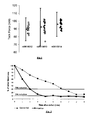
- the haemostatic gel of example 1 was applied to swine nasal mucosa laceration injuries with bleeding rates between 3 to 25 mL/min and successful hemostasis was achieved.
- a commercially available nasal dressing and sinus stent hydrogel composed of cross-linked hyaluronic acid was used as a control gel.
- Application of the calcium-sodium microdispersed polyanhydroglucuronic acid containing gel coated the surface of the injury facilitates interaction between the bleeding site and the microdispersed oxidized cellulose ( Fig 2 ). 70% reduction in bleeding was achieved within 1.5 minutes and with 90% reduction in bleeding in as little as 3 minutes.
- the gel was adherent and coated vertical and inverted tissue surfaces.
- control gel only achieved 70% reduction in bleeding after approximately 6 minutes and did not achieve 90% reduction in bleeding in the course of the study.
- This swine study demonstrated successfully the efficacy of the formulation to stop bleeding in a nasal injury such as that seen in sinus surgeries especially when compared to a commercially available gel for similar use.
- a frequent complication of functional endoscopic sinus surgery is the development of post-operative adhesions, which may block normal mucociliary drainage pathways of the sinuses. This blockage can cause a recurrence of sinusitis and require subsequent surgical procedures.
- nasal packing is often used. Alternatives to nasal packing include intranasal splints and gels, though the majority of these products employ the tamponade effect to achieve haemostasis, which can contribute to abnormal nasal breathing and significant patient discomfort.
- An optimal haemostat for endoscopic sinus surgery would effectively control bleeding and minimise adhesion formation, scar formation and inflammation of the mucosal tissue. The purpose of this study was to evaluate the post-operative performance of the haemostatic gel.
- the haemostatic gel of the invention can effectively control bleeding associated with FESS. Furthermore, the gel enables re-epithelialisation of the mucosa and subsequent natural wound healing without adhesion or granuloma formation.
- the purpose of the post-market clinical evaluation was to summarise the clinical use to-date of the haemostatic gel.
- the objectives of the clinical evaluation were to evaluate the gel's intra-operative haemostatic efficacy, its ability to coat the mucosal surface, delivery device ergonomics and various elements of the gel's application technique.
- the haemostatic gel of example 2 was utilised by five surgeons in nine separate cases.
- the nine cases can be broken down as follows: five functional endoscopic sinus surgeries (FESS), two FESS procedures combined with septoplasty and two FESS procedures combined with submucosal resection (SMR) of the inferior turbinate.
- FESS functional endoscopic sinus surgeries
- SMR submucosal resection
- the haemostatic gel of the invention effectively coats the mucosal tissue while simultaneously controlling bleeding typically associated with ENT surgical procedures.
- a gel was prepared with the following composition.
- the prepared mixture can be used successfully as a haemostatic agent for a surgical gel intended to reduce bleeding.
Landscapes
- Health & Medical Sciences (AREA)
- Public Health (AREA)
- Epidemiology (AREA)
- Life Sciences & Earth Sciences (AREA)
- Animal Behavior & Ethology (AREA)
- General Health & Medical Sciences (AREA)
- Veterinary Medicine (AREA)
- Chemical & Material Sciences (AREA)
- Engineering & Computer Science (AREA)
- Materials Engineering (AREA)
- Surgery (AREA)
- Medicinal Preparation (AREA)
- Materials For Medical Uses (AREA)
- Chemical Kinetics & Catalysis (AREA)
- Medicinal Chemistry (AREA)
- Polymers & Plastics (AREA)
- Organic Chemistry (AREA)
Claims (17)
- Gel chirurgical stérile permettant de recouvrir une zone de plaie et d'y adhérer pour maîtriser des saignements tout en encourageant la cicatrisation de la plaie, le gel comprenant un acide polyanhydroglucuronique ou un sel biocompatible de celui-ci en une quantité qui va de 1 % à 15 % en poids, une pectine en une quantité qui va de 0,1 % à 9 % en poids et un agent favorisant la stabilité, dans lequel la viscosité du gel va de 100 à 350 Pa.s (100 000 à 350 000 cP) quand mesurée à 37° C, dans lequel l'adhésivité du système de gel va de 70 mN à 110 mN et dans lequel le gel est stérilisé par irradiation gamma.
- Gel selon la revendication 1 comprenant un acide polyanhydroglucuronique ou un sel biocompatible de celui-ci en une quantité qui va de 3 % à 10 % en poids et éventuellement comprenant un acide polyanhydroglucuronique ou un sel biocompatible de celui-ci en une quantité de 9 % en poids.
- Gel selon la revendication 1 ou 2 comprenant une pectine en une quantité de 4 % approximativement ou en une quantité de 3,6 % approximativement.
- Gel selon l'une quelconque des revendication 1 à 3, dans lequel la viscosité du gel va de 200 à 350 Pa.s (200 000 à 350 000 cP) quand mesurée à 37 °C et éventuellement dans lequel la viscosité du gel va de 200 à 300 Pa.s (200 000 à 300 000 cP) quand mesurée à 37 °C.
- Gel selon l'une quelconque des revendications 1 à 4 dans lequel le système comprend un agent lubrifiant.
- Gel selon la revendication 5, dans lequel l'agent lubrifiant comprend de la glycérine.
- Gel selon la revendication 6 comprenant de la glycérine en une quantité qui va de 2 % à 8 % (p/p).
- Gel selon l'une quelconque des revendications 1 à 7, dans lequel l'agent favorisant la stabilité est sélectionné parmi un ou plusieurs des suivants : éthanol et sorbate de potassium.
- Gel selon la revendication 8, dans lequel l'agent favorisant la stabilité comprend de l'éthanol en une quantité qui va de 0 % à 8 % (p/p), l'éthanol étant éventuellement présent en une quantité qui va de 3 % à 7 % (p/p).
- Gel selon la revendication 8 ou 9, dans lequel l'agent favorisant la stabilité comprend du sorbate de potassium en une quantité qui va de 0,05 % à 1 % (p/p).
- Gel selon l'une quelconque des revendications 1 à 10 comprenant de la glycérine en une quantité qui va de 2 % à 8 % (p/p), de l'éthanol en une quantité qui va de 0 % à 8 % (p/p) et du sorbate de potassium en une quantité qui va de 0,05 % à 1 % (p/p).
- Gel stérile comprenant 9 % (p/p) d'un acide polyanhydroglucuronique, 4 % (p/p) d'une pectine, 3 % (p/p) de glycérine, 5 % (p/p) d'éthanol, 0,2 % (p/p) de sorbate de potassium et 78,8 % (p/p) d'eau et où le gel est stérilisé par irradiation gamma.
- Gel stérile comprenant 9 % (p/p) d'un acide polyanhydroglucuronique, 3,6 % (p/p) d'une pectine, 2,9 % (p/p) de glycérine, 5,1 % (p/p) d'éthanol, 0,2 % (p/p) de sorbate de potassium et 79,2 % (p/p) d'eau et où le gel est stérilisé par irradiation gamma.
- Gel selon l'une quelconque des revendications 1 à 13 comprenant un agent antimicrobien.
- Gel selon l'une quelconque des revendications 1 à 14 qui est stérilisé par irradiation gamma.
- Seringue contenant le gel selon l'une quelconque des revendications 1 à 15.
- Gel selon l'une quelconque des revendications 1 à 11 pour une utilisation dans
la maîtrise des saignements pendant ou après une chirurgie des sinus ;
la maîtrise des saignements lors de procédures concernant la sphère ORL ;
la maîtrise des saignements lors d'une chirurgie plastique reconstructive générale ;
la maîtrise des saignements lors d'une chirurgie neurologique ;
la maîtrise des saignements après prélèvement d'une biopsie ;
la maîtrise des saignements lors d'une chirurgie vasculaire ;
la maîtrise des saignements lors d'une chirurgie oncologique avec résection d'organe pour enlever des tumeurs ; ou
la maitrise des saignements lors de procédures gynécologiques.
Applications Claiming Priority (2)
| Application Number | Priority Date | Filing Date | Title |
|---|---|---|---|
| US34416710P | 2010-06-03 | 2010-06-03 | |
| PCT/IE2011/000029 WO2011151810A1 (fr) | 2010-06-03 | 2011-06-01 | Système de gel chirurgical |
Publications (2)
| Publication Number | Publication Date |
|---|---|
| EP2575907A1 EP2575907A1 (fr) | 2013-04-10 |
| EP2575907B1 true EP2575907B1 (fr) | 2015-07-29 |
Family
ID=44343201
Family Applications (1)
| Application Number | Title | Priority Date | Filing Date |
|---|---|---|---|
| EP11728064.4A Not-in-force EP2575907B1 (fr) | 2010-06-03 | 2011-06-01 | Système de gel chirurgical |
Country Status (3)
| Country | Link |
|---|---|
| US (1) | US8865680B2 (fr) |
| EP (1) | EP2575907B1 (fr) |
| WO (1) | WO2011151810A1 (fr) |
Families Citing this family (3)
| Publication number | Priority date | Publication date | Assignee | Title |
|---|---|---|---|---|
| WO2015120085A1 (fr) | 2014-02-04 | 2015-08-13 | Hemcon Medical Technologies, Inc. | Matériaux de chitosane d'une solution d'acide carbonique |
| WO2016164903A1 (fr) * | 2015-04-10 | 2016-10-13 | Hemcon Medical Technologies, Inc. | Gel de chitosane bioadhésif destiné à réguler les saignements et à favoriser la guérison par la réduction des cicatrices sans cacher ou gêner l'accès a un champ chirurgical |
| CN106512079B (zh) * | 2016-11-28 | 2018-08-31 | 北京福爱乐科技发展有限公司 | 一种止血喷涂型粘合剂及其制备方法 |
Family Cites Families (5)
| Publication number | Priority date | Publication date | Assignee | Title |
|---|---|---|---|---|
| ATE209661T1 (de) * | 1997-01-30 | 2001-12-15 | Alpenstock Holdings Ltd | Cellulosederivate |
| JP2002521392A (ja) * | 1998-07-21 | 2002-07-16 | アルペンストック・ホールディングス・リミテッド | グルクロノグルカンのポリマーコンプレックス |
| GB2399289B (en) * | 2003-03-10 | 2006-03-08 | Johnson & Johnson Medical Ltd | Hydrocolloid materials for use in wound healing |
| EP1773414A1 (fr) * | 2004-07-08 | 2007-04-18 | Alltracel Development Services Limited | Systeme d'administration pour limiter le saignement des blessures a la peau |
| US8445671B2 (en) | 2005-09-02 | 2013-05-21 | Alltracel Development Services Limited | Method for preparing polyanhydroglucuronic acid and/or salts thereof |
-
2011
- 2011-06-01 EP EP11728064.4A patent/EP2575907B1/fr not_active Not-in-force
- 2011-06-01 WO PCT/IE2011/000029 patent/WO2011151810A1/fr not_active Ceased
-
2012
- 2012-11-30 US US13/690,529 patent/US8865680B2/en not_active Expired - Fee Related
Also Published As
| Publication number | Publication date |
|---|---|
| EP2575907A1 (fr) | 2013-04-10 |
| US20130165402A1 (en) | 2013-06-27 |
| US8865680B2 (en) | 2014-10-21 |
| WO2011151810A1 (fr) | 2011-12-08 |
Similar Documents
| Publication | Publication Date | Title |
|---|---|---|
| US11160901B2 (en) | Bioadhesive chitosan gel for controlling bleeding and for promoting healing with scar reduction without obscuring or interfering with access to a surgical field | |
| CA2785595C (fr) | Adhesif de fibrine en poudre seche | |
| AU2012280218B2 (en) | Formulations for wound therapy | |
| EP2233157A1 (fr) | Matériau spongieux biocompatible à l'amidon dénaturé | |
| CN101848739A (zh) | 手术用水凝胶 | |
| KR102802704B1 (ko) | 산화 셀룰로오스를 포함하는 조성물 | |
| CN115605234B (zh) | 止血糊剂及其用途 | |
| EP2575907B1 (fr) | Système de gel chirurgical | |
| CN102448442A (zh) | 组织粘连的治疗 | |
| EP3532026B1 (fr) | Pansements hémostatiques s'appuyant sur la nanotechnologie | |
| HK40086343B (zh) | 止血糊剂及其用途 | |
| HK40086343A (zh) | 止血糊剂及其用途 | |
| HK40055061A (en) | Compositions comprising oxidized cellulose | |
| Chandra et al. | Bioabsorbable Materials in Revision Sinus Surgery | |
| HK1171680A (en) | Dry powder fibrin sealant |
Legal Events
| Date | Code | Title | Description |
|---|---|---|---|
| PUAI | Public reference made under article 153(3) epc to a published international application that has entered the european phase |
Free format text: ORIGINAL CODE: 0009012 |
|
| 17P | Request for examination filed |
Effective date: 20121204 |
|
| AK | Designated contracting states |
Kind code of ref document: A1 Designated state(s): AL AT BE BG CH CY CZ DE DK EE ES FI FR GB GR HR HU IE IS IT LI LT LU LV MC MK MT NL NO PL PT RO RS SE SI SK SM TR |
|
| DAX | Request for extension of the european patent (deleted) | ||
| 17Q | First examination report despatched |
Effective date: 20131025 |
|
| REG | Reference to a national code |
Ref country code: DE Ref legal event code: R079 Ref document number: 602011018244 Country of ref document: DE Free format text: PREVIOUS MAIN CLASS: A61L0026000000 Ipc: A61L0024000000 |
|
| GRAP | Despatch of communication of intention to grant a patent |
Free format text: ORIGINAL CODE: EPIDOSNIGR1 |
|
| RIC1 | Information provided on ipc code assigned before grant |
Ipc: A61L 24/08 20060101ALI20150210BHEP Ipc: A61L 24/00 20060101AFI20150210BHEP Ipc: A61L 24/04 20060101ALI20150210BHEP |
|
| INTG | Intention to grant announced |
Effective date: 20150312 |
|
| GRAS | Grant fee paid |
Free format text: ORIGINAL CODE: EPIDOSNIGR3 |
|
| GRAA | (expected) grant |
Free format text: ORIGINAL CODE: 0009210 |
|
| AK | Designated contracting states |
Kind code of ref document: B1 Designated state(s): AL AT BE BG CH CY CZ DE DK EE ES FI FR GB GR HR HU IE IS IT LI LT LU LV MC MK MT NL NO PL PT RO RS SE SI SK SM TR |
|
| REG | Reference to a national code |
Ref country code: GB Ref legal event code: FG4D |
|
| REG | Reference to a national code |
Ref country code: CH Ref legal event code: EP |
|
| REG | Reference to a national code |
Ref country code: AT Ref legal event code: REF Ref document number: 738769 Country of ref document: AT Kind code of ref document: T Effective date: 20150815 |
|
| REG | Reference to a national code |
Ref country code: IE Ref legal event code: FG4D |
|
| REG | Reference to a national code |
Ref country code: DE Ref legal event code: R096 Ref document number: 602011018244 Country of ref document: DE |
|
| REG | Reference to a national code |
Ref country code: AT Ref legal event code: MK05 Ref document number: 738769 Country of ref document: AT Kind code of ref document: T Effective date: 20150729 |
|
| REG | Reference to a national code |
Ref country code: LT Ref legal event code: MG4D |
|
| REG | Reference to a national code |
Ref country code: NL Ref legal event code: MP Effective date: 20150729 |
|
| PG25 | Lapsed in a contracting state [announced via postgrant information from national office to epo] |
Ref country code: FI Free format text: LAPSE BECAUSE OF FAILURE TO SUBMIT A TRANSLATION OF THE DESCRIPTION OR TO PAY THE FEE WITHIN THE PRESCRIBED TIME-LIMIT Effective date: 20150729 Ref country code: GR Free format text: LAPSE BECAUSE OF FAILURE TO SUBMIT A TRANSLATION OF THE DESCRIPTION OR TO PAY THE FEE WITHIN THE PRESCRIBED TIME-LIMIT Effective date: 20151030 Ref country code: LV Free format text: LAPSE BECAUSE OF FAILURE TO SUBMIT A TRANSLATION OF THE DESCRIPTION OR TO PAY THE FEE WITHIN THE PRESCRIBED TIME-LIMIT Effective date: 20150729 Ref country code: LT Free format text: LAPSE BECAUSE OF FAILURE TO SUBMIT A TRANSLATION OF THE DESCRIPTION OR TO PAY THE FEE WITHIN THE PRESCRIBED TIME-LIMIT Effective date: 20150729 Ref country code: NO Free format text: LAPSE BECAUSE OF FAILURE TO SUBMIT A TRANSLATION OF THE DESCRIPTION OR TO PAY THE FEE WITHIN THE PRESCRIBED TIME-LIMIT Effective date: 20151029 |
|
| PG25 | Lapsed in a contracting state [announced via postgrant information from national office to epo] |
Ref country code: IS Free format text: LAPSE BECAUSE OF FAILURE TO SUBMIT A TRANSLATION OF THE DESCRIPTION OR TO PAY THE FEE WITHIN THE PRESCRIBED TIME-LIMIT Effective date: 20151129 Ref country code: PL Free format text: LAPSE BECAUSE OF FAILURE TO SUBMIT A TRANSLATION OF THE DESCRIPTION OR TO PAY THE FEE WITHIN THE PRESCRIBED TIME-LIMIT Effective date: 20150729 Ref country code: AT Free format text: LAPSE BECAUSE OF FAILURE TO SUBMIT A TRANSLATION OF THE DESCRIPTION OR TO PAY THE FEE WITHIN THE PRESCRIBED TIME-LIMIT Effective date: 20150729 Ref country code: SE Free format text: LAPSE BECAUSE OF FAILURE TO SUBMIT A TRANSLATION OF THE DESCRIPTION OR TO PAY THE FEE WITHIN THE PRESCRIBED TIME-LIMIT Effective date: 20150729 Ref country code: ES Free format text: LAPSE BECAUSE OF FAILURE TO SUBMIT A TRANSLATION OF THE DESCRIPTION OR TO PAY THE FEE WITHIN THE PRESCRIBED TIME-LIMIT Effective date: 20150729 Ref country code: HR Free format text: LAPSE BECAUSE OF FAILURE TO SUBMIT A TRANSLATION OF THE DESCRIPTION OR TO PAY THE FEE WITHIN THE PRESCRIBED TIME-LIMIT Effective date: 20150729 Ref country code: RS Free format text: LAPSE BECAUSE OF FAILURE TO SUBMIT A TRANSLATION OF THE DESCRIPTION OR TO PAY THE FEE WITHIN THE PRESCRIBED TIME-LIMIT Effective date: 20150729 Ref country code: PT Free format text: LAPSE BECAUSE OF FAILURE TO SUBMIT A TRANSLATION OF THE DESCRIPTION OR TO PAY THE FEE WITHIN THE PRESCRIBED TIME-LIMIT Effective date: 20151130 |
|
| PG25 | Lapsed in a contracting state [announced via postgrant information from national office to epo] |
Ref country code: NL Free format text: LAPSE BECAUSE OF FAILURE TO SUBMIT A TRANSLATION OF THE DESCRIPTION OR TO PAY THE FEE WITHIN THE PRESCRIBED TIME-LIMIT Effective date: 20150729 |
|
| PG25 | Lapsed in a contracting state [announced via postgrant information from national office to epo] |
Ref country code: CZ Free format text: LAPSE BECAUSE OF FAILURE TO SUBMIT A TRANSLATION OF THE DESCRIPTION OR TO PAY THE FEE WITHIN THE PRESCRIBED TIME-LIMIT Effective date: 20150729 Ref country code: EE Free format text: LAPSE BECAUSE OF FAILURE TO SUBMIT A TRANSLATION OF THE DESCRIPTION OR TO PAY THE FEE WITHIN THE PRESCRIBED TIME-LIMIT Effective date: 20150729 Ref country code: DK Free format text: LAPSE BECAUSE OF FAILURE TO SUBMIT A TRANSLATION OF THE DESCRIPTION OR TO PAY THE FEE WITHIN THE PRESCRIBED TIME-LIMIT Effective date: 20150729 Ref country code: IT Free format text: LAPSE BECAUSE OF FAILURE TO SUBMIT A TRANSLATION OF THE DESCRIPTION OR TO PAY THE FEE WITHIN THE PRESCRIBED TIME-LIMIT Effective date: 20150729 Ref country code: SK Free format text: LAPSE BECAUSE OF FAILURE TO SUBMIT A TRANSLATION OF THE DESCRIPTION OR TO PAY THE FEE WITHIN THE PRESCRIBED TIME-LIMIT Effective date: 20150729 |
|
| REG | Reference to a national code |
Ref country code: DE Ref legal event code: R097 Ref document number: 602011018244 Country of ref document: DE |
|
| REG | Reference to a national code |
Ref country code: FR Ref legal event code: PLFP Year of fee payment: 6 |
|
| PG25 | Lapsed in a contracting state [announced via postgrant information from national office to epo] |
Ref country code: RO Free format text: LAPSE BECAUSE OF FAILURE TO SUBMIT A TRANSLATION OF THE DESCRIPTION OR TO PAY THE FEE WITHIN THE PRESCRIBED TIME-LIMIT Effective date: 20150729 |
|
| PLBE | No opposition filed within time limit |
Free format text: ORIGINAL CODE: 0009261 |
|
| STAA | Information on the status of an ep patent application or granted ep patent |
Free format text: STATUS: NO OPPOSITION FILED WITHIN TIME LIMIT |
|
| 26N | No opposition filed |
Effective date: 20160502 |
|
| PG25 | Lapsed in a contracting state [announced via postgrant information from national office to epo] |
Ref country code: SI Free format text: LAPSE BECAUSE OF FAILURE TO SUBMIT A TRANSLATION OF THE DESCRIPTION OR TO PAY THE FEE WITHIN THE PRESCRIBED TIME-LIMIT Effective date: 20150729 |
|
| PG25 | Lapsed in a contracting state [announced via postgrant information from national office to epo] |
Ref country code: BE Free format text: LAPSE BECAUSE OF FAILURE TO SUBMIT A TRANSLATION OF THE DESCRIPTION OR TO PAY THE FEE WITHIN THE PRESCRIBED TIME-LIMIT Effective date: 20150729 |
|
| PG25 | Lapsed in a contracting state [announced via postgrant information from national office to epo] |
Ref country code: MC Free format text: LAPSE BECAUSE OF FAILURE TO SUBMIT A TRANSLATION OF THE DESCRIPTION OR TO PAY THE FEE WITHIN THE PRESCRIBED TIME-LIMIT Effective date: 20150729 |
|
| REG | Reference to a national code |
Ref country code: CH Ref legal event code: PL |
|
| REG | Reference to a national code |
Ref country code: IE Ref legal event code: MM4A |
|
| PG25 | Lapsed in a contracting state [announced via postgrant information from national office to epo] |
Ref country code: CH Free format text: LAPSE BECAUSE OF NON-PAYMENT OF DUE FEES Effective date: 20160630 Ref country code: LI Free format text: LAPSE BECAUSE OF NON-PAYMENT OF DUE FEES Effective date: 20160630 |
|
| REG | Reference to a national code |
Ref country code: FR Ref legal event code: PLFP Year of fee payment: 7 |
|
| PG25 | Lapsed in a contracting state [announced via postgrant information from national office to epo] |
Ref country code: IE Free format text: LAPSE BECAUSE OF NON-PAYMENT OF DUE FEES Effective date: 20160601 |
|
| REG | Reference to a national code |
Ref country code: FR Ref legal event code: PLFP Year of fee payment: 8 |
|
| PG25 | Lapsed in a contracting state [announced via postgrant information from national office to epo] |
Ref country code: SM Free format text: LAPSE BECAUSE OF FAILURE TO SUBMIT A TRANSLATION OF THE DESCRIPTION OR TO PAY THE FEE WITHIN THE PRESCRIBED TIME-LIMIT Effective date: 20150729 Ref country code: CY Free format text: LAPSE BECAUSE OF FAILURE TO SUBMIT A TRANSLATION OF THE DESCRIPTION OR TO PAY THE FEE WITHIN THE PRESCRIBED TIME-LIMIT Effective date: 20150729 Ref country code: HU Free format text: LAPSE BECAUSE OF FAILURE TO SUBMIT A TRANSLATION OF THE DESCRIPTION OR TO PAY THE FEE WITHIN THE PRESCRIBED TIME-LIMIT; INVALID AB INITIO Effective date: 20110601 |
|
| PG25 | Lapsed in a contracting state [announced via postgrant information from national office to epo] |
Ref country code: MT Free format text: LAPSE BECAUSE OF NON-PAYMENT OF DUE FEES Effective date: 20160630 Ref country code: TR Free format text: LAPSE BECAUSE OF FAILURE TO SUBMIT A TRANSLATION OF THE DESCRIPTION OR TO PAY THE FEE WITHIN THE PRESCRIBED TIME-LIMIT Effective date: 20150729 Ref country code: MK Free format text: LAPSE BECAUSE OF FAILURE TO SUBMIT A TRANSLATION OF THE DESCRIPTION OR TO PAY THE FEE WITHIN THE PRESCRIBED TIME-LIMIT Effective date: 20150729 Ref country code: LU Free format text: LAPSE BECAUSE OF NON-PAYMENT OF DUE FEES Effective date: 20160601 |
|
| PG25 | Lapsed in a contracting state [announced via postgrant information from national office to epo] |
Ref country code: BG Free format text: LAPSE BECAUSE OF FAILURE TO SUBMIT A TRANSLATION OF THE DESCRIPTION OR TO PAY THE FEE WITHIN THE PRESCRIBED TIME-LIMIT Effective date: 20150729 |
|
| PG25 | Lapsed in a contracting state [announced via postgrant information from national office to epo] |
Ref country code: AL Free format text: LAPSE BECAUSE OF FAILURE TO SUBMIT A TRANSLATION OF THE DESCRIPTION OR TO PAY THE FEE WITHIN THE PRESCRIBED TIME-LIMIT Effective date: 20150729 |
|
| PGFP | Annual fee paid to national office [announced via postgrant information from national office to epo] |
Ref country code: DE Payment date: 20190624 Year of fee payment: 9 |
|
| PGFP | Annual fee paid to national office [announced via postgrant information from national office to epo] |
Ref country code: FR Payment date: 20190701 Year of fee payment: 9 Ref country code: GB Payment date: 20190619 Year of fee payment: 9 |
|
| REG | Reference to a national code |
Ref country code: DE Ref legal event code: R119 Ref document number: 602011018244 Country of ref document: DE |
|
| GBPC | Gb: european patent ceased through non-payment of renewal fee |
Effective date: 20200601 |
|
| PG25 | Lapsed in a contracting state [announced via postgrant information from national office to epo] |
Ref country code: FR Free format text: LAPSE BECAUSE OF NON-PAYMENT OF DUE FEES Effective date: 20200630 Ref country code: GB Free format text: LAPSE BECAUSE OF NON-PAYMENT OF DUE FEES Effective date: 20200601 |
|
| PG25 | Lapsed in a contracting state [announced via postgrant information from national office to epo] |
Ref country code: DE Free format text: LAPSE BECAUSE OF NON-PAYMENT OF DUE FEES Effective date: 20210101 |