EP2576868B1 - Verfahren zur bearbeitung gewalzter stahlartikel - Google Patents
Verfahren zur bearbeitung gewalzter stahlartikel Download PDFInfo
- Publication number
- EP2576868B1 EP2576868B1 EP11785958.7A EP11785958A EP2576868B1 EP 2576868 B1 EP2576868 B1 EP 2576868B1 EP 11785958 A EP11785958 A EP 11785958A EP 2576868 B1 EP2576868 B1 EP 2576868B1
- Authority
- EP
- European Patent Office
- Prior art keywords
- solution
- rolled steel
- steel article
- air
- article
- Prior art date
- Legal status (The legal status is an assumption and is not a legal conclusion. Google has not performed a legal analysis and makes no representation as to the accuracy of the status listed.)
- Not-in-force
Links
- 229910000831 Steel Inorganic materials 0.000 title claims description 119
- 239000010959 steel Substances 0.000 title claims description 119
- 238000000034 method Methods 0.000 title claims description 47
- 239000007788 liquid Substances 0.000 claims description 24
- XLYOFNOQVPJJNP-UHFFFAOYSA-N water Substances O XLYOFNOQVPJJNP-UHFFFAOYSA-N 0.000 claims description 24
- 239000002253 acid Substances 0.000 claims description 7
- 238000005507 spraying Methods 0.000 claims description 6
- 238000005112 continuous flow technique Methods 0.000 claims description 5
- 239000004094 surface-active agent Substances 0.000 claims description 5
- 239000003599 detergent Substances 0.000 claims description 4
- 239000003595 mist Substances 0.000 claims description 4
- LFQSCWFLJHTTHZ-UHFFFAOYSA-N Ethanol Chemical compound CCO LFQSCWFLJHTTHZ-UHFFFAOYSA-N 0.000 claims description 3
- 239000003945 anionic surfactant Substances 0.000 claims description 3
- 125000000484 butyl group Chemical group [H]C([*])([H])C([H])([H])C([H])([H])C([H])([H])[H] 0.000 claims description 3
- 239000012530 fluid Substances 0.000 claims description 3
- 239000000243 solution Substances 0.000 description 55
- 238000000576 coating method Methods 0.000 description 23
- 238000004140 cleaning Methods 0.000 description 21
- JEIPFZHSYJVQDO-UHFFFAOYSA-N iron(III) oxide Inorganic materials O=[Fe]O[Fe]=O JEIPFZHSYJVQDO-UHFFFAOYSA-N 0.000 description 18
- 239000011248 coating agent Substances 0.000 description 17
- 238000012360 testing method Methods 0.000 description 12
- 230000008569 process Effects 0.000 description 11
- 238000004519 manufacturing process Methods 0.000 description 10
- 238000011282 treatment Methods 0.000 description 10
- 238000005554 pickling Methods 0.000 description 9
- 239000010960 cold rolled steel Substances 0.000 description 8
- 238000001035 drying Methods 0.000 description 6
- 239000003921 oil Substances 0.000 description 5
- 239000003973 paint Substances 0.000 description 5
- 238000003466 welding Methods 0.000 description 5
- VEXZGXHMUGYJMC-UHFFFAOYSA-N Hydrochloric acid Chemical compound Cl VEXZGXHMUGYJMC-UHFFFAOYSA-N 0.000 description 4
- 238000005422 blasting Methods 0.000 description 4
- 238000002360 preparation method Methods 0.000 description 4
- 239000000758 substrate Substances 0.000 description 4
- OKKJLVBELUTLKV-UHFFFAOYSA-N Methanol Chemical compound OC OKKJLVBELUTLKV-UHFFFAOYSA-N 0.000 description 3
- 239000000853 adhesive Substances 0.000 description 3
- 230000001070 adhesive effect Effects 0.000 description 3
- 238000005260 corrosion Methods 0.000 description 3
- 230000007797 corrosion Effects 0.000 description 3
- 238000002347 injection Methods 0.000 description 3
- 239000007924 injection Substances 0.000 description 3
- 238000003698 laser cutting Methods 0.000 description 3
- XEEYBQQBJWHFJM-UHFFFAOYSA-N Iron Chemical compound [Fe] XEEYBQQBJWHFJM-UHFFFAOYSA-N 0.000 description 2
- 239000000356 contaminant Substances 0.000 description 2
- 238000012864 cross contamination Methods 0.000 description 2
- 238000007598 dipping method Methods 0.000 description 2
- 238000002845 discoloration Methods 0.000 description 2
- 238000005516 engineering process Methods 0.000 description 2
- SZVJSHCCFOBDDC-UHFFFAOYSA-N ferrosoferric oxide Chemical compound O=[Fe]O[Fe]O[Fe]=O SZVJSHCCFOBDDC-UHFFFAOYSA-N 0.000 description 2
- 239000002245 particle Substances 0.000 description 2
- 239000000779 smoke Substances 0.000 description 2
- 239000007921 spray Substances 0.000 description 2
- 238000003860 storage Methods 0.000 description 2
- 238000005406 washing Methods 0.000 description 2
- 241000251468 Actinopterygii Species 0.000 description 1
- 208000020564 Eye injury Diseases 0.000 description 1
- 238000005299 abrasion Methods 0.000 description 1
- 239000003082 abrasive agent Substances 0.000 description 1
- 238000005270 abrasive blasting Methods 0.000 description 1
- 239000011324 bead Substances 0.000 description 1
- 230000009286 beneficial effect Effects 0.000 description 1
- 230000015572 biosynthetic process Effects 0.000 description 1
- 230000001680 brushing effect Effects 0.000 description 1
- 230000008859 change Effects 0.000 description 1
- 239000007795 chemical reaction product Substances 0.000 description 1
- 239000008199 coating composition Substances 0.000 description 1
- 238000013329 compounding Methods 0.000 description 1
- 238000011109 contamination Methods 0.000 description 1
- 238000005520 cutting process Methods 0.000 description 1
- 230000003247 decreasing effect Effects 0.000 description 1
- 239000013527 degreasing agent Substances 0.000 description 1
- 230000018044 dehydration Effects 0.000 description 1
- 238000006297 dehydration reaction Methods 0.000 description 1
- 238000009792 diffusion process Methods 0.000 description 1
- 239000000428 dust Substances 0.000 description 1
- 230000000694 effects Effects 0.000 description 1
- 238000001704 evaporation Methods 0.000 description 1
- 230000008020 evaporation Effects 0.000 description 1
- 238000001125 extrusion Methods 0.000 description 1
- 239000003517 fume Substances 0.000 description 1
- 239000011521 glass Substances 0.000 description 1
- 239000004519 grease Substances 0.000 description 1
- 238000010438 heat treatment Methods 0.000 description 1
- 238000005098 hot rolling Methods 0.000 description 1
- 230000002401 inhibitory effect Effects 0.000 description 1
- 229910052742 iron Inorganic materials 0.000 description 1
- 239000000314 lubricant Substances 0.000 description 1
- 238000012423 maintenance Methods 0.000 description 1
- 238000005259 measurement Methods 0.000 description 1
- 239000002184 metal Substances 0.000 description 1
- 229910052751 metal Inorganic materials 0.000 description 1
- 239000000203 mixture Substances 0.000 description 1
- 230000004048 modification Effects 0.000 description 1
- 238000012986 modification Methods 0.000 description 1
- 230000007935 neutral effect Effects 0.000 description 1
- 238000005457 optimization Methods 0.000 description 1
- 238000010422 painting Methods 0.000 description 1
- 238000012545 processing Methods 0.000 description 1
- 239000000047 product Substances 0.000 description 1
- 230000009467 reduction Effects 0.000 description 1
- 150000003839 salts Chemical class 0.000 description 1
- 238000007789 sealing Methods 0.000 description 1
- 238000000926 separation method Methods 0.000 description 1
- 239000007787 solid Substances 0.000 description 1
- 238000010186 staining Methods 0.000 description 1
- 239000002562 thickening agent Substances 0.000 description 1
- 230000001550 time effect Effects 0.000 description 1
Images

Classifications
-
- C—CHEMISTRY; METALLURGY
- C23—COATING METALLIC MATERIAL; COATING MATERIAL WITH METALLIC MATERIAL; CHEMICAL SURFACE TREATMENT; DIFFUSION TREATMENT OF METALLIC MATERIAL; COATING BY VACUUM EVAPORATION, BY SPUTTERING, BY ION IMPLANTATION OR BY CHEMICAL VAPOUR DEPOSITION, IN GENERAL; INHIBITING CORROSION OF METALLIC MATERIAL OR INCRUSTATION IN GENERAL
- C23G—CLEANING OR DE-GREASING OF METALLIC MATERIAL BY CHEMICAL METHODS OTHER THAN ELECTROLYSIS
- C23G1/00—Cleaning or pickling metallic material with solutions or molten salts
- C23G1/02—Cleaning or pickling metallic material with solutions or molten salts with acid solutions
- C23G1/08—Iron or steel
-
- C—CHEMISTRY; METALLURGY
- C23—COATING METALLIC MATERIAL; COATING MATERIAL WITH METALLIC MATERIAL; CHEMICAL SURFACE TREATMENT; DIFFUSION TREATMENT OF METALLIC MATERIAL; COATING BY VACUUM EVAPORATION, BY SPUTTERING, BY ION IMPLANTATION OR BY CHEMICAL VAPOUR DEPOSITION, IN GENERAL; INHIBITING CORROSION OF METALLIC MATERIAL OR INCRUSTATION IN GENERAL
- C23G—CLEANING OR DE-GREASING OF METALLIC MATERIAL BY CHEMICAL METHODS OTHER THAN ELECTROLYSIS
- C23G1/00—Cleaning or pickling metallic material with solutions or molten salts
-
- C—CHEMISTRY; METALLURGY
- C23—COATING METALLIC MATERIAL; COATING MATERIAL WITH METALLIC MATERIAL; CHEMICAL SURFACE TREATMENT; DIFFUSION TREATMENT OF METALLIC MATERIAL; COATING BY VACUUM EVAPORATION, BY SPUTTERING, BY ION IMPLANTATION OR BY CHEMICAL VAPOUR DEPOSITION, IN GENERAL; INHIBITING CORROSION OF METALLIC MATERIAL OR INCRUSTATION IN GENERAL
- C23G—CLEANING OR DE-GREASING OF METALLIC MATERIAL BY CHEMICAL METHODS OTHER THAN ELECTROLYSIS
- C23G5/00—Cleaning or de-greasing metallic material by other methods; Apparatus for cleaning or de-greasing metallic material with organic solvents
-
- C—CHEMISTRY; METALLURGY
- C23—COATING METALLIC MATERIAL; COATING MATERIAL WITH METALLIC MATERIAL; CHEMICAL SURFACE TREATMENT; DIFFUSION TREATMENT OF METALLIC MATERIAL; COATING BY VACUUM EVAPORATION, BY SPUTTERING, BY ION IMPLANTATION OR BY CHEMICAL VAPOUR DEPOSITION, IN GENERAL; INHIBITING CORROSION OF METALLIC MATERIAL OR INCRUSTATION IN GENERAL
- C23G—CLEANING OR DE-GREASING OF METALLIC MATERIAL BY CHEMICAL METHODS OTHER THAN ELECTROLYSIS
- C23G5/00—Cleaning or de-greasing metallic material by other methods; Apparatus for cleaning or de-greasing metallic material with organic solvents
- C23G5/02—Cleaning or de-greasing metallic material by other methods; Apparatus for cleaning or de-greasing metallic material with organic solvents using organic solvents
-
- B—PERFORMING OPERATIONS; TRANSPORTING
- B21—MECHANICAL METAL-WORKING WITHOUT ESSENTIALLY REMOVING MATERIAL; PUNCHING METAL
- B21B—ROLLING OF METAL
- B21B45/00—Devices for surface or other treatment of work, specially combined with or arranged in, or specially adapted for use in connection with, metal-rolling mills
- B21B45/04—Devices for surface or other treatment of work, specially combined with or arranged in, or specially adapted for use in connection with, metal-rolling mills for de-scaling, e.g. by brushing
- B21B45/08—Devices for surface or other treatment of work, specially combined with or arranged in, or specially adapted for use in connection with, metal-rolling mills for de-scaling, e.g. by brushing hydraulically
Definitions
- the present invention relates to treatment of a hot rolled or cold rolled steel article to remove mill scale, surface rust and oils prior to using the steel in the fabrication of a manufactured product. More particularly, this invention relates to the surface preparation of hot rolled steel and cold rolled steel articles to prepare them prior to fabricating processes including, but not limited to welding, laser cutting, coatings applications and transport of articles.
- Hot and cold rolled steels are both used to fabricate a wide variety of goods, but each have unique properties depending on the temperature at which the steel has been worked or rolled in relation to the steel's critical temperature range, i.e., a temperature range through which the properties of the steel change dramatically.
- Hot rolled steel provided by steel mills is coated with a tough skin of steel oxide primarily composed of Fe 3 O 4 , known as "mill scale," whereas cold rolled steel has a smooth surface with very few blemishes. Hot rolled steel also has more rust that is tightly bound to the surface than does cold rolled steel.
- cold rolled steel is normally "oiled” prior to shipment and said oils are desired to be removed prior to the welding, laser cutting and coatings processes.
- the Pickling and Oiling process demands large acquisition costs and input costs. Although the end result removes surface rust and mill scale - the end product the manufacturer / fabricator is left with is "oiled" steel to inhibit rusting of the surface for storage and transportation. Removal of the oils applied to the steel is required prior to the welding (smoke, splatter), laser cutting (piercing ability, diffusion and tip wear) and coatings (adhesion, corrosion assistants, fish eyes). This method resolves certain issues for the supplier of the steel, but still requires further processing by the manufacturer / fabricator - increasing overhead, input and labour costs. Also, certain coatings require a neutral ph on the substrate and pickling solutions have been noted to increase the acidity of the steel.
- Power tool cleaning can remove a very high degree of rust and mill scale, but like blast cleaning, power tool cleaning generates large quantities of dust, while consuming large amounts of energy and requiring frequent maintenance and replacement of worn parts.
- Water washing equipment requires specialized components for operating at medium to high pressure (206.843 bar (3000 psig) or higher). For example, a pressure pump, a specialized lance and a nozzle assembly are required, in addition to large volumes of water. This technique can remove loose rust but will not effectively remove tight rust or mill scale.
- Abrasive injection in water may provide a greater ability to remove rust and mill scale. However, abrasive injection in water raises most of the concerns of ordinary blast cleaning, in addition to consuming large volumes of water.
- mill scale and rust on large articles made of hot rolled steel has conventionally been removed by blast cleaning, a method of removing mill scale, rust, rust scale, paint or foreign matter by the use of abrasives propelled through nozzles or by centrifugal wheels.
- a "Commercial Blast Cleaned Surface Finish” is sought, which is defined by the Steel Structures Painting Council (SSPC) as one from which all oil, grease, dirt, rust scale and foreign matter have been completely removed from the surface, and all rust, mill scale and old paint have been completely removed except for slight shadows, streaks, or discolorations caused by rust stain, mill scale oxides or slight, tight residues of paint or coating that may remain.
- SSPC Steel Structures Painting Council
- the patent application JP 2007162087 A discloses a method for cleaning a steel strip in a pickling line.
- the method is characterized in that in a pickling line for pickling the surface of a steel strip after hot rolling, a spray of high pressure water is sprayed on the surface of a steel strip discharged from the pickling tank and from which a pickling liquid is squeezed by a wringer roll, thus the surface of the steel strip is cleaned.
- a method of treating a rolled steel article comprising:
- the invention comprises an acid cleaning process that uses the first solution to not only release the mill scale and rust from the steel substrate but to suspend it from the surface allowing minimal psi and gpm to be deployed at the rinse stage, greatly decreasing input costs.
- the further steps in the process utilizing the second solution and air fully dehydrate the steel, inhibiting rust formation.
- the surfactant comprises a non-anionic surfactant.
- the first solution comprises a non-ionic, non-denaturing detergent, which may be a water conditioner and a non-butyl cleaner.
- a non-ionic, non-denaturing detergent which may be a water conditioner and a non-butyl cleaner.
- the first solution is applied to the rolled steel article at an ambient room temperature.
- the prescribed duration of the first solution comprises approximately 3 to 10 minutes.
- the first solution may be applied by dipping the rolled steel article into the first solution.
- the first solution may be applied by spraying the first solution onto exterior surfaces of the rolled steel article.
- the second solution comprises an alcohol.
- the second solution may be applied to the rolled steel article at an ambient room temperature by spraying the second solution as a mist onto exterior surfaces of the rolled steel article.
- the rinse liquid comprises water.
- the rinse liquid may be directed onto the rolled steel article in the form of a jet from a source of fluid under pressure which is less than 68.9476 bar (1000 psi).
- the method includes directing the first solution, the rinse liquid, the first flow of air, the second solution, and the second flow of air at the rolled steel article at separate stations in a continuous flow process, navigating the rolled steel article through the separate stations in a working direction, and orienting the rinse liquid in a jet which is directed towards the rolled steel article at an inclination opposite to the working direction.
- the method may further include directing the first solution, the rinse liquid, the first flow of air, the second solution, and the second flow of air at the rolled steel article at separate stations in a continuous flow process, navigating the rolled steel article through the separate stations in a working direction, and orienting the first and second flows of air towards the rolled steel article at an inclination opposite to the working direction.
- the second flow of air is oriented to oppose the working direction more than the first flow of air.
- a larger volume of air is directed across a larger area of the article in the second flow of air than in the first flow of air.
- the first and second flows of air are at ambient temperature.
- the method includes applying the first solution, the rinse liquid, the first flow of air, the second solution, and the second flow of air to the rolled steel article in immediate succession with one another prior to fabricating the rolled steel article into a manufactured good.
- the rolled steel article may comprise either a hot rolled steel article or a cold rolled steel article.
- the system 10 provides a method of treating steel articles, for example hot rolled and cold rolled steel to prepare the steel prior to subsequent manufacturing and fabrication stages including cutting, welding, coating and the like.
- the treatment method is a continuous flow process in which articles are navigated through a series of five stations in immediate succession with one another. The stations remain isolated from one another such that there is no cross contamination of fluids between adjacent stations.
- Articles 12 typically enter the system at an entrance 14 to be conveyed by a suitable conveying system 16 through the system in a forward working direction 18 to an outlet 20 of the system.
- the first step in the process comprises applying a first solution to the outer surfaces of the rolled steel article 12 for a first prescribed duration.
- the first solution typically comprises a suitable acid, for example a hydrochloric acid, which is arranged to separate mill scale components from the surface of the steel.
- the first solution further comprises a surfactant which is arranged to suspend the separated mill scale components within the solution, as well as a suitable degreaser or detergent to remove oily residues from the steel.
- the additional components of the first solution optimize the cleansing ability of the first solution.
- the first solution is applied at a first station 22 which may comprise a tank through which the steel article is dipped, or a chamber receiving the steel article therein so that the first solution can be sprayed onto the exterior surfaces of the article.
- the first solution typically comprises a suitable thickener to allow the first solution to remain applied to the surface of the steel article for the required prescribed duration which is in the range of three to ten minutes in the preferred embodiment described below.
- the article is conveyed through a second station 24 for rinsing the first solution from the surface of the steel article.
- a source of rinse liquid under pressure is directed through jets onto the surface of the steel article with the rinse liquid and first solution residues being collected from below the article.
- the source of rinse liquid under pressure is typically water at approximately 800 psi with the jets being directed through orifices as descried in further detail below.
- the jets are oriented towards the article at a rearward inclination opposite the forward working direction 18 such that the jets are oriented approximately 45 degrees from the travel direction, but in the opposing direction from the travel direction.
- the article 12 Upon exiting the second station, the article 12 passes through a third station 26 where a series of air knives direct non-heated air in a first flow onto the surface of the rolled steel article to remove substantially all visible moisture on the surfaces of the steel article.
- the jets are typically arranged such that the first flow of air therefrom is in a narrow sheet of moving air, for example having a thickness in the working direction which may be in the range of 1.27 to 2.54 cm (0.5 to 1 inch) while being elongate in a lateral direction across the width of the article.
- the first flow of air in the third station is also directed onto the article so as to be inclined rearwardly opposite the forward travel direction 18.
- the jets of air are directed at an orientation of approximately 45 degrees to the travel direction, but in an opposing direction to the travel direction.
- the article 12 Upon exiting the third station, the article 12 passes through the fourth station 28 where the second solution is applied to the surface of the rolled steel article.
- the second solution is applied in the form of a mist which is sprayed onto the surfaces of the article.
- the second solution typically comprises an alcohol, however any suitable liquid which is more volatile than water would be effective to assist in removing traces of moisture penetrated into the surface of the steel article.
- the second solution saturates the surface of the steel article for the prescribed duration that the steel article is conveyed through the fourth station until the article reaches the final and fifth station 30 for additional drying.
- a second flow of air is directed onto the surface of the steel article until substantially all remaining moisture on the rolled steel article is removed in a kiln drying process.
- the second flow of air also comprises non-heated air from a source of air under pressure directed onto the article in jets which are inclined rearwardly opposite the forward working direction.
- the airflows in the fifth station are typically oriented closer to 30 degrees from the travel direction as opposed to the first airflow which is closer to perpendicular to the travel direction than the second airflow.
- the second flows of air from the second jets are elongate in the lateral direction across the width of the article while also being many times thicker in the working direction than the first flow of air from the first jets.
- the air flow may be approximately 4 inches thick in the working direction so as to result in a greater movement of air for more thoroughly drying the article.
- the second airflow thus opposes the working direction more than the first flow.
- the fifth station typically comprises a greater volume of air directed at the article than the second station to ensure a more thorough drying of the article at the completion of the treatment process.
- the article 12 exits the outlet 20 of the treatment system, the article is ready for subsequent fabrication and manufacturing.
- the dry surface of the steel is also suitable for storage, handling and transport subsequent to treatment without concern for short-term corrosion re-emerging on the surface prior to subsequent fabrication and manufacturing processes.
- the cleaning and dehydrating stages are followed by at least one air movement stage.
- the acid cleaning and dehydrating coating compositions are applied by a process comprising, in order:
- first and second flows of air for drying may comprise heated air for improving the results, however heated the air is not necessary and the cost of additional inputs may not justify the benefits of heating the air.
- the inventor In order to achieve high quality cleaning and dehydration of the steel, while preventing cross-contamination of liquid to neighbouring stages in which liquid is also applied, the inventor has found it beneficial to substantially contain the mist, spray and fumes of each stage from carrying over to each of the other stages.
- Hot rolled and cold rolled steel articles comprising the various types ie. tube, square, rectangular, sheet and plate were tested.
- the steel articles have solution #1 either sprayed on or they are immersed in the solution.
- Either method requires a dwell time of 3 - 10 minutes, depending on the condition of the pre-processed surface.
- the time effect is directly related to the originating steel mill's abilities and roller process technology - that is the amount and consistency of the mill scale from the extrusion and forming process at the steel mill.
- the cleaning stage was followed by a water rinse stage, utilizing non-heated water.
- a water rinse stage utilizing non-heated water.
- the optimum configuration utilized 60 degree nozzle outputs coupled with a .017" orifice. This combination provided the maximum removal of the contaminants utilizing minimum inputs.
- Stage three provides for "wiping" the moisture of the steel. Utilizing available air knife technologies positioned at a 45 degree angle from the article at a prescribed distance allowed the inventors to dehydrate the steel up to 95%, providing a surface conducive to "kiln drying" the surface as described in Stage Five.
- the fourth stage, once all containments have been removed is, via a misting on of solution #2 to allow quicker removal of moisture from the steel.
- solution #2 By utilizing solution #2 the time and effectiveness of the next air steps has been minimized and increased respectively.
- a coating was applied to several steel samples which were prepared according to the treatment of the present invention as described above.
- the same coating was also applied under the same conditions to several steel samples which were prepared in a conventional manner by blasting with glass shot beads. The treated samples and the blasted samples where then tested for comparison.
- testing element was adhered to coating.
- An average force of 68.9476 bar (1000 psi) was required to release the testing element from the four steel samples which were shot blasted.
- 10% of the adhered contact area of the testing element resulted in a failure of the coating to adhere to the steel.
- a remainder of the contact area of the testing element became separated because of adhesive failure between the testing element and the coating.
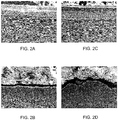
- FIGs 2C and 2D a cross section of one shot blast sample is shown in Figures 2C and 2D and a cross section of one treated sample according to the present invention is shown in Figures 2A and 2B for side by side comparison.
- both samples are shown magnified 200 times such that the overall sample size as shown is near 700 micrometers across.
- both samples are shown magnified 800 times such that the overall sample size as shown is closer to 140 micrometers across.
- the protruding peaks at the surface of the treated steel are much smaller than the protruding peaks at the surface of the shot blasted steel.
Landscapes
- Chemical & Material Sciences (AREA)
- Chemical Kinetics & Catalysis (AREA)
- General Chemical & Material Sciences (AREA)
- Engineering & Computer Science (AREA)
- Materials Engineering (AREA)
- Mechanical Engineering (AREA)
- Metallurgy (AREA)
- Organic Chemistry (AREA)
- Cleaning And De-Greasing Of Metallic Materials By Chemical Methods (AREA)
- Application Of Or Painting With Fluid Materials (AREA)
Claims (15)
- Verfahren zum Behandeln eines gewalzten Stahlgegenstands, wobei das Verfahren umfasst:Bereitstellen einer ersten Lösung, umfassend eine Säure, die zum Trennen von Walzzunderkomponenten von Stahl vorgesehen ist, und ein Tensid, das zum Suspendieren von abgetrennten Walzzunderkomponenten in der ersten Lösung vorgesehen ist;Auftragen der ersten Lösung auf eine Oberfläche des gewalzten Stahlgegenstands für eine vorgeschriebene Dauer;Spülen der ersten Lösung von der Oberfläche des gewalzten Stahlgegenstands durch Aufbringen einer Spülflüssigkeit auf den gewalzten Stahlgegenstand;Leiten eines ersten Luftstroms auf die Oberfläche des gewalzten Stahlgegenstands, um Feuchtigkeit von der Oberfläche des gewalzten Stahlgegenstands zu entfernen;Bereitstellen einer zweiten Lösung, die flüchtiger als Wasser ist;Aufbringen der zweiten Lösung auf die Oberfläche des gewalzten Stahlgegenstandes; undLeiten eines zweiten Luftstroms auf die Oberfläche des gewalzten Stahlgegenstandes nach dem Aufbringen der zweiten Lösung, bis verbleibende Feuchtigkeit auf dem gewalzten Stahlgegenstand im Wesentlichen entfernt ist.
- Verfahren nach Anspruch 1, wobei das Tensid ein nicht-anionisches Tensid umfasst.
- Verfahren nach einem der Ansprüche 1 oder 2, wobei die erste Lösung ein nicht-ionisches, nicht-denaturierendes Detergens umfasst.
- Verfahren nach einem der Ansprüche 1 bis 3, wobei die erste Lösung einen Wasseraufbereiter umfasst.
- Verfahren nach einem der Ansprüche 1 bis 4, wobei die erste Lösung ein nichtbutylisches Reinigungsmittel umfasst.
- Verfahren nach einem der Ansprüche 1 bis 5, wobei die vorgeschriebene Dauer für die erste Lösung 3 bis 10 Minuten umfasst.
- Verfahren nach einem der Ansprüche 1 bis 6, wobei die zweite Lösung einen Alkohol umfasst.
- Verfahren nach einem der Ansprüche 1 bis 7, umfassend das Aufbringen der zweiten Lösung auf den gewalzten Stahlgegenstand bei Raumtemperatur.
- Verfahren nach einem der Ansprüche 1 bis 8, umfassend das Aufbringen der zweiten Lösung durch Aufsprühen der zweiten Lösung als Nebel auf äußere Oberflächen des gewalzten Stahlgegenstandes.
- Verfahren nach einem der Ansprüche 1 bis 9, wobei die Spülflüssigkeit Wasser umfasst.
- Verfahren nach einem der Ansprüche 1 bis 10, umfassend das Leiten der Spülflüssigkeit auf den gewalzten Stahlgegenstand in der Form eines Strahls aus einer Fluidquelle unter Druck, welcher weniger als 68,9476 bar (1000 psi) beträgt.
- Verfahren nach einem der Ansprüche 1 bis 11, umfassend das Leiten der ersten Lösung, der Spülflüssigkeit, des ersten Luftstroms, der zweiten Lösung und des zweiten Luftstroms auf den gewalzten Stahlgegenstand an getrennten Stationen in einem kontinuierlichen Fließprozess, Bewegen des gewalzten Stahlgegenstands durch die getrennten Stationen in einer Arbeitsrichtung und Orientieren der Spülflüssigkeit in einem Strahl, der in einer zu der Arbeitsrichtung entgegengesetzten Neigung auf den gewalzten Stahlgegenstand gerichtet ist.
- Verfahren nach einem der Ansprüche 1 bis 12, umfassend das Leiten der ersten Lösung, der Spülflüssigkeit, des ersten Luftstroms, der zweiten Lösung und des zweiten Luftstroms auf den gewalzten Stahlgegenstand an getrennten Stationen in einem kontinuierlichen Fließprozess, Bewegen des gewalzten Stahlgegenstands durch die getrennten Stationen in einer Arbeitsrichtung und Orientieren der ersten und zweiten Luftströme in Richtung des gewalzten Stahlgegenstands mit einer Neigung entgegengesetzt zur Arbeitsrichtung.
- Verfahren nach einem der Ansprüche 1 bis 13, bei dem der zweite Luftstrom so orientiert wird, dass er der Arbeitsrichtung mehr entgegenwirkt als der erste Luftstrom.
- Verfahren nach einem der Ansprüche 1 bis 14, umfassend das Richten eines größeren Luftvolumens über einen größeren Bereich des Gegenstands in dem zweiten Luftstrom als in dem ersten Luftstrom.
Applications Claiming Priority (2)
| Application Number | Priority Date | Filing Date | Title |
|---|---|---|---|
| US34892410P | 2010-05-27 | 2010-05-27 | |
| PCT/CA2011/050316 WO2011147037A2 (en) | 2010-05-27 | 2011-05-20 | Method of treating rolled steel article |
Publications (3)
| Publication Number | Publication Date |
|---|---|
| EP2576868A2 EP2576868A2 (de) | 2013-04-10 |
| EP2576868A4 EP2576868A4 (de) | 2017-04-05 |
| EP2576868B1 true EP2576868B1 (de) | 2018-07-11 |
Family
ID=45004463
Family Applications (1)
| Application Number | Title | Priority Date | Filing Date |
|---|---|---|---|
| EP11785958.7A Not-in-force EP2576868B1 (de) | 2010-05-27 | 2011-05-20 | Verfahren zur bearbeitung gewalzter stahlartikel |
Country Status (7)
| Country | Link |
|---|---|
| US (1) | US9422629B2 (de) |
| EP (1) | EP2576868B1 (de) |
| AU (1) | AU2011257886B2 (de) |
| CA (1) | CA2800912C (de) |
| DK (1) | DK2576868T3 (de) |
| ES (1) | ES2695973T3 (de) |
| WO (1) | WO2011147037A2 (de) |
Families Citing this family (3)
| Publication number | Priority date | Publication date | Assignee | Title |
|---|---|---|---|---|
| FR3023851A1 (fr) * | 2014-07-21 | 2016-01-22 | Hydromecanique & Frottement | Procede de traitement d'une piece nitruree/ nitrocarburee |
| CN106736330A (zh) * | 2016-11-17 | 2017-05-31 | 盐城国刀刀具有限公司 | 一种热复合刀的生产工艺 |
| CN119220989B (zh) * | 2024-09-26 | 2025-11-25 | 北京科技大学 | 一种高效的热轧板除锈装置及工艺 |
Family Cites Families (8)
| Publication number | Priority date | Publication date | Assignee | Title |
|---|---|---|---|---|
| DE1810245A1 (de) * | 1968-11-22 | 1970-06-18 | Henkel & Cie Gmbh | Mittel zur Entfernung von waessrigen Fluessigkeitsschichten auf Metalloberflaechen |
| DE4345077C2 (de) * | 1993-12-31 | 1999-09-23 | Zibulla & Sohn Gmbh | Vorrichtung zum Reinigen und Entfetten der Oberflächen von Blechen |
| WO1996009899A1 (en) * | 1994-09-26 | 1996-04-04 | E.R. Squibb & Sons, Inc. | Stainless steel acid treatment |
| US5879465A (en) * | 1996-12-20 | 1999-03-09 | Mckevitt; Patrick | Method and apparatus for descaling hot rolled stainless steel strip |
| US6284059B1 (en) * | 1998-08-06 | 2001-09-04 | Trn Business Trust | Cleaning and conversion coating of hot rolled steel articles |
| DE10022083A1 (de) * | 2000-05-08 | 2001-11-15 | Sms Demag Ag | Verfahren und Einrichtung zum Beizen von Edelstahlwarmbändern |
| US6491761B1 (en) * | 2000-07-24 | 2002-12-10 | Bethlelem Steel Corporation | Process for removing stains from steel sheet in a continuous pickling line |
| JP4669385B2 (ja) | 2005-12-15 | 2011-04-13 | 新日本製鐵株式会社 | 酸洗ラインにおける鋼帯の清浄化方法 |
-
2011
- 2011-05-20 ES ES11785958T patent/ES2695973T3/es active Active
- 2011-05-20 WO PCT/CA2011/050316 patent/WO2011147037A2/en not_active Ceased
- 2011-05-20 AU AU2011257886A patent/AU2011257886B2/en not_active Ceased
- 2011-05-20 DK DK11785958.7T patent/DK2576868T3/en active
- 2011-05-20 US US13/700,154 patent/US9422629B2/en active Active
- 2011-05-20 CA CA2800912A patent/CA2800912C/en not_active Expired - Fee Related
- 2011-05-20 EP EP11785958.7A patent/EP2576868B1/de not_active Not-in-force
Non-Patent Citations (1)
| Title |
|---|
| None * |
Also Published As
| Publication number | Publication date |
|---|---|
| WO2011147037A2 (en) | 2011-12-01 |
| AU2011257886A1 (en) | 2013-01-17 |
| DK2576868T3 (en) | 2018-10-29 |
| CA2800912A1 (en) | 2011-12-01 |
| AU2011257886B2 (en) | 2016-01-07 |
| WO2011147037A3 (en) | 2012-02-02 |
| US20130068249A1 (en) | 2013-03-21 |
| ES2695973T3 (es) | 2019-01-11 |
| EP2576868A4 (de) | 2017-04-05 |
| US9422629B2 (en) | 2016-08-23 |
| CA2800912C (en) | 2016-08-23 |
| EP2576868A2 (de) | 2013-04-10 |
Similar Documents
| Publication | Publication Date | Title |
|---|---|---|
| US9815172B2 (en) | Method of steel sheet surface treatment and apparatus of the same | |
| RU2440197C2 (ru) | Абразивоструйное устройство мокрой очистки для удаления окалины с листового металла | |
| CA2977337C (en) | Method and device for descaling metal wire | |
| KR930001083B1 (ko) | 열간압연강대(hot rolled streel strip)의 압연 방법 및 그 장치 | |
| WO2009117314A2 (en) | Slurry blasting apparatus for removing scale from sheet metal | |
| US9422629B2 (en) | Method of treating rolled steel article | |
| AU660440B2 (en) | Method for finishing metal surfaces with terpene | |
| EP1959032B1 (de) | Verfahren zur Reinigung von heißtauchbeschichtetem Stahlblech | |
| US5248343A (en) | Method for finishing metal containers | |
| JP5706837B2 (ja) | 洗浄方法及びその装置 | |
| CN205571006U (zh) | 光亮管体加工设备 | |
| KR102169454B1 (ko) | 스트립 탈지설비의 드라이어 전처리장치 | |
| JPH0841667A (ja) | 金属帯材の洗浄方法 | |
| CN111604717A (zh) | 钢板表面预处理方法 | |
| US20020000264A1 (en) | Cleaning and conversion coating of hot rolled steel articles | |
| WO1994003651A2 (en) | Method, apparatus and salt for descaling metal strip | |
| JPH0542516B2 (de) | ||
| Kent | Prepaint Treatment of Plastics | |
| HK1133409B (en) | Slurry blasting apparatus for removing scale from sheet metal |
Legal Events
| Date | Code | Title | Description |
|---|---|---|---|
| PUAI | Public reference made under article 153(3) epc to a published international application that has entered the european phase |
Free format text: ORIGINAL CODE: 0009012 |
|
| 17P | Request for examination filed |
Effective date: 20121221 |
|
| AK | Designated contracting states |
Kind code of ref document: A2 Designated state(s): AL AT BE BG CH CY CZ DE DK EE ES FI FR GB GR HR HU IE IS IT LI LT LU LV MC MK MT NL NO PL PT RO RS SE SI SK SM TR |
|
| DAX | Request for extension of the european patent (deleted) | ||
| RAP1 | Party data changed (applicant data changed or rights of an application transferred) |
Owner name: MJ LIQUID SOLUTIONS INC. |
|
| RIN1 | Information on inventor provided before grant (corrected) |
Inventor name: MATTHEWS, MATTHEW MARIS Inventor name: DYCK, JOHN WAYNE |
|
| A4 | Supplementary search report drawn up and despatched |
Effective date: 20170306 |
|
| RIC1 | Information provided on ipc code assigned before grant |
Ipc: F26B 5/00 20060101ALI20170228BHEP Ipc: C23G 1/00 20060101ALI20170228BHEP Ipc: B21B 45/04 20060101ALI20170228BHEP Ipc: C23G 1/08 20060101AFI20170228BHEP Ipc: C23G 5/00 20060101ALI20170228BHEP Ipc: B21B 45/08 20060101ALI20170228BHEP Ipc: C23G 5/02 20060101ALI20170228BHEP |
|
| GRAP | Despatch of communication of intention to grant a patent |
Free format text: ORIGINAL CODE: EPIDOSNIGR1 |
|
| STAA | Information on the status of an ep patent application or granted ep patent |
Free format text: STATUS: GRANT OF PATENT IS INTENDED |
|
| RIC1 | Information provided on ipc code assigned before grant |
Ipc: F26B 5/00 20060101ALI20171024BHEP Ipc: C23G 1/08 20060101AFI20171024BHEP Ipc: C23G 5/02 20060101ALI20171024BHEP Ipc: B21B 45/08 20060101ALI20171024BHEP Ipc: B21B 45/04 20060101ALI20171024BHEP Ipc: C23G 5/00 20060101ALI20171024BHEP Ipc: C23G 1/00 20060101ALI20171024BHEP |
|
| INTG | Intention to grant announced |
Effective date: 20171128 |
|
| GRAS | Grant fee paid |
Free format text: ORIGINAL CODE: EPIDOSNIGR3 |
|
| GRAA | (expected) grant |
Free format text: ORIGINAL CODE: 0009210 |
|
| STAA | Information on the status of an ep patent application or granted ep patent |
Free format text: STATUS: THE PATENT HAS BEEN GRANTED |
|
| AK | Designated contracting states |
Kind code of ref document: B1 Designated state(s): AL AT BE BG CH CY CZ DE DK EE ES FI FR GB GR HR HU IE IS IT LI LT LU LV MC MK MT NL NO PL PT RO RS SE SI SK SM TR |
|
| REG | Reference to a national code |
Ref country code: GB Ref legal event code: FG4D |
|
| REG | Reference to a national code |
Ref country code: CH Ref legal event code: EP |
|
| REG | Reference to a national code |
Ref country code: AT Ref legal event code: REF Ref document number: 1016972 Country of ref document: AT Kind code of ref document: T Effective date: 20180715 |
|
| REG | Reference to a national code |
Ref country code: IE Ref legal event code: FG4D |
|
| REG | Reference to a national code |
Ref country code: DE Ref legal event code: R096 Ref document number: 602011050003 Country of ref document: DE |
|
| REG | Reference to a national code |
Ref country code: NL Ref legal event code: FP |
|
| REG | Reference to a national code |
Ref country code: DK Ref legal event code: T3 Effective date: 20181016 |
|
| REG | Reference to a national code |
Ref country code: SE Ref legal event code: TRGR |
|
| REG | Reference to a national code |
Ref country code: LT Ref legal event code: MG4D |
|
| REG | Reference to a national code |
Ref country code: ES Ref legal event code: FG2A Ref document number: 2695973 Country of ref document: ES Kind code of ref document: T3 Effective date: 20190111 |
|
| PG25 | Lapsed in a contracting state [announced via postgrant information from national office to epo] |
Ref country code: FI Free format text: LAPSE BECAUSE OF FAILURE TO SUBMIT A TRANSLATION OF THE DESCRIPTION OR TO PAY THE FEE WITHIN THE PRESCRIBED TIME-LIMIT Effective date: 20180711 Ref country code: IS Free format text: LAPSE BECAUSE OF FAILURE TO SUBMIT A TRANSLATION OF THE DESCRIPTION OR TO PAY THE FEE WITHIN THE PRESCRIBED TIME-LIMIT Effective date: 20181111 Ref country code: RS Free format text: LAPSE BECAUSE OF FAILURE TO SUBMIT A TRANSLATION OF THE DESCRIPTION OR TO PAY THE FEE WITHIN THE PRESCRIBED TIME-LIMIT Effective date: 20180711 Ref country code: LT Free format text: LAPSE BECAUSE OF FAILURE TO SUBMIT A TRANSLATION OF THE DESCRIPTION OR TO PAY THE FEE WITHIN THE PRESCRIBED TIME-LIMIT Effective date: 20180711 Ref country code: PL Free format text: LAPSE BECAUSE OF FAILURE TO SUBMIT A TRANSLATION OF THE DESCRIPTION OR TO PAY THE FEE WITHIN THE PRESCRIBED TIME-LIMIT Effective date: 20180711 Ref country code: GR Free format text: LAPSE BECAUSE OF FAILURE TO SUBMIT A TRANSLATION OF THE DESCRIPTION OR TO PAY THE FEE WITHIN THE PRESCRIBED TIME-LIMIT Effective date: 20181012 Ref country code: NO Free format text: LAPSE BECAUSE OF FAILURE TO SUBMIT A TRANSLATION OF THE DESCRIPTION OR TO PAY THE FEE WITHIN THE PRESCRIBED TIME-LIMIT Effective date: 20181011 Ref country code: BG Free format text: LAPSE BECAUSE OF FAILURE TO SUBMIT A TRANSLATION OF THE DESCRIPTION OR TO PAY THE FEE WITHIN THE PRESCRIBED TIME-LIMIT Effective date: 20181011 |
|
| PG25 | Lapsed in a contracting state [announced via postgrant information from national office to epo] |
Ref country code: AL Free format text: LAPSE BECAUSE OF FAILURE TO SUBMIT A TRANSLATION OF THE DESCRIPTION OR TO PAY THE FEE WITHIN THE PRESCRIBED TIME-LIMIT Effective date: 20180711 Ref country code: HR Free format text: LAPSE BECAUSE OF FAILURE TO SUBMIT A TRANSLATION OF THE DESCRIPTION OR TO PAY THE FEE WITHIN THE PRESCRIBED TIME-LIMIT Effective date: 20180711 Ref country code: LV Free format text: LAPSE BECAUSE OF FAILURE TO SUBMIT A TRANSLATION OF THE DESCRIPTION OR TO PAY THE FEE WITHIN THE PRESCRIBED TIME-LIMIT Effective date: 20180711 |
|
| REG | Reference to a national code |
Ref country code: DE Ref legal event code: R097 Ref document number: 602011050003 Country of ref document: DE |
|
| PG25 | Lapsed in a contracting state [announced via postgrant information from national office to epo] |
Ref country code: EE Free format text: LAPSE BECAUSE OF FAILURE TO SUBMIT A TRANSLATION OF THE DESCRIPTION OR TO PAY THE FEE WITHIN THE PRESCRIBED TIME-LIMIT Effective date: 20180711 Ref country code: CZ Free format text: LAPSE BECAUSE OF FAILURE TO SUBMIT A TRANSLATION OF THE DESCRIPTION OR TO PAY THE FEE WITHIN THE PRESCRIBED TIME-LIMIT Effective date: 20180711 Ref country code: RO Free format text: LAPSE BECAUSE OF FAILURE TO SUBMIT A TRANSLATION OF THE DESCRIPTION OR TO PAY THE FEE WITHIN THE PRESCRIBED TIME-LIMIT Effective date: 20180711 |
|
| PLBE | No opposition filed within time limit |
Free format text: ORIGINAL CODE: 0009261 |
|
| STAA | Information on the status of an ep patent application or granted ep patent |
Free format text: STATUS: NO OPPOSITION FILED WITHIN TIME LIMIT |
|
| PG25 | Lapsed in a contracting state [announced via postgrant information from national office to epo] |
Ref country code: SM Free format text: LAPSE BECAUSE OF FAILURE TO SUBMIT A TRANSLATION OF THE DESCRIPTION OR TO PAY THE FEE WITHIN THE PRESCRIBED TIME-LIMIT Effective date: 20180711 Ref country code: SK Free format text: LAPSE BECAUSE OF FAILURE TO SUBMIT A TRANSLATION OF THE DESCRIPTION OR TO PAY THE FEE WITHIN THE PRESCRIBED TIME-LIMIT Effective date: 20180711 |
|
| 26N | No opposition filed |
Effective date: 20190412 |
|
| PG25 | Lapsed in a contracting state [announced via postgrant information from national office to epo] |
Ref country code: SI Free format text: LAPSE BECAUSE OF FAILURE TO SUBMIT A TRANSLATION OF THE DESCRIPTION OR TO PAY THE FEE WITHIN THE PRESCRIBED TIME-LIMIT Effective date: 20180711 |
|
| PGFP | Annual fee paid to national office [announced via postgrant information from national office to epo] |
Ref country code: LU Payment date: 20191129 Year of fee payment: 9 |
|
| PG25 | Lapsed in a contracting state [announced via postgrant information from national office to epo] |
Ref country code: MC Free format text: LAPSE BECAUSE OF FAILURE TO SUBMIT A TRANSLATION OF THE DESCRIPTION OR TO PAY THE FEE WITHIN THE PRESCRIBED TIME-LIMIT Effective date: 20180711 |
|
| PGFP | Annual fee paid to national office [announced via postgrant information from national office to epo] |
Ref country code: SE Payment date: 20191129 Year of fee payment: 9 Ref country code: DE Payment date: 20191129 Year of fee payment: 9 Ref country code: IE Payment date: 20191129 Year of fee payment: 9 Ref country code: NL Payment date: 20191129 Year of fee payment: 9 |
|
| PGFP | Annual fee paid to national office [announced via postgrant information from national office to epo] |
Ref country code: BE Payment date: 20191129 Year of fee payment: 9 Ref country code: FR Payment date: 20191129 Year of fee payment: 9 Ref country code: ES Payment date: 20191126 Year of fee payment: 9 Ref country code: DK Payment date: 20191129 Year of fee payment: 9 Ref country code: IT Payment date: 20191129 Year of fee payment: 9 |
|
| PG25 | Lapsed in a contracting state [announced via postgrant information from national office to epo] |
Ref country code: TR Free format text: LAPSE BECAUSE OF FAILURE TO SUBMIT A TRANSLATION OF THE DESCRIPTION OR TO PAY THE FEE WITHIN THE PRESCRIBED TIME-LIMIT Effective date: 20180711 |
|
| PGFP | Annual fee paid to national office [announced via postgrant information from national office to epo] |
Ref country code: AT Payment date: 20191202 Year of fee payment: 9 Ref country code: CH Payment date: 20191125 Year of fee payment: 9 |
|
| PGFP | Annual fee paid to national office [announced via postgrant information from national office to epo] |
Ref country code: GB Payment date: 20191129 Year of fee payment: 9 |
|
| PG25 | Lapsed in a contracting state [announced via postgrant information from national office to epo] |
Ref country code: PT Free format text: LAPSE BECAUSE OF FAILURE TO SUBMIT A TRANSLATION OF THE DESCRIPTION OR TO PAY THE FEE WITHIN THE PRESCRIBED TIME-LIMIT Effective date: 20181111 |
|
| REG | Reference to a national code |
Ref country code: DE Ref legal event code: R119 Ref document number: 602011050003 Country of ref document: DE |
|
| REG | Reference to a national code |
Ref country code: DK Ref legal event code: EBP Effective date: 20200531 |
|
| REG | Reference to a national code |
Ref country code: NL Ref legal event code: MM Effective date: 20200601 |
|
| REG | Reference to a national code |
Ref country code: AT Ref legal event code: MM01 Ref document number: 1016972 Country of ref document: AT Kind code of ref document: T Effective date: 20200520 |
|
| PG25 | Lapsed in a contracting state [announced via postgrant information from national office to epo] |
Ref country code: AT Free format text: LAPSE BECAUSE OF NON-PAYMENT OF DUE FEES Effective date: 20200520 Ref country code: SE Free format text: LAPSE BECAUSE OF NON-PAYMENT OF DUE FEES Effective date: 20200521 Ref country code: CH Free format text: LAPSE BECAUSE OF NON-PAYMENT OF DUE FEES Effective date: 20200531 Ref country code: LI Free format text: LAPSE BECAUSE OF NON-PAYMENT OF DUE FEES Effective date: 20200531 |
|
| PG25 | Lapsed in a contracting state [announced via postgrant information from national office to epo] |
Ref country code: NL Free format text: LAPSE BECAUSE OF NON-PAYMENT OF DUE FEES Effective date: 20200601 |
|
| REG | Reference to a national code |
Ref country code: BE Ref legal event code: MM Effective date: 20200531 |
|
| GBPC | Gb: european patent ceased through non-payment of renewal fee |
Effective date: 20200520 |
|
| PG25 | Lapsed in a contracting state [announced via postgrant information from national office to epo] |
Ref country code: LU Free format text: LAPSE BECAUSE OF NON-PAYMENT OF DUE FEES Effective date: 20200520 |
|
| PG25 | Lapsed in a contracting state [announced via postgrant information from national office to epo] |
Ref country code: FR Free format text: LAPSE BECAUSE OF NON-PAYMENT OF DUE FEES Effective date: 20200531 Ref country code: DK Free format text: LAPSE BECAUSE OF NON-PAYMENT OF DUE FEES Effective date: 20200531 Ref country code: IE Free format text: LAPSE BECAUSE OF NON-PAYMENT OF DUE FEES Effective date: 20200520 Ref country code: GB Free format text: LAPSE BECAUSE OF NON-PAYMENT OF DUE FEES Effective date: 20200520 |
|
| PG25 | Lapsed in a contracting state [announced via postgrant information from national office to epo] |
Ref country code: CY Free format text: LAPSE BECAUSE OF FAILURE TO SUBMIT A TRANSLATION OF THE DESCRIPTION OR TO PAY THE FEE WITHIN THE PRESCRIBED TIME-LIMIT Effective date: 20180711 Ref country code: BE Free format text: LAPSE BECAUSE OF NON-PAYMENT OF DUE FEES Effective date: 20200531 Ref country code: DE Free format text: LAPSE BECAUSE OF NON-PAYMENT OF DUE FEES Effective date: 20201201 |
|
| PG25 | Lapsed in a contracting state [announced via postgrant information from national office to epo] |
Ref country code: HU Free format text: LAPSE BECAUSE OF FAILURE TO SUBMIT A TRANSLATION OF THE DESCRIPTION OR TO PAY THE FEE WITHIN THE PRESCRIBED TIME-LIMIT; INVALID AB INITIO Effective date: 20110520 Ref country code: MT Free format text: LAPSE BECAUSE OF FAILURE TO SUBMIT A TRANSLATION OF THE DESCRIPTION OR TO PAY THE FEE WITHIN THE PRESCRIBED TIME-LIMIT Effective date: 20180711 |
|
| REG | Reference to a national code |
Ref country code: ES Ref legal event code: FD2A Effective date: 20211006 |
|
| PG25 | Lapsed in a contracting state [announced via postgrant information from national office to epo] |
Ref country code: IT Free format text: LAPSE BECAUSE OF NON-PAYMENT OF DUE FEES Effective date: 20200520 |
|
| PG25 | Lapsed in a contracting state [announced via postgrant information from national office to epo] |
Ref country code: ES Free format text: LAPSE BECAUSE OF NON-PAYMENT OF DUE FEES Effective date: 20200521 |
|
| REG | Reference to a national code |
Ref country code: AT Ref legal event code: UEP Ref document number: 1016972 Country of ref document: AT Kind code of ref document: T Effective date: 20180711 |
|
| PG25 | Lapsed in a contracting state [announced via postgrant information from national office to epo] |
Ref country code: MK Free format text: LAPSE BECAUSE OF FAILURE TO SUBMIT A TRANSLATION OF THE DESCRIPTION OR TO PAY THE FEE WITHIN THE PRESCRIBED TIME-LIMIT Effective date: 20180711 |