EP2581473B1 - Verfahren zur Korrosionsschutzbehandlung eines Werkstücks aus einem Aluminiumwerkstoff, insbesondere aus einer Aluminiumknetlegierung - Google Patents
Verfahren zur Korrosionsschutzbehandlung eines Werkstücks aus einem Aluminiumwerkstoff, insbesondere aus einer Aluminiumknetlegierung Download PDFInfo
- Publication number
- EP2581473B1 EP2581473B1 EP12006874.7A EP12006874A EP2581473B1 EP 2581473 B1 EP2581473 B1 EP 2581473B1 EP 12006874 A EP12006874 A EP 12006874A EP 2581473 B1 EP2581473 B1 EP 2581473B1
- Authority
- EP
- European Patent Office
- Prior art keywords
- coating
- nickel
- layer
- work piece
- minutes
- Prior art date
- Legal status (The legal status is an assumption and is not a legal conclusion. Google has not performed a legal analysis and makes no representation as to the accuracy of the status listed.)
- Not-in-force
Links
- 238000000034 method Methods 0.000 title claims description 41
- 229910052782 aluminium Inorganic materials 0.000 title claims description 33
- XAGFODPZIPBFFR-UHFFFAOYSA-N aluminium Chemical compound [Al] XAGFODPZIPBFFR-UHFFFAOYSA-N 0.000 title claims description 33
- 230000007797 corrosion Effects 0.000 title claims description 19
- 238000005260 corrosion Methods 0.000 title claims description 19
- 239000000463 material Substances 0.000 title claims description 19
- 229910045601 alloy Inorganic materials 0.000 title claims description 6
- 239000000956 alloy Substances 0.000 title claims description 6
- 239000004411 aluminium Substances 0.000 title 2
- PXHVJJICTQNCMI-UHFFFAOYSA-N Nickel Chemical compound [Ni] PXHVJJICTQNCMI-UHFFFAOYSA-N 0.000 claims description 96
- 229910052759 nickel Inorganic materials 0.000 claims description 51
- HEMHJVSKTPXQMS-UHFFFAOYSA-M Sodium hydroxide Chemical compound [OH-].[Na+] HEMHJVSKTPXQMS-UHFFFAOYSA-M 0.000 claims description 48
- 238000000576 coating method Methods 0.000 claims description 34
- 239000011248 coating agent Substances 0.000 claims description 32
- KDLHZDBZIXYQEI-UHFFFAOYSA-N Palladium Chemical compound [Pd] KDLHZDBZIXYQEI-UHFFFAOYSA-N 0.000 claims description 21
- KRHYYFGTRYWZRS-UHFFFAOYSA-M Fluoride anion Chemical compound [F-] KRHYYFGTRYWZRS-UHFFFAOYSA-M 0.000 claims description 11
- 229910052763 palladium Inorganic materials 0.000 claims description 11
- 239000011148 porous material Substances 0.000 claims description 9
- 229910052725 zinc Inorganic materials 0.000 claims description 8
- 239000011701 zinc Substances 0.000 claims description 8
- HCHKCACWOHOZIP-UHFFFAOYSA-N Zinc Chemical compound [Zn] HCHKCACWOHOZIP-UHFFFAOYSA-N 0.000 claims description 7
- 229910052707 ruthenium Inorganic materials 0.000 claims description 7
- NWONKYPBYAMBJT-UHFFFAOYSA-L zinc sulfate Chemical compound [Zn+2].[O-]S([O-])(=O)=O NWONKYPBYAMBJT-UHFFFAOYSA-L 0.000 claims description 7
- RYGMFSIKBFXOCR-UHFFFAOYSA-N Copper Chemical compound [Cu] RYGMFSIKBFXOCR-UHFFFAOYSA-N 0.000 claims description 6
- KJTLSVCANCCWHF-UHFFFAOYSA-N Ruthenium Chemical compound [Ru] KJTLSVCANCCWHF-UHFFFAOYSA-N 0.000 claims description 6
- 229910052802 copper Inorganic materials 0.000 claims description 6
- 239000010949 copper Substances 0.000 claims description 6
- 239000003792 electrolyte Substances 0.000 claims description 6
- 229910001369 Brass Inorganic materials 0.000 claims description 5
- 239000010951 brass Substances 0.000 claims description 5
- 238000002161 passivation Methods 0.000 claims description 5
- XFXPMWWXUTWYJX-UHFFFAOYSA-N Cyanide Chemical compound N#[C-] XFXPMWWXUTWYJX-UHFFFAOYSA-N 0.000 claims description 4
- QAOWNCQODCNURD-UHFFFAOYSA-N Sulfuric acid Chemical compound OS(O)(=O)=O QAOWNCQODCNURD-UHFFFAOYSA-N 0.000 claims description 4
- 239000007788 liquid Substances 0.000 claims description 4
- BASFCYQUMIYNBI-UHFFFAOYSA-N platinum Chemical compound [Pt] BASFCYQUMIYNBI-UHFFFAOYSA-N 0.000 claims description 4
- KRVSOGSZCMJSLX-UHFFFAOYSA-L chromic acid Substances O[Cr](O)(=O)=O KRVSOGSZCMJSLX-UHFFFAOYSA-L 0.000 claims description 3
- 230000003628 erosive effect Effects 0.000 claims description 3
- AWJWCTOOIBYHON-UHFFFAOYSA-N furo[3,4-b]pyrazine-5,7-dione Chemical compound C1=CN=C2C(=O)OC(=O)C2=N1 AWJWCTOOIBYHON-UHFFFAOYSA-N 0.000 claims description 3
- XLYOFNOQVPJJNP-UHFFFAOYSA-N water Substances O XLYOFNOQVPJJNP-UHFFFAOYSA-N 0.000 claims description 3
- MQRWBMAEBQOWAF-UHFFFAOYSA-N acetic acid;nickel Chemical compound [Ni].CC(O)=O.CC(O)=O MQRWBMAEBQOWAF-UHFFFAOYSA-N 0.000 claims description 2
- KVBCYCWRDBDGBG-UHFFFAOYSA-N azane;dihydrofluoride Chemical compound [NH4+].F.[F-] KVBCYCWRDBDGBG-UHFFFAOYSA-N 0.000 claims description 2
- 229940078494 nickel acetate Drugs 0.000 claims description 2
- 229910052697 platinum Inorganic materials 0.000 claims description 2
- 229910052703 rhodium Inorganic materials 0.000 claims description 2
- 239000010948 rhodium Substances 0.000 claims description 2
- 229910001112 rose gold Inorganic materials 0.000 claims description 2
- 239000010930 yellow gold Substances 0.000 claims description 2
- 229910001097 yellow gold Inorganic materials 0.000 claims description 2
- IOVCWXUNBOPUCH-UHFFFAOYSA-N Nitrous acid Chemical compound ON=O IOVCWXUNBOPUCH-UHFFFAOYSA-N 0.000 claims 2
- 238000004040 coloring Methods 0.000 claims 1
- 238000007373 indentation Methods 0.000 claims 1
- 230000001376 precipitating effect Effects 0.000 claims 1
- 238000002203 pretreatment Methods 0.000 claims 1
- MHOVAHRLVXNVSD-UHFFFAOYSA-N rhodium atom Chemical compound [Rh] MHOVAHRLVXNVSD-UHFFFAOYSA-N 0.000 claims 1
- 239000010410 layer Substances 0.000 description 91
- XLOMVQKBTHCTTD-UHFFFAOYSA-N Zinc monoxide Chemical compound [Zn]=O XLOMVQKBTHCTTD-UHFFFAOYSA-N 0.000 description 18
- 239000000126 substance Substances 0.000 description 14
- 238000000151 deposition Methods 0.000 description 13
- 230000008021 deposition Effects 0.000 description 12
- OFNHPGDEEMZPFG-UHFFFAOYSA-N phosphanylidynenickel Chemical compound [P].[Ni] OFNHPGDEEMZPFG-UHFFFAOYSA-N 0.000 description 11
- 239000010931 gold Substances 0.000 description 9
- CDBYLPFSWZWCQE-UHFFFAOYSA-L Sodium Carbonate Chemical compound [Na+].[Na+].[O-]C([O-])=O CDBYLPFSWZWCQE-UHFFFAOYSA-L 0.000 description 8
- GRYLNZFGIOXLOG-UHFFFAOYSA-N Nitric acid Chemical compound O[N+]([O-])=O GRYLNZFGIOXLOG-UHFFFAOYSA-N 0.000 description 7
- 229910017604 nitric acid Inorganic materials 0.000 description 7
- 230000004913 activation Effects 0.000 description 6
- 238000001994 activation Methods 0.000 description 6
- 238000009713 electroplating Methods 0.000 description 6
- 229910000510 noble metal Inorganic materials 0.000 description 6
- 239000011787 zinc oxide Substances 0.000 description 6
- 230000007547 defect Effects 0.000 description 5
- PCHJSUWPFVWCPO-UHFFFAOYSA-N gold Chemical compound [Au] PCHJSUWPFVWCPO-UHFFFAOYSA-N 0.000 description 5
- 229910052737 gold Inorganic materials 0.000 description 5
- 239000000203 mixture Substances 0.000 description 5
- 238000005554 pickling Methods 0.000 description 5
- 238000007747 plating Methods 0.000 description 5
- LJCNRYVRMXRIQR-OLXYHTOASA-L potassium sodium L-tartrate Chemical compound [Na+].[K+].[O-]C(=O)[C@H](O)[C@@H](O)C([O-])=O LJCNRYVRMXRIQR-OLXYHTOASA-L 0.000 description 5
- 230000002378 acidificating effect Effects 0.000 description 4
- 238000011161 development Methods 0.000 description 4
- 230000018109 developmental process Effects 0.000 description 4
- 230000000694 effects Effects 0.000 description 4
- 229910052698 phosphorus Inorganic materials 0.000 description 4
- 239000011574 phosphorus Substances 0.000 description 4
- 229910000029 sodium carbonate Inorganic materials 0.000 description 4
- 229910000838 Al alloy Inorganic materials 0.000 description 3
- VEXZGXHMUGYJMC-UHFFFAOYSA-M Chloride anion Chemical compound [Cl-] VEXZGXHMUGYJMC-UHFFFAOYSA-M 0.000 description 3
- XEEYBQQBJWHFJM-UHFFFAOYSA-N Iron Chemical compound [Fe] XEEYBQQBJWHFJM-UHFFFAOYSA-N 0.000 description 3
- 229910002669 PdNi Inorganic materials 0.000 description 3
- OAICVXFJPJFONN-UHFFFAOYSA-N Phosphorus Chemical compound [P] OAICVXFJPJFONN-UHFFFAOYSA-N 0.000 description 3
- 238000005275 alloying Methods 0.000 description 3
- KXZJHVJKXJLBKO-UHFFFAOYSA-N chembl1408157 Chemical compound N=1C2=CC=CC=C2C(C(=O)O)=CC=1C1=CC=C(O)C=C1 KXZJHVJKXJLBKO-UHFFFAOYSA-N 0.000 description 3
- DOBRDRYODQBAMW-UHFFFAOYSA-N copper(i) cyanide Chemical compound [Cu+].N#[C-] DOBRDRYODQBAMW-UHFFFAOYSA-N 0.000 description 3
- 238000005238 degreasing Methods 0.000 description 3
- 229960002089 ferrous chloride Drugs 0.000 description 3
- NMCUIPGRVMDVDB-UHFFFAOYSA-L iron dichloride Chemical compound Cl[Fe]Cl NMCUIPGRVMDVDB-UHFFFAOYSA-L 0.000 description 3
- 230000007935 neutral effect Effects 0.000 description 3
- 150000003839 salts Chemical class 0.000 description 3
- QGZKDVFQNNGYKY-UHFFFAOYSA-N Ammonia Chemical compound N QGZKDVFQNNGYKY-UHFFFAOYSA-N 0.000 description 2
- CIWBSHSKHKDKBQ-JLAZNSOCSA-N Ascorbic acid Chemical compound OC[C@H](O)[C@H]1OC(=O)C(O)=C1O CIWBSHSKHKDKBQ-JLAZNSOCSA-N 0.000 description 2
- AFVFQIVMOAPDHO-UHFFFAOYSA-N Methanesulfonic acid Chemical compound CS(O)(=O)=O AFVFQIVMOAPDHO-UHFFFAOYSA-N 0.000 description 2
- FAPWRFPIFSIZLT-UHFFFAOYSA-M Sodium chloride Chemical compound [Na+].[Cl-] FAPWRFPIFSIZLT-UHFFFAOYSA-M 0.000 description 2
- 229910052751 metal Inorganic materials 0.000 description 2
- 239000002184 metal Substances 0.000 description 2
- 150000002739 metals Chemical class 0.000 description 2
- 235000021110 pickles Nutrition 0.000 description 2
- 239000010970 precious metal Substances 0.000 description 2
- YGSDEFSMJLZEOE-UHFFFAOYSA-N salicylic acid Chemical compound OC(=O)C1=CC=CC=C1O YGSDEFSMJLZEOE-UHFFFAOYSA-N 0.000 description 2
- AEQDJSLRWYMAQI-UHFFFAOYSA-N 2,3,9,10-tetramethoxy-6,8,13,13a-tetrahydro-5H-isoquinolino[2,1-b]isoquinoline Chemical compound C1CN2CC(C(=C(OC)C=C3)OC)=C3CC2C2=C1C=C(OC)C(OC)=C2 AEQDJSLRWYMAQI-UHFFFAOYSA-N 0.000 description 1
- QXNVGIXVLWOKEQ-UHFFFAOYSA-N Disodium Chemical compound [Na][Na] QXNVGIXVLWOKEQ-UHFFFAOYSA-N 0.000 description 1
- KRHYYFGTRYWZRS-UHFFFAOYSA-N Fluorane Chemical compound F KRHYYFGTRYWZRS-UHFFFAOYSA-N 0.000 description 1
- BQCADISMDOOEFD-UHFFFAOYSA-N Silver Chemical compound [Ag] BQCADISMDOOEFD-UHFFFAOYSA-N 0.000 description 1
- DWAQJAXMDSEUJJ-UHFFFAOYSA-M Sodium bisulfite Chemical compound [Na+].OS([O-])=O DWAQJAXMDSEUJJ-UHFFFAOYSA-M 0.000 description 1
- FMRLDPWIRHBCCC-UHFFFAOYSA-L Zinc carbonate Chemical compound [Zn+2].[O-]C([O-])=O FMRLDPWIRHBCCC-UHFFFAOYSA-L 0.000 description 1
- 238000010306 acid treatment Methods 0.000 description 1
- 230000003213 activating effect Effects 0.000 description 1
- 230000001464 adherent effect Effects 0.000 description 1
- 229910021529 ammonia Inorganic materials 0.000 description 1
- 229940072107 ascorbate Drugs 0.000 description 1
- 239000011668 ascorbic acid Substances 0.000 description 1
- 235000010323 ascorbic acid Nutrition 0.000 description 1
- 230000009286 beneficial effect Effects 0.000 description 1
- 239000003638 chemical reducing agent Substances 0.000 description 1
- 239000000470 constituent Substances 0.000 description 1
- 238000010276 construction Methods 0.000 description 1
- 230000002950 deficient Effects 0.000 description 1
- 230000001419 dependent effect Effects 0.000 description 1
- 238000005137 deposition process Methods 0.000 description 1
- GVGUFUZHNYFZLC-UHFFFAOYSA-N dodecyl benzenesulfonate;sodium Chemical compound [Na].CCCCCCCCCCCCOS(=O)(=O)C1=CC=CC=C1 GVGUFUZHNYFZLC-UHFFFAOYSA-N 0.000 description 1
- 230000001804 emulsifying effect Effects 0.000 description 1
- 238000001125 extrusion Methods 0.000 description 1
- 235000013861 fat-free Nutrition 0.000 description 1
- 150000002222 fluorine compounds Chemical class 0.000 description 1
- -1 hexafluorosilicic acid Chemical compound 0.000 description 1
- BHEPBYXIRTUNPN-UHFFFAOYSA-N hydridophosphorus(.) (triplet) Chemical compound [PH] BHEPBYXIRTUNPN-UHFFFAOYSA-N 0.000 description 1
- 239000012535 impurity Substances 0.000 description 1
- 239000002346 layers by function Substances 0.000 description 1
- 238000003754 machining Methods 0.000 description 1
- 229940098779 methanesulfonic acid Drugs 0.000 description 1
- XIKYYQJBTPYKSG-UHFFFAOYSA-N nickel Chemical class [Ni].[Ni] XIKYYQJBTPYKSG-UHFFFAOYSA-N 0.000 description 1
- 229910000480 nickel oxide Inorganic materials 0.000 description 1
- BFDHFSHZJLFAMC-UHFFFAOYSA-L nickel(ii) hydroxide Chemical compound [OH-].[OH-].[Ni+2] BFDHFSHZJLFAMC-UHFFFAOYSA-L 0.000 description 1
- 239000003921 oil Substances 0.000 description 1
- 230000003287 optical effect Effects 0.000 description 1
- GNRSAWUEBMWBQH-UHFFFAOYSA-N oxonickel Chemical compound [Ni]=O GNRSAWUEBMWBQH-UHFFFAOYSA-N 0.000 description 1
- FJKROLUGYXJWQN-UHFFFAOYSA-N papa-hydroxy-benzoic acid Natural products OC(=O)C1=CC=C(O)C=C1 FJKROLUGYXJWQN-UHFFFAOYSA-N 0.000 description 1
- 229940074439 potassium sodium tartrate Drugs 0.000 description 1
- 239000011241 protective layer Substances 0.000 description 1
- 229960004889 salicylic acid Drugs 0.000 description 1
- 229910052710 silicon Inorganic materials 0.000 description 1
- 239000010703 silicon Substances 0.000 description 1
- 229910052709 silver Inorganic materials 0.000 description 1
- 239000004332 silver Substances 0.000 description 1
- 229940001593 sodium carbonate Drugs 0.000 description 1
- 239000011780 sodium chloride Substances 0.000 description 1
- 229940080264 sodium dodecylbenzenesulfonate Drugs 0.000 description 1
- 239000000176 sodium gluconate Substances 0.000 description 1
- 235000012207 sodium gluconate Nutrition 0.000 description 1
- 229940005574 sodium gluconate Drugs 0.000 description 1
- 229940079827 sodium hydrogen sulfite Drugs 0.000 description 1
- 235000010267 sodium hydrogen sulphite Nutrition 0.000 description 1
- 235000011006 sodium potassium tartrate Nutrition 0.000 description 1
- 239000002904 solvent Substances 0.000 description 1
- 239000007921 spray Substances 0.000 description 1
- 239000002344 surface layer Substances 0.000 description 1
- 150000003751 zinc Chemical class 0.000 description 1
- 239000011667 zinc carbonate Substances 0.000 description 1
- 235000004416 zinc carbonate Nutrition 0.000 description 1
- 229910000010 zinc carbonate Inorganic materials 0.000 description 1
- GTLDTDOJJJZVBW-UHFFFAOYSA-N zinc cyanide Chemical compound [Zn+2].N#[C-].N#[C-] GTLDTDOJJJZVBW-UHFFFAOYSA-N 0.000 description 1
Images





Classifications
-
- C—CHEMISTRY; METALLURGY
- C23—COATING METALLIC MATERIAL; COATING MATERIAL WITH METALLIC MATERIAL; CHEMICAL SURFACE TREATMENT; DIFFUSION TREATMENT OF METALLIC MATERIAL; COATING BY VACUUM EVAPORATION, BY SPUTTERING, BY ION IMPLANTATION OR BY CHEMICAL VAPOUR DEPOSITION, IN GENERAL; INHIBITING CORROSION OF METALLIC MATERIAL OR INCRUSTATION IN GENERAL
- C23G—CLEANING OR DE-GREASING OF METALLIC MATERIAL BY CHEMICAL METHODS OTHER THAN ELECTROLYSIS
- C23G1/00—Cleaning or pickling metallic material with solutions or molten salts
- C23G1/02—Cleaning or pickling metallic material with solutions or molten salts with acid solutions
- C23G1/12—Light metals
- C23G1/125—Light metals aluminium
-
- C—CHEMISTRY; METALLURGY
- C23—COATING METALLIC MATERIAL; COATING MATERIAL WITH METALLIC MATERIAL; CHEMICAL SURFACE TREATMENT; DIFFUSION TREATMENT OF METALLIC MATERIAL; COATING BY VACUUM EVAPORATION, BY SPUTTERING, BY ION IMPLANTATION OR BY CHEMICAL VAPOUR DEPOSITION, IN GENERAL; INHIBITING CORROSION OF METALLIC MATERIAL OR INCRUSTATION IN GENERAL
- C23C—COATING METALLIC MATERIAL; COATING MATERIAL WITH METALLIC MATERIAL; SURFACE TREATMENT OF METALLIC MATERIAL BY DIFFUSION INTO THE SURFACE, BY CHEMICAL CONVERSION OR SUBSTITUTION; COATING BY VACUUM EVAPORATION, BY SPUTTERING, BY ION IMPLANTATION OR BY CHEMICAL VAPOUR DEPOSITION, IN GENERAL
- C23C18/00—Chemical coating by decomposition of either liquid compounds or solutions of the coating forming compounds, without leaving reaction products of surface material in the coating; Contact plating
- C23C18/16—Chemical coating by decomposition of either liquid compounds or solutions of the coating forming compounds, without leaving reaction products of surface material in the coating; Contact plating by reduction or substitution, e.g. electroless plating
- C23C18/1601—Process or apparatus
- C23C18/1633—Process of electroless plating
- C23C18/1646—Characteristics of the product obtained
- C23C18/165—Multilayered product
- C23C18/1653—Two or more layers with at least one layer obtained by electroless plating and one layer obtained by electroplating
-
- C—CHEMISTRY; METALLURGY
- C23—COATING METALLIC MATERIAL; COATING MATERIAL WITH METALLIC MATERIAL; CHEMICAL SURFACE TREATMENT; DIFFUSION TREATMENT OF METALLIC MATERIAL; COATING BY VACUUM EVAPORATION, BY SPUTTERING, BY ION IMPLANTATION OR BY CHEMICAL VAPOUR DEPOSITION, IN GENERAL; INHIBITING CORROSION OF METALLIC MATERIAL OR INCRUSTATION IN GENERAL
- C23C—COATING METALLIC MATERIAL; COATING MATERIAL WITH METALLIC MATERIAL; SURFACE TREATMENT OF METALLIC MATERIAL BY DIFFUSION INTO THE SURFACE, BY CHEMICAL CONVERSION OR SUBSTITUTION; COATING BY VACUUM EVAPORATION, BY SPUTTERING, BY ION IMPLANTATION OR BY CHEMICAL VAPOUR DEPOSITION, IN GENERAL
- C23C18/00—Chemical coating by decomposition of either liquid compounds or solutions of the coating forming compounds, without leaving reaction products of surface material in the coating; Contact plating
- C23C18/16—Chemical coating by decomposition of either liquid compounds or solutions of the coating forming compounds, without leaving reaction products of surface material in the coating; Contact plating by reduction or substitution, e.g. electroless plating
- C23C18/31—Coating with metals
- C23C18/32—Coating with nickel, cobalt or mixtures thereof with phosphorus or boron
- C23C18/34—Coating with nickel, cobalt or mixtures thereof with phosphorus or boron using reducing agents
- C23C18/36—Coating with nickel, cobalt or mixtures thereof with phosphorus or boron using reducing agents using hypophosphites
-
- C—CHEMISTRY; METALLURGY
- C23—COATING METALLIC MATERIAL; COATING MATERIAL WITH METALLIC MATERIAL; CHEMICAL SURFACE TREATMENT; DIFFUSION TREATMENT OF METALLIC MATERIAL; COATING BY VACUUM EVAPORATION, BY SPUTTERING, BY ION IMPLANTATION OR BY CHEMICAL VAPOUR DEPOSITION, IN GENERAL; INHIBITING CORROSION OF METALLIC MATERIAL OR INCRUSTATION IN GENERAL
- C23G—CLEANING OR DE-GREASING OF METALLIC MATERIAL BY CHEMICAL METHODS OTHER THAN ELECTROLYSIS
- C23G1/00—Cleaning or pickling metallic material with solutions or molten salts
- C23G1/14—Cleaning or pickling metallic material with solutions or molten salts with alkaline solutions
- C23G1/22—Light metals
-
- C—CHEMISTRY; METALLURGY
- C25—ELECTROLYTIC OR ELECTROPHORETIC PROCESSES; APPARATUS THEREFOR
- C25D—PROCESSES FOR THE ELECTROLYTIC OR ELECTROPHORETIC PRODUCTION OF COATINGS; ELECTROFORMING; APPARATUS THEREFOR
- C25D11/00—Electrolytic coating by surface reaction, i.e. forming conversion layers
- C25D11/38—Chromatising
-
- C—CHEMISTRY; METALLURGY
- C25—ELECTROLYTIC OR ELECTROPHORETIC PROCESSES; APPARATUS THEREFOR
- C25D—PROCESSES FOR THE ELECTROLYTIC OR ELECTROPHORETIC PRODUCTION OF COATINGS; ELECTROFORMING; APPARATUS THEREFOR
- C25D3/00—Electroplating: Baths therefor
- C25D3/02—Electroplating: Baths therefor from solutions
- C25D3/12—Electroplating: Baths therefor from solutions of nickel or cobalt
-
- C—CHEMISTRY; METALLURGY
- C25—ELECTROLYTIC OR ELECTROPHORETIC PROCESSES; APPARATUS THEREFOR
- C25D—PROCESSES FOR THE ELECTROLYTIC OR ELECTROPHORETIC PRODUCTION OF COATINGS; ELECTROFORMING; APPARATUS THEREFOR
- C25D3/00—Electroplating: Baths therefor
- C25D3/02—Electroplating: Baths therefor from solutions
- C25D3/38—Electroplating: Baths therefor from solutions of copper
- C25D3/40—Electroplating: Baths therefor from solutions of copper from cyanide baths, e.g. with Cu+
-
- C—CHEMISTRY; METALLURGY
- C25—ELECTROLYTIC OR ELECTROPHORETIC PROCESSES; APPARATUS THEREFOR
- C25D—PROCESSES FOR THE ELECTROLYTIC OR ELECTROPHORETIC PRODUCTION OF COATINGS; ELECTROFORMING; APPARATUS THEREFOR
- C25D5/00—Electroplating characterised by the process; Pretreatment or after-treatment of workpieces
- C25D5/10—Electroplating with more than one layer of the same or of different metals
-
- C—CHEMISTRY; METALLURGY
- C25—ELECTROLYTIC OR ELECTROPHORETIC PROCESSES; APPARATUS THEREFOR
- C25D—PROCESSES FOR THE ELECTROLYTIC OR ELECTROPHORETIC PRODUCTION OF COATINGS; ELECTROFORMING; APPARATUS THEREFOR
- C25D5/00—Electroplating characterised by the process; Pretreatment or after-treatment of workpieces
- C25D5/10—Electroplating with more than one layer of the same or of different metals
- C25D5/12—Electroplating with more than one layer of the same or of different metals at least one layer being of nickel or chromium
-
- C—CHEMISTRY; METALLURGY
- C25—ELECTROLYTIC OR ELECTROPHORETIC PROCESSES; APPARATUS THEREFOR
- C25D—PROCESSES FOR THE ELECTROLYTIC OR ELECTROPHORETIC PRODUCTION OF COATINGS; ELECTROFORMING; APPARATUS THEREFOR
- C25D5/00—Electroplating characterised by the process; Pretreatment or after-treatment of workpieces
- C25D5/34—Pretreatment of metallic surfaces to be electroplated
- C25D5/38—Pretreatment of metallic surfaces to be electroplated of refractory metals or nickel
- C25D5/40—Nickel; Chromium
-
- C—CHEMISTRY; METALLURGY
- C25—ELECTROLYTIC OR ELECTROPHORETIC PROCESSES; APPARATUS THEREFOR
- C25D—PROCESSES FOR THE ELECTROLYTIC OR ELECTROPHORETIC PRODUCTION OF COATINGS; ELECTROFORMING; APPARATUS THEREFOR
- C25D5/00—Electroplating characterised by the process; Pretreatment or after-treatment of workpieces
- C25D5/34—Pretreatment of metallic surfaces to be electroplated
- C25D5/42—Pretreatment of metallic surfaces to be electroplated of light metals
- C25D5/44—Aluminium
-
- C—CHEMISTRY; METALLURGY
- C25—ELECTROLYTIC OR ELECTROPHORETIC PROCESSES; APPARATUS THEREFOR
- C25D—PROCESSES FOR THE ELECTROLYTIC OR ELECTROPHORETIC PRODUCTION OF COATINGS; ELECTROFORMING; APPARATUS THEREFOR
- C25D5/00—Electroplating characterised by the process; Pretreatment or after-treatment of workpieces
- C25D5/627—Electroplating characterised by the visual appearance of the layers, e.g. colour, brightness or mat appearance
-
- C—CHEMISTRY; METALLURGY
- C25—ELECTROLYTIC OR ELECTROPHORETIC PROCESSES; APPARATUS THEREFOR
- C25D—PROCESSES FOR THE ELECTROLYTIC OR ELECTROPHORETIC PRODUCTION OF COATINGS; ELECTROFORMING; APPARATUS THEREFOR
- C25D3/00—Electroplating: Baths therefor
- C25D3/02—Electroplating: Baths therefor from solutions
- C25D3/22—Electroplating: Baths therefor from solutions of zinc
-
- C—CHEMISTRY; METALLURGY
- C25—ELECTROLYTIC OR ELECTROPHORETIC PROCESSES; APPARATUS THEREFOR
- C25D—PROCESSES FOR THE ELECTROLYTIC OR ELECTROPHORETIC PRODUCTION OF COATINGS; ELECTROFORMING; APPARATUS THEREFOR
- C25D3/00—Electroplating: Baths therefor
- C25D3/02—Electroplating: Baths therefor from solutions
- C25D3/48—Electroplating: Baths therefor from solutions of gold
-
- C—CHEMISTRY; METALLURGY
- C25—ELECTROLYTIC OR ELECTROPHORETIC PROCESSES; APPARATUS THEREFOR
- C25D—PROCESSES FOR THE ELECTROLYTIC OR ELECTROPHORETIC PRODUCTION OF COATINGS; ELECTROFORMING; APPARATUS THEREFOR
- C25D3/00—Electroplating: Baths therefor
- C25D3/02—Electroplating: Baths therefor from solutions
- C25D3/50—Electroplating: Baths therefor from solutions of platinum group metals
-
- C—CHEMISTRY; METALLURGY
- C25—ELECTROLYTIC OR ELECTROPHORETIC PROCESSES; APPARATUS THEREFOR
- C25D—PROCESSES FOR THE ELECTROLYTIC OR ELECTROPHORETIC PRODUCTION OF COATINGS; ELECTROFORMING; APPARATUS THEREFOR
- C25D3/00—Electroplating: Baths therefor
- C25D3/02—Electroplating: Baths therefor from solutions
- C25D3/56—Electroplating: Baths therefor from solutions of alloys
- C25D3/567—Electroplating: Baths therefor from solutions of alloys containing more than 50% by weight of platinum group metals
-
- C—CHEMISTRY; METALLURGY
- C25—ELECTROLYTIC OR ELECTROPHORETIC PROCESSES; APPARATUS THEREFOR
- C25D—PROCESSES FOR THE ELECTROLYTIC OR ELECTROPHORETIC PRODUCTION OF COATINGS; ELECTROFORMING; APPARATUS THEREFOR
- C25D3/00—Electroplating: Baths therefor
- C25D3/02—Electroplating: Baths therefor from solutions
- C25D3/56—Electroplating: Baths therefor from solutions of alloys
- C25D3/58—Electroplating: Baths therefor from solutions of alloys containing more than 50% by weight of copper
Definitions
- the invention relates to a method for anticorrosive treatment of a workpiece made of an aluminum material, in particular of an aluminum wrought alloy.
- the oxide layers present on the aluminum material are removed so that the corrosion protective layer to be applied by electroplating or the corrosion protection layers to be applied by electroplating can adhere to the aluminum material.
- the pickling solution can fulfill an erosive function.
- the workpieces made from the aluminum material are then deboned in dilute nitric acid to remove residues and clean their surface.
- the workpieces are previously pickled in a fluoride-containing solution prior to pickling by the above-mentioned nitric acid treatment.
- the workpieces are subjected to zincate activation in a known process, wherein a thin layer of zinc is applied.
- a thin chemico-nickel base layer with a thickness of 0.5 to 2.0 .mu.m is applied from a robust chemical nickel process, before the actual corrosion-protecting chemical nickel layer in a thickness of at least 20 .mu.m is applied.
- Chemically-nickel layers are suitable for this because they can be used to form a uniformly thick layer even on complicated surface geometries of the workpieces. It is therefore particularly suitable for the coating of electrical low, medium or high frequency connectors.
- Essential in the Coating the workpiece with a chemico-nickel layer is that this layer or layers are closed throughout and contain no imperfections, so that the aluminum material is enveloped closed. Otherwise, a corrosion stress which would affect the solution applied to the chemical-nickel-coated workpiece by this defect, the aluminum immediately. For example, a solution of only 5 percent NaCl solution would attack the workpiece within 24 hours due to this defect, thereby releasing substantially aluminum and thus destroying the workpiece as corrosion progresses.
- Aluminum wrought alloys have a fine, uniform structure, but also contain pores and voids, which are not eliminated by extrusion, but only stretched in the longitudinal direction, resulting in a stretched, rigid structure.
- the aluminum wrought alloys are pressed into bars and from these bars a variety of workpieces, especially connector components and parts for the assembly of connector systems, rotated on CNC machines.
- These rods not only contain pores and voids, but may also contain smudges on the surface if no suitable turning tools are used or the tools are worn.
- defects such as burrs, chips, breakouts, etc. can occur due to defective tools or machining errors on the workpieces.
- the inventive method should be particularly suitable for Aluminiumknetlegtechniken.
- the workpiece having a surface into which the size of the pores and / or cavities is less than 20 microns, in a first process step of a removing pretreatment with a sodium hydroxide-containing solution is subjected to that in one Next step, the workpiece is dekapiert with a dilute nitric acid, that in a further process step in the surface of the workpiece small recesses are generated by the workpiece is treated with a fluoride pickling, and then followed by a pre-layer and then a chemical nickel Layer is applied.
- the inventive measures a method for corrosion protection treatment of manufactured from an aluminum material workpieces is created in an advantageous manner, which allows in a simple manner to coat such workpieces with a corrosion protection layer that meets high requirements.
- the inventive method is particularly for made of an aluminum wrought alloy workpieces such. B. Stanal 32 or Stanal 40A suitable.
- An advantageous development of the invention provides that the pre-layer applied before the application of the chemical nickel layer is formed by a pre-nickel layer.
- a further advantageous embodiment of the invention provides that a brass layer is deposited as a pre-layer.
- a further advantageous development of the invention provides that a thin copper layer of cyanide-containing copper electrolytes is deposited as a pre-layer.
- a further advantageous development of the invention provides that a further layer which brings about functional and / or decorative properties is deposited on the chemical nickel layer.
- the workpiece formed from an aluminum material or coated with such an aluminum material ie made from an aluminum material
- the corresponding workpieces may have no or only insignificant defects such as burrs, chips and damage, as such defects can lead to the fact that the chemical nickel layer is not able to securely enclose the workpiece and make its surface closed.
- the workpieces are first - if not sufficiently fat-free - subjected to a removing pretreatment with a solution containing sodium hydroxide.
- this solution contains 0.5 to 20 g / l of sodium hydroxide, preferably 9 to 11 g / l of sodium hydroxide.
- the treatment time is between 1 and 30 Minutes, preferably at 10 minutes.
- the erosive pretreatment of the above-described sodium hydroxide solution is carried out at a temperature between 4 and 80 ° C, preferably at 20 ° C.
- the pretreatment solution further contains as residual degreasing salt a mixture of disodium ascorbate, sodium carbonate, sodium dodecylbenzenesulfonate in an amount of 1 to 20 kg / 100 l of liquid, it being preferred that the proportion of this degreasing salt in the pretreatment solution is between 9 to 11 kg / 100 I liquid lies.
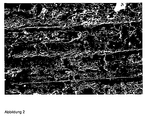
- Figures 1 a, 1 b and 2 show - in greatly enlarged representation - surface areas of the workpiece. You can clearly see the smudges on it.
- Figure 2 a surface area of the same workpiece is shown after pretreatment. One recognizes from the Figure 2 in that the surface is clearly leveled.
- the workpieces to be treated are dekapiert with a dilute nitric acid to those on the workpiece - like Figure 2 apparent - to remove remaining residues and to produce an even cleaner surface for the next treatment step.
- the nitric acid used in this process step has a concentration of 5 to 75%, with a concentration of 50% being preferred.
- the treatment of the workpieces is carried out at a temperature of 4 to 40 ° C, preferably in the range between 18 and 22 ° C and in particular at 20 ° C, with a time duration between 0.5 and 5 minutes, preferably with a time duration between 0.5 and 2 minutes, and more preferably 1 minute.
- the workpieces are treated with a fluoride-containing stain, whereby the surface of the same is further leveled and further alloying components of the aluminum alloy are removed from the workpiece.
- the fluoride-containing pickle used here per 100 l of liquid 1-30 kg, preferably 12 kg Ammoniumhydrogendifluorid, 1-50 l, preferably 25 l of sulfuric acid chemically pure, 1-60 l, preferably 50 l of nitric acid chemically pure, and the remainder water.
- the treatment time of the workpieces in this fluoride-containing pickling is between 1 to 20 minutes, preferably between 3 and 7 minutes and more preferably about 5 minutes, at a temperature of 4 to 40 ° C, preferably at a temperature of 18 to 22 ° C and more preferably at a temperature of 20 ° C.
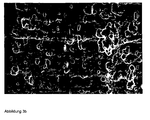
- Figures 3a and 3b now show images of surface areas of the workpiece treated in this way: It can be seen that its surface is flat and largely planar, but has small depressions.
- depressions advantageously allow the chemico-nickel layer to be anchored on the surface pretreated in this way, in the manner of a "pushbutton effect".
- This effect can only be achieved if the material - as already mentioned - has hardly any pores or pores smaller than 20 ⁇ m, preferably smaller than 10 ⁇ m. If the pores contained in the surface of the aluminum workpiece are widened too large, this causes a pre-layer applied before application of the chemical nickel layer, in particular a pre-nickel layer, which as a rule has a thin nickel-phosphorus layer. Layer is formed on the surface treated as described can not adhere, so that caused by the described method corrosion protection layer does not or not completely encloses the material of the workpiece.
- the solution used contains 2.5 to 25 g / l zinc, preferably 10 to 15 g / l zinc and in particular 13 g / l zinc.
- the treatment time of the first stage of the two-stage zincate treatment is about 0.5 to 2 minutes, preferably 0.8 to 1.2 minutes, in particular 1 minute and is at a temperature between 10 and 40 ° C, preferably between 18 and 22 ° C and especially at 20 ° C performed.
- the second stage of the described zincate treatment again uses the same solution and the treatment time is 0.25 to 0.75 minutes, preferably 0.5 minutes.
- the Figure 4 now shows the aluminum workpiece after this zincate treatment. It can be seen that the surface of the workpiece hardly visually differs from that of Figures 3a and 3b, but has a 0.5 to 5 microns thick zinc layer.
- the preferred zincate pickle used for the application described here is the composition of number 1 with the application parameters described above.
- This zinc layer forms the prerequisite for an autocatalytic deposition of a thin nickel-phosphorus layer, that is to say the pre-nickel layer already mentioned above.
- a nickel-nickel layer To prepare this nickel-nickel layer is the as above treated workpiece is placed in a nickel bath containing nickel, preferably in the form of nickel acetate, with 2 to 10 g / l nickel, preferably 4 to 8 g / l nickel at a pH of 10.5 to 11.5 , wherein the temperature is 15 to 40 ° C, preferably 18 to 22 ° C and in particular 20 ° C.
- the deposition time is 1 to 20 minutes, preferably 8 to 12 minutes and in particular 10 minutes, wherein a nickel-phosphorus layer of 1 to 3 microns thickness is deposited.
- the Figure 5 now shows the surface of the workpiece after the deposition of the pre-nickel layer. It can be seen that the structure of the surface substantially corresponds to that of Figures 3a and 3b, although on this now a thin zinc layer and a pre-nickel layer were applied.
- Such a brass electrolyte has the following composition: 20 g / l copper cyanide, 20 g / l zinc cyanide, 40 g / l sodium cyanide, 15 g / l sodium carbonate, 1.5 m / l ammonia.
- the deposition of the brass layer is carried out with a current density of 0.1-0.6 A / dm 2, preferably 0.3 A / dm 2 at a temperature of 10 - 40 ° C, preferably 25 ° C.
- the deposition time is 2 - 7 min., Preferably 5 min. To achieve a layer thickness of 1 - 3 microns.
- a thin copper layer of cyanide-containing copper electrolytes may be deposited which operate at higher or lower current densities.
- An electrolyte operating at higher current levels of 2 - 6 A / dm 2 contains potassium sodium tartrate and has the following composition: 45 g / l copper (I) cyanide, 57 g / l sodium cyanide, 30 g / l sodium carbonate, 45-60 g / l potassium sodium tartrate preferably 50 g / l.
- the deposition takes place with a current density of 2-6 A / dm 2, preferably 4 A / dm 2 at a temperature of 50 to 80 ° C, preferably at 65 ° C.
- cyanide electrolyte operates at lower current densities, it contains 25 g / l copper (I) cyanide, 30 g / l sodium cyanide, 3 g / l sodium hydrogen sulfite, 6 g / l sodium carbonate.
- the deposition takes place at a current density of 0.1 to 1 A / dm 2 at a temperature of 20-40 ° C, preferably at 25 ° C.
- a chemical nickel layer is applied to the pre-layer, in particular the pre-nickel, Vormessing- or Vorkupfer layer described above, which is between 15 and 30 .mu.m, preferably between 18 and 25 .mu.m and more preferably 20 .mu.m is thick.
- the deposition process is in turn basically known, so that it is only briefly outlined here:
- the chemical nickel layer is formed here by depositing a nickel-phosphorus layer, which is preferably deposited by means of a high-phosphorus chemical nickel process, wherein the proportion of phosphorus is between 5 and 15% by weight, preferably between 9 and 14% by weight.
- the process contains 4 to 8 g / l nickel, preferably 5.5 to 6.5 g / l nickel and in particular 6 g / l nickel.
- Natriumhypophosfit for electroless deposition of the nickel-phosphorus layer is preferably used with at least 10.5 wt .-% phosphorus.
- the deposition takes place at a temperature between 85 and 90 ° C, preferably at 88 ° C at a deposition rate of 9.5 to 11 microns / hour.
- the Figure 6 now shows the surface of the deposited nickel-phosphorus layer with a phosphorus content of greater than 10.5%.
- the Figure 7 now shows the back side of a coating of a pre-nickel layer and a chemical nickel layer after it has been peeled off from the workpiece treated as described above. It can be seen that this coating has protruding "pushbuttons” which cause a good adhesion of this coating on the surface of the workpiece pretreated as described above, by bringing these "pushbuttons” into the process caused by the pretreatment process in the surface of the aluminum workpiece. " Depressions "intervene.
- the thus treated workpiece then has a corrosion resistance of 96 hours NSS.
- decorative and / or functional surface layers preferably noble metal layers, but also non-noble metal layers in order to bring about certain mechanical, optical or electrical properties.
- the nickel-phosphorus layer usually has to be reactivated because it passivates very quickly when it comes into contact with air and / or moisture, thereby forming a nickel oxide or nickel hydroxide layer on the surface of the workpiece. No precious metal layer can be deposited on such a surface without activation.
- Au pre-electroplating, Ni pre-electroplating, PdNi pre-plating or fluoride activation or gold or palladium coating will be performed depending on the functional layer to be applied.
- Pre-galvanization with gold is preferably carried out at a temperature between 20 and 50 ° C, preferably at a temperature between 30 and 40 ° C, preferably at 35 ° C, the current density between 2 and 10 A / dm 2 , preferably between 4 and 6 A / dm 2 and especially 5 A / dm 2 and is carried out for a period of 2 to 10 minutes.
- the used Solution has 2 to 6 g / l Au, preferably 4 g / l Au and the process is carried out at a very acidic pH.
- the solution used has 40 to 60 g / l nickel and 120 to 170 g / l chloride, preferably 48 g / l nickel and 150 g / l chloride. It is envisaged that this Vorgalvanmaschine takes place at a temperature between 20 and 30 ° C, preferably at 25 ° C.
- the current density is between 2 and 10 A / dm 2 , preferably between 4 and 6 A / dm 2 and in particular 5 A / dm 2 .
- the treatment lasts for 2 to 20 minutes, preferably 4 to 6 minutes and especially 5 minutes, and is carried out in a very acidic pH environment.
- the PdNi pre-plating is carried out at a temperature of 30 to 60 ° C, preferably at a temperature between 38 and 45 ° C and in particular at 42 ° C.
- the treatment time is between 0.15 and 5 minutes, with a treatment time of 0.5 minutes being preferred.
- the current density in this case is 0.25 to 1.5 A / dm 2 , preferably 0.5 to 1 A / dm 2 and in particular 0.8 A / dm 2 .
- the solution contains 60 to 80 wt .-% palladium and 40 to 20 wt .-% nickel, in particular 3 to 4 g / l palladium and 2 to 3 g / l nickel and is carried out at a neutral pH.
- fluoride activation a solution is provided which contains 1 to 3% fluorohydric acid, 1 to 5% hexafluorosilicic acid and 20 to 25% methanesulfonic acid and 5 kg of ammonium hydrogendifluoride per 100 l of water.
- the fluoride activation is carried out in a very acidic pH environment, the temperature is 22 to 40 ° C, preferably 23 to 27 ° C and especially at 35 ° C and lasts 2 to 10 minutes, with a period of 2 minutes is preferred ,
- a solution which uses 4 g / l Au and the process in a very acidic pH environment at a temperature between 30 and 70 ° C, preferably between 40 and 50 ° C and especially at 45 ° C. and takes 0.5 to 5 minutes, preferably 4 minutes.
- the current density is 0.5 to 5 A / dm 2 , preferably 1 to 2 A / dm 2 and in particular 1.5 A / dm 2 .
- the palladium deposition is carried out in a solution containing 4 to 8 g / l of palladium, in particular 6 g / l of palladium.
- the process is carried out at a neutral pH and at a temperature between 30 and 70 ° C, in particular at 40 ° C. It lasts 0.15 to 5 minutes, in particular 1 minute, and the current density is 0.15 to 3 A / dm 2 , preferably 0.5 to 1.5 A / dm 2 and in particular 1 A / dm 2 .
- the applicant hereby for activating the nickel-phosphorus layer, the PdNi pre-electroplating, to then apply adherent noble metal layers.
- Example 2 On the thus activated surface can then z.
- gold layers for the functional properties, in particular to witness electrical contact properties, gold layers, silver layers, palladium layers and, to ensure a high chemical resistance, fine gold layers are suitable.
- the preferred process for decorative properties such as low reflectance dark color is black ruthenium coating.
- a commercially available black ruthenium process is used with 4.5 to 6 g / l Ru preferably 5 g / l Ru. It is deposited at 50 ° C to 90 ° C, preferably at 65 ° C at 0.8 to 1.5 A / dm 2, preferably 1 A / dm 2 .
- the blackness addition is 30 to 38 ml / l, preferably 35 ml / l.
- the coating time is 7 to 10 minutes, preferably 8 minutes, to deposit a layer thickness of 0.2 to 0.6 ⁇ m Ru.
- This applied black ruthenium layer is preferably finally subjected to a passivation with chromic acid to complete the coating process.
- the solution preferably used here contains 1 g / l chromic acid.
- the passivation process is preferably carried out at a temperature between 50 and 70 ° C, preferably at 60 ° C.
- the treatment time is 5 to 15 minutes, preferably about 10 minutes.
- noble metal layers to achieve a dark color with low reflection
- non-precious metal coatings are also possible, such as black-chrome layers or black-nickel layers. Layer constructions with these final layers show even after a passivation consistently poorer corrosion resistance than in noble metal layers and therefore the noble metal layers are preferably used.
Landscapes
- Chemical & Material Sciences (AREA)
- Chemical Kinetics & Catalysis (AREA)
- Engineering & Computer Science (AREA)
- Materials Engineering (AREA)
- Metallurgy (AREA)
- Organic Chemistry (AREA)
- Electrochemistry (AREA)
- General Chemical & Material Sciences (AREA)
- Mechanical Engineering (AREA)
- Health & Medical Sciences (AREA)
- Toxicology (AREA)
- Electroplating Methods And Accessories (AREA)
Description
- Die Erfindung betrifft ein Verfahren zur Korrosionsschutzbehandlung eines Werkstücks aus einem Aluminiumwerkstoff, insbesondere aus einer Aluminiumknetlegierung.
- Aus Aluminium hergestellte Werkstücke finden aufgrund des geringen spezifischen Gewichts von Aluminium und deren hinreichender mechanischer Stabilität vielfache Verwendung, wenn es um besonders starke Beanspruchungen geht, insbesondere auch im militärischen Bereich. Für den militärischen Einsatz bestimmte Stecker werden aus Aluminiumwerkstoffen hergestellt, die in und an der Kleidung von Soldaten und an Schnittstellen zu Fahr- und Waffensystemen eingesetzt werden. Aufgrund des unedlen Charakters von Aluminiumlegierungen ist aber ein Korrosionsschutz erforderlich, um die vom Militär geforderte Korrosionsbeständigkeit von 96 Stunden Neutralem Salzsprühtest (NSS) zu erfüllen. Die aus einem Aluminiumwerkstoff hergestellten Werkstücke müssen dabei entfettet, desoxidiert und aktiviert werden, bevor sie mit einer galvanischen Korrosionsschutzschicht überzogen werden können. Dazu werden in einem Entfettungsbad, das lösende und emulgierende Bestandteile enthält, die auf dem Aluminiumwerkstoff anhaftenden Fett- und Ölrückstände entfernt. Anschließend werden in einem Beizbad, das Natronlauge enthält, die auf dem Aluminiumwerkstoff vorhandenen Oxidschichten entfernt, damit die galvanisch aufzutragende Korrosionsschutzschicht oder die galvanisch aufzutragenden Korrosionsschutzschichten auf dem Aluminiumwerkstoff haften können. Zusätzlich kann die Beizlösung hierbei eine abtragende Funktion erfüllen. Die aus dem Aluminiumwerkstoff hergestellten Werkstücke werden zur Entfernung von Rückständen und zur Reinigung ihrer Oberfläche dann in verdünnter Salpetersäure dekapiert. Zur Entfernung von Silizium und anderen schwerlöslichen Legierungsbestandteilen werden die Werkstücke in einer fluoridhaltigen Lösung vorher gebeizt, bevor durch die vorstehend genannte Salpetersäure-Behandlung eine Dekapierung erfolgt. Danach werden die Werkstücke in einem bekannten Prozeß einer Zinkataktivierung unterzogen, wobei eine dünne Zinkschicht aufgetragen wird. Darauf wird in der Regel eine dünne Chemisch-Nickel-Grundschicht mit einer Dicke von 0,5 bis 2,0 µm aus einem robusten Chemisch-Nickel-Prozess aufgebracht, bevor die eigentliche korrosionsschützende Chemisch-Nickel-Schicht in einer Dicke von mindestens 20 µm aufgebracht wird.
- Chemisch-Nickel-Schichten bieten sich hierfür an, weil sie mit ihnen eine gleichmäßig dicke Schicht auch auf komplizierten Oberflächen-Geometrien der Werkstücke ausbildbar ist. Sie eignet sich daher insbesondere zur Beschichtung von elektrischen Nieder-, Mittel- oder Hochfrequenzsteckern. Wesentlich bei der Beschichtung des Werkstücks mit einer Chemisch-Nickel-Schicht ist, dass diese Schicht oder diese Schichten durchgehend geschlossen sind und keine Fehlstellen enthalten, so dass der Aluminiumwerkstoff geschlossen umhüllt ist. Ansonsten würde einer Korrosionsbeanspruchung die das mit Chemisch-Nickel beschichtete Werkstück beaufschlagende Lösung durch diese Fehlstelle das Aluminium sofort angreifen. Z. B. würde eine nur 5-prozentige NaCl-Lösung schon innerhalb von 24 Stunden durch diese Fehlstelle das Werkstück angreifen und dabei wesentlich Aluminium herauslösen und somit mit fortschreitender Korrosion das Werkstück zerstören.
- Aluminiumknetlegierungen haben ein feines, gleichmäßiges Gefüge, enthalten aber auch Poren und Hohlräume, die durch ein Strangpressen nicht beseitigt, sondern nur in Längsrichtung gestreckt werden, wobei ein gedehntes, steifes Gefüge entsteht. Die Aluminiumknetlegierungen werden zu Stangen gepresst und aus diesen Stangen werden unterschiedlichste Werkstücke, insbesondere Steckerkomponenten und -teile für die Konfektionierung von Steckersystemen, auf CNC-Maschinen gedreht. Diese Stangen enthalten nicht nur Poren und Hohlräume, sondern können auch auf der Oberfläche Verschmierungen enthalten, wenn keine geeigneten Drehwerkzeuge verwendet werden oder die Werkzeuge abgenutzt sind. Zusätzlich können durch defekte Werkzeuge oder Bearbeitungsfehler an den Werkstücken Defekte wie Grate, Späne, Ausbrüche, etc. entstehen.
- Auf die derart gegen Korrosion geschützten Werkstücke werden noch zusätzlich Schichten aufgebracht, die funktionelle und/oder dekorative Anforderungen erfüllen, wie z. B, gewisse elektrische Eigenschaften, z. B. die Realisierung eines bestimmten Übergangswiderstandes, oder einer bestimmten Farbe des derart behandelten Werkstücks, um möglichst viel oder wenig Reflektionen sicherzustellen.
- Aus der
US 2004/067314 A1 ist es bekannt, dass ein Werkstück zuerst alkalisch entfettet und dann geätzt wird. Danach wird die derart vorbehandelte Oberfläche des Aluminiumwerkstücks mit einer fluoridhaltigen Beize behandelt, um diese zu reinigen. - Aus dem Aufsatz von MURAKAMI K ET AL: "Effects of alloying elements in aluminium alloys and activations on zincate treatment and electroless nickelphosphorus plating", veröffentlicht in KEIKINZOKU/JOURNAL OF JAPAN INSTITUTE OF LIGHT METALS FEBRUARY 2010 JAPAN INSTITUTE OF LIGHT METALS JPN, Bd. 60, Nr. 2, Februar 2010 (2010-02), Seiten 81-87, ist es bekannt, dass die Vorbehandlung der Aluminium-Oberfläche das Beschichtungsergebnis beeinflusst.
- Es ist Aufgabe der vorliegenden Erfindung, ein Verfahren zur Korrosionsschutzbehandlung eines aus einem Aluminiumwerkstoff bestehenden oder mit einem Aluminiumwerkstoff beschichteten Werkstücks zu entwickeln, durch das ein verbesserter Korrosionsschutz dieses Werkstücks erreicht wird. Das erfindungsgemäße Verfahren soll insbesondere für Aluminiumknetlegierungen geeignet sein.
- Diese Aufgabe wird erfindungsgemäß dadurch gelöst, dass das Werkstück, das eine Oberfläche aufweist, in die die Größe der Poren und/oder Hohlräume kleiner als 20 µm ist, in einem ersten Verfahrensschritt einer abtragenden Vorbehandlung mit einer Natriumhydroxid enthaltenden Lösung unterzogen wird, dass in einem nächsten Verfahrensschritt das Werkstück mit einer verdünnten Salpetersäure dekapiert wird, dass in einem weiteren Verfahrensschritt in der Oberfläche des Werkstücks kleine Vertiefungen erzeugt werden, indem das Werkstück mit einer fluoridhaltigen Beize behandelt wird, und dass anschließend eine Vor- Schicht und daran anschließend eine Chemisch-Nickel-Schicht aufgetragen wird.
- Durch die erfindungsgemäßen Maßnahmen wird in vorteilhafter Art und Weise ein Verfahren zur Korrosionsschutzbehandlung von aus einem Aluminiumwerkstoff gefertigten Werkstücken geschaffen, welches es in einfacher Art und Weise erlaubt, derartige Werkstücke mit einer Korrosionsschutzschicht zu beschichten, die hohen Anforderungen genügt. Das erfindungsgemäße Verfahren ist insbesondere für aus einer Aluminiumknetlegierung gefertigte Werkstücke wie z. B. Stanal 32 oder Stanal 40A geeignet.
- Eine vorteilhafte Weiterbildung der Erfindung sieht vor, dass die vor dem Aufbringen der Chemisch-Nickel-Schicht aufgebrachte Vor-Schicht durch eine VorNickel-Schicht ausgebildet ist.
- Eine weitere vorteilhafte Weiterbildung der Erfindung sieht vor, dass als Vor-Schicht eine Messing-Schicht abgeschieden wird.
- Eine weitere vorteilhafte Weiterbildung der Erfindung sieht vor, dass als Vor-Schicht eine dünne Kupfer-Schicht aus cyanidhaltigen Kupferelektrolyten abgeschieden wird.
- Eine weitere vorteilhafte Weiterbildung der Erfindung sieht vor, dass auf die Chemisch-Nickel-Schicht eine funktionelle und/oder dekorative Eigenschaften bewirkende weitere Schicht abgeschieden wird.
- Weitere vorteilhafte Weiterbildungen der Erfindung sind Gegenstand der Unteransprüche.
- Weitere Einzelheiten und Vorteile der Erfindung sind dem Ausführungsbeispiel zu entnehmen, das im folgenden beschrieben wird. Es zeigen:
- Abbildungen 1 bis 7:
- vergrößerte Darstellungen eines Oberflächenbereichs des Werkstücks nach unterschiedlichen Verfahrensschritten.
- Das beschriebene Verfahren geht davon aus, dass das aus einem Aluminiumwerkstoff ausgebildete oder mit einem derartigen Aluminiumwerkstoff beschichtete, also aus einem Aluminium-Werkstoff hergestellte Werkstück eine Oberfläche aufweisen, in der die Größe der Poren und/oder Hohlräume kleiner als 20 µm, vorzugsweise kleiner als 10 µm ist, da ansonsten die auf das Werkstück aufzutragende Chemisch-Nickel-Schicht nicht in der Lage ist, den Aluminiumwerkstoff geschlossen zu beschichten. Außerdem dürfen die entsprechenden Werkstücke keine oder nur unwesentliche Defekte wie Grate, Späne und Beschädigungen aufweisen, da derartige Defekte dazu führen können, dass die Chemisch-NickelSchicht nicht in der Lage ist, das Werkstück sicher zu umschließen und dessen Oberfläche geschlossen zu machen.
- Die Werkstücke werden zuerst - sofern nicht hinreichend fettfrei - einer abtragenden Vorbehandlung mit einer Natriumhydroxid enthaltenden Lösung unterzogen. Vorzugsweise enthält diese Lösung 0,5 bis 20 g/l Natriumhydroxid, vorzugsweise 9 bis 11 g/l Natriumhydroxid. Die Behandlungszeit liegt zwischen 1 und 30 Minuten, vorzugsweise bei 10 Minuten. Die abtragende Vorbehandlung der vorstehend beschriebenen Natriumhydroxid-Lösung erfolgt bei einer Temperatur zwischen 4 und 80 °C, vorzugsweise bei 20 °C. In der Vorbehandlungslösung ist des weiteren als restliches Entfettungssalz ein Gemisch aus Dinatriumetasilikat, Natriumcarbonat, Natriumdodecylbenzolsulfonat in einer Menge von 1 bis 20 kg/100 I Flüssigkeit enthalten, wobei bevorzugt wird, dass der Anteil dieses Entfettungssalzes in der Vorbehandlungslösung zwischen 9 bis 11 kg/100 I Flüssigkeit liegt.
- Durch die Vorbehandlung des Werkstücks mit der vorstehend beschriebenen, Natriumhydroxid enthaltenen Lösung werden die auf der Oberfläche des Werkstücks vorhandenen Verschmierungen aufgelöst und weitestgehend entfernt. Die Wirkung dieser Vorbehandlung ist durch einen Vergleich der Abbildungen 1 a, 1 b und 2 ersichtlich. Die Abbildungen 1a und 1b zeigen - in stark vergrößerter Darstellung - Oberflächenbereiche des Werkstücks. Man erkennt deutlich die darauf vorhandenen Verschmierungen. In der
Abbildung 2 ist ein Oberflächenbereich des gleichen Werkstücks nach der Vorbehandlung abgebildet. Man erkennt aus derAbbildung 2 , dass die Oberfläche deutlich eingeebnet ist. - In einem darauf folgenden Verfahrensschritt werden die zu behandelnden Werkstücke mit einer verdünnten Salpetersäure dekapiert, um die auf dem Werkstück - wie aus
Abbildung 2 ersichtlich - noch vorhandenen Rückstände zu entfernen und eine noch sauberere Oberfläche für den nächsten Behandlungsschritt zu erzeugen. Die in diesem Verfahrensschritt verwendete Salpetersäure weist eine Konzentration von 5 bis 75 % auf, wobei eine Konzentration von 50 % bevorzugt wird. Die Behandlung der Werkstücke erfolgt bei einer Temperatur von 4 bis 40 °C, vorzugsweise im Bereich zwischen 18 und 22 °C und insbesondere bei 20 °C, mit einer Zeitdauer zwischen 0,5 und 5 Minuten, vorzugsweise mit einer Zeitdauer zwischen 0,5 und 2 Minuten und weiter vorzugsweise mit einer Zeitdauer von 1 Minute. - Danach werden die Werkstücke mit einer fluoridhaltigen Beize behandelt, wodurch die Oberfläche derselben noch weiter eingeebnet wird und weitere Legierungsbestandteile der Aluminiumlegierung aus dem Werkstück herausgelöst werden. Die hierbei verwendete fluoridhaltige Beize enthält pro 100 l Flüssigkeit 1-30 kg, vorzugsweise 12 kg Ammoniumhydrogendifluorid, 1-50 l, vorzugsweise 25 l Schwefelsäure chemischrein, 1-60 l, vorzugsweise 50 l Salpetersäure chemischrein, und als Rest Wasser. Die Behandlungszeit der Werkstücke in dieser fluoridhaltigen Beize beträgt zwischen 1 bis 20 Minuten, vorzugsweise zwischen 3 und 7 Minuten und weiter vorzugsweise ungefähr 5 Minuten, dies bei einer Temperatur von 4 bis 40 °C , vorzugsweise bei einer Temperatur von 18 bis 22 °C und weiter vorzugsweise bei einer Temperatur von 20 °C. In diesem weiteren Dekapierungsschritt wird - wie auch in dem vorstehend beschriebenen Verfahrensschritt - der Behandlung mit Salpetersäure - die Oberfläche der Werkstücke weiter von Verunreinigungen gereinigt. Die Abbildungen 3a und 3b zeigen nun Aufnahmen von Oberflächenbereichen des derartig behandelten Werkstücks: Man erkennt, dass dessen Oberfläche eben und weitestgehend plan ist, aber kleine Vertiefungen aufweist. Diese Vertiefungen erlauben es in vorteilhafter Art und Weise, dass die Chemisch-Nickel-Schicht auf der derart vorbehandelten Oberfläche verankert wird, nach Art eines "Druckknopf-Effekts". Dieser Effekt lässt sich nur dann erzielen, wenn der Werkstoff - wie bereits eingangs erwähnt - kaum Poren bzw. Poren kleiner als 20µm, vorzugsweise kleiner als 10 µm aufweist. Sind die in der Oberfläche des Aluminium-Werkstücks enthaltenen Poren zu groß aufgeweitet, bewirkt dies, dass eine vor Auftragung der Chemisch-Nickel-Schicht aufgetragene Vor-Schicht, insbesondere eine Vor-Nickelschicht, die in der Regel durch eine dünne Nickel-Phosphor-Schicht gebildet wird, auf der wie beschrieben behandelten Oberfläche nicht anhaften kann, so dass die durch das beschriebene Verfahren bewirkte Korrosionsschutzschicht nicht oder nicht vollständig den Werkstoff des Werkstücks umschließt.
- Um nun das Aluminium-Werkstück mit einer Vor-Schicht und mindestens einer Chemisch-Nickel-Schicht zu beschichten, wird eine allgemein bekannte und daher nur kurz beschriebene zweistufige Zinkatbehandlung durchgeführt. Die dabei verwendete Lösung enthält 2,5 bis 25 g/l Zink, vorzugsweise 10 bis 15 g/l Zink und insbesondere 13 g/l Zink. Die Behandlungsdauer der ersten Stufe der zweistufigen Zinkatbehandlung beträgt ungefähr 0,5 bis 2 Minuten, vorzugsweise 0,8 bis 1,2 Minuten, insbesondere 1 Minute und wird bei einer Temperatur zwischen 10 und 40 °C, vorzugsweise zwischen 18 und 22 °C und insbesondere bei 20 °C durchgeführt. Die zweite Stufe der beschriebenen Zinkatbehandlung verwendet wiederum die gleiche Lösung und die Behandlungsdauer beträgt 0,25 bis 0,75 Minuten, vorzugsweise 0,5 Minuten. Die
Abbildung 4 zeigt nun das Aluminium-Werkstück nach dieser Zinkatbehandlung. Man erkennt, dass sich die Oberfläche des Werkstücks optisch kaum von der der Abbildungen 3a und 3b unterscheidet, aber eine 0,5 bis 5 µm dicke Zink-Schicht aufweist. - Die hierzu typischerweise verwendeten Zinkatbeizen können folgende Zusammensetzung haben:
- 1. 345 g/l Natriumhydroxid, 87 g/l Zinkcarbonat, 23g/l Eisen(II)-chlorid, 23 g/l Zinkoxid, 100 g/l Kaliumnatriumtartrat.
- 2. 60 g/l Natriumhydroxid, 10 g/l Zinkoxid, 7g/l Natriumglukonat, 4 g/l Salicylsäure
- 3. 335 g/l Natriumhydroxid, 63 g/l Zinkoxid
- 4. 10 g/l Natriumhydroxid, 5 g/l Zinkoxid, 500 g/l Natriumhydroxid, 2 g/l Eisen(II)chlorid, 20 g/l Zinkoxid, 50 g/l Kaliumnatriumtartrat
- 5. 120 g/l Natriumhydroxid, 2 g/l Eisen (II)-chlorid, 20 g/l Zinkoxid, 50 g/l Kaliumnatriumtartrat.
- Die für die hier beschriebene Anwendung bevorzugt eingesetzte Zinkatbeize ist die Zusammensetzung der Nummer 1 mit den zuvor beschriebenen Anwendungsparametern.
- Diese Zink-Schicht bildet die Voraussetzung für eine autokatalytische Abscheidung einer dünnen Nickel-Phosphor-Schicht, also der bereits vorstehend angesprochenen Vornickel-Schicht. Zur Herstellung dieser Vornickel-Schicht wird das wie vorstehend behandelte Werkstück in einem Nickelbad eingebracht, welches Nickel, vorzugsweise in der Form von Nickelacetat, mit 2 bis 10 g/l Nickel, vorzugsweise 4 bis 8 g/l Nickel bei einem pH-Wert von 10,5 bis 11,5 enthält, wobei die Temperatur 15 bis 40 °C, vorzugsweise 18 bis 22 °C und insbesondere 20 °C beträgt. Die Abscheidezeit beträgt 1 bis 20 Minuten, vorzugsweise 8 bis 12 Minuten und insbesondere 10 Minuten, wobei eine Nickel-Phosphor-Schicht von 1 bis 3 µm Dicke abgeschieden wird. Die
Abbildung 5 zeigt nun die Oberfläche des Werkstücks nach der Abscheidung der Vornickel-Schicht. Man erkennt, dass die Struktur der Oberfläche im wesentlichen derjenigen der Abbildungen 3a und 3b entspricht, obwohl auf dieser nun eine dünne Zinkschicht und eine Vornickel-Schicht aufgebracht wurden. - Alternativ zum Vernickeln kann auch als Vor-Schicht eine Messingschicht abgeschieden werden, die die gleiche Funktion erfüllt und auch die Grundlage für die anschließende Chemisch-Nickel-Schicht bildet. So ein Messingelektrolyt hat folgende Zusammensetzung: 20 g/l Kupfercyanid, 20 g/l Zinkcyanid, 40 g/l Natriumcyanid, 15 g/l Natriumcarbonat, 1,5 m/l Ammoniak. Die Abscheidung der Messingschicht erfolgt mit einer Stromdichte von 0,1 - 0,6 A/dm2 vorzugsweise 0,3 A/dm2 bei einer Temperatur von 10 - 40 °C, vorzugsweise 25°C. Die Abscheidedauer beträgt 2 - 7 Min., vorzugsweise 5 Min. zur Erzielung einer Schichtdicke von 1 - 3 µm.
- Als weitere Alternative zum Vernickeln zur Ausbildung der Vor-Schicht kann eine dünne Kupferschicht aus cyanidhaltigen Kupferelektrolyten abgeschieden werden, die bei höheren oder niedrigeren Stromdichten arbeiten. Ein Elektrolyt der bei höheren Stromschichten von 2 - 6 A/dm2 arbeitet, enthält Kaliumnatriumtartrat und hat folgende Zusammensetzung: 45 g/l Kupfer(I)cyanid, 57 g/l Natriumcyanid, 30 g/l Natriumcarbonat, 45-60 g/l Kaliumnatriumtartrat vorzugsweise 50 g/l. Die Abscheidung erfolgt mit einer Stromdichte von 2 - 6 A/dm2 vorzugsweise 4 A/dm2 bei einer Temperatur von 50 bis 80°C vorzugsweise bei 65°C.
- Ein weiterer bei dem beschriebenen Verfahren einsetzbarer cyanidischer Elektrolyt arbeitet bei niedrigeren Stromdichten, er enthält 25 g/l Kupfer(I)cyanid, 30 g/l Natriumcyanid, 3 g/l Natriumhydrogensulfit, 6 g/l Natriumcarbonat. Die Abscheidung erfolgt bei einer Stromdichte von 0,1 bis 1 A/dm2 bei einer Temperatur von 20-40°C vorzugsweise bei 25°C.
- Im nächsten Schritt wird auf die Vor-Schicht, insbesondere die vorstehend beschriebene Vornickel-, Vormessing- oder Vorkupfer-Schicht, eine Chemisch-Nickel-Schicht aufgebracht, welche zwischen 15 und 30 µm, vorzugsweise zwischen 18 und 25 µm und weiter vorzugsweise 20 µm dick ist. Der Abscheideprozess ist wiederum grundsätzlich bekannt, so dass er an dieser Stelle nur kurz umrissen wird: Die Chemisch-Nickel-Schicht wird hier durch Abscheiden einer Nickel-Phosphor-Schicht ausgebildet, welche vorzugsweise mittels eines hochphosphorhaltigen Chemisch-Nickel-Prozesses abgeschieden wird, wobei der Anteil von Phosphor zwischen 5 und 15 Gew.-%, vorzugsweise zwischen 9 bis 14 Gew.-% beträgt. Der Prozess enthält 4 bis 8 g/l Nickel, vorzugsweise 5,5 bis 6,5 g/l Nickel und insbesondere 6 g/l Nickel. Als Reduktionsmittel wird Natriumhypophosfit zur stromlosen Abscheidung der Nickel-Phosphor-Schicht mit vorzugsweise mindestens 10,5 Gew.-% Phosphor verwendet. Die Abscheidung erfolgt dabei bei einer Temperatur zwischen 85 und 90 °C, vorzugsweise bei 88 °C bei einer Abscheidungsgeschwindigkeit von 9,5 bis 11 µm/Stunde. Die
Abbildung 6 zeigt nun die Oberfläche der abgeschiedenen Nickel-Phosphor-Schicht mit einem Phosphor-Gehalt von größer als 10,5 %. Ein Vergleich derAbbildung 6 mit den Abbildungen 3a und 3b zeigt, dass die Oberfläche des beschichteten Werkstücks eingeebnet ist, es sind keine Poren mehr zu erkennen, lediglich eine leicht streifige Struktur, welche aus der Drehbearbeitung des Ausgangswerkstücks resultiert, ist zu erkennen. Die Nickel-Phosphor-Schicht sollte hierbei amorph sein, da ansonsten die Gefahr einer Schichtkorrosion an Nickel-Phosphor Schwachstellen besteht. - Die
Abbildung 7 zeigt nun die Rückseite einer Beschichtung aus einer Vor-Nickel-Schicht und einer Chemisch-Nickel-Schicht, nachdem sie von dem wie vorstehend beschrieben behandelten Werkstück abgezogen wurde. Man erkennt, dass diese Beschichtung aus ihr hervorstehende "Druckknöpfe" aufweist, welche ein gutes Anhaften dieser Beschichtung auf der wie vorstehend beschrieben vorbehandelten Oberfläche des Werkstücks bewirkt, indem diese "Druckknöpfe" in die durch den Vorbehandlungsprozess in der Oberfläche des Aluminium-Werkstücks hervorgerufene "Vertiefungen" eingreifen. - Das derart behandelte Werkstück weist dann eine Korrosionbeständigkeit von 96 Stunden NSS auf. Auf der Grundlage dieser Vorbehandlung und Beschichtung mit der wie vorstehend beschriebenen Korrosionsschutzschicht lassen sich zusätzlich dekorative und/oder funktionelle Oberflächenschichten, bevorzugt Edelmetallschichten, aber auch Nicht-Edelmetallschichten aufbringen, um gewisse mechanische, optische oder elektrische Eigenschaften zu bewirken.
- Hierzu muss die Nickel-Phosphor-Schicht in der Regel neu aktiviert werden, da sie sehr schnell passiviert, wenn sie mit Luft und/oder Feuchtigkeit in Verbindung kommt und sich dadurch auf der Oberfläche des Werkstücks eine Nickeloxid- oder Nickelhydroxid-Schicht bildet. Auf eine derartige Oberfläche kann ohne Aktivierung keine Edelmetall-Schicht mehr abgeschieden werden. Zur Aktivierung der Nickel-Phosphor-Schicht ist vorgesehen, dass - in Abhängigkeit von der aufzubringenden Funktionsschicht - entweder eine Au-Vorgalvanisierung, eine Ni-Vorgalvanisierung, eine PdNi-Vorgalvanisierung oder eine Fluorid-Aktivierung oder eine Beschichtung mit Gold oder Palladium durchgeführt wird.
- Die Vorgalvanisierung mit Gold wird vorzugsweise bei einer Temperatur zwischen 20 und 50 °C, vorzugsweise bei einer Temperatur zwischen 30 und 40 °C, vorzugsweise bei 35 °C durchgeführt, wobei die Stromdichte zwischen 2 und 10 A/dm2, vorzugsweise zwischen 4 und 6 A/dm2 und insbesondere 5 A/dm2 beträgt und während einer Zeitdauer von 2 bis 10 Minuten durchgeführt wird. Die verwendete Lösung weist 2 bis 6 g/l Au, vorzugsweise 4 g/l Au auf und der Prozess wird bei einem sehr sauren ph-Wert durchgeführt.
- Bei einer Nickel-Vorgalvanisierung weist die verwendete Lösung 40 bis 60 g/l Nickel und 120 bis 170 g/l Chlorid auf, vorzugsweise 48 g/l Nickel und 150 g/l Chlorid. Es ist vorgesehen, dass diese Vorgalvanisierung bei einer Temperatur zwischen 20 und 30 °C, vorzugsweise bei 25 °C erfolgt. Die Stromdichte beträgt zwischen 2 bis 10 A/dm2, vorzugsweise zwischen 4 und 6 A/dm2 und insbesondere 5 A/dm2. Die Behandlung dauert 2 bis 20 Minuten, vorzugsweise 4 bis 6 Minuten und insbesondere 5 Minuten und wird in einer sehr sauren ph-Umgebung durchgeführt.
- Die PdNi-Vorgalvanisierung wird bei einer Temperatur von 30 bis 60 °C, vorzugsweise bei einer Temperatur zwischen 38 und 45 °C und insbesondere bei 42 °C durchgeführt. Die Behandlungsdauer beträgt zwischen 0,15 und 5 Minuten, wobei eine Behandlungsdauer von 0,5 Minuten bevorzugt wird. Die Stromdichte beträgt hierbei 0,25 bis 1,5 A/dm2, vorzugsweise 0,5 bis 1 A/dm2 und insbesondere 0,8 A/dm2. Die Lösung enthält 60 bis 80 Gew.-% Palladium und 40 bis 20 Gew.-% Nickel, insbesondere 3 bis 4 g/l Palladium und 2 bis 3 g/l Nickel und wird bei einem neutralen ph-Wert durchgeführt.
- Bei einer Fluorid-Aktivierung ist eine Lösung vorgesehen, die 1 bis 3 % FluorWasserstoffsäure, 1 bis 5 % Hexafluorokieselsäure und 20 bis 25 % Methansulfonsäure sowie 5 kg Ammoniumhydrogendifluorid auf 100 I Wasser enthält. Die Fluorid-Aktivierung wird in einem sehr sauren ph-Milieu durchgeführt, die Temperatur beträgt 22 bis 40 °C, vorzugsweise 23 bis 27 °C und insbesondere bei 35 °C und dauert 2 bis 10 Minuten, wobei eine Zeitdauer von 2 Minuten bevorzugt wird.
- Bei einer Gold-Abscheidung wird eine Lösung verwendet, die 4 g/l Au verwendet und der Prozess in einem sehr sauren ph-Milieu bei einer Temperatur zwischen 30 und 70 °C, vorzugsweise zwischen 40 und 50 °C und insbesondere bei 45 °C durchgeführt und dauert 0,5 bis 5 Minuten, vorzugsweise 4 Minuten. Die Stromdichte beträgt dabei 0,5 bis 5 A/dm2, vorzugsweise 1 bis 2 A/dm2 und insbesondere 1,5 A/dm2.
- Die Palladium-Abscheidung wird in einer Lösung durchgeführt, die 4 bis 8 g/l Palladium, insbesondere 6 g/l Palladium enthält. Der Prozess wird bei einem neutralen ph-Wert und bei einer Temperatur zwischen 30 und 70 °C, insbesondere bei 40 °C, durchgeführt. Er dauert 0,15 bis 5 Minuten, insbesondere 1 Minute und die Stromdichte beträgt dabei 0,15 bis 3 A/dm2, vorzugsweise 0,5 bis 1,5 A/dm2 und insbesondere 1 A/dm2.
- Bevorzugt wird von Seiten der Anmelderin hierbei zur Aktivierung der Nickel-Phosphor-Schicht die PdNi-Vorgalvanisierung, um anschließend haftfeste Edel-metall-Schichten aufzubringen.
- Auf die derart aktivierte Oberfläche können dann z. B. eine Schwarz-Ruthenium-Schicht, eine Schwarz-Palladium-Schicht, eine Schwarz-Rhodium-Schicht aufgebracht werden, um die Werkstückoberfläche eine gezielte Farbgebung sowie eine geringe Reflektion zu geben. Es ist auch möglich, dass eine Gelbgold-Schicht, eine Rotgold-Schicht oder weiße Schichten aus Platin, Palladium oder Ruthenium aufgebracht werden.
- Für die funktionellen Eigenschaften, insbesondere um elektrische Kontakteigenschaften zu zeugen, bieten sich Gold-Schichten, Silber-Schichten, Palladium-Schichten an und, um eine hohe chemische Beständigkeit sicherzustellen, Feingold-Schichten.
- Der bevorzugte Prozess für dekorative Eigenschaften wie dunkle Farbe mit geringer Reflexion ist die Beschichtung mit Schwarz-Ruthenium. Dazu wird ein kommerziell erhältlicher Schwarz-Ruthenium-Prozess eingesetzt mit 4,5 bis 6 g/l Ru vorzugsweise 5 g/l Ru. Abgeschieden wird bei 50°C bis 90°C, vorzugsweise bei 65°C mit 0,8 bis 1,5 A/dm2 vorzugsweise mit 1 A/dm2. Der Schwärzezusatz beträgt 30 bis 38 ml/l vorzugsweise 35 ml/l. Die Beschichtungszeit beträgt 7 bis 10 Min. vorzugsweise 8 Min., um eine Schichtdicke von 0,2 bis 0,6 µm Ru abzuscheiden.
- Diese aufgebrachte Schwarz-Ruthenium-Schicht wird vorzugsweise abschließend einer Passivierung mit Chromsäure unterzogen um den Beschichtungsprozess abzuschließen. Die hierbei vorzugsweise verwendete Lösung enthält 1 g/l Chromsäure. Der Passivierungsprozess wird vorzugsweise bei einer Temperatur zwischen 50 und 70 °C, vorzugsweise bei 60 °C, durchgeführt. Die Behandlungsdauer beträgt 5 bis 15 Minuten, vorzugsweise ca. 10 Minuten.
- Alternativ zu Edelmetallschichten um eine dunkle Farbe mit geringer Reflexion zu erzielen, kommen auch Nichtedelmetallbeschichtungen in Frage, wie Schwarz-Chrom-Schichten oder Schwarz-Nickel-Schichten. Schichtaufbauten mit diesen Endschichten zeigen selbst nach einer Passivierung durchgehend eine schlechtere Korrosionsbeständigkeit als bei Edelmetallschichten und daher werden die Edelmetallschichten vorzugsweise eingesetzt.
- Diese Passivierungen sind für alle dunklen Schichten zur Sicherstellung des Korrosionsschutzes von Vorteil.
Claims (11)
- Verfahren zur Korrosionsschutzbehandlung eines Werkstücks aus einem Aluminiumwerkstoff, insbesondere aus einer Aluminiumknetlegierung, dadurch gekennzeichnet, dass das Werkstück, das eine Oberfläche aufweist, in die die Größe der Poren und/oder Hohlräume kleiner als 20 µm ist, in einem ersten Verfahrensschritt einer abtragenden Vorbehandlung mit einer Natriumhydroxid enthaltenden Lösung unterzogen wird, dass in einem nächsten Verfahrensschritt das Werkstück mit einer verdünnten Salpetersäure dekapiert wird, dass in einem weiteren Verfahrensschritt in der Oberfläche des Werkstücks kleine Vertiefungen erzeugt werden, indem das Werkstück mit einer fluoridhaltigen Beize behandelt wird, und dass anschließend eine Vor-Schicht und daran anschließend eine Chemisch-Nickel-Schicht aufgetragen wird.
- Verfahren nach Anspruch 1, dadurch gekennzeichnet, dass die fluoridhaltige Beize pro 100 l Flüssigkeit 1 bis 30 kg, vorzugsweise 12 kg Ammoniumhydrogendifluorid, 1 bis 50 l, vorzugsweise 25 l Schwefelsäure chemisch rein, 1 bis 60 l, vorzugsweise 50 l Salpetersäure chemisch rein und als Rest Wasser enthält.
- Verfahren nach einem der Ansprüche 1 oder 2, dadurch gekennzeichnet, dass die Behandlungszeit des Werkstücks in dieser fluoridhaltigen Beize zwischen 1 bis 20 Minuten, vorzugsweise zwischen 3 und 7 Minuten, und weiter vorzugsweise ungefähr 5 Minuten beträgt, wobei die Temperatur zwischen 4 und 40 °C, vorzugsweise zwischen 18 und 22 °C und weiter vorzugsweise 20 °C beträgt.
- Verfahren nach einem der vorangehenden Ansprüche, dadurch gekennzeichnet, dass als Vor-Schicht eine Nickel-Schicht, eine Messing-Schicht oder eine Kupfer-Schicht aus cyanidhaltigen Kupferelektrolyten abgeschieden wird.
- Verfahren nach einem der vorangehenden Ansprüche, dadurch gekennzeichnet, dass die Chemisch-Nickel-Schicht durch Abscheiden einer Nickel-Phosphor-Schicht ausgebildet wird.
- Verfahren nach einem der vorangehenden Ansprüche, dadurch gekennzeichnet, dass vor dem Aufbringen einer Vor-Schicht eine zweistufige Zinkat-Behandlung zur Ausbildung einer Zink-Schicht durchgeführt wird.
- Verfahren nach einem der vorangehenden Ansprüche, dadurch gekennzeichnet, dass zur Herstellung der Vornickel-Schicht das zu behandelnde Werkstück in ein Nickelbad eingebracht wird, welches Nickel, vorzugsweise in der Form von Nickelacetat, mit 2 bis 10 g/l Nickel, vorzugsweise 4 bis 8 g/l Nickel einem pH-Wert von 10,5 bis 11,5 enthält.
- Verfahren nach einem der vorangehenden Ansprüche, dadurch gekennzeichnet, dass auf die Chemisch-Nickel-Schicht mindestens eine dekorative und/oder funktionelle Oberflächenschicht aufgebracht wird.
- Verfahren nach Anspruch 8, dadurch gekennzeichnet, dass die Chemisch-Nickel-Schicht vor dem Aufbringen der dekorativen und/oder funktionellen Oberflächenschicht aktiviert wird.
- Verfahren nach einem der vorangehenden Ansprüche, dadurch gekennzeichnet, dass zur Farbgebung des Werkstücks auf dieses eine Schwarz-Ruthenium-Schicht, eine Schwarz-Palladium-Schicht, eine Schwarz-Rhodium-Schicht, eine Gelb-Gold-Schicht, eine Rot-Gold-Schicht oder eine weiße Schicht aus Platin, Palladium oder Ruthenium aufgebracht wird.
- Verfahren nach Anspruch 10, dadurch gekennzeichnet, dass die wie vorstehend aufgebrachte Schicht einer Passivierung, vorzugsweise mit Chromsäure, unterzogen wird.
Applications Claiming Priority (1)
| Application Number | Priority Date | Filing Date | Title |
|---|---|---|---|
| DE102011115802.6A DE102011115802B4 (de) | 2011-10-12 | 2011-10-12 | Verfahren zur Korrosionsschutzbehandlung eines Werkstücks aus einem Aluminiumwerkstoff, insbesondere aus einer Aluminiumknetlegierung |
Publications (2)
| Publication Number | Publication Date |
|---|---|
| EP2581473A1 EP2581473A1 (de) | 2013-04-17 |
| EP2581473B1 true EP2581473B1 (de) | 2016-02-24 |
Family
ID=47076014
Family Applications (1)
| Application Number | Title | Priority Date | Filing Date |
|---|---|---|---|
| EP12006874.7A Not-in-force EP2581473B1 (de) | 2011-10-12 | 2012-10-04 | Verfahren zur Korrosionsschutzbehandlung eines Werkstücks aus einem Aluminiumwerkstoff, insbesondere aus einer Aluminiumknetlegierung |
Country Status (2)
| Country | Link |
|---|---|
| EP (1) | EP2581473B1 (de) |
| DE (1) | DE102011115802B4 (de) |
Families Citing this family (3)
| Publication number | Priority date | Publication date | Assignee | Title |
|---|---|---|---|---|
| CN107447237B (zh) | 2016-05-30 | 2021-04-20 | 史莱福灵有限公司 | 具有降低的接触噪声的滑环 |
| EP3252187B1 (de) * | 2016-05-30 | 2020-04-29 | Schleifring GmbH | Schleifring mit reduziertem kontaktrauschen |
| DE102019109188B4 (de) * | 2019-04-08 | 2022-08-11 | Umicore Galvanotechnik Gmbh | Verwendung eines Elektrolyten zur Abscheidung von anthrazit/schwarzen Rhodium/Ruthenium Legierungsschichten |
Family Cites Families (6)
| Publication number | Priority date | Publication date | Assignee | Title |
|---|---|---|---|---|
| US3666529A (en) * | 1969-04-02 | 1972-05-30 | Atomic Energy Commission | Method of conditioning aluminous surfaces for the reception of electroless nickel plating |
| US3982055A (en) * | 1974-07-25 | 1976-09-21 | Eltra Corporation | Method for zincating aluminum articles |
| ES2027496A6 (es) * | 1989-10-12 | 1992-06-01 | Enthone | Metodo para precipitar una capa metalica no electrica lisa sobre un substrato de aluminio. |
| US6203936B1 (en) * | 1999-03-03 | 2001-03-20 | Lynntech Inc. | Lightweight metal bipolar plates and methods for making the same |
| US6790265B2 (en) * | 2002-10-07 | 2004-09-14 | Atotech Deutschland Gmbh | Aqueous alkaline zincate solutions and methods |
| JP2011137206A (ja) * | 2009-12-28 | 2011-07-14 | Suzuki Motor Corp | アルミニウム合金のめっき前処理方法 |
-
2011
- 2011-10-12 DE DE102011115802.6A patent/DE102011115802B4/de not_active Expired - Fee Related
-
2012
- 2012-10-04 EP EP12006874.7A patent/EP2581473B1/de not_active Not-in-force
Also Published As
| Publication number | Publication date |
|---|---|
| DE102011115802A1 (de) | 2013-04-18 |
| DE102011115802B4 (de) | 2015-03-12 |
| EP2581473A1 (de) | 2013-04-17 |
Similar Documents
| Publication | Publication Date | Title |
|---|---|---|
| DE3321231C2 (de) | Verfahren zur Herstellung von Verschleißschutzschichten auf Oberflächen von Bauteilen aus Titan oder Titanbasislegierungen | |
| EP2192210B1 (de) | Edelmetallhaltige Schichtfolge für dekorative Artikel | |
| DE2014285B2 (de) | Verfahren fuer die vorbereitung von aluminium oder aluminiumlegierungsflaechen zur stromlosen vernickelung | |
| DE3821073A1 (de) | Verfahren zum galvanischen beschichten von aus aluminium oder aluminiumlegierungen gefertigten gegenstaenden mit einem vorzugsweise loetbaren metallueberzug | |
| DE4432591A1 (de) | Beschichtungsverfahren für ein Nickel-Titan-Legierungs-Teil | |
| DE69222129T2 (de) | Automobilkarrosserieblech aus mehrfach beschichteter Aluminiumplatte | |
| DE102011115802B4 (de) | Verfahren zur Korrosionsschutzbehandlung eines Werkstücks aus einem Aluminiumwerkstoff, insbesondere aus einer Aluminiumknetlegierung | |
| WO2009059915A2 (de) | Goldhaltige nickelschicht | |
| WO2004101850A1 (de) | Vorbehandlung von metallloberflächen vor einer lackierung | |
| DE102007053456A1 (de) | Silberhaltige Nickelschicht | |
| DE2824320C2 (de) | Verfahren zur galvanischen Beschichtung mit Nickel und/oder Chrom unter Aufbringung einer Messingzwischenschicht | |
| DE102006020988B4 (de) | Edelmetallhaltiges Nickelbad, dessen Verwendung zur Herstellung einer edelmetallhaltigen Nickelschicht, edelmetallhaltige Nickelschicht sowie deren Verwendung | |
| DE2917019C2 (de) | Verfahren zur Metallisierung von Verbundmaterial und dazu geeignete Badzusammensetzung | |
| DE10159890A1 (de) | Vorbehandlungsprozess für das Beschichten von Aluminiumwerkstoffen | |
| DE2254857B2 (de) | Verfahren zur Herstellung von abnutzungsfesten Nickeldispersionsüberzügen | |
| EP2770088B1 (de) | Hochkorrosionsfeste Stahlteile und Verfahren zu deren Herstellung | |
| EP1743053B1 (de) | Verfahren zur herstellung einer beschichtung | |
| DE2310638C2 (de) | Verfahren zum Umwandeln hydrophober Oberflächen aus Aluminium, Aluminiumlegierungen, Kupfer oder Kupferlegierungen in hydrophile Oberflächen | |
| CH633828A5 (de) | Verfahren zur herstellung von aktiven kathoden, die sich fuer die anwendung in elektrochemischen verfahren eignen. | |
| EP2233609A1 (de) | Lichtabsorbierendes element und herstellungsverfahren dafür | |
| DE3301703C2 (de) | Verfahren zur Herstellung einer mit Blei beschichteten Titan-Elektrode und deren Verwendung | |
| DE2200527A1 (de) | Verfahren zum Aufbringen eines metallischen UEberzuges auf ein Werkstueck aus Titan oder Titanlegierung und nach diesem Verfahren mit einem metallischen UEberzug versehenes Werkstueck aus Titan oder Titanlegierung | |
| EP2975162B1 (de) | Verfahren zum schutzbeschichten eines werkstücks | |
| DE1903580A1 (de) | Verfahren zur Oberflaechenbehandlung von Uran und Uranlegierungen | |
| DE4231052C2 (de) | Verfahren zur Vorbehandlung von Leichtmetallen für eine nachfolgende außenstromlose Metallabscheidung |
Legal Events
| Date | Code | Title | Description |
|---|---|---|---|
| PUAI | Public reference made under article 153(3) epc to a published international application that has entered the european phase |
Free format text: ORIGINAL CODE: 0009012 |
|
| AK | Designated contracting states |
Kind code of ref document: A1 Designated state(s): AL AT BE BG CH CY CZ DE DK EE ES FI FR GB GR HR HU IE IS IT LI LT LU LV MC MK MT NL NO PL PT RO RS SE SI SK SM TR |
|
| AX | Request for extension of the european patent |
Extension state: BA ME |
|
| 17P | Request for examination filed |
Effective date: 20131008 |
|
| RBV | Designated contracting states (corrected) |
Designated state(s): AL AT BE BG CH CY CZ DE DK EE ES FI FR GB GR HR HU IE IS IT LI LT LU LV MC MK MT NL NO PL PT RO RS SE SI SK SM TR |
|
| GRAP | Despatch of communication of intention to grant a patent |
Free format text: ORIGINAL CODE: EPIDOSNIGR1 |
|
| RIC1 | Information provided on ipc code assigned before grant |
Ipc: C23G 1/12 20060101AFI20150605BHEP Ipc: C25D 5/44 20060101ALI20150605BHEP Ipc: C25D 5/10 20060101ALI20150605BHEP Ipc: C25D 3/40 20060101ALI20150605BHEP Ipc: C23G 1/22 20060101ALI20150605BHEP Ipc: C23C 18/18 20060101ALI20150605BHEP Ipc: C25D 5/12 20060101ALI20150605BHEP Ipc: C23C 18/36 20060101ALI20150605BHEP Ipc: C23C 18/16 20060101ALI20150605BHEP Ipc: C25D 5/40 20060101ALI20150605BHEP Ipc: C25D 5/14 20060101ALI20150605BHEP Ipc: C25D 3/12 20060101ALI20150605BHEP Ipc: C25D 11/38 20060101ALI20150605BHEP |
|
| INTG | Intention to grant announced |
Effective date: 20150703 |
|
| RAP1 | Party data changed (applicant data changed or rights of an application transferred) |
Owner name: C. HAFNER GMBH + CO. KG |
|
| GRAS | Grant fee paid |
Free format text: ORIGINAL CODE: EPIDOSNIGR3 |
|
| GRAA | (expected) grant |
Free format text: ORIGINAL CODE: 0009210 |
|
| AK | Designated contracting states |
Kind code of ref document: B1 Designated state(s): AL AT BE BG CH CY CZ DE DK EE ES FI FR GB GR HR HU IE IS IT LI LT LU LV MC MK MT NL NO PL PT RO RS SE SI SK SM TR |
|
| REG | Reference to a national code |
Ref country code: GB Ref legal event code: FG4D Free format text: NOT ENGLISH |
|
| REG | Reference to a national code |
Ref country code: CH Ref legal event code: EP |
|
| REG | Reference to a national code |
Ref country code: AT Ref legal event code: REF Ref document number: 776796 Country of ref document: AT Kind code of ref document: T Effective date: 20160315 |
|
| REG | Reference to a national code |
Ref country code: IE Ref legal event code: FG4D Free format text: LANGUAGE OF EP DOCUMENT: GERMAN |
|
| REG | Reference to a national code |
Ref country code: DE Ref legal event code: R096 Ref document number: 502012006021 Country of ref document: DE |
|
| REG | Reference to a national code |
Ref country code: SE Ref legal event code: TRGR |
|
| REG | Reference to a national code |
Ref country code: LT Ref legal event code: MG4D |
|
| REG | Reference to a national code |
Ref country code: NL Ref legal event code: MP Effective date: 20160224 |
|
| REG | Reference to a national code |
Ref country code: NO Ref legal event code: T2 Effective date: 20160224 |
|
| PG25 | Lapsed in a contracting state [announced via postgrant information from national office to epo] |
Ref country code: ES Free format text: LAPSE BECAUSE OF FAILURE TO SUBMIT A TRANSLATION OF THE DESCRIPTION OR TO PAY THE FEE WITHIN THE PRESCRIBED TIME-LIMIT Effective date: 20160224 Ref country code: IT Free format text: LAPSE BECAUSE OF FAILURE TO SUBMIT A TRANSLATION OF THE DESCRIPTION OR TO PAY THE FEE WITHIN THE PRESCRIBED TIME-LIMIT Effective date: 20160224 Ref country code: GR Free format text: LAPSE BECAUSE OF FAILURE TO SUBMIT A TRANSLATION OF THE DESCRIPTION OR TO PAY THE FEE WITHIN THE PRESCRIBED TIME-LIMIT Effective date: 20160525 Ref country code: HR Free format text: LAPSE BECAUSE OF FAILURE TO SUBMIT A TRANSLATION OF THE DESCRIPTION OR TO PAY THE FEE WITHIN THE PRESCRIBED TIME-LIMIT Effective date: 20160224 |
|
| PG25 | Lapsed in a contracting state [announced via postgrant information from national office to epo] |
Ref country code: PL Free format text: LAPSE BECAUSE OF FAILURE TO SUBMIT A TRANSLATION OF THE DESCRIPTION OR TO PAY THE FEE WITHIN THE PRESCRIBED TIME-LIMIT Effective date: 20160224 Ref country code: LT Free format text: LAPSE BECAUSE OF FAILURE TO SUBMIT A TRANSLATION OF THE DESCRIPTION OR TO PAY THE FEE WITHIN THE PRESCRIBED TIME-LIMIT Effective date: 20160224 Ref country code: PT Free format text: LAPSE BECAUSE OF FAILURE TO SUBMIT A TRANSLATION OF THE DESCRIPTION OR TO PAY THE FEE WITHIN THE PRESCRIBED TIME-LIMIT Effective date: 20160624 Ref country code: NL Free format text: LAPSE BECAUSE OF FAILURE TO SUBMIT A TRANSLATION OF THE DESCRIPTION OR TO PAY THE FEE WITHIN THE PRESCRIBED TIME-LIMIT Effective date: 20160224 Ref country code: RS Free format text: LAPSE BECAUSE OF FAILURE TO SUBMIT A TRANSLATION OF THE DESCRIPTION OR TO PAY THE FEE WITHIN THE PRESCRIBED TIME-LIMIT Effective date: 20160224 Ref country code: LV Free format text: LAPSE BECAUSE OF FAILURE TO SUBMIT A TRANSLATION OF THE DESCRIPTION OR TO PAY THE FEE WITHIN THE PRESCRIBED TIME-LIMIT Effective date: 20160224 |
|
| REG | Reference to a national code |
Ref country code: FR Ref legal event code: PLFP Year of fee payment: 5 |
|
| PG25 | Lapsed in a contracting state [announced via postgrant information from national office to epo] |
Ref country code: EE Free format text: LAPSE BECAUSE OF FAILURE TO SUBMIT A TRANSLATION OF THE DESCRIPTION OR TO PAY THE FEE WITHIN THE PRESCRIBED TIME-LIMIT Effective date: 20160224 Ref country code: DK Free format text: LAPSE BECAUSE OF FAILURE TO SUBMIT A TRANSLATION OF THE DESCRIPTION OR TO PAY THE FEE WITHIN THE PRESCRIBED TIME-LIMIT Effective date: 20160224 |
|
| REG | Reference to a national code |
Ref country code: DE Ref legal event code: R097 Ref document number: 502012006021 Country of ref document: DE |
|
| PG25 | Lapsed in a contracting state [announced via postgrant information from national office to epo] |
Ref country code: SK Free format text: LAPSE BECAUSE OF FAILURE TO SUBMIT A TRANSLATION OF THE DESCRIPTION OR TO PAY THE FEE WITHIN THE PRESCRIBED TIME-LIMIT Effective date: 20160224 Ref country code: CZ Free format text: LAPSE BECAUSE OF FAILURE TO SUBMIT A TRANSLATION OF THE DESCRIPTION OR TO PAY THE FEE WITHIN THE PRESCRIBED TIME-LIMIT Effective date: 20160224 Ref country code: SM Free format text: LAPSE BECAUSE OF FAILURE TO SUBMIT A TRANSLATION OF THE DESCRIPTION OR TO PAY THE FEE WITHIN THE PRESCRIBED TIME-LIMIT Effective date: 20160224 Ref country code: RO Free format text: LAPSE BECAUSE OF FAILURE TO SUBMIT A TRANSLATION OF THE DESCRIPTION OR TO PAY THE FEE WITHIN THE PRESCRIBED TIME-LIMIT Effective date: 20160224 |
|
| PLBE | No opposition filed within time limit |
Free format text: ORIGINAL CODE: 0009261 |
|
| STAA | Information on the status of an ep patent application or granted ep patent |
Free format text: STATUS: NO OPPOSITION FILED WITHIN TIME LIMIT |
|
| 26N | No opposition filed |
Effective date: 20161125 |
|
| PG25 | Lapsed in a contracting state [announced via postgrant information from national office to epo] |
Ref country code: BG Free format text: LAPSE BECAUSE OF FAILURE TO SUBMIT A TRANSLATION OF THE DESCRIPTION OR TO PAY THE FEE WITHIN THE PRESCRIBED TIME-LIMIT Effective date: 20160524 Ref country code: SI Free format text: LAPSE BECAUSE OF FAILURE TO SUBMIT A TRANSLATION OF THE DESCRIPTION OR TO PAY THE FEE WITHIN THE PRESCRIBED TIME-LIMIT Effective date: 20160224 |
|
| REG | Reference to a national code |
Ref country code: IE Ref legal event code: MM4A |
|
| PG25 | Lapsed in a contracting state [announced via postgrant information from national office to epo] |
Ref country code: LU Free format text: LAPSE BECAUSE OF NON-PAYMENT OF DUE FEES Effective date: 20161004 |
|
| REG | Reference to a national code |
Ref country code: FR Ref legal event code: PLFP Year of fee payment: 6 |
|
| PGFP | Annual fee paid to national office [announced via postgrant information from national office to epo] |
Ref country code: GB Payment date: 20170920 Year of fee payment: 6 |
|
| PG25 | Lapsed in a contracting state [announced via postgrant information from national office to epo] |
Ref country code: IE Free format text: LAPSE BECAUSE OF NON-PAYMENT OF DUE FEES Effective date: 20161004 |
|
| PGFP | Annual fee paid to national office [announced via postgrant information from national office to epo] |
Ref country code: SE Payment date: 20170918 Year of fee payment: 6 |
|
| PGFP | Annual fee paid to national office [announced via postgrant information from national office to epo] |
Ref country code: DE Payment date: 20170919 Year of fee payment: 6 Ref country code: NO Payment date: 20171020 Year of fee payment: 6 Ref country code: FI Payment date: 20171018 Year of fee payment: 6 Ref country code: FR Payment date: 20171023 Year of fee payment: 6 |
|
| PGFP | Annual fee paid to national office [announced via postgrant information from national office to epo] |
Ref country code: BE Payment date: 20171023 Year of fee payment: 6 Ref country code: CH Payment date: 20171019 Year of fee payment: 6 Ref country code: AT Payment date: 20171018 Year of fee payment: 6 |
|
| PG25 | Lapsed in a contracting state [announced via postgrant information from national office to epo] |
Ref country code: HU Free format text: LAPSE BECAUSE OF FAILURE TO SUBMIT A TRANSLATION OF THE DESCRIPTION OR TO PAY THE FEE WITHIN THE PRESCRIBED TIME-LIMIT; INVALID AB INITIO Effective date: 20121004 Ref country code: CY Free format text: LAPSE BECAUSE OF FAILURE TO SUBMIT A TRANSLATION OF THE DESCRIPTION OR TO PAY THE FEE WITHIN THE PRESCRIBED TIME-LIMIT Effective date: 20160224 |
|
| PG25 | Lapsed in a contracting state [announced via postgrant information from national office to epo] |
Ref country code: MK Free format text: LAPSE BECAUSE OF FAILURE TO SUBMIT A TRANSLATION OF THE DESCRIPTION OR TO PAY THE FEE WITHIN THE PRESCRIBED TIME-LIMIT Effective date: 20160224 Ref country code: TR Free format text: LAPSE BECAUSE OF FAILURE TO SUBMIT A TRANSLATION OF THE DESCRIPTION OR TO PAY THE FEE WITHIN THE PRESCRIBED TIME-LIMIT Effective date: 20160224 Ref country code: IS Free format text: LAPSE BECAUSE OF FAILURE TO SUBMIT A TRANSLATION OF THE DESCRIPTION OR TO PAY THE FEE WITHIN THE PRESCRIBED TIME-LIMIT Effective date: 20160224 Ref country code: MT Free format text: LAPSE BECAUSE OF FAILURE TO SUBMIT A TRANSLATION OF THE DESCRIPTION OR TO PAY THE FEE WITHIN THE PRESCRIBED TIME-LIMIT Effective date: 20160224 Ref country code: MC Free format text: LAPSE BECAUSE OF FAILURE TO SUBMIT A TRANSLATION OF THE DESCRIPTION OR TO PAY THE FEE WITHIN THE PRESCRIBED TIME-LIMIT Effective date: 20160224 |
|
| PG25 | Lapsed in a contracting state [announced via postgrant information from national office to epo] |
Ref country code: AL Free format text: LAPSE BECAUSE OF FAILURE TO SUBMIT A TRANSLATION OF THE DESCRIPTION OR TO PAY THE FEE WITHIN THE PRESCRIBED TIME-LIMIT Effective date: 20160224 |
|
| REG | Reference to a national code |
Ref country code: DE Ref legal event code: R119 Ref document number: 502012006021 Country of ref document: DE |
|
| REG | Reference to a national code |
Ref country code: NO Ref legal event code: MMEP |
|
| REG | Reference to a national code |
Ref country code: SE Ref legal event code: EUG |
|
| REG | Reference to a national code |
Ref country code: CH Ref legal event code: PL |
|
| REG | Reference to a national code |
Ref country code: AT Ref legal event code: MM01 Ref document number: 776796 Country of ref document: AT Kind code of ref document: T Effective date: 20181004 |
|
| GBPC | Gb: european patent ceased through non-payment of renewal fee |
Effective date: 20181004 |
|
| REG | Reference to a national code |
Ref country code: BE Ref legal event code: MM Effective date: 20181031 |
|
| PG25 | Lapsed in a contracting state [announced via postgrant information from national office to epo] |
Ref country code: SE Free format text: LAPSE BECAUSE OF NON-PAYMENT OF DUE FEES Effective date: 20181005 Ref country code: FI Free format text: LAPSE BECAUSE OF NON-PAYMENT OF DUE FEES Effective date: 20181004 Ref country code: NO Free format text: LAPSE BECAUSE OF NON-PAYMENT OF DUE FEES Effective date: 20181031 Ref country code: DE Free format text: LAPSE BECAUSE OF NON-PAYMENT OF DUE FEES Effective date: 20190501 |
|
| PG25 | Lapsed in a contracting state [announced via postgrant information from national office to epo] |
Ref country code: BE Free format text: LAPSE BECAUSE OF NON-PAYMENT OF DUE FEES Effective date: 20181031 Ref country code: CH Free format text: LAPSE BECAUSE OF NON-PAYMENT OF DUE FEES Effective date: 20181031 Ref country code: LI Free format text: LAPSE BECAUSE OF NON-PAYMENT OF DUE FEES Effective date: 20181031 Ref country code: FR Free format text: LAPSE BECAUSE OF NON-PAYMENT OF DUE FEES Effective date: 20181031 |
|
| PG25 | Lapsed in a contracting state [announced via postgrant information from national office to epo] |
Ref country code: AT Free format text: LAPSE BECAUSE OF NON-PAYMENT OF DUE FEES Effective date: 20181004 Ref country code: GB Free format text: LAPSE BECAUSE OF NON-PAYMENT OF DUE FEES Effective date: 20181004 |