EP2581737B1 - System zur Messung des Redoxpotentials, mit porösen Platinelektroden - Google Patents
System zur Messung des Redoxpotentials, mit porösen Platinelektroden Download PDFInfo
- Publication number
- EP2581737B1 EP2581737B1 EP12188401.9A EP12188401A EP2581737B1 EP 2581737 B1 EP2581737 B1 EP 2581737B1 EP 12188401 A EP12188401 A EP 12188401A EP 2581737 B1 EP2581737 B1 EP 2581737B1
- Authority
- EP
- European Patent Office
- Prior art keywords
- electrode
- platinum
- platinum electrode
- oxidation
- reduction potential
- Prior art date
- Legal status (The legal status is an assumption and is not a legal conclusion. Google has not performed a legal analysis and makes no representation as to the accuracy of the status listed.)
- Not-in-force
Links
Images





Classifications
-
- G—PHYSICS
- G01—MEASURING; TESTING
- G01N—INVESTIGATING OR ANALYSING MATERIALS BY DETERMINING THEIR CHEMICAL OR PHYSICAL PROPERTIES
- G01N27/00—Investigating or analysing materials by the use of electric, electrochemical, or magnetic means
- G01N27/26—Investigating or analysing materials by the use of electric, electrochemical, or magnetic means by investigating electrochemical variables; by using electrolysis or electrophoresis
- G01N27/416—Systems
- G01N27/4166—Systems measuring a particular property of an electrolyte
- G01N27/4168—Oxidation-reduction potential, e.g. for chlorination of water
Definitions
- Embodiments of the present disclosure relate to an electrode system. More specifically, embodiments of the present disclosure relate to an electrode system using a porous platinum electrode and a method for calculating pH, oxidation-reduction potential or the like of a solution using the same.
- An oxidation-reduction potential (ORP) sensor used in the related art is optimized for measurement of oxidation-reduction potentials of ions in a solution.
- a dissolved oxygen sensor comprising: a nanoporous platinum electrode, a plane platinum counter electrode, and a silver/silver chloride electrode.
- an electrode system capable of more accurately measuring properties of solutions using a porous platinum electrode.
- an electrode system capable of detaching hydrogen atoms bonded to a platinum electrode, in order to prevent deterioration in the platinum electrode caused by bonding between the platinum electrode and the hydrogen atoms. Additional aspects will be set forth in part in the description which follows and, in part, will be obvious from the description, or may be learned by practice of the invention.
- an electrode system as set out in claim 1.
- Preferred features of this aspect are set out in claims 2 to 8.
- FIG. 1 is a view illustrating an electrode system according to one embodiment.
- the electrode system according to one embodiment includes a reference electrode 1 and two working electrodes.
- the electrode system could comprise the electrodes alone, or the electrodes in combination with a suitable control apparatus, such as a control unit.
- the electrode system is used to measure pH or oxidation-reduction potential of a solution. More specifically, the electrode system may be used for calculation of a pH or an oxidation-reduction potential of reducing water or a dissolved hydrogen gas concentration of reducing water. Further, the electrode system may be used for calculation of concentrations of various gases dissolved in the solution to be measured.
- the reference electrode 1 may be gold (Au) or silver (Ag) and is preferably formed using gold that does not substantially exhibit reactivity in the solution to be measured.
- the reference electrode 1 serves as a basis of potential calculation of the two working electrodes.
- the two working electrodes are porous platinum electrodes formed by depositing platinum in a porous form on the surface of general bulk platinum or other metal.
- the porous platinum may be deposited using electrodeposition.
- the porous platinum electrode thus obtained exhibits a great increase in overall surface area according to the processed thickness.
- the surface area of the porous platinum electrode increases, leading to an increase in the roughness factor (Rf).
- the roughness factor (Rf) can to a value of 400, assuming that Rf of general platinum is 1.
- the roughness factor (Rf) is the ratio of surface area to geometric area.
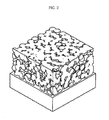
- FIG. 2 is a view illustrating the surface of a porous platinum electrode.
- FIG. 3 is a concept view illustrating a reaction state of a subject to be measured in the porous platinum electrode according to one embodiment.
- the size of platinum grain is about 3 nm and the gap between grains has a size of about 1 to about 2 nm.
- the two porous platinum electrodes may have different porosities.
- One is a porous platinum electrode having Rf of 1 to 50 (hereinafter, referred to as a low porosity platinum electrode), which may be a porous platinum electrode having a low deposition degree of porous platinum or a general platinum electrode.
- the other platinum electrode is a porous platinum electrode that has Rf of 50 to 400 (hereinafter, referred to as a "high porous platinum electrode").
- electrode system comprising a low porosity platinum electrode comprising porous platinum on an outer surface of an electrode base, and a high porosity platinum electrode comprising porous platinum on an outer surface of an electrode base, with the high porosity platinum electrode having a higher roughness factor than the low porosity platinum electrode.
- the low porosity platinum electrode can have a roughness factor of about 1 to about 50 and the high porosity platinum electrode can have a roughness factor of about 50 to about 400.
- the general platinum electrode or the low porosity platinum electrode 2 yields measurement results to which the variation is applied, while the high porosity platinum electrode 3 does not yield measurement results to which the variation is applied.
- dissolved hydrogen gas evaporates from reducing water stored in a water tank and, as a result, the concentration of hydrogen gas decreases.
- the oxidation-reduction potential value measured from the general platinum electrode or low porous platinum electrode 2 increases in proportion to a decreased concentration of hydrogen gas, while the oxidation-reduction potential value measured from the high porosity platinum electrode 3 has a constant oxidation-reduction potential, regardless of concentration variation in hydrogen gas (see FIG. 4 ).
- FIG. 4 is a graph showing a result of a measured value of oxidation-reduction potential of the porous platinum electrode according to one embodiment.
- FIG. 4 shows a measured value of an oxidation-reduction potential of a low porosity platinum electrode 2 and a measured value of an oxidation-reduction potential of a high porosity platinum electrode 3 in reducing water at pH 9.9.
- the graph of oxidation-reduction potential of the high porosity platinum electrode 3 exhibits a constant oxidation-reduction potential, regardless of evaporation of dissolved hydrogen gas as time goes by, while the graph of oxidation-reduction potential of the low porosity platinum electrode 2 exhibits an increase in oxidation-reduction potential, to which a decrease in dissolved hydrogen gas concentration caused by evaporation of dissolved hydrogen gas is applied.
- the high porosity platinum electrode 3 has a gap between grains of 5 nm or less. When a molecule such as hydrogen gas is introduced into the gap, the hydrogen gas passes through the gap and, at the same time, is scattered, and then reacts with grains surrounding the gap several times. Such a multiple reaction exhibits the same effects as in the case in which a plurality of particles are introduced, in spite of using one particle.
- reaction molecules introduced into the gap of the high porosity platinum electrode 3 occur multiple reactions while moving along the gap, while, in a general platinum electrode, one molecule undergoes only one reaction. Accordingly, although the concentration of dissolved hydrogen gas decreases due to evaporation of hydrogen gas from reducing water of the water tank, a measured value of an oxidation-reduction potential of the high porosity platinum electrode 3 has an approximate maximum value, regardless of the concentration variation of dissolved hydrogen gas, as long as the concentration of dissolved hydrogen gas do not decrease to a predetermined level.
- the low porosity platinum electrode 2 of the electrode system may be used as an electrode for measuring an oxidation-reduction potential of a solution to be measured.
- the oxidation-reduction potential is a sum of oxidation-reduction potentials that oxidizing/reducing substances affect electrodes and should reflect the effects of both hydrogen ions and dissolved hydrogen gas, for example, when the hydrogen ions and dissolved hydrogen gas are present as oxidizing/reducing substances in a solution to be measured.
- the low porosity platinum electrode 2 that can yield measurement results reflecting the variation is used as an oxidation-reduction potential measurement electrode.
- the high porosity platinum electrode 3 is used as a pH measurement electrode of a solution to be measured since it is not affected by variation in concentration of the dissolved hydrogen gas and is affected only by hydrogen ion concentration.
- the electrode system according to one embodiment of the present invention enables oxidation-reduction potential and pH of a solution to be measured.
- the oxidation-reduction potential of highly active reducing water includes a reducing force of the dissolved hydrogen gas as well as an oxidizing force of hydrogen ions. For this reason, in order to accurately evaluate the reducing force of dissolved hydrogen gas of reducing water, the effect of the oxidizing force of hydrogen ions should be excluded.
- the electrode system according to one embodiment of the present invention can be used to accurately calculate an oxidation-reduction potential of dissolved gas present in the solution to be measured using two porous platinum electrodes having different porosities, that is, the low porosity platinum electrode 2 and the high porosity platinum electrode 3 and concentration of dissolved gas using the same.
- the high porosity platinum electrode 3 and the low porosity platinum electrode 2 have the same reactivity to ions, for example, hydrogen ions of a solution to be measured. That is, they calculate measured values of oxidation-reduction potentials to which variation in concentration of hydrogen ions is applied.
- the high porosity platinum electrode 3 exhibits a constant measured value of an oxidation-reduction potential, regardless of variation in concentration of dissolved hydrogen gas, while the low porosity platinum electrode 2 exhibits a measured value of an oxidation-reduction potential, to which a concentration variation of dissolved hydrogen gas is applied (see FIG. 4 ).
- the high porosity platinum electrode 3 and the low porosity platinum electrode 2 calculate measured values of an oxidation-reduction potential to which concentration variation of hydrogen ions is applied, thus obtaining measured values of an oxidation-reduction potential in which the effect of hydrogen ions of the solution to be measured is offset and only the effect of dissolved hydrogen gas is reflected.
- the electrode system can calculate measured values of an oxidation-reduction potential in which only the effect of dissolved hydrogen gas of reducing water is reflected, thus more accurately measuring the reducing force of dissolved hydrogen gas as well as the concentration of dissolved hydrogen gas in reducing water, based on the oxidation-reduction potential of dissolved hydrogen gas.
- FIG. 5 is a block diagram illustrating a configuration to calculate character values of a solution in an electrode system according to one embodiment.
- the solution character value calculation unit 4 calculates information exhibiting properties such as oxidation-reduction potential and pH of solutions through potentials of the high porosity platinum electrode 3 and the low porosity platinum electrode 2.
- the solution character value calculation unit 4 may be a readout device.
- the solution character value calculation unit 4 calculates an oxidation-reduction potential of a solution through the potential value of the low porosity platinum electrode 2 to the reference electrode 1.
- the oxidation-reduction potential of the solution thus calculated exhibits an oxidation-reduction potential to which effects of both ions and dissolved gases present in the solution are applied.
- the oxidation-reduction potential is a sum of oxidation-reduction potentials that oxidizing/reducing substances and should reflect the effects of both hydrogen ions and dissolved hydrogen gas, for example, when the hydrogen ions and dissolved hydrogen gas are present as oxidizing/reducing substances in a solution to be measured.
- the low porosity platinum electrode 2 that can yield measurement results to which the variation is applied is used as an oxidation-reduction potential measurement electrode.
- the solution character value calculation unit 4 calculates pH of a solution based on the potential value of the high porosity platinum electrode 3 to the reference electrode 1.
- the high porosity platinum electrode 3 is used as a pH measurement electrode of a solution to be measured, since it is not affected by variation in concentration of dissolved hydrogen gas and is affected by only concentration of hydrogen ions.
- the solution character value calculation unit 4 calculates measured values of an oxidation-reduction potential through the potential value of the low porosity platinum electrode 2 to the high porosity platinum electrode 3 using the high porosity platinum electrode 3 as a reference electrode and the low porosity platinum electrodes 2 as working electrodes. As a result, the oxidation-reduction potential in which only the effect of dissolved hydrogen gas is reflected is obtained, since the effect of hydrogen ions of the solution to be measured is offset.
- the solution character value calculation unit 4 calculates concentration of dissolved gas in a solution through the calculated oxidation-reduction potential of the solution.
- an oxidation-reduction potential in which only the effect of dissolved hydrogen gas of reducing water is reflected is calculated through the potential value of the low porosity platinum electrode 2 calculated using the high porosity platinum electrode 3 as a reference electrode, thereby more accurately measuring the reducing force of dissolved hydrogen gas as well as the concentration of dissolved hydrogen gas in reducing water, based on the oxidation-reduction potential.
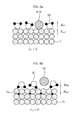
- FIGS. 6A and 6B are views illustrating reactions on the surface of a platinum electrode according to surface potential of the platinum electrode.
- an oxidation-reduction potential of the platinum electrode including a low porosity platinum electrode 2 and a high porosity platinum electrode 3 is measured while immersing the platinum electrode in highly active reducing water containing a great amount of dissolved hydrogen gases for a long period of time, dissolved hydrogen gases and hydrogen atoms in water molecules continuously react with platinum. When this reaction occurs for a long period of time, hydrogen atoms are accumulated in platinum and reactivity of hydrogen gas to platinum thus decreases.
- a dipole moment ( ⁇ surf) of the platinum electrode surface directs toward a surface direction of the platinum electrode.
- the surface of the platinum electrode contacts oxygen molecules of water molecules and reaction between platinum and hydrogen atoms does not occur.
- a dipole moment ( ⁇ surf) of the platinum electrode surface directs toward an opposite direction to a surface direction of the platinum electrode.
- the surface of the platinum electrode contacts hydrogen atoms of water molecules and dissolved hydrogen gas.
- hydrogen atoms of water molecules sand dissolved hydrogen gas react with electrons present on the platinum surface, hydrogen atoms are produced even at a voltage or less at which electrolysis actually occurs, which are adsorbed on the platinum surface.
- Such a hydrogen atom is referred to as underpotential deposition hydrogen, represented by "Hupd”.
- the embodiment of the present invention provides an electrode system that returns the platinum electrode on which hydrogen atoms are adsorbed while being exposed in a state of FIG. 6B for a long period of time to the state of FIG. 6A .
- FIG. 7 is a view illustrating a configuration of an electrode system arranged to recycle the platinum electrode according to one embodiment.
- the electrode system includes an electrode unit including a reference electrode 1, a low porosity platinum electrode 2 and a high porosity platinum electrode 3, a relay 5 to selectively connect the electrode unit to a power unit or a readout device 7, the power unit 6 to supply power to the electrode unit, a readout device 7 to calculate an oxidation-reduction potential or pH of a solution according to a measured value of the electrode unit, and a control unit 8 to control driving of the relay 5 based on the calculated result of the readout device 7.
- an electrode unit including a reference electrode 1, a low porosity platinum electrode 2 and a high porosity platinum electrode 3, a relay 5 to selectively connect the electrode unit to a power unit or a readout device 7, the power unit 6 to supply power to the electrode unit, a readout device 7 to calculate an oxidation-reduction potential or pH of a solution according to a measured value of the electrode unit, and a control unit 8 to control driving of the relay 5 based on the calculated result of the readout device 7.
- the relay 5 electrically connects the electrode unit to the readout device 7.
- an output value of the low porosity platinum electrode 2 means an oxidation-reduction potential of a solution.
- both the high porosity platinum electrode 3 and the low porosity platinum electrode 2 calculate a measured value of an oxidation-reduction potential reflecting concentration variation of hydrogen ions. Accordingly, the oxidation-reduction potential measured using the high porosity platinum electrode 3 as a reference electrode and the low porosity platinum electrode 2 as a working electrode means an oxidation-reduction potential in which only the effect of dissolved hydrogen gas is reflected.
- the output value of the high porosity platinum electrode 3 means pH of the solution, since it is not affected by variation in concentration of the dissolved hydrogen gas in the solution to be measured and is affected only by the concentration of hydrogen ions.
- the control unit 8 controls the relay 5 so that the electrode unit is electrically connected to the power unit 6.
- the voltage applied for oxidation recycling of the platinum electrode may be a value of 0 to 2V with respect to the reference electrode 1.
- the time for which a voltage is applied is preferably 1 to 30 minutes.
- the level of voltage applied to the platinum electrode may be varied depending on the oxidation-reduction potential of a subject in need of measurement and a voltage application time may be varied depending on surface area of platinum.
- the control unit 8 monitors output of the readout device 7 and thereby determines a control time of the relay 5. That is, the control unit 8 increases the potential of the platinum electrode, when hydrogen atoms are adsorbed on the surface of the platinum electrode, and the control unit 8 controls the relay 5 so that the platinum electrode is connected to the power unit 6, when the potential of the platinum electrode exceeds a predetermined reference value.
- control unit 8 controls the relay 5 so that the platinum electrode is connected to the power unit 6.
- FIG. 8 is a graph showing an oxidation-reduction potential of an initial platinum electrode and an oxidation-reduction potential of a platinum electrode immersed in reducing water for three days.
- a thick line represents variation in initial oxidation-reduction potential of the platinum electrode and a thin line represents variation in oxidation-reduction potential of the platinum electrode immersed in reducing water for three days.
- the surface potential of the platinum electrode that has a negative value due to high reducing force of the reducing water causes an increase in hydrogen atoms adsorbed on platinum, thus causing a rapid increase in oxidation-reduction potential value of the platinum electrode.
- the increase in oxidation-reduction potential of initial platinum electrode over time is a natural result that reflects evaporation of dissolved hydrogen gas.
- FIG. 9 is a graph showing an oxidation-reduction potential of the platinum electrode oxidation-recycled after immersion for one day and an oxidation-reduction potential of the platinum electrode immersed in reducing water for four days.
- FIG. 10 is a graph showing an oxidation-reduction potential of the platinum electrode oxidation-recycled after immersion for two days and an oxidation-reduction potential of platinum electrode immersed in reducing water for five days.
- the variation (thin line) in oxidation-reduction potential of the platinum electrode immersed for five days means a saturated state in which hydrogen atoms are adsorbed on the surface of the platinum electrode and the oxidation-reduction potential value thus reaches about 0 mV.
- FIG. 11 is a graph showing an oxidation-reduction potential of the platinum electrode oxidation-recycled after immersion for five days shown in FIG. 10 and an oxidation-reduction potential of the platinum electrode oxidation-recycled after immersion for three days.
- the oxidation-reduction potential (thin line) of the platinum electrode oxidation-recycled after immersion for five days, and oxidation-reduction potential (thick line) of a repeatedly oxidation-recycled platinum electrode exhibit substantially equivalent variation behaviors.
- the platinum electrode may return to an initial state thereof via an oxidative recycling process, in which a positive voltage is applied thereto, and the platinum electrode maintains the surface state and exhibits the initial measurement performance, although repeatedly undergoing oxidative recycling.
Landscapes
- Chemical & Material Sciences (AREA)
- Life Sciences & Earth Sciences (AREA)
- Health & Medical Sciences (AREA)
- Biochemistry (AREA)
- General Physics & Mathematics (AREA)
- Electrochemistry (AREA)
- Physics & Mathematics (AREA)
- Analytical Chemistry (AREA)
- Molecular Biology (AREA)
- General Health & Medical Sciences (AREA)
- Chemical Kinetics & Catalysis (AREA)
- Immunology (AREA)
- Pathology (AREA)
- Electrodes For Compound Or Non-Metal Manufacture (AREA)
- Water Treatment By Electricity Or Magnetism (AREA)
- Measuring Oxygen Concentration In Cells (AREA)
- Sampling And Sample Adjustment (AREA)
Claims (14)
- Elektrodenvorrichtung, umfassend:eine Elektrodeneinheit,eine Leistungseinheit (6), die zum Anlegen einer Spannung an die Elektrodeneinheit angeordnet ist,eine Auslesevorrichtung (7), die zum Berechnen eines Charakterwertes einer Lösung durch einen Ausgabewert der Elektrodeneinheit angeordnet ist,ein Relais (5), das zum elektrischen Verbinden der Elektrodeneinheit mit der Leistungseinheit oder der Auslesevorrichtung angeordnet ist, undeine Steuereinheit (8), die angeordnet ist, um das Relais auf der Basis des Ausgabewerts der Auslesevorrichtung so zu steuern, dass die Elektrodeneinheit elektrisch mit der Leistungseinheit verbunden wird,wobei die Elektrodeneinheit Folgendes aufweist:eine schwach poröse Platinelektrode (2), die poröses Platin auf einer Außenfläche einer Elektrodenbasis aufweist, undeine stark poröse Platinelektrode (3), die poröses Platin auf einer Außenfläche einer Elektrodenbasis aufweist, das einen höheren Rauheitsfaktor als die schwach poröse Platinelektrode hat,und wobei die Elektrodenvorrichtung so konfiguriert ist, dass die schwach poröse Platinelektrode eine Arbeitselektrode ist, die zum Messen eines Oxidations-/Reduktionspotentials einer Lösung unter Verwendung der stark porösen Platinelektrode als eine Referenz angeordnet ist.
- Elektrodenvorrichtung nach Anspruch 1, wobei die schwach poröse Platinelektrode (2) einen Rauheitsfaktor von etwa 1 bis etwa 50 hat und die stark poröse Platinelektrode (3) einen Rauheitsfaktor von etwa 50 bis etwa 400 hat.
- Elektrodenvorrichtung nach Anspruch 1 oder 2, wobei die Elektrodeneinheit ferner Folgendes aufweist:Referenzelektrode (1),wobei die zusätzliche Referenzelektrode (1) wahlweise aus Gold oder Silber hergestellt ist.
- Elektrodenvorrichtung nach Anspruch 3, wobei die schwach poröse Platinelektrode (2) und die stark poröse Platinelektrode (3) Arbeitselektroden in Bezug auf die Referenzelektrode (1) sind und die schwach poröse Platinelektrode eine Oxidations-/Reduktionspotential-, ORP-, -Messelektrode ist und die stark poröse Platinelektrode eine pH-Messelektrode ist.
- Elektrodenvorrichtung nach einem der vorhergehenden Ansprüche, wobei das von der schwach porösen Platinelektrode (2) unter Verwendung der stark porösen Platinelektrode (3) als die Referenzelektrode gemessene Oxidations-/Reduktionspotential ein Oxidations-/Reduktionspotential auf der Basis eines in der Lösung anwesenden aufgelösten Gases ist,
wobei die Lösung wahlweise Reduktionswasser ist, in dem Wasserstoffgas aufgelöst ist, und das aufgelöste Gas Wasserstoffgas umfasst. - Elektrodenvorrichtung nach einem der vorhergehenden Ansprüche, wobei die Steuereinheit (8) angeordnet ist, um das Relais (5) so zu steuern, dass die Elektrodeneinheit elektrisch mit der Leistungseinheit (6) verbunden wird, wenn der Ausgabewert der Auslesevorrichtung (7) einen vorbestimmten Referenzwert überschreitet.
- Elektrodenvorrichtung nach einem der vorhergehenden Ansprüche, wobei die Steuereinheit (8) angeordnet ist, um das Relais (5) so zu steuern, dass die Elektrodeneinheit in einem vorbestimmten Intervall elektrisch mit der Leistungseinheit (6) verbunden wird.
- Elektrodenvorrichtung nach einem der vorhergehenden Ansprüche, wobei die Leistungseinheit (6) angeordnet ist, um eine positive Spannung an das Elektrodensystem anzulegen, wenn die Leistungseinheit elektrisch mit der Elektrodeneinheit verbunden ist,
wobei die Leistungseinheit wahlweise angeordnet ist, um eine Spannung von etwa 0 V bis etwa 2 V an das Elektrodensystem anzulegen. - Verfahren zum Berechnen eines Charakterwertes einer Lösung unter Verwendung eines Elektrodensystems, das eine stark poröse Platinelektrode (3) und eine schwach poröse Platinelektrode (2) aufweist, wobei die stark poröse Platinelektrode einen höheren Rauheitsfaktor als die schwach poröse Platinelektrode hat, umfassend:Berechnen eines Oxidations-/Reduktionspotentials einer Lösung anhand der schwach porösen Platinelektrode unter Verwendung der stark porösen Platinelektrode als eine Referenz undBerechnen einer Konzentration von aufgelöstem Gas in der Lösung anhand des berechneten Oxidations-/Reduktionspotentials der Lösung.
- Verfahren nach Anspruch 9, wobei die schwach poröse Platinelektrode (2) einen Rauheitsfaktor von etwa 1 bis etwa 50 hat und die stark poröse Platinelektrode (3) einen Rauheitsfaktor von etwa 50 bis etwa 400 hat.
- Verfahren nach Anspruch 9 oder 10, wobei das von der schwach porösen Platinelektrode (2) unter Verwendung der stark porösen Platinelektrode (3) als eine Referenz berechnete Oxidations-/Reduktionspotential ein Oxidations-/Reduktionspotential auf der Basis eines in der Lösung anwesenden aufgelösten Gases ist.
- Verfahren nach einem der Ansprüche 9 bis 11, wobei das Elektrodensystem ferner eine Referenzelektrode (1) aufweist, wobei die Referenzelektrode wahlweise aus Gold oder Silber hergestellt ist,
wobei wahlweise das Oxidations-/Reduktionspotential der Lösung ferner unter Verwendung der schwach porösen Platinelektrode (2) als die Arbeitselektrode in Bezug auf die Referenzelektrode berechnet wird und pH unter Verwendung der stark porösen Platinelektrode (3) als die Arbeitselektrode in Bezug auf die Referenzelektrode berechnet wird. - Verfahren nach einem der Ansprüche 9 bis 12, wobei die Lösung Reduktionswasser ist, in dem Wasserstoffgas aufgelöst ist, und das aufgelöste Gas ein Wasserstoffgas umfasst.
- Verfahren nach einem der Ansprüche 9 bis 13, wobei der Charakterwert der Lösung pH und das Oxidations-/Reduktionspotential der Lösung und die Konzentration von aufgelöstem Gas in der Lösung aufweist.
Applications Claiming Priority (2)
| Application Number | Priority Date | Filing Date | Title |
|---|---|---|---|
| KR20110105514 | 2011-10-14 | ||
| KR1020120053490A KR20130040693A (ko) | 2011-10-14 | 2012-05-21 | 전극 시스템 및 이를 이용한 용액 특성값 산출방법 |
Publications (3)
| Publication Number | Publication Date |
|---|---|
| EP2581737A2 EP2581737A2 (de) | 2013-04-17 |
| EP2581737A3 EP2581737A3 (de) | 2013-06-19 |
| EP2581737B1 true EP2581737B1 (de) | 2014-11-26 |
Family
ID=47357887
Family Applications (1)
| Application Number | Title | Priority Date | Filing Date |
|---|---|---|---|
| EP12188401.9A Not-in-force EP2581737B1 (de) | 2011-10-14 | 2012-10-12 | System zur Messung des Redoxpotentials, mit porösen Platinelektroden |
Country Status (2)
| Country | Link |
|---|---|
| US (1) | US9297781B2 (de) |
| EP (1) | EP2581737B1 (de) |
Families Citing this family (1)
| Publication number | Priority date | Publication date | Assignee | Title |
|---|---|---|---|---|
| EP3882618A4 (de) * | 2018-12-18 | 2022-08-24 | HORIBA Advanced Techno, Co., Ltd. | Analysevorrichtung |
Family Cites Families (13)
| Publication number | Priority date | Publication date | Assignee | Title |
|---|---|---|---|---|
| US4602985A (en) * | 1985-05-06 | 1986-07-29 | Eldorado Resources Limited | Carbon cell electrodes |
| US5746900A (en) * | 1996-03-07 | 1998-05-05 | H.V. Setty Enterprises, Inc. | Non-aqueous amperometric multi-gas sensor |
| US6295474B1 (en) * | 1998-03-13 | 2001-09-25 | Intermedics Inc. | Defibrillator housing with conductive polymer coating |
| EP1403957A1 (de) * | 2001-05-10 | 2004-03-31 | Nisshinbo Industries, Inc. | Wasserfreie elektrolytlösung, zusammensetzung für ein polymergelelektrolyt, polymergelelektrolyt, sekundärzelle und elektrischer doppelschichtkondensator |
| US6974533B2 (en) * | 2002-04-11 | 2005-12-13 | Second Sight Medical Products, Inc. | Platinum electrode and method for manufacturing the same |
| US7813780B2 (en) * | 2005-12-13 | 2010-10-12 | Medtronic Minimed, Inc. | Biosensors and methods for making and using them |
| KR100481663B1 (ko) | 2002-09-24 | 2005-04-08 | 김희찬 | 중기공성 백금을 포함하는 바이오센서 및 이를 이용한글루코스 농도 측정방법 |
| US20100126858A1 (en) * | 2003-01-30 | 2010-05-27 | Tanita Corporation | Chemical sensor type measuring apparatus |
| EP2035824A2 (de) * | 2006-06-14 | 2009-03-18 | Ceramatec, Inc. | Ammoniakgassensor mit ungleichen elektroden |
| US8551322B2 (en) * | 2006-08-24 | 2013-10-08 | University Of North Carolina At Chapel Hill | Nitric oxide microsensors via fluorosilane-based xerogel membranes |
| US9401523B2 (en) * | 2007-01-09 | 2016-07-26 | GM Global Technology Operations LLC | Fuel cell and method for reducing electrode degradation during startup and shutdown cycles |
| BRPI1011317B8 (pt) * | 2009-06-09 | 2021-12-21 | Neuronano Ab | Microeletrodo médico para inserção em tecido mole, feixe de microeletrodo médico e arranjo dos mesmos |
| JP2014153243A (ja) * | 2013-02-12 | 2014-08-25 | Tanita Corp | バイオセンサおよびこれを用いた測定方法 |
-
2012
- 2012-10-12 EP EP12188401.9A patent/EP2581737B1/de not_active Not-in-force
- 2012-10-12 US US13/650,809 patent/US9297781B2/en not_active Expired - Fee Related
Also Published As
| Publication number | Publication date |
|---|---|
| US9297781B2 (en) | 2016-03-29 |
| EP2581737A2 (de) | 2013-04-17 |
| EP2581737A3 (de) | 2013-06-19 |
| US20130092560A1 (en) | 2013-04-18 |
Similar Documents
| Publication | Publication Date | Title |
|---|---|---|
| Steegstra et al. | Influence of oxidation state on the pH dependence of hydrous iridium oxide films | |
| Marcandalli et al. | Understanding hydrogen evolution reaction in bicarbonate buffer | |
| Wang et al. | Preparation of reduced graphene oxide/Cu nanoparticle composites through electrophoretic deposition: application for nonenzymatic glucose sensing | |
| Głab et al. | Metal-metal oxide and metal oxide electrodes as pH sensors | |
| Gyurcsanyi et al. | Direct evidence of ionic fluxes across ion-selective membranes: a scanning electrochemical microscopic and potentiometric study | |
| Kim et al. | Nanoporous platinum thin films synthesized by electrochemical dealloying for nonenzymatic glucose detection | |
| Sutter et al. | A polypyrrole-based solid-contact Pb2+-selective PVC-membrane electrode with a nanomolar detection limit | |
| He et al. | Dynamic diffuse double-layer model for the electrochemistry of nanometer-sized electrodes | |
| Chen et al. | EDTA assisted highly selective detection of As3+ on Au nanoparticle modified glassy carbon electrodes: facile in situ electrochemical characterization of Au nanoparticles | |
| Yang et al. | An iridium oxide reference electrode for use in microfabricated biosensors and biochips | |
| Wang et al. | Simultaneous detection of copper, lead and zinc on tin film/gold nanoparticles/gold microelectrode by square wave stripping voltammetry | |
| Giao et al. | Au nanodendrite incorporated graphite pencil lead as a sensitive and simple electrochemical sensor for simultaneous detection of Pb (II), Cu (II) and Hg (II) | |
| Gong et al. | A glucose biosensor based on the polymerization of aniline induced by a bio-interphase of glucose oxidase and horseradish peroxidase | |
| Xie et al. | Substrate mediated dissolution of redox active nanoparticles; electron transfer over long distances | |
| Klusmann et al. | pH-Microscopy: technical application in phosphating solutions | |
| WO2016032314A1 (en) | An egfet phosphate sensor device | |
| EP2581737B1 (de) | System zur Messung des Redoxpotentials, mit porösen Platinelektroden | |
| Dang et al. | Integrated probe for electrochemical analysis of small volume droplets | |
| Medina et al. | Electrochemical preconcentration mechanism of trivalent lanthanum | |
| KR101618337B1 (ko) | 센서의 제조방법 및 이에 의하여 제조된 센서 | |
| Hwang et al. | Revealing Indirect Electro-Reduction of Quaternary Ammonium Polybromide Droplets in Acidic Aqueous Solutions | |
| Buss et al. | Modifications and characterization of a silicon-based microelectrode array | |
| Tolstopyatova et al. | Synthesis and electrochemical properties of composite films based on poly-3, 4-ethylenedioxythiophene with inclusions of silver particles | |
| Inzelt | Electrochemical quartz crystal nanobalance | |
| JP2008256604A (ja) | 溶存オゾン濃度測定装置及び溶存オゾン濃度測定方法 |
Legal Events
| Date | Code | Title | Description |
|---|---|---|---|
| PUAI | Public reference made under article 153(3) epc to a published international application that has entered the european phase |
Free format text: ORIGINAL CODE: 0009012 |
|
| AK | Designated contracting states |
Kind code of ref document: A2 Designated state(s): AL AT BE BG CH CY CZ DE DK EE ES FI FR GB GR HR HU IE IS IT LI LT LU LV MC MK MT NL NO PL PT RO RS SE SI SK SM TR |
|
| AX | Request for extension of the european patent |
Extension state: BA ME |
|
| PUAL | Search report despatched |
Free format text: ORIGINAL CODE: 0009013 |
|
| AK | Designated contracting states |
Kind code of ref document: A3 Designated state(s): AL AT BE BG CH CY CZ DE DK EE ES FI FR GB GR HR HU IE IS IT LI LT LU LV MC MK MT NL NO PL PT RO RS SE SI SK SM TR |
|
| AX | Request for extension of the european patent |
Extension state: BA ME |
|
| RIC1 | Information provided on ipc code assigned before grant |
Ipc: G01N 27/416 20060101AFI20130514BHEP |
|
| 17P | Request for examination filed |
Effective date: 20131030 |
|
| RBV | Designated contracting states (corrected) |
Designated state(s): AL AT BE BG CH CY CZ DE DK EE ES FI FR GB GR HR HU IE IS IT LI LT LU LV MC MK MT NL NO PL PT RO RS SE SI SK SM TR |
|
| 17Q | First examination report despatched |
Effective date: 20131119 |
|
| GRAP | Despatch of communication of intention to grant a patent |
Free format text: ORIGINAL CODE: EPIDOSNIGR1 |
|
| INTG | Intention to grant announced |
Effective date: 20140618 |
|
| GRAS | Grant fee paid |
Free format text: ORIGINAL CODE: EPIDOSNIGR3 |
|
| GRAA | (expected) grant |
Free format text: ORIGINAL CODE: 0009210 |
|
| AK | Designated contracting states |
Kind code of ref document: B1 Designated state(s): AL AT BE BG CH CY CZ DE DK EE ES FI FR GB GR HR HU IE IS IT LI LT LU LV MC MK MT NL NO PL PT RO RS SE SI SK SM TR |
|
| REG | Reference to a national code |
Ref country code: GB Ref legal event code: FG4D |
|
| REG | Reference to a national code |
Ref country code: CH Ref legal event code: EP |
|
| REG | Reference to a national code |
Ref country code: AT Ref legal event code: REF Ref document number: 698476 Country of ref document: AT Kind code of ref document: T Effective date: 20141215 |
|
| REG | Reference to a national code |
Ref country code: IE Ref legal event code: FG4D |
|
| REG | Reference to a national code |
Ref country code: DE Ref legal event code: R096 Ref document number: 602012003974 Country of ref document: DE Effective date: 20150108 |
|
| REG | Reference to a national code |
Ref country code: NL Ref legal event code: T3 |
|
| REG | Reference to a national code |
Ref country code: AT Ref legal event code: MK05 Ref document number: 698476 Country of ref document: AT Kind code of ref document: T Effective date: 20141126 |
|
| REG | Reference to a national code |
Ref country code: LT Ref legal event code: MG4D |
|
| PG25 | Lapsed in a contracting state [announced via postgrant information from national office to epo] |
Ref country code: LT Free format text: LAPSE BECAUSE OF FAILURE TO SUBMIT A TRANSLATION OF THE DESCRIPTION OR TO PAY THE FEE WITHIN THE PRESCRIBED TIME-LIMIT Effective date: 20141126 Ref country code: FI Free format text: LAPSE BECAUSE OF FAILURE TO SUBMIT A TRANSLATION OF THE DESCRIPTION OR TO PAY THE FEE WITHIN THE PRESCRIBED TIME-LIMIT Effective date: 20141126 Ref country code: NO Free format text: LAPSE BECAUSE OF FAILURE TO SUBMIT A TRANSLATION OF THE DESCRIPTION OR TO PAY THE FEE WITHIN THE PRESCRIBED TIME-LIMIT Effective date: 20150226 Ref country code: PT Free format text: LAPSE BECAUSE OF FAILURE TO SUBMIT A TRANSLATION OF THE DESCRIPTION OR TO PAY THE FEE WITHIN THE PRESCRIBED TIME-LIMIT Effective date: 20150326 Ref country code: ES Free format text: LAPSE BECAUSE OF FAILURE TO SUBMIT A TRANSLATION OF THE DESCRIPTION OR TO PAY THE FEE WITHIN THE PRESCRIBED TIME-LIMIT Effective date: 20141126 Ref country code: IS Free format text: LAPSE BECAUSE OF FAILURE TO SUBMIT A TRANSLATION OF THE DESCRIPTION OR TO PAY THE FEE WITHIN THE PRESCRIBED TIME-LIMIT Effective date: 20150326 |
|
| PG25 | Lapsed in a contracting state [announced via postgrant information from national office to epo] |
Ref country code: AT Free format text: LAPSE BECAUSE OF FAILURE TO SUBMIT A TRANSLATION OF THE DESCRIPTION OR TO PAY THE FEE WITHIN THE PRESCRIBED TIME-LIMIT Effective date: 20141126 Ref country code: SE Free format text: LAPSE BECAUSE OF FAILURE TO SUBMIT A TRANSLATION OF THE DESCRIPTION OR TO PAY THE FEE WITHIN THE PRESCRIBED TIME-LIMIT Effective date: 20141126 Ref country code: LV Free format text: LAPSE BECAUSE OF FAILURE TO SUBMIT A TRANSLATION OF THE DESCRIPTION OR TO PAY THE FEE WITHIN THE PRESCRIBED TIME-LIMIT Effective date: 20141126 Ref country code: HR Free format text: LAPSE BECAUSE OF FAILURE TO SUBMIT A TRANSLATION OF THE DESCRIPTION OR TO PAY THE FEE WITHIN THE PRESCRIBED TIME-LIMIT Effective date: 20141126 Ref country code: RS Free format text: LAPSE BECAUSE OF FAILURE TO SUBMIT A TRANSLATION OF THE DESCRIPTION OR TO PAY THE FEE WITHIN THE PRESCRIBED TIME-LIMIT Effective date: 20141126 Ref country code: GR Free format text: LAPSE BECAUSE OF FAILURE TO SUBMIT A TRANSLATION OF THE DESCRIPTION OR TO PAY THE FEE WITHIN THE PRESCRIBED TIME-LIMIT Effective date: 20150227 Ref country code: CY Free format text: LAPSE BECAUSE OF FAILURE TO SUBMIT A TRANSLATION OF THE DESCRIPTION OR TO PAY THE FEE WITHIN THE PRESCRIBED TIME-LIMIT Effective date: 20141126 |
|
| PG25 | Lapsed in a contracting state [announced via postgrant information from national office to epo] |
Ref country code: CZ Free format text: LAPSE BECAUSE OF FAILURE TO SUBMIT A TRANSLATION OF THE DESCRIPTION OR TO PAY THE FEE WITHIN THE PRESCRIBED TIME-LIMIT Effective date: 20141126 Ref country code: RO Free format text: LAPSE BECAUSE OF FAILURE TO SUBMIT A TRANSLATION OF THE DESCRIPTION OR TO PAY THE FEE WITHIN THE PRESCRIBED TIME-LIMIT Effective date: 20141126 Ref country code: DK Free format text: LAPSE BECAUSE OF FAILURE TO SUBMIT A TRANSLATION OF THE DESCRIPTION OR TO PAY THE FEE WITHIN THE PRESCRIBED TIME-LIMIT Effective date: 20141126 Ref country code: EE Free format text: LAPSE BECAUSE OF FAILURE TO SUBMIT A TRANSLATION OF THE DESCRIPTION OR TO PAY THE FEE WITHIN THE PRESCRIBED TIME-LIMIT Effective date: 20141126 Ref country code: SK Free format text: LAPSE BECAUSE OF FAILURE TO SUBMIT A TRANSLATION OF THE DESCRIPTION OR TO PAY THE FEE WITHIN THE PRESCRIBED TIME-LIMIT Effective date: 20141126 |
|
| REG | Reference to a national code |
Ref country code: DE Ref legal event code: R097 Ref document number: 602012003974 Country of ref document: DE |
|
| PG25 | Lapsed in a contracting state [announced via postgrant information from national office to epo] |
Ref country code: PL Free format text: LAPSE BECAUSE OF FAILURE TO SUBMIT A TRANSLATION OF THE DESCRIPTION OR TO PAY THE FEE WITHIN THE PRESCRIBED TIME-LIMIT Effective date: 20141126 |
|
| PLBE | No opposition filed within time limit |
Free format text: ORIGINAL CODE: 0009261 |
|
| STAA | Information on the status of an ep patent application or granted ep patent |
Free format text: STATUS: NO OPPOSITION FILED WITHIN TIME LIMIT |
|
| 26N | No opposition filed |
Effective date: 20150827 |
|
| PG25 | Lapsed in a contracting state [announced via postgrant information from national office to epo] |
Ref country code: IT Free format text: LAPSE BECAUSE OF FAILURE TO SUBMIT A TRANSLATION OF THE DESCRIPTION OR TO PAY THE FEE WITHIN THE PRESCRIBED TIME-LIMIT Effective date: 20141126 |
|
| PG25 | Lapsed in a contracting state [announced via postgrant information from national office to epo] |
Ref country code: SI Free format text: LAPSE BECAUSE OF FAILURE TO SUBMIT A TRANSLATION OF THE DESCRIPTION OR TO PAY THE FEE WITHIN THE PRESCRIBED TIME-LIMIT Effective date: 20141126 |
|
| PG25 | Lapsed in a contracting state [announced via postgrant information from national office to epo] |
Ref country code: LU Free format text: LAPSE BECAUSE OF FAILURE TO SUBMIT A TRANSLATION OF THE DESCRIPTION OR TO PAY THE FEE WITHIN THE PRESCRIBED TIME-LIMIT Effective date: 20151012 |
|
| REG | Reference to a national code |
Ref country code: CH Ref legal event code: PL |
|
| PG25 | Lapsed in a contracting state [announced via postgrant information from national office to epo] |
Ref country code: MC Free format text: LAPSE BECAUSE OF FAILURE TO SUBMIT A TRANSLATION OF THE DESCRIPTION OR TO PAY THE FEE WITHIN THE PRESCRIBED TIME-LIMIT Effective date: 20141126 |
|
| REG | Reference to a national code |
Ref country code: IE Ref legal event code: MM4A |
|
| PG25 | Lapsed in a contracting state [announced via postgrant information from national office to epo] |
Ref country code: LI Free format text: LAPSE BECAUSE OF NON-PAYMENT OF DUE FEES Effective date: 20151031 Ref country code: CH Free format text: LAPSE BECAUSE OF NON-PAYMENT OF DUE FEES Effective date: 20151031 |
|
| REG | Reference to a national code |
Ref country code: FR Ref legal event code: PLFP Year of fee payment: 5 |
|
| PG25 | Lapsed in a contracting state [announced via postgrant information from national office to epo] |
Ref country code: IE Free format text: LAPSE BECAUSE OF NON-PAYMENT OF DUE FEES Effective date: 20151012 |
|
| PG25 | Lapsed in a contracting state [announced via postgrant information from national office to epo] |
Ref country code: HU Free format text: LAPSE BECAUSE OF FAILURE TO SUBMIT A TRANSLATION OF THE DESCRIPTION OR TO PAY THE FEE WITHIN THE PRESCRIBED TIME-LIMIT; INVALID AB INITIO Effective date: 20121012 Ref country code: BG Free format text: LAPSE BECAUSE OF FAILURE TO SUBMIT A TRANSLATION OF THE DESCRIPTION OR TO PAY THE FEE WITHIN THE PRESCRIBED TIME-LIMIT Effective date: 20141126 Ref country code: SM Free format text: LAPSE BECAUSE OF FAILURE TO SUBMIT A TRANSLATION OF THE DESCRIPTION OR TO PAY THE FEE WITHIN THE PRESCRIBED TIME-LIMIT Effective date: 20141126 |
|
| PG25 | Lapsed in a contracting state [announced via postgrant information from national office to epo] |
Ref country code: MT Free format text: LAPSE BECAUSE OF FAILURE TO SUBMIT A TRANSLATION OF THE DESCRIPTION OR TO PAY THE FEE WITHIN THE PRESCRIBED TIME-LIMIT Effective date: 20141126 |
|
| REG | Reference to a national code |
Ref country code: FR Ref legal event code: PLFP Year of fee payment: 6 |
|
| PG25 | Lapsed in a contracting state [announced via postgrant information from national office to epo] |
Ref country code: BE Free format text: LAPSE BECAUSE OF FAILURE TO SUBMIT A TRANSLATION OF THE DESCRIPTION OR TO PAY THE FEE WITHIN THE PRESCRIBED TIME-LIMIT Effective date: 20141126 |
|
| PG25 | Lapsed in a contracting state [announced via postgrant information from national office to epo] |
Ref country code: TR Free format text: LAPSE BECAUSE OF FAILURE TO SUBMIT A TRANSLATION OF THE DESCRIPTION OR TO PAY THE FEE WITHIN THE PRESCRIBED TIME-LIMIT Effective date: 20141126 Ref country code: MK Free format text: LAPSE BECAUSE OF FAILURE TO SUBMIT A TRANSLATION OF THE DESCRIPTION OR TO PAY THE FEE WITHIN THE PRESCRIBED TIME-LIMIT Effective date: 20141126 |
|
| REG | Reference to a national code |
Ref country code: FR Ref legal event code: PLFP Year of fee payment: 7 |
|
| PG25 | Lapsed in a contracting state [announced via postgrant information from national office to epo] |
Ref country code: AL Free format text: LAPSE BECAUSE OF FAILURE TO SUBMIT A TRANSLATION OF THE DESCRIPTION OR TO PAY THE FEE WITHIN THE PRESCRIBED TIME-LIMIT Effective date: 20141126 |
|
| PGFP | Annual fee paid to national office [announced via postgrant information from national office to epo] |
Ref country code: FR Payment date: 20180927 Year of fee payment: 7 |
|
| PGFP | Annual fee paid to national office [announced via postgrant information from national office to epo] |
Ref country code: GB Payment date: 20180921 Year of fee payment: 7 Ref country code: NL Payment date: 20180921 Year of fee payment: 7 |
|
| PGFP | Annual fee paid to national office [announced via postgrant information from national office to epo] |
Ref country code: DE Payment date: 20180920 Year of fee payment: 7 |
|
| REG | Reference to a national code |
Ref country code: DE Ref legal event code: R119 Ref document number: 602012003974 Country of ref document: DE |
|
| REG | Reference to a national code |
Ref country code: NL Ref legal event code: MM Effective date: 20191101 |
|
| PG25 | Lapsed in a contracting state [announced via postgrant information from national office to epo] |
Ref country code: DE Free format text: LAPSE BECAUSE OF NON-PAYMENT OF DUE FEES Effective date: 20200501 |
|
| PG25 | Lapsed in a contracting state [announced via postgrant information from national office to epo] |
Ref country code: NL Free format text: LAPSE BECAUSE OF NON-PAYMENT OF DUE FEES Effective date: 20191101 |
|
| GBPC | Gb: european patent ceased through non-payment of renewal fee |
Effective date: 20191012 |
|
| PG25 | Lapsed in a contracting state [announced via postgrant information from national office to epo] |
Ref country code: GB Free format text: LAPSE BECAUSE OF NON-PAYMENT OF DUE FEES Effective date: 20191012 Ref country code: FR Free format text: LAPSE BECAUSE OF NON-PAYMENT OF DUE FEES Effective date: 20191031 |