EP2581990A2 - Gehäuse für eine Telekommunikationsvorrichtung - Google Patents
Gehäuse für eine Telekommunikationsvorrichtung Download PDFInfo
- Publication number
- EP2581990A2 EP2581990A2 EP20120006957 EP12006957A EP2581990A2 EP 2581990 A2 EP2581990 A2 EP 2581990A2 EP 20120006957 EP20120006957 EP 20120006957 EP 12006957 A EP12006957 A EP 12006957A EP 2581990 A2 EP2581990 A2 EP 2581990A2
- Authority
- EP
- European Patent Office
- Prior art keywords
- connecting element
- housing according
- connection
- conductive
- housing
- Prior art date
- Legal status (The legal status is an assumption and is not a legal conclusion. Google has not performed a legal analysis and makes no representation as to the accuracy of the status listed.)
- Granted
Links
Images



Classifications
-
- H—ELECTRICITY
- H01—ELECTRIC ELEMENTS
- H01R—ELECTRICALLY-CONDUCTIVE CONNECTIONS; STRUCTURAL ASSOCIATIONS OF A PLURALITY OF MUTUALLY-INSULATED ELECTRICAL CONNECTING ELEMENTS; COUPLING DEVICES; CURRENT COLLECTORS
- H01R9/00—Structural associations of a plurality of mutually-insulated electrical connecting elements, e.g. terminal strips or terminal blocks; Terminals or binding posts mounted upon a base or in a case; Bases therefor
- H01R9/22—Bases, e.g. strip, block, panel
- H01R9/24—Terminal blocks
- H01R9/2425—Structural association with built-in components
-
- H—ELECTRICITY
- H01—ELECTRIC ELEMENTS
- H01R—ELECTRICALLY-CONDUCTIVE CONNECTIONS; STRUCTURAL ASSOCIATIONS OF A PLURALITY OF MUTUALLY-INSULATED ELECTRICAL CONNECTING ELEMENTS; COUPLING DEVICES; CURRENT COLLECTORS
- H01R12/00—Structural associations of a plurality of mutually-insulated electrical connecting elements, specially adapted for printed circuits, e.g. printed circuit boards [PCB], flat or ribbon cables, or like generally planar structures, e.g. terminal strips, terminal blocks; Coupling devices specially adapted for printed circuits, flat or ribbon cables, or like generally planar structures; Terminals specially adapted for contact with, or insertion into, printed circuits, flat or ribbon cables, or like generally planar structures
- H01R12/70—Coupling devices
- H01R12/71—Coupling devices for rigid printing circuits or like structures
- H01R12/712—Coupling devices for rigid printing circuits or like structures co-operating with the surface of the printed circuit or with a coupling device exclusively provided on the surface of the printed circuit
- H01R12/714—Coupling devices for rigid printing circuits or like structures co-operating with the surface of the printed circuit or with a coupling device exclusively provided on the surface of the printed circuit with contacts abutting directly the printed circuit; Button contacts therefore provided on the printed circuit
-
- H—ELECTRICITY
- H01—ELECTRIC ELEMENTS
- H01R—ELECTRICALLY-CONDUCTIVE CONNECTIONS; STRUCTURAL ASSOCIATIONS OF A PLURALITY OF MUTUALLY-INSULATED ELECTRICAL CONNECTING ELEMENTS; COUPLING DEVICES; CURRENT COLLECTORS
- H01R13/00—Details of coupling devices of the kinds covered by groups H01R12/70 or H01R24/00 - H01R33/00
- H01R13/02—Contact members
- H01R13/22—Contacts for co-operating by abutting
- H01R13/24—Contacts for co-operating by abutting resilient; resiliently-mounted
- H01R13/2464—Contacts for co-operating by abutting resilient; resiliently-mounted characterized by the contact point
-
- H—ELECTRICITY
- H01—ELECTRIC ELEMENTS
- H01R—ELECTRICALLY-CONDUCTIVE CONNECTIONS; STRUCTURAL ASSOCIATIONS OF A PLURALITY OF MUTUALLY-INSULATED ELECTRICAL CONNECTING ELEMENTS; COUPLING DEVICES; CURRENT COLLECTORS
- H01R12/00—Structural associations of a plurality of mutually-insulated electrical connecting elements, specially adapted for printed circuits, e.g. printed circuit boards [PCB], flat or ribbon cables, or like generally planar structures, e.g. terminal strips, terminal blocks; Coupling devices specially adapted for printed circuits, flat or ribbon cables, or like generally planar structures; Terminals specially adapted for contact with, or insertion into, printed circuits, flat or ribbon cables, or like generally planar structures
- H01R12/70—Coupling devices
- H01R12/71—Coupling devices for rigid printing circuits or like structures
- H01R12/75—Coupling devices for rigid printing circuits or like structures connecting to cables except for flat or ribbon cables
-
- H—ELECTRICITY
- H01—ELECTRIC ELEMENTS
- H01R—ELECTRICALLY-CONDUCTIVE CONNECTIONS; STRUCTURAL ASSOCIATIONS OF A PLURALITY OF MUTUALLY-INSULATED ELECTRICAL CONNECTING ELEMENTS; COUPLING DEVICES; CURRENT COLLECTORS
- H01R13/00—Details of coupling devices of the kinds covered by groups H01R12/70 or H01R24/00 - H01R33/00
- H01R13/02—Contact members
- H01R13/22—Contacts for co-operating by abutting
- H01R13/24—Contacts for co-operating by abutting resilient; resiliently-mounted
- H01R13/2407—Contacts for co-operating by abutting resilient; resiliently-mounted characterized by the resilient means
-
- H—ELECTRICITY
- H01—ELECTRIC ELEMENTS
- H01R—ELECTRICALLY-CONDUCTIVE CONNECTIONS; STRUCTURAL ASSOCIATIONS OF A PLURALITY OF MUTUALLY-INSULATED ELECTRICAL CONNECTING ELEMENTS; COUPLING DEVICES; CURRENT COLLECTORS
- H01R13/00—Details of coupling devices of the kinds covered by groups H01R12/70 or H01R24/00 - H01R33/00
- H01R13/46—Bases; Cases
- H01R13/502—Bases; Cases composed of different pieces
-
- H—ELECTRICITY
- H01—ELECTRIC ELEMENTS
- H01R—ELECTRICALLY-CONDUCTIVE CONNECTIONS; STRUCTURAL ASSOCIATIONS OF A PLURALITY OF MUTUALLY-INSULATED ELECTRICAL CONNECTING ELEMENTS; COUPLING DEVICES; CURRENT COLLECTORS
- H01R13/00—Details of coupling devices of the kinds covered by groups H01R12/70 or H01R24/00 - H01R33/00
- H01R13/58—Means for relieving strain on wire connection, e.g. cord grip, for avoiding loosening of connections between wires and terminals within a coupling device terminating a cable
- H01R13/582—Means for relieving strain on wire connection, e.g. cord grip, for avoiding loosening of connections between wires and terminals within a coupling device terminating a cable the cable being clamped between assembled parts of the housing
- H01R13/5829—Means for relieving strain on wire connection, e.g. cord grip, for avoiding loosening of connections between wires and terminals within a coupling device terminating a cable the cable being clamped between assembled parts of the housing the clamping part being flexibly or hingedly connected to the housing
-
- H—ELECTRICITY
- H01—ELECTRIC ELEMENTS
- H01R—ELECTRICALLY-CONDUCTIVE CONNECTIONS; STRUCTURAL ASSOCIATIONS OF A PLURALITY OF MUTUALLY-INSULATED ELECTRICAL CONNECTING ELEMENTS; COUPLING DEVICES; CURRENT COLLECTORS
- H01R24/00—Two-part coupling devices, or either of their cooperating parts, characterised by their overall structure
- H01R24/38—Two-part coupling devices, or either of their cooperating parts, characterised by their overall structure having concentrically or coaxially arranged contacts
- H01R24/40—Two-part coupling devices, or either of their cooperating parts, characterised by their overall structure having concentrically or coaxially arranged contacts specially adapted for high frequency
-
- H—ELECTRICITY
- H01—ELECTRIC ELEMENTS
- H01R—ELECTRICALLY-CONDUCTIVE CONNECTIONS; STRUCTURAL ASSOCIATIONS OF A PLURALITY OF MUTUALLY-INSULATED ELECTRICAL CONNECTING ELEMENTS; COUPLING DEVICES; CURRENT COLLECTORS
- H01R9/00—Structural associations of a plurality of mutually-insulated electrical connecting elements, e.g. terminal strips or terminal blocks; Terminals or binding posts mounted upon a base or in a case; Bases therefor
- H01R9/03—Connectors arranged to contact a plurality of the conductors of a multiconductor cable, e.g. tapping connections
- H01R9/05—Connectors arranged to contact a plurality of the conductors of a multiconductor cable, e.g. tapping connections for coaxial cables
- H01R9/0515—Connection to a rigid planar substrate, e.g. printed circuit board
Definitions
- the invention relates to a housing for a telecommunications device according to the preamble of claim 1.
- the disclosed solution requires two blades that make galvanic contact.
- the second Spanish patent application P200901964 discloses a user socket for telecommunications networks, in particular for MATV / SMATV networks with a system for connection to a printed circuit, consisting of a first Connecting element and consists of a second connecting element, wherein the connecting elements are galvanically connected to each other, and wherein the galvanic connection consists of at least one conductive lamella, which exerts a pressure on the first connecting element.
- the slat provided in this solution which produces the galvanic contact and thereby exerts pressure on the first connecting element, is arranged at right angles to this; the contact surface is small and the likelihood of failure of the connection is comparatively high if the product is handled improperly.
- the present invention has for its object to provide a housing for a telecommunications device of the type mentioned, having a connection system for a printed circuit board, which does not require soldering and makes a comparatively simpler and secure connection.
- the invention is characterized by a number of advantages.
- An advantageous embodiment of the housing according to the invention consists of a chassis with at least one connector, an electronic circuit with electronic components, which is arranged on a circuit board with a printed circuit structure, and a connection system, wherein the connection system consists of a first connection element and a second connection element wherein the first connection member is a conductive fin, the second connection member being a conductive film disposed on the circuit board having the printed circuit structure, and the first connection member making pressure contact with the second connection member.
- This embodiment of the housing according to the invention is characterized in that the conductive lamella, which forms the first connection element, has a body with a front side and a contact surface, and that the conductive lamella is arranged with its contact surface on the conductive film, which on the circuit board with the printed circuit structure is arranged and forms the second connection element.
- a further advantageous embodiment of the housing according to the invention is characterized in that the conductive blade (spring) is elastic or consists of elastic material, for example of copper or a copper alloy. This is associated with the advantage that a greater pressure of the conductive lamination of the first connecting element is achieved on the conductive film of the second connecting element and thus a better galvanic contact is made.
- a further advantageous embodiment of the housing according to the invention is characterized in that the circuit board has a first side, on which the printed circuit structure is arranged, and a second side, on which the conductive film, which forms the second connecting element.
- the advantage is achieved that a larger area can be provided for the conductive film of the second connecting element and thus the contact area between the first connecting element and the second connecting element can be increased.
- electronic components, including traces can be placed on both the first side and the second side of the circuit board.
- a further advantageous embodiment of the housing according to the invention is characterized in that the first connecting element is arranged in a casing made of insulating material.
- the advantage is achieved that an insulation between the first connecting element and other elements of the housing is provided and thus possible short circuits are avoided.
- the sheath of insulating material keeps the first connector clean and ensures greater security or sustainability of the connection.
- a further advantageous embodiment of the housing according to the invention is characterized in that the first connecting element has a third connecting element for an inner conductor of a coaxial cable.
- This embodiment is characterized by the advantage that the possibility is created to connect external devices with the housing according to the invention.
- a further advantageous embodiment of the housing according to the invention is characterized in that the third connecting element has a mechanism which, with the introduction of the inner conductor of the coaxial cable into the third connecting element, firmly connects the inner conductor to the third connecting element.
- a further advantageous embodiment of the housing according to the invention is characterized in that the mechanism is configured in such a way that with the introduction of the inner conductor of the coaxial cable, which has a wire mesh or outer conductor, in the third connecting element, a galvanic connection of the wire mesh of the coaxial cable Chassis manufactures.
- This is characterized by the advantage of a simple realization of the connection system and at the same time gives a high level of security.
- a further advantageous embodiment of the housing according to the invention is characterized in that the housing has hinges which connect the wire mesh of the coaxial cable in the one connector.
- FIG. 1 the embodiment of the housing according to the invention shown in the figure, a chassis 1, which consists of a top 11 and a bottom 12.
- a connector 2 or a plurality of connectors 2 is usually arranged on the top 11, but the invention is not limited thereto.
- FIG. 1 only schematically illustrated - electronic circuit 3 with circuit components 31, which are arranged on a circuit board 32.
- FIG. 1 illustrated arrangement on a connection system 4; this consists of a first connecting element 41 and a second connecting element 42.
- the first connecting element 41 consists of a conductive lamella (spring) 411 and of a third connecting element 43.
- the second connecting element 42 consists of a conductive film 421 which is mounted on the circuit board 32 is arranged.
- the circuit board 32 has a first side on which a printed circuit pattern is disposed, and a second side on which the conductive film 421 constituting the second connection element 42 is arranged.
- Electronic components as well as printed conductors can be arranged both on the first side and on the second side of the circuit board.
- the first connecting element 41 is arranged within an insulating element (block) 5, which essentially consists of two parts, a front part 51 and a rear part 52. Both parts 51, 52 are connected to each other and form in the connected state, an element 53, in particular a small channel 53, through which the conductive blade 411 of the first connecting element 41 extends.
- the front part 51 of the insulating block 5 has a through hole 511 on its front side.
- FIG. 2 shows the connection elements of the connection system for a circuit board (with a printed circuit structure) of a housing according to the invention. How out FIG. 2 it can be seen, the conductive blade (spring) 411 of the first connecting element 41 makes a galvanic contact by means of pressure on the conductive Film 421 ago, which is applied to the circuit board 32 and which is the second connecting element 42.
- This pressure is generated as a result of the pressure applied by the upper side 11 of the chassis 1 of the housing according to the invention to the insulating block 5 (see FIG FIG. 1 ), where the first connector 41 is located, and the pressure that the bottom 12 of the chassis 1 exerts on the circuit board 32 where the second connector 42 is disposed.
- the conductive fin (spring) 411 constituting the first connection member 41 is disposed obliquely (bevelled, angled) with respect to this conductive film 421 disposed on the circuit board 32 and before being positioned on the conductive film 421 forms the second connecting element 42.
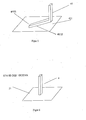
- FIG. 5 A preferred embodiment of the arrangement of the conductive fin 411 - after its positioning - on the conductive film 421 is in FIG. 5 shown.
- the lamella or spring 411 has a body, for example in the form of a cylinder or a leaf-shaped parallelepiped, with an end face 4111 and a contact surface 4112.
- the contact face 4112 rests on its corresponding positioning on the conductive film 421 and forms one with it galvanic contact.
- the surface of the contact surface 4112 is larger than the surface of the end surface 4111. Accordingly, the blade 411 and the film 421 form a galvanic contact with a correspondingly large contact area.
- FIG. 6 which shows the state of the art according to the aforementioned Spanish patent application P200901964, a lamella 4 with a film 31 forms a galvanic contact with a comparatively small contact surface.
- the conductive blade (spring) 411 is formed elastically or consists of a conductive elastic material, in particular copper or a copper alloy.
- the first connecting element 41 has a third connecting element 43, into which the inner conductor 61 of a coaxial cable 6 is introduced via a through-opening 511 of the insulating block 5.
- the third connection element 43 has a mechanism which, as a consequence of an activation, the is carried out by the introduction of the inner conductor 61 of the coaxial cable 6, this inner conductor 61 connects to the third connecting element 43 and the inner conductor 61 attached to the connecting element 43.
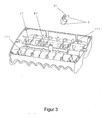
- FIG. 3 shows a different view of the housing according to the invention for electronic devices. How out FIG. 3 can be seen, the top 11 of the chassis 1 of the housing according to the invention recesses or receiving spaces 111, in the insulating sheaths 5 (blocks 5) are introduced and stored there, each containing a first connecting element 41.
- These recesses / receiving spaces 111 are configured in such a way that the passage opening 511 exactly corresponds to the position of the passage opening 21 of the corresponding connection plug 2, so that the inner conductor 61 of the coaxial cable 6 extends through both openings up to the third connection element 43.
- FIG. 4 shows one in the housing or in the openings 21 and 511 (FIG. FIG. 2 In this case, a galvanic connection between the inner conductor 61 of the coaxial cable 6 and the third connecting element 43 of the first connecting element 41 (FIG. FIG. 2 ) produced.
- the housing has hinges (joints) 7, which introduce and secure the outer conductor 62 of the respective coaxial cable 6 in the corresponding connector 2 of the upper side 11 of the chassis of the housing according to the invention.
Landscapes
- Coupling Device And Connection With Printed Circuit (AREA)
- Cooling Or The Like Of Electrical Apparatus (AREA)
- Casings For Electric Apparatus (AREA)
- Telephone Set Structure (AREA)
Abstract
Description
- Die Erfindung betrifft ein Gehäuse für eine Telekommunikationsvorrichtung nach dem Oberbegriff des Anspruchs 1.
- Auf dem Markt befindet sich zur Zeit eine große Vielfalt von Gehäusen für elektronische Geräte mit Systemen und Vorrichtungen zur Verbindung mit einer Schaltungsplatine für gedruckte Schaltungen. Die bekannten Systeme und Vorrichtungen weisen Lötverbindungen als Basiselement auf. Dies ist mit der Problematik verbunden, dass der industrielle Prozess kompliziert gestaltet ist und dass Probleme im Zusammenhang mit dem Löten (Bruch von Lötstellen, Kaltlötungen, etc). auftreten.
- Die spanischen Patentanmeldungen Nr.
P200901160 P200901964 - Die erstgenannte spanische Patentanmeldung
P200901160 - ein erstes Verbindungselement, das aus einem ersten leitenden Film besteht, wobei sich der erste Film auf einer Seite der Platine befindet, während sich ein zweiter Film auf einer anderen Seite der Platine befindet, und
- ein zweites Verbindungselement, das aus einer ersten Lamelle und einer zweiten Lamelle besteht, wobei die beiden Lamellen mittels Druck einen galvanischen Kontakt mit dem ersten und/oder mit dem zweiten leitenden Film herstellen.
- Die offenbarte Lösung erfordert zwei Lamellen, die den galvanischen Kontakt herstellen.
- Die zweitgenannte spanische Patentanmeldung
P200901964 - Die bei dieser Lösung vorgesehene Lamelle, die den galvanischen Kontakt herstellt und dabei Druck auf das erste Verbindungselement ausübt, ist rechtwinklig zu diesem angeordnet; die Kontaktoberfläche ist klein und die Wahrscheinlichkeit für den Ausfall der Verbindung ist bei unsachgemäßer Handhabung des entsprechenden Produkts vergleichsweise groß.
- Der vorliegenden Erfindung liegt die Aufgabe zugrunde, ein Gehäuse für eine Telekommunikationsvorrichtung der eingangs genannten Art zu schaffen, das ein Verbindungssystem für eine Platine mit einer gedruckten Schaltung aufweist, das ohne Lötungen auskommt und eine vergleichsweise einfachere und sichere Verbindung herstellt.
- Diese Aufgabe wird durch ein Gehäuse gelöst, das in den Ansprüchen definiert ist.
- Die Erfindung zeichnet sich durch eine Vielzahl von Vorteilen aus.
- Eine vorteilhafte Ausführungsform des erfindungsgemäßen Gehäuses besteht aus einem Chassis mit mindestens einem Verbindungsstecker, einer elektronischen Schaltung mit elektronischen Komponenten, welche auf einer Schaltungsplatine mit einer gedruckten Schaltungsstruktur angeordnet ist, und einem Verbindungssystem, wobei das Verbindungssystem aus einem ersten Verbindungselement und aus einem zweiten Verbindungselement besteht, wobei das erste Verbindungselement aus einer leitenden Lamelle besteht, wobei das zweite Verbindungselement aus einem leitenden Film besteht, der auf der Schaltungsplatine mit der gedruckten Schaltungsstruktur angeordnet ist, und wobei das erste Verbindungselement einen galvanischen Kontakt mittels Druck auf das zweite Verbindungselement herstellt.
Diese Ausführungsform des erfindungsgemäßen Gehäuses ist dadurch gekennzeichnet, dass die leitende Lamelle, die das erste Verbindungselement bildet, einen Körper mit einer Stirnseite und einer Kontaktfläche aufweist, und dass die leitende Lamelle mit ihrer Kontaktfläche auf dem leitenden Film angeordnet ist, der auf der Schaltungsplatine mit der gedruckten Schaltungsstruktur angeordnet ist und der das zweite Verbindungselement bildet. - Dies ist mit dem Vorteil verbunden, dass die Kontaktoberfläche zwischen der leitenden Lamelle des ersten Verbindungselements und dem leitenden Film des zweiten Verbindungselements vergrößert wird und so ein besserer galvanischer Kontakt sichergestellt wird.
- Eine weitere vorteilhafte Ausführungsform des erfindungsgemäßen Gehäuses ist dadurch gekennzeichnet, dass die leitende Lamelle (Feder) elastisch ausgebildet ist bzw. aus elastischem Material, zum Beispiel aus Kupfer oder einer Kupferlegierung besteht. Dies ist mit dem Vorteil verbunden, dass ein größerer Druck der leitenden Lamelle des ersten Verbindungselements auf den leitenden Film des zweiten Verbindungselements erzielt wird und so ein besserer galvanischer Kontakt hergestellt wird.
- Eine weitere vorteilhafte Ausführungsform des erfindungsgemäßen Gehäuses ist dadurch gekennzeichnet, dass die Schaltungsplatine eine erste Seite besitzt, auf der die gedruckte Schaltungsstruktur angeordnet ist, und eine zweite Seite, auf der der leitende Film, der das zweite Verbindungselement bildet.
Damit wird der Vorteil erzielt, dass eine größere Fläche für den leitenden Film des zweiten Verbindungselements vorgesehen werden kann und so die Kontaktfläche zwischen dem ersten Verbindungselement und dem zweiten Verbindungselement vergrößert werden kann. Dies schließt nicht aus, dass elektronische Komponenten einschließlich Leiterbahnen sowohl auf der ersten Seite wie auch auf der zweiten Seite der Schaltungsplatine.angeordnet werden können. - Eine weitere vorteilhafte Ausführungsform des erfindungsgemäßen Gehäuses ist dadurch gekennzeichnet, dass das erste Verbindungselement in einer Hülle aus isolierendem Material angeordnet ist.
Damit wird der Vorteil erzielt, dass eine Isolierung zwischen dem ersten Verbindungselement und weiteren Elementen des Gehäuses geschaffen wird und so mögliche Kurzschlüsse vermieden werden. Außerdem hält die Hülle aus isolierendem Material das erste Verbindungselement sauber und sichert eine größere Sicherheit bzw. Nachhaltigkeit der Verbindung. - Eine weitere vorteilhafte Ausführungsform des erfindungsgemäßen Gehäuses ist dadurch gekennzeichnet, dass das erste Verbindungselement ein drittes Verbindungselement für einen Innleiter eines Koaxialkabels aufweist.
- Diese Ausführungsform zeichnet sich durch den Vorteil aus, dass die Möglichkeit geschaffen wird, externe Vorrichtungen mit dem erfindungsgemäßen Gehäuse zu verbinden.
- Eine weitere vorteilhafte Ausführungsform des erfindungsgemäßen Gehäuses ist dadurch gekennzeichnet, dass das dritte Verbindungselement einen Mechanismus aufweist, der mit der Einführung des Innenleiters des Koaxialkabels in das dritte Verbindungselement den Innenleiter fest mit dem dritten Verbindungselement verbindet.
Damit wird der Vorteil erzielt, dass die Verbindung von Koaxialkabel und Verbindungssystem in einfacher Weise hergestellt oder auch gelöst werden kann. - Eine weitere vorteilhafte Ausführungsform des erfindungsgemäßen Gehäuses ist dadurch gekennzeichnet, dass der Mechanismus in der Weise ausgestaltet ist, der mit der Einführung des Innenleiters des Koaxialkabels, das einen Maschendraht bzw. Außenleiter aufweist, in das dritte Verbindungselement eine galvanische Verbindung des Maschendrahts des Koaxialkabels mit dem Chassis herstellt.
Dies zeichnet sich durch den Vorteil einer einfachen Realisierung des Verbindungssystems aus und verleiht zugleich eine hohe Sicherheit. - Eine weitere vorteilhafte Ausführungsform des erfindungsgemäßen Gehäuses ist dadurch gekennzeichnet, dass das Gehäuse Scharniere aufweist, die den Maschendraht des Koaxialkabels in dem einen Verbindungsstecker verbinden.
- Zum besseren Verständnis der Erfindung wird nun beispielhaft, also nicht einschränkend, ein erfindungsgemäßes Gehäuse anhand der Zeichnung beschrieben.
- Es zeigt
- Figur 1
- ein erfindungsgemäßes Gehäuse,
- Figur 2
- Verbindungselemente eines Verbindungssystems für eine Schaltungsplatine in einem Gehäuse nach
Figur 1 , - Figur 3
- erste Komponenten des Gehäuses nach
Figur 1 , - Figur 4
- zweite Komponenten des Gehäuses nach
Figur 2 , - Figur 5
- den im erfindungsgemäßen Gehäuse gebildeten galvanischen Kontakt zwischen einer Lamelle und einem leitenden Film; und
- Figur 6
- einen im Stand der Technik gebildeten Kontakt zwischen einer Lamelle und einem leitenden Film.
- Wie aus
Figur 1 zu ersehen ist, weist die in der Figur dargestellte Ausführungsform des erfindungsgemäßen Gehäuses ein Chassis 1 auf, das aus einer Oberseite 11 und aus einer Unterseite 12 besteht. Ein Verbindungsstecker 2 bzw. eine Mehrzahl von Verbindungssteckern 2 ist üblicherweise an der Oberseite 11 angeordnet, hierauf ist die Erfindung jedoch nicht eingeschränkt. - Weiterhin weist die Anordnung eine - in
Figur 1 lediglich schematisch dargestellte - elektronische Schaltung 3 mit Schaltungskomponenten 31 auf, die auf einer Schaltungsplatine 32 angeordnet sind. - Schließlich weist die in
Figur 1 dargestellte Anordnung ein Verbindungssystem 4 auf; dieses besteht aus einem ersten Verbindungselement 41 und aus einem zweiten Verbindungselement 42. Das erste Verbindungselement 41 besteht aus einer leitenden Lamelle (Feder) 411 sowie aus einem dritten Verbindungselement 43. Das zweite Verbindungselement 42 besteht aus einem leitenden Film 421, der auf der Schaltungsplatine 32 angeordnet ist. - Die Schaltungsplatine 32 besitzt eine erste Seite, auf der eine gedruckte Schaltungsstruktur angeordnet ist, und eine zweite Seite, auf der der leitende Film 421 angeordnet ist, der das zweite Verbindungselement 42 bildet. Elektronische Komponenten sowie Leiterbahnen können sowohl auf der ersten Seite wie auch auf der zweiten Seite der Schaltungsplatine angeordnet sein..
- Wie in
Figur 1 weiterhin dargestellt ist das erste Verbindungselement 41 innerhalb eines isolierenden Elements (Block) 5 angeordnet, das im Wesentlichen aus zwei Teilen, einem vorderen Teil 51 und einem rückwärtigen Teil 52 besteht. Beide Teile 51, 52 werden miteinander verbunden und bilden im verbundenen Zustand ein Element 53, insbesondere einen kleinen Kanal 53, durch den die leitende Lamelle 411 des ersten Verbindungselements 41 verläuft. Das vordere Teil 51 des isolierenden Blocks 5 hat an seiner Stirnseite eine Durchgangsöffnung 511. -
Figur 2 zeigt die Verbindungselemente des Verbindungssystems für eine Schaltungsplatine (mit einer gedruckten Schaltungsstruktur) eines Gehäuses gemäß der Erfindung. Wie ausFigur 2 zu ersehen ist, stellt die leitende Lamelle (Feder) 411 des ersten Verbindungselements 41 einen galvanischen Kontakt mittels Druck auf den leitenden Film 421 her, der auf der Schaltungsplatine 32 aufgebracht ist und der das zweite Verbindungselement 42 darstellt. - Dieser Druck wird als Ergebnis des Drucks erzeugt, den die Oberseite 11 des Chassis 1 des erfindungsgemäßen Gehäuses auf den isolierenden Block 5 (siehe
Figur 1 ) ausübt, wo das erste Verbindungselement 41 angeordnet ist, und des Drucks, den die Unterseite 12 des Chassis 1 auf die Schaltungsplatine 32 ausübt, wo das zweite Verbindungselement 42 angeordnet ist. - Wie in
Figur 2 dargestellt, ist die leitende Lamelle (Feder) 411, die das erste Verbindungselement 41 bildet, - vor ihrer Positionierung auf dem leitenden Film 421 - schräg (abgeschrägt, abgewinkelt) bezüglich dieses leitenden Films 421 angeordnet, der auf der Schaltungsplatine 32 angeordnet ist und der das zweite Verbindungselement 42 bildet. - Eine bevorzugte Ausführungsform der Anordnung der leitenden Lamelle 411 - nach ihrer Positionierung - auf dem leitenden Film 421 ist in
Figur 5 dargestellt. - Die Lamelle oder Feder 411 hat einen Körper, zum Beispiel in Form eines Zylinders oder eines - blattförmigen - Quaders, mit einer Stirnfläche 4111 und einer Kontaktfläche 4112. Die Kontaktfläche 4112 liegt nach ihrer entsprechenden Positionierung auf dem leitenden Film 421 auf und bildet mit diesem einen galvanischen Kontakt.
Die Oberfläche der Kontaktfläche 4112 ist größer als die Oberfläche der Stirnseite 4111. Dementsprechend bilden die Lamelle 411 und der Film 421 einen galvanischen Kontakt mit einer entsprechend großen Kontaktfläche. - In
Figur 6 , die den Stand der Technik entsprechend der eingangs genannten spanischen Patentanmeldung P200901964 zeigt, bildet eine Lamelle 4 mit einem Film 31 einen galvanischen Kontakt mit einer vergleichsweise kleinen Kontaktfläche. - Die leitende Lamelle (Feder) 411 ist elastisch ausgebildet bzw. besteht aus einem leitenden elastischen Material, insbesondere aus Kupfer oder einer Kupferlegierung.
- Wie weiterhin in
Figur 2 dargestellt weist das erste Verbindungselement 41 ein drittes Verbindungselement 43 auf, in welches über eine Durchgangsöffnung 511 des Isolierblocks 5 der Innenleiter 61 eines Koaxialkabels 6 eingeführt wird. Das dritte Verbindungselement 43 weist einen Mechanismus auf, der als Folge einer Aktivierung, die durch die Einführung des Innenleiters 61 des Koaxialkabels 6 erfolgt, diesen Innenleiter 61 mit dem dritten Verbindungselement 43 verbindet bzw. den Innenleiter 61 an dem Verbindungselement 43 befestigt. -
Figur 3 zeigt eine andere Ansicht des erfindungsgemäßen Gehäuses für elektronische Geräte. Wie ausFigur 3 zu ersehen ist, weist die Oberseite 11 des Chassis 1 des erfindungsgemäßen Gehäuses Aussparungen bzw. Aufnahmeräume 111 auf, in die isolierende Hüllen 5 (Blöcke 5) eingeführt und dort gelagert werden, die jeweils ein erstes Verbindungselement 41 enthalten. - Diese Aussparungen/Aufnahmeräume 111 sind in der Weise ausgestaltet, dass die Durchgangsöffnung 511 exakt der Position der Durchgangsöffnung 21 des korrespondierenden Verbindungssteckers 2 entspricht, so dass durch beide Öffnungen der Innenleiter 61 des Koaxialkabels 6 bis zum dritten Verbindungselement 43 verläuft.
-
Figur 4 zeigt einen in das Gehäuse bzw. in die Öffnungen 21 und 511 (Figur 2 ) eingeführten Innenleiter 61 des Koaxialkabels 6. Dabei wird eine galvanische Verbindung zwischen dem Innenleiter 61 des Koaxialkabels 6 und dem dritten Verbindungselement 43 des ersten Verbindungselements 41 (Figur 2 ) hergestellt. - Mit Hilfe eines Mechanismus wird ausgelöst durch die Einführung des Innenleiters 61 des Koaxialkabels 6, das einen Maschendraht (Außenleiter) 62 aufweist, ein galvanischer Kontakt des Maschendrahts 62 des Koaxialkabels 6 und des Chassis 1 des erfindungsgemäßen Gehäuses hergestellt.
- Um diesen Kontakt bzw. diese Verbindung sicher zu stellen, weist das Gehäuse Scharniere (Gelenke) 7 auf, die den Außenleiter 62 des jeweiligen Koaxialkabels 6 in den korrespondierenden Verbindungsstecker 2 der Oberseite 11 des Chassis des erfindungsgemäßen Gehäuses einführen und befestigen.
-
- 1
- Chassis
- 11
- Oberseite des Chassis
- 111
- Aussparungen, Aufnahmeräume für 5
- 12
- Unterseite des Chassis
- 2
- Verbindungsstecker
- 21
- Durchgangsöffnungen
- 3
- Elektronische Schaltung
- 31
- Elektronische Komponenten
- 32
- Schaltungsplatine
- 41
- Erstes Verbindungselement
- 411
- Leitende Lamelle (Feder)
- 4111
- Stirnseite der leitenden Lamelle
- 4112
- Kontaktfläche der leitenden Lamelle
- 42
- Zweites Verbindungselement
- 421
- Leitender Film
- 43
- Drittes Verbindungselement
- 5
- Isolierende Hülle (Block)
- 51
- Vordere Hälfte
- 511
- Durchgangsöffnung
- 52
- Hintere Hälfte
- 53
- Kleiner Kanal
- 6
- Koaxialkabel
- 61
- Innenleiter des Koaxialkabels 6
- 62
- Außenleiter (Maschendraht) des Koaxialkabels 6
- 7
- Scharnier
Claims (8)
- Gehäuse für eine Telekommunikationsvorrichtung, bestehend aus einem Chassis (1) mit- mindestens einem Verbindungsstecker (2),- einer elektronischen Schaltung mit elektronischen Komponenten (31), welche auf einer Schaltungsplatine (32) mit einer gedruckten Schaltungsstruktur angeordnet ist, und- einem Verbindungssystem (4), wobei das Verbindungssystem aus einem ersten Verbindungselement (41) und einem zweiten Verbindungselement (42) besteht,- wobei das erste Verbindungselement (41) aus einer leitenden Lamelle (411) besteht,- wobei das zweite Verbindungselement (42) aus einem leitenden Film (421) besteht, der auf der Schaltungsplatine mit der gedruckten Schaltungsstruktur angeordnet ist, und- wobei das erste Verbindungselement (41) einen galvanischen Kontakt mittels Druck auf das zweite Verbindungselement (42) herstellt,
dadurch gekennzeichnet, dass
die leitende Lamelle (411), die das erste Verbindungselement (41) bildet, einen Körper mit einer Stirnseite (4111) und einer Kontaktfläche (4112) aufweist, und dass die leitende Lamelle (411) mit ihrer Kontaktfläche (4112) auf dem leitenden Film (421) angeordnet ist, der auf der Schaltungsplatine mit der gedruckten Schaltungsstruktur (32) angeordnet ist und der das zweite Verbindungselement (42) bildet. - Gehäuse nach Anspruch 1, dadurch gekennzeichnet, dass die leitende Lamelle (411) elastisch ausgebildet ist und aus elastischem Material, insbesondere aus Kupfer oder einer Kupferlegierung besteht.
- Gehäuse nach einem der vorstehenden Ansprüche, dadurch gekennzeichnet, dass die Schaltungsplatine (32) eine erste Seite besitzt, auf der die gedruckte Schaltungsstruktur angeordnet ist, und eine zweite Seite, auf der der leitende Film (421) angeordnet ist, der das zweite Verbindungselement (42) bildet.
- Gehäuse nach einem der vorstehenden Ansprüche, dadurch gekennzeichnet, dass das erste Verbindungselement (41) in einer Hülle (5) aus isolierenden Material angeordnet ist.
- Gehäuse nach einem der vorstehenden Ansprüche, dadurch gekennzeichnet, dass das erste Verbindungselement (41) ein drittes Verbindungselement (43) für einen Innenleiter (61) eines Koaxialkabels (6) aufweist.
- Gehäuse nach Anspruch 5, dadurch gekennzeichnet, dass das dritte Verbindungselement (43) einen Mechanismus aufweist, der ausgelöst durch eine Aktivierung, die durch die Einführung des Innenleiters (61) des Koaxialkabels (6) gebildet wird, den Innenleiter (61) fest mit dem dritten Verbindungselement (43) verbindet.
- Gehäuse nach Anspruch 6, dadurch gekennzeichnet, dass der Mechanismus in der Weise ausgestaltet ist, dass ausgelöst durch die Aktivierung, die durch die Einführung des Innenleiters (61) des Koaxialkabels (6) gebildet wird, das einen Maschendraht (62) aufweist, eine galvanische Verbindung des Maschendrahts (62) des Koaxialkabels (6) mit dem Chassis (1) herstellt.
- Gehäuse nach Anspruch 7, dadurch gekennzeichnet, dass das Gehäuse Scharniere (7) aufweist, die den Maschendraht (62) des Koaxialkabels (6) in dem einen Verbindungsstecker (2) verbinden.
Applications Claiming Priority (2)
| Application Number | Priority Date | Filing Date | Title |
|---|---|---|---|
| ES201100992U ES1077193Y (es) | 2011-10-10 | 2011-10-10 | Cofre para equipos electronicos con sistema de conexionado para placa de circuito impreso. |
| ES201101105A ES2413164R1 (es) | 2011-10-10 | 2011-10-10 | Cofre para equipos electronicos con sistema de conexionado para placa de circuito impreso |
Publications (3)
| Publication Number | Publication Date |
|---|---|
| EP2581990A2 true EP2581990A2 (de) | 2013-04-17 |
| EP2581990A3 EP2581990A3 (de) | 2014-10-08 |
| EP2581990B1 EP2581990B1 (de) | 2018-12-26 |
Family
ID=47262951
Family Applications (1)
| Application Number | Title | Priority Date | Filing Date |
|---|---|---|---|
| EP12006957.0A Active EP2581990B1 (de) | 2011-10-10 | 2012-10-08 | Gehäuse für eine Telekommunikationsvorrichtung |
Country Status (1)
| Country | Link |
|---|---|
| EP (1) | EP2581990B1 (de) |
Family Cites Families (7)
| Publication number | Priority date | Publication date | Assignee | Title |
|---|---|---|---|---|
| JPH0665102B2 (ja) * | 1988-09-30 | 1994-08-22 | トーマス アンド ベツツ コーポレーシヨン | コネクタ |
| US4993956A (en) * | 1989-11-01 | 1991-02-19 | Amp Incorporated | Active electrical connector |
| JPH078961U (ja) * | 1993-07-14 | 1995-02-07 | 日本エー・エム・ピー株式会社 | 同軸ケーブル用コネクタ |
| US5709557A (en) * | 1994-12-12 | 1998-01-20 | The Whitaker Corporation | Electrical connector for dual printed circuit boards |
| ES1049159Y (es) * | 2001-02-23 | 2002-03-16 | Televes Sa | Cofre para equipos de telecomunicacion |
| ES2323610B2 (es) * | 2006-10-20 | 2010-09-10 | Televes, S.A. | Conector para cable coaxial. |
| DE102007043197B4 (de) * | 2007-09-11 | 2015-03-26 | Mc Technology Gmbh | Anschlussklemme |
-
2012
- 2012-10-08 EP EP12006957.0A patent/EP2581990B1/de active Active
Also Published As
| Publication number | Publication date |
|---|---|
| EP2581990A3 (de) | 2014-10-08 |
| EP2581990B1 (de) | 2018-12-26 |
Similar Documents
| Publication | Publication Date | Title |
|---|---|---|
| EP1816706B1 (de) | Elektrische Anschlußklemme | |
| DE102013110082C5 (de) | Steckverbinder | |
| DE102013108383B4 (de) | Steckverbindermodul | |
| EP3342005B1 (de) | Elektrische reihenklemme | |
| EP3375048B1 (de) | Steckkontakt | |
| DE102014108965A1 (de) | Einzelelement-Verbinder Draht zu Platte | |
| EP3698438B1 (de) | Vorrichtung zur elektrischen kontaktierung | |
| DE202005002902U1 (de) | Elektrischer Steckverbinder | |
| EP1353417B1 (de) | Anschlussvorrichtung zum Anschluss von Daten-und Versorgunsleitung an ein elektrisches Gerät | |
| EP0865105B1 (de) | Steckbuchse bzw. elektrischer Steckverbinder mit Kontaktfeder und Steckbuchse als Anschlusskontakt | |
| DE2405464A1 (de) | Vielfachsteckverbinder zur herstellung mehrerer elektrischer verbindungen | |
| DE102018104843A1 (de) | Erdungsanschlusselement zur Abschirmung von in Kunststoffgehäusen angeordneten elektrischen Komponenten sowie Verfahren zu seinem Einbau | |
| DE20203910U1 (de) | Anschlussmodul der Telekommunikationstechnik | |
| EP1175712B1 (de) | Leiterplatten-steckverbinder | |
| WO2015135709A1 (de) | Überspannungsschutzeinrichtung mit mindestens einem überspannungsschutzgerät | |
| EP0578118A1 (de) | Steckkontaktelement | |
| EP3443618B1 (de) | Steckverbinder mit leitgummi | |
| EP2581990B1 (de) | Gehäuse für eine Telekommunikationsvorrichtung | |
| EP3700018B1 (de) | Leiterplattendirektkontaktierungsvorrichtung zum herstellen eines elektrischen kontakts sowie leiterplatte und elektrisches gerät | |
| EP2309605B1 (de) | Steckdose für Telekommunikationsnetze | |
| EP1939987B1 (de) | Kontaktvorrichtung | |
| DE102006020045B4 (de) | Zwischenstecker und Verfahren zur Herstellung eines Zwischensteckers | |
| DE102019122317A1 (de) | Leiterplattendirektkontaktierungsvorrichtung zum Herstellen eines elektrischen Kontakts sowie Leiterplatte und elektrisches Gerät | |
| WO2020192836A1 (de) | Steckverbinder | |
| DE10033841B4 (de) | Abzweigvorrichtung |
Legal Events
| Date | Code | Title | Description |
|---|---|---|---|
| PUAI | Public reference made under article 153(3) epc to a published international application that has entered the european phase |
Free format text: ORIGINAL CODE: 0009012 |
|
| AK | Designated contracting states |
Kind code of ref document: A2 Designated state(s): AL AT BE BG CH CY CZ DE DK EE ES FI FR GB GR HR HU IE IS IT LI LT LU LV MC MK MT NL NO PL PT RO RS SE SI SK SM TR |
|
| AX | Request for extension of the european patent |
Extension state: BA ME |
|
| PUAL | Search report despatched |
Free format text: ORIGINAL CODE: 0009013 |
|
| AK | Designated contracting states |
Kind code of ref document: A3 Designated state(s): AL AT BE BG CH CY CZ DE DK EE ES FI FR GB GR HR HU IE IS IT LI LT LU LV MC MK MT NL NO PL PT RO RS SE SI SK SM TR |
|
| AX | Request for extension of the european patent |
Extension state: BA ME |
|
| RIC1 | Information provided on ipc code assigned before grant |
Ipc: H01R 24/40 20110101ALN20140904BHEP Ipc: H01R 13/58 20060101ALN20140904BHEP Ipc: H01R 12/75 20110101ALN20140904BHEP Ipc: H01R 9/05 20060101ALN20140904BHEP Ipc: H01R 9/24 20060101ALI20140904BHEP Ipc: H01R 13/66 20060101ALI20140904BHEP Ipc: H01R 13/502 20060101ALI20140904BHEP Ipc: H01R 13/24 20060101AFI20140904BHEP Ipc: H01R 12/71 20110101ALI20140904BHEP |
|
| 17P | Request for examination filed |
Effective date: 20150408 |
|
| RBV | Designated contracting states (corrected) |
Designated state(s): AL AT BE BG CH CY CZ DE DK EE ES FI FR GB GR HR HU IE IS IT LI LT LU LV MC MK MT NL NO PL PT RO RS SE SI SK SM TR |
|
| STAA | Information on the status of an ep patent application or granted ep patent |
Free format text: STATUS: EXAMINATION IS IN PROGRESS |
|
| 17Q | First examination report despatched |
Effective date: 20170627 |
|
| GRAP | Despatch of communication of intention to grant a patent |
Free format text: ORIGINAL CODE: EPIDOSNIGR1 |
|
| STAA | Information on the status of an ep patent application or granted ep patent |
Free format text: STATUS: GRANT OF PATENT IS INTENDED |
|
| RIC1 | Information provided on ipc code assigned before grant |
Ipc: H01R 12/75 20110101ALN20180613BHEP Ipc: H01R 13/66 20060101ALI20180613BHEP Ipc: H01R 13/24 20060101AFI20180613BHEP Ipc: H01R 9/24 20060101ALI20180613BHEP Ipc: H01R 9/05 20060101ALN20180613BHEP Ipc: H01R 13/58 20060101ALN20180613BHEP Ipc: H01R 13/502 20060101ALI20180613BHEP Ipc: H01R 12/71 20110101ALI20180613BHEP Ipc: H01R 24/40 20110101ALN20180613BHEP |
|
| RIC1 | Information provided on ipc code assigned before grant |
Ipc: H01R 12/75 20110101ALN20180628BHEP Ipc: H01R 13/66 20060101ALI20180628BHEP Ipc: H01R 9/05 20060101ALN20180628BHEP Ipc: H01R 13/24 20060101AFI20180628BHEP Ipc: H01R 24/40 20110101ALN20180628BHEP Ipc: H01R 13/502 20060101ALI20180628BHEP Ipc: H01R 12/71 20110101ALI20180628BHEP Ipc: H01R 9/24 20060101ALI20180628BHEP Ipc: H01R 13/58 20060101ALN20180628BHEP |
|
| INTG | Intention to grant announced |
Effective date: 20180712 |
|
| GRAS | Grant fee paid |
Free format text: ORIGINAL CODE: EPIDOSNIGR3 |
|
| GRAA | (expected) grant |
Free format text: ORIGINAL CODE: 0009210 |
|
| STAA | Information on the status of an ep patent application or granted ep patent |
Free format text: STATUS: THE PATENT HAS BEEN GRANTED |
|
| AK | Designated contracting states |
Kind code of ref document: B1 Designated state(s): AL AT BE BG CH CY CZ DE DK EE ES FI FR GB GR HR HU IE IS IT LI LT LU LV MC MK MT NL NO PL PT RO RS SE SI SK SM TR |
|
| REG | Reference to a national code |
Ref country code: GB Ref legal event code: FG4D Free format text: NOT ENGLISH |
|
| REG | Reference to a national code |
Ref country code: CH Ref legal event code: EP |
|
| REG | Reference to a national code |
Ref country code: AT Ref legal event code: REF Ref document number: 1082721 Country of ref document: AT Kind code of ref document: T Effective date: 20190115 |
|
| REG | Reference to a national code |
Ref country code: DE Ref legal event code: R096 Ref document number: 502012014032 Country of ref document: DE |
|
| REG | Reference to a national code |
Ref country code: IE Ref legal event code: FG4D Free format text: LANGUAGE OF EP DOCUMENT: GERMAN |
|
| PG25 | Lapsed in a contracting state [announced via postgrant information from national office to epo] |
Ref country code: BG Free format text: LAPSE BECAUSE OF FAILURE TO SUBMIT A TRANSLATION OF THE DESCRIPTION OR TO PAY THE FEE WITHIN THE PRESCRIBED TIME-LIMIT Effective date: 20190326 Ref country code: HR Free format text: LAPSE BECAUSE OF FAILURE TO SUBMIT A TRANSLATION OF THE DESCRIPTION OR TO PAY THE FEE WITHIN THE PRESCRIBED TIME-LIMIT Effective date: 20181226 Ref country code: NO Free format text: LAPSE BECAUSE OF FAILURE TO SUBMIT A TRANSLATION OF THE DESCRIPTION OR TO PAY THE FEE WITHIN THE PRESCRIBED TIME-LIMIT Effective date: 20190326 Ref country code: LV Free format text: LAPSE BECAUSE OF FAILURE TO SUBMIT A TRANSLATION OF THE DESCRIPTION OR TO PAY THE FEE WITHIN THE PRESCRIBED TIME-LIMIT Effective date: 20181226 Ref country code: FI Free format text: LAPSE BECAUSE OF FAILURE TO SUBMIT A TRANSLATION OF THE DESCRIPTION OR TO PAY THE FEE WITHIN THE PRESCRIBED TIME-LIMIT Effective date: 20181226 Ref country code: LT Free format text: LAPSE BECAUSE OF FAILURE TO SUBMIT A TRANSLATION OF THE DESCRIPTION OR TO PAY THE FEE WITHIN THE PRESCRIBED TIME-LIMIT Effective date: 20181226 |
|
| REG | Reference to a national code |
Ref country code: NL Ref legal event code: MP Effective date: 20181226 |
|
| REG | Reference to a national code |
Ref country code: LT Ref legal event code: MG4D |
|
| PG25 | Lapsed in a contracting state [announced via postgrant information from national office to epo] |
Ref country code: SE Free format text: LAPSE BECAUSE OF FAILURE TO SUBMIT A TRANSLATION OF THE DESCRIPTION OR TO PAY THE FEE WITHIN THE PRESCRIBED TIME-LIMIT Effective date: 20181226 Ref country code: GR Free format text: LAPSE BECAUSE OF FAILURE TO SUBMIT A TRANSLATION OF THE DESCRIPTION OR TO PAY THE FEE WITHIN THE PRESCRIBED TIME-LIMIT Effective date: 20190327 Ref country code: AL Free format text: LAPSE BECAUSE OF FAILURE TO SUBMIT A TRANSLATION OF THE DESCRIPTION OR TO PAY THE FEE WITHIN THE PRESCRIBED TIME-LIMIT Effective date: 20181226 Ref country code: RS Free format text: LAPSE BECAUSE OF FAILURE TO SUBMIT A TRANSLATION OF THE DESCRIPTION OR TO PAY THE FEE WITHIN THE PRESCRIBED TIME-LIMIT Effective date: 20181226 |
|
| PG25 | Lapsed in a contracting state [announced via postgrant information from national office to epo] |
Ref country code: NL Free format text: LAPSE BECAUSE OF FAILURE TO SUBMIT A TRANSLATION OF THE DESCRIPTION OR TO PAY THE FEE WITHIN THE PRESCRIBED TIME-LIMIT Effective date: 20181226 |
|
| PG25 | Lapsed in a contracting state [announced via postgrant information from national office to epo] |
Ref country code: CZ Free format text: LAPSE BECAUSE OF FAILURE TO SUBMIT A TRANSLATION OF THE DESCRIPTION OR TO PAY THE FEE WITHIN THE PRESCRIBED TIME-LIMIT Effective date: 20181226 Ref country code: PL Free format text: LAPSE BECAUSE OF FAILURE TO SUBMIT A TRANSLATION OF THE DESCRIPTION OR TO PAY THE FEE WITHIN THE PRESCRIBED TIME-LIMIT Effective date: 20181226 Ref country code: ES Free format text: LAPSE BECAUSE OF FAILURE TO SUBMIT A TRANSLATION OF THE DESCRIPTION OR TO PAY THE FEE WITHIN THE PRESCRIBED TIME-LIMIT Effective date: 20181226 Ref country code: PT Free format text: LAPSE BECAUSE OF FAILURE TO SUBMIT A TRANSLATION OF THE DESCRIPTION OR TO PAY THE FEE WITHIN THE PRESCRIBED TIME-LIMIT Effective date: 20190426 Ref country code: IT Free format text: LAPSE BECAUSE OF FAILURE TO SUBMIT A TRANSLATION OF THE DESCRIPTION OR TO PAY THE FEE WITHIN THE PRESCRIBED TIME-LIMIT Effective date: 20181226 |
|
| PG25 | Lapsed in a contracting state [announced via postgrant information from national office to epo] |
Ref country code: EE Free format text: LAPSE BECAUSE OF FAILURE TO SUBMIT A TRANSLATION OF THE DESCRIPTION OR TO PAY THE FEE WITHIN THE PRESCRIBED TIME-LIMIT Effective date: 20181226 Ref country code: SM Free format text: LAPSE BECAUSE OF FAILURE TO SUBMIT A TRANSLATION OF THE DESCRIPTION OR TO PAY THE FEE WITHIN THE PRESCRIBED TIME-LIMIT Effective date: 20181226 Ref country code: IS Free format text: LAPSE BECAUSE OF FAILURE TO SUBMIT A TRANSLATION OF THE DESCRIPTION OR TO PAY THE FEE WITHIN THE PRESCRIBED TIME-LIMIT Effective date: 20190426 Ref country code: RO Free format text: LAPSE BECAUSE OF FAILURE TO SUBMIT A TRANSLATION OF THE DESCRIPTION OR TO PAY THE FEE WITHIN THE PRESCRIBED TIME-LIMIT Effective date: 20181226 Ref country code: SK Free format text: LAPSE BECAUSE OF FAILURE TO SUBMIT A TRANSLATION OF THE DESCRIPTION OR TO PAY THE FEE WITHIN THE PRESCRIBED TIME-LIMIT Effective date: 20181226 |
|
| REG | Reference to a national code |
Ref country code: DE Ref legal event code: R097 Ref document number: 502012014032 Country of ref document: DE |
|
| PG25 | Lapsed in a contracting state [announced via postgrant information from national office to epo] |
Ref country code: DK Free format text: LAPSE BECAUSE OF FAILURE TO SUBMIT A TRANSLATION OF THE DESCRIPTION OR TO PAY THE FEE WITHIN THE PRESCRIBED TIME-LIMIT Effective date: 20181226 |
|
| PLBE | No opposition filed within time limit |
Free format text: ORIGINAL CODE: 0009261 |
|
| STAA | Information on the status of an ep patent application or granted ep patent |
Free format text: STATUS: NO OPPOSITION FILED WITHIN TIME LIMIT |
|
| REG | Reference to a national code |
Ref country code: ES Ref legal event code: NE2A Effective date: 20191122 |
|
| REG | Reference to a national code |
Ref country code: ES Ref legal event code: FG2A Ref document number: 2733465 Country of ref document: ES Kind code of ref document: T3 Effective date: 20191129 |
|
| 26N | No opposition filed |
Effective date: 20190927 |
|
| PG25 | Lapsed in a contracting state [announced via postgrant information from national office to epo] |
Ref country code: ES Free format text: LAPSE BECAUSE OF FAILURE TO SUBMIT A TRANSLATION OF THE DESCRIPTION OR TO PAY THE FEE WITHIN THE PRESCRIBED TIME-LIMIT Effective date: 20181226 Ref country code: SI Free format text: LAPSE BECAUSE OF FAILURE TO SUBMIT A TRANSLATION OF THE DESCRIPTION OR TO PAY THE FEE WITHIN THE PRESCRIBED TIME-LIMIT Effective date: 20181226 |
|
| PGRI | Patent reinstated in contracting state [announced from national office to epo] |
Ref country code: ES Effective date: 20191122 |
|
| PG25 | Lapsed in a contracting state [announced via postgrant information from national office to epo] |
Ref country code: TR Free format text: LAPSE BECAUSE OF FAILURE TO SUBMIT A TRANSLATION OF THE DESCRIPTION OR TO PAY THE FEE WITHIN THE PRESCRIBED TIME-LIMIT Effective date: 20181226 |
|
| PG25 | Lapsed in a contracting state [announced via postgrant information from national office to epo] |
Ref country code: MC Free format text: LAPSE BECAUSE OF FAILURE TO SUBMIT A TRANSLATION OF THE DESCRIPTION OR TO PAY THE FEE WITHIN THE PRESCRIBED TIME-LIMIT Effective date: 20181226 |
|
| REG | Reference to a national code |
Ref country code: CH Ref legal event code: PL |
|
| PG25 | Lapsed in a contracting state [announced via postgrant information from national office to epo] |
Ref country code: CH Free format text: LAPSE BECAUSE OF NON-PAYMENT OF DUE FEES Effective date: 20191031 Ref country code: LU Free format text: LAPSE BECAUSE OF NON-PAYMENT OF DUE FEES Effective date: 20191008 Ref country code: LI Free format text: LAPSE BECAUSE OF NON-PAYMENT OF DUE FEES Effective date: 20191031 |
|
| REG | Reference to a national code |
Ref country code: BE Ref legal event code: MM Effective date: 20191031 |
|
| PG25 | Lapsed in a contracting state [announced via postgrant information from national office to epo] |
Ref country code: BE Free format text: LAPSE BECAUSE OF NON-PAYMENT OF DUE FEES Effective date: 20191031 |
|
| PG25 | Lapsed in a contracting state [announced via postgrant information from national office to epo] |
Ref country code: IE Free format text: LAPSE BECAUSE OF NON-PAYMENT OF DUE FEES Effective date: 20191008 |
|
| REG | Reference to a national code |
Ref country code: AT Ref legal event code: MM01 Ref document number: 1082721 Country of ref document: AT Kind code of ref document: T Effective date: 20191008 |
|
| PG25 | Lapsed in a contracting state [announced via postgrant information from national office to epo] |
Ref country code: AT Free format text: LAPSE BECAUSE OF NON-PAYMENT OF DUE FEES Effective date: 20191008 |
|
| PG25 | Lapsed in a contracting state [announced via postgrant information from national office to epo] |
Ref country code: CY Free format text: LAPSE BECAUSE OF FAILURE TO SUBMIT A TRANSLATION OF THE DESCRIPTION OR TO PAY THE FEE WITHIN THE PRESCRIBED TIME-LIMIT Effective date: 20181226 |
|
| PG25 | Lapsed in a contracting state [announced via postgrant information from national office to epo] |
Ref country code: MT Free format text: LAPSE BECAUSE OF FAILURE TO SUBMIT A TRANSLATION OF THE DESCRIPTION OR TO PAY THE FEE WITHIN THE PRESCRIBED TIME-LIMIT Effective date: 20181226 Ref country code: HU Free format text: LAPSE BECAUSE OF FAILURE TO SUBMIT A TRANSLATION OF THE DESCRIPTION OR TO PAY THE FEE WITHIN THE PRESCRIBED TIME-LIMIT; INVALID AB INITIO Effective date: 20121008 |
|
| PG25 | Lapsed in a contracting state [announced via postgrant information from national office to epo] |
Ref country code: MK Free format text: LAPSE BECAUSE OF FAILURE TO SUBMIT A TRANSLATION OF THE DESCRIPTION OR TO PAY THE FEE WITHIN THE PRESCRIBED TIME-LIMIT Effective date: 20181226 |
|
| PGFP | Annual fee paid to national office [announced via postgrant information from national office to epo] |
Ref country code: GB Payment date: 20250918 Year of fee payment: 14 |
|
| PGFP | Annual fee paid to national office [announced via postgrant information from national office to epo] |
Ref country code: FR Payment date: 20250918 Year of fee payment: 14 |
|
| PGFP | Annual fee paid to national office [announced via postgrant information from national office to epo] |
Ref country code: DE Payment date: 20250919 Year of fee payment: 14 |
|
| PGFP | Annual fee paid to national office [announced via postgrant information from national office to epo] |
Ref country code: ES Payment date: 20251104 Year of fee payment: 14 |