EP2582088A2 - Vérification de certificats implicites et de signatures numériques - Google Patents
Vérification de certificats implicites et de signatures numériques Download PDFInfo
- Publication number
- EP2582088A2 EP2582088A2 EP12188382.1A EP12188382A EP2582088A2 EP 2582088 A2 EP2582088 A2 EP 2582088A2 EP 12188382 A EP12188382 A EP 12188382A EP 2582088 A2 EP2582088 A2 EP 2582088A2
- Authority
- EP
- European Patent Office
- Prior art keywords
- elliptic curve
- digital signature
- point
- curve point
- certificate
- Prior art date
- Legal status (The legal status is an assumption and is not a legal conclusion. Google has not performed a legal analysis and makes no representation as to the accuracy of the status listed.)
- Ceased
Links
- 238000000034 method Methods 0.000 claims abstract description 60
- 238000012795 verification Methods 0.000 claims abstract description 39
- 238000004891 communication Methods 0.000 claims description 28
- 238000012545 processing Methods 0.000 claims description 12
- 238000004590 computer program Methods 0.000 abstract description 20
- 230000008569 process Effects 0.000 description 29
- 230000006870 function Effects 0.000 description 12
- 238000004422 calculation algorithm Methods 0.000 description 7
- 238000007792 addition Methods 0.000 description 5
- 238000010586 diagram Methods 0.000 description 5
- 238000004364 calculation method Methods 0.000 description 3
- 230000004044 response Effects 0.000 description 3
- 238000013515 script Methods 0.000 description 3
- 241000272534 Struthio camelus Species 0.000 description 2
- 238000004883 computer application Methods 0.000 description 2
- 238000012790 confirmation Methods 0.000 description 2
- 230000003993 interaction Effects 0.000 description 2
- 238000000926 separation method Methods 0.000 description 2
- 230000005540 biological transmission Effects 0.000 description 1
- 230000001413 cellular effect Effects 0.000 description 1
- 238000013500 data storage Methods 0.000 description 1
- 238000009434 installation Methods 0.000 description 1
- 239000004973 liquid crystal related substance Substances 0.000 description 1
- 238000007726 management method Methods 0.000 description 1
- 238000007781 pre-processing Methods 0.000 description 1
- 230000009467 reduction Effects 0.000 description 1
- 239000004065 semiconductor Substances 0.000 description 1
- 230000001953 sensory effect Effects 0.000 description 1
- 230000011664 signaling Effects 0.000 description 1
- 239000000758 substrate Substances 0.000 description 1
- 238000012546 transfer Methods 0.000 description 1
- 230000000007 visual effect Effects 0.000 description 1
Images



Classifications
-
- H—ELECTRICITY
- H04—ELECTRIC COMMUNICATION TECHNIQUE
- H04L—TRANSMISSION OF DIGITAL INFORMATION, e.g. TELEGRAPHIC COMMUNICATION
- H04L9/00—Cryptographic mechanisms or cryptographic arrangements for secret or secure communications; Network security protocols
- H04L9/32—Cryptographic mechanisms or cryptographic arrangements for secret or secure communications; Network security protocols including means for verifying the identity or authority of a user of the system or for message authentication, e.g. authorization, entity authentication, data integrity or data verification, non-repudiation, key authentication or verification of credentials
- H04L9/3247—Cryptographic mechanisms or cryptographic arrangements for secret or secure communications; Network security protocols including means for verifying the identity or authority of a user of the system or for message authentication, e.g. authorization, entity authentication, data integrity or data verification, non-repudiation, key authentication or verification of credentials involving digital signatures
- H04L9/3252—Cryptographic mechanisms or cryptographic arrangements for secret or secure communications; Network security protocols including means for verifying the identity or authority of a user of the system or for message authentication, e.g. authorization, entity authentication, data integrity or data verification, non-repudiation, key authentication or verification of credentials involving digital signatures using DSA or related signature schemes, e.g. elliptic based signatures, ElGamal or Schnorr schemes
-
- H—ELECTRICITY
- H04—ELECTRIC COMMUNICATION TECHNIQUE
- H04L—TRANSMISSION OF DIGITAL INFORMATION, e.g. TELEGRAPHIC COMMUNICATION
- H04L9/00—Cryptographic mechanisms or cryptographic arrangements for secret or secure communications; Network security protocols
- H04L9/30—Public key, i.e. encryption algorithm being computationally infeasible to invert or user's encryption keys not requiring secrecy
- H04L9/3066—Public key, i.e. encryption algorithm being computationally infeasible to invert or user's encryption keys not requiring secrecy involving algebraic varieties, e.g. elliptic or hyper-elliptic curves
-
- H—ELECTRICITY
- H04—ELECTRIC COMMUNICATION TECHNIQUE
- H04L—TRANSMISSION OF DIGITAL INFORMATION, e.g. TELEGRAPHIC COMMUNICATION
- H04L9/00—Cryptographic mechanisms or cryptographic arrangements for secret or secure communications; Network security protocols
- H04L9/32—Cryptographic mechanisms or cryptographic arrangements for secret or secure communications; Network security protocols including means for verifying the identity or authority of a user of the system or for message authentication, e.g. authorization, entity authentication, data integrity or data verification, non-repudiation, key authentication or verification of credentials
- H04L9/3236—Cryptographic mechanisms or cryptographic arrangements for secret or secure communications; Network security protocols including means for verifying the identity or authority of a user of the system or for message authentication, e.g. authorization, entity authentication, data integrity or data verification, non-repudiation, key authentication or verification of credentials using cryptographic hash functions
- H04L9/3242—Cryptographic mechanisms or cryptographic arrangements for secret or secure communications; Network security protocols including means for verifying the identity or authority of a user of the system or for message authentication, e.g. authorization, entity authentication, data integrity or data verification, non-repudiation, key authentication or verification of credentials using cryptographic hash functions involving keyed hash functions, e.g. message authentication codes [MACs], CBC-MAC or HMAC
-
- H—ELECTRICITY
- H04—ELECTRIC COMMUNICATION TECHNIQUE
- H04L—TRANSMISSION OF DIGITAL INFORMATION, e.g. TELEGRAPHIC COMMUNICATION
- H04L2209/00—Additional information or applications relating to cryptographic mechanisms or cryptographic arrangements for secret or secure communication H04L9/00
- H04L2209/12—Details relating to cryptographic hardware or logic circuitry
-
- H—ELECTRICITY
- H04—ELECTRIC COMMUNICATION TECHNIQUE
- H04L—TRANSMISSION OF DIGITAL INFORMATION, e.g. TELEGRAPHIC COMMUNICATION
- H04L9/00—Cryptographic mechanisms or cryptographic arrangements for secret or secure communications; Network security protocols
- H04L9/32—Cryptographic mechanisms or cryptographic arrangements for secret or secure communications; Network security protocols including means for verifying the identity or authority of a user of the system or for message authentication, e.g. authorization, entity authentication, data integrity or data verification, non-repudiation, key authentication or verification of credentials
- H04L9/3247—Cryptographic mechanisms or cryptographic arrangements for secret or secure communications; Network security protocols including means for verifying the identity or authority of a user of the system or for message authentication, e.g. authorization, entity authentication, data integrity or data verification, non-repudiation, key authentication or verification of credentials involving digital signatures
Definitions
- Cryptography systems enable secure communication over public channels.
- digital signature schemes can be implemented in a public key cryptography system.
- users verify the authenticity of other users' digital signatures based on certificates issued by a trusted third party.
- an Elliptic Curve Digital Signature Algorithm (ECDSA) signature may be sent with an implicit certificate such as an Elliptic Curve Qu-Vanstone (ECQV) certificate.
- ECDSA Elliptic Curve Digital Signature Algorithm
- ECQV Elliptic Curve Qu-Vanstone
- the sum of individual computation cost for verifying the ECDSA signatures and the ECQV certificate may be significant, and a joint operation for simultaneous verification for the both may require less total time or computation resources.
- the disclosed verification techniques provide an example of such a joint operation.
- the verification techniques disclosed here can be used with other types of digital signature schemes and digital certificate schemes, such as, for example, other types of Elliptic Curve Cryptography (ECC)-based systems.
- ECC Elliptic Curve Cryptography
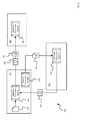
- FIG. 1 is a schematic diagram of an example data communication system 100.
- the data communication system 100 includes a certificate authority server 104, two terminals 102, 106, and a data network 108.
- the data communication system 100 can include additional, fewer, or different components.
- the data communication system 100 may include additional storage devices, additional servers (including additional certificate authority servers), additional terminals, and other features not shown in the figure.
- the certificate authority server 104 and the terminals 102, 106 can communicate with each other and with other components of the data communication system 100 over the data network 108.
- the terminal 102 can send a certificate request 120 to the certificate authority server 104, and the certificate authority can respond by sending an implicit certificate 122 to the terminal 102.
- the terminal 102 can send a signed message 124 to the terminal 106, and the terminal 106 can verify the authenticity of the signed message 124 using the implicit certificate 122 from the certificate server authority 104.
- the data communication system 100 can support additional or different types of communication.
- the terminals 102, 106 can also exchange encrypted messages and other types of information with each other, with the certificate authority server 104, and with other components of the data communication system 100.
- the certificate authority server 104 is a computing system that can perform operations of a certificate authority in a cryptography system.
- the certificate authority server 104 is generally operable to receive, transmit, process, and store information associated with the cryptography system.
- FIG. 1 shows a single certificate authority server 104, a certificate authority can be implemented using multiple certificate authority servers 104, including server clusters, as well as additional or different types of computing devices other than servers.
- the certificate authority server 104 and the terminals 102, 106 can be implemented as computing devices that generally include a data processing apparatus, a data storage medium, and a data communication interface.
- the example certificate authority server 104 shown in FIG. 1 can include a processor, a memory, an input/output controller, and other components.
- the memory can include, for example, a random access memory (RAM), a storage device (e.g., a writable read-only memory (ROM), etc.), a hard disk, or another type of storage medium.
- a computing device can be preprogrammed or it can be programmed (and reprogrammed) by loading a program from another source (e.g ., from a CD-ROM, from another computer device through a data network, or in another manner).
- the input/output controller can be coupled to input/output devices (e.g ., a monitor, a keyboard, etc.) and to the data network 108.
- the input/output devices receive and transmit data in analog or digital form over communication links such as a serial link, wireless link (e.g., infrared, radio frequency, etc.), parallel link, or another type of link.
- the memory of a computing device can store instructions (e.g ., computer code) associated with computer applications, programs and computer program modules, and other resources.
- the memory can store instructions associated with computer program modules shown in FIG. 2 .
- the memory can also store application data and data objects that can be interpreted by applications, programs, modules, or virtual machines.
- the memory can store additional information, for example, files and instruction associated with an operating system, device drivers, archival data, or other types of information.
- the processor of a computing device can execute instructions to generate output data based on data inputs.
- the processor can run applications and programs by executing or interpreting the software, scripts, functions, executables, and other types of computer program modules.
- the processor may perform one or more of the operations shown in FIGS. 3 and 4 .
- the input data received by the processor and the output data generated by the processor can be stored in a computer-readable medium, such as the memory or a storage device.
- the data network 108 can include any type of data communication network.
- the data network 108 can include a wireless or wired network, a cellular network, a telecommunications network, an enterprise network, an application-specific public network, a Local Area Network (LAN), a Wide Area Network (WAN), a private network, a public network (such as the Internet), a WiFi network, a network that includes a satellite link, or another type of data communication network.
- the data network 108 can include a tiered structure defined by firewalls or similar features that implement various levels of security.
- the terminals 102, 106 can communicate over the data network 108 based on communication schemes specified by the cryptography system.
- the terminals 102, 106 are generally operable to receive, transmit, process, and store information.
- FIG. 1 shows two terminals 102, 106
- a data communication system 100 may include any number of terminals.
- the data communication system 100 can include groups or subgroups of terminals that can communicate with each other, but not necessarily with the terminals in other groups or subgroups.
- each group of terminals can access a certificate authority server and a database of implicit certificates that have been issued by the certificate authority server.
- the data communication system 100 can include terminals of disparate types, having different types of hardware and software configurations, and in a variety of different locations. In some cases, multiple devices or subsystems can be identified together as a single terminal.
- the terminals 102, 106 can be computing devices that include a memory, a data processor, and an input/output controller.
- a terminal can include user interface devices, for example, a monitor, touchscreen, mouse, or keyboard.
- the terminals 102, 106 interface with the data network 108.
- the memory of a terminal can store messages and information associated with the cryptography system. For example, a terminal may store public and private key data, digital certificate data, and other types of information.
- the memory of the terminal can store instructions (e.g ., computer code) associated with computer applications, programs and computer program modules, and other resources.
- the terminals can store instructions associated with the computer program modules of the terminal modules 202, 206 shown in FIG. 2 .
- Terminals can include handheld devices such as smart phones, personal digital assistants (PDAs), portable media players, laptops, notebooks, tablets, and others. Terminals can include work stations, mainframes, non-portable computing systems, devices installed in structures, vehicles, and other types of installations. Terminals can include embedded communication devices. For example, the terminals can include messaging devices that are embedded in smart energy meters of a smart energy system. Other types of terminals may also be used.
- PDAs personal digital assistants
- Terminals can include work stations, mainframes, non-portable computing systems, devices installed in structures, vehicles, and other types of installations.
- Terminals can include embedded communication devices.
- the terminals can include messaging devices that are embedded in smart energy meters of a smart energy system. Other types of terminals may also be used.
- the terminal 102 sends the certificate request 120 to the certificate authority server 104, and the certificate authority server 104 generates the implicit certificate 122 for the terminal 102.
- the implicit certificate 122 associates a particular public key value with a particular user entity (e.g ., the terminal 102, a user associated with the user terminal 102, a module implemented at the terminal 102, etc.).
- the terminal 102 receives the implicit certificate 122 from the certificate authority server 104.
- the terminal 102 When the terminal 102 has a message to send to the terminal 106, the terminal 102 generates a digital signature for the message based on the implicit certificate 122.
- the digital signature can be combined with the message to form the signed message 124, which the terminal 102 sends to the terminal 106.
- the digital signature and the message are sent separately.
- the terminal 106 receives the signed message 124, obtains the implicit certificate 122, and verifies the digital signature based on the implicit certificate 122.
- Implicit certificates can also be used in other types of schemes, for example, encryption schemes.
- An implicit certificate scheme implemented by the data communication system 100 allows the terminals 102, 106 to communicate with each other in a secure manner, even when communications on the data network 108 are observable by malicious users.
- the implicit certificate 122 binds a user entity associated with the terminal 102 to a particular public key value that can be used to verify digital signatures generated by the terminal 102.
- the terminal 106 can obtain the implicit certificate 122 to verify that the digital signature was generated by the user entity associated with the terminal 102, and not by an impostor.
- the terminal 106 can also verify that the implicit certificate 122 was generated by a trusted third party at the certificate authority server 104. In this manner, the implicit certificate 122 serves as confirmation by the trusted third party that the signed message 124 was signed by the user entity associated with the terminal 102 and not by an impostor.
- the example implicit certificate 122 shown in FIG. 1 includes neither an explicit representation of the public key nor an explicit representation of the certificate authority's digital signature. Thus, in some implementations, the implicit certificate 122 is more compact than some other types of digital certificates.
- the implicit certificate 122 includes a digital signature of the certificate authority that allows user entities, for example a user entity associated with the terminal 106, to verify that the implicit certificate 122 was generated by the trusted certificate authority. The certificate authority can, in some cases, require the user entity to prove knowledge of the user entity's private key.
- the implicit certificate 122 includes an explicit representation of the user's public key.
- the example implicit certificate 122 in FIG. 1 includes public key reconstruction data that can be combined with other information (e.g ., the certificate authority's public key, etc.) to generate the public key of the user entity associated with the terminal 102.
- the example implicit certificate 122 is constructed such that successful verification of a digital signature generated by the terminal 102 serves as confirmation that the terminal 102 is in possession of the private key.
- binding of a user entity to its public key and the user entity's knowledge of its private key can be verified in unison during key usage.
- FIG. 2 is a schematic diagram of an example cryptography system 200 that implements an implicit certificate scheme.
- the cryptography system 200 includes terminal modules 202, 206, and a certificate authority module 204.
- the cryptography system 200 can include additional or different components.
- the terminal modules 202, 206 can each be computer program modules implemented by one or more terminals.
- the terminal module 202 can be implemented by the terminal 102 of FIG. 1
- the terminal module 206 can be implemented by the terminal 106 of FIG. 1 .
- the certificate authority module 204 can be a computer program module implemented by one or more certificate authority servers.
- the certificate authority module 204 can be implemented by certificate authority server 104 of FIG. 1 .
- the terminal modules 202, 206, the certificate authority module 204, and the certificate database 236 can be implemented by additional or different types of hardware systems.
- the certificate authority module 204, or in some instances individual modules, data, or other aspects of the certificate authority module 204 can be offloaded to non-certificate authority devices.
- server functionality can be distributed among client devices.
- terminal modules, or in some instances individual modules, data, or other aspects of a terminal module can be provided on a server device, such as a certificate authority server or another type of server.
- the terminal modules 202, 206 and the certificate authority module 204 can communicate with each other, for example, over a data network or another type of communication link. In some implementations, the terminal modules 202, 206 and the certificate authority module 204 can communicate with each other by messages transmitted over the data network 108 of FIG. 1 .
- the terminal module 202 can send a certificate request 220 to the certificate authority module 204.
- the certificate authority module 204 can receive the certificate request 220 from the terminal module 202 and send an implicit certificate 222 to the terminal module 202 in response to the certificate request 220.
- the certificate authority module 204 can also send the terminal module 202 private key contribution data. The private key contribution data can be sent to the terminal module 202 together with or separate from the implicit certificate 222.
- the certificate authority module 204 can also publish the implicit certificate 222, for example, to a certificate database.
- the terminal module 202 can receive the implicit certificate 222 from the certificate authority module 204 and send a signed message 224 to the terminal module 206.
- the terminal module 206 can receive the signed message 224 and the implicit certificate 222 from the terminal module 202.
- the terminal module 206 can verify the digital signature and the implicit certificate 222, for example, using the techniques shown in FIGS. 3 and 4 .
- the cryptography system 200 can support additional or different types of communications.
- the cryptography system 200 utilizes an implicit certificate and digital signature scheme that allows the terminal modules to verify the authenticity of messages received from other terminal modules.
- implicit certificates issued by the certificate authority bind each user entity to a particular public key value.
- the ECQV implicit certificate scheme may be implemented using a group of points on an elliptic curve, a multiplicative group of a finite field, or other groups where the discrete logarithm problem may be hard.
- the ECQV implicit certificate scheme can function as a general purpose digital signature scheme for applications within computer and communications systems. Some implementations of the ECQV implicit certificate scheme are well suited for application environments where resources, such as bandwidth, computing power, and storage are limited. In those cases, ECQV implicit certificates may provide a more efficient alternative to some other types of certificates. Some implementations of the ECQV implicit certificate scheme are well suited for other types of application environments, for example, with superior resources.
- ECDSA Elliptic Curve Digital Signature Algorithm
- ECPVS Elliptic Curve Pintsov Vanstone Signatures
- ECNR Elliptic Curve Nyberg Rueppel
- an elliptic curve cryptography (ECC) scheme information is encoded in elliptic curve points in an elliptic curve group.
- An elliptic curve group can be described in terms of a solution to an equation over a finite field, for example, a prime finite field or a characteristic-two finite field. Each point in the elliptic curve group is a pair of field elements corresponding to a solution to an elliptic curve equation.
- the elliptic curve group also includes an identity element.
- F p represent a prime finite field where p is an odd prime number
- a , b ⁇ F p satisfy 4. a 3 + 27. b 2 ⁇ 0 (mod p ).
- the identity element O is sometimes referred to as the point at infinity.
- the integer p specifies the finite field F p .
- Field elements a , b ⁇ F p specify an elliptic curve E (F p ) over F p as discussed above.
- the cofactor h is equal to # E (F p )/ n , which is the number of points on the elliptic curve E (F p ) divided by the order of the base point generator G.
- Elliptic curve domain parameters may alternatively be identified over other types of finite fields.
- the elliptic curve domain parameters can be generated, validated, and utilized by the terminal modules 202, 206 or by the certificate authority module 204 in the cryptography system 200. In some implementations, the elliptic curve domain parameters can be shared among the modules in the cryptography system 200.
- the random integer d may be selected or obtained by a random number generator.
- the elliptic curve key pairs can be generated, validated, and processed by the terminal modules 202, 206 or by the certificate authority module 204 in the cryptography system 200.
- the terminal module 202 includes a signature generation module 242, a request generation module 240, and other possibly other modules.
- the request generation module 240 can generate a certificate request 220.
- the certificate request 220 can include an identification U of a user entity.
- the certificate request 220 can include an elliptic curve point R U .
- the certificate request 220 can include additional or different information.
- the identification value U can be a unique identifier for a particular user entity, a particular device, or both.
- the terminal module 202 may have a random number generator module that generates random numbers.
- the request generation module 240 can perform a validity check to ensure that the values k U and R U correspond to a valid key pair.
- the requester can convert the elliptic curve point R U , the identification value U, and any other information to be included in the certificate request 220 to an appropriate data format (e.g ., an octet string).
- the signature generation module 242 can use the implicit certificate 222 to generate a digital signature for a message 218.
- An example technique for generating a digital signature based on an elliptic curve key pair is provided by the Elliptic Curve Digital Signature Algorithm (ECDSA).
- EDSA Elliptic Curve Digital Signature Algorithm
- the message 218 can include any type of electronic document, data file, data object, or other form of information.
- the message 218 is an e-mail message, an electronic document, or an electronic data file that can be edited and rendered by appropriate software applications.
- the message 218 is a data message or a combination of data messages used in signaling applications among hardware components.
- the message 218 can include status information from a smart energy meter in a smart energy infrastructure.
- the signature generation module 242 can generate the digital signature using the private key of the terminal module 202 and the implicit certificate 222.
- the signature generation module can generate the private key of the terminal module 202 based on private key contribution data r , the implicit certificate 222, and the random value k U that was used to generate the certificate request 220.
- the digital signature generated by the signature generation module 242 can be appended to, combined with, or otherwise associated with the message 218 to create the signed message 224.
- the digital signature can be sent separately from the message 218.
- the terminal module 202 can send the implicit certificate 222 to the terminal module 206 along with the signed message 224.
- the terminal module 206 includes a signature verification module 250 and possibly other modules.
- the signature verification module 250 can verify the digital signature associated with the signed message 224.
- the terminal module 206 can include a data input module that obtains or provides the input values used by the signature verification module 250. Example techniques for verifying a digital signature are provided in FIGS. 3 and 4 . Additional or different techniques may be used.
- the signed message 224 includes a digital signature purportedly generated by a user entity associated with an identification value U.
- the signature verification module 250 can receive the implicit certificate 222 from the terminal module 206 or retrieve the implicit certificate 222 associated with the identification value U from another source.
- the signature verification module 250 can verify the authenticity of the digital signature and the validity of implicit certificate 222.
- the certificate authority module 204 includes a certificate generation module 230, and possibly other modules.
- the certificate generation module 230 can perform one or more operations for issuing the implicit certificate 222 for use in the cryptography system 200.
- the certificate generation module 230 may be configured to perform one or more of the operations presented in FIG. 3A , or the certificate generation module 230 may be configured to issued implicit certificates in a different manner.
- the certificate authority module 204 may have a random number generator module that generates random numbers.
- the certificate generation module 230 can encode the public key reconstruction data P U , and sometimes other information, in an implicit certificate Cert U .
- the implicit certificate Cert U can be generated by a certificate encoding scheme, for example, a fixed-length field scheme, a minimal ASN.1 encoding scheme, or an X.509-compliant ASN.1 encoding scheme.
- FIG. 3 is a flow chart showing an example verification process 300.
- the process 300 can be implemented by a terminal of a cryptography system.
- the process 300 can be implemented by the terminal 106 shown in FIG. 1 , the terminal module 206 shown in FIG. 2 , or by another type of system or module.
- the example process 300 shown in FIG. 3 can be implemented using additional, fewer, or different operations, which can be performed in the order shown or in a different order. In some implementations, one or more of the operations can be repeated or iterated, for example, until a terminating condition is reached.
- the operations of the example process 300 are described below as implemented by a terminal of an elliptic curve cryptography system.
- the example process 300 can also be in other types of cryptography systems.
- one or more of the operations of the example process 300 can be implemented by another type of entity in the cryptography such as a certificate authority.
- the process 300 may be used to simultaneously verify an ECQV implicit certificate and an ECDSA digital certificate that is based on the implicit certificate.
- the ECQV implicit certificate scheme may be described with respect to operations performed by three entities with the following representations - a Certificate Authority CA , a certificate requester U , and a certificate processer V .
- FIG. 3A shows an example protocol executed by the certificate requester U and the certificate authority CA when the certificate authority CA issues the implicit certificate for the requester U .
- certificate issuance can include a two pass protocol between the requester U and the certificate authority CA , where the first flow is the certificate request from U , and the second flow is the response from CA, containing the certificate.
- G represents a base point operable to generate the group of elliptic curve points used to implement ECQV.
- the group G may be of prime order n.
- C represents the CA's public key, which is a point in the group G.
- the ECQV implicit certificate can be represented as ( P,I ), where P represents an elliptic curve point in G, and I is a bit string that may contain information about the requester U .
- the choice of the hash function H can be fixed, for example, as part of the domain parameters.
- the certificate authority CA or another entity establishes the elliptic curve domain parameters, a hash function, the certificate encoding format, and all parties have selected a random number generator.
- the certificate authority CA can generate a key pair. All parties can receive authentic copies of CA 's public key and domain parameters.
- the elliptic curve domain parameters which can be generated by the certificate authority or another entity, include the field size q , the elliptic curve coefficients a and b , the base point generator G , the order n of the base point generator, the cofactor h (where hn is the number of points on the elliptic curve), and others.
- the elliptic curve domain parameters include a seed value for selecting random values.
- the elliptic curve domain parameters include an indication of the basis (e.g ., the reduction polynomial).
- the hash function H can be a hash function that has been approved for the specified security level in the cryptography system.
- one or more conventional hash functions in the SHA-2 family can be used (e.g ., SHA-256, SHA-512). Additional or different hash functions may be used.
- an ECDSA digital signature can be generated based on the following example technique.
- Q xG, where G represents the base point.
- Q represents the public key and x represents the private key.
- the hash function H': ⁇ 0, 1 ⁇ * ⁇ Z n may be the same as the function H used with ECQV, or may be different.
- the ECDSA signing process may utilize as input a message m and a private key x , and produce as output a signature ( r , s ).
- the requester U may then send the digital signature and the implicit certificate to a verifier V .
- the requester U may send the implicit certificate with the digital signature, the requester U may send the implicit certificate and the digital signature separately, or the verifier may obtain the implicit certificate from another source.
- an ECQV implicit certificate is received by a verifier V
- an ECDSA digital signature is received by the verifier V .
- the ECQV implicit certificate and the ECDSA digital signature are verified by the verifier V .
- a combined fast verification technique can be used for verifying an ECDSA signed message where the signer has an ECQV implicit certificate.
- the technique can combine the two processes of recovering the signer's ECQV public key and ECDSA.
- the technique may access inputs that include an ECDSA signed message m , the digital signature ( r , s ), and an ECQV certificate ( P,I ).
- the technique may produce outputs that include reporting "accept” or "reject".
- the process of inverting the function f can be efficiently conducted, for example, where the co-factor of the elliptic curve group is small.
- the co-factor is one, there can be a single inverse for each r , and when the cofactor is greater than one, but still small, with a few "hint bits", the inversion may be made efficient.
- Operation (5.) in the verification process outlined above can use the extended Euclidean algorithm to express x (mod n ) as a fraction u / v (mod n ) such that u , v ⁇ n .
- the efficiency of the combined verification process can be higher than the sum of calculation in each component.
- the resulting verification equation can be computed by computing the sum of scalar multiples (sometimes called a "multi scalar multiplication" or MSM).
- Two of the scalar multiples may have full sized exponents and fixed bases. For example, assuming there is a small number of CAs, pre-processing can be conducted to pre-compute and store multiples of G and C .
- the other two bases ( P and R ) may vary with each signer/signature, but here the scalars are half-sized, on account of the choice of u and v .
- t ⁇ log 2 ( n + 1) ⁇ .
- ⁇ ⁇ 0 + ⁇ 1 ⁇ 2 t / 2
- ⁇ ⁇ 0 + ⁇ 1 ⁇ 2 t / 2 for integers ⁇ 0 , ⁇ 1 , ⁇ 0 , ⁇ 1 that are about t /2 bits long in some instances.
- the notation ⁇ t /2 ⁇ denotes the ceiling of t /2, which refers to the smallest integer not less than t /2.
- Equation (4) uses six scalar multiplications with half-length scalars, compared to three scalar multiplications with full-length scalars in Equation (2).
- each "half-length" scalar is less than or equal to ⁇ t /2 ⁇ bits.
- each of the scalars ⁇ 0 , ⁇ 1 , ⁇ 0 , ⁇ 1 , u, v in Equation (4) can be less than or equal to ⁇ t /2 ⁇ bits.
- Equations (2) and (4) can be reduced to comparing an MSM with three terms and full-length ( t -bit) scalars to another MSM with six terms and half-length ( t /2-bit) scalars.
- Some example algorithms for evaluating the speedup (e.g ., the Strauss Algorithm) use (1 + p / log 2 log 2 B ) log 2 B group operations, where p is the number of terms in the MSM and the scalars are less than B .
- a second estimate can be given, assuming the MSM is implemented using a conventional w-NAF, to facilitate calculation.
- Equation (2) two of the three terms are known.
- Equation (4) four of the six terms are known in advance.
- the tables of points used by the NAF algorithm may be pre-computed for the known points. Each table has (2 w - (-1) w )/3 entries, and takes one addition per entry to create.
- the tables for the unknown points can be computed on-the-fly.
- the scalars are w -NAF re-encoded, reducing the overall number of additions by about 1/( w + 1).
- Equation (2) uses 3 ⁇ t / w + 1 + 2 w - - 1 w / 3 ⁇ A + t - 1 ⁇ D additions and doublings
- Equation (4) uses 6 ⁇ t / 2 ⁇ w + 1 + 2 ⁇ 2 w - - 1 w / 3 ⁇ A + t - 1 / 2 ⁇ D additions and doublings.
- Equation (2) uses 3 ⁇ t / 5 + 5 ⁇ A + t - 1 ⁇ D and Equation (4) uses 3 ⁇ t / 5 + 10 ⁇ A + t - 1 / 2 ⁇ D .
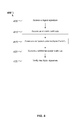
- FIG. 4 is a flow chart showing an example verification process 400.
- the verification process 400 can be implemented by any suitable hardware, for example, by a data processing apparatus, a computing device or a system of computing devices. In some instances, the process 400 can be implemented by the terminal 106 shown in FIG. 1 , by the terminal module 206 shown in FIG. 2 , or by another type of system or module.
- the example verification process 400 shown in FIG. 4 can be implemented using additional, fewer, or different operations, which can be performed in the order shown or in a different order. In some implementations, one or more of the operations can be repeated or iterated, for example, until a terminating condition is reached.
- the operations of the example verification process 400 are described below as implemented by a terminal of an elliptic curve cryptography system.
- the verification process may be used to verify an ECDSA digital signature and an ECQV implicit certificate.
- the example process 400 can also be used in different types of cryptography systems.
- one or more of the operations of the example process 400 can be implemented by another type of entity in the cryptography such as a certificate authority.
- a digital signature is accessed.
- the digital signature can be an ECDSA digital signature or another type of ECC-based digital signature.
- the digital signature may be associated with an entity.
- the entity can be a user, a computing device, a user account, or another type of entity.
- the digital signature can be accessed from a local memory, from a remote device, or another source. In some instances, the digital signature is received from the entity.
- an implicit certificate is accessed.
- the implicit certificate can be an ECQV implicit certificate or another type of ECC-based implicit certificate.
- the implicit certificate may be issued by a certificate authority and associated with the entity.
- the implicit certificate can be accessed from a local memory, from a remote device, or another source.
- the digital signature is received from the entity.
- the implicit certificate may include an elliptic curve point P representing a public key reconstruction value of the entity.
- a second elliptic curve point C 1 is accessed.
- the second elliptic curve point C 1 represents a pre-computed multiple of a public key C of the certificate authority.
- the pre-computed multiple of the certificate authority's public key C can be used to verify the digital signature faster. For example, performing an elliptic curve point multiplication can be time-consuming.
- the pre-computed multiples can values that are likely to be used to verify digital signatures.
- the pre-computed multiples can include one or more pre-computed multiples of the certificate authority's public key, one or more pre-computed multiples of the generator point, or any suitable combination of these and other values. Such values can be "pre-computed” by computing them before a particular digital signature is to be verified.
- the pre-computed multiples can be stored and made accessible to be used when a digital signature is to be verified.
- additional scalar multiples are generated based on a number of half-length scalars and a plurality of elliptic curve points.
- Each of the scalar multiples may be generated by multiplying one of the half-length scalars by one of the elliptic curve points.
- the elliptic curve points that are used to produce the scalar multiples may include P , C 1 and G 1 , of which G 1 represents a pre-computed multiple of a generator point G .
- the digital signature is verified using the first elliptic curve point P and the second elliptic curve point C 1 .
- the digital signature can be verified based on the scalar multiples generated at 420, which may include a scalar multiple of the first elliptic curve point P , a scalar multiple of the second elliptic curve point C 1 , a scalar multiple of the third elliptic curve point G 1 , or a combination of these and other scalar multiples.
- the digital signature may be verified at 420 using the example Equation 4 provided above, or by another suitable technique.
- Subject matter and operations described in this specification can be implemented in digital electronic circuitry, or in computer software, firmware, or hardware, including the structures disclosed in this specification and their structural equivalents, or in combinations of one or more of them.
- Some of the subject matter described in this specification can be implemented as one or more computer programs, i.e., one or more modules of computer program instructions, encoded on non-transitory computer storage medium for execution by, or to control the operation of, data processing apparatus.
- the program instructions can be encoded for transmission to suitable receiver apparatus for execution by a data processing apparatus.
- a computer storage medium can be, or be included in, a computer-readable storage device, a computer-readable storage substrate, a random or serial access memory array or device, or a combination of one or more of them.
- the computer storage medium can be, or be included in, one or more separate physical components or media (e.g., multiple cards, disks, or other storage devices).
- the operations described in this specification can be implemented as operations performed by a data processing apparatus on data stored on one or more computer-readable storage devices or received from other sources.
- data processing apparatus encompasses all kinds of apparatus, devices, and machines for processing data, including by way of example a programmable processor, a computer, a system on a chip, or multiple ones, or combinations, of the foregoing.
- the apparatus can include special purpose logic circuitry, e.g ., an FPGA (field programmable gate array) or an ASIC (application-specific integrated circuit).
- the apparatus can also include, in addition to hardware, code that creates an execution environment for the computer program in question, e.g ., code that constitutes processor firmware, a protocol stack, a database management system, an operating system, a cross-platform runtime environment, a virtual machine, or a combination of one or more of them.
- code that creates an execution environment for the computer program in question e.g ., code that constitutes processor firmware, a protocol stack, a database management system, an operating system, a cross-platform runtime environment, a virtual machine, or a combination of one or more of them.
- the apparatus and execution environment can realize various different computing model infrastructures, such as web services, distributed computing and grid computing infrastructures.
- a computer program (also known as a program, software, software application, script, or code) can be written in any form of programming language, including compiled or interpreted languages, declarative or procedural languages, and it can be deployed in any form, including as a stand-alone program or as a module, component, subroutine, object, or other unit suitable for use in a computing environment.
- a computer program may, but need not, correspond to a file in a file system.
- a program can be stored in a portion of a file that holds other programs or data (e.g., one or more scripts stored in a markup language document), in a single file dedicated to the program in question, or in multiple coordinated files (e.g., files that store one or more modules, sub-programs, or portions of code).
- a computer program can be deployed to be executed on one computing device or on multiple computers that are located at one site or distributed across multiple sites and interconnected by a communication network.
- the processes and logic flows described in this specification can be performed by one or more programmable processors executing one or more computer programs to perform actions by operating on input data and generating output.
- the processes and logic flows can also be performed by, and apparatus can also be implemented as, special purpose logic circuitry, e.g., an FPGA (field programmable gate array) or an ASIC (application-specific integrated circuit).
- processors suitable for the execution of a computer program include, by way of example, both general and special purpose microprocessors, and any one or more processors of any kind of digital computing device.
- a processor will receive instructions and data from a read-only memory or a random access memory or both.
- the essential elements of a computing device are a processor for performing actions in accordance with instructions and one or more memory devices for storing instructions and data.
- a computing device will also include, or be operatively coupled to receive data from or transfer data to, or both, one or more storage devices for storing data. However, a computing device need not have such devices.
- a computer can be embedded in another device, e.g ., a mobile telephone, a personal digital assistant (PDA), a mobile audio or video player, a game console, a Global Positioning System (GPS) receiver, or a portable storage device (e.g., a universal serial bus (USB) flash drive), to name just a few.
- Devices suitable for storing computer program instructions and data include all forms of non-volatile memory, media and memory devices, including by way of example semiconductor memory devices, e.g ., EPROM, EEPROM, and flash memory devices; magnetic disks, e.g., internal hard disks or removable disks; magneto-optical disks; and CD-ROM and DVD-ROM disks.
- the processor and the memory can be supplemented by, or incorporated in, special purpose logic circuitry.
- subject matter described in this specification can be implemented on a computer having a display device, e.g., an LCD (liquid crystal display) screen for displaying information to the user and a keyboard and a pointing device, e.g., touch screen, stylus, mouse, etc. by which the user can provide input to the computer.
- a display device e.g., an LCD (liquid crystal display) screen for displaying information to the user
- a keyboard and a pointing device e.g., touch screen, stylus, mouse, etc.
- Other kinds of devices can be used to provide for interaction with a user as well; for example, feedback provided to the user can be any form of sensory feedback, e.g., visual feedback, auditory feedback, or tactile feedback; and input from the user can be received in any form, including acoustic, speech, or tactile input.
- a computing device can interact with a user by sending documents to and receiving documents from a device that is used by the user; for example, by sending web pages to a web browser on
- Some of the subject matter described in this specification can be implemented in a computing system that includes a back-end component, e.g., as a data server, or that includes a middleware component, e.g ., an application server, or that includes a front-end component, e.g ., a client computing device having a graphical user interface or a Web browser through which a user can interact with an implementation of the subject matter described in this specification, or any combination of one or more such back-end, middleware, or front-end components.
- the components of the system can be interconnected by any form or medium of digital data communication, e.g., a data network.
- the computing system can include clients and servers.
- a client and server are generally remote from each other and typically interact through a data network. The relationship of client and server arises by virtue of computer programs running on the respective computers and having a client-server relationship to each other.
- a server transmits data to a client device. Data generated at the client device can be received from the client device at the server.
- a technique for verifying digital signatures may take an implicit certificate and a digital signature as input.
- the technique may determine and generate a positive output if the certificate is valid and the signature on the message is valid.
- a digital signature associated with an entity is accessed.
- An implicit certificate issued by a certificate authority and associated with the entity is accessed.
- the implicit certificate may include a first elliptic curve point P representing a public key reconstruction value of the entity.
- a second elliptic curve point C 1 representing a pre-computed multiple of a public key C of the certificate authority is accessed.
- the first elliptic curve point P and the second elliptic curve point C 1 are used to verify the digital signature by data processing apparatus.
- Verifying the digital signature provides verification that the implicit certificate is valid.
- a third elliptic curve point G 1 representing a pre-computed multiple of a generator point G is accessed and the third elliptic curve point G 1 is accessed with the first elliptic curve point P and the second elliptic curve point C 1 to verify the digital signature.
- Verifying the digital signature can include generating a plurality of scalar multiples based on a plurality of half-length scalars and a plurality of elliptic curve points. Each of the scalar multiples is generated by multiplying one of the plurality of half-length scalars by one of the plurality of elliptic curve points.
- the plurality of elliptic curve points includes the first elliptic curve point P, the second elliptic curve point C 1 , and the third elliptic curve point G 1 .
- Verifying the digital signature can also include combining the plurality of scalar multiples according to a digital signature verification equation.
- the digital signature includes a first signature element r and a second signature element s .
- the generator point G is a generator of an elliptic curve group of order n . Based on the first signature element r, a fourth elliptic curve point R can be obtained. A first integer u and a second integer n are then computed based on the digital signature.
- the first integer u and the second integer v are each less than n .
- the second elliptic curve point C 1 and the third elliptic curve point G 1 may be stored for subsequent access.
Landscapes
- Engineering & Computer Science (AREA)
- Computer Security & Cryptography (AREA)
- Signal Processing (AREA)
- Computer Networks & Wireless Communication (AREA)
- Theoretical Computer Science (AREA)
- Physics & Mathematics (AREA)
- Algebra (AREA)
- General Physics & Mathematics (AREA)
- Mathematical Analysis (AREA)
- Mathematical Optimization (AREA)
- Mathematical Physics (AREA)
- Pure & Applied Mathematics (AREA)
- Power Engineering (AREA)
- Computing Systems (AREA)
- Storage Device Security (AREA)
- Mobile Radio Communication Systems (AREA)
Applications Claiming Priority (1)
| Application Number | Priority Date | Filing Date | Title |
|---|---|---|---|
| US13/273,503 US8745376B2 (en) | 2011-10-14 | 2011-10-14 | Verifying implicit certificates and digital signatures |
Publications (2)
| Publication Number | Publication Date |
|---|---|
| EP2582088A2 true EP2582088A2 (fr) | 2013-04-17 |
| EP2582088A3 EP2582088A3 (fr) | 2015-04-22 |
Family
ID=47290591
Family Applications (1)
| Application Number | Title | Priority Date | Filing Date |
|---|---|---|---|
| EP20120188382 Ceased EP2582088A3 (fr) | 2011-10-14 | 2012-10-12 | Vérification de certificats implicites et de signatures numériques |
Country Status (3)
| Country | Link |
|---|---|
| US (1) | US8745376B2 (fr) |
| EP (1) | EP2582088A3 (fr) |
| CA (1) | CA2792267C (fr) |
Cited By (1)
| Publication number | Priority date | Publication date | Assignee | Title |
|---|---|---|---|---|
| US20220045870A1 (en) * | 2018-09-28 | 2022-02-10 | Blackberry Limited | Method and system for intelligent transportation system certificate revocation list reduction |
Families Citing this family (20)
| Publication number | Priority date | Publication date | Assignee | Title |
|---|---|---|---|---|
| US9178698B1 (en) * | 2011-12-21 | 2015-11-03 | Google Inc. | Dynamic key management |
| US9800411B1 (en) * | 2016-05-05 | 2017-10-24 | ISARA Corporation | Using a secret generator in an elliptic curve cryptography (ECC) digital signature scheme |
| US9660978B1 (en) | 2016-08-08 | 2017-05-23 | ISARA Corporation | Using a digital certificate with multiple cryptosystems |
| US10397002B2 (en) | 2017-02-10 | 2019-08-27 | International Business Machines Corporation | Signature scheme for homomorphic message encoding functions |
| EP3382930A1 (fr) * | 2017-03-31 | 2018-10-03 | Nxp B.V. | Station de système de transport intelligent, processeur hôte et procédé associé |
| EP3382932A1 (fr) * | 2017-03-31 | 2018-10-03 | Nxp B.V. | Station de système de transport intelligent, processeur hôte et procédé associé |
| US10798129B2 (en) | 2017-07-10 | 2020-10-06 | Ebay Inc. | Constraint-based multiuse certificates |
| WO2019092552A1 (fr) | 2017-11-09 | 2019-05-16 | nChain Holdings Limited | Systèmes et procédés permettant de garantir l'exécution correcte d'un programme informatique à l'aide d'un système informatique médiateur |
| GB201720946D0 (en) | 2017-12-15 | 2018-01-31 | Nchain Holdings Ltd | Computer-implemented system and method |
| KR102738013B1 (ko) | 2017-11-09 | 2024-12-05 | 엔체인 홀딩스 리미티드 | 확인 키를 변경으로부터 보호하고 정확성 증명의 유효성을 확인하기 위한 시스템 |
| KR102810891B1 (ko) | 2017-12-13 | 2025-05-20 | 엔체인 홀딩스 리미티드 | 암호 자료를 안전하게 공유하기 위한 시스템 및 방법 |
| US10425401B1 (en) | 2018-10-31 | 2019-09-24 | ISARA Corporation | Extensions for using a digital certificate with multiple cryptosystems |
| CN111695159B (zh) * | 2019-03-15 | 2023-04-07 | 阿里巴巴集团控股有限公司 | 数据的处理方法、装置及设备 |
| SG11202002419WA (en) * | 2019-05-31 | 2020-04-29 | Alibaba Group Holding Ltd | Method for restoring public key based on sm2 signature |
| US12206792B2 (en) | 2020-01-15 | 2025-01-21 | Planetway Corporation | Digital signature system using scalable servers |
| KR102568418B1 (ko) * | 2021-08-26 | 2023-08-18 | 하이파이브랩 주식회사 | 다중 서명을 지원하는 전자 인증 시스템 및 방법 |
| CN114329548A (zh) * | 2021-12-28 | 2022-04-12 | 上海市数字证书认证中心有限公司 | 一种pdf文档隐式数字签名和验证方法、装置及电子设备 |
| WO2023126491A1 (fr) * | 2021-12-30 | 2023-07-06 | Poola Oskar | Procédé et système de génération de signatures numériques à l'aide d'une composition universelle |
| FR3133251B1 (fr) * | 2022-03-03 | 2024-03-22 | Idemia France | Procédé de signature cryptographique d’une donnée, dispositif électronique et programme d’ordinateur associés |
| CN119966637B (zh) * | 2025-02-07 | 2025-11-14 | 深圳市汇顶科技股份有限公司 | 数字签名验证方法、装置、电子设备和存储介质 |
Family Cites Families (82)
| Publication number | Priority date | Publication date | Assignee | Title |
|---|---|---|---|---|
| FR2536928B1 (fr) | 1982-11-30 | 1989-10-06 | France Etat | Systeme pour chiffrer et dechiffrer des informations, du type utilisant un systeme de dechiffrement a cle publique |
| US4519036A (en) | 1983-01-05 | 1985-05-21 | Emi Limited | Program storage hardware with security scheme |
| US4745568A (en) | 1986-12-16 | 1988-05-17 | Onyszchuk Ivan M | Computational method and apparatus for finite field multiplication |
| EP0246823A3 (en) | 1986-05-22 | 1989-10-04 | Racal-Guardata Limited | Data communication systems and methods |
| US4748668A (en) | 1986-07-09 | 1988-05-31 | Yeda Research And Development Company Limited | Method, apparatus and article for identification and signature |
| US5218637A (en) | 1987-09-07 | 1993-06-08 | L'etat Francais Represente Par Le Ministre Des Postes, Des Telecommunications Et De L'espace | Method of transferring a secret, by the exchange of two certificates between two microcomputers which establish reciprocal authorization |
| EP0364627B1 (fr) | 1988-10-18 | 1996-08-28 | Koninklijke Philips Electronics N.V. | Appareil de traitement de données pour le calcul d'un élément d'un corps fini inversé multiplicativement |
| US5202995A (en) | 1989-10-12 | 1993-04-13 | International Business Machines Corporation | Method for removing invariant branches from instruction loops of a computer program |
| GB9008362D0 (en) | 1990-04-12 | 1990-06-13 | Hackremco No 574 Limited | Banking computer system |
| EP0482233B1 (fr) | 1990-10-24 | 1995-03-08 | Omnisec Ag | Système cryptographique permettant une communication chiffrée entre utilisateurs avec une clé de chiffrage mutuellement sécurisée déterminée sans interaction d'un utilisateur |
| FR2672402B1 (fr) | 1991-02-05 | 1995-01-27 | Gemplus Card Int | Procede et dispositif pour la generation de nombres pseudo-aleatoires uniques. |
| ATE128297T1 (de) | 1991-03-14 | 1995-10-15 | Omnisec Ag | Verschlüsselungssystem mit öffentlichem schlüssel unter verwendung elliptischer kurven über ringe. |
| US5272755A (en) | 1991-06-28 | 1993-12-21 | Matsushita Electric Industrial Co., Ltd. | Public key cryptosystem with an elliptic curve |
| US5351297A (en) | 1991-06-28 | 1994-09-27 | Matsushita Electric Industrial Co., Ltd. | Method of privacy communication using elliptic curves |
| US5271061A (en) | 1991-09-17 | 1993-12-14 | Next Computer, Inc. | Method and apparatus for public key exchange in a cryptographic system |
| US5159632A (en) | 1991-09-17 | 1992-10-27 | Next Computer, Inc. | Method and apparatus for public key exchange in a cryptographic system |
| US5373560A (en) | 1991-12-06 | 1994-12-13 | Schlafly; Roger | Partial modular reduction method |
| US5666296A (en) | 1991-12-31 | 1997-09-09 | Texas Instruments Incorporated | Method and means for translating a data-dependent program to a data flow graph with conditional expression |
| US5524222A (en) | 1992-03-27 | 1996-06-04 | Cyrix Corporation | Microsequencer allowing a sequence of conditional jumps without requiring the insertion of NOP or other instructions |
| US5396558A (en) | 1992-09-18 | 1995-03-07 | Nippon Telegraph And Telephone Corporation | Method and apparatus for settlement of accounts by IC cards |
| US5442707A (en) | 1992-09-28 | 1995-08-15 | Matsushita Electric Industrial Co., Ltd. | Method for generating and verifying electronic signatures and privacy communication using elliptic curves |
| US5627893A (en) | 1992-12-22 | 1997-05-06 | Telstra Corporation Limited | Cryptographic method |
| JPH06314203A (ja) | 1993-04-28 | 1994-11-08 | Fujitsu Ltd | コンパイラの最適化方法および装置 |
| US5497423A (en) | 1993-06-18 | 1996-03-05 | Matsushita Electric Industrial Co., Ltd. | Method of implementing elliptic curve cryptosystems in digital signatures or verification and privacy communication |
| US5825880A (en) | 1994-01-13 | 1998-10-20 | Sudia; Frank W. | Multi-step digital signature method and system |
| WO1996004602A1 (fr) | 1994-07-29 | 1996-02-15 | Certicom Corp. | Systemes de chiffrement a courbe elliptique |
| CA2167631A1 (fr) | 1995-01-20 | 1996-07-21 | W. Dale Hopkins | Methode et appareil d'authentification d'utilisateurs et de dispositifs de securite |
| US5675645A (en) | 1995-04-18 | 1997-10-07 | Ricoh Company, Ltd. | Method and apparatus for securing executable programs against copying |
| WO1996033565A1 (fr) | 1995-04-21 | 1996-10-24 | Certicom Corp. | Procede de generation de signature et de cle de session |
| US5761305A (en) | 1995-04-21 | 1998-06-02 | Certicom Corporation | Key agreement and transport protocol with implicit signatures |
| CA2176972C (fr) | 1995-05-17 | 2008-11-25 | Scott A. Vanstone | Protocole d'etablissement et de transfert de cles utilisant des signatures implicites |
| US5768389A (en) | 1995-06-21 | 1998-06-16 | Nippon Telegraph And Telephone Corporation | Method and system for generation and management of secret key of public key cryptosystem |
| US5764772A (en) | 1995-12-15 | 1998-06-09 | Lotus Development Coporation | Differential work factor cryptography method and system |
| US5778069A (en) | 1996-04-10 | 1998-07-07 | Microsoft Corporation | Non-biased pseudo random number generator |
| US5999626A (en) | 1996-04-16 | 1999-12-07 | Certicom Corp. | Digital signatures on a smartcard |
| US5892899A (en) | 1996-06-13 | 1999-04-06 | Intel Corporation | Tamper resistant methods and apparatus |
| US6526456B1 (en) | 1996-07-01 | 2003-02-25 | David Ian Allan | Distribution and controlled use of software products |
| US5937066A (en) | 1996-10-02 | 1999-08-10 | International Business Machines Corporation | Two-phase cryptographic key recovery system |
| CA2228185C (fr) | 1997-01-31 | 2007-11-06 | Certicom Corp. | Protocole de verification |
| US5991415A (en) | 1997-05-12 | 1999-11-23 | Yeda Research And Development Co. Ltd. At The Weizmann Institute Of Science | Method and apparatus for protecting public key schemes from timing and fault attacks |
| US5987131A (en) | 1997-08-18 | 1999-11-16 | Picturetel Corporation | Cryptographic key exchange using pre-computation |
| US6279110B1 (en) | 1997-11-10 | 2001-08-21 | Certicom Corporation | Masked digital signatures |
| US6411715B1 (en) | 1997-11-10 | 2002-06-25 | Rsa Security, Inc. | Methods and apparatus for verifying the cryptographic security of a selected private and public key pair without knowing the private key |
| US6334189B1 (en) | 1997-12-05 | 2001-12-25 | Jamama, Llc | Use of pseudocode to protect software from unauthorized use |
| ATE325478T1 (de) | 1998-01-02 | 2006-06-15 | Cryptography Res Inc | Leckresistentes kryptographisches verfahren und vorrichtung |
| DE69930334T2 (de) | 1998-01-28 | 2006-11-09 | Hitachi, Ltd. | IC-Karte ausgerüstet mit einer Verarbeitungsanlage für Elliptische-Kurven-Verschlüsselung |
| CA2235359C (fr) * | 1998-03-23 | 2012-04-10 | Certicom Corp. | Programme implicite de certificat avec chainage de ca |
| US6404890B1 (en) | 1998-04-08 | 2002-06-11 | Citibank, Na | Generating RSA moduli including a predetermined portion |
| IL139935A (en) | 1998-06-03 | 2005-06-19 | Cryptography Res Inc | Des and other cryptographic processes with leak minimization for smartcards and other cryptosystems |
| US6212279B1 (en) | 1998-06-26 | 2001-04-03 | The United States Of America As Represented By The United States National Security Agency | Method of elliptic curve cryptographic key exchange using reduced base tau expansion in non-adjacent form |
| US6243467B1 (en) | 1998-07-23 | 2001-06-05 | The United States Of America As Represented By The National Security Agency | Method of elliptic curve cryptographic digital signature generation and verification using reduced base tau expansion in non-adjacent form |
| DE69906897T2 (de) | 1998-09-03 | 2004-01-29 | Nippon Telegraph & Telephone | Gerät und Verfahren zur Elliptische-Kurven Multiplikation und Aufnahmemedium mitdarauf aufgenommen ein Program zur Ausführung des Verfahrens |
| CA2257008C (fr) * | 1998-12-24 | 2007-12-11 | Certicom Corp. | Methode permettant l'acceleration des operations cryptographiques sur des courbes elliptiques |
| US20020057796A1 (en) * | 1998-12-24 | 2002-05-16 | Lambert Robert J. | Method for accelerating cryptographic operations on elliptic curves |
| CA2259089C (fr) | 1999-01-15 | 2013-03-12 | Robert J. Lambert | Methode et appareillage de masquage des operations cryptographiques |
| US7599491B2 (en) | 1999-01-11 | 2009-10-06 | Certicom Corp. | Method for strengthening the implementation of ECDSA against power analysis |
| US6298135B1 (en) | 1999-04-29 | 2001-10-02 | Motorola, Inc. | Method of preventing power analysis attacks on microelectronic assemblies |
| US6419159B1 (en) | 1999-06-14 | 2002-07-16 | Microsoft Corporation | Integrated circuit device with power analysis protection circuitry |
| US6829356B1 (en) | 1999-06-29 | 2004-12-07 | Verisign, Inc. | Server-assisted regeneration of a strong secret from a weak secret |
| JP3689039B2 (ja) | 1999-09-08 | 2005-08-31 | 株式会社日立製作所 | 楕円曲線生成方法、装置及び楕円暗号システム並びに記録媒体 |
| WO2001024439A1 (fr) | 1999-09-29 | 2001-04-05 | Hitachi, Ltd. | Dispositif, programme ou systeme de traitement d'informations secretes |
| US6724894B1 (en) | 1999-11-05 | 2004-04-20 | Pitney Bowes Inc. | Cryptographic device having reduced vulnerability to side-channel attack and method of operating same |
| DE19963408A1 (de) | 1999-12-28 | 2001-08-30 | Giesecke & Devrient Gmbh | Tragbarer Datenträger mit Zugriffsschutz durch Schlüsselteilung |
| US7308096B2 (en) | 2000-05-30 | 2007-12-11 | Hitachi, Ltd. | Elliptic scalar multiplication system |
| JP3859983B2 (ja) | 2001-04-27 | 2006-12-20 | 日本電信電話株式会社 | ブラインド署名方法、その装置、そのプログラム及びその記録媒体 |
| JP2002328845A (ja) | 2001-05-07 | 2002-11-15 | Fujitsu Ltd | 半導体集積回路及びicカードのセキュリティー保護方法 |
| JP4596686B2 (ja) | 2001-06-13 | 2010-12-08 | 富士通株式会社 | Dpaに対して安全な暗号化 |
| US7142670B2 (en) | 2001-08-14 | 2006-11-28 | International Business Machines Corporation | Space-efficient, side-channel attack resistant table lookups |
| JP2003131568A (ja) | 2001-10-26 | 2003-05-09 | Hitachi Ltd | 楕円曲線署名検証方法及び装置並びに記憶媒体 |
| US7215780B2 (en) | 2001-12-31 | 2007-05-08 | Certicom Corp. | Method and apparatus for elliptic curve scalar multiplication |
| CA2369540C (fr) | 2001-12-31 | 2013-10-01 | Blackberry Limited | Methode et appareil pour calculer une cle secrete partagee |
| JP4034585B2 (ja) * | 2002-01-28 | 2008-01-16 | 松下電器産業株式会社 | 楕円曲線演算装置及び楕円曲線演算方法 |
| JP2004163687A (ja) | 2002-11-13 | 2004-06-10 | Fujitsu Ltd | 楕円曲線暗号装置、楕円曲線暗号プログラム |
| US7613660B2 (en) | 2002-12-30 | 2009-11-03 | Pitney Bowes Inc. | System and method for mail destination address information encoding, protection and recovery in postal payment |
| KR100720726B1 (ko) | 2003-10-09 | 2007-05-22 | 삼성전자주식회사 | Rsa 알고리즘을 이용한 보안유지시스템 및 그 방법 |
| WO2005043807A1 (fr) | 2003-10-28 | 2005-05-12 | Certicom Corp. | Procede et dispositif pour la production verifiable de cles publiques |
| US8204232B2 (en) * | 2005-01-18 | 2012-06-19 | Certicom Corp. | Accelerated verification of digital signatures and public keys |
| WO2006076804A1 (fr) * | 2005-01-21 | 2006-07-27 | Certicom Corp. | Generation de nombre aleatoire par courbe elliptique |
| US9125742B2 (en) * | 2005-12-15 | 2015-09-08 | Georgia Tech Research Foundation | Papillary muscle position control devices, systems, and methods |
| CN101641905B (zh) * | 2006-11-15 | 2012-09-05 | 塞尔蒂卡姆公司 | 隐式证书验证 |
| US8457307B2 (en) * | 2007-07-17 | 2013-06-04 | Certicom Corp. | Method and system for generating implicit certificates and applications to identity-based encryption (IBE) |
| EP2124382A1 (fr) * | 2008-05-20 | 2009-11-25 | Siemens Aktiengesellschaft | Procédé d'échange de données verrouillé et système de communication |
-
2011
- 2011-10-14 US US13/273,503 patent/US8745376B2/en active Active
-
2012
- 2012-10-12 CA CA2792267A patent/CA2792267C/fr active Active
- 2012-10-12 EP EP20120188382 patent/EP2582088A3/fr not_active Ceased
Non-Patent Citations (1)
| Title |
|---|
| BROWN D R L ET AL: "Provably secure implicit certificate schemes", FINANCIAL CRYPTOGRAPHY : 5TH INTERNATIONAL CONFERENCE ; PROCEEDINGS / FC 2001, GRAND CAYMAN, BRITISH WEST INDIES, FEBRUARY 19 - 22, 2001 (IN: LECTURES NOTES IN COMPUTER SCIENCE); [LECTURE NOTES IN COMPUTER SCIENCE ; 2339], SPRINGER, BERLIN, DE, vol. 2339, 1 January 2002 (2002-01-01), pages 156 - 165, XP002524293, ISBN: 978-3-540-44079-6 * |
Cited By (2)
| Publication number | Priority date | Publication date | Assignee | Title |
|---|---|---|---|---|
| US20220045870A1 (en) * | 2018-09-28 | 2022-02-10 | Blackberry Limited | Method and system for intelligent transportation system certificate revocation list reduction |
| US12316780B2 (en) * | 2018-09-28 | 2025-05-27 | Malikie Innovations Limited | Method and system for intelligent transportation system certificate revocation list reduction |
Also Published As
| Publication number | Publication date |
|---|---|
| CA2792267C (fr) | 2015-12-29 |
| US20130097420A1 (en) | 2013-04-18 |
| US8745376B2 (en) | 2014-06-03 |
| CA2792267A1 (fr) | 2013-04-14 |
| EP2582088A3 (fr) | 2015-04-22 |
Similar Documents
| Publication | Publication Date | Title |
|---|---|---|
| US8745376B2 (en) | Verifying implicit certificates and digital signatures | |
| US20120233457A1 (en) | Issuing implicit certificates | |
| US8995656B2 (en) | Multiple hashing in a cryptographic scheme | |
| US9698993B2 (en) | Hashing prefix-free values in a signature scheme | |
| US9503267B2 (en) | Generating digital signatures | |
| EP2737656B1 (fr) | Validation d'un justificatif d'identité | |
| US12003650B2 (en) | Data communication between a group of users | |
| EP2582085A1 (fr) | Génération de certificats implicites | |
| US8688977B2 (en) | Validating a batch of implicit certificates | |
| EP3681093B1 (fr) | Chaîne de certificats implicites | |
| US9049022B2 (en) | Hashing prefix-free values in a certificate scheme | |
| US20130091362A1 (en) | Generating implicit certificates | |
| CN102318260A (zh) | 密钥协商协议的加速 | |
| KR102070061B1 (ko) | 묶음 검증 방법 및 장치 | |
| CN116743395A (zh) | 一种基于格密码的门限环签名方法 | |
| Koppl et al. | Performance Comparison of ECDH and ECDSA | |
| Fanfara et al. | Usage of asymmetric encryption algorithms to enhance the security of sensitive data in secure communication | |
| Chande et al. | An improvement of a elliptic curve digital signature algorithm | |
| Ouyang et al. | An efficient and provably secure SM2 key-insulated signature scheme for Industrial Internet of Things | |
| CN117837127A (zh) | 生成数字签名 | |
| Dou et al. | Code-based Sequential Aggregate Signature Scheme. | |
| HK1175603A (en) | Issuing implicit certificates | |
| Huang | A Digital Signature System Based on ElGamal Algorithm | |
| Wei et al. | Data protection method for charging pile based on blockchain technology | |
| KR20240093761A (ko) | 디지털 서명을 이용한 개선된 모듈러 역원의 시스템 및 방법 |
Legal Events
| Date | Code | Title | Description |
|---|---|---|---|
| PUAI | Public reference made under article 153(3) epc to a published international application that has entered the european phase |
Free format text: ORIGINAL CODE: 0009012 |
|
| 17P | Request for examination filed |
Effective date: 20121012 |
|
| AK | Designated contracting states |
Kind code of ref document: A2 Designated state(s): AL AT BE BG CH CY CZ DE DK EE ES FI FR GB GR HR HU IE IS IT LI LT LU LV MC MK MT NL NO PL PT RO RS SE SI SK SM TR |
|
| AX | Request for extension of the european patent |
Extension state: BA ME |
|
| PUAL | Search report despatched |
Free format text: ORIGINAL CODE: 0009013 |
|
| AK | Designated contracting states |
Kind code of ref document: A3 Designated state(s): AL AT BE BG CH CY CZ DE DK EE ES FI FR GB GR HR HU IE IS IT LI LT LU LV MC MK MT NL NO PL PT RO RS SE SI SK SM TR |
|
| AX | Request for extension of the european patent |
Extension state: BA ME |
|
| RIC1 | Information provided on ipc code assigned before grant |
Ipc: H04L 9/32 20060101AFI20150319BHEP |
|
| 17Q | First examination report despatched |
Effective date: 20180309 |
|
| RAP1 | Party data changed (applicant data changed or rights of an application transferred) |
Owner name: BLACKBERRY LIMITED |
|
| STAA | Information on the status of an ep patent application or granted ep patent |
Free format text: STATUS: THE APPLICATION HAS BEEN REFUSED |
|
| 18R | Application refused |
Effective date: 20200130 |