EP2583575A1 - Procédé destiné à lýadaptation dýune protection pour le dos - Google Patents
Procédé destiné à lýadaptation dýune protection pour le dos Download PDFInfo
- Publication number
- EP2583575A1 EP2583575A1 EP12189189.9A EP12189189A EP2583575A1 EP 2583575 A1 EP2583575 A1 EP 2583575A1 EP 12189189 A EP12189189 A EP 12189189A EP 2583575 A1 EP2583575 A1 EP 2583575A1
- Authority
- EP
- European Patent Office
- Prior art keywords
- chin
- protectors
- distance
- belly
- range
- Prior art date
- Legal status (The legal status is an assumption and is not a legal conclusion. Google has not performed a legal analysis and makes no representation as to the accuracy of the status listed.)
- Withdrawn
Links
Images

Classifications
-
- A—HUMAN NECESSITIES
- A41—WEARING APPAREL
- A41D—OUTERWEAR; PROTECTIVE GARMENTS; ACCESSORIES
- A41D13/00—Professional, industrial or sporting protective garments, e.g. surgeons' gowns or garments protecting against blows or punches
- A41D13/05—Professional, industrial or sporting protective garments, e.g. surgeons' gowns or garments protecting against blows or punches protecting only a particular body part
- A41D13/0531—Spine
-
- A—HUMAN NECESSITIES
- A41—WEARING APPAREL
- A41H—APPLIANCES OR METHODS FOR MAKING CLOTHES, e.g. FOR DRESS-MAKING OR FOR TAILORING, NOT OTHERWISE PROVIDED FOR
- A41H1/00—Measuring aids or methods
Definitions
- the invention relates to a method for adapting a back protector intended for protecting a person's back.
- EN 1621-2 The adaptation or selection of such a back protector is described for example in the standard EN 1621-2.
- This standard was originally developed to protect motorcyclists.
- Back protectors according to EN 1621-2 are also used by many other athletes, including skiers, snowboarders, mountain bikers and riders.
- EN 1621-2 specifies the size of the protective area of a back protector in relation to a certain measured back length.
- the measurement method for determining this back length is described in the standard.
- the measurement points required to determine this distance are defined in the standard very complicated, so that this distance can not be determined by the retailers and certainly by the end users or only with great effort. Since the measuring points lie on the back of the body, the help of a third party is required for their detection. Consequently, fitting a back protector using the standard method is often very difficult. In addition, errors can also occur.
- the object of the invention is therefore to provide a method of the type described, by means of which a simpler adaptation of a back protector is possible.
- a method according to the features of claim 1 is given.
- the method according to the invention is measured as an auxiliary size for a back length of the back to be protected a chin-belly button distance between the chin and the construction label of the person to be protected.
- a set of back protectors of various sizes is provided, with each back protector of the set being designed for a specific chin-to-belly distance range.
- such a back protector is selected in whose chin-to-belly distance range the measured chin-to-belly distance falls.
- the chin-to-belly distance is highly correlated to the back length specified in the standard and can therefore be used as a design variable instead of the back length. This is incredibly true, although the chin-to-belly distance is not identical to the standard back length.
- the established favorable correlation between the chin-navel distance and the standard back length advantageously applies to all common body sizes of persons who come into question for wearing a back protector.
- the advantage of using the chin-to-belly distance as an aid or design variable lies above all in the fact that this distance can be easily determined by a layman.
- the chin and navel are two defined points on the human body that can be located without any problems. In addition, these measurement points are located on the front of the body.
- the set of back protectors is provided such that the chin-abdomen spacing regions of the various back protectors of the set each adjoin one another gap-free and without overlapping.
- the overall required range of different back protector sizes is covered very efficiently.
- it can thus be clearly determined which back protector of the set is most suitable for the person concerned. Associated uncertainties that might otherwise arise with partially overlapping chin-to-belly distance ranges are excluded if the chin-to-belly distance ranges are overlapped.
- the set of back protectors is provided such that the chin-to-belly distance ranges of the various back protectors of the set have a total chin-to-navel distance of 275 mm to 600 mm, especially 280 mm to 590 mm, preferably 285 mm to 585 mm, cover.
- a suitable back protector can be selected for practically all current body sizes.
- the chin-to-belly distance for a person with a currently common body size is within the specified overall ranges.
- the set of back protectors is provided such that the chin-to-belly distance ranges of the various back protectors of the set, apart from the back and smallest size back protectors, respectively have a range end value and a range initial value, and the range difference between the respective range end value and the respective range start value has a value between 25 mm and 40 mm, in particular between 30 mm and 36 mm, preferably between 32 mm and 34 mm. Then each back protector covers a chin-to-belly distance range within which the protective function can still be very well ensured with a single back protector. If the chin-to-belly distance range is chosen to be very large, this protective function may no longer be guaranteed.
- the set of protectors comprises a large number of protectors of different sizes, which increases the manufacturing and deployment effort.
- the specified chin-belly-distance ranges represent a very good compromise between protection function on the one hand and cost aspects on the other hand.
- the set of back protectors is provided such that the range initial values and the range end values of the chin and navel distance ranges of the various back protectors are determined by a mean body size, a mean chin-to-belly distance, and a body size associated with the respective range initial or span value be determined.
- the range start value or the range end value is determined as the product of the mean chin-to-belly distance with the body size related to the average body size and assigned to the respective range start or end value.
- a value of 490 mm and, preferably, a value of 178 cm are used as the mean chin-navel distance. It has been found that these values are very good for an adult male average person.
- the mean chin-to-belly distance as well as the average body size can be used.
- the respective chin-to-belly distance range with its range start value and its range end value for each individual back protector of the set can be very easily determined on the basis of the specified calculation rule.
- the set of back protectors is provided such that the range differences of the chin-to-belly distance ranges of the various back protectors each have a same value.
- the back protectors are then - optionally apart from the smallest and largest back protector - each designed for an equal chin-navel distance range.
- the boundaries between the chin-navel distance ranges of the back protectors are then each arranged in particular equidistant.
- This equidistant division of the chin-to-belly distance is derived, in particular, from an equally equidistant division of the body size range to be covered overall.
- Such an equidistant range division is favorable in terms of production, logistics and handling by retailers and end users.
- the set of back protectors is provided such that the chin-to-belly distance range of the back protector with the smallest size has a range end value of at most 360 mm, in particular at most 355 mm, preferably at most 352.5 mm.
- the smallest back protector then fits very well for a person with a maximum body height of about 130 cm, in particular of a maximum of about 128 cm. As far as such a small person ever a back protector is in demand, this smallest back protector is very well.
- the set of back protectors is provided so that the chin-to-belly distance range of the back protector with the largest size has a range initial value of at least 540 mm, in particular of at least 545 mm, preferably of at least 550 mm.
- the largest back protector fits very well for a person with a minimum body size of 200 cm. As far as a back protector is in demand for such large persons, this largest back protector is very well suited.
- the set of back protectors is provided so as to be composed of a total of eight back protectors each having a different size.
- the back protectors are then those for motorcyclists, skiers, snowboarders or mountain bikers. It has been found that a set of eight back protectores of different sizes fulfills the requirements specific to these applications very well. A larger number of back protectors of different sizes is not absolutely necessary in these applications, but in principle quite possible. To ensure sufficient back protection and cost considerations, a set with eight different back protectors is sufficient in these cases. However, other applications, such as riders, may well provide a set with a larger number of back protectors of different sizes, especially if required or desirable due to standards or other requirements.
- a person 1 is shown schematically. This person 1 should be adapted to protect the back 3 of the person 1 a suitable back protector 2, which is indicated in the illustration with dashed lines.
- a back length D_R in particular a waist-shoulder distance, must be determined for this purpose.
- the beginning and end point of this waist-shoulder distance can be difficult to localize with sufficient accuracy despite the standard definition in practice, so that often errors in the determination of the standard back length D_R result.
- One possible consequence is the selection or adaptation of a not one hundred percent matching back protector 2.
- a chin-to-navel distance D_KB is determined.
- the person 1 takes an upright posture with straight ahead looking. Then, the distance between the chin 4 and the navel 5 is measured. The thus determined chin-to-belly distance D_KB is then used instead of the standard back length D_R as an auxiliary variable for selecting a suitable back protector 2.
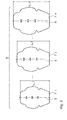
- a set 6 with back protectors 7_1, 7_i to 7_n is provided, wherein the letter “i” designates a running index and the letter “n” designates the number of protectors 7_i of the set 6.
- Fig. 2 For the sake of simplicity of illustration, only one part of the protectors 7_i, namely a damping element to be placed in the region of the backbone, is shown.
- the back protectors 7_1, 7_i to 7_n of the set 6 each have a different size. In particular, they have a different protector length L_1, L_i or L_n measured in the longitudinal direction of a central longitudinal axis 8.
- Each of the back protectors 7_1, 7_i to 7_n is associated with a portion of the chin-to-belly distance D_KB.
- the adaptation of the suitable back protector 2 then takes place in such a way that from the set 6 of the back protectors 7_1, 7_i to 7_n that back protector 7_i is selected which is designed for a chin-belly button spacing area comprising the measured chin-belly button distance D_KB.
- the selection or adaptation of the suitable back protector 2 thus does not take place on the basis of the back length D_R, which is difficult to detect, but on the basis of the chin-navel distance D_KB, which is much easier to determine, although these two lengths - as well as in FIG Fig. 1 indicated schematically - do not coincide identically.
- the back protector 2 can be selected or adjusted on the basis of the auxiliary size of the chin-belly button distance D_KB so that the protective function of the back is ensured very well. Due to the easy and reproducible chin-navel distance D_KB, the adaptation or the selection of the back protector 2 is simplified considerably.
- the eight back protectors 7_i are each designed for a range of the chin-to-belly distance D_KB to be measured. This range is based on the height H of the person 1 to be protected.
- the average height H for a male adult average person is 178 cm, the mean chin-to-belly distance K_DB for such an average person is about 490 mm.
- For the body height H areas are determined, each associated with a size of the back protector 7_i. These regions of body height H each extend over twelve cm in the exemplary embodiment, although this is not a mandatory value. Basically, other body size ranges can be used.
- the assignments of the sizes of the back protectors 7_i listed in the following table with the aid of the abovementioned formula relationship can be determined to the respective relevant range of the chin-belly button distance D_KB: Size of the back protector 7_i 1 2 3 4 5 6 7 8th Range for height H in cm ⁇ 128 128 to 140 140 to 152 152 to 164 164 to 176 176 to 188 188 to 200 ⁇ 200 Chin-navel distance range D_KB in mm ⁇ 352.4 352.4 to 385.4 385.4 to 418.4 418.4 to 451.5 451.5 to 484.5 484.5 to 517.5 517.5 to 550.6 ⁇ 550.6
- the back protectors 7_i are motorcycle back protectors. Similar phrases with in particular also a total of eight different sized back protectors can also be specified for applications in the field of skiing, snowboarding or mountain biking. In these applications, the same or similar areas for the chin-to-belly distance D_KB can be used as an assignment to the respective sizes of the back protectors. In principle, however, other applications are conceivable in which the set of back protectors is divided differently and, above all, includes a different number of individual protectors. An example of this is the equestrian area. In particular, when used in this field, the kit should include more than eight different sizes of individual protectors to best meet all riding-specific requirements and, in particular, to meet the requirements of EN 13158-2000 regarding the size of the protection zones.
Landscapes
- Health & Medical Sciences (AREA)
- Engineering & Computer Science (AREA)
- Textile Engineering (AREA)
- Orthopedic Medicine & Surgery (AREA)
- General Health & Medical Sciences (AREA)
- Physical Education & Sports Medicine (AREA)
- Life Sciences & Earth Sciences (AREA)
- Biophysics (AREA)
- Professional, Industrial, Or Sporting Protective Garments (AREA)
- Orthopedics, Nursing, And Contraception (AREA)
Applications Claiming Priority (1)
| Application Number | Priority Date | Filing Date | Title |
|---|---|---|---|
| DE102011084971A DE102011084971B3 (de) | 2011-10-21 | 2011-10-21 | Verfahren zur Anpassung eines Rückenprotektors |
Publications (1)
| Publication Number | Publication Date |
|---|---|
| EP2583575A1 true EP2583575A1 (fr) | 2013-04-24 |
Family
ID=47080344
Family Applications (1)
| Application Number | Title | Priority Date | Filing Date |
|---|---|---|---|
| EP12189189.9A Withdrawn EP2583575A1 (fr) | 2011-10-21 | 2012-10-19 | Procédé destiné à lýadaptation dýune protection pour le dos |
Country Status (2)
| Country | Link |
|---|---|
| EP (1) | EP2583575A1 (fr) |
| DE (1) | DE102011084971B3 (fr) |
Citations (1)
| Publication number | Priority date | Publication date | Assignee | Title |
|---|---|---|---|---|
| EP2062487A2 (fr) * | 2007-11-20 | 2009-05-27 | Planet Knox Limited | Protège-dos |
Family Cites Families (2)
| Publication number | Priority date | Publication date | Assignee | Title |
|---|---|---|---|---|
| DE4415876C2 (de) * | 1994-05-05 | 1998-05-20 | Bayerische Motoren Werke Ag | Rückenprotektor |
| TWI235041B (en) * | 2004-12-09 | 2005-07-01 | Univ Tsinghua | Characteristic points automatically identification method for three-dimensional space scanning data of human body |
-
2011
- 2011-10-21 DE DE102011084971A patent/DE102011084971B3/de not_active Expired - Fee Related
-
2012
- 2012-10-19 EP EP12189189.9A patent/EP2583575A1/fr not_active Withdrawn
Patent Citations (1)
| Publication number | Priority date | Publication date | Assignee | Title |
|---|---|---|---|---|
| EP2062487A2 (fr) * | 2007-11-20 | 2009-05-27 | Planet Knox Limited | Protège-dos |
Non-Patent Citations (4)
| Title |
|---|
| ANONYMOUS: "Gappay Jackets and Vests", 3 April 2009 (2009-04-03), XP002690982, Retrieved from the Internet <URL:http://www.sundogsgear.com/GAPPAY/GPYvests.htm> [retrieved on 20130124] * |
| ANONYMOUS: "Knox 'how to measure for a back protector' Video", 4 June 2009 (2009-06-04), XP055052705, Retrieved from the Internet <URL:http://www.youtube.com/watch?v=BZP5NowGplg> [retrieved on 20130125] * |
| ANONYMOUS: "Knox Size Guide for Back Protectors", 4 June 2009 (2009-06-04), XP055051128, Retrieved from the Internet <URL:http://store.planet-knox.com/pdf/fitting-chart.pdf> [retrieved on 20130125] * |
| ANONYMOUS: "Sundogs Training Gear offering specialized and custom products for sport and working dogs", 3 April 2009 (2009-04-03), XP002691855, Retrieved from the Internet <URL:http://www.sundogsgear.com/> [retrieved on 20130124] * |
Also Published As
| Publication number | Publication date |
|---|---|
| DE102011084971B3 (de) | 2012-12-20 |
Similar Documents
| Publication | Publication Date | Title |
|---|---|---|
| EP0239659B1 (fr) | Plaquette nasale souple pour monter dans une monture de lunettes | |
| EP0168498A1 (fr) | Lentilles speciales pour lunettes | |
| DE29911641U1 (de) | Wasserdichte Schwimmbrille | |
| AT11119U1 (de) | Sicherheitsbrille für reinräume und verfahren zu ihrer befestigung | |
| Helming et al. | Forschen für nachhaltige Entwicklung: Kriterien für gesellschaftlich verantwortliche Forschungsprozesse | |
| DE202020103575U1 (de) | Gesichtsschutz | |
| DE102010032193A1 (de) | Verfahren und Vorrichtung zur Bestimmung der Augentorsion | |
| DE102016001662A1 (de) | Verwendung eines Verfahrens zur Herstellung eines Protektors für ein Körperteil eines Menschen oder eines Tieres | |
| Froehlich | Handlungsmotive bei Herodot | |
| DE102011084971B3 (de) | Verfahren zur Anpassung eines Rückenprotektors | |
| Keil | Naturalismus und Intentionalität | |
| EP2097141A1 (fr) | Harnais de protection de la veine fémorale | |
| Maschwitz et al. | Hochschule digital?! | |
| Vókó | Europäisches Strafvollzugsrecht | |
| DE102020116331B4 (de) | Gesichtsschutz | |
| Halberschmidt et al. | Psychologische Schulsportunfallforschung | |
| DE202015100942U1 (de) | Identitätserkennungssystem | |
| DE202019106147U1 (de) | Sehlösung für Narrenmasken | |
| Häfner et al. | Simultane Beobachtungen der alten Nova RR Pictoris | |
| Burghardt | Revolution und Religion in Boris Pasternaks Roman Doktor Shiwago | |
| May | Gemeinwesen-und Sozialraumorientierung | |
| Haman | Expandierende Hüllen heißer Sterne: Ein empirisches Modell für Tau Scorpii | |
| Seifferth | The Sources of Madame Blavatsky’s Writings | |
| Kashchy | Plurizentritität der deutschsprachigen terminologie im amts-und verwaltungsbereich | |
| CH664447A5 (de) | Brillengestell mit einem mittelteil aus naturhorn. |
Legal Events
| Date | Code | Title | Description |
|---|---|---|---|
| PUAI | Public reference made under article 153(3) epc to a published international application that has entered the european phase |
Free format text: ORIGINAL CODE: 0009012 |
|
| AK | Designated contracting states |
Kind code of ref document: A1 Designated state(s): AL AT BE BG CH CY CZ DE DK EE ES FI FR GB GR HR HU IE IS IT LI LT LU LV MC MK MT NL NO PL PT RO RS SE SI SK SM TR |
|
| AX | Request for extension of the european patent |
Extension state: BA ME |
|
| STAA | Information on the status of an ep patent application or granted ep patent |
Free format text: STATUS: THE APPLICATION IS DEEMED TO BE WITHDRAWN |
|
| 18D | Application deemed to be withdrawn |
Effective date: 20131025 |