EP2584190A2 - Nacelle et tour de levage - Google Patents
Nacelle et tour de levage Download PDFInfo
- Publication number
- EP2584190A2 EP2584190A2 EP12188486.0A EP12188486A EP2584190A2 EP 2584190 A2 EP2584190 A2 EP 2584190A2 EP 12188486 A EP12188486 A EP 12188486A EP 2584190 A2 EP2584190 A2 EP 2584190A2
- Authority
- EP
- European Patent Office
- Prior art keywords
- tower sections
- wind turbine
- tower
- nacelle
- elements
- Prior art date
- Legal status (The legal status is an assumption and is not a legal conclusion. Google has not performed a legal analysis and makes no representation as to the accuracy of the status listed.)
- Withdrawn
Links
- 238000000034 method Methods 0.000 claims abstract description 88
- 230000006835 compression Effects 0.000 claims description 2
- 238000007906 compression Methods 0.000 claims description 2
- 230000008569 process Effects 0.000 description 15
- 238000009434 installation Methods 0.000 description 14
- 230000005484 gravity Effects 0.000 description 9
- 230000008878 coupling Effects 0.000 description 5
- 238000010168 coupling process Methods 0.000 description 5
- 238000005859 coupling reaction Methods 0.000 description 5
- 238000012546 transfer Methods 0.000 description 5
- 230000008901 benefit Effects 0.000 description 4
- 230000006870 function Effects 0.000 description 3
- 238000012423 maintenance Methods 0.000 description 3
- 230000000087 stabilizing effect Effects 0.000 description 3
- 230000005611 electricity Effects 0.000 description 2
- 238000004519 manufacturing process Methods 0.000 description 2
- 230000007246 mechanism Effects 0.000 description 2
- 238000012986 modification Methods 0.000 description 2
- 230000004048 modification Effects 0.000 description 2
- XLYOFNOQVPJJNP-UHFFFAOYSA-N water Substances O XLYOFNOQVPJJNP-UHFFFAOYSA-N 0.000 description 2
- 229910000831 Steel Inorganic materials 0.000 description 1
- 238000005452 bending Methods 0.000 description 1
- 230000009286 beneficial effect Effects 0.000 description 1
- 238000006243 chemical reaction Methods 0.000 description 1
- 238000010276 construction Methods 0.000 description 1
- 230000001419 dependent effect Effects 0.000 description 1
- 238000011161 development Methods 0.000 description 1
- 238000006073 displacement reaction Methods 0.000 description 1
- 238000009826 distribution Methods 0.000 description 1
- 238000005553 drilling Methods 0.000 description 1
- 230000009977 dual effect Effects 0.000 description 1
- 230000000694 effects Effects 0.000 description 1
- 230000007613 environmental effect Effects 0.000 description 1
- 239000012530 fluid Substances 0.000 description 1
- 230000014759 maintenance of location Effects 0.000 description 1
- 230000007935 neutral effect Effects 0.000 description 1
- 230000008439 repair process Effects 0.000 description 1
- 230000006641 stabilisation Effects 0.000 description 1
- 238000011105 stabilization Methods 0.000 description 1
- 239000010959 steel Substances 0.000 description 1
- 230000000007 visual effect Effects 0.000 description 1
- 238000003466 welding Methods 0.000 description 1
Images






Classifications
-
- B—PERFORMING OPERATIONS; TRANSPORTING
- B66—HOISTING; LIFTING; HAULING
- B66C—CRANES; LOAD-ENGAGING ELEMENTS OR DEVICES FOR CRANES, CAPSTANS, WINCHES, OR TACKLES
- B66C1/00—Load-engaging elements or devices attached to lifting or lowering gear of cranes or adapted for connection therewith for transmitting lifting forces to articles or groups of articles
- B66C1/10—Load-engaging elements or devices attached to lifting or lowering gear of cranes or adapted for connection therewith for transmitting lifting forces to articles or groups of articles by mechanical means
- B66C1/108—Load-engaging elements or devices attached to lifting or lowering gear of cranes or adapted for connection therewith for transmitting lifting forces to articles or groups of articles by mechanical means for lifting parts of wind turbines
-
- E—FIXED CONSTRUCTIONS
- E04—BUILDING
- E04H—BUILDINGS OR LIKE STRUCTURES FOR PARTICULAR PURPOSES; SWIMMING OR SPLASH BATHS OR POOLS; MASTS; FENCING; TENTS OR CANOPIES, IN GENERAL
- E04H12/00—Towers; Masts or poles; Chimney stacks; Water-towers; Methods of erecting such structures
- E04H12/34—Arrangements for erecting or lowering towers, masts, poles, chimney stacks, or the like
- E04H12/342—Arrangements for stacking tower sections on top of each other
-
- F—MECHANICAL ENGINEERING; LIGHTING; HEATING; WEAPONS; BLASTING
- F03—MACHINES OR ENGINES FOR LIQUIDS; WIND, SPRING, OR WEIGHT MOTORS; PRODUCING MECHANICAL POWER OR A REACTIVE PROPULSIVE THRUST, NOT OTHERWISE PROVIDED FOR
- F03D—WIND MOTORS
- F03D13/00—Assembly, mounting or commissioning of wind motors; Arrangements specially adapted for transporting wind motor components
- F03D13/10—Assembly of wind motors; Arrangements for erecting wind motors
-
- Y—GENERAL TAGGING OF NEW TECHNOLOGICAL DEVELOPMENTS; GENERAL TAGGING OF CROSS-SECTIONAL TECHNOLOGIES SPANNING OVER SEVERAL SECTIONS OF THE IPC; TECHNICAL SUBJECTS COVERED BY FORMER USPC CROSS-REFERENCE ART COLLECTIONS [XRACs] AND DIGESTS
- Y02—TECHNOLOGIES OR APPLICATIONS FOR MITIGATION OR ADAPTATION AGAINST CLIMATE CHANGE
- Y02E—REDUCTION OF GREENHOUSE GAS [GHG] EMISSIONS, RELATED TO ENERGY GENERATION, TRANSMISSION OR DISTRIBUTION
- Y02E10/00—Energy generation through renewable energy sources
- Y02E10/70—Wind energy
- Y02E10/72—Wind turbines with rotation axis in wind direction
Definitions
- the subject matter described herein relates generally to methods and systems for wind turbines, and more particularly, to methods and systems for lifting one or more tower sections of a wind turbine, or one or more tower sections of a wind turbine preassembled to a nacelle in on- and offshore environments.
- the electricity generated from wind by the construction and operation of clean, environmental and resource friendly wind turbines may be referred to as on- or offshore wind power depending on the environment in which the wind turbine is operating.
- Installing wind turbines in such environments usually requires specialized equipment and machinery such as lifting cranes capable of hoisting bulky objects with heavy loads.
- At least some known wind turbines include a tower and a nacelle mounted on the tower.
- a rotor is rotatably mounted to the nacelle and is coupled to a generator by a shaft.
- a plurality of blades extend from the rotor. The blades are oriented such that wind passing over the blades turns the rotor and rotates the shaft, thereby driving the generator to generate electricity.
- Wind turbines developed for onshore use are usually assembled on site where the wind turbine will operate.
- method for hoisting one or more tower sections of a wind turbine, wherein the one or more tower sections include an uppermost flange includes: attaching one or more linking elements inside the one or more tower sections below the uppermost flange; and hoisting the one or more tower sections using a hoisting machine that is connected with the one or more tower sections by the one or more linking elements.
- a method for hoisting one or more tower sections of a wind turbine preassembled to a nacelle, wherein the one or more tower sections include an uppermost flange includes: attaching one or more linking elements inside the one or more tower sections at or below the uppermost flange; and hoisting the one or more tower sections preassembled with a nacelle using a hoisting machine that is connected with the one or more tower sections by the one or more linking elements.
- a wind turbine tower section in yet another aspect, includes a flange and one or more attaching elements, wherein the attaching elements are attached on the inside of the tower section below an uppermost flange.
- Various of the methods described herein facilitate hoisting one or more tower sections of a wind turbine or one or more tower sections of a wind turbine preassembled to a nacelle in on- or offshore environments.
- one or more tower sections of a wind turbine or one or more tower sections of a wind turbine preassembled to a nacelle are hoisted by one, two, three or more linking elements that are attached at or below the uppermost flange or pair of flanges.
- the lifting load on the portions of the wind turbine above the attachment points of the linking elements is effectively absent.
- the linking elements may be attached to such flanges at or below the uppermost flange of a tower section. Attachment of the linking elements may be done by attaching elements, which are for instance lifting lugs that are permanently or removably attached to the flanges. In particular, compared to known hoisting methods, loading the lower flanges with the weight avoids that the thinner and more fragile upper tower parts carry the entire tower or turbine load during hoisting.
- the hoisting method described herein may be used to assemble or erect, maintain or disassemble wind turbines in a quick and cost efficient manner.
- wind turbine is intended to be representative of any device that generates rotational energy from wind energy, and more specifically, converts kinetic energy of wind into mechanical energy.
- blade is intended to be representative of any device that provides a reactive force when in motion relative to a surrounding fluid.
- the term "craft” is intended to be representative of any vessel capable of transporting a wind turbine or, one or more tower sections thereof. However, the term “craft” may also be representative of a vessel capable of transporting any one or more of hoisting machine or lifting equipment. Additionally, the wind turbine or, one or more tower sections thereof and one or more of the lifting machine or equipment may be transported by a single vessel. As used herein, the term “hoisting machine” is intended to be representative of any machine or device capable of hoisting a wind turbine or, one or more tower sections thereof.
- wind generator is intended to be representative of any wind turbine that generates electrical power from rotational energy generated from wind energy, and more specifically, converts mechanical energy converted from kinetic energy of wind to electrical power.
- uppermost flange is intended to be representative of the upper most flange or pair of flanges of the uppermost wind turbine tower section.
- linking element is intended to be representative of any one or more of for example lifting cables, chains, slings or any one ore more hoisting aids such as for instance rods and cross bars.
- attachment element is intended to be representative of any feature, such as for example lifting lugs that enable attachment of the linking elements to the nacelle or tower section as described herein.
- top edge is intended to be representative of the uppermost edge of one or more tower sections of a wind turbine, which are in the upright position.
- below the top edge is intended to be representative of the location below the uppermost edge of one or more tower sections, which are in the upright position.
- the term "guiding elements" is intended to be representative of elements that are capable of guiding the linking elements to their place of attachment or capable of exerting a perpendicular force to the linking elements.
- Such guiding elements usually do not support loads in the vertical direction, i.e. the guiding elements are typically not designed for being points of attachment for the linking elements and therefore are generally not able to carry the loads of one or more tower sections of a wind turbine, or one or more tower sections of a wind turbine preassembled to a nacelle during the hoisting process.
- the guiding elements may be designed to withstand heavy loads of, for example, at least one of the tower sections.
- the guiding elements further, may secure the linking elements in position. Additionally, they usually are capable of withstanding large horizontal forces exerted on them by for example the linking elements.
- the routing angle of the linking elements may be up to 60°, more typically 15° or less.
- wind turbines may be pre-assembled fully or partially ashore (i.e. inland or close to the coast) and brought to their offshore site of operation by a transport and installation craft and then, if necessary, assemblage is completed on site.
- wind turbines may be fully assembled on site, i.e. the wind turbine parts may be transported by a craft and assembled fully on site.
- the embodiments described herein include a cost effective wind turbine hoisting method that allows hosting one or more tower sections of a wind turbine, or one or more tower sections of a wind turbine preassembled to a nacelle by attaching linking elements inside the one or more tower sections, at or below the uppermost flange or pair of flanges of the one or more tower sections. Further, embodiments described herein, enable hoisting only the nacelle of a wind turbine by attaching the linking elements inside the nacelle or by guiding the linking elements through the inside of the nacelle and attaching them at the bottom of or below the nacelle. The load on the more fragile upper portions of the wind turbine nacelle or, in particular on the uppermost flange of one or more tower sections may be reduced.
- the hoisting method described herein is not only helpful if one lifts nacelle with one or more tower sections attached to it but also, for instance, if one or more tower sections (not yet attached to the nacelle) are hoisted. In such a case, loading a lower flange with the weight removes any tensile stress from the thinner upper flange(s).
- a further advantage includes that the amount of flanges used in the wind turbine tower may be reduced due to a better load distribution on the tower sections and in particular due to a reduced load on connected flanges of the tower sections during the lifting process.
- this hoisting method allows a single hook-lift with a single crane.
- Existing methods for hoisting wind turbines typically include two cranes. Since a fully pre-assembled wind turbine may be hoisted by the method herein, the time required for installation, maintenance and repair of wind turbines may be reduced. For instance, one could move the fully assembled wind turbine, which includes the attached rotors to a harbor where it may be mounted on a foundation, repaired or tested before being transported offshore and installed at its site of operation. Further advantages are: reduced volume and weight of assembling equipment, which, for instance, results from the possibility of using only one crane to perform the hoisting method described herein. This aspect is particularly relevant in offshore scenarios, since in such cases, the assembling equipment needs to be transported to the site where the wind turbine is installed for operation.
- the hoisting method described herein may employ just a single crane it is very cost effective, especially, when installing wind turbines in on- or, more particularly, offshore wind farms.
- Wind farms are typically numerous wind turbines spaced apart.
- a method for erecting a plurality of wind turbines in a wind farm or a method, particularly beneficial for serial use is disclosed.
- the one or more tower sections of a wind turbine, or one or more tower sections of a wind turbine preassembled to a nacelle or preassembled wind turbine (eventually including a foundation or support system) or nacelle of a wind turbine, if necessary, are brought into an upright position.
- linking elements may be attached to the tower section or nacelle during pre-assembly or before the hoisting process is started.
- linking elements may be attached to the tower section or nacelle before or after the one or more tower sections of a wind turbine, or one or more tower sections of a wind turbine preassembled to a nacelle or preassembled wind turbine (eventually including a foundation or support system) or nacelle of a wind turbine have been brought into the upright position.
- the guiding elements may be designed to withstand exceptionally heavy loads. For instance, in the case where the guiding elements and the linking elements are attached to the tower section before hoisting the one or more tower sections of a wind turbine, or one or more tower sections of a wind turbine preassembled to a nacelle or preassembled wind turbine (eventually including a foundation or support system) from a horizontal or non-vertical position.
- the guiding elements should be capable of carrying the load of the one or more tower sections of a wind turbine or one or more tower sections of a wind turbine preassembled to a nacelle or preassembled wind turbine (eventually including a foundation or support system) whilst they are maneuvered into a vertical position.
- linking elements are guided by guiding elements, of which non-limiting examples include pulleys or rollers.
- the guiding elements can be positioned or attached, permanently or removably on or below the top edge of a wind turbine tower section or on the in- or outside of the nacelle.
- the linking elements or guiding elements may be interconnected inside or above a tower section, or inside or above the nacelle of a wind turbine.
- the guiding elements may not be connected to a tower section or nacelle such that guiding of the linking elements may take place without touching the tower, nacelle or any other machinery of the wind turbine.
- employing guiding elements reduces the amount of strain or wear on the linking elements, which is caused by contact with parts of the wind turbine during the hoisting process.
- excessive bending of the linking elements due to obstructing parts of the one or more tower sections of a wind turbine, or one or more tower sections of a wind turbine preassembled to a nacelle or preassembled wind turbine may be avoided.
- the chance of damaging the one or more tower sections of a wind turbine, or one or more tower sections of a wind turbine preassembled to a nacelle or preassembled wind turbine may be reduced.
- reduced horizontal reaction forces are induced on the linking elements due to the guiding elements that may be positioned to reduce the angle at which the linking elements are attached to the tower section or nacelle.
- the one or more tower sections of a wind turbine or one or more tower sections of a wind turbine preassembled to a nacelle or preassembled wind turbine (eventually including a foundation or support system) or nacelle of a wind turbine may be lifted using a hoisting machine such as, but not limited to a lifting crane.
- the linking elements may be attached to the hoisting machine by one or more lifting hooks.
- Further embodiments include the use of a spreader, for example in the form of a spreader beam.
- the spreader beam may function as a stabilizing element during the hoisting process and also provides spaced apart attachment points for the linking elements.
- a method of hoisting one or more tower sections of a wind turbine as described herein or, one or more tower sections of a wind turbine preassembled to a nacelle includes attaching linking elements below the uppermost flange of the one or more tower sections.
- the linking elements it is possible to attach one or more of the linking elements to the one or more tower sections of a wind turbine or one or more tower sections of a wind turbine preassembled to a nacelle or the nacelle of a wind turbine below the center of gravity.
- the partly assembled or fully assembled wind turbine or one or more tower sections thereof or nacelle may need to be stabilized in the vertical direction.
- a non-limiting example for stabilizing the partly assembled or fully assembled wind turbine or one or more tower sections thereof or nacelle includes, attaching the guiding element above the center of gravity.
- the equilibrium of moments around the horizontal axis should be ensured to enable vertical stabilization of the one or more tower sections of a wind turbine or one or more tower sections of a wind turbine preassembled to a nacelle or nacelle of a wind turbine that is/are being hoisted.
- All of the above embodiments with regard to attaching the linking elements to the tower section or nacelle may employ two or more linking elements, which are positioned between the shackle of the hoisting machine and the one or more tower sections or nacelle of a wind turbine.
- specialized guiding elements which for example surround the tower section on the outside or inside may be employed. Such guiding elements may stabilize the wind turbine or one or more tower sections thereof in the vertical position and guide the linking elements.
- the linking elements When the linking elements are attached inside of a tower section, care should be taken whilst positioning them, especially in the case when hoisting a fully pre-assembled wind turbine. It may generally be necessary that the linking elements are brought through the nacelle into the tower section. To facilitate access of the linking elements to the tower section, the nacelle may be displaced from a functional to a temporarily non-functional position.
- one or more of the gear box, yaw system, converters, platforms or electric generator in the nacelle may be displaced to facilitate the entry of the linking elements into the tower section or into or below the nacelle.
- One or more of the gear box, yaw system, converters, platforms or electric generator may be replaced before the hoisting process begins. Detaching the linking elements after the hoisting process has completed, may again require displacing and replacing said wind turbine elements. Wind turbine elements may be replaced after the hoisting process has completed and once the linking elements have been removed from the nacelle.
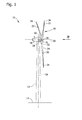
- Fig. 1 is a perspective view of an exemplary wind turbine 10.
- wind turbine 10 is a horizontal-axis wind turbine.
- wind turbine 10 may be a vertical-axis wind turbine.
- wind turbine 10 includes a tower 12 that extends from a support system 14, a nacelle 16 mounted on tower 12, and a rotor 18 that is coupled to nacelle 16.
- Rotor 18 includes a rotatable hub 20 and at least one rotor blade 22 coupled to and extending outward from hub 20.
- rotor 18 has three rotor blades 22.
- rotor 18 includes more or less than three rotor blades 22.
- tower 12 is fabricated from tubular steel to define a cavity (not shown in Fig. 1 ) between support system 14 and nacelle 16.
- tower 12 is any suitable type of tower having any suitable height.
- Rotor blades 22 are spaced about hub 20 to facilitate rotating rotor 18 to enable kinetic energy to be transferred from the wind into usable mechanical energy, and subsequently, electrical energy.
- Rotor blades 22 are mated to hub 20 by coupling a blade root portion 24 to hub 20 at a plurality of load transfer regions 26.
- Load transfer regions 26 have a hub load transfer region and a blade load transfer region (both not shown in Fig. 1 ). Loads induced to rotor blades 22 are transferred to hub 20 via load transfer regions 26.
- rotor blades 22 have a length ranging from about 15 meters (m) to about 91 m.
- rotor blades 22 may have any suitable length that enables wind turbine 10 to function as described herein.
- other non-limiting examples of blade lengths include 10 m or less, 20 m, 37 m, or a length that is greater than 91 m.
- rotor 18 is rotated about an axis of rotation 30.
- rotor blades 22 are also subjected to various forces and moments. As such, rotor blades 22 may deflect and/or rotate from a neutral, or non-deflected, position to a deflected position.
- Fig. 2 is an enlarged sectional view of a portion of wind turbine 10.
- wind turbine 10 includes nacelle 16 and hub 20 that is rotatably coupled to nacelle 16. More specifically, hub 20 is rotatably coupled to an electric generator 42 positioned within nacelle16 by rotor shaft 44 (sometimes referred to as either a main shaft or a low speed shaft), a gearbox 46, a high speed shaft 48, and a coupling 50.
- rotor shaft 44 is disposed coaxial to longitudinal axis 116. Rotation of rotor shaft 44 rotatably drives gearbox 46 that subsequently drives high speed shaft 48.
- High speed shaft 48 rotatably drives generator 42 with coupling 50 and rotation of high speed shaft 48 facilitates production of electrical power by generator 42.
- Gearbox 46 and generator 42 are supported by a support 52 and a support 54.
- gearbox 46 utilizes a dual path geometry to drive high speed shaft 48.
- Other variants include one, or more preferably 3 or more planetary gears employed to drive the high speed shaft 48.
- rotor shaft 44 is coupled directly to generator 42 with coupling 50.
- Nacelle 16 also includes a yaw drive mechanism 56 that may be used to rotate nacelle 16 and hub 20 on yaw axis 38 (shown in Fig. 1 ) to control the perspective of rotor blades 22 with respect to direction 28 of the wind.
- Nacelle 16 also includes at least one meteorological mast 58 that includes a wind vane and anemometer (neither shown in Fig. 2 ). Mast 58 provides information to control system 36 that may include wind direction and/or wind speed.
- nacelle 16 also includes a main forward support bearing 60 and a main aft support bearing 62.
- Forward support bearing 60 and aft support bearing 62 facilitate radial support and alignment of rotor shaft 44.
- Forward support bearing 60 is coupled to rotor shaft 44 near hub 20.
- Aft support bearing 62 is positioned on rotor shaft 44 near gearbox 46 and/or generator 42.
- nacelle 16 includes any number of support bearings that enable wind turbine 10 to function as disclosed herein.
- Rotor shaft 44, generator 42, gearbox 46, high speed shaft 48, coupling 50, and any associated fastening, support, and/or securing device including, but not limited to, support 52 and/or support 54, and forward support bearing 60 and aft support bearing 62, are sometimes referred to as a drive train 64.
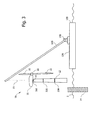
- Fig. 3 shows hoisting pre-assembled wind turbine 10 in an offshore environment according to some embodiments described herein.
- Wind turbine 10 may be pre-assembled ashore and transported by a craft 120 over a body of water 2 to its offshore destination.
- Wind turbine 10 may be transported in an upright position, which may facilitate the hoisting method in offshore environments.
- a support system 14, which anchors the wind turbine to a particular location, is provided.
- linking element 19 is brought into position inside a tower section of wind turbine 10.
- Linking element 19 may be attached inside the tower section before transport, or during or after pre-assembly of the wind turbine.
- linking element 19 is attached to uppermost flange 310 of the uppermost tower section of wind turbine 10.
- Non-limiting examples of attachment include lifting lugs or cross beams as shown in Fig. 13 to 16 , described in more detail below.
- the lugs or cross beams include a straight drilling to which one applies a D-shackle.
- the linking element may be attached to the D-shackle by lifting aids, such as for instance lifting hooks.
- lifting lugs 15 may be attached permanently to the tower section or removed after installation. Permanent installations typically include welding attaching elements to a portion of a tower section, whereas removable installations typically include screwing attaching elements to a portion of a tower section, such as for instance to a flange.
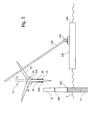
- Fig. 4 shows how wind turbine 10 is hoisted in an offshore environment.
- Lifting elements 19 are attached to the inside, and below uppermost flange 310 of wind turbine tower 12.
- the linking elements 19 are attached to lifting lugs 15.
- the lifting lugs are permanently or removably attached, in this particular embodiment, to the third flange 330.
- a spreader 13 may be used during the hoisting process. Further embodiments may include attaching the linking elements inside the bottom, middle or top section of the tower.
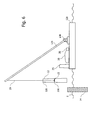
- Fig. 5 shows how one tower section 25 preassembled to nacelle 16 is hoisted in an offshore environment.
- Nacelle 16 includes rotor hub 20 and rotor blades 22, which are preassembled ashore or on deck 126 before or after transport to the site of operation of the wind turbine.
- Linking elements 19 are attached to lifting lugs 15, which are permanently or removably attached to flange 320.
- a spreader 13 may be used to ensure that the lifting point is vertically above the center of gravity of the one tower section 25 preassembled to nacelle 16.
- Fig. 6 shows how a wind turbine is partly assembled on site, offshore at the location of its operation.
- two tower sections are hoisted using linking element 19.
- linking element 19 is attached via lifting lugs 15 to flange 330 inside the shown tower section 12.
- the tower section 12 consists of two pre-assembled tower sections.
- flange 330 carries the entire load whilst flange 320 or any flange above flange 330 experiences no tensile stress.
- a similar hoisting method is used to bring tower section 25, pre-assembled nacelle 16 and rotor hub 20, and rotor blades 22 (not shown in Fig. 6 ) into position.
- These wind turbine parts may either be brought into position separately or pre-assembled ashore or on deck 126 and hoisted as such.
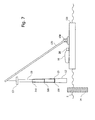
- Fig. 7 shows how a wind turbine is partly assembled on site, offshore at the location of its operation.
- three tower sections preassembled to each other are hoisted.
- Linking elements 19 attach to the inside of the tower section 12.
- Lifting lugs 15 are permanently or removably attached to the third flange 330.
- a spreader 13 may be used in order to minimize horizontal forces of linking elements 19 from acting on tower section 12.
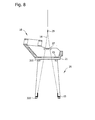
- Figs. 8 and 9 are cross-sectional illustrations of nacelle 16 and upper tower section 25 of wind turbine 10, showing in more detail how linking elements 19 can be positioned inside the tower section for hoisting a pre-assembled wind turbine or parts thereof.
- the wind turbine or parts thereof are suspended from a crane arm using a single lifting hook 29.
- Linking elements 19 are brought into position and attached inside of tower section 25.
- Linking elements 19 go through yaw bearing 23 and base plate 21, if any, into the tower and are attached to the tower via lifting lugs 15.
- Lifting lugs 15 may be positioned on, above or below flange 320.
- One or more guiding elements 27 may be positioned anywhere within or on top of nacelle 16 to direct and maintain linking elements 19 in a predetermined position. Guiding elements such as for instance cross bars may be attached to yaw bearing 23. Figures 17 and 18 , described in more detail below, illustrate examples of how the linking elements may be kept in position during the hoisting method. Further, the use of guiding elements may reduce the likelihood of damage caused to the wind turbine or linking elements, for example due to friction at unwanted contact points between wind turbine and linking elements. In addition, guiding elements 27 may be positioned in such a way that linking elements 19 avoid obstacles within nacelle 16.
- Fig. 9 shows a further embodiment, wherein lifting lugs 15 are attached away from flange 320 closer to nacelle 16.
- attaching elements may be attached further down the wind turbine tower.
- the force introduction on the tower wall may need to be compensated by for example increasing the wall thickness of the tower or by providing an extra flange to which the attaching elements may be attached.
- the attaching elements are usually attached to pre-existing stiffening members such as for instance a pre-existing flange or pair of flanges.
- theta routing angles ( ⁇ ) may increase the strain on guiding elements 27 or on linking elements 19. Horizontal forces exerted on linking elements are usually reduced when the linking elements are attached further down the tower.
- Theta angles ( ⁇ ) may be optimized by changing the horizontal spacing between guiding elements 27 or their vertical position within nacelle 16. However, the theta angle ( ⁇ ) lies between 0 and 30 degrees and more preferably between 0 and 10 degrees.
- Linking elements 19 may be attached to a spreader 13, as illustrated in Fig. 9 , which may be suspended from the lifting crane via a single lifting hook 29.
- the spreader may help to reduce horizontal forces on the linking elements 19 and stabilize the wind turbine during the hoisting process.
- the wind turbine is stabilized by bringing the lifting point vertically above the center of gravity. This is achieved by making the two arms of the spreader different in length.
- gear box 46 may be displaced to facilitate positioning of linking elements 19.
- the gear box may be placed on one side, for example to the left of the linking elements and the electric generator on the right side of the linking elements (not shown in the figures).
- the center of gravity of the wind turbine would be disrupted minimally.
- the displaced elements may be replaced after the hoisting process has terminated.
- any other nacelle elements such as for instance the brake assembly, yaw system, converters, platforms or rotor shaft may be displaced to allow unhindered entry of linking elements into the tower section of a wind turbine.
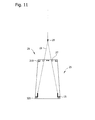
- Fig. 11 and Fig. 12 are cross-sections of tower section 25, showing in more detail how linking elements 19 are positioned inside the tower section during hoisting of one or more tower sections of a wind turbine.
- the attaching elements are attached to a portion, for instance, a flange at the bottom of the one or more tower sections.
- lifting lugs 15 are attached, below the uppermost flange 310, to flange 320 of tower section 25.
- Guiding elements 27 are positioned below the top edge of tower section 25.
- their horizontal position may be varied.
- the guiding elements or linking elements may be interconnected inside or above a tower section or possibly inside or above the nacelle of a wind turbine (not shown in the figs) such that guiding may take place without touching the tower, nacelle or any other machinery of the wind turbine.
- guiding elements may also be positioned at the top edge of one or more tower sections.
- Linking elements 19 are attached to a single hook 29 of the lifting crane.
- Fig. 12 shows another embodiment, wherein lifting lugs 15 are positioned between uppermost flange 310 and lower flange 320 of tower section 25.
- lifting lugs 15 may also be positioned inside a lower tower section thereof and attached, for instance, to a lower flange.
- lifting lugs 15 between lower 320 and upper 310 flange of tower section 25 results in routing angle theta prime ( ⁇ '). Since the weight of a wind turbine tower sections is generally high, large forces act on the linking elements. Hence, guiding elements 27 may be positioned at the top edge of tower section 25 to reduce angle theta prime ( ⁇ '), thereby ensuring that linking elements 19 are safely guided from spreader 13 to lifting lugs 15.
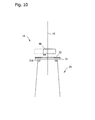
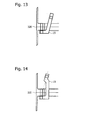
- Figs. 13 to 16 show non-limiting examples of attachment possibilities of lifting lugs 15 to a flange. Furthermore a variety of lifting lugs are shown that may be employed during hoisting. Figs. 13 and 14 show examples of lifting lugs 15 attached to flange 320 of the wind turbine tower sections from underneath. Furthermore, Figs. 13 and 14 show embodiments where different types of lifting lugs are employed depending on the pull force direction exerted on them by the linking elements.
- Fig. 15 shows an embodiment where lifting lugs 15 are attached to flange 330 from above.
- Fig. 16 shows another embodiment where lifting lugs 15, attached to flange 320, are in the shape of a cross bar, which provides extra stability and acts as stiffening element during the hoisting process.
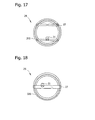
- Figs. 17 and 18 are non-limiting examples of guiding elements 27 attached to wind turbine tower section 25 at flange 310 or 320 respectively.
- Fig. 17 shows two separate guiding elements 27 removably attached to tower section 25.
- Guiding elements 27 have one or more guiding grooves on either side to provide for different positions of the linking elements.
- means for securing the linking elements in the grooves may be for instance shackle elements 21 that are permanently or removably attached to guiding elements 27.
- Shackle elements 21 may further include a fast lock- and opening mechanism to allow for rapid positioning of the linking elements.
- Fig. 18 shows and embodiment for the use of a single guiding element 27 during the hoisting process.
- Fig. 19 is a flow chart of a method for hoisting one or more tower sections of a wind turbine or one or more tower sections of a wind turbine preassembled to the nacelle in on- or offshore environments.
- one or more tower sections of a wind turbine or one or more tower sections of a wind turbine preassembled to the nacelle are provided.
- Linking elements are attached to a wind turbine tower section at or below the uppermost flange of the uppermost tower section, in block 820.
- the one or more tower sections of a wind turbine or one or more tower sections of a wind turbine preassembled to the nacelle may be in a lying down or in an upright position.
- the one or more tower sections of a wind turbine or one or more tower sections of a wind turbine preassembled to the nacelle are in a lying down position, before the hoisting process and according to embodiments of the method herein, the one or more tower sections of a wind turbine or one or more tower sections of a wind turbine preassembled to the nacelle are brought into an upright position.
- the one or more tower sections of a wind turbine or one or more tower sections of a wind turbine preassembled to the nacelle are hoisted by the use of a hoisting machine such as for instance a lifting crane.
- the one or more tower sections of a wind turbine or one or more tower sections of a wind turbine preassembled to the nacelle are brought to their desired location, where final installation or anchorage to the foundation occurs.
- the above-described systems and methods may facilitate an improved, efficient and cost effective hoisting method for assembling, maintaining or disassembling on- and offshore wind turbines.
- Exemplary embodiments of systems and methods for hoisting a wind turbine or, one or more tower sections thereof are described above in detail.
- the systems and methods are not limited to the specific embodiments described herein, but rather, components of the systems and/or steps of the methods may be utilized independently and separately from other components and/or steps described herein.
- components of the systems and/or steps of the methods may be utilized independently and separately from other components and/or steps described herein.
- to lift one or more structures of a vertical wind turbine from the bottom section or below the uppermost flange of the vertical wind turbine or, uppermost flange of the uppermost one or more tower sections thereof and hence are not limited to practice with only the wind turbine systems as described herein.
- the exemplary embodiment can be implemented and utilized in connection with many other rotor blade applications.
Landscapes
- Engineering & Computer Science (AREA)
- Mechanical Engineering (AREA)
- Architecture (AREA)
- Life Sciences & Earth Sciences (AREA)
- Sustainable Development (AREA)
- Sustainable Energy (AREA)
- Chemical & Material Sciences (AREA)
- Combustion & Propulsion (AREA)
- General Engineering & Computer Science (AREA)
- Civil Engineering (AREA)
- Structural Engineering (AREA)
- Wind Motors (AREA)
Applications Claiming Priority (1)
| Application Number | Priority Date | Filing Date | Title |
|---|---|---|---|
| US13/275,687 US20120131876A1 (en) | 2011-10-18 | 2011-10-18 | Hoisting nacelle and tower |
Publications (1)
| Publication Number | Publication Date |
|---|---|
| EP2584190A2 true EP2584190A2 (fr) | 2013-04-24 |
Family
ID=46125705
Family Applications (1)
| Application Number | Title | Priority Date | Filing Date |
|---|---|---|---|
| EP12188486.0A Withdrawn EP2584190A2 (fr) | 2011-10-18 | 2012-10-15 | Nacelle et tour de levage |
Country Status (3)
| Country | Link |
|---|---|
| US (1) | US20120131876A1 (fr) |
| EP (1) | EP2584190A2 (fr) |
| CN (1) | CN103061998A (fr) |
Families Citing this family (19)
| Publication number | Priority date | Publication date | Assignee | Title |
|---|---|---|---|---|
| EP2185816B2 (fr) * | 2007-08-29 | 2021-11-03 | Vestas Offshore Wind A/S | Fondation monopieu pour une éolienne située en mer |
| US8640340B2 (en) * | 2009-05-22 | 2014-02-04 | Keppel Offshore & Marine Technology Centre Pte Ltd | Offshore wind turbine installation |
| WO2014075686A1 (fr) | 2012-11-15 | 2014-05-22 | Vestas Wind Systems A/S | Procédé et dispositif permettant d'aligner des sections tours |
| EP2923017B1 (fr) | 2012-11-15 | 2016-10-26 | Vestas Wind Systems A/S | Section de tour et procédé pour section de tour |
| DE102015000787A1 (de) * | 2015-01-26 | 2016-07-28 | Senvion Gmbh | Lastaufnahmemittel für einen Turm oder eine Turmsektion einer Windenergieanlage und Verfahren zum Errichten einer Windenergieanlage |
| DE102016006571A1 (de) * | 2016-06-01 | 2017-12-07 | Senvion Gmbh | Verfahren zum Errichten einer Windenergieanlage sowie Vorrichtung dafür |
| US20180038350A1 (en) * | 2016-08-08 | 2018-02-08 | General Electric Company | Adapters for wind turbine refurbishment |
| US9982659B1 (en) * | 2017-02-03 | 2018-05-29 | General Electric Company | Methods for refurbishing wind turbines |
| US10570889B2 (en) | 2018-04-23 | 2020-02-25 | General Electric Company | Adaptor for wind turbine refurbishment and associated methods |
| CN109340055A (zh) * | 2018-11-21 | 2019-02-15 | 江苏科技大学 | 一种海上风电机组整体安装方法、软着陆动力控制系统及其方法 |
| US11231017B2 (en) | 2019-03-29 | 2022-01-25 | General Electric Company | System and method for the service and exchange of a yaw bearing for a machine head of a wind turbine |
| EP3771825A1 (fr) * | 2019-08-01 | 2021-02-03 | Siemens Gamesa Renewable Energy A/S | Éolienne et procédé de construction d'une éolienne |
| EP3792486B1 (fr) * | 2019-09-16 | 2026-02-18 | Siemens Gamesa Renewable Energy A/S | Procédé de montage d'une éolienne en mer |
| CN113279917B (zh) * | 2020-02-20 | 2023-03-03 | 江苏金风科技有限公司 | 塔筒段和风力发电机组 |
| EP3868981A1 (fr) * | 2020-02-21 | 2021-08-25 | Siemens Gamesa Renewable Energy A/S | Bride |
| CN114165389A (zh) * | 2021-12-24 | 2022-03-11 | 中交第一航务工程局有限公司 | 一种海上起重船浮态安装风机部件的施工装置及操作方法 |
| CN115285826A (zh) * | 2022-08-08 | 2022-11-04 | 中船重工(上海)节能技术发展有限公司 | 一种风力助推转子内塔起吊装置 |
| CN116534266B (zh) * | 2023-07-06 | 2024-01-05 | 中国电子科技集团公司第二十九研究所 | 一种机载高刚度和轻量化电子吊舱舱体及装配方法 |
| FI20245881A1 (en) * | 2024-07-12 | 2026-01-13 | Norsepower Oy Ltd | Lifting equipment |
Family Cites Families (5)
| Publication number | Priority date | Publication date | Assignee | Title |
|---|---|---|---|---|
| US1918007A (en) * | 1932-08-25 | 1933-07-11 | Lcl Corp | Bottom lift container |
| US3734325A (en) * | 1971-03-31 | 1973-05-22 | Zimmerman D W Mfg | Safety interlock for fluid-operated, load-handling apparatus |
| US6467233B1 (en) * | 2000-11-09 | 2002-10-22 | Beaird Industries, Inc | Wind tower |
| GB2434823A (en) * | 2006-02-06 | 2007-08-08 | Engineering Business Ltd | Transport and installation of offshore structures |
| US7883131B2 (en) * | 2007-10-30 | 2011-02-08 | Machining And Welding By Olsen, Inc. | Crane hook assemblies and methods of use |
-
2011
- 2011-10-18 US US13/275,687 patent/US20120131876A1/en not_active Abandoned
-
2012
- 2012-10-15 EP EP12188486.0A patent/EP2584190A2/fr not_active Withdrawn
- 2012-10-18 CN CN201210397404XA patent/CN103061998A/zh active Pending
Non-Patent Citations (1)
| Title |
|---|
| None |
Also Published As
| Publication number | Publication date |
|---|---|
| CN103061998A (zh) | 2013-04-24 |
| US20120131876A1 (en) | 2012-05-31 |
Similar Documents
| Publication | Publication Date | Title |
|---|---|---|
| EP2584190A2 (fr) | Nacelle et tour de levage | |
| US8240955B2 (en) | Tower segments and method for off-shore wind turbines | |
| EP2505823B1 (fr) | Trame de transport pour unité de moyeu de rotor/nacelle d'une éolienne, procédé de transport et de montage d'une unité de moyeu de rotor/nacelle | |
| CN102282361B (zh) | 具有预装系泊系统的可拆除的海上风轮机 | |
| EP2520792B2 (fr) | Système d'extraction et procédé de fourniture d'un système d'extraction | |
| EP2161394A1 (fr) | Pylône en treillis et procédé d'érection d'une éolienne avec un pylône en treillis | |
| JP2018529890A (ja) | 風力タービンの設置のためのホイスティングシステム | |
| KR101318111B1 (ko) | 파력 저감형 다열 파일 하이브리드 해상풍력 지지구조물 및 그 시공 방법 | |
| US20120027523A1 (en) | Device and method for assembling a structure at sea | |
| JP2015028298A (ja) | 流体力利用構造物 | |
| EP2080899A1 (fr) | Éolienne en mer avec rotor intégré avec fondation flottante et rotative | |
| US9500178B2 (en) | Wind turbine rotor and method of mounting | |
| EP3085958A1 (fr) | Système pour installer un câble dans une tour d'une éolienne et procédé associé | |
| EP2487364A2 (fr) | Navire et procédé pour le montage d'une éolienne en mer | |
| WO2013100441A1 (fr) | Structure de turbine éolienne extracôtière utilisant une base de pilier à tubes en acier et une structure préfabriquée, et son procédé de construction | |
| EP3875753A1 (fr) | Procédé d'installation d'aube d'éolienne | |
| JP6320738B2 (ja) | 風力発電設備および風力発電設備の保守方法 | |
| JP7717245B1 (ja) | 施工システム、および施工方法 | |
| EP4540523B1 (fr) | Procédés d'installation d'une éolienne à rotor supportée par câble | |
| US12497952B2 (en) | Couplings and auxiliary components for wind turbines, and associated methods | |
| US20250250963A1 (en) | Wind turbine blade assembly device for easy installation and removal in vertical position | |
| US11885297B2 (en) | Transitioning wind turbine | |
| KR20130094507A (ko) | 풍력발전기 타워 자체를 이용한 인양식 나셀 설치장치 | |
| Paulsen | Sizing of a spar-type floating support structure for DeepWind | |
| KR20130062008A (ko) | 해상 풍력 발전 단지 |
Legal Events
| Date | Code | Title | Description |
|---|---|---|---|
| PUAI | Public reference made under article 153(3) epc to a published international application that has entered the european phase |
Free format text: ORIGINAL CODE: 0009012 |
|
| AK | Designated contracting states |
Kind code of ref document: A2 Designated state(s): AL AT BE BG CH CY CZ DE DK EE ES FI FR GB GR HR HU IE IS IT LI LT LU LV MC MK MT NL NO PL PT RO RS SE SI SK SM TR |
|
| AX | Request for extension of the european patent |
Extension state: BA ME |
|
| STAA | Information on the status of an ep patent application or granted ep patent |
Free format text: STATUS: THE APPLICATION IS DEEMED TO BE WITHDRAWN |
|
| 18D | Application deemed to be withdrawn |
Effective date: 20150501 |