EP2584338A1 - Détection d'amas de particules magnétiques - Google Patents
Détection d'amas de particules magnétiques Download PDFInfo
- Publication number
- EP2584338A1 EP2584338A1 EP11187706.4A EP11187706A EP2584338A1 EP 2584338 A1 EP2584338 A1 EP 2584338A1 EP 11187706 A EP11187706 A EP 11187706A EP 2584338 A1 EP2584338 A1 EP 2584338A1
- Authority
- EP
- European Patent Office
- Prior art keywords
- cluster
- magnetic field
- detection
- detection signal
- clusters
- Prior art date
- Legal status (The legal status is an assumption and is not a legal conclusion. Google has not performed a legal analysis and makes no representation as to the accuracy of the status listed.)
- Ceased
Links
- 238000001514 detection method Methods 0.000 title claims abstract description 65
- 239000006249 magnetic particle Substances 0.000 title claims abstract description 45
- 230000005291 magnetic effect Effects 0.000 claims abstract description 46
- 238000001228 spectrum Methods 0.000 claims abstract description 11
- 230000002123 temporal effect Effects 0.000 claims abstract description 8
- 239000002245 particle Substances 0.000 claims description 36
- 238000000034 method Methods 0.000 claims description 25
- 230000003595 spectral effect Effects 0.000 claims description 16
- 238000011156 evaluation Methods 0.000 claims description 12
- 239000000523 sample Substances 0.000 description 30
- 230000003287 optical effect Effects 0.000 description 11
- 239000002105 nanoparticle Substances 0.000 description 10
- 238000003556 assay Methods 0.000 description 9
- 108010072866 Prostate-Specific Antigen Proteins 0.000 description 7
- 102100038358 Prostate-specific antigen Human genes 0.000 description 7
- 230000027455 binding Effects 0.000 description 7
- 238000009739 binding Methods 0.000 description 7
- 239000000090 biomarker Substances 0.000 description 6
- 238000002474 experimental method Methods 0.000 description 6
- 238000013459 approach Methods 0.000 description 5
- 239000003795 chemical substances by application Substances 0.000 description 5
- 238000005259 measurement Methods 0.000 description 5
- LMDZBCPBFSXMTL-UHFFFAOYSA-N 1-ethyl-3-(3-dimethylaminopropyl)carbodiimide Chemical compound CCN=C=NCCCN(C)C LMDZBCPBFSXMTL-UHFFFAOYSA-N 0.000 description 4
- 230000009871 nonspecific binding Effects 0.000 description 4
- 230000035945 sensitivity Effects 0.000 description 4
- 239000000243 solution Substances 0.000 description 4
- 238000012360 testing method Methods 0.000 description 4
- 239000000427 antigen Substances 0.000 description 3
- 102000036639 antigens Human genes 0.000 description 3
- 108091007433 antigens Proteins 0.000 description 3
- 239000011324 bead Substances 0.000 description 3
- 230000015572 biosynthetic process Effects 0.000 description 3
- 230000001419 dependent effect Effects 0.000 description 3
- 238000003018 immunoassay Methods 0.000 description 3
- 239000002122 magnetic nanoparticle Substances 0.000 description 3
- 125000000896 monocarboxylic acid group Chemical group 0.000 description 3
- 108010090804 Streptavidin Proteins 0.000 description 2
- 238000002820 assay format Methods 0.000 description 2
- 230000008901 benefit Effects 0.000 description 2
- 210000004027 cell Anatomy 0.000 description 2
- 238000010586 diagram Methods 0.000 description 2
- 230000000694 effects Effects 0.000 description 2
- 210000001723 extracellular space Anatomy 0.000 description 2
- 239000012530 fluid Substances 0.000 description 2
- 238000000338 in vitro Methods 0.000 description 2
- 230000002452 interceptive effect Effects 0.000 description 2
- 239000000463 material Substances 0.000 description 2
- 239000000203 mixture Substances 0.000 description 2
- 230000036962 time dependent Effects 0.000 description 2
- 206010060862 Prostate cancer Diseases 0.000 description 1
- 208000000236 Prostatic Neoplasms Diseases 0.000 description 1
- 241000700605 Viruses Species 0.000 description 1
- 230000001133 acceleration Effects 0.000 description 1
- 238000005054 agglomeration Methods 0.000 description 1
- 230000002776 aggregation Effects 0.000 description 1
- 238000004458 analytical method Methods 0.000 description 1
- 239000012490 blank solution Substances 0.000 description 1
- 230000001413 cellular effect Effects 0.000 description 1
- 230000008859 change Effects 0.000 description 1
- 125000003636 chemical group Chemical group 0.000 description 1
- 238000006243 chemical reaction Methods 0.000 description 1
- 239000011248 coating agent Substances 0.000 description 1
- 238000000576 coating method Methods 0.000 description 1
- 239000002131 composite material Substances 0.000 description 1
- 230000008878 coupling Effects 0.000 description 1
- 238000010168 coupling process Methods 0.000 description 1
- 238000005859 coupling reaction Methods 0.000 description 1
- 230000003247 decreasing effect Effects 0.000 description 1
- 238000011161 development Methods 0.000 description 1
- 238000003745 diagnosis Methods 0.000 description 1
- 239000000539 dimer Substances 0.000 description 1
- 238000002296 dynamic light scattering Methods 0.000 description 1
- 239000011521 glass Substances 0.000 description 1
- 238000005286 illumination Methods 0.000 description 1
- 238000002347 injection Methods 0.000 description 1
- 239000007924 injection Substances 0.000 description 1
- 238000001746 injection moulding Methods 0.000 description 1
- 230000003993 interaction Effects 0.000 description 1
- 239000012528 membrane Substances 0.000 description 1
- 239000011859 microparticle Substances 0.000 description 1
- 238000012544 monitoring process Methods 0.000 description 1
- 230000009022 nonlinear effect Effects 0.000 description 1
- 238000005457 optimization Methods 0.000 description 1
- 229920000642 polymer Polymers 0.000 description 1
- 230000008569 process Effects 0.000 description 1
- 238000012545 processing Methods 0.000 description 1
- 230000004044 response Effects 0.000 description 1
- 238000011896 sensitive detection Methods 0.000 description 1
- 125000006850 spacer group Chemical group 0.000 description 1
- 241000894007 species Species 0.000 description 1
- 230000009870 specific binding Effects 0.000 description 1
- 239000000126 substance Substances 0.000 description 1
- 230000003746 surface roughness Effects 0.000 description 1
- 210000001519 tissue Anatomy 0.000 description 1
Images


Classifications
-
- G—PHYSICS
- G01—MEASURING; TESTING
- G01N—INVESTIGATING OR ANALYSING MATERIALS BY DETERMINING THEIR CHEMICAL OR PHYSICAL PROPERTIES
- G01N21/00—Investigating or analysing materials by the use of optical means, i.e. using sub-millimetre waves, infrared, visible or ultraviolet light
- G01N21/17—Systems in which incident light is modified in accordance with the properties of the material investigated
- G01N21/47—Scattering, i.e. diffuse reflection
- G01N21/49—Scattering, i.e. diffuse reflection within a body or fluid
- G01N21/51—Scattering, i.e. diffuse reflection within a body or fluid inside a container, e.g. in an ampoule
-
- G—PHYSICS
- G01—MEASURING; TESTING
- G01N—INVESTIGATING OR ANALYSING MATERIALS BY DETERMINING THEIR CHEMICAL OR PHYSICAL PROPERTIES
- G01N33/00—Investigating or analysing materials by specific methods not covered by groups G01N1/00 - G01N31/00
- G01N33/48—Biological material, e.g. blood, urine; Haemocytometers
- G01N33/50—Chemical analysis of biological material, e.g. blood, urine; Testing involving biospecific ligand binding methods; Immunological testing
- G01N33/53—Immunoassay; Biospecific binding assay; Materials therefor
- G01N33/543—Immunoassay; Biospecific binding assay; Materials therefor with an insoluble carrier for immobilising immunochemicals
- G01N33/54313—Immunoassay; Biospecific binding assay; Materials therefor with an insoluble carrier for immobilising immunochemicals the carrier being characterised by its particulate form
- G01N33/54326—Magnetic particles
-
- G—PHYSICS
- G01—MEASURING; TESTING
- G01N—INVESTIGATING OR ANALYSING MATERIALS BY DETERMINING THEIR CHEMICAL OR PHYSICAL PROPERTIES
- G01N21/00—Investigating or analysing materials by the use of optical means, i.e. using sub-millimetre waves, infrared, visible or ultraviolet light
- G01N21/17—Systems in which incident light is modified in accordance with the properties of the material investigated
- G01N21/1717—Systems in which incident light is modified in accordance with the properties of the material investigated with a modulation of one or more physical properties of the sample during the optical investigation, e.g. electro-reflectance
- G01N2021/1727—Magnetomodulation
-
- G—PHYSICS
- G01—MEASURING; TESTING
- G01N—INVESTIGATING OR ANALYSING MATERIALS BY DETERMINING THEIR CHEMICAL OR PHYSICAL PROPERTIES
- G01N21/00—Investigating or analysing materials by the use of optical means, i.e. using sub-millimetre waves, infrared, visible or ultraviolet light
- G01N21/17—Systems in which incident light is modified in accordance with the properties of the material investigated
- G01N21/1717—Systems in which incident light is modified in accordance with the properties of the material investigated with a modulation of one or more physical properties of the sample during the optical investigation, e.g. electro-reflectance
Definitions
- the invention relates to a method for the detection of at least one cluster in a sample, wherein the cluster comprises at least one magnetic particle.
- the term "magnetic particle” shall comprise both permanently magnetic particles as well as magnetizable particles, for example superparamagnetic beads.
- the size of the magnetic particles typically ranges between 3 nm and 50 ⁇ m.
- the “clusters” are agglomerates of two or more (magnetic or non-magnetic) particles which are coupled by some kind of binding. Of particular interest are specific (chemical) bindings via special chemical groups and intermediate components of interest and, in contrast thereto, nonspecific bindings that are e.g. merely caused by magnetic attraction forces between magnetized particles.
- the method comprises the following steps, which can be executed in the listed or any other appropriate order:
- the invention relates to a device for the detection of at least one cluster comprising at least one magnetic particle in a sample, said device comprising the following components:
- the method and the device are realizations of a common inventive concept, i.e. the spectral evaluation of a detection signal obtained from actuated clusters. Explanations and definitions provided for one of these realizations are therefore valid for the other realization, too.
- the approach realized by the method and the device allows to gain information which may help to discriminate between clusters of similar, but slightly different, constitution. Surprisingly it is for example possible to distinguish between nonspecifically and specifically bound clusters of two magnetic particles by evaluating (a part of) the frequency content of the detection signal.
- the temporal variation of the magnetic field that acts on the clusters may in general be arbitrary. According to a preferred embodiment, the magnetic field is however varied periodically. The period of this field then provides a basic frequency which reappears in the detection signal. In typical examples, at least one component of the magnetic field may for example be a square wave or a sinusoidal wave.
- the magnetic field rotates at least partially (i.e. at least one component of the field vector rotates at least partially in a given plane, wherein a "partially rotating" time-dependent field has orientations in a limited angular space, e.g. in an angular segment of less than 360°).
- a corresponding rotation of the clusters can be induced.
- the spectral evaluation of the detection signal may particularly comprise the determination of the signal spectral components (Fourier coefficients) at a basic frequency and at least one higher harmonic thereof or at least two higher harmonics of the basic frequency.
- n reflects the n-fold rotation symmetry of the rotating cluster.
- the evaluation of the detection signal may comprise the determination of the ratio between the mentioned signal spectral components at at least two higher harmonics of the basic frequency.
- the ratio between the signal spectral components at 4f and 2f comprises valuable information about two-particle clusters.
- the 4f signal seems to contain information about the gap size whereas the 2f signal does not.
- Use of a ratio is preferable because it is independent of the number of clusters in the sample (which shows variations) and is therefore more accurately describing the properties of the sample.
- the scattered output light may originate from ambient light.
- a technical light source is however provided for emitting input light into the sample. The illumination can then more precisely be controlled. If the clusters to be detected are rotated, the input light may in general come from any direction with respect to the plane of rotation, e.g. perpendicular. Preferably, the input light will however propagate in the plane of rotation.
- the light detector is preferably disposed oblique with respect to the direction of the input light, i.e. at an angle (strictly) between 0° and 180°. Most preferably, an angle of roughly 45° is used (i.e. an angle between about 20° and 60°).
- the clusters to be detected preferably comprise (at least) two particles each (at least one of which is a magnetic particle). Thus a symmetrical configuration is provided for which a rotational movement can be observed.
- the two particles may be specifically bound via an intermediate target component.
- the specificity of this binding is typically used to detect particular target components of interest in a sample by linking them to the (magnetic) particles in a cluster.
- the target component can for example be a biomolecule, which can have a size between a nanometer and several tens of nanometers; or it can be a composite containing several biomolecules; or it can be a larger moiety such as a virus or a small organism; or it can be material derived from a biological cell or from tissue, e.g. material derived from cellular membrane or from the intercellular and/or extracellular space, or e.g. microparticles that are shed by cells.”
- the spectral evaluation of the detection signal is hence preferably applied to infer the distance between these particles and/or to infer the presence or absence of an intermediate target component of the aforementioned kind.
- the possibility to discriminate between clusters with and without an intermediate target component allows to increase the detection accuracy as specifically bound clusters (target signal) can be distinguished from nonspecifically bound clusters (background).
- the observed spectrum of the detection signal will usually depend on the time course of the magnetic field with which movement of the clusters is induced. Accordingly, the temporal course of the magnetic field is preferably optimized such that a high correlation between the spectral characteristics of the detection signal and a parameter of interest is achieved, for example the size of the one or more clusters, or the inter-particle distance, or the nature of the inter-particle bond, or the number of molecular bonds between the particles, or the nature of the molecular architecture on the particle, or the magnetic or optical properties of the particle, or the shape of the particle, or the viscosity or other mechanical properties of the sample. If the temporal course of the magnetic field is determined by a basic frequency, the optimization may for example comprise the determination of an optimal value of this frequency.
- the magnetic particles MP coated with antibodies are provided.
- the antigen AG is added and binds to magnetic particles.
- the sample is exposed to a magnetic field B, causing the formation of particle chains or clusters C.
- the sample is illuminated with a light source L, and the light scattered by the clusters is detected.
- FIG. 2 illustrates a particular sandwich assay format where the magnetic particles MP are coated with different monoclonal antibodies AB1 and AB2.
- the antibodies can specifically bind different sites of the antigen AG, thus forming a two-particle cluster with a sandwich configuration.
- the sensor device 100 further comprises a reader, of which only the most relevant components are schematically sketched. These components comprise:
- the clusters C in the sample volume 111 expose a time-dependent cross-section to the incoming light L1, therefore introducing a modulation of the light intensity scattered by the sample in the output light L2.
- the resulting detection signal S is forwarded to the control and evaluation unit 150.
- a FFT (Fast Fourier Transform) algorithm can be applied there to the recorded signal S.
- the (two-particle) clusters are exposing the same cross-section to the incoming light beam L1 twice per period, therefore generating a modulation of the scattered light L2 at double the frequency f of the magnetic field B. Because of interference and non-linear effects, such modulation also contains features at higher frequencies, as visible in the Fourier spectrum of Figure 5 .
- the amplitude F 2f of the FFT at twice the basic frequency f of the magnetic field is defined as signal, since it showed up as the strongest of all the harmonics.
- the magnitude F 4f of the harmonic at four times the applied frequency i.e. 4f
- the mentioned result was derived as follows:
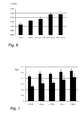
- the hydrodynamic radius r of these particles was measured by dynamic light scattering. It is plotted in Figure 6 for the investigated architectures.
- the first architecture is carboxyl-terminated (COOH) groups
- the second is streptavidin (Strep) coating
- the third, fourth and fifth are composed of PEG linkers of respectively 3.4 KDa, 5 KDa and 10 KDa of molecular weight.
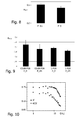
- Figure 7 shows the ratio R 4f/2f of 4th and 2nd harmonics for the different surface architectures described in Figure 6 .
- the diagram contains the results from ten independent experiments (wavelength 658 nm, intensity 18 mW, p polarized) for two different detection angles of 45° (left bars) and 30° (right bars). It is possible to see from this a proportional relationship: for increasing gap size the ratio R 4f/2f also increases.
- each nanoparticle scatters light mostly in the forward direction with respect to the optical axis, therefore shining light into the second nanoparticle when the cluster is aligned with the optical beam.
- Such injection of scattered light generates a stronger scattering from the second nanoparticle, which is responsible for the local smaller maximum contributing the most to the 4th harmonic.
- the effect seems to be most pronounced when detecting the scattered light L2 at about 45° orientation with respect to the exciting laser beam L1.
- This Figure shows the ratio R 4f/2f of 4th to 2nd harmonic for twelve blank measurements P_0 (no bB SA) and for twelve low concentration measurements P_Db at concentrations of bBSA biomolecules low enough that only doublets are present in the sample (the critical frequency ⁇ i.e. the maximum frequency at which the cluster can rotate synchronously with the field ⁇ relates to the size of the clusters in solution and was monitored as a function of the target concentration).
- the sample is characterized by a mixture of specific and non-specific doublets in the midst of a large number of single magnetic nanoparticles.
- a biomarker for prostate cancer Prostate Specific Antigen or PSA
- PSA Prostate Specific Antigen
- a more conventional surface chemistry was used, where the antibodies against PSA are coupled directly to the surface of carboxyl-terminated nanoparticles by EDC (1-ethyl-3-(3-dimethylaminopropyl) carbodiimide) chemistry.
- EDC 1-ethyl-3-(3-dimethylaminopropyl) carbodiimide
- Another feature of the invention lies in analyzing the ratio R 4f/2f as a function of frequency f.
- the shear stress experienced by each magnetic particle increases, therefore transmitting a force to the biomolecule in between.
- the dipole-dipole interaction is always attractive and mild ( ⁇ 1 pN) and it is consequently not very suited to probe molecular bonds.
- Hydrodynamic forces can be accurately controlled by the magnetically-induced rotational behavior, resulting in forces of the order of few pN, relevant to probe the biophysical properties of many biomolecules (i.e. DNA, polymer linkers etc.).
- experiments were performed by measuring the frequency response of multilayered coated nanoparticles.
- nanometer sensitivity in the distance between nanoparticles can be achieved by accurately monitoring the spectral content of the signal.
- the distance determination is for example relevant in making a distinction between specific and non-specific binding, which increases the sensitivity in the low concentration limit of biosensing.
- the detection volume of a biosensor can have different sizes with respect to the sample volume.
- the detection volume can be as large as the total sample volume, but the detection volume can also be much smaller.
- An advantage of having a small detection volume is that the number of magnetic particles and/or clusters in the detection volume will be low. For example, even single particles and/or single clusters can be resolved in the detection signal. Having a small detection volume will facilitate the detection of small differences between particles and/or clusters. E.g. differences between specific versus non-specific binding.
- a disadvantage of having a very small detection volume is that the number of magnetic particles and/or clusters may be so low that number fluctuations give an imprecise measurement outcome.
- the detection volume may be scanned through the sample, or magnetic particles and/or clusters may be scanned through the detection volume.
- the scanning of magnetic particles and/or clusters through the detection volume may e.g. be realized by flowing the fluid (e.g. as in a flow cytometer or in a microfluidic device) and/or by using magnetic forces.
Landscapes
- Health & Medical Sciences (AREA)
- Immunology (AREA)
- Life Sciences & Earth Sciences (AREA)
- Chemical & Material Sciences (AREA)
- Engineering & Computer Science (AREA)
- Analytical Chemistry (AREA)
- Biomedical Technology (AREA)
- Hematology (AREA)
- Pathology (AREA)
- Molecular Biology (AREA)
- Urology & Nephrology (AREA)
- General Physics & Mathematics (AREA)
- General Health & Medical Sciences (AREA)
- Biochemistry (AREA)
- Physics & Mathematics (AREA)
- Cell Biology (AREA)
- Medicinal Chemistry (AREA)
- Food Science & Technology (AREA)
- Biotechnology (AREA)
- Microbiology (AREA)
- Investigating Or Analyzing Materials By The Use Of Magnetic Means (AREA)
Priority Applications (1)
| Application Number | Priority Date | Filing Date | Title |
|---|---|---|---|
| PCT/IB2012/055495 WO2013057634A1 (fr) | 2011-10-19 | 2012-10-11 | Détection d'agrégats de particules magnétiques |
Applications Claiming Priority (1)
| Application Number | Priority Date | Filing Date | Title |
|---|---|---|---|
| US54885211P | 2011-10-19 | 2011-10-19 |
Publications (1)
| Publication Number | Publication Date |
|---|---|
| EP2584338A1 true EP2584338A1 (fr) | 2013-04-24 |
Family
ID=45346208
Family Applications (1)
| Application Number | Title | Priority Date | Filing Date |
|---|---|---|---|
| EP11187706.4A Ceased EP2584338A1 (fr) | 2011-10-19 | 2011-11-03 | Détection d'amas de particules magnétiques |
Country Status (1)
| Country | Link |
|---|---|
| EP (1) | EP2584338A1 (fr) |
Cited By (1)
| Publication number | Priority date | Publication date | Assignee | Title |
|---|---|---|---|---|
| JP2021025930A (ja) * | 2019-08-07 | 2021-02-22 | 国立研究開発法人産業技術総合研究所 | 標的物質検出装置 |
Citations (6)
| Publication number | Priority date | Publication date | Assignee | Title |
|---|---|---|---|---|
| US4725140A (en) * | 1985-11-19 | 1988-02-16 | Olympus Optical Co., Ltd. | Method of measuring specific binding reaction with the aid of polarized light beam and magnetic field |
| EP1304542A2 (fr) * | 2001-10-19 | 2003-04-23 | Philips Corporate Intellectual Property GmbH | Méthode pour déterminer la distribution spatiale des particules magnétiques |
| US20040126903A1 (en) * | 2002-08-01 | 2004-07-01 | Garcia Antonio A. | Dynamically formed rotors for lock-in amplifier detection |
| WO2009037636A1 (fr) * | 2007-09-21 | 2009-03-26 | Koninklijke Philips Electronics N.V. | Capteur avec un champ magnétique alternatif à haute fréquence |
| WO2010026551A1 (fr) * | 2008-09-05 | 2010-03-11 | Koninklijke Philips Electronics N.V. | Champ magnétique rotatif pour améliorer la détection dans des essais sur agrégat |
| WO2011021142A1 (fr) * | 2009-08-19 | 2011-02-24 | Koninklijke Philips Electronics N.V. | Détection de différents composants cibles par formation de groupes |
-
2011
- 2011-11-03 EP EP11187706.4A patent/EP2584338A1/fr not_active Ceased
Patent Citations (6)
| Publication number | Priority date | Publication date | Assignee | Title |
|---|---|---|---|---|
| US4725140A (en) * | 1985-11-19 | 1988-02-16 | Olympus Optical Co., Ltd. | Method of measuring specific binding reaction with the aid of polarized light beam and magnetic field |
| EP1304542A2 (fr) * | 2001-10-19 | 2003-04-23 | Philips Corporate Intellectual Property GmbH | Méthode pour déterminer la distribution spatiale des particules magnétiques |
| US20040126903A1 (en) * | 2002-08-01 | 2004-07-01 | Garcia Antonio A. | Dynamically formed rotors for lock-in amplifier detection |
| WO2009037636A1 (fr) * | 2007-09-21 | 2009-03-26 | Koninklijke Philips Electronics N.V. | Capteur avec un champ magnétique alternatif à haute fréquence |
| WO2010026551A1 (fr) * | 2008-09-05 | 2010-03-11 | Koninklijke Philips Electronics N.V. | Champ magnétique rotatif pour améliorer la détection dans des essais sur agrégat |
| WO2011021142A1 (fr) * | 2009-08-19 | 2011-02-24 | Koninklijke Philips Electronics N.V. | Détection de différents composants cibles par formation de groupes |
Non-Patent Citations (4)
| Title |
|---|
| BAUDRY ET AL., PROCEEDINGS OF THE NATIONAL ACADEMY OF SCIENCES, vol. 103, no. 44, 2006, pages 16076 |
| MAYE ET AL.: "Switching binary states of nanoparticle superlattices and dimer clusters by DNA strands", NATURE NANOTECHNOLOGY, vol. 5, 2010, pages 116 |
| RANZONI, A., SCHLEIPEN, J.J.H.B., VAN IJZENDOORN, L.J., PRINS, M.W.J.: "Frequency-Selective Rotation of Two-Particle Nanoactuators for Rapid and Sensitive Detection of Biomolecules", NANO LETT, vol. 11, pages 2017 - 2022, XP002663465, DOI: doi:DOI:10.1021/NL200384P |
| VUPPU ANIL ET AL: "Phase sensitive enhancement for biochemical detection using rotating paramagnetic particle chains", JOURNAL OF APPLIED PHYSICS, AMERICAN INSTITUTE OF PHYSICS. NEW YORK, US, vol. 96, no. 11, 1 January 2004 (2004-01-01), pages 6831 - 6838, XP012068383, ISSN: 0021-8979, DOI: 10.1063/1.1809269 * |
Cited By (1)
| Publication number | Priority date | Publication date | Assignee | Title |
|---|---|---|---|---|
| JP2021025930A (ja) * | 2019-08-07 | 2021-02-22 | 国立研究開発法人産業技術総合研究所 | 標的物質検出装置 |
Similar Documents
| Publication | Publication Date | Title |
|---|---|---|
| Ma et al. | Optical imaging of single-protein size, charge, mobility, and binding | |
| JP5232168B2 (ja) | 粒子を検出するセンサ・デバイス及び方法 | |
| JP5295149B2 (ja) | 生体物質分析方法並びにそれに用いられる生体物質分析セル、チップおよび装置 | |
| JP5643825B2 (ja) | 物質決定装置 | |
| EP2467722B1 (fr) | Détection de composants cibles différents par la formation d' agrégats | |
| JP2011508199A (ja) | 標的粒子を検出するためのマイクロエレクトロニクスセンサデバイス | |
| JP2010513913A (ja) | 凝集パラメータの測定 | |
| CN102947900A (zh) | 磁性颗粒及其聚类的检测 | |
| EP2726848B1 (fr) | Détection d'amas de particules magnétiques | |
| JPS62118255A (ja) | 磁界を用いた免疫反応の検出法 | |
| Kastner et al. | The effect of layer thickness and immobilization chemistry on the detection of CRP in LSPR assays | |
| Ovezova et al. | Plasmonic sensing platform for C-reactive protein recognition via synthetic receptors decorated on graphene oxide and gold nanoparticles | |
| WO2013057634A1 (fr) | Détection d'agrégats de particules magnétiques | |
| CN101627297A (zh) | 测量凝集参数 | |
| JP7203532B2 (ja) | 被検物質の検出方法 | |
| JPWO2011049044A1 (ja) | 磁性微粒子を用いるバイオセンサ | |
| US20210404960A1 (en) | Detection method and detection device | |
| JP2020193868A (ja) | 検出方法及び検出装置 | |
| US20130052632A1 (en) | Method for sensing a chemical | |
| CN103344753A (zh) | 基于磁免疫分析技术实现毒品含量快速检测的装置 | |
| US9977015B2 (en) | Systems and methods for detecting molecular interactions using magnetic beads | |
| Ranjbari et al. | Biosensors to detect low-density lipoprotein and oxidized low-density lipoprotein in cardiovascular disease | |
| JP5766642B2 (ja) | 測定方法、センサチップ、および測定装置 | |
| JP2020071136A (ja) | 計測装置及び計測方法 | |
| JP2007292598A (ja) | 標的物質検出用の素子及びそれを作製するための基体、ならびにそれを用いた標的物質の検出方法及び検出装置 |
Legal Events
| Date | Code | Title | Description |
|---|---|---|---|
| PUAI | Public reference made under article 153(3) epc to a published international application that has entered the european phase |
Free format text: ORIGINAL CODE: 0009012 |
|
| AK | Designated contracting states |
Kind code of ref document: A1 Designated state(s): AL AT BE BG CH CY CZ DE DK EE ES FI FR GB GR HR HU IE IS IT LI LT LU LV MC MK MT NL NO PL PT RO RS SE SI SK SM TR |
|
| AX | Request for extension of the european patent |
Extension state: BA ME |
|
| RAP1 | Party data changed (applicant data changed or rights of an application transferred) |
Owner name: KONINKLIJKE PHILIPS N.V. |
|
| STAA | Information on the status of an ep patent application or granted ep patent |
Free format text: STATUS: THE APPLICATION HAS BEEN REFUSED |
|
| 18R | Application refused |
Effective date: 20130513 |