EP2584608A2 - Nanoparticules et leur procédé de fabrication - Google Patents
Nanoparticules et leur procédé de fabrication Download PDFInfo
- Publication number
- EP2584608A2 EP2584608A2 EP12188399.5A EP12188399A EP2584608A2 EP 2584608 A2 EP2584608 A2 EP 2584608A2 EP 12188399 A EP12188399 A EP 12188399A EP 2584608 A2 EP2584608 A2 EP 2584608A2
- Authority
- EP
- European Patent Office
- Prior art keywords
- ligands
- organic
- solution
- nanoparticles
- hydrazine hydrate
- Prior art date
- Legal status (The legal status is an assumption and is not a legal conclusion. Google has not performed a legal analysis and makes no representation as to the accuracy of the status listed.)
- Withdrawn
Links
Images




Classifications
-
- C—CHEMISTRY; METALLURGY
- C09—DYES; PAINTS; POLISHES; NATURAL RESINS; ADHESIVES; COMPOSITIONS NOT OTHERWISE PROVIDED FOR; APPLICATIONS OF MATERIALS NOT OTHERWISE PROVIDED FOR
- C09K—MATERIALS FOR MISCELLANEOUS APPLICATIONS, NOT PROVIDED FOR ELSEWHERE
- C09K11/00—Luminescent materials, e.g. electroluminescent or chemiluminescent
- C09K11/08—Luminescent materials, e.g. electroluminescent or chemiluminescent containing inorganic luminescent materials
-
- H—ELECTRICITY
- H10—SEMICONDUCTOR DEVICES; ELECTRIC SOLID-STATE DEVICES NOT OTHERWISE PROVIDED FOR
- H10D—INORGANIC ELECTRIC SEMICONDUCTOR DEVICES
- H10D62/00—Semiconductor bodies, or regions thereof, of devices having potential barriers
- H10D62/10—Shapes, relative sizes or dispositions of the regions of the semiconductor bodies; Shapes of the semiconductor bodies
- H10D62/117—Shapes of semiconductor bodies
- H10D62/118—Nanostructure semiconductor bodies
-
- B—PERFORMING OPERATIONS; TRANSPORTING
- B82—NANOTECHNOLOGY
- B82B—NANOSTRUCTURES FORMED BY MANIPULATION OF INDIVIDUAL ATOMS, MOLECULES, OR LIMITED COLLECTIONS OF ATOMS OR MOLECULES AS DISCRETE UNITS; MANUFACTURE OR TREATMENT THEREOF
- B82B3/00—Manufacture or treatment of nanostructures by manipulation of individual atoms or molecules, or limited collections of atoms or molecules as discrete units
-
- B—PERFORMING OPERATIONS; TRANSPORTING
- B82—NANOTECHNOLOGY
- B82Y—SPECIFIC USES OR APPLICATIONS OF NANOSTRUCTURES; MEASUREMENT OR ANALYSIS OF NANOSTRUCTURES; MANUFACTURE OR TREATMENT OF NANOSTRUCTURES
- B82Y10/00—Nanotechnology for information processing, storage or transmission, e.g. quantum computing or single electron logic
-
- B—PERFORMING OPERATIONS; TRANSPORTING
- B82—NANOTECHNOLOGY
- B82Y—SPECIFIC USES OR APPLICATIONS OF NANOSTRUCTURES; MEASUREMENT OR ANALYSIS OF NANOSTRUCTURES; MANUFACTURE OR TREATMENT OF NANOSTRUCTURES
- B82Y30/00—Nanotechnology for materials or surface science, e.g. nanocomposites
-
- B—PERFORMING OPERATIONS; TRANSPORTING
- B82—NANOTECHNOLOGY
- B82Y—SPECIFIC USES OR APPLICATIONS OF NANOSTRUCTURES; MEASUREMENT OR ANALYSIS OF NANOSTRUCTURES; MANUFACTURE OR TREATMENT OF NANOSTRUCTURES
- B82Y40/00—Manufacture or treatment of nanostructures
-
- C—CHEMISTRY; METALLURGY
- C01—INORGANIC CHEMISTRY
- C01B—NON-METALLIC ELEMENTS; COMPOUNDS THEREOF; METALLOIDS OR COMPOUNDS THEREOF NOT COVERED BY SUBCLASS C01C
- C01B19/00—Selenium; Tellurium; Compounds thereof
- C01B19/002—Compounds containing, besides selenium or tellurium, more than one other element, with -O- and -OH not being considered as anions
-
- C—CHEMISTRY; METALLURGY
- C01—INORGANIC CHEMISTRY
- C01B—NON-METALLIC ELEMENTS; COMPOUNDS THEREOF; METALLOIDS OR COMPOUNDS THEREOF NOT COVERED BY SUBCLASS C01C
- C01B19/00—Selenium; Tellurium; Compounds thereof
- C01B19/007—Tellurides or selenides of metals
-
- C—CHEMISTRY; METALLURGY
- C09—DYES; PAINTS; POLISHES; NATURAL RESINS; ADHESIVES; COMPOSITIONS NOT OTHERWISE PROVIDED FOR; APPLICATIONS OF MATERIALS NOT OTHERWISE PROVIDED FOR
- C09K—MATERIALS FOR MISCELLANEOUS APPLICATIONS, NOT PROVIDED FOR ELSEWHERE
- C09K11/00—Luminescent materials, e.g. electroluminescent or chemiluminescent
- C09K11/08—Luminescent materials, e.g. electroluminescent or chemiluminescent containing inorganic luminescent materials
- C09K11/62—Luminescent materials, e.g. electroluminescent or chemiluminescent containing inorganic luminescent materials containing gallium, indium or thallium
-
- C—CHEMISTRY; METALLURGY
- C09—DYES; PAINTS; POLISHES; NATURAL RESINS; ADHESIVES; COMPOSITIONS NOT OTHERWISE PROVIDED FOR; APPLICATIONS OF MATERIALS NOT OTHERWISE PROVIDED FOR
- C09K—MATERIALS FOR MISCELLANEOUS APPLICATIONS, NOT PROVIDED FOR ELSEWHERE
- C09K11/00—Luminescent materials, e.g. electroluminescent or chemiluminescent
- C09K11/08—Luminescent materials, e.g. electroluminescent or chemiluminescent containing inorganic luminescent materials
- C09K11/66—Luminescent materials, e.g. electroluminescent or chemiluminescent containing inorganic luminescent materials containing germanium, tin or lead
-
- H—ELECTRICITY
- H10—SEMICONDUCTOR DEVICES; ELECTRIC SOLID-STATE DEVICES NOT OTHERWISE PROVIDED FOR
- H10D—INORGANIC ELECTRIC SEMICONDUCTOR DEVICES
- H10D62/00—Semiconductor bodies, or regions thereof, of devices having potential barriers
- H10D62/80—Semiconductor bodies, or regions thereof, of devices having potential barriers characterised by the materials
- H10D62/81—Semiconductor bodies, or regions thereof, of devices having potential barriers characterised by the materials of structures exhibiting quantum-confinement effects, e.g. single quantum wells; of structures having periodic or quasi-periodic potential variation
- H10D62/812—Single quantum well structures
- H10D62/814—Quantum box structures
-
- H—ELECTRICITY
- H10—SEMICONDUCTOR DEVICES; ELECTRIC SOLID-STATE DEVICES NOT OTHERWISE PROVIDED FOR
- H10D—INORGANIC ELECTRIC SEMICONDUCTOR DEVICES
- H10D62/00—Semiconductor bodies, or regions thereof, of devices having potential barriers
- H10D62/80—Semiconductor bodies, or regions thereof, of devices having potential barriers characterised by the materials
- H10D62/85—Semiconductor bodies, or regions thereof, of devices having potential barriers characterised by the materials being Group III-V materials, e.g. GaAs
-
- H—ELECTRICITY
- H10—SEMICONDUCTOR DEVICES; ELECTRIC SOLID-STATE DEVICES NOT OTHERWISE PROVIDED FOR
- H10D—INORGANIC ELECTRIC SEMICONDUCTOR DEVICES
- H10D62/00—Semiconductor bodies, or regions thereof, of devices having potential barriers
- H10D62/80—Semiconductor bodies, or regions thereof, of devices having potential barriers characterised by the materials
- H10D62/86—Semiconductor bodies, or regions thereof, of devices having potential barriers characterised by the materials being Group II-VI materials, e.g. ZnO
-
- C—CHEMISTRY; METALLURGY
- C01—INORGANIC CHEMISTRY
- C01P—INDEXING SCHEME RELATING TO STRUCTURAL AND PHYSICAL ASPECTS OF SOLID INORGANIC COMPOUNDS
- C01P2002/00—Crystal-structural characteristics
- C01P2002/80—Crystal-structural characteristics defined by measured data other than those specified in group C01P2002/70
- C01P2002/82—Crystal-structural characteristics defined by measured data other than those specified in group C01P2002/70 by IR- or Raman-data
-
- C—CHEMISTRY; METALLURGY
- C01—INORGANIC CHEMISTRY
- C01P—INDEXING SCHEME RELATING TO STRUCTURAL AND PHYSICAL ASPECTS OF SOLID INORGANIC COMPOUNDS
- C01P2006/00—Physical properties of inorganic compounds
- C01P2006/40—Electric properties
-
- H—ELECTRICITY
- H10—SEMICONDUCTOR DEVICES; ELECTRIC SOLID-STATE DEVICES NOT OTHERWISE PROVIDED FOR
- H10D—INORGANIC ELECTRIC SEMICONDUCTOR DEVICES
- H10D30/00—Field-effect transistors [FET]
- H10D30/40—FETs having zero-dimensional [0D], one-dimensional [1D] or two-dimensional [2D] charge carrier gas channels
- H10D30/402—Single electron transistors; Coulomb blockade transistors
Definitions
- the present disclosure relates to nanoparticles and methods of manufacturing the same, and more particularly, to nanoparticles comprising an inorganic capping agent and methods of manufacturing the same.
- a quantum dot (sometimes abbreviated as "QD" throughout the application) or a nanocrystal is a crystal structure of a dimension from a few to several ten nanometers, of which properties vary depending on its size.
- QD quantum dot
- a semiconductor QD demonstrates properties between those of bulk semiconductors of the same material and those of discontinuous molecules. Since its physical, chemical, and electrical properties may be controlled by changing the size of the same material due to quantum confinement effects and large surface to volume ratios, a nanoparticle has received great interest for a new method of controlling properties of a material and a new material.
- a typical nanoparticle of which dimension varies from several to several hundred nanometers, may be comprised of two or three main parts: the middle core part which is a single crystal, of which the diameter may be about one to several ten nanometers, a shell or multiple shells, and a coating region or a coating layer of ligands formed on a surface of the core or the shell.
- the middle core part which is a single crystal, of which the diameter may be about one to several ten nanometers
- a shell or multiple shells and a coating region or a coating layer of ligands formed on a surface of the core or the shell.
- a wet-chemical synthesis method which makes colloidal nanoparticle core, may produce a mass amount of uniformly nanosized particles at a low cost.
- Single-core semiconductor nanoparticles which contain a single semiconductor material along with an outer organic passivating (or capping) layer, may have relatively low quantum efficiencies due to electron-hole recombination occurring at defects and dangling bonds situated on the nanoparticle surface.
- One method to eliminate defects and dangling bonds is to grow a second inorganic material, having a wider band-gap and smaller lattice mismatch to that of the core material, epitaxially on the surface of the core particle to produce a "core-shell" particle.
- a second inorganic material having a wider band-gap and smaller lattice mismatch to that of the core material, epitaxially on the surface of the core particle to produce a "core-shell" particle.
- ZnS grown on the surface of a CdSe core to provide a CdSe/ZnS nanoparticle.
- Another approach is to prepare a core/multi-shell structure where the "electron-hole" pair is confined to a single shell layer such as the quantum dot-quantum well structure.
- a core/shell/shell structured nanoparticle is CdS/HgS/CdS.
- the coordination about the final inorganic surface atoms in core, core/shell or core/multi shell nanoparticle is generally incomplete, with highly reactive atoms that are not fully coordinated leaving "dangling bonds" on the surface of the particle, which may lead to particle agglomeration.
- the core, core/shell or core/multishell is passivated (capped) with protecting organic groups.
- the outermost layer (or capping agent) of organic material helps to inhibit particle aggregation and also further protects the nanoparticle from its surrounding chemical environment. It also provides chemical linkage to other inorganic, organic or biological material.
- the organic passivating layer (or capping layer) coated on a surface of the core or the shell of the nanoparticle act as an insulating barrier layer, causing a decrease in electric conductivity of the nanoparticle, which limits actual industrial applications of the semiconductor nanoparticles to various electronic devices such as a light-emitting diode, a solar cell, a transistor, and the like.
- a luminous efficiency of the nanoparticles may decline due to effects of dangling bonds, surface defects, etc. on the surface of the nanoparticle, or optical and electrical properties may decline due to charge carriers trapped on the surface of the nanoparticle.
- removing the organic capping layer causes aggregation or fusion of nanoparticles and destabilizes the nanoparticles.
- MCC metal chalcogenide complexes
- nanoparticles with an inorganic capping layer which have a good electrical conductivity and stability.
- nanoparticles with an inorganic capping layer which have a good electrical conductivity and stability in a less toxic and safe way.
- a method for producing nanoparticles comprising inorganic ligands, the method including replacing organic ligands coupled to a surface of nanoparticles with the inorganic ligands to give the nanoparticles containing the inorganic ligands coupled to a surface of the nanoparticles, wherein the replacement is performed in a solvent containing the inorganic ligands and the nanoparticles coupled with the organic ligands, and wherein the inorganic ligands are a hydrazine hydrate of metal chalcogenide complex.
- the solvent may be a mixed solvent of a first solvent which contains the metal chalcogenide complex hydrazine hydrate dissolved therein and a second solvent which contains the nanoparticles coupled with the organic ligands dissolved therein.
- the replacement is performed by stirring the mixed solvent.
- the first solvent may be different from the second solvent, or may be the same as the second solvent.
- the first solvent may be a hydrazine hydrate and the second solvent may be an organic solvent.
- the first solvent may be a polar organic solvent and the second solvent may be a non-polar organic solvent.
- the first solvent and the second solvent may be the same and may include a polar organic solvent.
- the polar organic solvent may be one which dissolves or disperses the metal chalcogenide complex hydrazine hydrate and the nanoparticles coupled with the organic ligands.
- nanoparticles each may include a nanoparticle core of a semiconductor material; and an inorganic capping layer including hydrazine hydrate on a surface of the nanoparticle core.
- a method for producing nanoparticles comprising inorganic ligands comprising replacing organic ligands coupled to a surface of nanoparticles with the inorganic ligands to give the nanoparticles comprising the inorganic ligands coupled to a surface of the nanoparticles, wherein the replacement is performed in a solvent system comprising the inorganic ligands and the nanoparticles coupled with the organic ligands, and wherein the inorganic ligands are a metal chalcogenide complex hydrazine hydrate.
- the method further comprises providing a first solution comprising a metal chalcogenide complex (MCC) hydrazine hydrate in a first solvent; providing a first organic solution of nanoparticles capped with first organic ligands in a first organic solvent; and mixing the MCC hydrazine hydrate solution and the first organic solution of the first organic ligands-capped nanoparticles to form the solvent system.
- MCC metal chalcogenide complex
- solution comprising a metal chalcogenide complexes (MCC) hydrazine hydrate comprises an organic solvent.
- the method further comprising providing a first further organic solution of nanoparticles capped with first further organic ligands; stirring the first further organic solution with a second further organic solution comprising an excess amount of the first organic ligands dispersed or dissolved therein, thereby forming nanoparticles capped with the first organic ligands by replacing the first further organic ligands with the first organic ligands; separating the nanoparticles capped with the first organic ligands from the second further organic solution; and dispersing or dissolving the nanoparticles capped with the first organic ligands in the first organic solvent to form the first organic solution.
- organic ligands of organic ligands-capped nanoparticles with inorganic ligands such as MCC hydrazine hydrate, electrical properties of the nanoparticles may be improved, and the use of a solvent other than hydrazine allows manufacturing inorganic ligand-capped nanoparticles, in a less toxic and safe way.
- ligand capped nanoparticle(s),” “ligand coated nanoparticle(s),” ligand passivated nanoparticle(s),” “nanoparticle(s) coated with a ligand,” “nanoparticle(s) passivated with a ligand,” “nanoparticle(s) capped with a ligand,” and “nanoparticle(s) coupled with a ligand” are interchangeably used to mean that ligands are coupled or bound to a surface of nanoparticles. Therefore, it is understood that the ligand coat, ligand capping, or ligand passivating layer does not need to be continuous.
- solution and “dispersion” are sometimes interchangeably used to indicate a liquid made of a solute (here, for example, MCC hydrazine hydrate or organic ligand-capped nanoparticles) and a solvent which dissolves or disperses the solute.
- a solute here, for example, MCC hydrazine hydrate or organic ligand-capped nanoparticles
- solvent which dissolves or disperses the solute.
- the word “stirring” is used to include, but is not limited to, stirring, agitating or vortex a mixed solvent by a various means known in the art so that the desired replacement of ligands on the surface of the nanoparticles may occur.
- Nanoparticles in the present invention refer to nano-sized particles containing an elemental semiconductor or a compound semiconductor composed of particles of a size in a range of up to several ten nanometers.
- the nanoparticle may be quantum dot of about 1 nm - about 10 nm.
- the nanoparticles in the present invention may have a core-shell structure, and each of a core and a shell may be formed of one or more layers.
- the nanoparticles may have a core-shell or a core-shell-shell structure.
- Phase transfer in the present invention means a phenomenon: when an interface is formed between two liquid phases as in solvent extraction, nanoparticles having first ligands in first liquid phase exchange the first ligands with second ligands in second liquid phase at a liquid interface and transfer to the second liquid phase.
- the nanoparticles after phase transfer are present in the second liquid phase and have the second ligands.
- the ligands of the nanoparticles in the present invention may be single compounds or may be formed of 2 or more types of compounds.
- FIG. 1 is a schematic diagram illustrating a nanoparticle with inorganic ligands (hereinafter, sometimes referred to as “inorganic ligand coated nanoparticle” or “inorganic ligand capped nanoparticle”) 30, according to an embodiment.
- the inorganic ligand coated nanoparticle 30 includes a nanoparticle core 10 which is formed of a semiconductor material; and an inorganic ligand (sometimes referred to as "inorganic coat”) 23 passivated on a surface of the nanoparticle core 10, in which the ligands are a metal chalcogenide complexes (MCC) hydrazine hydrate.
- MCC metal chalcogenide complexes
- the semiconductor material of the nanoparticle core 10 may be formed of, for example, a Group II-VI semiconductor compound, a Group III-V semiconductor compound, a Group IV-VI semiconductor compound, a Group IV element or compound, or a combination thereof.
- the Group II-VI semiconductor compound may be, for example: a binary compound such as CdS, CdSe, CdTe, ZnS, ZnSe, ZnTe, ZnO, HgS, HgSe, HgTe or a combination thereof; a ternary compound such as CdSeS, CdSeTe, CdSTe, ZnSeS, ZnSeTe, ZnSTe, HgSeS, HgSeTe, HgSTe, CdZnS, CdZnSe, CdZnTe, CdHgS, CdHgSe, CdHgTe, HgZnS, HgZnSe or a combination thereof; or a
- the Group III-V semiconductor compound may be: for example, a binary compound such as GaN, GaP, GaAs, GaSb, AlN, AlP, AlAs, AlSb, InN, InP, InAs, InSb or a combination thereof; a ternary compound such as GaNP, GaNAs, GaNSb, GaPAs, GaPSb, AlNP, AlNAs, AlNSb, AlPAs, AlPSb, InNP, InNAs, InNSb, InPAs, InPSb or a combination thereof; or a quaternary compound such as GaAlNAs, GaAlNSb, GaAlPAs, GaAlPSb, GaInNP, GaInNAs, GaInNSb, GaInPAs, GaInPSb, InAlNP, InAlNAs, InAlNSb, InAlPAs, InAlPSb or a combination thereof.
- the Group IV-VI semiconductor compound may be: for example, a binary compound such as SnS, SnSe, SnTe, PbS, PbSe, PbTe or a combination thereof; a ternary compound such as SnSeS, SnSeTe, SnSTe, PbSeS, PbSeTe, PbSTe, SnPbS, SnPbSe, SnPbTe or a combination thereof; or a quaternary compound such as SnPbSSe, SnPbSeTe, SnPbSTe or a combination thereof.
- the Group IV element or compound may be, for example, Si, Ge, SiC, SiGe, or a combination thereof.
- the nanoparticle 10 may have a core-shell structure.
- Each of the core 11 and the shell 12 may be formed of a single layer or of two or more layers.
- nanoparticle 10 may be formed of CdSe/ZnS or CdSe/CdS/ZnS.
- the MCC hydrazine hydrate is coordinatively bonded to the surface of the nanoparticle 10 to form a coat 23.
- the metal chalcogenides complex or MCC of the MCC hydrazine hydrate, suitable as an inorganic ligand are compounds consisting of a metal and an element which is a member of the chalcogen column of the periodic table. While oxygen is a member of the chalcogens, the term metal chalcogenide used in the instant application with regard to an inorganic ligand refers to compounds of a metal with sulfur, selenium, tellurium, or polonium.
- Exemplary metals include Ga, In, Ti, Sn, Pb, Bi, Zn, Cd, Hg, Cu, Ag, Au, Ni, Pd, Pt, Co, Rh, Ir, Fe, Ru, Os, Mn, Tc, Re, Cr, Mo, W,V, Nb, Ta, Ti, Zr, Hf, Sc, and Y.
- Metal chalcogenides may include a semiconductor cadmium sulfide, cadmium selenide, Sn 2 S 6 , Sn 2 Se 6 , In 2 Se 4 , In 2 Te 3 , Ga 2 Se 3 , CuInSe 2 , Cu 7 S 4 , Hg 3 Se 4 , Sb 2 Te 3 , or ZnTe.
- Sn 2 S 6 , Sn 2 Se 6 , In 2 Se 4 , In 2 Te 3 , Ga 2 Se 3 , CuInSe 2 , Cu 7 S 4 , Hg 3 Se 4 , Sb 2 Te 3 , or ZnTe may be usefully employed in embodiments of the invention.
- the MCC as an inorganic ligand to be bound by a coordinate bond to the surface of the core or the shell of a core-shell or core-shell-shell nanoparticle is different from the semiconducting metal chalcogenide forming the core or the shell.
- Exemplary hydrazine hydrates may include, but are not limited to, monohydrate, dihydrate, trihydrate, tetrahydrate, pentahydrate, or hexahydrate of hydrazine.
- Exemplary hydrazine solvates may include, but are not limited to, hydrazine dihydrochloride (N 2 H 4 -2HCI), hydrazine monohydrochloride, hydrazine monohydrobromide or hydrazine acetate.
- a nanoparticle solution may be provided by dissolving the nanoparticles 30 described above in an organic solvent such as ethanolamine, dimethyl sulfoxide (DMSO), dimethylformamide (DMF), or formamide solvent.
- organic solvent such as ethanolamine, dimethyl sulfoxide (DMSO), dimethylformamide (DMF), or formamide solvent.
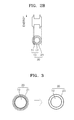
- FIG. 2A is an energy diagram illustrating electronic energy of an organic ligand coated nanoparticle 20
- FIG. 2B is an energy diagram illustrating electronic energy of an inorganic ligand coated nanoparticle 30.
- energy levels of organic ligand coat 21 of the organic ligand coated nanoparticle 20, which is composed of a nanoparticle 10 formed of a core 11 and a shell 12 and the organic ligands 21 on the surface of the nanoparticle 10 are relatively higher than energy levels of the core 11 and the shell 12.
- FIG. 2A energy levels of organic ligand coat 21 of the organic ligand coated nanoparticle 20, which is composed of a nanoparticle 10 formed of a core 11 and a shell 12 and the organic ligands 21 on the surface of the nanoparticle 10.
- the nanoparticle with the inorganic ligands 30, which is composed of a nanoparticle 10 formed of a core 11 and a shell 12 and the inorganic ligands 23 on the surface of the nanoparticle 10, has lower energy levels of the inorganic ligands 23 than energy levels of the shell 12. Therefore, inorganic ligands-coated nanoparticles do not have a high energy barrier caused by organic ligands 21 of organic ligands-passivated nanoparticle 20, and thus can have an improved conductivity.
- FIG. 3 is a diagram conceptually illustrating a method of manufacturing nanoparticles coated with inorganic ligands, according to an embodiment.
- a nanoparticle coated with inorganic ligands 30 may be prepared by providing organic ligands-passivated nanoparticles, and replacing organic ligands 21 of the organic ligands-passivated nanoparticle 10 with inorganic ligands 23.
- the inorganic ligands 23 may be an MCC hydrazine hydrate.
- the substitution of organic ligands with inorganic ligands may be done via phase transfer between a first solution or dispersion comprising inorganic ligand compounds and a second solution or dispersion comprising nanoparticles coated with organic ligands of a solvent system.
- the substitution of ligands may be done in a solvent system comprising a single solvent where nanoparticles coated with organic ligands and an excess amount of inorganic ligand compounds are present.
- FIG. 4 is a flowchart for describing a method of manufacturing nanoparticles coated with MCC hydrazine hydrate ligands, according to an embodiment.
- an MCC hydrazine hydrate solution (solution A) is prepared (S110).
- the MCC hydrazine hydrate is a compound comprised of an MCC and hydrazine hydrate, which are bound to each other.
- the MCC hydrazine hydrate may be dissolved or dispersed into an appropriate solvent to give an MCC hydrazine hydrate solution.
- a chalcogen hydrazine hydrate solution or chalcogen hydrazine hydrate dispersion is prepared by dissolving or dispersing chalcogen powder (nonlimiting examples include S, Se, or Te) in hydrazine hydrate (N 2 H 4 ⁇ nH 2 O).
- sulfur powder may be dissolved in a hydrazine hydrate solution to prepare a sulfur hydrazine monohydrate solution.
- hydrazine monohydrate may contain about 60-70, or about 64-65 wt% hydrazine.
- hydrazine hydrates may contain about 50-60 wt%, or about 55% hydrazine. It can be used as a diluted solution or a stock solution.
- a hydrazine hydrate solution containing hydrazine up to 65 wt% may be diluted to 1 M solution.
- the metal may include a metal element or a metal compound.
- the metal may include Sn, Ga, Cu 2 S, GeS, Sb 2 Se 3 , Sb 2 Te 3 , In 2 Se 3 , ZnTe, In 2 Te 3 , etc.
- An additional hydrazine hydrate solution along with the metal powder may be added.
- the reaction temperature may be in a range from room temperature to about 200°C. Since hydrazine hydrate is a strong reducing agent, MCC may be synthesized in the hydrazine hydrate solution.
- the MCC may bind to the hydrazine hydrate in the hydrazine hydrate solution to form MCC hydrazine hydrate.
- the MCC hydrazine hydrate may be an MCC hydrazine monohydrate, MCC hydrazine dihydrate, MCC hydrazine trihydrate, MCC hydrazine tetrahydrate, MCC hydrazine pentahydrate, MCC hydrazine hexahydrate, or a combination thereof.
- the hydrazine hydrate solution may be safely used in MCC synthesis due to its less toxicity than hydrazine and non-explosiveness.
- the MCC hydrazine hydrate solution (“solution A”) may be prepared by removing precipitates from the reaction mixture using, for example, centrifugation or filtration after the reaction.
- hydrazine hydrate is employed as a solvent for the MCC hydrazine hydrate solution.
- a hydrazine monohydrate solution of Sn 2 S 6 , Sn 2 Se 6 , In 2 Se 4 , In 2 Te 3 , Ga 2 Se 3 , CuInSe 2 , Cu 7 S 4 , Hg 3 Se 4 , Sb 2 Te 3 , or ZnTe may be prepared.
- a first organic solution or dispersion containing first organic ligand-capped nanoparticle (“solution B") is prepared (S120).
- the solution B is a solution in which nanoparticles capped with first organic ligands are dissolved or dispersed in a first organic solvent.
- a nanoparticle may be formed of, for example, a Group II-VI semiconductor compound, a Group III-V semiconductor compound, a Group IV-VI semiconductor compound, a Group IV element or compound, or a combination thereof.
- the Group II-VI semiconductor compound may be: for example a binary compound such as CdS, CdSe, CdTe, ZnS, ZnSe, ZnTe, ZnO, HgS, HgSe, HgTe, or a combination thereof; a ternary compound such as CdSeS, CdSeTe, CdSTe, ZnSeS, ZnSeTe, ZnSTe, HgSeS, HgSeTe, HgSTe, CdZnS, CdZnSe, CdZnTe, CdHgS, CdHgSe, CdHgTe, HgZnS, HgZnSe, or a combination thereof; or a quaternary compound such as CdHgZnTe, CdZnSeS, CdZnSeTe, CdZnSTe, CdHgSeS, CdHgSeTe, CdH
- the Group III-V semiconductor compound may be, for example: a binary compound such as GaN, GaP, GaAs, GaSb, AlN, AlP, AlAs, AlSb, InN, InP, InAs, InSb, or a combination thereof; a ternary compound such as GaNP, GaNAs, GaNSb, GaPAs, GaPSb, AlNP, AlNAs, AlNSb, AlPAs, AlPSb, InNP, InNAs, InNSb, InPAs, InPSb, GaAlNP, or a combination thereof; or a quaternary compound such as GaAlNAs, GaAlNSb, GaAlPAs, GaAlPSb, GaInNP, GaInNAs, GaInNSb, GaInPAs, GaInPSb, InAlNP, InAlNAs, InAlNSb, InAlPAs, InAlPSb, or a combination thereof.
- the Group IV-VI semiconductor compound may be: for example, a binary compound such as SnS, SnSe, SnTe, PbS, PbSe, PbTe, or a combination thereof; a ternary compound such as SnSeS, SnSeTe, SnSTe, PbSeS, PbSeTe, PbSTe, SnPbS, SnPbSe, SnPbTe, or a combination thereof; a quaternary compound such as SnPbSSe, SnPbSeTe, SnPbSTe, or a combination thereof.
- the Group IV element or compound may be, for example, Si, Ge, SiC, SiGe, or a combination thereof.
- the nanoparticle may have a structure of core/shell/shell of CdSe/CdS/ZnS.
- the nanoparticles are dispersed in the form of colloid in the first organic solution, and the first organic ligands are coordinately bonded on surfaces of the nanoparticles. That is, each of the nanoparticles is passivated with the first organic ligands.
- the first organic ligands may include trioctylphosphine (TOP), trioctylphosphine oxide (TOPO), oleic acid, oleylamine, octylamine, trioctylamine, hexadecylamine, octanethiol, dodecanethiol, hexylphosphonic acid (HPA), tetradecylphosphonic acid (TDPA), octylphosphonic acid (OPA) or a combination thereof.
- TOP trioctylphosphine
- TOPO trioctylphosphine oxide
- the first solvent may include, but is not limited thereto, cyclohexane, hexane, chloroform, toluene, octane, chlorobenzene or a combination thereof.
- the first solvent may be the same compound as the first organic ligands.
- the first organic ligands of the nanoparticles may be replaced with the MCC hydrazine hydrate ligands by a phase transfer reaction, for example by mixing the solution B with solution A (S130).
- the phase transfer may be performed by mixing solution B and solution A with stirring, vortex, agitation, or combinations thereof.
- the phase transfer may be promoted by adding hydrazine hydrate solution to the mixture.
- solution A may be added to a hydrazine hydrate solution, followed by the addition of the first organic solution of the first organic ligand-capped nanoparticles.
- Thy hydrazine hydrate solution may be hydrazine monohydrate, hydrazine dihydrate, hydrazine trihydrate, hydrazine tetrahydrate, hydrazine pentahydrate, hydrazine hexahydrate, or a combination thereof.
- the solvent (i.e., hydrazine hydrate) of the MCC hydrazine hydrate solution (or dispersion) is immiscible with the solvent for the first organic ligand capped nanoparticle solution, when two solutions are combined, it is separated into two layers (or phases): a first organic solution layer of an upper portion and a hydrazine hydrate layer of a lower portion.
- the first organic solution layer of the upper portion may include the first organic ligands-capped nanoparticles, and the hydrazine hydrate layer of the lower portion may include an excess amount of MCC.
- the organic ligands capped nanoparticles in the first organic solution layer move to the hydrazine hydrate layer, and the organic ligands passivating the nanoparticles may be replaced with the MCC hydrazine hydrate ligands.
- the stirring temperature may be in a range from room temperature to 200°C.
- nanoparticles By allowing the nanoparticles to move between two phases of immiscible solvents of a solvent system, substitution of ligands which are bound to the surface of the nanoparticles occurs, giving nanoparticles of a semiconductor compound passivated with MCC hydrazine hydrate ligands.
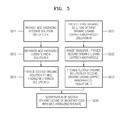
- FIG. 5 is a flowchart schematically describing a method of manufacturing nanoparticles capped with MCC hydrazine hydrate ligands, according to another embodiment.
- the current embodiment is different from the embodiment of FIG. 4 in the sense of replacing the solvent of the first MCC hydrazine hydrate solution, exchanging organic ligands of a nanoparticle to new organic ligands, followed by converting the solvent of the nanoparticle solution.
- an MCC hydrazine hydrate solution (solution A) is prepared (S211).
- the process is as same as the preparation process S110 of the MCC hydrazine hydrate solution described in regard to the embodiment of FIG 4 .
- the MCC hydrazine hydrate is separated from the solution A (S212).
- the MCC hydrazine hydrate is a compound composed of MCC and hydrazine hydrate.
- the MCC hydrazine hydrate may be separated from hydrazine hydrate solvent by blowing an inert gas such as nitrogen gas to the solution A to evaporate hydrazine hydrate solvent.
- an excessive amount of a solvent which does not dissolve MCC may be added to solution A , and then solution A may be centrifuged to separate the MCC hydrazine hydrate.
- the solvent which does not dissolve MCC methanol, ethanol, butanol, or acetonitrile may be exemplified.
- a second solution (or dispersion) of MCC hydrazine hydrate may be prepared by dispersing the separated MCC hydrazine hydrate in a second solvent, which may be an organic solvent (S213).
- the solvent may be an organic solvent that may dissolves (disperses) both MCC and nanoparticles.
- the second solvent may be an organic solvent with a polarity, such as ethanolamine, DMSO (dimethylsulfoxide), DMF(dimethylformamide), formamide, etc.
- a first solution of the first organic ligand-capped nanoparticle (solution B) is prepared (S221).
- the process is as same as the preparation process S121 of the solution B described in regard to the embodiment of FIG 4 .
- first organic ligands are replaced with second organic ligands via phase transfer of the nanoparticles (S222).
- the solution B may be added and stirred in a third organic solution including an excess amount of the second organic ligands.
- the second organic ligands are ligands that may be dissolved or dispersed in a second organic solvent which may dissolve (or disperse) MCC hydrazine hydrate.
- the second organic ligands may be ligands with a polarity such as mercaptopropionic acid (MPA), cysteamine, mercaptoacetic acid, etc.
- the third organic solvent may be, for example, chloroform, chlorobenzene, etc.
- the first organic ligands of the nanoparticles are replaced with the second organic ligands due to an equilibrium reaction in the third organic solution including an excess amount of the second organic ligands.
- the second organic ligands may be dissolved in both the second organic solvent and the third organic solvent. Since the second organic ligands may be dissolved in the second organic solvent in which MCC hydrazine hydrate is dissolved, the substitution of ligands of nanoparticles in the same type of solvent is enabled.
- Nanoparticles capped with the second ligands are dispersed in a second organic solvent to prepare a second organic solution of the second organic ligand-capped nanoparticles (solution D) (S223).
- solution D a second organic solution of the second organic ligand-capped nanoparticles
- the nanoparticles capped with the second organic ligands are separated from the third organic solution.
- the third organic solution including the nanoparticles capped with the second organic ligands is centrifuged to precipitate and separate the nanoparticles.
- the solution D may be prepared by dispersing the separated nanoparticles in an organic solvent which is the same as the second organic solvent in which MCC hydrazine hydrate are dissolved (or dispersed) in (S213).
- the second organic ligands of the nanoparticles are replaced with the MCC hydrazine hydrate ligand by forming a solvent system by mixing the solution D into the solution C (S230). Mixing the solution C and the solution D does not cause a phase separation because the solvents of the solutions are the same. Since a phase separation does not occur, byproducts at the interface between the hydrazine hydrate solution and the first organic solution are not produced, and thus, damage on surfaces of the nanoparticles due to the byproducts which may be produced during the replacement of ligands of the nanoparticles may be prevented.
- hydrazine hydrate as a solvent which by itself may reduce a luminescence efficiency of nanoparticles is not present during the formation of MCC hydrazine hydrate-capped nanoparticles, a reduction in luminescence efficiency may be inhibited.
- the second organic ligands passivating the nanoparticle may be replaced with the MCC hydrazine hydrate ligands by stirring, vortex, or agitating the mixed solution.
- the stirring temperature may be in a range between room temperature to 200°C.
- the second organic ligands passivating the nanoparticles in the second organic solution may be replaced with the MCC hydrazine hydrate ligands in the same solvent. Therefore, a nanoparticle of a semiconductor compound passivated with the MCC hydrazine hydrate ligands may be manufactured by the ligands replacement in a single solvent.
- the current embodiment uses the same organic solvents for solution C containing MCC hydrazine hydrate ligands and for solution D containing organic ligands-capped nanoparticles, a sub-reaction at an interface between different solvents does not occur. Also, the current embodiment may have a broader applicability because various factors limiting the applicability of phase transfer reaction, including for example, selecting a degree of polarity of each solvent and portions of the solvents are not applied to this method.
- FIG. 6 is a flowchart for describing a method of manufacturing nanoparticles capped with MCC hydrazine hydrate ligands, according to another embodiment.
- the present embodiment is different from the embodiment of FIG. 4 in the sense that the solvent of an MCC hydrazine hydrate solution is replaced with a second organic solvent.
- the current embodiment is different from the embodiment of FIG. 5 in the sense of not performing a surface reforming of a nanoparticle (S222) and a solvent replacement of a nanoparticle solution (S223).
- an MCC hydrazine hydrate solution (solution A) is prepared (S311).
- MCC hydrazine hydrate is isolated from the solution A (S312).
- a second organic solution of MCC hydrazine hydrate (solution C) is prepared by dispersing the separated MCC hydrazine hydrate in a second organic solvent (S313).
- S311, S312, and S313 is same as each procedure of S211, S212, and S213 explained in regard to the embodiment of FIG. 5 , except that the second organic solvent is not required to dissolve both of MCC hydrazine hydrate and first organic ligands-capped nanoparticles.
- An organic solvent which dissolves both of MCC hydrazine hydrate and nanoparticles of which surfaces are reformed with MCC hydrazine hydrate may also be used.
- a first organic solution of the first organic ligand-capped nanoparticles (solution B) is prepared (S321).
- the procedure is the same as the preparation procedure S121 of the solution B explained in regards to the embodiment of FIG. 4 .
- the current embodiment does not perform the procedures of substituting the first organic ligands with second organic ligands and replacing a solvent of a nanoparticle solution.
- the first organic ligands of the nanoparticle are substituted with the ligands of the MCC hydrazine hydrate by forming a solvent system by mixing the solution B into the solution C (S330). Phase separation may occur due to different solvents of the solution C and the solution B. For example, phase separation may occur when the solution C is polar, while the solution B is non-polar.
- the first organic ligands passivating the nanoparticle may be replaced with the MCC hydrazine hydrate ligands by stirring, vortex, agitating the combined solution.
- the nanoparticle in a first organic solution layer moves to a second organic solution layer, thus the first organic ligands passivating the nanoparticle may be replaced with the MCC hydrazine hydrate ligands.
- the stirring temperature may be in the range between room temperature to 200°C. Therefore, the nanoparticles of a semiconductor compound passivated with the MCC hydrazine hydrate may be prepared by ligands exchange in the different solvents.
- impurities may be formed at the interface between the two different solvents due to a remnant of the first organic ligands and an imperfect ligands exchange reaction.
- the amount of the impurities formed is less than the amount of sub-reaction substance produced at the interface between the hydrazine hydrate solvent and the first organic solvent. It is speculated that the strong reducing power of hydrazine hydrate as a solvent may affect the surface of the nanoparticles. In the current embodiment, a reduction in the luminous efficiency of the nanoparticles due to the hydrazine hydrate solvent may be inhibited.
- the omission of the substitution of first organic ligands with second organic ligands of nanoparticles according to the current embodiment is expected to minimize any reduction in luminous efficiency which could occur due to a ligands substitution reaction, and the number of an entire reaction process is reduced, thus the overall ligand substitution may be fast and convenient.
- 1 M of sulfur hydrazine monohydrate solution was prepared by dissolving 0.32 g (10 mmol) of sulfur powder in 10 mlof hydrazine monohydrate solution (hydrazine content 64-65 wt%). 120 mg (1 mmol) of tin (Sn) powder was added to a mixed solution of 3 ml of the 1 M of sulfur hydrazine monohydrate solution and 1 ml of the hydrazine monohydrate and the mixture was allowed to react. The reaction took place at room temperature and the solution was stirred for about an hour. At the end of the reaction, a Sn 2 S 6 hydrazine monohydrate solution was obtained by centrifugation to remove remaining precipitates from the reaction solution. The Sn 2 S 6 hydrazine monohydrate solution contained Sn 2 S 6 hydrazine monohydrate of which Sn 2 S 6 and hydrazine monohydrate are bound to each other.
- a CdSe/CdS/ZnS nanoparticle cyclohexane solution with concentration of 5 mg/ml was prepared by dissolving (or dispersing) CdSe/CdS/ZnS nanoparticles in a cyclohexane solution by following a known method, for example the process reported in Advanced Materials, 2007, 19, 1927-1932 .
- the CdSe/CdS/ZnS nanoparticle has a structure of CdSe core/ CdS inner shell/ ZnS outer shell.
- the CdSe/CdS/ZnS nanoparticles are capped with mixed organic ligands of oleic acid, trioctylphosphine ("TOP”), trioctylphosphine oxide (“TOPO”), trioctylamine, etc.
- TOP trioctylphosphine
- TOPO trioctylphosphine oxide
- trioctylamine etc.
- the phase-separated mixed solution was stirred for 72 hours at room temperature. After the stirring, the CdSe/CdS/ZnS nanoparticles were moved from the upper portion of the cyclohexane layer to the lower portion of the hydrazine monohydrate layer. While CdSe/CdS/ZnS nanoparticles were moving from the cyclohexane layer to the hydrazine monohydrate layer, the mixed organic ligands on the surface of CdSe/CdS/ZnS nanoparticles were exchanged with the Sn 2 S 6 hydrazine monohydrate ligands.
- FIG. 7 is a Fourier transform infrared spectroscopy (FTIR) spectrum of the CdSe/CdS/ZnS nanoparticles before and after ligands exchange of Example 1.
- the nanoparticles before ligands exchange were the CdSe/CdS/ZnS nanoparticles containing the mixed organic ligands
- the nanoparticles after the ligands substitution were the CdSe/CdS/ZnS nanoparticles after the reaction exchanging to the Sn 2 S 6 hydrazine monohydrate ligand.
- the FTIR spectrum regarding each powder of nanoparticles was measured.
- a luminous efficiency of the CdSe/CdS/ZnS nanoparticles after ligands substitution of Example 1 was reduced to a level of about 25 % of the CdSe/CdS/ZnS nanoparticles before ligands substitution.
- Such a reduction in the luminous efficiency of the CdSe/CdS/ZnS nanoparticles is speculated to be caused by damage on the surfaces of nanoparticles when the nanoparticles ligands were substituted as subreaction substances at an interface between the hydrazine monohydrate layer and the cyclohexane layer were produced.
- a possibility that the hydrazine monohydrate itself may reduce the luminous efficiency of the nanoparticles may not be excluded.
- a Sn 2 S 6 hydrazine monohydrate solution was prepared with the same procedures in Example 1.
- the Sn 2 S 6 hydrazine monohydrate solution was dried with N 2 gas to remove hydrazine monohydrate solvent to leave Sn 2 S 6 hydrazine monohydrate.
- the separated Sn 2 S 6 hydrazine monohydrate was dissolved in ethanolamine to give an ethanolamine solution of Sn 2 S 6 hydrazine monohydrate at a concentration of 16 mg/ml.
- a CdSe/CdS/ZnS nanoparticle cyclohexane solution with a concentration of 10 mg/ml was prepared by following the procedures of Example 1. 2 ml of the CdSe/CdS/ZnS nanoparticle cyclohexane solution was added to 18 ml of 2M mercapto propionic acid (MPA) solution and stirred at 80°C for 3 hours. Due to the reaction, mixed organic ligands of the surface of the CdSe/CdS/ZnS nanoparticles were replaced with MPA ligands.
- MPA 2M mercapto propionic acid
- CdSe/CdS/ZnS nanoparticles exchanged with MPA ligands were precipitated by centrifugation.
- the precipitated CdSe/CdS/ZnS nanoparticles were re-dispersed(re-dissolved) in an ethanolamine to prepare a CdSe/CdS/ZnS nanoparticle ethanolamine solution with a concentration of 10 mg/ml.
- FIG. 8 is an FTIR spectrum of CdSe/CdS/ZnS nanoparticles before and after a ligands substitution reaction of Example 2.
- the nanoparticles before the ligands substitution were CdSe/CdS/ZnS nanoparticles with MPA ligands, and the nanoparticles after the ligands substitution were CdSe/CdS/ZnS nanoparticles after the replacement reaction with Sn 2 S 6 hydrazine monohydrate ligands.
- the FTIR spectrum regarding each powder of nanoparticles was measured.
- a luminous efficiency of the CdSe/CdS/ZnS nanoparticles after ligands exchange of Example 2 was reduced to a level of about 60% of the CdSe/CdS/ZnS nanoparticles with the mixed organic ligands.
- Such reduction in the luminous efficiency of the CdSe/CdS/ZnS nanoparticles is speculated to be caused by a reduction in a luminescence quantum yield during the substitution process of the ligands of the CdSe/CdS/ZnS nanoparticles with the MPA and the substitution process of the MPA with the ligands of the Sn 2 S 6 hydrazine monohydrate.
- a Sn 2 S 6 hydrazine monohydrate ethanolamine solution with a concentration of 16 mg/ml was prepared with the same procedures in Example 2.
- a CdSe/CdS/ZnS nanoparticle cyclohexane solution with a concentration of 10 mg/ml was prepared with the same procedures of Example 1.
- 0.2 ml of the Sn 2 S 6 hydrazine monohydrate ethanolamine solution prepared in (a) was added to 2 ml of ethanolamine.
- 0.2 ml of the CdSe/CdS/ZnS nanoparticle cyclohexane solution prepared in (b) was added to 2 ml of cyclohexane, then mixed with the Sn 2 S 6 hydrazine monohydrate ethanolamine solution and reacted for ligands exchange while stirring for 8 hours at room temperature.
- FIG. 9 is an FTIR spectrum of CdSe/CdS/ZnS nanoparticles before and after a ligands exchange reaction of Example 3.
- the nanoparticles before the ligands exchange were the CdSe/CdS/ZnS nanoparticles with the mixed organic ligands
- the nanoparticles after the ligands exchange were the CdSe/CdS/ZnS nanoparticles after an exchange reaction to the Sn 2 S 6 hydrazine monohydrate ligands.
- the FTIR spectrum regarding each powder of nanoparticles was measured.
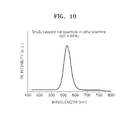
- FIG. 10 is a photoluminescence (PL) spectrum of the CdSe/CdS/ZnS nanoparticles of Example 3 after ligands substitution. After the ligand substitution, the PL spectrum was measured for the CdSe/CdS/ZnS nanoparticles with the Sn 2 S 6 hydrazine hydrate ligands dissolved (dispersed) in ethanolamine. Also, referring to FIG. 10 , a luminescence quantum yield (QY) of the Sn 2 S 6 hydrazine hydrate ligand-capped CdSe/CdS/ZnS nanoparticles after ligands substitution was 68 %.
- QY luminescence quantum yield
- Inorganic ligands-capped CdSe/ZnS nanoparticles prepared using a hydrazine showed reduction to a level of about 40-50 % of photoluminescence intensity, compared to the same nanoparticles, and a luminescence (QY) was 35-41 %. (refer to J. Am. Chem. Soc., 2010, 132 (29), pp 10085-10092 ).
- the QY of the CdSe/CdS/ZnS nanoparticles capped with the Sn 2 S 6 hydrazine hydrate ligands of Example 3 was higher than that of the inorganic ligand-capped CdSe/ZnS nanoparticles of the above article.
- Such an increase in the QY of MCC hydrazine hydrate-capped nanoparticles obtained by the processes described in various embodiments may be attributed to the feature of the processes that the hydrazine hydrate solvent does not directly affect the preparation of nanoparticles capped with MCC hydrazine hydrate which increases a photoluminescence efficiency.
- the FTIR spectra were recorded on a Varian 670-IR spectrophotometer from Varian Inc., and the photoluminescence spectra were recorded on a F-7000 fluorescence spectrophotometer from Hitachi High-Technologies.
Landscapes
- Chemical & Material Sciences (AREA)
- Engineering & Computer Science (AREA)
- Nanotechnology (AREA)
- Organic Chemistry (AREA)
- Crystallography & Structural Chemistry (AREA)
- Inorganic Chemistry (AREA)
- Physics & Mathematics (AREA)
- Materials Engineering (AREA)
- Condensed Matter Physics & Semiconductors (AREA)
- General Physics & Mathematics (AREA)
- Manufacturing & Machinery (AREA)
- Composite Materials (AREA)
- Mathematical Physics (AREA)
- Theoretical Computer Science (AREA)
- Luminescent Compositions (AREA)
- Manufacturing Of Micro-Capsules (AREA)
- Powder Metallurgy (AREA)
Applications Claiming Priority (1)
| Application Number | Priority Date | Filing Date | Title |
|---|---|---|---|
| KR1020110106637A KR101874413B1 (ko) | 2011-10-18 | 2011-10-18 | 무기 리간드를 갖는 양자점 및 그의 제조방법 |
Publications (2)
| Publication Number | Publication Date |
|---|---|
| EP2584608A2 true EP2584608A2 (fr) | 2013-04-24 |
| EP2584608A3 EP2584608A3 (fr) | 2014-05-28 |
Family
ID=47022556
Family Applications (1)
| Application Number | Title | Priority Date | Filing Date |
|---|---|---|---|
| EP12188399.5A Withdrawn EP2584608A3 (fr) | 2011-10-18 | 2012-10-12 | Nanoparticules et leur procédé de fabrication |
Country Status (5)
| Country | Link |
|---|---|
| US (1) | US9385194B2 (fr) |
| EP (1) | EP2584608A3 (fr) |
| JP (1) | JP6084804B2 (fr) |
| KR (1) | KR101874413B1 (fr) |
| CN (1) | CN103059868B (fr) |
Families Citing this family (53)
| Publication number | Priority date | Publication date | Assignee | Title |
|---|---|---|---|---|
| JP6007669B2 (ja) * | 2012-08-20 | 2016-10-12 | 東ソー株式会社 | 金属酸化物微粒子分散液及びこれを用いた透明導電膜 |
| KR101941173B1 (ko) * | 2012-12-04 | 2019-01-22 | 삼성전자주식회사 | 양이온성 금속 칼코게나이드 화합물로 표면안정화된 나노입자 |
| KR101619933B1 (ko) * | 2013-08-01 | 2016-05-11 | 주식회사 엘지화학 | 태양전지 광흡수층 제조용 3층 코어-쉘 나노 입자 및 이의 제조 방법 |
| CN104513663A (zh) * | 2013-09-27 | 2015-04-15 | 深圳先进技术研究院 | 近红外铜铟硒量子点及其制备方法 |
| CN104513664A (zh) * | 2013-09-27 | 2015-04-15 | 深圳先进技术研究院 | 近红外银铟硒量子点及其制备方法 |
| US20150162468A1 (en) * | 2013-12-06 | 2015-06-11 | Nanoco Technologies Ltd. | Core-Shell Nanoparticles for Photovoltaic Absorber Films |
| EP3102647B1 (fr) * | 2014-02-04 | 2020-11-04 | Lumileds Holding B.V. | Ligands composites inorganiques à base d'oxo et d'hydroxo pour des points quantiques |
| CN105940082B (zh) | 2014-02-04 | 2019-07-05 | 亮锐控股有限公司 | 在无机基质中具有无机配体的量子点 |
| KR102214829B1 (ko) * | 2014-02-27 | 2021-02-10 | 삼성전자주식회사 | 나노입자 다층 박막 |
| CN104952626B (zh) * | 2015-05-19 | 2017-12-01 | 温州大学 | 一种纳米晶对电极及其制备方法 |
| FR3039531A1 (fr) * | 2015-07-28 | 2017-02-03 | Nexdot | |
| US11581582B2 (en) | 2015-08-04 | 2023-02-14 | Honda Motor Co., Ltd. | Liquid-type room-temperature fluoride ion batteries |
| US11177512B2 (en) | 2016-12-15 | 2021-11-16 | Honda Motor Co., Ltd. | Barium-doped composite electrode materials for fluoride-ion electrochemical cells |
| US11749797B2 (en) | 2016-12-15 | 2023-09-05 | Honda Motor Co., Ltd. | Nanostructural designs for electrode materials of fluoride ion batteries |
| US12136735B2 (en) | 2018-12-05 | 2024-11-05 | Honda Motor Co., Ltd. | Electroactive materials modified with molecular thin film shell |
| KR20170044791A (ko) * | 2015-10-15 | 2017-04-26 | 희성전자 주식회사 | 양자점, 고분자 수지, 양자점 시트 및 이를 포함하는 백라이트 유닛 |
| KR20180067628A (ko) * | 2015-11-12 | 2018-06-20 | 후지필름 가부시키가이샤 | 코어 셸 입자, 코어 셸 입자의 제조 방법 및 필름 |
| CN105522168B (zh) * | 2016-01-08 | 2017-05-10 | 浙江大学 | 一种立方体铂钌核壳纳米晶的制备方法及其产物 |
| CN106854224B (zh) * | 2016-11-11 | 2019-03-12 | 苏州大学 | 一种含过渡金属配离子的汞碲化合物及其肼辅助制备方法 |
| EP3555940B1 (fr) | 2016-12-15 | 2023-08-30 | Honda Motor Co., Ltd. | Matériaux d'électrodes composites pour piles électrochimiques aux ions fluorure |
| KR101975989B1 (ko) * | 2017-03-09 | 2019-08-28 | 주식회사 지엘비젼 | 양자점, 필름 및 조명장치 |
| CN108630814B (zh) * | 2017-03-15 | 2020-08-18 | Tcl科技集团股份有限公司 | 一种核壳结构胶体纳米片、qled器件及制备方法 |
| KR101982011B1 (ko) * | 2017-07-17 | 2019-05-27 | 주식회사 지엘비젼 | 양자점필름 및 이를 이용하는 광학부재 |
| US11005060B2 (en) | 2018-03-19 | 2021-05-11 | Samsung Electronics Co., Ltd. | Electroluminescent device, and display device comprising thereof |
| US11737301B2 (en) | 2018-03-19 | 2023-08-22 | Samsung Electronics Co., Ltd. | Electroluminescent device, and display device comprising thereof |
| KR102712559B1 (ko) * | 2018-04-24 | 2024-10-02 | 삼성전자주식회사 | 발광막, 그 제조 방법, 및 이를 포함하는 발광 소자 |
| US11228026B2 (en) | 2018-06-20 | 2022-01-18 | Honda Motor Co., Ltd. | Two phase shell formation on metal nanostructures |
| US10978658B2 (en) * | 2018-08-24 | 2021-04-13 | Samsung Electronics Co., Ltd. | Light emitting device and display device including the same |
| EP3852151A4 (fr) * | 2018-09-12 | 2022-06-15 | NS Materials Inc. | Capteur infrarouge et son procédé de production |
| CN112111277A (zh) * | 2018-10-18 | 2020-12-22 | 浙江大学 | 单光子源和qled |
| CN111384269B (zh) | 2018-12-29 | 2021-08-03 | Tcl科技集团股份有限公司 | 量子点发光二极管及其制备方法 |
| JP7520287B2 (ja) | 2019-03-20 | 2024-07-23 | 昭栄化学工業株式会社 | エレクトロルミネッセンスデバイスのための無機配位子を有するナノ構造 |
| KR102823948B1 (ko) | 2019-08-05 | 2025-06-24 | 삼성디스플레이 주식회사 | 양자점 조성물, 발광 소자 및 이를 포함하는 표시 장치 |
| CN112397671B (zh) * | 2019-08-19 | 2022-08-23 | Tcl科技集团股份有限公司 | 一种改性硫化锌及其制备方法与量子点发光二极管 |
| US12289944B2 (en) * | 2019-09-02 | 2025-04-29 | Sharp Kabushiki Kaisha | Light-emitting element and display device |
| CN113046064A (zh) * | 2019-12-28 | 2021-06-29 | Tcl集团股份有限公司 | 量子点材料及其制备方法、量子点发光二极管和发光装置 |
| CN113121382B (zh) * | 2019-12-30 | 2023-08-25 | Tcl科技集团股份有限公司 | 金属化合物材料及其制备方法、量子点发光二极管和发光装置 |
| TW202147464A (zh) * | 2020-02-13 | 2021-12-16 | 日商富士軟片股份有限公司 | 半導體膜、光檢測元件、影像感測器及半導體膜的製造方法 |
| EP3872146A1 (fr) * | 2020-02-25 | 2021-09-01 | Rijksuniversiteit Groningen | Encres à nanoparticules colloïdales pour l'impression de couches actives dans un dispositif optoélectronique |
| WO2021171605A1 (fr) * | 2020-02-28 | 2021-09-02 | シャープ株式会社 | Procédé de production d'une dispersion de points quantiques, procédé de production de points quantiques |
| KR102840024B1 (ko) | 2020-09-28 | 2025-07-29 | 삼성디스플레이 주식회사 | 양자점 조성물 및 이를 이용한 발광 소자의 제조 방법 |
| KR102578817B1 (ko) * | 2020-12-02 | 2023-09-15 | 재단법인대구경북과학기술원 | 극성을 갖는 리간드로 표면처리된 양자점의 전사 인쇄 방법, 상기 방법으로 제조된 극성을 갖는 리간드로 표면처리된 양자점 박막 및 전자소자 |
| KR102587824B1 (ko) * | 2020-12-02 | 2023-10-10 | 재단법인대구경북과학기술원 | 양자점 다층 박막의 적층 전사 인쇄 방법 및 이를 통해 제조된 양자점 다층 박막 |
| KR102893541B1 (ko) | 2021-01-07 | 2025-12-02 | 삼성디스플레이 주식회사 | 발광 소자, 이의 제조방법 및 이를 포함하는 표시 장치 |
| CN113120872B (zh) * | 2021-04-19 | 2022-11-29 | 哈尔滨科友半导体产业装备与技术研究院有限公司 | 一种pvt法使用的氮化铝粉末的预处理方法 |
| US20240240076A1 (en) * | 2021-05-20 | 2024-07-18 | Sharp Kabushiki Kaisha | Quantum-dot-containing film, light-emitting element, quantum dot composition and method for producing same, and method for producing quantum-dot-containing film |
| KR20230013993A (ko) | 2021-07-20 | 2023-01-27 | 삼성전자주식회사 | 광전 소자 및 이를 포함하는 전자 장치 |
| KR102718017B1 (ko) * | 2021-11-25 | 2024-10-16 | 울산과학기술원 | 광 감응 전-무기 나노입자 잉크의 제조방법 및 이를 사용한 3차원 구조체 프린팅 방법 |
| US20250048786A1 (en) * | 2022-02-14 | 2025-02-06 | Sharp Display Technology Corporation | Light-emitting element, quantum dot dispersion solution, display device, method for manufacturing light-emitting element, and method for manufacturing quantum dot dispersion solution |
| KR102840174B1 (ko) * | 2022-09-28 | 2025-07-31 | 재단법인대구경북과학기술원 | Ii-vi 극소 나노클러스터 및 이의 제조방법 |
| JP2026053780A (ja) * | 2023-02-08 | 2026-03-26 | 学校法人立命館 | 水和電子発生用、ハロゲン含有有機材料分解用、フォトクロミック材料用のナノ粒子 |
| CN121889479A (zh) | 2023-09-20 | 2026-04-17 | 三星显示有限公司 | 量子点以及包括量子点的油墨组合物、发光装置、光学构件和设备 |
| WO2025182059A1 (fr) * | 2024-03-01 | 2025-09-04 | シャープディスプレイテクノロジー株式会社 | Élément électroluminescent et dispositif d'affichage |
Family Cites Families (9)
| Publication number | Priority date | Publication date | Assignee | Title |
|---|---|---|---|---|
| US7534488B2 (en) * | 2003-09-10 | 2009-05-19 | The Regents Of The University Of California | Graded core/shell semiconductor nanorods and nanorod barcodes |
| US6875661B2 (en) | 2003-07-10 | 2005-04-05 | International Business Machines Corporation | Solution deposition of chalcogenide films |
| CN100490205C (zh) | 2003-07-10 | 2009-05-20 | 国际商业机器公司 | 淀积金属硫族化物膜的方法和制备场效应晶体管的方法 |
| US7405129B2 (en) | 2004-11-18 | 2008-07-29 | International Business Machines Corporation | Device comprising doped nano-component and method of forming the device |
| JP4565153B2 (ja) | 2004-11-19 | 2010-10-20 | 独立行政法人産業技術総合研究所 | ナノ粒子の低温合成法 |
| GB0522027D0 (en) | 2005-10-28 | 2005-12-07 | Nanoco Technologies Ltd | Controlled preparation of nanoparticle materials |
| US7517718B2 (en) | 2006-01-12 | 2009-04-14 | International Business Machines Corporation | Method for fabricating an inorganic nanocomposite |
| WO2007125812A1 (fr) * | 2006-04-28 | 2007-11-08 | Konica Minolta Medical & Graphic, Inc. | Nanoparticule inorganique, son procede de production et agent de marquage de biosubstance liee a une nanoparticule inorganique |
| US8067259B2 (en) | 2009-05-12 | 2011-11-29 | Evident Technologies | Method of producing high performance photovoltaic and thermoelectric nanostructured bulk and thin films |
-
2011
- 2011-10-18 KR KR1020110106637A patent/KR101874413B1/ko not_active Expired - Fee Related
-
2012
- 2012-05-23 US US13/478,961 patent/US9385194B2/en not_active Expired - Fee Related
- 2012-10-12 EP EP12188399.5A patent/EP2584608A3/fr not_active Withdrawn
- 2012-10-16 JP JP2012229160A patent/JP6084804B2/ja not_active Expired - Fee Related
- 2012-10-18 CN CN201210397296.6A patent/CN103059868B/zh not_active Expired - Fee Related
Non-Patent Citations (3)
| Title |
|---|
| ADVANCED MATERIALS, vol. 19, 2007, pages 1927 - 1932 |
| J. AM. CHEM. SOC., vol. 132, no. 29, 2010, pages 10085 - 10092 |
| SCIENCE, vol. 324, 2009, pages 1417 - 1420 |
Also Published As
| Publication number | Publication date |
|---|---|
| JP2013089969A (ja) | 2013-05-13 |
| US9385194B2 (en) | 2016-07-05 |
| KR101874413B1 (ko) | 2018-07-05 |
| CN103059868B (zh) | 2016-04-13 |
| CN103059868A (zh) | 2013-04-24 |
| JP6084804B2 (ja) | 2017-02-22 |
| US20130092885A1 (en) | 2013-04-18 |
| EP2584608A3 (fr) | 2014-05-28 |
| KR20130042372A (ko) | 2013-04-26 |
Similar Documents
| Publication | Publication Date | Title |
|---|---|---|
| US9385194B2 (en) | Nanoparticles and methods of manufacturing the same | |
| US10562770B2 (en) | Nanoparticles passivated with cationic metal-chalcogenide compound | |
| US9334440B2 (en) | Processes for synthesizing nanocrystals and nanocrystal compositions | |
| CN109072067B (zh) | 量子点及其制备方法 | |
| CN107663452B (zh) | 量子点、其制造方法、以及包括其的量子点-聚合物复合物和电子装置 | |
| TWI626294B (zh) | 量子點及其製備方法 | |
| CN104818019B (zh) | 纳米晶体颗粒、其合成方法和包括其的器件 | |
| KR101963224B1 (ko) | 나노입자와 그의 제조방법, 상기 나노입자를 포함하는 용액, 및 나노입자 필름과 그의 제조방법 | |
| CN104512860B (zh) | 纳米晶体颗粒及其合成方法 | |
| US10121565B2 (en) | Nanoparticle multilayer film | |
| US20130146834A1 (en) | Quantum dot-matrix thin film and method of producing the same | |
| CN105940081A (zh) | 用于量子点的基于配位氧和配位羟的复合无机配体 | |
| US9902900B2 (en) | Nanoparticle polymer and method of preparing a nanoparticle polymer | |
| KR101971586B1 (ko) | 단일 전자 점유된 양자점 및 이의 자성 제어방법 | |
| KR101719574B1 (ko) | 패시베이션된 양자점 및 그 제조방법 | |
| KR20150016436A (ko) | 마그네슘-셀레나이드 나노 결정 합성 방법 | |
| US9764320B2 (en) | Anion exchange methods using anion exchange precursor | |
| KR102864844B1 (ko) | 양자점 |
Legal Events
| Date | Code | Title | Description |
|---|---|---|---|
| PUAI | Public reference made under article 153(3) epc to a published international application that has entered the european phase |
Free format text: ORIGINAL CODE: 0009012 |
|
| AK | Designated contracting states |
Kind code of ref document: A2 Designated state(s): AL AT BE BG CH CY CZ DE DK EE ES FI FR GB GR HR HU IE IS IT LI LT LU LV MC MK MT NL NO PL PT RO RS SE SI SK SM TR |
|
| AX | Request for extension of the european patent |
Extension state: BA ME |
|
| PUAL | Search report despatched |
Free format text: ORIGINAL CODE: 0009013 |
|
| AK | Designated contracting states |
Kind code of ref document: A3 Designated state(s): AL AT BE BG CH CY CZ DE DK EE ES FI FR GB GR HR HU IE IS IT LI LT LU LV MC MK MT NL NO PL PT RO RS SE SI SK SM TR |
|
| AX | Request for extension of the european patent |
Extension state: BA ME |
|
| RIC1 | Information provided on ipc code assigned before grant |
Ipc: H01L 29/06 20060101ALI20140423BHEP Ipc: B82Y 40/00 20110101ALI20140423BHEP Ipc: G03C 1/06 20060101ALI20140423BHEP Ipc: H01L 29/20 20060101ALI20140423BHEP Ipc: H01L 29/22 20060101ALI20140423BHEP Ipc: H01L 29/76 20060101ALN20140423BHEP Ipc: B82Y 30/00 20110101ALI20140423BHEP Ipc: C01B 19/00 20060101ALI20140423BHEP Ipc: H01L 29/12 20060101AFI20140423BHEP |
|
| 17P | Request for examination filed |
Effective date: 20141128 |
|
| RBV | Designated contracting states (corrected) |
Designated state(s): AL AT BE BG CH CY CZ DE DK EE ES FI FR GB GR HR HU IE IS IT LI LT LU LV MC MK MT NL NO PL PT RO RS SE SI SK SM TR |
|
| RIC1 | Information provided on ipc code assigned before grant |
Ipc: H01L 29/20 20060101ALI20190626BHEP Ipc: H01L 29/06 20060101ALI20190626BHEP Ipc: B82Y 30/00 20110101ALI20190626BHEP Ipc: H01L 29/22 20060101ALI20190626BHEP Ipc: G03C 1/06 20060101ALI20190626BHEP Ipc: C01B 19/00 20060101ALI20190626BHEP Ipc: H01L 29/12 20060101AFI20190626BHEP Ipc: B82Y 40/00 20110101ALI20190626BHEP |
|
| RIC1 | Information provided on ipc code assigned before grant |
Ipc: B82Y 30/00 20110101ALI20190711BHEP Ipc: H01L 29/06 20060101ALI20190711BHEP Ipc: H01L 29/20 20060101ALI20190711BHEP Ipc: B82Y 40/00 20110101ALI20190711BHEP Ipc: H01L 29/12 20060101AFI20190711BHEP Ipc: G03C 1/06 20060101ALI20190711BHEP Ipc: B82Y 10/00 20110101ALI20190711BHEP Ipc: H01L 29/22 20060101ALI20190711BHEP Ipc: C01B 19/00 20060101ALI20190711BHEP |
|
| GRAP | Despatch of communication of intention to grant a patent |
Free format text: ORIGINAL CODE: EPIDOSNIGR1 |
|
| INTG | Intention to grant announced |
Effective date: 20190919 |
|
| STAA | Information on the status of an ep patent application or granted ep patent |
Free format text: STATUS: THE APPLICATION IS DEEMED TO BE WITHDRAWN |
|
| 18D | Application deemed to be withdrawn |
Effective date: 20200130 |