EP2585555B1 - Composes polymerisables et utilisation de ceux-ci dans des ecrans a cristaux liquides - Google Patents
Composes polymerisables et utilisation de ceux-ci dans des ecrans a cristaux liquides Download PDFInfo
- Publication number
- EP2585555B1 EP2585555B1 EP11724555.5A EP11724555A EP2585555B1 EP 2585555 B1 EP2585555 B1 EP 2585555B1 EP 11724555 A EP11724555 A EP 11724555A EP 2585555 B1 EP2585555 B1 EP 2585555B1
- Authority
- EP
- European Patent Office
- Prior art keywords
- compounds
- oder
- atoms
- psa
- formula
- Prior art date
- Legal status (The legal status is an assumption and is not a legal conclusion. Google has not performed a legal analysis and makes no representation as to the accuracy of the status listed.)
- Active
Links
- 0 P*C1(CC2)CCC2(*P)CC1 Chemical compound P*C1(CC2)CCC2(*P)CC1 0.000 description 28
- FORFMXUOFYBWAI-UHFFFAOYSA-N CC(C(OCc(cc1)ccc1C#Cc(cc1)ccc1OC(C(C)=C)=O)=O)=C Chemical compound CC(C(OCc(cc1)ccc1C#Cc(cc1)ccc1OC(C(C)=C)=O)=O)=C FORFMXUOFYBWAI-UHFFFAOYSA-N 0.000 description 1
- IVNAPRMSDJLUFE-UHFFFAOYSA-N OCc(cc1)ccc1C#Cc(cc1)ccc1O Chemical compound OCc(cc1)ccc1C#Cc(cc1)ccc1O IVNAPRMSDJLUFE-UHFFFAOYSA-N 0.000 description 1
Classifications
-
- C—CHEMISTRY; METALLURGY
- C09—DYES; PAINTS; POLISHES; NATURAL RESINS; ADHESIVES; COMPOSITIONS NOT OTHERWISE PROVIDED FOR; APPLICATIONS OF MATERIALS NOT OTHERWISE PROVIDED FOR
- C09K—MATERIALS FOR MISCELLANEOUS APPLICATIONS, NOT PROVIDED FOR ELSEWHERE
- C09K19/00—Liquid crystal materials
- C09K19/04—Liquid crystal materials characterised by the chemical structure of the liquid crystal components, e.g. by a specific unit
- C09K19/06—Non-steroidal liquid crystal compounds
- C09K19/08—Non-steroidal liquid crystal compounds containing at least two non-condensed rings
- C09K19/10—Non-steroidal liquid crystal compounds containing at least two non-condensed rings containing at least two benzene rings
- C09K19/14—Non-steroidal liquid crystal compounds containing at least two non-condensed rings containing at least two benzene rings linked by a carbon chain
- C09K19/18—Non-steroidal liquid crystal compounds containing at least two non-condensed rings containing at least two benzene rings linked by a carbon chain the chain containing carbon-to-carbon triple bonds, e.g. tolans
-
- C—CHEMISTRY; METALLURGY
- C07—ORGANIC CHEMISTRY
- C07C—ACYCLIC OR CARBOCYCLIC COMPOUNDS
- C07C69/00—Esters of carboxylic acids; Esters of carbonic or haloformic acids
- C07C69/52—Esters of acyclic unsaturated carboxylic acids having the esterified carboxyl group bound to an acyclic carbon atom
- C07C69/533—Monocarboxylic acid esters having only one carbon-to-carbon double bond
- C07C69/54—Acrylic acid esters; Methacrylic acid esters
-
- C—CHEMISTRY; METALLURGY
- C07—ORGANIC CHEMISTRY
- C07C—ACYCLIC OR CARBOCYCLIC COMPOUNDS
- C07C37/00—Preparation of compounds having hydroxy or O-metal groups bound to a carbon atom of a six-membered aromatic ring
-
- C—CHEMISTRY; METALLURGY
- C07—ORGANIC CHEMISTRY
- C07C—ACYCLIC OR CARBOCYCLIC COMPOUNDS
- C07C37/00—Preparation of compounds having hydroxy or O-metal groups bound to a carbon atom of a six-membered aromatic ring
- C07C37/11—Preparation of compounds having hydroxy or O-metal groups bound to a carbon atom of a six-membered aromatic ring by reactions increasing the number of carbon atoms
- C07C37/18—Preparation of compounds having hydroxy or O-metal groups bound to a carbon atom of a six-membered aromatic ring by reactions increasing the number of carbon atoms by condensation involving halogen atoms of halogenated compounds
-
- C—CHEMISTRY; METALLURGY
- C07—ORGANIC CHEMISTRY
- C07C—ACYCLIC OR CARBOCYCLIC COMPOUNDS
- C07C67/00—Preparation of carboxylic acid esters
- C07C67/08—Preparation of carboxylic acid esters by reacting carboxylic acids or symmetrical anhydrides with the hydroxy or O-metal group of organic compounds
-
- C—CHEMISTRY; METALLURGY
- C07—ORGANIC CHEMISTRY
- C07C—ACYCLIC OR CARBOCYCLIC COMPOUNDS
- C07C69/00—Esters of carboxylic acids; Esters of carbonic or haloformic acids
- C07C69/52—Esters of acyclic unsaturated carboxylic acids having the esterified carboxyl group bound to an acyclic carbon atom
- C07C69/602—Dicarboxylic acid esters having at least two carbon-to-carbon double bonds
-
- C—CHEMISTRY; METALLURGY
- C07—ORGANIC CHEMISTRY
- C07F—ACYCLIC, CARBOCYCLIC OR HETEROCYCLIC COMPOUNDS CONTAINING ELEMENTS OTHER THAN CARBON, HYDROGEN, HALOGEN, OXYGEN, NITROGEN, SULFUR, SELENIUM OR TELLURIUM
- C07F7/00—Compounds containing elements of Groups 4 or 14 of the Periodic Table
- C07F7/02—Silicon compounds
- C07F7/08—Compounds having one or more C—Si linkages
- C07F7/18—Compounds having one or more C—Si linkages as well as one or more C—O—Si linkages
- C07F7/1804—Compounds having Si-O-C linkages
-
- C—CHEMISTRY; METALLURGY
- C07—ORGANIC CHEMISTRY
- C07F—ACYCLIC, CARBOCYCLIC OR HETEROCYCLIC COMPOUNDS CONTAINING ELEMENTS OTHER THAN CARBON, HYDROGEN, HALOGEN, OXYGEN, NITROGEN, SULFUR, SELENIUM OR TELLURIUM
- C07F7/00—Compounds containing elements of Groups 4 or 14 of the Periodic Table
- C07F7/02—Silicon compounds
- C07F7/08—Compounds having one or more C—Si linkages
- C07F7/18—Compounds having one or more C—Si linkages as well as one or more C—O—Si linkages
- C07F7/1804—Compounds having Si-O-C linkages
- C07F7/1872—Preparation; Treatments not provided for in C07F7/20
- C07F7/1892—Preparation; Treatments not provided for in C07F7/20 by reactions not provided for in C07F7/1876 - C07F7/1888
-
- C—CHEMISTRY; METALLURGY
- C09—DYES; PAINTS; POLISHES; NATURAL RESINS; ADHESIVES; COMPOSITIONS NOT OTHERWISE PROVIDED FOR; APPLICATIONS OF MATERIALS NOT OTHERWISE PROVIDED FOR
- C09K—MATERIALS FOR MISCELLANEOUS APPLICATIONS, NOT PROVIDED FOR ELSEWHERE
- C09K19/00—Liquid crystal materials
- C09K19/04—Liquid crystal materials characterised by the chemical structure of the liquid crystal components, e.g. by a specific unit
- C09K19/06—Non-steroidal liquid crystal compounds
- C09K19/08—Non-steroidal liquid crystal compounds containing at least two non-condensed rings
- C09K19/10—Non-steroidal liquid crystal compounds containing at least two non-condensed rings containing at least two benzene rings
- C09K19/20—Non-steroidal liquid crystal compounds containing at least two non-condensed rings containing at least two benzene rings linked by a chain containing carbon and oxygen atoms as chain links, e.g. esters or ethers
-
- C—CHEMISTRY; METALLURGY
- C09—DYES; PAINTS; POLISHES; NATURAL RESINS; ADHESIVES; COMPOSITIONS NOT OTHERWISE PROVIDED FOR; APPLICATIONS OF MATERIALS NOT OTHERWISE PROVIDED FOR
- C09K—MATERIALS FOR MISCELLANEOUS APPLICATIONS, NOT PROVIDED FOR ELSEWHERE
- C09K19/00—Liquid crystal materials
- C09K19/04—Liquid crystal materials characterised by the chemical structure of the liquid crystal components, e.g. by a specific unit
- C09K19/06—Non-steroidal liquid crystal compounds
- C09K19/08—Non-steroidal liquid crystal compounds containing at least two non-condensed rings
- C09K19/10—Non-steroidal liquid crystal compounds containing at least two non-condensed rings containing at least two benzene rings
- C09K19/20—Non-steroidal liquid crystal compounds containing at least two non-condensed rings containing at least two benzene rings linked by a chain containing carbon and oxygen atoms as chain links, e.g. esters or ethers
- C09K19/2007—Non-steroidal liquid crystal compounds containing at least two non-condensed rings containing at least two benzene rings linked by a chain containing carbon and oxygen atoms as chain links, e.g. esters or ethers the chain containing -COO- or -OCO- groups
- C09K19/2014—Non-steroidal liquid crystal compounds containing at least two non-condensed rings containing at least two benzene rings linked by a chain containing carbon and oxygen atoms as chain links, e.g. esters or ethers the chain containing -COO- or -OCO- groups containing additionally a linking group other than -COO- or -OCO-, e.g. -CH2-CH2-, -CH=CH-, -C=C-; containing at least one additional carbon atom in the chain containing -COO- or -OCO- groups, e.g. -(CH2)m-COO-(CH2)n-
-
- C—CHEMISTRY; METALLURGY
- C09—DYES; PAINTS; POLISHES; NATURAL RESINS; ADHESIVES; COMPOSITIONS NOT OTHERWISE PROVIDED FOR; APPLICATIONS OF MATERIALS NOT OTHERWISE PROVIDED FOR
- C09K—MATERIALS FOR MISCELLANEOUS APPLICATIONS, NOT PROVIDED FOR ELSEWHERE
- C09K19/00—Liquid crystal materials
- C09K19/04—Liquid crystal materials characterised by the chemical structure of the liquid crystal components, e.g. by a specific unit
- C09K19/06—Non-steroidal liquid crystal compounds
- C09K19/08—Non-steroidal liquid crystal compounds containing at least two non-condensed rings
- C09K19/30—Non-steroidal liquid crystal compounds containing at least two non-condensed rings containing saturated or unsaturated non-aromatic rings, e.g. cyclohexane rings
- C09K19/3001—Cyclohexane rings
- C09K19/3003—Compounds containing at least two rings in which the different rings are directly linked (covalent bond)
-
- C—CHEMISTRY; METALLURGY
- C09—DYES; PAINTS; POLISHES; NATURAL RESINS; ADHESIVES; COMPOSITIONS NOT OTHERWISE PROVIDED FOR; APPLICATIONS OF MATERIALS NOT OTHERWISE PROVIDED FOR
- C09K—MATERIALS FOR MISCELLANEOUS APPLICATIONS, NOT PROVIDED FOR ELSEWHERE
- C09K19/00—Liquid crystal materials
- C09K19/04—Liquid crystal materials characterised by the chemical structure of the liquid crystal components, e.g. by a specific unit
- C09K19/06—Non-steroidal liquid crystal compounds
- C09K19/32—Non-steroidal liquid crystal compounds containing condensed ring systems, i.e. fused, bridged or spiro ring systems
-
- C—CHEMISTRY; METALLURGY
- C09—DYES; PAINTS; POLISHES; NATURAL RESINS; ADHESIVES; COMPOSITIONS NOT OTHERWISE PROVIDED FOR; APPLICATIONS OF MATERIALS NOT OTHERWISE PROVIDED FOR
- C09K—MATERIALS FOR MISCELLANEOUS APPLICATIONS, NOT PROVIDED FOR ELSEWHERE
- C09K19/00—Liquid crystal materials
- C09K19/04—Liquid crystal materials characterised by the chemical structure of the liquid crystal components, e.g. by a specific unit
- C09K19/06—Non-steroidal liquid crystal compounds
- C09K19/32—Non-steroidal liquid crystal compounds containing condensed ring systems, i.e. fused, bridged or spiro ring systems
- C09K19/322—Compounds containing a naphthalene ring or a completely or partially hydrogenated naphthalene ring
-
- C—CHEMISTRY; METALLURGY
- C09—DYES; PAINTS; POLISHES; NATURAL RESINS; ADHESIVES; COMPOSITIONS NOT OTHERWISE PROVIDED FOR; APPLICATIONS OF MATERIALS NOT OTHERWISE PROVIDED FOR
- C09K—MATERIALS FOR MISCELLANEOUS APPLICATIONS, NOT PROVIDED FOR ELSEWHERE
- C09K19/00—Liquid crystal materials
- C09K19/04—Liquid crystal materials characterised by the chemical structure of the liquid crystal components, e.g. by a specific unit
- C09K19/38—Polymers
-
- C—CHEMISTRY; METALLURGY
- C09—DYES; PAINTS; POLISHES; NATURAL RESINS; ADHESIVES; COMPOSITIONS NOT OTHERWISE PROVIDED FOR; APPLICATIONS OF MATERIALS NOT OTHERWISE PROVIDED FOR
- C09K—MATERIALS FOR MISCELLANEOUS APPLICATIONS, NOT PROVIDED FOR ELSEWHERE
- C09K19/00—Liquid crystal materials
- C09K19/04—Liquid crystal materials characterised by the chemical structure of the liquid crystal components, e.g. by a specific unit
- C09K19/42—Mixtures of liquid crystal compounds covered by two or more of the preceding groups C09K19/06 - C09K19/40
- C09K19/46—Mixtures of liquid crystal compounds covered by two or more of the preceding groups C09K19/06 - C09K19/40 containing esters
-
- G—PHYSICS
- G02—OPTICS
- G02F—OPTICAL DEVICES OR ARRANGEMENTS FOR THE CONTROL OF LIGHT BY MODIFICATION OF THE OPTICAL PROPERTIES OF THE MEDIA OF THE ELEMENTS INVOLVED THEREIN; NON-LINEAR OPTICS; FREQUENCY-CHANGING OF LIGHT; OPTICAL LOGIC ELEMENTS; OPTICAL ANALOGUE/DIGITAL CONVERTERS
- G02F1/00—Devices or arrangements for the control of the intensity, colour, phase, polarisation or direction of light arriving from an independent light source, e.g. switching, gating or modulating; Non-linear optics
- G02F1/01—Devices or arrangements for the control of the intensity, colour, phase, polarisation or direction of light arriving from an independent light source, e.g. switching, gating or modulating; Non-linear optics for the control of the intensity, phase, polarisation or colour
- G02F1/13—Devices or arrangements for the control of the intensity, colour, phase, polarisation or direction of light arriving from an independent light source, e.g. switching, gating or modulating; Non-linear optics for the control of the intensity, phase, polarisation or colour based on liquid crystals, e.g. single liquid crystal display cells
-
- G—PHYSICS
- G02—OPTICS
- G02F—OPTICAL DEVICES OR ARRANGEMENTS FOR THE CONTROL OF LIGHT BY MODIFICATION OF THE OPTICAL PROPERTIES OF THE MEDIA OF THE ELEMENTS INVOLVED THEREIN; NON-LINEAR OPTICS; FREQUENCY-CHANGING OF LIGHT; OPTICAL LOGIC ELEMENTS; OPTICAL ANALOGUE/DIGITAL CONVERTERS
- G02F1/00—Devices or arrangements for the control of the intensity, colour, phase, polarisation or direction of light arriving from an independent light source, e.g. switching, gating or modulating; Non-linear optics
- G02F1/01—Devices or arrangements for the control of the intensity, colour, phase, polarisation or direction of light arriving from an independent light source, e.g. switching, gating or modulating; Non-linear optics for the control of the intensity, phase, polarisation or colour
- G02F1/13—Devices or arrangements for the control of the intensity, colour, phase, polarisation or direction of light arriving from an independent light source, e.g. switching, gating or modulating; Non-linear optics for the control of the intensity, phase, polarisation or colour based on liquid crystals, e.g. single liquid crystal display cells
- G02F1/133—Constructional arrangements; Operation of liquid crystal cells; Circuit arrangements
- G02F1/1333—Constructional arrangements; Manufacturing methods
-
- C—CHEMISTRY; METALLURGY
- C09—DYES; PAINTS; POLISHES; NATURAL RESINS; ADHESIVES; COMPOSITIONS NOT OTHERWISE PROVIDED FOR; APPLICATIONS OF MATERIALS NOT OTHERWISE PROVIDED FOR
- C09K—MATERIALS FOR MISCELLANEOUS APPLICATIONS, NOT PROVIDED FOR ELSEWHERE
- C09K19/00—Liquid crystal materials
- C09K19/04—Liquid crystal materials characterised by the chemical structure of the liquid crystal components, e.g. by a specific unit
- C09K2019/0444—Liquid crystal materials characterised by the chemical structure of the liquid crystal components, e.g. by a specific unit characterized by a linking chain between rings or ring systems, a bridging chain between extensive mesogenic moieties or an end chain group
- C09K2019/0448—Liquid crystal materials characterised by the chemical structure of the liquid crystal components, e.g. by a specific unit characterized by a linking chain between rings or ring systems, a bridging chain between extensive mesogenic moieties or an end chain group the end chain group being a polymerizable end group, e.g. -Sp-P or acrylate
-
- C—CHEMISTRY; METALLURGY
- C09—DYES; PAINTS; POLISHES; NATURAL RESINS; ADHESIVES; COMPOSITIONS NOT OTHERWISE PROVIDED FOR; APPLICATIONS OF MATERIALS NOT OTHERWISE PROVIDED FOR
- C09K—MATERIALS FOR MISCELLANEOUS APPLICATIONS, NOT PROVIDED FOR ELSEWHERE
- C09K19/00—Liquid crystal materials
- C09K19/52—Liquid crystal materials characterised by components which are not liquid crystals, e.g. additives with special physical aspect: solvents, solid particles
- C09K19/54—Additives having no specific mesophase characterised by their chemical composition
- C09K19/542—Macromolecular compounds
- C09K2019/548—Macromolecular compounds stabilizing the alignment; Polymer stabilized alignment
Definitions
- the present invention relates to polymerizable compounds, processes and intermediates for their preparation, and their use for optical, electro-optical and electronic purposes, in particular in liquid crystal (FK) media and LC displays, especially in FK displays of the PS or PSA Type ("polymer sustained” or "polymer sustained alignment").
- FK liquid crystal
- the currently used liquid crystal displays are mostly those of the TN type ("twisted nematic"). However, these have the disadvantage of a strong viewing angle dependence of the contrast.
- so-called VA vertical aligned
- the FK cell of a VA display contains a layer of FK medium between two transparent electrodes, the FK medium usually having a negative value of dielectric (DK) anisotropy.
- DK dielectric
- the molecules of the FK layer in the switched-off state are oriented perpendicular to the electrode surfaces (homeotropic) or tilted homeotropically (“tilted”). When an electrical voltage is applied to the two electrodes, a reorientation of the FK molecules takes place parallel to the electrode surfaces.
- OCB displays (“optically compensated bend") are known, which are based on a birefringence effect and have an FK layer with a so-called "bend” orientation and usually positive (DK) anisotropy. Upon application of an electrical voltage, a reorientation of the FK molecules takes place perpendicular to the electrode surfaces.
- OCB displays typically contain one or more birefringent optical retardation films to avoid unwanted transmittance of the "bend" cell in the dark state. OCB displays have a wider viewing angle and shorter switching times than TN displays.
- IPS displays in-plane switching
- the two Electrodes are arranged only on one of the two substrates, and preferably have intermeshed, comb-shaped structures.
- an electric field is generated between them, which has a significant component parallel to the FK layer. This causes a reorientation of the FK molecules in the layer plane.
- FFS displays (fringe field switching) have been proposed (see, inter alia SH Jung et al., Jpn. J. Appl. Phys., Vol. 43, no. 3, 2004, 1028 ), which also contain two electrodes on the same substrate, but of which, in contrast to IPS displays, only one designed as a comb-shaped electrode, and the other electrode is unstructured.
- Both IPS and FFS displays have low viewing angle dependency of contrast.
- VA displays In more recent VA displays, the uniform alignment of the FK molecules is confined to several smaller domains within the FK cell. Between these domains, also called tilt domains ("tilt domains”), disclinations may exist. VA displays with tilt domains have greater viewing angle independence of contrast and grayscale compared to traditional VA displays. In addition, such displays are easier to manufacture, since additional treatment of the electrode surface for uniform orientation of the molecules in the on state, such as, e.g. by rubbing, is no longer necessary. Instead, the preferred direction of the tilt angle (“pretilt”) is controlled by a special configuration of the electrodes.
- MVA multidomain vertical alignment
- MVA uses protrusions only on one electrode side, while the opposite electrode has slits, which improves the light transmission.
- the slotted electrodes generate an inhomogeneous electric field in the FK cell when a voltage is applied so that controlled switching is still achieved.
- the distances between the slits and protrusions can be increased, which in turn leads to an extension of the switching times.
- PVA patterned VA
- PVA patterned VA
- the so-called PVA can be done without any protrusions by structuring both electrodes on the opposite sides through slits, which leads to increased contrast and improved light transmission, but is technologically difficult and makes the display more sensitive to mechanical influences (knocking , "tapping", etc.).
- a shortening of the switching times as well as an improvement of the contrast and the luminance (transmission) of the display is required.
- PSA displays ( “Polymer S ustained” or “P olymer S ustained A lignment”) represents, for which also the term “polymer S tabilized” is used occasionally.
- a small amount for example 0.3% by weight, typically ⁇ 1% by weight
- polymerisable compound (s) is added to the LC medium which, after being filled into the LC cell with or without applied electrical voltage is polymerized or crosslinked in situ between the electrodes, usually by UV photopolymerization.
- Particularly suitable is the addition of polymerizable mesogenic or liquid crystalline compounds, also referred to as reactive mesogens or "RM" s, proved to be the LC mixture.
- PSA PSA
- PSA-VA, PSA-OCB, PSA-IPS, PSA-FFS and PSA-TN displays are known.
- the polymerization of the polymerizable compound (s) is carried out in PSA-VA and PSA-OCB displays, preferably with applied electrical voltage, in PSA-IPS displays with or without applied electrical voltage.
- the PS (A) method leads to a pretilt in the cell.
- PSA-OCB displays for example, one can achieve that the Bend structure is stabilized, so that one can do without or reduce offset voltage.
- the pretilt has a positive effect on the switching times.
- PSA-VA displays a standard MVA or PVA pixel and electrode layout can be used. In addition, but you can, for example, with only a structured electrode side and do without protruding, which significantly simplifies the production and at the same time leads to a very good contrast with very good light transmission.
- Posi-VA displays (“positive VA”) have proven to be a particularly favorable embodiment.
- the initial orientation of the liquid crystals in the stress-free initial state is here, as in classical VA displays, homeotropic, ie substantially perpendicular to the substrates.
- Posi-VA displays use dielectrically positive FK media.
- interdigital electrodes By applying an electrical voltage to interdigital electrodes which produce a field substantially parallel to the FK medium layer, the FK molecules are transformed into an orientation substantially parallel to the substrates.
- interdigital electrodes are also commonly used in IPS displays.
- Posi-VA displays has a corresponding polymer stabilization (PSA) proved to be advantageous, whereby a considerable reduction of the switching times could be realized.
- PSA VA displays are for example in JP 10-036847 A .
- PSA OCB displays are for example in T.-J-Chen et al., Jpn. J. Appl. Phys. 45, 2006, 2702-2704 and SH Kim, L.-C-Chien, Jpn. J. Appl. Phys. 43, 2004, 7643-7647 described.
- PSA IPS ads are for example in US 6,177,972 and Appl. Phys. Lett. 1999, 75 (21), 3264 described.
- PSA TN displays are for example in Optics Express 2004, 12 (7), 1221 described.
- PSA displays like the conventional FK displays described above, can be operated as active matrix or passive matrix displays.
- active matrix displays the control of individual pixels is usually carried out by integrated, non-linear active elements such as transistors (eg thin film transistors, or "thin film transistor” or “TFT”), in passive matrix displays usually by the multiplex method, both methods being known in the art.
- transistors eg thin film transistors, or "thin film transistor” or “TFT”
- PSA process can bring decisive benefits.
- PSA-VA, PSA-IPS, PSA-FFS and PSA-Posi-VA displays in particular, shortening of the switching times, which correlate with a pretilt measurable in test cells, can be achieved without significant sacrifices of other parameters.
- polymerizable compounds of the following formula are used wherein P represents a polymerizable group, usually an acrylate or methacrylate group, such as in US 7,169,449 described.
- FK host mixture FK host mixture
- RMs polymerizable component
- VHR or HR Voltage Holding Ratio
- the selected combination FK-Hostmischung / RM should have the lowest possible rotational viscosity and the best possible electrical properties, in particular they should have the highest possible VHR.
- a high VHR after exposure to UV light is required since UV exposure is a necessary part of the display's manufacturing process, but also occurs as a normal load in the operation of the finished display.
- PSA displays known in the art often show the undesirable effect of so-called “image sticking” or “image burn”, i. that the image generated in the FK display by temporary control of individual pixels (pixel) remains visible even after switching off the electric field in these pixels, or after driving other pixels.
- this image sticking can occur when FK host mixes with a low VHR are used.
- the UV component of the daylight or the backlight can trigger unwanted decay reactions of the FK molecules and thereby the generation of ionic or radical impurities. These can accumulate in particular at the electrodes or the orientation layers and reduce the effective applied voltage there. This effect can also be observed in conventional FK displays without a polymer component.
- PSA displays often show an additional "image sticking" effect caused by the presence of unpolymerized RMs.
- uncontrolled polymerization of the residual RMs is triggered by UV light from the environment or by the backlight.
- the tilt angle is thereby changed after several activation cycles. As a result, a change in transmission may occur in the switched regions while remaining unchanged in the unswitched regions.
- PSA displays particularly of the VA and OCB type, as well as LC media and polymerizable compounds for use in such displays, which do not or only slightly show the disadvantages described above and improved properties have.
- PSA displays as well as materials for use in PSA displays, which have advantageous properties, in particular a high resistivity at the same time a large operating temperature range, short switching times even at low temperatures and low threshold voltage, a low pretilt angle, provide high levels of gray scale, high contrast, and wide viewing angles, as well as high voltage holding ratio (VHR) values after UV exposure and low temperature stability, also referred to as low temperature stability (LTS), ie the stability of the FK mixture against spontaneous crystallization of individual components.
- VHR voltage holding ratio
- LTS low temperature stability
- the object of the invention is to provide new suitable materials, in particular RMs and LC media containing them, for use in PSA displays which do not or to a lesser extent have the abovementioned disadvantages, polymerize as rapidly and completely as possible, as rapidly as possible Allow setting of a low pretilt angle, reduce or avoid the occurrence of "image sticking" in the display, and preferably at the same time allow very high resistivities, low threshold voltages, and low switching times.
- the FK media should have favorable FK phase characteristics as well as high VHR and LTS values.
- Another object of the invention is the provision of new RMs, in particular for optical, electro-optical and electronic applications, as well as suitable processes and intermediates for their preparation.
- the invention has for its object to provide polymerizable compounds which produce a greater maximum after pretreatment Pretilt, resulting in a faster achievement of the desired pretilt and thus significantly shortened times in the production of FK display
- the polymerizable compounds according to the invention exhibit a significantly higher polymerization rate in the PSA displays, less unreacted residual amounts remain in the FK cell, thereby improving their electro-optical properties, and facilitating the controlled off-reaction of these residual amounts.
- WO 2009/086911 A1 discloses monoreactive polymerizable tolan compounds having a terminal isothiocyanate group.
- DE 100 64 291 A1 discloses reactive polymerizable tolan compounds.
- Yao et al., Liquid Crystals 2006, 33 (1), 33-39 and Sekine et al., Liquid Crystals 2001, 28 (1), 1505-1512 disclose polymerizable tolan compounds as well as polymers obtainable by their polymerization.
- EP 2 218 764 A1 discloses a chiral mixture of reactive mesogens which also contains polymerizable tolan compounds.
- US 2008/0236727 A1 discloses FK media containing polymerizable compounds and FK displays containing such media.
- US 2008/0143943 A1 discloses a polymerizable LC mixture containing a polymerizable tolan compound and its use for producing optically biaxial polymer films.
- DE 10 2009 011 652 A1 and D11 DE 10 2008 036 248 A1 reveal PSA ads.
- the above documents neither disclose nor suggest the use of polymerizable tolan compounds according to the present invention for use in PSA displays.
- polymerizable compounds according to the invention when used in PSA displays, exhibit a significantly faster tilt angle generation and a faster and more complete polymerization than polymerizable compounds known from the prior art. This could be confirmed by direct comparison experiments. This result was neither described nor suggested by the prior art.
- FK liquid crystal
- Another object of the invention is an LC medium containing one or more compounds of formula I and one or more additional compounds which may also be mesogenic, liquid-crystalline and / or polymerizable, as defined in claim 9 or 10.
- Another object of the invention is a FK medium as defined in claim 9 or 10, comprising a polymer obtainable by polymerization of one or more compounds of formula I and one or more additional compounds which may also be mesogenic, liquid-crystalline and / or polymerizable.
- Another object of the invention is a process for preparing a FK medium as described above and below, by one or more low molecular weight liquid crystalline compounds, or a FK-host mixture as described above and below, with one or more compounds of formula I. and optionally with further liquid crystalline compounds and / or additives.
- Another object of the invention is the use of compounds of formula I and FK media according to the invention in PS and PSA displays, in particular the use in PS and PSA displays containing a FK medium, for producing a Tiltwinkels in FK medium by in situ polymerization of the compound (s) of the formula I in the PSA display, preferably under application of an electric or magnetic field.
- Another object of the invention is a FK display containing one or more compounds of formula I or an inventive FK medium, in particular a PS or PSA display, more preferably a PSA-VA, PSA-OCB, PSA-IPS , PSA-FFS-PSA-Posi-VA or PSA-TN display.
- a PS or PSA display more preferably a PSA-VA, PSA-OCB, PSA-IPS , PSA-FFS-PSA-Posi-VA or PSA-TN display.
- Another object of the invention is an FK display of the PS or PSA type, comprising a FK cell with two substrates and two electrodes, wherein at least one substrate is transparent and at least one substrate has one or two electrodes, and one between the Substrate located FK medium containing a polymerized component and a low molecular weight component, wherein the polymerized component is obtainable by polymerization of one or more polymerizable compounds between the substrates of the FK cell in the LC medium, preferably under application of an electrical voltage to the electrodes wherein at least one of the polymerizable compounds is a compound of the formula I.
- Another object of the invention is a process for preparing a FK display as described above and below, by using an LC medium containing one or more low molecular weight liquid crystalline compounds or an FK-host mixture as described above and below, and one or more Compounds of formula I, filled in a FK cell with two substrates and two electrodes as described above and below, and polymerizing the polymerizable compounds, preferably under application of an electrical voltage to the electrodes.
- the PS and PSA displays according to the invention have two electrodes, preferably in the form of transparent layers, which are applied to one or both of the substrates which form the FK cell.
- either one electrode is applied to one of the two substrates, for example in PSA-VA, PSA-OCB or PSA-TN displays according to the invention, or both electrodes are applied to only one of the two substrates, while the other Substrate has no electrode, such as in PSA-Posi-VA invention, PSA-IPS or PSA-FFS displays.
- the invention further provides novel compounds of the formula I, processes for their preparation, as well as novel intermediates used in or derived from these processes.
- mesogenic group is known to the person skilled in the art and described in the literature, and means a group which, by the anisotropy of its attractive and repulsive interactions, contributes substantially to producing a liquid crystal (FK) phase in low molecular weight or polymeric substances.
- Compounds containing mesogenic groups may not necessarily have an FK phase themselves. It is also possible that mesogenic compounds show FK phase behavior only after mixing with other compounds and / or after polymerization. Typical mesogenic groups are, for example, rigid rod-shaped or disc-shaped units.
- spacer or "spacer group”, also referred to below as “Sp”, is known to the person skilled in the art and described in the literature, see for example Pure Appl. Chem. 73 (5), 888 (2001 ) and C. Tschierske, G. Pelzl, S. Diele, Angew. Chem. 2004, 116, 6340-6368 , Unless otherwise stated, the The term “spacer group” or “spacer” above and below a flexible group which connects the mesogenic group and the polymerizable group (s) in a polymerizable mesogenic compound.
- reactive mesogen refers to a compound containing a mesogenic group and one or more functional groups suitable for polymerization (also referred to as polymerizable group or group P).
- low molecular weight compound and "unpolymerizable compound” mean, usually monomeric, compounds which do not have a functional group suitable for polymerization under the usual conditions known to those skilled in the art, especially under the conditions used to polymerize the RMs.
- low molecular weight compound and "unpolymerizable compound” mean, usually monomeric, compounds which do not have a functional group suitable for polymerization under the usual conditions known to those skilled in the art, especially under the conditions used to polymerize the RMs.
- organic group means a carbon or hydrocarbon group.
- carbon group means a monovalent or polyvalent organic group containing at least one carbon atom, preferably 1 to 40 carbon atoms, which either contains no further atoms (such as -C ⁇ C-), or optionally one or more further atoms such as, for example, N, O, S, P, Si, Se, As, Te, or Ge (eg, carbonyl, etc.).
- hydrocarbon group means a carbon group which additionally contains one or more H atoms and optionally one or more heteroatoms such as, for example, N, O, S, P, Si, Se, As, Te or Ge.
- Halogen means F, Cl, Br or I.
- a carbon or hydrocarbon group may be a saturated or unsaturated group. Unsaturated groups are, for example, aryl, alkenyl or alkynyl groups.
- a carbon or hydrocarbon radical having more than 3 C atoms may be straight-chain, branched and / or cyclic, and may also have spiro-linkages or fused rings.
- alkyl also include polyvalent groups, for example alkylene, arylene, heteroarylene, etc.
- aryl means an aromatic carbon group or a group derived therefrom.
- heteroaryl means "aryl” as defined above containing one or more heteroatoms.
- Preferred carbon and hydrocarbon groups are optionally substituted alkyl, alkenyl, alkynyl, alkoxy, alkylcarbonyl, alkoxycarbonyl, alkylcarbonyloxy and alkoxycarbonyloxy having 1 to 40, preferably 1 to 25, particularly preferably 1 to 18 carbon atoms, optionally substituted aryl, heteroaryl, aryloxy or Heteroaryloxy having 1 to 40, preferably 1 to 25 carbon atoms, or optionally substituted alkylaryl, arylalkyl, alkylaryloxy, arylalkyloxy, arylcarbonyl, aryloxycarbonyl, arylcarbonyloxy and aryloxycarbonyloxy having 6 to 40, preferably 6 to 25 carbon atoms.
- carbon and hydrocarbon groups are C 1 -C 40 alkyl, C 2 -C 40 alkenyl, C 2 -C 40 alkynyl, C 3 -C 40 allyl, C 4 -C 40 alkyl dienyl, C 4 -C 40 polyenyl, C 6 -C 40 aryl, C 6 -C 40 alkylaryl, C 6 -C 40 arylalkyl, C 6 -C 40 alkylaryloxy, C 6 -C 40 arylalkyloxy, C 2 -C 40 heteroaryl, C 4 -C 40 cycloalkyl, C 4 -C 40 cycloalkenyl, etc.
- C 1 -C 22 alkyl Particularly preferred are C 1 -C 22 alkyl, C 2 -C 22 alkenyl, C 2 -C 22 alkynyl, C 3 -C 22 allyl, C 4 -C 22 alkyl dienyl, C 6 -C 12 Aryl, C 6 -C 20 arylalkyl and C 2 -C 20 heteroaryl.
- R x is preferably H, halogen, a straight-chain, branched or cyclic alkyl chain having 1 to 25 C atoms, in which one or more nonadjacent C atoms are represented by -O-, -S-, -CO-, -CO- O-, -O-CO-, -O-CO-O- may be replaced, wherein also one or more H atoms may be replaced by fluorine, an optionally substituted aryl or aryloxy group having 6 to 40 carbon atoms, or an optionally substituted heteroaryl or heteroaryloxy group having 2 to 40 carbon atoms.
- Preferred alkoxy groups are, for example, methoxy, ethoxy, 2-methoxyethoxy, n-propoxy, i-propoxy, n-butoxy, i-butoxy, s-butoxy, t-butoxy, 2-methylbutoxy, n-pentoxy, n-hexoxy, n- Heptoxy, n-octoxy, n-nonoxy, n-decoxy, n-undecoxy, n-dodecoxy, etc.
- alkyl groups are methyl, ethyl, n-propyl, isopropyl, n-butyl, isobutyl, s-butyl, t-butyl, 2-methylbutyl, n-pentyl, s-pentyl, cyclopentyl, n-hexyl, cyclohexyl, 2- Ethylhexyl, n-heptyl, cycloheptyl, n-octyl, cyclooctyl, n-nonyl, n-decyl, n-undecyl, n-dodecyl, dodecanyl, trifluoromethyl, perfluoro-n-butyl, 2,2,2-trifluoroethyl, perfluorooctyl, Perfluorohexyl etc.
- Preferred alkenyl groups are, for example, ethenyl, propenyl, butenyl, pentenyl, cyclopentenyl, hexenyl, cyclohexenyl, heptenyl, cycloheptenyl, octenyl, cyclooctenyl, etc.
- Preferred alkynyl groups are, for example, ethynyl, propynyl, butynyl, pentynyl, hexynyl, octynyl, etc.
- Preferred alkoxy groups are, for example, methoxy, ethoxy, 2-methoxyethoxy, n-propoxy, i-propoxy, n-butoxy, i-butoxy, s-butoxy, t-butoxy, 2-methylbutoxy, n-pentoxy, n-hexoxy, n- Heptoxy, n-octoxy, n-nonoxy, n-decoxy, n-undecoxy, n-dodecoxy, etc.
- Preferred amino groups are, for example, dimethylamino, methylamino, methylphenylamino, phenylamino, etc.
- Aryl and heteroaryl groups can be mononuclear or polynuclear, i. they may have a ring (such as phenyl) or two or more rings, which may also be fused (such as naphthyl) or covalently linked (such as biphenyl), or a combination of fused and linked rings.
- Heteroaryl groups contain one or more heteroatoms, preferably selected from O, N, S and Se.
- Preferred aryl groups are, for example, phenyl, biphenyl, terphenyl, [1,1 ': 3', 1 "] terphenyl-2'-yl, naphthyl, anthracene, binaphthyl, phenanthrene, pyrene, dihydropyrene, chrysene, perylene, tetracene, pentacene, benzpyrene , Fluorene, indene, indenofluorene, spirobifluorene, etc.
- Preferred heteroaryl groups are, for example, 5-membered rings such as pyrrole, pyrazole, imidazole, 1,2,3-triazole, 1,2,4-triazole, tetrazole, furan, thiophene, selenophene, oxazole, isoxazole, 1,2-thiazole, 1 , 3-thiazole, 1,2,3-oxadiazole, 1,2,4-oxadiazole, 1,2,5-oxadiazole, 1,3,4-oxadiazole, 1,2,3-thiadiazole, 1,2,4 Thiadiazole, 1,2,5-thiadiazole, 1,3,4-thiadiazole, 6-membered rings such as pyridine, pyridazine, pyrimidine, pyrazine, 1,3,5-triazine, 1,2,4-triazine, 1, 2,3-triazine, 1,2,4,5-tetrazine, 1,2,3,4-tetrazine, 1,2,3,
- the (non-aromatic) alicyclic and heterocyclic groups include both saturated rings, i. those containing only single bonds as well as partially unsaturated rings, i. those which may also contain multiple bonds.
- Heterocyclic rings contain one or more heteroatoms, preferably selected from Si, O, N, S and Se.
- the (non-aromatic) alicyclic and heterocyclic groups can be mononuclear, ie contain only one ring (such as cyclohexane), or be polynuclear, ie contain several rings (such as decahydronaphthalene or bicyclooctane). Particularly preferred are saturated groups. Also preferred are mono-, di- or trinuclear groups having 3 to 25 carbon atoms, which optionally contain fused rings and are optionally substituted.
- 5-, 6-, 7- or 8-membered carbocyclic groups wherein one or more carbon atoms may be replaced by Si and / or one or more CH groups may be replaced by N and / or one or more non-adjacent CH 2 groups may be replaced by -O- and / or -S-.
- Preferred alicyclic and heterocyclic groups are, for example, 5-membered groups such as cyclopentane, tetrahydrofuran, tetrahydrothiofuran, pyrrolidine, 6-membered groups such as cyclohexane, silinane, cyclohexene, tetrahydropyran, tetrahydrothiopyran, 1,3-dioxane, 1,3-dithiane, piperidine, 7 - membered groups such as cycloheptane, and fused groups such as tetrahydronaphthalene, decahydronaphthalene, Indane, bicyclo [1.1.1] pentane-1,3-diyl, bicyclo [2.2.2] octane-1,4-diyl, spiro [3.3] heptane-2,6-diyl, octahydro-4,7-methano- indan-2,
- Preferred substituents are, for example, solubility-promoting groups such as alkyl or alkoxy, electron-withdrawing groups such as fluorine, nitro or nitrile, or substituents for increasing the glass transition temperature (Tg) in the polymer, in particular bulky groups such as e.g. t-butyl or optionally substituted aryl groups.
- Substituted silyl or aryl is preferably substituted by halogen, - CN, R 0 , -OR 0 , -CO-R 0 , -CO-OR 0 , -O-CO-R 0 or -O-CO-OR 0 , wherein R 0 has the meaning given above.
- substituents L are, for example, F, Cl, CN, NO 2 , CH 3 , C 2 H 5 , OCH 3 , OC 2 H 5 , COCH 3 , COC 2 H 5 , COOCH 3 , COOC 2 H 5 , CF 3 , OCF 3 , OCHF 2 , OC 2 F 5 , furthermore phenyl. is preferable or wherein L has one of the meanings given above.
- the polymerizable group P is a group suitable for a polymerization reaction such as radical or ionic chain polymerization, polyaddition or polycondensation, or for a polymer-analogous reaction, for example, the addition or condensation to a polymer backbone is suitable.
- a polymerization reaction such as radical or ionic chain polymerization, polyaddition or polycondensation, or for a polymer-analogous reaction, for example, the addition or condensation to a polymer backbone is suitable.
- groups suitable for polymerization with ring opening for example oxetane or epoxy groups
- groups P are selected from the group consisting of vinyloxy, acrylate, methacrylate, fluoroacrylate, chloroacrylate, oxetane, 3-ethyloxetane and epoxy groups, and more preferably an acrylate or methacrylate group.
- X ' is preferably -O-, -S -CO-, -COO-, -OCO-, -O-COO-, -CO-NR0 -, - NR 0 -CO-, -NR 0 -CO-NR 0 - or a single bond.
- Particularly preferred groups -Sp "-X" - is - (CH 2) p1 -, - (CH 2) p1 O-, - (CH 2) p1 -O-CO-, - (CH 2) p1 O- CO-O-, wherein p1 and q1 are as defined above.
- Particularly preferred groups Sp are, for example, in each case straight-chain ethylene, propylene, butylene, pentylene, hexylene, heptylene, octylene, nonylene, decylene, undecylene, dodecylene, octadecylene, ethyleneoxyethylene, methyleneoxybutylene, ethylene thioethylene, ethylene-N-methyl-iminoethylene, 1-methylalkylene , Ethenylene, propenylene and butenylene.
- the polymerizable compounds of the formula I are characterized in that at least one of the radicals Z 1 and Z 2 contained in the compounds is a C ⁇ C triple bond. It has surprisingly been found that when using these compounds in FK media and PSA displays according to the invention, the desired pretilt can be achieved particularly quickly and the time of preparation of the display can be significantly shortened.
- the polymerizable compounds of the invention show in the PSA displays a significantly higher rate of polymerization, thereby leaving less unreacted residual amounts in the FK cell, whereby their electro-optical properties are improved and the controlled Abreagieren this residual amounts easier.
- Particularly preferred compounds of the formula I are selected from the group consisting of the following sub-formulas wherein P, Sp and L have one of the meanings given above and below, r is 0, 1, 2, 3 or 4 and s is 0, 1, 2 or 3.
- P preferably denotes acrylate or methacrylate, furthermore fluoroacrylate.
- Sp in the compounds of the formulas I and the sub-formulas Ia-Ip preferably denotes - (CH 2 ) p 1 -, - (CH 2 ) p 1 -O-, - (CH 2 ) p 1 -O-CO- or - (CH 2 ) p1 -O-CO-O-, or their mirror images, wherein p1 is an integer from 1 to 12, preferably from 1 to 6, particularly preferably 1, 2, 3 or 4, and wherein the linkage with the adjacent benzene ring on the O atom takes place.
- Another object of the invention are novel compounds of formula I.
- Another object of the invention are novel intermediates for the preparation of compounds of formula I selected from formula II GO- (Sp) s1 -A 1 -Z 1 -A 2 (-Z 2 -A 3) m - (Sp) s2 -O-G 'II wherein Sp, s1, s2, A 1 , A 2 , A 3 , Z 1 , Z 2 and m have the meaning given in formula I or above and below, and G and G 'are each independently an H atom or a Mean protecting group.
- Suitable protecting groups G are known to the person skilled in the art.
- Preferred protective groups are alkyl, acyl and alkylsilyl or arylsilyl groups, 2-tetrahydropyranyl or methoxymethyl.
- Particularly preferred intermediates of the formula II are selected from the group consisting of the abovementioned sub-formulas Ia-Ip, in which "P-" is G-O- and "-P" is -O-G ', where G and G' are preferably H.
- Another object of the invention is thus a process for preparing a compound of formula I by reacting a compound of the formula II with corresponding acids, acid derivatives, or halogenated compounds containing a group P in the presence of a dehydrating reagent esterified or etherified.
- the arylacetylenes in turn are accessible by Sonogashira coupling with silylacetylenes. (Scheme 3).
- the Arylsilylacetylene obtained in a first step are z.
- the polymerizable compounds in the LC medium are polymerized or crosslinked between the substrates of the LC display by applying a voltage through in situ polymerization (if a compound contains two or more polymerizable groups).
- the polymerization can be carried out in one step. It is also possible first to carry out the polymerization in a first step by applying a voltage in order to generate a pretilt angle, and then in a second Polymerization step without applied voltage to polymerize or crosslink the unreacted in the first step compounds ("end curing").
- Suitable and preferred polymerization methods are, for example, thermal or photopolymerization, preferably photopolymerization, in particular UV photopolymerization.
- one or more initiators can also be added.
- Suitable conditions for the polymerization, as well as suitable types and amounts of initiators, are known in the art and described in the literature.
- the commercially available photoinitiators Irgacure651®, Irgacure184®, Irgacure907®, Irgacure369®, or Darocure1173® (Ciba AG) are suitable for the free-radical polymerization.
- an initiator is used, its proportion is preferably 0.001 to 5 wt .-%, particularly preferably 0.001 to 1 wt .-%.
- the polymerizable compounds according to the invention are also suitable for polymerization without initiator, which brings considerable advantages, such as lower material costs and in particular a lower contamination of the LC medium by possible residual amounts of the initiator or its degradation products.
- the polymerization can thus be carried out without addition of an initiator.
- the LC medium does not contain a polymerization initiator.
- the polymerizable component A) or the LC medium may also contain one or more stabilizers to prevent unwanted spontaneous polymerization of the RMs, for example during storage or transport.
- stabilizers Suitable types and amounts of stabilizers are known to those skilled in the art and described in the literature. Particularly suitable are, for example, the commercially available stabilizers Irganox® series (Ciba AG), such as Irganox® 1076. If stabilizers are used, their proportion, based on the total amount of RMs or the polymerizable component A), preferably 10 - 10,000 ppm, more preferably 50-500 ppm.
- the LC media according to the invention for use in PSA ads preferably comprise ⁇ 5% by weight, more preferably ⁇ 1% by weight, very preferably ⁇ 0.5% by weight of polymerisable compounds, in particular polymerisable compounds of the abovementioned formulas I. and their sub-formulas.
- LC media containing one, two or three polymerizable compounds according to the invention.
- LC media in which the polymerisable component (component A) contains exclusively polymerizable compounds according to the invention.
- FK media wherein component B) is an FK compound or an FK mixture having a nematic liquid crystal phase.
- achiral polymerizable compounds according to the invention, and FK media wherein the compounds of component A) and / or B) are selected exclusively from the group consisting of achiral compounds.
- the polymerisable component or component A) comprises one or more polymerizable compounds according to the invention having a polymerizable group (monoreactive) and one or more polymerizable compounds according to the invention having two or more, preferably two polymerisable groups (di- or multireactive ) contains.
- PSA displays and LC media in which the polymerisable component or component A) contains exclusively polymerizable compounds according to the invention having two polymerisable groups (direactive).
- the proportion of the polymerizable component or component A) in the LC media according to the invention is preferably ⁇ 5%, particularly preferably ⁇ 1%, very particularly preferably ⁇ 0.5%.
- the proportion of the liquid-crystalline component or component B) in the LC media according to the invention is preferably> 95%, particularly preferably> 99%.
- the polymerizable compounds according to the invention can be polymerized individually, but it is also possible to polymerize mixtures which contain two or more polymerizable compounds according to the invention, or mixtures comprising one or more polymerizable compounds according to the invention and one or more further polymerizable compounds (comonomers), which are preferably mesogenic or are liquid crystalline. Upon polymerization of such mixtures, copolymers are formed.
- the polymerizable mixtures mentioned above and below are a further subject of the invention.
- the polymerizable compounds and comonomers are mesogenic or non-mesogenic, preferably mesogenic or liquid crystalline.
- the LC media for use in the LC displays according to the invention contain, in addition to the polymerizable compounds described above, an LC mixture ("host mixture") comprising one or more, preferably two or more low molecular weight (ie monomeric or unpolymerized) compounds , The latter are stable or unreactive to a polymerization reaction under the conditions used for the polymerization of the polymerizable compounds.
- the host mixture can be any FK mixture suitable for use in conventional VA and OCB displays.
- Suitable LC mixtures are known in the art and described in the literature, for example mixtures in VA displays in EP 1 378 557 A1 , and mixtures for OCB ads in EP 1 306 418 A1 and DE 102 24 046 A1 ,
- the FK medium contains an FK host mixture based on compounds having positive dielectric anisotropy.
- Such LC media are particularly suitable for use in PSA-OCB, PSA-TN, PSA-Posi-VA, PSA-IPS and PSA-FFS displays. Particularly preferred embodiments for such LC media are mentioned below:
- LC medium containing one or more compounds selected from the group consisting of the following formulas:
- LC medium which, in addition to the compounds of the formula AA and / or BB, contains one or more compounds of the following formula:
- the compounds of the formula AA are preferably selected from the group consisting of the following formulas: wherein A 21 , R 21 , X °, L 21 and L 22 have the meaning given in formula AA, L 23 and L 24 are each independently H or F, and X 0 is preferably F. Particular preference is given to compounds of the formulas AA1 and AA2.
- Particularly preferred compounds of the formula AA1 are selected from the group consisting of the following sub-formulas: wherein R 0 has one of the meanings given for R 21 in formula AA 1, X 0 , L 21 and L 22 have the meaning given in formula AA1, L 23 , L 24 , L 25 and L 26 are each independently H or F, and X 0 is preferably F.
- Very particularly preferred compounds of the formula AA1 are selected from the group consisting of the following sub-formulas: word R 0 has the meaning given to R 21 in formula AA1.
- Particularly preferred compounds of the formula AA2 are selected from the group consisting of the following sub-formulas: wherein R 0 has the meaning given for R 21 in formula AA1, X 0 , L 21 and L 22 have the meaning given in formula AA, L 23 , L 24 , L 25 and L 26 are each independently H or F, and X 0 preferably F means.
- Very particularly preferred compounds of the formula AA2 are selected from the group consisting of the following sub-formulas: wherein R 0 has the meaning given for R 21 in formula AA1.
- Particularly preferred compounds of the formula AA3 are selected from the group consisting of the following sub-formulas: wherein R 0 has the meaning given for R 21 in formula AA1, X 0 , L 21 and L 22 have the meaning given in formula AA3, and X 0 is preferably F.
- Particularly preferred compounds of the formula AA4 are selected from the group consisting of the following sub-formulas: wherein R 0 has the meaning given for R 21 in formula AA1.
- the compounds of formula BB are preferably selected from the group consisting of the following formulas: wherein A 31 , A 32 , R 31 , X 0 , L 31 and L 32 have the meaning given in formula BB, and X 0 is preferably F. Particular preference is given to compounds of the formulas BB1 and BB2.
- Particularly preferred compounds of the formula BB1 are selected from the group consisting of the following sub-formulas: wherein R 3 has the meaning given for R 31 in formula BB1, X 0 , L 31 and L 32 have the meaning given in formula BB1, and X 0 is preferably F.
- Very particularly preferred compounds of the formula BB1a are selected from the group consisting of the following sub-formulas: wherein R 3 has the meaning given for R 31 in formula BB1.
- Very particularly preferred compounds of the formula BB1 b are selected from the group consisting of the following sub-formulas: wherein R 3 has the meaning given for R 31 in formula BB1.
- Particularly preferred compounds of formula BB2 are selected from the group consisting of the following sub-formulas: in which R 0 has one of the meanings given for R 21 in formula BB 2, X 0 , L 31 and L 32 have the meanings given in formula BB 2, L 33 , L 34 , L 35 and L 36 each, independently of one another, denote H or F, and X 0 is preferably F.
- Very particularly preferred compounds of the formula BB2a are selected from the group consisting of the following sub-formulas: wherein R 3 has the meaning given for R 31 in formula BB2.
- Very particularly preferred compounds of the formula BB2b are selected from the group consisting of the following sub-formulas: wherein R 3 has the meaning given for R 31 in formula BB2.
- Very particularly preferred compounds of the formula BB2c are selected from the group consisting of the following sub-formulas: wherein R 3 has the meaning indicated in formula BB2 for R 31st
- Very particularly preferred compounds of the formulas BB2d and BB2e are selected from the group consisting of the following sub-formulas: wherein R 3 has the meaning given for R 31 in formula BB2.
- Very particularly preferred compounds of the formula BB2f are selected from the group consisting of the following sub-formulas: wherein R 3 has the meaning given for R 31 in formula BB2.
- Very particularly preferred compounds of the formula BB2g are selected from the group consisting of the following sub-formulas: wherein R 3 has the meaning given for R 31 in formula BB2.
- Very particularly preferred compounds of the formula BB2h are selected from the group consisting of the following sub-formulas: wherein R 3 has the meaning given for R 31 in formula BB2.
- Very particularly preferred compounds of the formula BB2i are selected from the group consisting of the following sub-formulas: wherein R 3 has the meaning given for R 31 in formula BB2.
- Very particularly preferred compounds of the formula BB2k are selected from the group consisting of the following sub-formulas: wherein R 3 has the meaning given for R 31 in formula BB2.
- the LC medium may also comprise one or more compounds of the formula BB3 as defined above.
- Particularly preferred compounds of formula BB3 are selected from the group consisting of the following sub-formulas: wherein R 3 has the meaning given for R 31 in formula BB3.
- the LC medium according to this second preferred embodiment contains, in addition to the compounds of formula AA and / or BB, one or more dielectrically neutral compounds having a dielectric anisotropy of -1.5 to +3, which are selected from the group consisting of compounds Formula CC as defined above.
- Particularly preferred compounds of the formula CC are selected from the group consisting of the following sub-formulas: wherein R 41 and R 42 have the meaning given in formula CC, and preferably each independently of one another alkyl, alkoxy, fluorinated alkyl or fluorinated alkoxy having 1 to 7 carbon atoms, or alkenyl, alkenyloxy, alkoxyalkyl or fluorinated alkenyl having 2 to 7 C. Atoms, and L 4 is H or F.
- the FK medium according to this second preferred embodiment in addition to or as an alternative to the dielectrically neutral compounds of formula CC, contains one or more dielectrically neutral compounds having a dielectric anisotropy of -1.5 to +3 selected from the group consisting of compounds the formula DD.
- a 41 , A 42 , Z 41 , Z 42 , R 41 , R 42 and h have the meaning given in formula CC.
- the concentration of the compounds of the formula AA and BB in the LC medium according to the invention is preferably from 2% to 60%, more preferably from 3% to 35%, most preferably from 4 to 30% in the total mixture.
- the concentration of the compounds of the formula CC and DD in the LC medium according to the invention is preferably from 2% to 70%, in particular from 5% to 65%, particularly preferably from 10% to 60%, and very particularly preferably from 10%, preferably 15 %, up to 55% in the total mixture.
- the combination of low molecular weight compounds as part of the FK-host mixture according to the abovementioned preferred embodiments with the above-described polymerized compounds causes low threshold voltages, low rotational viscosities and very good low-temperature stabilities with consistently high clearing points and high HR values in the LC media according to the invention allows fast setting of a particularly low pretilt angle in PSA displays.
- the LC media in PSA displays show significantly reduced switching times, in particular the gray scale switching times, compared to the prior art media.
- the liquid-crystal mixture preferably has a nematic phase range of at least 80 K, more preferably of at least 100 K, and a rotational viscosity of not more than 250, preferably not more than 200 mPas, at 20 ° C.
- the molecules in the layer of the FK medium in the switched-off state are oriented perpendicular to the electrode surfaces (homeotropic) or tilted homeotropically (tilted).
- a reorientation of the FK molecules with the longitudinal molecular axes takes place parallel to the electrode surfaces.
- Inventive LC media of the first preferred embodiment in particular those for use in displays of the PSA-VA type, have a negative dielectric anisotropy ⁇ , preferably from about -0.5 to -10, in particular from about -2.5 to - 7.5 at 20 ° C and 1 kHz.
- the birefringence ⁇ n in FK media of the first preferred embodiment according to the invention is preferably below 0.16, more preferably between 0.06 and 0.14, in particular between 0.07 and 0.12.
- the molecules in the FK medium layer are in a "bend" orientation.
- a reorientation of the FK molecules takes place with the longitudinal molecular axes perpendicular to the electrode surfaces.
- FK media according to the invention for use in displays of the PSA-OCB type are preferably those with a positive dielectric anisotropy ⁇ according to the second preferred embodiment, and preferably have a dielectric anisotropy ⁇ of about +4 to +17 at 20 ° C and 1 kHz ,
- the birefringence ⁇ n in FK media of the second preferred embodiment according to the invention for use in displays of the OCB type is preferably between 0.14 and 0.22, in particular between 0.16 and 0.22.
- Inventive LC media of the second preferred embodiment in particular those for use in displays of the PSA-TN, PSAposi-VA, PSA-IPS and PSA-FFS type, have a positive dielectric anisotropy ⁇ , preferably from +2 to +30, more preferably from +2 to +17, most preferably from +3 to +15, at 20 ° C and 1 kHz.
- the birefringence ⁇ n in FK media of the second preferred embodiment according to the invention especially those for use in displays of the PSA-TN, PSA-IPS, and PSA-FFS types preferably between 0.07 and 0.15, in particular between 0.08 and 0.13.
- the LC media according to the invention may also contain other additives or additives known to the person skilled in the art and described in the literature, for example polymerization initiators, inhibitors, stabilizers, surface-active substances or chiral dopants. These may be polymerisable or unpolymerisable. Polymerizable additives are accordingly attributed to the polymerizable component or component A). Unpolymerisable additives are accordingly attributed to the unpolymerisable component or component B).
- the FK.Medien can contain, for example, one or more chiral dopants, vorzusgweise selected from the group consisting of compounds of the following Table B.
- pleochroic dyes are added, also nanoparticles, conductive salts, preferably ethyl dimethyldodecylammonium-4-hexoxybenzoate, tetrabutylammonium tetraphenylborate or complex salts of crown ethers (see, eg Haller et al., Mol. Cryst. Liq. Cryst. 24, 249-258 (1973 )) for improving the conductivity, or substances for changing the dielectric anisotropy, the viscosity and / or the orientation of the nematic phases.
- Such substances are eg in DE-A 22 09 127 . 22 40 864 . 23 21 632 . 23 38 281 . 24 50 088 . 26 37 430 and 28 53 728 described.
- the preparation of the FK media which can be used according to the invention is carried out in a conventional manner, for example by mixing one or more of the abovementioned compounds with one or more polymerizable compounds as defined above and, if appropriate, with further liquid-crystalline compounds and / or additives.
- the desired amount of the components used in lesser amount is dissolved in the constituent of the main component, expediently at elevated temperature.
- an organic solvent e.g. in acetone, chloroform or methanol, and to remove the solvent again after thorough mixing, for example by distillation.
- the process for producing the LC media according to the invention is a further subject of the invention.
- the LC media according to the invention can also contain compounds in which, for example, H, N, O, Cl, F have been replaced by the corresponding isotopes.
- the structure of the FK displays according to the invention corresponds to the usual geometry for PSA displays, as described in the cited prior art. Geometries without protrusions are preferred, especially those in which, moreover, the electrode on the color filter side is unstructured and only the electrode on the TFT side has slots. Particularly suitable and preferred electrode structures for PSA-VA displays are, for example, in US 2006/0066793 A1 described.
- the LC media according to the invention contain one or more compounds selected from the group consisting of compounds of Table A.
- the LC media preferably contain 0 to 10% by weight, in particular 0.01 to 5% by weight, particularly preferably 0.1 to 3% by weight, of dopants.
- the LC media preferably contain one or more dopants selected from the group consisting of compounds of Table B.
- the FK media preferably contain 0 to 10% by weight, in particular 1 ppm to 5% by weight, particularly preferably 1 ppm to 1% by weight, of stabilizers.
- the LC media preferably contain one or more stabilizers selected from the group consisting of compounds of Table C.
- the mesogenic media contain one or more compounds selected from the group of compounds of Table D.
- temperatures such as the melting point T (C, N), the transition from the smectic (S) to the nematic (N) phase T (S, N) and the clearing point T (N, I), in degrees Celsius (° C).
- Mp means melting point
- bp clearing point.
- K crystalline state
- N nematic phase
- S smectic phase
- I isotropic phase.
- threshold voltage for the present invention refers to the capacitive threshold (V 0 ), also called Freedericksz threshold, unless explicitly stated otherwise. Also in the examples, as is common practice, the optical threshold can be given for 10% relative contrast (V 10 ).
- the display used to measure the capacitive threshold voltage consists of two plane-parallel glass carrier plates at a distance of 20 microns, which have on the insides each an electrode layer and an overlying, non-oriented orientation layer of polyimide, which cause a homeotropic edge orientation of the liquid crystal molecules.
- the display or test cell used for measuring the tilt angle consists of two plane-parallel glass carrier plates at a distance of 4 microns, which have on the insides each an electrode layer and an overlying alignment layer of polyimide, wherein the two polyimide layers are rubbed anti-parallel to each other and a homeotropic edge orientation of the liquid crystal molecules cause.
- the polymerizable compounds are polymerized in the display or test cell by irradiation with UVA light (usually 365 nm) of a defined intensity for a predetermined time, at the same time a voltage is applied to the display (usually 10V to 30V AC, 1 kHz).
- a mercury vapor lamp of 50 mW / cm 2 is used, the intensity is measured with a standard UV meter (manufactured by Ushio UNI meter) equipped with a band-pass filter at 365nm.
- the tilt angle is determined by a rotary crystal experiment (Autronic-Melcher's TBA-105). A low value (i.e., a large deviation from the 90 ° angle) corresponds to a large tilt.
- the VHR value is measured as follows: 0.3% of a polymerizable monomeric compound is added to the FK-host mixture and the resulting mixture is filled into TN-VHR test cells (90 ° rubbed, orientation layer TN-polyimide, layer thickness d ⁇ 6 microns).
- the HR value is determined after 5 min at 100 ° C before and after 2 h UV exposure (suntest) at 1V, 60Hz, 64 ⁇ s pulse (measuring device: Autronic-Melcher's VHRM-105).
- low temperature stability also referred to as “LTS” (low temperature stability), i. the stability of the LC mixture against spontaneous crystallization of individual components at low temperatures
- vials are stored with 1g FK / RM mixture at -10 ° C and it is checked regularly whether the mixtures were crystallized.
- 35.0 g (90.4 mmol) of (6-bromo-naphthalen-2-yloxy) -triisopropyl-silane are initially charged in 120 ml of THF and 70 ml of diisopropylamine and, after addition of 3.50 g (5.0 mmol) of bis (Triphenylphosphine) palladium (II) chloride and 1.0 g (5.3 mmol) of copper (I) iodide are added dropwise at 70 ° C 25.0 g (0.255 mol) of trimethylsilylacetylene in 30 ml of THF. The approach is 4 h at 70 ° C and overnight at room temp.
- Phases are dried over sodium sulfate, the solvent i. Vak. removed and the residue with toluene / ethyl acetate / ethanol (60: 39: 1) chromatographed on silica gel. Crystallization of the crude product from toluene affords 6- [4- (3-hydroxy-propyl) -phenylethynyl] -naphthalen-2-ol as a colorless solid.
- Example 2 In analogy to Example 1 is obtained from 6- [4- (3-hydroxy-propyl) -phenylethynyl] -naphthalen-2-ol, the 2-methyl-acrylic acid 6- ⁇ 4- [3- (2-methyl-acryloyloxy ) -propyl] -phenylethynyl ⁇ -naphthalen-2-yl ester as colorless crystals of mp. 85 ° C.
- the nematic LC mixture N1 is formulated as follows CCH 501 9.00% Kp. + 70.0 CCH-35 14.00% .DELTA.n 0.0825 PCH-53 8.00% ⁇ - 3,5 CY-3-04 14.00% ⁇
- a polymerizable monomeric compound from the examples listed below 0.3% are added to the LC mixture N1 and the resulting mixtures are filled in VA-e / o test cells (antiparallel-rubbed, orientation layer VA-polyimide, layer thickness d ⁇ 4 ⁇ m). Applying a voltage of 24 V (alternating current), the cells are irradiated in the specified time with UV light of intensity 50 mW / cm 2 , thereby polymerizing the monomeric compound. Before and after the UV irradiation, the tilt angle is determined by means of a rotary crystal experiment (Autronic-Melcher's TBA-105).
- the residual content of unpolymerized RM (in% by weight) in the test cells is measured after different exposure times using the HPLC method. For this purpose, each mixture is polymerized in the test cell under the given conditions. Thereafter, the mixture is rinsed with methyl ethyl ketone from the test cell and measured.
Landscapes
- Chemical & Material Sciences (AREA)
- Organic Chemistry (AREA)
- Crystallography & Structural Chemistry (AREA)
- Engineering & Computer Science (AREA)
- Materials Engineering (AREA)
- Physics & Mathematics (AREA)
- Nonlinear Science (AREA)
- Optics & Photonics (AREA)
- General Physics & Mathematics (AREA)
- Mathematical Physics (AREA)
- Chemical Kinetics & Catalysis (AREA)
- Liquid Crystal (AREA)
- Liquid Crystal Substances (AREA)
- Organic Low-Molecular-Weight Compounds And Preparation Thereof (AREA)
Claims (12)
- Utilisation de composés de la formule I
P-(Sp)s1-A1-Z1-A2(-Z2-A3)m-(Sp)s2-P I
dans laquelle les radicaux individuels présentent la signification qui suit :P représente, pour chaque occurrence, de manière identique ou différente, un groupe polymérisable,Sp représente, pour chaque occurrence, de manière identique ou différente, un groupe d'espaceur,s1, s2 représentent, chacun indépendamment de l'autre, 0 ou 1,A1, A2, A3 représentent, chacun indépendamment des autres, 1,4-phénylène, naphtalène-1,4-diyle ou naphtalène-2,6-diyle, où, en outre, un ou plusieurs groupes CH dans ces groupes peut/peuvent être remplacé(s) par N, phénanthrène-2,7-diyle, anthracène-2,7-diyle, 9,10-dihydrophénanthrène-2,7-diyle, 9H-fluorène-2,7-diyle, 9,9-diméthylfluorène-2,7-diyle, dibenzofuran-3,7-diyle, où tous ces groupes peuvent être non substitués ou mono- ou polysubstitués par L,m représente 0, 1 ou 2,L représente, pour chaque occurrence, de manière identique ou différente, P-, P-Sp-, OH, CH2OH, halogène, -CN, -NO2, -NCO, -NCS, -OCN, -SCN, -C(=O)N(Rx)2, -C(=O)Y1, -C(=O)Rx, -N(Rx)2, silyle en option substitué ou un groupe carbone ou un groupe hydrocarbone en option substitué,Rx représente P-, P-Sp-, H, halogène, alkyle en chaîne droite, ramifié ou cyclique comportant de 1 à 25, de façon préférable de 1 à 12, atomes de C, où, en outre, un ou plusieurs groupes CH2 non adjacents peut/ peuvent être remplacé(s) par -O-, -S-, -CO-, -CO-O-, -O-CO-, -O-CO-O- de telle sorte que des atomes de O et/ou de S ne soient pas liés directement les uns aux autres, et où, en outre, un ou plusieurs atomes de H peut/peuvent être remplacé(s) par F, Cl, P- ou P-Sp-,Y1 représente halogène,Z1, Z2 représentent, chacun indépendamment de l'autre, -CO-O-, -OCO-, -CY=CY-, -C≡C- ou une liaison simple,Y représente, pour chaque occurrence, de manière identique ou différente, H ou F,où au moins l'un des radicaux Z1 et Z2 représente -C≡C-,
dans des milieux LC et des affichages LC du type PS ou PSA. - Utilisation selon la revendication 1, caractérisée en ce que, pour les composés de la formule I,A1 et A2 représentent, chacun indépendamment de l'autre, 1,4-phénylène, naphtalène-2,6-diyle, phénanthrène-2,7-diyle ou anthracène-2,7-diyle, où tous ces groupes peuvent être non substitués ou mono- ou polysubstitués par L, etL représente P-Sp-, OH, CH2OH, F, Cl, Br, l, -CN, -NO2, -NCO, -NCS, -OCN, -SCN, -C(=O)N(Rx)2, -C(=O)Y1, -C(=O)Rx, -N(Rx)2, silyle en option substitué, aryle en option substitué comportant de 6 à 20 atomes de C, alkyle ou alcoxy en chaîne droite ou ramifié comportant de 1 à 25, de façon préférable de 1 à 12, atomes de C, ou alkényle, alkynyle, alkylcarbonyle, alcoxycarbonyle, alkylcarbonyloxy ou alcoxycarbonyloxy en chaîne droite ou ramifié comportant de 2 à 25, de façon préférable de 2 à 12, atomes de C, où, en outre, un ou plusieurs atomes de H dans tous ces groupes peut/peuvent être remplacé(s) par F, CI, P- ou P-Sp-,où Rx et Y1 présentent la signification indiquée selon la revendication 1.
- Utilisation selon la revendication 1 ou 2, caractérisée en ce que les composés de la formule I sont choisis parmi le groupe constitué par les sous-formules qui suivent :








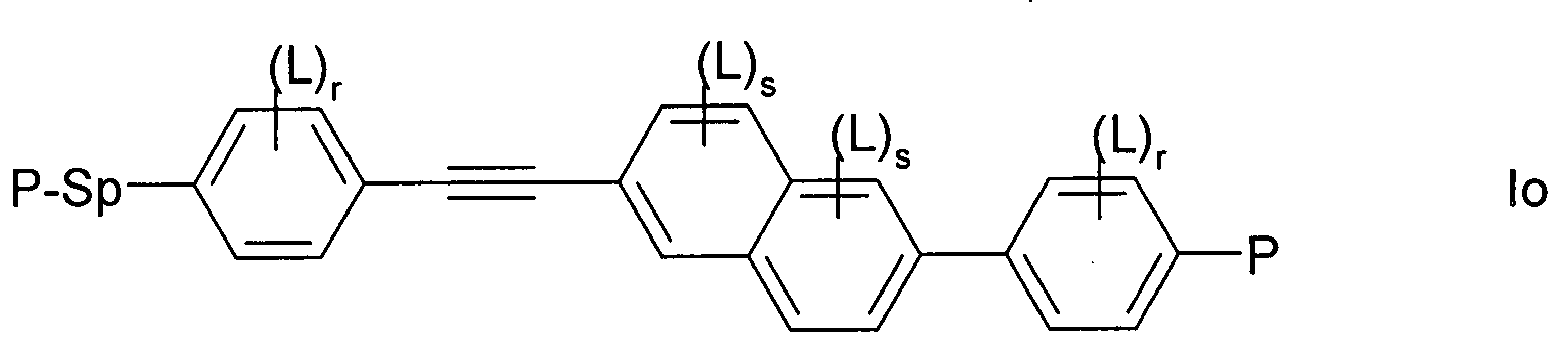


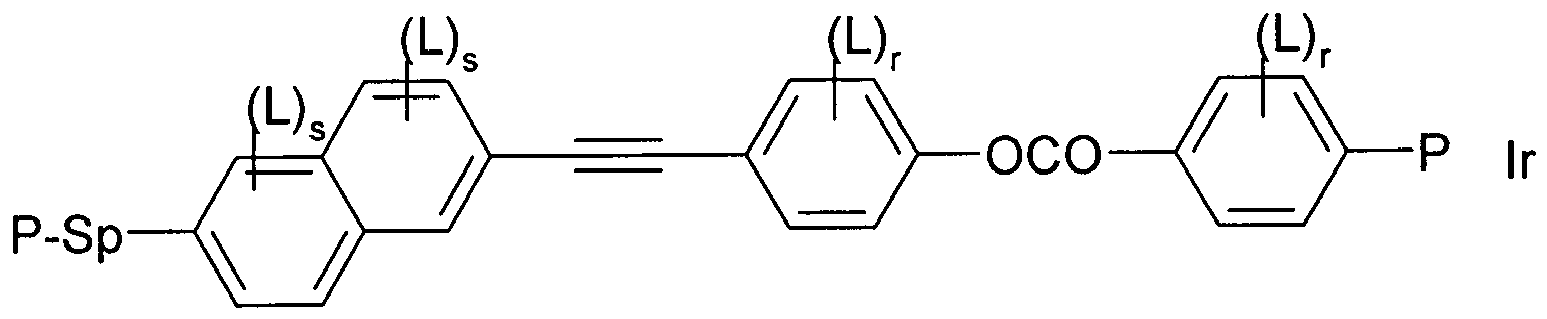


- Utilisation de composés selon une ou plusieurs des revendications 1 à 3 dans des affichages LC du type PS ou PSA contenant une cellule LC comportant deux substrats et deux électrodes, où au moins un substrat est transparent vis-à-vis de la lumière et au moins un substrat comporte une ou deux électrodes, et une couche, située entre les substrats, d'un milieu LC comprenant un composant polymérisé et un composant de poids moléculaire faible, où le composant polymérisé peut être obtenu par polymérisation d'un ou de plusieurs composé(s) polymérisable(s) entre les substrats de la cellule LC dans le milieu LC, de façon préférable moyennant l'application d'une tension électrique entre les électrodes, où au moins l'un des composés polymérisables est un composé polymérisable selon une ou plusieurs des revendications 1 à 3.
- Utilisation selon une ou plusieurs des revendications 1 à 4, caractérisée en ce que le milieu LC comprend un ou plusieurs composés des formules CY et/ou PY :

 a représente 1 ou 2,b représente 0 ou 1,
 R1 et R2 représentent, chacun indépendamment de l'autre, alkyle comportant de 1 à 12 atomes de C, où, en outre, un ou deux groupes CH2 non adjacents peut/peuvent être remplacé(s) par -O-, -CH=CH-, -CO-, -O-CO- ou -CO-O- de telle sorte que des atomes de O ne soient pas liés directement les uns aux autres,Zx représente -CH=CH-, -CH2O-, -OCH2-, -CF2O-, -OCF2-, -O-, -CH2-, -CH2CH2- ou une liaison simple, de façon préférable une liaison simple,L1-4 représentent, chacun indépendamment des autres, F, CI, OCF3, CF3, CH3, CH2F, CHF2.
 - Utilisation selon une ou plusieurs des revendications 1 à 5, caractérisée en ce que le milieu LC comprend un ou plusieurs composés de la formule qui suit :


 R3 et R4 représentent, chacun indépendamment de l'autre, alkyle comportant de 1 à 12 atomes de C, où, en outre, un ou deux groupes CH2 non adjacents peut/peuvent être remplacé(s) par -O-, -CH=CH-, -CO-, -O-CO- ou -CO-O- de telle sorte que des atomes de O ne soient pas liés directement les uns aux autres,Zy représente -CH2CH2-, -CH=CH-, -CF2O-, -OCF2-, -CH2O-, -OCH2-, -COO-, -OCO-, -C2F4-, -CF=CF- ou une liaison simple.
 - Affichage LC selon une ou plusieurs des revendications 1 à 6.
- Affichage LC selon la revendication 7, caractérisé en ce qu'il s'agit d'un affichage PSA-VA, PSA-OCB, PSA-IPS, PSA-FFS, PSA-positif-VA ou PSA-TN.
- Milieu LC comprenant :- un composant polymérisable A) comprenant un ou plusieurs composés polymérisables, et- un composant cristallin liquide B) comprenant un ou plusieurs composés de poids moléculaire faible,
caractérisé en ce que le composant A) comprend un ou plusieurs composés polymérisables selon une ou plusieurs des revendications 1 à 3, et le composant B) comprend un ou plusieurs composés choisis parmi les formules CY et PY selon la revendication 5. - Milieu LC comprenant :- un composant polymérisable A) comprenant un ou plusieurs composés polymérisables, et- un composant cristallin liquide B) comprenant un ou plusieurs composés de poids moléculaire faible,
caractérisé en ce que le composant A) comprend un ou plusieurs composés polymérisables selon une ou plusieurs des revendications 1 à 3, où la concentration des composés polymérisables dans le milieu LC est < 5% en poids. - Milieu LC selon la revendication 9 ou 10, dans lequel le composant B) comprend un ou plusieurs composés choisis parmi les formules CY, PY et ZK selon la revendication 5 ou 6.
- Procédé pour la fabrication d'un affichage LC du type PS ou PSA dans lequel un milieu LC selon une ou plusieurs des revendications 9 à 11 est introduit à l'intérieur d'une cellule LC comportant deux substrats et deux électrodes, où au moins un substrat est transparent vis-à-vis de la lumière et au moins un substrat comporte une ou deux électrodes, et les composés polymérisables sont polymérisés, de façon préférable moyennant l'application d'une tension électrique entre les électrodes.
Applications Claiming Priority (2)
| Application Number | Priority Date | Filing Date | Title |
|---|---|---|---|
| DE102010025091 | 2010-06-25 | ||
| PCT/EP2011/002726 WO2011160765A1 (fr) | 2010-06-25 | 2011-06-01 | Composés polymérisables et utilisation de ceux-ci dans des écrans à cristaux liquides |
Publications (2)
| Publication Number | Publication Date |
|---|---|
| EP2585555A1 EP2585555A1 (fr) | 2013-05-01 |
| EP2585555B1 true EP2585555B1 (fr) | 2014-07-30 |
Family
ID=44626897
Family Applications (1)
| Application Number | Title | Priority Date | Filing Date |
|---|---|---|---|
| EP11724555.5A Active EP2585555B1 (fr) | 2010-06-25 | 2011-06-01 | Composes polymerisables et utilisation de ceux-ci dans des ecrans a cristaux liquides |
Country Status (8)
| Country | Link |
|---|---|
| US (1) | US9045683B2 (fr) |
| EP (1) | EP2585555B1 (fr) |
| JP (1) | JP5844357B2 (fr) |
| KR (1) | KR101810718B1 (fr) |
| CN (2) | CN107011173A (fr) |
| DE (1) | DE102011103025A1 (fr) |
| TW (1) | TWI601806B (fr) |
| WO (1) | WO2011160765A1 (fr) |
Families Citing this family (12)
| Publication number | Priority date | Publication date | Assignee | Title |
|---|---|---|---|---|
| EP2361290B1 (fr) * | 2008-12-22 | 2013-05-22 | Merck Patent GmbH | Affichage à base de cristaux liquides |
| DE102010035730A1 (de) * | 2009-09-28 | 2011-04-07 | Merck Patent Gmbh | Polymerisierbare Verbindungen und ihre Verwendung in Flüssigkristallanzeigen |
| EP2496664B1 (fr) * | 2009-11-04 | 2014-10-01 | Merck Patent GmbH | Composés pour un fluide à base de cristaux liquides et leur utilisation pour des composants haute fréquence |
| GB2503629B (en) * | 2011-03-29 | 2019-04-17 | Merck Patent Gmbh | Liquid-crystalline medium |
| JP6136932B2 (ja) * | 2011-11-24 | 2017-05-31 | Jnc株式会社 | 重合性化合物 |
| US9073850B2 (en) | 2011-11-24 | 2015-07-07 | Jnc Corporation | Polymerizable compound |
| EP2818531B1 (fr) * | 2013-06-25 | 2017-07-26 | Merck Patent GmbH | Composés polymérisables et leur utilisation dans les affichages à base de cristaux liquides |
| JP6323144B2 (ja) * | 2014-04-22 | 2018-05-16 | Dic株式会社 | 重合性化合物及び光学異方体 |
| JP6379735B2 (ja) | 2014-06-27 | 2018-08-29 | Jnc株式会社 | 三重結合を有する重合性化合物、液晶組成物および液晶表示素子 |
| CN111465592B (zh) | 2017-12-12 | 2023-05-16 | 捷恩智株式会社 | 化合物、液晶组合物及液晶显示元件 |
| KR102195455B1 (ko) * | 2018-05-03 | 2020-12-28 | 주식회사 엘지화학 | 중합성 액정 화합물, 광학 소자용 액정 조성물, 중합체, 광학 이방체 및 디스플레이 장치용 광학 소자 |
| WO2020115936A1 (fr) * | 2018-12-06 | 2020-06-11 | Dic株式会社 | Composition de cristaux liquides et élément d'affichage à cristaux liquides |
Family Cites Families (33)
| Publication number | Priority date | Publication date | Assignee | Title |
|---|---|---|---|---|
| BE795849A (fr) | 1972-02-26 | 1973-08-23 | Merck Patent Gmbh | Phases nematiques modifiees |
| US3814700A (en) | 1972-08-03 | 1974-06-04 | Ibm | Method for controllably varying the electrical properties of nematic liquids and dopants therefor |
| DE2450088A1 (de) | 1974-10-22 | 1976-04-29 | Merck Patent Gmbh | Biphenylester |
| DE2637430A1 (de) | 1976-08-20 | 1978-02-23 | Merck Patent Gmbh | Fluessigkristallines dielektrikum |
| DE2636684C3 (de) | 1976-08-14 | 1980-06-19 | Merck Patent Gmbh, 6100 Darmstadt | Phenylcyclohexanderivate und ihre Verwendung in flüssigkristallinen Dielektrika |
| DE2853728A1 (de) | 1978-12-13 | 1980-07-17 | Merck Patent Gmbh | Fluessigkristalline carbonsaeureester, verfahren zu ihrer herstellung, diese enthaltende dielektrika und elektrooptisches anzeigeelement |
| DE3321373A1 (de) | 1983-06-14 | 1984-12-20 | Merck Patent Gmbh, 6100 Darmstadt | Bicyclohexyle |
| DE3807872A1 (de) | 1988-03-10 | 1989-09-21 | Merck Patent Gmbh | Difluorbenzolderivate |
| DE69231849T2 (de) * | 1991-10-22 | 2001-11-08 | Seiko Epson Corp., Tokio/Tokyo | Anzeigeelement und sein herstellungsverfahren |
| JPH1036847A (ja) | 1996-07-25 | 1998-02-10 | Seiko Epson Corp | 液晶表示素子およびその製造方法 |
| US6177972B1 (en) | 1999-02-04 | 2001-01-23 | International Business Machines Corporation | Polymer stabilized in-plane switched LCD |
| US7060200B1 (en) | 1999-09-03 | 2006-06-13 | Merck Patent Gmbh | Multireactive polymerizable mesogenic compounds |
| GB2359809B (en) | 1999-12-24 | 2004-01-14 | Sumitomo Chemical Co | Phenylacetylene compound liquid crystal composition, polymer optically anisotropic product, and liquid crystal or optical element |
| JP4947676B2 (ja) | 1999-12-24 | 2012-06-06 | 住友化学株式会社 | フェニルアセチレン化合物、液晶組成物及び液晶又は光学用素子 |
| JP2002023199A (ja) | 2000-07-07 | 2002-01-23 | Fujitsu Ltd | 液晶表示装置およびその製造方法 |
| DE10224046B4 (de) | 2001-06-26 | 2013-02-07 | Merck Patent Gmbh | Flüssigkristallines Medium und seine Verwendung |
| EP1306418B1 (fr) | 2001-10-23 | 2008-06-04 | MERCK PATENT GmbH | Milieu liquide cristallin et dispositif d'affichage à cristaux liquides |
| JP4175826B2 (ja) | 2002-04-16 | 2008-11-05 | シャープ株式会社 | 液晶表示装置 |
| ATE354623T1 (de) * | 2002-07-06 | 2007-03-15 | Merck Patent Gmbh | Flüssigkristallines medium |
| JP2004294605A (ja) | 2003-03-26 | 2004-10-21 | Fujitsu Display Technologies Corp | 液晶パネル |
| US7597942B2 (en) | 2004-09-06 | 2009-10-06 | Merck Patent Gmbh | Polymerisable liquid crystal material |
| JP4387276B2 (ja) | 2004-09-24 | 2009-12-16 | シャープ株式会社 | 液晶表示装置 |
| JP2006139047A (ja) | 2004-11-12 | 2006-06-01 | Sharp Corp | 液晶表示装置およびその製造方法 |
| US7527746B2 (en) | 2005-01-28 | 2009-05-05 | Chisso Corporation | Liquid crystal polyfunctional acrylate derivative and polymer thereof |
| TWI349029B (en) | 2007-03-30 | 2011-09-21 | Au Optronics Corp | Liquid crystalline medium, liquid crystal display panel using the same, and method for manufacturing liquid crystal display panel |
| CN101790573B (zh) | 2007-08-30 | 2014-09-10 | 默克专利股份有限公司 | 液晶显示器 |
| TWI368645B (en) * | 2007-10-24 | 2012-07-21 | Au Optronics Corp | Liquid crystal medium for psa process and liquid crystal display device |
| WO2009086911A1 (fr) * | 2008-01-11 | 2009-07-16 | Merck Patent Gmbh | Composés mésogènes réactifs et mélanges les comprenant |
| CN101978025B (zh) | 2008-03-25 | 2014-09-10 | 默克专利股份有限公司 | 液晶显示器 |
| TWI395993B (zh) | 2008-06-30 | 2013-05-11 | Au Optronics Corp | 液晶顯示面板及其液晶材料 |
| EP2218764B1 (fr) | 2009-02-13 | 2012-01-18 | Merck Patent GmbH | Mélange de mésogènes réactifs chiraux |
| TWI405753B (zh) * | 2009-10-02 | 2013-08-21 | Au Optronics Corp | 應用於顯示面板之可聚合單體以及液晶材料 |
| CN101671252A (zh) * | 2009-10-20 | 2010-03-17 | 友达光电股份有限公司 | 应用于显示面板的可聚合单体以及液晶材料 |
-
2011
- 2011-06-01 US US13/805,481 patent/US9045683B2/en not_active Expired - Fee Related
- 2011-06-01 JP JP2013515750A patent/JP5844357B2/ja not_active Expired - Fee Related
- 2011-06-01 EP EP11724555.5A patent/EP2585555B1/fr active Active
- 2011-06-01 DE DE201110103025 patent/DE102011103025A1/de not_active Withdrawn
- 2011-06-01 CN CN201610936285.9A patent/CN107011173A/zh active Pending
- 2011-06-01 WO PCT/EP2011/002726 patent/WO2011160765A1/fr not_active Ceased
- 2011-06-01 KR KR1020137001907A patent/KR101810718B1/ko not_active Expired - Fee Related
- 2011-06-01 CN CN201180030210XA patent/CN102959047A/zh active Pending
- 2011-06-24 TW TW100122298A patent/TWI601806B/zh active
Also Published As
| Publication number | Publication date |
|---|---|
| JP2013534646A (ja) | 2013-09-05 |
| CN107011173A (zh) | 2017-08-04 |
| CN102959047A (zh) | 2013-03-06 |
| WO2011160765A1 (fr) | 2011-12-29 |
| JP5844357B2 (ja) | 2016-01-13 |
| DE102011103025A1 (de) | 2012-01-05 |
| TWI601806B (zh) | 2017-10-11 |
| EP2585555A1 (fr) | 2013-05-01 |
| KR101810718B1 (ko) | 2017-12-19 |
| KR20130039759A (ko) | 2013-04-22 |
| US9045683B2 (en) | 2015-06-02 |
| TW201204815A (en) | 2012-02-01 |
| US20130093975A1 (en) | 2013-04-18 |
Similar Documents
| Publication | Publication Date | Title |
|---|---|---|
| EP2483370B1 (fr) | Composés polymérisables et leur utilisation dans des dispositifs d'affichage à base de cristaux liquides | |
| EP2181174B1 (fr) | Affichage à base de cristaux liquides | |
| EP2432851B1 (fr) | Dispositif d'affichage à base de cristaux liquides | |
| EP2181173B1 (fr) | Affichage à base de cristaux liquides | |
| EP2585555B1 (fr) | Composes polymerisables et utilisation de ceux-ci dans des ecrans a cristaux liquides | |
| EP2340292B1 (fr) | Dispositif d'affichage a base de cristaux liquides | |
| EP2243812B2 (fr) | Affichage à cristaux liquides | |
| EP1911828B1 (fr) | Affichage à cristaux liquides | |
| EP2494003B1 (fr) | Composes polymerisables et leur utilisation dans des ecrans a base de cristaux liquides | |
| EP2361290B1 (fr) | Affichage à base de cristaux liquides | |
| EP2990459B1 (fr) | Composés polymérisables et leur utilisation dans des affichages à base de cristaux liquides | |
| EP2181175A1 (fr) | Affichage à cristaux liquides | |
| EP2682448B1 (fr) | Composés polymérisables et leur utilisation dans les écrans à base de cristaux liquides | |
| DE102011103182A1 (de) | Polymerisierbare Verbindungen und ihre Verwendung in Flüssigkristallanzeigen | |
| DE102007043921A1 (de) | Flüssigkristallanzeige |
Legal Events
| Date | Code | Title | Description |
|---|---|---|---|
| PUAI | Public reference made under article 153(3) epc to a published international application that has entered the european phase |
Free format text: ORIGINAL CODE: 0009012 |
|
| 17P | Request for examination filed |
Effective date: 20121024 |
|
| AK | Designated contracting states |
Kind code of ref document: A1 Designated state(s): AL AT BE BG CH CY CZ DE DK EE ES FI FR GB GR HR HU IE IS IT LI LT LU LV MC MK MT NL NO PL PT RO RS SE SI SK SM TR |
|
| DAX | Request for extension of the european patent (deleted) | ||
| GRAP | Despatch of communication of intention to grant a patent |
Free format text: ORIGINAL CODE: EPIDOSNIGR1 |
|
| RIC1 | Information provided on ipc code assigned before grant |
Ipc: C09K 19/18 20060101AFI20140226BHEP Ipc: C09K 19/30 20060101ALI20140226BHEP Ipc: C09K 19/54 20060101ALI20140226BHEP Ipc: C09K 19/20 20060101ALI20140226BHEP Ipc: C07C 69/602 20060101ALI20140226BHEP Ipc: C09K 19/04 20060101ALI20140226BHEP Ipc: G02F 1/1333 20060101ALI20140226BHEP Ipc: C09K 19/32 20060101ALI20140226BHEP |
|
| INTG | Intention to grant announced |
Effective date: 20140319 |
|
| GRAS | Grant fee paid |
Free format text: ORIGINAL CODE: EPIDOSNIGR3 |
|
| GRAA | (expected) grant |
Free format text: ORIGINAL CODE: 0009210 |
|
| AK | Designated contracting states |
Kind code of ref document: B1 Designated state(s): AL AT BE BG CH CY CZ DE DK EE ES FI FR GB GR HR HU IE IS IT LI LT LU LV MC MK MT NL NO PL PT RO RS SE SI SK SM TR |
|
| REG | Reference to a national code |
Ref country code: GB Ref legal event code: FG4D Free format text: NOT ENGLISH |
|
| REG | Reference to a national code |
Ref country code: CH Ref legal event code: EP |
|
| REG | Reference to a national code |
Ref country code: AT Ref legal event code: REF Ref document number: 680001 Country of ref document: AT Kind code of ref document: T Effective date: 20140815 |
|
| REG | Reference to a national code |
Ref country code: IE Ref legal event code: FG4D Free format text: LANGUAGE OF EP DOCUMENT: GERMAN |
|
| REG | Reference to a national code |
Ref country code: DE Ref legal event code: R096 Ref document number: 502011003898 Country of ref document: DE Effective date: 20140911 |
|
| REG | Reference to a national code |
Ref country code: NL Ref legal event code: VDEP Effective date: 20140730 |
|
| REG | Reference to a national code |
Ref country code: LT Ref legal event code: MG4D |
|
| PG25 | Lapsed in a contracting state [announced via postgrant information from national office to epo] |
Ref country code: SE Free format text: LAPSE BECAUSE OF FAILURE TO SUBMIT A TRANSLATION OF THE DESCRIPTION OR TO PAY THE FEE WITHIN THE PRESCRIBED TIME-LIMIT Effective date: 20140730 Ref country code: BG Free format text: LAPSE BECAUSE OF FAILURE TO SUBMIT A TRANSLATION OF THE DESCRIPTION OR TO PAY THE FEE WITHIN THE PRESCRIBED TIME-LIMIT Effective date: 20141030 Ref country code: PT Free format text: LAPSE BECAUSE OF FAILURE TO SUBMIT A TRANSLATION OF THE DESCRIPTION OR TO PAY THE FEE WITHIN THE PRESCRIBED TIME-LIMIT Effective date: 20141202 Ref country code: ES Free format text: LAPSE BECAUSE OF FAILURE TO SUBMIT A TRANSLATION OF THE DESCRIPTION OR TO PAY THE FEE WITHIN THE PRESCRIBED TIME-LIMIT Effective date: 20140730 Ref country code: FI Free format text: LAPSE BECAUSE OF FAILURE TO SUBMIT A TRANSLATION OF THE DESCRIPTION OR TO PAY THE FEE WITHIN THE PRESCRIBED TIME-LIMIT Effective date: 20140730 Ref country code: LT Free format text: LAPSE BECAUSE OF FAILURE TO SUBMIT A TRANSLATION OF THE DESCRIPTION OR TO PAY THE FEE WITHIN THE PRESCRIBED TIME-LIMIT Effective date: 20140730 Ref country code: NO Free format text: LAPSE BECAUSE OF FAILURE TO SUBMIT A TRANSLATION OF THE DESCRIPTION OR TO PAY THE FEE WITHIN THE PRESCRIBED TIME-LIMIT Effective date: 20141030 Ref country code: GR Free format text: LAPSE BECAUSE OF FAILURE TO SUBMIT A TRANSLATION OF THE DESCRIPTION OR TO PAY THE FEE WITHIN THE PRESCRIBED TIME-LIMIT Effective date: 20141031 |
|
| PG25 | Lapsed in a contracting state [announced via postgrant information from national office to epo] |
Ref country code: CY Free format text: LAPSE BECAUSE OF FAILURE TO SUBMIT A TRANSLATION OF THE DESCRIPTION OR TO PAY THE FEE WITHIN THE PRESCRIBED TIME-LIMIT Effective date: 20140730 Ref country code: HR Free format text: LAPSE BECAUSE OF FAILURE TO SUBMIT A TRANSLATION OF THE DESCRIPTION OR TO PAY THE FEE WITHIN THE PRESCRIBED TIME-LIMIT Effective date: 20140730 Ref country code: IS Free format text: LAPSE BECAUSE OF FAILURE TO SUBMIT A TRANSLATION OF THE DESCRIPTION OR TO PAY THE FEE WITHIN THE PRESCRIBED TIME-LIMIT Effective date: 20141130 Ref country code: RS Free format text: LAPSE BECAUSE OF FAILURE TO SUBMIT A TRANSLATION OF THE DESCRIPTION OR TO PAY THE FEE WITHIN THE PRESCRIBED TIME-LIMIT Effective date: 20140730 Ref country code: PL Free format text: LAPSE BECAUSE OF FAILURE TO SUBMIT A TRANSLATION OF THE DESCRIPTION OR TO PAY THE FEE WITHIN THE PRESCRIBED TIME-LIMIT Effective date: 20140730 Ref country code: LV Free format text: LAPSE BECAUSE OF FAILURE TO SUBMIT A TRANSLATION OF THE DESCRIPTION OR TO PAY THE FEE WITHIN THE PRESCRIBED TIME-LIMIT Effective date: 20140730 Ref country code: NL Free format text: LAPSE BECAUSE OF FAILURE TO SUBMIT A TRANSLATION OF THE DESCRIPTION OR TO PAY THE FEE WITHIN THE PRESCRIBED TIME-LIMIT Effective date: 20140730 |
|
| PG25 | Lapsed in a contracting state [announced via postgrant information from national office to epo] |
Ref country code: EE Free format text: LAPSE BECAUSE OF FAILURE TO SUBMIT A TRANSLATION OF THE DESCRIPTION OR TO PAY THE FEE WITHIN THE PRESCRIBED TIME-LIMIT Effective date: 20140730 Ref country code: DK Free format text: LAPSE BECAUSE OF FAILURE TO SUBMIT A TRANSLATION OF THE DESCRIPTION OR TO PAY THE FEE WITHIN THE PRESCRIBED TIME-LIMIT Effective date: 20140730 Ref country code: SK Free format text: LAPSE BECAUSE OF FAILURE TO SUBMIT A TRANSLATION OF THE DESCRIPTION OR TO PAY THE FEE WITHIN THE PRESCRIBED TIME-LIMIT Effective date: 20140730 Ref country code: IT Free format text: LAPSE BECAUSE OF FAILURE TO SUBMIT A TRANSLATION OF THE DESCRIPTION OR TO PAY THE FEE WITHIN THE PRESCRIBED TIME-LIMIT Effective date: 20140730 Ref country code: RO Free format text: LAPSE BECAUSE OF FAILURE TO SUBMIT A TRANSLATION OF THE DESCRIPTION OR TO PAY THE FEE WITHIN THE PRESCRIBED TIME-LIMIT Effective date: 20140730 Ref country code: CZ Free format text: LAPSE BECAUSE OF FAILURE TO SUBMIT A TRANSLATION OF THE DESCRIPTION OR TO PAY THE FEE WITHIN THE PRESCRIBED TIME-LIMIT Effective date: 20140730 |
|
| REG | Reference to a national code |
Ref country code: DE Ref legal event code: R097 Ref document number: 502011003898 Country of ref document: DE |
|
| PLBE | No opposition filed within time limit |
Free format text: ORIGINAL CODE: 0009261 |
|
| STAA | Information on the status of an ep patent application or granted ep patent |
Free format text: STATUS: NO OPPOSITION FILED WITHIN TIME LIMIT |
|
| 26N | No opposition filed |
Effective date: 20150504 |
|
| PG25 | Lapsed in a contracting state [announced via postgrant information from national office to epo] |
Ref country code: SI Free format text: LAPSE BECAUSE OF FAILURE TO SUBMIT A TRANSLATION OF THE DESCRIPTION OR TO PAY THE FEE WITHIN THE PRESCRIBED TIME-LIMIT Effective date: 20140730 |
|
| PG25 | Lapsed in a contracting state [announced via postgrant information from national office to epo] |
Ref country code: MC Free format text: LAPSE BECAUSE OF FAILURE TO SUBMIT A TRANSLATION OF THE DESCRIPTION OR TO PAY THE FEE WITHIN THE PRESCRIBED TIME-LIMIT Effective date: 20140730 |
|
| REG | Reference to a national code |
Ref country code: CH Ref legal event code: PL |
|
| PG25 | Lapsed in a contracting state [announced via postgrant information from national office to epo] |
Ref country code: LU Free format text: LAPSE BECAUSE OF FAILURE TO SUBMIT A TRANSLATION OF THE DESCRIPTION OR TO PAY THE FEE WITHIN THE PRESCRIBED TIME-LIMIT Effective date: 20150601 |
|
| REG | Reference to a national code |
Ref country code: IE Ref legal event code: MM4A |
|
| REG | Reference to a national code |
Ref country code: FR Ref legal event code: ST Effective date: 20160229 |
|
| PG25 | Lapsed in a contracting state [announced via postgrant information from national office to epo] |
Ref country code: CH Free format text: LAPSE BECAUSE OF NON-PAYMENT OF DUE FEES Effective date: 20150630 Ref country code: IE Free format text: LAPSE BECAUSE OF NON-PAYMENT OF DUE FEES Effective date: 20150601 Ref country code: LI Free format text: LAPSE BECAUSE OF NON-PAYMENT OF DUE FEES Effective date: 20150630 |
|
| PG25 | Lapsed in a contracting state [announced via postgrant information from national office to epo] |
Ref country code: FR Free format text: LAPSE BECAUSE OF NON-PAYMENT OF DUE FEES Effective date: 20150630 |
|
| PG25 | Lapsed in a contracting state [announced via postgrant information from national office to epo] |
Ref country code: MT Free format text: LAPSE BECAUSE OF FAILURE TO SUBMIT A TRANSLATION OF THE DESCRIPTION OR TO PAY THE FEE WITHIN THE PRESCRIBED TIME-LIMIT Effective date: 20140730 |
|
| PG25 | Lapsed in a contracting state [announced via postgrant information from national office to epo] |
Ref country code: SM Free format text: LAPSE BECAUSE OF FAILURE TO SUBMIT A TRANSLATION OF THE DESCRIPTION OR TO PAY THE FEE WITHIN THE PRESCRIBED TIME-LIMIT Effective date: 20140730 Ref country code: HU Free format text: LAPSE BECAUSE OF FAILURE TO SUBMIT A TRANSLATION OF THE DESCRIPTION OR TO PAY THE FEE WITHIN THE PRESCRIBED TIME-LIMIT; INVALID AB INITIO Effective date: 20110601 |
|
| PG25 | Lapsed in a contracting state [announced via postgrant information from national office to epo] |
Ref country code: BE Free format text: LAPSE BECAUSE OF NON-PAYMENT OF DUE FEES Effective date: 20150630 |
|
| REG | Reference to a national code |
Ref country code: AT Ref legal event code: MM01 Ref document number: 680001 Country of ref document: AT Kind code of ref document: T Effective date: 20160601 |
|
| PG25 | Lapsed in a contracting state [announced via postgrant information from national office to epo] |
Ref country code: TR Free format text: LAPSE BECAUSE OF FAILURE TO SUBMIT A TRANSLATION OF THE DESCRIPTION OR TO PAY THE FEE WITHIN THE PRESCRIBED TIME-LIMIT Effective date: 20140730 |
|
| PG25 | Lapsed in a contracting state [announced via postgrant information from national office to epo] |
Ref country code: AT Free format text: LAPSE BECAUSE OF NON-PAYMENT OF DUE FEES Effective date: 20160601 |
|
| PG25 | Lapsed in a contracting state [announced via postgrant information from national office to epo] |
Ref country code: MK Free format text: LAPSE BECAUSE OF FAILURE TO SUBMIT A TRANSLATION OF THE DESCRIPTION OR TO PAY THE FEE WITHIN THE PRESCRIBED TIME-LIMIT Effective date: 20140730 |
|
| PG25 | Lapsed in a contracting state [announced via postgrant information from national office to epo] |
Ref country code: AL Free format text: LAPSE BECAUSE OF FAILURE TO SUBMIT A TRANSLATION OF THE DESCRIPTION OR TO PAY THE FEE WITHIN THE PRESCRIBED TIME-LIMIT Effective date: 20140730 |
|
| PGFP | Annual fee paid to national office [announced via postgrant information from national office to epo] |
Ref country code: GB Payment date: 20190529 Year of fee payment: 9 |
|
| GBPC | Gb: european patent ceased through non-payment of renewal fee |
Effective date: 20200601 |
|
| PG25 | Lapsed in a contracting state [announced via postgrant information from national office to epo] |
Ref country code: GB Free format text: LAPSE BECAUSE OF NON-PAYMENT OF DUE FEES Effective date: 20200601 |
|
| P01 | Opt-out of the competence of the unified patent court (upc) registered |
Effective date: 20230518 |
|
| PGFP | Annual fee paid to national office [announced via postgrant information from national office to epo] |
Ref country code: DE Payment date: 20250520 Year of fee payment: 15 |