EP2585586B1 - Verbesserte vernetzte hyaluronan-hydrogele für dreidimensionale zellkultur - Google Patents
Verbesserte vernetzte hyaluronan-hydrogele für dreidimensionale zellkultur Download PDFInfo
- Publication number
- EP2585586B1 EP2585586B1 EP11729592.3A EP11729592A EP2585586B1 EP 2585586 B1 EP2585586 B1 EP 2585586B1 EP 11729592 A EP11729592 A EP 11729592A EP 2585586 B1 EP2585586 B1 EP 2585586B1
- Authority
- EP
- European Patent Office
- Prior art keywords
- hydrogel
- hyaluronan
- cross
- linked
- hydrogels
- Prior art date
- Legal status (The legal status is an assumption and is not a legal conclusion. Google has not performed a legal analysis and makes no representation as to the accuracy of the status listed.)
- Not-in-force
Links
- 239000000017 hydrogel Substances 0.000 title claims description 290
- 229920002674 hyaluronan Polymers 0.000 title claims description 156
- KIUKXJAPPMFGSW-MNSSHETKSA-N hyaluronan Chemical compound CC(=O)N[C@H]1[C@H](O)O[C@H](CO)[C@@H](O)C1O[C@H]1[C@H](O)[C@@H](O)[C@H](O[C@H]2[C@@H](C(O[C@H]3[C@@H]([C@@H](O)[C@H](O)[C@H](O3)C(O)=O)O)[C@H](O)[C@@H](CO)O2)NC(C)=O)[C@@H](C(O)=O)O1 KIUKXJAPPMFGSW-MNSSHETKSA-N 0.000 title claims description 152
- 229940099552 hyaluronan Drugs 0.000 title claims description 151
- 238000012604 3D cell culture Methods 0.000 title claims description 20
- 238000000034 method Methods 0.000 claims description 75
- LFQSCWFLJHTTHZ-UHFFFAOYSA-N Ethanol Chemical compound CCO LFQSCWFLJHTTHZ-UHFFFAOYSA-N 0.000 claims description 27
- 239000013543 active substance Substances 0.000 claims description 25
- 230000006835 compression Effects 0.000 claims description 25
- 238000007906 compression Methods 0.000 claims description 25
- 239000002609 medium Substances 0.000 claims description 17
- 230000001954 sterilising effect Effects 0.000 claims description 16
- 230000008961 swelling Effects 0.000 claims description 16
- 238000010438 heat treatment Methods 0.000 claims description 15
- 239000011148 porous material Substances 0.000 claims description 15
- 238000004659 sterilization and disinfection Methods 0.000 claims description 13
- 239000006143 cell culture medium Substances 0.000 claims description 12
- 239000003242 anti bacterial agent Substances 0.000 claims description 6
- 229940088710 antibiotic agent Drugs 0.000 claims description 6
- 239000012298 atmosphere Substances 0.000 claims description 4
- 238000005520 cutting process Methods 0.000 claims description 4
- 230000000717 retained effect Effects 0.000 claims description 4
- 239000002975 chemoattractant Substances 0.000 claims description 2
- IYMAXBFPHPZYIK-BQBZGAKWSA-N Arg-Gly-Asp Chemical compound NC(N)=NCCC[C@H](N)C(=O)NCC(=O)N[C@@H](CC(O)=O)C(O)=O IYMAXBFPHPZYIK-BQBZGAKWSA-N 0.000 claims 2
- 108010072041 arginyl-glycyl-aspartic acid Proteins 0.000 claims 2
- 210000004027 cell Anatomy 0.000 description 69
- 239000011159 matrix material Substances 0.000 description 19
- 102100031573 Hematopoietic progenitor cell antigen CD34 Human genes 0.000 description 13
- 101000777663 Homo sapiens Hematopoietic progenitor cell antigen CD34 Proteins 0.000 description 13
- 238000004108 freeze drying Methods 0.000 description 12
- 210000000130 stem cell Anatomy 0.000 description 11
- 238000004113 cell culture Methods 0.000 description 10
- 238000002389 environmental scanning electron microscopy Methods 0.000 description 9
- 210000001519 tissue Anatomy 0.000 description 9
- 239000012620 biological material Substances 0.000 description 8
- XLYOFNOQVPJJNP-UHFFFAOYSA-N water Substances O XLYOFNOQVPJJNP-UHFFFAOYSA-N 0.000 description 8
- 238000001727 in vivo Methods 0.000 description 7
- 238000010899 nucleation Methods 0.000 description 7
- CURLTUGMZLYLDI-UHFFFAOYSA-N Carbon dioxide Chemical compound O=C=O CURLTUGMZLYLDI-UHFFFAOYSA-N 0.000 description 6
- 108010037362 Extracellular Matrix Proteins Proteins 0.000 description 6
- 102000010834 Extracellular Matrix Proteins Human genes 0.000 description 6
- 210000002744 extracellular matrix Anatomy 0.000 description 6
- 210000003958 hematopoietic stem cell Anatomy 0.000 description 6
- 238000004519 manufacturing process Methods 0.000 description 6
- 239000000463 material Substances 0.000 description 6
- 238000013508 migration Methods 0.000 description 6
- 238000004626 scanning electron microscopy Methods 0.000 description 6
- LMDZBCPBFSXMTL-UHFFFAOYSA-N 1-ethyl-3-(3-dimethylaminopropyl)carbodiimide Chemical compound CCN=C=NCCCN(C)C LMDZBCPBFSXMTL-UHFFFAOYSA-N 0.000 description 5
- 108010035532 Collagen Proteins 0.000 description 5
- 102000008186 Collagen Human genes 0.000 description 5
- 229920002683 Glycosaminoglycan Polymers 0.000 description 5
- 206010028980 Neoplasm Diseases 0.000 description 5
- 201000011510 cancer Diseases 0.000 description 5
- 230000012292 cell migration Effects 0.000 description 5
- 239000003153 chemical reaction reagent Substances 0.000 description 5
- 239000003795 chemical substances by application Substances 0.000 description 5
- 229920001436 collagen Polymers 0.000 description 5
- 238000007710 freezing Methods 0.000 description 5
- 230000008014 freezing Effects 0.000 description 5
- 239000001963 growth medium Substances 0.000 description 5
- 230000003993 interaction Effects 0.000 description 5
- 230000005012 migration Effects 0.000 description 5
- 239000000203 mixture Substances 0.000 description 5
- 238000012545 processing Methods 0.000 description 5
- 238000001878 scanning electron micrograph Methods 0.000 description 5
- 239000000126 substance Substances 0.000 description 5
- FPQQSJJWHUJYPU-UHFFFAOYSA-N 3-(dimethylamino)propyliminomethylidene-ethylazanium;chloride Chemical compound Cl.CCN=C=NCCCN(C)C FPQQSJJWHUJYPU-UHFFFAOYSA-N 0.000 description 4
- 238000004132 cross linking Methods 0.000 description 4
- 230000000694 effects Effects 0.000 description 4
- 238000002360 preparation method Methods 0.000 description 4
- 108091003079 Bovine Serum Albumin Proteins 0.000 description 3
- OKKJLVBELUTLKV-UHFFFAOYSA-N Methanol Chemical compound OC OKKJLVBELUTLKV-UHFFFAOYSA-N 0.000 description 3
- 108010067787 Proteoglycans Proteins 0.000 description 3
- 102000016611 Proteoglycans Human genes 0.000 description 3
- 239000012980 RPMI-1640 medium Substances 0.000 description 3
- 238000003556 assay Methods 0.000 description 3
- 230000010261 cell growth Effects 0.000 description 3
- 150000001875 compounds Chemical class 0.000 description 3
- 230000008030 elimination Effects 0.000 description 3
- 238000003379 elimination reaction Methods 0.000 description 3
- 230000002349 favourable effect Effects 0.000 description 3
- 239000011521 glass Substances 0.000 description 3
- 210000003714 granulocyte Anatomy 0.000 description 3
- 239000003102 growth factor Substances 0.000 description 3
- 238000000338 in vitro Methods 0.000 description 3
- 239000007788 liquid Substances 0.000 description 3
- 229920002521 macromolecule Polymers 0.000 description 3
- 230000008569 process Effects 0.000 description 3
- 230000035755 proliferation Effects 0.000 description 3
- 108090000623 proteins and genes Proteins 0.000 description 3
- 238000007665 sagging Methods 0.000 description 3
- 238000000926 separation method Methods 0.000 description 3
- 238000012414 sterilization procedure Methods 0.000 description 3
- 238000012360 testing method Methods 0.000 description 3
- XKRFYHLGVUSROY-UHFFFAOYSA-N Argon Chemical compound [Ar] XKRFYHLGVUSROY-UHFFFAOYSA-N 0.000 description 2
- IJGRMHOSHXDMSA-UHFFFAOYSA-N Atomic nitrogen Chemical compound N#N IJGRMHOSHXDMSA-UHFFFAOYSA-N 0.000 description 2
- 102100032912 CD44 antigen Human genes 0.000 description 2
- 102000006573 Chemokine CXCL12 Human genes 0.000 description 2
- 108010008951 Chemokine CXCL12 Proteins 0.000 description 2
- 102000003951 Erythropoietin Human genes 0.000 description 2
- 108090000394 Erythropoietin Proteins 0.000 description 2
- 102000018233 Fibroblast Growth Factor Human genes 0.000 description 2
- 108050007372 Fibroblast Growth Factor Proteins 0.000 description 2
- IAJILQKETJEXLJ-UHFFFAOYSA-N Galacturonsaeure Natural products O=CC(O)C(O)C(O)C(O)C(O)=O IAJILQKETJEXLJ-UHFFFAOYSA-N 0.000 description 2
- HTTJABKRGRZYRN-UHFFFAOYSA-N Heparin Chemical compound OC1C(NC(=O)C)C(O)OC(COS(O)(=O)=O)C1OC1C(OS(O)(=O)=O)C(O)C(OC2C(C(OS(O)(=O)=O)C(OC3C(C(O)C(O)C(O3)C(O)=O)OS(O)(=O)=O)C(CO)O2)NS(O)(=O)=O)C(C(O)=O)O1 HTTJABKRGRZYRN-UHFFFAOYSA-N 0.000 description 2
- 102000003745 Hepatocyte Growth Factor Human genes 0.000 description 2
- 108090000100 Hepatocyte Growth Factor Proteins 0.000 description 2
- 101000868273 Homo sapiens CD44 antigen Proteins 0.000 description 2
- 102000003815 Interleukin-11 Human genes 0.000 description 2
- 108090000177 Interleukin-11 Proteins 0.000 description 2
- 102000003816 Interleukin-13 Human genes 0.000 description 2
- 108090000176 Interleukin-13 Proteins 0.000 description 2
- 102000000646 Interleukin-3 Human genes 0.000 description 2
- 108010002386 Interleukin-3 Proteins 0.000 description 2
- 102000000743 Interleukin-5 Human genes 0.000 description 2
- 108010002616 Interleukin-5 Proteins 0.000 description 2
- 102000004889 Interleukin-6 Human genes 0.000 description 2
- 108090001005 Interleukin-6 Proteins 0.000 description 2
- 102000004890 Interleukin-8 Human genes 0.000 description 2
- 108090001007 Interleukin-8 Proteins 0.000 description 2
- 102000004058 Leukemia inhibitory factor Human genes 0.000 description 2
- 108090000581 Leukemia inhibitory factor Proteins 0.000 description 2
- 241001465754 Metazoa Species 0.000 description 2
- FAPWRFPIFSIZLT-UHFFFAOYSA-M Sodium chloride Chemical compound [Na+].[Cl-] FAPWRFPIFSIZLT-UHFFFAOYSA-M 0.000 description 2
- 102000036693 Thrombopoietin Human genes 0.000 description 2
- 108010041111 Thrombopoietin Proteins 0.000 description 2
- 230000001464 adherent effect Effects 0.000 description 2
- 239000007864 aqueous solution Substances 0.000 description 2
- 210000004369 blood Anatomy 0.000 description 2
- 239000008280 blood Substances 0.000 description 2
- 230000001413 cellular effect Effects 0.000 description 2
- 230000005757 colony formation Effects 0.000 description 2
- 238000011109 contamination Methods 0.000 description 2
- 230000018044 dehydration Effects 0.000 description 2
- 238000006297 dehydration reaction Methods 0.000 description 2
- 150000002016 disaccharides Chemical class 0.000 description 2
- 229940105423 erythropoietin Drugs 0.000 description 2
- 210000004700 fetal blood Anatomy 0.000 description 2
- 239000012894 fetal calf serum Substances 0.000 description 2
- 210000002950 fibroblast Anatomy 0.000 description 2
- 229940126864 fibroblast growth factor Drugs 0.000 description 2
- 239000000499 gel Substances 0.000 description 2
- 229940088597 hormone Drugs 0.000 description 2
- 239000005556 hormone Substances 0.000 description 2
- 238000007654 immersion Methods 0.000 description 2
- 238000011534 incubation Methods 0.000 description 2
- 210000004263 induced pluripotent stem cell Anatomy 0.000 description 2
- NOESYZHRGYRDHS-UHFFFAOYSA-N insulin Chemical compound N1C(=O)C(NC(=O)C(CCC(N)=O)NC(=O)C(CCC(O)=O)NC(=O)C(C(C)C)NC(=O)C(NC(=O)CN)C(C)CC)CSSCC(C(NC(CO)C(=O)NC(CC(C)C)C(=O)NC(CC=2C=CC(O)=CC=2)C(=O)NC(CCC(N)=O)C(=O)NC(CC(C)C)C(=O)NC(CCC(O)=O)C(=O)NC(CC(N)=O)C(=O)NC(CC=2C=CC(O)=CC=2)C(=O)NC(CSSCC(NC(=O)C(C(C)C)NC(=O)C(CC(C)C)NC(=O)C(CC=2C=CC(O)=CC=2)NC(=O)C(CC(C)C)NC(=O)C(C)NC(=O)C(CCC(O)=O)NC(=O)C(C(C)C)NC(=O)C(CC(C)C)NC(=O)C(CC=2NC=NC=2)NC(=O)C(CO)NC(=O)CNC2=O)C(=O)NCC(=O)NC(CCC(O)=O)C(=O)NC(CCCNC(N)=N)C(=O)NCC(=O)NC(CC=3C=CC=CC=3)C(=O)NC(CC=3C=CC=CC=3)C(=O)NC(CC=3C=CC(O)=CC=3)C(=O)NC(C(C)O)C(=O)N3C(CCC3)C(=O)NC(CCCCN)C(=O)NC(C)C(O)=O)C(=O)NC(CC(N)=O)C(O)=O)=O)NC(=O)C(C(C)CC)NC(=O)C(CO)NC(=O)C(C(C)O)NC(=O)C1CSSCC2NC(=O)C(CC(C)C)NC(=O)C(NC(=O)C(CCC(N)=O)NC(=O)C(CC(N)=O)NC(=O)C(NC(=O)C(N)CC=1C=CC=CC=1)C(C)C)CC1=CN=CN1 NOESYZHRGYRDHS-UHFFFAOYSA-N 0.000 description 2
- 229940074383 interleukin-11 Drugs 0.000 description 2
- 229940076264 interleukin-3 Drugs 0.000 description 2
- 229940100602 interleukin-5 Drugs 0.000 description 2
- 229940100601 interleukin-6 Drugs 0.000 description 2
- 229940096397 interleukin-8 Drugs 0.000 description 2
- XKTZWUACRZHVAN-VADRZIEHSA-N interleukin-8 Chemical compound C([C@H](NC(=O)[C@H](CC(O)=O)NC(=O)[C@H](CC=1C2=CC=CC=C2NC=1)NC(=O)[C@@H](NC(C)=O)CCSC)C(=O)N[C@@H](CC(O)=O)C(=O)N[C@@H](CC(O)=O)C(=O)N[C@@H](CC(C)C)C(=O)N[C@@H](CC(N)=O)C(=O)N[C@@H](CC=1C=CC=CC=1)C(=O)N[C@@H]([C@@H](C)O)C(=O)NCC(=O)N[C@@H](CCSC)C(=O)N1[C@H](CCC1)C(=O)N1[C@H](CCC1)C(=O)N[C@@H](C)C(=O)N[C@H](CC(O)=O)C(=O)N[C@H](CCC(O)=O)C(=O)N[C@H](CC(O)=O)C(=O)N[C@H](CC=1C=CC(O)=CC=1)C(=O)N[C@H](CO)C(=O)N1[C@H](CCC1)C(N)=O)C1=CC=CC=C1 XKTZWUACRZHVAN-VADRZIEHSA-N 0.000 description 2
- 238000002955 isolation Methods 0.000 description 2
- 210000002540 macrophage Anatomy 0.000 description 2
- 230000003211 malignant effect Effects 0.000 description 2
- 102000006240 membrane receptors Human genes 0.000 description 2
- 239000011325 microbead Substances 0.000 description 2
- 210000001616 monocyte Anatomy 0.000 description 2
- 210000005087 mononuclear cell Anatomy 0.000 description 2
- 210000000056 organ Anatomy 0.000 description 2
- 230000037361 pathway Effects 0.000 description 2
- 239000004033 plastic Substances 0.000 description 2
- 229920000642 polymer Polymers 0.000 description 2
- OXCMYAYHXIHQOA-UHFFFAOYSA-N potassium;[2-butyl-5-chloro-3-[[4-[2-(1,2,4-triaza-3-azanidacyclopenta-1,4-dien-5-yl)phenyl]phenyl]methyl]imidazol-4-yl]methanol Chemical compound [K+].CCCCC1=NC(Cl)=C(CO)N1CC1=CC=C(C=2C(=CC=CC=2)C2=N[N-]N=N2)C=C1 OXCMYAYHXIHQOA-UHFFFAOYSA-N 0.000 description 2
- 108020003175 receptors Proteins 0.000 description 2
- 102000005962 receptors Human genes 0.000 description 2
- 230000009467 reduction Effects 0.000 description 2
- 238000012216 screening Methods 0.000 description 2
- 238000003860 storage Methods 0.000 description 2
- UCSJYZPVAKXKNQ-HZYVHMACSA-N streptomycin Chemical compound CN[C@H]1[C@H](O)[C@@H](O)[C@H](CO)O[C@H]1O[C@@H]1[C@](C=O)(O)[C@H](C)O[C@H]1O[C@@H]1[C@@H](NC(N)=N)[C@H](O)[C@@H](NC(N)=N)[C@H](O)[C@H]1O UCSJYZPVAKXKNQ-HZYVHMACSA-N 0.000 description 2
- 239000000758 substrate Substances 0.000 description 2
- 239000011800 void material Substances 0.000 description 2
- OEANUJAFZLQYOD-CXAZCLJRSA-N (2r,3s,4r,5r,6r)-6-[(2r,3r,4r,5r,6r)-5-acetamido-3-hydroxy-2-(hydroxymethyl)-6-methoxyoxan-4-yl]oxy-4,5-dihydroxy-3-methoxyoxane-2-carboxylic acid Chemical compound CC(=O)N[C@H]1[C@H](OC)O[C@H](CO)[C@H](O)[C@@H]1O[C@H]1[C@H](O)[C@@H](O)[C@H](OC)[C@H](C(O)=O)O1 OEANUJAFZLQYOD-CXAZCLJRSA-N 0.000 description 1
- RLCSROTYKMPBDL-USJZOSNVSA-N 2-[[(2s)-1-[(2s)-2-[[(2s)-2-[[2-[[(2s)-2-amino-3-methylbutanoyl]amino]acetyl]amino]-3-methylbutanoyl]amino]propanoyl]pyrrolidine-2-carbonyl]amino]acetic acid Chemical compound CC(C)[C@H](N)C(=O)NCC(=O)N[C@@H](C(C)C)C(=O)N[C@@H](C)C(=O)N1CCC[C@H]1C(=O)NCC(O)=O RLCSROTYKMPBDL-USJZOSNVSA-N 0.000 description 1
- 238000012605 2D cell culture Methods 0.000 description 1
- SQDAZGGFXASXDW-UHFFFAOYSA-N 5-bromo-2-(trifluoromethoxy)pyridine Chemical compound FC(F)(F)OC1=CC=C(Br)C=N1 SQDAZGGFXASXDW-UHFFFAOYSA-N 0.000 description 1
- 206010006187 Breast cancer Diseases 0.000 description 1
- 108010001857 Cell Surface Receptors Proteins 0.000 description 1
- 102000019034 Chemokines Human genes 0.000 description 1
- 108010012236 Chemokines Proteins 0.000 description 1
- 229920001287 Chondroitin sulfate Polymers 0.000 description 1
- 206010009944 Colon cancer Diseases 0.000 description 1
- 239000004971 Cross linker Substances 0.000 description 1
- 229920000045 Dermatan sulfate Polymers 0.000 description 1
- KCXVZYZYPLLWCC-UHFFFAOYSA-N EDTA Chemical compound OC(=O)CN(CC(O)=O)CCN(CC(O)=O)CC(O)=O KCXVZYZYPLLWCC-UHFFFAOYSA-N 0.000 description 1
- 108010067306 Fibronectins Proteins 0.000 description 1
- 102000016359 Fibronectins Human genes 0.000 description 1
- 102400000321 Glucagon Human genes 0.000 description 1
- 108060003199 Glucagon Proteins 0.000 description 1
- SXRSQZLOMIGNAQ-UHFFFAOYSA-N Glutaraldehyde Chemical compound O=CCCCC=O SXRSQZLOMIGNAQ-UHFFFAOYSA-N 0.000 description 1
- 102000018997 Growth Hormone Human genes 0.000 description 1
- 108010051696 Growth Hormone Proteins 0.000 description 1
- 229920002971 Heparan sulfate Polymers 0.000 description 1
- 102100027735 Hyaluronan mediated motility receptor Human genes 0.000 description 1
- 108090001061 Insulin Proteins 0.000 description 1
- 102000004877 Insulin Human genes 0.000 description 1
- 108700021430 Kruppel-Like Factor 4 Proteins 0.000 description 1
- 101710135898 Myc proto-oncogene protein Proteins 0.000 description 1
- 206010061309 Neoplasm progression Diseases 0.000 description 1
- 102000004140 Oncostatin M Human genes 0.000 description 1
- 108090000630 Oncostatin M Proteins 0.000 description 1
- 229910019142 PO4 Inorganic materials 0.000 description 1
- 229930182555 Penicillin Natural products 0.000 description 1
- JGSARLDLIJGVTE-MBNYWOFBSA-N Penicillin G Chemical compound N([C@H]1[C@H]2SC([C@@H](N2C1=O)C(O)=O)(C)C)C(=O)CC1=CC=CC=C1 JGSARLDLIJGVTE-MBNYWOFBSA-N 0.000 description 1
- 101100247004 Rattus norvegicus Qsox1 gene Proteins 0.000 description 1
- 230000010799 Receptor Interactions Effects 0.000 description 1
- 239000006146 Roswell Park Memorial Institute medium Substances 0.000 description 1
- 101150086694 SLC22A3 gene Proteins 0.000 description 1
- 208000005718 Stomach Neoplasms Diseases 0.000 description 1
- 210000001744 T-lymphocyte Anatomy 0.000 description 1
- 239000004809 Teflon Substances 0.000 description 1
- 229920006362 Teflon® Polymers 0.000 description 1
- AUYYCJSJGJYCDS-LBPRGKRZSA-N Thyrolar Chemical compound IC1=CC(C[C@H](N)C(O)=O)=CC(I)=C1OC1=CC=C(O)C(I)=C1 AUYYCJSJGJYCDS-LBPRGKRZSA-N 0.000 description 1
- RTAQQCXQSZGOHL-UHFFFAOYSA-N Titanium Chemical compound [Ti] RTAQQCXQSZGOHL-UHFFFAOYSA-N 0.000 description 1
- 101710150448 Transcriptional regulator Myc Proteins 0.000 description 1
- 102000004338 Transferrin Human genes 0.000 description 1
- 108090000901 Transferrin Proteins 0.000 description 1
- 102000004887 Transforming Growth Factor beta Human genes 0.000 description 1
- 108090001012 Transforming Growth Factor beta Proteins 0.000 description 1
- 108010009583 Transforming Growth Factors Proteins 0.000 description 1
- 102000009618 Transforming Growth Factors Human genes 0.000 description 1
- 102000005789 Vascular Endothelial Growth Factors Human genes 0.000 description 1
- 108010019530 Vascular Endothelial Growth Factors Proteins 0.000 description 1
- 238000009825 accumulation Methods 0.000 description 1
- IBVAQQYNSHJXBV-UHFFFAOYSA-N adipic acid dihydrazide Chemical compound NNC(=O)CCCCC(=O)NN IBVAQQYNSHJXBV-UHFFFAOYSA-N 0.000 description 1
- 210000001789 adipocyte Anatomy 0.000 description 1
- 210000004504 adult stem cell Anatomy 0.000 description 1
- 238000013019 agitation Methods 0.000 description 1
- IAJILQKETJEXLJ-QTBDOELSSA-N aldehydo-D-glucuronic acid Chemical compound O=C[C@H](O)[C@@H](O)[C@H](O)[C@H](O)C(O)=O IAJILQKETJEXLJ-QTBDOELSSA-N 0.000 description 1
- AEMOLEFTQBMNLQ-WAXACMCWSA-N alpha-D-glucuronic acid Chemical compound O[C@H]1O[C@H](C(O)=O)[C@@H](O)[C@H](O)[C@H]1O AEMOLEFTQBMNLQ-WAXACMCWSA-N 0.000 description 1
- XAGFODPZIPBFFR-UHFFFAOYSA-N aluminium Chemical compound [Al] XAGFODPZIPBFFR-UHFFFAOYSA-N 0.000 description 1
- 229910052782 aluminium Inorganic materials 0.000 description 1
- 210000004381 amniotic fluid Anatomy 0.000 description 1
- 239000003708 ampul Substances 0.000 description 1
- 239000002246 antineoplastic agent Substances 0.000 description 1
- 229940041181 antineoplastic drug Drugs 0.000 description 1
- 229910052786 argon Inorganic materials 0.000 description 1
- 210000003719 b-lymphocyte Anatomy 0.000 description 1
- 210000000270 basal cell Anatomy 0.000 description 1
- 230000008901 benefit Effects 0.000 description 1
- 230000007321 biological mechanism Effects 0.000 description 1
- 239000012472 biological sample Substances 0.000 description 1
- 230000015572 biosynthetic process Effects 0.000 description 1
- 210000001109 blastomere Anatomy 0.000 description 1
- 210000001772 blood platelet Anatomy 0.000 description 1
- 210000000988 bone and bone Anatomy 0.000 description 1
- 210000001185 bone marrow Anatomy 0.000 description 1
- 229940098773 bovine serum albumin Drugs 0.000 description 1
- 210000004556 brain Anatomy 0.000 description 1
- 201000008274 breast adenocarcinoma Diseases 0.000 description 1
- 239000008366 buffered solution Substances 0.000 description 1
- 150000001718 carbodiimides Chemical class 0.000 description 1
- 235000011089 carbon dioxide Nutrition 0.000 description 1
- 210000004413 cardiac myocyte Anatomy 0.000 description 1
- 230000021164 cell adhesion Effects 0.000 description 1
- 239000012598 cell culture matrix Substances 0.000 description 1
- 239000012578 cell culture reagent Substances 0.000 description 1
- 230000003915 cell function Effects 0.000 description 1
- 230000004709 cell invasion Effects 0.000 description 1
- 230000004663 cell proliferation Effects 0.000 description 1
- 238000002659 cell therapy Methods 0.000 description 1
- 230000003833 cell viability Effects 0.000 description 1
- 238000005119 centrifugation Methods 0.000 description 1
- 239000000919 ceramic Substances 0.000 description 1
- 238000012512 characterization method Methods 0.000 description 1
- 229940059329 chondroitin sulfate Drugs 0.000 description 1
- 238000003501 co-culture Methods 0.000 description 1
- 230000001143 conditioned effect Effects 0.000 description 1
- 239000000470 constituent Substances 0.000 description 1
- 239000003431 cross linking reagent Substances 0.000 description 1
- 230000003247 decreasing effect Effects 0.000 description 1
- 230000002950 deficient Effects 0.000 description 1
- 210000004443 dendritic cell Anatomy 0.000 description 1
- 230000004069 differentiation Effects 0.000 description 1
- 201000010099 disease Diseases 0.000 description 1
- 208000037265 diseases, disorders, signs and symptoms Diseases 0.000 description 1
- 238000012377 drug delivery Methods 0.000 description 1
- 210000001671 embryonic stem cell Anatomy 0.000 description 1
- 210000002889 endothelial cell Anatomy 0.000 description 1
- 230000003511 endothelial effect Effects 0.000 description 1
- 238000005516 engineering process Methods 0.000 description 1
- 210000002919 epithelial cell Anatomy 0.000 description 1
- 238000002474 experimental method Methods 0.000 description 1
- 239000012530 fluid Substances 0.000 description 1
- MHMNJMPURVTYEJ-UHFFFAOYSA-N fluorescein-5-isothiocyanate Chemical compound O1C(=O)C2=CC(N=C=S)=CC=C2C21C1=CC=C(O)C=C1OC1=CC(O)=CC=C21 MHMNJMPURVTYEJ-UHFFFAOYSA-N 0.000 description 1
- 238000001943 fluorescence-activated cell sorting Methods 0.000 description 1
- 239000012737 fresh medium Substances 0.000 description 1
- 239000007789 gas Substances 0.000 description 1
- 208000005017 glioblastoma Diseases 0.000 description 1
- MASNOZXLGMXCHN-ZLPAWPGGSA-N glucagon Chemical compound C([C@@H](C(=O)N[C@H](C(=O)N[C@@H](CCC(N)=O)C(=O)N[C@@H](CC=1C2=CC=CC=C2NC=1)C(=O)N[C@@H](CC(C)C)C(=O)N[C@@H](CCSC)C(=O)N[C@@H](CC(N)=O)C(=O)N[C@@H]([C@@H](C)O)C(O)=O)C(C)C)NC(=O)[C@H](CC(O)=O)NC(=O)[C@H](CCC(N)=O)NC(=O)[C@H](C)NC(=O)[C@H](CCCNC(N)=N)NC(=O)[C@H](CCCNC(N)=N)NC(=O)[C@H](CO)NC(=O)[C@H](CC(O)=O)NC(=O)[C@H](CC(C)C)NC(=O)[C@H](CC=1C=CC(O)=CC=1)NC(=O)[C@H](CCCCN)NC(=O)[C@H](CO)NC(=O)[C@H](CC=1C=CC(O)=CC=1)NC(=O)[C@H](CC(O)=O)NC(=O)[C@H](CO)NC(=O)[C@@H](NC(=O)[C@H](CC=1C=CC=CC=1)NC(=O)[C@@H](NC(=O)CNC(=O)[C@H](CCC(N)=O)NC(=O)[C@H](CO)NC(=O)[C@@H](N)CC=1NC=NC=1)[C@@H](C)O)[C@@H](C)O)C1=CC=CC=C1 MASNOZXLGMXCHN-ZLPAWPGGSA-N 0.000 description 1
- 229960004666 glucagon Drugs 0.000 description 1
- 229940097043 glucuronic acid Drugs 0.000 description 1
- 230000012010 growth Effects 0.000 description 1
- 239000000122 growth hormone Substances 0.000 description 1
- 210000002216 heart Anatomy 0.000 description 1
- 229920000669 heparin Polymers 0.000 description 1
- 229960002897 heparin Drugs 0.000 description 1
- 210000003630 histaminocyte Anatomy 0.000 description 1
- 108010003425 hyaluronan-mediated motility receptor Proteins 0.000 description 1
- 230000002209 hydrophobic effect Effects 0.000 description 1
- 238000003384 imaging method Methods 0.000 description 1
- 229940125396 insulin Drugs 0.000 description 1
- 102000006495 integrins Human genes 0.000 description 1
- 108010044426 integrins Proteins 0.000 description 1
- 210000002570 interstitial cell Anatomy 0.000 description 1
- 230000003834 intracellular effect Effects 0.000 description 1
- 230000009545 invasion Effects 0.000 description 1
- 210000003734 kidney Anatomy 0.000 description 1
- 210000001865 kupffer cell Anatomy 0.000 description 1
- 210000001821 langerhans cell Anatomy 0.000 description 1
- 239000007791 liquid phase Substances 0.000 description 1
- 210000004185 liver Anatomy 0.000 description 1
- 230000033001 locomotion Effects 0.000 description 1
- 210000004072 lung Anatomy 0.000 description 1
- 210000004698 lymphocyte Anatomy 0.000 description 1
- 210000004962 mammalian cell Anatomy 0.000 description 1
- 230000007246 mechanism Effects 0.000 description 1
- 108020004084 membrane receptors Proteins 0.000 description 1
- 210000002901 mesenchymal stem cell Anatomy 0.000 description 1
- 238000001000 micrograph Methods 0.000 description 1
- -1 molecule Substances 0.000 description 1
- 210000003205 muscle Anatomy 0.000 description 1
- 210000000663 muscle cell Anatomy 0.000 description 1
- MBLBDJOUHNCFQT-UHFFFAOYSA-N n-(3,4,5,6-tetrahydroxy-1-oxohexan-2-yl)acetamide Chemical compound CC(=O)NC(C=O)C(O)C(O)C(O)CO MBLBDJOUHNCFQT-UHFFFAOYSA-N 0.000 description 1
- 210000000822 natural killer cell Anatomy 0.000 description 1
- 239000005445 natural material Substances 0.000 description 1
- 210000005155 neural progenitor cell Anatomy 0.000 description 1
- 210000003757 neuroblast Anatomy 0.000 description 1
- 210000004498 neuroglial cell Anatomy 0.000 description 1
- 229910052757 nitrogen Inorganic materials 0.000 description 1
- 230000008520 organization Effects 0.000 description 1
- 210000000963 osteoblast Anatomy 0.000 description 1
- 230000002188 osteogenic effect Effects 0.000 description 1
- 230000036961 partial effect Effects 0.000 description 1
- 229940049954 penicillin Drugs 0.000 description 1
- 230000035699 permeability Effects 0.000 description 1
- 230000000144 pharmacologic effect Effects 0.000 description 1
- 239000012071 phase Substances 0.000 description 1
- NBIIXXVUZAFLBC-UHFFFAOYSA-K phosphate Chemical compound [O-]P([O-])([O-])=O NBIIXXVUZAFLBC-UHFFFAOYSA-K 0.000 description 1
- 239000010452 phosphate Substances 0.000 description 1
- 238000011533 pre-incubation Methods 0.000 description 1
- 102000004196 processed proteins & peptides Human genes 0.000 description 1
- 108090000765 processed proteins & peptides Proteins 0.000 description 1
- 238000003672 processing method Methods 0.000 description 1
- 230000002062 proliferating effect Effects 0.000 description 1
- 238000003908 quality control method Methods 0.000 description 1
- 239000011541 reaction mixture Substances 0.000 description 1
- 238000005057 refrigeration Methods 0.000 description 1
- 230000001105 regulatory effect Effects 0.000 description 1
- 238000011160 research Methods 0.000 description 1
- 230000004044 response Effects 0.000 description 1
- 210000001995 reticulocyte Anatomy 0.000 description 1
- 230000035945 sensitivity Effects 0.000 description 1
- 210000003491 skin Anatomy 0.000 description 1
- 239000011780 sodium chloride Substances 0.000 description 1
- 239000007787 solid Substances 0.000 description 1
- 239000007790 solid phase Substances 0.000 description 1
- 239000002904 solvent Substances 0.000 description 1
- 210000001082 somatic cell Anatomy 0.000 description 1
- 229960005322 streptomycin Drugs 0.000 description 1
- 230000004083 survival effect Effects 0.000 description 1
- 238000003786 synthesis reaction Methods 0.000 description 1
- ZRKFYGHZFMAOKI-QMGMOQQFSA-N tgfbeta Chemical compound C([C@H](NC(=O)[C@H](C(C)C)NC(=O)CNC(=O)[C@H](CCC(O)=O)NC(=O)[C@H](CCCNC(N)=N)NC(=O)[C@H](CC(N)=O)NC(=O)[C@H](CC(C)C)NC(=O)[C@H]([C@@H](C)O)NC(=O)[C@H](CCC(O)=O)NC(=O)[C@H]([C@@H](C)O)NC(=O)[C@H](CC(C)C)NC(=O)CNC(=O)[C@H](C)NC(=O)[C@H](CO)NC(=O)[C@H](CCC(N)=O)NC(=O)[C@@H](NC(=O)[C@H](C)NC(=O)[C@H](C)NC(=O)[C@@H](NC(=O)[C@H](CC(C)C)NC(=O)[C@@H](N)CCSC)C(C)C)[C@@H](C)CC)C(=O)N[C@@H]([C@@H](C)O)C(=O)N[C@@H](C(C)C)C(=O)N[C@@H](CC=1C=CC=CC=1)C(=O)N[C@@H](C)C(=O)N1[C@@H](CCC1)C(=O)N[C@@H]([C@@H](C)O)C(=O)N[C@@H](CC(N)=O)C(=O)N[C@@H](CCC(O)=O)C(=O)N[C@@H](C)C(=O)N[C@@H](CC=1C=CC=CC=1)C(=O)N[C@@H](CCCNC(N)=N)C(=O)N[C@@H](C)C(=O)N[C@@H](CC(C)C)C(=O)N1[C@@H](CCC1)C(=O)N1[C@@H](CCC1)C(=O)N[C@@H](CCCNC(N)=N)C(=O)N[C@@H](CCC(O)=O)C(=O)N[C@@H](CCCNC(N)=N)C(=O)N[C@@H](CO)C(=O)N[C@@H](CCCNC(N)=N)C(=O)N[C@@H](CC(C)C)C(=O)N[C@@H](CC(C)C)C(O)=O)C1=CC=C(O)C=C1 ZRKFYGHZFMAOKI-QMGMOQQFSA-N 0.000 description 1
- 230000017423 tissue regeneration Effects 0.000 description 1
- 229910052719 titanium Inorganic materials 0.000 description 1
- 239000010936 titanium Substances 0.000 description 1
- 231100000027 toxicology Toxicity 0.000 description 1
- 239000012581 transferrin Substances 0.000 description 1
- 229940035722 triiodothyronine Drugs 0.000 description 1
- 210000004881 tumor cell Anatomy 0.000 description 1
- 230000005751 tumor progression Effects 0.000 description 1
- 230000007306 turnover Effects 0.000 description 1
- VBEQCZHXXJYVRD-GACYYNSASA-N uroanthelone Chemical compound C([C@@H](C(=O)N[C@H](C(=O)N[C@@H](CS)C(=O)N[C@@H](CC(N)=O)C(=O)N[C@@H](CS)C(=O)N[C@H](C(=O)N[C@@H]([C@@H](C)CC)C(=O)NCC(=O)N[C@@H](CC=1C=CC(O)=CC=1)C(=O)N[C@@H](CO)C(=O)NCC(=O)N[C@@H](CC(O)=O)C(=O)N[C@@H](CCCNC(N)=N)C(=O)N[C@@H](CS)C(=O)N[C@@H](CCC(N)=O)C(=O)N[C@@H]([C@@H](C)O)C(=O)N[C@@H](CCCNC(N)=N)C(=O)N[C@@H](CC(O)=O)C(=O)N[C@@H](CC(C)C)C(=O)N[C@@H](CCCNC(N)=N)C(=O)N[C@@H](CC=1C2=CC=CC=C2NC=1)C(=O)N[C@@H](CC=1C2=CC=CC=C2NC=1)C(=O)N[C@@H](CCC(O)=O)C(=O)N[C@@H](CC(C)C)C(=O)N[C@@H](CCCNC(N)=N)C(O)=O)C(C)C)[C@@H](C)O)NC(=O)[C@H](CO)NC(=O)[C@H](CC(O)=O)NC(=O)[C@H](CC(C)C)NC(=O)[C@H](CO)NC(=O)[C@H](CCC(O)=O)NC(=O)[C@@H](NC(=O)[C@H](CC=1NC=NC=1)NC(=O)[C@H](CCSC)NC(=O)[C@H](CS)NC(=O)[C@@H](NC(=O)CNC(=O)CNC(=O)[C@H](CC(N)=O)NC(=O)[C@H](CC(C)C)NC(=O)[C@H](CS)NC(=O)[C@H](CC=1C=CC(O)=CC=1)NC(=O)CNC(=O)[C@H](CC(O)=O)NC(=O)[C@H](CC=1C=CC(O)=CC=1)NC(=O)[C@H](CO)NC(=O)[C@H](CO)NC(=O)[C@H]1N(CCC1)C(=O)[C@H](CS)NC(=O)CNC(=O)[C@H]1N(CCC1)C(=O)[C@H](CC=1C=CC(O)=CC=1)NC(=O)[C@H](CO)NC(=O)[C@@H](N)CC(N)=O)C(C)C)[C@@H](C)CC)C1=CC=C(O)C=C1 VBEQCZHXXJYVRD-GACYYNSASA-N 0.000 description 1
- 108010011876 valyl-glycyl-valyl-alanyl-prolyl-glycine Proteins 0.000 description 1
Images


Classifications
-
- C—CHEMISTRY; METALLURGY
- C12—BIOCHEMISTRY; BEER; SPIRITS; WINE; VINEGAR; MICROBIOLOGY; ENZYMOLOGY; MUTATION OR GENETIC ENGINEERING
- C12N—MICROORGANISMS OR ENZYMES; COMPOSITIONS THEREOF; PROPAGATING, PRESERVING, OR MAINTAINING MICROORGANISMS; MUTATION OR GENETIC ENGINEERING; CULTURE MEDIA
- C12N5/00—Undifferentiated human, animal or plant cells, e.g. cell lines; Tissues; Cultivation or maintenance thereof; Culture media therefor
- C12N5/0068—General culture methods using substrates
-
- C—CHEMISTRY; METALLURGY
- C08—ORGANIC MACROMOLECULAR COMPOUNDS; THEIR PREPARATION OR CHEMICAL WORKING-UP; COMPOSITIONS BASED THEREON
- C08B—POLYSACCHARIDES; DERIVATIVES THEREOF
- C08B37/00—Preparation of polysaccharides not provided for in groups C08B1/00 - C08B35/00; Derivatives thereof
- C08B37/006—Heteroglycans, i.e. polysaccharides having more than one sugar residue in the main chain in either alternating or less regular sequence; Gellans; Succinoglycans; Arabinogalactans; Tragacanth or gum tragacanth or traganth from Astragalus; Gum Karaya from Sterculia urens; Gum Ghatti from Anogeissus latifolia; Derivatives thereof
- C08B37/0063—Glycosaminoglycans or mucopolysaccharides, e.g. keratan sulfate; Derivatives thereof, e.g. fucoidan
- C08B37/0072—Hyaluronic acid, i.e. HA or hyaluronan; Derivatives thereof, e.g. crosslinked hyaluronic acid (hylan) or hyaluronates
-
- C—CHEMISTRY; METALLURGY
- C08—ORGANIC MACROMOLECULAR COMPOUNDS; THEIR PREPARATION OR CHEMICAL WORKING-UP; COMPOSITIONS BASED THEREON
- C08L—COMPOSITIONS OF MACROMOLECULAR COMPOUNDS
- C08L5/00—Compositions of polysaccharides or of their derivatives not provided for in groups C08L1/00 or C08L3/00
- C08L5/08—Chitin; Chondroitin sulfate; Hyaluronic acid; Derivatives thereof
-
- C—CHEMISTRY; METALLURGY
- C12—BIOCHEMISTRY; BEER; SPIRITS; WINE; VINEGAR; MICROBIOLOGY; ENZYMOLOGY; MUTATION OR GENETIC ENGINEERING
- C12N—MICROORGANISMS OR ENZYMES; COMPOSITIONS THEREOF; PROPAGATING, PRESERVING, OR MAINTAINING MICROORGANISMS; MUTATION OR GENETIC ENGINEERING; CULTURE MEDIA
- C12N5/00—Undifferentiated human, animal or plant cells, e.g. cell lines; Tissues; Cultivation or maintenance thereof; Culture media therefor
- C12N5/0062—General methods for three-dimensional culture
-
- C—CHEMISTRY; METALLURGY
- C12—BIOCHEMISTRY; BEER; SPIRITS; WINE; VINEGAR; MICROBIOLOGY; ENZYMOLOGY; MUTATION OR GENETIC ENGINEERING
- C12N—MICROORGANISMS OR ENZYMES; COMPOSITIONS THEREOF; PROPAGATING, PRESERVING, OR MAINTAINING MICROORGANISMS; MUTATION OR GENETIC ENGINEERING; CULTURE MEDIA
- C12N2533/00—Supports or coatings for cell culture, characterised by material
- C12N2533/70—Polysaccharides
- C12N2533/80—Hyaluronan
-
- C—CHEMISTRY; METALLURGY
- C12—BIOCHEMISTRY; BEER; SPIRITS; WINE; VINEGAR; MICROBIOLOGY; ENZYMOLOGY; MUTATION OR GENETIC ENGINEERING
- C12N—MICROORGANISMS OR ENZYMES; COMPOSITIONS THEREOF; PROPAGATING, PRESERVING, OR MAINTAINING MICROORGANISMS; MUTATION OR GENETIC ENGINEERING; CULTURE MEDIA
- C12N2537/00—Supports and/or coatings for cell culture characterised by physical or chemical treatment
- C12N2537/10—Cross-linking
Definitions
- Three-dimensional (3D) cell culture matrices also called scaffolds, have been introduced to overcome 2D culture limitations. These matrices are porous substrates that can support cell growth, organization, and differentiation on or within their structure. It has been demonstrated that, in comparison to conventional cultures, cells in 3D cultures more closely resemble the in vivo situation with regard to cell shape and cellular environment. Architectural and material diversity is much greater on 3D matrices than on 2D substrates. A variety of fabrication processes and biomaterials have been developed or adapted to produce cellular supports with different physical appearance, porosity, permeability, mechanical characteristics, and nano-scale surface morphology to match the diversity of in vivo environments.
- Hyaluronan a glycosaminoglycan composed of a repeating disaccharide of glucuronic acid and N-acetylglycosamine ( ⁇ 1,4-GlcUA- ⁇ 1,3-GlcNAc) n , contributes significantly to cell proliferation and migration, and participates in a number of cell surface receptor interactions. It is generally accepted that hyaluronan is also implicated in tumor progression ( Stern, Pathol.
- a reticulated hyaluronan hydrogel suitable for 3D cell culture has been developed in the laboratory of the present inventors and used to examine cancer cell invasion in 3D and evaluate cancer cell sensitivity to anticancer drugs ( David et al., Matrix Biology, 2004, 23: 183-193 ; David et al., Cell Prolif., 2008, 41: 348-364 ; David et al., Acta Biomaterialia, 2008, 4: 256-263 ; Coquerel et al., Glia, 2009, 57: 1716-1726 ).
- 3D matrices with improved properties.
- the present invention generally relates to a method for preparing a cross-linked hyaluronan hydrogel that can be used in a variety of applications involving three-dimensional cell culture. More specifically, the invention provides a method for treating or processing a cross-linked hyaluronan hydrogel before the hydrogel is used as a scaffold for cell culture.
- a method according to the invention yields a hyaluronan hydrogel with improved properties compared to a similar hydrogel that has not been submitted to such processing.
- a hydrogel according to the present invention exhibits greater rehydration properties, which results in a more complete and uniform cell migration into the matrix, and therefore a more satisfactory 3D cell culture.
- the present invention provides a method for obtaining a cross-linked hyaluronan hydrogel that is suitable for use in 3D cell culture, said method comprising steps of: (a) lyophilizing the cross-linked hyaluronan hydrogel to obtain a lyophilized hyaluronan hydrogel or providing a lyophilized hyaluronan hydrogel; and (b) sterilizing the lyophilized hyaluronan hydrogel first by heating the hydrogel and then by immersing the hydrogel in alcohol and submitting the immersed hydrogel to physical compression.
- Hyaluronan hydrogels that can be processed according to a method of the present invention may consist essentially in cross-linked hyaluronan; or, alternatively, the hydrogels may comprise cross-linked hyaluronan and at least one of: biomolecules, biologically active agents, pharmaceutically active agents, and combinations thereof.
- biomolecules include, but are not limited to, collagens, basal adhesion molecules, proteoglycans or glycosaminoglycan chains, hormones, growth factors, and the like.
- the heating step in a method of the invention is performed for between 30 minutes and 1 hour using an oil bath at 100°C.
- the lyophilized hyaluronan hydrogel is immersed in pure ethanol at room temperature.
- the hydrogel may be left to stand at room temperature under sterile conditions (e.g ., in a sterile hood).
- the hydrogel is immersed in alcohol immediately after the heating step.
- the step of submitting the immersed hydrogel to physical compression eliminates any air trapped in the hydrogel.
- a method of the invention further comprises a step of: prior to sterilization, storing the lyophilized hyaluranon hydrogel at below 0°C temperature, for example at -20°C.
- a method of the invention further comprises a step of: prior to sterilization, cutting the lyophilized hyaluronan hydrogel to desired shape and dimensions. Shape and dimensions will generally be dictated by the intended use of the hydrogel.
- a method of the invention further comprises a step of: following sterilization, storing the sterilized hyaluronan hydrogel at -20°C under sterile conditions.
- a method of the invention further comprises a step of: rehydrating the sterilized hydrogel prior to use.
- the step of rehydrating is performed using a rehydrating medium, such as a cell culture medium, and the sterilized hydrogel is swelled to a desired mass or volume.
- the hydrogel is swelled about 100-fold in mass.
- the present invention provides a sterilized cross-linked hyaluronan hydrogel which is obtained, or is susceptible to be obtained, according to a method of the present invention.
- the present invention also provides a rehydrated cross-linked hyaluronan hydrogel which is obtained, or is susceptible to be obtained, according to a method of the present invention.
- the sterilized cross-linked hyaluronan hydrogels and rehydrated cross-linked hyaluronan hydrogels contain an organized porous network with pores having an opening with oblong shape, wherein the largest width of the opening is between 125 ⁇ m and 460 ⁇ m and the smallest width of the opening is between 105 ⁇ m and 450 ⁇ m.
- sterilized cross-linked hyaluronan hydrogels and rehydrated cross-linked hyaluronan hydrogels do not exhibit any tear or rip.
- a sterilized cross-linked hyaluronan hydrogel or a rehydrated cross-linked hyaluronan hydrogel retains the shape that it had before being sterilized.
- a sterilized cross-linked hyaluronan hydrogel or a rehydrated cross-linked hyaluronan hydrogel retain the shape that it had been cut into.
- the present invention provides a kit comprising a sterilized cross-linked hyaluronan hydrogel and a container containing the hydrogel under sterile conditions.
- the kit further comprises a rehydration medium, such as a cell culture medium.
- the present invention provides for the use of a crosslinked hyaluronan hydrogel described herein in an application involving 3D cell culture.
- hydrogel has its art understood meaning and refers to a water-swellable polymeric matrix that can absorb water to form gels of varying elasticity.
- matrix refers to a 3D network of macromolecules held together by covalent and/or non-covalent crosslinks.
- dry hydrogels swell to the extent allowed by the degree of cross-linking. The amount of water absorbed can be controlled by the macromolecule component used.
- a hydrogel can enclose or comprise a pharmaceutically active agent and/or a biologically active agent.
- pharmaceutically active agent and “therapeutically active agent” are used herein interchangeably. They refer to a substance, molecule, compound, agent, factor or composition effective in the treatment of a disease or a condition.
- biologically active agent refers to a substance, molecule, compound, agent, factor or composition that affects (e.g., modifies, prevents, inhibits, reverses, or enhances) a biological event or biological mechanism.
- Some biologically active agents may be pharmaceutically active agents.
- the term "effective amount" refers to any amount of a substance, molecule, agent, factor or composition that is sufficient to fulfil its intended purpose(s), e.g ., a desired biological or medicinal response to a cell, tissue, system or subject.
- the present invention provides a method for obtaining a cross-linked hyaluronan hydrogel that is suitable for use in applications involving 3D cell culture.
- a method according to the invention has the advantage of yielding a hyaluronan hydrogel that allows for a better migration of the cells in the 3D matrix.
- a method according to the invention generally comprises lyophilizing a cross-linked hyaluronan hydrogel and sterilizing the lyophilized hydrogel.
- the sterilization is performed in two consecutive steps, the first step comprising heating the lyophilized hydrogel and the second step comprising immersing the lyophilized hydrogel in alcohol and submitting the immersed hydrogel to physical compression.
- Cross-linked hyaluronan hydrogels that can be processed according to a method of the present invention include any cross-linked hyaluronan hydrogel that is suitable for use in applications involving 3D cell culture.
- hyaluronans are glycosaminoglycans (GAGs) consisting of disaccharide units that are themselves composed of D-glucuronic acid and D-N-acetylglucosamine, linked together via alternating ⁇ -1,4 and ⁇ -1,3 glycosidic bonds.
- GAGs glycosaminoglycans
- polymers of hyaluronan can range in size from 5x10 3 to 2x10 6 Da.
- a cross-linked hyaluronan hydrogel is prepared using high molecular weight hyaluronans, for example hyaluronans with a molecular weight of at least 1x10 6 Da.
- Hyaluronans have high turnover rates in vivo and, utilized as such, yield scaffolds that are fragile and unstable, affecting their ability to be used in practical ways needed for in vitro cultures. Therefore, hyaluronan scaffolds suitable for use in a method of the present invention are preferably "stabilized" by chemical (covalent) cross-linking.
- the hyaluronan molecules may be cross-linked by any suitable covalent chemical bond.
- the hyaluronan molecules are cross-linked through aldehyde bridges.
- the hyaluronans are cross-linked through disulfide bridges.
- Cross-linked hyaluronan hydrogels that can be processed according to a method of the present invention may be prepared using any suitable fabrication method. Methods for cross-linking macromolecules and for preparing hydrogels are known in the art. Example 1 provides a description of such a method.
- Cross-linked hyaluronan hydrogels suitable for use in a processing method of the invention may consist of, or consist essentially of, cross-linked hyaluronan.
- hydrogels consisting essentially of cross-linked hyaluronan include, but are not limited to, the hydrogels described in Prestwich et al., J. Control.
- a cross-linked hyaluronan hydrogel may comprise cross-linked hyaluronan and any of a variety of biomolecules, whose presence is desirable in a hydrogel intended to be used as a scaffold for 3D cell culture.
- biomolecules include, but are not limited to, extracellular matrix components such as collagens (such as type I, III, IV or V collagen), basal adhesion molecules (such as laminins or fibronectins), proteoglycans or glycosaminoglycan chains (such as heparin chondroitin sulfate, dermatan, heparin sulfate or proteoglycans thereof), hormones (such as insulin, transferrin, growth hormone, tri-iodothyronine, glucagon, and the like); growth factors (such as epidermal growth factor (EGF), fibroblast growth factor (FGF), transforming growth factor (TGF- ⁇ ), hepatocyte growth factor (HGF), leukemia inhibitory factor (LIF), interleukin 6 (IL-6), interleukin 11 (IL-11), interleukin 13 (IL-13), interleukin-8 (IL-8), interleukin 3 (IL-3), interleukin 5 (IL-5), granul,
- a cross-linked hyaluronan hydrogel suitable for use in a method of the present invention further comprises at least one of a variety of biologically active agents, pharmaceutically active agents, and any combinations thereof.
- hydrogels comprising, or coated with, biomolecules, biologically active agents or pharmaceutically active agents are known in the art.
- biomolecules, biologically active agents and/or pharmaceutically active agents may be added to a crosslinked hyaluronan hydrogel after the matrix has been treated using a method of the present invention.
- a biomolecule, biologically active agent or pharmaceutically active agent may be added to a processed hydrogel by pre-incubating the hydrogel with a cell culture medium comprising such a biomolecule, biologically active agent or pharmaceutically active agent. The pre-incubation is preferably performed following rehydration of the hydrogel but before seeding of the cells.
- the first step of a method according to the invention includes lyophilizing a crosslinked hyaluronan hydrogel or providing a lyophilized crosslinked hyaluronan hydrogel.
- lyophilizing and “ freeze-drying " , and related terms, are used herein interchangeably. They refer to a dehydration process which works by freezing the material to be lyophilized and then reducing the surrounding pressure and adding enough heat to allow the frozen water in the material to sublime directly from the solid phase to the gas phase.
- Lyophilization of the crosslinked hyaluronan hydrogel may be performed using any suitable method.
- freezing is carried out by placing the material to be lyophilized in a freeze-drying flask and rotating the flask in a bath, called a shell freezer, which is cooled by mechanical refrigeration using dry ice and methanol or liquid nitrogen.
- freezing is usually done using a freeze-drying machine.
- the freezing temperatures are between -50°C and -80°C. It is within the knowledge of one skilled in the art to select suitable conditions under which to perform the lyophilization of a hyaluronan hydrogel.
- the lyophilized crosslinked hyaluronan hydrogel obtained is stored prior to sterilization.
- the lyophilized hydrogel is stored at temperatures below 0°C.
- the hydrogel is stored at about -20°C, or at a temperature lower than -20°C ( e.g ., about -30°C, about -50°C, about -80°C).
- the lyophilized crosslinked hyaluronan hydrogel obtained is cut into a desired shape and desired dimensions prior to sterilization.
- the desired shape (geometry) and dimensions (size) will be dictated by the intended use of the hydrogel (e.g ., 3D cell culture, tissue engineering, or pharmacological tests).
- the hydrogel may be cut using any suitable method and means.
- the hydrogel may be cut manually using a sharp blade.
- the hydrogel will preferably be cut using a cutting or slicing machine, e.g ., a computer-controlled cutting machine, which allows for better reproducibility in terms of geometry and size.
- the dimensions of the cut hydrogel obtained may be determined, for example, using a picture processing software such as Saisam ® .
- the crosslinked hyaluronan hydrogel is stored following lyophilization, and is then cut into the desired shape and dimensions prior to sterilization. In other embodiments, the lyophilized hyaluronan hydrogel is cut into the desired shape and dimensions following lyophilization and then stored until it is submitted to the sterilization procedure.
- the sterilization procedure is performed in two consecutive steps.
- the first step comprises heating the lyophilized hyaluronan hydrogel and the second step comprises immersing the lyophilized hydrogel in alcohol and submitting the immersed hydrogel to a physical compression.
- the first step may be performed under any conditions and using any means as long as (1) the resulting hydrogel is sterilized and (2) the conditions and means used for heating the hydrogel do not significantly affect its architecture.
- the hydrogel is submitted to a temperature of about 100°C for 30 minutes to 1 hour.
- the heating step is carried out by placing a container containing the hydrogel into an oil bath heated at 100°C.
- an oil bath heated at 100°C One skilled in the art will know how to adapt these conditions and means, which are suitable for use in the laboratory, to a larger scale preparation.
- the second step of the sterilization procedure comprises immersing the lyophilized hydrogel in alcohol and submitting the immersed hydrogel to physical compression.
- the hyaluronan hydrogel is immersed in a bath of pure ethanol at room temperature. The immersion results in the hydrogel being in contact with the alcohol.
- physical compression and “ physical pressure” are used herein interchangeably. They refer to an effect which occurs when a force is applied on a surface.
- submitting an immersed hydrogel to physical compression means subjecting the hydrogel to a compressive stress or force, resulting in reduction of the hydrogel volume.
- the reduction in volume undergone by the hydrogel is mostly temporary and only lasts while the compressive stress is exerted.
- hydrogels that were prepared according to a method of the invention with the exception that they were not submitted to compressive stress while immersed in ethanol provided an environment that was less favorable to 3D cell culture than the hydrogels obtained using a method of the invention (see Example 4). Furthermore, they found that while hydrogels of the invention retained their parallelepipedic shape following rehydration and cell culture, hydrogels that were not submitted to compression had a sagging and distorted shape and presented tears or rips.
- submitting an immersed crosslinked hyaluronan hydrogel to physical compression may be performed using any suitable method that results in elimination of the air trapped inside the hydrogel.
- a method does not significantly and/or permanently alter the architecture of the scaffold.
- the hydrogel may be manually pressed against the bottom surface of the alcohol container in which the hydrogel is immersed.
- the compressive force may be applied directly on the hydrogel using a finger, or it may be applied to a plane surface (e.g ., a glass slide) that is put on top the hydrogel, or it may be applied to one or more than one (e.g ., one or two) cylindrical surface (e.g ., a glass rod) that are rolled onto the hydrogel.
- the immersed hydrogel may be placed between two plane surfaces and a compressive force may be applied on one or both surfaces.
- suitable materials include, but are not limited to, glass, ceramic, Teflon ® , titanium, anodized aluminum, and the like.
- the compression pressure to be applied will be sufficient to eliminate any air bubbles or air pockets present inside the immersed hydrogel. Generally, the compression pressure will be in the range of 1 kPa to 1000 kPa.
- the compression pressure may be kept constant over the whole step of physical compression. However, alternatively, the compression pressure may be increased or decreased over time (either continuously or by increment).
- the hydrogel is left to stand at room temperature under sterile conditions.
- the hydrogel may be placed in a sterile hood.
- the hydrogel is immediately immersed in alcohol at room temperature.
- the hydrogel may be stored at -20°C and under sterile conditions.
- a sterilized crosslinked hyaluronan hydrogel processed according to the present invention is rehydrated prior to use in an application involving 3D cell culture.
- Rehydration may be performed by any suitable method.
- rehydration is performed by placing the sterilized hydrogel into a rehydration medium at room temperature. The hydrogel is then left to stand in this medium at 37°C in a 5% CO 2 atmosphere until rehydration is complete.
- the hydrogel is rehydrated for several days, for example at least 3 days.
- the rehydration medium may be any suitable aqueous solution.
- the rehydrating medium is a cell culture medium.
- the rehydrating medium used in the rehydration step is the culture medium that is then employed in the 3D cell culture application for which the hydrogel is intended.
- rehydration is performed for any period of time that is necessary for the rehydration of the hydrogel to be complete (i.e ., to reach the equilibrium swelling).
- the swelling behavior of hydrogels i.e ., increase in mass and volume
- the swelling of a hydrogel is known to depend on the hydrophilicity of the polymer, the nature and degree of the crosslinking, the temperature of rehydration, and the rehydrating medium.
- the degree of swelling of a hydrogel can be quantified either by determining the ratio of the volume of the hydrogel in the swollen state to the volume of the hydrogel in the dry state, or by determining the ratio of the weight of the hydrogel in the swollen state to the weight of the hydrogel in the dry state. Therefore, in certain embodiments, rehydration of a hydrogel is performed until the hydrogel is swelled to a desired mass or volume, preferably to a desired mass or volume that corresponds to the swelling equilibrium of the hydrogel.
- a rehydrated hydrogel may be used immediately after rehydration, or alternatively, it may be stored at 37°C in a 5% CO 2 atmosphere in a cell culture medium comprising antibiotics to prevent contamination. Under these conditions, the hydrogel may be stored for several weeks. Preferably, the cell culture medium in which the hydrogel is stored is changed at least once a week.
- the rehydrated hydrogel may be pre-incubated with a cell culture medium comprising at least one of: biomolecules, biologically active agents, pharmaceutically active agents, and combinations thereof.
- hydrogels obtained by a method described herein are also encompassed within the scope of the invention.
- a crosslinked hyaluronan hydrogel processed according to a method of the present invention has several properties that are not found in a similar hydrogel which has not been submitted to the same treatment.
- a crosslinked hyaluronan hydrogel processed according to a method of the present invention rehydrates more easily, more completely and more homogeneously than an untreated counterpart.
- submitting a hydrogel to physical compression results in the elimination of any air that has been trapped inside the hydrogel during a previous freeze-drying procedure. Consequently, a hydrogel according to the present invention presents a degree of swelling that is higher than the degree of swelling of an untreated counterpart.
- the degree of swelling of a hydrogel according to the present invention is at least 1500% higher than the degree of swelling of an untreated counterpart, preferably at least 2000% higher, and more preferably about 2500% higher.
- the greater degree of swelling and/or the more homogenous swelling of crosslinked hyaluronan hydrogels processed according to a method of the present invention translate into hydrogels that retain the shape that they were cut into ( e.g ., parallelepipedic, cubic, and the like) prior to treatment or, if they were not cut into a desired shape, the shape that they had prior to treatment, while hydrogels that were not submitted to compression to remove air bubbles had a sagging and distorted shape (see Example 4).
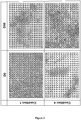
- the greater degree of swelling and/or the more homogeneous swelling of crosslinked hyaluronan hydrogels processed according to a method of the present invention also result in a better migration and more homogeneous occupation in the hyaluronan 3D matrix and provide an environment that is more suitable for cell growth and cell colony formation (see Example 4).
- a hydrogel of the present invention comprises an interconnected porous network.
- porous network refers to the combined or total void-volume consisting of the pores and interstices of the hydrogel.
- pore refers to a cavity or void in the surface, the body or both the surface and body of the hydrogel having at least one outer opening at a surface of the 3D matrix.
- interstice refers to a cavity or void in the body of the hydrogel not having a direct outer opening at a surface of the 3D matrix.
- an interstice may have an indirect outer opening or pathway to an outer surface of the matrix by way of one or more links or connections to adjacent or neighbor pores and/or interstices.
- an interconnected porous network is a porous network comprising pores and interstices, wherein at least some of the interstices have an indirect outer opening or pathway to an outer surface of the 3D matrix.
- a hyaluronan hydrogel matrix prepared by a method according to the present invention and cut into a parallelepiped contains a porous network organized in such a way that the parallelepiped presents a smooth upper surface and a smooth lower surface ( i.e ., upper and lower surfaces without any pore outer openings), and pore outer openings are mainly observed on two parallel faces of the parallelepiped.
- a hyaluronan hydrogel according to the present invention contains pores that have an outer opening with an oblong or oval shape, wherein the largest width of the opening is between 125 ⁇ m and 460 ⁇ m and the smallest width of the opening is between 105 ⁇ m and 450 ⁇ m.
- the mean largest width of the pores is about 235 ⁇ m and the mean smallest width of the opening is about 225 ⁇ m. It is understood that the outer opening of some pores may have a circular shape.
- the greater rehydration properties of a hydrogel of the present invention allow for a more complete and uniform migration and occupation of the cells in the interconnected porous network of the matrix and provide an environment that is more favorable to cell growth and cell colony formation.
- the present invention provides a sterilized crosslinked hyaluronan hydrogel that is obtained, or that is obtainable, using a method of the present invention.
- a sterilized crosslinked hyaluronan hydrogel of the invention is stored under sterile conditions and -20°C. Storage may be performed for very long periods of time ( e.g ., one year or more).
- the present invention also provides a rehydrated crosslinked hyaluronan hydrogel that is obtained by rehydrating a sterilized crosslinked hyaluronan hydrogel of the invention, as described herein.
- a rehydrated crosslinked hyaluronan hydrogel of the invention is stored in a rehydrating medium (e.g ., a cell culture medium) at 37°C and under a 5% CO 2 atmosphere.
- the rehydrating medium comprises antibiotics to prevent contamination. Under these conditions, storage may be performed for several weeks as long as new rehydrating medium is added at regular intervals, e.g., every week or every 10 days.
- crosslinked hyaluronan hydrogels of the present invention retain the shape that they were cut into ( e.g ., parallelepipedic, cubic, etc%) or that they had before treatment. They do not exhibit any, or any significant number of, tears or rips. They contain an organized interconnected porous network with pores having an outer opening with an oblong or oval shape, wherein the largest width of the opening is between 125 ⁇ m and 460 ⁇ m and the smallest width of the opening is between 105 ⁇ m and 450 ⁇ m.
- a crosslinked hyaluronan hydrogel of the present invention exhibits improved properties. These improved properties result in a higher capability and suitability for 3D cell culture. Therefore, the hydrogels of the present invention may be used in any of a large variety of applications involving 3D cell culture, and in particular in any one of the applications in which hyaluronan hydrogels have been used so far.
- Cells that can be cultured in 3 dimensions using a hydrogel of the present invention include stem cells, induced pluripotent stem cells, progenitor cells, and differentiated cells. Suitable cells may be of a single cell types (e.g ., cardiomyocytes or fibroblasts) or may comprise at least two different cell types (e.g ., keratinocyte-fibroblast co-culture). Preferably, cells to be cultured on a crosslinked hyaluronan hydrogel of the present invention are of mammalian (animal or human) origin.
- Mammalian cells may be of any organ, fluid or tissue origin (e.g ., brain, liver, skin, lung, kidney, heart, muscle, bone, bone marrow, blood, amniotic fluid, umbilical cord blood, etc) and of any cell type (see below).
- Cells may be primary cells, secondary cells or immortalized cells (i.e ., established cell lines). They may be isolated or derived from ex vivo biological samples or obtained from volunteers or patients by techniques well known in the art, or alternatively they may be purchased from commercial resources (for example, from the American Type Culture Collection, Manssas, VA).
- cells may be engineered to contain a gene of interest such as a gene expressing a growth factor or a receptor, or to contain a defective gene, or yet to contain Oct3/4, Sox2, Klf4, and c-Myc genes in order to prepare human induced stem cells from adult somatic cells.
- a gene of interest such as a gene expressing a growth factor or a receptor
- a defective gene or yet to contain Oct3/4, Sox2, Klf4, and c-Myc genes in order to prepare human induced stem cells from adult somatic cells.
- Examples of adult differentiated cells that can be grown in a 3D hydrogel matrix of the present invention include, but are not limited to , basal cells, epithelial cells, platelets, lymphocytes, T-cells, B-cells, natural killer cells, reticulocytes, granulocytes, monocytes, mast cells, neurocytes, neuroblasts, glioblastom, cytomegalic cells, dendritic cells, macrophages, blastomeres, endothelial cells, interstitial cells, Kupffer cells, Langerhans cells, littoral cells, tissue cells such as muscle cells and adipose cells, osteoblasts, fibroblasts, and the like.
- hematopoietic progenitor cells include, but are not limited to, hematopoietic progenitor cells, endothelial progenitor cells, neural progenitor cells, mesenchymal progenitor cells, osteogenic progenitor cells, stromal progenitor cells, and the like.
- the present inventors have demonstrated the feasibility of 3D culture of hematopoietic progenitor cells in a crosslinked hyaluronan hydrogel (see Examples section).
- the cell culture is conducted using " appropriate culture medium and conditions " .
- appropriate culture medium and conditions refers to a culture medium and to conditions that support survival and proliferation of cells cultured in a matrix. Such culture media and conditions are known in the art or may easily be optimized by one skilled in the art.
- Examples of applications involving 3D cell culture in which a crosslinked hyaluronan hydrogel of the invention can be used include, but are not limited to, proliferation of cells and tissues in vitro in an environment that more closely approximates that found in vivo (for example as research tools), screening of pharmaceutical compounds and toxicology assays in such cell cultures or tissues in vitro , cell therapy, cell delivery, drug delivery, biochemical replacement, production of biologically active molecules, tissue engineering (e.g ., ex vivo organ model, tissue explants, in vivo tissue regeneration), biomaterial, and clinical trials.
- tissue engineering e.g ., ex vivo organ model, tissue explants, in vivo tissue regeneration
- kits are provided that comprise a sterilized crosslinked hyaluronan hydrogel of the invention and a container containing the hydrogel under sterile conditions.
- kits are provided that comprise a rehydrated crosslinked hyaluronan hydrogel of the invention and a container containing the hydrogel in a rehydrating medium comprising antibiotics.
- a kit of the invention may further comprise instructions for storing the sterilized hydrogel, and/or instructions for rehydrating the sterilized hydrogel, and/or instructions for storing the rehydrated hydrogel, and/or instructions for using the rehydrated hydrogel.
- a kit may further comprise one or more of: rehydrating medium and/or reagents, antibiotics, biomolecules, biologically active agents, and/or pharmaceutically active agents as described herein, cell culture medium and/or reagents, cells, seeding means, and the like.
- kits of the present invention may optionally comprise different containers (e.g ., vial, ampoule, test tube, flask or bottle) for each individual buffer and/or reagent.
- Each component will generally be suitable as aliquoted in its respective container or provided in a concentrated form.
- Other containers e.g ., vials, ampoules, test tubes, flasks, bottles or assay plates
- suitable for conducting certain procedures e.g ., rehydration, cell culture, screening, etc.
- the individual containers of the kit are preferably maintained in close confinement for commercial sale.
- Optionally associated with the kit may be a notice or package insert in the form prescribed by a governmental agency regulating the manufacture, use or sale of pharmaceutical or biological products, which notice reflects approval by the agency of manufacture, use or sale for human or animal administration.
- An identifier (e.g ., a bar code, radio frequency, ID tags, etc%) may be present in or on the kit.
- the identifier can be used, for example, to uniquely identify the kit for purposes of quality control, inventory control, tracking movement between workstations, etc.
- hyaluronan (HA) hydrogels used were prepared using a long-chain of hyaluronan cross-linked with adipic dihydrazide (ADH, Sigma) as cross-linking agent and 1-ethyl-3[3-(dimethylamino)-propyl]carbodiimide (EDCI, Sigma) as reagent. All hydrogels were prepared from high molecular weight hyaluronan (> 1x10 6 Da) according to the procedure described by Prestwich et al. (J. Control. Release, 1998, 53: 93-103 ).
- the ratios of ADH to hyaluronan and of hyaluronan to EDCI were adjusted to obtain hydrogels optimized for cell adhesion and culture. The best results were obtained with a ratio of ADH to hyaluronan equal to 10:1 and a ratio of hyaluronan to EDCI equal to 1:1.
- Hyaluronan and hydrazide cross-linker (ADH) were dissolved in milliQ-water and the pH was adjusted to 4 by adding 0.1 N HCl.
- the carbodiimide reagent (EDCI) was dissolved in milliQ-water and added to the reaction mixture, and allowed to gel for 2 hours with gentle agitation.
- Hyaluronan hydrogels were equilibrated in 0.1 N NaCl for 2 days, than in a mixture water/ethanol (3/1, v/v) for 2 days, and in milliQ-water for 2 days to remove ADH.
- Crosslinked hyaluronan hydrogels thus obtained were then treated or processed according to the invention.
- the lyophilized hydrogels Prior to sterilization, the lyophilized hydrogels were cut into rectangular parallelepipeds (about 5 x 5 x 1.5 mm). The cut hydrogels were sterilized at 100°C for 1 hour using an oil bath. The hydrogels were then immersed in pure ethanol and manually compressed to eliminate air trapped within the hydrogel structure. The hydrogels were then rehydrated using a cell culture medium (e.g., RPMI (Eurobio) comprising antibiotics) until they swelled a 100-fold in volume.
- RPMI Eurobio
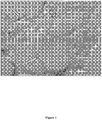
- FIG. 1 An inverted microscope picture of a crosslinked hyaluronan hydrogel treated according to a method of the present invention and seeded with hematopoietic stem cells is presented on Figure 1 . The picture was taken 24 hours after seeding. This figure clearly shows the porous structure of the hydrogel as well as the presence of cells in some of the interstices.
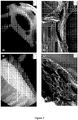
- Scanning Electron Microscopy (SEM) and Environmental Scanning Electron Microscopy (ESEM) were used to characterize the hyaluronan hydrogels and their interactions with cells. Scaffolds were incubated in glutaraldehyde (1% PBS) for 1 hour at 4°C. Then, the samples were snap dessicated for 2 hours at 40°C. The samples were then coated with an argon layer and examined using SEM EVO®40 series (Carl Zeiss AG, Germany). Since the ESEM technique does not require dehydration of the samples, the surface of hydrated scaffolds was directly observed by the same SEM equipment with a Peltier-cooled cold plate with a surface temperature of 0°C (Carl Zeiss AG, Germany). The scaffold pore sizes were determined by measuring pores from ESEM images. The ESEM and SEM images of hyaluronan hydrogels are presented on Figure 3(A)-(D) .
- ESEM was also used to analyze the fine structure of hyaluronan hydrogels after cell culture (at day 56). The interactions between cells and hyaluronan hydrogels were analyzed by SEM.
- MNCs Mononuclear cells
- the CD34 + MNC fraction was isolated by microbeads selection using a Vario magnetic affinity cell sorting (MACS) separator and MS separation columns (Miltenyi Biotec, France). This isolation was performed by positive selection of CD34 + -expressing cells.
- the CD34 + cells were suspended in phosphate-buffered solution (PBS, Eurobio, France), 0.1% bovine serum albumin (BSA, Sigma-Aldrich, France), and 2 mM EDTA buffer (Sigma-Aldrich, France). They were directly labeled by incubation for 30 minutes at 4°C with a monoclonal antibody coupled to microbeads. The cells were washed in a separation buffer and laid on an MS column placed in a magnetic field. The magnetically labeled CD34 + cells were retained on the column, after removal of the column from the magnetic field, cells can be eluted as the positively selected fraction, while unlabelled CD34- cells pass through.
- PBS phosphate-buffered solution
- BSA bovine
- CD34 + cells The purity of CD34 + cells was evaluated by FACS with anti-CD34 monoclonal antibody conjugated to fluorescein isothiocyanate (clone 581, Beckmann Coulter, France). The purity of cord blood CD34 + cells was between 93%-95%.
- Hyaluronan hydrogel culture of CD34 + CBCs Prior to cell seeding, hyaluronan hydrogels were incubated for 24 hours in RPMI1640 complemented with human SDF-1 ⁇ at 100 ng/mL (R&D System, France) then washed with PBS, in order to facilitate cell migration and colonization into the hydrogels.
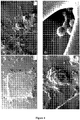
- the distinct non circular cell colonies most likely arose from single or small clusters of cells proliferating in a radial manner on the scaffold ( Fig. 4(A) and (B) ).
- the adherent cells were anchored to the matrix via numerous uropodia radiating from the cell surface ( Fig. 4(C) and (D) ).
- the first method was the same as that described in Examples 1 and 2 (i.e ., a method according to the present invention).
- the second method was identical except that after being sterilized at 100°C, the hydrogels were immersed in pure ethanol and then directly rehydrated using a cell culture medium. In other words, in the second method, the hydrogels were not manually compressed to eliminate air trapped within the hydrogel structure.
- both sets of hydrogels i.e ., compressed and non-compressed
- RPMI1640 complemented with human SDF-1 ⁇ at 100 ng/mL (R&D System, France) then washed with PBS, in order to facilitate cell migration and colonization into the hydrogels.
- PBS PBS
Landscapes
- Health & Medical Sciences (AREA)
- Life Sciences & Earth Sciences (AREA)
- Engineering & Computer Science (AREA)
- Chemical & Material Sciences (AREA)
- Organic Chemistry (AREA)
- Bioinformatics & Cheminformatics (AREA)
- Biomedical Technology (AREA)
- Zoology (AREA)
- Wood Science & Technology (AREA)
- Genetics & Genomics (AREA)
- Biotechnology (AREA)
- Biochemistry (AREA)
- General Health & Medical Sciences (AREA)
- Cell Biology (AREA)
- Microbiology (AREA)
- General Engineering & Computer Science (AREA)
- Polymers & Plastics (AREA)
- Chemical Kinetics & Catalysis (AREA)
- Medicinal Chemistry (AREA)
- Materials Engineering (AREA)
- Molecular Biology (AREA)
- Apparatus Associated With Microorganisms And Enzymes (AREA)
- Micro-Organisms Or Cultivation Processes Thereof (AREA)
Claims (17)
- Verfahren zum Erhalten eines vernetzten Hyaluronan-Hydrogels, welches zur 3D-Zellkultur geeignet ist, wobei das Verfahren die Schritte umfasst:(a) Lyophilisieren des vernetzten Hyaluronan-Hydrogels, um ein lyophilisiertes Hyaluronan-Hydrogel zu erhalten, oder Bereitstellen eines lyophilisierten Hyaluronan-Hydrogels, und(b) Sterilisieren des lyophilisierten Hyaluronan-Hydrogelserst durch Erwärmen des Hydrogels, und
dann durch Eintauchen des Hydrogels in Alkohol und Unterziehen des eingetauchten Hydrogels einer physikalischen Kompression. - Verfahren nach Anspruch 1, wobei das Erwärmen für 1 Stunde durchgeführt wird, wobei ein Ölbad bei 100 °C verwendet wird.
- Verfahren nach Anspruch 1 oder Anspruch 2, wobei der Schritt des Eintauchens unter Verwendung von reinem Ethanol bei Raumtemperatur durchgeführt wird.
- Verfahren gemäß einem der Ansprüche 1-3, wobei der Schritt des Unterziehens des eingetauchten Hydrogels einer physikalischen Kompression Luft eliminiert, welche in dem Hydrogel eingeschlossen ist.
- Verfahren nach einem der Ansprüche 1-4, weiterhin umfassend den Schritt:Schneiden des lyophilisierten Hydrogels vor der Sterilisation auf die gewünschte Form und Größe.
- Verfahren nach einem der Ansprüche 1-5, weiterhin umfassend den Schritt:Lagern des sterilisierten Hyaluronan-Hydrogels nach der Sterilisation unter sterilen Bedingungen bei -20 °C.
- Verfahren nach einem der Ansprüche 1-6, weiterhin umfassend den Schritt:Rehydrieren des sterilisierten Hydrogels, vorzugsweise in einem Zellkulturmedium, bis das sterilisierte Hydrogel ein Quellungsgleichgewicht erreicht.
- Verfahren nach Anspruch 7, weiterhin umfassend den Schritt:Lagern des rehydrierten Hyaluronan-Hydrogels nach der Rehydrierung in einem Rehydrierungsmedium umfassend Antibiotika bei 37 °C und in einer 5% CO2-Atmosphäre.
- Sterilisiertes vernetztes Hyaluronan-Hydrogel, wobei das Hydrogel durch ein Verfahren nach einem der Ansprüche 1-6 erhalten wurde, wobei das Hydrogel ein organisiertes verbundenes poröses Netzwerk mit Poren enthält, welche eine äußere Öffnung mit einer länglichen oder ovalen Form aufweisen, wobei die größte Weite der Öffnung zwischen 125 µm und 460 µm liegt und die kleinste Weite der Öffnung zwischen 105 µm und 450 µm liegt.
- Rehydriertes vernetztes Hyaluronan-Hydrogel, wobei das Hydrogel durch ein Verfahren nach einem der Ansprüche 7-8 erhalten wurde, wobei das Hydrogel ein organisiertes verbundenes poröses Netzwerk mit Poren enthält, welche eine äußere Öffnung mit einer länglichen oder ovalen Form aufweisen, wobei die größte Weite der Öffnung zwischen 125 µm und 460 µm liegt und die kleinste Weite der Öffnung zwischen 105 µm und 450 µm liegt.
- Vernetztes Hyaluronan-Hydrogel nach Anspruch 9 oder Anspruch 10, wobei das Hydrogel keinen Einriss oder Riss zeigt.
- Vernetztes Hyaluronan-Hydrogel nach einem der Ansprüche 9 bis 11, wobei das Hydrogel die Form behält, welche es vor der Sterilisierung hatte, oder die Form, in welche es geschnitten wurde.
- Vernetztes Hyaluronan-Hydrogel nach einem der Ansprüche 9 bis 12, wobei das Hydrogel Hyaluronan und wenigstens eines aus: Biomolekülen, biologisch aktiven Wirkstoffen, pharmazeutisch aktiven Wirkstoffen und Kombinationen davon umfasst, wobei das Hydrogel vorzugsweise Hyaluronan und ein chemoattraktives RGD-Tripeptid umfasst, wobei das Hydrogel stärker bevorzugt Hyaluronan umfasst, welches mit einem RGD-Tripeptid ko-vernetzt ist.
- Vernetztes Hyaluronan-Hydrogel nach einem der Ansprüche 9 bis 13, wobei das Hydrogel einen höheren Grad einer Quellung und/oder eine homogenere Quellung aufweist als ein ähnliches vernetztes Hyaluronan-Hydrogel, welches nicht einem Verfahren nach einem der Ansprüche 1-8 unterzogen wurde.
- Kit umfassend ein sterilisiertes vernetztes Hyaluronan-Hydrogel nach Anspruch 9 und einen Behälter, welcher das Hydrogel unter sterilen Bedingungen enthält.
- Kit umfassend ein rehydriertes vernetztes Hyaluronan-Hydrogel nach Anspruch 10 und einen Behälter, welcher das Hydrogel in einem Rehydrierungsmedium enthält.
- Verwendung eines vernetzten Hyaluronan-Hydrogels nach einem der Ansprüche 9 bis 14 in einer Anwendung, welche eine 3D-Zellkultur beinhaltet.
Priority Applications (1)
| Application Number | Priority Date | Filing Date | Title |
|---|---|---|---|
| EP11729592.3A EP2585586B1 (de) | 2010-06-22 | 2011-06-22 | Verbesserte vernetzte hyaluronan-hydrogele für dreidimensionale zellkultur |
Applications Claiming Priority (4)
| Application Number | Priority Date | Filing Date | Title |
|---|---|---|---|
| EP10305666 | 2010-06-22 | ||
| EP11305333 | 2011-03-24 | ||
| EP11729592.3A EP2585586B1 (de) | 2010-06-22 | 2011-06-22 | Verbesserte vernetzte hyaluronan-hydrogele für dreidimensionale zellkultur |
| PCT/EP2011/060465 WO2011161172A1 (en) | 2010-06-22 | 2011-06-22 | Improved crosslinked hyaluronan hydrogels for 3d cell culture |
Publications (2)
| Publication Number | Publication Date |
|---|---|
| EP2585586A1 EP2585586A1 (de) | 2013-05-01 |
| EP2585586B1 true EP2585586B1 (de) | 2017-03-22 |
Family
ID=44515186
Family Applications (1)
| Application Number | Title | Priority Date | Filing Date |
|---|---|---|---|
| EP11729592.3A Not-in-force EP2585586B1 (de) | 2010-06-22 | 2011-06-22 | Verbesserte vernetzte hyaluronan-hydrogele für dreidimensionale zellkultur |
Country Status (7)
| Country | Link |
|---|---|
| US (1) | US9315772B2 (de) |
| EP (1) | EP2585586B1 (de) |
| JP (1) | JP5937070B2 (de) |
| AU (1) | AU2011268951B2 (de) |
| CA (1) | CA2802557A1 (de) |
| DK (1) | DK2585586T3 (de) |
| WO (1) | WO2011161172A1 (de) |
Families Citing this family (6)
| Publication number | Priority date | Publication date | Assignee | Title |
|---|---|---|---|---|
| EP2801613A1 (de) | 2013-05-08 | 2014-11-12 | Ecole Polytechnique Fédérale de Lausanne (EPFL) | Anordnungen abgetrennter Zellkultur-Mikroumgebungen, Verfahren zur Herstellung solcher Anordnungen und Verwendungen davon |
| US10195313B2 (en) | 2014-04-10 | 2019-02-05 | Wisconsin Alumni Research Foundation | Method for forming hydrogel arrays using surfaces with differential wettability |
| FR3035107A1 (fr) * | 2015-04-15 | 2016-10-21 | Celenys | Procede de preparation d'hydrogel a partir d'acide hyaluronique modifie et de collagene de type i |
| IL269506B2 (en) | 2017-03-22 | 2024-04-01 | Genentech Inc | Hydrogel cross-linked hyaluronic acid prodrug compositions and methods |
| GB201711644D0 (en) * | 2017-07-19 | 2017-08-30 | Satie8 Ltd | Polymer Compositions |
| US20230212510A1 (en) * | 2020-05-04 | 2023-07-06 | City Of Hope | Methods for organoids production |
Citations (1)
| Publication number | Priority date | Publication date | Assignee | Title |
|---|---|---|---|---|
| EP0554898A2 (de) * | 1992-02-05 | 1993-08-11 | Seikagaku Kogyo Kabushiki Kaisha (Seikagaku Corporation) | Photohärtbare Derivate von Glykosaminoglykan, vernetzte Glykosaminoglykane und Verfahren zu deren Herstellung |
Family Cites Families (6)
| Publication number | Priority date | Publication date | Assignee | Title |
|---|---|---|---|---|
| ES335314A1 (es) * | 1966-01-06 | 1967-12-01 | Ceskoslovenska Akademie Ved | Mejoras introducidas en la preparacion de vehiculos insolubles de sustancias al menos parcialmente solubles, biologicamente activas. |
| WO2003074099A1 (en) * | 2002-03-06 | 2003-09-12 | Japan Tissue Engineering Co.,Ltd | Base material for tissue regeneration, transplantation material and process for producing the same |
| WO2005000402A2 (en) * | 2003-05-15 | 2005-01-06 | University Of Utah Research Foundation | Anti-adhesion composites and methods os use thereof |
| US9028872B2 (en) * | 2006-03-01 | 2015-05-12 | Fmc Corporation | Gelled composite |
| BRPI0808696A2 (pt) * | 2007-03-06 | 2015-06-23 | Univ North Carolina | Complexos de hiluronanas, outros componentes de matriz, hormônios e fatores de crescimento para manutenção, expansão e/ou diferenciação de células |
| US8529897B2 (en) * | 2007-08-16 | 2013-09-10 | Carnegie Mellon University | Inflammation-regulating compositions and methods |
-
2011
- 2011-06-22 DK DK11729592.3T patent/DK2585586T3/en active
- 2011-06-22 AU AU2011268951A patent/AU2011268951B2/en not_active Ceased
- 2011-06-22 CA CA2802557A patent/CA2802557A1/en not_active Abandoned
- 2011-06-22 EP EP11729592.3A patent/EP2585586B1/de not_active Not-in-force
- 2011-06-22 JP JP2013515891A patent/JP5937070B2/ja not_active Expired - Fee Related
- 2011-06-22 US US13/704,384 patent/US9315772B2/en not_active Expired - Fee Related
- 2011-06-22 WO PCT/EP2011/060465 patent/WO2011161172A1/en not_active Ceased
Patent Citations (1)
| Publication number | Priority date | Publication date | Assignee | Title |
|---|---|---|---|---|
| EP0554898A2 (de) * | 1992-02-05 | 1993-08-11 | Seikagaku Kogyo Kabushiki Kaisha (Seikagaku Corporation) | Photohärtbare Derivate von Glykosaminoglykan, vernetzte Glykosaminoglykane und Verfahren zu deren Herstellung |
Also Published As
| Publication number | Publication date |
|---|---|
| DK2585586T3 (en) | 2017-07-03 |
| CA2802557A1 (en) | 2011-12-29 |
| US20130260464A1 (en) | 2013-10-03 |
| EP2585586A1 (de) | 2013-05-01 |
| JP2013529464A (ja) | 2013-07-22 |
| US9315772B2 (en) | 2016-04-19 |
| AU2011268951B2 (en) | 2014-08-07 |
| WO2011161172A1 (en) | 2011-12-29 |
| JP5937070B2 (ja) | 2016-06-22 |
| AU2011268951A1 (en) | 2013-01-10 |
Similar Documents
| Publication | Publication Date | Title |
|---|---|---|
| Knight et al. | Advances in 3D cell culture technologies enabling tissue‐like structures to be created in vitro | |
| CN105025940B (zh) | 细胞移植用细胞结构体、生物亲和性高分子块及它们的制造方法 | |
| US9315772B2 (en) | Crosslinked hyaluronan hydrogels for 3D cell culture | |
| EP2138571B1 (de) | Verfahren zur Herstellung mehrzelliger Sphäroide | |
| US20140038275A1 (en) | Pharmacology Bioassays for Drug Discovery, Toxicity Evaluation and in vitro Cancer Research Using a 3D Nanocellulose Scaffold and Living Tissue | |
| AU2009208074A1 (en) | Cell culture well-plates having inverted colloidal crystal scaffolds | |
| Wang et al. | A 3D-printable gelatin/alginate/ε-poly-l-lysine hydrogel scaffold to enable porcine muscle stem cells expansion and differentiation for cultured meat development | |
| US20160123960A1 (en) | Method for preparing three-dimensional, organotypic cell cultures and uses thereof | |
| JPWO2005014774A1 (ja) | 動物細胞の培養担体と、該培養担体を用いた動物細胞の培養方法および移植方法 | |
| EP3913048A1 (de) | Synthetisches hydrogel und seine verwendung zur immuntherapie und zum 3d-drucken | |
| Singh et al. | Proliferation of chondrocytes on a 3-D modelled macroporous poly (hydroxyethyl methacrylate)–gelatin cryogel | |
| Cho et al. | Application of porous glycosaminoglycan‐based scaffolds for expansion of human cord blood stem cells in perfusion culture | |
| Smith et al. | Long-term culture of HL-1 cardiomyocytes in modular poly (ethylene glycol) microsphere-based scaffolds crosslinked in the phase-separated state | |
| Demange et al. | Survival of cord blood haematopoietic stem cells in a hyaluronan hydrogel for ex vivo biomimicry | |
| Concaro et al. | Effect of cell seeding concentration on the quality of tissue engineered constructs loaded with adult human articular chondrocytes | |
| CA2688789A1 (en) | Methods for the preparation of fibroblasts | |
| WO2023017800A1 (ja) | 立体的細胞組織の製造方法及び立体的細胞組織 | |
| Mikhalovsky et al. | 5.03-Biomaterials/Cryogels | |
| EP3967748A1 (de) | Nanocellulose-3d-matrix zur in-vitro-kultivierung von menschlichen und tierischen zellen | |
| EP4499159B1 (de) | Inverses opalhydrogel und seine verwendung | |
| EP2585585B1 (de) | Verfahren zur gewinnung von zellen aus dreidimensionalen hydrogelmatrix-kulturen | |
| KR20110008013A (ko) | 재건된 각막 및 점막 | |
| Sukach et al. | Three-dimensional cell cultivation systems | |
| Volkova et al. | Three-dimensional matrixes of natural and synthetic origin for cell biotechnology | |
| JP2021048834A (ja) | 細胞浸潤性評価方法、それを用いた抗浸潤性化合物スクリーニング方法、ならびにそれらの方法に用いられる架橋ゼラチン粉末および評価キット |
Legal Events
| Date | Code | Title | Description |
|---|---|---|---|
| PUAI | Public reference made under article 153(3) epc to a published international application that has entered the european phase |
Free format text: ORIGINAL CODE: 0009012 |
|
| 17P | Request for examination filed |
Effective date: 20121218 |
|
| AK | Designated contracting states |
Kind code of ref document: A1 Designated state(s): AL AT BE BG CH CY CZ DE DK EE ES FI FR GB GR HR HU IE IS IT LI LT LU LV MC MK MT NL NO PL PT RO RS SE SI SK SM TR |
|
| DAX | Request for extension of the european patent (deleted) | ||
| 17Q | First examination report despatched |
Effective date: 20140709 |
|
| 111L | Licence recorded |
Designated state(s): AL AT BE BG CH CY CZ DE DK EE ES FI FR GB GR HR HU IE IS IT LT LU LV MC MK MT NL NO PL PT RO RS SE SI SK SM TR Free format text: EXCLUSIVE LICENSE Name of requester: CELENYS, FR Effective date: 20140825 |
|
| GRAP | Despatch of communication of intention to grant a patent |
Free format text: ORIGINAL CODE: EPIDOSNIGR1 |
|
| INTG | Intention to grant announced |
Effective date: 20160712 |
|
| STAA | Information on the status of an ep patent application or granted ep patent |
Free format text: STATUS: GRANT OF PATENT IS INTENDED |
|
| GRAS | Grant fee paid |
Free format text: ORIGINAL CODE: EPIDOSNIGR3 |
|
| GRAA | (expected) grant |
Free format text: ORIGINAL CODE: 0009210 |
|
| STAA | Information on the status of an ep patent application or granted ep patent |
Free format text: STATUS: THE PATENT HAS BEEN GRANTED |
|
| 111L | Licence recorded |
Designated state(s): AL AT BE BG CH CY CZ DE DK EE ES FI FR GB GR HR HU IE IS IT LT LU LV MC MK MT NL NO PL PT RO RS SE SI SK SM TR Free format text: EXCLUSIVE LICENSE Name of requester: CELENYS, FR Effective date: 20140825 |
|
| AK | Designated contracting states |
Kind code of ref document: B1 Designated state(s): AL AT BE BG CH CY CZ DE DK EE ES FI FR GB GR HR HU IE IS IT LI LT LU LV MC MK MT NL NO PL PT RO RS SE SI SK SM TR |
|
| REG | Reference to a national code |
Ref country code: GB Ref legal event code: FG4D |
|
| REG | Reference to a national code |
Ref country code: CH Ref legal event code: EP Ref country code: CH Ref legal event code: PK Free format text: ERGAENZUNG LIZENZEINTRAG: AUSSCHLIESSLICHE LIZENZ |
|
| REG | Reference to a national code |
Ref country code: AT Ref legal event code: REF Ref document number: 877792 Country of ref document: AT Kind code of ref document: T Effective date: 20170415 |
|
| REG | Reference to a national code |
Ref country code: IE Ref legal event code: FG4D |
|
| REG | Reference to a national code |
Ref country code: DE Ref legal event code: R096 Ref document number: 602011036215 Country of ref document: DE |
|
| REG | Reference to a national code |
Ref country code: SE Ref legal event code: TRGR |
|
| REG | Reference to a national code |
Ref country code: NL Ref legal event code: FP |
|
| REG | Reference to a national code |
Ref country code: FR Ref legal event code: PLFP Year of fee payment: 7 |
|
| REG | Reference to a national code |
Ref country code: DK Ref legal event code: T3 Effective date: 20170628 |
|
| PG25 | Lapsed in a contracting state [announced via postgrant information from national office to epo] |
Ref country code: LT Free format text: LAPSE BECAUSE OF FAILURE TO SUBMIT A TRANSLATION OF THE DESCRIPTION OR TO PAY THE FEE WITHIN THE PRESCRIBED TIME-LIMIT Effective date: 20170322 Ref country code: GR Free format text: LAPSE BECAUSE OF FAILURE TO SUBMIT A TRANSLATION OF THE DESCRIPTION OR TO PAY THE FEE WITHIN THE PRESCRIBED TIME-LIMIT Effective date: 20170623 Ref country code: HR Free format text: LAPSE BECAUSE OF FAILURE TO SUBMIT A TRANSLATION OF THE DESCRIPTION OR TO PAY THE FEE WITHIN THE PRESCRIBED TIME-LIMIT Effective date: 20170322 Ref country code: FI Free format text: LAPSE BECAUSE OF FAILURE TO SUBMIT A TRANSLATION OF THE DESCRIPTION OR TO PAY THE FEE WITHIN THE PRESCRIBED TIME-LIMIT Effective date: 20170322 |
|
| PGFP | Annual fee paid to national office [announced via postgrant information from national office to epo] |
Ref country code: DK Payment date: 20170630 Year of fee payment: 7 Ref country code: IE Payment date: 20170626 Year of fee payment: 7 Ref country code: FR Payment date: 20170629 Year of fee payment: 7 |
|
| REG | Reference to a national code |
Ref country code: NO Ref legal event code: T2 Effective date: 20170322 |
|
| REG | Reference to a national code |
Ref country code: LT Ref legal event code: MG4D |
|
| REG | Reference to a national code |
Ref country code: AT Ref legal event code: MK05 Ref document number: 877792 Country of ref document: AT Kind code of ref document: T Effective date: 20170322 |
|
| PG25 | Lapsed in a contracting state [announced via postgrant information from national office to epo] |
Ref country code: LV Free format text: LAPSE BECAUSE OF FAILURE TO SUBMIT A TRANSLATION OF THE DESCRIPTION OR TO PAY THE FEE WITHIN THE PRESCRIBED TIME-LIMIT Effective date: 20170322 Ref country code: RS Free format text: LAPSE BECAUSE OF FAILURE TO SUBMIT A TRANSLATION OF THE DESCRIPTION OR TO PAY THE FEE WITHIN THE PRESCRIBED TIME-LIMIT Effective date: 20170322 Ref country code: BG Free format text: LAPSE BECAUSE OF FAILURE TO SUBMIT A TRANSLATION OF THE DESCRIPTION OR TO PAY THE FEE WITHIN THE PRESCRIBED TIME-LIMIT Effective date: 20170622 |
|
| PGFP | Annual fee paid to national office [announced via postgrant information from national office to epo] |
Ref country code: SE Payment date: 20170626 Year of fee payment: 7 Ref country code: NL Payment date: 20170626 Year of fee payment: 7 Ref country code: LU Payment date: 20170626 Year of fee payment: 7 |
|
| PG25 | Lapsed in a contracting state [announced via postgrant information from national office to epo] |
Ref country code: CZ Free format text: LAPSE BECAUSE OF FAILURE TO SUBMIT A TRANSLATION OF THE DESCRIPTION OR TO PAY THE FEE WITHIN THE PRESCRIBED TIME-LIMIT Effective date: 20170322 Ref country code: SK Free format text: LAPSE BECAUSE OF FAILURE TO SUBMIT A TRANSLATION OF THE DESCRIPTION OR TO PAY THE FEE WITHIN THE PRESCRIBED TIME-LIMIT Effective date: 20170322 Ref country code: RO Free format text: LAPSE BECAUSE OF FAILURE TO SUBMIT A TRANSLATION OF THE DESCRIPTION OR TO PAY THE FEE WITHIN THE PRESCRIBED TIME-LIMIT Effective date: 20170322 Ref country code: IT Free format text: LAPSE BECAUSE OF FAILURE TO SUBMIT A TRANSLATION OF THE DESCRIPTION OR TO PAY THE FEE WITHIN THE PRESCRIBED TIME-LIMIT Effective date: 20170322 Ref country code: ES Free format text: LAPSE BECAUSE OF FAILURE TO SUBMIT A TRANSLATION OF THE DESCRIPTION OR TO PAY THE FEE WITHIN THE PRESCRIBED TIME-LIMIT Effective date: 20170322 Ref country code: EE Free format text: LAPSE BECAUSE OF FAILURE TO SUBMIT A TRANSLATION OF THE DESCRIPTION OR TO PAY THE FEE WITHIN THE PRESCRIBED TIME-LIMIT Effective date: 20170322 Ref country code: AT Free format text: LAPSE BECAUSE OF FAILURE TO SUBMIT A TRANSLATION OF THE DESCRIPTION OR TO PAY THE FEE WITHIN THE PRESCRIBED TIME-LIMIT Effective date: 20170322 |
|
| PGFP | Annual fee paid to national office [announced via postgrant information from national office to epo] |
Ref country code: DE Payment date: 20170713 Year of fee payment: 7 Ref country code: CH Payment date: 20170724 Year of fee payment: 7 Ref country code: GB Payment date: 20170721 Year of fee payment: 7 Ref country code: NO Payment date: 20170629 Year of fee payment: 7 |
|
| PG25 | Lapsed in a contracting state [announced via postgrant information from national office to epo] |
Ref country code: PT Free format text: LAPSE BECAUSE OF FAILURE TO SUBMIT A TRANSLATION OF THE DESCRIPTION OR TO PAY THE FEE WITHIN THE PRESCRIBED TIME-LIMIT Effective date: 20170724 Ref country code: PL Free format text: LAPSE BECAUSE OF FAILURE TO SUBMIT A TRANSLATION OF THE DESCRIPTION OR TO PAY THE FEE WITHIN THE PRESCRIBED TIME-LIMIT Effective date: 20170322 Ref country code: SM Free format text: LAPSE BECAUSE OF FAILURE TO SUBMIT A TRANSLATION OF THE DESCRIPTION OR TO PAY THE FEE WITHIN THE PRESCRIBED TIME-LIMIT Effective date: 20170322 Ref country code: IS Free format text: LAPSE BECAUSE OF FAILURE TO SUBMIT A TRANSLATION OF THE DESCRIPTION OR TO PAY THE FEE WITHIN THE PRESCRIBED TIME-LIMIT Effective date: 20170722 |
|
| REG | Reference to a national code |
Ref country code: DE Ref legal event code: R097 Ref document number: 602011036215 Country of ref document: DE |
|
| PLBE | No opposition filed within time limit |
Free format text: ORIGINAL CODE: 0009261 |
|
| STAA | Information on the status of an ep patent application or granted ep patent |
Free format text: STATUS: NO OPPOSITION FILED WITHIN TIME LIMIT |
|
| PG25 | Lapsed in a contracting state [announced via postgrant information from national office to epo] |
Ref country code: MC Free format text: LAPSE BECAUSE OF FAILURE TO SUBMIT A TRANSLATION OF THE DESCRIPTION OR TO PAY THE FEE WITHIN THE PRESCRIBED TIME-LIMIT Effective date: 20170322 |
|
| 26N | No opposition filed |
Effective date: 20180102 |
|
| PG25 | Lapsed in a contracting state [announced via postgrant information from national office to epo] |
Ref country code: SI Free format text: LAPSE BECAUSE OF FAILURE TO SUBMIT A TRANSLATION OF THE DESCRIPTION OR TO PAY THE FEE WITHIN THE PRESCRIBED TIME-LIMIT Effective date: 20170322 |
|
| REG | Reference to a national code |
Ref country code: BE Ref legal event code: MM Effective date: 20170630 |
|
| PG25 | Lapsed in a contracting state [announced via postgrant information from national office to epo] |
Ref country code: BE Free format text: LAPSE BECAUSE OF NON-PAYMENT OF DUE FEES Effective date: 20170630 |
|
| PG25 | Lapsed in a contracting state [announced via postgrant information from national office to epo] |
Ref country code: MT Free format text: LAPSE BECAUSE OF NON-PAYMENT OF DUE FEES Effective date: 20170622 |
|
| REG | Reference to a national code |
Ref country code: DE Ref legal event code: R119 Ref document number: 602011036215 Country of ref document: DE |
|
| REG | Reference to a national code |
Ref country code: DK Ref legal event code: EBP Effective date: 20180630 |
|
| REG | Reference to a national code |
Ref country code: NO Ref legal event code: MMEP |
|
| REG | Reference to a national code |
Ref country code: SE Ref legal event code: EUG |
|
| PG25 | Lapsed in a contracting state [announced via postgrant information from national office to epo] |
Ref country code: SE Free format text: LAPSE BECAUSE OF NON-PAYMENT OF DUE FEES Effective date: 20180623 |
|
| REG | Reference to a national code |
Ref country code: CH Ref legal event code: PL |
|
| REG | Reference to a national code |
Ref country code: NL Ref legal event code: MM Effective date: 20180701 |
|
| GBPC | Gb: european patent ceased through non-payment of renewal fee |
Effective date: 20180622 |
|
| REG | Reference to a national code |
Ref country code: IE Ref legal event code: MM4A |
|
| PG25 | Lapsed in a contracting state [announced via postgrant information from national office to epo] |
Ref country code: NL Free format text: LAPSE BECAUSE OF NON-PAYMENT OF DUE FEES Effective date: 20180701 Ref country code: LU Free format text: LAPSE BECAUSE OF NON-PAYMENT OF DUE FEES Effective date: 20180622 |
|
| PG25 | Lapsed in a contracting state [announced via postgrant information from national office to epo] |
Ref country code: NO Free format text: LAPSE BECAUSE OF NON-PAYMENT OF DUE FEES Effective date: 20180630 Ref country code: FR Free format text: LAPSE BECAUSE OF NON-PAYMENT OF DUE FEES Effective date: 20180630 Ref country code: DE Free format text: LAPSE BECAUSE OF NON-PAYMENT OF DUE FEES Effective date: 20190101 Ref country code: GB Free format text: LAPSE BECAUSE OF NON-PAYMENT OF DUE FEES Effective date: 20180622 Ref country code: LI Free format text: LAPSE BECAUSE OF NON-PAYMENT OF DUE FEES Effective date: 20180630 Ref country code: CH Free format text: LAPSE BECAUSE OF NON-PAYMENT OF DUE FEES Effective date: 20180630 Ref country code: IE Free format text: LAPSE BECAUSE OF NON-PAYMENT OF DUE FEES Effective date: 20180622 |
|
| PG25 | Lapsed in a contracting state [announced via postgrant information from national office to epo] |
Ref country code: HU Free format text: LAPSE BECAUSE OF FAILURE TO SUBMIT A TRANSLATION OF THE DESCRIPTION OR TO PAY THE FEE WITHIN THE PRESCRIBED TIME-LIMIT; INVALID AB INITIO Effective date: 20110622 |
|
| PG25 | Lapsed in a contracting state [announced via postgrant information from national office to epo] |
Ref country code: DK Free format text: LAPSE BECAUSE OF NON-PAYMENT OF DUE FEES Effective date: 20180630 |
|
| PG25 | Lapsed in a contracting state [announced via postgrant information from national office to epo] |
Ref country code: CY Free format text: LAPSE BECAUSE OF NON-PAYMENT OF DUE FEES Effective date: 20170322 |
|
| PG25 | Lapsed in a contracting state [announced via postgrant information from national office to epo] |
Ref country code: MK Free format text: LAPSE BECAUSE OF FAILURE TO SUBMIT A TRANSLATION OF THE DESCRIPTION OR TO PAY THE FEE WITHIN THE PRESCRIBED TIME-LIMIT Effective date: 20170322 |
|
| PG25 | Lapsed in a contracting state [announced via postgrant information from national office to epo] |
Ref country code: TR Free format text: LAPSE BECAUSE OF FAILURE TO SUBMIT A TRANSLATION OF THE DESCRIPTION OR TO PAY THE FEE WITHIN THE PRESCRIBED TIME-LIMIT Effective date: 20170322 |
|
| PG25 | Lapsed in a contracting state [announced via postgrant information from national office to epo] |
Ref country code: AL Free format text: LAPSE BECAUSE OF FAILURE TO SUBMIT A TRANSLATION OF THE DESCRIPTION OR TO PAY THE FEE WITHIN THE PRESCRIBED TIME-LIMIT Effective date: 20170322 |