EP2585643B1 - Système de stérilisation de douche et son procédé d'utilisation - Google Patents
Système de stérilisation de douche et son procédé d'utilisation Download PDFInfo
- Publication number
- EP2585643B1 EP2585643B1 EP11729664.0A EP11729664A EP2585643B1 EP 2585643 B1 EP2585643 B1 EP 2585643B1 EP 11729664 A EP11729664 A EP 11729664A EP 2585643 B1 EP2585643 B1 EP 2585643B1
- Authority
- EP
- European Patent Office
- Prior art keywords
- shower
- composition
- growth
- sterilisation
- biocidal
- Prior art date
- Legal status (The legal status is an assumption and is not a legal conclusion. Google has not performed a legal analysis and makes no representation as to the accuracy of the status listed.)
- Not-in-force
Links
Images

Classifications
-
- A—HUMAN NECESSITIES
- A61—MEDICAL OR VETERINARY SCIENCE; HYGIENE
- A61L—METHODS OR APPARATUS FOR STERILISING MATERIALS OR OBJECTS IN GENERAL; DISINFECTION, STERILISATION OR DEODORISATION OF AIR; CHEMICAL ASPECTS OF BANDAGES, DRESSINGS, ABSORBENT PADS OR SURGICAL ARTICLES; MATERIALS FOR BANDAGES, DRESSINGS, ABSORBENT PADS OR SURGICAL ARTICLES
- A61L2/00—Disinfection or sterilisation of materials or objects, in general; Accessories therefor
- A61L2/16—Disinfection or sterilisation of materials or objects, in general; Accessories therefor using chemical substances
- A61L2/18—Liquid substances
-
- A—HUMAN NECESSITIES
- A01—AGRICULTURE; FORESTRY; ANIMAL HUSBANDRY; HUNTING; TRAPPING; FISHING
- A01N—PRESERVATION OF BODIES OF HUMANS OR ANIMALS OR PLANTS OR PARTS THEREOF; BIOCIDES, e.g. AS DISINFECTANTS, AS PESTICIDES OR AS HERBICIDES; PEST REPELLANTS OR ATTRACTANTS; PLANT GROWTH REGULATORS
- A01N33/00—Biocides, pest repellants or attractants, or plant growth regulators containing organic nitrogen compounds
- A01N33/02—Amines; Quaternary ammonium compounds
- A01N33/04—Nitrogen directly attached to aliphatic or cycloaliphatic carbon atoms
-
- E—FIXED CONSTRUCTIONS
- E03—WATER SUPPLY; SEWERAGE
- E03C—DOMESTIC PLUMBING INSTALLATIONS FOR FRESH WATER OR WASTE WATER; SINKS
- E03C1/00—Domestic plumbing installations for fresh water or waste water; Sinks
- E03C1/02—Plumbing installations for fresh water
- E03C1/04—Water-basin installations specially adapted to wash-basins or baths
- E03C1/046—Adding soap, disinfectant, or the like in the supply line or at the water outlet
-
- B—PERFORMING OPERATIONS; TRANSPORTING
- B05—SPRAYING OR ATOMISING IN GENERAL; APPLYING FLUENT MATERIALS TO SURFACES, IN GENERAL
- B05B—SPRAYING APPARATUS; ATOMISING APPARATUS; NOZZLES
- B05B7/00—Spraying apparatus for discharge of liquids or other fluent materials from two or more sources, e.g. of liquid and air, of powder and gas
- B05B7/24—Spraying apparatus for discharge of liquids or other fluent materials from two or more sources, e.g. of liquid and air, of powder and gas with means, e.g. a container, for supplying liquid or other fluent material to a discharge device
- B05B7/2402—Apparatus to be carried on or by a person, e.g. by hand; Apparatus comprising containers fixed to the discharge device
- B05B7/2462—Apparatus to be carried on or by a person, e.g. by hand; Apparatus comprising containers fixed to the discharge device using a carrying liquid flowing through the container for dissolving a block of solid material
Definitions
- the invention to which this application relates is a method of using a shower sterilisation system.
- a shower sterilisation system In recent years there have been a number of high profile incidents where the spread of Legionnaires' disease in particular has caused great concern for public health and in some cases susceptible individuals have died as a result of contacting the disease (as for example reported on the BBC News website, at http://news.bbc.co.uk/go/pr/fr/-/l/hi/england/somerset/5256926.stm).
- the generally accepted mechanism for the spread of this disease is via the very fine particulate water mists/aerosols released from contaminated cooling towers or other facilities where aerosols can be produced and can contact personnel.
- HSE Health and Safety Executive
- HSE document L8 which summarises the procedures to be applied in the control of Legionella pneumophila acknowledges the risk from showers and recommends that all shower systems in commercial and industrial facilities are treated with a high level of halogen release product, such as chlorine dioxide, on a regular basis.
- DE9016641 discloses a device for treating a stream of water in a pipe.
- the device includes a main channel through which the water flows and a mixing chamber adjacent to the main channel in which anti-bacterials or care agents can be located. Water is diverted from the main channel into the mixing chamber and then back into the main channel.
- FR2620470 discloses a device to be fitted to valves for perfuming sanitary water.
- the device can be used with a hand shower and includes an entry connecting nozzle, an exit connecting nozzle and a cavity enclosing a cartridge saturated with the perfume.
- US2002070293 discloses a shower filtration skin care device.
- the device is for joining to the threaded tube at the bottom of an existing hand held spray nozzle and the threaded orifice at the top of the nozzle hose.
- the device contains a filter and optionally can contain a skin care product.
- US6395172 discloses water purifying apparatus having a hollow container and a purifying material provided therein.
- the hollow container is disposed in a water channel.
- the purifying material contains a water soluble non-crystalline substance and activate carbon.
- US6647566 discloses an automatic bath additive feeder including an additive container defining an inner space, and a valve unit mounted on the container.
- US20070113892 discloses an apparatus for introducing additives into a fluid flow.
- An additive vessel with chambers for one or more additives, is attached to a primary flow fixture in a configuration that allow part of the primary flow to be diverted through the additive vessel then back to the primary flow.
- the additive vessel can contain cleansing agents, moisturises or scent producing compositions.
- FR2264583 discloses a mixer for primary and secondary streams for adding liquids, pastes, powders and soluble particles to a fluid stream.
- the mixer can be used for adding liquid soap and perfumed salt to a fluid stream.
- WO01/76647 discloses a process and composition for cleaning medical instruments in a cleaning bath.
- the composition includes an enzyme, a quaternary ammonium biocide, and an activity protector in a concentration sufficient to maintain a biocidal efficacy for the quaternary ammonium biocide in the presence of the enzyme and a protein load.
- Am activity protector enhancer can include an acid sequestrant.
- WO00/69475 discloses a recirculation device for allowing decontamination of items located in the device.
- a composition located in the recirculation device includes a disinfectant and an acid sequestrant for preventing precipitation of calcium and magnesium salts in the device during recirculation.
- an aim of the present invention is to provide a shower sterilisation system that allows a simple and safe method of delivering an anti-microbial or sterilisation composition into shower apparatus to be established.
- a further aim of the invention is to establish a simple and effective method of cleaning shower apparatus to encourage frequent treatment of the apparatus using an anti-microbial or sterilisation composition, such that greater control of the build up of microbiological activity in the shower lines and head, and hence greater levels of overall protection, can be provided.
- the solution consists in the method of using a shower sterilisation system according to claim 1.
- the method of using a shower sterilisation system of the present invention allows a sterilisation or biocidal composition and an acid sequestering composition to be easily and effectively delivered to one or more parts of the shower apparatus to sterilise or clean the same.
- Using the acid sequestering composition prior to the sterilisation or biocidal composition allows to break up the biofilm protecting the bacteria within the system before attacking the bacteria. The later treatment with the sterilisation or biocidal composition thus becomes more efficient.
- the applicator device comprises a housing including inlet means and/or outlet means for allowing the flow of water from the shower apparatus therethrough in use.
- the applicator device includes receiving means located in or forming part of the housing for receiving the sterilisation composition in use.
- the housing and/or the receiving means of the applicator device preferably includes attachment means and/or access means to allow the composition to be placed in the receiving means in use.
- connection means for allowing connection of the applicator device to the shower apparatus in use.
- the shower conduit means is typically any type of conduit, channel, tubing, hose, pipe and/or the like that allows water to flow therethrough from the water supply means to the shower head.
- the shower head is typically the portion of the shower apparatus from which the water is dispensed onto a user in use.
- the applicator device can be attached, detachably attached or integrally formed with the shower apparatus.
- An application device is used for delivering a composition to shower or fluid flow apparatus, said applicator device including; a housing including inlet means and/or outlet means; receiving means located in or forming part of the housing for receiving a composition in use; the housing and/or the receiving means having attachment means and/or access means to allow the composition to be placed in the receiving means in use; wherein the inlet and/or outlet means are provided with connection means for allowing connection of the applicator device to the shower or fluid flow apparatus in use.
- the applicator device allows effective delivery of a composition for cleaning or treating fluid flowing through the apparatus or one or more interior surfaces of the shower apparatus, fluid flow apparatus or other apparatus with which it is connected to in use.
- the applicator device can be retrofitted to existing shower or fluid flow apparatus, can be integrally formed therewith, attached to detachably attached to and/or the like.
- the composition is a biocidal or sterilisation composition and an acidic sequestering composition.
- the receiving means defines an inner portion in fluid communication with an outer portion. Typically the inlet and outlet means are in respective fluid communication with the inner portion and the outer portion.
- the inner portion includes a mesh, one or more apertures and/or the like to allow fluid communication between the inner and outer portions of the receiving means.
- the receiving means can be in the form of a basket or container for containing or supporting the composition in use.
- the receiving means can be a cavity defined within the housing with delimiting means to separate the cavity of the receiving means from the remainder of the housing.
- the delimiting means can be filter means and/or the like.
- the basket, container or cavity is in fluid communication with the shower apparatus or fluid flow apparatus with which the applicator device is fitted to in use.
- the inlet and/or outlet means preferably include at least one opening defined therein for the flow of fluid therethrough in use.
- the inlet and outlet means can be provided separately or combined.
- the applicator device is typically in fluid communication with one or more parts of the shower apparatus. Preferably at least one fluid flow channel defined in the applicator device is substantially aligned with a fluid flow channel defined in the shower apparatus.
- the applicator device is located between the water supply unit and the shower conduit means of the shower apparatus.
- the applicator device is connected or provided substantially in-line with one or more parts of the shower apparatus through which fluid flows in use.
- fluid or water flows from the water supply unit to the shower conduit means and head via the applicator device.
- the fluid flow allows any composition contained within the receiving means of the applicator device to be released into the water supply or fluid flow and pass out of the shower apparatus through the shower conduit and/or shower head.
- the water flow channel of the applicator device and water flow channel of the part of the shower apparatus with which it is fitted to are substantially coaxially arranged.
- the longitudinal axis of the applicator device or channel defined in the applicator device is substantially parallel with and aligned with the longitudinal axis of the shower apparatus or channel defined in the shower apparatus with which it is connected to in use.
- connection means include one or more screw threads extending from, provided on or associated with the housing of the applicator device.
- connection means are both male, and therefore suitable for being received by the female screw thread of the shower conduit means to allow connection therebetween in use.
- connection means could include any or any combination of one or more screw threads, friction fit, push fit and locking connection, inter-engaging members, one or more teeth, protruding lug or pin members, quick-release fittings, twist-lock connections and/or the like.
- the adapter means are provided to allow connection between the shower apparatus and the applicator device.
- the adapter means includes a tube or conduit provided with screw threads at one or both ends, such as for example female screw threads. Therefore the male screw thread of the applicator device in one embodiment can be connected to the male screw thread of the water supply unit via the adapter means.
- the adapter means engage the connection means of the applicator device to one or more parts of the shower or fluid flow apparatus in use.
- the receiving means includes filtration means, typically capable of filtering the fluid flowing between the inner and outer portions or passing through the receiving means.
- the filtration means defines the inner and outer portions or delimiting means of the receiving means.
- the filtration means is a mesh, screen or gauze.
- the mesh or gauze is formed from plastic, metal or a metal based material.
- the filtration means extends or is arranged substantially perpendicular to the direction of fluid flow through the apparatus or to a central longitudinal axis defined through the aperture of the inlet and/or outlet means.
- the receiving means and/or housing is substantially circular in cross-section.
- the filtration means is substantially concentric with the receiving means and/or channel defined through the housing of the applicator device through which fluid flows in use.
- the filtration means extends across at least a portion of the housing between the inlet and outlet means to filter liquid or fluid flowing therebetween.
- the housing is substantially Y-shaped or includes an outwardly protruding branch or arm portion from a main body portion to allow insertion of the composition therein in use.
- the branch or arm portion can be in fluid communication with the remainder of the housing or main body portion interior so that composition can pass into the water flowing through the housing in use.
- composition is locatable in the inner portion or cavity of the receiving means, such that the filtration means of the receiving means retains any insoluble material, such as for example any PVA material where used.
- the applicator device is arranged to allow liquid or fluid to flow through the inlet means to the outlet means via the filtration means. Further typically in one embodiment the applicator device is arranged to allow liquid or fluid to flow through the inlet means into the inner portion, from the inner portion to the outer portion via the filtration means, and out from the outer portion via the outlet means. Liquid or fluid may then flow into a shower hose, conduit, pipe and/or the like connected to the outlet means.
- the receiving means is detachably connected to the housing via attachment means.
- the attachment means can include any or any combination of one or more screw threads, friction fit, inter-engaging members, one or more clips, ties, screws and/or the like.
- the receiving means can be removed to insert, remove and/or replace the composition therein in use.
- the housing includes an access opening, and preferably in addition to one or more apertures of the inlet and/or outlet means, defined in a wall of the housing.
- the access opening allows user access to the interior of the housing and/or receiving means and preferably to the interior channel or cavity of the housing or receiving means through which fluid flows in use without having to remove the housing and/or receiving means from the apparatus.
- the composition can be located in the receiving means through the access opening of the housing.
- closure means are provided for closing the access opening in use.
- the closure means are typically movable between an open position, wherein access to the access opening is possible, and a closed position, wherein the access opening is closed.
- the closure means provides a substantially water tight sealing of the access opening when in a closed position to prevent fluid flowing through the applicator device from flowing through the access opening in the closed position.
- the closure means can be pivotably, rotatable, slidably movably mounted on the housing and/or the like to allow movement of the closure means between the open and closed positions.
- the closure means is slidably mounted on the housing and the closure means are maintained in the closed position by a rotatable nut or locking member.
- the closure means is a slidable sleeve member mounted on the housing.
- rotation of the nut or locking member in a direction away from the access opening allows the closure means to move from the closed position to an open position.
- Rotation of the nut or locking member in an opposite direction moves the closure means from an open position to a closed position.
- the applicator device can be fitted with a non-return ball valve which enables a column of water to be maintained in the fixed pipe even when the water flow is stopped and the 'drain down' valve automatically opens.
- the applicator device is used for the delivery of a biocidal or sterilisation composition after delivery of an acid sequestering composition, into the shower apparatus or fluid flow apparatus.
- composition for use with the applicator device can be in the form of a liquid, tablet, gel or powder.
- chemical composition is substantially soluble in water.
- composition is contained within a container, sachet, capsule or bag.
- the container, sachet, capsule or bag is made of a soluble material, such as for example a soluble plastic material or film.
- a soluble material such as for example a soluble plastic material or film.
- the soluble material includes or comprises poly(vinyl alcohol or PVA).
- the chemical composition includes a chemical carrier and preferably the chemical carrier is substantially or wholly non-aqueous (preferably below 5% aqueous content and preferably 0% aqueous content), such that it does not result in dissolution of the soluble container material before the required time in one embodiment.
- the chemical carrier is or includes an alkylene glycol, such as hexylene glycol, in which the chemical may be soluble but the soluble plastic does not dissolve.
- the alkylene glycol is provided in an amount of between 10-100% by weight of the final composition, and further preferably 50-100%.
- the chemical composition includes any or any combination of antimicrobial, biocidal, descaling, chelating, sterilisation and/or other cleaning or treating components.
- the biocidal or sterilisation composition preferably includes a biocidal active component.
- the biocidal active component is N-(3-aminopropyl)-N-dodecylpropane-1,3-diamine (Lonzabac 12.100; CAS No. 2372-82-9 ; Lonza Ltd).
- Lonzabac 12 is registered for use as a biocide in various countries including the UK, Europe, and the US at concentrations of 0.5%, and is effective against Legionella , Mycobacteria, Hepatatis and HIV down to concentrations of 0.05%.
- biocidal active component is used in the composition in an amount of 1-5% by weight of the final composition.
- the biocidal or sterilisation composition includes an alkyl alkoxylate.
- the alkyl alkoxylate is used in the composition in an amount of 2-10% by weight of the final composition.
- the alkyl alkoxylate typically acts as a wetting agent. Other wetting agents could be used.
- the acid sequestering composition is for removing calcium carbonate or precipitated hardness scale from the interior surfaces of the fluid flow apparatus or shower apparatus. This contributes to the removal of or cleaning of the 'key' to which a 'bio-film' layer may successfully adhere and build up.
- the composition includes an acid or organic acid, such as for example phosphonic acid.
- the acid is used in the composition in an amount of 2-10% by weight of the final composition.
- the acid sequestering composition includes an alkyl alkoxylate.
- the alkyl alkoxylate is used in the composition in an amount of 2-10% by weight of the final composition.
- the alkyl alkoxylate typically acts as a wetting agent. Other wetting agents could be used.
- the container, sachet, capsule or bag contains around 1-20ml of liquid composition, and typically around 4-10ml of liquid composition. It will be appreciated that the volume of composition used can be varied according to the circumstances.
- the composition is provided at a concentration of around 0.1-10% but preferably around 1%.
- a shower head and shower conduit means usually have volumes of around 100-400ml, this typically provides a concentration of approximately 200-500ppm when the chemical composition is diluted in water or other liquid filling the shower head and conduit means. It will be appreciated that the concentration of chemical composition can be adjusted to suit the user's systems.
- the chemical composition includes any or any combination of one or more foaming and/or wetting agents. This assists in the penetration of the bio-film by the antimicrobial active component and/or other components of the chemical composition.
- the chemical composition includes a dye and/or fragrance.
- the dye typically provides or forms a coloured solution when the composition is dissolved in the water flow.
- a user can visually detect when the shower apparatus or fluid flow apparatus is being treated with the chemical composition.
- the method includes the step of allowing water to flow through the shower apparatus to cause said sterilisation or biocidal composition to be delivered to the one or more parts of the shower apparatus in use.
- the chemical solution is allowed to stand or rest for a pre-determined period of time within the shower apparatus or fluid flow apparatus to allow any active ingredients of the chemical solution to take affect.
- the chemical solution is allowed to stand for between 5-60 minutes. Preferably the chemical solution is allowed to stand for approximately 15 minutes.
- the chemical solution is flushed out or washed out from the shower apparatus or fluid flow apparatus by allowing fluid or water to flow through the apparatus again for a pre-determined period of time following the standing time.
- the chemical composition is placed in an inner portion of the receiving means, such that liquid flows from the inner portion to the outlet means via an outer portion of the receiving means.
- the chemical composition is provided in a container, sachet, bag or capsule that dissolves on application of liquid or water thereto.
- any remains of the container, sachet, bag or capsule following liquid or water application is retained in the receiving means by the filtration means located between the inner and outer portions of the receiving means.
- the shower conduit means is substantially filled up with liquid or water in which the chemical composition is substantially dissolved.
- the shower head is also substantially filled with the chemical solution.
- the chemical solution is allowed to stand in the shower conduit means for a predetermined period of time, typically around one hour in one example.
- the stand time in one embodiment is 15 minutes.
- the shower is run hot or warm (i.e. at a temperature above normal mains water supply temperature) for a pre-determined period of time, such as for example around two minutes, before the chemical composition is added into the applicator device.
- the shower apparatus is flushed through with water or other liquid for around one to two minutes after the chemical solution has been allowed to stand for the predetermined period. This ensures that all traces of the treatment chemicals are removed before the shower is returned to service. This status is reached when all traces of the coloured dye and the foam generated by the wetting agents have completely disappeared from the shower spray and base.
- the invention provides a practical approach to the in-situ sterilisation of shower apparatus via the use of a detachable or permanently attached in-line device used in conjunction with a specific chemical treatment as defined in claim 1, which is designed to control microbiological activity typically in the shower conduit means and shower distribution head of the shower apparatus.
- the Applicants have designed a number of devices to allow the introduction of a biocidal or sterilisation composition and acidic sequestering composition into the shower apparatus.
- the compositions are preferably introduced into the shower hose and head of the apparatus downstream of the water control valve(s) of the apparatus.
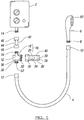
- shower apparatus including a water supply unit 2, a shower hose 4 and a shower head 6.
- the shower head 6 is provided with a standard male screw thread connector 8 which is received by the standard female screw thread connector 10 on one end of the shower hose 4.
- the other end of the shower hose is provided with a further standard female screw thread connector 12 which is adapted to fit the standard male screw thread connector 14 of the water supply unit 2.
- the antimicrobial or sterilisation applicator device 16 is fitted intermediate the shower hose 4 and water supply unit 2.
- the antimicrobial device 16 comprises a housing 18, and receiving means 20 which can be screwed on to the housing via screw thread 22 such that it extends therefrom.
- the housing 18 is provided with an inlet 32 provided with a standard male screw thread connector 34 and an outlet 36 provided with a standard male screw thread connector 38.
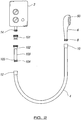
- the receiving means in this example is substantially circular in cross-section, and includes filtration means in the form of a concentric metal mesh 40, held in place by frictionally fitting to a protrusion 28.
- the mesh divides the receiving means into an inner portion 24 and an outer portion 26.
- the inner portion 24 of the receiving means, inside the mesh 40, is large enough to hold a sachet 54 containing an antimicrobial chemical such as Lonzabac 12.100 dissolved in hexylene glycol described in more detail below.
- the sachet is typically made from poly(vinyl alcohol) so that it dissolves when exposed to water.
- the sachet may alternatively contain a powder, which has the advantage that the sachet can be made from a thinner plastic film, which dissolves more rapidly and leaves less residue.
- liquid entering the inlet 32 flows into the inner portion 24, dissolves the sachet to release the chemical, forming a solution which is filtered through the mesh 40 into the outer portion 26, and then flows to the outlet 36.
- the mesh fits over a rim 52 of an orifice leading from the inlet, and the receiving means is provided with sealing means, in the form of a rubber seal 30 in this example, to prevent leaks.
- the antimicrobial applicator device in this example is provided with two male screw thread connectors 34, 38, to allow it to be connected to the water supply unit 2.
- An adapter 42 is also provided.
- the adapter 42 comprises a tube section 44 and two standard female screw thread connectors 46, 48 located at either end thereof, thereby allowing the antimicrobial applicator device to be connected to the water supply unit 2 via the adapter 42.
- the receiving means 103 is formed as part of the housing, in-line with the flow of water in the shower.
- the antimicrobial applicator device is provided with 'quick release' fittings 101, 102 allowing the device to be easily removed from the shower apparatus so that the chemical biocidal package can be placed therein above a mesh gauze 105 which acts as the filtration or screening means for filtering or retaining the PVA sachet until it dissolves completely.
- the housing 201 is Y-shaped and fitted directly onto a rigid delivery pipe in which the flow of liquid is upwardly direction from a water supply unit located below the shower head.
- One branch of the Y is in-line with the pipe (i.e. concentrically arranged), whereas the other branch is provided with a quick release fitting 202 and cap 203 allowing the receiving means 204 to be accessed for placement of a chemical therein, below a mesh gauze insert 205 which filters the liquid flow.
- a person disconnects the shower hose 4 from the water supply unit 2 and fits the antimicrobial applicator device 16 therebetween via the adapter 42.
- the system is flushed through with hot water for one to two minutes, then a sachet 54 of composition is placed inside the mesh 40 of the receiving means 20, and the receiving means is then screwed to the housing 18.
- the shower is switched on to allow water to flow through the antimicrobial applicator device 16, the water dissolving the sachet 54 to release the chemical and form a solution which flows through the mesh and to the outlet 36.
- the person runs the shower with the shower head in a raised position so that solution fills the hose 4, until solution comes out of the nozzles 50 of the shower head.
- the chemical may include a foaming agent so foam is visible at the shower head dispensing nozzles when the shower head is almost full of solution.
- the cleaning solution is allowed to stand for around 15 minutes, or other predetermined period according to the user's cleaning/disinfection/sterilisation requirements.
- the shower is then switched back on to flush the chemical out of the system.
- the chemical may be coloured so that the person can see when the liquid is free from chemical, when the water coming out of the shower head is clear.
- the antimicrobial applicator device does not need to be removed from the system after each use, and therefore on subsequent use the person can simply insert a new sachet of chemical and repeat the antimicrobial regime outlined above.
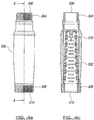
- Figures 4a-4b illustrate an example of a quick release in-line applicator device including an outer elongate sleeve housing 302 having a screw thread 308 provided at a first end 310 and a second screw thread 304 provided at a second end 306.
- Screw threads 304, 308 allow connection with complementary screw thread connections provided on or associated with the shower supply unit 2 and the shower hose 4, and the 'quick release' fitting 101/102 that joins thread 308 to the shower thread 14 in figure 2 .
- Receiving means in the form of a meshed basket 312 is provided in sleeve housing 302 to retain the PVA sachet containing the biocidal composition during the insertion and dissolution stage of the cleaning process.
- the water flow of the shower is typically stopped to allow the biocide rich solution to remain within the shower hose/head for the pre-defined contact time period.
- the shower is flushed through by switching the water flow in the shower back on and, in the intervening period, the remains of the sachet will have completely dissolved and can be removed from the system. It is clear when the flushing process is complete because the coloured dye contained in the composition disappears and foam from the bio-dispersants dissipates.
- the basket is removable from the sleeve housing, it is not necessary to remove it to allow insertion of the composition therein in use.
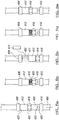
- Figures 5a-5e illustrate a further example of an in-line applicator device 402 that is located in place on the shower apparatus during fitting of the apparatus and does not require removal therefrom during a cleaning process.
- This applicator device 402 is particularly advantageous for use in fixed pipe or drain down shower systems where normal sterilisation is difficult without professional intervention being required to gain access to the areas of micro-biological growth and biofilm formation.
- the applicator device 402 is characterised by including a push fit design with a locking action to secure it in place. It is also tamper proof and no parts can be easily removed once fitted into the shower apparatus.
- Applicator device 402 includes an elongate body portion 403 including push fit locking connectors 408, 410 provided at opposite ends of device 402 for secure engagement with fixed shower pipes 404, 406 respectively.
- An aperture 411 is defined in body portion 403 to allow the location of a PVA sachet 414 therein in use during a cleaning process.
- a closure sleeve 412 is slidably mounted on the outer surface of body portion 403 and is movable between a closed position, wherein aperture 411 is closed by closure sleeve 412, and an open position, wherein aperture 411 is open and access to the aperture 411 can be gained by a user.
- a locking nut 416 has a screw thread on an internal surface thereof for engagement with a complementary screw thread 418 provided on body portion 403 below aperture 411. Locking nut 416 can be rotated via the screw threads in one direction to hold the closure sleeve in the closed position and can be rotated in the opposite direction to allow the closure sleeve to move away from the access opening to an open position.
- a non-return ball valve 420 is provided in body portion 403 towards end connector 410 to stop drain down of the pipe and shower head and allows the biocide rich solution to remain in contact with the wetted surfaces of the shower apparatus for the pre-defined sterilisation time.
- Filter means in the form of flat sieve members 422 are provided internally of body portion and substantially perpendicular to the direction of water flow to ensure the PVA sachet is retained in the applicator device prior to dissolution of the same.
- Figure 5a shows the applicator device 402 in a closed position located between two ends of fixed pipes 404, 406.
- Figure 5b shows the locking nut 416 being moved to a lowered position so that the closure sleeve 412 can be moved to an open position, as shown in figure 5c .
- Any water content present in the shower pipe and shower head are allowed to run back into the shower tray or bath via the access aperture 411.
- the PVA sachet containing the composition is inserted through aperture 411 in the device 402 and the closure sleeve member is then moved over the aperture 411 to the closed position to ensure no solution flows through the aperture 411 during the dissolution process, as shown in figure 5d .
- the locking nut 416 is moved back to a raised position so that the closure sleeve 412 is retained in the closed position and the device is substantially water tight, as shown in figure 5e .
- the shower apparatus is then switched on for a few seconds to allow hot water to fill the in-line device.
- the water flow is then stopped for approximately 30 seconds to allow the PVA to dissolve and release the composition therefrom.
- the shower apparatus is then switched on and water is allowed to flow through the shower at a low rate until all the coloured dye from the composition disappears.
- the shower apparatus is then switched on and water is allowed to flow through the shower at a low rate until the coloured dye appears at the shower head and then the water flow is stopped.
- the system is then allowed to rest for approximately 15 minutes. At the end of this rest period, the shower is switched on at a relatively high flow rate to allow the system to be flushed through for several minutes and to allow any foam to disperse.
- the shower apparatus is then ready for normal shower use.
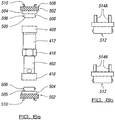
- Figure 6a shows examples of possible push fit connectors 502 that could be used with the in-line device 402 of figures 5a-5e to secure the device between the fixed shower pipes 404, 406.
- the fittings 502 can be adjusted to allow the fitment of the applicator device to various sizes of fixed pipe diameters, typically 15mm, 22mm, 25mm and the like.
- Connector 502 includes a body portion 504 having a first end 505 with locking lugs 506 that protrude outwardly from the body portion.
- the locking lugs 506, or threaded connections are pushed and twisted into complementary grooves or recesses defined on the interior surface of device connectors 408, 410.
- On the opposite second end 508 outwardly protruding locking members 510 are provided to engage with the interior surface of the fixed pipes 404, 406.
- Connector 512 is similar to connector 502 but outwardly protruding locking members 510 have been replaced by inwardly protruding engaging teeth 514.
- the teeth 514 A/B are designed to allow the applicator device to be inserted into the flexible shower hose as shown in fig.1 .
- the method of cleaning the shower apparatus includes the application of two separate compositions.
- the first composition is in the form of a packaged biocidal or sterilisation product.
- the second composition is in the form of a packaged acidic sequesterant which is designed to remove the 'biofilm' and the calcium carbonate/scale that accumulates on the interior surfaces of the shower apparatus in use over time and provides a roughened surface which act as a 'key' for the growth of microbes thereon.
- the acidic sequesterant is used in the shower apparatus before application of the biocidal or sterilisation composition (hereinafter referred to a biocidal composition).
- Both the first and second compositions are characterised by meeting all regulatory requirements on a worldwide basis, are capable of being blended with other components and can be handled by non-specialist operators.
- the first biocidal composition of the present invention includes a biocidal active component in the form of Bis-(3-aminopropyl)-dodecylamine which is commercially available under the trade name Lonzabac 12.100 (manufactured and distributed by Lonza AG).
- This biocidal composition is compatible for incorporation into a water soluble PVA sachet (i.e. is substantially or wholly non-aqueous).
- the biocidal component can be dissolved in a non-aqueous solution such as hexylene glycol to provide compatibility with the PVA sachet.
- the first biocidal composition also optionally includes one or more surface active bio-dispersants, a coloured dye (blue) and/or a fragrance.
- the biocidial composition of the present invention results in a fall in TVC from a starting level of approximately 10 5 cfu/ml to 20-500cfu/ ml.
- An example of the first biocidal general formulation includes: 1-5% N-(3-aminopropyl)-N-dodecylpropae-1,3,diamine 2-10% Alkyl alkoxylate 50-100% Alkylene glycol
- the second acidic sequestering composition includes Hydroxyl Ethylidene Di Phosphonic acid (H.E.D.P). In addition, a dispersion or wetting agent is included and a coloured dye (red). This acidic sequestering composition is compatible for incorporation into a water soluble PVA sachet (i.e. is substantially or wholly non-aqueous).
- An example of the second acidic sequestering composition includes:
- the Applicant has devised a sampling protocol to allow reproducible data to be obtained relating to the effectiveness of the composition.
- the Applicant has found that sampling water from a running shower to monitor existing microbiological activity within a shower is difficult. This is because any water sample taken from the shower water flow is significantly influenced by the free chlorine levels in the water flowing through the shower apparatus. These free chlorine levels are typically in the region of 0.6 to 0.8 ppm. In addition, sampling of aerosols that surround the flowing water has proven to be extremely difficult to achieve with any degree of reliability or repeatability.
- the biocidal composition of the present application can develop biocidal concentrations in the range of 300-600ppm in the wetted areas of the shower hose and head.
- the biocide was added to the pipe/shower head which was then completely filled with water. The contents were left for 60 minutes and then flushed out for a period of 5 minutes. The total volume (attachment/pipe/shower head) is 180mls - giving a biocide strength of 467ppm.
- Sample (1) 14.06.10 - Aerobic count. Dilution tubes used (100 & 1000x dilution applied) to provide a more accurate count. Subsequent tests on sample (1) after biocide addition - neat, 10x, 100x examined. DATE 14th June 2010 15th June 2010 16th June 2010 Analyses Water Halogen Content Mb. Analyses Halogen Content Mb. Analyses Halogen Content Mb.
- Table 2 shows how the microbiological activity has reestablished itself 8 days after treatment with the basic biocide solution, i.e. before the inclusion of the wetting agents and other functional components.
- Table 3 shows the effect of the introduction of the halogen release product BCDMH on the microbiological activity seen in the shower after 19 days resting. As can be seen, the microbiological recovery after two days is considerably greater than in the basic product results above.
- Table 4 shows the impact of the inclusion of the wetting agents and other components into the final formulation. As can be seen the microbiological 'count' after 48 hours still represents a sterile environment.
- Table 7 shows the impact of the increase in ambient temperature on the microbiological activity at time zero.
- the count of 1.36 x 10 6 colonies per millilitre is far higher than has been seen in any of the previous tests and is probably as a direct result of the increase in ambient temperature on the microbial activity.
- the average ambient temperature at this time was 14°C.
- the invention is also provided so that the cleaning treatment is quick and easy to perform on a regular basis.
- the samples were taken from shower apparatus in the en-suite facilities of ten bedrooms in a hotel local to the Applicant (with prior permission from the hotel owners obtained).
- Five of the bedrooms (Rooms 124, 133, 224, 324, 437) were treated using the biocide composition and procedure of the present invention as set out above and five of the bedrooms (Rooms 131, 231, 237, 330, 438) were treated using a conventional bleach treatment as outlined in the prior art HSE L8 procedure. All the showers tested used the protocol that has been developed by the Applicant and as set out herein (i.e. the shower hose of the apparatus is disconnected from the water supply or mixer unit and the contents of the shower hose and head drained down into a sterile container).
- sample 'A' sample The samples were taken prior to any treatment being applied (the 'A' sample) and after standing - 24 hours later (the 'C' sample).
- sample 'A' was taken after trickling water through the shower head and collecting the same in a sterile bottle.
- Sample C was taken 24 hours after each room had been treated by trickling water through the shower head and collecting the same in a sterile bottle.
- Samples were taken from each sterile container and placed in sterile tubes, sealed and transported to the third party analysts.
- Table 8 (also labelled Table 1) represent analyses carried out using a spiral plater technique for applying the samples to the plates.
- Tables 9-12 represent analyses carried out using the poured plate technique for applying the samples to the plates.
- the TVCs were measured on the plates after 2 days for plates kept at 37°C and after 3 days for plates kept at 22°C.
Landscapes
- Life Sciences & Earth Sciences (AREA)
- Health & Medical Sciences (AREA)
- Engineering & Computer Science (AREA)
- Public Health (AREA)
- General Health & Medical Sciences (AREA)
- Dentistry (AREA)
- Plant Pathology (AREA)
- Pest Control & Pesticides (AREA)
- Wood Science & Technology (AREA)
- Zoology (AREA)
- Environmental Sciences (AREA)
- Hydrology & Water Resources (AREA)
- Agronomy & Crop Science (AREA)
- Water Supply & Treatment (AREA)
- Chemical & Material Sciences (AREA)
- Chemical Kinetics & Catalysis (AREA)
- General Chemical & Material Sciences (AREA)
- Epidemiology (AREA)
- Animal Behavior & Ethology (AREA)
- Veterinary Medicine (AREA)
- Apparatus For Disinfection Or Sterilisation (AREA)
- Bathtubs, Showers, And Their Attachments (AREA)
- Devices For Medical Bathing And Washing (AREA)
- Agricultural Chemicals And Associated Chemicals (AREA)
- Nozzles (AREA)
Claims (15)
- Procédé permettant d'utiliser un système de stérilisation de douche, ledit système comprenant un appareil de douche incluant un moyen d'alimentation en eau (2), une pomme de douche (6) et un moyen de conduit de douche (4) raccordant la pomme de douche (6) au moyen d'alimentation en eau (2), ledit procédé incluant les étapes consistant à localiser un dispositif applicateur (16) entre le moyen d'alimentation en eau (2) et la pomme de douche (6), localiser une composition biocide ou de stérilisation dans le dispositif applicateur (16) et délivrer ladite composition biocide ou de stérilisation à une ou plusieurs parties dudit appareil de douche, caractérisé en ce qu'une composition séquestrante d'acides est localisée dans le dispositif applicateur (16) et est délivrée au système avant l'utilisation de la composition biocide ou de stérilisation.
- Procédé selon la revendication 1, un composant actif biocide dans la composition biocide ou de stérilisation étant Bis-(3-aminopropyl)-dodécylamine.
- Procédé selon la revendication 2, la composition biocide ou de stérilisation étant contenue dans un sachet PVA soluble dans l'eau (54).
- Procédé selon la revendication 3, la composition biocide ou de stérilisation incluant un véhicule non aqueux.
- Procédé selon la revendication 4, le véhicule non aqueux étant l'hexylène-glycol.
- Procédé selon la revendication 1, la composition biocide ou de stérilisation incluant un ou plusieurs bio-dispersants tensio-actifs, une teinture colorée et/ou un parfum.
- Procédé selon la revendication 1, la composition biocide ou de stérilisation incluant de 1 à 5 % de N-(3-aminopropyl)-N-dodécylpropane-1, 3, diamine, de 2 à 10 % d'alkoxylate d'alkyle, de 50 à 100 % d'alkylène-glycol.
- Procédé selon la revendication 1, la composition séquestrante d'acides incluant l'acide hydroxy-1-éthylidène diphosphonique (HEDP).
- Procédé selon la revendication 8, la composition séquestrante d'acides incluant également une dispersion ou un agent mouillant et une teinture colorée.
- Procédé selon la revendication 1, la composition séquestrante d'acides étant contenue dans un sachet PVA soluble dans l'eau (54).
- Procédé selon la revendication 1, le procédé incluant l'étape consistant à permettre à l'eau de couler à travers l'appareil de douche pour provoquer la délivrance de ladite composition biocide ou de stérilisation à une ou plusieurs parties de l'appareil de douche.
- Procédé selon la revendication 1, le procédé incluant l'étape consistant à permettre à la composition biocide ou de stérilisation de se dissoudre dans le fluide coulant à travers l'appareil pour former une solution chimique.
- Procédé selon la revendication 12 incluant l'étape consistant à permettre à la solution chimique de stagner ou de rester pendant un intervalle de temps prédéterminé au sein de l'appareil pour permettre à n'importe lesquels des ingrédients actifs de la solution chimique d'avoir un effet.
- Procédé selon la revendication 13, l'intervalle de temps prédéterminé se situant entre 5 et 60 minutes.
- Procédé selon la revendication 13 incluant l'étape consistant à laver l'appareil par rinçage en permettant au fluide de couler à travers l'appareil après un intervalle de temps de stagnation.
Applications Claiming Priority (2)
| Application Number | Priority Date | Filing Date | Title |
|---|---|---|---|
| GBGB1010808.2A GB201010808D0 (en) | 2010-06-28 | 2010-06-28 | Antimicrobial device for a shower |
| PCT/GB2011/051214 WO2012001400A1 (fr) | 2010-06-28 | 2011-06-27 | Système de stérilisation de douche et son procédé d'utilisation |
Publications (2)
| Publication Number | Publication Date |
|---|---|
| EP2585643A1 EP2585643A1 (fr) | 2013-05-01 |
| EP2585643B1 true EP2585643B1 (fr) | 2018-03-21 |
Family
ID=42583071
Family Applications (1)
| Application Number | Title | Priority Date | Filing Date |
|---|---|---|---|
| EP11729664.0A Not-in-force EP2585643B1 (fr) | 2010-06-28 | 2011-06-27 | Système de stérilisation de douche et son procédé d'utilisation |
Country Status (10)
| Country | Link |
|---|---|
| US (1) | US8894927B2 (fr) |
| EP (1) | EP2585643B1 (fr) |
| CN (1) | CN103080438B (fr) |
| AU (1) | AU2011273135B2 (fr) |
| BR (1) | BR112012033536A2 (fr) |
| CA (1) | CA2803702C (fr) |
| GB (1) | GB201010808D0 (fr) |
| SG (1) | SG186806A1 (fr) |
| WO (1) | WO2012001400A1 (fr) |
| ZA (1) | ZA201209716B (fr) |
Families Citing this family (20)
| Publication number | Priority date | Publication date | Assignee | Title |
|---|---|---|---|---|
| US10427961B2 (en) | 2011-07-15 | 2019-10-01 | Soclean, Inc. | Technologies for sanitizing reservoirs |
| CN107137733B (zh) | 2011-07-15 | 2021-02-05 | 速克粼股份有限公司 | 用于对持续正压通气设备进行臭氧消毒的系统 |
| US9669124B2 (en) | 2011-07-15 | 2017-06-06 | Soclean, Inc. | Devices, systems and methods for treating multiple medical devices having passageways with ozone gas |
| WO2015171730A1 (fr) | 2014-05-06 | 2015-11-12 | Inceptus, Inc. | Dispositifs, systèmes et procédés de désinfection à l'ozone de dispositifs de pression positive continue des voies aériennes |
| US10434204B2 (en) | 2011-07-15 | 2019-10-08 | Soclean, Inc. | Technologies for sanitizing mist humidifiers |
| US9486817B2 (en) * | 2013-03-15 | 2016-11-08 | Delta Faucet Company | Ozone shower device |
| JP6730426B2 (ja) | 2015-09-17 | 2020-07-29 | エコラボ ユーエスエー インコーポレイティド | トリアミン固体を作製する方法 |
| WO2017049076A1 (fr) | 2015-09-17 | 2017-03-23 | Ecolab Usa Inc. | Solidification de triamine à l'aide de diacides |
| US11104586B2 (en) | 2016-07-25 | 2021-08-31 | Guillaume Bertrand | Water recycling system and method |
| IL249680B (en) * | 2016-12-21 | 2018-05-31 | Zabari Lidor | Self-sealing and disinfecting shower head |
| CN114836266B (zh) | 2017-11-07 | 2024-06-11 | 埃科莱布美国股份有限公司 | 用于去除唇用化妆品污渍的清洁组合物和方法 |
| EP3688129B1 (fr) | 2017-12-07 | 2025-08-06 | Ecolab USA, Inc. | Compositions et procédés d'élimination de rouge à lèvres à l'aide de polyamines ramifiées |
| WO2020191194A1 (fr) | 2019-03-19 | 2020-09-24 | Soclean, Inc. | Technologies de désinfection de dispositifs médicaux |
| CN210207264U (zh) * | 2019-04-03 | 2020-03-31 | 九牧厨卫股份有限公司 | 一种洗护用品载具和淋浴器 |
| CN112043188B (zh) | 2019-06-07 | 2024-04-02 | 科勒公司 | 淋浴柱组件 |
| US11511304B2 (en) | 2019-06-07 | 2022-11-29 | Kohler Co. | Shower column assembly |
| GB2609626A (en) * | 2021-08-09 | 2023-02-15 | Challenor Liam | Salt shower device |
| KR102377792B1 (ko) * | 2021-12-14 | 2022-03-23 | (주) 산호인터내셔널 | 캡슐 삽입형 샤워장치 |
| US12064527B2 (en) | 2022-09-16 | 2024-08-20 | Soclean, Inc. | Disinfection systems and methods |
| US12280170B2 (en) | 2022-09-16 | 2025-04-22 | Soclean, Inc. | Disinfection systems and methods |
Citations (2)
| Publication number | Priority date | Publication date | Assignee | Title |
|---|---|---|---|---|
| WO2000069475A1 (fr) * | 1999-05-19 | 2000-11-23 | Steris Corporation | Indicateur chimique a renouvellement continu pour mesurer des agents biocides |
| WO2001076647A1 (fr) * | 2000-04-07 | 2001-10-18 | Novapharm Research (Australia) Pty Ltd | Procede et composition de nettoyage d'instruments medicaux |
Family Cites Families (27)
| Publication number | Priority date | Publication date | Assignee | Title |
|---|---|---|---|---|
| US1668802A (en) * | 1925-04-13 | 1928-05-08 | Frank J Cantrell | Plumbing fixture |
| US3460562A (en) * | 1967-08-04 | 1969-08-12 | Morgan M Moulder | Dissolver container having flanges at both ends to protect threaded hose couplings |
| US3847354A (en) * | 1973-09-20 | 1974-11-12 | R Lemond | Shower head additive dispenser |
| CA1007607A (en) * | 1973-10-02 | 1977-03-29 | National Sanitation Services Ltd. | Chemical dispenser |
| FR2264583A1 (en) * | 1974-03-19 | 1975-10-17 | Aquitaine Languedoc Etudes Tec | Mixer for primary and secondary streams - for adding liquids, pastes, powder, sol. particles to main fluid stream |
| DE2510381A1 (de) * | 1975-03-10 | 1976-09-16 | Fritz K Strauss | Zweiwege-nachfuellbehaelter an brauseanlagen fuer badezusaetze |
| FR2620470A1 (fr) * | 1987-09-14 | 1989-03-17 | Gruffy Georges | Dispositif de traitement d'eau sanitaire |
| US4964892A (en) * | 1988-12-22 | 1990-10-23 | Rohm And Haas Company | Synergistic microbicidal combinations containing 2-N-octyl-3-isothiazolone and certain commercial biocides |
| DE9016641U1 (de) * | 1989-12-20 | 1991-03-14 | Quint, Alfred, 5810 Witten | Vorrichtung zum Behandeln eines Wasserstroms in einer Leitung |
| BE1008419A6 (nl) * | 1994-07-01 | 1996-05-07 | Dotraco Nv | Doseerapparaat en patroon hierbij aangewend. |
| JPH1171210A (ja) * | 1997-08-28 | 1999-03-16 | Sanai Sekiyu Kk | 工業用防腐剤 |
| JP2000051869A (ja) * | 1998-08-07 | 2000-02-22 | Karufa Chemical Kk | 生活用水の浄水装置 |
| US20020070293A1 (en) * | 2000-12-07 | 2002-06-13 | Ti Shih Ti | Shower filtration skin care device |
| AU2002231383A1 (en) * | 2000-12-18 | 2002-07-01 | James Douglas Macgregor Osborne | Soluble solids dispenser |
| CN2495243Y (zh) * | 2001-07-17 | 2002-06-19 | 深圳市精锐实业有限公司 | 臭氧浴设备 |
| TW578537U (en) * | 2002-08-08 | 2004-03-01 | Sheng-Jeng Wang | Device for automatically releasing material into water |
| ITRM20020543A1 (it) * | 2002-10-29 | 2004-04-30 | Simone Fiorentino De | Dispositivo per far uscire schiuma dal soffione della doccia, con |
| EP1518607A1 (fr) * | 2003-09-23 | 2005-03-30 | Takayasu Okubo | Dispositif d'alimentation pour mélanger une substance chimique à l'eau courante |
| EP1951038A4 (fr) * | 2005-09-13 | 2012-01-18 | Taminco | Combinaison d'alkylalcanolamines et alkybisalcanolamines pour des compositions antimicrobiennes |
| US7905429B2 (en) * | 2005-10-18 | 2011-03-15 | Water Pik, Inc. | Dispensing system and method for shower arm |
| US8393350B2 (en) * | 2005-11-15 | 2013-03-12 | Vidacco International, LLC | Methods and apparatus for introducing additives into a fluid flow |
| CH698604B1 (de) * | 2005-11-29 | 2009-09-15 | Creaholic Sa | Wascheinrichtung. |
| US7611070B2 (en) * | 2006-02-28 | 2009-11-03 | Paoluccio John J | Aspirating scented oxygen enriched faucet and shower head |
| US20080063723A1 (en) * | 2006-09-08 | 2008-03-13 | Sungmee Choi | Isothiazolin-3-one-containing antimicrobial composition |
| US8028933B2 (en) * | 2006-11-27 | 2011-10-04 | Nils Friis | Shower additive dispenser |
| DE202007011127U1 (de) * | 2007-08-09 | 2007-10-18 | Kobylinski, Konstantin Von | Befüllte Kapsel an dem Wasserauslauf einer Wasserarmatur mit dem Zweck die Füllung und das Wasser in feiner Konsistenz vermischt abzugeben |
| ITMI20080200A1 (it) * | 2008-02-08 | 2009-08-09 | Enrico Sanvittore | Dispositivo idro-miscelatore applicabile ad erogatori di acqua, particolarmente di impianti igienico-sanitari, per l'additivazione dell'acqua con sostanze idrosolubili. |
-
2010
- 2010-06-28 GB GBGB1010808.2A patent/GB201010808D0/en not_active Ceased
-
2011
- 2011-06-27 AU AU2011273135A patent/AU2011273135B2/en not_active Ceased
- 2011-06-27 EP EP11729664.0A patent/EP2585643B1/fr not_active Not-in-force
- 2011-06-27 SG SG2012094942A patent/SG186806A1/en unknown
- 2011-06-27 BR BR112012033536A patent/BR112012033536A2/pt not_active IP Right Cessation
- 2011-06-27 WO PCT/GB2011/051214 patent/WO2012001400A1/fr not_active Ceased
- 2011-06-27 CA CA2803702A patent/CA2803702C/fr not_active Expired - Fee Related
- 2011-06-27 CN CN201180041547.0A patent/CN103080438B/zh not_active Expired - Fee Related
-
2012
- 2012-12-21 US US13/724,325 patent/US8894927B2/en not_active Expired - Fee Related
- 2012-12-21 ZA ZA2012/09716A patent/ZA201209716B/en unknown
Patent Citations (2)
| Publication number | Priority date | Publication date | Assignee | Title |
|---|---|---|---|---|
| WO2000069475A1 (fr) * | 1999-05-19 | 2000-11-23 | Steris Corporation | Indicateur chimique a renouvellement continu pour mesurer des agents biocides |
| WO2001076647A1 (fr) * | 2000-04-07 | 2001-10-18 | Novapharm Research (Australia) Pty Ltd | Procede et composition de nettoyage d'instruments medicaux |
Also Published As
| Publication number | Publication date |
|---|---|
| US8894927B2 (en) | 2014-11-25 |
| US20130177475A1 (en) | 2013-07-11 |
| WO2012001400A4 (fr) | 2012-03-01 |
| CA2803702A1 (fr) | 2012-01-05 |
| SG186806A1 (en) | 2013-02-28 |
| ZA201209716B (en) | 2013-08-28 |
| AU2011273135B2 (en) | 2014-10-23 |
| CA2803702C (fr) | 2015-06-23 |
| BR112012033536A2 (pt) | 2016-11-29 |
| GB201010808D0 (en) | 2010-08-11 |
| EP2585643A1 (fr) | 2013-05-01 |
| AU2011273135A1 (en) | 2013-01-31 |
| CN103080438A (zh) | 2013-05-01 |
| WO2012001400A1 (fr) | 2012-01-05 |
| CN103080438B (zh) | 2016-01-13 |
Similar Documents
| Publication | Publication Date | Title |
|---|---|---|
| EP2585643B1 (fr) | Système de stérilisation de douche et son procédé d'utilisation | |
| US6528467B1 (en) | Slime remover and slime preventing/removing agent | |
| US5556279A (en) | Water purification system for dental instrument | |
| CA2792028C (fr) | Composition de sterilisation | |
| JP3578655B2 (ja) | 排水口用ヌメリ取り器 | |
| ES2775398T3 (es) | Proceso para descontaminar o esterilizar un artículo con una composición que contiene peróxido y un agente antimicrobiano | |
| AU2007245701A1 (en) | Method and device for disinfecting a space | |
| JP2006502836A (ja) | 二酸化塩素又は他の殺菌剤の加圧水システムへの制御された用量供給 | |
| DE69523932T2 (de) | Behälter mit interner flüssigkeitverteilungsöffnung zur aufnahme einer vorrichtung mit innendurchführungen während der sterilisation | |
| JP4603795B2 (ja) | 送水システム、特に水泳および入浴用プール施設における水供給システムの殺菌および清浄化方法、ならびにそれを実行する装置 | |
| AU2011308621A1 (en) | Device for disinfecting and/or rinsing endoscopes with limited escape of fumes | |
| US6692757B1 (en) | Multi-component, safe biocidal complex | |
| US10785998B2 (en) | Method of using a cleaning, disinfecting and lubricating composition for a dental unit or beer fluid encompassing system | |
| JP7794614B2 (ja) | 悪臭の発生抑制方法及び悪臭発生抑制剤 | |
| US20190134682A1 (en) | Methods comprising to clean and/or lubricate fluid encompassing systems | |
| JPS62215507A (ja) | 水溶性工作油、水等の液体の腐敗防止方法 | |
| JP2025092268A (ja) | 水栓器具より吐出される湯水中のレジオネラ属菌の殺菌方法 | |
| WO2026035849A1 (fr) | Système de distribution d'une chimie solide et procédé d'utilisation | |
| JP2001252674A (ja) | 機能水生成装置 | |
| Gruninger | Disease transmission through dental unit water: an update | |
| JP2007146516A (ja) | 循環洗浄式男性用トイレの防臭防汚洗浄方法及び該方法に使用する循環洗浄式男性用トイレ | |
| JP2003082735A (ja) | 家庭用菌遮断流し台排水トラップ | |
| HK1038384A (en) | Slime remover and slime preventing/removing agent | |
| JP2021014980A (ja) | Hvac流体調整システム用の化学物質ロッドおよび製造方法 | |
| Quiroz | The importance of water quality for pigs. |
Legal Events
| Date | Code | Title | Description |
|---|---|---|---|
| PUAI | Public reference made under article 153(3) epc to a published international application that has entered the european phase |
Free format text: ORIGINAL CODE: 0009012 |
|
| 17P | Request for examination filed |
Effective date: 20130107 |
|
| AK | Designated contracting states |
Kind code of ref document: A1 Designated state(s): AL AT BE BG CH CY CZ DE DK EE ES FI FR GB GR HR HU IE IS IT LI LT LU LV MC MK MT NL NO PL PT RO RS SE SI SK SM TR |
|
| DAX | Request for extension of the european patent (deleted) | ||
| RAP1 | Party data changed (applicant data changed or rights of an application transferred) |
Owner name: OMNIA-KLENZ LTD. |
|
| RIN1 | Information on inventor provided before grant (corrected) |
Inventor name: FINCH, STEPHEN |
|
| 17Q | First examination report despatched |
Effective date: 20150504 |
|
| GRAP | Despatch of communication of intention to grant a patent |
Free format text: ORIGINAL CODE: EPIDOSNIGR1 |
|
| INTG | Intention to grant announced |
Effective date: 20171011 |
|
| GRAS | Grant fee paid |
Free format text: ORIGINAL CODE: EPIDOSNIGR3 |
|
| GRAA | (expected) grant |
Free format text: ORIGINAL CODE: 0009210 |
|
| AK | Designated contracting states |
Kind code of ref document: B1 Designated state(s): AL AT BE BG CH CY CZ DE DK EE ES FI FR GB GR HR HU IE IS IT LI LT LU LV MC MK MT NL NO PL PT RO RS SE SI SK SM TR |
|
| REG | Reference to a national code |
Ref country code: GB Ref legal event code: FG4D |
|
| REG | Reference to a national code |
Ref country code: CH Ref legal event code: EP |
|
| REG | Reference to a national code |
Ref country code: AT Ref legal event code: REF Ref document number: 981252 Country of ref document: AT Kind code of ref document: T Effective date: 20180415 |
|
| REG | Reference to a national code |
Ref country code: IE Ref legal event code: FG4D |
|
| REG | Reference to a national code |
Ref country code: DE Ref legal event code: R096 Ref document number: 602011046679 Country of ref document: DE |
|
| REG | Reference to a national code |
Ref country code: FR Ref legal event code: PLFP Year of fee payment: 8 |
|
| REG | Reference to a national code |
Ref country code: NL Ref legal event code: MP Effective date: 20180321 |
|
| PG25 | Lapsed in a contracting state [announced via postgrant information from national office to epo] |
Ref country code: NO Free format text: LAPSE BECAUSE OF FAILURE TO SUBMIT A TRANSLATION OF THE DESCRIPTION OR TO PAY THE FEE WITHIN THE PRESCRIBED TIME-LIMIT Effective date: 20180621 Ref country code: FI Free format text: LAPSE BECAUSE OF FAILURE TO SUBMIT A TRANSLATION OF THE DESCRIPTION OR TO PAY THE FEE WITHIN THE PRESCRIBED TIME-LIMIT Effective date: 20180321 Ref country code: HR Free format text: LAPSE BECAUSE OF FAILURE TO SUBMIT A TRANSLATION OF THE DESCRIPTION OR TO PAY THE FEE WITHIN THE PRESCRIBED TIME-LIMIT Effective date: 20180321 Ref country code: LT Free format text: LAPSE BECAUSE OF FAILURE TO SUBMIT A TRANSLATION OF THE DESCRIPTION OR TO PAY THE FEE WITHIN THE PRESCRIBED TIME-LIMIT Effective date: 20180321 Ref country code: CY Free format text: LAPSE BECAUSE OF FAILURE TO SUBMIT A TRANSLATION OF THE DESCRIPTION OR TO PAY THE FEE WITHIN THE PRESCRIBED TIME-LIMIT Effective date: 20180321 |
|
| REG | Reference to a national code |
Ref country code: LT Ref legal event code: MG4D |
|
| REG | Reference to a national code |
Ref country code: AT Ref legal event code: MK05 Ref document number: 981252 Country of ref document: AT Kind code of ref document: T Effective date: 20180321 |
|
| PG25 | Lapsed in a contracting state [announced via postgrant information from national office to epo] |
Ref country code: BG Free format text: LAPSE BECAUSE OF FAILURE TO SUBMIT A TRANSLATION OF THE DESCRIPTION OR TO PAY THE FEE WITHIN THE PRESCRIBED TIME-LIMIT Effective date: 20180621 Ref country code: GR Free format text: LAPSE BECAUSE OF FAILURE TO SUBMIT A TRANSLATION OF THE DESCRIPTION OR TO PAY THE FEE WITHIN THE PRESCRIBED TIME-LIMIT Effective date: 20180622 Ref country code: SE Free format text: LAPSE BECAUSE OF FAILURE TO SUBMIT A TRANSLATION OF THE DESCRIPTION OR TO PAY THE FEE WITHIN THE PRESCRIBED TIME-LIMIT Effective date: 20180321 Ref country code: LV Free format text: LAPSE BECAUSE OF FAILURE TO SUBMIT A TRANSLATION OF THE DESCRIPTION OR TO PAY THE FEE WITHIN THE PRESCRIBED TIME-LIMIT Effective date: 20180321 Ref country code: RS Free format text: LAPSE BECAUSE OF FAILURE TO SUBMIT A TRANSLATION OF THE DESCRIPTION OR TO PAY THE FEE WITHIN THE PRESCRIBED TIME-LIMIT Effective date: 20180321 |
|
| PG25 | Lapsed in a contracting state [announced via postgrant information from national office to epo] |
Ref country code: EE Free format text: LAPSE BECAUSE OF FAILURE TO SUBMIT A TRANSLATION OF THE DESCRIPTION OR TO PAY THE FEE WITHIN THE PRESCRIBED TIME-LIMIT Effective date: 20180321 Ref country code: IT Free format text: LAPSE BECAUSE OF FAILURE TO SUBMIT A TRANSLATION OF THE DESCRIPTION OR TO PAY THE FEE WITHIN THE PRESCRIBED TIME-LIMIT Effective date: 20180321 Ref country code: ES Free format text: LAPSE BECAUSE OF FAILURE TO SUBMIT A TRANSLATION OF THE DESCRIPTION OR TO PAY THE FEE WITHIN THE PRESCRIBED TIME-LIMIT Effective date: 20180321 Ref country code: AL Free format text: LAPSE BECAUSE OF FAILURE TO SUBMIT A TRANSLATION OF THE DESCRIPTION OR TO PAY THE FEE WITHIN THE PRESCRIBED TIME-LIMIT Effective date: 20180321 Ref country code: RO Free format text: LAPSE BECAUSE OF FAILURE TO SUBMIT A TRANSLATION OF THE DESCRIPTION OR TO PAY THE FEE WITHIN THE PRESCRIBED TIME-LIMIT Effective date: 20180321 Ref country code: NL Free format text: LAPSE BECAUSE OF FAILURE TO SUBMIT A TRANSLATION OF THE DESCRIPTION OR TO PAY THE FEE WITHIN THE PRESCRIBED TIME-LIMIT Effective date: 20180321 Ref country code: PL Free format text: LAPSE BECAUSE OF FAILURE TO SUBMIT A TRANSLATION OF THE DESCRIPTION OR TO PAY THE FEE WITHIN THE PRESCRIBED TIME-LIMIT Effective date: 20180321 |
|
| PG25 | Lapsed in a contracting state [announced via postgrant information from national office to epo] |
Ref country code: CZ Free format text: LAPSE BECAUSE OF FAILURE TO SUBMIT A TRANSLATION OF THE DESCRIPTION OR TO PAY THE FEE WITHIN THE PRESCRIBED TIME-LIMIT Effective date: 20180321 Ref country code: SK Free format text: LAPSE BECAUSE OF FAILURE TO SUBMIT A TRANSLATION OF THE DESCRIPTION OR TO PAY THE FEE WITHIN THE PRESCRIBED TIME-LIMIT Effective date: 20180321 Ref country code: AT Free format text: LAPSE BECAUSE OF FAILURE TO SUBMIT A TRANSLATION OF THE DESCRIPTION OR TO PAY THE FEE WITHIN THE PRESCRIBED TIME-LIMIT Effective date: 20180321 Ref country code: SM Free format text: LAPSE BECAUSE OF FAILURE TO SUBMIT A TRANSLATION OF THE DESCRIPTION OR TO PAY THE FEE WITHIN THE PRESCRIBED TIME-LIMIT Effective date: 20180321 |
|
| PG25 | Lapsed in a contracting state [announced via postgrant information from national office to epo] |
Ref country code: PT Free format text: LAPSE BECAUSE OF FAILURE TO SUBMIT A TRANSLATION OF THE DESCRIPTION OR TO PAY THE FEE WITHIN THE PRESCRIBED TIME-LIMIT Effective date: 20180723 |
|
| REG | Reference to a national code |
Ref country code: DE Ref legal event code: R097 Ref document number: 602011046679 Country of ref document: DE |
|
| PLBE | No opposition filed within time limit |
Free format text: ORIGINAL CODE: 0009261 |
|
| STAA | Information on the status of an ep patent application or granted ep patent |
Free format text: STATUS: NO OPPOSITION FILED WITHIN TIME LIMIT |
|
| PG25 | Lapsed in a contracting state [announced via postgrant information from national office to epo] |
Ref country code: DK Free format text: LAPSE BECAUSE OF FAILURE TO SUBMIT A TRANSLATION OF THE DESCRIPTION OR TO PAY THE FEE WITHIN THE PRESCRIBED TIME-LIMIT Effective date: 20180321 |
|
| REG | Reference to a national code |
Ref country code: CH Ref legal event code: PL |
|
| 26N | No opposition filed |
Effective date: 20190102 |
|
| REG | Reference to a national code |
Ref country code: BE Ref legal event code: MM Effective date: 20180630 |
|
| PG25 | Lapsed in a contracting state [announced via postgrant information from national office to epo] |
Ref country code: LU Free format text: LAPSE BECAUSE OF NON-PAYMENT OF DUE FEES Effective date: 20180627 Ref country code: MC Free format text: LAPSE BECAUSE OF FAILURE TO SUBMIT A TRANSLATION OF THE DESCRIPTION OR TO PAY THE FEE WITHIN THE PRESCRIBED TIME-LIMIT Effective date: 20180321 |
|
| REG | Reference to a national code |
Ref country code: IE Ref legal event code: MM4A |
|
| PG25 | Lapsed in a contracting state [announced via postgrant information from national office to epo] |
Ref country code: CH Free format text: LAPSE BECAUSE OF NON-PAYMENT OF DUE FEES Effective date: 20180630 Ref country code: LI Free format text: LAPSE BECAUSE OF NON-PAYMENT OF DUE FEES Effective date: 20180630 Ref country code: IE Free format text: LAPSE BECAUSE OF NON-PAYMENT OF DUE FEES Effective date: 20180627 |
|
| PG25 | Lapsed in a contracting state [announced via postgrant information from national office to epo] |
Ref country code: SI Free format text: LAPSE BECAUSE OF FAILURE TO SUBMIT A TRANSLATION OF THE DESCRIPTION OR TO PAY THE FEE WITHIN THE PRESCRIBED TIME-LIMIT Effective date: 20180321 Ref country code: BE Free format text: LAPSE BECAUSE OF NON-PAYMENT OF DUE FEES Effective date: 20180630 |
|
| PG25 | Lapsed in a contracting state [announced via postgrant information from national office to epo] |
Ref country code: MT Free format text: LAPSE BECAUSE OF NON-PAYMENT OF DUE FEES Effective date: 20180627 |
|
| PG25 | Lapsed in a contracting state [announced via postgrant information from national office to epo] |
Ref country code: TR Free format text: LAPSE BECAUSE OF FAILURE TO SUBMIT A TRANSLATION OF THE DESCRIPTION OR TO PAY THE FEE WITHIN THE PRESCRIBED TIME-LIMIT Effective date: 20180321 |
|
| PG25 | Lapsed in a contracting state [announced via postgrant information from national office to epo] |
Ref country code: HU Free format text: LAPSE BECAUSE OF FAILURE TO SUBMIT A TRANSLATION OF THE DESCRIPTION OR TO PAY THE FEE WITHIN THE PRESCRIBED TIME-LIMIT; INVALID AB INITIO Effective date: 20110627 |
|
| PG25 | Lapsed in a contracting state [announced via postgrant information from national office to epo] |
Ref country code: MK Free format text: LAPSE BECAUSE OF NON-PAYMENT OF DUE FEES Effective date: 20180321 |
|
| PG25 | Lapsed in a contracting state [announced via postgrant information from national office to epo] |
Ref country code: IS Free format text: LAPSE BECAUSE OF FAILURE TO SUBMIT A TRANSLATION OF THE DESCRIPTION OR TO PAY THE FEE WITHIN THE PRESCRIBED TIME-LIMIT Effective date: 20180721 |
|
| PGFP | Annual fee paid to national office [announced via postgrant information from national office to epo] |
Ref country code: FR Payment date: 20200624 Year of fee payment: 10 |
|
| PGFP | Annual fee paid to national office [announced via postgrant information from national office to epo] |
Ref country code: DE Payment date: 20200626 Year of fee payment: 10 |
|
| REG | Reference to a national code |
Ref country code: DE Ref legal event code: R119 Ref document number: 602011046679 Country of ref document: DE |
|
| PG25 | Lapsed in a contracting state [announced via postgrant information from national office to epo] |
Ref country code: DE Free format text: LAPSE BECAUSE OF NON-PAYMENT OF DUE FEES Effective date: 20220101 |
|
| PG25 | Lapsed in a contracting state [announced via postgrant information from national office to epo] |
Ref country code: FR Free format text: LAPSE BECAUSE OF NON-PAYMENT OF DUE FEES Effective date: 20210630 |
|
| PGFP | Annual fee paid to national office [announced via postgrant information from national office to epo] |
Ref country code: GB Payment date: 20230613 Year of fee payment: 13 |
|
| GBPC | Gb: european patent ceased through non-payment of renewal fee |
Effective date: 20240627 |
|
| PG25 | Lapsed in a contracting state [announced via postgrant information from national office to epo] |
Ref country code: GB Free format text: LAPSE BECAUSE OF NON-PAYMENT OF DUE FEES Effective date: 20240627 |