EP2586086B1 - Elektrodenmaterial für eine lithium-ionen-batterie und verfahren zur herstellung derselben - Google Patents
Elektrodenmaterial für eine lithium-ionen-batterie und verfahren zur herstellung derselben Download PDFInfo
- Publication number
- EP2586086B1 EP2586086B1 EP11727402.7A EP11727402A EP2586086B1 EP 2586086 B1 EP2586086 B1 EP 2586086B1 EP 11727402 A EP11727402 A EP 11727402A EP 2586086 B1 EP2586086 B1 EP 2586086B1
- Authority
- EP
- European Patent Office
- Prior art keywords
- tio
- range
- accordance
- lithium
- electrode material
- Prior art date
- Legal status (The legal status is an assumption and is not a legal conclusion. Google has not performed a legal analysis and makes no representation as to the accuracy of the status listed.)
- Not-in-force
Links
Images


Classifications
-
- H—ELECTRICITY
- H01—ELECTRIC ELEMENTS
- H01M—PROCESSES OR MEANS, e.g. BATTERIES, FOR THE DIRECT CONVERSION OF CHEMICAL ENERGY INTO ELECTRICAL ENERGY
- H01M4/00—Electrodes
- H01M4/02—Electrodes composed of, or comprising, active material
- H01M4/36—Selection of substances as active materials, active masses, active liquids
- H01M4/362—Composites
- H01M4/366—Composites as layered products
-
- H—ELECTRICITY
- H01—ELECTRIC ELEMENTS
- H01M—PROCESSES OR MEANS, e.g. BATTERIES, FOR THE DIRECT CONVERSION OF CHEMICAL ENERGY INTO ELECTRICAL ENERGY
- H01M4/00—Electrodes
- H01M4/02—Electrodes composed of, or comprising, active material
- H01M4/13—Electrodes for accumulators with non-aqueous electrolyte, e.g. for lithium-accumulators; Processes of manufacture thereof
- H01M4/131—Electrodes based on mixed oxides or hydroxides, or on mixtures of oxides or hydroxides, e.g. LiCoOx
-
- H—ELECTRICITY
- H01—ELECTRIC ELEMENTS
- H01M—PROCESSES OR MEANS, e.g. BATTERIES, FOR THE DIRECT CONVERSION OF CHEMICAL ENERGY INTO ELECTRICAL ENERGY
- H01M4/00—Electrodes
- H01M4/02—Electrodes composed of, or comprising, active material
- H01M4/36—Selection of substances as active materials, active masses, active liquids
- H01M4/48—Selection of substances as active materials, active masses, active liquids of inorganic oxides or hydroxides
- H01M4/485—Selection of substances as active materials, active masses, active liquids of inorganic oxides or hydroxides of mixed oxides or hydroxides for inserting or intercalating light metals, e.g. LiTi2O4 or LiTi2OxFy
-
- H—ELECTRICITY
- H01—ELECTRIC ELEMENTS
- H01M—PROCESSES OR MEANS, e.g. BATTERIES, FOR THE DIRECT CONVERSION OF CHEMICAL ENERGY INTO ELECTRICAL ENERGY
- H01M4/00—Electrodes
- H01M4/02—Electrodes composed of, or comprising, active material
- H01M4/36—Selection of substances as active materials, active masses, active liquids
- H01M4/48—Selection of substances as active materials, active masses, active liquids of inorganic oxides or hydroxides
- H01M4/50—Selection of substances as active materials, active masses, active liquids of inorganic oxides or hydroxides of manganese
- H01M4/505—Selection of substances as active materials, active masses, active liquids of inorganic oxides or hydroxides of manganese of mixed oxides or hydroxides containing manganese for inserting or intercalating light metals, e.g. LiMn2O4 or LiMn2OxFy
-
- H—ELECTRICITY
- H01—ELECTRIC ELEMENTS
- H01M—PROCESSES OR MEANS, e.g. BATTERIES, FOR THE DIRECT CONVERSION OF CHEMICAL ENERGY INTO ELECTRICAL ENERGY
- H01M4/00—Electrodes
- H01M4/02—Electrodes composed of, or comprising, active material
- H01M4/36—Selection of substances as active materials, active masses, active liquids
- H01M4/48—Selection of substances as active materials, active masses, active liquids of inorganic oxides or hydroxides
- H01M4/52—Selection of substances as active materials, active masses, active liquids of inorganic oxides or hydroxides of nickel, cobalt or iron
- H01M4/525—Selection of substances as active materials, active masses, active liquids of inorganic oxides or hydroxides of nickel, cobalt or iron of mixed oxides or hydroxides containing iron, cobalt or nickel for inserting or intercalating light metals, e.g. LiNiO2, LiCoO2 or LiCoOxFy
-
- H—ELECTRICITY
- H01—ELECTRIC ELEMENTS
- H01M—PROCESSES OR MEANS, e.g. BATTERIES, FOR THE DIRECT CONVERSION OF CHEMICAL ENERGY INTO ELECTRICAL ENERGY
- H01M10/00—Secondary cells; Manufacture thereof
- H01M10/05—Accumulators with non-aqueous electrolyte
- H01M10/052—Li-accumulators
- H01M10/0525—Rocking-chair batteries, i.e. batteries with lithium insertion or intercalation in both electrodes; Lithium-ion batteries
-
- H—ELECTRICITY
- H01—ELECTRIC ELEMENTS
- H01M—PROCESSES OR MEANS, e.g. BATTERIES, FOR THE DIRECT CONVERSION OF CHEMICAL ENERGY INTO ELECTRICAL ENERGY
- H01M4/00—Electrodes
- H01M4/02—Electrodes composed of, or comprising, active material
- H01M4/62—Selection of inactive substances as ingredients for active masses, e.g. binders, fillers
- H01M4/624—Electric conductive fillers
- H01M4/625—Carbon or graphite
-
- H—ELECTRICITY
- H01—ELECTRIC ELEMENTS
- H01M—PROCESSES OR MEANS, e.g. BATTERIES, FOR THE DIRECT CONVERSION OF CHEMICAL ENERGY INTO ELECTRICAL ENERGY
- H01M4/00—Electrodes
- H01M4/02—Electrodes composed of, or comprising, active material
- H01M4/64—Carriers or collectors
- H01M4/66—Selection of materials
- H01M4/661—Metal or alloys, e.g. alloy coatings
-
- Y—GENERAL TAGGING OF NEW TECHNOLOGICAL DEVELOPMENTS; GENERAL TAGGING OF CROSS-SECTIONAL TECHNOLOGIES SPANNING OVER SEVERAL SECTIONS OF THE IPC; TECHNICAL SUBJECTS COVERED BY FORMER USPC CROSS-REFERENCE ART COLLECTIONS [XRACs] AND DIGESTS
- Y02—TECHNOLOGIES OR APPLICATIONS FOR MITIGATION OR ADAPTATION AGAINST CLIMATE CHANGE
- Y02E—REDUCTION OF GREENHOUSE GAS [GHG] EMISSIONS, RELATED TO ENERGY GENERATION, TRANSMISSION OR DISTRIBUTION
- Y02E60/00—Enabling technologies; Technologies with a potential or indirect contribution to GHG emissions mitigation
- Y02E60/10—Energy storage using batteries
-
- Y—GENERAL TAGGING OF NEW TECHNOLOGICAL DEVELOPMENTS; GENERAL TAGGING OF CROSS-SECTIONAL TECHNOLOGIES SPANNING OVER SEVERAL SECTIONS OF THE IPC; TECHNICAL SUBJECTS COVERED BY FORMER USPC CROSS-REFERENCE ART COLLECTIONS [XRACs] AND DIGESTS
- Y02—TECHNOLOGIES OR APPLICATIONS FOR MITIGATION OR ADAPTATION AGAINST CLIMATE CHANGE
- Y02P—CLIMATE CHANGE MITIGATION TECHNOLOGIES IN THE PRODUCTION OR PROCESSING OF GOODS
- Y02P70/00—Climate change mitigation technologies in the production process for final industrial or consumer products
- Y02P70/50—Manufacturing or production processes characterised by the final manufactured product
-
- Y—GENERAL TAGGING OF NEW TECHNOLOGICAL DEVELOPMENTS; GENERAL TAGGING OF CROSS-SECTIONAL TECHNOLOGIES SPANNING OVER SEVERAL SECTIONS OF THE IPC; TECHNICAL SUBJECTS COVERED BY FORMER USPC CROSS-REFERENCE ART COLLECTIONS [XRACs] AND DIGESTS
- Y02—TECHNOLOGIES OR APPLICATIONS FOR MITIGATION OR ADAPTATION AGAINST CLIMATE CHANGE
- Y02T—CLIMATE CHANGE MITIGATION TECHNOLOGIES RELATED TO TRANSPORTATION
- Y02T10/00—Road transport of goods or passengers
- Y02T10/60—Other road transportation technologies with climate change mitigation effect
- Y02T10/70—Energy storage systems for electromobility, e.g. batteries
Definitions
- the present invention relates to an electrode material for use in a lithium ion battery, to an electrode, to use of a transition metal oxide as an electrode for a lithium ion battery and to a method of manufacturing an electrode material.
- transition-metal oxides are known to be very promising, due to their structural stability in maintaining their integrity over many charge/discharge cycles (see e.g. reference 5).
- transition metal oxides for use in negative electrodes titanium dioxides (TiO 2 ) recently have been studied mainly due to characteristics of low-voltage insertion of lithium, low volume changes during discharge/charge cycles. See for example references 6, 7 and 8.
- nanoporous TiO 2 with high surface area after calcination ( ⁇ 222 m 2 /g), containing uniform pores with a diameter of ⁇ 6 nm delivered fully reversible capacity up to 200 mAh/g with very little capacity decay at high current density of 1.680 A/g due to surface storage phenomena.
- nano-structuring is mainly beneficial to provide shorter diffusion lengths for lithium-ion diffusion than micometer-sized structures.
- ⁇ eq varies according to L 2 , where L is a diffusion length of lithium-ion, storage time can be subsequently saved by reducing diffusion length. Larger electrode/electrolyte contact area is another advantage of nano-structuring which leads to improved high current rate discharge/charge capacities.
- conductive networks by either introducing conductive second phases, of, for example, carbon nanotubes is known from reference 18, graphene from reference 19 and nano-sized metal (oxide) particles from reference 8 and reference 20.
- Doping with a supervalent ion is another effective way to improve electron transport between active material and current collectors.
- a major disadvantage of adding a second phase for enhanced electronic conductivity is the large volume fraction that is required to form a percolating network (typically around 30 vol.% for random arrangement of the second phase).
- the additives to enhance electronic conductivity of the active material they are sometimes disadvantageous with regard to obtaining excellent electrochemical lithium storage properties or give rise to safety concerns due to unpredictable reactions of these secondary phases in lithium batteries.
- the object of the present invention is to provide an electrode material which has improved storage properties in comparison to prior art electrode materials.
- an electrode material for a lithium-ion battery comprising a porous agglomeration of particles, the particles being formed from nanopowder of a transition metal oxide and comprising cores of stoichiometric transition metal oxide surrounded by an under stoichiometric oxide of the transition metal.
- the extent of that shell can be varied by changing the processing time and temperature, allowing to optimize conditions for a range of materials. Since the conductive zone is part of the electrode material itself, volumetric capacity is not reduced by this method. The shell thickness is always homogeneous. The conductive zone can withstand volume expansion upon Li insertion, since it is part of the electrode material itself and therefore subject to the same volume expansion. Finally, the method requires lower temperatures than carbon coating and therefore results in cheaper production of such electrode materials.
- said transition metal oxide is selected from the group comprising Sc, Ti, V, Cr, Mn, Fe, Co, Cu, Zn, Y, Zr, Nb, Mo, Tc, Ru, Rh, Ag, Cd, La, Hf, Ta, W, Re, Os, Ir, Pt, Au and Hg and is especially Ti, or wherein said core and/or said surrounding under stoichiometric oxide (or shell) optionally consist of an oxide of an alloy of two or more transition metals.
- said nanoparticles have average dimensions in the range from 5 nm to 900 nm.
- the pores within the porous agglomerate have sizes in the range from 1 nm to 1 ⁇ m and preferably comprise a bimodal pore distribution with at least first pores in the size range from 1 to 50 nm and at least second pores in the size range from 50 nm to 1 ⁇ m, said sizes being the diameters of spheres of equivalent volume to the respective pores, said first pores preferably being present with a volume of 1% to 5% of the total volume of the active material of the electrode material and said second pores preferably being present with a volume of 5% to 20% of the total volume of the active material, said upper limit of 1 ⁇ m not excluding the presence of up to 10% by volume relative to the total volume of the second pores of pores of larger dimensions and said lower limit of 1nm not excluding the presence of 1% by volume relative to the total volume of the first pores of pores of smaller dimensions.
- the oxygen content of the under stoichiometric oxide lies in the range from 1.6 to 1.99, preferably in the range from 1.8 to 1.99
- a trivalent transition metal oxide such as Fe 2 O 3
- the oxygen content of the under stoichiometric oxide lies in the range of 2 to 2.99, preferably from 2.6 to 2.99
- a hexavalent transition metal oxide such as MoO 3
- the oxygen content of the under stoichiometric oxide lies in the range of 5 to 5.9, preferably from 5.6 to 5.9.
- the percentage of the under stoichiometric oxide is selected to yield an electrical conductivity in the range from 1.5 x 10 -3 Siemens/cm to 4.4 x 10 -2 Siemens/cm in the absence of conductivity enhancing additives such as carbon.
- the present invention also relates to an electrode which includes an electrode material in accordance with the invention, wherein a conductive material is present, in at least said surrounding under stoichiometric oxide and preferably in said core and said surrounding under stoichiometric oxide.
- Such an electrode has improved storage properties with regard to the prior art.
- lithium storage properties of pristine anatase TiO 2 could be notably improved by surface modification by means of intrinsic defects without the use of any secondary phases.
- an element of said conductive material is carbon.
- the porous agglomerate is bonded to a carrier foil, consisting for example of Cu or Ti.
- the present invention also relates to the use of a transition metal oxide in the form of a porous agglomerate of nanopowders as an electrode material in a lithium-ion battery, wherein the particles of the powder comprise cores of stoichiometric oxide surrounded by shells of under stoichiometric oxide.
- a method of manufacturing an electrode material in accordance the present invention includes the steps of:
- the inert gas atmosphere can e.g. be Ar or N 2 .
- the reducing agent can e.g. be H 2 or N 2 O.
- the TiO 2 is heated under a gas atmosphere of 5% H 2 and 95% Ar including natural contaminants of typically 1%.
- the level of natural contaminants present in the inert gas has to be less than the amount of reducing agent present.
- the mixture of nanopowder and binder is applied to a metal foil, such as titanium or copper, and is roasted on the metal foil, whereby the porous agglomerate of nanopowder is formed and bonded to said foil.
- said nanopowder is subjected to a step of pre-treatment.
- the step of pre-treatment includes the step of heating the electrode material in an inert gas atmosphere carrying a reducing agent at a temperature in the range of 50 to 450 °C for a period in the range of 1 second to 1 hour.
- TiO 2 is known to be an oxygen deficient material (TiO 2- ⁇ ), thus its n-type semiconducting properties are affected by oxygen vacancies and titanium interstitials (both tri- and tetravalent) (see reference 21).
- redox (reduction and oxidation) chemistry according to oxygen partial pressure, p(O 2 ) plays a important role to control the stoichiometry of and/or electronic conduction behavior of TiO 2 , in which reduced TiO 2- ⁇ can cause an increase in electronic conductivity.
- p(O 2 ) plays a important role to control the stoichiometry of and/or electronic conduction behavior of TiO 2 , in which reduced TiO 2- ⁇ can cause an increase in electronic conductivity.
- the defect structure of TiO 2 which is oxygen-deficient n-type semiconductor, is rather complex to explain.
- the various point defects could be generated in anatase structure for example, oxygen vacancies, interstitial or substitutional Ti 3+ ions, and interstitial Ti 4+ ions.
- superficial hydroxyl species may be regarded as point defects located at normal anionic sites.
- Defect formation in Ar-annealed TiO 2 can be mainly ascribed to thermally activated creation of oxygen defects. Oxygen vacancies (small concentration though) could be formed by thermal annealing process (under Ar). Then the rate-controlling step in Ar-annealing might be the diffusion of oxygen anions through the lattice towards the surface in response to the oxygen activity gradient, see reference 23.
- Defect formation in highly reducible atmosphere can mainly be explained by reduction-related creation of oxygen defects.
- the mechanism forming defects in H 2 -reduced TiO 2- ⁇ seems to be more complex than that of Ar-annealed anatase particles.
- Zhong et al. (reference 24) proposed possible mechanisms of the defect formation in H 2 -reduced TiO 2- ⁇ system.
- the first step is dehydration reaction, in which thermally activated surface oxygen anions in TiO 2 i.e. O 2- may react with hydrogen molecule, resulting in surface reduction.
- the propagation of reduction from surface to bulk can be explained by two possible mechanisms either by diffusion of oxygen vacancies (V o ) or diffusion of hydrogen species.
- the surface oxygen vacancies formed by dehydration reaction can diffuse into the bulk structure of anatase particles to propagate reduction.
- Another possible propagation mechanism can be described with the diffusion of hydrogen molecules into the lattice. Because molecular hydrogen can dissociates on TriO 2 surfaces possessing vacancy sites, it is also possible that the propagation of reduction could be induced by diffusion of hydrogen into the lattice. Atomic hydrogen could diffuse into the bulk, reacting with lattice oxygen to produce hydroxyl in the lattice. The hydroxyl could diffuse towards the surface followed by desorption from the surface as water molecules.
- n 2 V O • •
- Crystallite sizes were determined by whole powder pattern decomposition method. During the thermal annealing process for 1 h, crystallite size of pristine TiO 2 (17 ⁇ 3 nm) was slightly increased to 29 ⁇ 5 nm for both Ar-annealed and H 2 -reduced samples showing comparable increase in particle size. In this temperature range, the isothermal grain growth of anatase TiO 2 nanocrystals was reported to limitedly occur below 40 nm, see reference 26.
- the physicochemical parameters for example, Brunauer-Emmett-Teller (BET) surface area, total pore volume, and average pore radius are summarized in table 2.
- BET Brunauer-Emmett-Teller
- both lithium ionic and electronic diffusion should be considered together.
- Several factors have been reported to mainly affect the rate performance of mixed conductive electrode materials i.e. TiO 2 , in which diffusion of both lithium ions and electrons is necessary.
- This includes not only materials intrinsic properties such as lithium ionic/electronic conductivity which are related to diffusion coefficient (D), extrinsic properties which are related to diffusion length (L) mainly being affected by morphological factors such as particle size including particle size distribution (see references 7 and 29) particle connectivity (see reference 30) and phase transition kinetics (for particular materials exhibiting the phase transition step during lithium insertion/extraction reaction (see reference 31).
- the nano-sized pristine anatase TiO 2 without further treatments exhibited high initial discharge capacity of 234 mAh/g but showed the sharp decay in 20 cycles (64 mAh/g at 20 th cycle).
- the annealing process only under Ar atmosphere revealed to be effective in enhancing capacity, showing almost two times higher initial discharge capacity (347 mAh/g) for the thermally-annealed sample though its larger particle size due to the grain growth.
- capacity retention (Cap. Ret.) of Ar-annealed sample after performing 100 cycles was also improved to 43 %. This capacity retention is not practically high, but considerably enhanced value, compared with very poor capacity retention for the pristine sample of only 27 %.
- thermal annealing process is also capable of improving lithium storage capacity, especially at low rates.
- the resulting improvement of both capacity and capacity retention in thermally annealed TiO 2 can be explained by either its more compact morphology or better crystallinity than that of non-annealed one.
- Fig. 2 SEM image
- thermal annealing could make particle morphology dense, thus provide better electronic contacts between particles than that of non-annealed particles, which is considerably advantageous to obtain high storage performance.
- anatase TiO 2 does not severely suffer from the volumetric changes during continuous charge/discharge, reduced volume changes resulting from the better particle connectivity can be one of the possible reason for the improved capacity retention.
- region A where initial monotonous potential decrease occurs before the plateau at ⁇ 1.78 V (Li + /Li) is attributed to storage mechanism by forming solid solution (see reference 32).
- region A of the first discharge curve of sr-TiO 2- ⁇ displays abnormal semi-plateau starting from ⁇ 2.5 V which contribute to deliver larger proportion of capacity (17 %, corresponding to 0.17 mol Li) than that of hr-TiO 2- ⁇ (12 %, corresponding to 0.09 mol Li).
- the proportion of capacity related to region A decreases to 9 ⁇ 10 %.
- region A of sr-TiO 2- ⁇ are larger than that of hr-TriO 2- ⁇ particles for all cycles. Since the solid solution domain is correlated to surface states of the particles, it gives rise to irreversible capacity at a first cycle due to the formation of solid electrolyte interfaces (SEI) between electrolyte and active materials (see reference 33). Therefore, the extended region A might be due to particularly modified surface (defects) structure of sr-TiO 2- ⁇ . However, since the semi-plateau was not obtained in the case of hr-TiO 2- ⁇ , it is hard to explain details of the differently modified surface structures in this report.
- region B corresponding to the horizontal plateau at ⁇ 1.78V (Li + /Li) ascribes to lithium storage mechanism by intercalation into interstitial octahedral sites of the bulk anatase TiO 2 in which phase transitions occurs from tetragonal (anatase TiO 2 ) to orthorhombic (Li x TiO 2 ) phase.
- region B was found to be the main storage proportion in both reduced samples, exhibiting ca. 40 ⁇ 55% of overall capacity.
- region C (potential range between 1.78 and 1.0V (Li+/Li)), even after all available octahedral sites for bulk storage are consumed, lithium ions can further stored at surface of anatase particles. Both sr-TiO 2- ⁇ and hr-TiO 2- ⁇ do not show any significant difference in the proportion of region C, capturing 36 ⁇ 48 % of total capacity. The proportions of region C in both samples increase as a function of cycle number. Because all the lithiated-TiO 2 particles cannot be restored back to the initial state during lithium extraction process, lithium intercalation reaction is not fully reversible.
- both nonstoichiometic sr- and hr-TiO 2- ⁇ anatase particles could deliver reversible lithium insertion/extraction capacities over 100 mAh/g.
- the lithium storage behavior of the sr-TiO 2- ⁇ particles was significantly superior, exhibiting excellent capacity with capacity retention. More interestingly, at much faster lithium insertion/extraction reaction condition, 10 C, a capacity reduction was not observed in case of sr-TiO 2- ⁇ , keeping deliver nearly the identical reversible capacity of 130 mAh/g even after 100 cycles.
- Ti 3+ -Li + defect clusters are reported to stably be formed with a relatively small binding energy of ⁇ 0.5 eV. Therefore, the location and electrostatic effect of the both isolated charged Ti 3+ defects [Ti Ti '] might affect the behavior of Li + in anatase crystal structures, in which the ability of Li + ions to intercalate and diffuse could be changed in the defective bulk structure of nanocrystalline anatase particles depending on the nature of the defects including a type and concentration (see reference 34).
- slightly-reduced anatase TriO 2- ⁇ active material shows the higher capacity as well as better rate capability including smaller electrode polarization as compared to those of heavily-reduced TiO 2- ⁇ particles.
- the better electrochemical performances of slightly-reduced TiO 2- ⁇ particles may arise from balanced electronic and lithium ionic transports. From the best of our knowledge, it is mostly reasonable to describe the different lithium ion transport behaviors in two differently reduced samples with the concept of different surface and/or bulk defect structures.
- H 2 -treatment of TriO 2 The nonstoichiometric TiO 2- ⁇ was prepared by using 5% H 2 /Ar gas mixture.
- the nano-sized commercial TiO 2 with the particle size of ca. 50 nm was put in a cylindrical electric furnace, and firstly underwent a pre-treatment at 300 °C to remove impurities under pure Ar for 30 min. After completely cooling down to room temperature, the pre-treated sample was again heated up to 400 °C under pure Ar at a gradient rate of 10 °C ⁇ min -1 .
- the Ar flow rate was fixed as 20 ml ⁇ min -1 .
- the 5 % H 2 /Ar gas mixture was introduced with the flow rate of 18 ml ⁇ min -1 when the temperature was in stable condition at 400 °C and further treated for 1 h or 7 h to prepare two different samples, slightly-reduced TiO 2- ⁇ (sr-TiO 2- ⁇ ) and heavily-reduced TiO 2 (hr-TiO 2- ⁇ ).
- the gas was deliberately switched again to pure Ar after H 2 -reduction process descending temperature to room temperature with the same gradient rate of 10 °C ⁇ min -1 .
- the reduced-TiO 2- ⁇ sample was taken out from the electric furnace when the sample was totally cooled down to room temperature in order to avoid a possibility of re-oxidation at higher temperature.
- the heat treatment is summarised in Fig. 8 .
- a mixture of 90% by weight of active material (treated TriO 2 powder) and 10% binder can be used and the proportion of active material to binder can also be varied. Equally the amount of a conductive addition of carbon black can be varied and proportionately more or less binder can be used. Also other binders well known in the art can be used.
- One advantage of the above described binders and other organic binders is that on roasting the mixture to form the electrode material the binder can be reduced to form of carbon and also preserves the desired porosity (voids) in the structure to achieve the desired porosity.
- the mixture was uniformly pasted on Cu-foil of 0.025 mm in thickness (99.9 %, Goodfellow) followed by drying process under vacuum overnight.
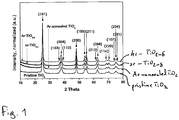
- Fig. 1 shows X-ray diffraction (XRD) patterns of pristine TiO 2 (bottom curve), Ar annealed TiO 2 (2 nd from bottom curve), sr-TiO 2- ⁇ (3nd from top curve) and hr -TiO 2- ⁇ (top curve) respectively.
- the respective intensity for each phase has been normalized for reasons of comparison. Since the positions of the different intensity maxima remain unchanged after H 2 treatment these curves indicate that no phase change from anatase phase takes place after the H2 treatment.
- Figs. 2a-d show SEM images of various TriO 2 phases.
- Figs. 2a-d indicate the particle morphology of pristine TiO 2 , Ar-annealed -TiO 2 , and sr -TiO 2- ⁇ , and an H 2 -7h-TiO 2- ⁇ sample.
- the pristine TiO 2 nanoparticles have relatively loose morphology, whereas that of the thermally annealed materials (both under pure Ar and 5% H 2 / 95% Ar mixture, Figure 2b-d ) tend to be closely packed.
- the denser particle interconnectivity induced by thermal annealing can give rise to better electronic contacts between anatase particles than that of non-annealed materials, which is advantageous to obtain better electrode performance.
- the electronic conductivity is still limited to the bulk value of the anatase.
- H 2 -thermal treatment effectively increases the bulk value of electronic conductivity when compared to the Ar-annealing and thus not only yields a capacity enhancement at low C rates, but also improves storage kinetics at high C rates.
- Fig. 3a shows the DC-conductivity of anatase TiO 2 during the reduction experiment for different H 2 -treatment times, as the reduction time increases so does the DC-conductivity.
- Figs. 3b and 3c show heating and cooling curves of TiO 2 before and after treatment of the TiO 2 in H 2 /Ar indicating that the conduction mechanism of the anatase TiO 2 is very similar before and after H 2 -treatment.
- Figs. 4a and 4b show the rate capability of corresponding electrodes of pristine TiO 2 , sr -TiO 2- ⁇ , and Ar -annealed TiO 2 (filled-point: discharge capacity, open-point: charge capacity) charged/discharged with current densities starting from 67.2 mA ⁇ g -1 (0.2C) up to 10.1 A ⁇ g -1 (30C).
- the pristine TiO 2 exhibited high initial discharge capacity (234 mA ⁇ g -1 ) followed, however, by the sharp capacity decay in further 20 cycles.
- Ar - annealed -TiO 2 electrode shows remarkably enhanced initial discharge capacity (350 mAh ⁇ g -1 ).
- the Li-storage performance of sr -TiO 2 and Ar-annealed -TiO 2 nanoparticles is compared in Fig. 4b and Table 1.
- the electrodes were charged/discharged for 100 cycles at a constant current density of 1C (0.336 A ⁇ g -1 ).
- Both oxygen-nonstoichiometic sr -TiO 2- ⁇ and Ar-annealed TriO 2 electrodes delivered higher capacities than those for the pristine, stoichiometric TiO 2 electrode.
- Figs 5a and 5b show different Galvanostatic charge / discharge profiles for different anatase TiO 2 for different H 2 treatment times.
- Fig. 5a shows sr -TiO 2- ⁇ cycled for different C
- Fig. 5b shows hr -TiO 2- ⁇ cycled for different C
- Fig. 5c shows the corresponding discharge capacity proportions of region A (solid solution domains), region B (lithium intercalations) and region C (surface storages) of sr -TiO 2- ⁇ .
- Figs. 6a-b show the variation of charge and discharge capacity versus cycle number for sr -TiO 2- ⁇ (discharge ⁇ , charge ⁇ ), hr -TiO 2- ⁇ (discharge ⁇ , charge ⁇ ), and pristine TiO 2 (discharge ⁇ , charge ⁇ ) cycled at constant current rate of a) 1C (336 mA ⁇ g -1 ) and b) 10C (3.36 A ⁇ g -1 ).
- Fig. 6c shows the current density dependency of the discharge capacity for differently-treated anatase TiO 2 nanoparticles. In particular the excellent rate capability of the sr -TiO 2- ⁇ is illustrated in Figure 6c .
- Fig. 7 shows a schematic of a proposed lithium storage mechanism in surface oxygen-nonstoichiometric TiO 2- ⁇ networks via H 2 -thermal treatment.
- Fig. 8 shows a schematic of the experimental procedure carried out to prepare H 2 -thermal treated anatase TiO 2- ⁇ nanocrystalline.
- anatase nanoparticles were treated under 5 % H 2 / 95 % Ar mixture at a temperature of 400°C for 60 minutes following a 30 min long step of pre-treatment in an Ar atmosphere at a temperature of 250°C.
- the step of pre-treatment can naturally be carried out for a period in the range of 1 second to 1 hour, preferably in the range of 20 minutes to 40 minutes.
- the step of pre-treatment can also be carried out in a temperature range of from 50°C to 400 °C, preferably of from 150°C to 300°C.
- Fig. 9 shows a hierarchical nanoporous TiO 2 structure which was successfully prepared by a simple in-situ hydrolysis method. Used as an anode material, the TiO 2 achieves sustained high lithium-storage performance especially at high charge/discharge rates due to its sufficiently high surface area which facilitates the Li + diffusion.
- the material shows two different major storage modes, a) bulk intercalation, and b) pseudo-capacitive interfacial storage which is responsible for 64 % of the total capacity. In order to kinetically emphasize the interfacial storage even further, the material was directly cycled at high rates, resulting in 302 mAhg -1 and 200 mAhg -1 of fully reversible discharge capacity at charge/ discharge rate of 1C and 5C with very high cycle stability.
- Fig. 10 shows the formation of mixed conducting networks (e - / Li + ) which is necessary for excellent Li-storage performance.
- ionic wiring can be successfully achieved by using hierarchically porous electrochemically active materials.
- the conventional method for electronic wiring is either coating the material with carbon or adding secondary conducting phases for example RuO 2 or Ag nanoparticles (top figure).
- the method of obtaining efficient electronic wiring is the direct reduction of the electrochemically active particles without using secondary phases. This method is beneficial to the volumetric energy density of Li-battery electrodes.
- Fig. 11 shows the theoretical background of the charge carrier formation and core shell particle formation upon H 2 treatment.
- the lower right diagram of Fig. 11 illustrates the increase in pore volume size at the outer core radius of the TiO 2 .
- Fig. 12 shows Ti/O phase diagrams.
- the hashed areas show potential areas from which the treatment conditions can be selected to obtain anatase TiO 2 .
- Fig. 13 shows the variation of resistance (i.e. the inverse graph to that shown in Fig. 3 ) with regard to exposure time.
- Fig. 12 shows the progress of the shell frontier into the particle. In the case of full equilibrium the whole particle is described by the shell.
- Fig. 15 shows how the re-oxidation of reduced TiO 2- ⁇ particle may influence the stability of electrode performance.
- the rate capability of electrodes kept for four months in an Ar-filled glove box (containing traces of oxygen) were tested at various C rates. Only slight capacity decays were shown at over high C rate of 20C, maintaining almost similar reversible capacities with those for fresh electrodes. This indicates that the stability of the reduced TiO 2 electrodes is fairly good for use in Li-batteries.
- Table 1 shows the physiochemical properties of pristine TiO 2 , Ar-annealed TiO 2 and sr -TiO 2- ⁇ and hr -TiO 2- ⁇ .
- Table 3 below shows the discharge capacity (in mAh/g) and capacity retention (cap.ret.) after 100 cycles (in %).
- Table 3 Pristine TiO 2 Ar-annelaed TiO 2 (1h) Ar-annelaed TiO 2 (7h) sr -TiO 2- ⁇ hr -TiO 2- ⁇ 1 st 20 th Cap . ret 1 st 100 th Cap. ret. 1 st 100 th Cap . ret. 1 st 100 th Cap . ret. 1 st 100 th Cap . ret. 1 st 100 th Cap . ret. 1C 195 41 21 267 91 34 307 131 43 196 88 45 10C 148 27 18 192 65 34 307 130 42 124 70 56
Landscapes
- Chemical & Material Sciences (AREA)
- Chemical Kinetics & Catalysis (AREA)
- Electrochemistry (AREA)
- General Chemical & Material Sciences (AREA)
- Inorganic Chemistry (AREA)
- Composite Materials (AREA)
- Engineering & Computer Science (AREA)
- Materials Engineering (AREA)
- Battery Electrode And Active Subsutance (AREA)
- Inorganic Compounds Of Heavy Metals (AREA)
Claims (15)
- Elektrodenmaterial für eine Lithiumionenbatterie mit einer porösen Agglomeration von Partikeln, wobei die Partikel aus Nanopulver eines Übergangsmetalloxids gebildet sind und Kerne aus stöchiometrischem Übergangsmetalloxid umfassen, die von einem unterstöchiometrischen Oxid des Übergangsmetalls umgeben sind.
- Elektrodenmaterial nach Anspruch 1, wobei das Übergangsmetalloxid aus der Gruppe gewählt ist, die umfasst: Sc, Ti, V, Cr, Mn, Fe, Co, Cu, Zn, Y, Zr, Nb, Mo, Tc, Ru, Rh, Ag, Cd, La, Hf, Ta, W, Re, Os, Ir, Pt, Au und Hg, und ist insbesondere Ti, oder wobei der Kern und/oder das umgebende unterstöchiometrische Oxid optional aus einem Oxid einer Legierung von zwei oder mehr Übergangsmetallen bestehen.
- Elektrodenmaterial nach einem oder mehreren der vorhergehenden Ansprüche, wobei die Nanopartikel durchschnittliche Abmessungen im Bereich von 5 nm bis 900 nm besitzen.
- Elektrodenmaterial nach einem der vorhergehenden Ansprüche, wobei die Poren in dem porösen Agglomerat Größen im Bereich von 1 nm bis 1 µm besitzen und bevorzugt eine bimodale Porenverteilung mit zumindest ersten Poren im Größenbereich von 1 bis 50 nm und zumindest zweiten Poren im Bereich von 50 nm bis 1 µm umfassen, wobei die Größen die Durchmesser von Kugeln mit äquivalentem Volumen zu den jeweiligen Poren sind, wobei die ersten Poren bevorzugt in einem Volumen von 1% bis 5% des Gesamt-volumens des aktiven Materials des Elektrodenmaterials vorhanden sind und die zweiten Poren bevorzugt in einem Volumen von 5% bis 20% des Gesamtvolumens des aktiven Materials vorhanden sind, wobei die obere Grenze von 1 µm die Anwesenheit von bis zu 10 Volumen-% relativ zu dem Gesamtvolumen der zweiten Poren von Poren mit größeren Abmessungen nicht ausschließt und die untere Grenze von 1 nm die Anwesenheit von 1 Volumen-% relativ zu dem Gesamtvolumen der ersten Poren von Poren mit kleinerem Durchmesser nicht ausschließt.
- Elektrodenmaterial nach einem der vorhergehenden Ansprüche, wobei für ein tetravalentes Übergangsmetalloxid (wie TiO2) der Sauerstoffgehalt des unterstöchiometrischen Oxids im Bereich von 1,6 bis 1,99, bevorzugt im Bereich von 1,8 bis 1,99 liegt, für ein trivalentes Übergangsmetalloxid (wie Fe2O3) der Sauerstoffgehalt des unterstöchiometrischen Oxids im Bereich von 2 bis 2,99, bevorzugt zwischen 2,6 bis 2,99 liegt und für ein hexavalentes Übergangsmetalloxid (wie MoO3) der Sauerstoffgehalt des unterstöchiometrischen Oxids im Bereich von 5 bis 5,9, bevorzugt zwischen 5,6 und 5,9 liegt.
- Elektrodenmaterial nach einem der vorhergehenden Ansprüche, wobei der Prozentsatz des unterstöchiometrischen Oxids so gewählt ist, dass eine elektrische Leitfähigkeit im Bereich von 1,5 x 10⁻³ Siemens/cm bis 4,4 x 10⁻³ Siemens/cm in der Abwesenheit von die Leitfähigkeit fördernden Additiven, wie Kohlenstoff, erreicht wird.
- Elektrode mit einem Elektrodenmaterial nach einem der vorhergehenden Ansprüche, wobei ein leitendes Material in zumindest dem umgebenden unterstöchiometrischen Oxid und bevorzugt in dem Kern und dem umgebenden unterstöchiometrischen Oxid vorhanden ist.
- Elektrode nach Anspruch 7, wobei ein Element des leitenden Materials Kohlenstoff ist.
- Elektrode nach einem der Ansprüche 7 oder 8, wobei das poröse Agglomerat mit einer Trägerfolie verbunden ist, die beispielhaft aus Cu oder Ti besteht.
- Verwendung eines Übergangsmetalloxids nach Anspruch 1 in der Form eines porösen Agglomerat aus Nanopulvern als ein Elektrodenmaterial in einer Lithiumionenbatterie, wobei die Partikel des Pulvers Kerne aus stöchiometrischem Oxid umfassen, die durch Schalen von unterstöchiometrischem Oxid umgeben sind.
- Verfahren zur Herstellung eines Elektrodenmaterials nach einem der vorhergehenden Ansprüche 1 bis 6, wobei ein Nanopulver eines Übergangsoxidmaterials in einer Inertgasatmosphäre, optional in einer Inertgasatmosphäre mit dem Zusatz eines Reduktionsmittels bei einer Temperatur im Bereich von 250°C bis 800°C erhitzt wird, wobei der Sauerstoffpartialdruck in der Atmosphäre so gewählt ist, dass er kleiner als 10-15 bar, bevorzugt kleiner als 10-25 bar ist und die Behandlung bei der erhöhten Temperatur für eine Zeitdauer im Bereich zwischen 1 Sekunde und 7 Stunden, bevorzugt zwischen 1 h und 7 Stunden ausgeführt wird.
- Verfahren nach Anspruch 11, wobei das Nanopulver anschließend eng mit einem leitenden Material, wie Kohlenstoff in einer Feinpartikelform, wie Ruß, und mit einem Binder gemischt wird und anschließend geröstet wird, um flüchtige Elemente des Binders zu entfernen, wobei ein poröses Agglomerat des Nanopulvers zurückbleibt.
- Verfahren nach einem der Ansprüche 11 oder 12, wobei das Gemisch aus Nanopulver und Binder auf eine Metallfolie, wie Titan oder Kupfer, aufgebracht und an der Metallfolie geröstet wird, wobei das poröse Agglomerat aus Nanopulver geformt und mit der Folie verbunden wird.
- Verfahren nach einem der vorhergehenden Ansprüche 11 bis 13, wobei das Nanopulver einem Schritt einer Vorbehandlung unterzogen wird.
- Verfahren nach Anspruch 14, wobei der Schritt zur Vorbehandlung den Schritt zum Erwärmen des Elektrodenmaterials in einer Inertgasatmosphäre bei einer Temperatur im Bereich von 100 bis 350°C für eine Dauer im Bereich von 1 Sekunde bis 1 Stunde umfasst.
Priority Applications (1)
| Application Number | Priority Date | Filing Date | Title |
|---|---|---|---|
| EP11727402.7A EP2586086B1 (de) | 2010-06-25 | 2011-06-22 | Elektrodenmaterial für eine lithium-ionen-batterie und verfahren zur herstellung derselben |
Applications Claiming Priority (3)
| Application Number | Priority Date | Filing Date | Title |
|---|---|---|---|
| EP10006647 | 2010-06-25 | ||
| EP11727402.7A EP2586086B1 (de) | 2010-06-25 | 2011-06-22 | Elektrodenmaterial für eine lithium-ionen-batterie und verfahren zur herstellung derselben |
| PCT/EP2011/003096 WO2011160837A1 (en) | 2010-06-25 | 2011-06-22 | An electrode material for a lithium-ion battery and a method of manufacturing the same |
Publications (2)
| Publication Number | Publication Date |
|---|---|
| EP2586086A1 EP2586086A1 (de) | 2013-05-01 |
| EP2586086B1 true EP2586086B1 (de) | 2017-03-08 |
Family
ID=44462061
Family Applications (1)
| Application Number | Title | Priority Date | Filing Date |
|---|---|---|---|
| EP11727402.7A Not-in-force EP2586086B1 (de) | 2010-06-25 | 2011-06-22 | Elektrodenmaterial für eine lithium-ionen-batterie und verfahren zur herstellung derselben |
Country Status (3)
| Country | Link |
|---|---|
| US (1) | US9419275B2 (de) |
| EP (1) | EP2586086B1 (de) |
| WO (1) | WO2011160837A1 (de) |
Families Citing this family (5)
| Publication number | Priority date | Publication date | Assignee | Title |
|---|---|---|---|---|
| US9780362B2 (en) * | 2015-10-30 | 2017-10-03 | Nissan North America, Inc. | Electrode having a selectively loaded matrix and method of manufacturing |
| CN107244693B (zh) * | 2017-05-23 | 2022-01-14 | 湖南大学 | 一种Li0.5TiO2粉体材料的制备方法 |
| EP4026186A4 (de) * | 2019-09-03 | 2024-07-17 | Georgia Tech Research Corporation | Tief aufladbare batteriesysteme und verfahren |
| CN113479860B (zh) * | 2021-07-01 | 2023-08-11 | 中国石油大学(华东) | 一种SbPO4/氮掺杂碳复合材料的制备方法 |
| CN113488647B (zh) * | 2021-07-01 | 2024-09-20 | 中国石油大学(华东) | 一种含氧空位的非晶态SnP2O7/氮掺杂碳复合材料的应用 |
Family Cites Families (7)
| Publication number | Priority date | Publication date | Assignee | Title |
|---|---|---|---|---|
| KR100378014B1 (ko) * | 2000-08-21 | 2003-03-29 | 삼성에스디아이 주식회사 | 리튬 이차 전지용 전극 및 리튬 이차 전지 |
| US7618609B2 (en) * | 2002-01-16 | 2009-11-17 | The United States Of America As Represented By The Secretary Of The Navy | Method to prepare defective metal oxides with increased specific capacity |
| US7435509B2 (en) * | 2002-09-10 | 2008-10-14 | Uchicago Argonne, Llc | Electrode for a lithium cell |
| JP4485442B2 (ja) * | 2004-10-01 | 2010-06-23 | コリア インスティテュート オブ サイエンス アンド テクノロジー | 均一な粒度を有する親水性金属酸化物ナノ粒子及びその製造方法 |
| US8080335B2 (en) * | 2006-06-09 | 2011-12-20 | Canon Kabushiki Kaisha | Powder material, electrode structure using the powder material, and energy storage device having the electrode structure |
| KR100814880B1 (ko) | 2006-11-22 | 2008-03-18 | 삼성에스디아이 주식회사 | 리튬 이차 전지용 음극 활물질, 이의 제조 방법 및 이를포함하는 리튬 이차 전지 |
| DE102008050692B4 (de) | 2008-10-07 | 2014-04-03 | Süd-Chemie Ip Gmbh & Co. Kg | Kohlenstoffbeschichteter Lithiumtitan-Spinell |
-
2011
- 2011-06-22 EP EP11727402.7A patent/EP2586086B1/de not_active Not-in-force
- 2011-06-22 US US13/806,723 patent/US9419275B2/en not_active Expired - Fee Related
- 2011-06-22 WO PCT/EP2011/003096 patent/WO2011160837A1/en not_active Ceased
Non-Patent Citations (1)
| Title |
|---|
| None * |
Also Published As
| Publication number | Publication date |
|---|---|
| EP2586086A1 (de) | 2013-05-01 |
| US9419275B2 (en) | 2016-08-16 |
| WO2011160837A1 (en) | 2011-12-29 |
| US20150287982A1 (en) | 2015-10-08 |
Similar Documents
| Publication | Publication Date | Title |
|---|---|---|
| CN114930570B (zh) | Li/Na离子电池阳极材料 | |
| Lin et al. | Mitigating lattice distortion of high-voltage LiCoO2 via core-shell structure induced by cationic heterogeneous co-doping for lithium-ion batteries | |
| Dong et al. | Metallurgy inspired formation of homogeneous Al2O3 coating layer to improve the electrochemical properties of LiNi0. 8Co0. 1Mn0. 1O2 cathode material | |
| Cai et al. | Graphene and graphene-based composites as Li-ion battery electrode materials and their application in full cells | |
| Liang et al. | Nasicon-type surface functional modification in core–shell LiNi0. 5Mn0. 3Co0. 2O2@ NaTi2 (PO4) 3 cathode enhances its high-voltage cycling stability and rate capacity toward Li-Ion batteries | |
| Fu et al. | One-step calcination-free synthesis of multicomponent spinel assembled microspheres for high-performance anodes of Li-ion batteries: a case study of MnCo2O4 | |
| Wang et al. | Monodisperse multicore-shell SnSb@ SnOx/SbOx@ C nanoparticles space-confined in 3D porous carbon networks as high-performance anode for Li-ion and Na-ion batteries | |
| Wang et al. | Combining fast Li-ion battery cycling with large volumetric energy density: grain boundary induced high electronic and ionic conductivity in Li4Ti5O12 spheres of densely packed nanocrystallites | |
| Xiong et al. | Enhanced electrochemical properties of lithium-reactive V 2 O 5 coated on the LiNi 0.8 Co 0.1 Mn 0.1 O 2 cathode material for lithium ion batteries at 60 C | |
| Wang et al. | Tailoring yolk–shell FeP@ carbon nanoboxes with engineered void space for pseudocapacitance-boosted lithium storage | |
| Wagemaker et al. | Properties and promises of nanosized insertion materials for Li-ion batteries | |
| Li et al. | Hierarchical mesoporous lithium-rich Li [Li0. 2Ni0. 2Mn0. 6] O2 cathode material synthesized via ice templating for lithium-ion battery | |
| Zhang et al. | High performance of electrochemical lithium storage batteries: ZnO-based nanomaterials for lithium-ion and lithium–sulfur batteries | |
| Deng et al. | Recent advances in Mn-based oxides as anode materials for lithium ion batteries | |
| Wu et al. | Aligned NiO nanoflake arrays grown on copper as high capacity lithium-ion battery anodes | |
| Rahman et al. | A review on porous negative electrodes for high performance lithium-ion batteries | |
| Xia et al. | Flake Cu-Sn alloys as negative electrode materials for rechargeable lithium batteries | |
| Hu et al. | Hierarchical CuO octahedra inherited from copper metal–organic frameworks: high-rate and high-capacity lithium-ion storage materials stimulated by pseudocapacitance | |
| Zhao et al. | Nanostructured electrode materials for rechargeable lithium-ion batteries | |
| Cai et al. | Li4Ti5O12/Sn composite anodes for lithium-ion batteries: Synthesis and electrochemical performance | |
| Fang et al. | A facile strategy to prepare nano-crystalline Li4Ti5O12/C anode material via polyvinyl alcohol as carbon source for high-rate rechargeable Li-ion batteries | |
| Yu et al. | Diffusion induced concave Co3O4@ CoFe2O4 hollow heterostructures for high performance lithium ion battery anode | |
| Yuvaraj et al. | Effect of carbon coating on the electrochemical properties of Co 2 SnO 4 for negative electrodes in Li-ion batteries | |
| Yang et al. | Constructing durable carbon layer on LiMn0. 8Fe0. 2PO4 with superior long-term cycling performance for lithium-ion battery | |
| CN103081187A (zh) | 铌氧化物组合物和使用其的方法 |
Legal Events
| Date | Code | Title | Description |
|---|---|---|---|
| PUAI | Public reference made under article 153(3) epc to a published international application that has entered the european phase |
Free format text: ORIGINAL CODE: 0009012 |
|
| 17P | Request for examination filed |
Effective date: 20121212 |
|
| AK | Designated contracting states |
Kind code of ref document: A1 Designated state(s): AL AT BE BG CH CY CZ DE DK EE ES FI FR GB GR HR HU IE IS IT LI LT LU LV MC MK MT NL NO PL PT RO RS SE SI SK SM TR |
|
| RIN1 | Information on inventor provided before grant (corrected) |
Inventor name: SAMUELIS, DOMINIK Inventor name: JOO, JONG-HOON Inventor name: MAIER, JOACHIM Inventor name: SHIN, JI-YONG |
|
| RIN1 | Information on inventor provided before grant (corrected) |
Inventor name: SHIN, JI-YONG Inventor name: JOO, JONG-HOON Inventor name: SAMUELIS, DOMINIK Inventor name: MAIER, JOACHIM |
|
| DAX | Request for extension of the european patent (deleted) | ||
| GRAP | Despatch of communication of intention to grant a patent |
Free format text: ORIGINAL CODE: EPIDOSNIGR1 |
|
| RIC1 | Information provided on ipc code assigned before grant |
Ipc: H01M 4/505 20100101ALI20160822BHEP Ipc: H01M 10/0525 20100101ALI20160822BHEP Ipc: H01M 4/525 20100101ALI20160822BHEP Ipc: H01M 4/131 20100101ALI20160822BHEP Ipc: H01M 4/485 20100101AFI20160822BHEP Ipc: H01M 4/66 20060101ALI20160822BHEP Ipc: H01M 4/62 20060101ALI20160822BHEP Ipc: H01M 4/36 20060101ALI20160822BHEP |
|
| INTG | Intention to grant announced |
Effective date: 20160916 |
|
| STAA | Information on the status of an ep patent application or granted ep patent |
Free format text: STATUS: GRANT OF PATENT IS INTENDED |
|
| GRAS | Grant fee paid |
Free format text: ORIGINAL CODE: EPIDOSNIGR3 |
|
| GRAA | (expected) grant |
Free format text: ORIGINAL CODE: 0009210 |
|
| STAA | Information on the status of an ep patent application or granted ep patent |
Free format text: STATUS: THE PATENT HAS BEEN GRANTED |
|
| AK | Designated contracting states |
Kind code of ref document: B1 Designated state(s): AL AT BE BG CH CY CZ DE DK EE ES FI FR GB GR HR HU IE IS IT LI LT LU LV MC MK MT NL NO PL PT RO RS SE SI SK SM TR |
|
| REG | Reference to a national code |
Ref country code: GB Ref legal event code: FG4D |
|
| REG | Reference to a national code |
Ref country code: CH Ref legal event code: EP Ref country code: AT Ref legal event code: REF Ref document number: 874277 Country of ref document: AT Kind code of ref document: T Effective date: 20170315 |
|
| REG | Reference to a national code |
Ref country code: IE Ref legal event code: FG4D |
|
| REG | Reference to a national code |
Ref country code: DE Ref legal event code: R096 Ref document number: 602011035694 Country of ref document: DE |
|
| REG | Reference to a national code |
Ref country code: FR Ref legal event code: PLFP Year of fee payment: 7 |
|
| REG | Reference to a national code |
Ref country code: LT Ref legal event code: MG4D |
|
| REG | Reference to a national code |
Ref country code: NL Ref legal event code: MP Effective date: 20170308 |
|
| PG25 | Lapsed in a contracting state [announced via postgrant information from national office to epo] |
Ref country code: HR Free format text: LAPSE BECAUSE OF FAILURE TO SUBMIT A TRANSLATION OF THE DESCRIPTION OR TO PAY THE FEE WITHIN THE PRESCRIBED TIME-LIMIT Effective date: 20170308 Ref country code: GR Free format text: LAPSE BECAUSE OF FAILURE TO SUBMIT A TRANSLATION OF THE DESCRIPTION OR TO PAY THE FEE WITHIN THE PRESCRIBED TIME-LIMIT Effective date: 20170609 Ref country code: NO Free format text: LAPSE BECAUSE OF FAILURE TO SUBMIT A TRANSLATION OF THE DESCRIPTION OR TO PAY THE FEE WITHIN THE PRESCRIBED TIME-LIMIT Effective date: 20170608 Ref country code: LT Free format text: LAPSE BECAUSE OF FAILURE TO SUBMIT A TRANSLATION OF THE DESCRIPTION OR TO PAY THE FEE WITHIN THE PRESCRIBED TIME-LIMIT Effective date: 20170308 Ref country code: FI Free format text: LAPSE BECAUSE OF FAILURE TO SUBMIT A TRANSLATION OF THE DESCRIPTION OR TO PAY THE FEE WITHIN THE PRESCRIBED TIME-LIMIT Effective date: 20170308 |
|
| REG | Reference to a national code |
Ref country code: AT Ref legal event code: MK05 Ref document number: 874277 Country of ref document: AT Kind code of ref document: T Effective date: 20170308 |
|
| PG25 | Lapsed in a contracting state [announced via postgrant information from national office to epo] |
Ref country code: RS Free format text: LAPSE BECAUSE OF FAILURE TO SUBMIT A TRANSLATION OF THE DESCRIPTION OR TO PAY THE FEE WITHIN THE PRESCRIBED TIME-LIMIT Effective date: 20170308 Ref country code: SE Free format text: LAPSE BECAUSE OF FAILURE TO SUBMIT A TRANSLATION OF THE DESCRIPTION OR TO PAY THE FEE WITHIN THE PRESCRIBED TIME-LIMIT Effective date: 20170308 Ref country code: ES Free format text: LAPSE BECAUSE OF FAILURE TO SUBMIT A TRANSLATION OF THE DESCRIPTION OR TO PAY THE FEE WITHIN THE PRESCRIBED TIME-LIMIT Effective date: 20170308 Ref country code: LV Free format text: LAPSE BECAUSE OF FAILURE TO SUBMIT A TRANSLATION OF THE DESCRIPTION OR TO PAY THE FEE WITHIN THE PRESCRIBED TIME-LIMIT Effective date: 20170308 Ref country code: BG Free format text: LAPSE BECAUSE OF FAILURE TO SUBMIT A TRANSLATION OF THE DESCRIPTION OR TO PAY THE FEE WITHIN THE PRESCRIBED TIME-LIMIT Effective date: 20170608 |
|
| PG25 | Lapsed in a contracting state [announced via postgrant information from national office to epo] |
Ref country code: NL Free format text: LAPSE BECAUSE OF FAILURE TO SUBMIT A TRANSLATION OF THE DESCRIPTION OR TO PAY THE FEE WITHIN THE PRESCRIBED TIME-LIMIT Effective date: 20170308 |
|
| PG25 | Lapsed in a contracting state [announced via postgrant information from national office to epo] |
Ref country code: IT Free format text: LAPSE BECAUSE OF FAILURE TO SUBMIT A TRANSLATION OF THE DESCRIPTION OR TO PAY THE FEE WITHIN THE PRESCRIBED TIME-LIMIT Effective date: 20170308 Ref country code: EE Free format text: LAPSE BECAUSE OF FAILURE TO SUBMIT A TRANSLATION OF THE DESCRIPTION OR TO PAY THE FEE WITHIN THE PRESCRIBED TIME-LIMIT Effective date: 20170308 Ref country code: AT Free format text: LAPSE BECAUSE OF FAILURE TO SUBMIT A TRANSLATION OF THE DESCRIPTION OR TO PAY THE FEE WITHIN THE PRESCRIBED TIME-LIMIT Effective date: 20170308 Ref country code: SK Free format text: LAPSE BECAUSE OF FAILURE TO SUBMIT A TRANSLATION OF THE DESCRIPTION OR TO PAY THE FEE WITHIN THE PRESCRIBED TIME-LIMIT Effective date: 20170308 Ref country code: CZ Free format text: LAPSE BECAUSE OF FAILURE TO SUBMIT A TRANSLATION OF THE DESCRIPTION OR TO PAY THE FEE WITHIN THE PRESCRIBED TIME-LIMIT Effective date: 20170308 Ref country code: RO Free format text: LAPSE BECAUSE OF FAILURE TO SUBMIT A TRANSLATION OF THE DESCRIPTION OR TO PAY THE FEE WITHIN THE PRESCRIBED TIME-LIMIT Effective date: 20170308 |
|
| PG25 | Lapsed in a contracting state [announced via postgrant information from national office to epo] |
Ref country code: PT Free format text: LAPSE BECAUSE OF FAILURE TO SUBMIT A TRANSLATION OF THE DESCRIPTION OR TO PAY THE FEE WITHIN THE PRESCRIBED TIME-LIMIT Effective date: 20170710 Ref country code: PL Free format text: LAPSE BECAUSE OF FAILURE TO SUBMIT A TRANSLATION OF THE DESCRIPTION OR TO PAY THE FEE WITHIN THE PRESCRIBED TIME-LIMIT Effective date: 20170308 Ref country code: IS Free format text: LAPSE BECAUSE OF FAILURE TO SUBMIT A TRANSLATION OF THE DESCRIPTION OR TO PAY THE FEE WITHIN THE PRESCRIBED TIME-LIMIT Effective date: 20170708 Ref country code: SM Free format text: LAPSE BECAUSE OF FAILURE TO SUBMIT A TRANSLATION OF THE DESCRIPTION OR TO PAY THE FEE WITHIN THE PRESCRIBED TIME-LIMIT Effective date: 20170308 |
|
| REG | Reference to a national code |
Ref country code: DE Ref legal event code: R097 Ref document number: 602011035694 Country of ref document: DE |
|
| PLBE | No opposition filed within time limit |
Free format text: ORIGINAL CODE: 0009261 |
|
| STAA | Information on the status of an ep patent application or granted ep patent |
Free format text: STATUS: NO OPPOSITION FILED WITHIN TIME LIMIT |
|
| PG25 | Lapsed in a contracting state [announced via postgrant information from national office to epo] |
Ref country code: DK Free format text: LAPSE BECAUSE OF FAILURE TO SUBMIT A TRANSLATION OF THE DESCRIPTION OR TO PAY THE FEE WITHIN THE PRESCRIBED TIME-LIMIT Effective date: 20170308 Ref country code: MC Free format text: LAPSE BECAUSE OF FAILURE TO SUBMIT A TRANSLATION OF THE DESCRIPTION OR TO PAY THE FEE WITHIN THE PRESCRIBED TIME-LIMIT Effective date: 20170308 |
|
| REG | Reference to a national code |
Ref country code: CH Ref legal event code: PL |
|
| 26N | No opposition filed |
Effective date: 20171211 |
|
| PG25 | Lapsed in a contracting state [announced via postgrant information from national office to epo] |
Ref country code: SI Free format text: LAPSE BECAUSE OF FAILURE TO SUBMIT A TRANSLATION OF THE DESCRIPTION OR TO PAY THE FEE WITHIN THE PRESCRIBED TIME-LIMIT Effective date: 20170308 |
|
| REG | Reference to a national code |
Ref country code: IE Ref legal event code: MM4A |
|
| PG25 | Lapsed in a contracting state [announced via postgrant information from national office to epo] |
Ref country code: LI Free format text: LAPSE BECAUSE OF NON-PAYMENT OF DUE FEES Effective date: 20170630 Ref country code: IE Free format text: LAPSE BECAUSE OF NON-PAYMENT OF DUE FEES Effective date: 20170622 Ref country code: LU Free format text: LAPSE BECAUSE OF NON-PAYMENT OF DUE FEES Effective date: 20170622 Ref country code: CH Free format text: LAPSE BECAUSE OF NON-PAYMENT OF DUE FEES Effective date: 20170630 |
|
| REG | Reference to a national code |
Ref country code: BE Ref legal event code: MM Effective date: 20170630 |
|
| REG | Reference to a national code |
Ref country code: FR Ref legal event code: PLFP Year of fee payment: 8 |
|
| PG25 | Lapsed in a contracting state [announced via postgrant information from national office to epo] |
Ref country code: BE Free format text: LAPSE BECAUSE OF NON-PAYMENT OF DUE FEES Effective date: 20170630 |
|
| PG25 | Lapsed in a contracting state [announced via postgrant information from national office to epo] |
Ref country code: MT Free format text: LAPSE BECAUSE OF NON-PAYMENT OF DUE FEES Effective date: 20170622 |
|
| PG25 | Lapsed in a contracting state [announced via postgrant information from national office to epo] |
Ref country code: HU Free format text: LAPSE BECAUSE OF FAILURE TO SUBMIT A TRANSLATION OF THE DESCRIPTION OR TO PAY THE FEE WITHIN THE PRESCRIBED TIME-LIMIT; INVALID AB INITIO Effective date: 20110622 |
|
| PG25 | Lapsed in a contracting state [announced via postgrant information from national office to epo] |
Ref country code: CY Free format text: LAPSE BECAUSE OF NON-PAYMENT OF DUE FEES Effective date: 20170308 |
|
| PG25 | Lapsed in a contracting state [announced via postgrant information from national office to epo] |
Ref country code: MK Free format text: LAPSE BECAUSE OF FAILURE TO SUBMIT A TRANSLATION OF THE DESCRIPTION OR TO PAY THE FEE WITHIN THE PRESCRIBED TIME-LIMIT Effective date: 20170308 |
|
| PG25 | Lapsed in a contracting state [announced via postgrant information from national office to epo] |
Ref country code: TR Free format text: LAPSE BECAUSE OF FAILURE TO SUBMIT A TRANSLATION OF THE DESCRIPTION OR TO PAY THE FEE WITHIN THE PRESCRIBED TIME-LIMIT Effective date: 20170308 |
|
| PG25 | Lapsed in a contracting state [announced via postgrant information from national office to epo] |
Ref country code: AL Free format text: LAPSE BECAUSE OF FAILURE TO SUBMIT A TRANSLATION OF THE DESCRIPTION OR TO PAY THE FEE WITHIN THE PRESCRIBED TIME-LIMIT Effective date: 20170308 |
|
| PGFP | Annual fee paid to national office [announced via postgrant information from national office to epo] |
Ref country code: GB Payment date: 20220627 Year of fee payment: 12 Ref country code: DE Payment date: 20220628 Year of fee payment: 12 |
|
| PGFP | Annual fee paid to national office [announced via postgrant information from national office to epo] |
Ref country code: FR Payment date: 20220628 Year of fee payment: 12 |
|
| REG | Reference to a national code |
Ref country code: DE Ref legal event code: R119 Ref document number: 602011035694 Country of ref document: DE |
|
| GBPC | Gb: european patent ceased through non-payment of renewal fee |
Effective date: 20230622 |
|
| PG25 | Lapsed in a contracting state [announced via postgrant information from national office to epo] |
Ref country code: DE Free format text: LAPSE BECAUSE OF NON-PAYMENT OF DUE FEES Effective date: 20240103 Ref country code: GB Free format text: LAPSE BECAUSE OF NON-PAYMENT OF DUE FEES Effective date: 20230622 |
|
| PG25 | Lapsed in a contracting state [announced via postgrant information from national office to epo] |
Ref country code: FR Free format text: LAPSE BECAUSE OF NON-PAYMENT OF DUE FEES Effective date: 20230630 |