EP2586331A1 - Standmöbel mit Beinhalterung - Google Patents
Standmöbel mit Beinhalterung Download PDFInfo
- Publication number
- EP2586331A1 EP2586331A1 EP12006431.6A EP12006431A EP2586331A1 EP 2586331 A1 EP2586331 A1 EP 2586331A1 EP 12006431 A EP12006431 A EP 12006431A EP 2586331 A1 EP2586331 A1 EP 2586331A1
- Authority
- EP
- European Patent Office
- Prior art keywords
- furniture according
- leg
- clamping
- projection
- bore
- Prior art date
- Legal status (The legal status is an assumption and is not a legal conclusion. Google has not performed a legal analysis and makes no representation as to the accuracy of the status listed.)
- Granted
Links
Images


Classifications
-
- A—HUMAN NECESSITIES
- A47—FURNITURE; DOMESTIC ARTICLES OR APPLIANCES; COFFEE MILLS; SPICE MILLS; SUCTION CLEANERS IN GENERAL
- A47B—TABLES; DESKS; OFFICE FURNITURE; CABINETS; DRAWERS; GENERAL DETAILS OF FURNITURE
- A47B13/00—Details of tables or desks
- A47B13/02—Underframes
- A47B13/06—Underframes of metal
-
- A—HUMAN NECESSITIES
- A47—FURNITURE; DOMESTIC ARTICLES OR APPLIANCES; COFFEE MILLS; SPICE MILLS; SUCTION CLEANERS IN GENERAL
- A47B—TABLES; DESKS; OFFICE FURNITURE; CABINETS; DRAWERS; GENERAL DETAILS OF FURNITURE
- A47B13/00—Details of tables or desks
- A47B13/02—Underframes
- A47B13/023—Underframes with a central column
Definitions
- the present invention relates to a stand furniture with a leg and with a plate on which the leg is detachably mounted, wherein the plate has a holder in which at least a part of the released leg can be releasably secured.
- the object of the present invention is therefore to develop a stand furniture of the type mentioned in such a way that this is easier to handle and better usable.
- the holder comprises an open clamping ring which can loosely enclose the leg in a relaxed state and the leg clamped in a tight state fixed position, and with a force acting on the clamping ring clamping device for lever-free clamping and relaxing the clamping ring.
- the tensioning device has a helical tensioning element acting between a first free end and a second free end of the tensioning ring for adjusting a tension.
- a helical clamping element With the help of a helical clamping element, the tension of the open clamping ring can be adjusted by means of a transmission ratio that is favorable for the force required.
- the first free end has a first lateral approach and the free end has a second lateral approach and the actuator engages through a first bore of the first lateral approach and engages in a second bore of the second lateral approach.
- Another advantage of the present invention is that the clamping element is designed captive. This prevents the clamping element from falling out of the first bore of the first lateral projection after it has been released from the second bore and the second lateral projection.
- the first bore has an inner circumference with a recessed peripheral portion which forms a recess on the first projection and the actuating element has a projection on a circumference.
- Another advantage of the present invention is that the projection on the adjusting ring is mounted precisely at such a position that it engages between the cocked and the relaxed state of the clamping ring in the recessed peripheral portion. The projection thus always intervenes functionally in the recessed peripheral portion.
- Another advantage of the present invention is that the recess makes the first approach compliant, such that the actuator can be pulled out of the first bore in the relaxed state under manual force input, but is trapped with the projection in the recessed peripheral portion without manual application of force. This makes it possible to remove the clamping element as needed from the two holes. For example, when the clamping element is to be replaced with another new clamping element.
- the first lug has a curved, hook-shaped end.
- the handling of the attitude is thereby optimized.
- the hook-shaped approach is used in a purpose built up furniture as a sub-table hook for receiving an object to be attached.
- the actuator is a set screw is and has an external thread which can engage in an internal thread of the second bore.
- Such an actuator is relatively easy to manufacture and reduces the time required for the clamping of the clamping ring force sufficient.
- the actuator has a head with an integrated contact point for a tool. This makes it possible to operate the screw not only by hand, but also with a tool.
- a particular advantage of the present invention is that the holder has a plurality of clamping rings.
- the plurality of clamping rings are aligned so that they align parts of the released leg parallel to each other, this has the advantage that the leg parts can be arranged, for example, under a table top.
- Another advantage of the present invention is that the clamping ring is mounted on a top plate. If the clamping ring is mounted on a top plate, then this forms with the top plate easily mountable unit.
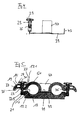
- a piece of furniture 1 which comprises a plate 3, a leg 5 with a first leg part 5.1 and a second leg part 5.2 and a foot 7.
- the stand furniture 1 is formed in the illustrated embodiment as a bar table.
- the furniture stand 1 may also be designed as any other functional furniture, as long as individual leg parts or legs for the purpose of transport or storage removable and captive with another plate-shaped component should be connected.
- the present invention is therefore not limited to the specific embodiment as a bar table.
- the present invention has a mounted on an underside of the plate 3 holder 9, on which at least a part of the leg 5, z. B. the leg part 5.1 and / or the leg part 5.2, or even the leg 5 itself, can be attached.
- the holder 9 comprises a clamping device 11.1 and in the present embodiment, a clamping device 11.2.
- the clamping devices 11.1 and 11.2 are identical, so that in the following only the clamping device 11.1 will be described further.
- the clamping device 11.1 comprises an open clamping ring 13.
- the open clamping ring 13 has a first free end 13.1 and a second free end 13.2.
- the two free ends 13.1 and 13.2 are opposite.
- a first projection 15 is formed and at the second free end 13.2, a second projection 17 is formed.
- the projection 15 has a first bore 19 and the second projection 17 has a second bore 21.
- the clamping device 11.1 also has a clamping element 23, which is a clamping screw in the present embodiment.
- the clamping element 23 is passed through the first bore 19 of the first projection 15 and engages with an external thread 25 in an internal thread 27 of the second bore 21 of the second projection 17 a.
- the situation is in the Figures 2 and 5 shown.
- the clamping element 23 has a head 29, which is formed Moerielig (see Fig. 2 ) so that the head can be easily touched and manipulated by a user's hand.
- the head has an integrated contact point 31 for a tool. This can be, for example, a hexagon socket.
- the first approach has a recess 33 which forms a recessed peripheral portion 33.1 with respect to the first bore 19.
- the adjusting element 23 has on its circumference a projection 35, with which this engages in the recess 33.
- the recessed peripheral portion 33.1 formed by the recess 33 extends in the longitudinal direction so far that the projection moves in the recessed peripheral portion 33.1 when the clamping member 23 is screwed into or out of the second bore 21.
- the recess 33 gives the first projection 15 a certain flexibility, which allows the user to lever out the adjusting element 23 with its projection 35 from the region of the recessed peripheral portion 33.1 with manual force application.
- the clamping element 23 can be replaced as needed.
- the first lug 15 extends to a curved, hook-shaped end 37.
- This curved, hook-shaped end 37 can be used in functional operation of the stand furniture as a hook for hanging objects, for example a jacket, a bag or the like.
- a holder 11 or 11.2 is mounted on a top plate 39.
- the head plate 39 has a plurality of holes 41 with which it can be mounted under a plate, for example table top 3.
- a receiving plate 43 is formed with two juxtaposed receptacles 45.
- a receptacle 45 cooperates with a respective clamping ring 13th
- a pipe extension 47 is formed, which is provided for receiving a leg part, for example of the leg part 5.1.
- first clamping ring 11.1 and the second clamping ring 11.2 are interconnected.
- a connection region 49 is shown.
- the first approach and a bridge 51 carrying the upper half of the clamping ring 13 are made of plastic and have stiffening elements 53.
- the clamping device 11.1 or 11.2 independently of a top plate 39 under a plate, for example table top 3.
- the invention expressly also includes embodiments that do not include a top plate 39.
Landscapes
- Furniture Connections (AREA)
- Clamps And Clips (AREA)
Abstract
Description
- Die vorliegende Erfindung betrifft ein Standmöbel mit einem Bein und mit einer Platte, an der das Bein lösbar montiert ist, wobei die Platte eine Halterung aufweist, in der wenigstens ein Teil des gelösten Beins lösbar befestigt werden kann.
- Ein solches Standmöbel ist aus
EP 1 053 700 bekannt. Der Nachteil des darin beschriebenen Untergestells besteht darin, dass eine auf einen Spannbügel zur Befestigung und Lösung eines Beinteils in einer Halterung wirkende Federkraft relativ groß sein muss, um eine sichere Aufbewahrung der Beinteile in der Halterung zu gewährleisten. So soll eine Tischplatte mit dem Untergestell und den darin befestigten Beinteilen gedreht, gewendet, gerollt und schließlich gestapelt werden, ohne dass sich die Beinteile aus der Aufnahme lösen. Die hohe Federkraft muss aber überwunden werden, wenn der Spannbügel betätigt wird, um ein in der Aufnahme liegendes Beinteil zu entnehmen. Wenn also ein aufbewahrtes Standmöbel mit den in der Halterung des Untergestells festliegenden Beinteilen aufgestellt werden soll, muss der Benutzer sehr viel Kraft aufwenden, um den Spannbügel zu betätigen. Wenn diese Kraft nicht vorhanden ist, muss der Benutzer Unterstützung erhalten. - Die Aufgabe der vorliegenden Erfindung ist daher, ein Standmöbel der eingangs genannten Art derart weiterzubilden, dass dieses leichter handhabbar und besser nutzbar ist.
- Die Aufgabe wird erfindungsgemäß dadurch gelöst, dass die Halterung einen offenen Spannring umfasst, der in entspanntem Zustand das Bein lose umschließen kann und das Bein in gespanntem Zustand lagefest einspannt, und mit einer auf den Spannring wirkenden Spanneinrichtung zum hebelfreien Spannen und Entspannen des Spannrings.
- Mithilfe des erfindungsgemäßen Standmöbels ist es möglich, das Einspannen wenigstens eines Teils des gelösten Beins zur Aufbewahrung desselben in der Halterung mit sehr viel geringerer Körperkraft herbeizuführen.
- Ein weiterer Vorteil der vorliegenden Erfindung ist, dass die Spanneinrichtung ein zwischen einem ersten freien Ende und einem zweiten freien Ende des Spannrings wirkendes schraubenförmiges Spannelement zur Einstellung einer Spannung aufweist. Mithilfe eines schraubenförmigen Spannelements kann die Spannung des offenen Spannrings mithilfe eines für den Kraftaufwand günstigen Übersetzungsverhältnisses eingestellt werden.
- Ein weiterer Vorteil der vorliegenden Erfindung ist, dass das erste freie Ende einen ersten seitlichen Ansatz und das freie Ende einen zweiten seitlichen Ansatz aufweist und das Stellelement durch eine erstes Bohrung des ersten seitlichen Ansatzes hindurch greift und in eine zweite Bohrung des zweiten seitlichen Ansatzes hineingreift.
- Durch diese Bauweise ist es möglich, das erste freie Ende und das zweite freie Ende zueinander hin zu bewegen und die Spannung des Spannrings zu erhöhen oder voneinander weg zu bewegen und die Spannung des Spannrings zu verringern.
- Ein weiterer Vorteil der vorliegenden Erfindung ist, dass das Spannelement unverlierbar ausgebildet ist. So wird verhindert, dass das Spannelement nach Lösung aus der zweiten Bohrung und des zweiten seitlichen Ansatzes aus der ersten Bohrung des ersten seitlichen Ansatzes heraus fällt.
- Aus diesem Grund ist es von Vorteil, dass die erste Bohrung einen Innenumfang mit einem zurückgesetzten Umfangsabschnitt aufweist, der eine Aussparung am ersten Ansatz bildet und das Stellelement an einem Umfang einen Vorsprung aufweist.
- Ein weiterer Vorteil der vorliegenden Erfindung ist, dass der Vorsprung an dem Stellring genau an einer solchen Position angebracht ist, dass dieser zwischen dem gespannten und dem entspannten Zustand des Spannrings in den zurückgesetzten Umfangsabschnitt eingreift. Der Vorsprung greift also funktionsgerecht immer in den zurückgesetzten Umfangsabschnitt ein.
- Ein weiterer Vorteil der vorliegenden Erfindung ist, dass die Aussparung den ersten Ansatz nachgiebig macht, derart, dass das Stellelement im entspannten Zustand unter manuellem Krafteinsatz aus der ersten Bohrung herausgezogen werden kann, aber ohne manuellen Krafteinsatz mit dem Vorsprung in den zurückgesetzten Umfangsabschnitt gefangen ist. Dadurch wird es möglich, das Spannelement bei Bedarf aus den beiden Bohrungen zu entnehmen. Zum Beispiel dann, wenn das Spannelement gegen ein anderes neues Spannelement ausgetauscht werden soll.
- Ein weiterer Vorteil der vorliegenden Erfindung ist, dass der erste Ansatz ein gebogenes, hakenförmiges Ende aufweist. Die Handhabbarkeit der Haltung wird dadurch optimiert. Der hakenförmige Ansatz dient bei einem bestimmungsgemäß aufgebauten Standmöbel als Untertischhaken zur Aufnahme eines anzuhängenden Gegenstandes.
- Ein weiterer Vorteil der vorliegenden Erfindung ist, dass das Stellelement eine Stellschraube ist und ein Außengewinde aufweist, das in ein Innengewinde der zweiten Bohrung eingreifen kann. Ein solches Stellelement ist relativ einfach herzustellen und vermindert den für das Spannen des Spannrings erforderlichen Kraftaufwand ausreichend.
- Ein weiterer Vorteil der vorliegenden Erfindung ist, dass das Stellelement einen Kopf mit einer integrierten Kontaktstelle für ein Werkzeug aufweist. Dadurch ist es möglich, die Stellschraube nicht nur mit der Hand, sondern auch mit einem Werkzeug zu betätigen.
- Ein besonderer Vorteil der vorliegenden Erfindung ist, dass die Halterung mehrere Spannringe aufweist. Wenn zudem die mehreren Spannringe so ausgerichtet sind, dass sie Teile des gelösten Beins parallel zueinander ausrichten, hat dies den Vorteil, dass die Beinteile zum Beispiel unter einer Tischplatte angeordnet werden können.
- Ein weiterer Vorteil der vorliegenden Erfindung ist, dass der Spannring auf einer Kopfplatte montiert ist. Wenn der Spannring auf einer Kopfplatte montiert ist, dann bildet dieser mit der Kopfplatte eine leicht montierbare Einheit.
- Weitere Vorteile der vorliegenden Erfindung ergeben sich aus den Merkmalen der Unteransprüche.
- Eine Ausführungsform der vorliegenden Erfindung wird im Folgenden anhand der Zeichnungen näher beschrieben. Es zeigen:
- Fig. 1
- eine perspektivische Ansicht eines Standmöbels gemäß vorliegender Erfindung;
- Fig. 2
- eine perspektivische Ansicht einer Kopfplatte mit einer Halterung für ein Standmöbel gemäß vorliegender Erfindung;
- Fig. 3
- eine Draufsicht auf die Kopfplatte aus
Fig. 2 ; - Fig. 4
- eine Seitenansicht der Kopfplatte aus
Fig. 3 ; - Fig. 5
- eine Schnittdarstellung entlang Linie A-A in
Fig. 4 ; und - Fig. 6
- eine Schnittdarstellung durch ein Spannelement entlang Linie B-B in
Fig. 3 . - In
Fig. 1 ist schematisch ein Standmöbel 1 dargestellt, das eine Platte 3, ein Bein 5 mit einem ersten Beinteil 5.1 und einem zweiten Beinteil 5.2 und einen Fuß 7 umfasst. Das Standmöbel 1 ist in der dargestellten Ausführungsform als Stehtisch ausgebildet. In anderen Ausführungsformen kann das Standmöbel 1 auch als beliebig anderes Funktionsmöbel ausgebildet sein, solange einzelne Beinteile oder Beine zum Zwecke des Transports oder der Aufbewahrung demontierbar und unverlierbar mit einem anderen plattenförmigen Bauteil verbunden sein sollen. Die vorliegende Erfindung ist demnach nicht auf die konkrete Ausführung als Stehtisch beschränkt. - Die vorliegende Erfindung weist eine an einer Unterseite der Platte 3 angebrachte Halterung 9 auf, an der wenigstens ein Teil des Beines 5, z. B. das Beinteil 5.1 und/oder das Beinteil 5.2, oder aber auch das Bein 5 selbst, befestigt werden kann.
- Die Halterung 9 umfasst eine Spanneinrichtung 11.1 und in der vorliegenden Ausführungsform auch eine Spanneinrichtung 11.2. Die Spanneinrichtungen 11.1 und 11.2 sind identisch ausgebildet, so dass im Folgenden nur die Spanneinrichtung 11.1 weiter beschrieben wird.
- Die Spanneinrichtung 11.1 umfasst einen offenen Spannring 13. Der offene Spannring 13 hat ein erstes freies Ende 13.1 und ein zweites freies Ende 13.2. Die beiden freien Enden 13.1 und 13.2 liegen sich gegenüber.
- An dem ersten freien Ende 13.1 ist ein erster Ansatz 15 ausgebildet und an dem zweiten freien Ende 13.2 ist ein zweiter Ansatz 17 ausgebildet. Der Ansatz 15 weist eine erste Bohrung 19 auf und der zweite Ansatz 17 weist eine zweite Bohrung 21 auf. Die Spanneinrichtung 11.1 weist zudem ein Spannelement 23 auf, das in der vorliegenden Ausführungsform eine Spannschraube ist. Das Spannelement 23 ist durch die erste Bohrung 19 des ersten Ansatzes 15 hindurchgeführt und greift mit einem Außengewinde 25 in ein Innengewinde 27 der zweiten Bohrung 21 des zweiten Ansatzes 17 ein. Die Situation ist in den
Figuren 2 und5 dargestellt. - Das Spannelement 23 hat einen Kopf 29, der mehrflügelig ausgebildet ist (siehe
Fig. 2 ), so dass der Kopf von der Hand eines Benutzers leicht angefasst und betätigt (gedreht) werden kann. Zudem weist der Kopf eine integrierte Kontaktstelle 31 für ein Werkzeug auf. Dies kann zum Beispiel ein Innensechskant sein. - Der erste Ansatz weist eine Aussparung 33 auf, die in Bezug auf die erste Bohrung 19 einen zurückgesetzten Umfangsabschnitt 33.1 bildet. Das Stellelement 23 weist an seinem Umfang einen Vorsprung 35 auf, mit dem dieses in die Aussparung 33 eingreift. Der von der Aussparung 33 gebildete zurückgesetzte Umfangsabschnitt 33.1 erstreckt sich in Längsrichtung so weit, dass sich der Vorsprung in dem zurückgesetzten Umfangsabschnitt 33.1 bewegt, wenn das Spannelement 23 in die zweite Bohrung 21 hinein- oder herausgeschraubt wird. In einem aus der zweiten Bohrung 21 herausgeschraubten, gelösten Zustand, dem Entspannungszustand des Spannrings 13, kann das Spannelement 23 nicht aus der ersten Bohrung 19 herausfallen, da der Vorsprung 35 in dem zurückgesetzten Umfangsbereich 33.1 gefangen ist.
- Die Aussparung 33 verleiht dem ersten Ansatz 15 eine gewisse Nachgiebigkeit, die es dem Benutzer ermöglicht, mit manuellem Krafteinsatz das Stellelement 23 mit seinem Vorsprung 35 aus dem Bereich des zurückgesetzten Umfangsabschnitts 33.1 herauszuhebeln. So kann das Spannelement 23 bedarfsweise ausgewechselt werden.
- Der erste Ansatz 15 erstreckt sich zu einem gebogenen, hakenförmigen Ende 37. Dieses gebogene, hakenförmige Ende 37 kann bei funktionsgerechtem Betrieb des Standmöbels als Haken zum Aufhängen von Gegenständen verwendet werden, zum Beispiel einer Jacke, einer Tasche oder dergleichen.
- In
Fig. 2 ist dargestellt, dass die Halterung 11. bzw. 11.2 auf einer Kopfplatte 39 montiert ist. Die Kopfplatte 39 weist mehrere Löcher 41 auf, mit der diese unter einer Platte, zum Beispiel Tischplatte 3, montiert werden kann. An zwei gegenüberliegenden Seiten der Kopfplatte 39 ist eine Aufnahmeplatte 43 mit zwei nebeneinander angeordneten Aufnahmen 45 ausgebildet. Eine Aufnahme 45 kooperiert mit jeweils einem Spannring 13. - In der Mitte der Kopfplatte 39 ist ein Rohransatz 47 ausgebildet, der zur Aufnahme eines Beinteils, zum Beispiel des Beinteils 5.1, vorgesehen ist.
- In der dargestellten bevorzugten Ausführungsform sind der erste Spannring 11.1 und der zweite Spannring 11.2 miteinander verbunden. In
Fig. 2 undFig. 5 ist ein Verbindungsbereich 49 dargestellt. Der erste Ansatz und ein die obere Hälfte des Spannrings 13 tragende Brücke 51 sind aus Kunststoff hergestellt und weisen Versteifungselemente 53 auf. - In anderen Ausführungsformen ist es möglich, die Spanneinrichtung 11.1 bzw. 11.2 auch unabhängig von einer Kopfplatte 39 unter eine Platte, zum Beispiel Tischplatte 3, zu montieren. Die Erfindung umfasst ausdrücklich auch Ausführungsformen, die keine Kopfplatte 39 umfassen.
-
- 1
- Standmöbel
- 3
- Tischplatte
- 5
- Bein
- 5.1
- erstes Beinteil
- 5.2
- zweites Beinteil
- 7
- Fuß
- 9
- Halterung
- 11.1
- erste Spanneinrichtung
- 11.2
- zweite Spanneinrichtung
- 13
- offener Spannring
- 13.1
- erstes freies Ende
- 13.2
- zweites freies Ende
- 15
- erster Ansatz
- 17
- zweiter Ansatz
- 19
- erste Bohrung
- 21
- zweite Bohrung
- 23
- Spannelement
- 25
- Außengewinde
- 27
- Innengewinde
- 29
- Kopf
- 31
- integrierte Kontaktstelle
- 33
- Aussparung
- 33.1
- zurückgesetzter Umfangsabschnitt
- 35
- Vorsprung
- 37
- hakenförmiges Ende
- 39
- Kopfplatte
- 41
- Löcher
- 43
- Aufnahmeplatte
- 45
- Aufnahmen
- 47
- Rohransatz
- 49
- Verbindungsbereich
- 51
- Brücke
Claims (15)
- Standmöbel mit einem Bein und mit einer Platte, an der das Bein lösbar montiert ist, wobei die Platte eine Halterung aufweist, in der wenigstens ein Teil des gelösten Beins lösbar befestigt werden kann,
dadurch gekennzeichnet,
dass die Halterung (9) einen Spannring (13) umfasst, der in entspanntem Zustand das Bein (5; 5.1, 5.2) lose umschließen kann und das Bein (5; 5.1, 5.2) in gespanntem Zustand lagefest einspannt, und mit einer Spanneinrichtung (11.1; 11.2) zum Spannen und Entspannen des Spannrings (13). - Standmöbel nach Anspruch 1,
dadurch gekennzeichnet,
dass die Spanneinrichtung (11.1; 11.2) ein zwischen einem ersten freien Ende (13.1) und einem zweiten freien Ende (13.2) des Spannrings (13) wirkendes Spannelement (23) zur Einstellung einer Spannung aufweist. - Standmöbel nach Anspruch 2,
dadurch gekennzeichnet,
dass das erste freie Ende (13.1) einen ersten seitlichen Ansatz (15) und das zweite freie Ende (13.2) einen zweiten seitlichen Ansatz (17) aufweist und das Spannelement (23) durch eine erste Bohrung (19) des ersten seitlichen Ansatzes (15) hindurch und in eine zweite Bohrung (21) des zweiten seitlichen Ansatzes (17) hinein greift. - Standmöbel nach einem der vorstehenden Ansprüche,
dadurch gekennzeichnet,
dass das Spannelement (23) unverlierbar ausgebildet ist. - Standmöbel nach Anspruch 3 oder 4,
dadurch gekennzeichnet,
dass die erste Bohrung (19) einen Innenumfang mit einem zurückgesetzten Umfangsabschnitt (33.1) aufweist, der eine Aussparung (33) im ersten Ansatz (15) bildet. - Standmöbel nach Anspruch 4 oder 5,
dadurch gekennzeichnet,
dass das Spannelement (23) an seinem Umfang einen Vorsprung (35) aufweist. - Standmöbel nach Anspruch 6,
dadurch gekennzeichnet,
dass der Vorsprung (35) zwischen dem gespannten und dem entspannten Zustand des Spannrings (13) in den zurückgesetzten Umfangsabschnitt (33.1) eingreift. - Standmöbel nach einem der Ansprüche 5 bis 7,
dadurch gekennzeichnet,
dass die Aussparung (33) den ersten Ansatz (15) nachgiebig macht, derart, dass das Spannelement (23) im entspannten Zustand des Spannrings (13) unter manuellem Krafteinsatz aus der ersten Bohrung (19) herausgezogen werden kann, ohne manuellen Krafteinsatz mit dem Vorsprung (21) in dem zurückgesetzten Umfangsabschnitt (33.1) gefangen ist. - Standmöbel nach einem der vorstehenden Ansprüche,
dadurch gekennzeichnet,
dass der erste Ansatz (15) ein gebogenes, hakenförmiges Ende (37) aufweist. - Standmöbel nach einem der vorstehenden Ansprüche,
dadurch gekennzeichnet,
dass das Spannelement (23) eine Stellschraube ist und ein Außengewinde (25) aufweist, das in ein Innengewinde (27) der zweiten Bohrung (21) eingreifen kann. - Standmöbel nach einem der vorstehenden Ansprüche,
dadurch gekennzeichnet,
dass das Spannelement (23) einen Kopf (29) mit einer integrierten Kontaktstelle (31) für ein Werkzeug aufweist. - Standmöbel nach einem der vorstehenden Ansprüche,
dadurch gekennzeichnet,
dass die Halterung (9) mehrere Spanneinrichtungen (11.1; 11.2) mit jeweils einem Spannring (13) aufweist. - Standmöbel nach Anspruch 12,
dadurch gekennzeichnet,
dass mehrere Spannringe (13) zur parallelen Anordnung jeweils eines Teils (5.1 5.2) des gelösten Beins (5) ausgerichtet sind. - Standmöbel nach einem der vorstehenden Ansprüche,
dadurch gekennzeichnet,
dass der Spannring (13) auf einer Kopfplatte (39) montiert ist. - Standmöbel nach einem der vorstehenden Ansprüche,
dadurch gekennzeichnet,
dass die Kopfplatte (39) einen Rohransatz (47) aufweist, in den wenigstens ein Teil (5.1; 5.2) des gelösten Beins (5) gesteckt werden kann.
Applications Claiming Priority (1)
| Application Number | Priority Date | Filing Date | Title |
|---|---|---|---|
| DE201120107215 DE202011107215U1 (de) | 2011-10-27 | 2011-10-27 | Standmöbel mit Beinhalterung |
Publications (2)
| Publication Number | Publication Date |
|---|---|
| EP2586331A1 true EP2586331A1 (de) | 2013-05-01 |
| EP2586331B1 EP2586331B1 (de) | 2015-05-20 |
Family
ID=45495479
Family Applications (1)
| Application Number | Title | Priority Date | Filing Date |
|---|---|---|---|
| EP20120006431 Active EP2586331B1 (de) | 2011-10-27 | 2012-09-13 | Standmöbel mit Beinhalterung |
Country Status (3)
| Country | Link |
|---|---|
| EP (1) | EP2586331B1 (de) |
| DE (1) | DE202011107215U1 (de) |
| ES (1) | ES2545512T3 (de) |
Citations (4)
| Publication number | Priority date | Publication date | Assignee | Title |
|---|---|---|---|---|
| GB1370691A (en) * | 1972-06-14 | 1974-10-16 | West Alloy Diecastings | Retaining means for a table leg or like elongate member |
| EP1053700A2 (de) | 1999-05-19 | 2000-11-22 | Günter Urban | Untergestell für Tische, Hocker oder dgl. |
| DE202006013514U1 (de) * | 2006-08-28 | 2007-02-08 | Bfr Promotion Und Freizeitartikel Gmbh | Mobiles Möbelstück |
| US20080054141A1 (en) * | 2006-09-01 | 2008-03-06 | Hunter Fan Company | Table adapter |
-
2011
- 2011-10-27 DE DE201120107215 patent/DE202011107215U1/de not_active Expired - Lifetime
-
2012
- 2012-09-13 EP EP20120006431 patent/EP2586331B1/de active Active
- 2012-09-13 ES ES12006431.6T patent/ES2545512T3/es active Active
Patent Citations (4)
| Publication number | Priority date | Publication date | Assignee | Title |
|---|---|---|---|---|
| GB1370691A (en) * | 1972-06-14 | 1974-10-16 | West Alloy Diecastings | Retaining means for a table leg or like elongate member |
| EP1053700A2 (de) | 1999-05-19 | 2000-11-22 | Günter Urban | Untergestell für Tische, Hocker oder dgl. |
| DE202006013514U1 (de) * | 2006-08-28 | 2007-02-08 | Bfr Promotion Und Freizeitartikel Gmbh | Mobiles Möbelstück |
| US20080054141A1 (en) * | 2006-09-01 | 2008-03-06 | Hunter Fan Company | Table adapter |
Also Published As
| Publication number | Publication date |
|---|---|
| EP2586331B1 (de) | 2015-05-20 |
| DE202011107215U1 (de) | 2011-12-19 |
| ES2545512T3 (es) | 2015-09-11 |
Similar Documents
| Publication | Publication Date | Title |
|---|---|---|
| EP3003198B1 (de) | Adaptiervorrichtung für einen op-tisch | |
| DE10125400B4 (de) | Hängevorrichtung | |
| WO2015063061A1 (de) | Spannelement zum spannen eines sprungtuchs an einem rahmen eines trampolins | |
| DE69722577T2 (de) | Schnellkupplung, insbesondere zur Befestigung eines WC-Sitz-Deckels am Klosett | |
| EP3141516B1 (de) | Abstützanordnung zum abstützen eines anschlagppunktes | |
| DE102007038656A1 (de) | Niederzugspannvorrichtung zum Bohrungsspannen von Gegenständen | |
| EP2586331B1 (de) | Standmöbel mit Beinhalterung | |
| EP1568541B1 (de) | Einspannvorrichtung | |
| DE202012004265U1 (de) | Halte- und Trag-Vorrichtung | |
| DE102005047099B4 (de) | Chirurgisches Befestigungselement, Satz solcher Befestigungselemente, Zubehörteil und dazugehöriger Satz sowie Befestigungssystem und chirurgischer Behälter | |
| EP1053700B1 (de) | Untergestell für Tische, Hocker oder dgl. | |
| WO2018178160A1 (de) | Haltevorrichtung für medizinische behandlungsvorrichtungen | |
| DE2149358A1 (de) | Maschinenwerkzeug | |
| DE202012010661U1 (de) | Bindung für Gleitbrett mit Stützglied | |
| EP0271729A2 (de) | Stativ mit einem um eine Achse schwenkbaren Ausleger und einem Massenausgleich | |
| DE202008011834U1 (de) | Eckverbinder | |
| DE9417660U1 (de) | Instrumententräger | |
| EP1645756B1 (de) | Anbau- und Verbindungselement für ein System zum Aufbau von Vorrichtungen zum Aufspannen von Werkstücken | |
| DE29607345U1 (de) | Hilfseinrichtung für bettlägerige und behinderte Patienten | |
| WO2014040698A1 (de) | Vorrichtung zum ausschleudern eines mopps mit zentriermitteln | |
| DE102010047502A1 (de) | Tischbein mit einem Verbindungssystem zum Verbinden von Tischplatten | |
| DE20302476U1 (de) | Conga-Ständer | |
| DE202009015647U1 (de) | Sitz zum Befestigen an einer Tischplatte | |
| DE202017101918U1 (de) | Haltevorrichtung, insbesondere für Tablet-PCs | |
| DE4213365A1 (de) | Vorrichtung zum stabilisierenden verspannen von raumtragwerken |
Legal Events
| Date | Code | Title | Description |
|---|---|---|---|
| PUAI | Public reference made under article 153(3) epc to a published international application that has entered the european phase |
Free format text: ORIGINAL CODE: 0009012 |
|
| AK | Designated contracting states |
Kind code of ref document: A1 Designated state(s): AL AT BE BG CH CY CZ DE DK EE ES FI FR GB GR HR HU IE IS IT LI LT LU LV MC MK MT NL NO PL PT RO RS SE SI SK SM TR |
|
| AX | Request for extension of the european patent |
Extension state: BA ME |
|
| 17P | Request for examination filed |
Effective date: 20131010 |
|
| RBV | Designated contracting states (corrected) |
Designated state(s): AL AT BE BG CH CY CZ DE DK EE ES FI FR GB GR HR HU IE IS IT LI LT LU LV MC MK MT NL NO PL PT RO RS SE SI SK SM TR |
|
| GRAP | Despatch of communication of intention to grant a patent |
Free format text: ORIGINAL CODE: EPIDOSNIGR1 |
|
| INTG | Intention to grant announced |
Effective date: 20140729 |
|
| GRAS | Grant fee paid |
Free format text: ORIGINAL CODE: EPIDOSNIGR3 |
|
| GRAA | (expected) grant |
Free format text: ORIGINAL CODE: 0009210 |
|
| AK | Designated contracting states |
Kind code of ref document: B1 Designated state(s): AL AT BE BG CH CY CZ DE DK EE ES FI FR GB GR HR HU IE IS IT LI LT LU LV MC MK MT NL NO PL PT RO RS SE SI SK SM TR |
|
| REG | Reference to a national code |
Ref country code: GB Ref legal event code: FG4D Free format text: NOT ENGLISH |
|
| REG | Reference to a national code |
Ref country code: CH Ref legal event code: EP |
|
| REG | Reference to a national code |
Ref country code: AT Ref legal event code: REF Ref document number: 727271 Country of ref document: AT Kind code of ref document: T Effective date: 20150615 |
|
| REG | Reference to a national code |
Ref country code: IE Ref legal event code: FG4D Free format text: LANGUAGE OF EP DOCUMENT: GERMAN |
|
| REG | Reference to a national code |
Ref country code: DE Ref legal event code: R096 Ref document number: 502012003172 Country of ref document: DE |
|
| REG | Reference to a national code |
Ref country code: NL Ref legal event code: T3 |
|
| REG | Reference to a national code |
Ref country code: ES Ref legal event code: FG2A Ref document number: 2545512 Country of ref document: ES Kind code of ref document: T3 Effective date: 20150911 |
|
| REG | Reference to a national code |
Ref country code: FR Ref legal event code: PLFP Year of fee payment: 4 |
|
| REG | Reference to a national code |
Ref country code: LT Ref legal event code: MG4D |
|
| PG25 | Lapsed in a contracting state [announced via postgrant information from national office to epo] |
Ref country code: NO Free format text: LAPSE BECAUSE OF FAILURE TO SUBMIT A TRANSLATION OF THE DESCRIPTION OR TO PAY THE FEE WITHIN THE PRESCRIBED TIME-LIMIT Effective date: 20150820 Ref country code: HR Free format text: LAPSE BECAUSE OF FAILURE TO SUBMIT A TRANSLATION OF THE DESCRIPTION OR TO PAY THE FEE WITHIN THE PRESCRIBED TIME-LIMIT Effective date: 20150520 Ref country code: FI Free format text: LAPSE BECAUSE OF FAILURE TO SUBMIT A TRANSLATION OF THE DESCRIPTION OR TO PAY THE FEE WITHIN THE PRESCRIBED TIME-LIMIT Effective date: 20150520 Ref country code: LT Free format text: LAPSE BECAUSE OF FAILURE TO SUBMIT A TRANSLATION OF THE DESCRIPTION OR TO PAY THE FEE WITHIN THE PRESCRIBED TIME-LIMIT Effective date: 20150520 Ref country code: PT Free format text: LAPSE BECAUSE OF FAILURE TO SUBMIT A TRANSLATION OF THE DESCRIPTION OR TO PAY THE FEE WITHIN THE PRESCRIBED TIME-LIMIT Effective date: 20150921 |
|
| PG25 | Lapsed in a contracting state [announced via postgrant information from national office to epo] |
Ref country code: BG Free format text: LAPSE BECAUSE OF FAILURE TO SUBMIT A TRANSLATION OF THE DESCRIPTION OR TO PAY THE FEE WITHIN THE PRESCRIBED TIME-LIMIT Effective date: 20150820 Ref country code: IS Free format text: LAPSE BECAUSE OF FAILURE TO SUBMIT A TRANSLATION OF THE DESCRIPTION OR TO PAY THE FEE WITHIN THE PRESCRIBED TIME-LIMIT Effective date: 20150920 Ref country code: LV Free format text: LAPSE BECAUSE OF FAILURE TO SUBMIT A TRANSLATION OF THE DESCRIPTION OR TO PAY THE FEE WITHIN THE PRESCRIBED TIME-LIMIT Effective date: 20150520 Ref country code: GR Free format text: LAPSE BECAUSE OF FAILURE TO SUBMIT A TRANSLATION OF THE DESCRIPTION OR TO PAY THE FEE WITHIN THE PRESCRIBED TIME-LIMIT Effective date: 20150821 Ref country code: RS Free format text: LAPSE BECAUSE OF FAILURE TO SUBMIT A TRANSLATION OF THE DESCRIPTION OR TO PAY THE FEE WITHIN THE PRESCRIBED TIME-LIMIT Effective date: 20150520 |
|
| PG25 | Lapsed in a contracting state [announced via postgrant information from national office to epo] |
Ref country code: DK Free format text: LAPSE BECAUSE OF FAILURE TO SUBMIT A TRANSLATION OF THE DESCRIPTION OR TO PAY THE FEE WITHIN THE PRESCRIBED TIME-LIMIT Effective date: 20150520 Ref country code: EE Free format text: LAPSE BECAUSE OF FAILURE TO SUBMIT A TRANSLATION OF THE DESCRIPTION OR TO PAY THE FEE WITHIN THE PRESCRIBED TIME-LIMIT Effective date: 20150520 |
|
| REG | Reference to a national code |
Ref country code: DE Ref legal event code: R097 Ref document number: 502012003172 Country of ref document: DE |
|
| PG25 | Lapsed in a contracting state [announced via postgrant information from national office to epo] |
Ref country code: RO Free format text: LAPSE BECAUSE OF NON-PAYMENT OF DUE FEES Effective date: 20150520 Ref country code: SK Free format text: LAPSE BECAUSE OF FAILURE TO SUBMIT A TRANSLATION OF THE DESCRIPTION OR TO PAY THE FEE WITHIN THE PRESCRIBED TIME-LIMIT Effective date: 20150520 Ref country code: PL Free format text: LAPSE BECAUSE OF FAILURE TO SUBMIT A TRANSLATION OF THE DESCRIPTION OR TO PAY THE FEE WITHIN THE PRESCRIBED TIME-LIMIT Effective date: 20150520 Ref country code: CZ Free format text: LAPSE BECAUSE OF FAILURE TO SUBMIT A TRANSLATION OF THE DESCRIPTION OR TO PAY THE FEE WITHIN THE PRESCRIBED TIME-LIMIT Effective date: 20150520 |
|
| PLBE | No opposition filed within time limit |
Free format text: ORIGINAL CODE: 0009261 |
|
| STAA | Information on the status of an ep patent application or granted ep patent |
Free format text: STATUS: NO OPPOSITION FILED WITHIN TIME LIMIT |
|
| 26N | No opposition filed |
Effective date: 20160223 |
|
| PG25 | Lapsed in a contracting state [announced via postgrant information from national office to epo] |
Ref country code: MC Free format text: LAPSE BECAUSE OF FAILURE TO SUBMIT A TRANSLATION OF THE DESCRIPTION OR TO PAY THE FEE WITHIN THE PRESCRIBED TIME-LIMIT Effective date: 20150520 |
|
| PG25 | Lapsed in a contracting state [announced via postgrant information from national office to epo] |
Ref country code: SI Free format text: LAPSE BECAUSE OF FAILURE TO SUBMIT A TRANSLATION OF THE DESCRIPTION OR TO PAY THE FEE WITHIN THE PRESCRIBED TIME-LIMIT Effective date: 20150520 |
|
| REG | Reference to a national code |
Ref country code: FR Ref legal event code: PLFP Year of fee payment: 5 |
|
| PG25 | Lapsed in a contracting state [announced via postgrant information from national office to epo] |
Ref country code: MT Free format text: LAPSE BECAUSE OF FAILURE TO SUBMIT A TRANSLATION OF THE DESCRIPTION OR TO PAY THE FEE WITHIN THE PRESCRIBED TIME-LIMIT Effective date: 20150520 |
|
| PG25 | Lapsed in a contracting state [announced via postgrant information from national office to epo] |
Ref country code: HU Free format text: LAPSE BECAUSE OF FAILURE TO SUBMIT A TRANSLATION OF THE DESCRIPTION OR TO PAY THE FEE WITHIN THE PRESCRIBED TIME-LIMIT; INVALID AB INITIO Effective date: 20120913 Ref country code: SM Free format text: LAPSE BECAUSE OF FAILURE TO SUBMIT A TRANSLATION OF THE DESCRIPTION OR TO PAY THE FEE WITHIN THE PRESCRIBED TIME-LIMIT Effective date: 20150520 |
|
| PG25 | Lapsed in a contracting state [announced via postgrant information from national office to epo] |
Ref country code: SE Free format text: LAPSE BECAUSE OF FAILURE TO SUBMIT A TRANSLATION OF THE DESCRIPTION OR TO PAY THE FEE WITHIN THE PRESCRIBED TIME-LIMIT Effective date: 20150520 Ref country code: CY Free format text: LAPSE BECAUSE OF FAILURE TO SUBMIT A TRANSLATION OF THE DESCRIPTION OR TO PAY THE FEE WITHIN THE PRESCRIBED TIME-LIMIT Effective date: 20150520 |
|
| PG25 | Lapsed in a contracting state [announced via postgrant information from national office to epo] |
Ref country code: TR Free format text: LAPSE BECAUSE OF FAILURE TO SUBMIT A TRANSLATION OF THE DESCRIPTION OR TO PAY THE FEE WITHIN THE PRESCRIBED TIME-LIMIT Effective date: 20150520 |
|
| REG | Reference to a national code |
Ref country code: FR Ref legal event code: PLFP Year of fee payment: 6 |
|
| PG25 | Lapsed in a contracting state [announced via postgrant information from national office to epo] |
Ref country code: MK Free format text: LAPSE BECAUSE OF FAILURE TO SUBMIT A TRANSLATION OF THE DESCRIPTION OR TO PAY THE FEE WITHIN THE PRESCRIBED TIME-LIMIT Effective date: 20150520 |
|
| REG | Reference to a national code |
Ref country code: FR Ref legal event code: PLFP Year of fee payment: 7 |
|
| PG25 | Lapsed in a contracting state [announced via postgrant information from national office to epo] |
Ref country code: AL Free format text: LAPSE BECAUSE OF FAILURE TO SUBMIT A TRANSLATION OF THE DESCRIPTION OR TO PAY THE FEE WITHIN THE PRESCRIBED TIME-LIMIT Effective date: 20150520 |
|
| P01 | Opt-out of the competence of the unified patent court (upc) registered |
Free format text: CASE NUMBER: UPC_APP_4065_2586331/2025 Effective date: 20250822 |
|
| REG | Reference to a national code |
Ref country code: CH Ref legal event code: U11 Free format text: ST27 STATUS EVENT CODE: U-0-0-U10-U11 (AS PROVIDED BY THE NATIONAL OFFICE) Effective date: 20251001 |
|
| PGFP | Annual fee paid to national office [announced via postgrant information from national office to epo] |
Ref country code: DE Payment date: 20250916 Year of fee payment: 14 |
|
| PGFP | Annual fee paid to national office [announced via postgrant information from national office to epo] |
Ref country code: IT Payment date: 20250923 Year of fee payment: 14 Ref country code: LU Payment date: 20250917 Year of fee payment: 14 Ref country code: NL Payment date: 20250916 Year of fee payment: 14 |
|
| PGFP | Annual fee paid to national office [announced via postgrant information from national office to epo] |
Ref country code: BE Payment date: 20250916 Year of fee payment: 14 Ref country code: GB Payment date: 20250915 Year of fee payment: 14 |
|
| PGFP | Annual fee paid to national office [announced via postgrant information from national office to epo] |
Ref country code: FR Payment date: 20250916 Year of fee payment: 14 Ref country code: AT Payment date: 20250916 Year of fee payment: 14 |
|
| PGFP | Annual fee paid to national office [announced via postgrant information from national office to epo] |
Ref country code: IE Payment date: 20250916 Year of fee payment: 14 |
|
| PGFP | Annual fee paid to national office [announced via postgrant information from national office to epo] |
Ref country code: CH Payment date: 20251001 Year of fee payment: 14 |
|
| PGFP | Annual fee paid to national office [announced via postgrant information from national office to epo] |
Ref country code: ES Payment date: 20251001 Year of fee payment: 14 |