EP2586892A2 - Appareil de cuisson - Google Patents
Appareil de cuisson Download PDFInfo
- Publication number
- EP2586892A2 EP2586892A2 EP12405111.1A EP12405111A EP2586892A2 EP 2586892 A2 EP2586892 A2 EP 2586892A2 EP 12405111 A EP12405111 A EP 12405111A EP 2586892 A2 EP2586892 A2 EP 2586892A2
- Authority
- EP
- European Patent Office
- Prior art keywords
- particles
- coating
- cooking appliance
- layer
- cooking
- Prior art date
- Legal status (The legal status is an assumption and is not a legal conclusion. Google has not performed a legal analysis and makes no representation as to the accuracy of the status listed.)
- Granted
Links
Images
Classifications
-
- C—CHEMISTRY; METALLURGY
- C23—COATING METALLIC MATERIAL; COATING MATERIAL WITH METALLIC MATERIAL; CHEMICAL SURFACE TREATMENT; DIFFUSION TREATMENT OF METALLIC MATERIAL; COATING BY VACUUM EVAPORATION, BY SPUTTERING, BY ION IMPLANTATION OR BY CHEMICAL VAPOUR DEPOSITION, IN GENERAL; INHIBITING CORROSION OF METALLIC MATERIAL OR INCRUSTATION IN GENERAL
- C23C—COATING METALLIC MATERIAL; COATING MATERIAL WITH METALLIC MATERIAL; SURFACE TREATMENT OF METALLIC MATERIAL BY DIFFUSION INTO THE SURFACE, BY CHEMICAL CONVERSION OR SUBSTITUTION; COATING BY VACUUM EVAPORATION, BY SPUTTERING, BY ION IMPLANTATION OR BY CHEMICAL VAPOUR DEPOSITION, IN GENERAL
- C23C30/00—Coating with metallic material characterised only by the composition of the metallic material, i.e. not characterised by the coating process
-
- A—HUMAN NECESSITIES
- A47—FURNITURE; DOMESTIC ARTICLES OR APPLIANCES; COFFEE MILLS; SPICE MILLS; SUCTION CLEANERS IN GENERAL
- A47J—KITCHEN EQUIPMENT; COFFEE MILLS; SPICE MILLS; APPARATUS FOR MAKING BEVERAGES
- A47J36/00—Parts, details or accessories of cooking-vessels
- A47J36/02—Selection of specific materials, e.g. heavy bottoms with copper inlay or with insulating inlay
-
- C—CHEMISTRY; METALLURGY
- C23—COATING METALLIC MATERIAL; COATING MATERIAL WITH METALLIC MATERIAL; CHEMICAL SURFACE TREATMENT; DIFFUSION TREATMENT OF METALLIC MATERIAL; COATING BY VACUUM EVAPORATION, BY SPUTTERING, BY ION IMPLANTATION OR BY CHEMICAL VAPOUR DEPOSITION, IN GENERAL; INHIBITING CORROSION OF METALLIC MATERIAL OR INCRUSTATION IN GENERAL
- C23C—COATING METALLIC MATERIAL; COATING MATERIAL WITH METALLIC MATERIAL; SURFACE TREATMENT OF METALLIC MATERIAL BY DIFFUSION INTO THE SURFACE, BY CHEMICAL CONVERSION OR SUBSTITUTION; COATING BY VACUUM EVAPORATION, BY SPUTTERING, BY ION IMPLANTATION OR BY CHEMICAL VAPOUR DEPOSITION, IN GENERAL
- C23C28/00—Coating for obtaining at least two superposed coatings either by methods not provided for in a single one of groups C23C2/00 - C23C26/00 or by combinations of methods provided for in subclasses C23C and C25C or C25D
Definitions
- the invention relates to a cooking product for non-stick cooking food to be heated.
- the in the EP 1 048 751 described non-stick coating of a kitchen appliance had on the device interior bottom a lower mixed layer with a thickness between 50 microns and 150 microns.
- On the mixed layer was a middle layer with a thickness of 1 .mu.m to 10 .mu.m and on this in turn a cover layer with a thickness of 2 .mu.m to 10 .mu.m.
- In the mixed layer (thickness between 50 microns and 150 microns) were diamond minicrystals with a diameter of 0.5 .mu.m to 10 .mu.m and in the middle layer diamonds also embedded with a diameter of 0.5 .mu.m to 10 .mu.m.
- the diamond diameters and the layer thickness had to be selected appropriately so that the diamonds were each smaller than the layer thickness.
- the diamonds in the lowest mixed layer with their 1 ⁇ m to 10 ⁇ m diameter were always significantly smaller than the layer thickness of 50 ⁇ m to 150 ⁇ m.
- the object of the invention is to provide an anti-adhesive and very good heat-conducting coating on a kitchen appliance interior floor.
- the EP 1 048 751 Although also claimed to create a good heat-conducting coating on a kitchen appliance interior floor; however, it overlooked that in relation to the layer thickness, small diamond crystals in a heat-insulating layer material could not provide good heat transfer between the kitchen appliance interior floor and the food to be cooked on the coating.
- the thermal conductivity of the in the EP 1 048 751 The selected non-stick PTFE layer (polytetrafluoroethylene) was 0.25 W / m.K, ie, 13,000 times lower than that of the incorporated minidiamonds. With regard to heat transfer through the overall coating, the "good heat-conducting points" achieved only a very small effect.
- a contact tolerance is understood to mean an extremely small distance of a particle surface from the "naked" cooking appliance interior floor. This small distance may result, in that a "touch” of layer material pushes between the "bare” device inner bottom and the respective “particle support surface". For this purpose, for. B. surface tensions or on the still untreated inner bottom films are responsible.
- the contact tolerance is below 1 ⁇ m, better below 0.7 ⁇ m, whereby particles of the coating material (eg, the primer, non-stick coating, etc.) may play a role.
- a contact tolerance of less than one micrometer results from the consideration that the food and the cooking utensil bottom is usually brought to a temperature greater than 100 ° C (- 400 ° K).
- a "black body radiation" of 400 K has a maximum wavelength of 7 ⁇ m. Tunneling of radiation without appreciable loss occurs to about 10% of the wavelength. Ie. with a maximum of 1 ⁇ m Contact tolerance is still given a good heat transfer, as usually the temperature to be transmitted should also be higher than 400 ° K.
- an intrusion into the food results in excellent heat transfer from the cooking utensil floor to the food to be cooked, whereby a good heat transfer requires contact of the upper side of the heat-conducting particles with the food to be cooked (effects of surface tension must be taken into consideration during production).
- a direct contact of the particle top with the food is only allowed if the particulate material also has non-stick properties, such as diamonds. If the particulate material does not exhibit an anti-sticking property, such as aluminum, the portion adjacent to the outside of the layer must be e.g. of the aluminum part to be coated with an anti-adhesive layer having a preferred layer thickness of not more than 1 micron.
- Such a thin coating takes place by surface tensions, which pull the non-sticky material over the particles.
- a protrusion of the upper side of the thermally conductive particles into the cooking material or ends of the upper side below the layer outer side of the coating, i. a small distance to the food is defined by the concept of a coating top tolerance.
- For a negative layer outside tolerance, i. a lying of the particle upper side below the outside of the coating apply the same considerations of tunneling as for the contact tolerance.
- thermally conductive particles now diamond crystals (thermal conductivity 2300 W / m ⁇ ° K to 3300 W / m ⁇ ° K) can be used.
- the thermal conductivity given here refers to the usual temperatures for cooking appliances between 100 ° C and 200 ° C. Since, as described below, as a coating, a two-layer package with a layer thickness between 20 microns and 40 microns is used, one will choose depending on the selected total layer thickness diamonds with a diameter of 20 microns to 40 microns, the diamonds to improve the thermal conductivity and the Improvement of resistance to abrasion may also be slightly larger.
- heat-conducting particles and aluminum particles can be used.
- the oxidation layer formed on the surface of the aluminum particle is very thin, oxidation can also be tolerated (tunneling).
- the layer surrounding the particle should be basic and the diameter of the particle should be small, e.g. be about 1 micron smaller than the layer thickness or the thickness of the entire layer package. For a heat transfer through these very thin layers also applies the above concerning a tunneling.
- silicon carbide (350 W /. m ⁇ ° K) can be used.
- Silicon carbide not only has good thermal conductivity, it is also very hard (Mohs 9,6), giving the coating resistance to abrasion. That is, silicon carbide is almost as hard as diamond, has good thermal conductivity, is physiologically harmless, and still at a very low manufacturing cost.
- thermal conductivity of aluminum is only about 7% of that of diamond. Since aluminum is considerably cheaper than diamond, in many cases one will be satisfied with the lower thermal conductivity.
- the thermal conductivity of carbon nanotubes is 6000 W / m ⁇ ° K. Now, these tubes are processed together by an additive with aluminum powder, improve the mechanical properties of such aluminum particles considerably. The increase in the thermal conductivity depends on the amount of mixed nanotubes. While medical results are not yet available, nanotubes could cause harm to health if inhaled into the human lung. An inhalation of these tubes is not possible with such a coated cooking appliance, since these tubes are well fixed in the coating package. A possible abrasion when using a scraper would, if at all, work out only cuts, but which remain stuck in the food and thus could only get into the gastrointestinal tract and there would digested like all carbonaceous.
- An additive of the nanotubes with the above-mentioned metals gold, silver and silicon carbide is possible to improve their mechanical data.
- an additional antimicrobial effect can be achieved with an addition of gold and silver.
- these nanotubes can themselves be used as a heat-conducting element. Since the nanotubes are very thin - the diameters are typically from 1 to 50 nanometers - it is difficult to arrange them on the inside of the device up to approximately the outside of the layer. The nanotubes will therefore be sprayed with the layer material in such a way that a mat of nanotubes is formed. It can now be placed after a previous impregnation of the device interior this mat and then this mat can be impregnated with a hardening non-stick material. Instead of a mat, mat parts can also be sprayed together with the non-stick agent in a thermal spraying process. Preferably, however, one will add bundles of nanotubes to the spray steel. Since in this case the individual nanotubes are in good mechanical contact with one another, a coating produced in this way gives the desired good thermal conductivity through the entire coating.
- the nanotubes can also be applied to the bottom of the device using a very high voltage electrostatic wet coating process.
- the heat transfer through this layer can now be adjusted.
- Such an adjustment can also be done by mixing the above-mentioned different materials. It is thus possible to mix diamond crystals with aluminum particles, which preferably have an additive with carbon nanotubes. Also, a mixing can be done so that expensive particles are mixed with cheaper.
- a z. B. Lack of abrasion resistance can be achieved by adding a hard material, especially in the upper coating area. To increase the abrasion resistance, in particular silicon carbide alone or as admixture is suitable.
- a balance of the heat transfer in the anti-adhesive coating should be such that the heat transfer through the layer is in the same order as the heat transfer through the bottom material of the cooking appliance. Excessive heat transfer through the coating does not help, as the floor does not have enough heat subsequently supply. However, a too low heat transfer through the coating with respect to the cooking utensil bottom is to be avoided, since then a heat accumulation in the layer could take place.
- bacteria, viruses, yeasts and fungi play no role in the heating process because they are killed by the heating process, which usually always exceeds 100 ° C. Often, however, these devices still leave to be prepared or already cooked, steamed or fried dishes. These dishes, i. the "food” is or is cold or cool and bacteria, viruses, yeasts and fungi find an ideal breeding ground and multiply. This multiplication can now be prevented if, in addition to the heat-conducting particles, antimicrobial particles are incorporated into the coating and the particles protrude from the coating beyond the coating exterior.
- silver (Ag), gold (Au), platinum (Pt), palladium (Pd), copper (Cu), tin (Sn), antimony (Sb), bismuth (Bi) and / or zinc (Zn ) are used as pure substances, alloys or organometallic compounds.
- As an alloy z. As CuZn21 Si3P and CuZn23Al3Co proven.
- antimicrobial substances will be integrated as particles in the coating on the cooking appliance interior floor next to the heat-conducting particles.
- the concentration of particles in the coating is 0.05 to 0.5%, ie 50 particles per mm 2 .
- the antimicrobial particles must not be covered, otherwise there is no antimicrobial effect. That The antimicrobial particles must project beyond the outer surface of the coating in order to have direct contact with the food.
- the antimicrobial particles In contrast to the particles which conduct heat well, in addition to these, the antimicrobial particles must be incorporated in the coating in such a way that at least one side of the particles protrudes from the coating beyond the outside of the coating. Only in this way is it possible to develop an antimicrobial effect (oligodynamic effect) on the food to be cooked. If you choose elements for the antimicrobial effect, Compounds and alloys with good heat conduction, which z. As silver or copper, so this two effects (good heat transfer between the device interior floor and food and an antimicrobial effect on the food) can be united.
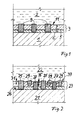
- coating for a good heat transfer shows a cross-section shown area of a cooking utensil 1 as a section of a cooking food to be heated 2 non-stick cooking appliance 4.
- cooking appliances 4 are understood in particular pots and pans.
- the soil material the cooking appliance 4 a good heat conducting material, such as aluminum; however, steel or cast iron could also be used as a less thermally conductive material.
- the surface 6 of the cooking appliance base 1, ie the cooking appliance inner bottom 2 has a roughness between 15 microns and 30 microns. Preferably, one will choose a roughness of about 20 microns.
- the indication of the roughness is defined as the height difference between the highest elevation and the deepest bulge.
- the roughness is preferably produced by sandblasting with a coarse and a fine corundum powder, whereby a coarse structure with an average of 5 to 10 "elevations" per millimeter arises on the ground, which has a fine structure of on average 100 to 30 "elevations”. is superimposed per millimeter.
- the roughness since it is almost negligible in their dimensions compared to the dimensions of particles and particles to be stored in the coatings 3 , is not shown.
- An anti-adhesive coating 3 has directly on the roughened inner bottom 6 lying a thin primer 5 and above this an anti-adhesive layer 7.
- the very thin primer 5 has a layer thickness typically between 2 microns and 10 microns, preferably one will choose a layer thickness of 5 microns
- the non-stick layer 7 typically has a layer thickness between 15 ⁇ m and 30 ⁇ m; Preferably, one will choose a layer thickness of about 20 microns.
- thermally conductive particles 9 are embedded with a thermal conductivity greater than 200 W / m ⁇ ° K.
- the surface of the coating 3 generally follows the profile of coarse roughness with a profile overlay by the particles and particles to be stored.
- the size and the position of the particles in the coating 3 is such that they rest directly on the cooking appliance interior bottom 6 , ie with a mechanical contact.
- a direct mechanical contact is difficult to achieve because often forms a thin cuticle by atmospheric influences.
- material of the primer 5 may creep under the heat-conductive particles 9 ". Atmospheric influences can largely be avoided by a protective gas atmosphere during the coating.
- a contact tolerance of less than 7 microns, d h. less than about 10% of the total thickness of the layer 3 is a good heat input into the heat-conductive particles 9 is given.
- a contact tolerance a tolerable distance of the bottom 10 of the heat-conductive particles 9 to the naked cooking appliance interior bottom 6 is understood. An estimate of the contact tolerance is given at the beginning.
- a layer outside tolerance is understood to mean a tolerance which indicates whether the top side of the heat-conducting particle lies exactly in the outer side of the view (tolerance zero), protrudes beyond the layer (positive tolerance) or comes to lie below the outside of the layer (negative tolerance).
- the layer outside tolerance is ⁇ 10%.
- the layer outside tolerance should be as high as zero; but it can also be negative (tunneling).
- the layer outside tolerance should be negative.
- section of a pan bottom 1 are used as thermally conductive particles 9 diamonds.
- a coating 7 containing essentially polytetrafluoroethylene (PTFE) is preferably selected.
- the coating 7 also contains, depending on the recipe, other materials in the percentage range.
- the primer 5 also contains PTFE, but in a lower concentration.
- the primer also contains substantial amounts of perfuoralkyd, silicon dioxide and polyamideimide. Depending on the recipe, other substances in the percentage range, such. Color pigments, to be included.
- the thermal conductivity of the layers 5 and 7, for the time being without well-conducting particles introduced according to the invention, is about 0.25 W / m.KDh the thermal conductivity of the layers 5 and 7 is about 1000 times (exactly 944) times smaller than that of the material of the bare aluminum interior floor 1 (236 W / m ⁇ ° K).
- the heat transfer of the two layers should be increased according to the invention in accordance with the following considerations.
- the heat transfer of the coating should now be increased by a factor of 5, ie to 1 W / m ⁇ ° K.
- the total layer thickness is 25 .mu.m diamonds with a diameter of about 25 .mu.m - here for example with a thermal conductivity of 2300 W / m ⁇ ° K - are added to increase the heat transfer.
- F D is the area occupied by diamonds and F S is the remaining area of the layer.
- diamonds are expensive. In the dimensions proposed here, however, diamonds are not for decorative purposes, but only industrially usable; Also here is not the appearance of the diamonds, but only their physical properties are crucial. Such diamonds are generally available inexpensively.
- aluminum particles can also be used to replace the diamonds. However, aluminum has approximately ten times less thermal conductivity than diamond, is not anti-adhesive, and is far removed from the hardness of diamonds. If diamonds are replaced by aluminum particles, crystals or particles of high hardness must be added to achieve sufficiently high abrasion resistance. For this purpose, z. As corundum, silicon carbide and related materials.
- the aluminum particles should not oxidize as much as possible - alumina is a poor conductor of heat - should the aluminum particles surrounding, non-sticky layer, have a basic character.
- the aluminum particles can now be round as beads or as fission products square. In the examples described here, angular aluminum particles have proven better than spherical ones.
- Aluminum particles have inferior properties to diamonds in terms of thermal conductivity and hardness.
- the thermal conductivity of aluminum particles can be significantly improved by an addition with carbon nanotubes. Not only the thermal conductivity is improved, but also the strength, which can be increased up to that of steel.
- Baytubes from Bayer MaterialSciences may be mentioned as a company product which can be used for this purpose, for example.
- Carbonnanotubes have a thermal conductivity of about 6000 W / m ⁇ ° K, about twice the value of diamonds.
- the aluminum particles additized with carbon nanotubes thus come close to the thermal conductivity of the diamond.
- nanotubes can also be integrated directly into the non-stick coating.
- Carbonnanotubes are very thin tubes, with ratios of 1: 132'000'000 have already been achieved for a length to diameter ratio of the tubes.
- Nanotubes have a diameter of about one nanometer and can be up to several microns or even millimeters long. Due to the good thermal conductivity in our application, the tubes can now be sprayed onto the bottom of the cooking appliance together with the coating material. Spraying can take place in such a way that parts of a "nanotube mat" or bundles of nanotubes or the nanotubes alone are sprayed on.
- the carbon nanotubes standing approximately perpendicular to the cooking appliance interior bottom surface one can use an electrostatic wet spraying process.
- the cooking utensil is grounded and an electrically conductive paint sprayed as a non-stick coating material with a very high voltage (20 kV to 100 kV) on the roughened cooking appliance interior floor.
- the nanotubes sprayed with the "paint" then stand more or less vertically on the cooking appliance interior floor.
- this is degreased and sandblasted with an abrasive agent.
- sandblasting will usually use corundum powder.
- the corundum powder has a fine grain, the coarse grains are mixed.
- the coarse and fine grains create a coarsely roughened structure with a fine substructure.
- the surface 6 of the cooking appliance inner bottom 1 has a coarse structure of about one to two hundred micrometres superimposed on a fine structure of about ten to thirty microns.
- a primer layer is applied in a wet spraying process.
- the above-mentioned, thermally conductive particles are already applied depending on the intended use.
- the material for the primer layer essentially contains polytetrafluoroethylene, perfluoroalkyne, silica and polyamideimide; other additives are added depending on the required flow requirements.
- This primer is followed by a heat-conductive particles laterally or superficially enveloping non-stick PTFE layer with essential constituents of polytetrafluoroethylene, perfluoroalkyne and color pigment; other additives in the percentage range may be included.
- the proportion of polytetrafluoroethylene here is about five to six times as high as in the primer layer.
- the non-stick layer may also be essentially a sol gel, or be composed of silicates or silicone.
- the heat-conducting particles are then enclosed by such a material.
- the sol gel contains essentially amorphous silica, alkyltrialkoxysilane and silicon carbide powder.
- the solgel is applied wet on wet in several layers. Each applied layer only evaporates very briefly; the next layer is then sprayed onto this still wet layer. There is no distinction here between primer and the layer lying on it, in particular anti-adhesive layer; both layers are one.
- the total layer thickness varies depending on the use between 2 microns and 15 microns.
- the finished coating is then sintered at about 200 ° C.
- the heat-conductive particles to be introduced are to be chosen between about 2 ⁇ m and 15 ⁇ m, depending on the selected layer thickness.
- a heat conduction in the range from about 0.2 W / m ⁇ ° K to 0.4 W / m ⁇ ° K, that is analogous to the values given at the outset, can be assumed.
- the layer thickness is now smaller, also reduces the percentage of heat-conductive particles to be stored.
- an anti-adhesive coating on a cooking appliance interior floor can also be designed as a solgel.
- the coating material must fix very well in the order of magnitude of the layer thickness good heat-conducting particles, so that during later use of the cooking appliance by a scraper, spoon, etc., as it is used during heating for turning and stirring the food, worked out during the period of use ( rubbed out). The scraper, the spoon, etc. finally attacks directly on the particle or in its immediate vicinity. Satisfactory results were obtained with the coatings described above. According to the comments below, further coatings with the properties listed there can be used.
- a fixation of the particles can be achieved in particular with the primer, wherein in the primer z. B. contained amines hold the particles well.
- the layer thickness of the primer should be increased (up to a thickness of 10 microns).
- the primer is then, in order to achieve a sufficient anti-adhesive effect in the cooking utensil, at least with a layer thickness of 10 microns, to cover with a non-sticky material.
- FIG. 2 is a cross-section of a coating 23 with a good heat transfer in a cooking appliance 24 from its surface 26 of the inner bottom 21 to the cooking product 22 shown in cross section.
- a primer layer 25 and an anti-adhesion layer 27 are present.
- diamond particles 25 and aluminum particles 27 for thermal conduction and silver or silver alloy particles 29 for antimicrobial action are incorporated.
- the diamond and aluminum particles 25 and 27 rest on the bare inner bottom surface 26 with a contact tolerance that is as close as possible to zero.
- the diamond particles 25 protrude beyond the coating outer side 33 with a coating outside tolerance 31 .
- Coating Outer Side Tolerance 31 may approach zero, but should (but can not) be negative for diamond particles.
- the aluminum particles 27 as stated above, must not project beyond the coating outer side 33 ; they have a negative outside coating tolerance 35.
- the antimicrobial particles 29 eg, silver, silver compounds
- the antimicrobial particles 29 must definitely project beyond the coating exterior 33 (positive outside coating tolerance), but they do not require contact with the inside bottom surface 26.
- Using antimicrobial particles containing silver or another good conductor of heat as an element at least approximately direct contact of the inner bottom surface 26 would be advantageous in increasing heat transfer.
Landscapes
- Chemical & Material Sciences (AREA)
- Engineering & Computer Science (AREA)
- Chemical Kinetics & Catalysis (AREA)
- Materials Engineering (AREA)
- Mechanical Engineering (AREA)
- Metallurgy (AREA)
- Organic Chemistry (AREA)
- Food Science & Technology (AREA)
- Cookers (AREA)
Priority Applications (1)
| Application Number | Priority Date | Filing Date | Title |
|---|---|---|---|
| EP12405111.1A EP2586892B1 (fr) | 2011-10-25 | 2012-10-18 | Appareil de cuisson |
Applications Claiming Priority (2)
| Application Number | Priority Date | Filing Date | Title |
|---|---|---|---|
| EP11405345.7A EP2586891A1 (fr) | 2011-10-25 | 2011-10-25 | Appareil de cuisson |
| EP12405111.1A EP2586892B1 (fr) | 2011-10-25 | 2012-10-18 | Appareil de cuisson |
Publications (3)
| Publication Number | Publication Date |
|---|---|
| EP2586892A2 true EP2586892A2 (fr) | 2013-05-01 |
| EP2586892A3 EP2586892A3 (fr) | 2014-05-21 |
| EP2586892B1 EP2586892B1 (fr) | 2017-04-12 |
Family
ID=47046505
Family Applications (2)
| Application Number | Title | Priority Date | Filing Date |
|---|---|---|---|
| EP11405345.7A Withdrawn EP2586891A1 (fr) | 2011-10-25 | 2011-10-25 | Appareil de cuisson |
| EP12405111.1A Active EP2586892B1 (fr) | 2011-10-25 | 2012-10-18 | Appareil de cuisson |
Family Applications Before (1)
| Application Number | Title | Priority Date | Filing Date |
|---|---|---|---|
| EP11405345.7A Withdrawn EP2586891A1 (fr) | 2011-10-25 | 2011-10-25 | Appareil de cuisson |
Country Status (1)
| Country | Link |
|---|---|
| EP (2) | EP2586891A1 (fr) |
Cited By (1)
| Publication number | Priority date | Publication date | Assignee | Title |
|---|---|---|---|---|
| DE102016118832A1 (de) * | 2016-10-05 | 2018-04-05 | Warimex Waren-Import Export Handels-Gmbh | Kochgeschirr |
Families Citing this family (2)
| Publication number | Priority date | Publication date | Assignee | Title |
|---|---|---|---|---|
| CN114532868B (zh) * | 2022-01-12 | 2024-07-12 | 广东美的厨房电器制造有限公司 | 一种厨房电器、烹饪箱体及其制作方法 |
| TWI838292B (zh) * | 2023-06-29 | 2024-04-01 | 樺榆國際有限公司 | 鑽石不沾表面及其烹飪器具 |
Citations (3)
| Publication number | Priority date | Publication date | Assignee | Title |
|---|---|---|---|---|
| JPH0767784B2 (ja) | 1990-10-11 | 1995-07-26 | 信越化学工業株式会社 | シリコーンゴム積層体及びその製造方法 |
| JPH08173321A (ja) | 1994-12-27 | 1996-07-09 | Toshiba Tungaloy Co Ltd | 調理器具 |
| EP1048751A1 (fr) | 1999-04-29 | 2000-11-02 | Hort, Stefan | Procédé pour appliquer un revêtement dur sur un substrat et substrat revêtu |
Family Cites Families (2)
| Publication number | Priority date | Publication date | Assignee | Title |
|---|---|---|---|---|
| JPH0767784A (ja) | 1993-08-31 | 1995-03-14 | Toshiba Home Technol Corp | 調理器の調理プレート |
| US7858188B2 (en) * | 2005-12-14 | 2010-12-28 | Dupont-Mitsui Fluorochemicals Co Ltd | Non-stick coating composition comprising diamond particles and substrate |
-
2011
- 2011-10-25 EP EP11405345.7A patent/EP2586891A1/fr not_active Withdrawn
-
2012
- 2012-10-18 EP EP12405111.1A patent/EP2586892B1/fr active Active
Patent Citations (3)
| Publication number | Priority date | Publication date | Assignee | Title |
|---|---|---|---|---|
| JPH0767784B2 (ja) | 1990-10-11 | 1995-07-26 | 信越化学工業株式会社 | シリコーンゴム積層体及びその製造方法 |
| JPH08173321A (ja) | 1994-12-27 | 1996-07-09 | Toshiba Tungaloy Co Ltd | 調理器具 |
| EP1048751A1 (fr) | 1999-04-29 | 2000-11-02 | Hort, Stefan | Procédé pour appliquer un revêtement dur sur un substrat et substrat revêtu |
Cited By (1)
| Publication number | Priority date | Publication date | Assignee | Title |
|---|---|---|---|---|
| DE102016118832A1 (de) * | 2016-10-05 | 2018-04-05 | Warimex Waren-Import Export Handels-Gmbh | Kochgeschirr |
Also Published As
| Publication number | Publication date |
|---|---|
| EP2586892A3 (fr) | 2014-05-21 |
| EP2586892B1 (fr) | 2017-04-12 |
| EP2586891A1 (fr) | 2013-05-01 |
Similar Documents
| Publication | Publication Date | Title |
|---|---|---|
| EP0510546B1 (fr) | Procédé pour le revêtement d'utensiles de ménage ou de cuisine | |
| DE69529420T2 (de) | Photokatalytisch funktionelles material und methode zu dessen herstellung | |
| DE60007855T2 (de) | Antihaftbeschichtung mit verbesserter kratzfestigkeit | |
| DE202010008753U1 (de) | Kochbehälter mit Antihaftbeschichtung | |
| EP2586892B1 (fr) | Appareil de cuisson | |
| DE1521401A1 (de) | Weichloetverfahren an einer Nickeloberflaeche und Koerper mit einer durch dieses Verfahren erhaltenen Loetverbindung | |
| DE112015005139T5 (de) | Kochgerät mit langer Lebensdauer | |
| DE2851729C2 (de) | Blendgold, Verfahren zum Verblenden gegossener oder gesinterter metallischer Zahnprothesen oder Zahnprothesenteile und Anwendung des Blendgoldes | |
| DE2152770C3 (de) | Haftgrundierung auf der Basis einer wäßrigen Dispersion eines FluorkoMenstoffpolymerisatharzes und deren Verwendung | |
| DE2550703C2 (de) | Mehrschichtiges Metallprodukt | |
| DE4323117C1 (de) | Verfahren zum Beschichten von Haus- und Küchengerätschaften und Haus- und Küchengerätschaft | |
| DE2838508A1 (de) | Elektrischer widerstand mit positivem temperaturkoeffizienten des widerstandswertes | |
| EP0285161B1 (fr) | Récipient de cuisson muni d'un revêtement anti-adhérent | |
| DE8816295U1 (de) | Beschichtete Platte für Haushaltsgeräte | |
| DE3142747C2 (de) | Perforierte, mit einer metallenen Schicht überzogene Metallfolie aus einem Schwermetall als Filter | |
| DE3806699A1 (de) | Verfahren zum beschichten von haushaltsgegenstaenden und haushaltsgegenstand | |
| DE1951140C3 (de) | Verfahren zum Herstellen eines metallischen Mehrschichtkörpers | |
| EP3261493A1 (fr) | Procédé de fabrication d'un ressort d'ameublement, ressort d'ameublement, matelas et meuble rembourré | |
| DE556817C (de) | Brat- oder Backgeschirr | |
| DE2900333A1 (de) | Plattiertes metallprodukt und verfahren zu seiner herstellung | |
| DE69105419T2 (de) | Heizelement und Verfahren zu seiner Herstellung. | |
| DE19902078B4 (de) | Gegenstand mit einer Fluorpolymer und Bindeharz enthaltenden Beschichtung, Verfahren zu dessen Herstellung und dessen Verwendung | |
| DE102024128075A1 (de) | Vorrichtung mit einer Oberfläche und einem antimikrobiellen Mittel zur Hemmung eines mikrobiellen Wachstums auf der Oberfläche | |
| DE3424635A1 (de) | Emailliertes kochgeschirr | |
| DE2821408B2 (de) | Mehrschichtiger Metallwerkstoff |
Legal Events
| Date | Code | Title | Description |
|---|---|---|---|
| PUAI | Public reference made under article 153(3) epc to a published international application that has entered the european phase |
Free format text: ORIGINAL CODE: 0009012 |
|
| AK | Designated contracting states |
Kind code of ref document: A2 Designated state(s): AL AT BE BG CH CY CZ DE DK EE ES FI FR GB GR HR HU IE IS IT LI LT LU LV MC MK MT NL NO PL PT RO RS SE SI SK SM TR |
|
| AX | Request for extension of the european patent |
Extension state: BA ME |
|
| PUAL | Search report despatched |
Free format text: ORIGINAL CODE: 0009013 |
|
| AK | Designated contracting states |
Kind code of ref document: A3 Designated state(s): AL AT BE BG CH CY CZ DE DK EE ES FI FR GB GR HR HU IE IS IT LI LT LU LV MC MK MT NL NO PL PT RO RS SE SI SK SM TR |
|
| AX | Request for extension of the european patent |
Extension state: BA ME |
|
| RIC1 | Information provided on ipc code assigned before grant |
Ipc: A47J 36/02 20060101ALI20140415BHEP Ipc: C23C 30/00 20060101AFI20140415BHEP Ipc: A47J 36/00 20060101ALI20140415BHEP Ipc: C23C 28/04 20060101ALI20140415BHEP |
|
| 17P | Request for examination filed |
Effective date: 20140917 |
|
| RBV | Designated contracting states (corrected) |
Designated state(s): AL AT BE BG CH CY CZ DE DK EE ES FI FR GB GR HR HU IE IS IT LI LT LU LV MC MK MT NL NO PL PT RO RS SE SI SK SM TR |
|
| 17Q | First examination report despatched |
Effective date: 20151021 |
|
| GRAP | Despatch of communication of intention to grant a patent |
Free format text: ORIGINAL CODE: EPIDOSNIGR1 |
|
| INTG | Intention to grant announced |
Effective date: 20160624 |
|
| GRAS | Grant fee paid |
Free format text: ORIGINAL CODE: EPIDOSNIGR3 |
|
| GRAJ | Information related to disapproval of communication of intention to grant by the applicant or resumption of examination proceedings by the epo deleted |
Free format text: ORIGINAL CODE: EPIDOSDIGR1 |
|
| GRAL | Information related to payment of fee for publishing/printing deleted |
Free format text: ORIGINAL CODE: EPIDOSDIGR3 |
|
| INTC | Intention to grant announced (deleted) | ||
| GRAP | Despatch of communication of intention to grant a patent |
Free format text: ORIGINAL CODE: EPIDOSNIGR1 |
|
| INTG | Intention to grant announced |
Effective date: 20161201 |
|
| GRAA | (expected) grant |
Free format text: ORIGINAL CODE: 0009210 |
|
| AK | Designated contracting states |
Kind code of ref document: B1 Designated state(s): AL AT BE BG CH CY CZ DE DK EE ES FI FR GB GR HR HU IE IS IT LI LT LU LV MC MK MT NL NO PL PT RO RS SE SI SK SM TR |
|
| REG | Reference to a national code |
Ref country code: GB Ref legal event code: FG4D Free format text: NOT ENGLISH |
|
| REG | Reference to a national code |
Ref country code: CH Ref legal event code: EP |
|
| REG | Reference to a national code |
Ref country code: IE Ref legal event code: FG4D Free format text: LANGUAGE OF EP DOCUMENT: GERMAN |
|
| REG | Reference to a national code |
Ref country code: AT Ref legal event code: REF Ref document number: 883973 Country of ref document: AT Kind code of ref document: T Effective date: 20170515 |
|
| REG | Reference to a national code |
Ref country code: DE Ref legal event code: R096 Ref document number: 502012010036 Country of ref document: DE |
|
| REG | Reference to a national code |
Ref country code: NL Ref legal event code: MP Effective date: 20170412 |
|
| REG | Reference to a national code |
Ref country code: LT Ref legal event code: MG4D |
|
| REG | Reference to a national code |
Ref country code: FR Ref legal event code: PLFP Year of fee payment: 6 |
|
| PG25 | Lapsed in a contracting state [announced via postgrant information from national office to epo] |
Ref country code: NL Free format text: LAPSE BECAUSE OF FAILURE TO SUBMIT A TRANSLATION OF THE DESCRIPTION OR TO PAY THE FEE WITHIN THE PRESCRIBED TIME-LIMIT Effective date: 20170412 |
|
| PG25 | Lapsed in a contracting state [announced via postgrant information from national office to epo] |
Ref country code: LT Free format text: LAPSE BECAUSE OF FAILURE TO SUBMIT A TRANSLATION OF THE DESCRIPTION OR TO PAY THE FEE WITHIN THE PRESCRIBED TIME-LIMIT Effective date: 20170412 Ref country code: NO Free format text: LAPSE BECAUSE OF FAILURE TO SUBMIT A TRANSLATION OF THE DESCRIPTION OR TO PAY THE FEE WITHIN THE PRESCRIBED TIME-LIMIT Effective date: 20170712 Ref country code: ES Free format text: LAPSE BECAUSE OF FAILURE TO SUBMIT A TRANSLATION OF THE DESCRIPTION OR TO PAY THE FEE WITHIN THE PRESCRIBED TIME-LIMIT Effective date: 20170412 Ref country code: GR Free format text: LAPSE BECAUSE OF FAILURE TO SUBMIT A TRANSLATION OF THE DESCRIPTION OR TO PAY THE FEE WITHIN THE PRESCRIBED TIME-LIMIT Effective date: 20170713 Ref country code: HR Free format text: LAPSE BECAUSE OF FAILURE TO SUBMIT A TRANSLATION OF THE DESCRIPTION OR TO PAY THE FEE WITHIN THE PRESCRIBED TIME-LIMIT Effective date: 20170412 Ref country code: FI Free format text: LAPSE BECAUSE OF FAILURE TO SUBMIT A TRANSLATION OF THE DESCRIPTION OR TO PAY THE FEE WITHIN THE PRESCRIBED TIME-LIMIT Effective date: 20170412 |
|
| PG25 | Lapsed in a contracting state [announced via postgrant information from national office to epo] |
Ref country code: LV Free format text: LAPSE BECAUSE OF FAILURE TO SUBMIT A TRANSLATION OF THE DESCRIPTION OR TO PAY THE FEE WITHIN THE PRESCRIBED TIME-LIMIT Effective date: 20170412 Ref country code: SE Free format text: LAPSE BECAUSE OF FAILURE TO SUBMIT A TRANSLATION OF THE DESCRIPTION OR TO PAY THE FEE WITHIN THE PRESCRIBED TIME-LIMIT Effective date: 20170412 Ref country code: RS Free format text: LAPSE BECAUSE OF FAILURE TO SUBMIT A TRANSLATION OF THE DESCRIPTION OR TO PAY THE FEE WITHIN THE PRESCRIBED TIME-LIMIT Effective date: 20170412 Ref country code: IS Free format text: LAPSE BECAUSE OF FAILURE TO SUBMIT A TRANSLATION OF THE DESCRIPTION OR TO PAY THE FEE WITHIN THE PRESCRIBED TIME-LIMIT Effective date: 20170812 Ref country code: BG Free format text: LAPSE BECAUSE OF FAILURE TO SUBMIT A TRANSLATION OF THE DESCRIPTION OR TO PAY THE FEE WITHIN THE PRESCRIBED TIME-LIMIT Effective date: 20170712 Ref country code: PL Free format text: LAPSE BECAUSE OF FAILURE TO SUBMIT A TRANSLATION OF THE DESCRIPTION OR TO PAY THE FEE WITHIN THE PRESCRIBED TIME-LIMIT Effective date: 20170412 |
|
| REG | Reference to a national code |
Ref country code: DE Ref legal event code: R097 Ref document number: 502012010036 Country of ref document: DE |
|
| PG25 | Lapsed in a contracting state [announced via postgrant information from national office to epo] |
Ref country code: EE Free format text: LAPSE BECAUSE OF FAILURE TO SUBMIT A TRANSLATION OF THE DESCRIPTION OR TO PAY THE FEE WITHIN THE PRESCRIBED TIME-LIMIT Effective date: 20170412 Ref country code: CZ Free format text: LAPSE BECAUSE OF FAILURE TO SUBMIT A TRANSLATION OF THE DESCRIPTION OR TO PAY THE FEE WITHIN THE PRESCRIBED TIME-LIMIT Effective date: 20170412 Ref country code: DK Free format text: LAPSE BECAUSE OF FAILURE TO SUBMIT A TRANSLATION OF THE DESCRIPTION OR TO PAY THE FEE WITHIN THE PRESCRIBED TIME-LIMIT Effective date: 20170412 Ref country code: RO Free format text: LAPSE BECAUSE OF FAILURE TO SUBMIT A TRANSLATION OF THE DESCRIPTION OR TO PAY THE FEE WITHIN THE PRESCRIBED TIME-LIMIT Effective date: 20170412 Ref country code: SK Free format text: LAPSE BECAUSE OF FAILURE TO SUBMIT A TRANSLATION OF THE DESCRIPTION OR TO PAY THE FEE WITHIN THE PRESCRIBED TIME-LIMIT Effective date: 20170412 |
|
| PLBE | No opposition filed within time limit |
Free format text: ORIGINAL CODE: 0009261 |
|
| STAA | Information on the status of an ep patent application or granted ep patent |
Free format text: STATUS: NO OPPOSITION FILED WITHIN TIME LIMIT |
|
| PG25 | Lapsed in a contracting state [announced via postgrant information from national office to epo] |
Ref country code: SM Free format text: LAPSE BECAUSE OF FAILURE TO SUBMIT A TRANSLATION OF THE DESCRIPTION OR TO PAY THE FEE WITHIN THE PRESCRIBED TIME-LIMIT Effective date: 20170412 |
|
| 26N | No opposition filed |
Effective date: 20180115 |
|
| PG25 | Lapsed in a contracting state [announced via postgrant information from national office to epo] |
Ref country code: MC Free format text: LAPSE BECAUSE OF FAILURE TO SUBMIT A TRANSLATION OF THE DESCRIPTION OR TO PAY THE FEE WITHIN THE PRESCRIBED TIME-LIMIT Effective date: 20170412 Ref country code: SI Free format text: LAPSE BECAUSE OF FAILURE TO SUBMIT A TRANSLATION OF THE DESCRIPTION OR TO PAY THE FEE WITHIN THE PRESCRIBED TIME-LIMIT Effective date: 20170412 |
|
| GBPC | Gb: european patent ceased through non-payment of renewal fee |
Effective date: 20171018 |
|
| REG | Reference to a national code |
Ref country code: IE Ref legal event code: MM4A |
|
| PG25 | Lapsed in a contracting state [announced via postgrant information from national office to epo] |
Ref country code: GB Free format text: LAPSE BECAUSE OF NON-PAYMENT OF DUE FEES Effective date: 20171018 Ref country code: LU Free format text: LAPSE BECAUSE OF NON-PAYMENT OF DUE FEES Effective date: 20171018 |
|
| REG | Reference to a national code |
Ref country code: BE Ref legal event code: MM Effective date: 20171031 |
|
| PG25 | Lapsed in a contracting state [announced via postgrant information from national office to epo] |
Ref country code: BE Free format text: LAPSE BECAUSE OF NON-PAYMENT OF DUE FEES Effective date: 20171031 |
|
| PG25 | Lapsed in a contracting state [announced via postgrant information from national office to epo] |
Ref country code: MT Free format text: LAPSE BECAUSE OF FAILURE TO SUBMIT A TRANSLATION OF THE DESCRIPTION OR TO PAY THE FEE WITHIN THE PRESCRIBED TIME-LIMIT Effective date: 20170412 |
|
| PG25 | Lapsed in a contracting state [announced via postgrant information from national office to epo] |
Ref country code: IE Free format text: LAPSE BECAUSE OF NON-PAYMENT OF DUE FEES Effective date: 20171018 |
|
| REG | Reference to a national code |
Ref country code: FR Ref legal event code: PLFP Year of fee payment: 7 |
|
| REG | Reference to a national code |
Ref country code: AT Ref legal event code: MM01 Ref document number: 883973 Country of ref document: AT Kind code of ref document: T Effective date: 20171018 |
|
| PG25 | Lapsed in a contracting state [announced via postgrant information from national office to epo] |
Ref country code: AT Free format text: LAPSE BECAUSE OF NON-PAYMENT OF DUE FEES Effective date: 20171018 |
|
| PG25 | Lapsed in a contracting state [announced via postgrant information from national office to epo] |
Ref country code: HU Free format text: LAPSE BECAUSE OF FAILURE TO SUBMIT A TRANSLATION OF THE DESCRIPTION OR TO PAY THE FEE WITHIN THE PRESCRIBED TIME-LIMIT; INVALID AB INITIO Effective date: 20121018 |
|
| PG25 | Lapsed in a contracting state [announced via postgrant information from national office to epo] |
Ref country code: CY Free format text: LAPSE BECAUSE OF NON-PAYMENT OF DUE FEES Effective date: 20170412 |
|
| PG25 | Lapsed in a contracting state [announced via postgrant information from national office to epo] |
Ref country code: MK Free format text: LAPSE BECAUSE OF FAILURE TO SUBMIT A TRANSLATION OF THE DESCRIPTION OR TO PAY THE FEE WITHIN THE PRESCRIBED TIME-LIMIT Effective date: 20170412 |
|
| PG25 | Lapsed in a contracting state [announced via postgrant information from national office to epo] |
Ref country code: TR Free format text: LAPSE BECAUSE OF FAILURE TO SUBMIT A TRANSLATION OF THE DESCRIPTION OR TO PAY THE FEE WITHIN THE PRESCRIBED TIME-LIMIT Effective date: 20170412 |
|
| PG25 | Lapsed in a contracting state [announced via postgrant information from national office to epo] |
Ref country code: PT Free format text: LAPSE BECAUSE OF FAILURE TO SUBMIT A TRANSLATION OF THE DESCRIPTION OR TO PAY THE FEE WITHIN THE PRESCRIBED TIME-LIMIT Effective date: 20170412 |
|
| PG25 | Lapsed in a contracting state [announced via postgrant information from national office to epo] |
Ref country code: AL Free format text: LAPSE BECAUSE OF FAILURE TO SUBMIT A TRANSLATION OF THE DESCRIPTION OR TO PAY THE FEE WITHIN THE PRESCRIBED TIME-LIMIT Effective date: 20170412 |
|
| PGFP | Annual fee paid to national office [announced via postgrant information from national office to epo] |
Ref country code: FR Payment date: 20250909 Year of fee payment: 14 |
|
| REG | Reference to a national code |
Ref country code: CH Ref legal event code: U11 Free format text: ST27 STATUS EVENT CODE: U-0-0-U10-U11 (AS PROVIDED BY THE NATIONAL OFFICE) Effective date: 20251101 |
|
| PGFP | Annual fee paid to national office [announced via postgrant information from national office to epo] |
Ref country code: DE Payment date: 20250911 Year of fee payment: 14 |
|
| PGFP | Annual fee paid to national office [announced via postgrant information from national office to epo] |
Ref country code: IT Payment date: 20251022 Year of fee payment: 14 |
|
| PGFP | Annual fee paid to national office [announced via postgrant information from national office to epo] |
Ref country code: CH Payment date: 20251101 Year of fee payment: 14 |