EP2587324A2 - Méthode et dispositif pour l'usinage du bois - Google Patents
Méthode et dispositif pour l'usinage du bois Download PDFInfo
- Publication number
- EP2587324A2 EP2587324A2 EP12190236.5A EP12190236A EP2587324A2 EP 2587324 A2 EP2587324 A2 EP 2587324A2 EP 12190236 A EP12190236 A EP 12190236A EP 2587324 A2 EP2587324 A2 EP 2587324A2
- Authority
- EP
- European Patent Office
- Prior art keywords
- workpiece
- prompt
- enter
- datum
- control unit
- Prior art date
- Legal status (The legal status is an assumption and is not a legal conclusion. Google has not performed a legal analysis and makes no representation as to the accuracy of the status listed.)
- Withdrawn
Links
Images



Classifications
-
- G—PHYSICS
- G05—CONTROLLING; REGULATING
- G05B—CONTROL OR REGULATING SYSTEMS IN GENERAL; FUNCTIONAL ELEMENTS OF SUCH SYSTEMS; MONITORING OR TESTING ARRANGEMENTS FOR SUCH SYSTEMS OR ELEMENTS
- G05B19/00—Program-control systems
- G05B19/02—Program-control systems electric
- G05B19/18—Numerical control [NC], i.e. automatically operating machines, in particular machine tools, e.g. in a manufacturing environment, so as to execute positioning, movement or co-ordinated operations by means of program data in numerical form
- G05B19/409—Numerical control [NC], i.e. automatically operating machines, in particular machine tools, e.g. in a manufacturing environment, so as to execute positioning, movement or co-ordinated operations by means of program data in numerical form characterised by using manual data input [MDI] or by using control panel, e.g. controlling functions with the panel; characterised by control panel details or by setting parameters
-
- G—PHYSICS
- G05—CONTROLLING; REGULATING
- G05B—CONTROL OR REGULATING SYSTEMS IN GENERAL; FUNCTIONAL ELEMENTS OF SUCH SYSTEMS; MONITORING OR TESTING ARRANGEMENTS FOR SUCH SYSTEMS OR ELEMENTS
- G05B2219/00—Program-control systems
- G05B2219/30—Nc systems
- G05B2219/45—Nc applications
- G05B2219/45229—Woodworking
Definitions
- the invention relates to a method and an apparatus for machining wood or similar to wood material.
- the invention can be advantageously applied in a numerically controlled machining centre for machining panels made of wood or similar to wood material.
- One of the problems of numerically controlled machining centres for machining wood is that of entering, into the computer memory associated with the programmable control unit that governs the machining centre, the data relating to the features of the workpiece (in particular the dimensions of the workpiece) before the operating unit performs the various programmed machinings on the workpiece.
- This preparatory step requires particular attention on the part of the operator entrusted with setting up the machine. Further, it is necessary for the operator to be previously trained to learn the data-entry procedure. Accordingly, the step of setting up a wood-machining centre has to be conducted by expert personnel and entails, in all cases, a relatively high risk of errors in entering the data required for starting machining, such as, for example, the data relating to the dimensions of the workpiece.
- One object of the invention is to overcome one or more of the prior-art drawbacks mentioned above.
- One advantage is to provide a method for facilitating entering the data required to start machining in a numerically controlled machining centre, such as, for example, the data relating to the dimensions of the workpiece and/or the positions of the machinings to be performed on the workpiece.
- One advantage is to devise a simple and intuitive method for assisting an operator to enter data into a computer memory connected to a control unit that governs an apparatus for machining a workpiece made of wood or a similar to wood material.
- One advantage is to provide a method that enables data to be entered through a procedure that does not require specific operator training.
- One advantage is to make available a method for facilitating the installation of an apparatus for machining a workpiece made of wood or a similar to wood material, in which an operator is guided step by step in the procedure of entering data relating to the dimensions of the workpiece and/or the positions of the machinings to be performed on the workpiece.
- One advantage is enabling even a non-expert operator to correctly and easily run the procedure of entering the data relating to the dimensions of the workpiece, and/or the positions of the machinings to be performed on the workpiece, in a numerically controlled machining centre workpieces made of wood or similar to wood material.
- One object of the present invention is to devise a constructionally simple and cheap apparatus, which is able to implement the above method.
- an assistance method in particular for assisting an operator to enter data into a computer memory connected to a control unit that governs an apparatus for machining a workpiece made of wood or similar to wood material, comprises the step of showing, on a screen of a graphic user interface, a pictogram that represents a workpiece and a graphic highlighting of a dimension of the workpiece to prompt the operator to enter the value of the first dimension; after said value has been entered in the computer memory, a graphic highlighting of a second dimension of the workpiece is shown on the screen to prompt the operator to enter the value of the second dimension.
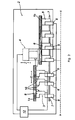
- Figure 1 is a schematic top plan view of a machining centre for panels.
- Figure 2 is a side view of figure 1 .
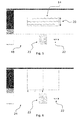
- Figures 3 to 8 illustrate some video pages on a screen of a graphic user interface for guiding an operator in entering data during setting up of a machining centre for panels.
- a workpiece unmachined panel
- an apparatus for machining workpieces made, in particular, of wood or of material that is similar to wood.
- the apparatus comprises a numerically controlled machining centre for panels made of wood or similar to wood material.
- the apparatus 2 can be used for various machinings of the workpiece 1, for example for obtaining machined workpieces 1a, 1b and 1c (panels), in particular for removing chip machinings (for example milling, vertical and horizontal drilling, cuts, etc).
- the apparatus 2 (machining centre) comprises a supporting plane (horizontal supporting plane 3) for at least one workpiece 1 (unmachined panel) and at least one operating unit 4, in which the supporting plane and the operating unit 4 are able to perform movements in relation to one another.
- the operating unit 4 may be supported, as in the specific example, by a portal structure 4a.
- the structure 4a may be movable along the three main axes X, Y, Z.
- the operating unit 4 will be provided with tools 5 machining on the unmachined panel 1 to obtain at least one machined workpiece 1a, 1b or 1c.
- Each operating unit 4 will be arranged, in particular, above the resting plane 3.
- An electronic control unit 12 is configured for governing the machining apparatus 2, in particular for controlling at least the operating unit 4.
- the electronic control unit 12 may be programmed for controlling the resting plane 3 and the operating units 4 in such a manner as to coordinate the movements of the operating units 4 in order to perform the programmed operations.
- the plane 3 and the operating units 4 may be movable in relation to one another at least along three main movement axes (X, Y, Z) controlled by the control unit.
- the supporting plane comprises a plurality of crosspieces 6 (in the form of bars) supported by a base formed, for example, by longitudinal beams 7.
- Each crosspiece 6 has at least one fixing member for locking the workpiece in the machining position on the supporting plane.
- Each fixing member may comprise, as in the case in point, a suction unit 8 having an upper surface 8a that defines the resting plane 3 for the workpiece 1.
- Each suction unit 8 will be connected to sucking means (known and not illustrated) configured for generating a vacuum. This vacuum will operate on each suction unit 8 to lock the workpiece 1 stably.
- the workpiece locking means may comprise (in addition or alternatively to the suction locking means created by the suction units 8), mechanical clamping means of a jaw or clamp type or of any other type.
- Each crosspiece 6 may be slidably supported on the longitudinal beams 7 (that are parallel to one another) in such a manner as to enable the crosspieces 6 to be positioned stably and in relation to one another along the longitudinal axis X of the machining centre 2 (see arrows F6). After adjustment, the crosspieces 6 can be stably locked in position.
- the position of each crosspiece 6 along the axis X may be adjusted by manual sliding (by an operator) on the beams 7, or automatically by means of an automatic movement system (of known type and not shown) connected to the control unit 12 to move the crosspieces 6 along the axis X independently of one another.
- each suction unit 8 may be slidably adjustable in position along the corresponding crosspiece 6, i.e. along the transverse axis Y arranged transversely (perpendicularly) to the first axis X (see arrows F8).
- Each suction unit 8, 8' will, in particular, be slidably coupled with the corresponding crosspiece 6 on sliding guides and may be moved, for example, by a kinematic chain system 51.
- each suction unit may be adjusted along the Y axis by manual sliding (performed by an operator) on the respective crosspiece 6, or automatically by an automatic movement system (for example by subordinating the kinematic system 51 to the control unit 12) connected to the control unit 12 to move the suction units along the axis Y independently of one another.
- each suction unit 8, 8' being provided with movement means 10 along a third vertical axis Z, to move the height of the corresponding upper surface 8a defining the resting plane of the panel 1, thus determining raising or lowering of the panel 1.
- the vertical movement means 10 may be for example, the means disclosed in patent publication EP 1872919 , which is incorporated here by way of reference.
- the control unit 12 is programmed to show, on a screen of a graphic user interface connected to the control unit 12, a video page 13 comprising a pictogram 14 that represents the workpiece ( figure 3 ).
- the workpiece comprises a panel made of wood, for which the data relating to the main dimensions of the panel, i.e. width, length and thickness, have to be entered.
- the video page 13 may further comprise a prompt to enter a first dimension of the workpiece.
- This prompt to enter a first dimension may comprise, as in the case in point, the presentation on the screen of a graphic highlighting of a first portion of the pictogram 14, in which this first portion is associated with the aforesaid first dimension.
- the graphic highlighting comprises, in particular, the drawing of a linear dimension 15 (twin-tipped arrow) relating to the first dimension (for example the length of the panel in the direction of the longitudinal axis X) in which the prompt is given to the operator to enter the numeric value of the dimension (for example by showing at least one question mark in the position where this numeric value is normally present according to the standards of technical drawing, or by making a symbol flash in this position, etc).
- a linear dimension 15 twin-tipped arrow
- the control unit 12 is programmed for receiving, in the computer memory connected to the control unit, a first datum relating to the first dimension.
- the control unit 12 is programmed to show, after the first datum has been received, a video page 16 on the screen comprising the pictogram 14 that represents the workpiece together with a prompt to enter a second dimension of the workpiece ( figure 4 ).
- This prompt to enter the second dimension may comprise, similarly for the prompt for the first dimension (in figure 3 ), graphic highlighting of a second portion of pictogram associated with the aforesaid second dimension.
- the graphic highlighting may comprise (as in the video page 13) the drawing of a linear dimension 17 relating to the second dimension (for example the width of the panel in the direction of the transverse axis Y).
- control unit 12 is programmed to show the graphic highlighting of the second portion (width dimension 17) alternatively to, i.e. not as the same time as, the graphic highlighting of the first portion (length dimension 15) that is therefore not present on the video page 16 ( figure 4 ).
- the control unit 12 is programmed for receiving, in the computer memory, a second datum relating to the aforesaid second dimension, and for showing on the screen, after receiving the second datum, a video page 18 with a pictogram 18 that represents the workpiece together with a prompt to enter a third dimension of the workpiece ( figure 5 ).
- This prompt may comprise graphic highlighting of a third portion of pictogram associated with the aforesaid third dimension.
- This graphic highlighting may comprise the drawing of a linear dimension 20 relating to the third dimension (for example the thickness of the panel in the direction of the vertical axis Z).
- control unit 12 may be programmed for supplying, after receiving the first datum, a prompt to confirm the aforesaid first datum.
- This prompt may comprise, in particular, a touch icon 22 (for example with the word "NEXT” and an arrow) to move to the next procedure step and/or a voice instruction (supplied by a voice user interface connected to the control unit 12) to induce a voice command to be emitted (for example "forwards" or "next” or the like).
- the control unit 12 may be further programmed to receive confirmation of the first datum and to show the prompt to enter the second dimension in response to the aforesaid confirmation.
- the confirmation may be received after a preset touch icon (22) is touched and/or after the emission of a preset voice command.
- the data (for example numeric values of dimensions of the workpiece or of machining positions on the workpiece) may be entered by voice commands via the voice user interface and/or the data can be keyed in (for example by using a touch keyboard 23 of the touchscreen).
- the control unit 12 may be programmed for showing one or more help video pages for entering one or more positions relating to at least one machining that has to be performed on the workpiece.
- control unit 12 may be programmed to show, in response to confirmation of the datum (workpiece thickness) entered with the help of the video page 18 of figure 5 , a subsequent help video page 24 ( figure 6 ) for entering a further dimension, in particular an intermediate length of the workpiece (for example halfway along the workpiece) at which specific machinings have to be performed.
- the program may provide a further (optional) help video page 25 to introduce the numeric value of the diameter of a hole to be made in the workpiece.
- a further (optional) help video page 25 to introduce the numeric value of the diameter of a hole to be made in the workpiece.
- other dimensional values for example, other dimensions of the workpiece and/or other positions of machinings to be performed on the workpiece
- the type of workpiece in particular in function of the conformation
- the control unit 12 may moreover be programmed to show, for example at the end of loading of the data relating to the dimensions of the workpiece and/or to the machining positions on the workpiece, a help video page 26 to prompt the operator choose the zone of the supporting plane where the workpiece should be positioned ( figure 8 ).
- This video page 26 can comprise, for example, a pictogram showing the supporting plane and a plurality of icons (for example touch icons of the touchscreen) for selecting, for example, the right zone ("RIGHT” icon 27) or the left zone (“LEFT” icon 28) of the supporting plane.
- control unit 12 automatically updates the apparatus settings on the basis of this choice.
Landscapes
- Engineering & Computer Science (AREA)
- Human Computer Interaction (AREA)
- Manufacturing & Machinery (AREA)
- Physics & Mathematics (AREA)
- General Physics & Mathematics (AREA)
- Automation & Control Theory (AREA)
- Numerical Control (AREA)
Applications Claiming Priority (1)
| Application Number | Priority Date | Filing Date | Title |
|---|---|---|---|
| IT000275A ITMO20110275A1 (it) | 2011-10-28 | 2011-10-28 | Metodo e apparato per lavorare legno |
Publications (2)
| Publication Number | Publication Date |
|---|---|
| EP2587324A2 true EP2587324A2 (fr) | 2013-05-01 |
| EP2587324A3 EP2587324A3 (fr) | 2016-10-05 |
Family
ID=45464749
Family Applications (1)
| Application Number | Title | Priority Date | Filing Date |
|---|---|---|---|
| EP12190236.5A Withdrawn EP2587324A3 (fr) | 2011-10-28 | 2012-10-26 | Méthode et dispositif pour l'usinage du bois |
Country Status (2)
| Country | Link |
|---|---|
| EP (1) | EP2587324A3 (fr) |
| IT (1) | ITMO20110275A1 (fr) |
Citations (1)
| Publication number | Priority date | Publication date | Assignee | Title |
|---|---|---|---|---|
| EP1872919A1 (fr) | 2006-06-26 | 2008-01-02 | SCM GROUP S.p.A. | Centre d'usinage pour panneaux d'usinage en bois ou similaire |
Family Cites Families (3)
| Publication number | Priority date | Publication date | Assignee | Title |
|---|---|---|---|---|
| JPS60191365A (ja) * | 1984-03-13 | 1985-09-28 | Okuma Mach Works Ltd | 自動プログラミング機能における形状入力方式 |
| JPH07111646B2 (ja) * | 1987-02-20 | 1995-11-29 | フアナツク株式会社 | 部品形状入力方法 |
| US5838328A (en) * | 1989-05-19 | 1998-11-17 | Hewlett-Packard Company | Method for generating graphical models and computer aided design system |
-
2011
- 2011-10-28 IT IT000275A patent/ITMO20110275A1/it unknown
-
2012
- 2012-10-26 EP EP12190236.5A patent/EP2587324A3/fr not_active Withdrawn
Patent Citations (1)
| Publication number | Priority date | Publication date | Assignee | Title |
|---|---|---|---|---|
| EP1872919A1 (fr) | 2006-06-26 | 2008-01-02 | SCM GROUP S.p.A. | Centre d'usinage pour panneaux d'usinage en bois ou similaire |
Also Published As
| Publication number | Publication date |
|---|---|
| ITMO20110275A1 (it) | 2013-04-29 |
| EP2587324A3 (fr) | 2016-10-05 |
Similar Documents
| Publication | Publication Date | Title |
|---|---|---|
| EP2586564B1 (fr) | Méthode et machine d'usinage du bois | |
| JPH0375887B2 (fr) | ||
| KR102302762B1 (ko) | 수평식 자동 가공기 | |
| JP6619947B2 (ja) | ワークローダ装置 | |
| WO2017168727A1 (fr) | Instrument pour mesurer une pièce à travailler et machine-outil | |
| KR102025247B1 (ko) | 다축제어 복합 cnc머신의 가공제어방법 | |
| JP2004058227A (ja) | 数値制御旋盤における工具選択方法及び制御装置 | |
| US10150190B2 (en) | Processing machine line | |
| US20200114436A1 (en) | Cnc sink aperture cutting machine and method | |
| CN111095142A (zh) | 机床 | |
| US8525065B2 (en) | Electric discharge machining apparatus and programming device | |
| KR101527323B1 (ko) | Cnc 탭핑머신 및 제어방법 | |
| EP1247611B1 (fr) | Centre d'usinage à plusieurs axes, pour usinage multiple, en particulier pour le travail du bois | |
| JP5136853B2 (ja) | 数値制御式工作機械及び数値制御式工作機械の制御プログラム | |
| EP2587325A2 (fr) | Procédé et dispositif pour l'usinage du bois | |
| EP2587324A2 (fr) | Méthode et dispositif pour l'usinage du bois | |
| KR102378435B1 (ko) | 감속기를 구비한 v컷팅 머신 | |
| JPWO2018047309A1 (ja) | 加工システム | |
| JP2008540136A (ja) | 板金加工機とシート加工の方法 | |
| CN105522185A (zh) | 数控打孔与切割一体机及其对准方法 | |
| JP2002178186A (ja) | レーザ加工システム及びこのレーザ加工システムを用いたレーザ加工方法 | |
| JP2009181405A (ja) | 数値制御装置及び数値制御装置用移動量補正制御プログラム | |
| KR20120016875A (ko) | 공작기계의 홀 가공을 위한 장치 및 이의 가공 전개 방법 | |
| KR101499362B1 (ko) | 브이 홈 커팅기 제어장치 | |
| US12443161B2 (en) | Computer numerical control (CNC) machine and method for using |
Legal Events
| Date | Code | Title | Description |
|---|---|---|---|
| PUAI | Public reference made under article 153(3) epc to a published international application that has entered the european phase |
Free format text: ORIGINAL CODE: 0009012 |
|
| AK | Designated contracting states |
Kind code of ref document: A2 Designated state(s): AL AT BE BG CH CY CZ DE DK EE ES FI FR GB GR HR HU IE IS IT LI LT LU LV MC MK MT NL NO PL PT RO RS SE SI SK SM TR |
|
| AX | Request for extension of the european patent |
Extension state: BA ME |
|
| PUAL | Search report despatched |
Free format text: ORIGINAL CODE: 0009013 |
|
| AK | Designated contracting states |
Kind code of ref document: A3 Designated state(s): AL AT BE BG CH CY CZ DE DK EE ES FI FR GB GR HR HU IE IS IT LI LT LU LV MC MK MT NL NO PL PT RO RS SE SI SK SM TR |
|
| AX | Request for extension of the european patent |
Extension state: BA ME |
|
| RIC1 | Information provided on ipc code assigned before grant |
Ipc: G05B 19/409 20060101AFI20160829BHEP |
|
| STAA | Information on the status of an ep patent application or granted ep patent |
Free format text: STATUS: THE APPLICATION IS DEEMED TO BE WITHDRAWN |
|
| 18D | Application deemed to be withdrawn |
Effective date: 20170406 |