EP2589935A2 - Drehwinkelerfassungsvorrichtung und Drehmomentsensor - Google Patents
Drehwinkelerfassungsvorrichtung und Drehmomentsensor Download PDFInfo
- Publication number
- EP2589935A2 EP2589935A2 EP12189002.4A EP12189002A EP2589935A2 EP 2589935 A2 EP2589935 A2 EP 2589935A2 EP 12189002 A EP12189002 A EP 12189002A EP 2589935 A2 EP2589935 A2 EP 2589935A2
- Authority
- EP
- European Patent Office
- Prior art keywords
- rotation angle
- planetary gear
- angle
- rotary body
- rotation
- Prior art date
- Legal status (The legal status is an assumption and is not a legal conclusion. Google has not performed a legal analysis and makes no representation as to the accuracy of the status listed.)
- Withdrawn
Links
- 238000001514 detection method Methods 0.000 title claims description 45
- 230000002159 abnormal effect Effects 0.000 claims description 13
- 239000000463 material Substances 0.000 claims description 3
- 230000007246 mechanism Effects 0.000 abstract description 16
- 239000000696 magnetic material Substances 0.000 abstract description 9
- 238000004804 winding Methods 0.000 description 47
- 238000000034 method Methods 0.000 description 11
- 230000008569 process Effects 0.000 description 4
- 230000000694 effects Effects 0.000 description 3
- 230000007935 neutral effect Effects 0.000 description 3
- 230000008859 change Effects 0.000 description 2
- 230000007423 decrease Effects 0.000 description 2
- 238000003780 insertion Methods 0.000 description 2
- 230000037431 insertion Effects 0.000 description 2
- 230000009467 reduction Effects 0.000 description 2
- 239000011347 resin Substances 0.000 description 2
- 229920005989 resin Polymers 0.000 description 2
- XAGFODPZIPBFFR-UHFFFAOYSA-N aluminium Chemical compound [Al] XAGFODPZIPBFFR-UHFFFAOYSA-N 0.000 description 1
- 229910052782 aluminium Inorganic materials 0.000 description 1
- 230000008878 coupling Effects 0.000 description 1
- 238000010168 coupling process Methods 0.000 description 1
- 238000005859 coupling reaction Methods 0.000 description 1
- 238000010586 diagram Methods 0.000 description 1
- 230000004907 flux Effects 0.000 description 1
- 238000000465 moulding Methods 0.000 description 1
- 230000004044 response Effects 0.000 description 1
- 230000000717 retained effect Effects 0.000 description 1
Images



Classifications
-
- G—PHYSICS
- G01—MEASURING; TESTING
- G01D—MEASURING NOT SPECIALLY ADAPTED FOR A SPECIFIC VARIABLE; ARRANGEMENTS FOR MEASURING TWO OR MORE VARIABLES NOT COVERED IN A SINGLE OTHER SUBCLASS; TARIFF METERING APPARATUS; MEASURING OR TESTING NOT OTHERWISE PROVIDED FOR
- G01D5/00—Mechanical means for transferring the output of a sensing member; Means for converting the output of a sensing member to another variable where the form or nature of the sensing member does not constrain the means for converting; Transducers not specially adapted for a specific variable
- G01D5/12—Mechanical means for transferring the output of a sensing member; Means for converting the output of a sensing member to another variable where the form or nature of the sensing member does not constrain the means for converting; Transducers not specially adapted for a specific variable using electric or magnetic means
- G01D5/14—Mechanical means for transferring the output of a sensing member; Means for converting the output of a sensing member to another variable where the form or nature of the sensing member does not constrain the means for converting; Transducers not specially adapted for a specific variable using electric or magnetic means influencing the magnitude of a current or voltage
- G01D5/20—Mechanical means for transferring the output of a sensing member; Means for converting the output of a sensing member to another variable where the form or nature of the sensing member does not constrain the means for converting; Transducers not specially adapted for a specific variable using electric or magnetic means influencing the magnitude of a current or voltage by varying inductance, e.g. by a movable armature
Definitions
- the invention relates to a rotation angle detection device that is able to detect the absolute rotation angle of a rotary body even when the rotation angle is larger than or equal to 360 degrees, and relates also to a torque sensor.
- a power steering system described in Japanese Patent Application Publication No. 2004-245642 includes a torque sensor and an electric motor.
- the torque sensor detects a steering torque that is applied to a steering shaft in response to a driver's operation of a steering wheel.
- the electric motor applies assist torque to the steering shaft.
- the steering shaft is configured such that an input shaft coupled to the steering wheel and a lower shaft coupled to steered wheels of a vehicle via, for example, a rack shaft are coupled to each other via a torsion bar.
- the torque sensor detects the rotation angle of the input shaft and the rotation angle of the lower shaft with the use of rotation angle sensors, and detects a steering torque applied to the steering shaft on the basis of the difference between the detected rotation angles of the respective shafts.
- a steering torque applied to the steering shaft on the basis of the difference between the detected rotation angles of the respective shafts.
- a rotation speed detection unit that detects the rotational speed of the lower shaft is provided, and the absolute steering angle of multiple-turn rotation of the steering wheel is detected on the basis of the rotational speed of the lower shaft, which is detected by the rotation speed detection unit, and the rotation angle of the lower shaft, which is detected with the use of the torque sensor.
- the invention provides a simply-structured rotation angle detection device that is able to detect the absolute rotation angle even when a rotary body is rotated 360 degrees or more, and also provides a torque sensor.
- an absolute rotation angle of a rotary body is detected with the use of a planetary gear mechanism.
- the torque sensor according to the invention is used as a torque sensor of an electric power steering system for a vehicle.
- a steering shaft 2 rotates on the basis of a steering force applied to the steering wheel 1.
- the steering shaft 2 is formed of a column shaft 3, an intermediate shaft 4 and a pinion shaft 5.
- the rotation of the steering shaft 2 is converted into a linear motion of a rack shaft 7 via a rack-and-pinion mechanism 6.
- the reciprocal linear motion of the rack shaft 7 is transmitted to steered wheels 9 via tie rods 8 coupled to respective ends of the rack shaft 7.
- the steered angle of the steered wheels 9 is changed.
- an electric power steering system 10 is structured such that an electric motor 11 is coupled to the column shaft 3 via a speed reduction mechanism 12.
- the electric power steering system 10 reduces the speed of rotation of the electric motor 11 with the use of the speed reduction mechanism 12 and then transmits the rotation with a reduced speed to the column shaft 3. In this way, motor torque is applied to the steering system as assist force.
- the vehicle includes various sensors that detect the state of the vehicle and the operation amount of the steering wheel 1.
- the vehicle includes a vehicle speed sensor 13 that detects a vehicle speed.
- a torque sensor 14 is provided on the steering shaft 2.
- the torque sensor 14 detects a torque that acts on the shaft 2, that is, a steering torque applied to the steering wheel 1 by the driver.
- the torque sensor 14 is used to detect the rotation angle (including an absolute rotation angle that is larger than or equal to 360 degrees) of the steering shaft 2, that is, the steering angle of the steering wheel 1.
- the outputs from these sensors 13, 14 are input into an ECU 15.
- the ECU 15 is mainly formed of a microcomputer, and collectively controls driving of the electric motor 11.
- the ECU 15 calculates a target torque that is a target value of steering torque that is applied by the driver on the basis of the vehicle speed and steering torque detected by the sensors, and executes feedback control on a current that is supplied to the electric motor 11 such that the steering torque detected by the torque sensor 14 coincides with the target torque.
- the column shaft 3 to which the torque sensor 14 is fitted is configured such that an input shaft 20 that may function as a first rotary body and a lower shaft 21 that may function as a second rotary body are coupled to each other via a torsion bar 22 along the same axis.
- the input shaft 20 is rotatably supported by a bearing 80 provided in an upper portion of a housing 30.
- the upper end portion of the input shaft 20 is coupled to the steering wheel 1.
- the lower shaft 21 is rotatably supported by a bearing 81 provided in a lower portion of the housing 30.
- the lower end portion of the lower shaft 21 is coupled to the intermediate shaft 4.
- the housing 30 is formed of a box-shaped first housing 31 and a second housing 32.
- the bearing 80 is provided in the first housing 31, and the lower side of the first housing 31 is open.
- the bearing 81 is provided in the second housing 32, and the second housing 32 closes the opening of the first housing 31. In this way, by forming the housing 30 as a splittable member formed of two portions, it is easy to assemble the housing 30.
- the torque sensor 14 is accommodated inside the housing 30.
- the torque sensor 14 includes a first resolver 40 and a second resolver 50.
- the first resolver 40 may function as a first rotation angle detection device that detects the rotation angle of the input shaft 20.
- the second resolver 50 may function as a second rotation angle detection device that detects the rotation angle of the lower shaft 21.
- the first resolver 40 is formed of a rotor 41 and an annular stator 42.
- the rotor 41 is fixed to the lower end portion of the input shaft 20, and rotates together with the input shaft 20.
- the stator 42 is fixed to the housing 30, and surrounds the rotor 41.
- the rotor 41 is made of a magnetic material. As shown in FIG. 3 , five bulge portions are formed on the outer periphery of the rotor 41. That is, the multiplication factor of angle of the first resolver 40 is set to "5X". Note that the housing 30 is not shown in FIG. 3 .
- the stator 42 is formed of a stator core 44, an exciting winding coil We and six output winding coils W1 to W6.
- the stator core 44 is made of a magnetic material, and has twelve teeth T1 to T12 at angular intervals of 30° such that the teeth T1 to T12 face the rotor 41.
- the exciting winding coil We and the six output winding coils W1 to W6 are wound around these teeth T1 to T12 as described in the following (a1) to (a7).
- voltage signals V1 to V6 based on the rotation angle (electric angle) ⁇ e of the rotor 41 as described in the following (b1) to (b6) are output from the output winding coils W1 to W6, respectively.
- K denotes transformer ratio.
- the exciting winding coil We and the rotor 41 may function as a magnetic field generation unit, and the first to sixth output winding coils W1 to W6 may function as a magnetic field detection unit.
- the six-phase voltage signals V1 to V6 output from the first resolver 40 are input into the ECU 15.
- the second resolver 50 is provided at the upper end portion of the lower shaft 21.
- the second resolver 50 detects the rotation angle of the lower shaft 21.
- the second resolver 50 is formed of a rotor 51 and an annular stator 52.
- the rotor 51 is fixed to the upper end portion of the lower shaft 21, and integrally rotates with the lower shaft 21.
- the stator 52 is fixed to the housing 30, and surrounds the rotor 51. Because the second resolver 50 has basically the same structure as that of the first resolver 40, the detailed description is omitted. Note that the multiplication factor of angle of the second resolver 50 is set to "4X". Voltage signals output from the second resolver 50 are also input into the ECU 15.
- a planetary gear mechanism 60 is provided at the upper portion of the first resolver 40. As shown in FIG. 4 , the planetary gear mechanism 60 is formed of a sun gear 61, an internal gear 62 and a planetary gear 63.
- the sun gear 61 is fixed to the input shaft 20, and rotates together with the input shaft 20.
- the internal gear 62 is provided so as to surround the sun gear 61, and is fixed in the housing 30 (not shown).
- the planetary gear 63 is in mesh with the sun gear 61 and the internal gear 62. Note that the housing 30 is not shown in FIG. 4 .
- Each of the gears 61 to 63 is formed of a bevel gear.
- the outer periphery of the sun gear 61, on which teeth are formed has such a shape that the diameter increases toward the first resolver 40.
- the inner periphery of the internal gear 62, on which teeth are formed has such a shape that the diameter decreases toward the first resolver 40.
- the planetary gear 63 is in mesh with the sun gear 61 and the internal gear 62 with the distal end portion of the planetary gear 63 oriented downward. With this configuration, movement of the planetary gear 63 toward the first resolver 40 is restricted.
- the sun gear 61 and the internal gear 62 each are made of a non-magnetic material.
- the planetary gear 63 is basically made of a magnetic material, and only part of the planetary gear 63, at which teeth are formed, is molded from resin. By molding the part of the planetary gear 63, at which teeth are formed, from resin, occurrence of abnormal noise between the planetary gear 63 and the sun gear 61 and between the planetary gear 63 and the internal gear 62 is suppressed.
- a shaft portion 63a is formed on the upper face of the planetary gear 63. The shaft portion 63a is fitted in a groove 33 formed in the inner wall surface of the housing 30.
- the groove 33 is formed in a circular shape along the orbital path of the planetary gear 63.
- the planetary gear 63 is supported by the groove 33 so as to be able to revolve around the sun gear 61.
- the number of teeth of the sun gear 61 is set to "40" and the number of teeth of the internal gear is set to "50".
- annular stopper 70 for restricting axial movement of the stator 42 is provided between the stator 42 of the first resolver 40 and the stator 52 of the second resolver 50, and an annular stopper 71 for restricting axial movement of the stator 52 is provided between the stator 52 of the second resolver 50 and the second housing 32.
- the ECU 15 executes known arctangent computation on the basis of two voltage signals among the voltage signals V1 to V6 output from the first resolver 40. In this way, the rotation angle (electric angle) of the rotor 41, that is, the rotation angle (electric angle) ⁇ es of the input shaft 20, is obtained. In addition, the ECU 15 also executes arctangent computation on the basis of the voltage signals output from the second resolver 50. In this way, the rotation angle (electric angle) ⁇ ep of the lower shaft 21 is also obtained.
- the ECU 15 computes the difference between the rotation angle ⁇ es of the input shaft 20 and the rotation angle ⁇ ep of the lower shaft 21, and then obtains a steering torque by multiplying the computed difference by the spring constant of the torsion bar 22.
- the ECU 15 obtains the steering angle of the steering wheel 1 by detecting the absolute rotation angle ⁇ ea of the input shaft 20 on the basis of the voltage signals V1 to V6 output from the first resolver 40. In this way, in the present embodiment, the ECU 15 serves as rotation angle detecting means for detecting the steering angle of the steering wheel 1.
- the principle of detection of the absolute rotation angle (electric angle) ⁇ ea of the input shaft 20 will be described with reference to FIG. 3, FIG. 4 and FIG. 7 .
- the description will be provided on the assumption that when the steering wheel 1 is located at a neutral position, the planetary gear 63 is located at a reference position indicated by long dashed double-short dashed line in FIG. 4 .
- a revolving angle is denoted by ⁇ p.
- the revolving angle ⁇ p is an angle formed between a line (dashed line in FIG.
- FIG. 4 shows the absolute rotation angle (electric angle) ⁇ ea of the input shaft 20 in the direction indicated by the arrow a from the reference position of the input shaft 20, which is the position of the input shaft 20 when the steering wheel 1 is at the neutral position.
- FIG. 3 shows the rotation angle ⁇ e of the rotor 41 in the direction indicated by the arrow a from the reference position of the rotor 41, which is the position of the rotor 41 when the steering wheel 1 is at the neutral position.
- the orbital path of the planetary gear 63 (more specifically, the orbital path of a central axis m of the planetary gear 63) is indicated by long dashed short dashed line.
- the input shaft 20 also rotates "202.5°” in absolute angle (mechanical angle).
- the magnetic field applied to the sixth output winding coil W6 changes under the influence of the planetary gear 63.
- the magnitude of the voltage signal V6 output from the sixth output winding coil W6 is larger than the magnitude of a normal voltage signal described in the above (b6), and the voltage signal V6 indicates an abnormal value.
- the ECU 15 compares the magnitudes of the voltage signals V1 to V6 of the first to sixth output winding coils W1 to W6 with a predetermined threshold to identify an output winding coil that outputs an abnormal voltage signal, and determines that the planetary gear 63 is located at a position corresponding to the tooth around which the identified output winding coil is wound. According to the above determination method, for example, when the magnitude of the voltage signal output from the sixth output winding coil W6 is larger than the threshold, the ECU 15 determines that the revolving angle ⁇ p of the planetary gear 63 is "90°" corresponding to the tooth T4 or "270°" corresponding to the tooth T10.
- the magnitude of the voltage signal V6 output from the sixth output winding coil W6 is abnormal, only the rotation angle ⁇ es that is computed from a combination with the voltage signal V6 is an abnormal angle. Therefore, as shown in FIG.
- the ECU 15 executes majority operation on the fifteen rotation angles ⁇ es computed from the voltage signals V1 to V6 of the first resolver 40 to detect a proper rotation angle ⁇ es of the input shaft 20. That is, when the fifteen rotation angles ⁇ es as shown in FIG. 7 are computed, ten rotation angles ⁇ es indicate "292.5°", and five rotation angles ⁇ es indicate other angles, so it is determined that the rotation angle ⁇ es of the input shaft 20 is "292.5°".
- the voltage signals V3 and V6 indicate abnormal values.
- nine rotation angles computed from a combination of the voltage signals V3 and V6 are abnormal values a to i that are different from each other, and the remaining six rotation angles are normal values. Therefore, through a majority operation, it is possible to detect the rotation angle ⁇ es of the input shaft 20.
- the ECU 15 detects that the revolving angle ⁇ p of the planetary gear 63 is "90°” or “270°” in mechanical angle and the rotation angle (electric angle) ⁇ es of the input shaft 20 is "292.5°”. Then, the ECU 15 computes the absolute rotation angle (electric angle) ⁇ ea of the input shaft 20, including multiple-turn rotation, from these detection results as follows.
- Equation 1 the following relational expression indicated by Equation 1 below is established among the absolute rotation angle (electric angle) ⁇ ea of the input shaft 20, the rotation angle (electric angle) ⁇ es of the input shaft 20, which is detected through a majority operation, and the revolving angle (mechanical angle) ⁇ p of the planetary gear 63.
- Np denotes the number of revolutions of the planetary gear 63 during one rotation of the input shaft 20
- Ax denotes the multiplication factor of angle of the first resolver 40.
- the ECU 15 sequentially changes the value of "n” to obtain “n” at which the revolving angle (mechanical angle) ⁇ p of the planetary gear 63 satisfies "90° - ⁇ ⁇ ⁇ p ⁇ 90° + ⁇ " or "270° - ⁇ ⁇ ⁇ p ⁇ 270° + ⁇ ".
- " ⁇ " is a constant set in advance as an angular range in which the magnitude of the voltage signals V1 to V6 output from the output winding coils W1 to W6 are expected to exceed a threshold, and, in the present embodiment, "7.5°” is employed.
- the revolving angle (mechanical angle) ⁇ p of the planetary gear 63 is determined through, for example, the following computations (c1) and (c2).
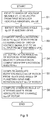
- FIG. 9 shows, as a flowchart, a process of computing the steering angle of the steering wheel 1 with the use of the ECU 15 on the basis of the above-described method of detecting the absolute rotation angle (electric angle) ⁇ ea of the input shaft 20.
- an operation example (operation) of the first resolver 40 will be described with reference to FIG. 9 .
- the process shown in FIG. 9 is repeatedly executed at predetermined computation cycles.
- step S1 it is identified which of the voltage signals V1 to V6 output from the first resolver 40 indicates an abnormal value by comparing the voltage signals V1 to V6 with the predetermined threshold (step S1).
- the revolving angle (mechanical angle) ⁇ p of the planetary gear 63 is detected form the identified result (step S2).
- fifteen rotation angles (electric angles) ⁇ es of the rotor 41 are each computed from combinations of two of the voltage signals V1 to V6 (step S3).
- the rotation angle (electric angle) ⁇ es of the input shaft 20 is detected (step S4).
- the absolute rotation angle (electric angle) ⁇ ea of the input shaft 20 is computed on the basis of the detected revolving angle (mechanical angle) ⁇ p of the planetary gear 63 and the detected rotation angle (electric angle) ⁇ es of the input shaft 20 (step S5). Specifically, by searching for "n" that satisfies Equation 1, the absolute rotation angle (electric angle) ⁇ ea of the input shaft 20 is computed. Then, the steering angle (mechanical angle) of the steering wheel 1 is computed on the basis of the multiplication factor of angle of the first resolver 40 from the computed absolute rotation angle (electric angle) ⁇ ea of the input shaft 20 (step S6).
- the first resolver 40 is provided with the planetary gear mechanism 60 includes: the sun gear 61 that rotates together with the input shaft 20; the planetary gear 63 that is made of a magnetic material and that revolves around the sun gear 61 in accordance with the rotation of the sun gear 61; and the internal gear 62 that is in mesh with the planetary gear 63.
- the rotation angle ⁇ es of the input shaft 20 and the revolving angle ⁇ p of the planetary gear 63 are detected on the basis of the voltage signals V1 to V6 respectively output from the first to sixth output winding coils W1 to W6 provided in the first resolver 40.
- the absolute rotation angle ⁇ ea of the input shaft 20 is computed on the basis of the rotation angle ⁇ es of the input shaft 20 and the revolving angle ⁇ p of the planetary gear 63, and the steering angle of the steering wheel 1 is obtained from the computed result.
- the steering angle of the steering wheel 1 it is possible to detect the steering angle of the steering wheel 1 just by providing the first resolver 40 with the planetary gear mechanism 60. Therefore, in comparison with the case where a rotation speed detection device that detects the rotational speed of the input shaft 20 is provided, it is possible to simplify the structure.
- the revolving angle ⁇ p of the planetary gear is detected by identifying which of the voltage signals V1 to V6 respectively output from the first to sixth output winding coils W1 to W6 of the first resolver 40 indicates an abnormal value.
- the rotation angle ⁇ es of the input shaft 20 is detected by computing a plurality of rotation angles ⁇ es of the input shaft 20 from combinations of two of the voltage signals V1 to V6 output from the first resolver 40 and performing a majority operation on the computed results. In this way, it is possible to easily detect the rotation angle ⁇ es of the input shaft 20.
- the planetary gear 63 is held between the housing 30 and the sun gear 61 and between the housing 30 and the internal gear 62. Therefore, without providing a member for supporting the planetary gear 63, it is possible to easily and accurately support the planetary gear 63. Therefore, it is possible to simplify the structure.
- the steering angle of the steering wheel 1 is detected with the use of the first resolver 40 provided in the torque sensor 14. Therefore, it is not necessary to provide a sensor that detects the steering angle of the steering wheel 1.
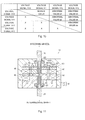
- the first resolver 40 outputs six-phase voltage signals. However, the number of output voltage signals may be changed as needed. However, when the first resolver 40 outputs four or smaller phases voltage signals, there is the following concern that will be described on the assumption that when the first resolver 40 is configured to output four-phase voltage signals V10 to V13, the two voltage signals V12 and V13 among the four-phase voltage signals V10 to V13 indicate abnormal values because the planetary gear 63 is located between the two teeth. In this case, as shown in FIG.
- the number of the computed results that indicate abnormal values b1 to b5 is five, and only one computed result indicates a normal value. Therefore, it may not be possible to identify the rotation angle ⁇ es of the rotor 41 according to the method of performing a majority operation on the computed results.
- the first resolver 40 has a three-phase output structure, if two voltage signals among the three outputs indicate abnormal values, there is no computed result that indicates a normal value. Therefore, it may also not be possible to identify the rotation angle ⁇ es of the rotor 41.
- the number of voltage signals output from the first resolver 40 is desirably larger than or equal to five. Note that, even when the first resolver 40 has a three-phase output structure or four-phase output structure, for example, if the output winding coils are apart from each other, it is possible to avoid a situation where the planetary gear 63 influences two output winding coils. Thus, with the above structure, it is possible to identify the rotation angle ⁇ es of the rotor 41 according to the method of performing a majority operation on computed results.
- the multiplication factor of angle of the first resolver 40 may be changed as needed.
- the gears 61 to 63 of the planetary gear mechanism 60 each are formed of a bevel gear.
- the gears 61 to 63 each may be formed of a spur gear.
- providing a flange portion 63b between a portion, at which the teeth of the planetary gear 63 are formed, and the shaft portion 63a is effective. Because movement of the planetary gear 63 toward the first resolver 40 is restricted by the flange portion 63b, it is possible to accurately keep the position of the planetary gear 63.
- the internal gear 62 is fixed inside the housing 30, and the planetary gear 63 is in mesh with the internal gear 62.
- the internal gear 62 may be replaced with an external gear.
- the planetary gear may be supported by a planetary carrier such that the planetary gear is rotatable about its axis and revolvable around the sun gear 61.
- FIG. 12 shows an embodiment in which external teeth are formed on the shaft portion 63a of the planetary gear 63.
- an external gear 64 is fixed to a portion of the inner wall of the housing 30 above the sun gear 61. The external gear 64 is in mesh with the external teeth formed on the shaft portion 63a of the planetary gear 63.
- an insertion hole 64a is formed at the center portion of the external gear 64, and the input shaft 20 is passed through the insertion hole 64a.
- a planetary carrier 65 that is supported by the input shaft 21 via a bearing 82 is provided below the sun gear 61, and the planetary gear 63 is supported by the planetary carrier 65 such that the planetary gear 63 is rotatable about its axis and revolvable around the sun gear 61.
- the revolving position of the planetary gear 63 is detected as one of positions of two teeth that face each other, that is, candidate two positions as the revolving position of the planetary gear 63 are detected, and then the absolute rotation angle ⁇ ea of the input shaft 20 is detected through the above computations (c1) and (c2) indicated as an example.
- the situation where the planetary gear 63 comes close to the first output winding coil W1 presumably includes two situations, that is, the situation where the planetary gear 63 comes close to the tooth T1 and the situation where the planetary gear 63 comes close to the tooth T7. Between these two situations, the rotation angle ⁇ e of the rotor 41 is different, and therefore the magnitude of the voltage signal V1 output from the first output winding coil W1 is different.
- the output winding coil to which the planetary gear 63 comes close is identified, it is possible to identify at which of the two teeth that face each other the planetary gear 63 is located, on the basis of the magnitude of the voltage signal output from the identified output winding coil.
- the position of the planetary gear 63 is identified in this way, it is possible to further accurately detect the absolute rotation angle ⁇ ea of the input shaft 20.
- the gears 61 to 63 of the planetary gear mechanism 60 each are formed of a bevel gear, and the planetary gear 63 is retained by inserting the shaft portion 63a of the planetary gear 63 in the groove 33 formed on the housing 30.
- the planetary gear 63 may be supported by bringing another planetary gear made of a non-magnetic material, other than the planetary gear 63, into mesh with the sun gear 61 and the internal gear 62 and then coupling the other planetary gear to the planetary gear 63 by a planetary carrier.
- the planetary gear 63 is made of a magnetic material.
- the planetary gear 63 may be made of a non-magnetic material, such as aluminum.
- the planetary gear 63 may be made of any material as long as the material changes magnetic fields formed by the exciting winding coil We.
- the structure in which the planetary gear 63 makes 4/9 revolution around the sun gear 61 while the input shaft 20 makes one rotation is employed.
- the number of revolutions of the planetary gear 63 may be changed as needed.
- the torque sensor according to the invention is applied to the electric power steering system.
- the invention may be applied to any device that includes a torque sensor.
- the invention may be applied to not only a torque sensor but also any resolver that detects the rotation angle of a rotary body.
- the rotation angle detection device is applied to the resolver.
- the invention may be applied to rotation angle detection devices, such as a rotation angle detection device that detects the rotation angle of a rotary body by utilizing, for example, a Hall element or a magnetoresistive element.
- FIG. 13 shows an example of a rotation angle detection device that utilizes a Hall element.
- the rotation angle detection device has the multiplication factor of angle "5X”, and includes a rotor 90 and a stator 91.
- the rotor 90 is formed of ten-pole magnets, and rotates together with the input shaft 20.
- the stator 91 is fixed to the housing 30, and surrounds the rotor 90.
- the rotation angle detection device detects the rotation angle (electric angle) of the rotor 90, that is, the rotation angle (electric angle) of the input shaft 20, on the basis of outputs from the Hall elements 92a to 92f.
- the rotation angle detection device when the above-described planetary gear mechanism 60 is provided, it is possible to cause the planetary gear 63 to revolve near the rotor 90 and the Hall elements 92a to 92f when the rotor 90 rotates as indicated by long dashed short dashed line in the drawing.
- a rotation angle detection device includes a plurality of magnetic field detection units arranged in a rotation direction of a rotary body and a magnetic field generation unit that generates magnetic fields respectively applied to these magnetic field detection units and detects the rotation angle of the rotary body by detecting changes that occur in the magnetic fields with the rotation of the rotor with the use of the magnetic field detection units, it is possible to apply the rotation angle detection device according to the invention.
Landscapes
- Physics & Mathematics (AREA)
- General Physics & Mathematics (AREA)
- Measurement Of Length, Angles, Or The Like Using Electric Or Magnetic Means (AREA)
- Transmission And Conversion Of Sensor Element Output (AREA)
- Power Steering Mechanism (AREA)
Applications Claiming Priority (1)
| Application Number | Priority Date | Filing Date | Title |
|---|---|---|---|
| JP2011241988A JP2013096930A (ja) | 2011-11-04 | 2011-11-04 | 回転角検出装置、及びトルクセンサ |
Publications (1)
| Publication Number | Publication Date |
|---|---|
| EP2589935A2 true EP2589935A2 (de) | 2013-05-08 |
Family
ID=47071167
Family Applications (1)
| Application Number | Title | Priority Date | Filing Date |
|---|---|---|---|
| EP12189002.4A Withdrawn EP2589935A2 (de) | 2011-11-04 | 2012-10-18 | Drehwinkelerfassungsvorrichtung und Drehmomentsensor |
Country Status (4)
| Country | Link |
|---|---|
| US (1) | US20130113471A1 (de) |
| EP (1) | EP2589935A2 (de) |
| JP (1) | JP2013096930A (de) |
| CN (1) | CN103085861A (de) |
Families Citing this family (13)
| Publication number | Priority date | Publication date | Assignee | Title |
|---|---|---|---|---|
| KR102205769B1 (ko) | 2013-03-13 | 2021-01-21 | 티악스 엘엘씨 | 토크 센서 |
| CN103407489B (zh) * | 2013-08-12 | 2016-07-06 | 长沙中联重科环卫机械有限公司 | 一种车辆转向装置及车辆 |
| CN103486965A (zh) * | 2013-09-29 | 2014-01-01 | 杭州飞越汽车零部件有限公司 | 测量转向角度和扭矩的装置 |
| JP5958572B2 (ja) * | 2014-02-27 | 2016-08-02 | 株式会社デンソー | 回転角検出装置、および、これを用いた電動パワーステアリング装置 |
| TWI579546B (zh) * | 2015-12-18 | 2017-04-21 | 財團法人車輛研究測試中心 | Gear type torque sensing device |
| CN109844448A (zh) * | 2016-10-19 | 2019-06-04 | 日本精工株式会社 | 传感器的组装构造体、电动马达、以及电动助力转向装置 |
| JP2018072022A (ja) * | 2016-10-25 | 2018-05-10 | クノールブレムゼ商用車システムジャパン株式会社 | 回転検出装置、ギアシフトユニット及びトランスミッションシステム |
| US10975717B2 (en) | 2016-12-19 | 2021-04-13 | General Electric Company | Torque monitoring device for a gas turbine engine |
| JP6926504B2 (ja) * | 2017-02-10 | 2021-08-25 | 株式会社デンソー | 回転検出装置 |
| CN107628110A (zh) * | 2017-09-29 | 2018-01-26 | 株洲易力达机电有限公司 | 一种汽车电动助力转向盘角度识别方法 |
| US10800447B2 (en) * | 2018-08-24 | 2020-10-13 | Ford Global Technologies, Llc | Steering system with multiple controllers |
| EP3907473B1 (de) * | 2020-05-06 | 2022-08-24 | Baumer Electric AG | Winkelmessvorrichtung für single- und multiturnmessung |
| JP7314426B2 (ja) * | 2020-12-11 | 2023-07-25 | マブチモーター株式会社 | レゾルバ |
Citations (1)
| Publication number | Priority date | Publication date | Assignee | Title |
|---|---|---|---|---|
| JP2004245642A (ja) | 2003-02-12 | 2004-09-02 | Koyo Seiko Co Ltd | ステアリング装置における回転角検出装置及びトルク検出装置 |
-
2011
- 2011-11-04 JP JP2011241988A patent/JP2013096930A/ja active Pending
-
2012
- 2012-10-16 US US13/652,659 patent/US20130113471A1/en not_active Abandoned
- 2012-10-18 EP EP12189002.4A patent/EP2589935A2/de not_active Withdrawn
- 2012-10-31 CN CN2012104287374A patent/CN103085861A/zh active Pending
Patent Citations (1)
| Publication number | Priority date | Publication date | Assignee | Title |
|---|---|---|---|---|
| JP2004245642A (ja) | 2003-02-12 | 2004-09-02 | Koyo Seiko Co Ltd | ステアリング装置における回転角検出装置及びトルク検出装置 |
Also Published As
| Publication number | Publication date |
|---|---|
| US20130113471A1 (en) | 2013-05-09 |
| JP2013096930A (ja) | 2013-05-20 |
| CN103085861A (zh) | 2013-05-08 |
Similar Documents
| Publication | Publication Date | Title |
|---|---|---|
| EP2589935A2 (de) | Drehwinkelerfassungsvorrichtung und Drehmomentsensor | |
| US10035535B2 (en) | Relative angle detection device, torque sensor, electric power steering device and vehicle | |
| US9097509B2 (en) | Rotation angle sensor | |
| JP5616281B2 (ja) | トルクセンサおよびパワーステアリング装置 | |
| US9212892B2 (en) | Steering angle sensor | |
| JP5679136B2 (ja) | 回転角検出装置、および、回転角検出装置を備えた電動パワーステアリング装置 | |
| EP3423333B1 (de) | Welligkeitsminimierung durch angemessene as/ts-magnetanordnung bei einer elektrischen servolenkvorrichtung | |
| US20150090051A1 (en) | Torque Index Sensor | |
| JP6669318B2 (ja) | 電動パワーステアリング装置、及び電動パワーステアリング装置用モータの回転角検出方法 | |
| JP2017015696A (ja) | 相対角度検出装置、トルクセンサ、電動パワーステアリング装置及び車両 | |
| US9989384B2 (en) | Measurement of motor rotor position or speed | |
| US9638509B2 (en) | Phase difference detector and rotation angle detection device including the same | |
| US9523573B2 (en) | Rotation angle detection device and electric power steering system including the same | |
| JP4281595B2 (ja) | 角度検出装置 | |
| US9658050B2 (en) | Rotation angle detection device | |
| JP6108009B2 (ja) | 相対角度検出装置、トルクセンサ、電動パワーステアリング装置及び車両 | |
| US9625249B2 (en) | Rotation angle detection device and electric power steering system including the same | |
| US6935194B2 (en) | Dual resolver device | |
| JP4882513B2 (ja) | 回転角検出装置およびトルクセンサ | |
| US8942890B2 (en) | Torque detecting device and electric power steering system | |
| US20230194313A1 (en) | Angle detection apparatus | |
| JP2017040545A (ja) | 回転センサ付軸受装置、この回転センサ付軸受装置を備える電動モータ、トルクセンサ、電動パワーステアリング装置及び車両 | |
| JP2013199146A (ja) | インデックスセンサ | |
| WO2016208712A1 (ja) | 相対角度検出装置、トルクセンサ、電動パワーステアリング装置及び車両 | |
| JP2014178178A (ja) | 磁気遮蔽部材およびトルク検出装置 |
Legal Events
| Date | Code | Title | Description |
|---|---|---|---|
| PUAI | Public reference made under article 153(3) epc to a published international application that has entered the european phase |
Free format text: ORIGINAL CODE: 0009012 |
|
| AK | Designated contracting states |
Kind code of ref document: A2 Designated state(s): AL AT BE BG CH CY CZ DE DK EE ES FI FR GB GR HR HU IE IS IT LI LT LU LV MC MK MT NL NO PL PT RO RS SE SI SK SM TR |
|
| AX | Request for extension of the european patent |
Extension state: BA ME |
|
| STAA | Information on the status of an ep patent application or granted ep patent |
Free format text: STATUS: THE APPLICATION HAS BEEN WITHDRAWN |
|
| 18W | Application withdrawn |
Effective date: 20140701 |