EP2590442B1 - Appareil et procédé pour la transmission adaptative pendant les sous-trames presque vide dans un réseau de communication sans fil - Google Patents
Appareil et procédé pour la transmission adaptative pendant les sous-trames presque vide dans un réseau de communication sans fil Download PDFInfo
- Publication number
- EP2590442B1 EP2590442B1 EP12191165.5A EP12191165A EP2590442B1 EP 2590442 B1 EP2590442 B1 EP 2590442B1 EP 12191165 A EP12191165 A EP 12191165A EP 2590442 B1 EP2590442 B1 EP 2590442B1
- Authority
- EP
- European Patent Office
- Prior art keywords
- macro
- pico
- enb
- ues
- during
- Prior art date
- Legal status (The legal status is an assumption and is not a legal conclusion. Google has not performed a legal analysis and makes no representation as to the accuracy of the status listed.)
- Active
Links
Images




Classifications
-
- H—ELECTRICITY
- H04—ELECTRIC COMMUNICATION TECHNIQUE
- H04W—WIRELESS COMMUNICATION NETWORKS
- H04W16/00—Network planning, e.g. coverage or traffic planning tools; Network deployment, e.g. resource partitioning or cells structures
- H04W16/14—Spectrum sharing arrangements between different networks
-
- H—ELECTRICITY
- H04—ELECTRIC COMMUNICATION TECHNIQUE
- H04W—WIRELESS COMMUNICATION NETWORKS
- H04W84/00—Network topologies
- H04W84/02—Hierarchically pre-organised networks, e.g. paging networks, cellular networks, WLAN [Wireless Local Area Network] or WLL [Wireless Local Loop]
- H04W84/04—Large scale networks; Deep hierarchical networks
- H04W84/042—Public Land Mobile systems, e.g. cellular systems
- H04W84/045—Public Land Mobile systems, e.g. cellular systems using private Base Stations, e.g. femto Base Stations, home Node B
Definitions
- the present disclosure relates to wireless communication systems, and in particular, to adaptive transmission during almost blank subframes (ABSs) in a wireless communication system.
- ABSs almost blank subframes
- the Second Generation technology also known as “Global System for Mobile Communications (GSM)” and the Third Generation (3G) technology have been commercially deployed successfully to provide voice, text, and data services for mobile communication devices.
- GSM Global System for Mobile Communications
- 3G Third Generation
- LTE Long Term Evolution of Universal Mobile Telecommunications System
- 3GPP 3rd Generation Partnership Project
- LTE-A 3rd Generation Partnership Project
- LTE-A LTE Advanced
- the term “legacy” or “legacy device” can refer to signals, user equipments, network components, and/or other entities that comply with 3GPP Release 9 or earlier release, but do not comply with LTE Advanced.
- WO 2009/142954 relates to a method and communication system for managing interference between femtocells and between each femtocell and a macrocell.
- a frequency assignment scheme for the femtocells minimizes the interference between a femtocell and a macrocell and among different femtocells using a spectrum-sensing technique.
- the scheme selects a suitable channel from a set of possible channels and ensures that the femtocell has a satisfactory coverage area even when it is close to the macrocell base station.
- the frequency assignment scheme provides a co-channel implementation to take advantage of the hand-off and cell search characteristics.
- Rl-102307 discloses basic approaches for Control Channel Inter Cell Interference Coordination implemented using Almost Blank subframes and pico-cells through muting resource elements for a control signal in some macro-subframes.
- Embodiments are described herein in the context of an LTE wireless network or system, but can be adapted for other wireless networks or systems.
- the LTE wireless network described herein is generally in compliance with 3GPP LTE standard, including, but not limited to, Releases 8 to 11 and beyond.
- heterogeneous wireless communication network or “heterogeneous network” can also be referred to as a "Hetnet.”
- the illustrated heterogeneous network 100 includes a core network 110 and a macro cell or overlay cell 120.
- the term “cell” or “wireless cell” generally refers to an area of coverage of wireless transmission by a network or network component, such as an access node.
- the core network 110 can be connected to the Internet 160.
- the macro cell 120 can include at least one base station.
- the term "base station” can be interchangeably used with a network node, an access node, or a network component. Two or more base stations may operate on the same radio frequency or on different radio frequencies.
- the base station can be an overlay access node 121 connected to the core network 110 via a backhaul link 111a, including optical fiber or cable.
- the term "overly access node” generally refers to a network element or component that at least partly serves to form a wireless cell.
- the overlay access node 121 can be an evolved Universal Terrestrial Radio Access Network (UTRAN) node B or "eNB” which is part of an EUTRAN.
- UTRAN Universal Terrestrial Radio Access Network
- eNB evolved Universal Terrestrial Radio Access Network
- An eNB that forms an overlay access node of a macro cell can be generally referred to as a "macro eNB.”
- the term “eNB” can be interchangeably used with an "evolved node B" or an “enhanced node B.”
- the network 100 can also include one or more underlay cells, for example, a pico cell 130 and a femto cell 140.
- the underlay cells can have a coverage at least partially overlapping with the coverage of the macro cell 120.
- the term "underlay cell" is described herein in the context of the LTE standard. However, a skilled artisan will appreciate that other wireless standards can also have components similar to underlay cells, and that the embodiments described herein can be adapted for such standards.
- Figure 1 illustrates only one pico cell and only one femto cell, the network 100 can include more or less of such cells.
- the underlay cells 130, 140 have a smaller coverage than the overlay cell 120. Access nodes 131, 141 forming the underlay cells 130, 140 can use a lower transmission power than that of the overlay access node 121.
- the pico cell 130 can include a pico eNB 131 connected to the core network 110 via a backhaul link 111b, and to the macro eNB 121 via a backhaul link 111c.
- the backhaul links 111b and 111c may include cable, fiber or wireless links.
- the pico eNB 131 can have a transmission power that is, for example, about 30 dBm, which is about 13 dB lower than that of the macro eNB 121.
- the femto cell 140 can include a femto eNB 141 connected to the core network 110 via the Internet 160 via a wired or wireless connection.
- the femto cell 140 is a subscription based cell, and can be referred to as a closed subscription group (CSG) cell.
- CSG closed subscription group
- the term "closed subscription group (CSG)” can be interchangeably used with closed subscriber group.
- the term "femto eNB” can also be referred to as a "home eNB (HeNB)."
- the macro eNB 121 can be referred to as a source eNB.
- the femto eNB 141 can have a transmission power that is, for example, about 20 dBm, which is about 23 dB lower than that of the macro eNB 121.
- the network 100 can also include a relay node 150 which serves to wirelessly relay data and/or control information between the macro eNB 121 and a user equipment (UE) 170.
- the macro eNB 121 and the relay node 150 can be connected to each other via a wireless back haul link 111d.
- the macro eNB 121 can be referred to as a donor eNB.
- the relay node 150 can have a transmission power that is, for example, about 30 or 37 dBm, which is about 13 dB or 6 dB lower than that of the macro eNB 121.
- underlay access node generally refers to pico eNBs, femto eNBs, and/or relay nodes, without being limited thereto.
- the user equipment 170 can communicate wirelessly with any one of the overlay access node 121 or the underlay access nodes 131, 141, 150, depending on the location or the existence of subscription in the case of the femto cell 140.
- the term "user equipment” can refer to various devices with telecommunications capabilities, such as mobile devices and network appliances.
- Examples of user equipments include, but are not limited to, a mobile phone, a smart phone, a telephone, a television, a remote controller, a set-top box, a computer monitor, a computer (including a tablet computer such as BlackBerry® Playbook tablet, a desktop computer, a handheld or laptop computer, a netbook computer), a personal digital assistant (PDA), a microwave, a refrigerator, a stereo system, a cassette recorder or player, a DVD player or recorder, a CD player or recorder, a VCR, an MP3 player, a radio, a camcorder, a camera, a digital camera, a portable memory chip, a washer, a dryer, a washer/dryer, a copier, a facsimile machine, a scanner, a multi functional peripheral device, a wrist watch, a clock, a game device, etc.
- a computer including a tablet computer such as BlackBerry® Playbook tablet, a desktop computer, a handheld or laptop computer, a netbook computer
- Such a UE might include a device and its associated removable memory module, such as a Universal Integrated Circuit Card (UICC) that includes a Subscriber Identity Module (SIM) application, a Universal Subscriber Identity Module (USIM) application, or a Removable User Identity Module (R-UIM) application.
- a UE might include the device itself without such a module.
- the term “UE” can also refer to any hardware or software component that can terminate a communication session for a user.
- the terms "user equipment,” “UE,” “user equipment device,” “user agent,” “UA,” “user device,” and “mobile device” can be used synonymously herein.
- the network 100 can support Multimedia Broadcast Multicast Services (MBMS), and can form at least part of a MBMS Single Frequency Network (MBSFN).
- MBMS Multimedia Broadcast Multicast Services
- MMSFN MBMS Single Frequency Network
- Figure 2 illustrates a part of Figure 1 , which includes the macro cell 120 including the macro eNB 121, and the pico cell 130 including the pico eNB 131.
- a biased handover offset value can be applied for handover such that more UEs are associated with the pico cell 130. Therefore, the pico cell range is effectively increased.
- Such an increased range is known as a cell range expansion (RE) area (or CRE area) 132.
- the term "cell range expansion area” generally refers to an expansion area from the edge of a normal pico cell. In the CRE area, transmission from the pico eNB 131 can be received by a UE at a lower power level than within the normal pico cell, and the UE can experience relatively high interference from the macro cell.
- the UE 170 When the UE 170 is within the coverage of the pico cell 130, it can be attached to or associated with the pico cell 130, and can communicate with the pico eNB 131. In the context of this document, such a UE can be referred to as a pico UE. On the other hand, a UE attached to or associated with a macro eNB can be referred to as a macro UE. A single UE can be either a macro UE or a pico UE, depending on whether it is attached to the macro eNB or pico eNB.
- the pico UE 170 is also within the coverage of the macro eNB 121, and thus can be affected by transmission of signals from the macro eNB 121.
- the pico eNB 131 can use a lower transmission power than that of the macro eNB 121
- the pico UE 170 can be subjected to interference by unwanted signals from the macro eNB 121.
- the interference can be also due to an overlap of the coverage of the two eNBs (macro and pico eNBs).
- Such interference can be referred to as inter-cell interference.
- a similar problem can also occur in the case of the femto cell 140 or the relay node 150.
- the LTE has introduced inter-cell interference coordination (ICIC).
- ICIC inter-cell interference coordination
- ABS Almost Blank Subframe
- E-UTRA Evolved Universal Terrestrial Radio Access
- E-UTRAN Evolved Universal Terrestrial Radio Access Network
- the LTE defines a radio frame (10 milliseconds (ms)) to include 10 subframes, each of which is 1 ms long.
- Each of the subframes includes two slots, each of which is 0.5 ms long.
- a radio frame 310 can include first to tenth subframes SF1-SF10.
- the fifth to eighth subframes SF5 to SF8 can be designated as ABSs by the macro eNB 121, as shown in Figure 3B although other subframes can also be ABSs.
- the macro eNB 121 does not communicate data during the ABSs while the pico 131 eNB is allowed to communicate with the pico UE 170 and/or other pico UEs during the ABSs. This scheme allows the pico UE 170 or other pico UEs to have reduced interference from the macro eNB 121 during the ABSs.
- ABS can reduce interference to pico UEs from a macro eNB, as described above in connection with Figure 3B .
- the macro eNB does not utilize the subframes designated as ABSs to transmit data, it has a lower throughput than when it does not use an ABS scheme.
- a macro eNB in a wireless network can transmit data and/or control information during one or more ABSs to a selected set of macro UEs among macro UEs attached to the macro eNB.
- the transmission from the macro eNB during ABSs can use a transmission power level lower than a regular or normal transmission power level used during non-ABS subframes.
- the transmission from the macro eNB during ABSs can use a beamforming technology to generate one or more directional beams or transmissions such that the transmission is not directed towards pico UEs.
- the directional transmissions can include, for example, spatial multiplexing mechanisms for beamforming, switched beams, or antenna nulling.
- a set of macro UEs can be selected by the macro eNB 121, based on various measurements and/or parameters obtained from macro UEs, MUE1-MUE4, and/or pico UEs, PUE.
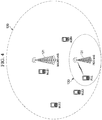
- Figure 4 shows the macro cell 120 with the macro eNB 121, and the pico cell 130 with the pico eNB 131.
- a number of UEs including first to fourth macro UEs, MUE1-MUE4, and a pico UE, PUE, can be located within the macro cell 120.
- the pico UE, PUE is also within the coverage of the pico cell 130.
- the first macro UE, MUE1 is located substantially closer to the macro eNB 121 than the pico eNB 131 while the third and fourth macro UEs, MUE3, MUE4 are close to the pico cell 130.
- the second macro UE, MUE2 is near the edge of the macro cell 120, and is also far from the pico cell 130.
- the macro eNB 121 can communicate with the first macro UE, MUE1, during ABSs, using a lower transmission power than the normal transmission power without interfering significantly with the pico UE, PUE.
- the macro eNB 121 may not be able to communicate with the second, third, or fourth macro UEs, MUE2-MUE4, using the same lower power as used for the first macro UE, MUE1, due to the distance and/or location.
- the macro eNB 121 can optionally use beamforming.
- the macro eNB 121 can determine a set of macro UEs for transmission during ABSs and transmission power level (or beamforming details), using some information or measurements indicative of the locations of the macro UEs and/or relative transmission strengths of the macro eNB and pico eNB at a given location, as will be described later in detail. In some embodiments, such determination by the macro eNB can be made adaptively or repeatedly.
- a heterogeneous network includes a macro eNB 121, a pico eNB 131, a pico UE 510, and a macro UE 520.
- Figure 5 shows only one pico eNB, only one pico UE, and only one macro UE, the network can include multiple pico eNBs, multiple pico UEs and/or multiple macro UEs.
- the vertical axis represents time
- the horizontal axis represents directions of signals.
- the embodiment is described herein with respect to a macro eNB and a pico eNB, but a skilled artisan will appreciate that the embodiment can be adapted for other combinations of an overlay access node and an underlay access node(s) (such as a femto eNB or a relay node).
- one or more of the macro eNB 121 or pico eNB 131 provide measurement configurations to UEs, such as the pico UE 510 and macro UE 520.
- the measurement configurations can be transmitted from the eNBs 121, 131 to the UEs 510, 520, using, for example, radio resource control (RRC) signaling.
- RRC radio resource control
- the RRC signaling from the macro eNB 121 and pico eNB 131 can be performed at different times or simultaneously within the time window T1.
- the eNBs 121, 131 can transmit signals that can be used for power measurements by the UEs 510, 520, and the UEs 510, 520 can measure power based at least partly on the signals.
- the signals can be transmitted at different times or simultaneously within the second time window T2.
- the signals can be reference signals including, for example, a cell-specific reference symbol (CRS) (which can be transmitted at every sub frame in the LTE network).
- CRS cell-specific reference symbol
- the pico UE 510 can measure signal strengths or power of one or more CRSs from the pico eNB 131 and/or macro eNB 121.
- the macro UE 520 can measure signal strengths or power of one or more CRSs from the pico eNB 131 and/or macro eNB 121 during the second time window T2.
- the UEs 510, 520 can measure or detect Reference Signal Received Power (RSRP) and/or Reference Signal Received Quality (RSRQ), as defined in the LTE network.
- RSRP Reference Signal Received Power
- RSRQ Reference Signal Received Quality
- the UEs 510, 520 can send information indicative of measurement results to the macro eNB 121.
- the pico UE 510 can send a message (Message PUE) to the pico eNB 131, to indicate measurement results.
- the messages described herein can include at least part of a measurement report in the context of the LTE.
- the pico eNB 131 can process the measurement results from the pico UE 510. Then, the pico eNB 131 can transmit a message (Message PeNB) to the macro eNB 121 via a backhaul link to provide information on the measurement results.
- Message PeNB message
- the pico UE 510 can send an alternative message (Message PUE') directly to the macro eNB 121 via a wireless connection.
- the macro UE 520 can also send a message (Message MUE) directly to the macro eNB 121 via a wireless connection using, for example, RRC signaling.
- the macro eNB 121 can select one or more macro UEs for transmission during one or more ABSs, and determine a transmission power level (which is lower than a regular non-ABS transmission power level), or alternatively beamforming details or parameters. Then, the macro eNB 121 can send a message (Message MeNB) to the macro UEs (for example, the macro UE 520) that have been selected for transmission during the ABSs.
- the Message MeNB can include control information for the transmission during the ABSs.
- the macro eNB 121 and the selected macro UE 520 can communicate data and/or control information during ABSs.
- the communication can be performed, using either a transmission power level or beamforming details determined during the fourth time window T4.
- the above described steps can be repeated as needed so that the transmission during ABSs can be adaptively changed according to the changes in the network, for example, change in the location of the macro UE 510.
- Other details of the adaptive transmission during ABS according to embodiments will be described later.
- the macro eNB can receive location information (for example, global positioning system (GPS)-based location information), or information from which the location may be derived (for example, wireless access node locations or other reference points), from macro UEs, and select one or more macro UEs for transmission during ABSs.
- location information for example, global positioning system (GPS)-based location information
- information from which the location may be derived for example, wireless access node locations or other reference points
- the macro eNB can have (1) a predetermined range(s) and/or direction(s) and (2) predetermined corresponding transmission power level(s) and/or beamforming details.
- the macro eNB can use the predetermined corresponding transmission power level and/or beamforming details for transmission during ABSs, based on the location information from the macro UEs.
- Such an eNB can also use this scheme either in conjunction with the embodiment described above or as a stand-alone scheme (i.e., without using power measurement results from UEs).
- the macro eNB can receive Channel State Information (CSI) and/or Channel Quality Indicator (CQI) from macro UEs, and determine one or more macro UEs for low power transmission during ABSs, based on the CSI and/or CQI feedback.
- CSI Channel State Information
- CQI Channel Quality Indicator
- the CSI can be restricted to the ABSs.
- the macro eNB can be, for example, the macro eNB 121 described above in connection with Figure 1 , 2 , 4 , or 5 , and can form a macro cell.
- the macro eNB can receive one or more power measurement results from one or more macro UEs (for example, one or more of the macro UEs MUE1-MUE4 of Figure 4 or the macro UE 520 of Figure 5 ), one or more pico UEs (for example, a pico UE PUE of Figure 4 or the pico UE 510 of Figure 5 ), and/or one or more pico eNBs (for example, a pico eNB 131 of Figure 4 or 5 ).
- the pico eNBs can form pico cells at least partially overlapping with the macro cell.
- the power measurement results can be in various forms, as will be described later in detail.
- the power measurement results can be in a form of an indication represented in one or more bits.
- the indication can be indicative of one or more of power measurement results obtained from multiple UEs in the network.
- the indication may or may not indicate actual numerical values of the measurement results.
- the power measurement results can include certain numerical values obtained from one or more UEs in the network.
- the power measurement results can include Reference Signal Received Power (RSRP) and/or Reference Signal Received Quality (RSRQ) reports, as defined in the LTE standard.
- the macro eNB can receive RSRP and/or RSRQ reports from one or more pico UEs within the macro cell's coverage area.
- the macro eNB can determine one or more path loss values between the macro eNB and the pico UEs. At least partly based on the values, the macro eNB can identify a pico UE with the smallest path loss (in other words, a pico UE that reported the maximum received macro cell power).
- the UEs can also provide the macro eNB with information on the location of the UEs. Such information can also be used for determining beamforming details.
- the macro eNB can select one or more of macro UEs in the network for communication during ABSs.
- the macro eNB can select the macro UEs based at least partly on the measurement results received at the block 610.
- the macro eNB can process the power measurement results to determine, for example, whether a specific macro UE can communicate during ABSs with the macro eNB at a lower power than a regular transmission power while not interfering with a communication between the pico UE and pico eNB.
- the measurement results can be used for determining a location of a macro UE for transmission using beamforming during ABSs.
- the macro eNB can categorize macro UEs into two groups: (1) a first group including macro UEs that are suitable for communication during ABS, and (2) a second group including macro UEs that are not suitable for communication during ABS.
- the categorization can be based at least partly on the results of the power measurements by the macro UEs and/or pico UEs.
- the power measurements can include, for example, (1) signal strength measurements by the macro UEs of the macro cell and the neighboring pico cells (hereinafter "macro UE measurement reports”), and/or (2) signal strength measurements by pico UEs of the macro cell (hereinafter "pico UE measurement reports").
- the macro eNB can compare the relative strengths of the neighboring pico cell RSRPs to the macro cell RSRPs reported by the macro UEs. Using such comparisons and the pico UE measurement reports, the macro eNB can choose the maximum number of macro UEs that can receive low power transmission during ABSs while reducing or avoiding interference to pico UEs from the macro eNB. In an alternative implementation, the macro eNB can use results from RSRP and RSRQ measurement by macro UEs during ABSs to determine these candidates.
- estimates of the path loss between the neighboring pico eNBs and the macro UEs can be used by the macro eNB (along with the pico UE measurement reports) in determining macro UEs that support low power transmission on physical downlink control channel and/or physical downlink shared channel (hereinafter, "lower power PDCCH/PDSCH") during ABS while reducing or avoiding interference to a macro UE from the pico eNBs.
- low power PDCCH/PDSCH physical downlink shared channel
- the pico-cell power to macro-cell power ratio can be reported to the macro eNB by the macro UE.
- the reported ratio can be compared to a Power Level Ratio Threshold (PLRT) value at the macro eNB to identify macro UEs that can be served by the macro eNB during ABSs.
- PLRT Power Level Ratio Threshold
- the macro UE can compare the pico-cell to macro-cell power ratio to the PLRT, and report a binary indicator value to the macro eNB. This binary indicator can be utilized by the macro eNB to identify macro UEs that may be served by the macro eNB during ABSs.
- the macro eNB can identify macro UEs that are located at least a selected distance away from one or more pico eNBs and can be served with beamformed transmissions during ABSs while reducing or avoiding interference to pico UEs from the macro eNB.
- the macro eNB can determine a power level for transmission between the macro eNB and one or more of the selected macro UEs during ABSs.
- the macro eNB can use the power measurement results to determine the power level which is lower than the regular or normal transmission power level during non-ABS subframes.
- the transmission power level during ABSs can be reduced, for example, by a factor of about 3 to about 30 dB.
- the macro eNB can send a signaling (such as the Message MeNB of Figure 5 ) to inform the selected macro UEs of the selection and/or the power level (or beamforming details or parameters) for transmission during ABSs.
- a signaling such as the Message MeNB of Figure 5
- a parameter called "Maximum ABS Low-Power Setting (MALPS)" for the macro eNB can be initially derived from the smallest path loss to a pico UE, and an estimated value ⁇ of the acceptable interference at the pico UE and a margin to account for measurement inaccuracies and uncertainties.
- the MALPS for the macro eNB can be derived from a minimum relative difference between received signal powers. If no pico UE measurement is available, a default value for MALPS can be used.
- the macro eNB can transmit data and/or control information during ABSs to one or more of the selected macro UEs, depending on the needs.
- the data can include any type of data, including, but not limited to, multimedia data (such as video, music, web data, and the like).
- the control information can include, for example, information on scheduling decisions (which are required for reception of data), or scheduling grants (which enable transmissions on the uplink).
- the macro eNB can return to the block 610 to repeat the entire process to adjust the selection of macro UEs and/or power levels.
- the macro cell can adjust the MALPS and PLRT on an ongoing basis.
- the MALPS setting can be varied according to: a macro cell low power level monitoring mechanism or alternatively the pico UEs' reports of the received low-power ABS transmissions, which will be described later in detail.
- the MALPS setting can also be varied according to any change in the distribution of the pico UEs within the pico cell(s) due to load balancing as the macro cell tries to offload more or less UEs to the pico cell.
- the PLRT may be varied according to the performance of macro UEs being served by low-power transmissions from the macro eNB based on channel quality indicator (CQI).
- CQI channel quality indicator
- the received power measurement estimation corresponding to the macro eNB can be provided by one or more pico UEs.
- the macro eNB can derive its interference to the pico UEs, using one or more reports from the pico UEs.
- the pico UEs can provide information on the received signal strength of macro cell transmissions at pico UE locations.
- the pico UE can measure one or more of Received Signal Strength Indicator (RSSI), RSRP, or RSRQ of the macro eNB during ABS and/or non-ABS.
- the pico UEs can report the corresponding RSRQ/RSRP measurements to the macro eNB.
- the pico UEs can report the measurements through the pico eNB, using, for example, a backhaul link, such as an X2 backhaul link.
- the pico UEs can measure RSRP values corresponding to the macro eNB transmission, using cell-specific reference symbols (CRS) transmitted from the macro eNB, as described above in connection with Figure 5 .
- the pico UEs can send the RSRP values (hereinafter, "macro-RSRPs) to the pico eNB.
- the pico eNB can select the maximum of the macro-RSRP values received from the pico UEs, and send information on the maximum to the macro eNB through the X2 backhaul link.
- the pico eNB can configure one or more pico UEs in a cell range expansion (CRE) area (see Figure 2 ) to report the macro-RSRP values.
- CRE cell range expansion
- These pico UEs in the cell range expansion area would most likely measure the maximum macro-RSRP value and most likely be affected by the low power ABS transmission from the macro eNB because these pico UEs are close to the macro eNB.
- pico UEs that are not in the cell range expansion area may also be scheduled for transmission during ABSs. These pico UEs may not be affected by the low power ABS transmissions from the macro eNB. Thus, the pico eNB may not necessarily need to configure the pico UEs outside the cell range expansion area to report the macro-RSRP values. Thus, the pico eNB can configure the pico UEs within the cell range expansion area to report measurements more frequently than the pico UEs outside the cell range expansion area.
- the pico eNB can use one or more of the following schemes.
- the pico eNB can have information on some pico UEs within the CRE area which have already been configured for measurement reporting.
- the pico eNB can configure the other pico UEs with, for example, the A2 event triggering criterion.
- A2 event triggering criterion refers to an event-triggered reporting criterion where the serving cell becomes worse than an absolute threshold (hereinafter, referred to as "A2 event threshold").
- A2 event threshold refers to an event-triggered reporting criterion where the serving cell becomes worse than an absolute threshold (hereinafter, referred to as "A2 event threshold").
- the pico eNB can set an appropriate A2 event threshold, based on knowledge of past RSRP reports in the pico cell.
- the pico eNB can configure the pico UEs in the CRE area (which have not already been configured for measurement reporting) to provide periodical reporting of the macro-RSRP values. Assuming that a path loss between the macro eNB and the pico UE is slowly varying, the interval for the periodic reporting can be set to a high value to reduce overhead.
- the measurement reports can be forwarded by the pico eNB to the macro eNB via the X2 backhaul link.
- the measurement reports can provide the macro eNB with information on the signal strength of its CRS transmissions at the pico UEs' locations.
- the information can be used to derive a power level (or the maximum power level) appropriate for low power transmission from the macro eNB during ABS.
- the low power transmission can be used for physical downlink control channel (PDCCH) and/or physical downlink shared channel (PDSCH).
- PDCCH physical downlink control channel
- PDSCH physical downlink shared channel
- the macro eNB can further use information on a power ratio of data signal to reference signal.
- the power ratio can be a ratio of Physical Downlink Shared Channel (PDSCH) Energy per Resource Element (EPRE) to Cell-specific Reference Symbol (CRS) EPRE (hereinafter, referred to as "PDSCH EPRE-to-CRS EPRE ratio") for the low-power PDSCH transmission during ABSs (hereinafter, referred to as "the ABS low-power PDSCH transmission).
- the RSRP values and the PDSCH EPRE-to-CRS EPRE ratio can be used to obtain an estimate of the received strength of its ABS low-power PDSCH transmission on the pico UEs.
- the PDSCH EPRE-to-CRS EPRE ratios are generally denoted by either parameter ⁇ A or ⁇ B .
- the PDSCH EPRE-to-CRS EPRE ratio is denoted either by ⁇ A or ⁇ B according to the OFDM symbol index as defined in 3GPP TS 36.213 v10.1.0, "Evolved Universal Terrestrial Radio Access (E-UTRA); Physical Layer Procedures (Release 10)," March 2011 , Section 5.2.
- E-UTRA Evolved Universal Terrestrial Radio Access
- ⁇ B is cell-specific
- the PDSCH EPRE-to-CRS EPRE ratio can be represented by ⁇ A for notational convenience in this document.
- This mechanism can enable the macro eNB to monitor the effect of its ABS low-power PDSCH transmission on pico UEs. It should also be noted that the macro eNB can use the RSRP feedback from the pico UEs to set the appropriate power for low- power PDCCH transmission during ABSs.
- the macro eNB When the macro eNB receives a new maximum macro-RSRP report from one of the pico eNBs, the macro eNB can approximately estimate the worst case received strength of its ABS low power transmission on the pico UEs. This can be achieved by, for example, scaling the received maximum macro-RSRP value by the maximum ⁇ A and ⁇ B values among all macro UEs scheduled for low power transmission during ABSs. If the worst case received signal strength due to the ABS low power transmission on the pico UEs is higher than an acceptable interference value ⁇ , the macro eNB can reduce the Maximum ABS Low-Power Setting (MALPS) value by a predefined update step ⁇ MALPS .
- MALPS Maximum ABS Low-Power Setting
- pico UEs 711, 712 can report measurement results to a pico eNB 131 with which they are associated.
- the pico eNB 131 can then communicate the pico UE measurements to the macro eNB 121 via an X2 interface or backhaul link 111c.
- the pico eNB 131 when reporting the pico UEs' received power measurements corresponding to the macro eNB 121, can report only the largest received power measurement from all the pico UEs in its pico cell. Then, the macro eNB 121 can consider only the largest received power measurement by one of the pico UEs 711, 712, from one or more of pico eNBs 121 in determining a power level for PDSCH transmission during ABS.
- the pico UEs 711, 712 can report macro cell received power measurements to the pico eNB 131.
- the pico eNB 131 can determine maximum received macro cell power from all the pico UE reports. Then, the maximum received power can be reported by the pico eNB 131 to the macro eNB 121 via the X2 interface 111c.
- the macro eNB 121 can thus have information on the maximum received power within the macro cell, and can use the information to determine the power level for transmission during ABS (for example, PDCCH/PDSCH transmission).
- the power measurement results from the two or more pico eNBs can be forwarded to the macro eNB 121.
- the macro eNB can determine the maximum received power from the received results, and use it for determining the power level for transmission during ABS (for example, PDCCH/PDSCH transmission).
- the pico eNB can first receive power measurement results from pico UEs at a block 810. Then, the pico eNB can optionally process the power measurement results to select, for example, the maximum received macro cell power at a block 820. Subsequently, the pico eNB can transmit information on the power measurement results to the overly access node (for example, the macro eNB 121) via a backhaul link. The steps at the blocks 810-830 can be repeated, as needed.
- one or more macro UEs 921-925 can measure power (for example, RSRP) from its serving macro cell 120 and/or its neighboring pico cells 130a-130c.
- the macro UEs 921-925 can report the measurement results to the macro eNB 121.
- the measurement results can include, for example, the serving-macro RSRP and/or the maximum among measured neighboring pico RSRPs.
- the macro eNB 121 can use the measurement results from the macro UEs 921-925 in combination with the measurement results or information from the pico UEs 931-933 or the pico eNB(s) 131a-131c.
- the macro eNB can utilize the measurement results from the macro UEs (along with the pico UE measurement reporting) to determine whether a given macro UE can be chosen for low power transmission or reception (for example, PDCCH/PDSCH reception) during ABS.
- max ⁇ RSRP M,PUE ⁇ denotes the maximum macro-RSRP received from the pico UEs forwarded through the pico eNB as described above.
- RSRP M,MUE j represents the RSRP corresponding to the serving-macro eNB as measured by the j -th macro UE.
- RSRP Pmax,MUEj denotes the maximum among measured neighboring pico RSRPs from the j -th macro UE.
- the rate of change in the reports of a UE can be used to determine its membership in the set ⁇ S 1 ⁇ .
- the macro eNB can compare the serving-macro RSRPs reported by the macro UEs to max ⁇ RSRP M,PUE ⁇ , and identify the set ⁇ S 1 ⁇ of macro UEs that satisfy the condition ⁇ RSRP M,MUE j > max ⁇ RSRP M,PUE ⁇ , where 0 ⁇ ⁇ ⁇ 1.
- the parameter ⁇ is a scaling parameter that can be included to control the number of macro UEs in the set ⁇ S 1 ⁇ . This step can be used for generally identifying macro UEs that may be chosen to receive low power PDCCH/PDSCH during ABSs.
- the macro eNB can compute or calculate a ratio, RSRP M,MUE j / RSRP Pmax,MUEj for each of the macro UEs in the set ⁇ S 1 ⁇ .
- This ratio can serve as an approximate indication of the Signal-to-Interference Ratio (SIR) of the macro UEs in the set ⁇ S 1 ⁇ .
- SIR Signal-to-Interference Ratio
- macro UEs with higher RSRP M,MUE j / RSRP Pmax,MUEj ratios are less likely to experience interference from the pico eNBs than those macro UEs with lower RSRP M,MUE j / RSRP Pmax,MUEj ratios.
- This additional step can be used by the macro eNB in further narrowing the set ⁇ S 2 ⁇ of macro UEs that can be chosen to receive low power PDCCH/PDSCH during ABS. Note that the macro UEs in ⁇ S 2 ⁇ are a subset of the macro UEs in ⁇ S 1 ⁇ .
- the power level suitable for the low power ABS transmissions can be determined. Such determination can be based at least partly on the maximum macro-RSRP (i.e., max ⁇ RSRP M,PUE ⁇ ) received from the pico UEs through the pico eNB.
- max ⁇ RSRP M,PUE ⁇ the maximum macro-RSRP
- max ⁇ RSRP M,PUE ⁇ can be used by the macro eNB to determine the MALPS value.
- a minimum relative difference between received signal powers which will be described later, can be used to determine the MALPS value.
- the power level(s) suitable for the low power ABS transmissions can be set by the macro eNB such that the PDCCH resource element (RE) energy and the PDSCH Energy per Resource Elements (EPREs) do not exceed MALPS for those macro UEs scheduled to receive low power transmission during ABS, taking into account the appropriate scaling due to ⁇ A and ⁇ B .
- the ⁇ A and ⁇ B values may be further reduced, based on Channel State Information (CSI)/Channel Quality Indicator (CQI) feedback during ABS from the macro UEs receiving low power ABS transmissions.
- CSI Channel State Information
- CQI Channel Quality Indicator
- the RSRP reports can be obtained by the macro eNB via one or a combination of the following options.
- the macro eNB can configure the macro UEs to perform periodic reporting of the RSRPs. Assuming a path loss between the eNB and macro UE is slowly varying, the interval for the periodic reporting can be set to a relatively high value to reduce overhead.
- the macro eNB may exclude certain macro UEs that are known to be near the macro cell edge (since they have a low serving cell RSRP value) as these cell-edge macro UEs are not likely to be scheduled to receive low power PDCCH/PDSCH during ABS.
- Another option is to utilize power headroom reports for those macro UEs that report the power headroom to the macro eNB.
- the macro eNB can obtain an approximate downlink path loss from the power headroom reports and use the path loss information to decide which macro UEs need to be configured for RSRP reporting.
- the macro eNB may configure the macro UEs that have not already been configured to report with an A2 event triggering criterion. Since the macro eNB is only interested in scheduling the cell-center macro UEs for low power transmissions during ABS, the macro eNB may exclude the cell-edge macro UEs (which may already be configured using another triggering event) from this type of configurations. To configure the macro UEs, the macro eNB can set the A2 event threshold to be low enough so that the cell-center macro UEs report their RSRPs to the macro eNB. These macro UEs can be configured for event-triggered periodic reporting. The macro eNB can choose appropriate low A2 threshold values based on knowledge of past RSRP reports in the cell.
- the macro eNB can signal a message, such as the Message MeNB of Figure 5 to the selected macro UEs.
- the message can include a power ratio(s) of data signal to reference signal, for example, PDSCH EPRE-to-CRS EPRE power ratios. This can help the selected macro UEs decode PDSCH symbols transmitted from the macro eNB during ABSs.
- this ratio corresponds to ⁇ A and ⁇ B .
- the embodiment may benefit by extending the current range of ⁇ A (and ⁇ B ) specified in 3GPP TS 36.331 v10.1.0, "Evolved Universal Terrestrial Radio Access (E-UTRA); Radio Resource Control (RRC) Protocol Specification (Release 10),” March 2011 , Section 6.3.2.
- E-UTRA Evolved Universal Terrestrial Radio Access
- RRC Radio Resource Control
- This can be equivalent to extending/shifting the current range of possible values allowed for the UE-specific parameter P A specified as part of parameter or information element (IE), PDSCH-Config defined in 3GPP TS 36.331 v10.1.0.
- IE information element
- new ratios ⁇ A,ABS and ⁇ B,ABS can be defined to be specific to the low power transmission during ABS. This can require introducing a new UE-specific parameter P A,ABS in addition to the P A parameter specified in the IE PDSCH-ConfigDedicated of 3GPP TS 36.331 v10.1.0.
- the range of possible values allowed for the new UE-specific parameter P A,ABS can be much lower than the range of values allowed for the existing P A parameter (since P A,ABS is specific to low power transmissions during ABS).
- ⁇ A,ABS and P A,ABS is similar to the relationship between ⁇ A and P A as defined in 3GPP TS 36.213 v10.1.0, "Evolved Universal Terrestrial Radio Access (E-UTRA); Physical Layer Procedures (Release 10),” March 2011 , Section 5.2.
- the ratio ⁇ B,ABS can be determined using Table 5.2-1 of 3GPP TS 36.213 v10.1.0 (in other words, the ratio ⁇ B,ABS / ⁇ A,ABS is cell-specific and can be equal to the existing cell-specific ratio ⁇ B / ⁇ A ).
- a one bit indicator may be added to the PDCCH downlink control information (DCI) which indicates to the macro UEs the appropriate PDSCH EPRE-to-CRS EPRE ratio to use for data demodulation (i.e., this one bit indicator can be used to instruct the macro UE to use either ⁇ A,ABS or ⁇ A , depending whether it is receiving low power transmission during ABS or not).
- DCI downlink control information
- the appropriate PDSCH EPRE-to-CRS EPRE ratio to use for data demodulation may be indicated to the macro UEs via RRC signaling.
- a modified CQI measurement can be specified to support low power transmissions during ABS in the embodiments described above.
- the modified CQI measurement for ABS can be needed because CQI is a function of ⁇ A (note that ⁇ A has a modified range in order to support low power transmission during ABS, as described above).
- the modified CQI measurement can be reported to the macro eNB as needed after the macro UE is chosen to receive low power transmissions during ABS.
- the UE can transmit two CQI reports, based on ⁇ A,ABS and ⁇ A respectively.
- the macro eNB can use the pico UE-reported RSRP values along with its knowledge of the PDSCH EPRE-to-CRS EPRE ratio corresponding to the ABS low-power PDSCH transmission to obtain an estimate of the received strength of its ABS low-power transmission on the pico UEs.
- the maximum among all the PDSCH EPRE-to-CRS EPRE (i.e., ⁇ A ) ratios corresponding to the ABS low power transmission can be made available in a common PDSCH configuration, and can be transmitted, for example, broadcast as System Information Blocks (SIBs) or common RRC messages (it should be noted that ⁇ A is a UE specific field).
- SIBs System Information Blocks
- RRC messages it should be noted that ⁇ A is a UE specific field.
- a default value of ⁇ A can be made available in a common PDSCH configuration (for example, this default value can be set to the maximum or the average value). Then, the pico UEs would be able to read the ⁇ A value corresponding to the ABS low power transmission during neighbor cell measurements. Each of the pico UEs then scales its measured RSRP corresponding to the macro eNB by ⁇ A to obtain an estimate of the received strength of the ABS low-power transmission at the pico UE. The pico UEs can report these ABS low-power received strength estimates to the macro eNB through its serving pico eNB. If the worst case received signal strength due to the ABS low power PDSCH transmission on the pico UEs is higher than the acceptable interference value ⁇ , the macro eNB can reduce the MALPS value by a predefined update step ⁇ MALPS .
- the pico UEs can report their measurements to the macro eNB through the pico eNB (for example, via the X2 interface).
- the pico UEs can report their measurements to the macro eNB through the pico eNB (for example, via the X2 interface).
- various other options are also possible as follows.
- a relative difference between received signal power values can be reported, instead of numerical values of the received signal powers.
- the pico UEs can measure the RSRP values corresponding to the macro eNB and the serving pico eNB, and report these values to the serving pico eNB.
- the pico eNB can then compute relative differences between the RSRP values reported by all pico UEs in its serving area.
- the relative difference can refer to RSRP P,PUE - RSRP M,PUE , where RSRP M,PUE and RSRP P,PUE respectively denote the RSRP values corresponding to the macro eNB and the serving pico eNB in units of dB.
- the pico eNB can communicate only the minimum among all relative RSRP differences to the macro eNB via the X2 interface.
- the macro eNB can consider only the minimum among all relative RSRP difference reports received from all pico eNBs in its power level determination for PDSCH transmission during ABS.
- the process can be described as follows.
- the pico UEs can report the RSRP M,PUE and RSRP P,PUE measurements to the serving pico eNB.
- the Pico eNB can determine the minimum among all relative RSRP differences corresponding to all pico UEs in its serving area.
- the pico eNB then reports the minimum among all relative RSRP differences to the macro eNB via the X2 interface.
- the macro eNB can determine the minimum among all relative RSRP difference reports received from all Pico eNBs in the macro cell.
- the minimum among all relative RSRP differences from all pico eNB reports can be used to determine the power level for PDCCH/PDSCH transmission during ABS.
- measurements reported by the pico UEs to the pico eNB can be compared to a threshold. If the measurement level exceeds the threshold, the pico cell can send an indication to the macro eNB.
- the measurement that is compared to a threshold can include a power level of macro eNB, the relative difference of received pico to macro eNB powers, or other reported measurements according to the embodiments described herein.
- the pico UEs can measure RSRP values corresponding to the macro eNB transmission, using cell-specific reference symbols (CRS) transmitted from the macro eNB, as described previously in connection with Figure 5 .
- the pico UEs can send the macro-RSRP values to the pico eNB.
- the pico eNB can select the maximum of the macro-RSRP values received from the pico UEs, and compare the maximum to a threshold for macro-RSRP values. If the reported value exceeds the threshold, the pico eNB can send an indication to the macro eNB through the X2 backhaul link.
- the pico eNB can send information to the macro eNB, based on one or more of the embodiments described above, such that not every message contains detailed measurement information.
- the pico UEs can measure RSRP values corresponding to the macro eNB transmission as described previously.
- the pico UEs can send the macro-RSRP values to the pico eNB.
- the pico eNB can select the maximum of the macro-RSRP values received from the pico UEs. Initially, and periodically thereafter, the pico eNB can send the maximum of the macro-RSRP values to the macro eNB through the X2 backhaul link.
- the pico eNB may compare the report macro-RSRP measurements to a threshold for macro-RSRP values, and if the reported value exceeds the threshold, the pico eNB can send an indication to the macro eNB through the X2 backhaul link.
- measurements can be reported directly from the pico UEs to the macro eNB.
- the measured RSRP can be directly reported wirelessly to the macro eNB by the pico UEs.
- These RSRP measurement reports can be performed by each of the pico UEs within the macro eNB's coverage area. This can benefit the system by reducing the signaling load on the backhaul link (i.e., the X2 interface) between the pico eNBs and the macro eNB, but requires allocation of macro eNB radio resources to the pico UEs. This may facilitate flexible reconfiguration of low power level value for PDCCH/PDSCH transmission with changing traffic load conditions (when a pico cell range expansion takes place, the low power level for PDCCH/PDSCH during ABS may need to be reduced).
- macro UEs can measure the RSRPs corresponding to its serving macro-cell and neighboring pico-cells and report these measurements to the macro eNB.
- RSRP/RSRQ measured during ABSs can be reported to a macro eNB.
- a macro UE can measure the RSRP and Received Signal Strength Indicator (RSSI) during ABSs, and report the RSRP and the corresponding RSRQ to the macro eNB.
- the RSRP and RSRQ measured during ABSs can be utilized by the macro eNB to obtain an approximate estimate of the change in the power level of the neighboring cells during ABSs.
- the macro eNB can use the RSSI (obtained using the reported RSRQ/RSRP measurements) from the ABSs along with the RSSI corresponding to non-ABS subframes and knowledge of its own power level to roughly estimate the change in neighboring cell power levels.
- This mechanism can be used in cases where the pico eNB employs different power levels during ABSs and non-ABS subframes.
- These RSRP/RSRQ measurement reports may provide additional information to the macro eNB in selecting potential macro UEs that can be served with low power PDCCH/PDSCH during ABSs and their associated low power level settings (note that in order to make these decisions, the macro eNB can also rely on the pico UE measurement reports and the macro UE measurement reports). For instance, the macro eNB may first determine the subset ⁇ S 2 ⁇ of macro UEs, as described above.
- the macro eNB may further narrow down the potential macro UEs that can be served with low power transmission during ABSs by choosing another set ⁇ S 3 ⁇ that experience the lowest interference from neighboring cells during ABSs (the macro UEs in ⁇ S 3 ⁇ is a subset of the macro UEs ⁇ S 2 ⁇ ).
- reporting can be performed to determine a path loss between a pico eNB and a macro UE.
- the pico eNB can send information to the macro eNB regarding the pico cell's RS power setting.
- the macro eNB uses this information along with the RSRP Pmax,MUEj measurement received from the j th macro UE ( RSRP Pmax,MUEj denotes the maximum among measured neighboring pico RSRPs from the j th macro UE) to approximately determine the smallest path loss PL Pmin,MUEj between one of the pico eNBs and the j th macro UE.
- This path loss estimate can be used (along with the pico UE measurement reporting mechanisms described above and the macro UE measurement reports) by the macro eNB in determining potential macro UEs that can be served with low power PDCCH/PDSCH during ABSs while reducing or minimizing interference from the pico eNBs.
- the pico eNB can send information regarding the referenceSignalPower parameter provided by higher layers to the macro eNB.
- the macro eNB can utilize the measurement reports to determine whether a given macro UE can be chosen to receive low power PDCCH/PDSCH during ABSs.
- max ⁇ RSRP M,PUE ⁇ denotes the maximum macro-RSRP received from the pico UEs through the pico eNB.
- RSRP M,MUE j represents the RSRP corresponding to the serving-macro eNB from the j th macro UE. Then, the macro eNB can determine whether a given macro UE can be chosen to receive low power PDCCH/PDSCH during ABSs using the following steps.
- the macro eNB can compare the serving-macro RSRPs reported by the macro UEs to max ⁇ RSRP M,PUE ⁇ , and identify the set ⁇ S 1 ⁇ of macro UEs that satisfy the condition ⁇ RSRP M,MUE j > max ⁇ RSRP M,PUE ⁇ , where 0 ⁇ ⁇ ⁇ 1.
- ⁇ represents a scaling parameter that can be included to control the number of macro UEs in the set ⁇ S 1 ⁇ . This can be the basic step in identifying the macro cell-centered macro UEs that may be chosen to receive low power PDCCH/PDSCH during ABSs.
- the macro eNB can approximately determine the smallest path loss PL Pmin,MUEj . It may be beneficial to choose the macro UEs in the set ⁇ S 1 ⁇ with high PL Pmin,MUEj values as these macro UEs are likely to suffer the minimum interference from the pico eNBs. This additional step can be used by the macro eNB in further narrowing down the set ⁇ S 2 ⁇ of macro UEs that may be chosen to receive low power PDCCH/PDSCH during ABS (note here that the macro UEs in ⁇ S 2 ⁇ are a subset of the macro UEs in ⁇ S 1 ⁇ ).
- an initial set of candidate macro UEs can be identified by comparing the signal powers received by a macro UE.
- Each macro UE served by the macro eNB can measure the RSRPs from the closest pico eNBs.
- Each macro UE then compares RSRP measurements from the closest pico eNBs to the RSRP measurement corresponding to the serving macro eNB.
- parameters RSRP P1,MUE and RSRP P2,MUE denote the RSRP measurements related to the two closest pico eNBs made at a given macro UE.
- parameter RSRP M,MUE denotes the most recent RSRP measurement corresponding to the serving macro eNB.
- the macro UE can compute the ratios RSRP M,MUE / RSRP P1,MUE and RSRP M,MUE / RSRP P2,MUE .
- the macro UE reports the minimum RSRP M,MUE / RSRP P,MUE value from the set of nearest pico-cells to the Macro eNB. This is an example where ratios are used for reports. The ratios omit some information. However, in other embodiments, it is possible to report both the numerator and denominator parameters separately.
- the pico cell ID can be included in the reporting to the macro eNB.
- These measurement reports can be used by the macro eNB to identify macro UEs that may be able to receive low-power PDCCH/PDSCH transmissions during ABSs.
- a further analysis can identify these macro UEs as candidates either for lower-power transmissions (the macro eNB can also require the pico UE measurement reports described above to make this decision) or for higher power beamformed transmissions.
- the procedure for determining the potential macro UEs for low power ABS transmissions using this embodiment is similar to the procedure described above in Section 3a, except that the ratios in this embodiment are calculated at the macro UE (whereas the ratios are calculated by the macro eNB in Section 3a).
- binary reporting can be used by macro UEs to indicate their proximity to pico cells.
- the ratio (computed by the macro UE) corresponding to each nearest pico-cell 131a-131c can be compared to a predefined power level ratio threshold (PLRT) value R th .
- PLRT power level ratio threshold
- This threshold value can be specified by the macro eNB 121 in a broadcast message or via RRC signaling. If any one of the macro eNB-pico eNB RSRP ratios is less than the PLRT value, the macro UE 921-925 can set a binary pico cell proximity indicator B to 1. On the other hand, if all of the macro eNB-pico eNB RRSP ratios at a given macro UE 921-925 are above the PLRT R th , then the binary pico cell proximity indicator B can be set to 0.
- This binary indicator communicates the signal strength ratios which can be indicative of geographical proximity of the macro UE 921-925 to the pico cell 130a-130c.
- One or more of the macro UEs 921-925 can report the determined indicator value to the macro eNB 121.
- the pico cell ID is added to the binary indicator in the report to the macro eNB 121.
- These reports can be used by the macro eNB in selecting potential macro UEs that can be served during ABSs either with lower power transmissions (note that in order to make these decisions, the macro eNB can also require the pico UE measurement reports and the macro UE reports) or with beamformed transmissions.
- a ratio between the power of a reference signal and data can be lowered.
- Energy per Resource Element EPRE
- the CRS EPRE does not change during ABSs (i.e., the CRS EPRE remains the same for ABS and non-ABS subframes).
- a more flexible downlink radio link quality monitoring mechanism for the macro UEs receiving low power transmission during ABSs may be needed.
- a new pair of thresholds Q out,ABS and Q in,ABS that are specific to ABS subframes only) can be introduced.
- a new pair of thresholds may be needed since a new set of requirement tests may be defined for ABSs with low power transmissions (it should be noted that the ratio of PDCCH RE energy to average RS RE energy is one of the transmission parameters that are specified in defining the threshold pairs for determining out-of-sync/in-sync statuses in 3GPP TS 36.133 v10.3.0, "Evolved Universal Terrestrial Radio Access (E-UTRA); Requirements for support of radio resource management (Release 10)," June 2011, Section 7.6 ).
- This new pair of thresholds can be beneficial in determining the quality for the low power transmissions during ABSs.
- the new pair of thresholds can also allow the macro UEs to have more flexibility to receive low power transmission during ABSs without always declaring out-of-sync to the higher layers during ABSs.
- the macro eNB can receive updated reports based on the most recent measurements from the pico UEs (either through the pico eNB or directly from the pico UEs). Likewise, the macro eNB can also receive updated measurement reports from the macro UEs. These reports can be used by the macro eNB to reselect potential macro UE candidates to receive low power PDCCH/PDSCH during ABSs. The power level suitable for low power ABS transmissions for the potential macro UEs can also be determined by the macro eNB at this stage. Based on the reports from pico UEs, the macro eNB can also update the MALPS value.
- the operation during pico cell range expansion can be as follows.
- the macro UEs can re-compute the pico-cell RSRP to macro-cell RSRP ratios based on the most recent pico cell strength measurements. These ratios (or alternatively the binary indicators corresponding to these ratios) can be reported to the macro eNB.
- the macro eNB Upon receiving the updated pico-cell RSRP to macro-cell RSRP ratios (or alternatively the binary indicators corresponding to these ratios), the macro eNB can update the set of macro UEs that are potentially suitable to receive low power PDCCH/PDSCH during ABSs (it should be noted that the macro eNB can also use updated reports from the pico UEs in performing these updates).
- FIGS 11A and 11B illustrate the adaptability of the above described embodiments to different pico UE/macro UE distributions within the macro cell's coverage area.
- a first macro UE MUE 1
- MUE 1 is scheduled to receive low power PDCCH/PDSCH during ABSs since MUE 1 is located sufficiently further away from causing significant interference to any of the pico UEs (PUE).
- the macro eNB 121 does not transmit PDCCH/PDSCH during ABSs even at the lower power. This is because none of the macro UEs (MUE1-MUE4) in Case 2 are determined to be suitable to receive low power control and data transmissions during ABS.
- the low power PDCCH/PDSCH transmission during ABS can be adapted to different macro UE/pico UE locations or distributions.
- the embodiments described above provide a method that enables the macro eNB to serve low-power data and control information during ABSs to some of the macro UEs which are in close proximity to the macro eNB (while ensuring that such transmissions do not cause significant interference to the pico cell users located within the macro cell).
- the embodiments also provide mechanisms to adaptively identify the macro UEs that can be served with low-power data and control information transmissions from the macro eNB during ABSs.
- the embodiments further provide mechanisms to adaptively identify the macro UEs that are not located near any pico eNB and that can be served with beamformed data and control information transmissions from the macro eNB during ABSs.
- the embodiments described above provide methods to determine the low power level appropriate for data and control information transmissions from the macro eNB during ABSs.
- the embodiments also provide mechanisms for enabling the macro eNB to monitor the effect of its ABS low-power transmissions on the pico UEs.
- the embodiments provide a maximum macro cell received strength measurement reporting procedure from pico UEs to the macro eNB through the pico eNB.
- the embodiments also provide a procedure for reporting the relative difference between received signal powers from pico UEs to the macro eNB through the pico eNB.
- the embodiments also provide reporting mechanisms for macro UEs' Pico/Macro cell strength measurements.
- the embodiments also provide PDSCH EPRE to CRS EPRE ratio signaling to facilitate the decoding of the ABS low-power data and control information by the macro UEs.
- the embodiments also provide modified CQI measurement methods for low power transmissions during ABSs.
- the embodiments described above can have several advantages as follows.
- the macro eNB can serve low power data and control information to at least some of the macro UEs which are close to it during the ABSs (as long as those macro UEs are sufficiently further away from causing significant interference to any of the pico cells within the macro cell). This can potentially lead to increased throughput for the macro UEs that are close to the macro eNB.
- the embodiments also allow the macro eNB to flexibly adapt its low power level for data and control information transmissions during ABSs by (1) determining the received CRS signal strength or (2) directly estimating the received signal strength of low power transmissions at the pico UE location(s).
- the pico UE sends this information to its serving pico cell which communicates the information to the macro cell through the X2 interface.
- the macro eNB can potentially reserve more ABSs to better coordinate interference at the pico cells within the macro cell. This is possible because the embodiments allow some macro UEs to be scheduled during the ABSs, which frees up some of the resources (i.e., subframes at the macro cell) that would otherwise be used by these macro UEs. These freed up subframes at the macro cell can then potentially be reserved as ABSs for the pico cells.
- the embodiments described above also provide robustness to pico cell range expansion. If the cell range of a pico eNB within the macro cell is expanded, the embodiments can ensure that the low power level used by the macro eNB for data and control information transmissions during ABS is quickly adapted.
- the load on the backhaul can be reduced which translates into reduced costs for the network operator.
- the illustrated system 1200 includes a macro eNB 1210, a pico eNB 1220, a macro UE 1230, and a pico UE 1240.
- the macro eNB 1210 and the pico eNB 1220 can be collectively referred to as a "network,” “network components,” “network elements,” “access nodes,” or “access devices.”
- Figure 12 shows only these four devices (alternatively, referred to as “apparatuses” or "entities”) for illustrative purposes, and a skilled artisan will appreciate that the system 1200 can further include one or more of such devices, depending on the needs.
- the macro eNB 1210 can communicate wirelessly with the macro UE 1230.
- the pico eNB 1220 can communicate wirelessly with the pico UE 1240.
- the macro eNB 1210 can communicate with the pico eNB 1210 via a backhaul link, for example, an X2 backhaul link, via a wireless connection, or via a combination thereof.
- the macro eNB 1210 can include a physical (PHY) layer 1211, a medium access control (MAC) layer 1212, a radio link control (RLC) layer 1213, a packet data convergence protocol (PDCP) layer 1214, and a radio resource control (RRC) layer 1215. In case of user plane, RRC layer is not located.
- the macro eNB 1210 can also include one or more antennas 1216 coupled to the PHY layer 1211.
- a "PHY layer” can also be referred to as “layer 1.”
- a MAC layer can also be referred to as “layer 2.”
- the other layers (RLC layer, PDCP layer, RRC layer and above) can be collectively referred to as a “higher layer(s).”
- the pico eNB 1220 includes a PHY layer 1221, a MAC layer 1222, a RLC layer 1223, a PDCP layer 1224, and an RRC layer 1225.
- the pico eNB 1220 can also include one or more antennas 1226 coupled to the PHY layer 1221.
- the macro UE 1230 can include a PHY layer 1231, a MAC layer 1232, a RLC layer 1233, a PDCP layer 1234, an RRC layer 1235, and a non-access stratum (NAS) layer 1236.
- the macro UE 1230 can also include one or more antennas 1237 coupled to the PHY layer 1231.
- the pico UE 1240 can include a PHY layer 1241, a MAC layer 1242, a RLC layer 1243, a PDCP layer 1244, an RRC layer 1245, and a NAS layer 1246.
- the macro UE 1240 can also include one or more antennas 1247 coupled to the PHY layer 1241.
- Communications between the devices generally occur within the same protocol layer between the two devices.
- communications from the RRC layer 1215 at the macro eNB 1210 travel through the PDCP layer 1214, the RLC layer 1213, the MAC layer 1212, and the PHY layer 1211, and are sent over the PHY layer 1211 and the antenna 1216 to the macro UE 1230.
- the communications travel through the PHY layer 1231, the MAC layer 1232, the RLC layer 1233, the PDCP layer 1234 to the RRC layer 1235 of the macro UE 1230.
- Such communications are generally done utilizing a communications subsystem and a processor, as described in more detail below.
- various steps and actions of the macro eNB, macro UE, pico eNB, and pico UE can be performed by one or more of the layers described above in connection with Figure 12 .
- the power measurement by the macro UE 1230 can be performed by one or more of the layers 1231-1236, for example, the PHY layer 1231, of the macro UE 1230.
- transmission of measurement results can be initiated by the RRC layer 1235.
- the illustrate device 1300 includes a processing module 1310, a wired communication subsystem 1320, and a wireless communication subsystem 1330.
- the processing module 1310 can include a processing component (alternatively referred to as "processor” or “central processing unit (CPU)") capable of executing instructions related to one or more of the processes, steps, or actions described above in connection with one or more of the embodiments disclosed herein.
- the processing module 1310 can also include other auxiliary components, such as random access memory (RAM), read only memory (ROM), secondary storage (for example, a hard disk drive or flash memory).
- RAM random access memory
- ROM read only memory
- secondary storage for example, a hard disk drive or flash memory
- the processing module 1310 can form at least part of the layers described above in connection with Figure 12 .
- the processing module 1310 can execute certain instructions and commands to provide wireless or wired communication, using the wired communication subsystem 1320 or a wireless communication subsystem 1330.
- wired communication subsystem 1320 or a wireless communication subsystem 1330.
- various other components can also be included in the device 1300.
- the illustrated device 1400 includes a processing unit 1410, a computer readable storage medium 1420 (for example, ROM or flash memory), a wireless communication subsystem 1430, a user interface 1440, and an I/O interface 1450.
- a processing unit 1410 for example, ROM or flash memory
- a computer readable storage medium 1420 for example, ROM or flash memory
- the processing unit 1410 can include a processing component configured to execute instructions related to one or more of the processes, steps, or actions described above in connection with one or more of the embodiments disclosed herein.
- the processing unit 1410 can also include other auxiliary components, such as random access memory (RAM) and read only memory (ROM).
- RAM random access memory
- ROM read only memory
- the computer readable storage medium 1420 can store an operating system (OS) of the device 1400 and various other computer executable software programs for performing one or more of the processes, steps, or actions described above.
- OS operating system
- the wireless communication subsystem 1430 is configured to provide wireless communication for data and/or control information provided by the processing unit 1410.
- the wireless communication subsystem 1430 can include, for example, one or more antennas, a receiver, a transmitter, a local oscillator, a mixer, and a digital processing (DSP) unit.
- DSP digital processing
- the subsystem 1430 can support a multiple input multiple output (MIMO) protocol.
- MIMO multiple input multiple output
- the user interface 1440 can include, for example, a screen or touch screen (for example, a liquid crystal display (LCD), a light emitting display (LED), an organic light emitting display (OLED), a microelectromechanical system (MEMS) display), a keyboard or keypad, a trackball, a speaker, a microphone.
- the I/O interface 1450 can include, for example, a universal serial bus (USB) interface.
- USB universal serial bus
Landscapes
- Engineering & Computer Science (AREA)
- Computer Networks & Wireless Communication (AREA)
- Signal Processing (AREA)
- Mobile Radio Communication Systems (AREA)
Claims (21)
- Procédé d'exploitation d'un noeud d'accès sus-jacent dans un réseau de communication sans fil incluant un ou plusieurs noeuds d'accès sous-jacents, le procédé comprenant :la réception, par le noeud d'accès sus-jacent, d'une indication d'au moins une mesure de puissance associée à un ou plusieurs du noeud d'accès sus-jacent et des noeuds d'accès sous-jacents, où le noeud d'accès sus-jacent est configuré pour transmettre des données pendant une ou plusieurs sous-trames presque vides, ABS ; etla sélection, par le noeud d'accès sus-jacent, d'au moins un équipement utilisateur, UE, pour la réception d'une transmission en provenance du noeud d'accès sus-jacent pendant une plusieurs ABS, sur la base au moins en partie de l'indication, où l'au moins un UE est en communication avec le noeud d'accès sus-jacent, mais pas avec les noeuds d'accès sous-jacents, pendant les une ou plusieurs ABS ;la détermination, par le noeud d'accès sus-jacent, d'un premier niveau de puissance pour communiquer avec l'au moins un UE pendant les une ou plusieurs ABS, où le premier niveau de puissance est inférieur à un second niveau de puissance utilisé pendant des sous-trames non-ABS ; etla communication, par le noeud d'accès sus-jacent, de données et/ou d'informations de contrôle avec l'au moins un UE au premier niveau de puissance.
- Procédé selon la revendication 1, dans lequel au moins un autre UE est en communication avec au moins l'un des noeuds d'accès sous-jacents pendant les une ou plusieurs ABS, et dans lequel l'indication de l'au moins une mesure de puissance est associée à la mesure de puissance par l'au moins un autre UE.
- Procédé selon la revendication 2, dans lequel la réception de l'indication comprend la réception d'une mesure en provenance d'au moins l'un des noeuds d'accès sous-jacents via une liaison terrestre (backhaul).
- Procédé selon la revendication 2, dans lequel la réception de l'indication comprend la réception d'une mesure de manière sans fil en provenance de l'au moins un autre UE.
- Procédé selon la revendication 1, dans lequel la réception de l'indication comprend la réception d'une mesure de manière sans fil en provenance de l'au moins un UE.
- Procédé selon la revendication 5, dans lequel l'indication est basée au moins en partie sur la mesure de puissance par l'au moins un UE d'un ou plusieurs signaux en provenance d'un ou plusieurs du noeud d'accès sus-jacent et des un ou plusieurs noeuds d'accès sous-jacents.
- Procédé selon la revendication 6, dans lequel l'indication est basée au moins en partie sur un rapport de (1) une mesure de puissance reçue de signal de référence, RSRP, d'un signal en provenance du noeud d'accès sus-jacent sur (2) une mesure RSRP d'un signal en provenance de l'un des noeuds d'accès sous-jacents.
- Procédé selon la revendication 6, dans lequel l'indication comprend un indicateur indicatif de la proximité de l'au moins un UE avec un ou plusieurs du noeud d'accès sus-jacent et des noeuds d'accès sous-jacents.
- Procédé selon la revendication 1, dans lequel la détermination du premier niveau de puissance comprend l'utilisation de l'indication.
- Procédé selon la revendication 1, comprenant en outre la transmission, par le noeud d'accès sus-jacent, d'une signalisation à l'au moins un UE, où la signalisation est indicative d'au moins un rapport de puissance d'un signal de données sur un signal de référence pendant les une ou plusieurs ABS, pendant une ou plusieurs sous-trames non presque vides, non-ABS, ou pendant les deux.
- Procédé selon la revendication 10, dans lequel le rapport de puissance comprend un rapport de puissance d'une énergie par élément de ressource, EPRE, de canal partagé de liaison descendante physique, PDSCH, sur une EPRE de symbole de référence spécifique à une cellule, CRS.
- Procédé selon la revendication 10, dans lequel le rapport est déterminé sur la base du premier niveau de puissance.
- Procédé selon la revendication 10, comprenant en outre l'extension d'une plage de valeurs d'un ou plusieurs de paramètres ρA et ρB en étendant/décalant le paramètre spécifique à un UE PA dans un message PDSCH-Config défini dans 3GPP LTE TS 36.331 version 10 ou ultérieure, où les paramètres ρA et ρB dont la plage de valeurs est étendue sont définis dans 3GPP LTE TS 36.331 version 10 ou ultérieure.
- Procédé selon la revendication 10, dans lequel la transmission de la signalisation comprend l'utilisation d'une signalisation de commande de ressource radio, RRC.
- Procédé selon la revendication 1, comprenant en outre la détermination, par le noeud d'accès sus-jacent, de la position relative de l'au moins un UE et la communication, par le noeud d'accès sus-jacent, de données et/ou d'informations de commande à l'au moins un UE pendant les une ou plusieurs ABS, en utilisant une transmission directionnelle.
- Procédé selon la revendication 1, comprenant en outre la transmission, par le noeud d'accès sus-jacent, d'une signalisation à l'au moins un UE, où la signalisation inclut au moins un paramètre indicatif de la puissance de transmission utilisée pour la communication pendant les une ou plusieurs ABS.
- Procédé selon la revendication 16, comprenant en outre la réception d'une mesure d'indice de qualité de canal, CQI, modifiée sur la base au moins en partie de l'au moins un paramètre.
- Procédé selon la revendication 1, dans lequel le noeud d'accès sus-jacent comprend un macro noeud B évolué, eNB, de réseau d'accès radio terrestre universel, UTRAN, et dans lequel les noeuds d'accès sous-jacents comprennent un pico eNB.
- Procédé selon la revendication 1, dans lequel le noeud d'accès sus-jacent fait au moins partie d'une cellule agresseur, et dans lequel au moins l'un des noeuds d'accès sous-jacents fait au moins partie d'une cellule victime.
- Dispositif de noeud d'accès comprenant :
un ou plusieurs processeurs configurés pour effectuer le procédé selon l'une quelconque des revendications 1 à 19. - Support lisible par ordinateur comprenant des instructions exécutables par ordinateur qui, lorsqu'elles sont exécutées par un processeur, effectuent le procédé selon l'une quelconque des revendications 1 à 19.
Applications Claiming Priority (2)
| Application Number | Priority Date | Filing Date | Title |
|---|---|---|---|
| US201161555557P | 2011-11-04 | 2011-11-04 | |
| US13/364,874 US8848560B2 (en) | 2011-11-04 | 2012-02-02 | Apparatus and method for adaptive transmission during almost blank subframes in a wireless communication network |
Publications (2)
| Publication Number | Publication Date |
|---|---|
| EP2590442A1 EP2590442A1 (fr) | 2013-05-08 |
| EP2590442B1 true EP2590442B1 (fr) | 2018-08-01 |
Family
ID=47257461
Family Applications (1)
| Application Number | Title | Priority Date | Filing Date |
|---|---|---|---|
| EP12191165.5A Active EP2590442B1 (fr) | 2011-11-04 | 2012-11-02 | Appareil et procédé pour la transmission adaptative pendant les sous-trames presque vide dans un réseau de communication sans fil |
Country Status (3)
| Country | Link |
|---|---|
| US (1) | US8848560B2 (fr) |
| EP (1) | EP2590442B1 (fr) |
| CA (1) | CA2795976C (fr) |
Families Citing this family (49)
| Publication number | Priority date | Publication date | Assignee | Title |
|---|---|---|---|---|
| US10212686B2 (en) * | 2009-03-13 | 2019-02-19 | Lenovo Innovations Limited (Hong Kong) | Method and arrangement for positioning in a wireless communications system |
| US8600393B2 (en) * | 2010-10-04 | 2013-12-03 | Samsung Electronics Co. Ltd. | Methods and apparatus for enabling interference coordination in heterogeneous networks |
| WO2012108880A1 (fr) * | 2011-02-11 | 2012-08-16 | Research In Motion Limited | Economie de batterie d'équipement d'utilisateur dans un déploiement de réseau hétérogène (hetnet) avec eicic |
| CN103535083B (zh) | 2011-02-11 | 2017-05-31 | 黑莓有限公司 | 具有eicic的hethet部署中的用户设备电池节约 |
| JP5978566B2 (ja) * | 2011-07-07 | 2016-08-24 | ソニー株式会社 | 通信装置、通信方法および基地局 |
| US8750896B2 (en) | 2011-10-13 | 2014-06-10 | At&T Mobility Ii Llc | Femtocell measurements for macro beam steering |
| WO2013062362A1 (fr) * | 2011-10-26 | 2013-05-02 | 엘지전자 주식회사 | Procédé et appareil pour contrôler des interférences entre cellules dans un système de communication sans fil |
| US8811994B2 (en) * | 2011-12-06 | 2014-08-19 | At&T Mobility Ii Llc | Closed loop heterogeneous network for automatic cell planning |
| WO2013119052A1 (fr) * | 2012-02-10 | 2013-08-15 | 엘지전자 주식회사 | Procédé pour la fourniture d'une puissance de transmission dans un système de communication sans fil, et appareil pour la mise en œuvre de ce procédé |
| US9445363B2 (en) * | 2012-02-15 | 2016-09-13 | Acer Incorporated | Method of handling transmission configuration of a communication device and related communication device |
| US10136340B2 (en) * | 2012-03-02 | 2018-11-20 | Qualcomm Incorporated | Method and apparatus for determining RF parameters based on neighboring access points |
| EP2640142B1 (fr) * | 2012-03-15 | 2019-01-02 | Alcatel Lucent | Procédé pour la coordination de la transmission à partir de stations de base et station de base correspondante |
| WO2013141543A1 (fr) * | 2012-03-18 | 2013-09-26 | Lg Electronics Inc. | Procédé et appareil pour mesurer une cellule de service dans un système de communication sans fil |
| US9532371B2 (en) * | 2012-03-23 | 2016-12-27 | Nec (China) Co., Ltd. | Method and apparatus for scheduling user equipment |
| KR20140134679A (ko) * | 2012-03-26 | 2014-11-24 | 후지쯔 가부시끼가이샤 | 이종 네트워크에서의 업링크 간섭 조정 방법 및 장치 |
| WO2013151395A1 (fr) * | 2012-04-06 | 2013-10-10 | 엘지전자 주식회사 | Procédé de réception de données entrantes et dispositif sans fil utilisant ce procédé |
| KR20150013444A (ko) * | 2012-05-02 | 2015-02-05 | 엘지전자 주식회사 | 무선 접속 시스템에서 abs 구간 추정 방법 및 이를 위한 장치 |
| WO2013169152A1 (fr) * | 2012-05-07 | 2013-11-14 | Telefonaktiebolaget L M Ericsson (Publ) | Extension de portée conditionnelle dans un système de télécommunication hétérogène |
| WO2014021759A2 (fr) * | 2012-08-03 | 2014-02-06 | Telefonaktiebolaget L M Ericsson (Publ) | Procédé et appareil destinés à être utilisés dans un réseau de communication mobile |
| WO2014019874A1 (fr) * | 2012-08-03 | 2014-02-06 | Nokia Siemens Networks Oy | Signalisation de ressources de mesure d'interférences (imr) et utilisation pour prise en charge de coordination d'interférences entre des cellules |
| EP2896235A1 (fr) * | 2012-09-13 | 2015-07-22 | Nokia Solutions and Networks Oy | Équilibrage de charge rapide, via une programmation collaborative dans des réseaux hétérogènes avec eicic |
| WO2014070035A1 (fr) * | 2012-11-02 | 2014-05-08 | Intel Corporation | Gestion des mesures de qualité de signal dans un réseau de communication sans fil |
| CN110099399B (zh) | 2012-11-28 | 2022-06-28 | 索尼公司 | 无线通信网络中的装置 |
| US9106358B2 (en) * | 2012-12-18 | 2015-08-11 | Airhop Communications, Inc. | Multi-cell interference management |
| JP2014131202A (ja) * | 2012-12-28 | 2014-07-10 | Ntt Docomo Inc | 無線基地局、ユーザ端末、無線通信方法、及び無線通信システム |
| JP2014131201A (ja) * | 2012-12-28 | 2014-07-10 | Ntt Docomo Inc | 無線基地局、ユーザ端末、無線通信方法、及び無線通信システム |
| US20140269623A1 (en) * | 2013-03-15 | 2014-09-18 | Qualcomm Incorporated | Method and apparatus for pdcch power and rate control for dense small cells |
| EP2816832B1 (fr) * | 2013-06-21 | 2017-08-09 | Alcatel Lucent | Réseau hétérogène |
| JP6096142B2 (ja) | 2013-08-08 | 2017-03-15 | 株式会社Nttドコモ | ユーザ端末、基地局及び無線通信方法 |
| US9277509B1 (en) * | 2013-09-12 | 2016-03-01 | Sprint Communications Company L.P. | Dynamic power boosting based on contiguous and non-contiguous coverage |
| EP2882241A1 (fr) * | 2013-12-04 | 2015-06-10 | Alcatel Lucent | Procédé de réduction de l'interférence inter-cellules basé sur une fonction d'utilité et s'appuyant sur la distribution d'informations de pertes de propagation pour réseaux LTE denses |
| US9635559B2 (en) * | 2013-12-11 | 2017-04-25 | Qualcomm Incorporated | Load balancing in network deployments using unlicensed spectrum |
| CN105188141A (zh) * | 2014-06-20 | 2015-12-23 | 中兴通讯股份有限公司 | 信道的解调方法及装置 |
| KR102301826B1 (ko) * | 2014-08-27 | 2021-09-14 | 삼성전자 주식회사 | 무선 통신 시스템 및 그 시스템에서 간섭 조정을 위한 자원 관리 방법 |
| EP3214884B1 (fr) * | 2014-10-27 | 2019-06-19 | Huawei Technologies Co., Ltd. | Procédé et dispositif pour une modulation et un codage adaptatifs |
| US10560864B2 (en) | 2014-10-31 | 2020-02-11 | At&T Intellectual Property I, L.P. | Event-driven network demand finder of a radio access network |
| GB2532067A (en) * | 2014-11-07 | 2016-05-11 | Nec Corp | Communication system |
| CN107211291B (zh) * | 2014-11-27 | 2020-12-01 | 缪国往 | 在移动网络中实现邻近服务的方法和装置 |
| KR102381574B1 (ko) | 2014-12-18 | 2022-04-01 | 삼성전자 주식회사 | 직교 주파수 분할 다중 방식을 사용하는 셀룰러 통신 시스템의 하향 링크에서 네트워크를 이용해 간섭을 제거하는 방법 및 장치 |
| US10356801B1 (en) * | 2015-02-25 | 2019-07-16 | Sprint Spectrum L.P. | Systems and methods for improving spectral efficiencies in a wireless communication network |
| US9930700B2 (en) * | 2015-04-21 | 2018-03-27 | Qualcomm Incorporated | Configurable random access initial power level selection |
| US10440625B2 (en) * | 2015-08-21 | 2019-10-08 | Lg Electronics Inc. | Method and apparatus for performing handover in inter-vehicle communication system |
| KR102512319B1 (ko) * | 2015-10-19 | 2023-03-22 | 삼성전자 주식회사 | 무선 통신 시스템에서 간섭 제어 방법 및 장치 |
| WO2018017717A1 (fr) | 2016-07-19 | 2018-01-25 | Shifamed Holdings, Llc | Dispositifs médicaux et procédés d'utilisation |
| US10057863B2 (en) * | 2016-10-07 | 2018-08-21 | Futurewei Technologies, Inc. | Apparatus, computer program, and method for setting a power of a cell node based on cell node gradient information |
| CA3057946A1 (fr) | 2017-03-30 | 2018-10-04 | Shifamed Holdings, Llc | Dispositifs de positionnement d'outil medical, systemes et procedes d'utilisation et de fabrication |
| US10567214B2 (en) * | 2018-04-30 | 2020-02-18 | Cirrus Logic, Inc. | Communication circuitry and control circuitry thereof |
| EP3840630B1 (fr) | 2018-08-23 | 2025-09-10 | NuVera Medical, Inc. | Dispositifs de positionnement d'outils médicaux, systèmes, et procédés d'utilisation et de production |
| WO2023130363A1 (fr) * | 2022-01-07 | 2023-07-13 | Nokia Shanghai Bell Co., Ltd. | Relâchement de mesures de détection de défaillance |
Family Cites Families (9)
| Publication number | Priority date | Publication date | Assignee | Title |
|---|---|---|---|---|
| US8280387B2 (en) | 2008-05-22 | 2012-10-02 | Ntt Docomo, Inc. | Femtocell channel assignment and power control for improved femtocell coverage and efficient cell search |
| JP5279677B2 (ja) | 2009-10-13 | 2013-09-04 | 株式会社日立製作所 | 無線通信システム、無線基地局装置及び無線通信方法 |
| US8824384B2 (en) * | 2009-12-14 | 2014-09-02 | Samsung Electronics Co., Ltd. | Systems and methods for transmitting channel quality information in wireless communication systems |
| AU2011233858B2 (en) * | 2010-03-29 | 2015-01-29 | Lg Electronics Inc. | Method and apparatus for measurement for inter-cell interference coordination in radio communication system |
| US9571229B2 (en) * | 2010-08-20 | 2017-02-14 | Telefonaktiebolaget Lm Ericsson (Publ) | Adaptation of receiver settings in a heterogeneous network |
| US9807633B2 (en) * | 2010-11-05 | 2017-10-31 | Google Technology Holdings LLC | Configuring unscheduled periods to enable interference reduction in heterogeneous networks |
| US20120113961A1 (en) * | 2010-11-08 | 2012-05-10 | Motorola Mobility, Inc. | Interference Measurements in Enhanced Inter-Cell Interference Coordination Capable Wireless Terminals |
| US9485749B2 (en) * | 2010-11-10 | 2016-11-01 | Google Technology Holdings LLC | Idle state interference mitigation in wireless communication network |
| WO2012070823A2 (fr) * | 2010-11-22 | 2012-05-31 | 엘지전자 주식회사 | Procédé et dispositif pour mesurer une liaison descendante dans un système de radiocommunication |
-
2012
- 2012-02-02 US US13/364,874 patent/US8848560B2/en active Active
- 2012-11-02 CA CA2795976A patent/CA2795976C/fr active Active
- 2012-11-02 EP EP12191165.5A patent/EP2590442B1/fr active Active
Non-Patent Citations (1)
| Title |
|---|
| NTT DOCOMO: "Interference Coordination for Non-CA-based Heterogeneous Networks", 3GPP DRAFT; R1-102307 ICIC FOR NON-CA HETNET, 3RD GENERATION PARTNERSHIP PROJECT (3GPP), MOBILE COMPETENCE CENTRE ; 650, ROUTE DES LUCIOLES ; F-06921 SOPHIA-ANTIPOLIS CEDEX ; FRANCE, vol. RAN WG1, no. Beijing, china; 20100412, 7 April 2010 (2010-04-07), XP050419698 * |
Also Published As
| Publication number | Publication date |
|---|---|
| CA2795976A1 (fr) | 2013-05-04 |
| US20130114434A1 (en) | 2013-05-09 |
| US8848560B2 (en) | 2014-09-30 |
| EP2590442A1 (fr) | 2013-05-08 |
| CA2795976C (fr) | 2016-05-17 |
Similar Documents
| Publication | Publication Date | Title |
|---|---|---|
| EP2590442B1 (fr) | Appareil et procédé pour la transmission adaptative pendant les sous-trames presque vide dans un réseau de communication sans fil | |
| US10506577B2 (en) | Systems and methods for adaptive transmissions in a wireless network | |
| US10397807B2 (en) | Interference management and network performance optimization in small cells | |
| CN103621133B (zh) | 减轻异类蜂窝网络中干扰的物理小区标识符(pci)调整 | |
| CN103650592B (zh) | 用于相邻小区范围扩展的方法和装置 | |
| JP6055467B2 (ja) | アップリンク送信の送信電力制御を行うユーザ装置およびその装置における方法 | |
| US9337972B2 (en) | Method for instructing user terminal to alleviate interference in a base station | |
| JP5674958B2 (ja) | 測定シグナリングを伝える方法および装置 | |
| KR101609997B1 (ko) | 이종 네트워크에서 간섭을 감소시키는 스케줄링되지 않은 기간 설정 | |
| WO2014113366A1 (fr) | Procédé et appareil d'amélioration de la mobilité | |
| CN105745983A (zh) | 无线网络中网络自适应支持的系统和方法 | |
| JP2018502475A (ja) | 異種ネットワーク通信システム | |
| US20130242744A1 (en) | Signalling for Interference Management in HETNETs | |
| WO2015014391A1 (fr) | Exploitation de sous-trames presque vides pour l'ordonnancement intercellulaire | |
| JP2016524424A (ja) | クラウド無線アクセスネットワークにおけるリレーの適時的なアクティベーション | |
| JP2015534358A (ja) | スモールセルネットワークにおけるパイロット汚染の緩和のための集中型管理 | |
| EP2984895B1 (fr) | Schéma de gestion d'interférence de groupe cellulaire dynamique à l'aide de sélection de point dynamique (dps) ou de sélection de point semi-statique (spss) pour une gestion d'interférence et une adaptation de trafic (eimta) améliorées | |
| CN106797617A (zh) | 用于针对家庭基站设置上行链路目标接收功率的通信系统 |
Legal Events
| Date | Code | Title | Description |
|---|---|---|---|
| PUAI | Public reference made under article 153(3) epc to a published international application that has entered the european phase |
Free format text: ORIGINAL CODE: 0009012 |
|
| 17P | Request for examination filed |
Effective date: 20121102 |
|
| AK | Designated contracting states |
Kind code of ref document: A1 Designated state(s): AL AT BE BG CH CY CZ DE DK EE ES FI FR GB GR HR HU IE IS IT LI LT LU LV MC MK MT NL NO PL PT RO RS SE SI SK SM TR |
|
| AX | Request for extension of the european patent |
Extension state: BA ME |
|
| RAP1 | Party data changed (applicant data changed or rights of an application transferred) |
Owner name: BLACKBERRY LIMITED |
|
| RAP1 | Party data changed (applicant data changed or rights of an application transferred) |
Owner name: BLACKBERRY LIMITED |
|
| 17Q | First examination report despatched |
Effective date: 20160901 |
|
| GRAP | Despatch of communication of intention to grant a patent |
Free format text: ORIGINAL CODE: EPIDOSNIGR1 |
|
| INTG | Intention to grant announced |
Effective date: 20180306 |
|
| GRAS | Grant fee paid |
Free format text: ORIGINAL CODE: EPIDOSNIGR3 |
|
| GRAA | (expected) grant |
Free format text: ORIGINAL CODE: 0009210 |
|
| AK | Designated contracting states |
Kind code of ref document: B1 Designated state(s): AL AT BE BG CH CY CZ DE DK EE ES FI FR GB GR HR HU IE IS IT LI LT LU LV MC MK MT NL NO PL PT RO RS SE SI SK SM TR |
|
| REG | Reference to a national code |
Ref country code: GB Ref legal event code: FG4D |
|
| REG | Reference to a national code |
Ref country code: CH Ref legal event code: EP Ref country code: AT Ref legal event code: REF Ref document number: 1025809 Country of ref document: AT Kind code of ref document: T Effective date: 20180815 |
|
| REG | Reference to a national code |
Ref country code: IE Ref legal event code: FG4D |
|
| REG | Reference to a national code |
Ref country code: DE Ref legal event code: R096 Ref document number: 602012049085 Country of ref document: DE |
|
| REG | Reference to a national code |
Ref country code: NL Ref legal event code: FP |
|
| REG | Reference to a national code |
Ref country code: LT Ref legal event code: MG4D |
|
| REG | Reference to a national code |
Ref country code: AT Ref legal event code: MK05 Ref document number: 1025809 Country of ref document: AT Kind code of ref document: T Effective date: 20180801 |
|
| PG25 | Lapsed in a contracting state [announced via postgrant information from national office to epo] |
Ref country code: PL Free format text: LAPSE BECAUSE OF FAILURE TO SUBMIT A TRANSLATION OF THE DESCRIPTION OR TO PAY THE FEE WITHIN THE PRESCRIBED TIME-LIMIT Effective date: 20180801 Ref country code: IS Free format text: LAPSE BECAUSE OF FAILURE TO SUBMIT A TRANSLATION OF THE DESCRIPTION OR TO PAY THE FEE WITHIN THE PRESCRIBED TIME-LIMIT Effective date: 20181201 Ref country code: RS Free format text: LAPSE BECAUSE OF FAILURE TO SUBMIT A TRANSLATION OF THE DESCRIPTION OR TO PAY THE FEE WITHIN THE PRESCRIBED TIME-LIMIT Effective date: 20180801 Ref country code: LT Free format text: LAPSE BECAUSE OF FAILURE TO SUBMIT A TRANSLATION OF THE DESCRIPTION OR TO PAY THE FEE WITHIN THE PRESCRIBED TIME-LIMIT Effective date: 20180801 Ref country code: FI Free format text: LAPSE BECAUSE OF FAILURE TO SUBMIT A TRANSLATION OF THE DESCRIPTION OR TO PAY THE FEE WITHIN THE PRESCRIBED TIME-LIMIT Effective date: 20180801 Ref country code: SE Free format text: LAPSE BECAUSE OF FAILURE TO SUBMIT A TRANSLATION OF THE DESCRIPTION OR TO PAY THE FEE WITHIN THE PRESCRIBED TIME-LIMIT Effective date: 20180801 Ref country code: GR Free format text: LAPSE BECAUSE OF FAILURE TO SUBMIT A TRANSLATION OF THE DESCRIPTION OR TO PAY THE FEE WITHIN THE PRESCRIBED TIME-LIMIT Effective date: 20181102 Ref country code: BG Free format text: LAPSE BECAUSE OF FAILURE TO SUBMIT A TRANSLATION OF THE DESCRIPTION OR TO PAY THE FEE WITHIN THE PRESCRIBED TIME-LIMIT Effective date: 20181101 Ref country code: NO Free format text: LAPSE BECAUSE OF FAILURE TO SUBMIT A TRANSLATION OF THE DESCRIPTION OR TO PAY THE FEE WITHIN THE PRESCRIBED TIME-LIMIT Effective date: 20181101 Ref country code: AT Free format text: LAPSE BECAUSE OF FAILURE TO SUBMIT A TRANSLATION OF THE DESCRIPTION OR TO PAY THE FEE WITHIN THE PRESCRIBED TIME-LIMIT Effective date: 20180801 |
|
| PG25 | Lapsed in a contracting state [announced via postgrant information from national office to epo] |
Ref country code: HR Free format text: LAPSE BECAUSE OF FAILURE TO SUBMIT A TRANSLATION OF THE DESCRIPTION OR TO PAY THE FEE WITHIN THE PRESCRIBED TIME-LIMIT Effective date: 20180801 Ref country code: LV Free format text: LAPSE BECAUSE OF FAILURE TO SUBMIT A TRANSLATION OF THE DESCRIPTION OR TO PAY THE FEE WITHIN THE PRESCRIBED TIME-LIMIT Effective date: 20180801 Ref country code: AL Free format text: LAPSE BECAUSE OF FAILURE TO SUBMIT A TRANSLATION OF THE DESCRIPTION OR TO PAY THE FEE WITHIN THE PRESCRIBED TIME-LIMIT Effective date: 20180801 |
|
| PG25 | Lapsed in a contracting state [announced via postgrant information from national office to epo] |
Ref country code: IT Free format text: LAPSE BECAUSE OF FAILURE TO SUBMIT A TRANSLATION OF THE DESCRIPTION OR TO PAY THE FEE WITHIN THE PRESCRIBED TIME-LIMIT Effective date: 20180801 Ref country code: RO Free format text: LAPSE BECAUSE OF FAILURE TO SUBMIT A TRANSLATION OF THE DESCRIPTION OR TO PAY THE FEE WITHIN THE PRESCRIBED TIME-LIMIT Effective date: 20180801 Ref country code: CZ Free format text: LAPSE BECAUSE OF FAILURE TO SUBMIT A TRANSLATION OF THE DESCRIPTION OR TO PAY THE FEE WITHIN THE PRESCRIBED TIME-LIMIT Effective date: 20180801 Ref country code: EE Free format text: LAPSE BECAUSE OF FAILURE TO SUBMIT A TRANSLATION OF THE DESCRIPTION OR TO PAY THE FEE WITHIN THE PRESCRIBED TIME-LIMIT Effective date: 20180801 Ref country code: ES Free format text: LAPSE BECAUSE OF FAILURE TO SUBMIT A TRANSLATION OF THE DESCRIPTION OR TO PAY THE FEE WITHIN THE PRESCRIBED TIME-LIMIT Effective date: 20180801 |
|
| REG | Reference to a national code |
Ref country code: DE Ref legal event code: R097 Ref document number: 602012049085 Country of ref document: DE |
|
| PG25 | Lapsed in a contracting state [announced via postgrant information from national office to epo] |
Ref country code: SK Free format text: LAPSE BECAUSE OF FAILURE TO SUBMIT A TRANSLATION OF THE DESCRIPTION OR TO PAY THE FEE WITHIN THE PRESCRIBED TIME-LIMIT Effective date: 20180801 Ref country code: SM Free format text: LAPSE BECAUSE OF FAILURE TO SUBMIT A TRANSLATION OF THE DESCRIPTION OR TO PAY THE FEE WITHIN THE PRESCRIBED TIME-LIMIT Effective date: 20180801 Ref country code: DK Free format text: LAPSE BECAUSE OF FAILURE TO SUBMIT A TRANSLATION OF THE DESCRIPTION OR TO PAY THE FEE WITHIN THE PRESCRIBED TIME-LIMIT Effective date: 20180801 |
|
| PLBE | No opposition filed within time limit |
Free format text: ORIGINAL CODE: 0009261 |
|
| STAA | Information on the status of an ep patent application or granted ep patent |
Free format text: STATUS: NO OPPOSITION FILED WITHIN TIME LIMIT |
|
| REG | Reference to a national code |
Ref country code: CH Ref legal event code: PL |
|
| 26N | No opposition filed |
Effective date: 20190503 |
|
| PG25 | Lapsed in a contracting state [announced via postgrant information from national office to epo] |
Ref country code: MC Free format text: LAPSE BECAUSE OF FAILURE TO SUBMIT A TRANSLATION OF THE DESCRIPTION OR TO PAY THE FEE WITHIN THE PRESCRIBED TIME-LIMIT Effective date: 20180801 Ref country code: LU Free format text: LAPSE BECAUSE OF NON-PAYMENT OF DUE FEES Effective date: 20181102 |
|
| REG | Reference to a national code |
Ref country code: BE Ref legal event code: MM Effective date: 20181130 |
|
| REG | Reference to a national code |
Ref country code: IE Ref legal event code: MM4A |
|
| PG25 | Lapsed in a contracting state [announced via postgrant information from national office to epo] |
Ref country code: CH Free format text: LAPSE BECAUSE OF NON-PAYMENT OF DUE FEES Effective date: 20181130 Ref country code: SI Free format text: LAPSE BECAUSE OF FAILURE TO SUBMIT A TRANSLATION OF THE DESCRIPTION OR TO PAY THE FEE WITHIN THE PRESCRIBED TIME-LIMIT Effective date: 20180801 Ref country code: LI Free format text: LAPSE BECAUSE OF NON-PAYMENT OF DUE FEES Effective date: 20181130 |
|
| PG25 | Lapsed in a contracting state [announced via postgrant information from national office to epo] |
Ref country code: IE Free format text: LAPSE BECAUSE OF NON-PAYMENT OF DUE FEES Effective date: 20181102 |
|
| PG25 | Lapsed in a contracting state [announced via postgrant information from national office to epo] |
Ref country code: BE Free format text: LAPSE BECAUSE OF NON-PAYMENT OF DUE FEES Effective date: 20181130 |
|
| PG25 | Lapsed in a contracting state [announced via postgrant information from national office to epo] |
Ref country code: MT Free format text: LAPSE BECAUSE OF NON-PAYMENT OF DUE FEES Effective date: 20181102 |
|
| PG25 | Lapsed in a contracting state [announced via postgrant information from national office to epo] |
Ref country code: TR Free format text: LAPSE BECAUSE OF FAILURE TO SUBMIT A TRANSLATION OF THE DESCRIPTION OR TO PAY THE FEE WITHIN THE PRESCRIBED TIME-LIMIT Effective date: 20180801 |
|
| PG25 | Lapsed in a contracting state [announced via postgrant information from national office to epo] |
Ref country code: PT Free format text: LAPSE BECAUSE OF FAILURE TO SUBMIT A TRANSLATION OF THE DESCRIPTION OR TO PAY THE FEE WITHIN THE PRESCRIBED TIME-LIMIT Effective date: 20180801 |
|
| PG25 | Lapsed in a contracting state [announced via postgrant information from national office to epo] |
Ref country code: MK Free format text: LAPSE BECAUSE OF NON-PAYMENT OF DUE FEES Effective date: 20180801 Ref country code: HU Free format text: LAPSE BECAUSE OF FAILURE TO SUBMIT A TRANSLATION OF THE DESCRIPTION OR TO PAY THE FEE WITHIN THE PRESCRIBED TIME-LIMIT; INVALID AB INITIO Effective date: 20121102 Ref country code: CY Free format text: LAPSE BECAUSE OF FAILURE TO SUBMIT A TRANSLATION OF THE DESCRIPTION OR TO PAY THE FEE WITHIN THE PRESCRIBED TIME-LIMIT Effective date: 20180801 |
|
| REG | Reference to a national code |
Ref country code: DE Ref legal event code: R082 Ref document number: 602012049085 Country of ref document: DE Ref country code: DE Ref legal event code: R081 Ref document number: 602012049085 Country of ref document: DE Owner name: MALIKIE INNOVATIONS LTD., IE Free format text: FORMER OWNER: BLACKBERRY LIMITED, WATERLOO, ONTARIO, CA |
|
| REG | Reference to a national code |
Ref country code: GB Ref legal event code: 732E Free format text: REGISTERED BETWEEN 20240530 AND 20240605 |
|
| PGFP | Annual fee paid to national office [announced via postgrant information from national office to epo] |
Ref country code: NL Payment date: 20251124 Year of fee payment: 14 |
|
| PGFP | Annual fee paid to national office [announced via postgrant information from national office to epo] |
Ref country code: DE Payment date: 20251126 Year of fee payment: 14 |
|
| PGFP | Annual fee paid to national office [announced via postgrant information from national office to epo] |
Ref country code: GB Payment date: 20251125 Year of fee payment: 14 |
|
| PGFP | Annual fee paid to national office [announced via postgrant information from national office to epo] |
Ref country code: FR Payment date: 20251125 Year of fee payment: 14 |