EP2591012B2 - Catalyseurs pour la production de polyoléfines à large distribution des masses moléculaires en l'absence d'hydrogène ajouté - Google Patents
Catalyseurs pour la production de polyoléfines à large distribution des masses moléculaires en l'absence d'hydrogène ajouté Download PDFInfo
- Publication number
- EP2591012B2 EP2591012B2 EP11738340.6A EP11738340A EP2591012B2 EP 2591012 B2 EP2591012 B2 EP 2591012B2 EP 11738340 A EP11738340 A EP 11738340A EP 2591012 B2 EP2591012 B2 EP 2591012B2
- Authority
- EP
- European Patent Office
- Prior art keywords
- group
- carbon atoms
- independently
- alumina
- formula
- Prior art date
- Legal status (The legal status is an assumption and is not a legal conclusion. Google has not performed a legal analysis and makes no representation as to the accuracy of the status listed.)
- Active
Links
Images




Classifications
-
- C—CHEMISTRY; METALLURGY
- C08—ORGANIC MACROMOLECULAR COMPOUNDS; THEIR PREPARATION OR CHEMICAL WORKING-UP; COMPOSITIONS BASED THEREON
- C08F—MACROMOLECULAR COMPOUNDS OBTAINED BY REACTIONS ONLY INVOLVING CARBON-TO-CARBON UNSATURATED BONDS
- C08F10/00—Homopolymers and copolymers of unsaturated aliphatic hydrocarbons having only one carbon-to-carbon double bond
-
- C—CHEMISTRY; METALLURGY
- C08—ORGANIC MACROMOLECULAR COMPOUNDS; THEIR PREPARATION OR CHEMICAL WORKING-UP; COMPOSITIONS BASED THEREON
- C08F—MACROMOLECULAR COMPOUNDS OBTAINED BY REACTIONS ONLY INVOLVING CARBON-TO-CARBON UNSATURATED BONDS
- C08F210/00—Copolymers of unsaturated aliphatic hydrocarbons having only one carbon-to-carbon double bond
- C08F210/16—Copolymers of ethene with alpha-alkenes, e.g. EP rubbers
-
- C—CHEMISTRY; METALLURGY
- C08—ORGANIC MACROMOLECULAR COMPOUNDS; THEIR PREPARATION OR CHEMICAL WORKING-UP; COMPOSITIONS BASED THEREON
- C08F—MACROMOLECULAR COMPOUNDS OBTAINED BY REACTIONS ONLY INVOLVING CARBON-TO-CARBON UNSATURATED BONDS
- C08F4/00—Polymerisation catalysts
- C08F4/42—Metals; Metal hydrides; Metallo-organic compounds; Use thereof as catalyst precursors
- C08F4/44—Metals; Metal hydrides; Metallo-organic compounds; Use thereof as catalyst precursors selected from light metals, zinc, cadmium, mercury, copper, silver, gold, boron, gallium, indium, thallium, rare earths or actinides
- C08F4/60—Metals; Metal hydrides; Metallo-organic compounds; Use thereof as catalyst precursors selected from light metals, zinc, cadmium, mercury, copper, silver, gold, boron, gallium, indium, thallium, rare earths or actinides together with refractory metals, iron group metals, platinum group metals, manganese, rhenium technetium or compounds thereof
- C08F4/62—Refractory metals or compounds thereof
- C08F4/64—Titanium, zirconium, hafnium or compounds thereof
- C08F4/659—Component covered by group C08F4/64 containing a transition metal-carbon bond
- C08F4/6592—Component covered by group C08F4/64 containing a transition metal-carbon bond containing at least one cyclopentadienyl ring, condensed or not, e.g. an indenyl or a fluorenyl ring
-
- C—CHEMISTRY; METALLURGY
- C08—ORGANIC MACROMOLECULAR COMPOUNDS; THEIR PREPARATION OR CHEMICAL WORKING-UP; COMPOSITIONS BASED THEREON
- C08L—COMPOSITIONS OF MACROMOLECULAR COMPOUNDS
- C08L23/00—Compositions of homopolymers or copolymers of unsaturated aliphatic hydrocarbons having only one carbon-to-carbon double bond; Compositions of derivatives of such polymers
- C08L23/02—Compositions of homopolymers or copolymers of unsaturated aliphatic hydrocarbons having only one carbon-to-carbon double bond; Compositions of derivatives of such polymers not modified by chemical after-treatment
- C08L23/04—Homopolymers or copolymers of ethene
- C08L23/08—Copolymers of ethene
- C08L23/0807—Copolymers of ethene with unsaturated hydrocarbons only containing four or more carbon atoms
- C08L23/0815—Copolymers of ethene with unsaturated hydrocarbons only containing four or more carbon atoms with aliphatic 1-olefins containing one carbon-to-carbon double bond
-
- C—CHEMISTRY; METALLURGY
- C08—ORGANIC MACROMOLECULAR COMPOUNDS; THEIR PREPARATION OR CHEMICAL WORKING-UP; COMPOSITIONS BASED THEREON
- C08F—MACROMOLECULAR COMPOUNDS OBTAINED BY REACTIONS ONLY INVOLVING CARBON-TO-CARBON UNSATURATED BONDS
- C08F2410/00—Features related to the catalyst preparation, the catalyst use or to the deactivation of the catalyst
- C08F2410/07—Catalyst support treated by an anion, e.g. Cl-, F-, SO42-
-
- C—CHEMISTRY; METALLURGY
- C08—ORGANIC MACROMOLECULAR COMPOUNDS; THEIR PREPARATION OR CHEMICAL WORKING-UP; COMPOSITIONS BASED THEREON
- C08F—MACROMOLECULAR COMPOUNDS OBTAINED BY REACTIONS ONLY INVOLVING CARBON-TO-CARBON UNSATURATED BONDS
- C08F4/00—Polymerisation catalysts
- C08F4/42—Metals; Metal hydrides; Metallo-organic compounds; Use thereof as catalyst precursors
- C08F4/44—Metals; Metal hydrides; Metallo-organic compounds; Use thereof as catalyst precursors selected from light metals, zinc, cadmium, mercury, copper, silver, gold, boron, gallium, indium, thallium, rare earths or actinides
- C08F4/60—Metals; Metal hydrides; Metallo-organic compounds; Use thereof as catalyst precursors selected from light metals, zinc, cadmium, mercury, copper, silver, gold, boron, gallium, indium, thallium, rare earths or actinides together with refractory metals, iron group metals, platinum group metals, manganese, rhenium technetium or compounds thereof
- C08F4/62—Refractory metals or compounds thereof
- C08F4/64—Titanium, zirconium, hafnium or compounds thereof
- C08F4/659—Component covered by group C08F4/64 containing a transition metal-carbon bond
- C08F4/65904—Component covered by group C08F4/64 containing a transition metal-carbon bond in combination with another component of C08F4/64
-
- C—CHEMISTRY; METALLURGY
- C08—ORGANIC MACROMOLECULAR COMPOUNDS; THEIR PREPARATION OR CHEMICAL WORKING-UP; COMPOSITIONS BASED THEREON
- C08F—MACROMOLECULAR COMPOUNDS OBTAINED BY REACTIONS ONLY INVOLVING CARBON-TO-CARBON UNSATURATED BONDS
- C08F4/00—Polymerisation catalysts
- C08F4/42—Metals; Metal hydrides; Metallo-organic compounds; Use thereof as catalyst precursors
- C08F4/44—Metals; Metal hydrides; Metallo-organic compounds; Use thereof as catalyst precursors selected from light metals, zinc, cadmium, mercury, copper, silver, gold, boron, gallium, indium, thallium, rare earths or actinides
- C08F4/60—Metals; Metal hydrides; Metallo-organic compounds; Use thereof as catalyst precursors selected from light metals, zinc, cadmium, mercury, copper, silver, gold, boron, gallium, indium, thallium, rare earths or actinides together with refractory metals, iron group metals, platinum group metals, manganese, rhenium technetium or compounds thereof
- C08F4/62—Refractory metals or compounds thereof
- C08F4/64—Titanium, zirconium, hafnium or compounds thereof
- C08F4/659—Component covered by group C08F4/64 containing a transition metal-carbon bond
- C08F4/65912—Component covered by group C08F4/64 containing a transition metal-carbon bond in combination with an organoaluminium compound
-
- C—CHEMISTRY; METALLURGY
- C08—ORGANIC MACROMOLECULAR COMPOUNDS; THEIR PREPARATION OR CHEMICAL WORKING-UP; COMPOSITIONS BASED THEREON
- C08F—MACROMOLECULAR COMPOUNDS OBTAINED BY REACTIONS ONLY INVOLVING CARBON-TO-CARBON UNSATURATED BONDS
- C08F4/00—Polymerisation catalysts
- C08F4/42—Metals; Metal hydrides; Metallo-organic compounds; Use thereof as catalyst precursors
- C08F4/44—Metals; Metal hydrides; Metallo-organic compounds; Use thereof as catalyst precursors selected from light metals, zinc, cadmium, mercury, copper, silver, gold, boron, gallium, indium, thallium, rare earths or actinides
- C08F4/60—Metals; Metal hydrides; Metallo-organic compounds; Use thereof as catalyst precursors selected from light metals, zinc, cadmium, mercury, copper, silver, gold, boron, gallium, indium, thallium, rare earths or actinides together with refractory metals, iron group metals, platinum group metals, manganese, rhenium technetium or compounds thereof
- C08F4/62—Refractory metals or compounds thereof
- C08F4/64—Titanium, zirconium, hafnium or compounds thereof
- C08F4/659—Component covered by group C08F4/64 containing a transition metal-carbon bond
- C08F4/65916—Component covered by group C08F4/64 containing a transition metal-carbon bond supported on a carrier, e.g. silica, MgCl2, polymer
-
- C—CHEMISTRY; METALLURGY
- C08—ORGANIC MACROMOLECULAR COMPOUNDS; THEIR PREPARATION OR CHEMICAL WORKING-UP; COMPOSITIONS BASED THEREON
- C08F—MACROMOLECULAR COMPOUNDS OBTAINED BY REACTIONS ONLY INVOLVING CARBON-TO-CARBON UNSATURATED BONDS
- C08F4/00—Polymerisation catalysts
- C08F4/42—Metals; Metal hydrides; Metallo-organic compounds; Use thereof as catalyst precursors
- C08F4/44—Metals; Metal hydrides; Metallo-organic compounds; Use thereof as catalyst precursors selected from light metals, zinc, cadmium, mercury, copper, silver, gold, boron, gallium, indium, thallium, rare earths or actinides
- C08F4/60—Metals; Metal hydrides; Metallo-organic compounds; Use thereof as catalyst precursors selected from light metals, zinc, cadmium, mercury, copper, silver, gold, boron, gallium, indium, thallium, rare earths or actinides together with refractory metals, iron group metals, platinum group metals, manganese, rhenium technetium or compounds thereof
- C08F4/62—Refractory metals or compounds thereof
- C08F4/64—Titanium, zirconium, hafnium or compounds thereof
- C08F4/659—Component covered by group C08F4/64 containing a transition metal-carbon bond
- C08F4/6592—Component covered by group C08F4/64 containing a transition metal-carbon bond containing at least one cyclopentadienyl ring, condensed or not, e.g. an indenyl or a fluorenyl ring
- C08F4/65922—Component covered by group C08F4/64 containing a transition metal-carbon bond containing at least one cyclopentadienyl ring, condensed or not, e.g. an indenyl or a fluorenyl ring containing at least two cyclopentadienyl rings, fused or not
- C08F4/65925—Component covered by group C08F4/64 containing a transition metal-carbon bond containing at least one cyclopentadienyl ring, condensed or not, e.g. an indenyl or a fluorenyl ring containing at least two cyclopentadienyl rings, fused or not two cyclopentadienyl rings being mutually non-bridged
-
- C—CHEMISTRY; METALLURGY
- C08—ORGANIC MACROMOLECULAR COMPOUNDS; THEIR PREPARATION OR CHEMICAL WORKING-UP; COMPOSITIONS BASED THEREON
- C08F—MACROMOLECULAR COMPOUNDS OBTAINED BY REACTIONS ONLY INVOLVING CARBON-TO-CARBON UNSATURATED BONDS
- C08F4/00—Polymerisation catalysts
- C08F4/42—Metals; Metal hydrides; Metallo-organic compounds; Use thereof as catalyst precursors
- C08F4/44—Metals; Metal hydrides; Metallo-organic compounds; Use thereof as catalyst precursors selected from light metals, zinc, cadmium, mercury, copper, silver, gold, boron, gallium, indium, thallium, rare earths or actinides
- C08F4/60—Metals; Metal hydrides; Metallo-organic compounds; Use thereof as catalyst precursors selected from light metals, zinc, cadmium, mercury, copper, silver, gold, boron, gallium, indium, thallium, rare earths or actinides together with refractory metals, iron group metals, platinum group metals, manganese, rhenium technetium or compounds thereof
- C08F4/62—Refractory metals or compounds thereof
- C08F4/64—Titanium, zirconium, hafnium or compounds thereof
- C08F4/659—Component covered by group C08F4/64 containing a transition metal-carbon bond
- C08F4/6592—Component covered by group C08F4/64 containing a transition metal-carbon bond containing at least one cyclopentadienyl ring, condensed or not, e.g. an indenyl or a fluorenyl ring
- C08F4/65922—Component covered by group C08F4/64 containing a transition metal-carbon bond containing at least one cyclopentadienyl ring, condensed or not, e.g. an indenyl or a fluorenyl ring containing at least two cyclopentadienyl rings, fused or not
- C08F4/65927—Component covered by group C08F4/64 containing a transition metal-carbon bond containing at least one cyclopentadienyl ring, condensed or not, e.g. an indenyl or a fluorenyl ring containing at least two cyclopentadienyl rings, fused or not two cyclopentadienyl rings being mutually bridged
Definitions
- Broad or bimodal molecular weight distribution polyolefins can be produced using various combinations of catalyst systems and polymerization processes.
- Such broad or bimodal molecular weight distribution polyolefins may be produced using a dual metallocene catalyst system, but often requiring the presence of added hydrogen in order to do so.
- the addition of hydrogen gas to certain polymerization reactor systems may adversely affect reactor operating conditions, as well as the resulting properties of the polymer produced, for example, polymer molecular weight or melt index.
- Hydrogen in this disclosure can refer to either hydrogen (H 2 ) which is used in a polymerization process, or a hydrogen atom (H), which can be present, for example, on a metallocene compound.
- H hydrogen
- H hydrogen
- co-catalyst is used generally herein to refer to organoaluminum compounds that can constitute one component of a catalyst composition. Additionally, “co-catalyst” can refer to other components of a catalyst composition including aluminoxanes, organoboron or organoborate compounds, and ionizing ionic compounds, as disclosed herein, when used in addition to an activator-support.
- co-catalyst is used regardless of the actual function of the compound or any chemical mechanism by which the compound may operate. In one aspect of this invention, the term “co-catalyst” is used to distinguish that component of the catalyst composition from the metallocene compound(s).
- chemically-treated solid oxide is used herein to indicate a solid, inorganic oxide of relatively high porosity, which can exhibit Lewis acidic or Bronsted acidic behavior, and which has been treated with an electron-withdrawing component, typically an anion, and which is calcined.
- the electron-withdrawing component is typically an electron-withdrawing anion source compound.
- the chemically-treated solid oxide can comprise a calcined contact product of at least one solid oxide with at least one electron-withdrawing anion source compound.
- the chemically-treated solid oxide comprises at least one acidic solid oxide compound.
- the terms “support” and “activator-support” are not used to imply these components are inert, and such components should not be construed as an inert component of the catalyst composition.
- the activator-support of the present invention can be a chemically-treated solid oxide.
- activator refers generally to a substance that is capable of converting a metallocene component into a catalyst that can polymerize olefins, or converting a contact product of a metallocene component and a component that provides an activatable ligand (e.g., an alkyl, a hydride) to the metallocene, when the metallocene compound does not already comprise such a ligand, into a catalyst that can polymerize olefins.
- activatable ligand e.g., an alkyl, a hydride
- Illustrative activators include activator-supports, aluminoxanes, organoboron or organoborate compounds, and ionizing ionic compounds.
- Aluminoxanes, organoboron or organoborate compounds, and ionizing ionic compounds generally are referred to as activators if used in a catalyst composition in which an activator-support is not present. If the catalyst composition contains an activator-support, then the aluminoxane, organoboron or organoborate, and ionizing ionic materials are typically referred to as co-catalysts.
- fluoroorgano boron compound is used herein with its ordinary meaning to refer to neutral compounds of the form BY 3 .
- fluoroorgano borate compound also has its usual meaning to refer to the monoanionic salts of a fluoroorgano boron compound of the form [cation] + [BY 4 ] - , where Y represents a fluorinated organic group. Materials of these types are generally and collectively referred to as "organoboron or organoborate compounds.”
- this invention comprises partially saturated ligands such as tetrahydroindenyl, tetrahydrofluorenyl, octahydrofluorenyl, partially saturated indenyl, partially saturated fluorenyl, substituted partially saturated indenyl, and substituted partially saturated fluorenyl.
- the metallocene is referred to simply as the "catalyst,” in much the same way the term "co-catalyst" is used herein to refer to, for example, an organoaluminum compound.
- Metallocene also is used generically herein to encompass dinuclear metallocene compounds, i.e., compounds comprising two metallocene moieties linked by a connecting group, such as an alkenyl group resulting from an olefin metathesis reaction or a saturated version resulting from hydrogenation or derivatization.
- a connecting group such as an alkenyl group resulting from an olefin metathesis reaction or a saturated version resulting from hydrogenation or derivatization.
- contact product is used herein to describe compositions wherein the components are contacted together in any order, in any manner, and for any length of time.
- the components can be contacted by blending or mixing.
- contacting of any component can occur in the presence or absence of any other component of the compositions described herein. Combining additional materials or components can be done by any suitable method.
- the term “contact product” includes mixtures, blends, solutions, slurries, and reaction products, or combinations thereof. Although “contact product” can include reaction products, it is not required for the respective components to react with one another.
- the term “contacting” is used herein to refer to materials which may be blended, mixed, slurried, dissolved, reacted, treated, or otherwise contacted in some other manner.
- precontacted mixture is used herein to describe a first mixture of catalyst components that are contacted for a first period of time prior to the first mixture being used to form a "postcontacted” or second mixture of catalyst components that are contacted for a second period of time.
- the precontacted mixture describes a mixture of metallocene compound (one or more than one), olefin monomer (or monomers), and organoaluminum compound (or compounds), before this mixture is contacted with an activator-support(s) and optional additional organoaluminum compound.
- precontacted describes components that are used to contact each other, but prior to contacting the components in the second, postcontacted mixture.
- this invention may occasionally distinguish between a component used to prepare the precontacted mixture and that component after the mixture has been prepared.
- a component used to prepare the precontacted mixture may be distinguished from a component used to prepare the precontacted mixture.
- the precontacted organoaluminum compound once it is contacted with the metallocene compound and the olefin monomer, to have reacted to form at least one different chemical compound, formulation, or structure from the distinct organoaluminum compound used to prepare the precontacted mixture.
- the precontacted organoaluminum compound or component is described as comprising an organoaluminum compound that was used to prepare the precontacted mixture.
- the precontacted mixture can describe a mixture of metallocene compound(s) and organoaluminum compound(s), prior to contacting this mixture with an activator-support(s).
- This precontacted mixture also can describe a mixture of metallocene compound(s), olefin monomer(s), and activator-support(s), before this mixture is contacted with an organoaluminum co-catalyst compound or compounds.
- postcontacted mixture is used herein to describe a second mixture of catalyst components that are contacted for a second period of time, and one constituent of which is the "precontacted” or first mixture of catalyst components that were contacted for a first period of time.
- postcontacted mixture is used herein to describe the mixture of metallocene compound(s), olefin monomer(s), organoaluminum compound(s), and activator-support(s) formed from contacting the precontacted mixture of a portion of these components with any additional components added to make up the postcontacted mixture.
- the activator-support comprises a chemically-treated solid oxide.
- the additional component added to make up the postcontacted mixture can be a chemically-treated solid oxide (one or more than one), and optionally, can include an organoaluminum compound which is the same as or different from the organoaluminum compound used to prepare the precontacted mixture, as described herein. Accordingly, this invention may also occasionally distinguish between a component used to prepare the postcontacted mixture and that component after the mixture has been prepared.
- any general or specific structure presented also encompasses all conformational isomers, regioisomers, and stereoisomers that may arise from a particular set of substituents, unless stated otherwise.
- the general or specific structure also encompasses all enantiomers, diastereomers, and other optical isomers whether in enantiomeric or racemic forms, as well as mixtures of stereoisomers, as would be recognized by a skilled artisan.
- Applicants disclose or claim a range of any type Applicants' intent is to disclose or claim individually each possible number that such a range could reasonably encompass, including end points of the range as well as any sub-ranges and combinations of sub-ranges encompassed therein.
- a moiety is a C 1 to C 18 hydrocarbyl group, or in alternative language a hydrocarbyl group having up to 18 carbon atoms, as used herein, refers to a moiety that can be selected independently from a hydrocarbyl group having 1, 2, 3, 4, 5, 6, 7, 8, 9, 10, 11, 12, 13, 14, 15, 16, 17, or 18 carbon atoms, as well as any range between these two numbers (for example, a C 1 to C 8 hydrocarbyl group), and also including any combination of ranges between these two numbers (for example, a C 2 to C 4 and a C 12 to C 16 hydrocarbyl group).
- an olefin polymerization process comprises contacting a catalyst composition with an olefin monomer and an olefin comonomer under polymerization conditions to produce an olefin polymer, wherein the catalyst composition comprises only one catalyst component I, only one catalyst component II, and an activator.
- the polymerization process can be conducted in the absence of added hydrogen.
- Olefin copolymers can be produced using the catalyst compositions and meth-ods for olefin polymerization disclosed herein.
- an ethylene polymer of the present invention can be characterized as having a broad and/or a bimodal molecular weight distribution (MWD); and/or a Mn in a range from 9,000 to 30,000 g/mol; and/or a ratio of Mw/Mn from 4 to 20; and/or a ratio of the number of short chain branches (SCB) per 1000 total carbon atoms of the polymer at D90 to the number of SCB per 1000 total carbon atoms of the polymer at D10 in a range from 1.1 to 20.
- MWD molecular weight distribution
- SCB short chain branches
- a catalyst composition of the present invention comprises only one catalyst component I, which consists of:
- formula ( A ) above, and any other structural formulas disclosed herein, and any metallocene species disclosed herein are not designed to show stereochemistry or isomeric positioning of the different moieties (e.g., these formulas are not intended to display cis or trans isomers, or R or S diastereoisomers), although such compounds are contemplated and encompassed by these formulas and/or structures.
- Hydrocarbyl is used herein to specify a hydrocarbon radical group that includes, aryl, alkyl, cycloalkyl, alkenyl, cycloalkenyl, cycloalkadienyl, alkynyl, aralkyl, aralkenyl, and aralkynyl, and includes all substituted, unsubstituted, linear, and/or branched derivatives thereof.
- the hydrocarbyl groups of this invention typically comprise up to 18 carbon atoms.
- hydrocarbyl groups can have up to 12 carbon atoms, for instance, up to 10 carbon atoms, up to 8 carbon atoms, or up to 6 carbon atoms.
- Suitable diluents used in slurry polymerization include the monomer being polymerized and hydrocarbons that are liquids under reaction conditions.
- suitable diluents include hydrocarbons such as propane, cyclohexane, isobutane, n-butane, n-pentane, isopentane, neopentane, and n-hexane.
- Some loop polymerization reactions can occur under bulk conditions where no diluent is used.
- An example is polymerization of propylene monomer as disclosed in U.S. Patent Nos. 5,455,314 .
- an olefin polymerization process of this invention can comprise contacting a catalyst composition with an olefin monomer and at least one olefin comonomer under polymerization conditions to produce an olefin polymer, wherein the catalyst composition comprises catalyst component I, catalyst component II, and at least one activator, and wherein the polymerization process is conducted in the absence of added hydrogen.
- hydrogen contents in the polymerization reactor may be in a range from 12 ppm to 475 ppm, from 15 ppm to 450 ppm, from 20 ppm to 425 ppm, or from 25 ppm to 400 ppm.
- the ratio of hydrogen to the olefin monomer in the polymerization process can be controlled.
- This weight ratio generally can range from 1 ppm to 1000 ppm of hydrogen, based on the weight of the olefin monomer.
- the reactant or feed ratio of hydrogen to olefin monomer can be controlled at a weight ratio which falls within a range from 5 ppm to 900 ppm, from 7 ppm to 750 ppm, or from 10 ppm to 500 ppm.
- the reactant or feed ratio of hydrogen to olefin monomer can be controlled at a weight ratio in a range from 15 ppm to 475 ppm, from 20 ppm to 450 ppm, or from 25 ppm to 400 ppm, in some aspects of this invention.
- the feed ratio of hydrogen to ethylene monomer may be controlled at a weight ratio within a range from 1 ppm to 1000 ppm; alternatively, from 5 ppm to 900 ppm; alternatively, from 7 ppm to 750 ppm; alternatively, from 10 ppm to 500 ppm; alternatively, from 15 ppm to 475 ppm; alternatively, from 20 ppm to 450 ppm; or alternatively, from 25 ppm to 400 ppm.
- the feed or reactant ratio of hydrogen to olefin monomer is maintained substantially constant during the polymerization run for a particular polymer grade. That is, the hydrogen:olefin ratio is selected at a particular ratio within the range from 1 ppm to 1000 ppm, and maintained at the ratio to within +/- 25% during the polymerization run. For instance, if the target ratio is 100 ppm, then maintaining the hydrogen:olefin ratio substantially constant would entail maintaining the feed ratio between 75 ppm and 125 ppm. Further, the addition of comonomer (or comonomers) can be, and generally is, substantially constant throughout the polymerization run for a particular polymer grade.
- monomer, comonomer (or comonomers), and/or hydrogen can be periodically pulsed to the reactor, for instance, in a manner similar to that employed in U.S. Patent No. 5,739,220 and U.S. Patent Publication No. 2004/0059070 .
- This invention is also directed to, and encompasses, the polymers produced by any of the polymerization processes disclosed herein.
- Articles of manufacture can be formed from, and/or can comprise, the polymers produced in accordance with this invention.
- the resultant polymer produced in accordance with the present invention is a copol-ymer of ethylene
- its properties can be characterized by various analytical techniques known and used in the polyolefin industry.
- Articles of manufacture can be formed from, and/or can comprise, the ethylene polymers of this invention, whose typical properties are provided below.
- Polymers of ethylene copolymers produced in accordance with this invention generally have a melt index from 0.001 to 100 g/10 min. Melt indices in the range from 0.001 to 75 g/10 min, from 0.01 to 50 g/10 min, or from 0.05 to 30 g/10 min, are contemplated in some aspects of this invention.
- a polymer of the present invention can have a melt index (MI) in a range from 0.05 to 25, or from 0.1 to 10 g/10 min.
- Ethylene polymers produced in accordance with this invention can have a ratio of HLMI/MI in a range from 5 to 150, such as, for example, from 10 to 125, from 10 to 100, from 15 to 90, from 15 to 80, from 20 to 70, or from 25 to 65.
- the density of ethylene-based polymers produced using the catalyst systems and processes disclosed herein typically falls within the range from 0.88 to 0.97 g/cm 3 .
- the density of an ethylene polymer is in a range from 0.90 to 0.95 g/cm 3 .
- the density is in a range from 0.91 to 0.945 g/cm 3 , such as, for example, from 0.92 to 0.945 g/cm 3 .
- Ethylene copolymers within the scope of the present invention generally have a polydispersity index - a ratio of the weight-average molecular weight (Mw) to the number-average molecular weight (Mn) - in a range from 4 to 20.
- the ratio of Mw/Mn is in a range from 4 to 18, from 4 to 16, from 4.2 to 16, or from 4.2 to 15.
- the Mw/Mn of the polymer can be within a range from 4.2 to 12, from 4.2 to 10, from 4.3 to 8, or from 4.3 to 7.5.
- the ratio of Mz/Mw for the polymers of this invention often is in a range from 2.2 to 10.
- Mz is the z-average molecular weight
- Mw is the weight-average molecular weight.
- the Mz/Mw of the ethylene polymers of this invention is in a range from 2.2 to 8, from 2.2 to 7, from 2.3 to 7, from 2.4 to 6, or from 2.5 to 5.
- Ethylene polymers can have, in some aspects of this invention, a Mn within a range from 7,000 to 40,000 g/mol, such as, for example, from 8,000 to 35,000, or from 9,000 to 30,000 g/mol. Accordingly, the Mn of the ethylene polymer can be within a range from 9,000 to 28,000 g/mol in aspects of this invention; alternatively, from 9,500 to 26,000 g/mol; alternatively, from 9,500 to 25,000 g/mol; alternatively, from 10,000 to 25,000 g/mol; alternatively, from 10,500 to 24,000 g/mol; or alternatively, from 11,000 to 23,000 g/mol.
- Ethylene copolymers produced using the polymerization processes and catalyst systems de-scribed above have a short chain branch content that decreases as molecular weight increases, i.e., the higher molecular weight components of the polymer generally have lower comonomer incorporation than the lower molecular weight components, or there is decreasing comonomer incorporation with increasing molecular weight.
- the amount of comonomer incorporation at higher molecular weights can be 20% lower, or 30% lower, or 50% lower, or 70% lower, or 90% lower, than at lower molecular weights.
- the number of short chain branches (SCB) per 1000 total carbon atoms can be greater at Mn than at Mw.
- Ethylene polymers of this invention may have a SCBD (short chain branching distribution) that is similar to the SCBD found in ethylene polymers produced using traditional Ziegler-Natta catalyst systems.
- the SCBD (short chain branching distribution) of polymers of the present invention can be characterized by the ratio of the number of SCB per 1000 total carbon atoms of the polymer at D90 to the number of SCB per 1000 total carbon atoms of the polymer at D10, i.e., (SCB at D90) / (SCB at D10).
- D90 is the molecular weight at which 90% of the polymer by weight has higher molecular weight
- D10 is the molecular weight at which 10% of the polymer by weight has higher molecular weight.
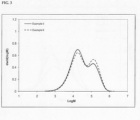
- D90 and D10 are depicted graphically in FIG. 1 for a molecular weight distribution curve as a function of increasing logarithm of the molecular weight.
- a ratio of the number of short chain branches (SCB) per 1000 total carbon atoms of the polymer at D90 to the number of SCB per 1000 total carbon atoms of the polymer at D10 is in a range from 1.1 to 20.
- the ratio of the number of short chain branches (SCB) per 1000 total carbon atoms of the polymer at D90 to the number of SCB per 1000 total carbon atoms of the polymer at D10 can be in a range from 1.1 to 10, or from 1.2 to 6, or from 1.2 to 3.
- polymers disclosed herein have from 1 to 20 short chain branches (SCB) per 1000 total carbon atoms at D90, and this typically varies with the density of the polymer.
- the SCBD of polymers of the present invention can be characterized by the ratio of the number of SCB per 1000 total carbon atoms of the polymer at D85 to the number of SCB per 1000 total carbon atoms of the polymer at D15, i.e., (SCB at D85)/(SCB at D15).
- D85 is the molecular weight at which 85% of the polymer by weight has higher molecular weight
- D15 is the molecular weight at which 15% of the polymer by weight has higher molecular weight.
- a ratio of the number of short chain branches (SCB) per 1000 total carbon atoms of the polymer at D85 to the number of SCB per 1000 total carbon atoms of the polymer at D15 is in a range from 1.1 to 18.
- the ratio of the number of short chain branches (SCB) per 1000 total carbon atoms of the polymer at D85 to the number of SCB per 1000 total carbon atoms of the polymer at D15 can be in a range from 1.1 to 10, or from 1.2 to 6, or from 1.2 to 4, or from 1.2 to 2 5.
- An illustrative example of an ethylene polymer of the present invention can be characterized by a broad and/or bimodal molecular weight distribution; and/or a Mn in a range from 9,000 to 30,000 g/mol; and/or a ratio of Mw/Mn from 4 to 20; and/or a ratio of the number of SCB per 1000 total carbon atoms of the polymer at D90 to the number of SCB per 1000 total carbon atoms of the polymer at D10 in a range from 1.1 to 10; and/or a ratio of the number of SCB per 1000 total carbon atoms of the polymer at D85 to the number of SCB per 1000 total carbon atoms of the polymer at D15 in a range from 1.1 to 8.
- Such illustrative polymers also may be further characterized by a MI in a range from 0.01 to 50 g/10 min, and/or a ratio of HLMI/MI in a range from 20 to 80 and/or a density in a range from 0.91 to 0.945 g/cm 3 .
- Polymers of ethylene which are copolymers can be formed into various articles of manufacture.
- Articles which can comprise polymers of this invention include an agricultural film, an automobile part, a bottle, a drum, a fiber or fabric, a food packaging film or container, a food service article, a fuel tank, a geomembrane, a household container, a liner, a molded product, a medical device or material, a pipe, a sheet or tape, and a toy.
- Various processes can be employed to form these articles. Examples of these processes include injection molding, blow molding, rotational molding, film extrusion, sheet extrusion, profile extrusion, and thermoforming. Additionally, additives and mod-ifiers are often added to these polymers in order to provide beneficial polymer processing or end-use product attributes.
- MI Melt index
- High load melt index (HLMI, g/10 min) was determined in accordance with ASTM D1238 at 190 °C with a 21,600 gram weight.
- Polymer density was determined in grams per cubic centimeter (g/cm 3 ) on a compression molded sample, cooled at about 15 °C per hour, and conditioned for about 40 hours at room temperature in accordance with ASTM D1505 and ASTM D1928, procedure C.
- Molecular weights and molecular weight distributions were obtained using a PL 220 SEC high temperature chromatography unit (Polymer Laboratories) with trichlorobenzene (TCB) as the solvent, with a flow rate of 1 mL/minute at a temperature of 145 °C.
- BHT 2,6-di-tert-butyl-4-methylphenol
- An injection volume of 200 ⁇ L was used with a nominal polymer concentration of 1.5 mg/mL.
- Dissolution of the sample in stabilized TCB was carried out by heating at 150°C for 5 hours with occasional, gentle agitation.
- the columns used were three PLge1 Mixed A LS columns (7.8x300mm) and were calibrated with a broad linear polyethylene standard (Phillips Marlex ® BHB 5003) for which the molecular weight had been determined.
- Short chain branching distribution (SCBD) data was obtained using a SEC-FTIR high temperature heated flow cell (Polymer Laboratories) as described by P.J. DesLauriers, D.C. Rohlfing, and E.T. Hsieh, Polymer, 43, 159 (2002 ).
- the sulfated alumina activator-support (abbreviated SA) employed in Examples 1-6 and 11-16 was prepared in accordance with the following procedure.
- Bohemite was obtained from W.R. Grace Company under the designation "Alumina A” and having a surface area of about 300 m 2 /g and a pore volume of about 1.3 mL/g.
- This material was obtained as a powder having an average particle size of about 100 microns.
- This material was impregnated to incipient wetness with an aqueous solution of ammonium sulfate to equal about 15% sulfate. This mixture was then placed in a flat pan and allowed to dry under vacuum at approximately 110 °C for about 16 hours.
- the fluorided silica-alumina activator-support (abbreviated FSA) employed in Examples 7-10 was prepared in accordance with the following procedure.
- a silica-alumina was obtained from W.R. Grace Company containing about 13% alumina by weight and having a surface area of about 400 m 2 /g and a pore volume of about 1.2 mL/g. This material was obtained as a powder having an average particle size of about 70 microns. Approximately 100 grams of this material were impregnated with a solution containing about 200 mL of water and about 10 grams of ammonium hydrogen fluoride, resulting in a damp powder having the consistency of wet sand. This mixture was then placed in a flat pan and allowed to dry under vacuum at approximately 110 °C for about 16 hours.
- the polymerization runs were conducted in a one-gallon (3.8-liter) stainless steel reactor as follows. First, the reactor was purged with nitrogen and then with isobutane vapor. Approximately 0.3-1.0 mmol of either triisobutylaluminum (TIBA) or triethylaluminum (TEA), 100-200 mg of activator-support SA or FSA, and the desired amount of catalyst component I and/or catalyst component II (see below for structures of these components) were added in that order through a charge port while venting isobutane vapor. The charge port was closed and about 2 L of isobutane were added. The contents of the reactor were stirred and heated to 85-90 °C.
- TIBA triisobutylaluminum
- TSA triethylaluminum
- FSA triethylaluminum
- catalyst component I and/or catalyst component II see below for structures of these components
- Catalyst component I metallocene compounds used in these examples had the following structures:
- Catalyst component II metallocene compounds used in these examples had the following structures:
- metallocene compounds can be prepared in accordance with any suitable method. Representative techniques are described in U.S. Patent Nos. 7,026,494 , 7,199,073 , 7,312,283 , 7,456,243 , and 7,521,572 , and U.S. Patent Publication
- Example 1-10 The polymerization conditions for Examples 1-10 are summarized in Table I , while the resultant polymer properties for Examples 1-10 are summarized in Table II.
- the weight ratio of catalyst components I:II in Examples 1-10 was within a range from about 4:1 to about 1:2.
- the Mn of the polymers of Examples 1-10 was within a range from about 11,000 to about 25,000 g/mol.
- FIG. 2 illustrates the molecular weight distributions of the polymers of Examples 1-4
- FIG. 3 illustrates the molecular weight distributions of the polymers of Examples 5-6
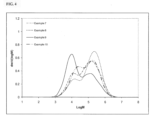
- FIG. 4 illustrates the molecular weight distributions of the polymers of Examples 7-10.
- FIGS. 2-4 demonstrate that the polymers of Examples 1-10 have a broad and/or bimodal MWD.
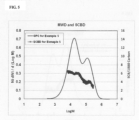
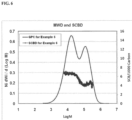
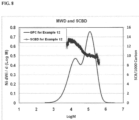
- FIGS. 5-8 illustrate the MWD and the SCBD of the polymers of Examples 5, 6, 11, and 12, respectively. These polymers have a bimodal MWD and, in addition, the SCB content decreases as molecular weight increases.
- Table I Polymerization Conditions for Examples 1-10.
- Example Catalyst Component I Catalyst Component II Time (min) Temperature (°C) Reactor Pressure kPa (psi) 1-hexene (g) Activator-Support Alkyl Aluminum 1 1.5 mg I-1 1 mg II-1 30 90 2689 (390) 8 150 mg SA 0.6 mmol TIBA 2 2 mg I-1 0.5 mg II-1 30 90 2689 (390) 8 150 mg SA 0.6 mmol TIBA 3 2 mg I-1 0.8 mg II-1 30 90 2689 (390) 8 150 mg SA 0.6 mmol TIBA 4 2 mg I-1 1 mg II-1 30 90 2689 (390) 8 150 mg SA 0.6 mmol TIBA 5 2 mg I-1 1 mg II-1 30 90 2689 (390) 15 150 mg SA 0.6 mmol TIBA 6 1.5 mg I-1 1 mg II-1 30 90 2689 (390) 15 150 mg SA 0.6 mmol TIBA 7* 1.5 mg I-2 1.5 mg II-2 30 90 3792 (550) 10 200 mg FSA 0.5
- Example g PE Produced MI (g/10 min) HLMI (g/ 10 min) Density (g/cc) Mn (g/mol) Mw (g/mol) Mz (g/mol) Mw/Mn Mz/Mw 1 168 1.7 68 0.9408 19,000 110,000 310,500 5.8 2.8 2 205 36.9 838 -- 12,300 55,900 233,800 4.5 4.2 3 198 7.8 498 0.9426 13,500 75,800 252,600 5.6 3.3 4 161 2.4 123 0.9423 16,900 99,400 303,300 5.9 3.1 5 197 5.7 306 0.9388 12,700 75,500 234,600 5.9 3.1 6 197 3.8 181 0.9368 14,300 84,200 244,600 5.9 2.9 7* 112 0.2 6.0 0.9467 23,100 234,200 1,067,000 10.1 4.6 8* 468 0.2 5.7 0.9381 24,800 236,800 601,200 5.9 2.5 9* 116 ⁇
- the catalyst component I metallocene compound used in these examples had the following structure:
- Example III The polymerization conditions for Examples 13-16 are summarized in Table III , while the resultant polymer properties for Examples 13-16 are summarized in Table IV.
- FIG. 9 illustrates the molecular weight distributions of the polymers of Examples 13-16. As shown in Tables III-IV and FIG. 9 , unexpectedly, the molecular weight distributions of the polymers of Examples 13-16 were largely unaffected by the amount of hydrogen added to the reactor. Table III. Polymerization Conditions for Examples 13-16.
- Example Catalyst Component I Catalyst Component II Time (min) Temperature (°C) Reactor Pressure kPa (psi) H 2 /ethylene (ppm) Activator-Support Alkyl Aluminum 13 2 mg I-1 None 30 90 2689 (390) 0 100 mg SA 0.3 mmol TIBA 14 2 mg I-1 None 30 90 2689 (390) 100 100 mg SA 0.3 mmol TIBA 15 2 mg I-1 None 30 90 2689 (390) 200 100 mg SA 0.3 mmol TIBA 16 2 mg I-1 None 30 90 2689 (390) 300 100 mg SA 0.3 mmol TIBA Table IV . Polymer Properties of Examples 13-16.
Landscapes
- Chemical & Material Sciences (AREA)
- Health & Medical Sciences (AREA)
- Chemical Kinetics & Catalysis (AREA)
- Medicinal Chemistry (AREA)
- Polymers & Plastics (AREA)
- Organic Chemistry (AREA)
- Crystallography & Structural Chemistry (AREA)
- Engineering & Computer Science (AREA)
- Materials Engineering (AREA)
- Transition And Organic Metals Composition Catalysts For Addition Polymerization (AREA)
- Addition Polymer Or Copolymer, Post-Treatments, Or Chemical Modifications (AREA)
Claims (14)
- Procédé de polymérisation d'oléfines, le procédé comprenant :
la mise en contact d'une composition catalytique avec un monomère oléfinique et au moins un comonomère oléfinique dans des conditions de polymérisation pour produire un polymère oléfinique, dans lequel la composition catalytique ne comprend qu'un seul composant catalytique I, qu'un seul composant catalytique II et au moins un activateur, dans lequel :
le composant catalytique I est constitué de :un composé ayant la formule (A) ;dans lequel la formule (A) étant : dans lequel :M1 est Zr ou Hf ;X1 et X2 sont indépendamment F ; C ; Br ; I ; méthyle ; benzyle ; phényle ; H ; BH4 ; OBR2 ou SO3R, dans lequel R étant un groupe alkyle ou aryle ayant jusqu'à 18 atomes de carbone ; ou un groupe Hydrocarbyloxyde, un groupe hydrocarbylamino ou un groupe hydrocarbylsilyle, chacun d'entre eux ayant jusqu'à 18 atomes de carbone ;E1 est C ou Si ;R1 et R2 sont indépendamment H, un groupe hydrocarbyle ayant jusqu'à 18 atomes de carbone, ou R1 et R2 sont reliés pour former un groupe cyclique ou hétérocyclique ayant jusqu'à 18 atomes de carbone ; etR3 est H ou un groupe hydrocarbyle ou hydrocarbylsilyle ayant jusqu'à 18 atomes de carbone ; etle composant catalytique II est constitué de :un composé ayant la formule (C) ;dans lequel la formule (C) étant :
 M3 est Zr ou Hf ;X4 et X5 sont indépendamment F ; Cl ; Br ; I ; méthyle ; benzyle ; phényle ; H ; BH4 ; OBR2 ou SO3R, dans lequel R étant un groupe alkyle ou aryle ayant jusqu'à 18 atomes de carbone ; ou un groupe hydrocarbyloxyde, un groupe hydrocarbylamino ou un groupe hydrocarbylsilyle, chacun d'entre eux ayant jusqu'à 18 atomes de carbone ;E3 est un groupe pontant choisi parmi :un groupe pontant cyclique ou hétérocyclique ayant jusqu'à 18 atomes de carbone,un groupe pontant ayant la formule >E3AR7AR8A, dans lequel E3A étant C ou Si, et R7A et R8A étant indépendamment H ou un groupe hydrocarbyle ayant jusqu'à 18 atomes de carbone,un groupe pontant ayant la formule -CR7BR8B-CR7CR8C-, dans lequel R7B, R8B, R7C et R8C étant indépendamment H ou un groupe hydrocarbyle ayant jusqu'à 10 atomes de carbone, ouun groupe pontant ayant la formule -SiR7DR8D-SiR7ER8E-, dans lequel R7D, R8D, R7E et R8E étant indépendamment H ou un groupe hydrocarbyle ayant jusqu'à 10 atomes de carbone ;R9 et R10 sont indépendamment H ou un groupe hydrocarbyle ayant jusqu'à 18 atomes de carbone ; etCp1 est un groupe cyclopentadiényle ou indényle, tout substituant sur Cp1 est H ou un groupe hydrocarbyle ou hydrocarbylsilyle ayant jusqu'à 18 atomes de carbone.
 - Procédé selon la revendication 1, dans lequel l'au moins un activateur comprend au moins un activateur-support comprenant un oxyde solide traité par un anion électro-attracteur, dans lequel :l'oxyde solide comprend de la silice, de l'alumine, de la silice-alumine, de l'alumine enrobée de silice, du phosphate d'aluminium, de l'aluminophosphate, de l'hétéropolytungstate, de l'oxyde de titane, de la zircone, de la magnésie, de l'oxyde de bore, de l'oxyde de zinc, un oxyde mixte de ceux-ci ou tout mélange de ceux-ci ; etl'anion électro-attracteur comprend le sulfate, le bisulfate, le fluorure, le chlorure, le bromure, l'iodure, le fluorosulfate, le fluoroborate, le phosphate, le flurophosphate, le trifluoroacétate, le triflate, le flurozirconate, le flurorotitanate, le phospho-tungstate ou toute combinaison de ceux-ci.
- Procédé selon la revendication 1, dans lequel la composition catalytique comprend en outre au moins un composé organoaluminium ayant la formule :
A1(XA)m(XB)3-m,
dans lequel :XA est un hydrocarbyle ;XB est un alcoxyde ou un aryloxyde, un halogénure ou un hydrure ; etm est compris entre 1 et 3, bornes incluses. - Procédé selon la revendication 3, dans lequel :l'au moins un composé organoaluminium comprend le triméthylaluminium, le triéthylaluminium, le tri-n-propylaluminium, le tri-n-butylaluminium, le triisobutylaluminium, le tri-n-hexylaluminium, le tri-n-octylaluminium, l'hydrure de diisobutylaluminium, l'éthoxyde de diéthylaluminium, le chlorure de diéthylaluminium ou toute combinaison de ceux-ci ; etl'au moins un activateur comprend au moins un activateur-support, et dans lequel l'au moins un activateur comprend de l'alumine fluorée, de l'alumine chlorée, de l'alumine bromée, de l'alumine sulfatée, de la silice-alumine fluorée, de la silice-alumine chlorée, de la silice-alumine bromée, de la silice-alumine sulfatée, de la silice-zircone fluorée, de la silice-zircone chlorée, de la silice-zircone bromée, de la silice-zircone sulfatée, de la silice-titane fluorée, de l'alumine enrobée de silice fluorée, de l'alumine enrobée de silice sulfatée, de l'alumine enrobée de silice phosphatée, ou toute combinaison de celles-ci.
- Procédé selon la revendication 1, dans lequel l'au moins un activateur comprend au moins un composé aluminoxane, au moins un composé organoboré ou organoborate, au moins un composé ionique ionisant, ou toute combinaison de ceux-ci.
- Procédé selon la revendication 1, dans lequel le composant catalytique I est constitué d'un composé ayant la formule (A), et dans lequel :X1 et X2 sont indépendamment F, Cl, Br, I, méthyle, benzyle ou phényle ; etR1, R2 et R3 sont indépendamment méthyle, éthyle, propyle, butyle, pentyle, hexyle, heptyle, octyle, nonyle, décyle, éthényle, propényle, butényle, pentényle, hexényle, heptényle, octényle, nonényle, décényle, phényle, tolyle ou benzyle.
- Procédé selon la revendication 1, dans lequel le composant catalytique II est constitué d'un composé ayant la formule (C), et dans lequel :X4 et X5 sont indépendamment F, Cl, Br, I, méthyle, benzyle ou phényle ; etE3 est un groupe pontant choisi parmi :un groupe cyclopentyle ou cyclohexyle,un groupe pontant ayant la formule >E3AR7AR8A, dans lequel E3A étant C ou Si, et R7A et R8A étant indépendamment H, méthyle, éthyle, propyle, butyle, pentyle, hexyle, heptyle, octyle, nonyle, décyle, éthényle, propényle, butényle, pentényle, hexényle, heptényle, octényle, nonényle, décényle, phényle, tolyle ou benzyle,un groupe pontant ayant la formule -CR7BR8B-CR7CR8C-, dans lequel R7B, R8B, R7C et R8C étant indépendamment H ou méthyle, ouun groupe pontant ayant la formule -SiR7DR8D-SiR7ER8E-, dans lequel R7D, R8D, R7E et R8E étant indépendamment H ou méthyle ; etR9 et R10 sont indépendamment H ou t-butyle.
- Procédé selon la revendication 1, dans lequel un rapport pondéral du composant catalytique I au composant catalytique II dans la composition catalytique est compris dans une plage de 100:1 à 1:100.
- Procédé selon la revendication 1, dans lequel le procédé est réalisé dans un réacteur discontinu, un réacteur à suspension, un réacteur à phase gazeuse, un réacteur à solution, un réacteur à haute pression, un réacteur tubulaire, un réacteur autoclave ou une combinaison de ceux-ci.
- Procédé selon la revendication 1, dans lequel le monomère oléfinique est l'éthylène, et l'au moins un comonomère oléfinique comprend le propylène, le 1-butène, le 2-butène, le 3-méthyl-1-butène, l'isobutylène, le 1-pentène, le 2-pentène, le 3-méthyl-1-pentène, le 4-méthyl-1-pentène, le 1-hexène, le 2-hexène, le 3-éthyl-1-hexène, le 1-heptène, le 2-heptène, le 3-heptène, le 1-octène, le 1-décène, le styrène ou un mélange de ceux-ci.
- Procédé selon la revendication 1, dans lequel le procédé est réalisé en l'absence d'hydrogène ajouté.
- Procédé selon la revendication 1, dans lequel le procédé est réalisé en présence de 10 ppm à 500 ppm d'hydrogène.
- Procédé selon la revendication 1, dans lequel :le polymère a un Mn compris dans une plage de 9000 à 30000 g/mol ; oule polymère a un rapport du nombre de ramifications à chaîne courte (SCB) pour 1000 atomes de carbone totaux du polymère à D90 au nombre de SCB pour 1000 atomes de carbone totaux du polymère à D10 compris dans une plage de 1,1 à 20 ; oules deux.
- Composition catalytique pour la production de copolymères d'oléfines comprenant un seul composant catalytique I, un seul composant catalytique II et au moins un activateur, dans laquelle :
le composant catalytique I est constitué de :un composé ayant la formule (A) ;dans laquelle : la formule (A) étant ; dans laquelle :M1 est Zr ou Hf ;X1 et X2 sont indépendamment F ; Cl ; Br ; I ; méthyle ; benzyle ; phényle ; H ; BH4 ; OBR2 ou SO3R, dans laquelle R étant un groupe alkyle ou aryle ayant jusqu'à 18 atomes de carbone ; ou un groupe Hydrocarbyloxyde, un groupe hydrocarbylamino ou un groupe hydrocarbylsilyle, chacun d'entre eux ayant jusqu'à 18 atomes de carbone ;E1 est C ou Si ;R1 et R2 sont indépendamment H, un groupe hydrocarbyle ayant jusqu'à 18 atomes de carbone, ou R1 et R2 sont reliés pour former un groupe cyclique ou hétérocyclique ayant jusqu'à 18 atomes de carbone ; etR3 est H ou un groupe hydrocarbyle ou hydrocarbylsilyle ayant jusqu'à 18 atomes de carbone ; etle composant catalytique II est constitué de :un composé ayant la formule (C) ;dans laquelle :
la formule (C) étantM3 est Zr ou Hf ;X4 et X5 sont indépendamment F ; Cl ; Br ; I ; méthyle ; benzyle ; phényle ; H ; BH4 ; OBR2 ou SO3R, dans laquelle R étant un groupe alkyle ou aryle ayant jusqu'à 18 atomes de carbone ; ou un groupe hydrocarbyloxyde, un groupe hydrocarbylamino ou un groupe hydrocarbylsilyle, chacun d'entre eux ayant jusqu'à 18 atomes de carbone ;E3 est un groupe pontant choisi parmi :un groupe pontant cyclique ou hétérocyclique ayant jusqu'à 18 atomes de carbone,un groupe pontant ayant la formule >E3AR7AR8A, dans laquelle E3A étant C ou Si, et R7A et R8A étant indépendamment H ou un groupe hydrocarbyle ayant jusqu'à 18 atomes de carbone,un groupe pontant ayant la formule -CR7BR8B-CR7CR8C-, dans laquelle R7B, R8B, R7C et R8C étant indépendamment H ou un groupe hydrocarbyle ayant jusqu'à 10 atomes de carbone, ouun groupe pontant ayant la formule -SiR7DR8D-SiR7ER8E-, dans laquelle R7D, R8D, R7E et R8E étant indépendamment H ou un groupe hydrocarbyle ayant jusqu'à 10 atomes de carbone ;R9 et R10 sont indépendamment H ou un groupe hydrocarbyle ayant jusqu'à 18 atomes de carbone ; etCp1 est un groupe cyclopentadiényle ou indényle, tout substituant sur Cp1 est H ou un groupe hydrocarbyle ou hydrocarbylsilyle ayant jusqu'à 18 atomes de carbone.
Applications Claiming Priority (2)
| Application Number | Priority Date | Filing Date | Title |
|---|---|---|---|
| US12/830,571 US8288487B2 (en) | 2010-07-06 | 2010-07-06 | Catalysts for producing broad molecular weight distribution polyolefins in the absence of added hydrogen |
| PCT/US2011/042935 WO2012006272A2 (fr) | 2010-07-06 | 2011-07-05 | Catalyseurs pour la production de polyoléfines à large distribution des masses moléculaires en l'absence d'hydrogène ajouté |
Publications (3)
| Publication Number | Publication Date |
|---|---|
| EP2591012A2 EP2591012A2 (fr) | 2013-05-15 |
| EP2591012B1 EP2591012B1 (fr) | 2020-10-28 |
| EP2591012B2 true EP2591012B2 (fr) | 2025-07-02 |
Family
ID=44629227
Family Applications (1)
| Application Number | Title | Priority Date | Filing Date |
|---|---|---|---|
| EP11738340.6A Active EP2591012B2 (fr) | 2010-07-06 | 2011-07-05 | Catalyseurs pour la production de polyoléfines à large distribution des masses moléculaires en l'absence d'hydrogène ajouté |
Country Status (9)
| Country | Link |
|---|---|
| US (3) | US8288487B2 (fr) |
| EP (1) | EP2591012B2 (fr) |
| KR (2) | KR101836542B1 (fr) |
| CN (1) | CN102958948B (fr) |
| BR (1) | BR112013000397B1 (fr) |
| CA (3) | CA3034897C (fr) |
| MX (2) | MX390719B (fr) |
| SG (1) | SG186217A1 (fr) |
| WO (1) | WO2012006272A2 (fr) |
Families Citing this family (93)
| Publication number | Priority date | Publication date | Assignee | Title |
|---|---|---|---|---|
| US7226886B2 (en) | 2005-09-15 | 2007-06-05 | Chevron Phillips Chemical Company, L.P. | Polymerization catalysts and process for producing bimodal polymers in a single reactor |
| US7619047B2 (en) | 2006-02-22 | 2009-11-17 | Chevron Phillips Chemical Company, Lp | Dual metallocene catalysts for polymerization of bimodal polymers |
| US8288487B2 (en) | 2010-07-06 | 2012-10-16 | Chevron Phillips Chemical Company Lp | Catalysts for producing broad molecular weight distribution polyolefins in the absence of added hydrogen |
| US8637616B2 (en) | 2010-10-07 | 2014-01-28 | Chevron Philips Chemical Company Lp | Bridged metallocene catalyst systems with switchable hydrogen and comonomer effects |
| US8629292B2 (en) | 2010-10-07 | 2014-01-14 | Chevron Phillips Chemical Company Lp | Stereoselective synthesis of bridged metallocene complexes |
| US8609793B2 (en) | 2010-10-07 | 2013-12-17 | Chevron Phillips Chemical Company Lp | Catalyst systems containing a bridged metallocene |
| SG11201406154VA (en) | 2012-04-02 | 2014-10-30 | Chevron Phillips Chemical Co | Catalyst systems containing a bridged metallocene reference to related application |
| US8940842B2 (en) | 2012-09-24 | 2015-01-27 | Chevron Phillips Chemical Company Lp | Methods for controlling dual catalyst olefin polymerizations |
| US8865846B2 (en) | 2012-09-25 | 2014-10-21 | Chevron Phillips Chemical Company Lp | Metallocene and half sandwich dual catalyst systems for producing broad molecular weight distribution polymers |
| US8821800B2 (en) | 2012-10-18 | 2014-09-02 | Chevron Phillips Chemical Company Lp | System and method for catalyst preparation |
| US9006367B2 (en) | 2012-11-07 | 2015-04-14 | Chevron Phillips Chemical Company Lp | Low density polyolefin resins and films made therefrom |
| US8912285B2 (en) | 2012-12-06 | 2014-12-16 | Chevron Phillips Chemical Company Lp | Catalyst system with three metallocenes for producing broad molecular weight distribution polymers |
| US8703886B1 (en) | 2013-02-27 | 2014-04-22 | Chevron Phillips Chemical Company Lp | Dual activator-support catalyst systems |
| US9181370B2 (en) | 2013-11-06 | 2015-11-10 | Chevron Phillips Chemical Company Lp | Low density polyolefin resins with low molecular weight and high molecular weight components, and films made therefrom |
| WO2015072658A1 (fr) * | 2013-11-18 | 2015-05-21 | 주식회사 엘지화학 | Polymère à base d'oléfine présentant une excellente aptitude à la mise en œuvre |
| KR101549209B1 (ko) * | 2013-11-18 | 2015-09-02 | 주식회사 엘지화학 | 가공성이 우수한 올레핀계 중합체 |
| WO2015077026A1 (fr) | 2013-11-19 | 2015-05-28 | Chevron Phillips Chemical Company Lp | Systèmes de catalyseur contenant des composés métallocène cyclopentadienyle-fluorényle à pont bore, avec un substituant alcényle |
| WO2015077100A2 (fr) | 2013-11-19 | 2015-05-28 | Chevron Phillips Chemical Company Lp | Systèmes de catalyseur à base de bis-indényl-métallocène à pont boré et polymères produits à partir de ceux-ci |
| US9540465B2 (en) | 2013-11-19 | 2017-01-10 | Chevron Phillips Chemical Company Lp | Boron-bridged metallocene catalyst systems and polymers produced therefrom |
| US9217049B2 (en) | 2013-11-19 | 2015-12-22 | Chevron Phillips Chemical Company Lp | Dual catalyst systems for producing polymers with a broad molecular weight distribution and a uniform short chain branch distribution |
| BR112016019334B1 (pt) * | 2014-02-11 | 2021-03-09 | Univation Technologies, Llc | método para formar uma composição de catalisador |
| BR112016027380B1 (pt) * | 2014-05-22 | 2021-08-10 | Chevron Phillips Chemical Company Lp | Processo de polimerização e composição de catalisador |
| CN106794455B (zh) | 2014-08-19 | 2020-09-04 | 尤尼威蒂恩技术有限责任公司 | 氟化催化剂载体和催化剂系统 |
| SG11201701260WA (en) | 2014-08-19 | 2017-03-30 | Univation Tech Llc | Fluorinated catalyst supports and catalyst systems |
| BR112017003306B1 (pt) | 2014-08-19 | 2022-03-03 | Univation Technologies, Llc | Método para preparar um suporte de catalisador fluorado e sistema de catalisador |
| EP3031831B1 (fr) * | 2014-09-05 | 2019-06-19 | LG Chem, Ltd. | Catalyseur hybride supporté et procédé de préparation de polymère à base d'oléfine utilisant ce dernier |
| WO2016036204A1 (fr) * | 2014-09-05 | 2016-03-10 | 주식회사 엘지화학 | Polymère à base d'oléfine présentant une excellente aptitude à la mise en œuvre |
| KR101617870B1 (ko) | 2014-09-05 | 2016-05-03 | 주식회사 엘지화학 | 가공성이 우수한 올레핀계 중합체 |
| KR101653356B1 (ko) | 2014-10-17 | 2016-09-01 | 주식회사 엘지화학 | 고분자량 폴리올레핀 제조용 메탈로센 촉매 및 이의 제조방법 |
| KR101653357B1 (ko) | 2014-11-06 | 2016-09-01 | 주식회사 엘지화학 | 고분자량 폴리올레핀 제조용 메탈로센 촉매 및 이의 제조방법 |
| WO2016093580A1 (fr) * | 2014-12-08 | 2016-06-16 | 주식회사 엘지화학 | Copolymère éthylène/alpha-oléfine ayant une excellente aptitude au traitement |
| KR101747401B1 (ko) | 2014-12-08 | 2017-06-14 | 주식회사 엘지화학 | 가공성이 우수한 에틸렌/알파-올레핀 공중합체 |
| WO2016171808A1 (fr) | 2015-04-20 | 2016-10-27 | Exxonmobil Chemical Patents Inc. | Composition catalytique comprenant un support fluoré et procédés d'utilisation associés |
| US9796795B2 (en) | 2015-01-14 | 2017-10-24 | Exxonmobil Chemical Patents Inc. | Tetrahydroindacenyl catalyst composition, catalyst system, and processes for use thereof |
| WO2016171807A1 (fr) | 2015-04-20 | 2016-10-27 | Exxonmobil Chemical Patents Inc. | Composition catalyseur comprenant un support fluoré et ses procédés d'utilisation |
| KR20160121045A (ko) * | 2015-04-09 | 2016-10-19 | 주식회사 엘지화학 | 중공 성형용 고밀도 폴리에틸렌 공중합체 |
| KR101831418B1 (ko) | 2015-04-13 | 2018-02-22 | 주식회사 엘지화학 | 가공성 및 표면 특성이 우수한 에틸렌/알파-올레핀 공중합체 |
| KR20160121940A (ko) * | 2015-04-13 | 2016-10-21 | 주식회사 엘지화학 | 내환경 응력 균열성이 우수한 에틸렌/알파-올레핀 공중합체 |
| WO2016167548A1 (fr) * | 2015-04-13 | 2016-10-20 | 주식회사 엘지화학 | Copolymère éthylène/alpha-oléfine ayant une aptitude au traitement et des caractéristiques de surface excellentes |
| KR101891638B1 (ko) | 2015-04-15 | 2018-08-24 | 주식회사 엘지화학 | 가공성이 우수한 에틸렌/알파-올레핀 공중합체 공중합체 |
| KR20160123172A (ko) * | 2015-04-15 | 2016-10-25 | 주식회사 엘지화학 | 가공성이 우수한 에틸렌/알파-올레핀 공중합체 |
| EP3274381B1 (fr) | 2015-04-20 | 2019-05-15 | ExxonMobil Chemical Patents Inc. | Composition de catalyseur comprenant un support fluoré et procédés pour leur utilisation |
| US9861955B2 (en) | 2015-06-11 | 2018-01-09 | Chevron Phillips Chemical Company, Lp | Treater regeneration |
| US9289748B1 (en) | 2015-06-11 | 2016-03-22 | Chevron Phillips Chemical Company Lp | Treater regeneration |
| US9540457B1 (en) * | 2015-09-24 | 2017-01-10 | Chevron Phillips Chemical Company Lp | Ziegler-natta—metallocene dual catalyst systems with activator-supports |
| KR101711788B1 (ko) | 2016-03-09 | 2017-03-14 | 한화케미칼 주식회사 | 혼성 촉매 조성물, 이의 제조방법, 및 이를 이용하여 제조된 폴리올레핀 |
| KR101725004B1 (ko) * | 2016-04-27 | 2017-04-18 | 한화케미칼 주식회사 | 혼성 담지 메탈로센 촉매 및 이를 이용한 가공성이 우수한 폴리올레핀 수지 |
| CN109312015B (zh) | 2016-05-03 | 2021-10-26 | 埃克森美孚化学专利公司 | 四氢引达省基催化剂组合物、催化剂体系及其使用方法 |
| US9803037B1 (en) | 2016-05-03 | 2017-10-31 | Exxonmobil Chemical Patents Inc. | Tetrahydro-as-indacenyl catalyst composition, catalyst system, and processes for use thereof |
| EP3778666B1 (fr) | 2016-11-08 | 2023-12-13 | Univation Technologies, LLC | Composition de polyéthylène |
| EP3538569B1 (fr) | 2016-11-08 | 2021-12-01 | Univation Technologies, LLC | Composition de polyéthylène |
| KR102139364B1 (ko) * | 2016-12-20 | 2020-07-29 | 주식회사 엘지화학 | 올레핀 중합체 및 이의 제조 방법 |
| KR102087340B1 (ko) * | 2016-12-20 | 2020-03-10 | 주식회사 엘지화학 | 폴리올레핀계 필름 |
| KR102065719B1 (ko) | 2017-01-25 | 2020-01-13 | 주식회사 엘지화학 | 혼성 담지 촉매 |
| MX2019009220A (es) * | 2017-02-13 | 2019-09-10 | Univation Tech Llc | Resinas de polietileno bimodales. |
| US10723819B2 (en) | 2017-02-20 | 2020-07-28 | Exxonmobil Chemical Patents, Inc. | Supported catalyst systems and processes for use thereof |
| CN110431160B (zh) | 2017-02-20 | 2021-12-31 | 埃克森美孚化学专利公司 | 负载型催化剂体系及其使用方法 |
| ES2986055T3 (es) | 2017-05-03 | 2024-11-08 | Chevron Phillips Chemical Co Lp | Regeneración de un desecante en un dispositivo de tratamiento fuera de línea de un proceso de producción de poliolefina |
| US10030086B1 (en) | 2017-07-21 | 2018-07-24 | Chevron Phillips Chemical Company Lp | Methods for determining transition metal compound concentrations in multicomponent liquid systems |
| US10697889B2 (en) | 2017-07-21 | 2020-06-30 | Chevron Phillips Chemical Company Lp | Methods for determining transition metal compound concentrations in multicomponent liquid systems |
| PL3661983T3 (pl) * | 2017-08-02 | 2022-05-30 | Total Research & Technology Feluy | Kompozycja podwójnego katalizatora |
| WO2019027585A1 (fr) | 2017-08-04 | 2019-02-07 | Exxonmobil Chemical Patents Inc. | Catalyseurs mixtes comprenant des hafnocènes non pontés avec des fractions -ch2-sime3 |
| US10844150B2 (en) | 2017-08-04 | 2020-11-24 | Exxonmobil Chemical Patents Inc. | Mixed catalysts with 2,6-bis(imino)pyridyl iron complexes and bridged hafnocenes |
| US10703838B2 (en) | 2017-10-31 | 2020-07-07 | Exxonmobil Chemical Patents Inc. | Mixed catalyst systems with four metallocenes on a single support |
| US10882925B2 (en) | 2017-11-29 | 2021-01-05 | Exxonmobil Chemical Patents Inc. | Catalysts that produce polyethylene with broad, bimodal molecular weight distribution |
| US10889663B2 (en) | 2017-11-29 | 2021-01-12 | Exxonmobil Chemical Patents Inc. | Asymmetric ANSA-metallocene catalyst compounds for producing polyolefins having a broad molecular weight distribution |
| WO2019108977A1 (fr) | 2017-12-01 | 2019-06-06 | Exxonmobil Chemical Patents Inc. | Systèmes de catalyseur et procédés de polymérisation pour leur utilisation |
| US10926250B2 (en) | 2017-12-01 | 2021-02-23 | Exxonmobil Chemical Patents Inc. | Catalyst systems and polymerization processes for using the same |
| EP3670544B1 (fr) * | 2017-12-20 | 2022-03-23 | Lg Chem, Ltd. | Composition de catalyseur et procédé de préparation de polymère d'oléfine faisant appel à celle-ci |
| KR102248557B1 (ko) * | 2017-12-20 | 2021-05-06 | 주식회사 엘지화학 | 촉매 조성물 및 이를 이용한 올레핀 중합체의 제조 방법 |
| US10865258B2 (en) | 2018-01-31 | 2020-12-15 | Exxonmobil Chemical Patents Inc. | Mixed catalyst systems containing bridged metallocenes with a pendant group 13 element, processes for making a polymer product using same, and products made from same |
| US10851187B2 (en) | 2018-01-31 | 2020-12-01 | Exxonmobil Chemical Patents Inc. | Bridged metallocene catalysts with a pendant group 13 element, catalyst systems containing same, processes for making a polymer product using same, and products made from same |
| US10899853B2 (en) | 2018-03-19 | 2021-01-26 | Exxonmobil Chemical Patents Inc. | Processes for producing high propylene content PEDM using tetrahydroindacenyl catalyst systems |
| US10679734B2 (en) | 2018-03-29 | 2020-06-09 | Chevron Phillips Chemical Company Lp | Methods for determining transition metal compound concentrations in multicomponent liquid systems |
| US10507445B2 (en) | 2018-03-29 | 2019-12-17 | Chevron Phillips Chemical Company Lp | Methods for determining transition metal compound concentrations in multicomponent liquid systems |
| US11174332B2 (en) | 2018-04-06 | 2021-11-16 | Exxonmobil Chemical Patents Inc. | Compatibilized thermoplastic vulcanizate compositions |
| US10792609B2 (en) | 2018-05-07 | 2020-10-06 | Chevron Phillips Chemical Company Lp | Nitrogen conservation in polymerization processes |
| US12049527B2 (en) * | 2018-09-28 | 2024-07-30 | Univation Technologies, Llc | Bimodal polyethylene copolymer composition and pipe made thereof |
| SG11202110447SA (en) * | 2019-04-05 | 2021-10-28 | Exxonmobil Chemical Patents Inc | Controlling molecular weight distribution and chemical composition distribution of a polyolefin product |
| US11014997B2 (en) | 2019-05-16 | 2021-05-25 | Chevron Phillips Chemical Company Lp | Dual catalyst system for producing high density polyethylenes with long chain branching |
| JP7430774B2 (ja) | 2019-07-17 | 2024-02-13 | エクソンモービル・ケミカル・パテンツ・インク | 低ガラス転移温度を有する高プロピレン含有量ep |
| US11667777B2 (en) | 2019-10-04 | 2023-06-06 | Chevron Phillips Chemical Company Lp | Bimodal polyethylene copolymers |
| US11472828B2 (en) | 2019-10-11 | 2022-10-18 | Exxonmobil Chemical Patents Inc. | Indacene based metallocene catalysts useful in the production of propylene polymers |
| CN112745366B (zh) * | 2019-10-30 | 2024-05-24 | 中国石油化工股份有限公司 | 硅基桥联的茂金属化合物及其制备方法、应用 |
| KR102342077B1 (ko) | 2019-12-24 | 2021-12-21 | 한화토탈 주식회사 | 에틸렌 중합용 촉매의 제조 방법 |
| US11339279B2 (en) | 2020-04-01 | 2022-05-24 | Chevron Phillips Chemical Company Lp | Dual catalyst system for producing LLDPE and MDPE copolymers with long chain branching for film applications |
| US11267919B2 (en) | 2020-06-11 | 2022-03-08 | Chevron Phillips Chemical Company Lp | Dual catalyst system for producing polyethylene with long chain branching for blow molding applications |
| US11186662B1 (en) | 2020-07-14 | 2021-11-30 | Chevron Phillips Chemical Company Lp | Metallocene catalyst systems with chemically-treated solid oxides for producing ethylene-based plastomers and elastomers |
| CN111974445B (zh) * | 2020-08-24 | 2023-01-17 | 大连华邦化学有限公司 | 一种惰性气体纯化催化剂、原料组合物及制备方法 |
| KR102926564B1 (ko) * | 2020-12-10 | 2026-02-10 | 주식회사 엘지화학 | 폴리올레핀 및 이를 포함하는 필름 |
| US20240124618A1 (en) | 2021-01-12 | 2024-04-18 | Exxonmobil Chemical Patents Inc. | Asymmetric Constrained Geometry Catalysts |
| US11125680B1 (en) | 2021-01-14 | 2021-09-21 | Chevron Phillips Chemical Company Lp | Methods for determining the activity of an activated chemically-treated solid oxide in olefin polymerizations |
| WO2023235799A1 (fr) * | 2022-06-02 | 2023-12-07 | Chevron Phillips Chemical Company Lp | Supports d'activateur d'alumine revêtus de silice fluorée à porosité élevée et leurs utilisations dans des systèmes de catalyseur à base de métallocène pour la polymérisation d'oléfines |
Citations (6)
| Publication number | Priority date | Publication date | Assignee | Title |
|---|---|---|---|---|
| US20050159300A1 (en) † | 2004-01-21 | 2005-07-21 | Jensen Michael D. | Dual metallocene catalyst for producing film resins with good machine direction (MD) elmendorf tear strength |
| US20070043176A1 (en) † | 2005-08-22 | 2007-02-22 | Martin Joel L | Polymerization catalysts and process for producing bimodal polymers in a single reactor |
| US20070043182A1 (en) † | 2005-08-22 | 2007-02-22 | Martin Joel L | Multimodal polyethylene compositions and pipe made from same |
| US20090008543A1 (en) † | 2007-06-11 | 2009-01-08 | Dana-Farber Cancer Institute, Inc. | Mass spectroscopy system and method including an excitation gate |
| US20090105433A1 (en) † | 2007-10-17 | 2009-04-23 | Fina Technology, Inc. | Multi-component catalyst systems and polymerization processes for forming in-situ heterophasic copolymers and/or varying the xylene solubles content of polyolefins |
| WO2009066689A1 (fr) † | 2007-11-19 | 2009-05-28 | Mitsui Chemicals, Inc. | Composé métallocène ponté, catalyseur de polymérisation d'oléfines utilisant le composé et polymère de l'éthylène obtenu à l'aide du catalyseur |
Family Cites Families (59)
| Publication number | Priority date | Publication date | Assignee | Title |
|---|---|---|---|---|
| US3248179A (en) | 1962-02-26 | 1966-04-26 | Phillips Petroleum Co | Method and apparatus for the production of solid polymers of olefins |
| US3242099A (en) | 1964-03-27 | 1966-03-22 | Union Carbide Corp | Olefin polymerization catalysts |
| US4060480A (en) | 1971-09-03 | 1977-11-29 | Chevron Research Company | Hydrocarbon hydroconversion process employing hydroxy-aluminum stabilized catalysts supports |
| US4501885A (en) | 1981-10-14 | 1985-02-26 | Phillips Petroleum Company | Diluent and inert gas recovery from a polymerization process |
| US4588790A (en) | 1982-03-24 | 1986-05-13 | Union Carbide Corporation | Method for fluidized bed polymerization |
| US4452910A (en) | 1982-06-15 | 1984-06-05 | Standard Oil Company (Indiana) | Chromium expanded smectite clay |
| US4808561A (en) | 1985-06-21 | 1989-02-28 | Exxon Chemical Patents Inc. | Supported polymerization catalyst |
| US4794096A (en) | 1987-04-03 | 1988-12-27 | Fina Technology, Inc. | Hafnium metallocene catalyst for the polymerization of olefins |
| US5565175A (en) | 1990-10-01 | 1996-10-15 | Phillips Petroleum Company | Apparatus and method for producing ethylene polymer |
| US5575979A (en) | 1991-03-04 | 1996-11-19 | Phillips Petroleum Company | Process and apparatus for separating diluents from solid polymers utilizing a two-stage flash and a cyclone separator |
| AU650787B2 (en) | 1991-12-09 | 1994-06-30 | Phillips Petroleum Company | Process for preparing a pillared chain silicate clay |
| US5352749A (en) | 1992-03-19 | 1994-10-04 | Exxon Chemical Patents, Inc. | Process for polymerizing monomers in fluidized beds |
| US5436304A (en) | 1992-03-19 | 1995-07-25 | Exxon Chemical Patents Inc. | Process for polymerizing monomers in fluidized beds |
| US5576259A (en) | 1993-10-14 | 1996-11-19 | Tosoh Corporation | Process for producing α-olefin polymer |
| US5455314A (en) | 1994-07-27 | 1995-10-03 | Phillips Petroleum Company | Method for controlling removal of polymerization reaction effluent |
| DE69611554T2 (de) | 1995-02-20 | 2001-07-05 | Tosoh Corp., Shinnanyo | Katalysator für die Polymerisation von Olefinen und Verfahren zur Herstellung von Olefinpolymerisaten |
| EP0889912B1 (fr) | 1996-03-27 | 2000-07-12 | The Dow Chemical Company | Activateur de catalyseur de polymerisation d'olefines hautement solubles |
| US5739220A (en) | 1997-02-06 | 1998-04-14 | Fina Technology, Inc. | Method of olefin polymerization utilizing hydrogen pulsing, products made therefrom, and method of hydrogenation |
| US6239235B1 (en) | 1997-07-15 | 2001-05-29 | Phillips Petroleum Company | High solids slurry polymerization |
| KR100531628B1 (ko) | 1998-03-20 | 2005-11-29 | 엑손모빌 케미칼 패턴츠 인코포레이티드 | 연속적인 슬러리 중합반응의 휘발물질 제거 |
| US6107230A (en) | 1998-05-18 | 2000-08-22 | Phillips Petroleum Company | Compositions that can produce polymers |
| US6300271B1 (en) | 1998-05-18 | 2001-10-09 | Phillips Petroleum Company | Compositions that can produce polymers |
| US6165929A (en) | 1998-05-18 | 2000-12-26 | Phillips Petroleum Company | Compositions that can produce polymers |
| MXPA00002181A (es) * | 1998-07-02 | 2003-04-22 | Montell Technology Company Bv | Procedimiento para la preparacion de polimeros de alfa-olefinas sustancialmente amorfos composiciones que los contienen, y procedimiento para la preparacion de ligandos puenteados. |
| US6294494B1 (en) | 1998-12-18 | 2001-09-25 | Phillips Petroleum Company | Olefin polymerization processes and products thereof |
| US6262191B1 (en) | 1999-03-09 | 2001-07-17 | Phillips Petroleum Company | Diluent slip stream to give catalyst wetting agent |
| US6355594B1 (en) | 1999-09-27 | 2002-03-12 | Phillips Petroleum Company | Organometal catalyst compositions |
| US6376415B1 (en) | 1999-09-28 | 2002-04-23 | Phillips Petroleum Company | Organometal catalyst compositions |
| US6395666B1 (en) | 1999-09-29 | 2002-05-28 | Phillips Petroleum Company | Organometal catalyst compositions |
| US6391816B1 (en) | 1999-10-27 | 2002-05-21 | Phillips Petroleum | Organometal compound catalyst |
| US6548441B1 (en) | 1999-10-27 | 2003-04-15 | Phillips Petroleum Company | Organometal catalyst compositions |
| US6613712B1 (en) | 1999-11-24 | 2003-09-02 | Phillips Petroleum Company | Organometal catalyst compositions with solid oxide supports treated with fluorine and boron |
| US6548442B1 (en) | 1999-12-03 | 2003-04-15 | Phillips Petroleum Company | Organometal compound catalyst |
| US6750302B1 (en) | 1999-12-16 | 2004-06-15 | Phillips Petroleum Company | Organometal catalyst compositions |
| US6524987B1 (en) | 1999-12-22 | 2003-02-25 | Phillips Petroleum Company | Organometal catalyst compositions |
| US7041617B2 (en) | 2004-01-09 | 2006-05-09 | Chevron Phillips Chemical Company, L.P. | Catalyst compositions and polyolefins for extrusion coating applications |
| US6632894B1 (en) | 1999-12-30 | 2003-10-14 | Phillips Petroleum Company | Organometal catalyst compositions |
| US6667274B1 (en) | 1999-12-30 | 2003-12-23 | Phillips Petroleum Company | Polymerization catalysts |
| US6576583B1 (en) | 2000-02-11 | 2003-06-10 | Phillips Petroleum Company | Organometal catalyst composition |
| US6388017B1 (en) | 2000-05-24 | 2002-05-14 | Phillips Petroleum Company | Process for producing a polymer composition |
| US20040059070A1 (en) | 2002-09-19 | 2004-03-25 | Whitte William M. | Process and apparatus for controlling molecular weight distribution and short chain branching for olefin polymers |
| US7199073B2 (en) | 2004-11-10 | 2007-04-03 | Chevron Phillips Chemical Company, Lp | Resins that yield low haze films and the process for their production |
| US7026494B1 (en) | 2005-01-10 | 2006-04-11 | Chevron Phillips Chemical Company, Lp | Polymerization catalysts for producing high melt index polymers without the use of hydrogen |
| US7226886B2 (en) | 2005-09-15 | 2007-06-05 | Chevron Phillips Chemical Company, L.P. | Polymerization catalysts and process for producing bimodal polymers in a single reactor |
| US7619047B2 (en) | 2006-02-22 | 2009-11-17 | Chevron Phillips Chemical Company, Lp | Dual metallocene catalysts for polymerization of bimodal polymers |
| US20070255022A1 (en) | 2006-04-28 | 2007-11-01 | Fina Technology, Inc. | Fluorinated transition metal catalysts and formation thereof |
| US7514510B2 (en) * | 2006-07-25 | 2009-04-07 | Fina Technology, Inc. | Fluorenyl catalyst compositions and olefin polymerization process |
| US8119553B2 (en) | 2007-09-28 | 2012-02-21 | Chevron Phillips Chemical Company Lp | Polymerization catalysts for producing polymers with low melt elasticity |
| US8080681B2 (en) | 2007-12-28 | 2011-12-20 | Chevron Phillips Chemical Company Lp | Nano-linked metallocene catalyst compositions and their polymer products |
| US7863210B2 (en) | 2007-12-28 | 2011-01-04 | Chevron Phillips Chemical Company Lp | Nano-linked metallocene catalyst compositions and their polymer products |
| US8012900B2 (en) | 2007-12-28 | 2011-09-06 | Chevron Phillips Chemical Company, L.P. | Nano-linked metallocene catalyst compositions and their polymer products |
| US7884163B2 (en) | 2008-03-20 | 2011-02-08 | Chevron Phillips Chemical Company Lp | Silica-coated alumina activator-supports for metallocene catalyst compositions |
| RU2509782C2 (ru) * | 2008-09-25 | 2014-03-20 | Базелль Полиолефине Гмбх | Ударопрочная композиция лпэнп и полученные из нее пленки |
| US7919639B2 (en) | 2009-06-23 | 2011-04-05 | Chevron Phillips Chemical Company Lp | Nano-linked heteronuclear metallocene catalyst compositions and their polymer products |
| KR101741855B1 (ko) | 2009-06-29 | 2017-05-30 | 셰브론 필립스 케미컬 컴퍼니 엘피 | 용융지수 감소 및 중합체 생성률 증가를 위한 이중 메탈로센 촉매시스템 |
| US8288487B2 (en) | 2010-07-06 | 2012-10-16 | Chevron Phillips Chemical Company Lp | Catalysts for producing broad molecular weight distribution polyolefins in the absence of added hydrogen |
| US8637616B2 (en) | 2010-10-07 | 2014-01-28 | Chevron Philips Chemical Company Lp | Bridged metallocene catalyst systems with switchable hydrogen and comonomer effects |
| US8609793B2 (en) | 2010-10-07 | 2013-12-17 | Chevron Phillips Chemical Company Lp | Catalyst systems containing a bridged metallocene |
| US8629292B2 (en) | 2010-10-07 | 2014-01-14 | Chevron Phillips Chemical Company Lp | Stereoselective synthesis of bridged metallocene complexes |
-
2010
- 2010-07-06 US US12/830,571 patent/US8288487B2/en active Active
-
2011
- 2011-07-05 KR KR1020127032094A patent/KR101836542B1/ko active Active
- 2011-07-05 CA CA3034897A patent/CA3034897C/fr active Active
- 2011-07-05 MX MX2019011352A patent/MX390719B/es unknown
- 2011-07-05 BR BR112013000397-9A patent/BR112013000397B1/pt active IP Right Grant
- 2011-07-05 KR KR1020187001522A patent/KR101959694B1/ko active Active
- 2011-07-05 CA CA2802498A patent/CA2802498C/fr active Active
- 2011-07-05 CA CA3035065A patent/CA3035065C/fr active Active
- 2011-07-05 SG SG2012090031A patent/SG186217A1/en unknown
- 2011-07-05 EP EP11738340.6A patent/EP2591012B2/fr active Active
- 2011-07-05 CN CN201180029135.5A patent/CN102958948B/zh active Active
- 2011-07-05 WO PCT/US2011/042935 patent/WO2012006272A2/fr not_active Ceased
- 2011-07-05 MX MX2012015222A patent/MX336179B/es unknown
-
2012
- 2012-09-04 US US13/602,567 patent/US8598061B2/en active Active
-
2013
- 2013-11-01 US US14/069,469 patent/US9102821B2/en active Active
Patent Citations (8)
| Publication number | Priority date | Publication date | Assignee | Title |
|---|---|---|---|---|
| US20050159300A1 (en) † | 2004-01-21 | 2005-07-21 | Jensen Michael D. | Dual metallocene catalyst for producing film resins with good machine direction (MD) elmendorf tear strength |
| US20070043176A1 (en) † | 2005-08-22 | 2007-02-22 | Martin Joel L | Polymerization catalysts and process for producing bimodal polymers in a single reactor |
| US20070043182A1 (en) † | 2005-08-22 | 2007-02-22 | Martin Joel L | Multimodal polyethylene compositions and pipe made from same |
| US20090008543A1 (en) † | 2007-06-11 | 2009-01-08 | Dana-Farber Cancer Institute, Inc. | Mass spectroscopy system and method including an excitation gate |
| US20090105433A1 (en) † | 2007-10-17 | 2009-04-23 | Fina Technology, Inc. | Multi-component catalyst systems and polymerization processes for forming in-situ heterophasic copolymers and/or varying the xylene solubles content of polyolefins |
| WO2009052146A1 (fr) † | 2007-10-17 | 2009-04-23 | Fina Technology, Inc. | Systèmes catalyseurs à plusieurs composants et procédés de polymérisation pour former des copolymères hétérophasiques in situ et/ou faire varier la teneur en matières solubles dans le xylène de polyoléfines |
| WO2009066689A1 (fr) † | 2007-11-19 | 2009-05-28 | Mitsui Chemicals, Inc. | Composé métallocène ponté, catalyseur de polymérisation d'oléfines utilisant le composé et polymère de l'éthylène obtenu à l'aide du catalyseur |
| EP2218725A1 (fr) † | 2007-11-19 | 2010-08-18 | Mitsui Chemicals, Inc. | Composé métallocène ponté, catalyseur de polymérisation d'oléfines utilisant le composé et polymère de l'éthylène obtenu à l'aide du catalyseur |
Non-Patent Citations (3)
| Title |
|---|
| ANONYMOUS: "6,6-di(n-butyl)fulvene", PUBCHEM, 4 December 2007 (2007-12-04), pages 1 - 1, XP055896371, Retrieved from the Internet <URL:https://pubchem.ncbi.nlm.nih.gov/#query=C(CCCC)(CCCC)=C1C=CC=C1&tab=identity> [retrieved on 20220301] † |
| GPC and Short Chain Branching Distribution of D6 Example 7 † |
| K. J. STONE ET AL: "An Exceptionaaly Simple and Efficient Method for the preparation of a Wide Variety of Fulvenes", THE JOURNAL OF ORGANIC CHEMISTRY, AMERICAN CHEMICAL SOCIETY, UNITED STATES, vol. 49, no. 11, 1 June 1984 (1984-06-01), United States, pages 1849 - 1853, XP002135670, ISSN: 0022-3263, DOI: 10.1021/jo00185a001 † |
Also Published As
| Publication number | Publication date |
|---|---|
| CA2802498A1 (fr) | 2012-01-12 |
| KR101959694B1 (ko) | 2019-03-18 |
| BR112013000397A2 (pt) | 2016-05-17 |
| US8288487B2 (en) | 2012-10-16 |
| CA3035065C (fr) | 2019-08-06 |
| CA3034897A1 (fr) | 2012-01-12 |
| SG186217A1 (en) | 2013-01-30 |
| CA3035065A1 (fr) | 2012-01-12 |
| MX336179B (es) | 2016-01-06 |
| CA2802498C (fr) | 2019-05-07 |
| KR20130113322A (ko) | 2013-10-15 |
| MX2019011352A (es) | 2019-11-05 |
| CN102958948A (zh) | 2013-03-06 |
| US9102821B2 (en) | 2015-08-11 |
| US8598061B2 (en) | 2013-12-03 |
| MX390719B (es) | 2025-03-21 |
| US20140107308A1 (en) | 2014-04-17 |
| EP2591012B1 (fr) | 2020-10-28 |
| US20120329641A1 (en) | 2012-12-27 |
| MX2012015222A (es) | 2013-06-28 |
| WO2012006272A3 (fr) | 2012-05-18 |
| CN102958948B (zh) | 2016-01-13 |
| BR112013000397B1 (pt) | 2020-12-29 |
| WO2012006272A2 (fr) | 2012-01-12 |
| US20120010375A1 (en) | 2012-01-12 |
| CA3034897C (fr) | 2020-12-15 |
| EP2591012A2 (fr) | 2013-05-15 |
| KR101836542B1 (ko) | 2018-04-19 |
| KR20180008935A (ko) | 2018-01-24 |
Similar Documents
| Publication | Publication Date | Title |
|---|---|---|
| EP2591012B1 (fr) | Catalyseurs pour la production de polyoléfines à large distribution des masses moléculaires en l'absence d'hydrogène ajouté | |
| EP2560999B2 (fr) | Composition de catalyseur permettant de produire des polyoléfines ayant un rapport mz/mw élevé | |
| EP2448977B1 (fr) | Utilisation de catalyseurs piégeant l'hydrogène pour contrôler la masse moléculaire de polymères et les taux d'hydrogène dans un réacteur de polymérisation | |
| EP2448978B1 (fr) | Systèmes catalytiques doubles à base de métallocène pour diminuer l'indice de fusion et augmenter les taux de production de polymère | |
| EP2376542B1 (fr) | Procédé de production de polymères présentant une distribution des masses moléculaires plus étendue ainsi qu'une distribution inversée des comonomères et de faibles teneurs en ramifications à longue chaîne | |
| EP2406293A2 (fr) | Catalyseur et procédé de production d'un polymère contenant une queue à poids moléculaire élevé |
Legal Events
| Date | Code | Title | Description |
|---|---|---|---|
| PUAI | Public reference made under article 153(3) epc to a published international application that has entered the european phase |
Free format text: ORIGINAL CODE: 0009012 |
|
| 17P | Request for examination filed |
Effective date: 20121210 |
|
| AK | Designated contracting states |
Kind code of ref document: A2 Designated state(s): AL AT BE BG CH CY CZ DE DK EE ES FI FR GB GR HR HU IE IS IT LI LT LU LV MC MK MT NL NO PL PT RO RS SE SI SK SM TR |
|
| DAX | Request for extension of the european patent (deleted) | ||
| 17Q | First examination report despatched |
Effective date: 20140219 |
|
| STAA | Information on the status of an ep patent application or granted ep patent |
Free format text: STATUS: EXAMINATION IS IN PROGRESS |
|
| GRAP | Despatch of communication of intention to grant a patent |
Free format text: ORIGINAL CODE: EPIDOSNIGR1 |
|
| STAA | Information on the status of an ep patent application or granted ep patent |
Free format text: STATUS: GRANT OF PATENT IS INTENDED |
|
| INTG | Intention to grant announced |
Effective date: 20200416 |
|
| GRAJ | Information related to disapproval of communication of intention to grant by the applicant or resumption of examination proceedings by the epo deleted |
Free format text: ORIGINAL CODE: EPIDOSDIGR1 |
|
| STAA | Information on the status of an ep patent application or granted ep patent |
Free format text: STATUS: EXAMINATION IS IN PROGRESS |
|
| GRAP | Despatch of communication of intention to grant a patent |
Free format text: ORIGINAL CODE: EPIDOSNIGR1 |
|
| STAA | Information on the status of an ep patent application or granted ep patent |
Free format text: STATUS: GRANT OF PATENT IS INTENDED |
|
| INTC | Intention to grant announced (deleted) | ||
| GRAS | Grant fee paid |
Free format text: ORIGINAL CODE: EPIDOSNIGR3 |
|
| INTG | Intention to grant announced |
Effective date: 20200826 |
|
| GRAA | (expected) grant |
Free format text: ORIGINAL CODE: 0009210 |
|
| STAA | Information on the status of an ep patent application or granted ep patent |
Free format text: STATUS: THE PATENT HAS BEEN GRANTED |
|
| AK | Designated contracting states |
Kind code of ref document: B1 Designated state(s): AL AT BE BG CH CY CZ DE DK EE ES FI FR GB GR HR HU IE IS IT LI LT LU LV MC MK MT NL NO PL PT RO RS SE SI SK SM TR |
|
| REG | Reference to a national code |
Ref country code: GB Ref legal event code: FG4D |
|
| REG | Reference to a national code |
Ref country code: CH Ref legal event code: EP |
|
| REG | Reference to a national code |
Ref country code: AT Ref legal event code: REF Ref document number: 1328147 Country of ref document: AT Kind code of ref document: T Effective date: 20201115 |
|
| REG | Reference to a national code |
Ref country code: DE Ref legal event code: R096 Ref document number: 602011069089 Country of ref document: DE |
|
| REG | Reference to a national code |
Ref country code: IE Ref legal event code: FG4D |
|
| REG | Reference to a national code |
Ref country code: AT Ref legal event code: MK05 Ref document number: 1328147 Country of ref document: AT Kind code of ref document: T Effective date: 20201028 |
|
| REG | Reference to a national code |
Ref country code: NL Ref legal event code: MP Effective date: 20201028 |
|
| PG25 | Lapsed in a contracting state [announced via postgrant information from national office to epo] |
Ref country code: NO Free format text: LAPSE BECAUSE OF FAILURE TO SUBMIT A TRANSLATION OF THE DESCRIPTION OR TO PAY THE FEE WITHIN THE PRESCRIBED TIME-LIMIT Effective date: 20210128 Ref country code: PT Free format text: LAPSE BECAUSE OF FAILURE TO SUBMIT A TRANSLATION OF THE DESCRIPTION OR TO PAY THE FEE WITHIN THE PRESCRIBED TIME-LIMIT Effective date: 20210301 Ref country code: NL Free format text: LAPSE BECAUSE OF FAILURE TO SUBMIT A TRANSLATION OF THE DESCRIPTION OR TO PAY THE FEE WITHIN THE PRESCRIBED TIME-LIMIT Effective date: 20201028 Ref country code: FI Free format text: LAPSE BECAUSE OF FAILURE TO SUBMIT A TRANSLATION OF THE DESCRIPTION OR TO PAY THE FEE WITHIN THE PRESCRIBED TIME-LIMIT Effective date: 20201028 Ref country code: RS Free format text: LAPSE BECAUSE OF FAILURE TO SUBMIT A TRANSLATION OF THE DESCRIPTION OR TO PAY THE FEE WITHIN THE PRESCRIBED TIME-LIMIT Effective date: 20201028 Ref country code: GR Free format text: LAPSE BECAUSE OF FAILURE TO SUBMIT A TRANSLATION OF THE DESCRIPTION OR TO PAY THE FEE WITHIN THE PRESCRIBED TIME-LIMIT Effective date: 20210129 |
|
| REG | Reference to a national code |
Ref country code: LT Ref legal event code: MG4D |
|
| PG25 | Lapsed in a contracting state [announced via postgrant information from national office to epo] |
Ref country code: AT Free format text: LAPSE BECAUSE OF FAILURE TO SUBMIT A TRANSLATION OF THE DESCRIPTION OR TO PAY THE FEE WITHIN THE PRESCRIBED TIME-LIMIT Effective date: 20201028 Ref country code: BG Free format text: LAPSE BECAUSE OF FAILURE TO SUBMIT A TRANSLATION OF THE DESCRIPTION OR TO PAY THE FEE WITHIN THE PRESCRIBED TIME-LIMIT Effective date: 20210128 Ref country code: IS Free format text: LAPSE BECAUSE OF FAILURE TO SUBMIT A TRANSLATION OF THE DESCRIPTION OR TO PAY THE FEE WITHIN THE PRESCRIBED TIME-LIMIT Effective date: 20210228 Ref country code: ES Free format text: LAPSE BECAUSE OF FAILURE TO SUBMIT A TRANSLATION OF THE DESCRIPTION OR TO PAY THE FEE WITHIN THE PRESCRIBED TIME-LIMIT Effective date: 20201028 Ref country code: PL Free format text: LAPSE BECAUSE OF FAILURE TO SUBMIT A TRANSLATION OF THE DESCRIPTION OR TO PAY THE FEE WITHIN THE PRESCRIBED TIME-LIMIT Effective date: 20201028 Ref country code: SE Free format text: LAPSE BECAUSE OF FAILURE TO SUBMIT A TRANSLATION OF THE DESCRIPTION OR TO PAY THE FEE WITHIN THE PRESCRIBED TIME-LIMIT Effective date: 20201028 Ref country code: LV Free format text: LAPSE BECAUSE OF FAILURE TO SUBMIT A TRANSLATION OF THE DESCRIPTION OR TO PAY THE FEE WITHIN THE PRESCRIBED TIME-LIMIT Effective date: 20201028 |
|
| PG25 | Lapsed in a contracting state [announced via postgrant information from national office to epo] |
Ref country code: HR Free format text: LAPSE BECAUSE OF FAILURE TO SUBMIT A TRANSLATION OF THE DESCRIPTION OR TO PAY THE FEE WITHIN THE PRESCRIBED TIME-LIMIT Effective date: 20201028 |
|
| REG | Reference to a national code |
Ref country code: DE Ref legal event code: R026 Ref document number: 602011069089 Country of ref document: DE |
|
| PG25 | Lapsed in a contracting state [announced via postgrant information from national office to epo] |
Ref country code: SM Free format text: LAPSE BECAUSE OF FAILURE TO SUBMIT A TRANSLATION OF THE DESCRIPTION OR TO PAY THE FEE WITHIN THE PRESCRIBED TIME-LIMIT Effective date: 20201028 Ref country code: CZ Free format text: LAPSE BECAUSE OF FAILURE TO SUBMIT A TRANSLATION OF THE DESCRIPTION OR TO PAY THE FEE WITHIN THE PRESCRIBED TIME-LIMIT Effective date: 20201028 Ref country code: EE Free format text: LAPSE BECAUSE OF FAILURE TO SUBMIT A TRANSLATION OF THE DESCRIPTION OR TO PAY THE FEE WITHIN THE PRESCRIBED TIME-LIMIT Effective date: 20201028 Ref country code: LT Free format text: LAPSE BECAUSE OF FAILURE TO SUBMIT A TRANSLATION OF THE DESCRIPTION OR TO PAY THE FEE WITHIN THE PRESCRIBED TIME-LIMIT Effective date: 20201028 Ref country code: SK Free format text: LAPSE BECAUSE OF FAILURE TO SUBMIT A TRANSLATION OF THE DESCRIPTION OR TO PAY THE FEE WITHIN THE PRESCRIBED TIME-LIMIT Effective date: 20201028 Ref country code: RO Free format text: LAPSE BECAUSE OF FAILURE TO SUBMIT A TRANSLATION OF THE DESCRIPTION OR TO PAY THE FEE WITHIN THE PRESCRIBED TIME-LIMIT Effective date: 20201028 |
|
| PLBI | Opposition filed |
Free format text: ORIGINAL CODE: 0009260 |
|
| PLAX | Notice of opposition and request to file observation + time limit sent |
Free format text: ORIGINAL CODE: EPIDOSNOBS2 |
|
| PG25 | Lapsed in a contracting state [announced via postgrant information from national office to epo] |
Ref country code: DK Free format text: LAPSE BECAUSE OF FAILURE TO SUBMIT A TRANSLATION OF THE DESCRIPTION OR TO PAY THE FEE WITHIN THE PRESCRIBED TIME-LIMIT Effective date: 20201028 |
|
| 26 | Opposition filed |
Opponent name: TOTAL RESEARCH & TECHNOLOGY FELUY Effective date: 20210728 |
|
| PG25 | Lapsed in a contracting state [announced via postgrant information from national office to epo] |
Ref country code: IT Free format text: LAPSE BECAUSE OF FAILURE TO SUBMIT A TRANSLATION OF THE DESCRIPTION OR TO PAY THE FEE WITHIN THE PRESCRIBED TIME-LIMIT Effective date: 20201028 Ref country code: AL Free format text: LAPSE BECAUSE OF FAILURE TO SUBMIT A TRANSLATION OF THE DESCRIPTION OR TO PAY THE FEE WITHIN THE PRESCRIBED TIME-LIMIT Effective date: 20201028 |
|
| PG25 | Lapsed in a contracting state [announced via postgrant information from national office to epo] |
Ref country code: SI Free format text: LAPSE BECAUSE OF FAILURE TO SUBMIT A TRANSLATION OF THE DESCRIPTION OR TO PAY THE FEE WITHIN THE PRESCRIBED TIME-LIMIT Effective date: 20201028 |
|
| PLBB | Reply of patent proprietor to notice(s) of opposition received |
Free format text: ORIGINAL CODE: EPIDOSNOBS3 |
|
| REG | Reference to a national code |
Ref country code: CH Ref legal event code: PL |
|
| GBPC | Gb: european patent ceased through non-payment of renewal fee |
Effective date: 20210705 |
|
| PG25 | Lapsed in a contracting state [announced via postgrant information from national office to epo] |
Ref country code: MC Free format text: LAPSE BECAUSE OF FAILURE TO SUBMIT A TRANSLATION OF THE DESCRIPTION OR TO PAY THE FEE WITHIN THE PRESCRIBED TIME-LIMIT Effective date: 20201028 |
|
| PG25 | Lapsed in a contracting state [announced via postgrant information from national office to epo] |
Ref country code: LI Free format text: LAPSE BECAUSE OF NON-PAYMENT OF DUE FEES Effective date: 20210731 Ref country code: GB Free format text: LAPSE BECAUSE OF NON-PAYMENT OF DUE FEES Effective date: 20210705 Ref country code: CH Free format text: LAPSE BECAUSE OF NON-PAYMENT OF DUE FEES Effective date: 20210731 |
|
| PG25 | Lapsed in a contracting state [announced via postgrant information from national office to epo] |
Ref country code: IS Free format text: LAPSE BECAUSE OF FAILURE TO SUBMIT A TRANSLATION OF THE DESCRIPTION OR TO PAY THE FEE WITHIN THE PRESCRIBED TIME-LIMIT Effective date: 20210228 Ref country code: LU Free format text: LAPSE BECAUSE OF NON-PAYMENT OF DUE FEES Effective date: 20210705 |
|
| PG25 | Lapsed in a contracting state [announced via postgrant information from national office to epo] |
Ref country code: IE Free format text: LAPSE BECAUSE OF NON-PAYMENT OF DUE FEES Effective date: 20210705 |
|
| PLAB | Opposition data, opponent's data or that of the opponent's representative modified |
Free format text: ORIGINAL CODE: 0009299OPPO |
|
| R26 | Opposition filed (corrected) |
Opponent name: TOTALENERGIES ONETECH BELGIUM Effective date: 20210728 |
|
| PLAB | Opposition data, opponent's data or that of the opponent's representative modified |
Free format text: ORIGINAL CODE: 0009299OPPO |
|
| PG25 | Lapsed in a contracting state [announced via postgrant information from national office to epo] |
Ref country code: HU Free format text: LAPSE BECAUSE OF FAILURE TO SUBMIT A TRANSLATION OF THE DESCRIPTION OR TO PAY THE FEE WITHIN THE PRESCRIBED TIME-LIMIT; INVALID AB INITIO Effective date: 20110705 Ref country code: CY Free format text: LAPSE BECAUSE OF FAILURE TO SUBMIT A TRANSLATION OF THE DESCRIPTION OR TO PAY THE FEE WITHIN THE PRESCRIBED TIME-LIMIT Effective date: 20201028 |
|
| APBM | Appeal reference recorded |
Free format text: ORIGINAL CODE: EPIDOSNREFNO |
|
| APBP | Date of receipt of notice of appeal recorded |
Free format text: ORIGINAL CODE: EPIDOSNNOA2O |
|
| PLAB | Opposition data, opponent's data or that of the opponent's representative modified |
Free format text: ORIGINAL CODE: 0009299OPPO |
|
| APAH | Appeal reference modified |
Free format text: ORIGINAL CODE: EPIDOSCREFNO |
|
| APAW | Appeal reference deleted |
Free format text: ORIGINAL CODE: EPIDOSDREFNO |
|
| R26 | Opposition filed (corrected) |
Opponent name: TOTALENERGIES ONETECH BELGIUM Effective date: 20210728 |
|
| P01 | Opt-out of the competence of the unified patent court (upc) registered |
Effective date: 20230519 |
|
| R26 | Opposition filed (corrected) |
Opponent name: TOTALENERGIES ONETECH BELGIUM Effective date: 20210728 |
|
| APBQ | Date of receipt of statement of grounds of appeal recorded |
Free format text: ORIGINAL CODE: EPIDOSNNOA3O |
|
| APBQ | Date of receipt of statement of grounds of appeal recorded |
Free format text: ORIGINAL CODE: EPIDOSNNOA3O |
|
| PG25 | Lapsed in a contracting state [announced via postgrant information from national office to epo] |
Ref country code: MK Free format text: LAPSE BECAUSE OF FAILURE TO SUBMIT A TRANSLATION OF THE DESCRIPTION OR TO PAY THE FEE WITHIN THE PRESCRIBED TIME-LIMIT Effective date: 20201028 |
|
| PG25 | Lapsed in a contracting state [announced via postgrant information from national office to epo] |
Ref country code: TR Free format text: LAPSE BECAUSE OF FAILURE TO SUBMIT A TRANSLATION OF THE DESCRIPTION OR TO PAY THE FEE WITHIN THE PRESCRIBED TIME-LIMIT Effective date: 20201028 |
|
| PG25 | Lapsed in a contracting state [announced via postgrant information from national office to epo] |
Ref country code: MT Free format text: LAPSE BECAUSE OF FAILURE TO SUBMIT A TRANSLATION OF THE DESCRIPTION OR TO PAY THE FEE WITHIN THE PRESCRIBED TIME-LIMIT Effective date: 20201028 |
|
| APBU | Appeal procedure closed |
Free format text: ORIGINAL CODE: EPIDOSNNOA9O |
|
| PUAH | Patent maintained in amended form |
Free format text: ORIGINAL CODE: 0009272 |
|
| STAA | Information on the status of an ep patent application or granted ep patent |
Free format text: STATUS: PATENT MAINTAINED AS AMENDED |
|
| 27A | Patent maintained in amended form |
Effective date: 20250702 |
|
| AK | Designated contracting states |
Kind code of ref document: B2 Designated state(s): AL AT BE BG CH CY CZ DE DK EE ES FI FR GB GR HR HU IE IS IT LI LT LU LV MC MK MT NL NO PL PT RO RS SE SI SK SM TR |
|
| REG | Reference to a national code |
Ref country code: DE Ref legal event code: R102 Ref document number: 602011069089 Country of ref document: DE |
|
| PGFP | Annual fee paid to national office [announced via postgrant information from national office to epo] |
Ref country code: BE Payment date: 20250619 Year of fee payment: 15 |
|
| PGFP | Annual fee paid to national office [announced via postgrant information from national office to epo] |
Ref country code: FR Payment date: 20250620 Year of fee payment: 15 |
|
| PGFP | Annual fee paid to national office [announced via postgrant information from national office to epo] |
Ref country code: DE Payment date: 20250620 Year of fee payment: 15 |