EP2591904A1 - Chiffon sec pour le nettoyage des surfaces vitreuses - Google Patents
Chiffon sec pour le nettoyage des surfaces vitreuses Download PDFInfo
- Publication number
- EP2591904A1 EP2591904A1 EP12191167.1A EP12191167A EP2591904A1 EP 2591904 A1 EP2591904 A1 EP 2591904A1 EP 12191167 A EP12191167 A EP 12191167A EP 2591904 A1 EP2591904 A1 EP 2591904A1
- Authority
- EP
- European Patent Office
- Prior art keywords
- film
- wipe
- wipe according
- mineral fillers
- plastic material
- Prior art date
- Legal status (The legal status is an assumption and is not a legal conclusion. Google has not performed a legal analysis and makes no representation as to the accuracy of the status listed.)
- Withdrawn
Links
- 238000005108 dry cleaning Methods 0.000 title claims abstract description 14
- 239000012764 mineral filler Substances 0.000 claims abstract description 46
- 239000000463 material Substances 0.000 claims abstract description 37
- 229920003023 plastic Polymers 0.000 claims abstract description 29
- 239000004033 plastic Substances 0.000 claims abstract description 29
- VTYYLEPIZMXCLO-UHFFFAOYSA-L Calcium carbonate Chemical compound [Ca+2].[O-]C([O-])=O VTYYLEPIZMXCLO-UHFFFAOYSA-L 0.000 claims abstract description 14
- -1 polyethylene Polymers 0.000 claims abstract description 13
- 229910000019 calcium carbonate Inorganic materials 0.000 claims abstract description 7
- 239000004698 Polyethylene Substances 0.000 claims abstract description 5
- 229920000573 polyethylene Polymers 0.000 claims abstract description 5
- 239000004743 Polypropylene Substances 0.000 claims abstract description 4
- 229910021536 Zeolite Inorganic materials 0.000 claims abstract description 4
- HNPSIPDUKPIQMN-UHFFFAOYSA-N dioxosilane;oxo(oxoalumanyloxy)alumane Chemical compound O=[Si]=O.O=[Al]O[Al]=O HNPSIPDUKPIQMN-UHFFFAOYSA-N 0.000 claims abstract description 4
- 229920000728 polyester Polymers 0.000 claims abstract description 4
- 229920001155 polypropylene Polymers 0.000 claims abstract description 4
- 239000000454 talc Substances 0.000 claims abstract description 4
- 229910052623 talc Inorganic materials 0.000 claims abstract description 4
- 239000010457 zeolite Substances 0.000 claims abstract description 4
- 238000000576 coating method Methods 0.000 claims description 9
- 239000011521 glass Substances 0.000 claims description 9
- 239000004744 fabric Substances 0.000 claims description 8
- 239000011248 coating agent Substances 0.000 claims description 7
- QIQXTHQIDYTFRH-UHFFFAOYSA-N octadecanoic acid Chemical class CCCCCCCCCCCCCCCCCC(O)=O QIQXTHQIDYTFRH-UHFFFAOYSA-N 0.000 claims description 7
- 239000004753 textile Substances 0.000 claims description 7
- 239000005014 poly(hydroxyalkanoate) Substances 0.000 claims description 6
- 229920000903 polyhydroxyalkanoate Polymers 0.000 claims description 6
- 235000021355 Stearic acid Nutrition 0.000 claims description 4
- 239000004745 nonwoven fabric Substances 0.000 claims description 4
- OQCDKBAXFALNLD-UHFFFAOYSA-N octadecanoic acid Natural products CCCCCCCC(C)CCCCCCCCC(O)=O OQCDKBAXFALNLD-UHFFFAOYSA-N 0.000 claims description 4
- 239000008117 stearic acid Substances 0.000 claims description 4
- 229920002988 biodegradable polymer Polymers 0.000 claims description 3
- 239000004621 biodegradable polymer Substances 0.000 claims description 3
- 229920001222 biopolymer Polymers 0.000 claims description 3
- 150000001875 compounds Chemical class 0.000 claims description 3
- 239000000203 mixture Substances 0.000 claims description 3
- 239000004626 polylactic acid Substances 0.000 claims description 3
- 238000004049 embossing Methods 0.000 claims description 2
- 230000003287 optical effect Effects 0.000 claims description 2
- 229920003179 starch-based polymer Polymers 0.000 claims description 2
- 239000004628 starch-based polymer Substances 0.000 claims description 2
- 238000004140 cleaning Methods 0.000 abstract description 18
- 238000004519 manufacturing process Methods 0.000 abstract description 7
- 238000000034 method Methods 0.000 description 12
- 210000003811 finger Anatomy 0.000 description 7
- 239000000126 substance Substances 0.000 description 7
- 239000002245 particle Substances 0.000 description 6
- 238000001816 cooling Methods 0.000 description 5
- 230000009471 action Effects 0.000 description 4
- 238000001125 extrusion Methods 0.000 description 4
- 239000000945 filler Substances 0.000 description 4
- 239000007788 liquid Substances 0.000 description 4
- 230000015572 biosynthetic process Effects 0.000 description 3
- 239000002131 composite material Substances 0.000 description 3
- XLYOFNOQVPJJNP-UHFFFAOYSA-N water Substances O XLYOFNOQVPJJNP-UHFFFAOYSA-N 0.000 description 3
- 238000004026 adhesive bonding Methods 0.000 description 2
- 238000003490 calendering Methods 0.000 description 2
- 230000008878 coupling Effects 0.000 description 2
- 238000010168 coupling process Methods 0.000 description 2
- 238000005859 coupling reaction Methods 0.000 description 2
- 238000005520 cutting process Methods 0.000 description 2
- 239000003599 detergent Substances 0.000 description 2
- 239000000976 ink Substances 0.000 description 2
- 238000002156 mixing Methods 0.000 description 2
- 238000004806 packaging method and process Methods 0.000 description 2
- 230000008569 process Effects 0.000 description 2
- 238000009877 rendering Methods 0.000 description 2
- 238000002604 ultrasonography Methods 0.000 description 2
- 229920002261 Corn starch Polymers 0.000 description 1
- 240000000111 Saccharum officinarum Species 0.000 description 1
- 235000007201 Saccharum officinarum Nutrition 0.000 description 1
- 229920002334 Spandex Polymers 0.000 description 1
- 238000010521 absorption reaction Methods 0.000 description 1
- 239000000654 additive Substances 0.000 description 1
- 230000005540 biological transmission Effects 0.000 description 1
- 230000000903 blocking effect Effects 0.000 description 1
- 238000005266 casting Methods 0.000 description 1
- 230000008859 change Effects 0.000 description 1
- 239000011538 cleaning material Substances 0.000 description 1
- 238000004040 coloring Methods 0.000 description 1
- 238000013329 compounding Methods 0.000 description 1
- 239000008120 corn starch Substances 0.000 description 1
- 229940099112 cornstarch Drugs 0.000 description 1
- 238000003851 corona treatment Methods 0.000 description 1
- 239000002537 cosmetic Substances 0.000 description 1
- 239000013078 crystal Substances 0.000 description 1
- 239000000428 dust Substances 0.000 description 1
- 238000007765 extrusion coating Methods 0.000 description 1
- 239000006260 foam Substances 0.000 description 1
- 239000007789 gas Substances 0.000 description 1
- 239000003292 glue Substances 0.000 description 1
- 239000004519 grease Substances 0.000 description 1
- 229910052751 metal Inorganic materials 0.000 description 1
- 239000002184 metal Substances 0.000 description 1
- 230000000704 physical effect Effects 0.000 description 1
- 239000002985 plastic film Substances 0.000 description 1
- 229920006255 plastic film Polymers 0.000 description 1
- 229920003229 poly(methyl methacrylate) Polymers 0.000 description 1
- 229920000642 polymer Polymers 0.000 description 1
- 239000004926 polymethyl methacrylate Substances 0.000 description 1
- 229920001592 potato starch Polymers 0.000 description 1
- 238000007639 printing Methods 0.000 description 1
- 238000004826 seaming Methods 0.000 description 1
- 239000007787 solid Substances 0.000 description 1
- 239000011343 solid material Substances 0.000 description 1
- 239000004759 spandex Substances 0.000 description 1
- 238000010561 standard procedure Methods 0.000 description 1
- 239000004575 stone Substances 0.000 description 1
- 239000000758 substrate Substances 0.000 description 1
- 230000003746 surface roughness Effects 0.000 description 1
- 210000004243 sweat Anatomy 0.000 description 1
- 229920002994 synthetic fiber Polymers 0.000 description 1
- 238000005496 tempering Methods 0.000 description 1
- 210000003813 thumb Anatomy 0.000 description 1
- 238000004804 winding Methods 0.000 description 1
Images


Classifications
-
- B—PERFORMING OPERATIONS; TRANSPORTING
- B08—CLEANING
- B08B—CLEANING IN GENERAL; PREVENTION OF FOULING IN GENERAL
- B08B1/00—Cleaning by methods involving the use of tools
- B08B1/10—Cleaning by methods involving the use of tools characterised by the type of cleaning tool
- B08B1/14—Wipes; Absorbent members, e.g. swabs or sponges
- B08B1/143—Wipes
-
- A—HUMAN NECESSITIES
- A47—FURNITURE; DOMESTIC ARTICLES OR APPLIANCES; COFFEE MILLS; SPICE MILLS; SUCTION CLEANERS IN GENERAL
- A47L—DOMESTIC WASHING OR CLEANING; SUCTION CLEANERS IN GENERAL
- A47L13/00—Implements for cleaning floors, carpets, furniture, walls, or wall coverings
- A47L13/10—Scrubbing; Scouring; Cleaning; Polishing
- A47L13/16—Cloths; Pads; Sponges
-
- B—PERFORMING OPERATIONS; TRANSPORTING
- B29—WORKING OF PLASTICS; WORKING OF SUBSTANCES IN A PLASTIC STATE IN GENERAL
- B29C—SHAPING OR JOINING OF PLASTICS; SHAPING OF MATERIAL IN A PLASTIC STATE, NOT OTHERWISE PROVIDED FOR; AFTER-TREATMENT OF THE SHAPED PRODUCTS, e.g. REPAIRING
- B29C48/00—Extrusion moulding, i.e. expressing the moulding material through a die or nozzle which imparts the desired form; Apparatus therefor
- B29C48/001—Combinations of extrusion moulding with other shaping operations
- B29C48/0018—Combinations of extrusion moulding with other shaping operations combined with shaping by orienting, stretching or shrinking, e.g. film blowing
-
- B—PERFORMING OPERATIONS; TRANSPORTING
- B29—WORKING OF PLASTICS; WORKING OF SUBSTANCES IN A PLASTIC STATE IN GENERAL
- B29C—SHAPING OR JOINING OF PLASTICS; SHAPING OF MATERIAL IN A PLASTIC STATE, NOT OTHERWISE PROVIDED FOR; AFTER-TREATMENT OF THE SHAPED PRODUCTS, e.g. REPAIRING
- B29C48/00—Extrusion moulding, i.e. expressing the moulding material through a die or nozzle which imparts the desired form; Apparatus therefor
- B29C48/001—Combinations of extrusion moulding with other shaping operations
- B29C48/0023—Combinations of extrusion moulding with other shaping operations combined with printing or marking
-
- B—PERFORMING OPERATIONS; TRANSPORTING
- B29—WORKING OF PLASTICS; WORKING OF SUBSTANCES IN A PLASTIC STATE IN GENERAL
- B29C—SHAPING OR JOINING OF PLASTICS; SHAPING OF MATERIAL IN A PLASTIC STATE, NOT OTHERWISE PROVIDED FOR; AFTER-TREATMENT OF THE SHAPED PRODUCTS, e.g. REPAIRING
- B29C48/00—Extrusion moulding, i.e. expressing the moulding material through a die or nozzle which imparts the desired form; Apparatus therefor
- B29C48/03—Extrusion moulding, i.e. expressing the moulding material through a die or nozzle which imparts the desired form; Apparatus therefor characterised by the shape of the extruded material at extrusion
- B29C48/07—Flat, e.g. panels
- B29C48/08—Flat, e.g. panels flexible, e.g. films
-
- B—PERFORMING OPERATIONS; TRANSPORTING
- B29—WORKING OF PLASTICS; WORKING OF SUBSTANCES IN A PLASTIC STATE IN GENERAL
- B29C—SHAPING OR JOINING OF PLASTICS; SHAPING OF MATERIAL IN A PLASTIC STATE, NOT OTHERWISE PROVIDED FOR; AFTER-TREATMENT OF THE SHAPED PRODUCTS, e.g. REPAIRING
- B29C48/00—Extrusion moulding, i.e. expressing the moulding material through a die or nozzle which imparts the desired form; Apparatus therefor
- B29C48/15—Extrusion moulding, i.e. expressing the moulding material through a die or nozzle which imparts the desired form; Apparatus therefor incorporating preformed parts or layers, e.g. extrusion moulding around inserts
- B29C48/154—Coating solid articles, i.e. non-hollow articles
-
- B—PERFORMING OPERATIONS; TRANSPORTING
- B29—WORKING OF PLASTICS; WORKING OF SUBSTANCES IN A PLASTIC STATE IN GENERAL
- B29C—SHAPING OR JOINING OF PLASTICS; SHAPING OF MATERIAL IN A PLASTIC STATE, NOT OTHERWISE PROVIDED FOR; AFTER-TREATMENT OF THE SHAPED PRODUCTS, e.g. REPAIRING
- B29C48/00—Extrusion moulding, i.e. expressing the moulding material through a die or nozzle which imparts the desired form; Apparatus therefor
- B29C48/16—Articles comprising two or more components, e.g. co-extruded layers
-
- G—PHYSICS
- G02—OPTICS
- G02C—SPECTACLES; SUNGLASSES OR GOGGLES INSOFAR AS THEY HAVE THE SAME FEATURES AS SPECTACLES; CONTACT LENSES
- G02C13/00—Assembling; Repairing; Cleaning
- G02C13/006—Devices specially adapted for cleaning spectacles frame or lenses
-
- B—PERFORMING OPERATIONS; TRANSPORTING
- B29—WORKING OF PLASTICS; WORKING OF SUBSTANCES IN A PLASTIC STATE IN GENERAL
- B29C—SHAPING OR JOINING OF PLASTICS; SHAPING OF MATERIAL IN A PLASTIC STATE, NOT OTHERWISE PROVIDED FOR; AFTER-TREATMENT OF THE SHAPED PRODUCTS, e.g. REPAIRING
- B29C48/00—Extrusion moulding, i.e. expressing the moulding material through a die or nozzle which imparts the desired form; Apparatus therefor
- B29C48/022—Extrusion moulding, i.e. expressing the moulding material through a die or nozzle which imparts the desired form; Apparatus therefor characterised by the choice of material
-
- B—PERFORMING OPERATIONS; TRANSPORTING
- B29—WORKING OF PLASTICS; WORKING OF SUBSTANCES IN A PLASTIC STATE IN GENERAL
- B29C—SHAPING OR JOINING OF PLASTICS; SHAPING OF MATERIAL IN A PLASTIC STATE, NOT OTHERWISE PROVIDED FOR; AFTER-TREATMENT OF THE SHAPED PRODUCTS, e.g. REPAIRING
- B29C48/00—Extrusion moulding, i.e. expressing the moulding material through a die or nozzle which imparts the desired form; Apparatus therefor
- B29C48/25—Component parts, details or accessories; Auxiliary operations
- B29C48/285—Feeding the extrusion material to the extruder
- B29C48/288—Feeding the extrusion material to the extruder in solid form, e.g. powder or granules
- B29C48/2886—Feeding the extrusion material to the extruder in solid form, e.g. powder or granules of fillers or of fibrous materials, e.g. short-fibre reinforcements
-
- B—PERFORMING OPERATIONS; TRANSPORTING
- B29—WORKING OF PLASTICS; WORKING OF SUBSTANCES IN A PLASTIC STATE IN GENERAL
- B29K—INDEXING SCHEME ASSOCIATED WITH SUBCLASSES B29B, B29C OR B29D, RELATING TO MOULDING MATERIALS OR TO MATERIALS FOR MOULDS, REINFORCEMENTS, FILLERS OR PREFORMED PARTS, e.g. INSERTS
- B29K2105/00—Condition, form or state of moulded material or of the material to be shaped
- B29K2105/06—Condition, form or state of moulded material or of the material to be shaped containing reinforcements, fillers or inserts
- B29K2105/16—Fillers
Definitions
- the present invention generally concerns the field of the cleaning of surfaces, and in particular it has the object of a dry wipe for drycleaning vitreous surfaces, or the like.
- Textiles, clothes and films typically having the shape of a strip or cloth, used for dry cleaning vitreous surfaces or the like, are known.
- Such textiles or similar hereinafter generically named wipes, allow to wash off the dirt present on the vitreous surface, for example dust, grease or other material extraneous to the surface itself, by a mechanical rubbing action determining the passing of the dirt from the vitreous surface to the textile.
- a mostly known example is certainly constituted of humidified clothes, that is soaked with a liquid detergent, and clothes made of silk, lycra or synthetic material for cleaning the glasses.
- the Applicant found that current wipes are characterized by a limited effectiveness in dry cleaning vitreous surfaces, particularly if they are considerably dirty, and such an ineffectiveness can be more definite in case wherein the dirt is not only rested on the vitreous surface but also adhering thereto; that is usual and typical in case of dirt comprising greasy or oily material, for example human sweat, cosmetics, etc.
- object of the present invention in its various aspects and/ or embodiments, is to provide a dry wipe for dry cleaning a vitreous surface, or the like, which is able to compensate for one or more mentioned drawbacks.
- object of the present invention is to provide a dry wipe which allows obtaining an effective and simple dry cleaning of vitreous surfaces and the like.
- a further object of the present invention is to provide a dry wipe for dry cleaning vitreous surfaces and the like characterized by a simple and lightweight structure and cost effective to manufacture with batch or continuous industrial processes.
- one of the aspects of the present invention relates to a dry wipe according to the claim 1.
- the present invention concerns a wipe for dry cleaning vitreous surfaces and the like composed of at least one film made of plastic material additivated with mineral fillers.
- wipe is intended generally a thin and deformable strip, band or stripe which is conceptually similar to a cloth, textile, fabric or rag adapted to be used for cleaning a surface.
- the wipe has then a leaf-like shape, with two main dimensions and a third constituted by the thin thickness.
- cleaning is identified an operation by which a surface is intended to be cleaned from dirt and every substance extraneous thereto.
- dry cleaning does not provide the use of water or other cleaning liquid, nor any detergent.
- the wipe object of the present invention is adapted particularly for cleaning eyeglass lenses, lenses for optical measuring instrumentation, photographic lenses, lenses for industrial instruments, solar lenses, glasses in building, mirrors, glasses for transport means, etc.
- the wipe object of the present invention is adapted for cleaning materials having a surface roughness comparable to the glass roughness.
- additive is intended the operation of adding one or more additives to a starting substance or composite, that is one or more chemical composites able to join to the starting substance/ composite and to improve its physical, and/ or chemical and/ or mechanical characteristics based on intended goals.
- the plastic material of the film is selected in the group comprising polyester, polyethylene and polypropylene or combinations thereof.
- mineral fillers are selected in the group comprising calcium carbonate, talc, zeolite or combinations thereof.
- the wipe structure according to the present invention is simple and cost effective to manufacture; everyone can use easily the wipe for cleaning effectively the surfaces.
- the Applicant considers, knowing it for the first time too, that the presence of mineral fillers combined with a plastic film allows acting on a vitreous surface with a double action, that is to combine a chemical and/ physical action similar to an absorption of dirty particles to be removed (in particular greasy particles) by means of mineral fillers to a mechanical rubbing action of the surface by means of the whole wipe, in particular of mineral fillers.
- the wipe remains dry and in spite of this feature it has a great cleaning capacity for vitreous surfaces and the like.
- a deep cleaning of the treated surfaces is obtained, avoiding the formation of marks or the use of cleaning liquid or foam. This allows canceling the time usually required by wet conventional supports to dry the cleaning liquid on the treated surface and rendering such a surface immediately available.
- the wipe according to the present invention allows minimizing the cleaning times for the same result obtained with conventional solutions.
- the described wipe is lightweight, can be used several times and can be preserved and washed easily.
- the wipe of the present invention is so much lightweight (also of 50% - 90%) to allow an important weight decrease of corresponding packs coming out from the production lines, with evident advantages about packaging, logistic and safety.
- the plastic material is a biopolymer or a biodegradable polymer, for example polylactic acid (PLA), polyhydroxyalkanoates (PHA) or a polymer based on cornstarch, potato starch or derivatives from sugar cane.
- PLA polylactic acid
- PHA polyhydroxyalkanoates
- cornstarch cornstarch
- potato starch or derivatives from sugar cane.
- the plastic material is of only one type, that is not obtained combining the mentioned materials.
- all mineral fillers are of the same type.
- the film object of the present invention is preferably obtained by an extrusion process and subsequently stretched, as hereinafter described.
- Figures 1- 3 refer to material used to form the dry wipe.
- the extrusion allows mixing, during the formation, plastic material and mineral fillers inside the film, whereas the stretching, that is the forced extension of the extruded film, gives the film determined characteristics useful to obtain a wipe which can implement intended objects.
- the plastic material inside the film is extended and oriented along the stretching direction, whereas the mineral fillers can not be stretched, because they are inert, rigid.
- This opposite behavior of the two film components causes micro-cracks of plastic material at points in which mineral fillers are; in practice the mineral filler is a localized discontinuity which avoids the extension of plastic material locally, then the latter will break.
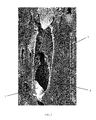
- FIG. 1 a film section is shown, indicated with numeral 1, in which mineral fillers 3 are in white, distributed in the film and having different dimensions in a diameter range.
- numeral 1 a film section is shown, indicated with numeral 1, in which mineral fillers 3 are in white, distributed in the film and having different dimensions in a diameter range.
- a micro-cavity, hole and recess presence is observed, having a darker color, indicated in general with numeral 4, and with a variable dimension between a fraction of diameter of mineral filler and some multiples of diameter of mineral filler.
- the stretching result is a porous structure, that is a structure provided with an alternation of solid material and micro-cavities.
- the Applicant verified that is the porosity itself to give the film an effective cleaning action; in fact the micro-cavities of the film attract the greasy particles in their inside, which penetrate easily therein. Further the presence of mineral fillers around and inside the cavities themselves, able to attract and maintain the greasy particles attached thereto, aids the entrance and the permanency of particles in the cavities.
- the film is not pierced anywhere (that is provided with openings crossing the film), but it is thinner in some points because of the micro-cavities distributed thereon.
- the result is a waterproof and liquid-proof film but, at the same time, breathable to gases, thanks to passages provided by micro-cavities in its whole structure.
- the film is characterized by the presence of micro-cavities in the plastic material at the mineral fillers, such to implement a micro-porous structure.
- the Applicant checked the film porosity by the execution of breathability test, that is tests intended to measure the water vapor transmission rate through the film.
- the breathability measure gives indirectly an information of the porosity level of the material.
- the breathability test has been carried out according to standard method ASTM D-6701 with MOCON Permatran W 100k instrument; the parameters of test execution are a temperature of 37.8°C +/- 10°C and a relative humidity of 60% +/-10%. Results bring out the fact that the wipe object of the present invention preferably has a breathability value comprises between about 1500 and about 12000 MOCON.
- the film has a substantially homogeneous composition, that is the mineral fillers are distributed or dispersed uniformly in the plastic material.
- the mineral fillers in particular when they are granulated calcium carbonate, each comprise a respective surface coating.
- the surface coating of the fillers is a compound of the stearate class, for example stearic acid.
- the film has a preferably uniform thickness which is preferably comprised between 10 and 100 micrometers ( ⁇ m).
- the film has a grammage between 10 g/m 2 and 100 g/m 2 , just for example equal to about 25 g/m 2 .
- 98 weight percent of the afore said mineral fillers has a diameter smaller than 8 ⁇ m.
- 50 weight percent of mineral fillers has an average diameter comprises between 0,5 and 2 ⁇ m.
- the wipe comprises an additional layer constrained to the film.
- said additional layer is a textile, fabric, hide or nonwoven fabric portion or the like.
- the additional layer is partially constrained to both sides of the film, letting a portion thereof emerge or, alternatively, it is advantageously constrained to one side of the film completely.
- the additional layer allows obtaining a wipe having a greater stiffness, mechanical strength and/ or handiness; this could be useful to avoid the incidental film damaging and to increase the useful life thereof, and further it facilitates the handling thereof.
- the possibility of constraining different additional layers to the film allows selecting, changing and customizing the external appearance of the wipe.
- the additional layer can be constrained to the film by gluing, seaming, hot or ultrasound calendering.
- the wipe provided or not with the additional layer, may be printed and/ or embossed and/ or colored on one or both sides.
- the film may be slightly treated on surface with high - frequency discharges, so that to aid inks, stickers or coatings to adhere thereon and/ or to increase the capacity of the wipe to attract and remove dirt from the surface to be cleaned.
- the wipe can have a substantially squared shape (for example with a side of 100 mm or 200 mm), rectangular, polygonal, circular, etc.
- the present invention concerns a method for implementing a wipe for dry cleaning vitreous surfaces and the like. Such a method comprises the steps of:
- the step of (b) hot extruding a film is a step of co-extruding the plastic material and the mineral fillers.
- the step of (a) comprises, in its turn, the step of (c), preceding the extruding step: mixing the plastic material and the mineral fillers by combination (named in the field as "compounding").
- the plastic material comprises one or more materials selected in the group comprising polyester, polyethylene and polypropylene, or it can be a biopolymer or a biodegradable polymer, for example polylactic acid (PLA), polyhydroxyalkanoates (PHA) or a starch - based polymer.
- PLA polylactic acid
- PHA polyhydroxyalkanoates
- starch - based polymer for example polylactic acid (PLA), polyhydroxyalkanoates (PHA) or a starch - based polymer.
- step (a) mineral fillers are selected from the group comprising calcium carbonate, talc, zeolite.
- the method comprises the step of (d): coating each of the mineral fillers with a respective surface coating.
- the surface coating is a compound of the stearate class, for example stearic acid.
- the step (b) comprises a step of selecting the fraction of mineral fillers in weight percent based on the film weight. It is then possible to change the film composition according to needs. The Applicant verified that the percentage of mineral filler in the film can reach up to 70% of total weight.
- the method could comprise a step of cooling the film, for example by cold rollers or cooling air jets.
- the method could comprise one or more step of stretching the film, for example by rollers heated at different temperatures and rotating at different rates. This allows, as afore described, to form the afore said micro-cavities in the plastic material at the mineral fillers, such to implement a micro-porous structure.
- one of the stretching steps happens at a temperature of about 80°C, able to cause the "tempering" of the film - useful for increasing its plasticity - anyway without casting the plastic material.
- the stretching step causes an extension of the film up to about 3 times with respect to the starting length.
- the method could comprise a further step of cooling the film. This allows blocking the stretched layer on the film, maintaining during time the just obtained length and micro-cavities.
- the method could comprise a step of winding the film on a roller to form a reel and/ or cutting the extruded film in single films each one to be used to have a single wipe.
- the method comprises a step of constraining an additional layer to the film.
- an additional layer is a textile, fabric, hide or nonwoven fabric portion or the like.
- the additional layer is partially constrained to both sides of the film, letting a portion thereof emerge or, alternatively, it is constrained to one side of the film completely.
- the step of constraining the additional layer to the film is carried out by gluing or ultrasound coupling, the additional layer being preferably nonwoven (spunbonded, thermobonded, carded) fabrics.
- the step of constraining the additional layer to the film happens by extrusion of the coating ("extrusion coating” or “co-extrusion”) or heat calendering. Still alternatively, the constraining step happens by coupling and stretching with an intermeshing cylinder system.
- the method comprises, after the extruding step, a step of printing and/ embossing and/ or coloring the film and/ or the additional layer, on one or both sides.
- the method comprises a step of treating the film surface with high - frequency discharges, for example by electrifier bars or ionizing processes ("corona treatment"). This allows increasing the adhesion of inks, stickers or coatings on the film surface.
- the reel may have a length of about 200 mm and a length comprised between 30 m and 1000 m.
- the wipe according to the present invention is provided with the following characteristics:
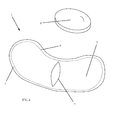
- the wipe comprises a continuous film 1 having a determined shape and an additional layer 5, for example made of fabric, having preferably the same shape of the film.
- the additional layer is overlapped to a side of the film and constrained thereto at the perimeter, for example by a seam 6 or a glue strip, leaving unconstrained the inner portion surrounded by the perimeter.
- the additional layer comprises a cut 7 passing the layer itself in its portion inside the constrained perimeter and not communicating with such a perimeter.
- the cut is interposed between two opposite portions of the constrained perimeter.
- the cut allows a user to put two or three fingers, preferably the thumb and the first finger and/ or the middle finger and/ or the ring finger, into the space between the film and the additional layer. Afterwards with the same fingers, wrapped by the wipe, the user catches the object 8 to be cleaned, the latter contacting the cleaning film (in figure the object to be cleaned is for example a lens). Then, by rubbing of the fingers, the user cleans the object surface simply and rapidly.
- the wipe of figure 4 implements a kind of "finger glove" by which it is possible to catch and directly clean an object having a vitreous surface or the like.
Landscapes
- Engineering & Computer Science (AREA)
- Mechanical Engineering (AREA)
- Physics & Mathematics (AREA)
- Health & Medical Sciences (AREA)
- General Physics & Mathematics (AREA)
- Ophthalmology & Optometry (AREA)
- Optics & Photonics (AREA)
- Cleaning Implements For Floors, Carpets, Furniture, Walls, And The Like (AREA)
- Compositions Of Macromolecular Compounds (AREA)
- Laminated Bodies (AREA)
Applications Claiming Priority (1)
| Application Number | Priority Date | Filing Date | Title |
|---|---|---|---|
| IT000154A ITBS20110154A1 (it) | 2011-11-10 | 2011-11-10 | Supporto per la pulizia a secco di superfici vetrose o a queste assimilabili |
Publications (1)
| Publication Number | Publication Date |
|---|---|
| EP2591904A1 true EP2591904A1 (fr) | 2013-05-15 |
Family
ID=45094071
Family Applications (1)
| Application Number | Title | Priority Date | Filing Date |
|---|---|---|---|
| EP12191167.1A Withdrawn EP2591904A1 (fr) | 2011-11-10 | 2012-11-02 | Chiffon sec pour le nettoyage des surfaces vitreuses |
Country Status (2)
| Country | Link |
|---|---|
| EP (1) | EP2591904A1 (fr) |
| IT (1) | ITBS20110154A1 (fr) |
Cited By (4)
| Publication number | Priority date | Publication date | Assignee | Title |
|---|---|---|---|---|
| CN105013726A (zh) * | 2015-06-29 | 2015-11-04 | 赖玉春 | 耳机线清洗装置 |
| IT202000011572A1 (it) * | 2020-05-19 | 2021-11-19 | Licheri Agnese Ravot | Struttura di accessorio per pulizia lenti di occhiali e simili |
| IT202100023342A1 (it) * | 2021-09-09 | 2023-03-09 | Univ Bologna Alma Mater Studiorum | Utilizzo di tessuto non tessuto comprendente acido polilattico (pla) per l’inoculazione di piante da micorrizare, specialmente per tartuficoltura |
| US20240382047A1 (en) * | 2023-05-18 | 2024-11-21 | Katherine A. Kimmerle | Bio-based products and methods for manufacturing the same |
Citations (12)
| Publication number | Priority date | Publication date | Assignee | Title |
|---|---|---|---|---|
| US4698372A (en) * | 1985-09-09 | 1987-10-06 | E. I. Du Pont De Nemours And Company | Microporous polymeric films and process for their manufacture |
| US5280661A (en) * | 1992-11-02 | 1994-01-25 | Brown Charles E | Digital wipe device for lenses and similar articles |
| DE4334783A1 (de) | 1993-10-13 | 1995-04-20 | Heinz Wendt | Reinigungsstreifen zur Trockenreinigung von Brillengläsern und anderen optischen Gläsern |
| DE19709352A1 (de) * | 1997-03-07 | 1998-09-17 | Corovin Gmbh | Folie aus Kunststoff mit mineralischen Zusatzstoffen sowie Verfahren zu deren Herstellung |
| US6277479B1 (en) * | 1997-12-19 | 2001-08-21 | Kimberly-Clark Worldwide, Inc. | Microporous films having zoned breathability |
| US20020155234A1 (en) * | 2001-02-09 | 2002-10-24 | 3M Innovative Properties Company | Multipurpose cosmetic wipes |
| US20030024625A1 (en) * | 2001-07-20 | 2003-02-06 | Mcamish Larry Hughey | Laminated sheet and method of making same |
| US20030168776A1 (en) * | 1996-07-31 | 2003-09-11 | Exxon Chemical Patents Inc. | Process for adjusting WVTR and other properties of a polyolefin film |
| DE20314102U1 (de) | 2003-09-11 | 2003-12-18 | Scs Skin Care Systems Gmbh | Folienförmiges Erzeugnis zur Reinigung von optischen Gläsern |
| EP1992982A1 (fr) * | 2007-05-08 | 2008-11-19 | Shark Tecnology, S.L. | Dispositif pour nettoyer des lentilles et des articles similaires |
| US20100314162A1 (en) * | 2009-06-10 | 2010-12-16 | Ppg Industries Ohio, Inc. | Microporous material derived from renewable polymers and articles prepared therefrom |
| US20110178223A1 (en) * | 2009-12-19 | 2011-07-21 | Rolefs Mike | Method of making an elastic film, in particular for a hygienci article |
-
2011
- 2011-11-10 IT IT000154A patent/ITBS20110154A1/it unknown
-
2012
- 2012-11-02 EP EP12191167.1A patent/EP2591904A1/fr not_active Withdrawn
Patent Citations (12)
| Publication number | Priority date | Publication date | Assignee | Title |
|---|---|---|---|---|
| US4698372A (en) * | 1985-09-09 | 1987-10-06 | E. I. Du Pont De Nemours And Company | Microporous polymeric films and process for their manufacture |
| US5280661A (en) * | 1992-11-02 | 1994-01-25 | Brown Charles E | Digital wipe device for lenses and similar articles |
| DE4334783A1 (de) | 1993-10-13 | 1995-04-20 | Heinz Wendt | Reinigungsstreifen zur Trockenreinigung von Brillengläsern und anderen optischen Gläsern |
| US20030168776A1 (en) * | 1996-07-31 | 2003-09-11 | Exxon Chemical Patents Inc. | Process for adjusting WVTR and other properties of a polyolefin film |
| DE19709352A1 (de) * | 1997-03-07 | 1998-09-17 | Corovin Gmbh | Folie aus Kunststoff mit mineralischen Zusatzstoffen sowie Verfahren zu deren Herstellung |
| US6277479B1 (en) * | 1997-12-19 | 2001-08-21 | Kimberly-Clark Worldwide, Inc. | Microporous films having zoned breathability |
| US20020155234A1 (en) * | 2001-02-09 | 2002-10-24 | 3M Innovative Properties Company | Multipurpose cosmetic wipes |
| US20030024625A1 (en) * | 2001-07-20 | 2003-02-06 | Mcamish Larry Hughey | Laminated sheet and method of making same |
| DE20314102U1 (de) | 2003-09-11 | 2003-12-18 | Scs Skin Care Systems Gmbh | Folienförmiges Erzeugnis zur Reinigung von optischen Gläsern |
| EP1992982A1 (fr) * | 2007-05-08 | 2008-11-19 | Shark Tecnology, S.L. | Dispositif pour nettoyer des lentilles et des articles similaires |
| US20100314162A1 (en) * | 2009-06-10 | 2010-12-16 | Ppg Industries Ohio, Inc. | Microporous material derived from renewable polymers and articles prepared therefrom |
| US20110178223A1 (en) * | 2009-12-19 | 2011-07-21 | Rolefs Mike | Method of making an elastic film, in particular for a hygienci article |
Cited By (5)
| Publication number | Priority date | Publication date | Assignee | Title |
|---|---|---|---|---|
| CN105013726A (zh) * | 2015-06-29 | 2015-11-04 | 赖玉春 | 耳机线清洗装置 |
| IT202000011572A1 (it) * | 2020-05-19 | 2021-11-19 | Licheri Agnese Ravot | Struttura di accessorio per pulizia lenti di occhiali e simili |
| IT202100023342A1 (it) * | 2021-09-09 | 2023-03-09 | Univ Bologna Alma Mater Studiorum | Utilizzo di tessuto non tessuto comprendente acido polilattico (pla) per l’inoculazione di piante da micorrizare, specialmente per tartuficoltura |
| WO2023037393A1 (fr) * | 2021-09-09 | 2023-03-16 | Alma Mater Studiorum - Universita' Di Bologna | Utilisation d'un tissu non tissé comprenant de l'acide polylactique (pla) pour l'inoculation de plantes devant former une mycorhise |
| US20240382047A1 (en) * | 2023-05-18 | 2024-11-21 | Katherine A. Kimmerle | Bio-based products and methods for manufacturing the same |
Also Published As
| Publication number | Publication date |
|---|---|
| ITBS20110154A1 (it) | 2013-05-11 |
Similar Documents
| Publication | Publication Date | Title |
|---|---|---|
| EP2591904A1 (fr) | Chiffon sec pour le nettoyage des surfaces vitreuses | |
| KR101952528B1 (ko) | 단층 또는 복층 폴리에스테르 장섬유 부직포 및 그것을 이용한 식품용 필터 | |
| US20090178223A1 (en) | Wear indicator for a flocked scouring material | |
| JP7482293B2 (ja) | 偏光子の製造方法及び偏光子の製造装置 | |
| JP5363857B2 (ja) | 通気性成形体 | |
| KR102125416B1 (ko) | 김 제거 및/또는 세척 작용을 갖는 건조 와이프 | |
| US10953591B2 (en) | Embossed microporous membrane wipes and methods of manufacture and use thereof | |
| JP2007532939A (ja) | 曇り止め用ワイプ | |
| CN105873484B (zh) | 多孔膜擦拭件及其制造与使用方法 | |
| JP5486331B2 (ja) | 生分解性長繊維不織布 | |
| RU2698845C2 (ru) | Охватывающий элемент для застежки-"липучки" | |
| RU2518657C2 (ru) | Новые поливинилспиртовые изделия | |
| JP5290895B2 (ja) | 複合シート及び成形体 | |
| US8293664B1 (en) | Process for producing polyvinyl alcohol articles | |
| JP2013224504A (ja) | 複合モノフィラメントおよび布帛 | |
| KR102925389B1 (ko) | 초음파 또는 레이저 절단된 측면들이 있는 컨베이어 벨트, 특히 스핀들 테이프 | |
| US20120142795A1 (en) | Hierarchical thermoplastic surface textures formed by phase transformation and methods of making | |
| KR101418447B1 (ko) | 부직포 롤 | |
| EP4214357B1 (fr) | Bande fibreuse non tissée | |
| Kanafchian et al. | Fabrication of nanostructured and multicompartmental fabrics based on electrospun nanofibers | |
| JPH11129355A (ja) | 粘着部材の製造方法 | |
| JP6664215B2 (ja) | 防水通気多孔質膜および防水通気複合材料 | |
| JP2001219492A (ja) | 包装用複合シート | |
| JPWO2019021978A1 (ja) | 液晶性ポリエステル繊維及びその製造方法 | |
| JP2004309842A (ja) | ラビング材 |
Legal Events
| Date | Code | Title | Description |
|---|---|---|---|
| PUAI | Public reference made under article 153(3) epc to a published international application that has entered the european phase |
Free format text: ORIGINAL CODE: 0009012 |
|
| AK | Designated contracting states |
Kind code of ref document: A1 Designated state(s): AL AT BE BG CH CY CZ DE DK EE ES FI FR GB GR HR HU IE IS IT LI LT LU LV MC MK MT NL NO PL PT RO RS SE SI SK SM TR |
|
| AX | Request for extension of the european patent |
Extension state: BA ME |
|
| 17P | Request for examination filed |
Effective date: 20131114 |
|
| RBV | Designated contracting states (corrected) |
Designated state(s): AL AT BE BG CH CY CZ DE DK EE ES FI FR GB GR HR HU IE IS IT LI LT LU LV MC MK MT NL NO PL PT RO RS SE SI SK SM TR |
|
| STAA | Information on the status of an ep patent application or granted ep patent |
Free format text: STATUS: THE APPLICATION IS DEEMED TO BE WITHDRAWN |
|
| 18D | Application deemed to be withdrawn |
Effective date: 20161005 |