EP2593523B1 - Composition adhésive comprenant du chitosane désacétyle - Google Patents
Composition adhésive comprenant du chitosane désacétyle Download PDFInfo
- Publication number
- EP2593523B1 EP2593523B1 EP11741672.7A EP11741672A EP2593523B1 EP 2593523 B1 EP2593523 B1 EP 2593523B1 EP 11741672 A EP11741672 A EP 11741672A EP 2593523 B1 EP2593523 B1 EP 2593523B1
- Authority
- EP
- European Patent Office
- Prior art keywords
- weight
- composition according
- compound
- chitosan
- composition
- Prior art date
- Legal status (The legal status is an assumption and is not a legal conclusion. Google has not performed a legal analysis and makes no representation as to the accuracy of the status listed.)
- Active
Links
Images
Classifications
-
- C—CHEMISTRY; METALLURGY
- C09—DYES; PAINTS; POLISHES; NATURAL RESINS; ADHESIVES; COMPOSITIONS NOT OTHERWISE PROVIDED FOR; APPLICATIONS OF MATERIALS NOT OTHERWISE PROVIDED FOR
- C09J—ADHESIVES; NON-MECHANICAL ASPECTS OF ADHESIVE PROCESSES IN GENERAL; ADHESIVE PROCESSES NOT PROVIDED FOR ELSEWHERE; USE OF MATERIALS AS ADHESIVES
- C09J105/00—Adhesives based on polysaccharides or on their derivatives, not provided for in groups C09J101/00 or C09J103/00
-
- C—CHEMISTRY; METALLURGY
- C08—ORGANIC MACROMOLECULAR COMPOUNDS; THEIR PREPARATION OR CHEMICAL WORKING-UP; COMPOSITIONS BASED THEREON
- C08L—COMPOSITIONS OF MACROMOLECULAR COMPOUNDS
- C08L97/00—Compositions of lignin-containing materials
- C08L97/02—Lignocellulosic material, e.g. wood, straw or bagasse
-
- C—CHEMISTRY; METALLURGY
- C08—ORGANIC MACROMOLECULAR COMPOUNDS; THEIR PREPARATION OR CHEMICAL WORKING-UP; COMPOSITIONS BASED THEREON
- C08K—Use of inorganic or non-macromolecular organic substances as compounding ingredients
- C08K5/00—Use of organic ingredients
- C08K5/04—Oxygen-containing compounds
- C08K5/05—Alcohols; Metal alcoholates
- C08K5/053—Polyhydroxylic alcohols
-
- C—CHEMISTRY; METALLURGY
- C08—ORGANIC MACROMOLECULAR COMPOUNDS; THEIR PREPARATION OR CHEMICAL WORKING-UP; COMPOSITIONS BASED THEREON
- C08K—Use of inorganic or non-macromolecular organic substances as compounding ingredients
- C08K5/00—Use of organic ingredients
- C08K5/04—Oxygen-containing compounds
- C08K5/09—Carboxylic acids; Metal salts thereof; Anhydrides thereof
-
- C—CHEMISTRY; METALLURGY
- C08—ORGANIC MACROMOLECULAR COMPOUNDS; THEIR PREPARATION OR CHEMICAL WORKING-UP; COMPOSITIONS BASED THEREON
- C08K—Use of inorganic or non-macromolecular organic substances as compounding ingredients
- C08K5/00—Use of organic ingredients
- C08K5/04—Oxygen-containing compounds
- C08K5/09—Carboxylic acids; Metal salts thereof; Anhydrides thereof
- C08K5/092—Polycarboxylic acids
-
- C—CHEMISTRY; METALLURGY
- C08—ORGANIC MACROMOLECULAR COMPOUNDS; THEIR PREPARATION OR CHEMICAL WORKING-UP; COMPOSITIONS BASED THEREON
- C08L—COMPOSITIONS OF MACROMOLECULAR COMPOUNDS
- C08L3/00—Compositions of starch, amylose or amylopectin or of their derivatives or degradation products
- C08L3/02—Starch; Degradation products thereof, e.g. dextrin
-
- C—CHEMISTRY; METALLURGY
- C09—DYES; PAINTS; POLISHES; NATURAL RESINS; ADHESIVES; COMPOSITIONS NOT OTHERWISE PROVIDED FOR; APPLICATIONS OF MATERIALS NOT OTHERWISE PROVIDED FOR
- C09J—ADHESIVES; NON-MECHANICAL ASPECTS OF ADHESIVE PROCESSES IN GENERAL; ADHESIVE PROCESSES NOT PROVIDED FOR ELSEWHERE; USE OF MATERIALS AS ADHESIVES
- C09J105/00—Adhesives based on polysaccharides or on their derivatives, not provided for in groups C09J101/00 or C09J103/00
- C09J105/08—Chitin; Chondroitin sulfate; Hyaluronic acid; Derivatives thereof
-
- C—CHEMISTRY; METALLURGY
- C08—ORGANIC MACROMOLECULAR COMPOUNDS; THEIR PREPARATION OR CHEMICAL WORKING-UP; COMPOSITIONS BASED THEREON
- C08L—COMPOSITIONS OF MACROMOLECULAR COMPOUNDS
- C08L5/00—Compositions of polysaccharides or of their derivatives not provided for in groups C08L1/00 or C08L3/00
- C08L5/08—Chitin; Chondroitin sulfate; Hyaluronic acid; Derivatives thereof
-
- Y—GENERAL TAGGING OF NEW TECHNOLOGICAL DEVELOPMENTS; GENERAL TAGGING OF CROSS-SECTIONAL TECHNOLOGIES SPANNING OVER SEVERAL SECTIONS OF THE IPC; TECHNICAL SUBJECTS COVERED BY FORMER USPC CROSS-REFERENCE ART COLLECTIONS [XRACs] AND DIGESTS
- Y10—TECHNICAL SUBJECTS COVERED BY FORMER USPC
- Y10T—TECHNICAL SUBJECTS COVERED BY FORMER US CLASSIFICATION
- Y10T428/00—Stock material or miscellaneous articles
- Y10T428/28—Web or sheet containing structurally defined element or component and having an adhesive outermost layer
- Y10T428/2852—Adhesive compositions
-
- Y—GENERAL TAGGING OF NEW TECHNOLOGICAL DEVELOPMENTS; GENERAL TAGGING OF CROSS-SECTIONAL TECHNOLOGIES SPANNING OVER SEVERAL SECTIONS OF THE IPC; TECHNICAL SUBJECTS COVERED BY FORMER USPC CROSS-REFERENCE ART COLLECTIONS [XRACs] AND DIGESTS
- Y10—TECHNICAL SUBJECTS COVERED BY FORMER USPC
- Y10T—TECHNICAL SUBJECTS COVERED BY FORMER US CLASSIFICATION
- Y10T428/00—Stock material or miscellaneous articles
- Y10T428/31504—Composite [nonstructural laminate]
- Y10T428/31678—Of metal
-
- Y—GENERAL TAGGING OF NEW TECHNOLOGICAL DEVELOPMENTS; GENERAL TAGGING OF CROSS-SECTIONAL TECHNOLOGIES SPANNING OVER SEVERAL SECTIONS OF THE IPC; TECHNICAL SUBJECTS COVERED BY FORMER USPC CROSS-REFERENCE ART COLLECTIONS [XRACs] AND DIGESTS
- Y10—TECHNICAL SUBJECTS COVERED BY FORMER USPC
- Y10T—TECHNICAL SUBJECTS COVERED BY FORMER US CLASSIFICATION
- Y10T428/00—Stock material or miscellaneous articles
- Y10T428/31504—Composite [nonstructural laminate]
- Y10T428/31971—Of carbohydrate
- Y10T428/31975—Of cellulosic next to another carbohydrate
Definitions
- the invention relates to an adhesive composition and a method of bonding comprising applying said composition.
- the invention more particularly relates to an adhesive composition comprising at least one deacetylated chitosan, an acid and an additional compound.
- Structural bonding is a technology commonly used to join all types of materials. It finds its application in many industrial fields such as building, car manufacturing, aeronautics, rail, naval or even wood structures or windows.
- Structural bonding allows bonded assemblies that can withstand as much stress as welded joints.
- Structural adhesives are generally designed to withstand shear stresses greater than 7 MPa.
- the structural adhesives known today are composed of materials of synthetic origin, such as polyurethanes, epoxides or acrylics and the presence of volatile organic compounds (VOCs) or other potentially toxic compounds in these adhesives represents an important problem. for human health and the environment.
- VOCs volatile organic compounds
- Polysaccharides have been identified as a potential alternative to the use of synthetic materials, including chitosan.
- Adhesive compositions comprising deacetylated chitosan solubilized in an acetic acid solution make it possible to improve the adhesion of plywood plates ( K.Umemura et al, Koen Yoshishu - Nippon Gakkai Setchaku Nenji Taikai, 2002, 40, 71-72 ).
- the adhesive compositions thus obtained can not withstand shear stresses greater than or equal to 2 MPa.
- compositions comprising a deacetylated chitosan solubilized in a solution of acetic acid and associated with glucose have been described as allowing to improve the adhesion of plywood plates (K.Umemura, Development of new natural polymer-based wood adhesives III: effects of glucose addition on properties of chitosan, Journal of Wood Science, 2010 ). Nevertheless, these compositions can not withstand shear stresses greater than or equal to 2.5 MPa.
- the present invention makes it possible to provide a solution to all or some of the problems of the state of the art.
- a first object of the present invention is therefore to provide a deacetylated chitosan adhesive composition that can be applied to the structural bonding, as well as a method of structural bonding by application of said composition.
- a second object of the present invention is to provide an easy and inexpensive deacetylated chitosan adhesive composition to be formulated, as well as a simple and inexpensive structural bonding method to be used.
- a third object of the present invention is to provide a deacetylated chitosan composition having both adhesive properties sufficient for structural bonding and antimicrobial properties.
- a fourth objective of the present invention is to provide a deacetylated chitosan composition having sufficient adhesive properties for structural bonding while limiting the risk of shrinkage after application.
- the composition comprises from 4 to 9% of chitosan, preferably from 4 to 6%.
- the chitosan has a molar mass ranging from 5,000 to 1,200,000 g / mol, preferably from 10,000 to 500,000 g / mol.
- the use of an acid allows the solubilization of the deacetylated chitosan in the composition according to the invention.
- the composition advantageously comprises from 1 to 3% of acid.
- the acid is in aqueous solution.
- the aqueous acid solution has a pH ranging from 2 to 4, preferably ranging from 2 to 2.5.
- the acid is advantageously an inorganic acid chosen from known inorganic acids.
- Sulfuric acid, hydrochloric acid or nitric acid are exemplified, advantageously, sulfuric acid.
- the acid is advantageously an organic acid chosen from known organic acids.
- the organic acid is chosen from carboxylic acids, preferably acetic acid.
- the composition comprises from 0.01 to 5% of compound (c1).
- the compound (c1) is advantageously chosen from hydroxycarboxylic acids, polycarboxylic acids, hydroxypolycarboxylic acids, polysaccharides, their salts or mixtures thereof.
- the polysaccharides are chosen from alginates, carrageenans, their salts or their mixtures, preferably from sodium alginates or carrageenans.
- the composition comprises from 2 to 5% of compound c1).
- the compound (c1) is chosen from citric acid salts or succinic acid salts, preferably chosen from trisodium citrate dihydrate.
- composition comprises from 0.05 to 1% of compound c1).
- the composition advantageously comprises from 0.5 to 1.5% of compound (c2).
- the compound (c2) is a polyol for which n is between 2 and 10.
- the polyol is chosen from glycerol or mannitol.
- the composition 1 comprises from 4 to 6% of chitosan or from 1 to 3% of acid or from 0.01 to 5% of compound (c1) or from 0.5 to 1.5% of compound (c2) or their total or partial combinations.
- the composition comprises the compounds (a) and (b) in a ratio (a) / (b) ranging from 3/1 to 10/3, preferably ranging from 4/1 to 6/2.
- the composition comprises the compounds (a) and (c1) in a ratio (a) / (c1) ranging from 1/2 to 200/1, preferably ranging from 4/1 to 120/1.
- the composition comprises the compounds (a) and (c2) in a ratio (a) / (c2) ranging from 2/1 to 12/1, preferably ranging from 8/3 to 7/1.
- the support (d) is water.
- the support (d) may also comprise adjuvants; dyes or preservatives are cited as examples.
- composition according to the invention may also comprise a polysaccharide filler (e).
- the polysaccharide filler (e) is different from the compound (c1).
- the polysaccharide filler (e) is chosen from starches, starch fractions and starchy meals.
- the polysaccharide filler (e) is chosen from starch from cereals, potatoes, wheat or cassava, preferably a cereal starch.
- starch fraction is meant one or more compounds resulting from the fractionation of starch.
- the polysaccharide filler (e) is chosen from amylopectin or amylose.
- the polysaccharide filler (e) is chosen from flour of cereals, chestnuts, horse chestnuts, millet, rice, buckwheat, quinoa, spelled, soya, pea, potatoes or manioc.
- the composition comprises from 0.1 to 20%, preferably from 1 to 15% by weight, of polysaccharide filler (e).
- the composition advantageously comprises the compounds (a) and (e) in a ratio ranging from 1/10 to 1/1.
- composition further comprises from 0.1 to 20% of a polysaccharide filler (e).
- the base adhesive composition further comprises a polysaccharide filler (e).
- the adhesive composition also has antimicrobial properties, thus making it possible to limit or eliminate the risk of microbial proliferation within the object or structure comprising said composition and thus improving its life.
- the adhesive composition also has improved withdrawal properties after application, thus allowing reduce the amount of composition to be applied to obtain an adhesive thickness sufficient for structural bonding.
- shrinkage is meant the reduction of the thickness, and therefore of the volume occupied by a layer of composition after application.
- the adhesive composition has a shear strength of from 7 to 100 MPa, preferably from 10 to 50 MPa.
- mixture used for the preparation process according to the invention may comprise a polysaccharide filler (e).
- the process is used for the preparation of an adhesive composition according to the invention.
- Another object of the present invention relates to a composition obtained or obtainable by the preparation process according to the invention.
- Another subject of the invention relates to a method of bonding by application of an adhesive composition according to the invention.
- the adhesive composition according to the invention may comprise a polysaccharide filler (e).
- the bonding method according to the invention is used for the structural bonding of a structure by application of the adhesive composition on the surface of at least one element of the structure.
- Structure means any assembly of at least two elements of the same nature or of different natures.
- the adhesive composition is applied to the surface of all elements of the structure.
- the element of the structure comprises a material of natural origin, a metal or its alloys, a plastic material, a ceramic or mixtures thereof.
- the element comprises a cellulosic material, preferably wood, a product derived from wood, a by-product of wood.
- the element comprises aluminum or its alloys.
- the 2014 aluminum alloy is cited as an example.
- the bonding method may comprise a preliminary stage of preparation by chemical or mechanical treatment of the surface of the structure or of at least one element of the structure.
- the treatment is a chemical treatment, preferably a sodium hydroxide treatment.
- Another subject of the invention concerns a composite object comprising an adhesive composition according to the invention and at least one element comprising another material.
- composite object is meant any object comprising at least two elements that can be of the same nature or of different natures.
- the material is chosen from cellulosic materials, metals and their alloys, plastics, ceramics or mixtures thereof.
- the material is wood, a product derived from wood, a by-product of wood or an aluminum alloy.
- the 2014 aluminum alloy is cited as an example.
- the composite object may in particular be in the form of a wooden structure comprising at least two wooden elements fixed to each other with the aid of the adhesive composition according to the invention.
- Beams, beams or wooden frames are cited as examples of wooden elements.
- the composite object may also be in the form of laminated wood elements commonly called "glulam” comprising wood slats bonded with a composition according to the invention.
- glue laminated wood elements commonly called "glulam” comprising wood slats bonded with a composition according to the invention.
- Slats of spruce, douglas pine are cited as examples of slats of wood.
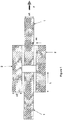
- the figure 1 shows a test piece for determining the shear strength of an adhesive composition according to the invention.
- the aluminum alloy test pieces were made as follows.
- Each aluminum alloy test specimen consisted of four 2014 aluminum alloy elements of length equal to 150mm, width equal to 20mm and thickness e1 and e2 equal to 2mm, 2 exterior elements 2, and 2 elements 1.
- each aluminum alloy element was soaked in trichlorethylene for 30 minutes to remove the oils, each element was then cleaned with detergent and dried at room temperature. Then each element was surface treated by soaking in a 1M sodium hydroxide solution for 1 hour. Then each element was thoroughly washed with a mild detergent and stored for 12 hours in a 2% aqueous acetic acid solution. Then each element was washed again and dried at room temperature.
- each inner aluminum alloy element 1 of thickness e 1 was applied to the surface of each inner aluminum alloy element 1 of thickness e 1 to form a layer of initial thickness e c of 1 mm, the final layer obtained being thinner after drying, so that to form a test tube according to the figure 1 .
- Each aluminum alloy element 2, thickness e 2 was fixed to the other elements 1 and held for 48 hours at a temperature of 40 ° C. The overlap length is equal to L.
- Each test piece was then subjected to a measurement of the breaking force.
- a traction measurement method based on the ASTM D3528 standard was used.
- the apparatus used is a machine marketed by Zwick Roell under the reference UTS Test System type BZC associated with Text-expert software VII 02 software marketed by TestXpert Machine.
- the specimens are subjected to a displacement imposed at a speed of 0.005 mm / s until rupture and the breaking force F is thus measured for each specimen.
- test pieces were made using a composition according to the invention comprising respectively 6% of deacetylated chitosan having a degree of deacetylation greater than or equal to 75%, 2% of acetic acid and a variable content of trisodium citrate dihydrate equal to 0 , 08, 0.14 and 0.5%.
- the test specimen was made using a composition comprising 6% deacetylated chitosan having a degree of deacetylation greater than or equal to 75% and 2% acetic acid.
- compositions according to the invention show an improved shear strength.
- test pieces were made using a composition according to the invention comprising respectively 6% of deacetylated chitosan having a degree of deacetylation of greater than or equal to 75%, 2% of acetic acid and a variable glycerol content of 0.5, 1 and 1.5%.
- the test specimen was made using a composition comprising 6% deacetylated chitosan having a degree of deacetylation greater than or equal to 75% and 2% acetic acid.
- Shear strength values are shown in Table II.
- Table II Adhesive composition Shear strength (MPa) Control 16.5 6% chitosan 25 2% acetic acid 0.5% glycerol 6% chitosan 26.2 2% acetic acid 1% glycerol 6% chitosan 24.7 2% acetic acid 1.5% glycerol
- compositions according to the invention show an improved shear strength.
- test pieces were made using a composition according to the invention comprising respectively 5% of deacetylated chitosan having a degree of deacetylation greater than or equal to 75%, 1% of acetic acid, a variable glycerol content equal to 0.5, 1 and 1.5% and a variable content of trisodium citrate dihydrate equal to 0.11, 0.14 and 0.17%.
- the test specimen was made using a composition comprising 5% deacetylated chitosan having a degree of deacetylation greater than or equal to 75% and 1% acetic acid.
- Shear strength values are shown in Table III.
- Table III Adhesive composition Shear strength (MPa) Control 22.2 5% chitosan 31.8 1% acetic acid 0.5% glycerol 0.14% citrate 5% chitosan 33.9 1% acetic acid 1% glycerol 0.14% citrate 5% chitosan 28.4 1% acetic acid 1.5% glycerol 0.14% citrate 5% chitosan 33 1% acetic acid 1% glycerol 0.11% citrate 5% chitosan 34.7 1% acetic acid 1% glycerol 0.17% citrate
- compositions according to the invention show an improved shear strength.
- the adhesive composition was applied identically for each of the supports and the final thickness was measured using a vernier caliper.
- starch in the composition according to the invention as a polysaccharide filler makes it possible to significantly reduce shrinkage.
- Example 6 Evaluation of the influence of the presence of starch on the shear strength of an adhesive composition based on chitosan
- Table VIII Adhesive composition Shear strength (MPa) 4% chitosan 1% acetic acid 20.1 4% chitosan 1% acetic acid 5% starch 19.5 4% chitosan 1% acetic acid 10% starch 20.6
Landscapes
- Chemical & Material Sciences (AREA)
- Organic Chemistry (AREA)
- Health & Medical Sciences (AREA)
- Chemical Kinetics & Catalysis (AREA)
- Medicinal Chemistry (AREA)
- Polymers & Plastics (AREA)
- Engineering & Computer Science (AREA)
- Life Sciences & Earth Sciences (AREA)
- Wood Science & Technology (AREA)
- Materials Engineering (AREA)
- Adhesives Or Adhesive Processes (AREA)
Description
- L'invention concerne une composition adhésive ainsi qu'un procédé de collage comprenant l'application de ladite composition. L'invention concerne plus particulièrement une composition adhésive comprenant au moins un chitosane désacétylé, un acide et un composé additionnel.
- Le collage structural est une technologie couramment utilisée pour unir tous types de matériaux. Il trouve son application dans de nombreux domaines industriels comme le bâtiment, la construction automobile, aéronautique, ferroviaire, navale ou encore les structures bois ou pour fenêtres.
- Le collage structural permet de réaliser des assemblages collés pouvant supporter des contraintes aussi importantes que les assemblages mécano-soudés.
- Les adhésifs structuraux sont généralement conçus pour résister à des contraintes en cisaillement supérieures à 7 MPa.
- Les adhésifs structuraux connus aujourd'hui sont composés de matériaux d'origine synthétique, tels que les polyuréthanes, les époxydes ou les acryliques et la présence de composés volatils organiques (COVs) ou d'autres composés potentiellement toxiques dans ces adhésifs représente une problématique importante pour la santé humaine et pour l'environnement.
- Les polysaccharides ont été identifiés comme une alternative potentielle à l'utilisation des matériaux synthétiques, et notamment le chitosane. Des compositions adhésives comprenant du chitosane désacétylé solubilisé dans une solution d'acide acétique permettent d'améliorer le collage de plaques de contreplaqué (K.Umemura et al, Koen Yoshishu - Nippon Setchaku Gakkai Nenji Taikai, 2002, 40, 71-72). Cependant les compositions adhésives ainsi obtenues ne peuvent résister à des contraintes en cisaillement supérieures ou égales à 2 MPa.
- D'autres composés ont été introduits dans des compositions adhésives à base de chitosane désacétylé pour en améliorer la force de collage. Des compositions comprenant un chitosane désacétylé solubilisé dans une solution d'acide acétique et associé à du glucose ont été décrites comme permettant d'améliorer le collage de plaques de contreplaqué (K.Umemura, Development of new natural polymer-based wood adhésives III: effects of glucose addition on properties of chitosan, Journal of Wood Science, 2010). Néanmoins, ces compositions ne peuvent résister à des contraintes en cisaillement supérieures ou égales 2,5 MPa.
- Par conséquent, il existe aujourd'hui le besoin d'obtenir des compositions adhésives à base de matériaux d'origine naturelle ayant des propriétés adhésives au moins équivalentes aux matériaux synthétiques et permettant de limiter voir de supprimer les risques sur la santé et l'environnement.
- La présente invention permet d'apporter une solution à tout ou partie des problèmes de l'état de la technique.
- Un premier objectif de la présente invention est donc de fournir une composition adhésive à base de chitosane désacétylé et pouvant être appliquée au collage structural, ainsi qu'un procédé de collage structural par application de ladite composition.
- Un second objectif de la présente invention est de fournir une composition adhésive à base de chitosane désacétylé facile et peu coûteuse à formuler, ainsi qu'un procédé de collage structural simple et peu coûteux à mettre en oeuvre.
- Un troisième objectif de la présente invention est de fournir une composition à base de chitosane désacétylé présentant à la fois des propriétés adhésives suffisantes pour le collage structural et des propriétés antimicrobiennes.
- Un quatrième objectif de la présente invention est de fournir une composition à base de chitosane désacétylé présentant des propriétés adhésives suffisantes pour le collage structural tout en limitant les risques de retrait après application.
- Ainsi la présente invention a tout d'abord pour objet une composition adhésive comprenant :
- (a) de 3 à 10% en poids d'au moins un chitosane désacétylé ayant un degré de désacétylation supérieur ou égal à 75% ;
- (b) de 0,5 à 5% en poids d'au moins un acide organique ou inorganique ;
- (c) au moins un composé choisi parmi :
- (c1) de 0,001 à 8% en poids d'un composé polyanionique,
- (c2) de 0,001 à 2% en poids d'un polyol de formule CnH2n+2On dans laquelle n représente un nombre entier compris entre 2 et 20,
- (d) une quantité complémentaire d'un support aqueux.
- Selon l'invention, la composition comprend de 4 à 9% de chitosane, de préférence de 4 à 6%.
- Selon l'invention, le chitosane a une masse molaire allant de 5 000 à 1 200 000 g/mol, de préférence de 10 000 à 500 000 g/mol.
- Comme exemple de chitosane, on peut choisir le produit commercialisé par la société SIGMA ALDRICH sous la référence C3646-500G.
- Selon l'invention, la mise en oeuvre d'un acide permet la solubilisation du chitosane désacétylé dans la composition selon l'invention.
- Selon l'invention, la composition comprend avantageusement de 1 à 3% d'acide.
- De manière avantageuse, l'acide est en solution aqueuse.
- De manière avantageuse, la solution aqueuse d'acide a un pH allant de 2 à 4, de préférence allant de 2 à 2,5.
- Selon l'invention, l'acide est avantageusement un acide inorganique choisi parmi les acides inorganiques connus. L'acide sulfurique, l'acide chlorhydrique ou l'acide nitrique sont cités comme exemples, de manière avantageuse, l'acide sulfurique.
- Selon l'invention, l'acide est avantageusement un acide organique choisi parmi les acides organiques connus. De manière avantageuse, l'acide organique est choisi parmi les acides carboxyliques, de préférence l'acide acétique.
- Selon l'invention, la composition comprend de 0,01 à 5% de composé (c1).
- Selon l'invention, le composé (c1) est avantageusement choisi parmi les acides hydroxycarboxyliques, les acides polycarboxyliques, les acides hydroxypolycarboxyliques, les polysaccharides, leurs sels ou leurs mélanges.
- Selon l'invention, les polysaccharides sont choisis parmi les alginates, les carraghénanes, leurs sels ou leurs mélanges, de préférence parmi les alginates de sodium ou les carraghénanes.
- De manière avantageuse, la composition comprend de 2 à 5% de composé c1).
- Selon l'invention, le composé (c1) est choisi parmi les sels d'acide citrique ou les sels d'acide succinique, de préférence choisi parmi le citrate de trisodium dihydraté.
- De manière avantageuse, la composition comprend de 0,05 à 1% de composé c1).
- Selon l'invention, la composition comprend avantageusement de 0,5 à 1,5 % de composé (c2).
- Selon l'invention, le composé (c2) est un polyol pour lequel n est compris entre 2 et 10. De manière avantageuse, le polyol est choisi parmi le glycérol ou le mannitol.
- Selon l'invention, la composition 1 comprend de 4 à 6% de chitosane ou de 1 à 3% d'acide ou de 0,01 à 5% de composé (c1) ou de 0,5 à 1,5% de composé (c2) ou leurs combinaisons totales ou partielles.
- Selon l'invention, la composition comprend les composés (a) et (b) en un ratio (a)/(b) allant de 3/1 à 10/3, de préférence allant de 4/1 à 6/2.
- Selon l'invention, la composition comprend les composés (a) et (c1) en un ratio (a)/(c1) allant de 1/2 à 200/1, de préférence allant de 4/1 à 120/1.
- Selon l'invention, la composition comprend les composés (a) et (c2) en un ratio (a)/(c2) allant de 2/1 à 12/1, de préférence allant de 8/3 à 7/1.
- De manière avantageuse, le support (d) est de l'eau. Le support (d) peut également comprendre des adjuvants ; les colorants ou les conservateurs sont cités comme exemples.
- En outre la composition selon l'invention peut également comprendre une charge polysaccharidique (e).
- De manière avantageuse, la charge polysaccharidique (e) est différente du composé (c1).
- Selon l'invention, la charge polysaccharidique (e) est choisie parmi les amidons, les fractions d'amidon et les farines amylacées.
- De manière avantageuse, la charge polysaccharidique (e) est choisie parmi l'amidon de céréales, de pommes de terre, de froment ou de manioc, de préférence un amidon de céréales.
- Par fraction d'amidon, on entend un ou plusieurs composés issus du fractionnement de l'amidon.
- De manière avantageuse, la charge polysaccharidique (e) est choisie parmi l'amylopectine ou l'amylose.
- Selon l'invention, la charge polysaccharidique (e) est choisie parmi la farine de céréales, de châtaignes, de marrons d'Inde, de millet, de riz, de sarrasin, de quinoa, d'épeautre, de soja, de pois, de pommes de terre ou de manioc.
- Selon l'invention, la composition comprend de 0,1 à 20% de préférence de 1 à 15% en poids de charge polysaccharidique (e).
- Selon l'invention, la composition comprend avantageusement les composés (a) et (e) dans un ratio allant de 1/10 à 1/1.
- De manière avantageuse, l'invention concerne une composition adhésive comprenant :
- (a) de 3 à 10% en poids d'au moins un chitosane désacétylé ayant un degré de désacétylation supérieur ou égal à 75% ;
- (b) de 0,5 à 5% en poids d'au moins un acide organique ou inorganique ;
- (c1) de 0,001 à 8% en poids d'un composé polyanionique ;
- (c2) de 0,001 à 2% en poids d'un polyol de formule CnH2n+2On dans laquelle n représente un nombre entier compris entre 2 et 10,
- (d) une quantité complémentaire d'un support aqueux.
- De manière avantageuse, la composition comprend en outre de 0,1 à 20% d'une charge polysaccharidique (e).
- Les différentes caractéristiques présentées pour la charge polysaccharidique (e) s'appliquent également à ce mode de réalisation avantageux.
- L'invention concerne également une composition adhésive de base comprenant :
- (a) au moins un chitosane désacétylé ayant un degré de désacétylation supérieur ou égale à 75%,
- (b) au moins un acide organique ou inorganique,
- (c) au moins un composé choisi dans le groupe constitué par :
- (c1) les composés polyanioniques,
- (c2) les polyols de formule CnH2n+2On, n étant compris entre 2 et 20,
- (d) un support aqueux.
- Selon l'invention, la composition adhésive de base comprend en outre une charge polysaccharidique (e).
- Les différentes caractéristiques présentées pour le chitosane désacétylé (a) et l'acide (b) ainsi que celles relatives à leur ratio s'appliquent également à la composition adhésive de base selon l'invention.
- Les différentes caractéristiques présentées pour les composés (c1), (c2), (e) et le support (d) ainsi que celles relatives aux ratios (a)/(c1), (a)/(c2) et (a)/(e) s'appliquent également à la composition adhésive de base selon l'invention.
- Selon l'invention, la composition adhésive possède également des propriétés antimicrobiennes, permettant ainsi de limiter, voire de supprimer le risque de prolifération microbienne au sein de l'objet ou de la structure comprenant ladite composition et améliorant ainsi sa durée de vie.
- Selon l'invention, la composition adhésive possède également des propriétés relatives au retrait après application améliorées, permettant ainsi de réduire la quantité de composition à appliquer pour obtenir une épaisseur adhésive suffisante pour le collage structural.
- Par retrait, on entend la réduction de l'épaisseur, et donc du volume occupée par une couche de composition après application.
- Selon l'invention, la composition adhésive a une résistance en cisaillement allant de 7 à 100 MPa, de préférence allant 10 à 50 MPa.
- Un autre objet de la présente invention concerne un procédé de préparation d'une composition adhésive comprenant le mélange :
- (a) de 3 à 10% en poids d'au moins un chitosane désacétylé ayant un degré de désacétylation supérieur ou égal à 75% ;
- (b) de 0,5 à 5% en poids d'au moins un acide organique ou inorganique ;
- (c) d'au moins un composé choisi parmi :
- (c1) de 0,001 à 8% en poids d'un composé polyanionique ou
- (c2) de 0,001 à 2% en poids d'un polyol de formule CnH2n+2On dans laquelle n représente un nombre entier compris entre 2 et 20 ;
- (d) d'une quantité complémentaire d'un support aqueux.
- En outre, le mélange mis en oeuvre pour le procédé de préparation selon l'invention peut comprendre une charge polysaccharidique (e).
- De manière avantageuse, le procédé est utilisé pour la préparation d'une composition adhésive selon l'invention.
- L'ensemble des différentes caractéristiques ou préférences de la composition selon l'invention présentées pour le chitosane désacétylé (a) et l'acide (b) ainsi que celles relatives à leur ratio s'appliquent également au procédé de préparation selon l'invention.
- L'ensemble des différentes caractéristiques ou préférences de la composition selon l'invention présentées pour les composés (c1), (c2), (e) et le support (d) ainsi que celles relatives aux ratios (a)/(c1), (a)/(c2) et (a)/(e) s'appliquent également au procédé de préparation selon l'invention.
- Un autre objet de la présente invention concerne une composition obtenue ou susceptible d'être obtenue par le procédé de préparation selon l'invention.
- Un autre objet de l'invention concerne un procédé de collage par application d'une composition adhésive selon l'invention.
- Un autre objet de la présente invention concerne un procédé de collage comprenant l'application d'une composition adhésive comprenant :
- (a) de 3 à 10% en poids d'au moins un chitosane désacétylé ayant un degré de désacétylation supérieur ou égal à 75% ;
- (b) de 0,5 à 5% en poids d'au moins un acide organique ou inorganique ;
- (c) au moins un composé choisi parmi :
- (c1) de 0,001 à 8% en poids d'un composé polyanionique,
- (c2) de 0,001 à 2% en poids d'un polyol de formule CnH2n+2On dans laquelle n représente un nombre entier compris entre 2 et 20,
- (d) une quantité complémentaire d'un support aqueux.
- En outre, la composition adhésive selon l'invention peut comprendre une charge polysaccharidique (e).
- De manière avantageuse, le procédé de collage selon l'invention est mis en oeuvre pour le collage structural d'une structure par application de la composition adhésive sur la surface d'au moins un élément de la structure.
- Par structure, on entend tout assemblage d'au moins deux éléments de même nature ou de natures différentes.
- Selon l'invention, la composition adhésive est appliquée sur la surface de tous les éléments de la structure.
- L'ensemble des différentes caractéristiques ou préférences de la composition selon l'invention présentées pour le chitosane désacétylé (a) et l'acide (b) ainsi que celles relatives à leur ratio s'appliquent également au procédé de collage selon l'invention.
- L'ensemble des différentes caractéristiques ou préférences de la composition selon l'invention présentées pour les composés (c1), (c2), (e) et le support (d) ainsi que celles relatives aux ratios (a)/(c1), (a)/(c2) et (a)/(e) s'appliquent également au procédé de collage selon l'invention.
- Selon le procédé de collage de l'invention, l'élément de la structure comprend un matériau d'origine naturelle, un métal ou ses alliages, une matière plastique, une céramique ou leurs mélanges.
- De manière avantageuse, l'élément comprend un matériau cellulosique, de préférence du bois, un produit dérivé du bois, un sous-produit du bois.
- De manière également avantageuse, l'élément comprend de l'aluminium ou ses alliages. L'alliage d'aluminium 2014 est cité comme exemple.
- Selon l'invention, le procédé de collage peut comprendre une étape préliminaire de préparation par traitement chimique ou mécanique de la surface de la structure ou d'au moins un élément de la structure.
- De manière avantageuse, le traitement est un traitement chimique, de préférence un traitement à la soude.
- Un autre objet de l'invention concerne un objet composite comprenant une composition adhésive selon l'invention et au moins un élément comprenant un autre matériau.
- Par objet composite, on entend tout objet comprenant au moins deux éléments pouvant être de même nature ou de natures différentes.
- Selon l'invention, le matériau est choisi parmi les matériaux cellulosiques, les métaux et leurs alliages, les matières plastiques, les céramiques ou leurs mélanges. De manière avantageuse, le matériau est du bois, un produit dérivé du bois, un sous-produit du bois ou un alliage d'aluminium. L'alliage d'aluminium 2014 est cité comme exemple.
- L'objet composite peut notamment se présenter sous la forme d'une structure en bois comprenant au moins deux éléments en bois fixés l'un à l'autre à l'aide de la composition adhésive selon l'invention. Des poutres, des poutrelles ou des armatures en bois sont citées comme exemples d'éléments en bois.
- L'objet composite peut également se présenter sous la forme d'éléments en bois lamellés-collés couramment dénommés "lamellé-collé" comprenant des lamelles de bois collées à l'aide d'une composition selon l'invention. Des lamelles d'épicéa, de pin douglas sont citées comme exemples de lamelles de bois.
- La
figure 1 montre une éprouvette permettant de déterminer la résistance en cisaillement d'une composition adhésive selon l'invention. - Les différents objets de l'invention et leurs modes de réalisation seront mieux compris à la lecture des exemples qui suivent. Ces exemples sont donnés à titre indicatif, sans caractère limitatif.
- Pour chacun des exemples suivants, les éprouvettes d'alliage d'aluminium ont été réalisées de la façon suivante.
- Chaque éprouvette d'alliage d'aluminium était constituée de quatre éléments d'alliage d'aluminium 2014 de longueur égale à 150mm, de largeur égale à 20mm et d'épaisseur e1 et e2 égale à 2mm, 2 éléments extérieurs 2, et 2 éléments intérieurs 1. Au préalable, chaque élément d'alliage d'aluminium a été trempé dans du trichloréthylène pendant 30 min afin d'éliminer les huiles, chaque élément ayant été ensuite nettoyé avec un détergent et séché à température ambiante. Puis chaque élément a subi un traitement de surface par trempage dans une solution de soude 1 M pendant 1 heure. Puis chaque élément a été lavé minutieusement avec un détergent doux et conservé pendant 12h dans une solution aqueuse d'acide acétique à 2%. Puis chaque élément a été à nouveau lavé et séché à température ambiante.
- La composition adhésive a été appliquée à la surface de chaque élément d'alliage d'aluminium intérieur 1 d'épaisseur e1 pour former une couche d'épaisseur initiale ec de 1 mm, la couche finale obtenue étant plus mince après séchage, afin de former une éprouvette selon la
figure 1 . Chaque élément d'alliage d'aluminium 2, d'épaisseur e2 a été fixé aux autres éléments 1 et maintenu pendant 48h à une température de 40°C. La longueur de chevauchement est égale à L. - Chaque éprouvette a ensuite été soumise à une mesure de la force de rupture. Pour cela, une méthode de mesure de traction s'appuyant sur la norme ASTM D3528 a été utilisée. L'appareil utilisé est une machine commercialisée par la société Zwick Roell sous la référence UTS Test System type BZC associé au logiciel Text-expert VII 02 software commercialisé par la société TestXpert Machine. Les éprouvettes sont soumises à un déplacement imposé suivant une vitesse de 0,005 mm/s jusqu'à rupture et la force de rupture F est ainsi mesurée pour chaque éprouvette.
- A partir de la force de rupture, a été calculée la résistance en cisaillement de chaque composition adhésive exemplifiée exprimée en MPa et résultant de la formule mathématique suivante, tirée de la théorie de Volkersen (Volkersen, Luftfahrtforschung, 15, 1938, pp. 41-47) :

- σ0 = F/S,
- S étant la section des éléments 1,
- F correspondant à la force de rupture de l'éprouvette,
- e1 et e2 correspondant aux épaisseurs des éléments 1 et 2,
- ec correspondant à l'épaisseur de la composition adhésive,
- E1 et E2 correspondant aux modules de Young des éléments 1 et 2,
- L correspondant à la longueur de chevauchement des éléments 1 et 2,

- Gc = Ec /(2(1 + ν)) et correspondant au module de cisaillement de la composition adhésive. Pour son calcul, on admet que le coefficient de poisson ν est égal à 0.3 et le module de Young Ec a été mesuré à 2 GPa.
- 3 éprouvettes ont été réalisées en utilisant une composition selon l'invention comprenant respectivement 6% de chitosane désacétylé ayant un degré de désacétylation supérieur ou égal à 75%, 2% d'acide acétique et une teneur variable en citrate de trisodium dihydraté égale à 0,08, 0,14 et 0,5%. L'éprouvette de contrôle a été réalisée en utilisant une composition comprenant 6% de chitosane désacétylé ayant un degré de désacétylation supérieur ou égal à 75% et 2% d'acide acétique.
- Les valeurs de résistance en cisaillement sont présentées dans le tableau I.
Tableau I Composition adhésive Résistance en cisaillement (MPa) Contrôle 16,5 6% chitosane 28,4 2% acide acétique 0,08% citrate 6% chitosane 29,8 2% acide acétique 0,14% citrate 6% chitosane 24,5 2% acide acétique 0,5% citrate - Les résultats montrent que les compositions selon l'invention montrent une résistance en cisaillement améliorée.
- 3 éprouvettes ont été réalisées en utilisant une composition selon l'invention comprenant respectivement 6% de chitosane désacétylé ayant un degré de désacétylation supérieur ou égal à 75%, 2% d'acide acétique et une teneur variable en glycérol égale à 0,5, 1 et 1,5%. L'éprouvette de contrôle a été réalisée en utilisant une composition comprenant 6% de chitosane désacétylé ayant un degré de désacétylation supérieur ou égal à 75% et 2% d'acide acétique.
- Les valeurs de résistance en cisaillement sont présentées dans le tableau II.
Tableau II Composition adhésive Résistance en cisaillement (MPa) Contrôle 16,5 6% chitosane 25 2% acide acétique 0,5% glycérol 6% chitosane 26,2 2% acide acétique 1% glycérol 6% chitosane 24,7 2% acide acétique 1,5% glycérol - Les résultats montrent que les compositions selon l'invention montrent une résistance en cisaillement améliorée.
- 5 éprouvettes ont été réalisées en utilisant une composition selon l'invention comprenant respectivement 5% de chitosane désacétylé ayant un degré de désacétylation supérieur ou égal à 75%, 1% d'acide acétique, une teneur variable en glycérol égale à 0,5, 1 et 1,5% et une teneur variable en citrate de trisodium dihydraté égale à 0,11, 0,14 et 0,17%. L'éprouvette de contrôle a été réalisée en utilisant une composition comprenant 5% de chitosane désacétylé ayant un degré de désacétylation supérieur ou égal à 75% et 1 % d'acide acétique.
- Les valeurs de résistance en cisaillement sont présentées dans le tableau III.
Tableau III Composition adhésive Résistance en cisaillement (MPa) Contrôle 22,2 5% chitosane 31,8 1% acide acétique 0,5% glycérol 0,14% citrate 5% chitosane 33,9 1% acide acétique 1% glycérol 0,14% citrate 5% chitosane 28,4 1% acide acétique 1,5% glycérol 0,14% citrate 5% chitosane 33 1% acide acétique 1% glycérol 0,11% citrate 5% chitosane 34,7 1% acide acétique 1% glycérol 0,17% citrate - Les résultats montrent que les compositions selon l'invention montrent une résistance en cisaillement améliorée.
- 2 éprouvettes ont été réalisées :
- la première éprouvette en utilisant une composition selon l'invention comprenant 6% de chitosane désacétylé ayant un degré de désacétylation supérieur ou égal à 75%, 2% d'acide acétique et 1% de glycérol,
- la seconde en utilisant un adhésif structural à base époxydes commercialisé sous le nom Epoxy adhesive E-504 par la société EPOTECHNY. Les éléments d'alliage d'aluminium formant la seconde éprouvette ont été fixés aux autres et maintenus pendant 40h à une température de 40°C.
- Les valeurs de résistance en cisaillement sont présentées dans le tableau IV.
Tableau IV Composition adhésive Résistance en cisaillement (MPa) Composition selon l'invention 39,4 6% chitosane 2% acide acétique 1% glycérol Epoxy adhesive E-504 39,1 - Les résultats montrent que les propriétés d'adhésion d'une composition selon l'invention sont équivalentes à celles d'un adhésif à base époxydes et donc que les compositions selon l'invention représentent une alternative aux adhésifs structuraux d'origine synthétique.
- L'épaisseur d'adhésion a été déterminée pour les compositions adhésives suivantes :
- composition comprenant 4% de chitosane (Sigma Aldrich ; poids moléculaire : 3,308.105 g/mol) et 1 % d'acide acétique,
- composition comprenant 6% de chitosane, 1% d'acide acétique, 1% de glycérol et 0,14% de citrate,
- composition comprenant 6% de chitosane, 1% d'acide acétique, 1% de glycérol, 0,14% de citrate et 10% d'amidon de blé soluble.
- Les mesures d'épaisseur adhésive ont été réalisées dans un bécher de 50 ml, sur des pièces en bois (27x27x9 mm3) et sur des éprouvettes d'aluminium traitées par de la soude comme présentées dans la
figure 1 (dimension de chaque élément 1 et 2 : 350x20x2 mm3; dimension de chaque zone de recouvrement entre les éléments 1 et 2 : 1000 mm2). - La composition adhésive a été appliquée de manière identique pour chacun des supports et l'épaisseur finale a été mesurée à l'aide d'un pied à coulisse.
- Les valeurs de l'épaisseur adhésive sont présentées dans les tableaux V, VI et VII ci-dessous et sont exprimées en mm :
Tableau V : bécher Volume appliqué (ml) 2,5 5 7,5 Composition adhésive 4% chitosane 0,085 0,155 0,29 1% acide acétique 6% chitosane 0,215 0,47 0,66 1% acide acétique 1% glycérol 0,14% citrate 6% chitosane 0,225 0,515 0,83 1% acide acétique 1% glycérol 0,14% citrate 10% d'amidon Tableau VI : pièces en bois Volume appliqué (ml) 2,5 5 7,5 Composition adhésive 4% chitosane 0,07 0,1 0,315 1% acide acétique 6% chitosane 0,051 0,061 0,236 1% acide acétique 1% glycérol 0,14% citrate 6% chitosane 0,3 ,08 0,9 1% acide acétique 1% glycérol 0,14% citrate 10% d'amidon Tableau VII : éprouvettes d'aluminium Volume appliqué (ml) 2,5 5 7,5 Composition adhésive 4% chitosane 0,04 0,02 0,02 1% acide acétique 6% chitosane 0,035 0,02 0,045 1% acide acétique 1% glycérol 0,14% citrate 6% chitosane 0,6 0,51 0,2 1% acide acétique 1% glycérol 0,14% citrate 10% d'amidon - Les résultats ci-dessus montrent que l'épaisseur de la composition adhésive selon l'invention après application est améliorée par rapport à une composition ne comprenant que du chitosane et de l'acide acétique, et ainsi que la composition selon l'invention possède de meilleures propriétés relatives au retrait.
- Il est à noter que l'ajout d'amidon dans la composition selon l'invention en tant que charge polysaccharidique permet de diminuer significativement le retrait.
- Les mesures de résistance au cisaillement ont été réalisées comme dans les exemples 1, 2, 3 et 4.
- Les compositions suivantes ont été testées :
- composition comprenant 4% de chitosane et 1% d'acide acétique,
- composition comprenant 4% de chitosane, 1% d'acide acétique et 5% d'amidon de blé soluble,
- composition comprenant 4% de chitosane, 1% d'acide acétique et 10% d'amidon de blé soluble.
- Les résultats sont présentés dans le tableau VIII ci-dessous :
Tableau VIII Composition adhésive Résistance au cisaillement (MPa) 4% chitosane 1 % acide acétique 20,1 4% chitosane 1 % acide acétique 5% d'amidon 19,5 4% chitosane 1 % acide acétique 10% d'amidon 20,6 - Les résultats ci-dessus montrent que l'ajout d'amidon dans une composition adhésive à base de chitosane n'influence pas significativement les propriétés adhésives de ladite composition.
- Ces résultats montrent ainsi que l'introduction d'amidon, dans une composition adhésive selon l'invention, n'altère pas les propriétés adhésives de ladite composition.
Claims (15)
- Composition adhésive comprenant :(a) de 3 à 10% en poids d'au moins un chitosane désacétylé ayant un degré de désacétylation supérieur ou égal à 75% ;(b) de 0,5 à 5% en poids d'au moins un acide organique ou inorganique ;(c) au moins un composé choisi parmi :(c1) de 0,001 à 8% en poids d'un composé polyanionique,(c2) de 0,001 à 2% en poids d'un polyol de formule CnH2n+2On dans laquelle n représente un nombre entier compris entre 2 et 20 ;(d) une quantité complémentaire d'un support aqueux.
- Composition selon la revendication 1 comprenant de 4 à 6% de chitosane ou de 1 à 3% d'acide ou de 0,01 à 5% de composé (c1) ou de 0,5 à 1,5% de composé (c2) ou leurs combinaisons totales ou partielles.
- Composition selon les revendications 1 ou 2 dans laquelle le chitosane a une masse molaire allant de 10 000 à 500 000 g/mol ou dans laquelle l'acide est l'acide sulfurique en solution aqueuse ou un acide organique en solution aqueuse choisi parmi les acides carboxyliques.
- Composition selon les revendications 1 à 3 dans laquelle le composé (c1) est choisi parmi les acides hydroxycarboxyliques, les acides polycarboxyliques, les acides hydroxypolycarboxyliques, les polysaccharides, leurs sels ou leurs mélanges; ou dans laquelle le composé (c2) est un polyol pour lequel n est compris entre 2 et 10.
- Composition selon les revendications 1 à 4 dans laquelle le composé (c1) est le citrate de trisodium dihydraté ou le composé (c2) est choisi parmi le glycérol ou le mannitol.
- Composition selon les revendications 1 à 5 pour laquelle le ratio (a)/(b) va de 3 /1 à 10 /3 ou le ratio (a)/(c1) va de 1/2 à 200/1 ou le ratio (a)/(c2) va de 2 /1 à 12 /1.
- Composition selon les revendications 1 à 6 comprenant :(a) de 3 à 10% en poids d'au moins un chitosane désacétylé ayant un degré de désacétylation supérieur ou égal à 75% ;(b) de 0,5 à 5% en poids d'au moins un acide organique ou inorganique ;(c1) de 0,001 à 8% en poids d'un composé polyanionique ;(c2) de 0,001 à 2% en poids d'un polyol de formule CnH2n+2On dans laquelle n représente un nombre entier compris entre 2 et 10 ;(d) une quantité complémentaire d'un support aqueux.
- Composition selon les revendications 1 à 7 comprenant en outre une charge polysaccharidique (e) ou une charge polysaccharidique (e) qui est différente du composé (c1).
- Composition selon la revendication 8 dans laquelle la charge polysaccharidique (e) est choisie parmi les amidons, les fractions d'amidon et les farines amylacées.
- Composition selon les revendications 8 ou 9 dans laquelle la charge polysaccharidique (e) est un amidon de céréales.
- Composition selon les revendications 8 à 10 comprenant de 0,1 à 20% en poids de charge polysaccharidique (e).
- Composition selon les revendications 8 à 11 pour laquelle le ratio (a)/(e) va de 1/10 à 1/1.
- Composition selon les revendications 8 à 12 comprenant :(a) de 3 à 10% en poids d'au moins un chitosane désacétylé ayant un degré de désacétylation supérieur ou égal à 75% ;(b) de 0,5 à 5% en poids d'au moins un acide organique ou inorganique ;(c1) de 0,001 à 8% en poids d'un composé polyanionique ;(c2) de 0,001 à 2% en poids d'un polyol de formule CnH2n+2On dans laquelle n représente un nombre entier compris entre 2 et 10,(d) une quantité complémentaire d'un support aqueux, et(e) de 0,1 à 20% en poids d'une charge polysaccharidique.
- Objet composite comprenant une composition adhésive selon les revendications 1 à 13 et au moins un élément comprenant un autre matériau choisi parmi du bois, un produit dérivé du bois, un sous-produit du bois ou un alliage d'aluminium.
- Procédé de collage comprenant l'application d'une composition selon les revendications 1 à 13.
Applications Claiming Priority (2)
| Application Number | Priority Date | Filing Date | Title |
|---|---|---|---|
| FR1055820A FR2962738B1 (fr) | 2010-07-16 | 2010-07-16 | Composition adhesive comprenant du chitosane desacetyle |
| PCT/FR2011/051687 WO2012007697A1 (fr) | 2010-07-16 | 2011-07-13 | Composition adhésive comprenant du chitosane désacétyle |
Publications (2)
| Publication Number | Publication Date |
|---|---|
| EP2593523A1 EP2593523A1 (fr) | 2013-05-22 |
| EP2593523B1 true EP2593523B1 (fr) | 2017-05-31 |
Family
ID=43599155
Family Applications (1)
| Application Number | Title | Priority Date | Filing Date |
|---|---|---|---|
| EP11741672.7A Active EP2593523B1 (fr) | 2010-07-16 | 2011-07-13 | Composition adhésive comprenant du chitosane désacétyle |
Country Status (9)
| Country | Link |
|---|---|
| US (1) | US9670387B2 (fr) |
| EP (1) | EP2593523B1 (fr) |
| CN (1) | CN103249792B (fr) |
| AU (1) | AU2011278165B2 (fr) |
| BR (1) | BR112013001110A2 (fr) |
| CA (1) | CA2806163C (fr) |
| ES (1) | ES2638844T3 (fr) |
| FR (1) | FR2962738B1 (fr) |
| WO (1) | WO2012007697A1 (fr) |
Families Citing this family (15)
| Publication number | Priority date | Publication date | Assignee | Title |
|---|---|---|---|---|
| US20160010713A1 (en) * | 2013-03-04 | 2016-01-14 | Nippon Steel & Sumitomo Metal Corporation | Impact-absorbing component |
| MX377086B (es) * | 2013-11-27 | 2025-03-07 | Nippon Steel Corp | Parte absorbedora de energia de impacto. |
| DK3114185T3 (en) * | 2014-03-07 | 2019-03-18 | Innovasea Marine Systems Canada Inc | FISH TRACKING MARK FOR PREDUCTION DETECTION |
| US9526228B2 (en) | 2014-03-07 | 2016-12-27 | Amirix Systems Inc. | Predation detection fish tracking tag |
| CA2903243C (fr) | 2014-11-19 | 2021-06-01 | Amirix Systems Inc. | Etiquette de suivi d'animal a detection de predation |
| WO2018038669A1 (fr) * | 2016-08-24 | 2018-03-01 | Organoclick Ab | Compositions de complexes de polyélectrolytes d'origine biologique comprenant des particules insolubles dans l'eau |
| SE1651136A1 (en) | 2016-08-24 | 2018-02-25 | Organoclick Ab | Bio-based pec compositions as binders for fiber based materials, textiles, woven and nonwoven materials |
| JP7145514B2 (ja) | 2016-08-24 | 2022-10-03 | オルガノクリック アーベー | 脂肪化合物を含む増加した疎水性を有するバイオ系高分子電解質複合体組成物 |
| FR3058155B1 (fr) * | 2016-11-03 | 2020-06-26 | Universite De Pau Et Des Pays De L'adour | Nouvelles compositions ignifugeantes |
| CN107629728A (zh) * | 2017-10-17 | 2018-01-26 | 高昕文 | 一种标签胶专用复合淀粉胶黏剂的制备方法 |
| DE102018214839B4 (de) * | 2018-08-31 | 2021-05-12 | Kufner Holding Gmbh | Heißsiegelbares, textiles Flächengebilde mit nachhaltiger Klebstoffbeschichtung und seine Verwendung |
| SE544929C2 (en) * | 2021-05-04 | 2023-01-10 | Organoclick Ab | Biobased binder compositions for airlaid nonwoven materials |
| CN115011261A (zh) * | 2022-06-24 | 2022-09-06 | 遵义医科大学附属口腔医院 | 一种含氨基难溶高分子溶液用于本体材料粘接的方法 |
| CN116497631B (zh) * | 2023-05-16 | 2023-12-08 | 中山永发纸业有限公司 | 一种低定量瓦楞纸及其制备工艺 |
| CN117025129B (zh) * | 2023-08-07 | 2025-03-07 | 东北林业大学 | 一种水性壳聚糖/柠檬酸超分子胶黏剂及其制备方法和应用 |
Family Cites Families (4)
| Publication number | Priority date | Publication date | Assignee | Title |
|---|---|---|---|---|
| US4659700A (en) * | 1984-03-02 | 1987-04-21 | Johnson & Johnson Products, Inc. | Chitosan-glycerol-water gel |
| US6200595B1 (en) * | 1998-04-24 | 2001-03-13 | Kuraray Co., Ltd. | Medical adhesive |
| DE10344126A1 (de) * | 2003-09-24 | 2005-04-21 | Henkel Kgaa | Wasserlöslicher Schmelzklebstoff |
| CN101177494A (zh) * | 2007-10-26 | 2008-05-14 | 天津商业大学 | 以甘油和硬脂酸为增塑剂的壳聚糖复合膜的制备方法 |
-
2010
- 2010-07-16 FR FR1055820A patent/FR2962738B1/fr active Active
-
2011
- 2011-07-13 US US13/810,308 patent/US9670387B2/en active Active
- 2011-07-13 ES ES11741672.7T patent/ES2638844T3/es active Active
- 2011-07-13 AU AU2011278165A patent/AU2011278165B2/en not_active Ceased
- 2011-07-13 CA CA2806163A patent/CA2806163C/fr active Active
- 2011-07-13 CN CN201180044754.1A patent/CN103249792B/zh active Active
- 2011-07-13 WO PCT/FR2011/051687 patent/WO2012007697A1/fr not_active Ceased
- 2011-07-13 EP EP11741672.7A patent/EP2593523B1/fr active Active
- 2011-07-13 BR BR112013001110A patent/BR112013001110A2/pt not_active Application Discontinuation
Also Published As
| Publication number | Publication date |
|---|---|
| EP2593523A1 (fr) | 2013-05-22 |
| WO2012007697A1 (fr) | 2012-01-19 |
| FR2962738B1 (fr) | 2013-04-26 |
| CN103249792A (zh) | 2013-08-14 |
| AU2011278165B2 (en) | 2015-07-16 |
| US9670387B2 (en) | 2017-06-06 |
| US20130143041A1 (en) | 2013-06-06 |
| FR2962738A1 (fr) | 2012-01-20 |
| RU2013106837A (ru) | 2014-08-27 |
| AU2011278165A1 (en) | 2013-02-28 |
| BR112013001110A2 (pt) | 2017-07-11 |
| CN103249792B (zh) | 2015-02-04 |
| CA2806163A1 (fr) | 2012-01-19 |
| CA2806163C (fr) | 2019-05-28 |
| AU2011278165A8 (en) | 2013-03-14 |
| ES2638844T3 (es) | 2017-10-24 |
Similar Documents
| Publication | Publication Date | Title |
|---|---|---|
| CA2806163C (fr) | Composition adhesive comprenant du chitosane desacetyle | |
| Patel | Chitosan: Emergence as potent candidate for green adhesive market | |
| Ferdosian et al. | Bio-based adhesives and evaluation for wood composites application | |
| Klímek et al. | Using sunflower (Helianthus annuus L.), topinambour (Helianthus tuberosus L.) and cup-plant (Silphium perfoliatum L.) stalks as alternative raw materials for particleboards | |
| EP3436491B1 (fr) | Composition adhesive aqueuse comportant une resine thermodurcissable | |
| Tenorio et al. | Comparative study on physical and mechanical properties of laminated veneer lumber and plywood panels made of wood from fast-growing Gmelina arborea trees | |
| BR112019024154A2 (pt) | Materiais aglutinantes | |
| de Souza et al. | Material properties and nondestructive evaluation of laminated veneer lumber (LVL) made from Pinus oocarpa and P. kesiya | |
| Resch et al. | Welding-through doweling of wood panels | |
| Hass et al. | Generic failure mechanisms in adhesive bonds | |
| RU2575728C2 (ru) | Адгезивная композиция, содержащая деацетилированный хитозан | |
| Moubarik et al. | Shear refinement of formaldehyde-free corn starch and mimosa tannin (Acacia mearnsii) wood adhesives | |
| Ortiz-Fernández et al. | Design of experiments for optimization a biodegrable adhesive based on ramon starch (Brosimum alicastrum Sw.) | |
| US20060014861A1 (en) | Compositions and methods relating to an adhesive composition | |
| Bidzo et al. | Mechanical behavior of tropical Glued Laminated Timber beams with fingers joints | |
| EP4298179B1 (fr) | Compositions adhésives comprenant un adhésif et des mélanges d'origine biologiques pour le revêtement de rideaux | |
| Parmar et al. | Adhesive Potential of Priestia aryabhattai KAG-18 Exopolysaccharide: Surface Bonding, Material Properties, and Finite Element Modeling | |
| Pallarola et al. | Surfactant-assisted lipopolysaccharide conjugation employing a cyanopyridinium agent and its application to a competitive assay | |
| Biswas et al. | Bilayer Films of Poly (lactic acid) and Cottonseed Protein for Packaging Applications. Polymers 2023, 15, 1425 | |
| FR3167647A1 (fr) | Composition adhésive biosourcée, procédé pour son obtention et son utilisation comme adhésif | |
| JP4097249B2 (ja) | 木材用接着剤および木材の接着方法 | |
| CA2778994A1 (fr) | Utilisation d'oligomeres d'acide hydroxycarboxylique comme adhesifs, procede de fabrication et oligomeres d'acide hydroxycarboxylique obtenus | |
| Ong et al. | Mechanical properties of Semantan laminated bamboo plank for structural application | |
| Ahmad et al. | Study on bonding strength of bamboo/bamboo unidirectional laminate with UF and PF-effect of pressing time on adhesive bonding strength | |
| DE102022105451A1 (de) | Transparente Klebstoffzusammensetzung |
Legal Events
| Date | Code | Title | Description |
|---|---|---|---|
| PUAI | Public reference made under article 153(3) epc to a published international application that has entered the european phase |
Free format text: ORIGINAL CODE: 0009012 |
|
| 17P | Request for examination filed |
Effective date: 20130208 |
|
| AK | Designated contracting states |
Kind code of ref document: A1 Designated state(s): AL AT BE BG CH CY CZ DE DK EE ES FI FR GB GR HR HU IE IS IT LI LT LU LV MC MK MT NL NO PL PT RO RS SE SI SK SM TR |
|
| DAX | Request for extension of the european patent (deleted) | ||
| 17Q | First examination report despatched |
Effective date: 20150515 |
|
| REG | Reference to a national code |
Ref country code: DE Ref legal event code: R079 Ref document number: 602011038343 Country of ref document: DE Free format text: PREVIOUS MAIN CLASS: C09J0005080000 Ipc: C09J0105000000 |
|
| GRAP | Despatch of communication of intention to grant a patent |
Free format text: ORIGINAL CODE: EPIDOSNIGR1 |
|
| RIC1 | Information provided on ipc code assigned before grant |
Ipc: C09J 105/00 20060101AFI20161021BHEP Ipc: C08L 97/02 20060101ALI20161021BHEP Ipc: C08L 5/08 20060101ALI20161021BHEP Ipc: C09J 105/08 20060101ALI20161021BHEP |
|
| INTG | Intention to grant announced |
Effective date: 20161117 |
|
| GRAS | Grant fee paid |
Free format text: ORIGINAL CODE: EPIDOSNIGR3 |
|
| RAP1 | Party data changed (applicant data changed or rights of an application transferred) |
Owner name: UNIVERSITE BLAISE PASCAL CLERMONT II Owner name: INSTITUT NATIONAL DE RECHERCHE EN SCIENCES ET TECH |
|
| GRAA | (expected) grant |
Free format text: ORIGINAL CODE: 0009210 |
|
| AK | Designated contracting states |
Kind code of ref document: B1 Designated state(s): AL AT BE BG CH CY CZ DE DK EE ES FI FR GB GR HR HU IE IS IT LI LT LU LV MC MK MT NL NO PL PT RO RS SE SI SK SM TR |
|
| REG | Reference to a national code |
Ref country code: CH Ref legal event code: EP Ref country code: GB Ref legal event code: FG4D Free format text: NOT ENGLISH |
|
| REG | Reference to a national code |
Ref country code: AT Ref legal event code: REF Ref document number: 897462 Country of ref document: AT Kind code of ref document: T Effective date: 20170615 |
|
| REG | Reference to a national code |
Ref country code: IE Ref legal event code: FG4D Free format text: LANGUAGE OF EP DOCUMENT: FRENCH |
|
| REG | Reference to a national code |
Ref country code: DE Ref legal event code: R096 Ref document number: 602011038343 Country of ref document: DE |
|
| REG | Reference to a national code |
Ref country code: FR Ref legal event code: PLFP Year of fee payment: 7 |
|
| REG | Reference to a national code |
Ref country code: NL Ref legal event code: FP |
|
| RAP2 | Party data changed (patent owner data changed or rights of a patent transferred) |
Owner name: UNIVERSITE CLERMONT AUVERGNE Owner name: INSTITUT NATIONAL DE RECHERCHE EN SCIENCES ET TECH |
|
| REG | Reference to a national code |
Ref country code: LT Ref legal event code: MG4D |
|
| REG | Reference to a national code |
Ref country code: AT Ref legal event code: MK05 Ref document number: 897462 Country of ref document: AT Kind code of ref document: T Effective date: 20170531 |
|
| REG | Reference to a national code |
Ref country code: ES Ref legal event code: FG2A Ref document number: 2638844 Country of ref document: ES Kind code of ref document: T3 Effective date: 20171024 |
|
| PG25 | Lapsed in a contracting state [announced via postgrant information from national office to epo] |
Ref country code: GR Free format text: LAPSE BECAUSE OF FAILURE TO SUBMIT A TRANSLATION OF THE DESCRIPTION OR TO PAY THE FEE WITHIN THE PRESCRIBED TIME-LIMIT Effective date: 20170901 Ref country code: HR Free format text: LAPSE BECAUSE OF FAILURE TO SUBMIT A TRANSLATION OF THE DESCRIPTION OR TO PAY THE FEE WITHIN THE PRESCRIBED TIME-LIMIT Effective date: 20170531 Ref country code: LT Free format text: LAPSE BECAUSE OF FAILURE TO SUBMIT A TRANSLATION OF THE DESCRIPTION OR TO PAY THE FEE WITHIN THE PRESCRIBED TIME-LIMIT Effective date: 20170531 Ref country code: AT Free format text: LAPSE BECAUSE OF FAILURE TO SUBMIT A TRANSLATION OF THE DESCRIPTION OR TO PAY THE FEE WITHIN THE PRESCRIBED TIME-LIMIT Effective date: 20170531 Ref country code: FI Free format text: LAPSE BECAUSE OF FAILURE TO SUBMIT A TRANSLATION OF THE DESCRIPTION OR TO PAY THE FEE WITHIN THE PRESCRIBED TIME-LIMIT Effective date: 20170531 Ref country code: NO Free format text: LAPSE BECAUSE OF FAILURE TO SUBMIT A TRANSLATION OF THE DESCRIPTION OR TO PAY THE FEE WITHIN THE PRESCRIBED TIME-LIMIT Effective date: 20170831 |
|
| PG25 | Lapsed in a contracting state [announced via postgrant information from national office to epo] |
Ref country code: BG Free format text: LAPSE BECAUSE OF FAILURE TO SUBMIT A TRANSLATION OF THE DESCRIPTION OR TO PAY THE FEE WITHIN THE PRESCRIBED TIME-LIMIT Effective date: 20170831 Ref country code: IS Free format text: LAPSE BECAUSE OF FAILURE TO SUBMIT A TRANSLATION OF THE DESCRIPTION OR TO PAY THE FEE WITHIN THE PRESCRIBED TIME-LIMIT Effective date: 20170930 Ref country code: RS Free format text: LAPSE BECAUSE OF FAILURE TO SUBMIT A TRANSLATION OF THE DESCRIPTION OR TO PAY THE FEE WITHIN THE PRESCRIBED TIME-LIMIT Effective date: 20170531 Ref country code: LV Free format text: LAPSE BECAUSE OF FAILURE TO SUBMIT A TRANSLATION OF THE DESCRIPTION OR TO PAY THE FEE WITHIN THE PRESCRIBED TIME-LIMIT Effective date: 20170531 Ref country code: SE Free format text: LAPSE BECAUSE OF FAILURE TO SUBMIT A TRANSLATION OF THE DESCRIPTION OR TO PAY THE FEE WITHIN THE PRESCRIBED TIME-LIMIT Effective date: 20170531 |
|
| REG | Reference to a national code |
Ref country code: NL Ref legal event code: PD Owner name: INSTITUT NATIONAL DE RECHERCHE EN SCIENCES ET TEC Free format text: DETAILS ASSIGNMENT: CHANGE OF OWNER(S), ASSIGNMENT; FORMER OWNER NAME: UNIVERSITE BLAISE PASCAL CLERMONT II Effective date: 20171025 |
|
| PG25 | Lapsed in a contracting state [announced via postgrant information from national office to epo] |
Ref country code: DK Free format text: LAPSE BECAUSE OF FAILURE TO SUBMIT A TRANSLATION OF THE DESCRIPTION OR TO PAY THE FEE WITHIN THE PRESCRIBED TIME-LIMIT Effective date: 20170531 Ref country code: CZ Free format text: LAPSE BECAUSE OF FAILURE TO SUBMIT A TRANSLATION OF THE DESCRIPTION OR TO PAY THE FEE WITHIN THE PRESCRIBED TIME-LIMIT Effective date: 20170531 Ref country code: RO Free format text: LAPSE BECAUSE OF FAILURE TO SUBMIT A TRANSLATION OF THE DESCRIPTION OR TO PAY THE FEE WITHIN THE PRESCRIBED TIME-LIMIT Effective date: 20170531 Ref country code: SK Free format text: LAPSE BECAUSE OF FAILURE TO SUBMIT A TRANSLATION OF THE DESCRIPTION OR TO PAY THE FEE WITHIN THE PRESCRIBED TIME-LIMIT Effective date: 20170531 Ref country code: EE Free format text: LAPSE BECAUSE OF FAILURE TO SUBMIT A TRANSLATION OF THE DESCRIPTION OR TO PAY THE FEE WITHIN THE PRESCRIBED TIME-LIMIT Effective date: 20170531 |
|
| PG25 | Lapsed in a contracting state [announced via postgrant information from national office to epo] |
Ref country code: SM Free format text: LAPSE BECAUSE OF FAILURE TO SUBMIT A TRANSLATION OF THE DESCRIPTION OR TO PAY THE FEE WITHIN THE PRESCRIBED TIME-LIMIT Effective date: 20170531 Ref country code: PL Free format text: LAPSE BECAUSE OF FAILURE TO SUBMIT A TRANSLATION OF THE DESCRIPTION OR TO PAY THE FEE WITHIN THE PRESCRIBED TIME-LIMIT Effective date: 20170531 |
|
| REG | Reference to a national code |
Ref country code: CH Ref legal event code: PL |
|
| REG | Reference to a national code |
Ref country code: DE Ref legal event code: R097 Ref document number: 602011038343 Country of ref document: DE |
|
| PLBE | No opposition filed within time limit |
Free format text: ORIGINAL CODE: 0009261 |
|
| STAA | Information on the status of an ep patent application or granted ep patent |
Free format text: STATUS: NO OPPOSITION FILED WITHIN TIME LIMIT |
|
| REG | Reference to a national code |
Ref country code: IE Ref legal event code: MM4A |
|
| PG25 | Lapsed in a contracting state [announced via postgrant information from national office to epo] |
Ref country code: CH Free format text: LAPSE BECAUSE OF NON-PAYMENT OF DUE FEES Effective date: 20170731 Ref country code: IE Free format text: LAPSE BECAUSE OF NON-PAYMENT OF DUE FEES Effective date: 20170713 Ref country code: LI Free format text: LAPSE BECAUSE OF NON-PAYMENT OF DUE FEES Effective date: 20170731 |
|
| 26N | No opposition filed |
Effective date: 20180301 |
|
| PG25 | Lapsed in a contracting state [announced via postgrant information from national office to epo] |
Ref country code: SI Free format text: LAPSE BECAUSE OF FAILURE TO SUBMIT A TRANSLATION OF THE DESCRIPTION OR TO PAY THE FEE WITHIN THE PRESCRIBED TIME-LIMIT Effective date: 20170531 |
|
| REG | Reference to a national code |
Ref country code: FR Ref legal event code: PLFP Year of fee payment: 8 |
|
| PG25 | Lapsed in a contracting state [announced via postgrant information from national office to epo] |
Ref country code: MT Free format text: LAPSE BECAUSE OF FAILURE TO SUBMIT A TRANSLATION OF THE DESCRIPTION OR TO PAY THE FEE WITHIN THE PRESCRIBED TIME-LIMIT Effective date: 20170531 |
|
| PG25 | Lapsed in a contracting state [announced via postgrant information from national office to epo] |
Ref country code: MC Free format text: LAPSE BECAUSE OF FAILURE TO SUBMIT A TRANSLATION OF THE DESCRIPTION OR TO PAY THE FEE WITHIN THE PRESCRIBED TIME-LIMIT Effective date: 20170531 Ref country code: HU Free format text: LAPSE BECAUSE OF FAILURE TO SUBMIT A TRANSLATION OF THE DESCRIPTION OR TO PAY THE FEE WITHIN THE PRESCRIBED TIME-LIMIT; INVALID AB INITIO Effective date: 20110713 |
|
| PGFP | Annual fee paid to national office [announced via postgrant information from national office to epo] |
Ref country code: LU Payment date: 20190617 Year of fee payment: 9 |
|
| PGFP | Annual fee paid to national office [announced via postgrant information from national office to epo] |
Ref country code: NL Payment date: 20190617 Year of fee payment: 9 |
|
| PG25 | Lapsed in a contracting state [announced via postgrant information from national office to epo] |
Ref country code: CY Free format text: LAPSE BECAUSE OF NON-PAYMENT OF DUE FEES Effective date: 20170531 |
|
| PG25 | Lapsed in a contracting state [announced via postgrant information from national office to epo] |
Ref country code: MK Free format text: LAPSE BECAUSE OF FAILURE TO SUBMIT A TRANSLATION OF THE DESCRIPTION OR TO PAY THE FEE WITHIN THE PRESCRIBED TIME-LIMIT Effective date: 20170531 |
|
| PGFP | Annual fee paid to national office [announced via postgrant information from national office to epo] |
Ref country code: BE Payment date: 20190725 Year of fee payment: 9 |
|
| PG25 | Lapsed in a contracting state [announced via postgrant information from national office to epo] |
Ref country code: TR Free format text: LAPSE BECAUSE OF FAILURE TO SUBMIT A TRANSLATION OF THE DESCRIPTION OR TO PAY THE FEE WITHIN THE PRESCRIBED TIME-LIMIT Effective date: 20170531 |
|
| PG25 | Lapsed in a contracting state [announced via postgrant information from national office to epo] |
Ref country code: PT Free format text: LAPSE BECAUSE OF FAILURE TO SUBMIT A TRANSLATION OF THE DESCRIPTION OR TO PAY THE FEE WITHIN THE PRESCRIBED TIME-LIMIT Effective date: 20170531 |
|
| REG | Reference to a national code |
Ref country code: LU Ref legal event code: PD Owner name: UNIVERSITE CLERMONT AUVERGNE; FR Free format text: FORMER OWNER: INSTITUT NATIONAL DE RECHERCHE EN SCIENCES ET TECHNOLOGIES POUR L'ENVIRONNEMENT ET L'AGRICULTURE Effective date: 20200430 |
|
| PG25 | Lapsed in a contracting state [announced via postgrant information from national office to epo] |
Ref country code: AL Free format text: LAPSE BECAUSE OF FAILURE TO SUBMIT A TRANSLATION OF THE DESCRIPTION OR TO PAY THE FEE WITHIN THE PRESCRIBED TIME-LIMIT Effective date: 20170531 |
|
| REG | Reference to a national code |
Ref country code: BE Ref legal event code: PD Owner name: INSTITUT NATIONAL DE RECHERCHE POUR L'AGRICULTURE, L'ALIMENTATION ET L'ENVIRONNEMENT; FR Free format text: DETAILS ASSIGNMENT: CHANGE OF OWNER(S), FUSION; FORMER OWNER NAME: INSTITUT NATIONAL DE RECHERCHE EN SCIENCES ET TECHNOLOGIES POUR L'ENVIRONNEMENT ET L'AGRICULTURE Effective date: 20200428 |
|
| REG | Reference to a national code |
Ref country code: DE Ref legal event code: R082 Ref document number: 602011038343 Country of ref document: DE Representative=s name: LAVOIX MUNICH, DE Ref country code: DE Ref legal event code: R081 Ref document number: 602011038343 Country of ref document: DE Owner name: UNIVERSITE BLAISE PASCAL CLERMONT II, FR Free format text: FORMER OWNERS: INSTITUT NATIONAL DE RECHERCHE EN SCIENCES ET TECHNOLOGIES POUR L'ENVIRONNEMENT ET L'AGRICULTURE, ANTONY CEDEX, FR; UNIVERSITE BLAISE PASCAL CLERMONT II, CLERMONT FERRAND, FR Ref country code: DE Ref legal event code: R081 Ref document number: 602011038343 Country of ref document: DE Owner name: INSTITUT NATIONAL DE RECHERCHE POUR L'AGRICULT, FR Free format text: FORMER OWNERS: INSTITUT NATIONAL DE RECHERCHE EN SCIENCES ET TECHNOLOGIES POUR L'ENVIRONNEMENT ET L'AGRICULTURE, ANTONY CEDEX, FR; UNIVERSITE BLAISE PASCAL CLERMONT II, CLERMONT FERRAND, FR |
|
| REG | Reference to a national code |
Ref country code: NL Ref legal event code: MM Effective date: 20200801 |
|
| REG | Reference to a national code |
Ref country code: BE Ref legal event code: MM Effective date: 20200731 |
|
| PG25 | Lapsed in a contracting state [announced via postgrant information from national office to epo] |
Ref country code: LU Free format text: LAPSE BECAUSE OF NON-PAYMENT OF DUE FEES Effective date: 20200713 Ref country code: NL Free format text: LAPSE BECAUSE OF NON-PAYMENT OF DUE FEES Effective date: 20200801 |
|
| PG25 | Lapsed in a contracting state [announced via postgrant information from national office to epo] |
Ref country code: BE Free format text: LAPSE BECAUSE OF NON-PAYMENT OF DUE FEES Effective date: 20200731 |
|
| REG | Reference to a national code |
Ref country code: GB Ref legal event code: 732E Free format text: REGISTERED BETWEEN 20210610 AND 20210616 |
|
| PGFP | Annual fee paid to national office [announced via postgrant information from national office to epo] |
Ref country code: DE Payment date: 20240719 Year of fee payment: 14 |
|
| PGFP | Annual fee paid to national office [announced via postgrant information from national office to epo] |
Ref country code: GB Payment date: 20240722 Year of fee payment: 14 |
|
| PGFP | Annual fee paid to national office [announced via postgrant information from national office to epo] |
Ref country code: FR Payment date: 20240723 Year of fee payment: 14 |
|
| PGFP | Annual fee paid to national office [announced via postgrant information from national office to epo] |
Ref country code: ES Payment date: 20240816 Year of fee payment: 14 |
|
| PGFP | Annual fee paid to national office [announced via postgrant information from national office to epo] |
Ref country code: IT Payment date: 20240731 Year of fee payment: 14 |
|
| REG | Reference to a national code |
Ref country code: DE Ref legal event code: R119 Ref document number: 602011038343 Country of ref document: DE |
|
| GBPC | Gb: european patent ceased through non-payment of renewal fee |
Effective date: 20250713 |
|
| PG25 | Lapsed in a contracting state [announced via postgrant information from national office to epo] |
Ref country code: GB Free format text: LAPSE BECAUSE OF NON-PAYMENT OF DUE FEES Effective date: 20250713 |
|
| PG25 | Lapsed in a contracting state [announced via postgrant information from national office to epo] |
Ref country code: DE Free format text: LAPSE BECAUSE OF NON-PAYMENT OF DUE FEES Effective date: 20260203 |
|
| PG25 | Lapsed in a contracting state [announced via postgrant information from national office to epo] |
Ref country code: FR Free format text: LAPSE BECAUSE OF NON-PAYMENT OF DUE FEES Effective date: 20250731 |