EP2597835A2 - MIMO-Decodierungssystem - Google Patents
MIMO-Decodierungssystem Download PDFInfo
- Publication number
- EP2597835A2 EP2597835A2 EP12250174.5A EP12250174A EP2597835A2 EP 2597835 A2 EP2597835 A2 EP 2597835A2 EP 12250174 A EP12250174 A EP 12250174A EP 2597835 A2 EP2597835 A2 EP 2597835A2
- Authority
- EP
- European Patent Office
- Prior art keywords
- symbol
- bit
- determining
- vector
- constellation
- Prior art date
- Legal status (The legal status is an assumption and is not a legal conclusion. Google has not performed a legal analysis and makes no representation as to the accuracy of the status listed.)
- Granted
Links
Images




Classifications
-
- H—ELECTRICITY
- H04—ELECTRIC COMMUNICATION TECHNIQUE
- H04L—TRANSMISSION OF DIGITAL INFORMATION, e.g. TELEGRAPHIC COMMUNICATION
- H04L25/00—Baseband systems
- H04L25/02—Details ; arrangements for supplying electrical power along data transmission lines
- H04L25/03—Shaping networks in transmitter or receiver, e.g. adaptive shaping networks
- H04L25/03891—Spatial equalizers
-
- H—ELECTRICITY
- H04—ELECTRIC COMMUNICATION TECHNIQUE
- H04L—TRANSMISSION OF DIGITAL INFORMATION, e.g. TELEGRAPHIC COMMUNICATION
- H04L1/00—Arrangements for detecting or preventing errors in the information received
- H04L1/02—Arrangements for detecting or preventing errors in the information received by diversity reception
- H04L1/06—Arrangements for detecting or preventing errors in the information received by diversity reception using space diversity
- H04L1/0618—Space-time coding
- H04L1/0631—Receiver arrangements
-
- H—ELECTRICITY
- H04—ELECTRIC COMMUNICATION TECHNIQUE
- H04B—TRANSMISSION
- H04B7/00—Radio transmission systems, i.e. using radiation field
- H04B7/02—Diversity systems; Multi-antenna system, i.e. transmission or reception using multiple antennas
- H04B7/04—Diversity systems; Multi-antenna system, i.e. transmission or reception using multiple antennas using two or more spaced independent antennas
- H04B7/0413—MIMO systems
-
- H—ELECTRICITY
- H04—ELECTRIC COMMUNICATION TECHNIQUE
- H04L—TRANSMISSION OF DIGITAL INFORMATION, e.g. TELEGRAPHIC COMMUNICATION
- H04L25/00—Baseband systems
- H04L25/02—Details ; arrangements for supplying electrical power along data transmission lines
- H04L25/03—Shaping networks in transmitter or receiver, e.g. adaptive shaping networks
- H04L25/03006—Arrangements for removing intersymbol interference
- H04L25/03178—Arrangements involving sequence estimation techniques
- H04L25/03312—Arrangements specific to the provision of output signals
- H04L25/03318—Provision of soft decisions
-
- H—ELECTRICITY
- H04—ELECTRIC COMMUNICATION TECHNIQUE
- H04L—TRANSMISSION OF DIGITAL INFORMATION, e.g. TELEGRAPHIC COMMUNICATION
- H04L25/00—Baseband systems
- H04L25/02—Details ; arrangements for supplying electrical power along data transmission lines
- H04L25/06—DC level restoring means; Bias distortion correction ; Decision circuits providing symbol by symbol detection
- H04L25/067—DC level restoring means; Bias distortion correction ; Decision circuits providing symbol by symbol detection providing soft decisions, i.e. decisions together with an estimate of reliability
-
- H—ELECTRICITY
- H04—ELECTRIC COMMUNICATION TECHNIQUE
- H04L—TRANSMISSION OF DIGITAL INFORMATION, e.g. TELEGRAPHIC COMMUNICATION
- H04L25/00—Baseband systems
- H04L25/02—Details ; arrangements for supplying electrical power along data transmission lines
- H04L25/03—Shaping networks in transmitter or receiver, e.g. adaptive shaping networks
- H04L25/03006—Arrangements for removing intersymbol interference
- H04L2025/0335—Arrangements for removing intersymbol interference characterised by the type of transmission
- H04L2025/03375—Passband transmission
- H04L2025/0342—QAM
-
- H—ELECTRICITY
- H04—ELECTRIC COMMUNICATION TECHNIQUE
- H04L—TRANSMISSION OF DIGITAL INFORMATION, e.g. TELEGRAPHIC COMMUNICATION
- H04L25/00—Baseband systems
- H04L25/02—Details ; arrangements for supplying electrical power along data transmission lines
- H04L25/03—Shaping networks in transmitter or receiver, e.g. adaptive shaping networks
- H04L25/03006—Arrangements for removing intersymbol interference
- H04L2025/0335—Arrangements for removing intersymbol interference characterised by the type of transmission
- H04L2025/03426—Arrangements for removing intersymbol interference characterised by the type of transmission transmission using multiple-input and multiple-output channels
Definitions
- This invention relates to decoding a MIMO radio frequency transmission method and to a receiver for use in such a method.
- MIMO Multiple-Input Multiple-Output
- a typical basic system there are two transmit antennas and two receive antennas, with associated transmitters and receivers, as illustrated in Figure 1 of the accompanying drawings.
- Such a system can deliver up to twice the throughput of conventional Single-Input Single-Output (SISO) systems, whilst requiring no additional spectrum.
- SISO Single-Input Single-Output
- More generally MIMO refers to a radio link employing at least two (two or more) transmitters and two or more receivers.
- Our earlier European Patent 1821481 describes an OFDM-MIMO system in the form of a DVB-T system which is modified in that the phases of selected ones of the pilot signal transmissions, particularly the scattered pilots, are chosen or changed at the transmitters such that some of the corresponding pilot signal transmissions from the two (or more) MIMO transmitter stages are in the same phase and others of the transmissions are with relatively-inverted phase.
- the pilot signals are extracted and combined by addition and subtraction of the inverted and non-inverted pilots, so as to obtain an indication of the transmission channel characteristics.
- Such modifications to the standard DVB-T transmission signal allow the receiver to have knowledge of the resulting 2-by-2 matrix channel.
- Quadrature amplitude modulation is a modulation scheme that operates by modulating the amplitudes of two carrier waves, using the amplitude-shift keying (ASK) digital modulation scheme or amplitude modulation (AM) analog modulation scheme.
- the two carrier waves usually sinusoids, are out of phase with each other by 90° and are thus called quadrature carriers or quadrature components - hence the name of the scheme.
- the modulated waves are summed, and the resulting waveform is a combination of both phase-shift keying (PSK) and amplitude-shift keying (ASK), or (in the analog case) of phase modulation (PM) and amplitude modulation.
- the symbol By representing a transmitted symbol (a number of bits) as a complex number and modulating a cosine and sine carrier signal with the real and imaginary parts (respectively), the symbol can be sent with two carriers on the same frequency.
- the symbols are represented as complex numbers, they can be visualized as points on the complex plane.
- the real and imaginary axes are often called the in phase, or I-axis and the quadrature, or Q-axis. Plotting several symbols in a scatter diagram produces the constellation diagram.
- the points on a constellation diagram are called constellation points, each point representing a symbol.
- the number of bits conveyed by a symbol depends upon the nature of the QAM scheme.
- the number of points in the constellation grid is a power of 2 and this defines how many bits may be represented by each symbol. For example, 16-QAM has 16 points, this being 2 4 giving 4 bits per symbol. 64-QAM has 64 points, this being 2 6 giving 6 bits per symbol. 256-QAM has 256 point, this being 2 8 giving 8 bits
- a demodulator Upon reception of the signal, a demodulator examines the signal at points in time, determines the vector represented by the signal and attempts to select the point on the constellation diagram which is closest (in a Euclidean distance sense) to that of the received vector. Thus it will demodulate incorrectly if the corruption has caused the received vector to move closer to another constellation point than the one transmitted.
- the process of determining the likely bit sequences represented by the QAM signal may be referred to as demodulation or decoding.
- multiple QAM symbols will be sent at any one time.
- the possible combinations may be referred to as a search space. More generally, the number of combinations in a search space is M N where M is the QAM value and N the number of MIMO transmit antennae.
- hard decision decoding the decoder determines the closest constellation point to the received vector and this is deemed to be the symbol that was transmitted. The corresponding bit sequence is thereby determined.
- soft decision decoding the probability of each individual bit represented by a received vector is determined and provided as an output. The probabilities may then be used in subsequent processing, such as in a Viterbi decoder.
- the present invention provides an MIMO decoding method and receiver for use in the method.
- the invention relates to various improvements in the system of our earlier applications.
- the invention provides a decoder in which a hard decision decoding approach is used in combination with a soft decision decoding, and using a technique to limit the number of calculations performed.
- the hard decision decoding produces, for each received vector, the most likely symbol within a search-space.
- Alternative candidate symbols referred to as counter hypothesis symbols, are then determined near to the most likely symbol in the search space. For the most likely symbol a distance is determined. For each counter hypothesis symbol, a distance is determined.. The lowest such distance for each bit position in that symbol when the bit is one and when it is zero is then used in a calculation of a likelihood value for that bit.
- the output of the embodiment is a string of likelihood values, such as log-likelihood ratios, as produced by a soft decision decoder, but with the advantage of more efficient processing because log-likelihood ratios are not produced for all possible symbols.
- An embodiment provides a novel MIMO decoding method which simplifies hardware implementation while maintaining a very near optimum performance.
- One example embodiment relates to DVB broadcasting, but the invention is also applicable to other MIMO transmission systems.
- MIMO Multiple antenna system
- MIMO Multiple-Input Multiple-Output
- the system uses multiple transmit and multiple receive antennas to increase the data throughput.
- the MIMO system shown in Figure 1 uses two transmit and two receive antennas, normally referred to as a 2x2 MIMO system.
- AWGN additive white Gaussian noise
- both s 1 and s 2 can be modulated on different QAM constellation, e.g. 16-QAM & 64-QAM, but for simplicity this document assumes that both symbols transmit using the same QAM constellation.
- a pair of symbols are transmitted for each time period. The time period is a constant for a given transmission system.
- the transmitter In a 2x2 MIMO system, the transmitter is able to transmit 2 independent and separate symbols ( s 1 and s 2 ) from its transmitters hence doubling the amount of data being sent, and this is commonly known as spatial multiplexing (SM) transmission.
- SM spatial multiplexing
- the system uses 16-QAM modulation scheme, two 16-QAM symbols will be sent in any one time hence the total number of unique combinations in any one instance is therefore 256. This is equivalent to M N where M is the modulation size, M-QAM, and N is the number of transmit antennas. All the possible combinations form a set and this is often referred to as the search-space.
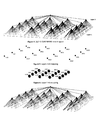
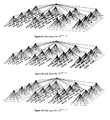
- Layer 2 (purple points) represents 16 unique points, s 2 , in the 16-QAM constellation and each of these unique point will have a further 16 points in Layer 1, s 1 , (green points). In total there are 256 unique symbols, [ s 1 , s 2 ] in the search-space.
- bits required to represent each constellation point depends on the constellation size as shown in Table 1.
- Table 1 Bit ordering and required bits for different constellation size Constellation Number of bits, B required Bit ordering QPSK 2 ⁇ bit0 bit1 ⁇ 16-QAM 4 ⁇ bit0 bit1 bit2 bit3 ⁇ 64-QAM 6 ⁇ bit0 bit1 bit2 bit3 bit4 bit5 ⁇ 256-QAM 8 ⁇ bit0 bit1 bit2 bit3 bit4 bit5 bit6 bit7 ⁇ 1024-QAM 10 ⁇ bit0 bit1 bit2 bit3 bit4 bit5 bit6 bit7 bit8 bit9 ⁇ 4096-QAM 12 ⁇ bit0 bit1 bit2 bit3 bit4 bit5 bit6 bit7 bit8 bit9 bit10 bit11 ⁇
- the total number of bits sent will be doubled, e.g. 8 bits for 16-QAM and 12 bits for 64-QAM.
- the bit ordering will be:
- the search-space is a set of all possible combinations of the transmitted data. For example in a 3x3 MIMO system which is using 64-QAM in all transmitting antennas, the search-space contains 262,144 (or 64 3 ) symbols or unique combinations.
- the search-space is all the symbols in Layer 1 (contained inside the yellow box) in Figure 4 .
- MIMO decoding exploits the use of QR matrix decomposition where Q is an orthonormal matrix and R is an upper triangular matrix with real (not complex) diagonal values. All the derivations below are intended for a 2x2 MIMO system.
- the hard-decision MIMO decoding can be done in stages; first calculate PD 2 2 by setting s 2 before calculating PD 1 2 by setting s 1 . This is iterated over all possible combination and the ML solution is the pair of s 1 and s 2 which gives the shortest Euclidean distance.
- Soft-decision decoding looks at the received symbol and works out the statistical probability of each individual bit that it represents and forms a log-likelihood ratio (LLR).
- LLR log-likelihood ratio
- the LLR of every bit in the transmitted symbols can be computed by calculating the distances between the received point and the group of constellation points (after the channel) where the corresponding bit is '0' and '1'.
- Equation (13) can be further simplified using the max-log approximation, hence reducing the equation to LLR bitn sk
- x log ⁇ exp - ⁇ x - Ha 1 min ⁇ 2 2 ⁇ ⁇ 2 exp - ⁇ x - Ha 0 min ⁇ 2 2 ⁇ ⁇ 2
- the ML solution is the nearest symbol to the equalised received symbol in the search-space and the corresponding squared Euclidean distance fills half of the required squared norm for the LLR calculations.
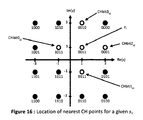
- the soft-decision decoder will then need to find the other half of the squared norm and these are calculated from the nearest ML counter-hypothesis (CH) points.
- Table 2 Example system parameters MIMO System 2x2 Transmit Symbol s 1 s 2 Modulation 16-QAM 16-QAM ML solution 3 + i -1 + 3i Bit representation 0001 1010 EDist ML 2 ⁇
- the LLR metric table is therefore:
- the soft-decision decoder will need to find all the remaining Euclidean distances; EDist CH0s1 2 , EDist CH0s1 2 , EDist CH0s1 2 , EDist CH0s1 2 , EDist CH0s2 2 , EDist CH0s2 2 , EDist CH0s2 2 , and EDist CH0s2 2 .
- the LLR metric table is filled, the LLR for every bit can be calculated.
- the decoder first select an s 2 symbol (in no particular order) to calculate PD 2 2 using equation (12.2), and in the conventional method it will then iterate over the whole set of s 1 symbols to calculate PD 1 2 . Summing both PD 2 2 and PD 1 2 on every iteration gives a new squared norm that is needed to fill in the LLR metric table. On every iteration, the affected cells in the LLR metric table will be updated with the new squared norm if the value is smaller than the existing one in the cell.
- the new proposed technique also starts by first choosing an s 2 symbol but it then avoids iterating over the entire set of s 1 symbols like in the conventional system. Instead it iterates over a carefully selected subset of s 1 symbols hence reducing the amount of calculations required for the decoding. This new technique does not cause any penalty to the decoding performance.
- the total number of PD that will be calculated is therefore M + M x [log2(M) + 1].
- the embodiment provides a hardware optimisation technique which reduces the number of calculations that it requires to maintain the near optimum decoding performance as in the conventional method.
- the embodiment works for any uniform rectangular modulation scheme e.g. QPSK, 16-QAM, 64-QAM, 256-QAM, etc.
- the new technique is divided into two steps:
- This new technique can also be used on higher system dimensions such as 3x3, 4x4 or even 8x8 MIMO systems; however the advantage of this decoding method diminishes as the dimensionality increases.
- Equation (12.1) can be written in a simpler form with the predetermined s 2 symbol.
- PD 1 2 ⁇ y pre ⁇ 1 - r 11 ⁇ s 1 ⁇ 2
- y pre ⁇ 1 y 1 - r 11 ⁇ s 2
- the diagonal entries of the upper triangular R matrix in the QR decomposition are real values; hence the r 11 pre-multiplier can be regarded as a scaling factor.
- the next step involves finding all the nearest CH points for s 1 .
- the decoder needs to find a CH point for every transmitted bit and this new technique efficiently finds half of the needed CH points on every s 2 iteration.
- the necessary real and imaginary values (stated as xCHn and yCHn) need to be calculated first, and the algorithm to find these values are shown in Appendix A (up until 4096-QAM).
- PD 1 2 for every CH can be calculated using the equation derived from equation (16).
- the s 1 will be replaced by CHbit n s1 , as shown in equation (19).
- PD 1 CHbit ⁇ n 2 ⁇ y y pre ⁇ 1 - r 11 CHbit ⁇ n s ⁇ 1 ⁇ 2
- EDist ML 2 EDist CH ⁇ 0 ⁇ s ⁇ 1 2 , ... , EDist CH ⁇ B ⁇ s ⁇ 1 2 .
- EDist ML 2 PD 1 2 + PD 2 2
- EDist CHnsl 2 PD 1 CHbit ⁇ n 2 + PD 2 2
- the decoder On every s 2 iteration, the decoder will compare the existing values in the metric table with these new values. All the affected cells in the metric table will be updated with the new values if it is smaller than the existing ones. After all the s 2 iterations, the LLR metric table should be complete and the LLR for every bit can be calculated using equation (15).
- the points in one select QAM constellation (here S 2 ) are chosen, ordered, and a LLR metric table initialised.
- An index (idx) is set to a first value to select the first point in the constellation.
- the first point is selected and the partial distance calculated at a calculation step 26.
- the estimated symbol is determined at a determining step 14 and counter hypothesis points in another constellation are then determined at step 18 for the estimated most likely symbol. For the most likely symbol a distance is calculated at calculation step 28.
- the partial distances are calculated at step 30.
- the Euclidean distances are determined at step 20 and used to update the metric table at step 22.
- the index is iterated at step 24 until the calculations have been performed for all points at which stage the algorithm terminates.
- the algorithm may be implemented as software or hardware.
- the method may be embodied in a decoder having an input, means to undertake the various calculations and an output for providing a data comprising log-likelihood ratios for use by a subsequent process such as a Viterbi decoder, either within the decoder or in a separate unit.
- This new proposed technique can save a lot of unnecessary calculations because the algorithm picks only the symbols that might have a smaller overall Euclidean distance. This is done by looking at the boundaries created by the Gray coded bit mapping of QAM constellation. Through a series of geometric deduction, the algorithm finds only the symbols that can potentially lead to a shorter Euclidean distance in the LLR metric table.
- This new technique has huge advantage in a 2x2 MIMO system with high QAM constellation and the advantage diminishes in small QAM constellation and/or larger MIMO systems.
Landscapes
- Engineering & Computer Science (AREA)
- Computer Networks & Wireless Communication (AREA)
- Signal Processing (AREA)
- Power Engineering (AREA)
- Digital Transmission Methods That Use Modulated Carrier Waves (AREA)
- Error Detection And Correction (AREA)
Applications Claiming Priority (1)
| Application Number | Priority Date | Filing Date | Title |
|---|---|---|---|
| GB1120541.6A GB2496918B (en) | 2011-11-28 | 2011-11-28 | MIMO decoding system |
Publications (3)
| Publication Number | Publication Date |
|---|---|
| EP2597835A2 true EP2597835A2 (de) | 2013-05-29 |
| EP2597835A3 EP2597835A3 (de) | 2014-10-01 |
| EP2597835B1 EP2597835B1 (de) | 2019-07-10 |
Family
ID=45508900
Family Applications (1)
| Application Number | Title | Priority Date | Filing Date |
|---|---|---|---|
| EP12250174.5A Active EP2597835B1 (de) | 2011-11-28 | 2012-11-28 | MIMO-Decodierungssystem |
Country Status (2)
| Country | Link |
|---|---|
| EP (1) | EP2597835B1 (de) |
| GB (1) | GB2496918B (de) |
Cited By (2)
| Publication number | Priority date | Publication date | Assignee | Title |
|---|---|---|---|---|
| CN110858773A (zh) * | 2018-08-22 | 2020-03-03 | 三星电子株式会社 | 无线通信设备及由其执行的方法、计算机可读介质 |
| DE102019135804A1 (de) * | 2019-01-30 | 2020-07-30 | Nokia Technologies Oy | Gerät und verfahren zum erfassen von empfangenen signalen |
Families Citing this family (1)
| Publication number | Priority date | Publication date | Assignee | Title |
|---|---|---|---|---|
| GB2548876B (en) | 2016-03-31 | 2019-12-25 | Toshiba Res Europe Limited | Low-complexity LLR computation for nonuniform QAM constellations |
Family Cites Families (2)
| Publication number | Priority date | Publication date | Assignee | Title |
|---|---|---|---|---|
| ATE434296T1 (de) * | 2006-04-05 | 2009-07-15 | Sequans Comm | Verfahren zum dekodieren eines räumlich gemultiplexten signals und entsprechender empfänger |
| TWI362841B (en) * | 2008-09-19 | 2012-04-21 | Realtek Semiconductor Corp | Sphere decoding method applied to mimo channel |
-
2011
- 2011-11-28 GB GB1120541.6A patent/GB2496918B/en not_active Expired - Fee Related
-
2012
- 2012-11-28 EP EP12250174.5A patent/EP2597835B1/de active Active
Non-Patent Citations (2)
| Title |
|---|
| JIANPENG YU ET AL: "Parallel SFSD MIMO detection with SOFT-HARD combination enumeration", SIGNAL PROCESSING SYSTEMS (SIPS), 2011 IEEE WORKSHOP ON, IEEE, 4 October 2011 (2011-10-04), pages 228-233, XP032029155, DOI: 10.1109/SIPS.2011.6088979 ISBN: 978-1-4577-1920-2 * |
| STUDER C ET AL: "Soft-Output Sphere Decoding: Performance and Implementation Aspects", SIGNALS, SYSTEMS AND COMPUTERS, 2006. ACSSC '06. FORTIETH ASILOMA R CONFERENCE ON, IEEE, PI, 1 October 2006 (2006-10-01), pages 2071-2076, XP031081392, DOI: 10.1109/ACSSC.2006.355132 ISBN: 978-1-4244-0784-2 * |
Cited By (7)
| Publication number | Priority date | Publication date | Assignee | Title |
|---|---|---|---|---|
| CN110858773A (zh) * | 2018-08-22 | 2020-03-03 | 三星电子株式会社 | 无线通信设备及由其执行的方法、计算机可读介质 |
| CN110858773B (zh) * | 2018-08-22 | 2023-07-18 | 三星电子株式会社 | 无线通信设备及由其执行的方法、计算机可读介质 |
| DE102019135804A1 (de) * | 2019-01-30 | 2020-07-30 | Nokia Technologies Oy | Gerät und verfahren zum erfassen von empfangenen signalen |
| CN111510187A (zh) * | 2019-01-30 | 2020-08-07 | 诺基亚技术有限公司 | 用于接收信号的检测的装置和方法 |
| US10797930B1 (en) | 2019-01-30 | 2020-10-06 | Nokia Technologies Oy | Apparatus and method for detection of received signals |
| DE102019135804B4 (de) * | 2019-01-30 | 2020-10-08 | Nokia Technologies Oy | Gerät und verfahren zum erfassen von empfangenen signalen |
| CN111510187B (zh) * | 2019-01-30 | 2021-12-31 | 诺基亚技术有限公司 | 用于接收信号的检测的装置和方法 |
Also Published As
| Publication number | Publication date |
|---|---|
| EP2597835A3 (de) | 2014-10-01 |
| GB2496918A (en) | 2013-05-29 |
| GB201120541D0 (en) | 2012-01-11 |
| EP2597835B1 (de) | 2019-07-10 |
| GB2496918B (en) | 2019-01-02 |
Similar Documents
| Publication | Publication Date | Title |
|---|---|---|
| Wang et al. | Approaching MIMO channel capacity with soft detection based on hard sphere decoding | |
| EP2288048A1 (de) | Gedrehte mehrdimensionale Konstellationen zur verbesserten Diversity bei Fading-Kanälen | |
| EP2375660B1 (de) | Symbol-Demappingverfahren in Systemen mit mehreren Ein- und Ausgängen | |
| US7095812B2 (en) | Reduced complexity receiver for space-time- bit-interleaved coded modulation | |
| Sugiura et al. | Effects of channel estimation on spatial modulation | |
| EP2200240A1 (de) | Verfahren und Vorrichtung zur annähernd optimalen Berechnung von Zuverlässigkeitsinformationen in Kommunikationssystemen mit mehreren Antennen und iterativer Detektion und Dekodierung | |
| US9065473B1 (en) | Soft decoding of coded bit-streams | |
| US20080112498A1 (en) | System for soft symbol decoding with mimo log-map detection | |
| EP1705822A2 (de) | Verfahren und Vorrichtung zum zur Erkennung und Dekodierung eines Signales in einem MIMO-Kommunikationssystem | |
| US9654252B2 (en) | Low complexity maximum-likelihood-based method for estimating emitted symbols in a SM-MIMO receiver | |
| Zheng et al. | LDPC-coded MIMO systems with unknown block fading channels: soft MIMO detector design, channel estimation, and code optimization | |
| EP1798920A1 (de) | Iterative Detektions- und Dekodierungsvorrichtung und Verfahren in MIMO-Systemen | |
| US8054904B2 (en) | Partial iterative detection and decoding apparatus and method in MIMO system | |
| US20070133709A1 (en) | Apparatus and method for iterative detection and decoding (IDD) in multi-antenna communication system | |
| US8520759B2 (en) | Apparatus and method for detecting signal based on lattice reduction to support different coding scheme for each stream in multiple input multiple output wireless communication system | |
| EP3291449A1 (de) | Verfahren und vorrichtungen zur erzeugung von optimierten codierten modulationen | |
| EP2597835B1 (de) | MIMO-Decodierungssystem | |
| Shang et al. | Partial Gaussian-approximation soft demapper for the core layer of MIMO-LDM in ATSC 3.0 | |
| EP2104260B1 (de) | Mit hoher Rate und vollständiger Diversität kodiertes Sendestrahlenformungsverfahren mit teilalgebraischer Vorkodierung und entsprechender fast optimaler Empfänger mit niedriger Komplexität | |
| US11923927B2 (en) | M-MIMO receiver | |
| US20080049862A1 (en) | Signal Processing Apparatus and Method | |
| US9722730B1 (en) | Multi-stream demodulation schemes with progressive optimization | |
| US10110253B2 (en) | Receiver | |
| EP2555479A1 (de) | Vorrichtung und Verfahren zur Einschätzung eines Kanalkoeffizienten eines Datenunterkanals eines Funkkanals | |
| US10243696B2 (en) | Diversity combining of non-coherently modulated LDPC codes in wireless communications |
Legal Events
| Date | Code | Title | Description |
|---|---|---|---|
| PUAI | Public reference made under article 153(3) epc to a published international application that has entered the european phase |
Free format text: ORIGINAL CODE: 0009012 |
|
| AK | Designated contracting states |
Kind code of ref document: A2 Designated state(s): AL AT BE BG CH CY CZ DE DK EE ES FI FR GB GR HR HU IE IS IT LI LT LU LV MC MK MT NL NO PL PT RO RS SE SI SK SM TR |
|
| AX | Request for extension of the european patent |
Extension state: BA ME |
|
| PUAL | Search report despatched |
Free format text: ORIGINAL CODE: 0009013 |
|
| AK | Designated contracting states |
Kind code of ref document: A3 Designated state(s): AL AT BE BG CH CY CZ DE DK EE ES FI FR GB GR HR HU IE IS IT LI LT LU LV MC MK MT NL NO PL PT RO RS SE SI SK SM TR |
|
| AX | Request for extension of the european patent |
Extension state: BA ME |
|
| RIC1 | Information provided on ipc code assigned before grant |
Ipc: H04L 25/03 20060101AFI20140827BHEP Ipc: H04L 25/06 20060101ALI20140827BHEP |
|
| 17P | Request for examination filed |
Effective date: 20150330 |
|
| RBV | Designated contracting states (corrected) |
Designated state(s): AL AT BE BG CH CY CZ DE DK EE ES FI FR GB GR HR HU IE IS IT LI LT LU LV MC MK MT NL NO PL PT RO RS SE SI SK SM TR |
|
| STAA | Information on the status of an ep patent application or granted ep patent |
Free format text: STATUS: EXAMINATION IS IN PROGRESS |
|
| 17Q | First examination report despatched |
Effective date: 20171215 |
|
| GRAP | Despatch of communication of intention to grant a patent |
Free format text: ORIGINAL CODE: EPIDOSNIGR1 |
|
| STAA | Information on the status of an ep patent application or granted ep patent |
Free format text: STATUS: GRANT OF PATENT IS INTENDED |
|
| INTG | Intention to grant announced |
Effective date: 20190201 |
|
| GRAS | Grant fee paid |
Free format text: ORIGINAL CODE: EPIDOSNIGR3 |
|
| GRAA | (expected) grant |
Free format text: ORIGINAL CODE: 0009210 |
|
| STAA | Information on the status of an ep patent application or granted ep patent |
Free format text: STATUS: THE PATENT HAS BEEN GRANTED |
|
| AK | Designated contracting states |
Kind code of ref document: B1 Designated state(s): AL AT BE BG CH CY CZ DE DK EE ES FI FR GB GR HR HU IE IS IT LI LT LU LV MC MK MT NL NO PL PT RO RS SE SI SK SM TR |
|
| REG | Reference to a national code |
Ref country code: GB Ref legal event code: FG4D |
|
| REG | Reference to a national code |
Ref country code: CH Ref legal event code: EP Ref country code: AT Ref legal event code: REF Ref document number: 1154713 Country of ref document: AT Kind code of ref document: T Effective date: 20190715 |
|
| REG | Reference to a national code |
Ref country code: DE Ref legal event code: R096 Ref document number: 602012061857 Country of ref document: DE |
|
| REG | Reference to a national code |
Ref country code: IE Ref legal event code: FG4D |
|
| REG | Reference to a national code |
Ref country code: NL Ref legal event code: MP Effective date: 20190710 |
|
| REG | Reference to a national code |
Ref country code: LT Ref legal event code: MG4D |
|
| REG | Reference to a national code |
Ref country code: AT Ref legal event code: MK05 Ref document number: 1154713 Country of ref document: AT Kind code of ref document: T Effective date: 20190710 |
|
| PG25 | Lapsed in a contracting state [announced via postgrant information from national office to epo] |
Ref country code: FI Free format text: LAPSE BECAUSE OF FAILURE TO SUBMIT A TRANSLATION OF THE DESCRIPTION OR TO PAY THE FEE WITHIN THE PRESCRIBED TIME-LIMIT Effective date: 20190710 Ref country code: HR Free format text: LAPSE BECAUSE OF FAILURE TO SUBMIT A TRANSLATION OF THE DESCRIPTION OR TO PAY THE FEE WITHIN THE PRESCRIBED TIME-LIMIT Effective date: 20190710 Ref country code: SE Free format text: LAPSE BECAUSE OF FAILURE TO SUBMIT A TRANSLATION OF THE DESCRIPTION OR TO PAY THE FEE WITHIN THE PRESCRIBED TIME-LIMIT Effective date: 20190710 Ref country code: AT Free format text: LAPSE BECAUSE OF FAILURE TO SUBMIT A TRANSLATION OF THE DESCRIPTION OR TO PAY THE FEE WITHIN THE PRESCRIBED TIME-LIMIT Effective date: 20190710 Ref country code: NO Free format text: LAPSE BECAUSE OF FAILURE TO SUBMIT A TRANSLATION OF THE DESCRIPTION OR TO PAY THE FEE WITHIN THE PRESCRIBED TIME-LIMIT Effective date: 20191010 Ref country code: LT Free format text: LAPSE BECAUSE OF FAILURE TO SUBMIT A TRANSLATION OF THE DESCRIPTION OR TO PAY THE FEE WITHIN THE PRESCRIBED TIME-LIMIT Effective date: 20190710 Ref country code: NL Free format text: LAPSE BECAUSE OF FAILURE TO SUBMIT A TRANSLATION OF THE DESCRIPTION OR TO PAY THE FEE WITHIN THE PRESCRIBED TIME-LIMIT Effective date: 20190710 Ref country code: PT Free format text: LAPSE BECAUSE OF FAILURE TO SUBMIT A TRANSLATION OF THE DESCRIPTION OR TO PAY THE FEE WITHIN THE PRESCRIBED TIME-LIMIT Effective date: 20191111 Ref country code: BG Free format text: LAPSE BECAUSE OF FAILURE TO SUBMIT A TRANSLATION OF THE DESCRIPTION OR TO PAY THE FEE WITHIN THE PRESCRIBED TIME-LIMIT Effective date: 20191010 |
|
| PG25 | Lapsed in a contracting state [announced via postgrant information from national office to epo] |
Ref country code: LV Free format text: LAPSE BECAUSE OF FAILURE TO SUBMIT A TRANSLATION OF THE DESCRIPTION OR TO PAY THE FEE WITHIN THE PRESCRIBED TIME-LIMIT Effective date: 20190710 Ref country code: ES Free format text: LAPSE BECAUSE OF FAILURE TO SUBMIT A TRANSLATION OF THE DESCRIPTION OR TO PAY THE FEE WITHIN THE PRESCRIBED TIME-LIMIT Effective date: 20190710 Ref country code: GR Free format text: LAPSE BECAUSE OF FAILURE TO SUBMIT A TRANSLATION OF THE DESCRIPTION OR TO PAY THE FEE WITHIN THE PRESCRIBED TIME-LIMIT Effective date: 20191011 Ref country code: AL Free format text: LAPSE BECAUSE OF FAILURE TO SUBMIT A TRANSLATION OF THE DESCRIPTION OR TO PAY THE FEE WITHIN THE PRESCRIBED TIME-LIMIT Effective date: 20190710 Ref country code: RS Free format text: LAPSE BECAUSE OF FAILURE TO SUBMIT A TRANSLATION OF THE DESCRIPTION OR TO PAY THE FEE WITHIN THE PRESCRIBED TIME-LIMIT Effective date: 20190710 Ref country code: IS Free format text: LAPSE BECAUSE OF FAILURE TO SUBMIT A TRANSLATION OF THE DESCRIPTION OR TO PAY THE FEE WITHIN THE PRESCRIBED TIME-LIMIT Effective date: 20191110 |
|
| PG25 | Lapsed in a contracting state [announced via postgrant information from national office to epo] |
Ref country code: TR Free format text: LAPSE BECAUSE OF FAILURE TO SUBMIT A TRANSLATION OF THE DESCRIPTION OR TO PAY THE FEE WITHIN THE PRESCRIBED TIME-LIMIT Effective date: 20190710 |
|
| PG25 | Lapsed in a contracting state [announced via postgrant information from national office to epo] |
Ref country code: EE Free format text: LAPSE BECAUSE OF FAILURE TO SUBMIT A TRANSLATION OF THE DESCRIPTION OR TO PAY THE FEE WITHIN THE PRESCRIBED TIME-LIMIT Effective date: 20190710 Ref country code: RO Free format text: LAPSE BECAUSE OF FAILURE TO SUBMIT A TRANSLATION OF THE DESCRIPTION OR TO PAY THE FEE WITHIN THE PRESCRIBED TIME-LIMIT Effective date: 20190710 Ref country code: PL Free format text: LAPSE BECAUSE OF FAILURE TO SUBMIT A TRANSLATION OF THE DESCRIPTION OR TO PAY THE FEE WITHIN THE PRESCRIBED TIME-LIMIT Effective date: 20190710 Ref country code: IT Free format text: LAPSE BECAUSE OF FAILURE TO SUBMIT A TRANSLATION OF THE DESCRIPTION OR TO PAY THE FEE WITHIN THE PRESCRIBED TIME-LIMIT Effective date: 20190710 Ref country code: DK Free format text: LAPSE BECAUSE OF FAILURE TO SUBMIT A TRANSLATION OF THE DESCRIPTION OR TO PAY THE FEE WITHIN THE PRESCRIBED TIME-LIMIT Effective date: 20190710 |
|
| PG25 | Lapsed in a contracting state [announced via postgrant information from national office to epo] |
Ref country code: SK Free format text: LAPSE BECAUSE OF FAILURE TO SUBMIT A TRANSLATION OF THE DESCRIPTION OR TO PAY THE FEE WITHIN THE PRESCRIBED TIME-LIMIT Effective date: 20190710 Ref country code: CZ Free format text: LAPSE BECAUSE OF FAILURE TO SUBMIT A TRANSLATION OF THE DESCRIPTION OR TO PAY THE FEE WITHIN THE PRESCRIBED TIME-LIMIT Effective date: 20190710 Ref country code: IS Free format text: LAPSE BECAUSE OF FAILURE TO SUBMIT A TRANSLATION OF THE DESCRIPTION OR TO PAY THE FEE WITHIN THE PRESCRIBED TIME-LIMIT Effective date: 20200224 Ref country code: SM Free format text: LAPSE BECAUSE OF FAILURE TO SUBMIT A TRANSLATION OF THE DESCRIPTION OR TO PAY THE FEE WITHIN THE PRESCRIBED TIME-LIMIT Effective date: 20190710 |
|
| REG | Reference to a national code |
Ref country code: DE Ref legal event code: R097 Ref document number: 602012061857 Country of ref document: DE |
|
| REG | Reference to a national code |
Ref country code: CH Ref legal event code: PL |
|
| PLBE | No opposition filed within time limit |
Free format text: ORIGINAL CODE: 0009261 |
|
| STAA | Information on the status of an ep patent application or granted ep patent |
Free format text: STATUS: NO OPPOSITION FILED WITHIN TIME LIMIT |
|
| PG2D | Information on lapse in contracting state deleted |
Ref country code: IS |
|
| PG25 | Lapsed in a contracting state [announced via postgrant information from national office to epo] |
Ref country code: MC Free format text: LAPSE BECAUSE OF FAILURE TO SUBMIT A TRANSLATION OF THE DESCRIPTION OR TO PAY THE FEE WITHIN THE PRESCRIBED TIME-LIMIT Effective date: 20190710 Ref country code: CH Free format text: LAPSE BECAUSE OF NON-PAYMENT OF DUE FEES Effective date: 20191130 Ref country code: LI Free format text: LAPSE BECAUSE OF NON-PAYMENT OF DUE FEES Effective date: 20191130 Ref country code: LU Free format text: LAPSE BECAUSE OF NON-PAYMENT OF DUE FEES Effective date: 20191128 |
|
| 26N | No opposition filed |
Effective date: 20200603 |
|
| REG | Reference to a national code |
Ref country code: BE Ref legal event code: MM Effective date: 20191130 |
|
| PG25 | Lapsed in a contracting state [announced via postgrant information from national office to epo] |
Ref country code: SI Free format text: LAPSE BECAUSE OF FAILURE TO SUBMIT A TRANSLATION OF THE DESCRIPTION OR TO PAY THE FEE WITHIN THE PRESCRIBED TIME-LIMIT Effective date: 20190710 |
|
| PG25 | Lapsed in a contracting state [announced via postgrant information from national office to epo] |
Ref country code: IE Free format text: LAPSE BECAUSE OF NON-PAYMENT OF DUE FEES Effective date: 20191128 |
|
| PG25 | Lapsed in a contracting state [announced via postgrant information from national office to epo] |
Ref country code: BE Free format text: LAPSE BECAUSE OF NON-PAYMENT OF DUE FEES Effective date: 20191130 |
|
| PG25 | Lapsed in a contracting state [announced via postgrant information from national office to epo] |
Ref country code: CY Free format text: LAPSE BECAUSE OF FAILURE TO SUBMIT A TRANSLATION OF THE DESCRIPTION OR TO PAY THE FEE WITHIN THE PRESCRIBED TIME-LIMIT Effective date: 20190710 |
|
| PG25 | Lapsed in a contracting state [announced via postgrant information from national office to epo] |
Ref country code: MT Free format text: LAPSE BECAUSE OF FAILURE TO SUBMIT A TRANSLATION OF THE DESCRIPTION OR TO PAY THE FEE WITHIN THE PRESCRIBED TIME-LIMIT Effective date: 20190710 Ref country code: HU Free format text: LAPSE BECAUSE OF FAILURE TO SUBMIT A TRANSLATION OF THE DESCRIPTION OR TO PAY THE FEE WITHIN THE PRESCRIBED TIME-LIMIT; INVALID AB INITIO Effective date: 20121128 |
|
| PG25 | Lapsed in a contracting state [announced via postgrant information from national office to epo] |
Ref country code: MK Free format text: LAPSE BECAUSE OF FAILURE TO SUBMIT A TRANSLATION OF THE DESCRIPTION OR TO PAY THE FEE WITHIN THE PRESCRIBED TIME-LIMIT Effective date: 20190710 |
|
| P01 | Opt-out of the competence of the unified patent court (upc) registered |
Effective date: 20230330 |
|
| PGFP | Annual fee paid to national office [announced via postgrant information from national office to epo] |
Ref country code: FR Payment date: 20250930 Year of fee payment: 14 |
|
| PGFP | Annual fee paid to national office [announced via postgrant information from national office to epo] |
Ref country code: DE Payment date: 20250930 Year of fee payment: 14 |
|
| PGFP | Annual fee paid to national office [announced via postgrant information from national office to epo] |
Ref country code: GB Payment date: 20251001 Year of fee payment: 14 |