EP2598029B1 - Ensemble implant crânien conçu pour être introduit pendant une craniectomie - Google Patents
Ensemble implant crânien conçu pour être introduit pendant une craniectomie Download PDFInfo
- Publication number
- EP2598029B1 EP2598029B1 EP11813283.6A EP11813283A EP2598029B1 EP 2598029 B1 EP2598029 B1 EP 2598029B1 EP 11813283 A EP11813283 A EP 11813283A EP 2598029 B1 EP2598029 B1 EP 2598029B1
- Authority
- EP
- European Patent Office
- Prior art keywords
- implant assembly
- cranial implant
- skull
- articulated
- spanning member
- Prior art date
- Legal status (The legal status is an assumption and is not a legal conclusion. Google has not performed a legal analysis and makes no representation as to the accuracy of the status listed.)
- Not-in-force
Links
Images




Classifications
-
- A—HUMAN NECESSITIES
- A61—MEDICAL OR VETERINARY SCIENCE; HYGIENE
- A61F—FILTERS IMPLANTABLE INTO BLOOD VESSELS; PROSTHESES; DEVICES PROVIDING PATENCY TO, OR PREVENTING COLLAPSING OF, TUBULAR STRUCTURES OF THE BODY, e.g. STENTS; ORTHOPAEDIC, NURSING OR CONTRACEPTIVE DEVICES; FOMENTATION; TREATMENT OR PROTECTION OF EYES OR EARS; BANDAGES, DRESSINGS OR ABSORBENT PADS; FIRST-AID KITS
- A61F2/00—Filters implantable into blood vessels; Prostheses, i.e. artificial substitutes or replacements for parts of the body; Appliances for connecting them with the body; Devices providing patency to, or preventing collapsing of, tubular structures of the body, e.g. stents
- A61F2/02—Prostheses implantable into the body
- A61F2/28—Bones
- A61F2/2875—Skull or cranium
-
- A—HUMAN NECESSITIES
- A61—MEDICAL OR VETERINARY SCIENCE; HYGIENE
- A61F—FILTERS IMPLANTABLE INTO BLOOD VESSELS; PROSTHESES; DEVICES PROVIDING PATENCY TO, OR PREVENTING COLLAPSING OF, TUBULAR STRUCTURES OF THE BODY, e.g. STENTS; ORTHOPAEDIC, NURSING OR CONTRACEPTIVE DEVICES; FOMENTATION; TREATMENT OR PROTECTION OF EYES OR EARS; BANDAGES, DRESSINGS OR ABSORBENT PADS; FIRST-AID KITS
- A61F2/00—Filters implantable into blood vessels; Prostheses, i.e. artificial substitutes or replacements for parts of the body; Appliances for connecting them with the body; Devices providing patency to, or preventing collapsing of, tubular structures of the body, e.g. stents
- A61F2/02—Prostheses implantable into the body
- A61F2/30—Joints
- A61F2/3094—Designing or manufacturing processes
- A61F2/30942—Designing or manufacturing processes for designing or making customized prostheses, e.g. using templates, CT or NMR scans, finite-element analysis or CAD-CAM techniques
-
- A—HUMAN NECESSITIES
- A61—MEDICAL OR VETERINARY SCIENCE; HYGIENE
- A61F—FILTERS IMPLANTABLE INTO BLOOD VESSELS; PROSTHESES; DEVICES PROVIDING PATENCY TO, OR PREVENTING COLLAPSING OF, TUBULAR STRUCTURES OF THE BODY, e.g. STENTS; ORTHOPAEDIC, NURSING OR CONTRACEPTIVE DEVICES; FOMENTATION; TREATMENT OR PROTECTION OF EYES OR EARS; BANDAGES, DRESSINGS OR ABSORBENT PADS; FIRST-AID KITS
- A61F2/00—Filters implantable into blood vessels; Prostheses, i.e. artificial substitutes or replacements for parts of the body; Appliances for connecting them with the body; Devices providing patency to, or preventing collapsing of, tubular structures of the body, e.g. stents
- A61F2/02—Prostheses implantable into the body
- A61F2/30—Joints
- A61F2002/30001—Additional features of subject-matter classified in A61F2/28, A61F2/30 and subgroups thereof
- A61F2002/30003—Material related properties of the prosthesis or of a coating on the prosthesis
- A61F2002/3006—Properties of materials and coating materials
- A61F2002/30079—Properties of materials and coating materials magnetic
-
- A—HUMAN NECESSITIES
- A61—MEDICAL OR VETERINARY SCIENCE; HYGIENE
- A61F—FILTERS IMPLANTABLE INTO BLOOD VESSELS; PROSTHESES; DEVICES PROVIDING PATENCY TO, OR PREVENTING COLLAPSING OF, TUBULAR STRUCTURES OF THE BODY, e.g. STENTS; ORTHOPAEDIC, NURSING OR CONTRACEPTIVE DEVICES; FOMENTATION; TREATMENT OR PROTECTION OF EYES OR EARS; BANDAGES, DRESSINGS OR ABSORBENT PADS; FIRST-AID KITS
- A61F2/00—Filters implantable into blood vessels; Prostheses, i.e. artificial substitutes or replacements for parts of the body; Appliances for connecting them with the body; Devices providing patency to, or preventing collapsing of, tubular structures of the body, e.g. stents
- A61F2/02—Prostheses implantable into the body
- A61F2/30—Joints
- A61F2002/30001—Additional features of subject-matter classified in A61F2/28, A61F2/30 and subgroups thereof
- A61F2002/30108—Shapes
- A61F2002/3011—Cross-sections or two-dimensional shapes
- A61F2002/30159—Concave polygonal shapes
- A61F2002/30179—X-shaped
-
- A—HUMAN NECESSITIES
- A61—MEDICAL OR VETERINARY SCIENCE; HYGIENE
- A61F—FILTERS IMPLANTABLE INTO BLOOD VESSELS; PROSTHESES; DEVICES PROVIDING PATENCY TO, OR PREVENTING COLLAPSING OF, TUBULAR STRUCTURES OF THE BODY, e.g. STENTS; ORTHOPAEDIC, NURSING OR CONTRACEPTIVE DEVICES; FOMENTATION; TREATMENT OR PROTECTION OF EYES OR EARS; BANDAGES, DRESSINGS OR ABSORBENT PADS; FIRST-AID KITS
- A61F2/00—Filters implantable into blood vessels; Prostheses, i.e. artificial substitutes or replacements for parts of the body; Appliances for connecting them with the body; Devices providing patency to, or preventing collapsing of, tubular structures of the body, e.g. stents
- A61F2/02—Prostheses implantable into the body
- A61F2/30—Joints
- A61F2002/30001—Additional features of subject-matter classified in A61F2/28, A61F2/30 and subgroups thereof
- A61F2002/30316—The prosthesis having different structural features at different locations within the same prosthesis; Connections between prosthetic parts; Special structural features of bone or joint prostheses not otherwise provided for
- A61F2002/30329—Connections or couplings between prosthetic parts, e.g. between modular parts; Connecting elements
- A61F2002/30462—Connections or couplings between prosthetic parts, e.g. between modular parts; Connecting elements retained or tied with a rope, string, thread, wire or cable
-
- A—HUMAN NECESSITIES
- A61—MEDICAL OR VETERINARY SCIENCE; HYGIENE
- A61F—FILTERS IMPLANTABLE INTO BLOOD VESSELS; PROSTHESES; DEVICES PROVIDING PATENCY TO, OR PREVENTING COLLAPSING OF, TUBULAR STRUCTURES OF THE BODY, e.g. STENTS; ORTHOPAEDIC, NURSING OR CONTRACEPTIVE DEVICES; FOMENTATION; TREATMENT OR PROTECTION OF EYES OR EARS; BANDAGES, DRESSINGS OR ABSORBENT PADS; FIRST-AID KITS
- A61F2/00—Filters implantable into blood vessels; Prostheses, i.e. artificial substitutes or replacements for parts of the body; Appliances for connecting them with the body; Devices providing patency to, or preventing collapsing of, tubular structures of the body, e.g. stents
- A61F2/02—Prostheses implantable into the body
- A61F2/30—Joints
- A61F2002/30001—Additional features of subject-matter classified in A61F2/28, A61F2/30 and subgroups thereof
- A61F2002/30316—The prosthesis having different structural features at different locations within the same prosthesis; Connections between prosthetic parts; Special structural features of bone or joint prostheses not otherwise provided for
- A61F2002/30329—Connections or couplings between prosthetic parts, e.g. between modular parts; Connecting elements
- A61F2002/30476—Connections or couplings between prosthetic parts, e.g. between modular parts; Connecting elements locked by an additional locking mechanism
- A61F2002/305—Snap connection
-
- A—HUMAN NECESSITIES
- A61—MEDICAL OR VETERINARY SCIENCE; HYGIENE
- A61F—FILTERS IMPLANTABLE INTO BLOOD VESSELS; PROSTHESES; DEVICES PROVIDING PATENCY TO, OR PREVENTING COLLAPSING OF, TUBULAR STRUCTURES OF THE BODY, e.g. STENTS; ORTHOPAEDIC, NURSING OR CONTRACEPTIVE DEVICES; FOMENTATION; TREATMENT OR PROTECTION OF EYES OR EARS; BANDAGES, DRESSINGS OR ABSORBENT PADS; FIRST-AID KITS
- A61F2/00—Filters implantable into blood vessels; Prostheses, i.e. artificial substitutes or replacements for parts of the body; Appliances for connecting them with the body; Devices providing patency to, or preventing collapsing of, tubular structures of the body, e.g. stents
- A61F2/02—Prostheses implantable into the body
- A61F2/30—Joints
- A61F2/30767—Special external or bone-contacting surface, e.g. coating for improving bone ingrowth
- A61F2/30907—Nets or sleeves applied to surface of prostheses or in cement
- A61F2002/30909—Nets
-
- A—HUMAN NECESSITIES
- A61—MEDICAL OR VETERINARY SCIENCE; HYGIENE
- A61F—FILTERS IMPLANTABLE INTO BLOOD VESSELS; PROSTHESES; DEVICES PROVIDING PATENCY TO, OR PREVENTING COLLAPSING OF, TUBULAR STRUCTURES OF THE BODY, e.g. STENTS; ORTHOPAEDIC, NURSING OR CONTRACEPTIVE DEVICES; FOMENTATION; TREATMENT OR PROTECTION OF EYES OR EARS; BANDAGES, DRESSINGS OR ABSORBENT PADS; FIRST-AID KITS
- A61F2310/00—Prostheses classified in A61F2/28 or A61F2/30 - A61F2/44 being constructed from or coated with a particular material
- A61F2310/00389—The prosthesis being coated or covered with a particular material
- A61F2310/0097—Coating or prosthesis-covering structure made of pharmaceutical products, e.g. antibiotics
Definitions
- the present teachings relate to medical devices, and more particularly, to an initially non-rigid cranial implant introduced immediately during a craniectomy procedure that is capable of adapting to the shape of a displaced brain and of transitioning during the normalization of brain shape to a rigid state to protect the skull opening resulting from the procedure.
- Several medical conditions including surgical interventions and trauma can lead to increasing intracranial pressure. These conditions include, but are not limited to: "malignant" cerebral infarction (stroke), brain tumors, epilepsy surgery, and craniosynostosis (congenital cranial anomalies), and brain injury trauma.
- stroke cerebral infarction
- brain tumors e.g., brain tumors
- epilepsy surgery e.g., epilepsy surgery
- craniosynostosis congenital cranial anomalies
- brain injury trauma e.g., a very dangerous effect of causing swelling or edema of brain matter and the enveloping dura within the confines of the cranium.
- the increased intracranial pressure caused by these conditions is be associated with serious complications including bruising or other damage to brain tissue, delirium, loss of consciousness or cognitive functions, secondary cerebral ischemia or infarctions, brain herniation and possibly death, if left untreated.
- This situation typically can only be effectively treated by surgical removal of a portion of the cranium (craniectomy) to allow room for the brain to expand and the release of cerebrospinal fluid to reduce the increased pressure.
- craniectomy surgical removal of a portion of the cranium
- the current practice in managing acute cases of medically uncontrolled brain swelling is to perform an emergency craniectomy.
- a flap of cranium is removed from the patient's cranium in order to provide relief to intracranial pressure and reduce the risk of the aforementioned serious or fatal complications.
- the initial craniectomy producing the cranial opening is followed by a period of intensive rehabilitation.
- US 2008/0200954 A1 describes a fastening system including a deformable connecting member configured for being connected at one end to a skull flap of a patient who has undergone a craniectomy procedure, and at the other end to the skull of the patient.
- One serious problem that can arise during the post-operative period is the so-called Syndrome of the Trephined.
- This condition results from the sinking of the dura within the cranial opening due to the negative intracranial pressure relative to the atmospheric pressure which, induces derangements of cerebrospinal fluid flow, cerebral blood flow and brain metabolism, leading to psychological and/or physical deficits in the patient during the recovery period.
- cranioplasty Once the cranial opening is covered through a separate, later-stage procedure (cranioplasty), documented cases exhibiting the Syndrome of the Trephined have shown a reversal of these deficits with varying rates of improvement.
- the prevailing practice for performing a cranioplasty is to wait for an average of six months or longer after the emergency craniectomy before repairing the cranial opening.
- a cranial implant assembly adapted for insertion during craniectomy procedure, which, among other advantages, provide the ability to relieve swelling of the brain and dura after a brain trauma or injury by way of a craniectomy, while providing the opportunity to concurrently introduce a cranial implant construct or assembly, during the same initial procedure, with no second-stage surgery required.
- Embodiments of the present teachings relate to systems and methods for a cranial implant assembly adapted for insertion during a craniectomy procedure. More particularly, embodiments relate to an advanced cranial implant assembly which is capable of being introduced during the same surgical operation, procedure, or intervention as the craniectomy procedure performed to relieve pressure on swollen brain tissue or performed to correct a cranial malformation.
- the cranial implant assembly achieves a single-operation capability by having the ability to be introduced in an non-rigid state, and then to transition to a rigid overall state as the affected brain and/or dura returns to a normal shape.
- FIG. 1 illustrates a schematic diagram of a surgical site 100 in which systems and techniques according to the present teachings can be practiced.
- the surgical site 100 can comprise the head and/or skull area of a patient, in which the skull 102 of a patient is desired to be operated upon to produce a skull opening 126 exposing the underlying dura 104.
- the skull opening 126 can be produced using known techniques for performing a cranietomy, and therefore reduce the swelling, edema, inflammation, and/or pressure on the brain 130 and/or the dura 104 encapsulating the brain 130. In other instances, the skull opening 126 can be caused by a TBI itself.
- FIG. 2 illustrates a top view of a cranial implant assembly 128 according to aspects of the present teachings.
- the cranial implant assembly 128 can, in general, be inserted or introduced in the area of the skull opening 126 as part of a concomitant cranioplasty procedure that can take place simultaneously with the craniectomy used to produce the skull opening 126.
- two or more procedures or actions performed "simultaneously” means procedures performed at the same time, at closely separated times, and/or during the same overall surgical operation, procedure, and/or intervention.
- "simultaneously” can refer to craniectomy, cranioplasty, and/or other procedures of actions performed within 24 hours of each other, or procedures separated by smaller or larger intervals of time.
- the cranial implant assembly 128 can, in general, comprise a number of components, elements, or constructs which cooperate to provide an expansile, elastic, semi-rigid, or flexible protective structure over the skull opening 126 during an initial period after the opening of the skull opening 126.
- "semi-rigid” means any state less rigid than a state of full or maximally attainable rigidity.
- the cranial implant assembly 128 can, however, retain the ability to gradually transition to a rigid state, as the swelling of the brain 130 and/or dura 104 subsides during the post-operative phase.
- the cranial implant assembly 128 can comprise generally shallow hemispherical construction, including an articulated spanning member 106 (or similar bridging scaffold) which spans the skull opening 126 and forms a topmost structural element, which provides protection and support to the cranial implant assembly 128.
- the articulated spanning member 106 can comprise a pair of bridging crossarms, which act as a scaffold-like structure above the skull opening 126.
- the crossarms are arranged generally perpendicular to each other, so that the two crossarms form a general X shape that extends across the skull opening 126. It will however be appreciated that other types, shapes, or constructions of the articulated spanning member 106 can be used.
- the articulated spanning member 106 can be introduced into the area of the skull opening 126 in a non-rigid or semi-rigid, expansile, elastic, or flexible state. That expansile or elastic state can be achieved for instance using separated or articulated sub-elements held together, for example, with a guide wire, as described further herein.
- the articulated spanning member 106 can likewise comprise a central implant 132, located, for instance as shown, in the center of the articulated spanning member 106.
- the central implant 132 can attach or connect to the underlying dura 104, and create a point of rigid connection to the dura 104, serving as a guide post from which the cranial implant assembly 128 will arrange itself on the skull defect and adapt to brain swelling and its resolution.
- the crania! implant assembly 128 can likewise comprise a cover 110, configured to be generally disposed underneath the articulated spanning member 106.
- the covering layer 110 can comprise a set of "chain-mail"- like quadrants of expansile or flexible subunits that can be held together, for example, with a set of guidewires to create a relatively flexible mesh, sheet, membrane, layer, and/or other covering construct.
- the cranial implant assembly 128 can also comprise a peripheral attachment member 108 (or similar peripheral implant) that is configured to be attachable to the articulated spanning member 106.
- the peripheral attachment member 108 can consist of a ring-like or annular structure that is capable of being connected or attached to the bone edges of the skull opening 126, for instance, using surgical screws or other techniques known to those skilled in the art.
- the tips or ends of the articulated spanning member 106 can be generally aligned with the peripheral attachment member 108.
- the articulated spanning member 106 and the peripheral attachment member 108 can be configured with a mutual locking mechanism, which permits those to elements to move into registration with each other, and to attain a rigid state. Any locking or registration mechanism known in the art can be used.
- the locking mechanism can consist of mutually aligned magnets, which attract and lock the articulated spanning member 106 and peripheral attachment member 108 when they reach sufficient proximity to each other. This registration occurs as the swelling of the dura 104 and/or brain 130 subsides, and the recession of the dura 104 begins to pull the articulated spanning member 106 in a downward direction.
- the peripheral attachment member 108 can comprise four units that are configured to register into place with their ends to the ends of the two bridging crossarms. It will however be appreciated that while particular constructions of the cover 110 and the peripheral attachment member 108 are shown, other types, shapes, and constructions of those elements can likewise be used.
- the cranial implant assembly 128 can, due to the cooperation of its various elements, remain in a non-rigid, expansile, or elastic state when first implanted simultaneously with the craniectomy used to produce the skull opening 126.
- both the articulated spanning member 106 and the underlying cover 110 can remain in a flexible state, in aspects because the position of the swollen dura 104 exerts pressure on those elements to remain in an expansile or elastic state.
- the guidewire or other meshing mechanism used to generally align those structures remains relatively loose, and the articulated spanning member 106 and peripheral attachment member 108 do not descend or significantly descend to a lower level relative to the skull opening 126.
- the dura 104 can begin to recede toward the skull opening 126.
- the reduction in swelling in the dura 104 and/or brain 130 can be expected to begin to take place within a few days to a few weeks of time after implantation of the cranial implant assembly 128, although the response of each individual patient will be different.
- the exertion of a downward-pulling force by the receding dura to the central implant 132 attached to the dura 104 can begin to cause a lateral force or tension to be exerted on a guidewire 116 in the articulated spanning member 106.
- the guidewire can begin to tighten a set of subunits 124 of the articulated spanning member 106, placed next to each other and connected through the guidewire 116 to form the articulated spanning member 106, in articulated fashion.
- the individual subunits of the set of subunits 124 can be of any shape provided they are capable of transitioning from an expansile and/or semi-rigid state to a rigid state as the swelling of the dura 104 and/or brain 130 subsides.
- the subunits of the set of subunits 124 can be formed to have a width of approximately one-fifth of the length of each arm of the articulated spanning member 106, or can have other sizes or dimensions.
- a terminal subunit 122 of the set of subunits including a magnet 112 can be drawn into proximity of a magnet 114 embedded in the peripheral attachment member 108.
- the strength of the magnetic field between magnet 112 and magnet 114 will be sufficient to lock the terminal subunit 122 into place with the peripheral attachment member 108, and create a fixed, rigid, and/or permanent attachment or connection between the overall articulated spanning member 106 and the peripheral attachment member 108.
- the cover 110 is also drawn or pressed into a position where the subunits of the cover 110 are brought into contact with each other to interdigitate, or also lock into place.
- the cover 110 can comprise a set of interdigitating subunits 134 connected by a set of guidewires 118.
- the set of guidewires 118 can be or include a set of wires arranged in a generally crossed or cross-hatched pattern through the rigid subunits of the set of interdigitating subunits 134.
- the set of interdigitating subunits 134 can, again, remain in an expansile, elastic, semi-rigid, or flexible state in a type of "ripped skirt" configuration.
- the expansile or semi-rigid state can persist until the tension exerted on the set of interdigitating subunits 134 through the set of guidewires 118 due to the downward force of the articulated spanning member 106 being pulled toward the skull opening 126 by the central implant 132 attached to the receding dura 104 begins to draw those subunits together.
- the individual subunits of the set of interdigitating subunits 134 can be formed with interdigitating clasps, clips, and/or other structures to bind together once brought into contact with each other.
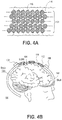
- the rigid subunits of the set of interdigitating subunits 134 can thereby lock into place and thus produce a rigid state in the cover 110 as illustrated in FIG. 4A , after sufficient tension through the set of guidewires 118 has been applied.
- the individual subunits of the set of interdigitating subunits 134 can be sized to be approximately one-eighth the size of each quadrant of the cover 110, or can in embodiments be of other sizes or dimensions. It may be noted, again, that after a rigid state of the cover 110 has been achieved, both the articulated spanning member 106 and the cover 110 are now in a mechanically or structurally fixed or rigid state, providing a dome or helmet-like structure for protection of the dura 104 and brain 130. This protective rigid construct is thus achieved without a necessity for a second surgical procedure, but instead, relying upon the ability of the cranial implant assembly 128 to transition from an expansile or elastic state to a rigid state, without further intervention after the initial implantation of the construct.
- the articulated spanning member 106 can register into a locked and permanent position with the peripheral attachment member 108, as for instance shown in FIG. 5A .
- the terminal subunit 122 of the set of subunits 124 can slide into place on a planar face or circumferential edge of the peripheral attachment member 108.
- the terminal subunit 122 and the circumferential terminal subunit 120 can be formed with angled or chamfered edges that slide into mating position with each other. In that position, the magnet 112 and the magnet 114 are located in relatively close proximity to each other, allowing magnetic attachment or locking to take place. It will be appreciated that other registration and locking mechanisms between the articulated spanning member 106 and peripheral attachment member 108 be used, in addition to or instead of a magnetic mechanism as illustrated.
- the area required to be covered by the crania! implant assembly 128 can be computed according to the diagram shown in FIG. 5B .
- the overall size, shape, and curvature of the patient's skull 102 can be determined by magnetic resonance imaging (MRI) or other imaging techniques.
- the intervening surface area, or gap, between the peripheral attachment member 108 and cover 110 can vary according to the degree of edema, distension, or swelling of the dura 104 from its normal position within the skull 102.
- the desired endpoint is always to replicate the normal curvature of the skull 102.
- areas of interest can be calculated per the following.
- a 3 A 1 ⁇ A 2
- a 1 ⁇ r 2 1 / 2
- a 2 ⁇ r 2 2 / 2
- r 3 r 1 ⁇ r 2 .
- a 1 represents the area of the dura 104 with swelling
- a 2 represents the area of the dura 104 in normal curvature
- a 3 represents the area of the gap.
- r 1 represents the radius of the area of the dura 104 with swelling
- r 2 represents the radius of the area of the dura 104 without swelling.
- the cranial implant assembly 128 can be fabricated by automated and/or mechanically assisted techniques, including stereolithography. It may be noted that in embodiments, one or more components of the cranial implant assembly 128, or the entire cranial implant assembly 128, can be fabricated from titanium, stainless steel, bioceramic, and/or other materials. As shown in FIG. 5B , the cuts of the set of subunits 124 can be determined by a line drawn from a middle portion of the underlying brain ventricles or canals which bisects the subunits as they cross the curvature of the overlying dura 104.
- cranial implant assembly 128, or the entire cranial implant assembly 128, can be coated with an antibiotic to assist in reducing the risk of infection in the surgical site 100.
- one or more components of the cranial implant assembly 128, or the entire cranial implant assembly 128, can be coated or covered with osteoconductive periosteum, and/or other growth-promoting material, to promote the growth of replacement skull material in the skull opening 126 over the cranial implant assembly 128.
- the cranial implant assembly 128 is configured to include an articulated spanning member 106 consisting of two (generally perpendicular) rectangular elongated crossarms
- the articulated spanning member 106 can, in embodiments, be constructed in other configuration.
- the articulated spanning member 106 can be constructed as a pair of elements formed in a tapered or pyramid-like shape, with the base of the elements formed nearest to the edge of the skull opening 126.
- an expansile state can likewise be achieved using guidewires or other connective mechanisms.
- the constructs of the present teachings can be adapted to other surgical applications.
- TBI traumatic brain injury
- decompressive craniectomy in its objective to relieve intracranial pressure, has been used in other conditions where efforts to control brain swelling medically have failed.
- the initial emergency decompressive craniectomy has predisposed the provider to plan for an eventual late-staged cranioplasty, due to the absence of a construct that can be applied during the time of the emergency craniectomy, such as constructs according to the present teachings.
- Cerebral infarction is a type of "stroke” (used herein as a genera! or umbrella term) whereby the blood supply to a major part of the brain becomes occluded and results in brain swelling.
- stroke used herein as a genera! or umbrella term
- the term "malignant” as it is alluded to in the medical sense has been applied here to mean cerebral infarction which is refractory to medical treatment, and for which a surgical option (decompressive craniectomy) is recommended to avoid a fatal outcome.
- Additional applications for constructs according to the present teachings include epilepsy surgery.
- seizure surgery is usually ablative, meaning a part of the diseased brain which is proven to be epileptogenic (causing seizures) is excised.
- the brain normally reacts to injury (ablative surgery) by swelling, which is relieved by deconstructive cranietomy. Second-stage cranioplasty is then required.
- Still further applications for constructs according to the present teachings include the treatment of craniosynostosis- a general term for congenital anomalies causing misshapen skulls, referring to premature fusion of the skull sutures.
- the cranium has suture lines separating the bony plates of the skull which later fuse as the child undergoes skull molding during growth. Suture lines may prematurely fuse or even fuse asymmetrically, causing a misshapen skull.
- the final skull shape will depend on which suture line(s) prematurely fuse. Those various conditions or deformities are given descriptive names ending with -"cephaly," e.g.
- FIG. 7 illustrates conventional treatment of an enlarged cranial vault in a child with hydrocephalus, in which a craniectomy is performed to produce multiple separated skull sections.
- a shunt valve may also be introduced to assist in reducing intracranial pressure.
- FIG. 8 illustrates a cranial implant assembly 228 that may be directed to the treatment of children having hydrocephalus, according to further various embodiments of the present teachings.
- the pediatric patient can have an enlarged cranial vault due to the effects of hydrocephalus.
- the cranial implant assembly 228 can comprise an articulated spanning member 206 whose multiple guide arms are snugly applied in strap-around fashion to the patient skull, to produce surgical skull shape correction.
- a set of central implants 232 can be attached or connected to the underlying dura (not shown), which set of central implants 232 serve to hold a cover 210 in place over the various skull openings or fissures produced by the multi-part or multi-section craniectomy.
- the cover 210 can comprise a multi-part expansile, flexible, and/or semi-rigid cover or layer each section of which has a set of subunits 234, which can be a set of interdigitating subunits similar to those described in embodiments above.
- the set of subunits 234 can be connected via a set of guidewires (not shown) in articulated fashion, likewise as above.
- the cranial implant assembly 228 can be configured to transition to an eventual rigid state through the tensioning and locking of the cover 110 and articulated spanning member 206 to a magnetic peripheral member (not shown) or other attachment site, in a manner generally similar to or using mechanisms like those described above.
- a shunt valve 214 may also be inserted to assist in regulating intracranial pressure.
- FIG. 8 Various embodiments of the present teachings including those shown in FIG. 8 will expedite the usually long period of operation needed in repairing the skull anomalies in pediatric patients, a vulnerable group.
- Some of the types of craniosynostosis that can be treated using these inventive constructs are part of a syndrome known by different names (Crouzon's syndrome, etc.).
- embodiments of the constructs of the present teachings can be used to treat other skull shape anomalies which are not congenital, but which may still require deconstructive cranietomy for repair.
- Those anomalies include positional ones, such as plagiocephaly (flat-headed condition) that is usually caused by poor child care when the child is left on the supine position for a long time, and the back head is positioned against a flat firm surface
- Those anomalies likewise include hydrocephalic megacephaly, or the condition of a large skull for infant/child's size caused by an underlying hydrocephalus (cerebrospinal fluid, or CSF disorder) where the amount of CSF produced is not absorbed by the body but accumulates in the brain.
- surgical constructs according to embodiments of the present teachings, and/or adaptations of those constructs, can be used in even further applications, including to treat other cranial conditions besides those directly noted herein, and/or to treat and heal conditions of other bone structures, tissues, organs, and/or areas of the body.
Landscapes
- Health & Medical Sciences (AREA)
- Neurosurgery (AREA)
- Orthopedic Medicine & Surgery (AREA)
- Cardiology (AREA)
- Oral & Maxillofacial Surgery (AREA)
- Transplantation (AREA)
- Engineering & Computer Science (AREA)
- Biomedical Technology (AREA)
- Heart & Thoracic Surgery (AREA)
- Vascular Medicine (AREA)
- Life Sciences & Earth Sciences (AREA)
- Animal Behavior & Ethology (AREA)
- General Health & Medical Sciences (AREA)
- Public Health (AREA)
- Veterinary Medicine (AREA)
- Prostheses (AREA)
- Surgical Instruments (AREA)
- External Artificial Organs (AREA)
- Magnetic Resonance Imaging Apparatus (AREA)
Claims (15)
- Ensemble implant crânien (128), comprenant :un élément d'enjambement articulé (106, 206), l'élément d'enjambement articulé comprenant un implant central (132, 232) et étant configuré pour
pouvoir être fixé dans un état semi-rigide, par le biais de l'implant central, à une zone durale gonflée (104) exposée dans une ouverture du crâne (126),pouvoir être fixé à une zone périphérique de l'ouverture de crâne, etrester dans un état non rigide avant d'être fixé à la zone périphérique de l'ouverture de crâne ;un cache (110, 210), configuré pour
être disposé sous l'élément d'enjambement articulé, etfournir une couverture non rigide sur l'ouverture de crâne pendant que l'élément d'enjambement articulé est dans un état non rigide, etun élément de fixation périphérique (108) configuré pour être fixé à la zone périphérique de l'ouverture de crâne ;dans lequel l'élément d'enjambement articulé est configuré, une fois que le gonflement de la dure-mère s'atténue, pourse mettre en place avec l'élément de fixation périphérique et
passer à un état rigide ; etdans lequel le cache est configuré pour passer à un état rigide quand l'élément d'enjambement articulé se met en place avec l'élément de fixation périphérique. - Ensemble implant crânien selon la revendication 1, dans lequel l'élément d'enjambement articulé comprend au moins deux traverses, chaque traverse ayant une première extrémité et une seconde extrémité, dans lequel la première extrémité et
la seconde extrémité sont configurées pour pouvoir être fixées à l'élément de fixation périphérique. - Ensemble implant crânien selon la revendication 2, dans lequel lesdits au moins deux traverses sont disposées au moins approximativement perpendiculairement
l'une à l'autre. - Ensemble implant crânien selon la revendication 2, dans lequel chacune des
traverses comprend un ensemble d'éléments en forme de coin articulés (124). - Ensemble implant crânien selon la revendication 4, dans lequel les éléments en
forme de coin sont articulés par le biais d'un fil guide (116). - Ensemble implant crânien selon l'une quelconque des revendications 2-5, dans lequel
la première et la seconde extrémité de chacune des traverses comprennent une pointe magnétique (112) et
l'élément de fixation périphérique comprend un ensemble d'aimants (114) configurés pour s'adapter aux pointes magnétiques respectives des traverses. - Ensemble implant crânien selon la revendication 6, dans lequel l'élément
d'enjambement articulé passe d'un état non rigide à un état rigide, du fait des pointes magnétiques des traverses qui se bloquent en place avec l'ensemble d'aimants sur l'élément de montage périphérique, et
de la tension appliquée au fil guide, du fait des pointes magnétiques des traverses qui se bloquent en place. - Ensemble implant crânien selon la revendication 7, dans lequel le cache comprend un ensemble de sous-unités de cache (134, 234), dans lequel les sous-unités de cache sont configurées pour s'interdigiter les unes avec les autres du fait de la pression exercée par l'élément d'enjambement articulé passant à l'état rigide.
- Ensemble implant crânien selon la revendication 8, dans lequel l'ensemble de sous-unités de cache comprend au moins quatre cadrans de sous-unités de cache alignés sous les traverses.
- Ensemble implant crânien selon la revendication 8 ou 9, dans lequel l'ensemble
de sous-unités de cache est connecté par le biais d'un ensemble de fils guides (118). - Ensemble implant crânien selon l'une quelconque des revendications 1-10, dans lequel l'élément d'enjambement articulé est réalisé en au moins un élément parmi le
titane, l'acier inoxydable ou un matériau en biocéramique. - Ensemble implant crânien selon l'une quelconque des revendications 1-11, dans lequel le cache comprend un revêtement antibiotique
- Ensemble implant crânien selon l'une quelconque des revendications 1-12, dans lequel le cache comprend un revêtement du périoste.
- Ensemble implant crânien selon les revendications 1-13, destiné à être introduit dans la zone d'une ouverture de crâne chez un sujet, dans le cadre d'une procédure de cranioplastie concomitante qui peut avoir lieu simultanément à une craniectomie utilisée pour produire l'ouverture du crâne.
- Ensemble implant crânien selon la revendication 14, dans lequel ledit ensemble implant crânien est conçu pour être introduit dans le cadre de l'utilisation, dans le traitement(1) d'une lésion cérébrale traumatique chez le sujet,(2) d'un défaut crânien congénital chez le sujet,(3) d'un défaut crânien non congénital chez le sujet,(4) d'un AVC subi par le sujet,(5) d'une tumeur chez le sujet, ou(6) d'une condition épileptique expérimentée par le sujet.
Applications Claiming Priority (2)
| Application Number | Priority Date | Filing Date | Title |
|---|---|---|---|
| US36940310P | 2010-07-30 | 2010-07-30 | |
| PCT/US2011/045992 WO2012016200A1 (fr) | 2010-07-30 | 2011-07-29 | Systèmes et procédés pour ensemble implant crânien conçu pour être introduit pendant une craniectomie |
Publications (3)
| Publication Number | Publication Date |
|---|---|
| EP2598029A1 EP2598029A1 (fr) | 2013-06-05 |
| EP2598029A4 EP2598029A4 (fr) | 2014-07-30 |
| EP2598029B1 true EP2598029B1 (fr) | 2016-04-06 |
Family
ID=45530516
Family Applications (1)
| Application Number | Title | Priority Date | Filing Date |
|---|---|---|---|
| EP11813283.6A Not-in-force EP2598029B1 (fr) | 2010-07-30 | 2011-07-29 | Ensemble implant crânien conçu pour être introduit pendant une craniectomie |
Country Status (5)
| Country | Link |
|---|---|
| US (1) | US8858639B2 (fr) |
| EP (1) | EP2598029B1 (fr) |
| AU (1) | AU2011283666B2 (fr) |
| CA (1) | CA2804530C (fr) |
| WO (1) | WO2012016200A1 (fr) |
Families Citing this family (19)
| Publication number | Priority date | Publication date | Assignee | Title |
|---|---|---|---|---|
| AU2011224893B2 (en) | 2010-03-10 | 2015-01-22 | Ossdsign Ab | Implants and methods for correcting tissue defects |
| US9463046B2 (en) | 2011-08-22 | 2016-10-11 | Ossdsign Ab | Implants and methods for using such implants to fill holes in bone tissue |
| US9968455B2 (en) | 2012-04-27 | 2018-05-15 | Howmedica Osteonics Corp. | Multiple component bone void filling implant |
| US20150265448A1 (en) * | 2012-11-09 | 2015-09-24 | Ernst-Johannes HABERL | System for reshaping skull |
| US10076416B2 (en) | 2013-02-12 | 2018-09-18 | Ossdsign Ab | Mosaic implants, kits and methods for correcting bone defects |
| US9220597B2 (en) | 2013-02-12 | 2015-12-29 | Ossdsign Ab | Mosaic implants, kits and methods for correcting bone defects |
| US9241528B2 (en) * | 2014-03-03 | 2016-01-26 | Loren George Partlo | Sport safety headgear with bracing system and warning system |
| CN103976781B (zh) * | 2014-04-09 | 2016-01-20 | 南方医科大学南方医院 | 一种复合颅底修补固定器 |
| EP3179961B1 (fr) * | 2014-08-14 | 2020-12-02 | OssDsign AB | Implants osseux et procédés de correction de défauts osseux |
| EP3380046B1 (fr) | 2015-11-24 | 2021-07-14 | OssDsign AB | Implants osseux et procédés de correction de défauts osseux |
| AU2017268377A1 (en) * | 2016-05-18 | 2018-12-13 | Karl Leibinger Medizintechnik GmbH & Co. KG. | Cranioplasty plate assembly with pivotal struts |
| CN106236326B (zh) * | 2016-08-26 | 2018-08-10 | 天津市赛宁生物工程技术有限公司 | 大阶段骨修复系统 |
| US10912648B2 (en) * | 2016-08-30 | 2021-02-09 | Longeviti Neuro Solutions Llc | Method for manufacturing a low-profile intercranial device and the low-profile intercranial device manufactured thereby |
| WO2019191749A1 (fr) * | 2018-03-31 | 2019-10-03 | The Research Foundation For The State University Of New York | Implant de régulation de pression et ses procédés d'utilisation |
| BR112021007281A2 (pt) | 2018-10-16 | 2021-07-20 | Ossdsign Ab | implantes para preencher orifícios perfurados no osso e métodos para preencher orifícios perfurados no osso |
| KR102294490B1 (ko) * | 2019-11-27 | 2021-08-27 | 재단법인 오송첨단의료산업진흥재단 | 환자 맞춤형 두개안면 윤곽 보존 지지체 |
| US12594165B2 (en) * | 2020-05-27 | 2026-04-07 | DePuy Synthes Products, Inc. | Expandable medical implant for adolescent cranium defects |
| CN112603386B (zh) * | 2021-01-27 | 2022-05-06 | 河南省人民医院 | 一种脑肿瘤术腔间质液采样监测诊疗器 |
| IL294216A (en) * | 2022-06-22 | 2024-01-01 | Mor Research Applic Ltd | Devices, systems and methods for protecting the brain in craniectomy patients |
Family Cites Families (12)
| Publication number | Priority date | Publication date | Assignee | Title |
|---|---|---|---|---|
| CH579899A5 (fr) | 1974-03-07 | 1976-09-30 | Etat De Vaud Departement De L | |
| US4062354A (en) | 1975-07-01 | 1977-12-13 | Taylor H Lyndon | Intracranial pressure transducer system |
| US4026276A (en) | 1976-04-05 | 1977-05-31 | The Johns Hopkins University | Intracranial pressure monitor |
| US4281667A (en) | 1976-06-21 | 1981-08-04 | Cosman Eric R | Single diaphragm telemetric differential pressure sensing system |
| EP2246012A2 (fr) * | 2002-03-30 | 2010-11-03 | Infinity Orthopaedics Company, Ltd. | Dispositif intervertébral |
| BRPI0409487A (pt) * | 2003-04-16 | 2006-05-02 | Porex Surgical Inc | implante cirúrgico, processo para sua preparação e método de reconstrução de um defeito ósseo |
| US20050208095A1 (en) * | 2003-11-20 | 2005-09-22 | Angiotech International Ag | Polymer compositions and methods for their use |
| WO2007146541A2 (fr) | 2006-06-09 | 2007-12-21 | Gyrus Productions | Méthode pour réaliser une craniectomie décompressive |
| US20080200954A1 (en) * | 2007-02-20 | 2008-08-21 | Tucci Keith A | Skull closure device and method |
| WO2009085829A2 (fr) | 2007-12-19 | 2009-07-09 | Sevrain Lionel C | Clamp crânien assisté par ressort |
| US8206425B2 (en) | 2009-07-31 | 2012-06-26 | Neurovention, LLC | Cranial fixation device |
| JP5940086B2 (ja) | 2010-12-13 | 2016-06-29 | カンナ,ロヒト | 減圧開頭術を実施するための装置および方法 |
-
2011
- 2011-07-29 AU AU2011283666A patent/AU2011283666B2/en not_active Ceased
- 2011-07-29 CA CA2804530A patent/CA2804530C/fr not_active Expired - Fee Related
- 2011-07-29 WO PCT/US2011/045992 patent/WO2012016200A1/fr not_active Ceased
- 2011-07-29 US US13/812,274 patent/US8858639B2/en active Active
- 2011-07-29 EP EP11813283.6A patent/EP2598029B1/fr not_active Not-in-force
Also Published As
| Publication number | Publication date |
|---|---|
| EP2598029A1 (fr) | 2013-06-05 |
| EP2598029A4 (fr) | 2014-07-30 |
| US8858639B2 (en) | 2014-10-14 |
| WO2012016200A1 (fr) | 2012-02-02 |
| US20130158670A1 (en) | 2013-06-20 |
| CA2804530C (fr) | 2017-07-25 |
| CA2804530A1 (fr) | 2012-02-02 |
| AU2011283666B2 (en) | 2014-12-11 |
| AU2011283666A1 (en) | 2013-01-24 |
Similar Documents
| Publication | Publication Date | Title |
|---|---|---|
| EP2598029B1 (fr) | Ensemble implant crânien conçu pour être introduit pendant une craniectomie | |
| ES2209822T3 (es) | Sistema ortopedico comprendiendo anclajes oseos liberables. | |
| KR101699694B1 (ko) | 소아 장골 지지 또는 고정판 | |
| US8439956B2 (en) | Method of performing a decompressive craniectomy | |
| US8057521B2 (en) | Surgical stabilization system | |
| WO2014110471A1 (fr) | Dispositif et procédé de fixation de sternum | |
| Perret et al. | Subgaleal shunt for temporary ventricle decompression and subdural drainage | |
| CZ2003936A3 (cs) | Ortopedický systém | |
| AU2002212884B2 (en) | System and method for physiological drainage | |
| WO2012093114A2 (fr) | Système écarteur | |
| Newton et al. | Lhermitte's sign as a presenting symptom of primary spinal cord tumor | |
| WO2009085829A2 (fr) | Clamp crânien assisté par ressort | |
| CH704793B1 (de) | Nasenwandimplantat und Operationsset zur Korrektur einer Knorpelschwäche der menschlichen Nase. | |
| US12232972B2 (en) | Interspinous stabilization device | |
| Mangiola et al. | Cerebrospinal fluid rhinorrhea: pathophysiological aspects and treatment | |
| Schweighofer et al. | Interbody fusion of the lower cervical spine: a dangerous surgical method? | |
| WALID et al. | Cranial bone flap fixation: comparison of titanium-based device (skull fix) and PEEK-based device (Cranial Loop): technical report | |
| CN206424179U (zh) | 神经外科颅骨缺损修补用钛网结构 | |
| EP3332721A1 (fr) | Dispositif de fixation osseuse à utiliser dans la croissance guidée et comme bande de tension | |
| KR100630966B1 (ko) | 추간체고정보형재 | |
| Jacka et al. | Bradycardia related to sudden decreases in intracranial pressure during craniotomy | |
| Strojnik | Different approaches to surgical treatment of arachnoid cysts | |
| DE102018132984A1 (de) | Interdentalschraube (Interdental screw) | |
| KR100501248B1 (ko) | 추간체 고정 보형재 | |
| Hernández-Durán et al. | Posterior Inferior Cerebellar Artery Aneurysm: Microsurgical Clipping of a Ruptured Posterior Inferior Cerebellar Artery (PICA) Aneurysm Not Well Suited to Endovascular Treatment, Far-Lateral Transcondylar Approach to the Anterior Medullary Segment of the PICA, Complete Exclusion of the Aneurysm with Preservation of the Parent Artery |
Legal Events
| Date | Code | Title | Description |
|---|---|---|---|
| PUAI | Public reference made under article 153(3) epc to a published international application that has entered the european phase |
Free format text: ORIGINAL CODE: 0009012 |
|
| 17P | Request for examination filed |
Effective date: 20130201 |
|
| AK | Designated contracting states |
Kind code of ref document: A1 Designated state(s): AL AT BE BG CH CY CZ DE DK EE ES FI FR GB GR HR HU IE IS IT LI LT LU LV MC MK MT NL NO PL PT RO RS SE SI SK SM TR |
|
| DAX | Request for extension of the european patent (deleted) | ||
| A4 | Supplementary search report drawn up and despatched |
Effective date: 20140702 |
|
| RIC1 | Information provided on ipc code assigned before grant |
Ipc: A61B 5/11 20060101AFI20140626BHEP |
|
| GRAP | Despatch of communication of intention to grant a patent |
Free format text: ORIGINAL CODE: EPIDOSNIGR1 |
|
| INTG | Intention to grant announced |
Effective date: 20151001 |
|
| GRAS | Grant fee paid |
Free format text: ORIGINAL CODE: EPIDOSNIGR3 |
|
| GRAA | (expected) grant |
Free format text: ORIGINAL CODE: 0009210 |
|
| AK | Designated contracting states |
Kind code of ref document: B1 Designated state(s): AL AT BE BG CH CY CZ DE DK EE ES FI FR GB GR HR HU IE IS IT LI LT LU LV MC MK MT NL NO PL PT RO RS SE SI SK SM TR |
|
| REG | Reference to a national code |
Ref country code: GB Ref legal event code: FG4D |
|
| REG | Reference to a national code |
Ref country code: AT Ref legal event code: REF Ref document number: 786815 Country of ref document: AT Kind code of ref document: T Effective date: 20160415 Ref country code: CH Ref legal event code: EP |
|
| REG | Reference to a national code |
Ref country code: IE Ref legal event code: FG4D |
|
| REG | Reference to a national code |
Ref country code: DE Ref legal event code: R096 Ref document number: 602011025075 Country of ref document: DE |
|
| REG | Reference to a national code |
Ref country code: FR Ref legal event code: PLFP Year of fee payment: 6 |
|
| REG | Reference to a national code |
Ref country code: LT Ref legal event code: MG4D Ref country code: NL Ref legal event code: MP Effective date: 20160406 |
|
| REG | Reference to a national code |
Ref country code: AT Ref legal event code: MK05 Ref document number: 786815 Country of ref document: AT Kind code of ref document: T Effective date: 20160406 |
|
| PG25 | Lapsed in a contracting state [announced via postgrant information from national office to epo] |
Ref country code: NL Free format text: LAPSE BECAUSE OF FAILURE TO SUBMIT A TRANSLATION OF THE DESCRIPTION OR TO PAY THE FEE WITHIN THE PRESCRIBED TIME-LIMIT Effective date: 20160406 |
|
| PG25 | Lapsed in a contracting state [announced via postgrant information from national office to epo] |
Ref country code: IS Free format text: LAPSE BECAUSE OF FAILURE TO SUBMIT A TRANSLATION OF THE DESCRIPTION OR TO PAY THE FEE WITHIN THE PRESCRIBED TIME-LIMIT Effective date: 20160806 Ref country code: NO Free format text: LAPSE BECAUSE OF FAILURE TO SUBMIT A TRANSLATION OF THE DESCRIPTION OR TO PAY THE FEE WITHIN THE PRESCRIBED TIME-LIMIT Effective date: 20160706 Ref country code: LT Free format text: LAPSE BECAUSE OF FAILURE TO SUBMIT A TRANSLATION OF THE DESCRIPTION OR TO PAY THE FEE WITHIN THE PRESCRIBED TIME-LIMIT Effective date: 20160406 Ref country code: FI Free format text: LAPSE BECAUSE OF FAILURE TO SUBMIT A TRANSLATION OF THE DESCRIPTION OR TO PAY THE FEE WITHIN THE PRESCRIBED TIME-LIMIT Effective date: 20160406 Ref country code: PL Free format text: LAPSE BECAUSE OF FAILURE TO SUBMIT A TRANSLATION OF THE DESCRIPTION OR TO PAY THE FEE WITHIN THE PRESCRIBED TIME-LIMIT Effective date: 20160406 |
|
| PG25 | Lapsed in a contracting state [announced via postgrant information from national office to epo] |
Ref country code: ES Free format text: LAPSE BECAUSE OF FAILURE TO SUBMIT A TRANSLATION OF THE DESCRIPTION OR TO PAY THE FEE WITHIN THE PRESCRIBED TIME-LIMIT Effective date: 20160406 Ref country code: RS Free format text: LAPSE BECAUSE OF FAILURE TO SUBMIT A TRANSLATION OF THE DESCRIPTION OR TO PAY THE FEE WITHIN THE PRESCRIBED TIME-LIMIT Effective date: 20160406 Ref country code: AT Free format text: LAPSE BECAUSE OF FAILURE TO SUBMIT A TRANSLATION OF THE DESCRIPTION OR TO PAY THE FEE WITHIN THE PRESCRIBED TIME-LIMIT Effective date: 20160406 Ref country code: LV Free format text: LAPSE BECAUSE OF FAILURE TO SUBMIT A TRANSLATION OF THE DESCRIPTION OR TO PAY THE FEE WITHIN THE PRESCRIBED TIME-LIMIT Effective date: 20160406 Ref country code: SE Free format text: LAPSE BECAUSE OF FAILURE TO SUBMIT A TRANSLATION OF THE DESCRIPTION OR TO PAY THE FEE WITHIN THE PRESCRIBED TIME-LIMIT Effective date: 20160406 Ref country code: GR Free format text: LAPSE BECAUSE OF FAILURE TO SUBMIT A TRANSLATION OF THE DESCRIPTION OR TO PAY THE FEE WITHIN THE PRESCRIBED TIME-LIMIT Effective date: 20160707 Ref country code: PT Free format text: LAPSE BECAUSE OF FAILURE TO SUBMIT A TRANSLATION OF THE DESCRIPTION OR TO PAY THE FEE WITHIN THE PRESCRIBED TIME-LIMIT Effective date: 20160808 Ref country code: HR Free format text: LAPSE BECAUSE OF FAILURE TO SUBMIT A TRANSLATION OF THE DESCRIPTION OR TO PAY THE FEE WITHIN THE PRESCRIBED TIME-LIMIT Effective date: 20160406 |
|
| PG25 | Lapsed in a contracting state [announced via postgrant information from national office to epo] |
Ref country code: IT Free format text: LAPSE BECAUSE OF FAILURE TO SUBMIT A TRANSLATION OF THE DESCRIPTION OR TO PAY THE FEE WITHIN THE PRESCRIBED TIME-LIMIT Effective date: 20160406 Ref country code: BE Free format text: LAPSE BECAUSE OF FAILURE TO SUBMIT A TRANSLATION OF THE DESCRIPTION OR TO PAY THE FEE WITHIN THE PRESCRIBED TIME-LIMIT Effective date: 20160406 |
|
| REG | Reference to a national code |
Ref country code: DE Ref legal event code: R097 Ref document number: 602011025075 Country of ref document: DE |
|
| PG25 | Lapsed in a contracting state [announced via postgrant information from national office to epo] |
Ref country code: RO Free format text: LAPSE BECAUSE OF FAILURE TO SUBMIT A TRANSLATION OF THE DESCRIPTION OR TO PAY THE FEE WITHIN THE PRESCRIBED TIME-LIMIT Effective date: 20160406 Ref country code: SK Free format text: LAPSE BECAUSE OF FAILURE TO SUBMIT A TRANSLATION OF THE DESCRIPTION OR TO PAY THE FEE WITHIN THE PRESCRIBED TIME-LIMIT Effective date: 20160406 Ref country code: CZ Free format text: LAPSE BECAUSE OF FAILURE TO SUBMIT A TRANSLATION OF THE DESCRIPTION OR TO PAY THE FEE WITHIN THE PRESCRIBED TIME-LIMIT Effective date: 20160406 Ref country code: EE Free format text: LAPSE BECAUSE OF FAILURE TO SUBMIT A TRANSLATION OF THE DESCRIPTION OR TO PAY THE FEE WITHIN THE PRESCRIBED TIME-LIMIT Effective date: 20160406 Ref country code: DK Free format text: LAPSE BECAUSE OF FAILURE TO SUBMIT A TRANSLATION OF THE DESCRIPTION OR TO PAY THE FEE WITHIN THE PRESCRIBED TIME-LIMIT Effective date: 20160406 |
|
| PLBE | No opposition filed within time limit |
Free format text: ORIGINAL CODE: 0009261 |
|
| STAA | Information on the status of an ep patent application or granted ep patent |
Free format text: STATUS: NO OPPOSITION FILED WITHIN TIME LIMIT |
|
| PG25 | Lapsed in a contracting state [announced via postgrant information from national office to epo] |
Ref country code: SM Free format text: LAPSE BECAUSE OF FAILURE TO SUBMIT A TRANSLATION OF THE DESCRIPTION OR TO PAY THE FEE WITHIN THE PRESCRIBED TIME-LIMIT Effective date: 20160406 |
|
| REG | Reference to a national code |
Ref country code: CH Ref legal event code: PL |
|
| 26N | No opposition filed |
Effective date: 20170110 |
|
| PG25 | Lapsed in a contracting state [announced via postgrant information from national office to epo] |
Ref country code: MC Free format text: LAPSE BECAUSE OF FAILURE TO SUBMIT A TRANSLATION OF THE DESCRIPTION OR TO PAY THE FEE WITHIN THE PRESCRIBED TIME-LIMIT Effective date: 20160406 |
|
| PG25 | Lapsed in a contracting state [announced via postgrant information from national office to epo] |
Ref country code: CH Free format text: LAPSE BECAUSE OF NON-PAYMENT OF DUE FEES Effective date: 20160731 Ref country code: LI Free format text: LAPSE BECAUSE OF NON-PAYMENT OF DUE FEES Effective date: 20160731 |
|
| REG | Reference to a national code |
Ref country code: IE Ref legal event code: MM4A |
|
| PG25 | Lapsed in a contracting state [announced via postgrant information from national office to epo] |
Ref country code: SI Free format text: LAPSE BECAUSE OF FAILURE TO SUBMIT A TRANSLATION OF THE DESCRIPTION OR TO PAY THE FEE WITHIN THE PRESCRIBED TIME-LIMIT Effective date: 20160406 |
|
| REG | Reference to a national code |
Ref country code: FR Ref legal event code: PLFP Year of fee payment: 7 |
|
| PG25 | Lapsed in a contracting state [announced via postgrant information from national office to epo] |
Ref country code: IE Free format text: LAPSE BECAUSE OF NON-PAYMENT OF DUE FEES Effective date: 20160729 |
|
| PG25 | Lapsed in a contracting state [announced via postgrant information from national office to epo] |
Ref country code: LU Free format text: LAPSE BECAUSE OF NON-PAYMENT OF DUE FEES Effective date: 20160729 |
|
| PG25 | Lapsed in a contracting state [announced via postgrant information from national office to epo] |
Ref country code: HU Free format text: LAPSE BECAUSE OF FAILURE TO SUBMIT A TRANSLATION OF THE DESCRIPTION OR TO PAY THE FEE WITHIN THE PRESCRIBED TIME-LIMIT; INVALID AB INITIO Effective date: 20110729 Ref country code: CY Free format text: LAPSE BECAUSE OF FAILURE TO SUBMIT A TRANSLATION OF THE DESCRIPTION OR TO PAY THE FEE WITHIN THE PRESCRIBED TIME-LIMIT Effective date: 20160406 |
|
| PG25 | Lapsed in a contracting state [announced via postgrant information from national office to epo] |
Ref country code: MK Free format text: LAPSE BECAUSE OF FAILURE TO SUBMIT A TRANSLATION OF THE DESCRIPTION OR TO PAY THE FEE WITHIN THE PRESCRIBED TIME-LIMIT Effective date: 20160406 Ref country code: TR Free format text: LAPSE BECAUSE OF FAILURE TO SUBMIT A TRANSLATION OF THE DESCRIPTION OR TO PAY THE FEE WITHIN THE PRESCRIBED TIME-LIMIT Effective date: 20160406 Ref country code: MT Free format text: LAPSE BECAUSE OF NON-PAYMENT OF DUE FEES Effective date: 20160731 |
|
| REG | Reference to a national code |
Ref country code: FR Ref legal event code: PLFP Year of fee payment: 8 |
|
| PG25 | Lapsed in a contracting state [announced via postgrant information from national office to epo] |
Ref country code: BG Free format text: LAPSE BECAUSE OF FAILURE TO SUBMIT A TRANSLATION OF THE DESCRIPTION OR TO PAY THE FEE WITHIN THE PRESCRIBED TIME-LIMIT Effective date: 20160406 |
|
| PG25 | Lapsed in a contracting state [announced via postgrant information from national office to epo] |
Ref country code: AL Free format text: LAPSE BECAUSE OF FAILURE TO SUBMIT A TRANSLATION OF THE DESCRIPTION OR TO PAY THE FEE WITHIN THE PRESCRIBED TIME-LIMIT Effective date: 20160406 |
|
| PGFP | Annual fee paid to national office [announced via postgrant information from national office to epo] |
Ref country code: FR Payment date: 20190725 Year of fee payment: 9 |
|
| REG | Reference to a national code |
Ref country code: DE Ref legal event code: R082 Ref document number: 602011025075 Country of ref document: DE Representative=s name: MUELLER FOTTNER STEINECKE RECHTSANWALTS- UND P, DE Ref country code: DE Ref legal event code: R082 Ref document number: 602011025075 Country of ref document: DE Representative=s name: WITTHOFF JAEKEL STEINECKE PATENTANWAELTE PARTG, DE |
|
| PGFP | Annual fee paid to national office [announced via postgrant information from national office to epo] |
Ref country code: GB Payment date: 20190729 Year of fee payment: 9 |
|
| REG | Reference to a national code |
Ref country code: DE Ref legal event code: R082 Ref document number: 602011025075 Country of ref document: DE Representative=s name: WITTHOFF JAEKEL STEINECKE PATENTANWAELTE PARTG, DE |
|
| GBPC | Gb: european patent ceased through non-payment of renewal fee |
Effective date: 20200729 |
|
| PG25 | Lapsed in a contracting state [announced via postgrant information from national office to epo] |
Ref country code: GB Free format text: LAPSE BECAUSE OF NON-PAYMENT OF DUE FEES Effective date: 20200729 Ref country code: FR Free format text: LAPSE BECAUSE OF NON-PAYMENT OF DUE FEES Effective date: 20200731 |
|
| PGFP | Annual fee paid to national office [announced via postgrant information from national office to epo] |
Ref country code: DE Payment date: 20220727 Year of fee payment: 12 |
|
| P01 | Opt-out of the competence of the unified patent court (upc) registered |
Effective date: 20230530 |
|
| REG | Reference to a national code |
Ref country code: DE Ref legal event code: R119 Ref document number: 602011025075 Country of ref document: DE |
|
| PG25 | Lapsed in a contracting state [announced via postgrant information from national office to epo] |
Ref country code: DE Free format text: LAPSE BECAUSE OF NON-PAYMENT OF DUE FEES Effective date: 20240201 |