EP2598227B1 - Élément filtrant et procédé de fabrication d'un élément filtrant - Google Patents
Élément filtrant et procédé de fabrication d'un élément filtrant Download PDFInfo
- Publication number
- EP2598227B1 EP2598227B1 EP11743488.6A EP11743488A EP2598227B1 EP 2598227 B1 EP2598227 B1 EP 2598227B1 EP 11743488 A EP11743488 A EP 11743488A EP 2598227 B1 EP2598227 B1 EP 2598227B1
- Authority
- EP
- European Patent Office
- Prior art keywords
- melt adhesive
- hot
- adhesive
- weight
- filter element
- Prior art date
- Legal status (The legal status is an assumption and is not a legal conclusion. Google has not performed a legal analysis and makes no representation as to the accuracy of the status listed.)
- Active
Links
Images

Classifications
-
- B—PERFORMING OPERATIONS; TRANSPORTING
- B01—PHYSICAL OR CHEMICAL PROCESSES OR APPARATUS IN GENERAL
- B01D—SEPARATION
- B01D46/00—Filters or filtering processes specially modified for separating dispersed particles from gases or vapours
- B01D46/42—Auxiliary equipment or operation thereof
- B01D46/4227—Manipulating filters or filter elements, e.g. handles or extracting tools
-
- B—PERFORMING OPERATIONS; TRANSPORTING
- B01—PHYSICAL OR CHEMICAL PROCESSES OR APPARATUS IN GENERAL
- B01D—SEPARATION
- B01D46/00—Filters or filtering processes specially modified for separating dispersed particles from gases or vapours
- B01D46/52—Particle separators, e.g. dust precipitators, using filters embodying folded corrugated or wound sheet material
- B01D46/521—Particle separators, e.g. dust precipitators, using filters embodying folded corrugated or wound sheet material using folded, pleated material
- B01D46/523—Particle separators, e.g. dust precipitators, using filters embodying folded corrugated or wound sheet material using folded, pleated material with means for maintaining spacing between the pleats or folds
-
- B—PERFORMING OPERATIONS; TRANSPORTING
- B01—PHYSICAL OR CHEMICAL PROCESSES OR APPARATUS IN GENERAL
- B01D—SEPARATION
- B01D29/00—Filters with filtering elements stationary during filtration, e.g. pressure or suction filters, not covered by groups B01D24/00 - B01D27/00; Filtering elements therefor
- B01D29/01—Filters with filtering elements stationary during filtration, e.g. pressure or suction filters, not covered by groups B01D24/00 - B01D27/00; Filtering elements therefor with flat filtering elements
- B01D29/016—Filters with filtering elements stationary during filtration, e.g. pressure or suction filters, not covered by groups B01D24/00 - B01D27/00; Filtering elements therefor with flat filtering elements with corrugated, folded or wound filtering elements
-
- B—PERFORMING OPERATIONS; TRANSPORTING
- B01—PHYSICAL OR CHEMICAL PROCESSES OR APPARATUS IN GENERAL
- B01D—SEPARATION
- B01D46/00—Filters or filtering processes specially modified for separating dispersed particles from gases or vapours
- B01D46/0001—Making filtering elements
-
- B—PERFORMING OPERATIONS; TRANSPORTING
- B01—PHYSICAL OR CHEMICAL PROCESSES OR APPARATUS IN GENERAL
- B01D—SEPARATION
- B01D46/00—Filters or filtering processes specially modified for separating dispersed particles from gases or vapours
- B01D46/52—Particle separators, e.g. dust precipitators, using filters embodying folded corrugated or wound sheet material
- B01D46/521—Particle separators, e.g. dust precipitators, using filters embodying folded corrugated or wound sheet material using folded, pleated material
-
- B—PERFORMING OPERATIONS; TRANSPORTING
- B01—PHYSICAL OR CHEMICAL PROCESSES OR APPARATUS IN GENERAL
- B01D—SEPARATION
- B01D46/00—Filters or filtering processes specially modified for separating dispersed particles from gases or vapours
- B01D46/52—Particle separators, e.g. dust precipitators, using filters embodying folded corrugated or wound sheet material
- B01D46/528—Particle separators, e.g. dust precipitators, using filters embodying folded corrugated or wound sheet material using wound sheets
-
- C—CHEMISTRY; METALLURGY
- C08—ORGANIC MACROMOLECULAR COMPOUNDS; THEIR PREPARATION OR CHEMICAL WORKING-UP; COMPOSITIONS BASED THEREON
- C08L—COMPOSITIONS OF MACROMOLECULAR COMPOUNDS
- C08L67/00—Compositions of polyesters obtained by reactions forming a carboxylic ester link in the main chain; Compositions of derivatives of such polymers
- C08L67/02—Polyesters derived from dicarboxylic acids and dihydroxy compounds
-
- C—CHEMISTRY; METALLURGY
- C09—DYES; PAINTS; POLISHES; NATURAL RESINS; ADHESIVES; COMPOSITIONS NOT OTHERWISE PROVIDED FOR; APPLICATIONS OF MATERIALS NOT OTHERWISE PROVIDED FOR
- C09J—ADHESIVES; NON-MECHANICAL ASPECTS OF ADHESIVE PROCESSES IN GENERAL; ADHESIVE PROCESSES NOT PROVIDED FOR ELSEWHERE; USE OF MATERIALS AS ADHESIVES
- C09J167/00—Adhesives based on polyesters obtained by reactions forming a carboxylic ester link in the main chain; Adhesives based on derivatives of such polymers
- C09J167/02—Polyesters derived from dicarboxylic acids and dihydroxy compounds
-
- C—CHEMISTRY; METALLURGY
- C09—DYES; PAINTS; POLISHES; NATURAL RESINS; ADHESIVES; COMPOSITIONS NOT OTHERWISE PROVIDED FOR; APPLICATIONS OF MATERIALS NOT OTHERWISE PROVIDED FOR
- C09J—ADHESIVES; NON-MECHANICAL ASPECTS OF ADHESIVE PROCESSES IN GENERAL; ADHESIVE PROCESSES NOT PROVIDED FOR ELSEWHERE; USE OF MATERIALS AS ADHESIVES
- C09J177/00—Adhesives based on polyamides obtained by reactions forming a carboxylic amide link in the main chain; Adhesives based on derivatives of such polymers
-
- B—PERFORMING OPERATIONS; TRANSPORTING
- B01—PHYSICAL OR CHEMICAL PROCESSES OR APPARATUS IN GENERAL
- B01D—SEPARATION
- B01D2201/00—Details relating to filtering apparatus
- B01D2201/40—Special measures for connecting different parts of the filter
-
- B—PERFORMING OPERATIONS; TRANSPORTING
- B01—PHYSICAL OR CHEMICAL PROCESSES OR APPARATUS IN GENERAL
- B01D—SEPARATION
- B01D2265/00—Casings, housings or mounting for filters specially adapted for separating dispersed particles from gases or vapours
- B01D2265/04—Permanent measures for connecting different parts of the filter, e.g. welding, glueing or moulding
-
- C—CHEMISTRY; METALLURGY
- C08—ORGANIC MACROMOLECULAR COMPOUNDS; THEIR PREPARATION OR CHEMICAL WORKING-UP; COMPOSITIONS BASED THEREON
- C08L—COMPOSITIONS OF MACROMOLECULAR COMPOUNDS
- C08L2666/00—Composition of polymers characterized by a further compound in the blend, being organic macromolecular compounds, natural resins, waxes or and bituminous materials, non-macromolecular organic substances, inorganic substances or characterized by their function in the composition
- C08L2666/02—Organic macromolecular compounds, natural resins, waxes or and bituminous materials
- C08L2666/14—Macromolecular compounds according to C08L59/00 - C08L87/00; Derivatives thereof
- C08L2666/20—Macromolecular compounds having nitrogen in the main chain according to C08L75/00 - C08L79/00; Derivatives thereof
-
- C—CHEMISTRY; METALLURGY
- C08—ORGANIC MACROMOLECULAR COMPOUNDS; THEIR PREPARATION OR CHEMICAL WORKING-UP; COMPOSITIONS BASED THEREON
- C08L—COMPOSITIONS OF MACROMOLECULAR COMPOUNDS
- C08L77/00—Compositions of polyamides obtained by reactions forming a carboxylic amide link in the main chain; Compositions of derivatives of such polymers
Definitions
- the invention relates to a filter element and a method for its production.
- the problem is that in the application of hot melt adhesives, especially in a spur-shaped application with elongated, multiple interrupted hot melt adhesive tracks or punctiform application, z. B. by means of application nozzles, job roles, etc., form between the application equipment and the ends of the hot melt adhesive hot melt adhesive threads that cool and harden and remain in the order range on the filter.
- This can be disadvantageous in particular in the case of adhesive bonding on the clean side of the filter elements, since pieces of cooled melt-adhesive threads detach in operation and can be entrained by the fluid flow.
- This can be a disadvantage, in particular in the filtration of intake air of internal combustion engines.
- hot melt adhesives are used regularly.
- Non-reactive hot melt adhesives are products which are solvent-free and more or less solid at room temperature and are applied to an adhesive surface when hot and produce the adhesive bond on cooling. This group of adhesives is also known as hotmelt and is based on various chemical raw materials.
- DIN EN 923 defines hot melt adhesive as a thermally fusible adhesive system that develops cohesion after cooling. Melting points are usually between 80 ° C and 250 ° C.
- the invention has for its object to provide a pasted by means of regularly or irregularly interrupted track form hot melt adhesive filter element with a smaller amount of hot melt adhesive threads and a process for its preparation.
- a filter element in particular for the filtration of gases and liquids, in particular for the filtration of intake air or fuel or oil of internal combustion engines or for filtration of machining fluids of metalworking machines, in particular erosion machines, comprising a zigzag folded, formed from a flat filter medium filter bellows
- the filter bellows can be designed as a rectangular, zigzag-shaped filter bellows or as a ring-shaped, star-shaped folded filter bellows.
- a mutually sealed channel forming filter medium may be used, the filter bellows being formed by winding and adhering together a semifinished product comprising two filter media layers, which comprises a plain sheet and a corrugated sheet disposed thereon.
- the filter element according to the invention by at least two, in particular regularly or irregularly interrupted traces of adhesive
- the filter element is bonded according to the invention by a hot melt adhesive system.
- the traces of adhesive in particular run perpendicular to the folded edges on the filter medium, but may also be arranged at an angle to the folded edges.
- adhesive traces of a hot-melt adhesive system are arranged in the filter element formed by the smooth and corrugated layer between the smooth and corrugated layers of the semifinished product and / or between the smooth and corrugated layers which come into contact during winding.
- the hot-melt adhesive system comprises a hot-melt adhesive mixture comprising hot melt adhesive composition comprising 15-85% by weight, in particular 30-70% by weight of a first hot-melt adhesive based on polyester, and 15-85% by weight, in particular 30-70% by weight of a second hot-melt adhesive Hot melt adhesive based on polyamide dissolved.
- the proportions by weight of the first and of the second hot melt adhesive together amount to 100% by weight of the hot melt adhesive mixture.
- the hot melt adhesive mixture has a content of 75-100% by weight (preferably almost or exactly 100% by weight) of the hot melt adhesive system, the balance of fillers such as chalk and / or pigments such as titanium dioxide as a white pigment and / or a tackifying resin and / or at least one further melt adhesive based on polycondensate is formed.
- fillers such as chalk and / or pigments such as titanium dioxide as a white pigment and / or a tackifying resin and / or at least one further melt adhesive based on polycondensate is formed.
- filter media for example, cellulose media, meltblown fiber media, nonwoven webs or combinations thereof may be used.
- the filter element comprises a zigzag-folded filter medium which separates a raw side from a clean side and has alternating pleat tips and pleats, wherein in the pleats interspaces, in particular elongated traces of adhesive are arranged, which extend alternately between pleat tips and pleat reasons, being on the raw side and preferred in particular also on the clean side of the filter medium in each case at least two adhesive tracks are arranged parallel to each other and perpendicular to the direction of the folding edges on the filter element, wherein the traces of adhesive on the raw side and / or the clean side are interrupted at regular intervals.
- the length in the application direction 5 times longer, preferably 10 times longer than the width.
- the hot melt adhesive tracks comprise, in particular, regularly spaced dot-shaped hot melt adhesive dots.
- the hot melt adhesive tracks comprise elongate, continuously applied sections, which in particular may be regularly interrupted by perforations.
- the start and end points of the interruptions of the adhesive tracks are aligned on a plurality of straight lines which are parallel to each other and form an angle of 10-80 °, preferably 45 +/- 15 °, with the folded edges.
- the adhesive tracks on the clean side and / or on the raw side have an interruption of the adhesive track, which surrounds the clean-side or raw-side fold tip.
- the traces of adhesive on the clean side and / or on the raw side have an interruption of the adhesive track, which surrounds the clean-side or untreated fold bottom.
- the interruptions of the opposing traces of adhesive on the raw side and the clean side do not overlap.
- the start and end points of the interruptions of the adhesive tracks run on at least two straight lines, each straight line comprising parallel straight lines, wherein the corresponding straight lines intersect on the filter medium, whereby an arrow-shaped or zigzag course of interruptions of the adhesive trace formed on the filter medium becomes.
- the start and end points of the interruptions of the adhesive tracks are defined by curves instead of straight lines, wherein the curves are in particular the same shape, but shifted in a direction perpendicular (+/- 30 °) to the folding edges.
- the family of curves includes circular or elliptical sections, sine shapes or other regular waveforms.
- the distance between two consecutive breaks ie the length of a continuous adhesive trace portion longer than at least one, preferably both subsequent to the continuous adhesive trace portion interruptions.
- the length of at least one interruption, in particular of interruptions lying between the fold tip and the fold base is 5-20 mm, preferably 20-40 mm, alternatively 40-60 mm.
- the length of continuous adhesive sections is at least 5-20 mm, preferably 20-40 mm, alternatively greater than 40 mm.
- the dimensions of the interruptions and the continuous adhesive portions are chosen so that a sufficient stability of the filter medium is achieved and advantageously at the same time a communication between the separated by the adhesive traces fold sections is made possible.
- the filter element comprises a zigzag folded filter bellows, which has two end faces arranged perpendicular to the folded edges, which are sealed by means of glued or welded end disks, a potting compound (in particular foamed polyurethane) or a continuous hot melt adhesive track, wherein the filter element in the area between the End faces by at least one, in particular at least two, in particular regularly or irregularly interrupted traces of adhesive is glued from a hot melt adhesive system.
- a potting compound in particular foamed polyurethane
- a continuous hot melt adhesive track wherein the filter element in the area between the End faces by at least one, in particular at least two, in particular regularly or irregularly interrupted traces of adhesive is glued from a hot melt adhesive system.
- the filter element is designed as an annular filter element with annular end disks, one of the end disks preferably being closed and the second end disk having an inner fluid flow opening around which an axial or radial seal for sealing against a housing fluid channel, in particular the outlet channel in a Flow from radially outside to inside, is arranged.
- the filter element has a rectangular shape with a raw-side upstream side and a downstream-side downstream side.
- the filter element is formed by a multiply folded filter medium, wherein the folds extend between the inflow side and the outflow side, ie there are respective fold tips on the inflow side and the outflow side.
- the non-perfused side surfaces of the filter element are in particular surrounded by a polyester fleece, which on its side facing the filter element is provided with a melt adhesive layer formed in particular with the hot-melt adhesive according to the invention. This hot-melt adhesive layer produces a surface bonding of the polyester fleece to the filter element, the end faces of the filter bellows also being sealed off.
- the filter element comprises a main frame and a subframe, the main frame carrying an axial seal which seals in the downstream direction and is inserted in a groove of the main frame or in a groove between the main frame and side surfaces.
- the subframe is advantageously connected in one embodiment with the side surfaces by an adhesive connection and has radial surfaces and / or axial surfaces for supporting the filter element in a filter housing.
- a plastic frame is applied by means of a hot melt adhesive compound formed in particular with the hot-melt adhesive according to the invention on the non-perfused side surfaces of the filter medium, wherein on the end faces by the hot melt adhesive and the sealing of the front side takes place.
- openings are made in the plastic frame on the end sides and / or the end faces.
- the plastic frame carries on the upstream side of an axial seal which can be brought into contact with a sealing surface of a filter housing for sealing between the raw side and the clean side.
- a handle is provided which communicates with the plastic frame and serves to better handle the filter element.
- the granules of the two hotmelt adhesives are mixed before heating and then heated and melted.
- the mixing, heating and melting of the hot melt adhesives takes place in an extruder.
- the molten hot melt adhesive system is foamed with a gas, in particular nitrogen, air, CO 2 or the like.
- the application of the adhesive takes place immediately after mixing, in particular to avoid segregation.
- a spur-shaped, regularly or irregularly interrupted application takes place on a flat, in particular fibrous, substrate.
- the application takes place by means of application nozzles, which are in particular connected to gear pumps.
- the application is carried out by means of a slot die which is in a steel pipe with many holes (size and number depending on the desired adhesive dot image) is applied through the steel pipe. With the size of the tube and the size of the holes, the dot size and the length of the hot melt adhesive application is determined in conjunction with the delivery rate of the adhesive.
- the invention further relates to the use of a hot melt adhesive system according to the invention for the thread-free bonding of flat substrates, in particular filter media, for example cellulose media, melt-blown filter media, nanofiber media or combinations thereof, in particular by means of regularly or irregularly interrupted hot melt adhesive tracks.
- filter media for example cellulose media, melt-blown filter media, nanofiber media or combinations thereof, in particular by means of regularly or irregularly interrupted hot melt adhesive tracks.
- the adhesive member is adhered to a hot melt adhesive system comprising a hot melt adhesive system comprising a hot melt adhesive composition comprising 15-85% by weight, especially 30-70% by weight of a first hot melt adhesive based on polyester and 15-85% by weight. %, in particular 30-70% by weight of a second hotmelt adhesive based on polyamide.
- the sum of the components should give 100% of the hot melt adhesive mixture and in particular 100% of the hot melt adhesive system.
- This hot melt adhesive system has surprisingly the advantage that it is possible, in particular by means of application nozzles on a substrate without or as far as possible without the formation of hot melt adhesive threads, in particular a regularly interrupted, spur-shaped application of the hot melt adhesive.
- first and second hotmelt adhesives are to be understood in that both the first and the second hot melt adhesives may in turn be formed from a plurality of respective polyester or polyamide based hotmelt adhesives, in particular in order to be able to finely adjust material parameters and mechanical properties.
- the hotmelt adhesive mixture has a proportion of more than 75% by weight, preferably more than 85% by weight, particularly preferably more than 95% by weight, in particular 100% by weight, of the hotmelt adhesive system, the remainder being composed of fillers such as chalk and or pigments such as titanium dioxide as a white pigment and / or a tackifying resin (aromatic, aliphatic or cycloaliphatic hydrocarbon resins or modified or hydrogenated versions thereof, for example rosin (esters) or aliphatic or alicyclic petroleum hydrocarbon resins or their hydrogenated derivatives; for example WO 2007/057059 A1 known) and / or paraffin and / or another melt adhesive based on polycondensate is formed.
- fillers such as chalk and or pigments such as titanium dioxide as a white pigment and / or a tackifying resin (aromatic, aliphatic or cycloaliphatic hydrocarbon resins or modified or hydrogenated versions thereof, for example rosin (esters) or aliphatic
- the hot melt adhesive system contains between 0-25% by weight of additives or fillers selected from the following additives and fillers of the base hot melt adhesives, namely, the first, polyester based hot melt adhesive and the second, polyamide based hot melt adhesive.
- the polyester-based hot melt adhesive contains as additive a carbodiimide, calcium oxide or anhydride, in particular for improving the hydrolysis resistance and / or the adhesive properties, in particular in a weight fraction of 0-5%.
- the polyester-based hot melt adhesive contains as additive a wax, in particular paraffin and / or an oxide wax or a powdered additive, in particular fumed silica, in particular for accelerating the crystallization, in particular in a weight fraction of 0-5%.
- the polyester-based hot melt adhesive has a density of between 1.15 and 1.35 g / cm 3 , preferably 1.2-1.3 g / cm 3 , more preferably 1.23-1.27 g / cm 3 ,
- the polyamide based hot melt adhesive has a density between 0.95 and 1 g / cm 3 , preferably 0.97-0.99 g / cm 3 .
- the polyester-based hotmelt adhesive has an elongation at break of> 50%, preferably> 70%, particularly preferably> 90%, in particular measured according to ISO 527.
- the polyester based hot melt adhesive has a melting temperature between 150 ° C and 170 ° C, preferably between 150 ° C and 160 ° C.
- the polyamide based hot melt adhesive has a melting temperature between 180 ° C and 210 ° C.
- the polyamide-based hotmelt adhesive has a softening temperature of less than 188.degree. C., preferably less than 175.degree. C., particularly preferably less than 165.degree.
- the polyamide based hot melt adhesive has a processing temperature between 180 ° C and 230 ° C.
- the polyester-based hot melt adhesive is formed from a composition of base materials comprising composition comprising 30-50% by weight, preferably 30-45% by weight, more preferably 30-40% by weight of butanediol or ethanediol or a mixture thereof.
- the polyester-based hot melt adhesive is formed from a composition of base materials, the composition comprising> 20% by weight, preferably> 30% by weight of terephthalic acid, in particular for reducing the thread tension and / or increasing the melting point.
- the polyester-based hotmelt adhesive is formed from a composition of base materials comprising composition comprising ⁇ 65% by weight, preferably ⁇ 45% by weight, particularly preferably ⁇ 35% by weight of terephthalic acid, in particular for reducing the thread tension tendency.
- the polyester-based hotmelt adhesive is formed from a composition of base materials, the composition comprising> 10% by weight, preferably> 20% by weight, particularly preferably> 25% by weight of adipic acid, in particular for reducing the melting point and / or the thread tension tendency ,
- the polyester-based hot melt adhesive is formed from a composition of base materials comprising composition comprising ⁇ 40% by weight, preferably ⁇ 30% by weight of adipic acid, in particular for reducing the melting point and / or the thread tension tendency.
- the polyamide-based hotmelt adhesive is formed from a composition of base materials comprising composition and ⁇ 30% by weight, preferably ⁇ 25% by weight, of sebacic acid, in particular for improving the heat resistance and / or for reducing the thread tension tendency.
- the polyamide-based hot melt adhesive is composed of a composition of precursors, the composition comprising 50-90% by weight, preferably 60-80% by weight, more preferably 60-70% by weight ⁇ -caprolactam or hexamethylenediamine or 2,2,4-trimethylhexamethylenediamine or a mixture of at least two of these amines.
- the polyamide-based hotmelt adhesive is formed from a composition of base materials, the composition comprising> 5% by weight, preferably> 10% by weight, particularly preferably> 15% by weight of adipic acid, in particular for improving the heat resistance and / or for reducing the thread tension tendency and / or to increase the elongation at break.
- the polyamide-based hotmelt adhesive is formed from a composition of base materials comprising composition and ⁇ 30% by weight, preferably ⁇ 25% by weight, of adipic acid, in particular for improving the heat resistance and / or for reducing the tendency to thread.
- the total proportion of adipic acid in the base materials of the polyamide-based hotmelt adhesive and of the polyester-based hotmelt adhesive is> 5% by weight, preferably> 10% by weight, more preferably> 15% by weight and at the same time ⁇ 35% by weight, preferably ⁇ 30% by weight and particularly preferably ⁇ 25% by weight, in particular for improving the heat resistance and / or for reducing the thread tension tendency.
- FIG. 1 shows a filter element 1 with a raw-side upstream side 2 and a clean-side downstream side 3.
- the filter element is formed by a multi-folded filter medium 14, wherein the folds between the upstream side and the downstream side, ie there are each pleat tips on the upstream side and the downstream side ,
- the non-perfused side surfaces of the filter element 4 are in particular surrounded by a polyester fleece, which is provided on its side facing the filter element with a hot melt adhesive layer. This hot melt adhesive layer produces a surface bonding of the polyester fleece to the filter element, the front side 5 of the filter bellows also being sealed off.
- the filter element 1 comprises a main frame 6 and an auxiliary frame 7, wherein the main frame carries an axial seal 8, which seals in the direction of the downstream side 3 and is introduced into a groove of the main frame or in a groove between the main frame and side surfaces 4.
- the subframe is connected to the side surfaces 4 by an adhesive connection and has radial surfaces 9 and axial surfaces 10 for supporting the filter element in a housing, not shown.
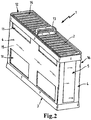
- FIG. 2 shows an embodiment of a filter element 1 with a raw-side upstream side 2 and a clean-side downstream side 3.
- a plastic frame 16 applied by means of a hot melt adhesive connection, wherein on the end faces 5 by the hot melt adhesive and the sealing of the front side takes place.
- On the end sides 15 openings in the plastic frame 16 are introduced.
- the plastic frame 16 carries on the upstream side 2, an axial seal 12, which is engageable with a sealing surface of a housing, not shown.
- a handle 13 is provided, which is in communication with the plastic frame 16 and for better handling of the filter element 1 is used.
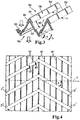
- FIG. 3 shows the detailed view of an arrangement of traces of adhesive on a filter element according to the invention.
- adhesive traces 101 are introduced into the folds, in particular from the hotmelt adhesive according to the invention, which extend between fold tips 102 and fold bottom 103.
- 105 adhesive traces 101 are introduced both on the clean side 104 and on the raw side.
- At least two in particular adhesive traces 101 are applied to the filter medium 106 parallel to one another and perpendicular to the direction of the fold edges 102, 103 before the individual folds are set up.
- the particular otherwise continuous traces of adhesive 101 are interrupted in particular regular intervals by an interruption 107.
- the adhesive trace is once interrupted between fold tip and wrinkle bottom.
- the interruption 107 is located centrally between the fold tip and wrinkle bottom and corresponds in length between one third and half of the fold height.
- the interruption 107 begins at a distance b from the raw-side fold bottom 103.
- the wrinkles are bonded on the raw side only in the area of the fold bottom and the fold tips.
- an interruption of the adhesive trace over a length a is provided, which surrounds the raw-side fold tip.
- the wrinkles are not glued on the raw side in the area of the pleat tips.
- the distances a and b of roh wornem wrinkle bottom and pure-side pleat tip are formed so that the interruption 107 of the clean side and the raw side adhesive track do not overlap. This ensures that both in the area of the pure-side pleat tips as well as in the Near the pure-side fold reason an overlap of the clean-side 104 and raw side 105 adhesive trace 101 is formed.
- the straight lines x and y formed by the start and end points of the individual adhesive trace portions are parallel to the fold edges.
- FIG. 4 shows an alternative arrangement of adhesive in particular formed with the hot melt adhesive according to the invention on a filter element according to the invention.
- the start and end points of the interruptions of the adhesive tracks 101 are aligned on a plurality of straight lines z, which run parallel to each other and with the folding edges F form an angle ⁇ of 10-80 °, preferably 45 +/- 15 °.
- the beginning and end points of the interruptions of the adhesive tracks on at least two pairs of straight lines z 'and z ", each straight line comprising mutually parallel straight lines, wherein the corresponding straight lines intersect on the filter medium, whereby an arrow-shaped or zigzag course of interruptions 107 of the adhesive trace 101 is formed on the filter medium.
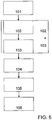
- FIG. 5 an embodiment of the sequence of a method according to the invention for producing a hot melt adhesive system is shown.
- a polyester hotmelt adhesive (Sika SikaMelt 9120) having a density of 1.25 g / cm 3 and an elongation at break of in the range of 75-115% and a polyamide hot melt adhesive (Henkel Marcomet 6208) having a density of 0.98 g / cm 3 are each heated separately to the processing temperature (200 ° C) with mixing.
- the yarn tension is qualitatively determined so that a 1 mm thick metal rod dipped into the melt and pulled out jerkily.
- a drop of hot melt adhesive remains on the metal round bar, on which a melt adhesive thread remains directly when it is withdrawn from the melt, which cools and hardens. A remaining, solidified thread is visible.
- the thread tension tendency is therefore judged to be high. Furthermore, the granules of the two mentioned hotmelt adhesives are mixed and the mixed granules are heated to 200 ° C and melted together. Immediately thereafter, in order to keep the segregation low, an order is made by means of a directly coupled with a gear pump application nozzle on a flat filter medium. In this case, surprisingly, a lower formation of filaments than in the use of the two hot melt adhesives in a separate form observed. Also, the yarn tension of the hot melt adhesive mixture is assessed qualitatively, such that a 1 mm thick metal rod in the previously again heated to a working temperature porcelain dish dynamically mixed melt is dipped and pulled out jerkily. There remains a drop of hot melt adhesive on the metal bar into which the thread formed directly after pulling the metal bar back out of the melt retreats. A remaining thread is not recognizable. The thread tension tendency is therefore judged to be low.
- a polyester hot melt adhesive having a melting point at 150-160 ° C, essentially formed from 40% by weight of butanediol, 33% by weight of terephthalic acid, 27% by weight of adipic acid and a polyamide hot melt adhesive having a melting point at 130 ° C. from 67% by weight of ⁇ -caprolactam, 5% by weight of 2,2,4-trimethylhexamethylenediamine, 12% by weight of 1-amino-3-aminomethyl-3,5,5-trimethylcyclohexane and 16% by weight of adipic acid in granule form and mixed together melted with dynamic mixing.
- the yarn tension is qualitatively determined so that a 1 mm thick metal rod dipped into the melt and pulled out jerkily.
- Example 2 a drop of hot melt adhesive remains on the metal bar, into which the thread formed directly after pulling the metal bar out of the melt retreats. A remaining thread is not recognizable. The thread tension tendency is therefore judged to be low.
- the polyester hotmelt adhesive (Sika Sikamelt 9420) with an elongation at break of about 50-60% is obtained in proportions by weight 60:40, 65:35, 70:30 (the polyester hotmelt adhesive is first mentioned in each case) with a polyamide hotmelt adhesive (Henkel Macromet 6208) with a melting temperature between 188 and 195 ° C and a density of 1.02 g / cm 3 as in Example 1 mixed and checked for thread tension tendency.
- a polyamide hotmelt adhesive Heenkel Macromet 6208
- Example 3 a drop of hot melt adhesive remains on the metal rod into which the thread formed directly after the metal rod has been withdrawn from the melt retreats completely or partially, depending on the mixing ratio. The effect is significantly less pronounced than in the application of the two hot melt adhesives in separate use.
- Example 4 The polyester hot melt adhesive of Example 2 and a polyamide hot melt adhesive with a density of 0.97 g / cm 3 , a softening point of 190-205 ° C (Henkel Macromet 2035) are mixed to 30:70, 50:50 and 70:30 by weight analogously to Example 1 and tested.
- a drop of hot melt adhesive remains on the metal bar into which the thread formed directly after the withdrawal of the metal rod from the melt retreats. A remaining thread is not recognizable or significantly less pronounced than in the application of the two hot melt adhesives in separate use wherein from a weight fraction of 70% of said polyester adhesive, the thread tension tendency increases again. The thread tension tendency is therefore judged to be low.
Landscapes
- Chemical & Material Sciences (AREA)
- Chemical Kinetics & Catalysis (AREA)
- Organic Chemistry (AREA)
- Health & Medical Sciences (AREA)
- Medicinal Chemistry (AREA)
- Polymers & Plastics (AREA)
- Adhesives Or Adhesive Processes (AREA)
Claims (15)
- Élément filtrant, comprenant un soufflet de filtre plié en accordéon et constitué d'un milieu filtrant plat, le soufflet de filtre étant collé par au moins deux cordons de colle, issus d'un système de colles thermofusibles, en particulier interrompus de façon régulière ou irrégulière qui s'étendent sur le milieu filtrant, le système de colles thermofusibles comprenant un mélange de colles thermofusibles, lequel comprend 15 à 85 % en poids, notamment 30 à 70 % en poids d'une première colle thermofusible à base de polyester et 15 à 85 % en poids, notamment 30 à 70 % en poids d'une deuxième colle thermofusible à base de polyamide, les pourcentages en poids de la première colle thermofusible et de la deuxième colle thermofusible donnant, par addition, 100 % en poids du mélange de colles thermofusibles, le mélange de colles thermofusibles représentant une part de plus de 75 % en poids du système de colles thermofusibles, le reste étant constitué de charges telles que de la craie et/ou des pigments comme de l'oxyde de titane en tant que pigment blanc et/ou une résine collante, et/ou d'au moins une autre colle thermofusible à base de polycondensat.
- Élément filtrant selon la revendication 1, comprenant un milieu filtrant plié en accordéon qui sépare un côté brut d'un côté pur et qui présente en alternance des crêtes de pli et des creux de pli, des cordons de colle thermofusible étant disposés dans les interstices de pliage, ces cordons de colle s'étendant en alternance entre les crêtes de pli et les creux de pli, respectivement au moins deux cordons de colle étant disposés sur l'élément filtrant, aussi bien du côté brut que du côté pur du milieu filtrant, parallèlement l'un par rapport à l'autre et en particulier verticalement au sens des bords de pliage, les cordons de colle étant interrompus à des distances régulières du côté brut et/ou du côté pur, les points de départ et les points finaux des interruptions des cordons de colle étant alignés sur de multiples lignes droites.
- Élément filtrant selon la revendication 2, caractérisé en ce que les multiples lignes droites sont parallèles aux bords de pliage.
- Élément filtrant selon la revendication 2, caractérisé en ce que les multiples lignes droites sont parallèles les unes aux autres et forment, avec les bords de pliage, un angle de 10 à 80°, de préférence de 45 +/-15°.
- Élément filtrant selon l'une des revendications précédentes, caractérisé en ce que les cordons de colle présentent du côté pur une interruption du cordon de colle qui entoure la crête de pli du côté pur.
- Élément filtrant selon l'une des revendications précédentes, caractérisé en ce qu'au moins un cordon de colle, et de préférence tous les cordons de colle, se situent du côté brut directement en face d'un cordon de colle ou des cordons de colle du côté pur.
- Élément filtrant selon l'une des revendications précédentes, caractérisé en ce que les interruptions des cordons de colle du côté brut et du côté pur ne se chevauchent pas.
- Élément filtrant selon l'une des revendications précédentes, caractérisé en ce que les points de départ et les points finaux des interruptions des cordons de colle s'étendent sur au moins deux familles de lignes droites, chaque famille de lignes droites comprenant des lignes droites parallèles les unes aux autres, les lignes correspondantes sur le milieu filtrant se coupant et réalisant ainsi un agencement en forme de flèche ou en accordéon des interruptions du cordon de colle sur le milieu filtrant.
- Élément filtrant selon l'une des revendications précédentes, caractérisé en ce que les points de départ et les points finaux des interruptions des cordons de colle ne sont pas définis par des familles de lignes droites mais par des familles de courbes, les courbes ayant en particulier la même forme mais étant décalées les unes par rapport aux autres, dans une direction, en sens vertical (+/- 30°) par rapport aux bords de pliage.
- Élément filtrant selon l'une des revendications précédentes, caractérisé en ce que la famille de courbes comprend des sections de cercles ou d'ellipses, des formes sinusoïdales ou d'autres formes courbées régulières.
- Élément filtrant selon l'une des revendications précédentes, caractérisé en ce que la distance entre deux interruptions consécutives, c'est-à-dire la longueur d'une section continue de cordon de colle est plus grande que celle d'au moins une interruption, de préférence de deux interruptions adjacentes.
- Élément filtrant selon l'une des revendications précédentes, le pourcentage global d'acide adipique dans les substances de base de la première colle thermofusible à base de polyester et de la deuxième colle thermofusible à base de polyamide correspondant à > 5 % en poids, de préférence à > 10 % en poids, et plus spécialement à > 15 % en poids, et en même temps à < 35 % en poids, de préférence à < 30 % en poids, et plus spécialement à < 25 % en poids.
- Procédé de fabrication d'un élément filtrant selon la revendication 1, ce procédé comprenant les étapes suivantes :a. fusion d'un mélange de colles thermofusibles, ce mélange de colles thermofusibles comprenantI. 15 à 85 % en poids d'une première colle thermofusible à base de polyester,II. 15 à 85 % en poids d'une deuxième colle thermofusible à base de polyamide, les pourcentages en poids de la première colle thermofusible et de la deuxième colle thermofusible donnant, par addition, 100 % en poids du mélange de colles thermofusibles, le mélange de colles thermofusibles représentant une part de plus de 75 % en poids d'un système de colles thermofusibles, le reste étant constitué de charges telles que de la craie et/ou des pigments comme de l'oxyde de titane en tant que pigment blanc et/ou une résine collante, et/ou d'au moins une autre colle thermofusible à base de polycondensat,b. mélange essentiellement dynamique des deux colles thermofusibles, en particulier avec génération de forces de cisaillement dans la masse fondue, afin de constituer un mélange de colles thermofusibles,c. application du système de colles thermofusibles sur un milieu filtrant en forme de bande, en cordons de colle interrompus en particulier de façon régulière ou irrégulière,d. pliage du milieu filtrant et collage simultané des plis avec le système de colles thermofusibles appliqué.
- Procédé selon la revendication précédente, caractérisé en ce que les granulés des deux colles thermofusibles sont mélangés avant le chauffage, puis sont chauffés et fondus.
- Procédé selon l'une des deux revendications précédentes, caractérisé en ce que le mélange, le chauffage et la fusion sont réalisés dans une extrudeuse.
Applications Claiming Priority (2)
| Application Number | Priority Date | Filing Date | Title |
|---|---|---|---|
| DE102010032295A DE102010032295A1 (de) | 2010-07-26 | 2010-07-26 | Filterelement und Verfahren zur Herstellung eines Filterelements |
| PCT/EP2011/062781 WO2012013647A1 (fr) | 2010-07-26 | 2011-07-26 | Élément filtrant et procédé de fabrication d'un élément filtrant |
Publications (2)
| Publication Number | Publication Date |
|---|---|
| EP2598227A1 EP2598227A1 (fr) | 2013-06-05 |
| EP2598227B1 true EP2598227B1 (fr) | 2017-01-11 |
Family
ID=44503803
Family Applications (1)
| Application Number | Title | Priority Date | Filing Date |
|---|---|---|---|
| EP11743488.6A Active EP2598227B1 (fr) | 2010-07-26 | 2011-07-26 | Élément filtrant et procédé de fabrication d'un élément filtrant |
Country Status (5)
| Country | Link |
|---|---|
| US (1) | US9254460B2 (fr) |
| EP (1) | EP2598227B1 (fr) |
| CN (1) | CN103002966B (fr) |
| DE (1) | DE102010032295A1 (fr) |
| WO (1) | WO2012013647A1 (fr) |
Families Citing this family (10)
| Publication number | Priority date | Publication date | Assignee | Title |
|---|---|---|---|---|
| DE102012005532A1 (de) | 2012-03-21 | 2013-09-26 | Mann + Hummel Gmbh | Filterelement eines Filters zur Filtrierung von Fluiden und Filter |
| WO2013110335A1 (fr) | 2012-01-26 | 2013-08-01 | Mann+Hummel Gmbh | Élément filtrant et procédé de fabrication d'un élément filtrant |
| US9233332B2 (en) | 2014-06-02 | 2016-01-12 | Caterpillar Inc. | Air filter assembly filling plenum interior space |
| CN105169847A (zh) * | 2015-09-11 | 2015-12-23 | 无锡零界净化设备有限公司 | 无隔板高效过滤器 |
| US11117079B2 (en) * | 2017-01-20 | 2021-09-14 | Champion Laboratories, Inc. | Filter packs, processes for making filter packs, and air filters comprising filter packs |
| CN111278528B (zh) | 2017-08-22 | 2022-07-01 | 唐纳森公司 | 槽纹过滤介质、过滤介质包和过滤元件 |
| JP7274484B2 (ja) * | 2017-12-14 | 2023-05-16 | ドナルドソン カンパニー,インコーポレイティド | フィルタプリーツのための周期的放射対称構成 |
| DE102018103157A1 (de) * | 2018-02-13 | 2019-08-14 | Camfil Apc Gmbh | Geteilte Strömungsleitvorrichtung, Bausatz aus Grundkörper und Endstück einer Strömungsleitvorrichtung, Filteranlage und Verfahren zum Reinigen |
| US10918976B2 (en) * | 2018-10-24 | 2021-02-16 | Pall Corporation | Support and drainage material, filter, and method of use |
| DE102019115568A1 (de) * | 2019-06-07 | 2020-12-10 | Mann+Hummel Gmbh | Filterelement und Filtersystem |
Family Cites Families (22)
| Publication number | Priority date | Publication date | Assignee | Title |
|---|---|---|---|---|
| DE1299230B (de) | 1966-12-24 | 1969-07-10 | Draegerwerk Ag | Verfahren zum Herstellen eines Schwebstoffiltereinsatzes aus gefaltetem Filtermaterial fuer Schwebstoffilter von Atemschutzgeraeten |
| US4217435A (en) * | 1976-12-02 | 1980-08-12 | Eastman Kodak Company | Adhesive composition |
| JPS6017359B2 (ja) * | 1978-09-20 | 1985-05-02 | 旭化成株式会社 | ポリエステル系ホツトメルト接着剤 |
| US4891264A (en) | 1988-01-05 | 1990-01-02 | Chisso Corporation | Electroconductive thermoplastic resin sheet |
| US5236480A (en) * | 1989-01-05 | 1993-08-17 | Camfil Ab | Air filter for workstations and methods of making and using such air filter |
| ATE98892T1 (de) * | 1989-01-05 | 1994-01-15 | Camfil Ab | Filter. |
| DE19510316A1 (de) * | 1995-03-22 | 1996-09-26 | Huels Chemische Werke Ag | Schmelzklebermasse zur Beschichtung von Einlagenstoff |
| DE19601978C2 (de) * | 1996-01-20 | 1997-12-18 | Freudenberg Carl Fa | Filterelement |
| US6239208B1 (en) * | 1998-01-07 | 2001-05-29 | H. B. Fuller Licensing & Financing, Inc. | Flame retardant hot melt compositions |
| AU1593599A (en) * | 1998-01-08 | 1999-07-26 | H.B. Fuller Licensing And Financing Inc. | Thermoplastic compositions comprising crystalline water soluble polymers and amorphous water sensitive polymers |
| DE10015951C2 (de) * | 1999-12-22 | 2002-09-26 | Jacobi Systemtechnik Gmbh | Filterelement |
| DE10113077A1 (de) * | 2000-09-21 | 2002-04-25 | Lippold Hans Joachim | Fluidfilterelement |
| US6685833B2 (en) * | 2000-09-21 | 2004-02-03 | Lpd Technologies, Inc. | Fluid filter element |
| CN1401721A (zh) * | 2002-09-06 | 2003-03-12 | 广州市鹿山化工材料有限公司 | 一种聚烯烃热熔胶粘剂及使用该热熔胶粘剂的复合结构胶片 |
| DE102005006335A1 (de) * | 2005-02-10 | 2006-08-24 | Bozzetto Gmbh | Vernetzbare Schmelzklebermischung und Verfahren zur Beschichtung und/oder Laminierung von Substraten |
| DE102005030431A1 (de) | 2005-06-30 | 2007-01-11 | Henkel Kgaa | Schmelzklebstoff mit Duftstoffen |
| EP1976917A1 (fr) | 2006-01-12 | 2008-10-08 | Basf Se | Materiaux poreux et procede de production correspondant |
| JP2009082822A (ja) * | 2007-09-28 | 2009-04-23 | Hitachi Plant Technologies Ltd | フィルタ分離装置 |
| DE102008020441A1 (de) | 2008-04-23 | 2009-10-29 | Merck Patent Gmbh | Klebstoff |
| DE102009040202B4 (de) * | 2009-09-07 | 2015-10-01 | Mann + Hummel Gmbh | Filter |
| DE102010032294A1 (de) * | 2010-07-26 | 2012-01-26 | Mann + Hummel Gmbh | Schmelzklebstoff und Verfahren zur Herstellung eines Schmelzklebstoffes |
| US20130042589A1 (en) * | 2010-08-20 | 2013-02-21 | Michael J. Chanak | Filter including a hot melt coated continuous substrate |
-
2010
- 2010-07-26 DE DE102010032295A patent/DE102010032295A1/de not_active Ceased
-
2011
- 2011-07-26 EP EP11743488.6A patent/EP2598227B1/fr active Active
- 2011-07-26 WO PCT/EP2011/062781 patent/WO2012013647A1/fr not_active Ceased
- 2011-07-26 CN CN201180036927.5A patent/CN103002966B/zh not_active Expired - Fee Related
-
2013
- 2013-01-28 US US13/751,775 patent/US9254460B2/en not_active Expired - Fee Related
Non-Patent Citations (1)
| Title |
|---|
| None * |
Also Published As
| Publication number | Publication date |
|---|---|
| DE102010032295A1 (de) | 2012-01-26 |
| EP2598227A1 (fr) | 2013-06-05 |
| US20130133517A1 (en) | 2013-05-30 |
| CN103002966B (zh) | 2015-11-25 |
| WO2012013647A1 (fr) | 2012-02-02 |
| CN103002966A (zh) | 2013-03-27 |
| US9254460B2 (en) | 2016-02-09 |
Similar Documents
| Publication | Publication Date | Title |
|---|---|---|
| EP2598227B1 (fr) | Élément filtrant et procédé de fabrication d'un élément filtrant | |
| EP2806962B1 (fr) | Élément filtrant et procédé de fabrication d'un élément filtrant | |
| EP2547418B1 (fr) | Procédé de fabrication d'un élément filtrant plissé | |
| EP3415213B1 (fr) | Élément filtrant | |
| DE69404708T2 (de) | Verfahren und Vorrichtung zur Herstellung eines Verbundgarnes | |
| EP4188581B1 (fr) | Elément filtrant et procédé de fabrication d'un élément filtrant | |
| DE102010032294A1 (de) | Schmelzklebstoff und Verfahren zur Herstellung eines Schmelzklebstoffes | |
| EP0737092A1 (fr) | Procede de fabrication d'une cartouche de filtre | |
| WO2010106087A1 (fr) | Milieu filtrant et élément filtrant | |
| DE102009041401A1 (de) | Filterelement mit einem Filtermedium sowie Verfahren zum Herstellen desselben | |
| EP2500077A1 (fr) | Elément de filtre avec deux couches de tissu | |
| EP2512618B1 (fr) | Filtre compact, procédé de fabrication d'un filtre compact, et milieu filtrant | |
| EP2585190B1 (fr) | Procédé de production d'un élément filtrant et élément filtrant | |
| DE112017006316B4 (de) | Filtermedium, Verfahren zu dessen Herstellung und Verwendung des Filtermediums in einem Filterelement | |
| DE102006003949B4 (de) | Filterelement mit Anschlusselement | |
| WO2016046127A1 (fr) | Élément formant filtre pourvu d'un soufflet de filtre | |
| EP4037806A1 (fr) | Élément filtrant et procédé de fabrication d'un élément filtrant | |
| WO2020099422A1 (fr) | Filtre à carburant | |
| EP3750615B1 (fr) | Élément filtrant à plis spécial et filtre à cassette doté des tels éléments filtrants et cartouche filtrante dotée d'un tel élément filtrant | |
| DE10150073A1 (de) | Mehrlagiges Filtermedium und Herstellprozess | |
| DE102024129852A1 (de) | Rohrbündel sowie Verfahren zur Herstellung eines Rohrbündels | |
| DE102008057736A1 (de) | Filterelement | |
| DD204113A1 (de) | Verfahren zur herstellung von leinwandbindig gewebten foliesaecken | |
| DE102015004644A1 (de) | Filterelement mit Filterbalg |
Legal Events
| Date | Code | Title | Description |
|---|---|---|---|
| PUAI | Public reference made under article 153(3) epc to a published international application that has entered the european phase |
Free format text: ORIGINAL CODE: 0009012 |
|
| 17P | Request for examination filed |
Effective date: 20130109 |
|
| AK | Designated contracting states |
Kind code of ref document: A1 Designated state(s): AL AT BE BG CH CY CZ DE DK EE ES FI FR GB GR HR HU IE IS IT LI LT LU LV MC MK MT NL NO PL PT RO RS SE SI SK SM TR |
|
| DAX | Request for extension of the european patent (deleted) | ||
| 17Q | First examination report despatched |
Effective date: 20140409 |
|
| RIC1 | Information provided on ipc code assigned before grant |
Ipc: C09J 177/00 20060101ALI20160321BHEP Ipc: B01D 46/52 20060101ALI20160321BHEP Ipc: B01D 46/00 20060101AFI20160321BHEP Ipc: C09J 167/02 20060101ALI20160321BHEP |
|
| GRAP | Despatch of communication of intention to grant a patent |
Free format text: ORIGINAL CODE: EPIDOSNIGR1 |
|
| INTG | Intention to grant announced |
Effective date: 20160520 |
|
| GRAP | Despatch of communication of intention to grant a patent |
Free format text: ORIGINAL CODE: EPIDOSNIGR1 |
|
| INTC | Intention to grant announced (deleted) | ||
| INTG | Intention to grant announced |
Effective date: 20160810 |
|
| GRAJ | Information related to disapproval of communication of intention to grant by the applicant or resumption of examination proceedings by the epo deleted |
Free format text: ORIGINAL CODE: EPIDOSDIGR1 |
|
| GRAJ | Information related to disapproval of communication of intention to grant by the applicant or resumption of examination proceedings by the epo deleted |
Free format text: ORIGINAL CODE: EPIDOSDIGR1 |
|
| GRAP | Despatch of communication of intention to grant a patent |
Free format text: ORIGINAL CODE: EPIDOSNIGR1 |
|
| GRAP | Despatch of communication of intention to grant a patent |
Free format text: ORIGINAL CODE: EPIDOSNIGR1 |
|
| INTC | Intention to grant announced (deleted) | ||
| GRAS | Grant fee paid |
Free format text: ORIGINAL CODE: EPIDOSNIGR3 |
|
| GRAA | (expected) grant |
Free format text: ORIGINAL CODE: 0009210 |
|
| INTG | Intention to grant announced |
Effective date: 20161117 |
|
| RIN1 | Information on inventor provided before grant (corrected) |
Inventor name: MBADINGA-MOUANDA, GELASE Inventor name: MAJER, TANJA Inventor name: GEHWOLF, KLAUS |
|
| AK | Designated contracting states |
Kind code of ref document: B1 Designated state(s): AL AT BE BG CH CY CZ DE DK EE ES FI FR GB GR HR HU IE IS IT LI LT LU LV MC MK MT NL NO PL PT RO RS SE SI SK SM TR |
|
| REG | Reference to a national code |
Ref country code: GB Ref legal event code: FG4D Free format text: NOT ENGLISH |
|
| REG | Reference to a national code |
Ref country code: CH Ref legal event code: EP |
|
| REG | Reference to a national code |
Ref country code: AT Ref legal event code: REF Ref document number: 860736 Country of ref document: AT Kind code of ref document: T Effective date: 20170115 |
|
| REG | Reference to a national code |
Ref country code: IE Ref legal event code: FG4D Free format text: LANGUAGE OF EP DOCUMENT: GERMAN |
|
| REG | Reference to a national code |
Ref country code: DE Ref legal event code: R096 Ref document number: 502011011511 Country of ref document: DE |
|
| REG | Reference to a national code |
Ref country code: LT Ref legal event code: MG4D |
|
| REG | Reference to a national code |
Ref country code: NL Ref legal event code: MP Effective date: 20170111 |
|
| PG25 | Lapsed in a contracting state [announced via postgrant information from national office to epo] |
Ref country code: NL Free format text: LAPSE BECAUSE OF FAILURE TO SUBMIT A TRANSLATION OF THE DESCRIPTION OR TO PAY THE FEE WITHIN THE PRESCRIBED TIME-LIMIT Effective date: 20170111 |
|
| PG25 | Lapsed in a contracting state [announced via postgrant information from national office to epo] |
Ref country code: IS Free format text: LAPSE BECAUSE OF FAILURE TO SUBMIT A TRANSLATION OF THE DESCRIPTION OR TO PAY THE FEE WITHIN THE PRESCRIBED TIME-LIMIT Effective date: 20170511 Ref country code: NO Free format text: LAPSE BECAUSE OF FAILURE TO SUBMIT A TRANSLATION OF THE DESCRIPTION OR TO PAY THE FEE WITHIN THE PRESCRIBED TIME-LIMIT Effective date: 20170411 Ref country code: LT Free format text: LAPSE BECAUSE OF FAILURE TO SUBMIT A TRANSLATION OF THE DESCRIPTION OR TO PAY THE FEE WITHIN THE PRESCRIBED TIME-LIMIT Effective date: 20170111 Ref country code: FI Free format text: LAPSE BECAUSE OF FAILURE TO SUBMIT A TRANSLATION OF THE DESCRIPTION OR TO PAY THE FEE WITHIN THE PRESCRIBED TIME-LIMIT Effective date: 20170111 Ref country code: HR Free format text: LAPSE BECAUSE OF FAILURE TO SUBMIT A TRANSLATION OF THE DESCRIPTION OR TO PAY THE FEE WITHIN THE PRESCRIBED TIME-LIMIT Effective date: 20170111 Ref country code: GR Free format text: LAPSE BECAUSE OF FAILURE TO SUBMIT A TRANSLATION OF THE DESCRIPTION OR TO PAY THE FEE WITHIN THE PRESCRIBED TIME-LIMIT Effective date: 20170412 |
|
| PG25 | Lapsed in a contracting state [announced via postgrant information from national office to epo] |
Ref country code: PL Free format text: LAPSE BECAUSE OF FAILURE TO SUBMIT A TRANSLATION OF THE DESCRIPTION OR TO PAY THE FEE WITHIN THE PRESCRIBED TIME-LIMIT Effective date: 20170111 Ref country code: PT Free format text: LAPSE BECAUSE OF FAILURE TO SUBMIT A TRANSLATION OF THE DESCRIPTION OR TO PAY THE FEE WITHIN THE PRESCRIBED TIME-LIMIT Effective date: 20170511 Ref country code: SE Free format text: LAPSE BECAUSE OF FAILURE TO SUBMIT A TRANSLATION OF THE DESCRIPTION OR TO PAY THE FEE WITHIN THE PRESCRIBED TIME-LIMIT Effective date: 20170111 Ref country code: BG Free format text: LAPSE BECAUSE OF FAILURE TO SUBMIT A TRANSLATION OF THE DESCRIPTION OR TO PAY THE FEE WITHIN THE PRESCRIBED TIME-LIMIT Effective date: 20170411 Ref country code: LV Free format text: LAPSE BECAUSE OF FAILURE TO SUBMIT A TRANSLATION OF THE DESCRIPTION OR TO PAY THE FEE WITHIN THE PRESCRIBED TIME-LIMIT Effective date: 20170111 Ref country code: ES Free format text: LAPSE BECAUSE OF FAILURE TO SUBMIT A TRANSLATION OF THE DESCRIPTION OR TO PAY THE FEE WITHIN THE PRESCRIBED TIME-LIMIT Effective date: 20170111 Ref country code: RS Free format text: LAPSE BECAUSE OF FAILURE TO SUBMIT A TRANSLATION OF THE DESCRIPTION OR TO PAY THE FEE WITHIN THE PRESCRIBED TIME-LIMIT Effective date: 20170111 |
|
| REG | Reference to a national code |
Ref country code: DE Ref legal event code: R097 Ref document number: 502011011511 Country of ref document: DE |
|
| PG25 | Lapsed in a contracting state [announced via postgrant information from national office to epo] |
Ref country code: EE Free format text: LAPSE BECAUSE OF FAILURE TO SUBMIT A TRANSLATION OF THE DESCRIPTION OR TO PAY THE FEE WITHIN THE PRESCRIBED TIME-LIMIT Effective date: 20170111 Ref country code: CZ Free format text: LAPSE BECAUSE OF FAILURE TO SUBMIT A TRANSLATION OF THE DESCRIPTION OR TO PAY THE FEE WITHIN THE PRESCRIBED TIME-LIMIT Effective date: 20170111 Ref country code: RO Free format text: LAPSE BECAUSE OF FAILURE TO SUBMIT A TRANSLATION OF THE DESCRIPTION OR TO PAY THE FEE WITHIN THE PRESCRIBED TIME-LIMIT Effective date: 20170111 Ref country code: SK Free format text: LAPSE BECAUSE OF FAILURE TO SUBMIT A TRANSLATION OF THE DESCRIPTION OR TO PAY THE FEE WITHIN THE PRESCRIBED TIME-LIMIT Effective date: 20170111 Ref country code: IT Free format text: LAPSE BECAUSE OF FAILURE TO SUBMIT A TRANSLATION OF THE DESCRIPTION OR TO PAY THE FEE WITHIN THE PRESCRIBED TIME-LIMIT Effective date: 20170111 |
|
| PLBE | No opposition filed within time limit |
Free format text: ORIGINAL CODE: 0009261 |
|
| STAA | Information on the status of an ep patent application or granted ep patent |
Free format text: STATUS: NO OPPOSITION FILED WITHIN TIME LIMIT |
|
| PG25 | Lapsed in a contracting state [announced via postgrant information from national office to epo] |
Ref country code: DK Free format text: LAPSE BECAUSE OF FAILURE TO SUBMIT A TRANSLATION OF THE DESCRIPTION OR TO PAY THE FEE WITHIN THE PRESCRIBED TIME-LIMIT Effective date: 20170111 Ref country code: SM Free format text: LAPSE BECAUSE OF FAILURE TO SUBMIT A TRANSLATION OF THE DESCRIPTION OR TO PAY THE FEE WITHIN THE PRESCRIBED TIME-LIMIT Effective date: 20170111 |
|
| 26N | No opposition filed |
Effective date: 20171012 |
|
| PG25 | Lapsed in a contracting state [announced via postgrant information from national office to epo] |
Ref country code: SI Free format text: LAPSE BECAUSE OF FAILURE TO SUBMIT A TRANSLATION OF THE DESCRIPTION OR TO PAY THE FEE WITHIN THE PRESCRIBED TIME-LIMIT Effective date: 20170111 |
|
| REG | Reference to a national code |
Ref country code: CH Ref legal event code: PL |
|
| GBPC | Gb: european patent ceased through non-payment of renewal fee |
Effective date: 20170726 |
|
| REG | Reference to a national code |
Ref country code: IE Ref legal event code: MM4A |
|
| REG | Reference to a national code |
Ref country code: FR Ref legal event code: ST Effective date: 20180330 |
|
| PG25 | Lapsed in a contracting state [announced via postgrant information from national office to epo] |
Ref country code: IE Free format text: LAPSE BECAUSE OF NON-PAYMENT OF DUE FEES Effective date: 20170726 Ref country code: CH Free format text: LAPSE BECAUSE OF NON-PAYMENT OF DUE FEES Effective date: 20170731 Ref country code: GB Free format text: LAPSE BECAUSE OF NON-PAYMENT OF DUE FEES Effective date: 20170726 Ref country code: LI Free format text: LAPSE BECAUSE OF NON-PAYMENT OF DUE FEES Effective date: 20170731 |
|
| PG25 | Lapsed in a contracting state [announced via postgrant information from national office to epo] |
Ref country code: FR Free format text: LAPSE BECAUSE OF NON-PAYMENT OF DUE FEES Effective date: 20170731 |
|
| REG | Reference to a national code |
Ref country code: BE Ref legal event code: MM Effective date: 20170731 |
|
| PG25 | Lapsed in a contracting state [announced via postgrant information from national office to epo] |
Ref country code: LU Free format text: LAPSE BECAUSE OF NON-PAYMENT OF DUE FEES Effective date: 20170726 |
|
| REG | Reference to a national code |
Ref country code: DE Ref legal event code: R081 Ref document number: 502011011511 Country of ref document: DE Owner name: MANN+HUMMEL GMBH, DE Free format text: FORMER OWNER: MANN + HUMMEL GMBH, 71638 LUDWIGSBURG, DE |
|
| PG25 | Lapsed in a contracting state [announced via postgrant information from national office to epo] |
Ref country code: BE Free format text: LAPSE BECAUSE OF NON-PAYMENT OF DUE FEES Effective date: 20170731 |
|
| REG | Reference to a national code |
Ref country code: AT Ref legal event code: MM01 Ref document number: 860736 Country of ref document: AT Kind code of ref document: T Effective date: 20170726 |
|
| PG25 | Lapsed in a contracting state [announced via postgrant information from national office to epo] |
Ref country code: MT Free format text: LAPSE BECAUSE OF FAILURE TO SUBMIT A TRANSLATION OF THE DESCRIPTION OR TO PAY THE FEE WITHIN THE PRESCRIBED TIME-LIMIT Effective date: 20170111 |
|
| PG25 | Lapsed in a contracting state [announced via postgrant information from national office to epo] |
Ref country code: AT Free format text: LAPSE BECAUSE OF NON-PAYMENT OF DUE FEES Effective date: 20170726 |
|
| PG25 | Lapsed in a contracting state [announced via postgrant information from national office to epo] |
Ref country code: MC Free format text: LAPSE BECAUSE OF FAILURE TO SUBMIT A TRANSLATION OF THE DESCRIPTION OR TO PAY THE FEE WITHIN THE PRESCRIBED TIME-LIMIT Effective date: 20170111 Ref country code: HU Free format text: LAPSE BECAUSE OF FAILURE TO SUBMIT A TRANSLATION OF THE DESCRIPTION OR TO PAY THE FEE WITHIN THE PRESCRIBED TIME-LIMIT; INVALID AB INITIO Effective date: 20110726 |
|
| PG25 | Lapsed in a contracting state [announced via postgrant information from national office to epo] |
Ref country code: CY Free format text: LAPSE BECAUSE OF NON-PAYMENT OF DUE FEES Effective date: 20170111 |
|
| PG25 | Lapsed in a contracting state [announced via postgrant information from national office to epo] |
Ref country code: MK Free format text: LAPSE BECAUSE OF FAILURE TO SUBMIT A TRANSLATION OF THE DESCRIPTION OR TO PAY THE FEE WITHIN THE PRESCRIBED TIME-LIMIT Effective date: 20170111 |
|
| PG25 | Lapsed in a contracting state [announced via postgrant information from national office to epo] |
Ref country code: TR Free format text: LAPSE BECAUSE OF FAILURE TO SUBMIT A TRANSLATION OF THE DESCRIPTION OR TO PAY THE FEE WITHIN THE PRESCRIBED TIME-LIMIT Effective date: 20170111 |
|
| PG25 | Lapsed in a contracting state [announced via postgrant information from national office to epo] |
Ref country code: AL Free format text: LAPSE BECAUSE OF FAILURE TO SUBMIT A TRANSLATION OF THE DESCRIPTION OR TO PAY THE FEE WITHIN THE PRESCRIBED TIME-LIMIT Effective date: 20170111 |
|
| PGFP | Annual fee paid to national office [announced via postgrant information from national office to epo] |
Ref country code: DE Payment date: 20250722 Year of fee payment: 15 |