EP2601236B1 - Matériaux semi-conducteurs préparés à partir de copolymères de bithiazole pontés - Google Patents
Matériaux semi-conducteurs préparés à partir de copolymères de bithiazole pontés Download PDFInfo
- Publication number
- EP2601236B1 EP2601236B1 EP11738716.7A EP11738716A EP2601236B1 EP 2601236 B1 EP2601236 B1 EP 2601236B1 EP 11738716 A EP11738716 A EP 11738716A EP 2601236 B1 EP2601236 B1 EP 2601236B1
- Authority
- EP
- European Patent Office
- Prior art keywords
- alkyl
- independently
- occurrence
- aryl
- heterocyclic residue
- Prior art date
- Legal status (The legal status is an assumption and is not a legal conclusion. Google has not performed a legal analysis and makes no representation as to the accuracy of the status listed.)
- Not-in-force
Links
- 0 Cc1ccc(*)cc1 Chemical compound Cc1ccc(*)cc1 0.000 description 16
- FGALPHNSQJNSNG-UHFFFAOYSA-N CC(C)(C)C(C)(C)N Chemical compound CC(C)(C)C(C)(C)N FGALPHNSQJNSNG-UHFFFAOYSA-N 0.000 description 1
- VGNHPNCIWJGAMV-UHFFFAOYSA-N CC1(C)OS(N)OC1(C)C Chemical compound CC1(C)OS(N)OC1(C)C VGNHPNCIWJGAMV-UHFFFAOYSA-N 0.000 description 1
- IFYMLSMPQVYWJM-UHFFFAOYSA-N CC1SC(C)(C)NC1 Chemical compound CC1SC(C)(C)NC1 IFYMLSMPQVYWJM-UHFFFAOYSA-N 0.000 description 1
- YPZJJADPWWKETJ-UHFFFAOYSA-N CNC(c1c-2[s]c([Sn](C)(C)C)c1)(c1c-2[s]c([Sn](C)(C)C)c1)N Chemical compound CNC(c1c-2[s]c([Sn](C)(C)C)c1)(c1c-2[s]c([Sn](C)(C)C)c1)N YPZJJADPWWKETJ-UHFFFAOYSA-N 0.000 description 1
- KGUSQDOPQTZIDV-UHFFFAOYSA-N Cc([s]1)cc2c1[s]c(I)c2 Chemical compound Cc([s]1)cc2c1[s]c(I)c2 KGUSQDOPQTZIDV-UHFFFAOYSA-N 0.000 description 1
- RGRCXSSDRWQGFM-UHFFFAOYSA-N Cc([s]1)nc2c1[s]c(C)n2 Chemical compound Cc([s]1)nc2c1[s]c(C)n2 RGRCXSSDRWQGFM-UHFFFAOYSA-N 0.000 description 1
- LMSDASREOBRXEC-UHFFFAOYSA-N Cc1cc(Cc2c-3[s]c(I)c2)c-3[s]1 Chemical compound Cc1cc(Cc2c-3[s]c(I)c2)c-3[s]1 LMSDASREOBRXEC-UHFFFAOYSA-N 0.000 description 1
- NHGCYVVJZQJXCW-UHFFFAOYSA-N Cc1cc(Cc2c-3cc(C)[s]2)c-3[s]1 Chemical compound Cc1cc(Cc2c-3cc(C)[s]2)c-3[s]1 NHGCYVVJZQJXCW-UHFFFAOYSA-N 0.000 description 1
- MSIUQOWNDKIKSG-UHFFFAOYSA-N Cc1cc([s]c(C)c2)c2[s]1 Chemical compound Cc1cc([s]c(C)c2)c2[s]1 MSIUQOWNDKIKSG-UHFFFAOYSA-N 0.000 description 1
- CZOBGAPMLREFKT-UHFFFAOYSA-N Cc1cc(c(cccc2)c2c2c3[s]c(CCc4cc5ccc(cc([s]6)I)c6c5[s]4)c2)c3[s]1 Chemical compound Cc1cc(c(cccc2)c2c2c3[s]c(CCc4cc5ccc(cc([s]6)I)c6c5[s]4)c2)c3[s]1 CZOBGAPMLREFKT-UHFFFAOYSA-N 0.000 description 1
- RHFUDHLBWKBYKO-UHFFFAOYSA-N Cc1nc(CCc2c-3nc(C)[s]2)c-3[s]1 Chemical compound Cc1nc(CCc2c-3nc(C)[s]2)c-3[s]1 RHFUDHLBWKBYKO-UHFFFAOYSA-N 0.000 description 1
- CKJQBXFLEPASFH-UHFFFAOYSA-N Cc1nc(Cc2c-3nc(C)[s]2)c-3[s]1 Chemical compound Cc1nc(Cc2c-3nc(C)[s]2)c-3[s]1 CKJQBXFLEPASFH-UHFFFAOYSA-N 0.000 description 1
- SYLHANIREIXJBI-UHFFFAOYSA-N Cc1nc([s]c(I)n2)c2[s]1 Chemical compound Cc1nc([s]c(I)n2)c2[s]1 SYLHANIREIXJBI-UHFFFAOYSA-N 0.000 description 1
- FPQOWDKKYXBSKE-UHFFFAOYSA-N Cc1nc(c(cccc2)c2c2c3[s]c(I)n2)c3[s]1 Chemical compound Cc1nc(c(cccc2)c2c2c3[s]c(I)n2)c3[s]1 FPQOWDKKYXBSKE-UHFFFAOYSA-N 0.000 description 1
- MAXONTHQCHKUCC-UHFFFAOYSA-N Cc1nc(c2c([nH]3)nc(C)[s]2)c3[s]1 Chemical compound Cc1nc(c2c([nH]3)nc(C)[s]2)c3[s]1 MAXONTHQCHKUCC-UHFFFAOYSA-N 0.000 description 1
- ADQYQMZUWPECTP-UHFFFAOYSA-N Cc1nc(cc2[s]c(I)nc2c2)c2[s]1 Chemical compound Cc1nc(cc2[s]c(I)nc2c2)c2[s]1 ADQYQMZUWPECTP-UHFFFAOYSA-N 0.000 description 1
Images

Classifications
-
- C—CHEMISTRY; METALLURGY
- C07—ORGANIC CHEMISTRY
- C07D—HETEROCYCLIC COMPOUNDS
- C07D513/00—Heterocyclic compounds containing in the condensed system at least one hetero ring having nitrogen and sulfur atoms as the only ring hetero atoms, not provided for in groups C07D463/00, C07D477/00 or C07D499/00 - C07D507/00
- C07D513/02—Heterocyclic compounds containing in the condensed system at least one hetero ring having nitrogen and sulfur atoms as the only ring hetero atoms, not provided for in groups C07D463/00, C07D477/00 or C07D499/00 - C07D507/00 in which the condensed system contains two hetero rings
- C07D513/04—Ortho-condensed systems
-
- C—CHEMISTRY; METALLURGY
- C07—ORGANIC CHEMISTRY
- C07D—HETEROCYCLIC COMPOUNDS
- C07D495/00—Heterocyclic compounds containing in the condensed system at least one hetero ring having sulfur atoms as the only ring hetero atoms
- C07D495/02—Heterocyclic compounds containing in the condensed system at least one hetero ring having sulfur atoms as the only ring hetero atoms in which the condensed system contains two hetero rings
- C07D495/04—Ortho-condensed systems
-
- C—CHEMISTRY; METALLURGY
- C07—ORGANIC CHEMISTRY
- C07D—HETEROCYCLIC COMPOUNDS
- C07D513/00—Heterocyclic compounds containing in the condensed system at least one hetero ring having nitrogen and sulfur atoms as the only ring hetero atoms, not provided for in groups C07D463/00, C07D477/00 or C07D499/00 - C07D507/00
- C07D513/12—Heterocyclic compounds containing in the condensed system at least one hetero ring having nitrogen and sulfur atoms as the only ring hetero atoms, not provided for in groups C07D463/00, C07D477/00 or C07D499/00 - C07D507/00 in which the condensed system contains three hetero rings
- C07D513/14—Ortho-condensed systems
-
- C—CHEMISTRY; METALLURGY
- C08—ORGANIC MACROMOLECULAR COMPOUNDS; THEIR PREPARATION OR CHEMICAL WORKING-UP; COMPOSITIONS BASED THEREON
- C08G—MACROMOLECULAR COMPOUNDS OBTAINED OTHERWISE THAN BY REACTIONS ONLY INVOLVING UNSATURATED CARBON-TO-CARBON BONDS
- C08G61/00—Macromolecular compounds obtained by reactions forming a carbon-to-carbon link in the main chain of the macromolecule
- C08G61/12—Macromolecular compounds containing atoms other than carbon in the main chain of the macromolecule
-
- C—CHEMISTRY; METALLURGY
- C08—ORGANIC MACROMOLECULAR COMPOUNDS; THEIR PREPARATION OR CHEMICAL WORKING-UP; COMPOSITIONS BASED THEREON
- C08G—MACROMOLECULAR COMPOUNDS OBTAINED OTHERWISE THAN BY REACTIONS ONLY INVOLVING UNSATURATED CARBON-TO-CARBON BONDS
- C08G61/00—Macromolecular compounds obtained by reactions forming a carbon-to-carbon link in the main chain of the macromolecule
- C08G61/12—Macromolecular compounds containing atoms other than carbon in the main chain of the macromolecule
- C08G61/122—Macromolecular compounds containing atoms other than carbon in the main chain of the macromolecule derived from five- or six-membered heterocyclic compounds, other than imides
- C08G61/123—Macromolecular compounds containing atoms other than carbon in the main chain of the macromolecule derived from five- or six-membered heterocyclic compounds, other than imides derived from five-membered heterocyclic compounds
-
- C—CHEMISTRY; METALLURGY
- C08—ORGANIC MACROMOLECULAR COMPOUNDS; THEIR PREPARATION OR CHEMICAL WORKING-UP; COMPOSITIONS BASED THEREON
- C08G—MACROMOLECULAR COMPOUNDS OBTAINED OTHERWISE THAN BY REACTIONS ONLY INVOLVING UNSATURATED CARBON-TO-CARBON BONDS
- C08G61/00—Macromolecular compounds obtained by reactions forming a carbon-to-carbon link in the main chain of the macromolecule
- C08G61/12—Macromolecular compounds containing atoms other than carbon in the main chain of the macromolecule
- C08G61/122—Macromolecular compounds containing atoms other than carbon in the main chain of the macromolecule derived from five- or six-membered heterocyclic compounds, other than imides
- C08G61/123—Macromolecular compounds containing atoms other than carbon in the main chain of the macromolecule derived from five- or six-membered heterocyclic compounds, other than imides derived from five-membered heterocyclic compounds
- C08G61/124—Macromolecular compounds containing atoms other than carbon in the main chain of the macromolecule derived from five- or six-membered heterocyclic compounds, other than imides derived from five-membered heterocyclic compounds with a five-membered ring containing one nitrogen atom in the ring
-
- C—CHEMISTRY; METALLURGY
- C08—ORGANIC MACROMOLECULAR COMPOUNDS; THEIR PREPARATION OR CHEMICAL WORKING-UP; COMPOSITIONS BASED THEREON
- C08G—MACROMOLECULAR COMPOUNDS OBTAINED OTHERWISE THAN BY REACTIONS ONLY INVOLVING UNSATURATED CARBON-TO-CARBON BONDS
- C08G61/00—Macromolecular compounds obtained by reactions forming a carbon-to-carbon link in the main chain of the macromolecule
- C08G61/12—Macromolecular compounds containing atoms other than carbon in the main chain of the macromolecule
- C08G61/122—Macromolecular compounds containing atoms other than carbon in the main chain of the macromolecule derived from five- or six-membered heterocyclic compounds, other than imides
- C08G61/123—Macromolecular compounds containing atoms other than carbon in the main chain of the macromolecule derived from five- or six-membered heterocyclic compounds, other than imides derived from five-membered heterocyclic compounds
- C08G61/126—Macromolecular compounds containing atoms other than carbon in the main chain of the macromolecule derived from five- or six-membered heterocyclic compounds, other than imides derived from five-membered heterocyclic compounds with a five-membered ring containing one sulfur atom in the ring
-
- H—ELECTRICITY
- H10—SEMICONDUCTOR DEVICES; ELECTRIC SOLID-STATE DEVICES NOT OTHERWISE PROVIDED FOR
- H10K—ORGANIC ELECTRIC SOLID-STATE DEVICES
- H10K10/00—Organic devices specially adapted for rectifying, amplifying, oscillating or switching; Organic capacitors or resistors having potential barriers
- H10K10/40—Organic transistors
- H10K10/46—Field-effect transistors, e.g. organic thin-film transistors [OTFT]
-
- H—ELECTRICITY
- H10—SEMICONDUCTOR DEVICES; ELECTRIC SOLID-STATE DEVICES NOT OTHERWISE PROVIDED FOR
- H10K—ORGANIC ELECTRIC SOLID-STATE DEVICES
- H10K85/00—Organic materials used in the body or electrodes of devices covered by this subclass
- H10K85/10—Organic polymers or oligomers
- H10K85/111—Organic polymers or oligomers comprising aromatic, heteroaromatic, or aryl chains, e.g. polyaniline, polyphenylene or polyphenylene vinylene
- H10K85/113—Heteroaromatic compounds comprising sulfur or selene, e.g. polythiophene
-
- H—ELECTRICITY
- H10—SEMICONDUCTOR DEVICES; ELECTRIC SOLID-STATE DEVICES NOT OTHERWISE PROVIDED FOR
- H10K—ORGANIC ELECTRIC SOLID-STATE DEVICES
- H10K85/00—Organic materials used in the body or electrodes of devices covered by this subclass
- H10K85/60—Organic compounds having low molecular weight
- H10K85/649—Aromatic compounds comprising a hetero atom
- H10K85/655—Aromatic compounds comprising a hetero atom comprising only sulfur as heteroatom
-
- H—ELECTRICITY
- H10—SEMICONDUCTOR DEVICES; ELECTRIC SOLID-STATE DEVICES NOT OTHERWISE PROVIDED FOR
- H10K—ORGANIC ELECTRIC SOLID-STATE DEVICES
- H10K85/00—Organic materials used in the body or electrodes of devices covered by this subclass
- H10K85/60—Organic compounds having low molecular weight
- H10K85/649—Aromatic compounds comprising a hetero atom
- H10K85/657—Polycyclic condensed heteroaromatic hydrocarbons
-
- H—ELECTRICITY
- H10—SEMICONDUCTOR DEVICES; ELECTRIC SOLID-STATE DEVICES NOT OTHERWISE PROVIDED FOR
- H10K—ORGANIC ELECTRIC SOLID-STATE DEVICES
- H10K85/00—Organic materials used in the body or electrodes of devices covered by this subclass
- H10K85/60—Organic compounds having low molecular weight
- H10K85/649—Aromatic compounds comprising a hetero atom
- H10K85/657—Polycyclic condensed heteroaromatic hydrocarbons
- H10K85/6576—Polycyclic condensed heteroaromatic hydrocarbons comprising only sulfur in the heteroaromatic polycondensed ring system, e.g. benzothiophene
-
- C—CHEMISTRY; METALLURGY
- C08—ORGANIC MACROMOLECULAR COMPOUNDS; THEIR PREPARATION OR CHEMICAL WORKING-UP; COMPOSITIONS BASED THEREON
- C08G—MACROMOLECULAR COMPOUNDS OBTAINED OTHERWISE THAN BY REACTIONS ONLY INVOLVING UNSATURATED CARBON-TO-CARBON BONDS
- C08G2261/00—Macromolecular compounds obtained by reactions forming a carbon-to-carbon link in the main chain of the macromolecule
- C08G2261/10—Definition of the polymer structure
- C08G2261/12—Copolymers
- C08G2261/124—Copolymers alternating
-
- C—CHEMISTRY; METALLURGY
- C08—ORGANIC MACROMOLECULAR COMPOUNDS; THEIR PREPARATION OR CHEMICAL WORKING-UP; COMPOSITIONS BASED THEREON
- C08G—MACROMOLECULAR COMPOUNDS OBTAINED OTHERWISE THAN BY REACTIONS ONLY INVOLVING UNSATURATED CARBON-TO-CARBON BONDS
- C08G2261/00—Macromolecular compounds obtained by reactions forming a carbon-to-carbon link in the main chain of the macromolecule
- C08G2261/10—Definition of the polymer structure
- C08G2261/22—Molecular weight
- C08G2261/226—Oligomers, i.e. up to 10 repeat units
-
- C—CHEMISTRY; METALLURGY
- C08—ORGANIC MACROMOLECULAR COMPOUNDS; THEIR PREPARATION OR CHEMICAL WORKING-UP; COMPOSITIONS BASED THEREON
- C08G—MACROMOLECULAR COMPOUNDS OBTAINED OTHERWISE THAN BY REACTIONS ONLY INVOLVING UNSATURATED CARBON-TO-CARBON BONDS
- C08G2261/00—Macromolecular compounds obtained by reactions forming a carbon-to-carbon link in the main chain of the macromolecule
- C08G2261/10—Definition of the polymer structure
- C08G2261/22—Molecular weight
- C08G2261/228—Polymers, i.e. more than 10 repeat units
-
- C—CHEMISTRY; METALLURGY
- C08—ORGANIC MACROMOLECULAR COMPOUNDS; THEIR PREPARATION OR CHEMICAL WORKING-UP; COMPOSITIONS BASED THEREON
- C08G—MACROMOLECULAR COMPOUNDS OBTAINED OTHERWISE THAN BY REACTIONS ONLY INVOLVING UNSATURATED CARBON-TO-CARBON BONDS
- C08G2261/00—Macromolecular compounds obtained by reactions forming a carbon-to-carbon link in the main chain of the macromolecule
- C08G2261/30—Monomer units or repeat units incorporating structural elements in the main chain
- C08G2261/32—Monomer units or repeat units incorporating structural elements in the main chain incorporating heteroaromatic structural elements in the main chain
- C08G2261/322—Monomer units or repeat units incorporating structural elements in the main chain incorporating heteroaromatic structural elements in the main chain non-condensed
- C08G2261/3223—Monomer units or repeat units incorporating structural elements in the main chain incorporating heteroaromatic structural elements in the main chain non-condensed containing one or more sulfur atoms as the only heteroatom, e.g. thiophene
-
- C—CHEMISTRY; METALLURGY
- C08—ORGANIC MACROMOLECULAR COMPOUNDS; THEIR PREPARATION OR CHEMICAL WORKING-UP; COMPOSITIONS BASED THEREON
- C08G—MACROMOLECULAR COMPOUNDS OBTAINED OTHERWISE THAN BY REACTIONS ONLY INVOLVING UNSATURATED CARBON-TO-CARBON BONDS
- C08G2261/00—Macromolecular compounds obtained by reactions forming a carbon-to-carbon link in the main chain of the macromolecule
- C08G2261/30—Monomer units or repeat units incorporating structural elements in the main chain
- C08G2261/32—Monomer units or repeat units incorporating structural elements in the main chain incorporating heteroaromatic structural elements in the main chain
- C08G2261/324—Monomer units or repeat units incorporating structural elements in the main chain incorporating heteroaromatic structural elements in the main chain condensed
- C08G2261/3243—Monomer units or repeat units incorporating structural elements in the main chain incorporating heteroaromatic structural elements in the main chain condensed containing one or more sulfur atoms as the only heteroatom, e.g. benzothiophene
-
- C—CHEMISTRY; METALLURGY
- C08—ORGANIC MACROMOLECULAR COMPOUNDS; THEIR PREPARATION OR CHEMICAL WORKING-UP; COMPOSITIONS BASED THEREON
- C08G—MACROMOLECULAR COMPOUNDS OBTAINED OTHERWISE THAN BY REACTIONS ONLY INVOLVING UNSATURATED CARBON-TO-CARBON BONDS
- C08G2261/00—Macromolecular compounds obtained by reactions forming a carbon-to-carbon link in the main chain of the macromolecule
- C08G2261/30—Monomer units or repeat units incorporating structural elements in the main chain
- C08G2261/32—Monomer units or repeat units incorporating structural elements in the main chain incorporating heteroaromatic structural elements in the main chain
- C08G2261/324—Monomer units or repeat units incorporating structural elements in the main chain incorporating heteroaromatic structural elements in the main chain condensed
- C08G2261/3246—Monomer units or repeat units incorporating structural elements in the main chain incorporating heteroaromatic structural elements in the main chain condensed containing nitrogen and sulfur as heteroatoms
-
- C—CHEMISTRY; METALLURGY
- C08—ORGANIC MACROMOLECULAR COMPOUNDS; THEIR PREPARATION OR CHEMICAL WORKING-UP; COMPOSITIONS BASED THEREON
- C08G—MACROMOLECULAR COMPOUNDS OBTAINED OTHERWISE THAN BY REACTIONS ONLY INVOLVING UNSATURATED CARBON-TO-CARBON BONDS
- C08G2261/00—Macromolecular compounds obtained by reactions forming a carbon-to-carbon link in the main chain of the macromolecule
- C08G2261/30—Monomer units or repeat units incorporating structural elements in the main chain
- C08G2261/33—Monomer units or repeat units incorporating structural elements in the main chain incorporating non-aromatic structural elements in the main chain
- C08G2261/332—Monomer units or repeat units incorporating structural elements in the main chain incorporating non-aromatic structural elements in the main chain containing only carbon atoms
- C08G2261/3327—Monomer units or repeat units incorporating structural elements in the main chain incorporating non-aromatic structural elements in the main chain containing only carbon atoms alkene-based
-
- C—CHEMISTRY; METALLURGY
- C08—ORGANIC MACROMOLECULAR COMPOUNDS; THEIR PREPARATION OR CHEMICAL WORKING-UP; COMPOSITIONS BASED THEREON
- C08G—MACROMOLECULAR COMPOUNDS OBTAINED OTHERWISE THAN BY REACTIONS ONLY INVOLVING UNSATURATED CARBON-TO-CARBON BONDS
- C08G2261/00—Macromolecular compounds obtained by reactions forming a carbon-to-carbon link in the main chain of the macromolecule
- C08G2261/30—Monomer units or repeat units incorporating structural elements in the main chain
- C08G2261/34—Monomer units or repeat units incorporating structural elements in the main chain incorporating partially-aromatic structural elements in the main chain
- C08G2261/344—Monomer units or repeat units incorporating structural elements in the main chain incorporating partially-aromatic structural elements in the main chain containing heteroatoms
-
- C—CHEMISTRY; METALLURGY
- C08—ORGANIC MACROMOLECULAR COMPOUNDS; THEIR PREPARATION OR CHEMICAL WORKING-UP; COMPOSITIONS BASED THEREON
- C08G—MACROMOLECULAR COMPOUNDS OBTAINED OTHERWISE THAN BY REACTIONS ONLY INVOLVING UNSATURATED CARBON-TO-CARBON BONDS
- C08G2261/00—Macromolecular compounds obtained by reactions forming a carbon-to-carbon link in the main chain of the macromolecule
- C08G2261/30—Monomer units or repeat units incorporating structural elements in the main chain
- C08G2261/36—Oligomers, i.e. comprising up to 10 repeat units
- C08G2261/364—Oligomers, i.e. comprising up to 10 repeat units containing hetero atoms
-
- C—CHEMISTRY; METALLURGY
- C08—ORGANIC MACROMOLECULAR COMPOUNDS; THEIR PREPARATION OR CHEMICAL WORKING-UP; COMPOSITIONS BASED THEREON
- C08G—MACROMOLECULAR COMPOUNDS OBTAINED OTHERWISE THAN BY REACTIONS ONLY INVOLVING UNSATURATED CARBON-TO-CARBON BONDS
- C08G2261/00—Macromolecular compounds obtained by reactions forming a carbon-to-carbon link in the main chain of the macromolecule
- C08G2261/40—Polymerisation processes
- C08G2261/41—Organometallic coupling reactions
- C08G2261/414—Stille reactions
-
- C—CHEMISTRY; METALLURGY
- C08—ORGANIC MACROMOLECULAR COMPOUNDS; THEIR PREPARATION OR CHEMICAL WORKING-UP; COMPOSITIONS BASED THEREON
- C08G—MACROMOLECULAR COMPOUNDS OBTAINED OTHERWISE THAN BY REACTIONS ONLY INVOLVING UNSATURATED CARBON-TO-CARBON BONDS
- C08G2261/00—Macromolecular compounds obtained by reactions forming a carbon-to-carbon link in the main chain of the macromolecule
- C08G2261/50—Physical properties
- C08G2261/59—Stability
- C08G2261/596—Stability against oxidation
-
- C—CHEMISTRY; METALLURGY
- C08—ORGANIC MACROMOLECULAR COMPOUNDS; THEIR PREPARATION OR CHEMICAL WORKING-UP; COMPOSITIONS BASED THEREON
- C08G—MACROMOLECULAR COMPOUNDS OBTAINED OTHERWISE THAN BY REACTIONS ONLY INVOLVING UNSATURATED CARBON-TO-CARBON BONDS
- C08G2261/00—Macromolecular compounds obtained by reactions forming a carbon-to-carbon link in the main chain of the macromolecule
- C08G2261/90—Applications
- C08G2261/92—TFT applications
-
- H—ELECTRICITY
- H10—SEMICONDUCTOR DEVICES; ELECTRIC SOLID-STATE DEVICES NOT OTHERWISE PROVIDED FOR
- H10K—ORGANIC ELECTRIC SOLID-STATE DEVICES
- H10K10/00—Organic devices specially adapted for rectifying, amplifying, oscillating or switching; Organic capacitors or resistors having potential barriers
- H10K10/40—Organic transistors
- H10K10/46—Field-effect transistors, e.g. organic thin-film transistors [OTFT]
- H10K10/462—Insulated gate field-effect transistors [IGFETs]
- H10K10/466—Lateral bottom-gate IGFETs comprising only a single gate
Definitions
- Organic semiconducting materials can be used in electronic devices such as organic photovoltaic (OPV) cells, organic field-effect transistors (OFETs) and organic light emitting diodes (OLEDs).
- OCV organic photovoltaic
- OFETs organic field-effect transistors
- OLEDs organic light emitting diodes
- organic semiconducting materials are compatible with liquid processing techniques such as spin coating, solution casting or printing.
- Liquid processing techniques are convenient from the point of processability, and can also be applied to plastic substrates.
- organic semiconducting materials which are compatible with liquid processing techniques allow the production of low cost, light weight and, optionally also flexible, electronic devices, which is a clear advantage of these organic semiconducting materials compared to inorganic semiconducting materials.
- the organic semiconducting materials are stable, in particular towards oxidation.
- the organic semiconducting materials When used in organic field-effect transistors (OFETs), the organic semiconducting materials should show a high charge carrier mobility and a high on/off ratio.
- OFETs organic field effect transistors
- Fuchigami, H.; Tsumura, A.; Koezuka, H. Appl. Phys. Lett. 1993, 63, 1372-1374 describes the use of poly(2,5-thienylenevinylene) in field-effect transistors.
- Bao, Z.; Dobadalapur, A.; Lovinger, A. J. Appl. Phys. Lett. 1996, 69, 4108-4110 describes the use of regioregular poly(3-hexylthiophene) in field-effect transistors.
- Xiao, S; Zhou H.; You, W. Macromolecules 2008, 41 , 5688-5696 describes the following polymers and as donor materials for use in photovoltaic devices.
- Osaka, I.; Sauve, G.; Zhang, R.; Kowalewski, T.; McCullough R. D. Adv. Mater. 2007, 19, 4160-4165 describes the polymers for use in organic field effect transistors (OFETs).
- EP 2 085 401 A1 describes benzobisthiazole polymers comprising a unit having the following formula wherein each of R 1 , R 2 , R 3 and R 4 represents a hydrogen atom, a halogen atom, a substituted or unsubstituted alkyl group, a substituted or unsubstituted alkoxy group or a substituted or unsubstituted thioalkoxy group, wherein at least one of R 1 , R 2 , R 3 and R 4 is not a hydrogen atom, and n is a positive integer, wherein when n is 2 or more, each of R 3 is the same as or different from the others and each of R 4 is the same or different from the others, for use in transistors.
- Cyclopentadithiazole-containing polymers can be polymers which include a first comonomer repeat unit comprising a cyclopentadithiazole moiety, and a second comonomer repeat unit different from the first comonomer repeat unit.
- the first comonomer repeat unit includes a cyclopentadithiazole moiety of formula in which each of R 1 and R 2 , independently, is H, C 1 - 20 -alkyl, C 1 - 20 -alkoxy, C 3-20 -cycloalkyl, C 1-20 -heterocycloalkyl, aryl, heteroaryl, halo, CN, OR, C(O)R, C(O)OR, or SO 2 R; R being H, C 1-20 -alkyl, C 1-20 -alkoxy, C 3-20 -cycloalkyl, C 1-20 -heterocycloalkyl, aryl, or heteroaryl.
- WO 2009/069687 describes a polymer represented by the general formula wherein Z 21 and Z 22 independently represent, for example, -S-.
- OFETs organic field effect transistors
- the organic field effect transistors comprising the organic semiconducting materials should show an acceptable charge carrier mobility and current on/off ratio.
- oligomers or polymers of the present disclosure are of formula wherein
- halogen examples are -F, -Cl, -Br and -I.
- C 1-6 -alkyl examples are methyl, ethyl, n -propyl, isopropyl, n -butyl, sec -butyl, isobutyl, tert -butyl, n -pentyl, neopentyl, isopentyl and n -hexyl.
- C 1-20 -alkyl examples are C 1-6 -alkyl, n -heptyl, n -octyl, n -(2-ethyl)hexyl, n -nonyl, n -decyl, n -undecyl, n -dodecyl, n -undecyl, n -dodecyl, n -tridecyl, n -tetradecyl, n -pentadecyl, n -hexadecyl, n -heptadecyl, n -octadecyl, n -nonadecyl and n -icosyl (C 20 ).
- C 1-30 -alkyl examples are C 1-20 -alkyl, n -docosyl (C 22 ), n -tetracosyl (C 24 ), n -hexacosyl (C 26 ), n -octacosyl (C 28 ) and n -triacontyl (C 30 ).
- C 1-6 -haloalkyl examples include CF 3 , CHF 2 , CH 2 F, C 2 F 5 , CH 2 (CH 2 ) 4 CF 3 , CF 3 , CCl 3 , CHCl 2 , CH 2 Cl, C 2 Cl 5 and CH 2 (CH 2 ) 4 CCl 3 .
- Examples of C 1-20 -haloalkyl and of C 1-30 -haloalkyl are C 1-6 -haloalkyl and CH 2 (CH 2 ) 8 CF 3 , CH 2 (CH 2 ) 14 CF 3 .
- C 1-6 -alkoxy examples are methoxy, ethoxy, n -propoxy, isopropoxy, n -butoxy, sec -butoxy, isobutoxy, tert -butoxy, n -pentoxy, neopentoxy, isopentoxy and n -hexoxy.
- C 1-20 -alkoxy examples are C 1-6 -alkoxy, n -heptoxy, n -octoxy, n -nonoxy and n -decoxy, n -undecoxy, n -dodoxy, n -undecoxy, n -dodecoxy, n -tridecoxy, n -tetradecoxy, n -pentadecoxy, n -hexadecoxy, n -heptadecoxy, n -octadecoxy, n -nonadecoxy and n -eicosoxy (C 20 ).
- C 2-20 -alkenyl examples include ethenyl, propenyl, cis -2-butenyl, trans -2-butenyl, 3-butenyl, cis -2-pentenyl, trans- 2-pentenyl , cis -3-pentenyl, trans -3-pentenyl, 4-pentenyl, 2-methyl-3-butenyl, hexenyl, heptenyl, octenyl, nonenyl, docenyl, undocenyl and oleyl (C 18 ).
- Examples of C 2-20 -alkenyl are also butadienyl, pentadienyl, hexadienyl, linoleyl (C 18 ), linolenyl (C 18 ) and arachidonyl (C 20 ).
- Examples of C 2-30 -alkenyl are C 2-20 -alkenyl and erucyl (C 22 ).
- C 2-20 -alkynyl examples are ethynyl, 2-propynyl, 2-butynyl, 3-butynyl, pentynyl, hexynyl, heptynyl, octynyl, nonynyl, decynyl, undecynyl, dodecynyl, undecynyl, dodecynyl, tridecynyl, tetradecynyl, pentadecynyl, hexadecynyl, heptadecynyl, octadecynyl, nonadecynyl and icosynyl (C 20 ).
- Examples of C 2-30 -alkynyl are C 2-20 -alkynyl.
- C 3-10 -cycloalkyl are preferably monocyclic C 3-10 -cycloalkyls such as cyclopropyl, cyclobutyl, cyclopentyl, cyclohexyl, cycloheptyl and cyclooctyl, but include also polycyclic C 3-10 -cycloalkyls such as decalinyl, norbornyl and adamantyl.
- C 5-10 -cycloalkenyl are preferably monocyclic C 5-10 -cycloalkenyls such as cyclopentenyl, cyclohexenyl, cyclohexadienyl and cycloheptatrienyl, but include also polycyclic C 5-10 -cycloalkenyls.
- C 8-10 -cycloalkynyl is cyclooctynyl.
- the monovalent 3 to 12 membered aliphatic heterocyclic residues can be monocyclic monovalent 3 to 8 membered aliphatic heterocyclic residues or polycyclic, for example bicyclic, monovalent 7 to 12 membered aliphatic heterocyclic residues.
- Examples of monocyclic monovalent 3 to 8 membered aliphatic heterocyclic residues are monocyclic monovalent 5 membered aliphatic heterocyclic residues containing one heteroatom such as pyrrolidinyl, 1-pyrrolinyl, 2-pyrrolinyl, 3-pyrrolinyl, tetrahydrofuryl, 2,3-dihydrofuryl, tetrahydrothiophenyl and 2,3-dihydrothiophenyl, monocyclic monovalent 5 membered aliphatic heterocyclic residues containing two heteroatoms such as imidazolidinyl, imidazolinyl, pyrazolidinyl, pyrazolinyl, oxazolidinyl, oxazolinyl, isoxazolidinyl, isoxazolinyl, thiazolidinyl, thiazolinyl, isothiazolidinyl and isothiazolinyl, monocyclic monovalent
- the monovalent 3 to 12 membered aliphatic heterocyclic residues can contain one or more heteroatoms, which can independently be selected from the group consisting of nitrogen, oxygen, sulfur, phosphor, silicon and arsenic, preferably from the group consisting of nitrogen, oxygen and sulfur.
- bicyclic monovalent 7 to 12 membered aliphatic heterocyclic residue is decahydronaphthyl.
- C 6-14 -aryl can be monocyclic or polycyclic.
- Examples of C 6-14 -aryl are monocyclic C 6 -aryl such as phenyl, bicyclic C 9-10 -aryl such as 1-naphthyl, 2-naphthyl, indenyl, indanyl and tetrahydronaphthyl, and tricyclic C 12-14 -aryl such as anthryl, phenanthryl, fluorenyl and s -indacenyl.
- C 6-14 -haloaryl can be monocyclic or polycyclic.
- Examples of C 6-14 -haloaryl are 6-chlorophenyl and 2-chlorophenyl.
- the monovalent 5 to 14 membered aromatic heterocyclic residues can be monocyclic monovalent 5 to 8 membered aromatic heterocyclic residues, or polycyclic monovalent 7 to 12 membered aromatic heterocyclic residues, for example bicyclic or tricyclic monovalent 9 to 14 membered aromatic heterocyclic residues.
- monocyclic monovalent 5 to 8 membered aromatic heterocyclic residues are monocyclic monovalent 5 membered aromatic heterocyclic residues containing one heteroatom such as pyrrolyl, furyl and thiophenyl, monocyclic monovalent 5 membered aromatic heterocyclic residues containing two heteroatoms such as imidazolyl, pyrazolyl, oxazolyl, isoxazolyl, thiazolyl, isothiazolyl, monocyclic monovalent 5 membered aromatic heterocyclic residues containing three heteroatoms such as 1,2,3-triazolyl, 1,2,4-triazolyl and oxadiazolyl, monocyclic monovalent 5 membered aromatic heterocyclic residues containing four heteroatoms such as tetrazolyl, monocyclic monovalent 6 membered aromatic heterocyclic residues containing one heteroatom such as pyridyl, monocyclic monovalent 6 membered aromatic heterocyclic residues containing two heteroatoms such as pyra
- bicyclic monovalent 7 to 12 membered aromatic heterocyclic residues are bicyclic 9 membered aromatic heterocyclic residues containing one heteroatom such as indolyl, isoindolyl, indolizinyl, indolinyl, benzofuryl, isobenzofuryl, benzothiophenyl and isobenzothiophenyl, bicyclic monovalent 9 membered aromatic heterocyclic residues containing two heteroatoms such as indazolyl, benzimidazolyl, benzimidazolinyl, benzoxazolyl, benzisooxazolyl, benzthiazolyl, benzisothiazolyl, furopyridyl and thienopyridyl, bicyclic monovalent 9 membered aromatic heterocyclic residues containing three heteroatoms such as benzotriazolyl, benzoxadiazolyl, oxazolopyridyl, isooxazolopyridyl,
- tricyclic monovalent 9 to 14 membered aromatic heterocyclic residues are dibenzofuryl, acridinyl, phenoxazinyl, 7H-cyclopenta[1,2-b:3,4-b']dithiophenyl and 4H-cyclopenta[2,1-b:3,4-b']dithiophenyl.
- the monovalent 5 to 14 membered aromatic heterocyclic residue can contain one or more heteroatoms which can independently be selected from the group consisting of nitrogen, oxygen, sulfur, phosphor, silicon and arsenic, preferably from the group consisting of nitrogen, oxygen and sulfur.
- Examples of C 1-6 -alkylene are methylene, ethylene, butylene, pentylene, hexylene and 2-methylpentylene.
- Examples of C 1-30 -alkylene are C 1-6 -alkylene, CH 2 (CH 2 ) 10 CH 2 and CH 2 (CH 2 ) 20 )CH 2 .
- Examples of C 2-6 -alkenylene are ethenylene, cis -2-butenylene, trans -butenylene, cis -2-pentenylene, trans- 2-pentenylene, trans -2-hexenylene, trans -3-hexenylene and 2-methyl- trans- 3-pentenylene.
- C 1-6 -haloalkylene examples include CF 2 , CCl 2 , CF 2 CF 2 , CCl 2 CCl 2 , CHFCH 2 , CHFCH 2 CH 2 CHF and CHF(CH 2 ) 4 CHF.
- Examples of C 1-30 -haloalkylene are C 1-6 -haloalkylene, CHF(CH 2 ) 10 CHF and CHF(CH 2 ) 20 CHF.
- C 6-14 -arylene examples include monocyclic C 6 -arylene such as phenylene, bicyclic C 9-10 -arylene such as 1-naphthylene, 2-naphthyl, indenylene, indanylene and tetrahydronaphthylene, and tricyclic C 12-14 -arylene such as anthrylene, phenanthrylene, fluorenylene and s -indacenylene.
- Examples of C 6-24 -arylene are C 6-14 -arylene and pyrenylene, tetracenylene, perylenylene, indenofluorenylene, pentacenylene, coronenylene and tetraphenylenylene.
- the bivalent 5 to 14 membered aromatic heterocyclic residues can be monocyclic bivalent 5 to 8 membered aromatic heterocyclic residues, or polycyclic bivalent 7 to 12 membered aromatic heterocyclic residues, for example bicyclic or tricyclic bivalent 9 to 14 membered aromatic heterocyclic residues.
- monocyclic bivalent 5 to 8 membered aromatic heterocyclic residues are monocyclic bivalent 5 membered aromatic heterocyclic residues containing one heteroatom such as pyrrolylene, furylene and thiophenylene, monocyclic bivalent 5 membered aromatic heterocyclic residues containing two heteroatoms such as imidazolylene, pyrazolylene, oxazolylene, isoxazolylene, thiazolylene, isothiazolylene, monocyclic bivalent 5 membered aromatic heterocyclic residues containing three heteroatoms such as 1,2,3-triazolylene, 1,2,4-triazolylene and oxadiazolylene, monocyclic bivalent 5 membered aromatic heterocyclic residues containing four heteroatoms such as tetrazolylene, monocyclic bivalent 6 membered aromatic heterocyclic residues containing one heteroatom such as pyridylene, monocyclic bivalent 6 membered aromatic heterocyclic residues containing two heteroatoms such as pyr
- bicyclic bivalent 7 to 12 membered aromatic heterocyclic residues are bicyclic bivalent 9 membered aromatic heterocyclic residues containing one heteroatom such as indolylene, isoindolylene, indolizinylene, indolinylene, benzofurylene, isobenzofurylene, benzothiophenylene and isobenzothiophenylene, bicyclic bivalent 9 membered aromatic heterocyclic residues containing two heteroatoms such as indazolylene, benzimidazolylene, benzimidazolinylene, benzoxazolylene, benzisooxazolylene, benzthiazolylene, benzisothiazolylene, furopyridylene and thienopyridylene, bicyclic bivalent 9 membered aromatic heterocyclic residues containing three heteroatoms such as benzotriazolylene, benzoxadiazolylene, oxazolopyridylene, isooxazolopyridy
- tricyclic bivalent 9 to 14 membered aromatic heterocyclic residues containing one heteroatom are dibenzofurylene and acridinylene.
- Examples of a tricyclic bivalent 9 to 14 membered aromatic heterocyclic residues containing two heteroatoms are phenoxazinylene, 7H-cyclopenta[1,2-b:3,4-b']dithiophenylene and 4H-cyclopenta[2,1-b:3,4-b']dithiophenylene.
- bivalent 5 to 18 membered aromatic heterocyclic residues are bivalent 5 to 14 membered aromatic heterocyclic residues.
- the bivalent 5 to 14 membered, repectively, 5 to 18 membered aromatic heterocyclic residue can contain one or more heteroatoms which can independently be selected from the group consisting of nitrogen, oxygen, sulfur, phosphor, silicon and arsenic, preferably from the group consisting of nitrogen, silicon and sulfur.
- a 1 and A 2 are S.
- E is R 1 and R 2 are the same or different and are C 1-30 -alkyl, for example C 1-20 -alkyl or C 1-6 -alkyl, for example methyl or n -hexyl.
- R 3 is H, halogen, CN, C 1-30 -alkyl, C 2-30 -alkenyl, C 1-30 -haloalkyl, -X 4 -R 12 , -X 5 -Ar 7 , -X 5 -Ar 8 -Ar 7 , -X 5 -Ar 8 -R 13 or -X 5 -Ar 8 -Ar 9 -R 13 , wherein X 4 at each occurrence is independently -[Z 9 -O] b -, -[Z 9 -S-] b -, -S(O)-, -C(O)-, -C(O)O-, -C(O)NR 14 - or C(O)S-, wherein Z 9 at each occurrence is independently C 1-6 -alkylene, C 2-6 -alkenylene or C 1-6 -haloalkylene, b at each occurrence is independently an integer from 1 to 10 and
- R 3 is H, C 1-30 -alkyl, C 2-30 -alkenyl, C 1-30 -haloalkyl, -X 4 -R 12 , -X 5 -Ar 7 , -X 5 -Ar 8 -Ar 7 ,-X 5 -Ar 8 -R 13 or -X 5 -Ar 8 -Ar 9 -R 13 , wherein X 4 at each occurrence is independently -[Z 9 -O] b - or -[Z 9 -S-] b -, wherein Z 9 at each occurrence is independently C 1-6 -alkylene, C 2-6 -alkenylene or C 1-6 -haloalkylene, and b at each occurrence is independently an integer from 1 to 10 and R 12 at each occurrence is independently C 1-30 -alkyl, C 2-30 -alkenyl or C 1-30 -haloalkyl, X 5 at each occurrence is independently -Z
- R 3 is -X 5 -Ar 7 , -X 5 -Ar 8 -Ar 7 , -X 5 -Ar 8 -R 13 or -X 5 -Ar 8 -Ar 9 -R 13 , wherein X 5 at each occurrence is a covalent bond, Ar 7 at each occurrence is independently C 6-14 -aryl or monovalent 5 to 14 membered aromatic heterocyclic residue, each optionally substituted with 1 to 5 substituents Re, wherein each Re is independently selected from the group consisting of halogen, CN, C 1-6 -alkyl, C 1-6 -alkoxy and C 1-6 -haloalkyl, Ar 8 and Ar 9 at each occurrence are independently C 6-14 -arylene or bivalent 5 to 14 membered aromatic heterocyclic residue, each optionally substituted with 1 to 4 substituents R f , wherein each R f is independently selected from the group consisting of halogen, CN, C 1-6 -al
- R 3 is -X 5 -Ar 8 -R 13 , wherein X 5 is a covalent bond, Ar 8 is C 6-14 -arylene, for example phenylene, and R 13 is C 1-20 -alkyl.
- R 3 is
- G 1 and G 2 are the same or different and are phenylene, such as or, preferably, a monocyclic bivalent 5 to 8 membered aromatic heterocyclic residue selected from the group consisting of wherein
- each R i is independently C 1-30 -alkyl, preferably n -octyl, n -(2-ethyl)hexyl, n -nonyl, n -decyl, n -undecyl, n -dodecyl, n -undecyl, n -dodecyl, n -tridecyl, n -tetradecyl, n -pentadecyl, n -hexadecyl, n -heptadecyl, n -octadecyl, n -nonadecyl and n -icosyl (C 20 ), more preferably, n -dodecyl.
- G 1 and G 2 are the same or different and are phenylene, such as or, preferably, a monocyclic bivalent 5 to 8 membered aromatic heterocyclic residue selected from the group consisting of which phenylene or monocyclic bivalent 5 to 8 membered aromatic heterocyclic residue are optionally substituted with 1 to 2 substituents R i , wherein each R i is independently selected from the group consisting of C 1-30 -alkyl, -Z 17 -O-C 1-30 -alkyl, -Z 17 -S-C 1-30 -alkyl, -Z 17 -C 3-10 -cycloalkyl, -Z 17 -C 6-14 -aryl, -Z 17 -monovalent 3 to 12 membered aliphatic heterocyclic residue and -Z 17 -monovalent 5 to 14 membered aromatic heterocyclic residue, wherein C 1-30 -alkyl, C 3-10 -cycloalkyl, C 6-14 -aryl
- G 1 and G 2 are the same or different and are a monocyclic bivalent 5 to 8 membered aromatic heterocyclic residue which monocyclic bivalent 5 to 8 membered aromatic heterocyclic residue is which monocyclic bivalent 5 to 8 membered aromatic heterocyclic residue is substituted with 1 substituent R i , wherein R i is C 1-30 -alkyl, preferably n -octyl, n -(2-ethyl)hexyl, n -nonyl, n -decyl, n- undecyl, n -dodecyl, n -undecyl, n -dodecyl, n -tridecyl, n -tetradecyl, n -pentadecyl, n -hexadecyl, n -heptadecyl, n -octadecyl, n -
- L is C 6-24 -arylene or a bivalent 5 to 18 membered aromatic heterocyclic residue, wherein C 6-24 -arylene and bivalent 5 to 18 membered aromatic heterocyclic residue are optionally substituted with 1 to 4 substituents R l , wherein each R l is independently selected from the group consisting of -CN, C 1-30 -alkyl, -Z 18 -O-C 1-30 -alkyl, -Z 18 -S-C 1-30 -alkyl, -Z 18 -C 3-10 -cycloalkyl, -Z 18 -C 6-14 -aryl, -Z 18 -monovalent 3 to 12 membered aliphatic heterocyclic residue and -Z 18 -monovalent 5 to 14 membered aromatic heterocyclic residue, wherein C 1-30 -alkyl, C 3-10 -cycloalkyl, C 6-14 -aryl, monovalent 3 to 12 membered aliphatic heterocyclic residue and
- each R l is independently C 1-30 -alkyl, preferably n -octyl, n -(2-ethyl)hexyl, n -nonyl, n -decyl, n -undecyl, n -dodecyl, n -undecyl, n -dodecyl, n -tridecyl, n -tetradecyl, n -pentadecyl, n -hexadecyl, n -heptadecyl, n -octadecyl, n -nonadecyl and n -icosyl (C 20 ), more preferably, n -hexadecyl.
- R 23 and R 24 are the same or different and are H, halogen, -CN, C 1-30 -alkyl, C 2-30 -alkenyl, C 1-30 -haloalkyl, -X 7 -R 25 , -X 8 -Ar 13 , -X 8 -Ar 14 -Ar 13 , -X 8 -Ar 14 -R 26 or -X 8 -Ar 14 -Ar 15 -R 26 , wherein X 7 at each occurrence is independently -O-, -[Z 19 -O] c -, -[O-Z 19 ] c -O-, -S-, -[Z 19 -S-] c -, or -[S-Z 19 ] c -S-, wherein Z 19 at each occurrence is independently C 1-6 -alkylene, C 2-6 -alkenylene or C 1-6 -haloalkylene, c at each
- R 23 and R 24 are the same or different and are H, C 1-30 -alkyl, C 1-30 -haloalkyl, -X 7 -R 25 or -X 8 -Ar 13 , wherein X 7 at each occurrence is independently -[Z 19 -O] c -, -[Z 19 -S-] c -, or -[S-Z 19 ] c -S-, wherein Z 19 at each occurrence is independently C 1-6 -alkylene or C 1-6 -haloalkylene, c at each occurrence is independently an integer from 1 to 10 and R 25 at each occurrence is independently C 1-30 -alkyl or C 1-30 -haloalkyl, X 8 at each occurrence is independently -Z 21 -O-Z 22 -, -Z 21 -S-Z 22 -, C 1-30 -alkylene or C 1-30 -haloalkylene, wherein Z 21 and Z 22 at each occurrence are
- R 23 and R 24 are the same or different and are H, C 1-30 -alkyl or C 1-30 -haloalkyl, in particular H.
- L is a bivalent 5 to 18 membered aromatic heterocyclic residue, wherein the bivalent 5 to 18 membered aromatic heterocyclic residue is optionally substituted with 1 to 4 substituents R', wherein each R l is independently selected from the group consisting of C 1-30 -alkyl, -Z 18 -O-C 1-30 -alkyl, -Z 18 -S-C 1-30 -alkyl, -Z 18 -C 3-10 -cycloalkyl, -Z 18 -C 6-14 -aryl, -Z 18 -monovalent 3 to 12 membered aliphatic heterocyclic residue and -Z 18 -monovalent 5 to 14 membered aromatic heterocyclic residue, wherein C 1-30 -alkyl, C 3-10 -cycloalkyl, C 6-14 -aryl, monovalent 3 to 12 membered aliphatic heterocyclic residue and monovalent 5 to 14 membered aromatic heterocyclic residue is optionally substituted with 1 to
- L is wherein each R l is independently C 1-30 -alkyl, preferably n -octyl, n -(2-ethyl)hexyl, n -nonyl, n- decyl, n -undecyl, n -dodecyl, n -undecyl, n -dodecyl, n -tridecyl, n -tetradecyl, n -pentadecyl, n- hexadecyl, n -heptadecyl, n -octadecyl, n -nonadecyl and n -icosyl (C 20 ), more preferably, n -hexadecyl, or L is wherein R 23 and R 24 are the same or different and are H, C 1-30 -alkyl or C 1-30 -halo
- q, r and s are 0 or 1, with the proviso that q, r and s are not all 0 at the same time.
- n is an integer from 2 to 5000, 2 to 1000, 2 to 50, 2 to 30. In some embodiments, n can be an integer from 4 to 1000, 4 to 100, 8 to 1000 or 8 to 100.
- a 1 and A 2 are S, E is wherein
- a 1 and A 2 are S
- E is wherein R 1 and R 2 are C 1-30 -alkyl
- G 1 and G 2 are the same or different and are phenylene such as or, preferably, a monocyclic bivalent 5 to 8 membered aromatic heterocyclic residue selected from the group consisting of which phenylene or monocyclic bivalent 5 to 8 membered aromatic heterocyclic residue are optionally substituted with 1 to 2 substituents R i , wherein each R i is independently selected from the group consisting of C 1-30 -alkyl, -Z 17 -O-C 1-30 -alkyl, -Z 17 -S-C 1-30 -alkyl, -Z 17 -C 3-10 -cycloalkyl, -Z 17 -C 6-14 -aryl, -Z 17 -monovalent 3 to 12 membered aliphatic heterocyclic residue and -Z 17 -monovalent 5 to 14 membered aromatic heterocyclic residue, where
- a 1 and A 2 are S, E is wherein
- Examples of compounds, oligomers or polymers of formula 1 are and wherein n is an integer from 2 to 1000, 2 to 100, 2 to 50, 2 to 30, or an integer from 4 to 100 or 8 to 100.
- Also part of the present invention is a process for the preparation of the oligomer or polymer of formula wherein
- R 31 , R 32 , R 33 , R 34 , R 35 and R 36 are methyl or n-butyl.
- the metal catalyst is preferably a palladium catalyst such tris(dibenzylideneacetone)-dipalladium(0) preferably in combination with a phosphine such as tri- o -tolylphosphine.
- the reaction is preferably performed at elevated temperatures such 80 to 200 °C, preferably 90 to 150 °C.
- the reaction can be performed in an inert organic solvent such as chlorobenzene.
- the reaction can be stopped by the addition of end cappers such as 2-bromothiophene and 2-tributylstannylthiophene.
- the crude product may be worked up by conventional merthods, for example by extracting the crude product with an appropriate solvent, for example with acetone.
- the compound, oligomer or polymer of formula wherein A 1 , A 2 , E, G 1 , L, G 2 , q, r, s and n are as defined above can be prepared by the process as outlined above but using wherein G 1 , G 2 , L, q, r, and s are as defined above, and R 37 , R 38 , R 39 and R 40 are the same and are H or C 1-30 -alkyl, or R 37 and R 38 , respectively, R 39 and R 40 form together with -O-B-O- a 5 to 8-membered cyclic ring, for example a pinacol type ring of formula instead of the compound of formula 3, wherein L and r are as defined above, and R 37 , R 38 , R 39 and R 40 are the same and are H or C 1-30 -alkyl, or R 37 and R 38 , respectively, R 39 and R 40 form together with -O-B-O- a 5 to 8-member
- the compound of formula wherein A 1 and A 2 are as defined above, and Hal is halogen, preferably -Br, and E is wherein R 1 , R 2 and R 3 are as defined above, can be prepared by a process, which comprises the step of reacting a compound of formula wherein A 1 , A 2 and E are as defined above, and R 41 , R 42 , R 43 , R 44 , R 45 and R 46 are C 1-30 -alkyl, preferably C 1-6 -alkyl, more preferably isopropyl, with a halogenating agent in the presence of an acidic catalyst.
- the halogenating agent is preferably Br 2 .
- the acidic catalyst is preferably trichloroacetic acid.
- the reaction is preferably carried out in an inert organic solvent such as chloroform.
- the reaction is preferably carried out at ambient temperature, for example at a temperature from 15 to 30 °C, more preferably at a temperature from 18 to 26 °C.
- the reaction mixture can be worked up by conventional methods.
- the compound of formula wherein A 1 , A 2 and E are as defined above, and R 41 , R 42 , R 43 , R 44 , R 45 and R 46 are C 1-30 -alkyl, preferably C 1-6 -alkyl, more preferably isopropyl, can be prepared by a process, which comprises the step of coupling a compound of formula wherein A 1 , A 2 , R 41 , R 42 , R 43 , R 44 , R 45 and R 46 are as defined above, and Hal is halogen, preferably -Br, with H-E-H or wherein R 47 , R 48 , R 49 and R 50 are the same and are H or C 1-30 -alkyl, or R 47 and R 48 , respectively, R 49 and R 50 form together with -O-B-O- a 5 to 8-membered cyclic ring, for example a pinacol type ring of formula. in the presence of a metal catalyst.
- the metal catalyst can be a palladium catalyst such as tetrakis(triphenylphosphine)-palladium(0), or tris(dibenzylideneacetone)dipalladium(0) in combination with a phosphine such as rac -BINAP or tri- tert -butylphosphine.
- the reaction is carried out in the presence of a base such as potassium carbonate or sodium tert -butoxide.
- the reaction can be carried out in an inert organic solvent such as toluene, or in mixtures of inert organic solvents and water, for example in mixtures of toluene and water.
- the reaction can be carried out at elevated temperatures, for example at a temperature from 70 to 200 °C, preferably at a temperature from 80 to 150 °C.
- the reaction mixture can be worked up by conventional methods.
- E is the vic -bis(pinacolatoboryl) complex is preferably used in the reaction.
- This vic -bis(pinacolatoboryl) complex can be synthesized via platinum catalyzed boronation of
- R 41 , R 42 , R 43 , R 44 , R 45 and R 46 are C 1-30 -alkyl, preferably, C 1-20 -alkyl, preferably C 1-6 -alkyl, more preferably isopropyl, and Hal is halogen, preferably-Br, can be prepared by a process which comprises the step of reacting wherein A 1 and A 2 are as defined above, and Hal is halogen, preferably -Br, with R 41 R 42 R 43 Si-Hal and R 44 R 45 R 46 Si-Hal and a base, wherein R 41 , R 42 , R 43 , R 44 , R 45 and R 46 are as defined above, and Hal is halogen, preferably -Br.
- An example of a base is lithium diisopropylamide.
- the reaction can be performed in an inert organic solvent, for example THF.
- the reaction can be performed at a temperature of 0 to -100 °C, preferably at -40 to -90 °C, preferably at around -78 °C.
- the reaction mixture obtained can be worked-up by conventional methods.
- the compound of formula wherein A 1 and A 2 are as defined above, and Hal is halogen, preferably -Br, can be prepared by a process comprising the step of reacting wherein A 1 and A 2 are as defined above, with a halogenating agent.
- a halogenating agent is N -bromosuccinimide.
- the reaction can be performed in an inert organic solvent, for example DMF.
- the reaction can be performed at elevated temperature, for example at a temperature from 20 to 100 °C, preferably at 40 to 80 °C.
- the reaction mixture obtained can be worked-up by conventional methods.
- a compound of formula 2d can also be prepared via thiocyanation of 2,6-diamino-benzothiazole 18 as reported by Landquist, J. K. J. Chem. Soc. C 1967, 2212 to 2220 , followed by Sandmeyer reaction as depicted below
- a compound of formula 2e can also be prepared via condensation of 3,6-diamino-1,2-phenylene dihydrogen thiosulphate 19 with thiophene-2-carboxylic acid in analogy to the processes described by Green, A.G. J. Chem. Soc., Trans. 1903, 83, 1201 to 1212 , and by Cox, R.J.; Clecak, N.J. J. Org. Chem. 1968, 33, 2132 to 2133 , followed by halogenation as depicted below
- the compound of formula wherein A 1 and A 2 are as defined above, and Hal is halogen, preferably -Br, and E is selected from the group consisting of wherein R 4 , R 5 , R 19 , R 20 and R 21 are as defined above, can be prepared by a process, which comprises the step of reacting a compound of formula wherein A 1 and A 2 are as defined above, R 41 , R 42 , R 43 , R 44 , R 45 and R 46 are C 1-30 -alkyl, preferably C 1-6 -alkyl, more preferably isopropyl, and Hal is halogen, preferably -Br, with a suitable compound to incorporate E, in the presence of a base such as butyl lithium.
- the compounds of formulae 2f, 2g, 2h and 2i can be prepared as follows:
- the compound of formula wherein A 1 and A 2 are as defined above, and Hal is halogen, preferably -Br, and E is selected from the group consisting of wherein R 4 , R 5 , R 19 , R 20 and R 21 are as defined above, can also be prepared by a process, which comprises the step of reacting a compound of formula wherein A 1 and A 2 are as defined above, R 41 , R 42 , R 43 , R 44 , R 45 and R 46 are C 1-30 -alkyl, preferably C 1-6 -alkyl, more preferably isopropyl, with a suitable compound to incorporate E,
- R 41 , R 42 , R 43 , R 44 , R 45 and R 46 are C 1-30 -alkyl, preferably C 1-6 -alkyl, more preferably isopropyl, can be prepared via oxidative coupling of
- the compound of formula 20a can be prepared as follows:
- the compound of formula 8a can be prepared as follows:
- a 1 and A 2 can be the same or different and are S or Se
- R 41 , R 42 , R 43 , R 44 , R 45 and R 46 are C 1-30 -alkyl, preferably C 1-6 -alkyl, more preferably isopropyl
- Hal is halogen, preferably -Br.
- Also part of the present invention is an electronic device comprising the oligomers and polymers of the present invention.
- the electronic device can be any electronic device, for example an organic photovoltaic (OPV) cell, an organic field-effect transistor (OFET) or an organic light emitting diode (OLED). Preferably, it is an organic field-effect transistor.
- OCV organic photovoltaic
- OFET organic field-effect transistor
- OLED organic light emitting diode
- the organc field effect transistor comprising the compounds, oligomers and polymers of the present invention can be prepared by solution deposition of a solution of the compounds, oligomers and polymers of the present invention in a suitable solvent.
- the solvent can be an organic solvent, for example 1,2-dichlorobenzene.
- Solution deposition can be performed by methods known in the art, for example by spin coating, for example at 2000 rpm, 255 acc (acc: spin acceleration), 1 minute.
- the organic field effect transistor can have any architecture known in the art, for example a bottom gate bottom contact (BGBC) architecture as depicted in Figure 1 .
- the substrate (or gate electrode), the gate dielectric, and the source and drain electrodes can be any substrate, gate dielectric, source and drain electrode known in the art.
- the substrate (or gate electrode) can be heavily doped silicon wafer
- the gate dielectric can be thermally grown silica
- the source and drain electrode can be made of gold which is lithographically patterned.
- the device Before deposition of the compounds, oligomers and polymers of the present invention as semiconductors, the device can be vapor treated with hexamethyldisilazane (HMDS).
- HMDS hexamethyldisilazane
- oligomer or polymer of the present invention as organic semiconducting material.
- the oligomers and polymers of the present invention show a surprising high ioniziation potential, which may contribute to better ambient oxidative stability.
- the oligomers and polymers of the present invention are compatible with liquid processing techniques and are suitable for use as semiconductors in organic field effect transistors.
- the organic field effect transistor using the oligomers and polymers of the present invention as semiconductors show good field-effect mobilities and on/off ratios.
- Figure 1 shows an organic field effect transistor having a bottom gate bottom contact (BGBC) architecture.
- BGBC bottom gate bottom contact
- N-bromosuccinimide (6.35 g, 35.66 mmol, 4 eq.) is added to a stirred homogeneous solution of 5,5'-bithiazole (7a) (1.5 g, 8.9 mmol) in anhydrous DMF (125 mL).
- the reaction mixture is heated at 60 °C for 3 hours.
- the reaction mixture is washed subsequently with an aqueous solution of 10% sodium bicarbonate (200 mL), extracted with dichloromethane (200 mL), washed with water (3 x 100 mL) and sodium chloride saturated water (100 mL), and dried over anhydrous sodium sulfate.
- Dibromo-benzobisthiazole ( 2a ) (60 mg, 0.116 mmol, 1 eq.), bis(trimethylstannyl) cyclopentadithiophene (3a) (110 mg, 0.116 mmol, 1 eq.), tris(dibenzylidene-acetone)dipalladium(0) (3.2 mg, 0.003 mmol, 3% eq.) and tri- o -tolylphosphine (2.1 mg, 0.007 mmol, 6% eq.) are added into a Schlenk flask and degassed 3 times.
- Dibromo-benzobisthiazole ( 2a ) (55 mg, 0.106 mmol, 1 eq.) prepared as described in example 1, bis(2-trimethylstannyl-4-dodecylthienyl)ethylene (3b) (90.7 mg, 0.106 mmol, 1 eq.), tris(dibenzylideneacetone)dipalladium(0) (2.9 mg, 0.003 mmol, 3% eq.) and tri- o -tolylphosphine (1.9 mg, 0.006 mmol, 6% eq.) are added into a Schlenk flask and degassed 3 times.
- Dibromo-benzobisthiazole (2b) is prepared in analogy to 2,2'-dibromo-(5,6-dihexyl-benzo[2,1- d ;3,4- d ]bisthiazole) (2a) in example 1, except that vic -bis(pinacolatoboryl)-2-butene (with the equivalent of 1.3 eq to the substrate 5a ) is used instead of vic -bis(pinacolatoboryl)-7-tetradecene (with the equivalent of 1.3 eq to the substrate 5a ).
- Dibromo-benzobisthiazole (2b) (79 mg, 0.209 mmol, 1 eq.) is added as a 4.2 mL chlorobenzene solution into a pre-degassed mixture of bis(2-trimethylstannyl-2-dodecylthiophene) ( 3c ) (173.1 mg, 0.209 mmol, 1 eq.), tris(dibenzylideneacetone)dipalladium(0) (5.7 mg, 0.003 mmol, 3% eq.) and tri- o -tolylphosphine (3.8 mg, 0.006 mmol, 6% eq.). The reaction mixture is stirred at 130 °C for 2 days.
- tris(dibenzylideneacetone)-dipalladium(0) (5.7 mg, 0.003 mmol, 3% eq.) and tri- o -tolylphosphine (3.8 mg, 0.006 mmol, 6% eq.) is added.
- another portion of tris(dibenzylidene-acetone)dipalladium(0) (5.7 mg, 0.003 mmol, 3% eq.) and tri- o -tolylphosphine (3.8 mg, 0.006 mmol, 6% eq.) is added.
- the reaction mixture is stirred and heated at 100 °C for 2 days under nitrogen. After the mono-aminated intermediate is formed tris(dibenzylideneacetone)dipalladium(0) (56 mg, 0.061 mmol, 0.05 eq.) and 0.36 mL of a 10 weight% solution of tri- tert -butylphosphine (24 mg, 0.173 mmol, 0.1 eq.) in n -hexane is added. The reaction mixture is stirred at 100 °C for 2 days under nitrogen. Afterwards the reaction mixture is diluted with ethyl acetate (100 mL).
- Dibromo-dithiazolopyrrole (2c) (36 mg, 0.065 mmol, 1 eq.) prepared as described in example 5, bis(2-trimethylstannyl-4-dodecylthienyl)ethylene (3d) (55.4 mg, 0.065 mmol, 1 eq.), tris(dibenzylideneacetone)dipalladium(0) (3.6 mg, 0.004 mmol, 6% eq.) and tri- o -tolylphosphine (2.4 mg, 0.008 mmol, 12% eq.) are added into a Schlenk flask and degassed 3 times.
- the oxidative stability of ⁇ -conjugated polymers may be contributed by their ionization potential (IP), that is, on the energy of the highest occupied molecular orbital (HOMO) with respect to vacuum.
- IP ionization potential
- E HOMO HOMO energy levels
- Cyclic voltamogramms are recorded from thin films of polymer 1a, respectively comparative polymer 22a , drop-casted from 0.5 mg/mL chloroform solutions.
- a Pt disk is used as a working electrode and Ag/AgCl reference electrode is employed.
- the measurement is done in tetrabutylammonium tetrafluoroborate as electrolyte and ferrocene/ferrocenium redox couple (Fc/Fc + ) is used as an internal reference, which has a known reduction potential of 4.8 eV.
- E HOMO ⁇ E Ox + 4.8 eV
- the HOMO energy level (E HOMO ) value of polymer 1a is decreased by 0.4 eV compared to the HOMO energy level (E HOMO ) value of comparative polymer 22a, and thus the ionization potential (IP) and consequently the oxidative stability of polymer 1a is higher than the one of comparative polymer 22a.
- An organic field effect transistor is made in bottom gate bottom contact (BGBC) architecture, as depicted in Figure 1 .
- Heavily doped Si wafer are used as substrate and gate electrode with 200 nm thermally grown SiO 2 serving as gate dielectric.
- Source and drain electrode are made of gold which is lithographically patterned.
- the substrate is vapor treated with hexamethyldisilazane (HMDS).
- HMDS hexamethyldisilazane
- the polymer 1a solution is prepared by solubilizing the polymer 1a in 1,2-dichlorobenzene and heating it inside oven until soluble.
- semiconductor solution deposition of the polymer 1a is done by spin coating (deposition condition: 2000 rpm, 255 acc, 1 minute).
- the organic field effect transitor is made in ambient environment.
- the hole mobility ( ⁇ p), onset voltage (V on , voltage when the drain current increases abruptly and can be measured), and the on/off ratio of the organic field effect transitor using polymer 1a as semiconductor are determined at room temperature and after annealing at 200 °C for 30 minutes, in order to observe the effect of annealing on the semiconductor performance.
- the organic field effect transitor is tested in ambient environment.
- Channel length (L) 5 ⁇ m
- Channel width (W) 350 ⁇ m
- W/L 70.
Landscapes
- Chemical & Material Sciences (AREA)
- Organic Chemistry (AREA)
- Polymers & Plastics (AREA)
- Health & Medical Sciences (AREA)
- Chemical Kinetics & Catalysis (AREA)
- Medicinal Chemistry (AREA)
- Engineering & Computer Science (AREA)
- Materials Engineering (AREA)
- Spectroscopy & Molecular Physics (AREA)
- Physics & Mathematics (AREA)
- Polyoxymethylene Polymers And Polymers With Carbon-To-Carbon Bonds (AREA)
- Heterocyclic Carbon Compounds Containing A Hetero Ring Having Oxygen Or Sulfur (AREA)
- Electroluminescent Light Sources (AREA)
- Thin Film Transistor (AREA)
- Organic Low-Molecular-Weight Compounds And Preparation Thereof (AREA)
Claims (20)
- Oligomère ou polymère de formule
 A1 et A2 peuvent être identiques ou différents et sont chacun S ou Se,E est choisi dans le groupe constitué par
 R1 et R2 peuvent être identiques ou différents et sont chacun un groupe alkyle en C1-30,R3 est H, un groupe halogéno, -CN, alkyle en C1-30, alcényle en C2-30, alcynyle en C2-20, cycloalkyle en C3-10, cycloalcényl en C5-10, cycloalcynyle en C8-10, halogénoalkyle en C1-30, un résidu hétérocyclique aliphatique à 3 à 12 chaînons monovalent, -X4-R12, -X5-Ar7, -X5-Ar8-Ar7, -X5-Ar8-R13 ou -X5-Ar8-Ar9-R13,
oùX4 à chaque occurrence est indépendamment -[Z9-O]b-, -[Z9-S-]b-, -S(O)-, -C(O)-, -C(O)O-, -C(O)NR14- ou C(O)S-,
oùZ9 à chaque occurrence est indépendamment un groupe alkylène en C1-6, alcénylène en C2-6 ou halogénoalkylène en C1-6,b à chaque occurrence est indépendamment un nombre entier de 1 à 10 etR14 à chaque occurrence est indépendamment H ou un groupe alkyle en C1-20 ou -Z10-(aryle en C6-14),
oùZ10 à chaque occurrence est indépendamment un groupe alkylène en C1-6, alcénylène en C2-6, halogénoalkylène en C1-6 ou une liaison covalente,R12 à chaque occurrence est indépendamment un groupe alkyle en C1-30, alcényle en C2-30 ou halogénoalkyle en C1-30,X5 à chaque occurrence est indépendamment un groupe -Z11-O-Z12, -Z11-S-Z12-, -S(O)-, -C(O)-, -C(O)O-, -(CO)NR15, -C(O)S-, -Z11-SiR15 2-Z12-, alkylène en C1- 30, alcénylène en C2-30, halogénoalkylène en C1-30 ou une liaison covalente,
oùZ11 à chaque occurrence est indépendamment un groupe alkylène en C1-6, alcénylène en C2-6 ou halogénoalkylène en C1-6,Z12 à chaque occurrence est indépendamment un groupe alkylène en C1-6, alcénylène en C2-6, halogénoalkylène en C1-6 ou une liaison covalente etR15 à chaque occurrence est indépendamment H ou un groupe alkyle en C1-20 ou -Z13- (aryle en C6-14),
oùZ13 à chaque occurrence est indépendamment un groupe alkylène en C1-6, alcénylène en C2-6, halogénoalkylène en C1-6 ou une liaison covalente,Ar7 à chaque occurrence est indépendamment un groupe aryle en C6-14 ou un résidu hétérocyclique aromatique à 5 à 14 chaînons monovalent, chacun éventuellement substitué par 1 à 5 substituants Re, chaque Re étant indépendamment choisi dans le groupe constitué par les substituants halogéno, CN, alkyle en C1-6, alcoxy en C1-6 et halogénoalkyle en C1-6,Ar8 et Ar9 à chaque occurrence sont chacun indépendamment un groupe arylène en C6-14 ou un résidu hétérocyclique aromatique à 5 à 14 chaînons divalent, chacun éventuellement substitué par 1 à 4 substituants Rf, chaque Rf étant indépendamment choisi dans le groupe constitué par les substituants halogéno, CN, alkyle en C1-6, alcoxy en C1-6 et halogénoalkyle en C1-6, etR13 à chaque occurrence est indépendamment un groupe alkyle en C1-20, alcényle en C2-20, halogénoalkyle en C1-20, alcoxy en C1-20, -X6-Ar10, -X6-Ar11-Ar10, -X6-Ar11-R17 ou -X6-Ar11-Ar12-R17,
oùX6 à chaque occurrence est indépendamment un groupe -Z14-O-Z15-, -Z14-S-Z15, -S(O)-, -C(O)-, -C(O)O-, -(CO)NR18, -C(O)S-, -O(CO)-, -S(CO)-, -NR18C(O)-, -NR18-, -Z14-SiR18 2-Z15-, alkylène en C1-30, alcénylène en C2-30, halogénoalkylène en C1-30 ou une liaison covalente,
oùZ14 et Z15 à chaque occurrence sont chacun indépendamment un groupe alkylène en C1-6, alcénylène en C2-6, halogénoalkylène en C1-6 ou une liaison covalente etR18 à chaque occurrence est indépendamment H ou un groupe alkyle en C1-20 ou -Z16-(aryle en C6-14),
oùZ16 à chaque occurrence est indépendamment un groupe alkylène en C1-6, alcénylène en C2-6, halogénoalkylène en C1-6 ou une liaison covalente,Ar10 à chaque occurrence est indépendamment un groupe aryle en C6-14 ou un résidu hétérocyclique aromatique à 5 à 14 chaînons monovalent, chacun éventuellement substitué par 1 à 5 substituantsRg, chaque Rg étant indépendamment choisi dans le groupe constitué par les substituants halogéno, CN, alkyle en C1-6, alcoxy en C1-6 et halogénoalkyle en C1-6,Ar11 et Ar12 à chaque occurrence sont chacun indépendamment un groupe arylène en C6-14 ou un résidu hétérocyclique aromatique à 5 à 14 chaînons divalent, chacun éventuellement substitué par 1 à 4 substituants Rh, chaque Rh étant indépendamment choisi dans le groupe constitué par les substituants halogéno, CN, alkyle en C1-6, alcoxy en C1-6 et halogénoalkyle en C1-6, etR17 à chaque occurrence est indépendamment un groupe alkyle en C1-20, alcényle en C2-20, halogénoalkyle en C1-20 ou alcoxy en C1-20,G1 et G2 sont identiques ou différents et sont chacun un groupe phénylène ou un résidu hétérocyclique aromatique à 5 à 8 chaînons monocyclique divalent, lesquels groupe phénylène et résidu hétérocyclique aromatique à 5 à 8 chaînons monocyclique divalent sont éventuellement substitués par 1 à 4 substituants R1, chaque R1 étant indépendamment choisi dans le groupe constitué par les substituants halogéno, -CN, -NO2, OH, alkyle en C1-30, alcényle en C2-30, alcynyle en C2-30, -Z17-O-(alkyle en C1-30), -Z17-S-(alkyle en C1-30), -Z17-(cycloalkyle en C3-10), -Z17-(cycloalcényle en C5-10), -Z17-(cycloalcynyle en C8-10), -Z17-(aryle en C6-14), -Z17-(résidu hétérocyclique aliphatique à 3 à 12 chaînons monovalent) et -Z17-(résidu hétérocyclique aromatique à 5 à 14 chaînons monovalent),les groupes alkyle en C1-30, alcényle en C2-30, alcynyle en C2-30, cycloalkyle en C3-10, cycloalcényle en C5-10, cycloalcynyle en C8-10, aryle en C6-14, résidu hétérocyclique aliphatique à 3 à 12 chaînons monovalent et résidu hétérocyclique aromatique à 5 à 14 chaînons monovalent étant éventuellement substitués par 1 à 4 substituants Rj, chaque Rj étant indépendamment choisi dans le groupe constitué par les substituants halogéno, -CN, -NO2, *=O, -OH, -NH2, -NH (alkyle en C1-20), -N (alkyle en C1-20)2, -N (alkyl en C1-20)-(aryle en C6-14), -N (aryle en C6-14)2, -S(O)mH, -S(O)m-(alkyle en C1-20), -S(O)2OH, -S(O)m-O (alkyle en C1-20), -S(O)m-O(aryle en C6-14), -CHO, -C(O)-(alkyle en C1-20), -C(O)-(aryle en C6-14), -C(O)OH, -C(O)-O(alkyle en C1-20), -C(O)-O(aryle en C6-14), -C(O)NH2, -C(O)NH-(alkyle en C1-20), -C(O)N(alkyle en C1-20)2, -C(O)NH-(aryle en C6-14), -C(O)N(alkyl en C1-20)-(aryle en C6-14), -C(O)N(aryle en C6-14)2, -C(S)NH2, -C(S)NH-(alkyle en C1-20),-C(S)N(alkyle en C1-20)2, -C(S)N(aryle en C6-14)2,-C(S)N(alkyl en C1-20)-(aryle en C6-14), -C(S)NH-(aryle en C6-14), -S(O)mNH2, -S(O)mNH(alkyle en C1-20),-S(O)mN(alkyle en C1-20)2, -S(O)mNH(aryle en C6-14),-S(O)mN(alkyl en C1-20)-(aryle en C6-14), -S(O)mN(aryle en C6-14)2, SiH3, SiH (alkyle en C1-20)2, SiH2 (alkyle en C1-20) et Si (alkyle en C1-20)3, etles groupes cycloalkyle en C3-10, cycloalcényle en C5-10, cycloalcynyle en C8-10, aryle en C6-14, résidu hétérocyclique aliphatique à 3 à 12 chaînons monovalent et résidu hétérocyclique aromatique à 5 à 14 chaînons monovalent étant éventuellement substitués par 1 à 4 substituants Rk, chaque Rk étant indépendamment choisi dans le groupe constitué par les substituants alkyle en C1-20, alcényle en C2-20, alcynyle en C2-20, alcoxy en C1-20, -S-(alkyle en C1-20), halogénoalkyle en C1-20,
oùZ17 à chaque occurrence est indépendamment un groupe alkylène en C1-6, alcénylène en C2-6, halogénoalkylène en C1-6 ou une liaison covalente etm à chaque occurrence vaut indépendamment 0, 1 ou 2,L est un groupe arylène en C6-24 ou un résidu hétérocyclique aromatique à 5 à 18 chaînons divalent, les groupe arylène en C6-24 et résidu hétérocyclique aromatique à 5 à 18 chaînons divalent étant éventuellement substitués par 1 à 4 substituants R1, chaque R1 étant indépendamment choisi dans le groupe constitué par les substituants halogéno, -CN, -NO2, *=O, OH, *=C(alkyle en C1-30)2, alkyle en C1-30, alcényle en C2-30, alcynyle en C2-30, -Z18-O-(alkyle en C1-30), -Z18-S-(alkyle en C1-30), -Z18-(cycloalkyle en C3-10), -Z18-(cycloalcényle en C5-10), -Z18-(cycloalcynyle en C8-10), -Z18-(aryle en C6-14), -Z18-(résidu hétérocyclique aliphatique à 3 à 12 chaînons monovalent) et -Z18-(résidu hétérocyclique aromatique à 5 à 14 chaînons monovalent),les groupes alkyle en C1-30, alcényle en C2-30, alcynyle en C2-30, cycloalkyle en C3-10, cycloalcényle en C5-10, cycloalcynyle en C8-10, aryle en C6-14, résidu hétérocyclique aliphatique à 3 à 12 chaînons monovalent et résidu hétérocyclique aromatique à 5 à 14 chaînons monovalent étant éventuellement substitués par 1 à 4 substituants Rm, chaque Rm étant indépendamment choisi dans le groupe constitué par les substituants halogéno, -CN, -NO2, *=O, -OH, -NH2, -NH (alkyle en C1-20), -N(alkyle en C1-20)2, -N (alkyl en C1-20)-(aryle en C6-14), -N(aryle en C6-14)2, -S(O)oH, -S(O)o-(alkyle en C1-20), -S(O)2OH, -S(O)o-O (alkyle en C1-20), -S(O)o-O(aryle en C6-44), -CHO, -C(O)-(alkyle en C1-20), -C(O)-(aryle en C6-14), -C(O)OH, -C(O)-O(alkyle en C1-20), -C(O)-O(aryle en C6-14), -C(O)NH2, -C(O)NH-(alkyle en C1-20), -C(O)N(alkyle en C1-20)2, -C(O)NH-(aryle en C6-14), -C(O)N(alkyl en C1-20)-(aryle en C6-14), -C(O)N(aryle en C6-14)2, -C(S)NH2, -C(S)NH-(alkyle en C1-20),-C(S)N(alkyle en C1-20)2, -C(S)N(aryle en C6-14)2,-C(S)N(alkyl en C1-20)-(aryle en C6-14), -C(S)NH-(aryle en C6-14), -S(O)oNH2, -S(O)oNH(alkyle en C1-20),-S(O)oN(alkyle en C1-20)2, -S(O)oNH(aryle en C6-14),-S(O)oN(alkyl en C1-20)-(aryle en C6-14), -S(O)oN(aryle en C6-14)2, SiH3, SiH (alkyle en C1-20)2, SiH2 (alkyle en C1-20) et Si (alkyle en C1-20)3, etles groupes cycloalkyle en C3-10, cycloalcényle en C5-10, cycloalcynyle en C8-10, aryle en C6-14, résidu hétérocyclique aliphatique à 3 à 12 chaînons monovalent et résidu hétérocyclique aromatique à 5 à 14 chaînons monovalent étant éventuellement substitués par 1 à 4 substituants Rn, chaque Rn étant indépendamment choisi dans le groupe constitué par les substituants alkyle en C1-20, alcényle en C2-20, alcynyle en C2-20, alcoxy en C1-20, -S-(alkyle en C1-20), halogénoalkyle en C1-20,
oùZ18 à chaque occurrence est indépendamment un groupe alkylène en C1-6, alcénylène en C2-6, halogénoalkylène en C1-6 ou une liaison covalente eto à chaque occurrence vaut indépendamment 0, 1 ou 2,ou L est R23 et R24 peuvent être identiques ou différents et sont chacun H ou un groupe halogéno, -CN, alkyle en C1-30, alcényle en C2-30, alcynyle en C2-20, cycloalkyle en C3-10, cycloalcényle en C5-10, cycloalcynyle en C8-10, halogénoalkyle en C1-30, résidu hétérocyclique aliphatique à 3 à 12 chaînons monovalent, -X7-R25, -X8-Ar13, -X8-Ar14-Ar13, -X8-Ar14-R26 ou -X8-Ar14-Ar15-R26,
oùX7 à chaque occurrence est indépendamment -O-, -[Z19-O]c-, -[O-Z19]c-O-, -S-, -[Z19-S]c-, -[S-Z19]c-S-, -S(O), -C(O)-, -C(O)O-, -C(O)NR27-, C(O)S-, -O(CO)-, -S(CO)-, -NR27C(O)- ou -NR27-,
oùZ19 à chaque occurrence est indépendamment un groupe alkylène en C1-6, alcénylène en C2-6 ou halogénoalkylène en C1-6,c à chaque occurrence est indépendamment un nombre entier de 1 à 10 etR27 à chaque occurrence est indépendamment H ou un groupe alkyle en C1-20 ou -Z20-(aryle en C6-14),
oùZ20 à chaque occurrence est indépendamment un groupe alkylène en C1-6, alcénylène en C2-6, halogénoalkylène en C1-6 ou une liaison covalente,R25 à chaque occurrence est indépendamment un groupe alkyle en C1-30, alcényle en C2-30 ou halogénoalkyle en C1-30,X8 à chaque occurrence est indépendamment un groupe -Z21-O-Z22-, -Z21-S-Z22-, -S(O)-, -C(O)-, -C(O)O-, -(CO)NR28, -C(O)S-, -O(CO)-, -S(CO)-, -NR28C(O)-, -NR28-, -Z21-SiR28 2-Z22-, alkylène en C1-30, alcénylène en C2-30, halogénoalkylène en C1-30 ou une liaison covalente,
oùZ21 et Z22 à chaque occurrence sont chacun indépendamment un groupe alkylène en C1-6, alcénylène en C2-6, halogénoalkylène en C1-6 ou une liaison covalente etR28 à chaque occurrence est indépendamment H ou un groupe alkyle en C1-20 ou -Z23-(aryle en C6-14),
oùZ23 à chaque occurrence est indépendamment un groupe alkylène en C1-6, alcénylène en C2-6, halogénoalkylène en C1-6 ou une liaison covalente,Ar13 à chaque occurrence est indépendamment un groupe aryle en C6-14 ou un résidu hétérocyclique aromatique à 5 à 14 chaînons monovalent, chacun éventuellement substitué par 1 à 5 substituants R°, chaque R° étant indépendamment choisi dans le groupe constitué par les substituants halogéno, CN, alkyle en C1-6, alcoxy en C1-6 et halogénoalkyle en C1-6,Ar14 et Ar15 à chaque occurrence sont chacun indépendamment un groupe arylène en C6-14 ou un résidu hétérocyclique aromatique à 5 à 14 chaînons divalent, chacun éventuellement substitué par 1 à 4 substituants Rp, chaque Rp étant indépendamment choisi dans le groupe constitué par les substituants halogéno, CN, alkyle en C1-6, alcoxy en C1-6 et halogénoalkyle en C1-6, etR26 à chaque occurrence est indépendamment un groupe alkyle en C1-20, alcényle en C2-20, halogénoalkyle en C1-20, alcoxy en C1-20, -X9-Ar16, -X9-Ar17-Ar16, -X9-Ar17-R29 ou -X9-Ar17-Ar18-R29,
oùX9 à chaque occurrence est indépendamment un groupe -Z24-O-Z25-, -Z24-S-Z25, -S(O)-, -C(O)-, -C(O)O-, -(CO)NR30, -C(O)S-, -O(CO)-, -S(CO)-, -NR30C (0) -, -NR30-, -Z24-SiR30 2-Z25-, alkylène en C1-30, alcénylène en C2-30, halogénoalkylène en C1-30 ou une liaison covalente,
oùZ24 et Z25 à chaque occurrence sont chacun indépendamment un groupe alkylène en C1-6, alcénylène en C2-6, halogénoalkylène en C1-6 ou une liaison covalente etR30 à chaque occurrence est indépendamment H ou un groupe alkyle en C1-20 ou -Z26- (aryle en C6-14),
oùZ26 à chaque occurrence est indépendamment un groupe alkylène en C1-6, alcénylène en C2-6, halogénoalkylène en C1-6 ou une liaison covalente,Ar16 à chaque occurrence est indépendamment un groupe aryle en C6-14 ou un résidu hétérocyclique aromatique à 5 à 14 chaînons monovalent, chacun éventuellement substitué par 1 à 5 substituants Rq, chaque Rq étant indépendamment choisi dans le groupe constitué par les substituants halogéno, CN, alkyle en C1-6, alcoxy en C1-6 et halogénoalkyle en C1-6,Ar17 et Ar18 à chaque occurrence sont chacun indépendamment un groupe arylène en C6-14 ou un résidu hétérocyclique aromatique à 5 à 14 chaînons divalent, chacun éventuellement substitué par 1 à 4 substituants Rr, chaque Rr étant indépendamment choisi dans le groupe constitué par les substituants halogéno, CN, alkyle en C1-6, alcoxy en C1-6 et halogénoalkyle en C1-6, etR29 à chaque occurrence est indépendamment un groupe alkyle en C1-20, alcényle en C2-20, halogénoalkyle en C1-20 ou alcoxy en C1-20,q et s sont identiques ou différents et valent chacun 0, 1, 2, 3, 4 ou 5,r vaut 0, 1 ou 2etn est un nombre entier de 1 à 10 000. - Oligomère ou polymère de formule (1) selon la revendication 1, dans lequel A1 et A2 sont chacun S.
- Oligomère ou polymère de formule (1) selon la revendication 1 ou 2, dans lequel E est
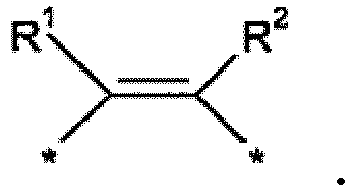
- Oligomère ou polymère de formule (1) selon la revendication 1 ou 2, dans lequel E est

- Oligomère ou polymère de formule (1) selon l'une quelconque des revendications 1 à 3, dans lequel R1 et R2 sont identiques ou différents et sont chacun H ou un groupe alkyle en C1-20, de préférence encore alkyle en C1-6.
- Oligomère ou polymère de formule (1) selon l'une quelconque des revendications 1, 2 et 4, dans lequel R3 est -X5-Ar7, -X5-Ar8-Ar7, -X5-Ar8-R13 ou -X5-Ar8-Ar9-R13,
où
X5 à chaque occurrence est une liaison covalente,
Ar7 à chaque occurrence est indépendamment un groupe aryle en C6-14 ou un résidu hétérocyclique aromatique à 5 à 14 chaînons monovalent, chacun éventuellement substitué par 1 à 5 substituants Re, chaque Re étant indépendamment choisi dans le groupe constitué par les substituants halogéno, CN, alkyle en C1-6, alcoxy en C1-6 et halogénoalkyle en C1-6,
Ar8 et Ar9 à chaque occurrence sont chacun indépendamment un groupe arylène en C6-14 ou un résidu hétérocyclique aromatique à 5 à 14 chaînons divalent, chacun éventuellement substitué par 1 à 4 substituants Rf, chaque Rf étant indépendamment choisi dans le groupe constitué par les substituants halogéno, CN, alkyle en C1-6, alcoxy en C1-6 et halogénoalkyle en C1-6, et
R13 à chaque occurrence est indépendamment un groupe alkyle en C1-20, alcényle en C2-20, halogénoalkyle en C1-20 ou alcoxy en C1-20. - Oligomère ou polymère de formule (1) selon l'une quelconque des revendications 1, 2, 4 et 6, dans lequel R3 est -X5-Ar8-R13,
où
X5 est une liaison covalente,
Ar8 est un groupe arylène en C6-14, de préférence phénylène, et
R13 est un groupe alkyle en C1-20. - Oligomère ou polymère de formule (1) selon l'une quelconque des revendications précédentes, dans lequel G1 et G2 sont identiques ou différents et sont chacun un groupe phénylène, tel que


les groupes alkyle en C1-30, cycloalkyle en C3-10, aryle en C6-14, résidu hétérocyclique aliphatique à 3 à 12 chaînons monovalent et résidu hétérocyclique aromatique à 5 à 14 chaînons monovalent étant éventuellement substitués par 1 à 4 substituants Rj, chaque Rj étant indépendamment choisi dans le groupe constitué par les substituants halogéno, -CN et *=O, et
les groupes cycloalkyle en C3-10, aryle en C6-14, résidu hétérocyclique aliphatique à 3 à 12 chaînons monovalent et résidu hétérocyclique aromatique à 5 à 14 chaînons monovalent étant éventuellement substitués par 1 à 4 substituants Rk, chaque Rk étant indépendamment choisi dans le groupe constitué par les substituants alkyle en C1-20, alcoxy en C1-20, halogénoalkyle en C1-20,
où
Z17 à chaque occurrence est indépendamment un groupe alkylène en C1-6, halogénoalkylène en C1-6 ou une liaison covalente. - Oligomère ou polymère de formule (1) selon l'une quelconque des revendications précédentes, dans lequel G1 et G2 sont identiques ou différents et sont chacun un résidu hétérocyclique aromatique à 5 à 8 chaînons monocyclique divalent lequel résidu hétérocyclique aromatique à 5 à 8 chaînons monocyclique divalent est

les groupes alkyle en C1-30 et aryle en C6-14 étant éventuellement substitués par 1 à 4 substituants Rj, chaque Rj étant indépendamment choisi dans le groupe constitué par les substituants halogéno, -CN et *=O, et le groupe aryle en C6-14 étant éventuellement substitué par 1 à 4 substituants Rk, chaque Rk étant indépendamment choisi dans le groupe constitué par les substituants alkyle en C1-20 et alcoxy en C1-20,
où
Z17 à chaque occurrence est une liaison covalente. - Oligomère ou polymère de formule (1) selon les revendications 1, 8 et 9, dans lequel chaque Ri est indépendamment un groupe alkyle en C1-30, de préférence n-octyle, n-(2-éthyl)hexyle, n-nonyle, n-décyle, n-undécyle, n-dodécyle, n-undécyle, n-dodécyle, n-tridécyle, n-tétradécyle, n-pentadécyle, n-hexadécyle, n-heptadécyle, n-octadécyle, n-nonadécyle et n-éicosyle (C20), de préférence encore n-dodécyle.
- Oligomère ou polymère de formule (1) selon une quelconque revendication précédente, dans lequel L est un résidu hétérocyclique aromatique à 5 à 18 chaînons divalent, le résidu hétérocyclique aromatique à 5 à 18 chaînons divalent étant éventuellement substitué par 1 à 4 substituants Rl, chaque Rl étant indépendamment choisi dans le groupe constitué par les substituants alkyle en C1-30, -Z18-O-(alkyle en C1-30), -Z18-S-(alkyle en C1-30), -Z18-(cycloalkyle en C3-10), -Z18-(aryle en C6-14), -Z18-(résidu hétérocyclique aliphatique à 3 à 12 chaînons monovalent) et -Z18-(résidu hétérocyclique aromatique à 5 à 14 chaînons monovalent),
les groupes alkyle en C1-30, cycloalkyle en C3-10, aryle en C6-14, résidu hétérocyclique aliphatique à 3 à 12 chaînons monovalent et résidu hétérocyclique aromatique à 5 à 14 chaînons monovalent étant éventuellement substitués par 1 à 4 substituants Rm, chaque Rm étant indépendamment choisi dans le groupe constitué par les substituants halogéno, -CN et *=O, et
les groupes cycloalkyle en C3-10, aryle en C6-14, résidu hétérocyclique aliphatique à 3 à 12 chaînons monovalent et résidu hétérocyclique aromatique à 5 à 14 chaînons monovalent étant éventuellement substitués par 1 à 4 substituants Rn, chaque Rn étant indépendamment choisi dans le groupe constitué par les substituants alkyle en C1-20, alcoxy en C1-20, halogénoalkyle en C1-20,
où
Z18 à chaque occurrence est indépendamment un groupe alkylène en C1-6, halogénoalkylène en C1-6 ou une liaison covalente,
ou
L est R23 et R24 sont identiques ou différents et sont chacun H ou un groupe halogéno, -CN, alkyle en C1-30, alcényle en C2-30, halogénoalkyle en C1-30, -X7-R25, -X8-Ar13, -X8-Ar14-Ar13, -X8-Ar14-R26 ou -X8-Ar14-Ar15-R26,
oùX7 à chaque occurrence est indépendamment -O-, -[Z19-O]c-, -[O-Z19]c-O-, -S-, -[Z19-S]c- ou -[S-Z19]c-S-,
oùZ19 à chaque occurrence est indépendamment un groupe alkylène en C1-6, alcénylène en C2-6 ou halogénoalkylène en C1-6,c à chaque occurrence est indépendamment un nombre entier de 1 à 10 etR25 à chaque occurrence est indépendamment un groupe alkyle en C1-30, alcényle en C2-30 ou halogénoalkyle en C1-30,X8 à chaque occurrence est indépendamment un groupe -Z21-O-Z22-, -Z21-S-Z22-, alkylène en C1-30, alcénylène en C2-30 ou halogénoalkylène en C1-30 ou une liaison covalente,
oùZ21 et Z22 à chaque occurrence sont chacun indépendamment un groupe alkylène en C1-6, alcénylène en C2-6, halogénoalkylène en C1-6 ou une liaison covalente, etAr13 à chaque occurrence est indépendamment un groupe aryle en C6-14 ou un résidu hétérocyclique aromatique à 5 à 14 chaînons monovalent, chacun éventuellement substitué par 1 à 5 substituants R°, chaque R° étant indépendamment choisi dans le groupe constitué par les substituants halogéno, CN, alkyle en C1-6, alcoxy en C1-6 et halogénoalkyle en C1-6,Ar14 et Ar15 à chaque occurrence sont chacun indépendamment un groupe arylène en C6-14 ou un résidu hétérocyclique aromatique à 5 à 14 chaînons divalent, chacun éventuellement substitué par 1 à 4 substituants Rp, chaque Rp étant indépendamment choisi dans le groupe constitué par les substituants halogéno, CN, alkyle en C1-6, alcoxy en C1-6 et halogénoalkyle en C1-6, etR26 à chaque occurrence est indépendamment un groupe alkyle en C1-20, alcényle en C2-20, halogénoalkyle en C1-20 ou alcoxy en C1-20. - Oligomère ou polymère de formule (1) selon une quelconque revendication précédente, dans lequel L est un résidu hétérocyclique aromatique à 5 à 18 chaînons divalent choisi dans le groupe constitué par



les groupes alkyle en C1-30, cycloalkyle en C3-10, aryle en C6-14, résidu hétérocyclique aliphatique à 3 à 12 chaînons monovalent et résidu hétérocyclique aromatique à 5 à 14 chaînons monovalent étant éventuellement substitués par 1 à 4 substituants Rm, chaque Rm étant indépendamment choisi dans le groupe constitué par les substituants halogéno, -CN, et *=O,
les groupes cycloalkyle en C3-10, aryle en C6-14, résidu hétérocyclique aliphatique à 3 à 12 chaînons monovalent et résidu hétérocyclique aromatique à 5 à 14 chaînons monovalent étant éventuellement substitués par 1 à 4 substituants Rn, chaque Rn étant indépendamment choisi dans le groupe constitué par les substituants alkyle en C1-20, alcoxy en C1-20, halogénoalkyle en C1-20,
où Z18 à chaque occurrence est indépendamment un groupe alkylène en C1-6, halogénoalkylène en C1-6 ou une liaison covalente
et
où Rt est l'atome d'hydrogène ou un groupe alkyle en C1-30,
ou
L est
R23 et R24 sont identiques ou différents et sont chacun H ou un groupe halogéno, -CN, alkyle en C1-30, alcényle en C2-30, halogénoalkyle en C1-30, -X7-R25, -X8-Ar13, -X8-Ar14-Ar13, -X8-Ar14-R26 ou -X8-Ar14-Ar15-R26, où X7 à chaque occurrence est indépendamment -O-, -[Z19-O]c-, -[O-Z19]c-O-, -S-, -[Z19-S]c-, ou -[S-Z19]c-S-,
où
Z19 à chaque occurrence est indépendamment un groupe alkylène en C1-6, alcénylène en C2-6 ou halogénoalkylène en C1-6, c à chaque occurrence est indépendamment un nombre entier de 1 à 10 et
R25 à chaque occurrence est indépendamment un groupe alkyle en C1-30, alcényle en C2-30 ou halogénoalkyle en C1-30, X8 à chaque occurrence est indépendamment un groupe -Z21-O-Z22-, -Z21-S-Z22-, alkylène en C1-30, alcénylène en C2-30, halogénoalkylène en C1-30 ou une liaison covalente où
Z21 et Z22 à chaque occurrence sont chacun indépendamment un groupe alkylène en C1-6, alcénylène en C2-6, halogénoalkylène en C1-6 ou une liaison covalente et
Ar13 à chaque occurrence est indépendamment un groupe aryle en C6-14 ou un résidu hétérocyclique aromatique à 5 à 14 chaînons monovalent, chacun éventuellement substitué par 1 à 5 substituants R°, chaque R° étant indépendamment choisi dans le groupe constitué par les substituants halogéno, CN, alkyle en C1-6, alcoxy en C1-6 et halogénoalkyle en C1-6, Ar14 et Ar15 à chaque occurrence sont chacun indépendamment un groupe arylène en C6-14 ou un résidu hétérocyclique aromatique à 5 à 14 chaînons divalent, chacun éventuellement substitué par 1 à 4 substituants Rp, chaque Rp étant indépendamment choisi dans le groupe constitué par les substituants halogéno, CN, alkyle en C1-6, alcoxy en C1-6 et halogénoalkyle en C1-6, et R26 à chaque occurrence est indépendamment un groupe alkyle en C1-20, alcényle en C2-20, halogénoalkyle en C1-20, ou alcoxy en C1-20. - Oligomère ou polymère de formule (1) selon une quelconque revendication précédente, dans lequel
L est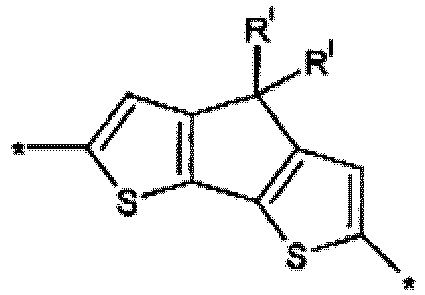
ou
L est
R23 et R24 sont identiques ou différents et ont la signification telle que décrite dans la revendication 12. - Oligomère ou polymère de formule (1) selon l'une quelconque des revendications 1 et 11 à 13, dans lequel R1 est indépendamment choisi dans le groupe constitué par les groupes alkyle en C1-30 et -Z18-(aryle en C6-14),
les groupes alkyle en C1-30 et aryle en C6-14 étant éventuellement substitués par 1 à 4 substituants Rm, chaque Rm étant indépendamment choisi dans le groupe constitué par les substituants halogéno, -CN et *=O, et
le groupe aryle en C6-14 étant éventuellement substitué par 1 à 4 substituants Rn, chaque Rn étant indépendamment choisi dans le groupe constitué par les substituants alkyle en C1-20 et alcoxy en C1-20,
où
Z18 à chaque occurrence est une liaison covalente,
et
R23 et R24 sont identiques ou différents et sont chacun H ou un groupe alkyle en C1-30, halogénoalkyle en C1-30, -X7-R25 ou -X8-Ar13,
où
X7 à chaque occurrence est indépendamment -[Z19-O]c-, -[Z19-S]c- ou - [S-Z19]c-S-, où
Z19 à chaque occurrence est indépendamment un groupe alkylène en C1-6 ou halogénoalkylène en C1-6,
c à chaque occurrence est indépendamment un nombre entier de 1 à 10 et
R25 à chaque occurrence est indépendamment un groupe alkyle en C1-30 ou halogénoalkyle en C1-30,
X8 à chaque occurrence est indépendamment un groupe -Z21-O-Z22-, -Z21-S-Z22-, alkylène en C1-30 ou halogénoalkylène en C1-30, où
Z21 et Z22 à chaque occurrence sont chacun indépendamment un groupe alkylène en C1-6 ou halogénoalkylène en C1-6, et
Ar13 à chaque occurrence est indépendamment un groupe aryle en C6-14, éventuellement substitué par 1 à 5 substituants R°, chaque R° étant indépendamment choisi dans le groupe constitué par les substituants halogéno, alkyle en C1-6 et alcoxy en C1-6. - Oligomère ou polymère de formule (1) selon l'une quelconque des revendications 1 et 11 à 13, dans lequel chaque R1 est indépendamment un groupe alkyle en C1-30, de préférence n-octyle, n-(2-éthyl)hexyle, n-nonyle, n-décyle, n-undécyle, n-dodécyle, n-undécyle, n-dodécyle, n-tridécyle, n-tétradécyle, n-pentadécyle, n-hexadécyle, n-heptadécyle, n-octadécyle, n-nonadécyle et n-éicosyle (C20), de préférence encore n-hexadécyle,
et
R23 et R24 sont identiques ou différents et sont chacun H ou un groupe alkyle en C1-30 ou halogénoalkyle en C1-30, de préférence H. - Oligomère ou polymère de formule (1) selon une quelconque revendication précédente, dans lequel q, r et s valent 0 ou 1, à condition que q, r et s ne vaillent pas tous 0 en même temps.
- Oligomère ou polymère de formule (1) selon une quelconque revendication précédente, dans lequel n est un nombre entier de 2 à 5000, 2 à 1000, 2 à 50 ou de 2 à 30.
- Dispositif électronique comprenant l'oligomère ou polymère de formule (1) selon une quelconque revendication précédente.
- Dispositif électronique selon la revendication 18, le dispositif électronique étant un transistor à effet de champ organique.
- Utilisation de l'oligomère ou polymère de formule (1) selon l'une quelconque des revendications 1 à 17 comme matériau semi-conducteur organique.
Priority Applications (1)
| Application Number | Priority Date | Filing Date | Title |
|---|---|---|---|
| EP11738716.7A EP2601236B1 (fr) | 2010-08-05 | 2011-07-29 | Matériaux semi-conducteurs préparés à partir de copolymères de bithiazole pontés |
Applications Claiming Priority (4)
| Application Number | Priority Date | Filing Date | Title |
|---|---|---|---|
| US37085710P | 2010-08-05 | 2010-08-05 | |
| EP10172083 | 2010-08-05 | ||
| EP11738716.7A EP2601236B1 (fr) | 2010-08-05 | 2011-07-29 | Matériaux semi-conducteurs préparés à partir de copolymères de bithiazole pontés |
| PCT/EP2011/063109 WO2012016925A2 (fr) | 2010-08-05 | 2011-07-29 | Matériaux semi-conducteurs préparés à partir de copolymères de bithiazole pontés |
Publications (2)
| Publication Number | Publication Date |
|---|---|
| EP2601236A2 EP2601236A2 (fr) | 2013-06-12 |
| EP2601236B1 true EP2601236B1 (fr) | 2016-11-02 |
Family
ID=43466510
Family Applications (1)
| Application Number | Title | Priority Date | Filing Date |
|---|---|---|---|
| EP11738716.7A Not-in-force EP2601236B1 (fr) | 2010-08-05 | 2011-07-29 | Matériaux semi-conducteurs préparés à partir de copolymères de bithiazole pontés |
Country Status (6)
| Country | Link |
|---|---|
| US (2) | US20130144065A1 (fr) |
| EP (1) | EP2601236B1 (fr) |
| JP (1) | JP5693722B2 (fr) |
| KR (1) | KR101522112B1 (fr) |
| CN (1) | CN103052643B (fr) |
| WO (1) | WO2012016925A2 (fr) |
Families Citing this family (12)
| Publication number | Priority date | Publication date | Assignee | Title |
|---|---|---|---|---|
| WO2013023109A1 (fr) * | 2011-08-10 | 2013-02-14 | Georgia Tech Research Corporation | Composés hétéroarylés couplés par l'intermédiaire d'un réarrangement d'hétéroaromatiques halogénés suivi par un couplage oxydant (composés à cœurs tricycliques couplés) |
| WO2013023108A1 (fr) * | 2011-08-10 | 2013-02-14 | Georgia Tech Research Corporation | Composés hétéroarylés couplés par un réarrangement d'hétéroaromatiques halogénés suivi par un couplage oxydant (fraction espaceur hétéroarylène) |
| WO2013023106A1 (fr) * | 2011-08-10 | 2013-02-14 | Georgia Tech Research Corporation | Composés hétéroarylés couplés par un réarrangement d'hétéroaromatiques halogénés suivi par un couplage oxydant (fractions acyle) |
| JP5807497B2 (ja) * | 2011-10-03 | 2015-11-10 | 住友化学株式会社 | 高分子化合物及びそれを用いた電子素子 |
| JP2014114265A (ja) * | 2012-12-12 | 2014-06-26 | Kuraray Co Ltd | ジチオフェン化合物及びそのジチオフェン基を有するπ電子共役重合体、並びにその重合体を用いた有機半導体デバイス |
| EP3194469B1 (fr) | 2014-09-19 | 2019-06-12 | Momentive Performance Materials Inc. | Complexes platine (ii) diène pour réticulation de siloxane contrôlée |
| EP3385298B1 (fr) * | 2017-04-03 | 2019-10-30 | Qatar Foundation For Education Science And Community Development | Procédé de fabrication d'un homopolymère de pyrrolo bisthiazole |
| US10927214B2 (en) | 2017-04-04 | 2021-02-23 | Qatar Foundation For Education, Science And Community Development | Method of making a pyrrolo bisthiazole homopolymer |
| US11274178B2 (en) | 2018-07-18 | 2022-03-15 | Phillips 66 Company | High performance wide-bandgap polymers for organic photovoltaics |
| BR112020001847A2 (pt) * | 2017-07-28 | 2020-09-01 | Phillips 66 Company | polímeros de larga faixa de energia proibida de alto desempenho para fotovoltaico orgânico |
| KR102110990B1 (ko) * | 2017-11-03 | 2020-05-14 | 삼성에스디아이 주식회사 | 중합체, 유기막 조성물 및 패턴 형성 방법 |
| JP7834322B2 (ja) * | 2021-08-23 | 2026-03-24 | 国立大学法人広島大学 | 共役系重合体、共役系化合物、これを用いた電子供与性有機材料、光起電力素子用材料および光起電力素子 |
Family Cites Families (11)
| Publication number | Priority date | Publication date | Assignee | Title |
|---|---|---|---|---|
| SU503197A1 (ru) * | 1974-05-29 | 1976-02-15 | Всесоюзный Государственный Научно-Исследовательский И Проектный Институт Химико-Фотографической Промышленности | Везикул рный материал |
| KR900003149B1 (ko) * | 1981-12-28 | 1990-05-09 | 제이.에이.부캐넌, 주니어 | 전기활성을 띈 중합체로 결합된 전지 |
| IL67556A (en) * | 1981-12-28 | 1987-10-20 | Chevron Res | Batteries fabricated with electroactive polymers |
| JPS5915256A (ja) * | 1982-07-19 | 1984-01-26 | Ricoh Co Ltd | 乾式電子写真用正荷電トナ− |
| US4522745A (en) * | 1982-11-17 | 1985-06-11 | Chevron Research Company | Fused 5,6,5-membered heterocyclic electroactive polymers |
| DE502006000749D1 (de) * | 2006-03-21 | 2008-06-19 | Novaled Ag | Heterocyclisches Radikal oder Diradikal, deren Dimere, Oligomere, Polymere, Dispiroverbindungen und Polycyclen, deren Verwendung, organisches halbleitendes Material sowie elektronisches Bauelement |
| US8008424B2 (en) * | 2006-10-11 | 2011-08-30 | Konarka Technologies, Inc. | Photovoltaic cell with thiazole-containing polymer |
| US8378338B2 (en) * | 2007-11-30 | 2013-02-19 | Sumitomo Chemical Company, Limited | Conjugated compound, nitrogenated condensed-ring compound, nitrogenated condensed-ring polymer, organic thin film, and organic thin film element |
| TW201002722A (en) * | 2008-01-22 | 2010-01-16 | Ricoh Co Ltd | Benzobisthiazole compound, benzobisthiazole polymer, organic film including the compound or polymer and transistor including the organic film |
| WO2010079064A2 (fr) * | 2008-12-18 | 2010-07-15 | Basf Se | Matériaux semi-conducteurs préparés à partir de copolymères de dithiénylvinylène |
| US20110006287A1 (en) * | 2009-07-10 | 2011-01-13 | Wei You | Polymers with tunable band gaps for photonic and electronic applications |
-
2011
- 2011-07-29 KR KR1020137005494A patent/KR101522112B1/ko not_active Expired - Fee Related
- 2011-07-29 JP JP2013522215A patent/JP5693722B2/ja not_active Expired - Fee Related
- 2011-07-29 US US13/810,819 patent/US20130144065A1/en not_active Abandoned
- 2011-07-29 CN CN201180038511.7A patent/CN103052643B/zh not_active Expired - Fee Related
- 2011-07-29 EP EP11738716.7A patent/EP2601236B1/fr not_active Not-in-force
- 2011-07-29 WO PCT/EP2011/063109 patent/WO2012016925A2/fr not_active Ceased
-
2015
- 2015-02-12 US US14/620,755 patent/US9570688B2/en active Active
Also Published As
| Publication number | Publication date |
|---|---|
| JP5693722B2 (ja) | 2015-04-01 |
| JP2013538257A (ja) | 2013-10-10 |
| CN103052643A (zh) | 2013-04-17 |
| KR101522112B1 (ko) | 2015-05-20 |
| WO2012016925A2 (fr) | 2012-02-09 |
| US9570688B2 (en) | 2017-02-14 |
| WO2012016925A3 (fr) | 2012-10-11 |
| US20130144065A1 (en) | 2013-06-06 |
| EP2601236A2 (fr) | 2013-06-12 |
| KR20130052623A (ko) | 2013-05-22 |
| US20150162546A1 (en) | 2015-06-11 |
| CN103052643B (zh) | 2016-03-09 |
Similar Documents
| Publication | Publication Date | Title |
|---|---|---|
| EP2601236B1 (fr) | Matériaux semi-conducteurs préparés à partir de copolymères de bithiazole pontés | |
| US10396286B2 (en) | Regioregular pyridal[2,1,3]thiadiazole π-conjugated copolymers for organic semiconductors | |
| EP2702086B1 (fr) | Matériaux semi-conducteurs basés sur des copolymères de dicétopipéridinopipéridine | |
| EP2702087B1 (fr) | Matériaux semi-conducteurs à base d'oligomères et de polymères de thienothiophène-2,5-dione | |
| KR20140129080A (ko) | 반도체성 고분자 | |
| Ashraf et al. | Fused ring thiophene-based poly (heteroarylene ethynylene) s for organic solar cells | |
| Kim et al. | Photovoltaic properties of a new quinoxaline-based copolymer with Thieno [3, 2-b] thiophene side chain for organic photovoltaic cell applications | |
| Kim et al. | High open-circuit voltage organic photovoltaic cells fabricated using semiconducting copolymers consisting of bithiophene and fluorinated quinoxaline or triazole derivatives | |
| JP5946273B2 (ja) | 有機半導体化合物および、これを含むトランジスタと電子素子 | |
| Kim et al. | New naphthalene diimide-based n-type copolymers: The effects of conjugated side chains | |
| US8436127B2 (en) | Semiconductor materials based on diketopiperidinopiperidine copolymers | |
| KR101486693B1 (ko) | 디티에노피리돈 공중합체 기재의 반도체 물질 | |
| Deng et al. | Synthesis, field-effect and photovoltaic properties of random difluorobenzothiadiazole-isoindigo electron donor-acceptor polymers | |
| CN110872376B (zh) | 环化靛蓝受体及聚合物及其制备方法与应用 | |
| WO2019041047A1 (fr) | Polymères et monomères de dithiényl-dicétopyrrolopyrrole fluorés et leurs utilisations | |
| KR101935466B1 (ko) | 유기 전자 소자 | |
| KR101375563B1 (ko) | 전도성 고분자, 이를 이용한 유기 광전변환재료 및 유기 태양전지 | |
| KR20130085860A (ko) | 유기 전자 소자 | |
| US8394919B2 (en) | Semiconductor materials based on dithienopyridone copolymers | |
| US8431680B2 (en) | Semiconductor materials based on thienothiophene-2,5-dione oligomers and polymers | |
| KR101947020B1 (ko) | 낮은 밴드 갭을 갖는 유기 반도체 화합물 및 이를 포함하는 트랜지스터와 전자 소자 |
Legal Events
| Date | Code | Title | Description |
|---|---|---|---|
| PUAI | Public reference made under article 153(3) epc to a published international application that has entered the european phase |
Free format text: ORIGINAL CODE: 0009012 |
|
| 17P | Request for examination filed |
Effective date: 20130411 |
|
| AK | Designated contracting states |
Kind code of ref document: A2 Designated state(s): AL AT BE BG CH CY CZ DE DK EE ES FI FR GB GR HR HU IE IS IT LI LT LU LV MC MK MT NL NO PL PT RO RS SE SI SK SM TR |
|
| DAX | Request for extension of the european patent (deleted) | ||
| GRAP | Despatch of communication of intention to grant a patent |
Free format text: ORIGINAL CODE: EPIDOSNIGR1 |
|
| INTG | Intention to grant announced |
Effective date: 20160114 |
|
| GRAP | Despatch of communication of intention to grant a patent |
Free format text: ORIGINAL CODE: EPIDOSNIGR1 |
|
| INTG | Intention to grant announced |
Effective date: 20160616 |
|
| GRAS | Grant fee paid |
Free format text: ORIGINAL CODE: EPIDOSNIGR3 |
|
| GRAA | (expected) grant |
Free format text: ORIGINAL CODE: 0009210 |
|
| AK | Designated contracting states |
Kind code of ref document: B1 Designated state(s): AL AT BE BG CH CY CZ DE DK EE ES FI FR GB GR HR HU IE IS IT LI LT LU LV MC MK MT NL NO PL PT RO RS SE SI SK SM TR |
|
| REG | Reference to a national code |
Ref country code: GB Ref legal event code: FG4D |
|
| REG | Reference to a national code |
Ref country code: AT Ref legal event code: REF Ref document number: 841807 Country of ref document: AT Kind code of ref document: T Effective date: 20161115 Ref country code: CH Ref legal event code: EP |
|
| REG | Reference to a national code |
Ref country code: IE Ref legal event code: FG4D |
|
| REG | Reference to a national code |
Ref country code: DE Ref legal event code: R096 Ref document number: 602011031921 Country of ref document: DE |
|
| PG25 | Lapsed in a contracting state [announced via postgrant information from national office to epo] |
Ref country code: LV Free format text: LAPSE BECAUSE OF FAILURE TO SUBMIT A TRANSLATION OF THE DESCRIPTION OR TO PAY THE FEE WITHIN THE PRESCRIBED TIME-LIMIT Effective date: 20161102 |
|
| REG | Reference to a national code |
Ref country code: NL Ref legal event code: MP Effective date: 20161102 |
|
| REG | Reference to a national code |
Ref country code: LT Ref legal event code: MG4D |
|
| REG | Reference to a national code |
Ref country code: AT Ref legal event code: MK05 Ref document number: 841807 Country of ref document: AT Kind code of ref document: T Effective date: 20161102 |
|
| PG25 | Lapsed in a contracting state [announced via postgrant information from national office to epo] |
Ref country code: LT Free format text: LAPSE BECAUSE OF FAILURE TO SUBMIT A TRANSLATION OF THE DESCRIPTION OR TO PAY THE FEE WITHIN THE PRESCRIBED TIME-LIMIT Effective date: 20161102 Ref country code: NL Free format text: LAPSE BECAUSE OF FAILURE TO SUBMIT A TRANSLATION OF THE DESCRIPTION OR TO PAY THE FEE WITHIN THE PRESCRIBED TIME-LIMIT Effective date: 20161102 Ref country code: NO Free format text: LAPSE BECAUSE OF FAILURE TO SUBMIT A TRANSLATION OF THE DESCRIPTION OR TO PAY THE FEE WITHIN THE PRESCRIBED TIME-LIMIT Effective date: 20170202 Ref country code: GR Free format text: LAPSE BECAUSE OF FAILURE TO SUBMIT A TRANSLATION OF THE DESCRIPTION OR TO PAY THE FEE WITHIN THE PRESCRIBED TIME-LIMIT Effective date: 20170203 Ref country code: SE Free format text: LAPSE BECAUSE OF FAILURE TO SUBMIT A TRANSLATION OF THE DESCRIPTION OR TO PAY THE FEE WITHIN THE PRESCRIBED TIME-LIMIT Effective date: 20161102 |
|
| PG25 | Lapsed in a contracting state [announced via postgrant information from national office to epo] |
Ref country code: FI Free format text: LAPSE BECAUSE OF FAILURE TO SUBMIT A TRANSLATION OF THE DESCRIPTION OR TO PAY THE FEE WITHIN THE PRESCRIBED TIME-LIMIT Effective date: 20161102 Ref country code: PT Free format text: LAPSE BECAUSE OF FAILURE TO SUBMIT A TRANSLATION OF THE DESCRIPTION OR TO PAY THE FEE WITHIN THE PRESCRIBED TIME-LIMIT Effective date: 20170302 Ref country code: AT Free format text: LAPSE BECAUSE OF FAILURE TO SUBMIT A TRANSLATION OF THE DESCRIPTION OR TO PAY THE FEE WITHIN THE PRESCRIBED TIME-LIMIT Effective date: 20161102 Ref country code: HR Free format text: LAPSE BECAUSE OF FAILURE TO SUBMIT A TRANSLATION OF THE DESCRIPTION OR TO PAY THE FEE WITHIN THE PRESCRIBED TIME-LIMIT Effective date: 20161102 Ref country code: PL Free format text: LAPSE BECAUSE OF FAILURE TO SUBMIT A TRANSLATION OF THE DESCRIPTION OR TO PAY THE FEE WITHIN THE PRESCRIBED TIME-LIMIT Effective date: 20161102 Ref country code: ES Free format text: LAPSE BECAUSE OF FAILURE TO SUBMIT A TRANSLATION OF THE DESCRIPTION OR TO PAY THE FEE WITHIN THE PRESCRIBED TIME-LIMIT Effective date: 20161102 Ref country code: IS Free format text: LAPSE BECAUSE OF FAILURE TO SUBMIT A TRANSLATION OF THE DESCRIPTION OR TO PAY THE FEE WITHIN THE PRESCRIBED TIME-LIMIT Effective date: 20170302 Ref country code: RS Free format text: LAPSE BECAUSE OF FAILURE TO SUBMIT A TRANSLATION OF THE DESCRIPTION OR TO PAY THE FEE WITHIN THE PRESCRIBED TIME-LIMIT Effective date: 20161102 |
|
| REG | Reference to a national code |
Ref country code: DE Ref legal event code: R081 Ref document number: 602011031921 Country of ref document: DE Owner name: FLEXTERRA, INC., SKOKIE, US Free format text: FORMER OWNERS: BASF SE, 67063 LUDWIGSHAFEN, DE; POLYERA CORPORATION, SKOKIE, IL., US Ref country code: DE Ref legal event code: R081 Ref document number: 602011031921 Country of ref document: DE Owner name: BASF SE, DE Free format text: FORMER OWNERS: BASF SE, 67063 LUDWIGSHAFEN, DE; POLYERA CORPORATION, SKOKIE, IL., US |
|
| REG | Reference to a national code |
Ref country code: FR Ref legal event code: PLFP Year of fee payment: 7 |
|
| PG25 | Lapsed in a contracting state [announced via postgrant information from national office to epo] |
Ref country code: RO Free format text: LAPSE BECAUSE OF FAILURE TO SUBMIT A TRANSLATION OF THE DESCRIPTION OR TO PAY THE FEE WITHIN THE PRESCRIBED TIME-LIMIT Effective date: 20161102 Ref country code: CZ Free format text: LAPSE BECAUSE OF FAILURE TO SUBMIT A TRANSLATION OF THE DESCRIPTION OR TO PAY THE FEE WITHIN THE PRESCRIBED TIME-LIMIT Effective date: 20161102 Ref country code: EE Free format text: LAPSE BECAUSE OF FAILURE TO SUBMIT A TRANSLATION OF THE DESCRIPTION OR TO PAY THE FEE WITHIN THE PRESCRIBED TIME-LIMIT Effective date: 20161102 Ref country code: DK Free format text: LAPSE BECAUSE OF FAILURE TO SUBMIT A TRANSLATION OF THE DESCRIPTION OR TO PAY THE FEE WITHIN THE PRESCRIBED TIME-LIMIT Effective date: 20161102 Ref country code: SK Free format text: LAPSE BECAUSE OF FAILURE TO SUBMIT A TRANSLATION OF THE DESCRIPTION OR TO PAY THE FEE WITHIN THE PRESCRIBED TIME-LIMIT Effective date: 20161102 |
|
| REG | Reference to a national code |
Ref country code: DE Ref legal event code: R097 Ref document number: 602011031921 Country of ref document: DE |
|
| REG | Reference to a national code |
Ref country code: DE Ref legal event code: R082 Ref document number: 602011031921 Country of ref document: DE |
|
| PG25 | Lapsed in a contracting state [announced via postgrant information from national office to epo] |
Ref country code: BE Free format text: LAPSE BECAUSE OF FAILURE TO SUBMIT A TRANSLATION OF THE DESCRIPTION OR TO PAY THE FEE WITHIN THE PRESCRIBED TIME-LIMIT Effective date: 20161102 Ref country code: SM Free format text: LAPSE BECAUSE OF FAILURE TO SUBMIT A TRANSLATION OF THE DESCRIPTION OR TO PAY THE FEE WITHIN THE PRESCRIBED TIME-LIMIT Effective date: 20161102 Ref country code: BG Free format text: LAPSE BECAUSE OF FAILURE TO SUBMIT A TRANSLATION OF THE DESCRIPTION OR TO PAY THE FEE WITHIN THE PRESCRIBED TIME-LIMIT Effective date: 20170202 |
|
| PLBE | No opposition filed within time limit |
Free format text: ORIGINAL CODE: 0009261 |
|
| STAA | Information on the status of an ep patent application or granted ep patent |
Free format text: STATUS: NO OPPOSITION FILED WITHIN TIME LIMIT |
|
| 26N | No opposition filed |
Effective date: 20170803 |
|
| REG | Reference to a national code |
Ref country code: GB Ref legal event code: 732E Free format text: REGISTERED BETWEEN 20170928 AND 20171004 |
|
| REG | Reference to a national code |
Ref country code: FR Ref legal event code: TQ Owner name: BASF SE, DE Effective date: 20170920 Ref country code: FR Ref legal event code: TQ Owner name: FLEXTERRA, INC., US Effective date: 20170920 |
|
| PG25 | Lapsed in a contracting state [announced via postgrant information from national office to epo] |
Ref country code: SI Free format text: LAPSE BECAUSE OF FAILURE TO SUBMIT A TRANSLATION OF THE DESCRIPTION OR TO PAY THE FEE WITHIN THE PRESCRIBED TIME-LIMIT Effective date: 20161102 |
|
| REG | Reference to a national code |
Ref country code: CH Ref legal event code: PL |
|
| PG25 | Lapsed in a contracting state [announced via postgrant information from national office to epo] |
Ref country code: LI Free format text: LAPSE BECAUSE OF NON-PAYMENT OF DUE FEES Effective date: 20170731 Ref country code: CH Free format text: LAPSE BECAUSE OF NON-PAYMENT OF DUE FEES Effective date: 20170731 |
|
| REG | Reference to a national code |
Ref country code: IE Ref legal event code: MM4A |
|
| PG25 | Lapsed in a contracting state [announced via postgrant information from national office to epo] |
Ref country code: LU Free format text: LAPSE BECAUSE OF NON-PAYMENT OF DUE FEES Effective date: 20170729 |
|
| REG | Reference to a national code |
Ref country code: FR Ref legal event code: PLFP Year of fee payment: 8 |
|
| PG25 | Lapsed in a contracting state [announced via postgrant information from national office to epo] |
Ref country code: IE Free format text: LAPSE BECAUSE OF NON-PAYMENT OF DUE FEES Effective date: 20170729 |
|
| PG25 | Lapsed in a contracting state [announced via postgrant information from national office to epo] |
Ref country code: MT Free format text: LAPSE BECAUSE OF NON-PAYMENT OF DUE FEES Effective date: 20170729 |
|
| PGFP | Annual fee paid to national office [announced via postgrant information from national office to epo] |
Ref country code: FR Payment date: 20180726 Year of fee payment: 8 Ref country code: IT Payment date: 20180725 Year of fee payment: 8 |
|
| PGFP | Annual fee paid to national office [announced via postgrant information from national office to epo] |
Ref country code: GB Payment date: 20180731 Year of fee payment: 8 |
|
| PGFP | Annual fee paid to national office [announced via postgrant information from national office to epo] |
Ref country code: DE Payment date: 20180928 Year of fee payment: 8 |
|
| PG25 | Lapsed in a contracting state [announced via postgrant information from national office to epo] |
Ref country code: HU Free format text: LAPSE BECAUSE OF FAILURE TO SUBMIT A TRANSLATION OF THE DESCRIPTION OR TO PAY THE FEE WITHIN THE PRESCRIBED TIME-LIMIT; INVALID AB INITIO Effective date: 20110729 Ref country code: MC Free format text: LAPSE BECAUSE OF FAILURE TO SUBMIT A TRANSLATION OF THE DESCRIPTION OR TO PAY THE FEE WITHIN THE PRESCRIBED TIME-LIMIT Effective date: 20161102 |
|
| PG25 | Lapsed in a contracting state [announced via postgrant information from national office to epo] |
Ref country code: CY Free format text: LAPSE BECAUSE OF NON-PAYMENT OF DUE FEES Effective date: 20161102 |
|
| PG25 | Lapsed in a contracting state [announced via postgrant information from national office to epo] |
Ref country code: MK Free format text: LAPSE BECAUSE OF FAILURE TO SUBMIT A TRANSLATION OF THE DESCRIPTION OR TO PAY THE FEE WITHIN THE PRESCRIBED TIME-LIMIT Effective date: 20161102 |
|
| REG | Reference to a national code |
Ref country code: DE Ref legal event code: R119 Ref document number: 602011031921 Country of ref document: DE |
|
| GBPC | Gb: european patent ceased through non-payment of renewal fee |
Effective date: 20190729 |
|
| PG25 | Lapsed in a contracting state [announced via postgrant information from national office to epo] |
Ref country code: TR Free format text: LAPSE BECAUSE OF FAILURE TO SUBMIT A TRANSLATION OF THE DESCRIPTION OR TO PAY THE FEE WITHIN THE PRESCRIBED TIME-LIMIT Effective date: 20161102 |
|
| PG25 | Lapsed in a contracting state [announced via postgrant information from national office to epo] |
Ref country code: GB Free format text: LAPSE BECAUSE OF NON-PAYMENT OF DUE FEES Effective date: 20190729 Ref country code: DE Free format text: LAPSE BECAUSE OF NON-PAYMENT OF DUE FEES Effective date: 20200201 |
|
| PG25 | Lapsed in a contracting state [announced via postgrant information from national office to epo] |
Ref country code: FR Free format text: LAPSE BECAUSE OF NON-PAYMENT OF DUE FEES Effective date: 20190731 |
|
| PG25 | Lapsed in a contracting state [announced via postgrant information from national office to epo] |
Ref country code: AL Free format text: LAPSE BECAUSE OF FAILURE TO SUBMIT A TRANSLATION OF THE DESCRIPTION OR TO PAY THE FEE WITHIN THE PRESCRIBED TIME-LIMIT Effective date: 20161102 |
|
| PG25 | Lapsed in a contracting state [announced via postgrant information from national office to epo] |
Ref country code: IT Free format text: LAPSE BECAUSE OF NON-PAYMENT OF DUE FEES Effective date: 20190729 |