EP2603185B1 - Valve pour glaucome comprenant un polymère biodégradable avec un agent stéroïdien - Google Patents
Valve pour glaucome comprenant un polymère biodégradable avec un agent stéroïdien Download PDFInfo
- Publication number
- EP2603185B1 EP2603185B1 EP11816699.0A EP11816699A EP2603185B1 EP 2603185 B1 EP2603185 B1 EP 2603185B1 EP 11816699 A EP11816699 A EP 11816699A EP 2603185 B1 EP2603185 B1 EP 2603185B1
- Authority
- EP
- European Patent Office
- Prior art keywords
- pla
- pcl
- copolymer
- polymer
- valve
- Prior art date
- Legal status (The legal status is an assumption and is not a legal conclusion. Google has not performed a legal analysis and makes no representation as to the accuracy of the status listed.)
- Not-in-force
Links
Images



Classifications
-
- A—HUMAN NECESSITIES
- A61—MEDICAL OR VETERINARY SCIENCE; HYGIENE
- A61F—FILTERS IMPLANTABLE INTO BLOOD VESSELS; PROSTHESES; DEVICES PROVIDING PATENCY TO, OR PREVENTING COLLAPSING OF, TUBULAR STRUCTURES OF THE BODY, e.g. STENTS; ORTHOPAEDIC, NURSING OR CONTRACEPTIVE DEVICES; FOMENTATION; TREATMENT OR PROTECTION OF EYES OR EARS; BANDAGES, DRESSINGS OR ABSORBENT PADS; FIRST-AID KITS
- A61F9/00—Methods or devices for treatment of the eyes; Devices for putting in contact-lenses; Devices to correct squinting; Apparatus to guide the blind; Protective devices for the eyes, carried on the body or in the hand
- A61F9/007—Methods or devices for eye surgery
- A61F9/00781—Apparatus for modifying intraocular pressure, e.g. for glaucoma treatment
-
- A—HUMAN NECESSITIES
- A61—MEDICAL OR VETERINARY SCIENCE; HYGIENE
- A61F—FILTERS IMPLANTABLE INTO BLOOD VESSELS; PROSTHESES; DEVICES PROVIDING PATENCY TO, OR PREVENTING COLLAPSING OF, TUBULAR STRUCTURES OF THE BODY, e.g. STENTS; ORTHOPAEDIC, NURSING OR CONTRACEPTIVE DEVICES; FOMENTATION; TREATMENT OR PROTECTION OF EYES OR EARS; BANDAGES, DRESSINGS OR ABSORBENT PADS; FIRST-AID KITS
- A61F2210/00—Particular material properties of prostheses classified in groups A61F2/00 - A61F2/26 or A61F2/82 or A61F9/00 or A61F11/00 or subgroups thereof
- A61F2210/0004—Particular material properties of prostheses classified in groups A61F2/00 - A61F2/26 or A61F2/82 or A61F9/00 or A61F11/00 or subgroups thereof bioabsorbable
Definitions
- the invention relates to a glaucoma valve, a casing for containing a glaucoma valve and a glaucoma drainage device comprising the valve and/or the casing.
- Glaucoma is an ocular disorder associated with elevated intraocular pressures (IOP) that are too high for normal ocular activity and may result in an irreversible loss of visual function.
- IOP intraocular pressures
- a fluid called the aqueous humor functions to maintain pressure in the eye at a range of about 10 to 21 mm Hg.
- the aqueous humor is constantly secreted by the ciliary body, and functions to keep the globe of the eye firm while providing nutrition for the lens and the cornea.
- the aqueous humor is drained away at the base of the iris via a series of channels known as the trabecular meshwork back into the bloodstream. When the aqueous humor drains properly, an appropriate fluid pressure is maintained in the eye.
- glaucoma is not curable by any available treatment method.
- various options are available to control and perhaps delay the progression of the disorder.
- State of the art methods to treat glaucoma include medicinal therapy and surgery.
- eye drops containing a pharmaceutical agent such as latanoprost and levobunolol
- the eye drops may work by improving outflow of aqueous humor from the eye and/or decrease production of aqueous humor by the ciliary body.
- this method may suffer from disadvantages such as undesirable side effects as a result of the medications and ineffective treatment due to poor compliance with medication administration procedures.
- glaucoma In some cases, medicinal therapy alone may not be sufficient to alleviate pressure built-up in the eye. Under these circumstances, surgery may be performed as a next step in glaucoma treatment. Examples of surgical methods for the treatment of glaucoma include trabeculectomy, laser surgery and implantation of glaucoma drainage devices.
- a partial thickness scleral flap is made in the scleral wall of the eye and an opening is made under the flap to excise a section of trabecular meshwork.
- the scleral flap is then loosely sewn back into place so as to allow continuous drainage of the aqueous humor fluid.
- the aqueous humor may flow out of the eye through the opening and may be absorbed through the bloodstream, thereby resulting in a lowered IOP.
- this method may cause excessive scarring around or over the flap, which could decrease the amount of, or prevent the flow of, aqueous humor fluid from the eye. Consequently, IOP may not be adequately lowered.
- hypotemy there may be excessive filtering of the aqueous humor fluid from the eye, a condition termed as hypotemy, which may result in an IOP value that is too low.
- thermal energy from a laser is applied to a number of spots in the trabecular meshwork, with the object to facilitate outflow of aqueous humor from the eye in order to lower the IOP.
- this method suffers from complications such as inflammation of the trabecular meshwork and tissue scarring.
- the doctor may recommend implanting a glaucoma drainage device (GDD) in the affected eye(s).
- GDD glaucoma drainage device
- a GDD is implanted when glaucoma cannot be controlled using medication, trabeculectomy or laser surgery. It may also be used in cases where trabeculectomy or laser surgery would likely fail.
- the GDD works to provide an avenue in which aqueous humor fluid can be drained from the eye so as to lower the IOP.
- State of the art GDD includes a tube that is attached to a plate, such as that for an Ahmed GDD or a Baerveldt® GDD.
- implanting the GDD includes excising the conjunctiva to expose the eye muscles, placing the plate of the GDD between or underneath the eye muscles, and fastening the plate to the underlying sclera with permanent sutures.
- the tube of the GDD is then cut to appropriate length and inserted into the anterior chamber of the eye.
- the conjunctiva is subsequently put into place over the plate to cover the tube.
- An abnormally high late IOP may occur due to formation of a fibrous capsule around the GDD as part of a natural wound healing process after invasive surgery.
- the fibrous capsule may increase the flow resistance by at least partially obstructing the drainage of aqueous humor fluid from the eye, thereby resulting in a higher IOP value compared to the period of time before capsule formation.
- Current state of the art GDDs are not able to mitigate the increase in IOP resulting from fibrous capsule formation. As a result, further surgical intervention is required for glaucoma control.
- the patent publication US 2004/162545 discloses a glaucoma valve, the valve comprising a flow channel having an inlet and an outlet and a valve member connected to the outlet of the flow channel, wherein the valve member comprises a degradable structure.
- the valve is disclosed with a degradable structure to allow a greater flow of fluid after degradation.
- the invention in a first aspect, relates to a glaucoma valve.
- the valve comprises
- the degradable polymer is a biodegradable elastomer.
- the biodegradable elastomer may be polylactic acid (PLA), polycaprolactone (PCL), poly(glycolide) (PLGA), a copolymer of PLA and PCL, a copolymer of PLA, PCL and PLGA, a copolymer of PLA, PCL and trimethylene carbonate (TMC), or a copolymer of PLA, PCL, TMC and polyurethane (PU).
- the copolymer of PLA and PCL has a molar ratio of about 7:3.
- the copolymer of PLA and PCL is a multiblock copolymer of PLA and PCL, or a triblock copolymer of PLA and PCL having PLA as the end-blocks and PCL as the middle block.
- the multiblock copolymer of PLA and PCL may be PCL-PLA-co-PLA-PCL, having a caprolactone content of about 30 % in the first block and an lactic acid content of about 30 % in the second block.
- the PLA end-blocks of the triblock copolymer of PLA and PCL may have a crystallinity of about 10 % to about 20 %.
- the copolymer of PLA, PCL and PLGA is a triblock copolymer having PLA as the end-blocks and a random copolymer of PCL and PLGA as the middle block.
- the copolymer of PLA, PCL and TMC is a triblock copolymer having PLA as the end-blocks and a random copolymer of PCL and TMC as the middle block.
- the PLA end-blocks of the triblock copolymer of PLA, PCL and TMC has a crystallinity of about 10 % to about 20 %.
- the copolymer of PLA, PCL, TMC and PU is a polyurethane with PCL/PLA and PCL/TMC soft segments.
- the polymer has a Young's modulus of about 1 MPa to about 30 MPa. In some embodiments, the polymer has an elongation to break percentage of greater than about 100 %. In some embodiments, the polymer has an elastic recovery value of greater than about 80 %.
- the valve member has a length of about 1 mm to about 10 mm.
- the valve member further comprises a steroid.
- the steroid may be, for example, dexamethasone, fluocinolone, fluocinolone acetonide, triamcinolone, triamcinolone acetonide, salts thereof, derivatives thereof, or mixtures thereof.
- the steroid may be coated on the surface of the valve member.
- the invention in a second aspect, relates to a glaucoma valve.
- the valve comprises a first flow channel.
- the interior of the first flow channel is at least in part coated with a degradable polymer, such that in use, the polymer degrades to allow a greater flow of fluid through the flow channel.
- the polymer is a biodegradable polymer.
- the biodegradable polymer may be polylactic acid (PLA), polycaprolactone (PCL), poly(glycolide) (PLGA), a copolymer of PLA and PCL, a copolymer of PLA, PCL and PLGA, a copolymer of PLA, PCL and trimethylene carbonate (TMC), or a copolymer of PLA, PCL, TMC and polyurethane (PU).
- PLA polylactic acid
- PCL polycaprolactone
- PLGA poly(glycolide)
- a copolymer of PLA and PCL a copolymer of PLA, PCL and PLGA
- TMC trimethylene carbonate
- PU polyurethane
- the glaucoma valve further comprises a second flow channel.
- the second flow channel may be arranged in parallel to the first flow channel.
- the second flow channel is connected in parallel to the first flow channel.
- the first flow channel may be completely sealed with the polymer, such that in use, the polymer degrades to allow fluid to flow through the first flow channel.
- the invention in a third aspect, relates to a casing for containing a glaucoma valve.
- the casing may have a top portion and a bottom portion. Either or both the top portion and the bottom portion may be formed from a biodegradable polymer.
- the biodegradable polymer is PLGA.
- the PLGA may have a lactic acid to glycolic acid ratio of about 3:1 to about 9:1.
- the biodegradable polymer may have a Young's modulus of about 10 to about 1000 MPa.
- the biodegradable polymer may have a degradation time of about 3 weeks to about 12 weeks.
- the invention in a fourth aspect, relates to a glaucoma drainage device comprising a glaucoma valve according to the first aspect or the second aspect, or a casing according to the third aspect.
- the invention relates to use of a glaucoma drainage device according to the fourth aspect for the drainage of aqueous humor in an eye.
- the invention in a first aspect, relates to a glaucoma valve.
- the glaucoma valve includes a flow channel having an inlet and an outlet.
- a valve member is connected to the outlet of the flow channel, in which the valve member comprises a degradable polymer.
- the valve member can be formed from a mixture or combination of a degradable polymer and a non-degradable polymer.
- the valve member may degrade gradually due to action of the aqueous fluid in the body with the biodegradable elastomer.
- a fibrous capsule may be formed around the glaucoma valve as part of the natural healing process.
- formation of the fibrous capsule increases the flow resistance of the glaucoma valve by at least partially obstructing the drainage of aqueous humor fluid from the eye, thereby resulting in a higher IOP value compared to the period of time before capsule formation.
- the flow resistance of the glaucoma valve may be maintained at a constant level or decreases with time as the polymer degrades.
- the IOP may be maintained at a constant level.
- valve refers to a device for regulating and/or directing the flow of a fluid.
- a valve include, but are not limited to, a check valve, a globe valve, a gate valve, a ball valve, a needle valve, a solenoid valve and a spool valve.
- glaucoma valve refers to a valve used in glaucoma drainage devices.
- the glaucoma valve includes a flow channel having an inlet and an outlet.
- the flow channel acts as a conduit for fluid to flow through, and may be of any suitable length.
- the flow channel may have a length of about 5 mm to about 25 mm, such as about 5 mm, 10 mm, 15 mm, 20 mm, or 25 mm.
- the cross-section of the flow channel may be of any shape, such as a square, a triangle, a rectangle, an oval or a circle.
- the flow channel is in the form of a cylindrical tube.
- the cross-section of the flow channel may be characterized by its diameter.
- the term "diameter" as used herein refers to the maximal length of a straight line segment passing through the center of a figure and terminating at the periphery. Accordingly, the outer diameter of the flow channel refers to the maximal length of a line segment passing through the centre and connecting two points on the outer wall of the flow channel, whereas the inner diameter of the flow channel refers to the maximal length of a line segment passing through the centre and connecting two points on the inner wall of the flow channel.
- diameter is used normally to refer to the maximal length of a line segment passing through the centre and connecting two points on the periphery of a circle, it is also used herein to refer to the maximal length of a line segment passing through the centre and connecting two points on the periphery of other shapes, such as a square, triangle, rectangle, oval or circle.
- the diameter of the flow channel may be of any suitable length.
- the outer diameter of the flow channel may be from about 0.1 mm to about 1 mm, such as about 0.1 mm, 0.2 mm, 0.4 mm, 0.6 mm, 0.8 mm or 1 mm.
- the inner diameter of the respective flow channel is smaller than its outer diameter, and is dependent on the wall thickness of the flow channel.
- the inner diameter of the flow channel may be from about 0.05 mm to about 0.5 mm, such as about 0.05 mm, 0.1 mm, 0.2 mm, 0.3 mm, 0.4 mm or 0.5 mm.
- the flow channel may be formed from any material that is suitable for implanting into a living body such as a human.
- the flow channel may be formed from a medical grade polymer such as, but are not limited to, medical grade elastomers, medical grade polyurethane, high density polyethylene, polyethylene, polypropylene and nylon.
- valve member may be connected to the outlet of the flow channel.
- valve member refers to a component in a valve that is used as an obstruction to control or restrict fluid flow through the valve.
- the valve member may extend outwards from the flow channel, and may be of any suitable length.
- the valve member may have a length of about 1 mm to about 10 mm, such as about 1 mm, 2 mm, 4 mm, 6 mm, 8 mm, or about 10 mm.
- the valve member may be of any suitable shape.
- the valve member may be a cylindrical tube, a cube, a sphere or may be irregularly shaped.
- the valve member may have an opening which is normally closed.
- the opening is present as an elongated slit-like opening on the valve member.
- the opening on the valve member may be triggered to open when the IOP exceeds a predetermined pressure level of the valve member.
- IOP may be maintained at a level close to the predetermined pressure level of the valve member.
- the valve member may have a predetermined pressure level of about 10 mm Hg to about 14 mm Hg, such as about 10 mm Hg, 11 mm Hg, 12 mm Hg, 13 mm Hg or 14 mm Hg. In one embodiment, the valve member has a predetermined pressure level of about 10 mm Hg.
- the valve member When the IOP exceeds 10 mm Hg, the valve member opens to allow excess aqueous humor fluid to flow out from the eye, via the tube and out through the opening on the valve member. In this way, IOP may be maintained at a pressure level of about 10 mm Hg.
- the predetermined pressure level of the valve member may depend, for example, on the dimension of the valve member, the size and/or shape of the opening on the valve member, the types of polymer and the tensile modulus of the polymers that is used to form the valve member.
- the valve member may be formed from a degradable polymer.
- degradable refers to a material having a structure which can decompose to smaller molecules under certain conditions, such as temperature, abrasion, pH, ionic strength, electrical voltage, current effects, radiation and biological means.
- the valve member may comprise a biodegradable polymer.
- the valve member consists of a biodegradable polymer.
- biodegradable refers to a substance which can be broken down biologically, for example, when exposed to conditions found in the human body or under environmental conditions commonly found in nature.
- Examples of a biodegradable polymer include, but are not limited to, polymers and oligomers of glycolide, lactide, polylactic acid, polyesters of a-hydroxy acids, including lactic acid and glycolic acid, such as the poly(a-hydroxy) acids including polyglycolic acid, poly-DL-lactic, poly-L-lactic acid, and terpolymers of DL-lactide and glycolide; e-caprolactone and e-caprolactone copolymerized with polyesters; polylactones and polycaprolactones including poly(e-caprolactone), poly(8-valerolactone) and poly (gamma-butyrolactone); polyanhydrides; polyorthoesters; other hydroxy acids; polydioxanone; and other biologically degradable polymers that are non-toxic or are present as metabolites in the body.
- the biodegradable polymer may be a biodegradable elastomer.
- the term "elastomer” refers to polymers having the ability to undergo deformation under the influence of a force and regain its original shape once the force is removed.
- the biodegradable elastomer according to various embodiments of the present invention may be polylactic acid (PLA), polycaprolactone (PCL), poly(glycolide) (PLGA), a copolymer of PLA and PCL, a copolymer of PLA, PCL and PLGA, a copolymer of PLA, PCL and trimethylene carbonate (TMC), a copolymer of PLA, PCL, TMC and polyurethane (PU).
- PLA polylactic acid
- PCL polycaprolactone
- PLGA poly(glycolide)
- a copolymer of PLA and PCL a copolymer of PLA, PCL and PLGA
- TMC trimethylene carbonate
- PU polyurethane
- the biodegradable elastomer is a copolymer of PLA and PCL.
- the copolymer of PLA and PCL may have a molar ratio of about 7:3.
- a multiblock copolymer of PLA and PCL or a triblock copolymer of PLA and PCL having PLA as the end-blocks and PCL as the middle block may be used as the biodegradable elastomer.
- the multiblock copolymer PLA and PCL may be PCL-PLA-co-PLA-PCL, having a caprolactone content of about 30 % in the first block and a lactic acid content of about 30 % in the second block.
- the PLA end-blocks of the triblock copolymer of PLA and PCL may have a crystallinity of about 10 % to about 20 %.
- the biodegradable elastomer is a copolymer of PLA, PCL and PLGA.
- the copolymer of PLA, PCL and PLGA may be a triblock copolymer having PLA as the end-blocks and a random copolymer of PCL and PLGA as the middle block.
- the biodegradable elastomer is a copolymer of PLA, PCL and TMC.
- the copolymer of PLA, PCL and TMC may be a triblock copolymer having PLA as the end-blocks and a random copolymer of PCL and TMC as the middle block.
- the PLA end-blocks of the triblock copolymer may have a crystallinity of about 10 % to about 20 %.
- the biodegradable elastomer is a copolymer of PLA, PCL, TMC and PU.
- the copolymer of PLA, PCL, TMC and PU may be a polyurethane with PCL/PLA and PCL/TMC soft segments.
- the valve member may degrade at the opening, thereby resulting in a larger opening and allowing a larger volume of aqueous humor to be drained out from the eye with time.
- the time at which the valve member starts to degrade and/or the time required for the valve member to degrade may be designed to coincide with the time a fibrous capsule starts to develop around the valve and/or the time required for the fibrous capsule to develop around the valve. In this way, a steady rate aqueous outflow may result and may lead to a lesser extent of IOP fluctuation. Degradation of the valve member can take place over a time period ranging from a few seconds to a few days or months.
- the time period required for the valve member to degrade can be dependent on a few parameters, for example, constituent of valve member such as types of polymer used and the level of crystallinity of the polymer(s), temperature, pH, and amount of aqueous fluid present. Under physiological conditions, that means in an animal body, degradation is in general about 2 months. In some embodiments, the degradation time of the valve member is about 3 weeks to about 12 weeks. In some embodiments, the valve member is completely degraded, leaving only the flow channel.
- the polymer used to form the valve member may exhibit different tensile properties, which may affect the predetermined pressure level of the valve member.
- the polymer that is used to form the valve member may have a Young's modulus of about 1 MPa to about 30 MPa, such as about 1, 2, 4, 10, 20, or 30 MPa.
- the polymer that is used to form the valve member has a Young's modulus of about 10 MPa.
- Young's modulus refers to a mechanical property of a material, expressed as a ratio of stress to corresponding strain when the material behaves elastically under tension.
- the Young's modulus of the polymer used to form the valve member can be measured using any suitable method.
- the Young's modulus of the polymer can be measured using the standard test method for tensile properties of plastics described in American Society for Testing and Materials (ASTM) Standard D882-09.
- the polymer used to form the valve member may have an elongation to break percentage of greater than about 100 %.
- elongation to break refers to the percent elongation of a material under an applied tensile loading at the moment of rupture (break point). Generally, the percent elongation to break is determined based on original length of the polymer under test.
- the elongation to break percentage of the polymer used to form the valve member can be measured using any suitable method, such as that mentioned herein for determining the Young's modulus of the polymer.
- the elastic recovery value of the polymer used to form the valve member is greater than about 80 %.
- the term "elastic recovery value” as used herein refers to the percentage of the elastic deformation to the total deformation of the polymer.
- the elastic recovery value of the polymer used to form the valve member can be determined using any suitable method. For example, in one test for determining the elastic recovery value of the polymers, the polymers under test may be prepared in the same way as that mentioned herein for determining the Young's modulus of the polymers. Subsequently, polymer samples may be pulled to about 100 %, 200 % and 300 % elongations at about 10 mm/min using a microtester.
- the microtester may be stopped and the sample may be taken out of the microtester.
- the polymer samples may recover at different extents to its original dimensions.
- the final sizes, such as length and breath, of the sample may be measured after the samples are allowed to recover for 5 minutes.
- the elastic recovery value may be calculated based on the percentage change in size of the polymer samples from its elongated state to its recovered state.
- FIG. 1A to FIG. 1D are schematic diagrams of a glaucoma valve 100 according to an embodiment of the present invention.
- FIG. 1A shows a glaucoma valve 100 formed from a flow channel 105 and a valve member 110.
- the flow channel 105 has an inlet 102 and an outlet 104.
- the valve member 110 is connected to the outlet 104 of the flow channel 105.
- FIG. 1B depicts the behavior of the glaucoma valve 100 when a fluid flows through it.
- the fluid flows into the flow channel 105 via the inlet 102 and out via the outlet 104.
- the valve member 110 opens to allow outflow of the fluid.
- IOP intraocular pressure
- FIG. 1C shows that the valve member 110 has completely degraded, leaving behind the flow channel 105 only. This may take place after about 12 weeks from implantation.
- the valve member may further include a steroid.
- Steroids are widely used as therapeutic agents for various inflammatory diseases.
- steroids may be used to reduce post-operative inflammation.
- Examples of steroid that may be used in the present invention include, but are not limited to, dexamethasone, fluocinolone, fluocinolone acetonide, triamcinolone, triamcinolone acetonide, salts thereof, derivatives thereof, and mixtures thereof.
- the steroid may be mixed with the polymer used to form the valve member or may be present as a coating on the valve member.
- the steroid constituent or coating may be controlled release at a specific surgical site in a sustained manner, which may make the drug action more effective compared to the administration of eye drops comprising the steroid. Furthermore, as the steroids are released in therapeutic levels concurrently with the degradation of the polymer of the glaucoma valve, this may alleviate the need for self-administration of the eye drops by the patients thereby preventing issues with patient compliance with the medication protocol and potential toxicity from incorrect dosages.
- the invention relates to a glaucoma valve.
- the valve comprises a first flow channel.
- the interior of the first flow channel is at least in part coated with a degradable polymer, such that in use, the polymer degrades to allow a greater flow of fluid through the flow channel.
- the degradable polymer may be a biodegradable polymer.
- any biodegradable polymer can be used in the present invention. Examples of biodegradable polymers that can be used have already been described herein.
- the biodegradable polymer is a biodegradable elastomer.
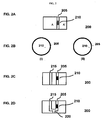
- FIG. 2A shows a glaucoma valve 200 according to an embodiment, the valve having a first flow channel 205.
- the interior of the first flow channel 205 is at least in part coated with a degradable polymer 210.
- FIG. 2B(I) shows a sectional view of the flow channel 205 along the line A-A' in the embodiment shown in FIG. 2A .
- the polymer 210 may degrade to result in the flow channel 205 having a larger diameter allowable for fluid flow, such as that shown in FIG. 2B(II).
- the inner diameter of the flow channel may be small due to the coated polymer, thereby providing a higher flow resistance. With time, a fibrous capsule may be formed around the GDD.
- the coated polymer may dissolve or degrade, thereby providing a larger diameter for fluid flow and which may result in a lower flow resistance. Since the coated polymer may act as an obstruction to control or restrict fluid flow through the valve, it functions like a valve member such as that defined herein.
- the glaucoma valve further comprises a second flow channel, such as that illustrated in FIG. 2C for example.
- FIG. 2C shows a glaucoma valve 200 according to an embodiment of the second aspect of the present invention.
- the valve has a first flow channel 205 and a second flow channel 215.
- the second flow channel 215 is arranged in parallel to the first flow channel 205.
- the second flow channel 215 may be completely sealed with a degradable polymer 210 such that no fluid is allowed to pass through the first channel when the glaucoma valve is first used.
- the first flow channel may allow a fluid to flow through it.
- the polymer in the first channel may act like a valve member to control and/or restrict fluid flow through the valve.
- the second flow channel may always allow a fluid to flow through.
- FIG. 2D shows a glaucoma valve 200 according to another embodiment, the valve having a first flow channel 205 and a second flow channel 215.
- the first flow channel 205 is connected in parallel to the second flow channel 215.
- Fluid may be allowed to flow through an inlet 220 which then flows to both the first flow channel 205 and the second flow channel 215.
- the first flow channel 205 is completely sealed with a degradable polymer 210, therefore, the fluid may flow out via the second flow channel 215 only.
- the degradable polymer 210 in the first flow channel 205 may be degraded to a sufficient extent with time such that the fluid flows out from the first flow channel 205.
- the time at which the polymer in the first channel flow starts to degrade and/or the time required for the polymer in the first channel to degrade may be designed to match the time at which a fibrous capsule starts to form around the valve and/or the time required for a fibrous capsule to form around the valve.
- a fibrous capsule may gradually form about the glaucoma valve.
- the extra flow resistance conferred by the fibrous capsule may result in a higher than the initial level of IOP before capsule formation.
- the resultant flow resistance of the glaucoma valve after capsule formation may be maintained or may even be lower than the initial flow resistance prior to capsule formation.
- Flow resistance of the second flow channel may be designed to provide an acceptable IOP before fibrous capsule formation.
- an acceptable IOP may be about 10 mm Hg to about 14 mm Hg.
- the flow resistance of the second flow channel may depend on the dimensions of the flow channel such as the length and diameter, and the type of material that is used to form the channel.
- the invention relates to a casing for containing a glaucoma valve.
- the casing may have a top portion and a bottom portion.
- Either or both the top portion and the bottom portion may comprise a degradable polymer, such as a biodegradable polymer.
- either or both the top portion and the bottom portion may be formed from a mixture of a degradable polymer and a non-degradable polymer.
- the degradable polymer is a biodegradable polymer, such as a biodegradable elastomer.
- the biodegradable polymer is PLGA.
- the PLGA may have a lactic acid to glycolic acid ratio of about 3:1 to about 9:1.
- the biodegradable polymer may have a Young's modulus of about 10 to about 1000 MPa.
- the biodegradable polymer may have a degradation time of about 3 weeks to about 12 weeks.
- both the top portion and the bottom portion of the casing consist of a biodegradable polymer.
- the use of biodegradable polymer to form the casing may lead to reduction in hypertony, which may take place in a 3 weeks to a 6 weeks timeframe.
- FIG. 9 is a schematic diagram of a GDD 950 according to the fourth aspect of the present invention.
- the GDD 950 includes a casing comprised of a top cover 930 and a bottom cover 935, and a glaucoma valve 900.
- the glaucoma valve 900 may be encased in the casing.
- the casing maybe integrally formed with the glaucoma valve. In some embodiments, the casing and the glaucoma valve may be formed separately and subsequently assembled together.
- the invention relates to a glaucoma drainage device comprising a glaucoma valve according to the first or the second aspect, and/or a casing according to the third aspect.
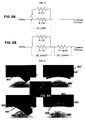
- FIG. 6A is a schematic diagram showing a possible location of a GDD valve in a GDD.
- FIG. 6B is a schematic diagram showing a prior art GDD valve 600', including a flow channel 601' that is contained in a casing 620'.
- FIG. 6C is a schematic diagram showing a side view of the prior art GDD valve 600'.
- FIG. 6D is a schematic diagram showing a GDD valve 600 according to an embodiment of the second aspect of the present invention, including a first flow channel 601, a second flow channel 603 and a third flow channel 605.
- the flow channels are contained in a casing 620, which may be formed from a biodegradable polymer.
- the second flow channel 603 and a third flow channel 605 may be at least partially sealed with a degradable polymer.
- FIG. 6E is a schematic diagram showing a side view of the GDD valve 600 according to an embodiment of the second aspect of the present invention.
- the invention relates to use of a glaucoma drainage device according to the fourth aspect for the drainage of aqueous humor in an eye.
- PCL Poly( ⁇ -caprolactone)
- PLA polylactide
- a group of complex copolymers (PCL-PLA)-b-(PLA-PCL) have been synthesized in the lab, with about 30% of PCL in the first block and about 30 % of PLA in the second block (denoted herein as "First Group”).
- the targeted weight average molecular weight is 20 K for each of the two blocks.
- the copolymers formed have a Young's modulus of about 10 MPa.
- a second group of PCL and PLA copolymers were formed with a different molecular weight to test its suitability to be used as the glaucoma valve (denoted herein as "Second Group”).
- the polymer is (PCL-PLA)-b(PLA-PCL), containing about 30% of PCL in the first block and about 30 % of PLA in the second block.
- the targeted weight average molecular weight is 40 K for each of the two blocks.
- the polymer was dissolved in tetrahydrofuran (THF) and film casted. The film thickness is about 170 ⁇ m.
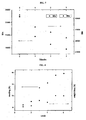
- FIG. 7 is a graph showing the loss of molecular weight of the "Second Group" PCL-PLA copolymer.
- Mn denotes the number average molecular weight of the copolymers
- Mw denotes the weight average molecular weight of the copolymers.
- Figure 8 is a graph showing the swelling and weight loss of the "Second Group” PCL-PLA copolymer. As can be seen from the graph, there was about 20 % weight loss observed in the first six weeks.
- the rate of reduction of the molecular weight of the PCL-PLA copolymer suggests that it is suitable for use as a biodegradable polymer in various aspects of the present invention.
- a PCL-PLA copolymer is used to form a valve member with a thickness of about 100 ⁇ m of a glaucoma valve according to the first aspect of the invention.
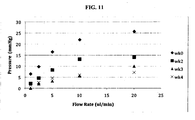
- the pressure drop at a given flow rate of a GDD comprising the glaucoma valve is measured using de-ionized water and results are plotted in FIG. 10.
- FIG. 10 is a graph showing pressure drop of the GDD against flow rate. As shown from the figures, the pressure drop increases non-linearly with an increase in flow rate and the pressure drop at 2.5 ul/min is about 8 mmHg.
- FIG. 11 is a graph comparing the pressure drop behavior of the GDD as a function of time ranging from week 0 (denoted as wk 0) to week 4 (denoted as wk 4) at different flow rates. As can be seen from the graph, the pressure drop at 2.5 ul/min decreased from about 10 mmHg to about 3 mmHg in a time duration of four weeks.
Landscapes
- Health & Medical Sciences (AREA)
- Ophthalmology & Optometry (AREA)
- Life Sciences & Earth Sciences (AREA)
- Animal Behavior & Ethology (AREA)
- Engineering & Computer Science (AREA)
- Biomedical Technology (AREA)
- Heart & Thoracic Surgery (AREA)
- Vascular Medicine (AREA)
- Nuclear Medicine, Radiotherapy & Molecular Imaging (AREA)
- Surgery (AREA)
- General Health & Medical Sciences (AREA)
- Public Health (AREA)
- Veterinary Medicine (AREA)
- Prostheses (AREA)
- Medicinal Preparation (AREA)
- Polyesters Or Polycarbonates (AREA)
Claims (13)
- Soupape de glaucome (100), la soupape (100) comprenanta) un canal d'écoulement (105) ayant une entrée (102) et une sortie (104) ; etb) un élément de soupape (110) relié à la sortie (104) du canal d'écoulement (105), l'élément de soupape (110) comprenant un polymère dégradable, caractérisé en ce qu'il comprend en outre un stéroïde, le stéroïde étant mélangé avec le polymère dégradable pour former l'élément de soupape (110), et le polymère dégradable étant adapté pour se dégrader pendant la formation d'une capsule fibreuse de sorte à libérer le stéroïde à des taux thérapeutiques, en même temps que la dégradation du polymère dégradable.
- Soupape de glaucome (100) selon la revendication 1, dans laquelle(a) le polymère est un élastomère biodégradable ; ou(b) le polymère est un élastomère biodégradable, l'élastomère biodégradable étant choisi dans le groupe constitué par l'acide polylactique (PLA), la polycaprolactone (PCL), le poly(glycolide) (PLGA), un copolymère de PLA et PCL, un copolymère de PLA, PCL et PLGA, un copolymère de PLA, PCL et carbonate de triméthylène (TMC), un copolymère de PLA, PCL, TMC et polyuréthane (PU).
- Soupape de glaucome (100) selon la revendication 1, dans laquelle le polymère est un élastomère biodégradable, l'élastomère biodégradable étant choisi dans le groupe constitué par l'acide polylactique (PLA), la polycaprolactone (PCL), le poly(glycolide) (PLGA), un copolymère de PLA et PCL, un copolymère de PLA, PCL et PLGA, un copolymère de PLA, PCL et carbonate de triméthylène (TMC), un copolymère de PLA, PCL, TMC et polyuréthane (PU), et dans laquelle(a) le copolymère de PLA et PCL a un rapport molaire d'environ 7:3 ;(b) le copolymère de PLA et PCL est choisi dans le groupe constitué par un copolymère multiséquencé de PLA et PCL et un copolymère triséquencé de PLA et PCL ayant le PLA comme séquences terminales et le PCL comme séquence du milieu ;(c) le copolymère de PLA, PCL et PLGA est un copolymère triséquencé ayant le PLA comme séquences terminales et un copolymère aléatoire de PCL et PLGA comme séquence du milieu ;(d) le copolymère de PLA, PCL et TMC est un copolymère triséquencé ayant le PLA comme séquences terminales et un copolymère aléatoire de PCL et TMC comme séquence du milieu ;(e) le copolymère de PLA, PCL, TMC et PU est un polyuréthane avec des segments souples PCL/PLA et PCL/TMC ; ou(f) le polymère est un élastomère biodégradable, l'élastomère biodégradable étant choisi dans le groupe constitué par l'acide polylactique (PLA), la polycaprolactone (PCL), le poly(glycolide) (PLGA), un copolymère de PLA et PCL, un copolymère de PLA, PCL et PLGA, un copolymère de PLA, PCL et carbonate de triméthylène (TMC), un copolymère de PLA, PCL, TMC et polyuréthane (PU), le copolymère de PLA, PCL et TMC étant un copolymère triséquencé ayant le PLA comme séquences terminales et un copolymère aléatoire de PCL et TMC comme séquence du milieu, et les séquences terminales de PLA du copolymère triséquencé de PLA, PCL et TMC ayant une cristallinité d'environ 10 % à environ 20 %.
- Soupape de glaucome (100) selon la revendication 1, dans laquelle le polymère est un élastomère biodégradable, l'élastomère biodégradable étant choisi dans le groupe constitué par l'acide polylactique (PLA), la polycaprolactone (PCL), le poly(glycolide) (PLGA), un copolymère de PLA et PCL, un copolymère de PLA, PCL et PLGA, un copolymère de PLA, PCL et carbonate de triméthylène (TMC), un copolymère de PLA, PCL, TMC et polyuréthane (PU), le copolymère de PLA et PCL étant choisi dans le groupe constitué par un copolymère multiséquencé de PLA et PCL et un copolymère triséquencé de PLA et PCL ayant le PLA comme séquences terminales et le PCL comme séquence du milieu, dans laquelle(a) le copolymère multiséquencé de PLA et PCL est PCL-PLA-co-PLA-PCL, ayant une teneur en caprolactone d'environ 30 % dans la première séquence et une teneur en acide lactique d'environ 60 % dans la seconde séquence ; ou(b) les séquences terminales de PLA du copolymère triséquencé de PLA et PCL ont une cristallinité d'environ 10 % à environ 20 %.
- Soupape de glaucome (100) selon l'une quelconque des revendications 1 à 4, dans laquelle(a) le polymère a un module de Young d'environ 1 MPa à environ 30 MPa ; et/ou(b) le polymère a un pourcentage d'élongation à la rupture supérieur à environ 100 % ; et/ou(c) le polymère a une valeur de récupération élastique supérieure à environ 80 % ; et/ou(d) l'élément de soupape (110) a une longueur d'environ 1 mm à environ 10 mm.
- Soupape de glaucome (100) selon la revendication 1, dans laquelle(a) le stéroïde est choisi dans le groupe constitué par la dexaméthasone, la fluocinolone, le fluocinolone acétonide, le triamcinolone, le triamcinolone acétonide, des sels de ceux-ci, des dérivés de ceux-ci, et des mélanges de ceux-ci ; ou(b) le stéroïde est choisi dans le groupe constitué par la dexaméthasone, la fluocinolone, le fluocinolone acétonide, le triamcinolone, le triamcinolone acétonide, des sels de ceux-ci, des dérivés de ceux-ci, et des mélanges de ceux-ci, et le stéroïde étant revêtu sur la surface de l'élément de soupape.
- Soupape de glaucome (200), la soupape (200) comprenant un premier canal d'écoulement (205), dans laquelle l'intérieur du canal d'écoulement (205) est au moins en partie revêtu avec un polymère dégradable (210), caractérisé en ce que le polymère dégradable comprend un stéroïde, le stéroïde étant mélangé avec le polymère dégradable (210), de sorte que lors de son utilisation, le polymère (210) se dégrade pendant la formation d'une capsule fibreuse pour permettre un meilleur écoulement du fluide et libérer le stéroïde à travers le canal d'écoulement (205) à des taux thérapeutiques, en même temps que la dégradation du polymère dégradable.
- Soupape de glaucome (200) selon la revendication 7, dans laquelle(a) le polymère (210) est un élastomère biodégradable ; ou(b) le polymère (210) est un polymère biodégradable, le polymère biodégradable étant choisi dans le groupe constitué par l'acide polylactique (PLA), la polycaprolactone (PCL), le poly(glycolide) (PLGA), un copolymère de PLA et PCL, un copolymère de PLA, PCL et PLGA, un copolymère de PLA, PCL et carbonate de triméthylène (TMC), et un copolymère de PLA, PCL, TMC et polyuréthane (PU).
- Soupape de glaucome (200) selon la revendication 7 ou 8, comprenant en outre un second canal d'écoulement (215), dans laquelle le second canal d'écoulement (215) est agencé parallèlement au premier canal d'écoulement (205).
- Soupape de glaucome (200) selon la revendication 9, dans laquelle le second canal d'écoulement (215) est relié parallèlement au premier canal d'écoulement (205).
- Soupape de glaucome (200) selon la revendication 9 ou 10, dans laquelle le premier canal d'écoulement (205) est complètement scellé avec le polymère (210), de sorte que lors de son utilisation, le polymère (210) se dégrade pour permettre l'écoulement du fluide à travers le premier canal d'écoulement (205).
- Dispositif de drainage de glaucome (950) comprenant(a) une soupape de glaucome (100, 200, 900) selon l'une quelconque des revendications 1 à 11 et(b) un boitier renfermant la soupape de glaucome, le boitier comprenant une partie supérieure (930) et une partie inférieure (935), l'une des deux parties ou à la fois la partie supérieure (930) et la partie inférieure (935) se composent d'un polymère biodégradable.
- Dispositif de drainage de glaucome (950) selon la revendication 12, dans lequel(a) le polymère biodégradable est le PLGA ; et/ou(b) le polymère biodégradable est le PLGA, le PLGA ayant un rapport d'acide lactique à l'acide glycolique d'environ 3:1 à environ 9:1 ; et/ou(c) le polymère biodégradable a un module de Young d'environ 10 à environ 1000 MPa ; et/ou(d) le polymère biodégradable a un temps de dégradation d'environ 3 semaines à environ 12 semaines.
Applications Claiming Priority (2)
| Application Number | Priority Date | Filing Date | Title |
|---|---|---|---|
| US37295110P | 2010-08-12 | 2010-08-12 | |
| PCT/SG2011/000283 WO2012021109A1 (fr) | 2010-08-12 | 2011-08-12 | Valve pour glaucome, enveloppe pour valve pour glaucome et dispositif de drainage pour glaucome comprenant ladite valve et/ou ladite enveloppe |
Publications (3)
| Publication Number | Publication Date |
|---|---|
| EP2603185A1 EP2603185A1 (fr) | 2013-06-19 |
| EP2603185A4 EP2603185A4 (fr) | 2015-03-25 |
| EP2603185B1 true EP2603185B1 (fr) | 2016-10-05 |
Family
ID=45567871
Family Applications (1)
| Application Number | Title | Priority Date | Filing Date |
|---|---|---|---|
| EP11816699.0A Not-in-force EP2603185B1 (fr) | 2010-08-12 | 2011-08-12 | Valve pour glaucome comprenant un polymère biodégradable avec un agent stéroïdien |
Country Status (5)
| Country | Link |
|---|---|
| US (1) | US10548769B2 (fr) |
| EP (1) | EP2603185B1 (fr) |
| CN (1) | CN103179927B (fr) |
| SG (1) | SG187761A1 (fr) |
| WO (1) | WO2012021109A1 (fr) |
Families Citing this family (17)
| Publication number | Priority date | Publication date | Assignee | Title |
|---|---|---|---|---|
| US8663303B2 (en) | 2010-11-15 | 2014-03-04 | Aquesys, Inc. | Methods for deploying an intraocular shunt from a deployment device and into an eye |
| US9808373B2 (en) | 2013-06-28 | 2017-11-07 | Aquesys, Inc. | Intraocular shunt implantation |
| CN104558542B (zh) * | 2013-10-25 | 2016-05-25 | 中国石油化工股份有限公司 | 一种透明弹性聚乳酸共聚物及制备方法 |
| RU2648229C1 (ru) | 2013-11-14 | 2018-03-22 | Эквисис, Инк. | Устройство для введения интраокулярного шунта |
| US10507101B2 (en) | 2014-10-13 | 2019-12-17 | W. L. Gore & Associates, Inc. | Valved conduit |
| US11351058B2 (en) | 2017-03-17 | 2022-06-07 | W. L. Gore & Associates, Inc. | Glaucoma treatment systems and methods |
| US11246753B2 (en) * | 2017-11-08 | 2022-02-15 | Aquesys, Inc. | Manually adjustable intraocular flow regulation |
| KR102190257B1 (ko) * | 2017-12-20 | 2020-12-16 | 주식회사 마이크로트 | 안압의 조절을 위한 안질환용 임플란트 장치 |
| US10952898B2 (en) | 2018-03-09 | 2021-03-23 | Aquesys, Inc. | Intraocular shunt inserter |
| US11135089B2 (en) | 2018-03-09 | 2021-10-05 | Aquesys, Inc. | Intraocular shunt inserter |
| WO2020047221A1 (fr) | 2018-08-29 | 2020-03-05 | W. L. Gore & Associates, Inc. | Systèmes et procédés d'administration de thérapie par médicaments |
| US11678983B2 (en) | 2018-12-12 | 2023-06-20 | W. L. Gore & Associates, Inc. | Implantable component with socket |
| CN111759582A (zh) * | 2019-04-02 | 2020-10-13 | 巨晰光纤股份有限公司 | 眼球排水的分流支架 |
| US11419761B2 (en) * | 2020-07-22 | 2022-08-23 | The Eye Hospital Of Wenzhou Medical University | Glaucoma aqueous humor drainage device and glaucoma aqueous humor drainage method |
| US12527691B2 (en) | 2021-11-05 | 2026-01-20 | W. L. Gore & Associates, Inc. | Fluid drainage devices, systems, and methods |
| US12042432B1 (en) | 2024-01-11 | 2024-07-23 | Michael Reynard | Method and device for the treatment of glaucoma |
| US12274640B1 (en) | 2024-11-08 | 2025-04-15 | Michael Reynard | Implant for electrolysis of aqueous humor |
Family Cites Families (20)
| Publication number | Priority date | Publication date | Assignee | Title |
|---|---|---|---|---|
| US4722724A (en) | 1986-06-23 | 1988-02-02 | Stanley Schocket | Anterior chamber tube shunt to an encircling band, and related surgical procedure |
| US5071408A (en) | 1988-10-07 | 1991-12-10 | Ahmed Abdul Mateen | Medical valve |
| US6558342B1 (en) | 1999-06-02 | 2003-05-06 | Optonol Ltd. | Flow control device, introducer and method of implanting |
| US20030158598A1 (en) | 2001-09-17 | 2003-08-21 | Control Delivery Systems, Inc. | System for sustained-release delivery of anti-inflammatory agents from a coated medical device |
| US20040162545A1 (en) | 2003-02-14 | 2004-08-19 | Brown J. David | Bypass for glaucoma drainage device |
| DE602004018664D1 (de) * | 2003-09-30 | 2009-02-05 | Kaneka Corp | Thermoplastische elastomerzusammensetzung |
| KR20060135605A (ko) * | 2003-10-24 | 2006-12-29 | 스미토모덴코파인폴리머 가부시키가이샤 | 생분해성 재료 및 상기 생분해성 재료의 제조방법 |
| US7862531B2 (en) * | 2004-06-25 | 2011-01-04 | Optonol Ltd. | Flow regulating implants |
| EP1979023B1 (fr) * | 2006-01-17 | 2015-07-22 | Transcend Medical, Inc. | Dispositif de traitement de glaucome |
| WO2008011125A2 (fr) * | 2006-07-20 | 2008-01-24 | Neurosystec Corporation | Dispositifs, systèmes et procédés destinés à administrer des médicaments ophtalmiques |
| US8394488B2 (en) * | 2006-10-06 | 2013-03-12 | Cordis Corporation | Bioabsorbable device having composite structure for accelerating degradation |
| US20090004243A1 (en) * | 2007-06-29 | 2009-01-01 | Pacetti Stephen D | Biodegradable triblock copolymers for implantable devices |
| US8501290B2 (en) * | 2008-01-15 | 2013-08-06 | Abbott Cardiovascular Systems Inc. | Implantable medical devices fabricated from polyurethanes with biodegradable hard and soft blocks and blends thereof |
| US9421305B2 (en) * | 2008-02-01 | 2016-08-23 | Wake Forest University Health Sciences | Aligned scaffolding system for skeletal muscle regeneration |
| US8883768B2 (en) * | 2008-04-18 | 2014-11-11 | Warsaw Orthopedic, Inc. | Fluocinolone implants to protect against undesirable bone and cartilage destruction |
| CA2722971C (fr) * | 2008-05-09 | 2019-05-07 | Qlt Plug Delivery, Inc. | Administration d'agents actifs a liberation prolongee pour traiter le glaucome et l'hypertension oculaire |
| US8206636B2 (en) * | 2008-06-20 | 2012-06-26 | Amaranth Medical Pte. | Stent fabrication via tubular casting processes |
| NZ592645A (en) * | 2008-11-20 | 2013-01-25 | Insight Innovations Llc | Biocompatible biodegradable intraocular implant system |
| EP2367503A1 (fr) | 2008-11-25 | 2011-09-28 | AttenueX Technologies, Inc. | Implant avec milieu à pression de vapeur élevée |
| WO2011003422A1 (fr) * | 2009-07-06 | 2011-01-13 | Coloplast A/S | Échafaudage biodégradable pour régénération de tissu mou et utilisation de celui-ci |
-
2011
- 2011-08-12 WO PCT/SG2011/000283 patent/WO2012021109A1/fr not_active Ceased
- 2011-08-12 EP EP11816699.0A patent/EP2603185B1/fr not_active Not-in-force
- 2011-08-12 SG SG2013009428A patent/SG187761A1/en unknown
- 2011-08-12 US US13/816,631 patent/US10548769B2/en active Active
- 2011-08-12 CN CN201180039894.XA patent/CN103179927B/zh not_active Expired - Fee Related
Also Published As
| Publication number | Publication date |
|---|---|
| WO2012021109A1 (fr) | 2012-02-16 |
| CN103179927A (zh) | 2013-06-26 |
| CN103179927B (zh) | 2016-09-07 |
| WO2012021109A8 (fr) | 2012-03-22 |
| US20130211314A1 (en) | 2013-08-15 |
| EP2603185A4 (fr) | 2015-03-25 |
| EP2603185A1 (fr) | 2013-06-19 |
| SG187761A1 (en) | 2013-03-28 |
| US10548769B2 (en) | 2020-02-04 |
Similar Documents
| Publication | Publication Date | Title |
|---|---|---|
| EP2603185B1 (fr) | Valve pour glaucome comprenant un polymère biodégradable avec un agent stéroïdien | |
| EP3060180B1 (fr) | Dispositif de drainage oculaire et son procédé de fabrication | |
| CA2764862C (fr) | Matrice de fibre destinee a maintenir un espace dans des tissus mous | |
| US8771220B2 (en) | Glaucoma active pressure regulation shunt | |
| US9693901B2 (en) | Shunt placement through the sclera | |
| US20080027304A1 (en) | Intraocular pressure attenuation device | |
| US20040254520A1 (en) | Coil implant for glaucoma treatment | |
| US20160250071A1 (en) | Methods for intraocular shunt placement | |
| AU2014238174B2 (en) | Trans-sclera portal for delivery of therapeutic agents | |
| AU2004213006A1 (en) | Methods and devices for draining fluids and lowering intraocular pressure | |
| Yadav et al. | Implantable drainage devices in glaucoma: Quo vadis? | |
| Kerr et al. | PRESERFLO MicroShunt | |
| Kwon et al. | Factors associated with outcomes of combined phacoemulsification and Ahmed glaucoma valve implantation | |
| RU2644550C1 (ru) | Способ хирургического лечения глаукомы | |
| Glaucoma | 38 Translimbal SIBS Shunt: The InnFocus MicroShunt | |
| Angmo et al. | The Ex-PRESS Glaucoma drainage device: current perspective | |
| Pande | cataract surgical problem | |
| Pande | Consultation| Journal of Cataract & Refractive Surgery-Volume 30, Issue 6 |
Legal Events
| Date | Code | Title | Description |
|---|---|---|---|
| PUAI | Public reference made under article 153(3) epc to a published international application that has entered the european phase |
Free format text: ORIGINAL CODE: 0009012 |
|
| 17P | Request for examination filed |
Effective date: 20130312 |
|
| AK | Designated contracting states |
Kind code of ref document: A1 Designated state(s): AL AT BE BG CH CY CZ DE DK EE ES FI FR GB GR HR HU IE IS IT LI LT LU LV MC MK MT NL NO PL PT RO RS SE SI SK SM TR |
|
| DAX | Request for extension of the european patent (deleted) | ||
| A4 | Supplementary search report drawn up and despatched |
Effective date: 20150225 |
|
| RIC1 | Information provided on ipc code assigned before grant |
Ipc: A61M 27/00 20060101ALI20150219BHEP Ipc: A61F 9/007 20060101AFI20150219BHEP |
|
| GRAP | Despatch of communication of intention to grant a patent |
Free format text: ORIGINAL CODE: EPIDOSNIGR1 |
|
| INTG | Intention to grant announced |
Effective date: 20160330 |
|
| GRAS | Grant fee paid |
Free format text: ORIGINAL CODE: EPIDOSNIGR3 |
|
| GRAA | (expected) grant |
Free format text: ORIGINAL CODE: 0009210 |
|
| AK | Designated contracting states |
Kind code of ref document: B1 Designated state(s): AL AT BE BG CH CY CZ DE DK EE ES FI FR GB GR HR HU IE IS IT LI LT LU LV MC MK MT NL NO PL PT RO RS SE SI SK SM TR |
|
| REG | Reference to a national code |
Ref country code: GB Ref legal event code: FG4D |
|
| REG | Reference to a national code |
Ref country code: CH Ref legal event code: EP |
|
| REG | Reference to a national code |
Ref country code: AT Ref legal event code: REF Ref document number: 833954 Country of ref document: AT Kind code of ref document: T Effective date: 20161015 |
|
| REG | Reference to a national code |
Ref country code: IE Ref legal event code: FG4D |
|
| REG | Reference to a national code |
Ref country code: DE Ref legal event code: R096 Ref document number: 602011031056 Country of ref document: DE |
|
| REG | Reference to a national code |
Ref country code: NL Ref legal event code: FP |
|
| REG | Reference to a national code |
Ref country code: SE Ref legal event code: TRGR |
|
| REG | Reference to a national code |
Ref country code: LT Ref legal event code: MG4D |
|
| PG25 | Lapsed in a contracting state [announced via postgrant information from national office to epo] |
Ref country code: LV Free format text: LAPSE BECAUSE OF FAILURE TO SUBMIT A TRANSLATION OF THE DESCRIPTION OR TO PAY THE FEE WITHIN THE PRESCRIBED TIME-LIMIT Effective date: 20161005 |
|
| REG | Reference to a national code |
Ref country code: AT Ref legal event code: MK05 Ref document number: 833954 Country of ref document: AT Kind code of ref document: T Effective date: 20161005 |
|
| PG25 | Lapsed in a contracting state [announced via postgrant information from national office to epo] |
Ref country code: GR Free format text: LAPSE BECAUSE OF FAILURE TO SUBMIT A TRANSLATION OF THE DESCRIPTION OR TO PAY THE FEE WITHIN THE PRESCRIBED TIME-LIMIT Effective date: 20170106 Ref country code: NO Free format text: LAPSE BECAUSE OF FAILURE TO SUBMIT A TRANSLATION OF THE DESCRIPTION OR TO PAY THE FEE WITHIN THE PRESCRIBED TIME-LIMIT Effective date: 20170105 Ref country code: LT Free format text: LAPSE BECAUSE OF FAILURE TO SUBMIT A TRANSLATION OF THE DESCRIPTION OR TO PAY THE FEE WITHIN THE PRESCRIBED TIME-LIMIT Effective date: 20161005 |
|
| PG25 | Lapsed in a contracting state [announced via postgrant information from national office to epo] |
Ref country code: AT Free format text: LAPSE BECAUSE OF FAILURE TO SUBMIT A TRANSLATION OF THE DESCRIPTION OR TO PAY THE FEE WITHIN THE PRESCRIBED TIME-LIMIT Effective date: 20161005 Ref country code: PT Free format text: LAPSE BECAUSE OF FAILURE TO SUBMIT A TRANSLATION OF THE DESCRIPTION OR TO PAY THE FEE WITHIN THE PRESCRIBED TIME-LIMIT Effective date: 20170206 Ref country code: ES Free format text: LAPSE BECAUSE OF FAILURE TO SUBMIT A TRANSLATION OF THE DESCRIPTION OR TO PAY THE FEE WITHIN THE PRESCRIBED TIME-LIMIT Effective date: 20161005 Ref country code: HR Free format text: LAPSE BECAUSE OF FAILURE TO SUBMIT A TRANSLATION OF THE DESCRIPTION OR TO PAY THE FEE WITHIN THE PRESCRIBED TIME-LIMIT Effective date: 20161005 Ref country code: RS Free format text: LAPSE BECAUSE OF FAILURE TO SUBMIT A TRANSLATION OF THE DESCRIPTION OR TO PAY THE FEE WITHIN THE PRESCRIBED TIME-LIMIT Effective date: 20161005 Ref country code: BE Free format text: LAPSE BECAUSE OF FAILURE TO SUBMIT A TRANSLATION OF THE DESCRIPTION OR TO PAY THE FEE WITHIN THE PRESCRIBED TIME-LIMIT Effective date: 20161005 Ref country code: PL Free format text: LAPSE BECAUSE OF FAILURE TO SUBMIT A TRANSLATION OF THE DESCRIPTION OR TO PAY THE FEE WITHIN THE PRESCRIBED TIME-LIMIT Effective date: 20161005 Ref country code: IS Free format text: LAPSE BECAUSE OF FAILURE TO SUBMIT A TRANSLATION OF THE DESCRIPTION OR TO PAY THE FEE WITHIN THE PRESCRIBED TIME-LIMIT Effective date: 20170205 |
|
| REG | Reference to a national code |
Ref country code: DE Ref legal event code: R097 Ref document number: 602011031056 Country of ref document: DE |
|
| PG25 | Lapsed in a contracting state [announced via postgrant information from national office to epo] |
Ref country code: RO Free format text: LAPSE BECAUSE OF FAILURE TO SUBMIT A TRANSLATION OF THE DESCRIPTION OR TO PAY THE FEE WITHIN THE PRESCRIBED TIME-LIMIT Effective date: 20161005 Ref country code: CZ Free format text: LAPSE BECAUSE OF FAILURE TO SUBMIT A TRANSLATION OF THE DESCRIPTION OR TO PAY THE FEE WITHIN THE PRESCRIBED TIME-LIMIT Effective date: 20161005 Ref country code: DK Free format text: LAPSE BECAUSE OF FAILURE TO SUBMIT A TRANSLATION OF THE DESCRIPTION OR TO PAY THE FEE WITHIN THE PRESCRIBED TIME-LIMIT Effective date: 20161005 Ref country code: EE Free format text: LAPSE BECAUSE OF FAILURE TO SUBMIT A TRANSLATION OF THE DESCRIPTION OR TO PAY THE FEE WITHIN THE PRESCRIBED TIME-LIMIT Effective date: 20161005 Ref country code: SK Free format text: LAPSE BECAUSE OF FAILURE TO SUBMIT A TRANSLATION OF THE DESCRIPTION OR TO PAY THE FEE WITHIN THE PRESCRIBED TIME-LIMIT Effective date: 20161005 |
|
| PLBE | No opposition filed within time limit |
Free format text: ORIGINAL CODE: 0009261 |
|
| STAA | Information on the status of an ep patent application or granted ep patent |
Free format text: STATUS: NO OPPOSITION FILED WITHIN TIME LIMIT |
|
| REG | Reference to a national code |
Ref country code: FR Ref legal event code: PLFP Year of fee payment: 7 |
|
| PG25 | Lapsed in a contracting state [announced via postgrant information from national office to epo] |
Ref country code: IT Free format text: LAPSE BECAUSE OF FAILURE TO SUBMIT A TRANSLATION OF THE DESCRIPTION OR TO PAY THE FEE WITHIN THE PRESCRIBED TIME-LIMIT Effective date: 20161005 Ref country code: SM Free format text: LAPSE BECAUSE OF FAILURE TO SUBMIT A TRANSLATION OF THE DESCRIPTION OR TO PAY THE FEE WITHIN THE PRESCRIBED TIME-LIMIT Effective date: 20161005 Ref country code: BG Free format text: LAPSE BECAUSE OF FAILURE TO SUBMIT A TRANSLATION OF THE DESCRIPTION OR TO PAY THE FEE WITHIN THE PRESCRIBED TIME-LIMIT Effective date: 20170105 |
|
| 26N | No opposition filed |
Effective date: 20170706 |
|
| PG25 | Lapsed in a contracting state [announced via postgrant information from national office to epo] |
Ref country code: SI Free format text: LAPSE BECAUSE OF FAILURE TO SUBMIT A TRANSLATION OF THE DESCRIPTION OR TO PAY THE FEE WITHIN THE PRESCRIBED TIME-LIMIT Effective date: 20161005 |
|
| REG | Reference to a national code |
Ref country code: CH Ref legal event code: PL |
|
| PG25 | Lapsed in a contracting state [announced via postgrant information from national office to epo] |
Ref country code: MC Free format text: LAPSE BECAUSE OF FAILURE TO SUBMIT A TRANSLATION OF THE DESCRIPTION OR TO PAY THE FEE WITHIN THE PRESCRIBED TIME-LIMIT Effective date: 20161005 |
|
| PG25 | Lapsed in a contracting state [announced via postgrant information from national office to epo] |
Ref country code: LI Free format text: LAPSE BECAUSE OF NON-PAYMENT OF DUE FEES Effective date: 20170831 Ref country code: CH Free format text: LAPSE BECAUSE OF NON-PAYMENT OF DUE FEES Effective date: 20170831 |
|
| PG25 | Lapsed in a contracting state [announced via postgrant information from national office to epo] |
Ref country code: LU Free format text: LAPSE BECAUSE OF NON-PAYMENT OF DUE FEES Effective date: 20170812 |
|
| REG | Reference to a national code |
Ref country code: FR Ref legal event code: PLFP Year of fee payment: 8 |
|
| PG25 | Lapsed in a contracting state [announced via postgrant information from national office to epo] |
Ref country code: MT Free format text: LAPSE BECAUSE OF NON-PAYMENT OF DUE FEES Effective date: 20170812 |
|
| PG25 | Lapsed in a contracting state [announced via postgrant information from national office to epo] |
Ref country code: HU Free format text: LAPSE BECAUSE OF FAILURE TO SUBMIT A TRANSLATION OF THE DESCRIPTION OR TO PAY THE FEE WITHIN THE PRESCRIBED TIME-LIMIT; INVALID AB INITIO Effective date: 20110812 |
|
| PG25 | Lapsed in a contracting state [announced via postgrant information from national office to epo] |
Ref country code: CY Free format text: LAPSE BECAUSE OF NON-PAYMENT OF DUE FEES Effective date: 20161005 |
|
| PG25 | Lapsed in a contracting state [announced via postgrant information from national office to epo] |
Ref country code: MK Free format text: LAPSE BECAUSE OF FAILURE TO SUBMIT A TRANSLATION OF THE DESCRIPTION OR TO PAY THE FEE WITHIN THE PRESCRIBED TIME-LIMIT Effective date: 20161005 |
|
| PG25 | Lapsed in a contracting state [announced via postgrant information from national office to epo] |
Ref country code: TR Free format text: LAPSE BECAUSE OF FAILURE TO SUBMIT A TRANSLATION OF THE DESCRIPTION OR TO PAY THE FEE WITHIN THE PRESCRIBED TIME-LIMIT Effective date: 20161005 |
|
| PG25 | Lapsed in a contracting state [announced via postgrant information from national office to epo] |
Ref country code: AL Free format text: LAPSE BECAUSE OF FAILURE TO SUBMIT A TRANSLATION OF THE DESCRIPTION OR TO PAY THE FEE WITHIN THE PRESCRIBED TIME-LIMIT Effective date: 20161005 |
|
| P01 | Opt-out of the competence of the unified patent court (upc) registered |
Effective date: 20230601 |
|
| PGFP | Annual fee paid to national office [announced via postgrant information from national office to epo] |
Ref country code: NL Payment date: 20230823 Year of fee payment: 13 |
|
| PGFP | Annual fee paid to national office [announced via postgrant information from national office to epo] |
Ref country code: IE Payment date: 20230821 Year of fee payment: 13 Ref country code: GB Payment date: 20230824 Year of fee payment: 13 Ref country code: FI Payment date: 20230823 Year of fee payment: 13 |
|
| PGFP | Annual fee paid to national office [announced via postgrant information from national office to epo] |
Ref country code: SE Payment date: 20230823 Year of fee payment: 13 Ref country code: FR Payment date: 20230821 Year of fee payment: 13 Ref country code: DE Payment date: 20230807 Year of fee payment: 13 |
|
| REG | Reference to a national code |
Ref country code: DE Ref legal event code: R119 Ref document number: 602011031056 Country of ref document: DE |
|
| REG | Reference to a national code |
Ref country code: SE Ref legal event code: EUG |
|
| REG | Reference to a national code |
Ref country code: NL Ref legal event code: MM Effective date: 20240901 |
|
| PG25 | Lapsed in a contracting state [announced via postgrant information from national office to epo] |
Ref country code: FI Free format text: LAPSE BECAUSE OF NON-PAYMENT OF DUE FEES Effective date: 20240812 |
|
| GBPC | Gb: european patent ceased through non-payment of renewal fee |
Effective date: 20240812 |
|
| PG25 | Lapsed in a contracting state [announced via postgrant information from national office to epo] |
Ref country code: NL Free format text: LAPSE BECAUSE OF NON-PAYMENT OF DUE FEES Effective date: 20240901 |
|
| PG25 | Lapsed in a contracting state [announced via postgrant information from national office to epo] |
Ref country code: DE Free format text: LAPSE BECAUSE OF NON-PAYMENT OF DUE FEES Effective date: 20250301 |
|
| PG25 | Lapsed in a contracting state [announced via postgrant information from national office to epo] |
Ref country code: GB Free format text: LAPSE BECAUSE OF NON-PAYMENT OF DUE FEES Effective date: 20240812 |
|
| PG25 | Lapsed in a contracting state [announced via postgrant information from national office to epo] |
Ref country code: FR Free format text: LAPSE BECAUSE OF NON-PAYMENT OF DUE FEES Effective date: 20240831 |
|
| PG25 | Lapsed in a contracting state [announced via postgrant information from national office to epo] |
Ref country code: IE Free format text: LAPSE BECAUSE OF NON-PAYMENT OF DUE FEES Effective date: 20240812 |
|
| PG25 | Lapsed in a contracting state [announced via postgrant information from national office to epo] |
Ref country code: SE Free format text: LAPSE BECAUSE OF NON-PAYMENT OF DUE FEES Effective date: 20240813 |